Copper-Bottomed – natural cleaning with lemon and salt

For Christmas, Hubby gave me a gorgeous old copper pan we found in a second hand shop in Bideford a few weeks ago. Not everyone’s fantasy Christmas gift, I grant you, but very much to my taste, I’ve been looking for something like it for some time, but every one I’ve seen has been exorbitantly expensive.

Not so this one – a real bargain, as it happened! – but of course there’s always a catch, and the pan was in, well, shall we say ‘rustic’ condition? Well used, well worn, and yes, very stained and tarnished, both inside and out. Despite his best efforts with several rounds of ‘Brasso’ to try and make it presentable for its debut under the Christmas tree, it’s fair to say that still looked like a pan which had had rather a hard life!

I took some advice, and after considering the various cleaning options, ordered some ‘Barkeeper’s Friend’, which of course has yet to make its way through the Christmas post. I’d also come across some advice that lemon juice and salt might do a useful job of getting tarnish and stains off copper surfaces.  This morning I noticed a rather wizened half-lemon left over in the fridge, and thought, ‘hey, why not give it a go?’.

All I can say is ‘Wow!’.

Cleaning in progress

It works startlingly well, even on the dark burned stains. I used a quarter of lemon at a time, working gently in circles with a bit of table salt. You can just see the colour changing in front of your eyes. I was genuinely stunned by how quickly and easily this worked – so unexpected was it I didn’t think to take ‘before’ photos! Better still, the segments of lemon come along with their own natural gentle scrubbing pad.

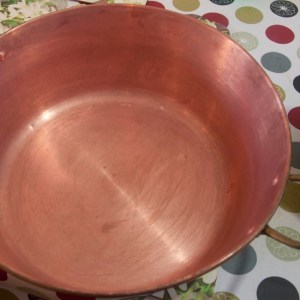
Finished pan - inside

It’s not a perfect finish, by any means, but it’s a really decent clean that I would be more than happy to cook with, something I really couldn’t have said before! I think I’ll probably still try the Barkeeper’s Friend when that arrives, to see if I can get a slightly finer finish – but if I hadn’t ordered it already I don’t think I’d be bothering.

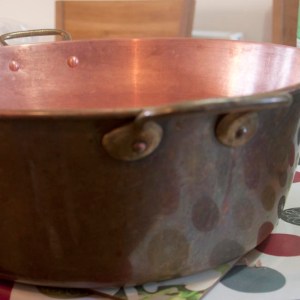
Finished pan - outside

I love the patination on the outside of the pan, so I’ve left that alone. Isn’t it gorgeous? I just can’t wait to cook in it now!

Read more from the Country Skills blog >>

Very Berry – elderberry vinegar

This foraged hedgerow vinegar is just fabulous. Hubby was unconvinced when I first made it last year, but very quickly the simple vinaigrette I made from it, with just the addition of olive oil and a little spoon of wholegrain mustard, was such a favourite he started calling it ‘my dressing’. Success!

It’s a sweet, fruity, unctuous vinegar, and makes a perfect substitute for even the very best balsamic vinegar, at a fraction of the cost – I’ve yet to find an occasion I can’t make the substitution, and find I prefer the elderberry vinegar pretty much universally, which is quite a result given how attached I’ve been to balsamic vinegar in my cooking and salads for many many years now!

ElderberriesThe elderberries are finished now, sadly, so unless like me you had a cache stashed in the deep freeze from earlier in the year, it’s probably too late to make any wonderful elderberry vinegar this year.  That said, I saw dried elderberries the last time I was in my favourite home-brew supplies shop – I have no idea how using dried berries would work out, but it might well be worth a try, at a push!

I pick my elderberries when I get the chance, strip the berries from their stems, wash them, and then freeze them in ziplock bags (I get about 700g per bag). Then, stashed in the freezer, they’re ready for when I eventually get around to using them.  If you happened to pick too many for your elderberry wine or preserve-making plans, then this is a great way to use up any leftovers!

The original recipe and inspiration, incidentally, come from Mark Williams’ Galloway Wild Foods blog, which I can heartily recommend to you!

To make this year’s batch of elderberry vinegar – which I cannot now imagine living without in my store cupboard – I used:

  • A 2l Kilner jar
  • A large stainless steel saucepan
  • 700g of frozen elderberries. If you’ve just picked these fresh, you’ll need to remove them from the stems. I find using a fork to ‘comb’ through the umbels is the easiest approach, but it can be a messy process!
  • 1.4l of white wine vinegar
  • 1.5kg of golden caster sugar

Elderberry vinegar infusingPut the elderberries in the jar and top up to the brim with white wine vinegar.  Keep the vinegar bottles you’ve just emptied – you’ll want them to store the finished vinegar later! Give the jar a good shake and set aside for 5 – 7 days. You can give it a bit of a shake when you think about it during this time. You’ll notice the vinegar almost immediately start to turn the most amazing dark purple colour.

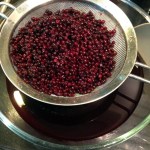
Strain the vinegarAfter about a week, pour the vinegar into a large saucepan, retaining the elderberries using a reasonably fine sieve. Give the elderberries a good squeeze to get as much juice out of them as you can, and then discard the remains.

Roughly measure out the liquid – it will be a bit more than the volume of vinegar than you started with.  Mine was a little over 1.5l (I’ll admit I didn’t try to measure it accurately!).

I’m happy with a vinegar sweetened with about 1kg of sugar per litre of vinegar, but your tastes may be different to mine – perhaps try this the first year and adjust in the future if it turns out too sweet or too tart for your tastes!

Bring to the boilIn a large pan, mix the vinegar and sugar, and slowly bring up to boiling point, stirring to dissolve the sugar.  Be aware, this stuff *stains*. My wooden spoon is still purple!

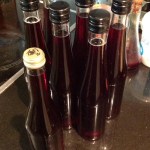
Safely bottledOnce at the boil, turn the heat down and simmer for about 10 minutes. Then, while still piping hot, use a funnel to fill your bottles and seal tightly. My quantities gave a final volume of  about two and a half litres, and filled seven 350ml vinegar bottles (luckily I had extras left over from the pickled chillies I’d made earlier in the day!).

Store in a cool dry place. It will keep for at least year, if you manage to save any that long!

And as if all the cooking substitutions you can think of aren’t exciting enough, you can also enjoy it as a fruity sweet warm cordial, diluted with hot water. Elderberries are even said to be good for seeing off the winter season’s cold and ‘flu bugs, not that you need the excuse when something tastes so very very good!

Read more from the Country Skills blog >>

Pick a Peck of Pickled Peppers – home-grown pickled chillies

The blog has been a bit neglected the past month! There’s been a lot going on just recently – most of it good, but which I can’t really talk about at the moment (The mystery! The suspense!).

two-candlesA few weeks ago, the blog’s second birthday passed entirely un-marked, a fact which will come as no surprise at all to my close friends and family, who are all well used to their birthdays and significant anniversaries passing equally without notice! Anyway, a huge thank you to all of you who read and comment, thank you for taking the time and bearing with us though this quiet interlude!

Right oh, back to the hot and spicy business at hand!

Last weekend, we admitted the arrival of the colder weather and stripped the greenhouse chilli plants of all their fruit.  The result was almost exactly 1 kg of mixed home-grown chillies, mostly ‘Vampire’, a mild flavoured mid-sized dark purple to red variety with beautiful purple-green foliage and purple flowers, and ‘twilight’, a fiendishly-hot small chilli which ripens from purple to red via white & yellow on a small-leafed plant.

The home-grown chilli harvest!

Aren’t they gorgeous? Even I can’t eat that many fresh chillies before they go off, though.  I considered making chilli sauce, but in the end settled on pickled chillies as more versatile to use down the line. And with all these gorgeous colours and varieties, it would have seemed a bit of a crime to put them in a food processor!

This recipe is based on one attributed to Michael Symon, from Michael Ruhlman’s blog, with a few modifications to suit the ingredients I had available. It’s really straightforward, and the results *look* stunningly pretty – it’s too early to say how they taste yet!

Pack chillies in jarsWash your chillies carefully, inspect them and set aside any which are damaged or imperfect (you can always cook with these fresh, or process them and freeze in small batches) and then pack them into cold sterilised jars. Then fill each jar full of water, before tipping the water back out into a bowl or jug. Measure this volume – this will give you a good accurate estimate of the volume of pickling liquid required. In my case, using eight small jars and one large one, the volume was a bit over a litre.

For the brine, I combined –

  • 700ml white wine vinegar
  • 500ml water
  • 2 1/2 tbsp sea salt
  • 2 1/2 tbsp golden caster sugar (any sugar will do)

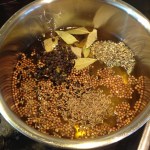
Obviously these volumes can be adjusted depending on how much pickling liquid you need! Mix these in a saucepan and start to warm, dissolving the sugar and salt, then add the following herbs and spices and bring to a good rolling boil –

  • Herbs and spicesTwo bay leaves – you can leave these whole if only making one or two jars, but I broke them up into smaller pieces
  • Three cloves of garlic, sliced up likewise
  • 2 tbsp whole coriander seed
  • 2 tbsp whole black peppercorns
  • 1 tsp whole cumin seed
  • 1 tsp dried oregano

Boiling brineOnce the brine is boiling, turn the heat down and simmer for 10 minutes.

Then, if you’re making a single large kilner-type jar of pickled chillies, you could just pour the whole volume of brine, spices and herbs over the top and seal up the jar.

I wanted to make sure the spices were evenly distributed between my eight small and one large jar, so I first strained the solids out and returned the brine to the saucepan to keep simmering.

Strained-out spices Share spices between jars Fill to the brim with boiling liquor

This made it easy go share the spices and garlic out evenly between the jars with a spoon. Then just ladle the boiling hot brine into the jars, filling them all the way to the brim before sealing tightly with plastic-lined lids.

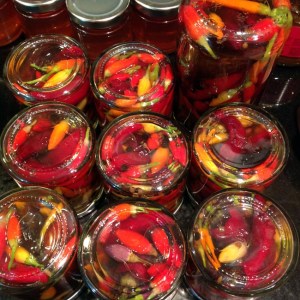
Filled jars of pickled chillies

Once cool, refrigerate until use, or at this time of year in Northern climes you should be fine to store them in an unheated outbuilding, garage or shed. They’re ready to eat within a day or two but a few weeks in the pickle will only help develop the flavours. When you’re ready to use them, just slice or mince the chillies and use in cooking as you would fresh – obviously only in dishes that will tolerate a little bit of added acidity from the vinegar, most will – but beware, these are going to be an unpredictable bunch, and the little ones bite!

Read more from the Country Skills blog >>

Elderflorescence – it’s not too late for elderflower cordial, champagne, and how about vinegar?

The scent of an elder tree or shrub, in full flower on a hot sunny afternoon, is one of the heady, intoxicating, unmistakeable aromas of high summer.  This year the elders seem to be making up for last season’s poor showing – they’re simply smothered with elderflowers right now, dressed up from tip to toe in ivory flowers like a fairytale bride.

Elderflower buds, just breaking

Last year, we really struggled to harvest the elderflowers I needed to make my traditional annual batch of elderflower cordial and champagne. I blogged at the time about the ritual of gathering my elderflowers, and what it means for me. Well, this year, the elderflowers are in abundance – what took several hours and a five mile walk last year, we achieved in ten minutes on a short length of our country lane on Sunday. That’s one of the things about foraging – it’s never ever the same!

A chilled fizzy glass of summer!I adore elderflower ‘champagne’. My grandmother used to make it, and it was my gateway to home brewing, I suppose! My favourite recipe is here, with full instructions. It’s a great and rewarding introduction to home brewing, so even if you’ve never tried to brew before, do consider giving it a whirl. It’s not as scary as it seems, I promise, and the result is a fun summer tipple, fantastic for bbqs and parties, and which costs very little.

Under Pressure!Unfortunately for us, it’s really bad timing for starting a batch of elderflower champagne just now – but you most definitely should! Just be aware, it’s a lively beast, and I would under no circumstances advise trying to store it in glass bottles – even those tempting-looking pop top Grolsch-style ones. Just look what it did to the stout small plastic bottles I used last year!  With a little luck there will still be enough flowers around that I can get a late batch on the go in a few weeks time! Otherwise – and this would be nothing short of a minor tragedy – we’ll have to go without this year!

Elderflower cordial, steepingBut – thank goodness – I have found time to make my elderflower cordial, and it  is steeping in the kitchen as I write – I’ve made it this way for a few years now (full instructions & photos blogged last year), and the results are always amazing. If you’re not a brewer, or don’t want to use campden (sulphite) to stabilise the cordial for storage at room temperature, how about freezing it in carefully washed out milk bottles or juice cartons?

Filled marlalade jarsAnd don’t neglect the lemon and orange slices from the cordial once it’s finished – they make really great marmalade!

Those of you who read the blog regularly know that I’m always up for trying something different! So, considering the success of the chive blossom vinegar, I’ve started an experimental batch of elderflower vinegar.

Stripped elderflowersFor this, I’ve stripped the elderflowers off their stems – I finally found a technique that works for me, which is closer to rubbing the flowers and stamens off the green stems than it is to picking off the tips, and gives flowers almost entirely without green material.  Give the flower bunches a good sharp shake first, to dislodge any ‘passengers’ who might be hitching a ride.

You will probably find, despite this, there are some tiny little insects in amongst your flowers once you’ve picked them. Just ignore these (certainly don’t be tempted to wash the flowers as you’ll wash away much of the lovely flavour!). The vinegar will be filtered through fine muslin later, in any case, and if that still doesn’t reassure you, consider that you eat large numbers of insects and associated material every day already – just take a look at the US Food & Drug Administration’s pamphlet on allowable levels of insect and other contaminants in different foodstuffs if you don’t believe me!

Elderflowers steeping in vinegarI filled about half a 1 litre kilner jar with loose flowers, and then filled it up with cider vinegar. In retrospect, I may have used something with less aroma of its own, like rice wine vinegar, but cider vinegar was what I had, and hopefully the fruity note of the cider vinegar will complement the elderflowers beautifully. Put the filled jar somewhere warm to infuse – unlike the chive flower vinegar, there’s no need to keep it out of the light as there’s no problem with colour fading.  I expect to leave it for a couple of weeks before straining and bottling.

This vinegar smells beautiful after only 24 hours,  with a gorgeous fresh elderflower fragrance. So does the cordial, actually, so my kitchen is a sweetly-scented haven right now, and with my living room full of little posies of gorgeous sweet peas from the garden, the house smells nicer than a perfumery!

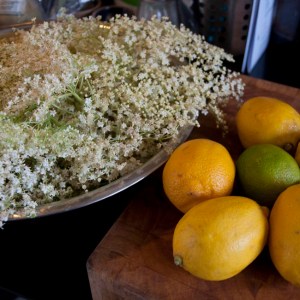
Elderflowers and citrus fruit

So, if you do nothing else this week, seize the opportunity to capture – even if just in a small batch of cordial or vinegar – one of the ephemeral scents and flavours of high summer.  During the long dark winter months, it’s amazing what a taste and smell of elderflower can do to lift my spirits!

And of course, with elderflowers so abundant this year, we can only hope for a great elderberry season to come!

Read more from the Country Skills blog >>

In A Flap – flip-flop denim fabric strap upcycle

The flip-flops.Summer is here (or so they say!). And whether you call them thongs or flip-flops, the three-point strap sandal is a mainstay of hot weather footwear. While I was getting a few bits and bobs in town the other day, I saw these fun flip-flops on a sale rack. I really want to like flip-flops, but I’m afraid they don’t like me! I can’t walk 100 yards in flip-flops with rubber or plastic toe posts without getting the most awful blisters between my toes. Ouchie!

Chop off the strapsSo those straps were going to have to go. There’s always something faintly satisfying about a spot of wanton destruction, isn’t there? Push the straps through the sole and chop them off with a pair of stout scissors. Congratulations, you’ve taken a pair of perfectly good, new flip flops and rendered them completely useless. Time to get mending!

I was planning to make fabric straps for these flip-flops out of some recycled cotton jersey, but I couldn’t find anything in my old-clothes stash in an appropriate colour. What I did find was a pair of Hubby’s old jeans. On reflection, denim seemed like a rather great idea, and the colour was a good match for the psychedelic print on the soles, too.

Of course denim poses some problems that cotton jersey doesn’t, not least in it’s tendency to fray extensively.  It’s also not famous for its stretchy characteristics, which means sizing will need to be more accurate, but I was pretty sure these were things that could be overcome.

Rough cutFirst up, I rough cut a broad and a narrow strap for a ‘test fit’. The narrow strap is tied in a reef knot around the wide strap and acts as the toe post. Push the straps gently through the holes and support them temporarily with safety pins while you offer up the sizing.  I tried the sandal on at this stage and showed it to Hubby to see what he thought. His verdict, ‘they’re quite, erm, rustic…’ felt a little bit short of an unqualified recommendation!

The principle seemed sound, though this mock-up stage proved one thing, which was that the narrow toe straps were literally going to fray away to nothing, and really quite quickly, too. Some reinforcement was going to be needed to avoid the whole thing coming apart!

Now, my sewing machine is a really very basic beast, more or less does straight stitch, zig-zag, not much else. But it has a rather neglected set of ‘special stitches’, one of which I admit I’ve never used in anger before today – it’s a sort of faintly-decorative compound zig-zag, which looked like it might do dual purpose for fray control while not being entirely unattractive! Well, it was worth a shot. A trial run on a narrow strap confirmed that I could run a length of the stitching, and then pull away the stray threads before trimming quite tight to the stitch line. The result seemed quite stable and robust. Excellent!

Rectangle of denimI chopped a rough rectangle of denim out of the leg of hubby’s discarded jeans. They were very well worn by the time they reached the end of their working life, so the denim is gorgeous and soft.

Cut the wide strapsUsing a ruler and cutting wheel, I sliced two wide straps 3cm wide, and two narrow straps about 1cm in width. If you don’t have a cutting wheel, mark the back and cut carefully, especially for the narrow straps.

I decided to go with a contrasting colour for the stitching to make a decorative detail out of it, and loaded up the machine with some bright yellow cotton.

With stitching completeEach wide strap takes two rows of stitches, as close as possible to the edges. The narrow straps get one row of stitches straight up the middle. If your machine doesn’t do a stitch like this, then a sensible width zig-zag is probably a good compromise.

Pull away your the threadsOnce the stitching is done, tease away at the threads outside the sewing, and gently pull it away until it ‘sticks’ in the stitching. Then, using a really sharp pair of scissors, trim the loose threads to within about 1mm of the edge of the stitching. This is all a little bit time consuming, but worth it in the end!

Now, all your straps are made, and ready to be assembled.

Straps complete before assembly

Fit the straps to the sandalTie the narrow straps in a reef knot around the approximate mid-point of the wide strap, and then feed all the ends through the appropriate holes. My denim isn’t an even colour because of the wear on it, so I used the darker end for the outside hole on both sandals, and the lighter end on the inside.

Straps on sole-sideThis is the experimental trying-on bit of the process. Adjust the straps until they’re all the right length and the fit is comfortable, using safety pins on the underside if necessary. Once you’ve know how long your straps need to be, it’s time to work out how to retain them. I’d considered the ‘tie a knot in it’ approach, and that seemed likely to work ok with the narrow toe strap, but didn’t seem as plausible for the thick straps.

Instead, I had a dig about in my button box and found six small stout little white buttons, just the right size for the recessed gaps in the bottom of the sandals.

For the toe strap, join both halves together with a horizontal row of stitches, before fixing the button between them, then trim the ends with about a cm spare and fold the straps over, securing the ends down again as firmly as you can.


Fixing toe strap (1)  Fixing toe strap (2)  Fixing toe strap (3)

For the broad straps, start by identifying the attachment point you need, secure your thread firmly and then sew the button into the centre of the strap. Trim the strap and then sew the corners down over the button, before securing the strap below the button into a round shank, wrapping a few times with the thread to help you hold the shape.
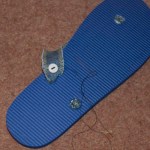
Fixing wide strap (1)  Fixing wide strap (2)  Fixing wide strap (3)

In essence, that’s it. Make the second sandal the same way, trying to get the strap lengths to match.

Finished straps

If you were just going to wear them indoors, you could probably leave it at that. I had in mind using a blob of hot glue both beneath and finally on top of the strap and button assembly to secure and stabilise the lot, and add some waterproofing and abrasion resistance to stop the first rough floor surface wearing the thread away and letting all the hard work come apart again. But then I remembered that I’ve finally got my hands on some Sugru, so I think I’m going to use a blob of that over the top (and possibly a cuff underneath) as the rubber texture seems likely to be nicely compatible with the rest of the sole. I’ll post final photos once I’ve done this (in the next few days, all being well!).

Finished sandals with home-made denim straps

I can think of some possible variations (and having done this ‘make’, some I wish I’d thought of before I started!). Satin or grosgrain ribbon would make great straps (you’d want a matching pair in 25mm and 6mm widths, I would guess, and a metre of each will be plenty) – and might even be quite ‘dressy’, with the right choice colour and plain dark-coloured sandals.  I suspect – though I haven’t tried this, so if you do, please let me know! – that you could just tie knots in the ends of the ribbons, embed the knots in a little ball of  Sugru, and just sort of ‘squidge’ it into the recesses in the sole, reducing the whole make to a five or ten minute job.  Hot glue would probably work pretty much the same, too (but don’t burn your fingers)! Next time I see a set of dirt cheap flip-flops in a pound shop or market, I’m definitely giving this variation a try!

I’m really thrilled with this, actually. These sandals are *comfortable*, and they look pretty cool too, though I say so myself. I’m definitely planning to take them on holiday, and I shan’t be one bit embarrassed by them by the pool – the finished effect is certainly more ‘handcrafted’ than ‘homemade’. So do give this a try, and please, let me know how you get on?

Read more from the Country Skills blog >>

Simple Summer Sewing – make a quick, cheap, pretty beach and pool cover-up

I can’t take the credit for the idea here – I’d seen a photo of something similar on Pinterest some time ago, and tracked instructions on the ‘Vie en Rose’ blog (and you should go and take a look at these, the rest of the post will make a lot more sense!) at the time. Then I more or less forgot about it until I started thinking about what to pack for our summer holiday. It seemed the perfect alternative to a sarong, easier to wear and a bit more ‘shaped’.

So I picked up some remaindered floral print cotton jersey on Ebay for about a fiver, and got started with it on my day off a week or two ago.  I’d offered up a sarong to get an idea of how wide a piece of fabric I needed, and came to the conclusion that the ‘ideal’ size was about 10cm wider than the width of fabric I had.  Slightly irritating.

Rather than chop a lengthwise section from my 2.5m length (seemed wasteful!), I decided to take a punt on the 1.6m width and hope the bit of stretch in the jersey and the inherent ‘forgivingness’ of the pattern would let me get away with it.  This decision rather forced my hand in terms of hemming – no spare fabric for this, and worse, I was going to have to use the selvedge, rather than trimming it, too. I know, I know, two cardinal sins of sewing and dressmaking just there. But do bear with me, this is quick and cheerful stuff, but the result is surprisingly good!!

Decide roughly how long you want your wrap, measuring from about armpit length downwards, and make this the width of your piece of jersey fabric.  Make sure all the edges are nice and straight as you cut your piece, as these will be your finished edges. I used a cutting mat and roller for speed and convenience, but you could manage carefully with fabric scissors.

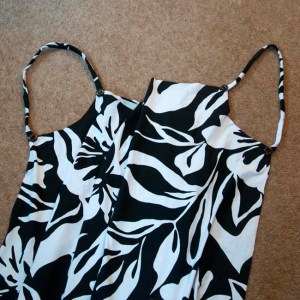
Shape the armsThe only piece of shaping required is around the arm holes. I used a strappy top I own as a reference template. Line it up at the top of the ‘body’ and mark out the arm shape. If you fold the fabric in half, you can cut both sides together, so they’ll be symmetrical.

Cut the arm shapingMark (this is the reverse side!) with a pen or pencil. Then just cut carefully along the mark.

Now it’s just a question of working out how to attach a for each shoulder. I measured the strappy top from where I’d stopped shaping the arm hole, up to the seam at the top of the shoulder, and then back down to the seam at the underarm.

Measure for the strapsThis gave me a length of about 40cm as an estimate for the strap length. The blog tutorial I found made braided straps, and you could certainly do this.  I had my sewing machine conveniently to hand, so it was just as quick to make tubes – I cut two lengths about 2.5cm wide and 40 cm long, sewed along the length with right sides together, trimmed the seam allowance and then turned them carefully the right way out.  This was actually pretty fiddly and time consuming, but I think gives a nice finish.

Straps sewn in placeOnce your straps are ready, safety pin them in place and try on your cover up. This will allow you to adjust the strap length to suit your preferences (I shortened mine by about 5cm in the end).  Now, I can see no reason at all to post photos of myself in my bathing suit on the internet, so you’ll have to refer to the original tutorial for fitting photographs. Once you’ve decided on the right strap length, hand sew the straps in place firmly.

If you’re using a solid coloured fabric, this should give a pretty nice finish, but you can see with my contrasting print it’s all rather scruffy!  But it’s done. Try it on and flounce about in it a bit, pretending to be standing by a beach bar somewhere delightfully tropical.

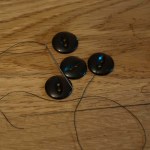
Buttons!I wasn’t quite happy with the strap sewing, so I gave it some thought. Eventually it was a colleague who suggested buttons, which were an inspired solution.  I had a dig around, eventually found my button box, and excavated these four pretty little off-black beauties.

Strap with buttons in placeSewn in place over the strap joins, they completely conceal my scruffy sewing.  Hurray!

I’ve considered shaping the short edges on a slight angle to cut away the worst of the selvedge, but although I know it’s there, it really isn’t obvious, so I’ll probably leave it for now. If it annoys me later, I’ve always got the option!

Finished beach wrapWell, there it is! I’m really pleased with it, I think it’ll work beautifully as a cover-up over swim wear, for the beach of the pool this summer.  It’s such a quick ‘make’, not sure I agree with the ’20 minute’ assertion, but certainly well under an hour, all told. And all for well under a fiver. Practical summer style on a serious budget!

Fun crochet beach bagIncidentally, I’ve also finished the crochet beach bag I was working on a few weeks ago. I’ll  do a full tutorial at some stage when I re-make it (there were a few details I got wrong with this one that I’d like to do right next time!), but I’m still pretty thrilled with it, it’ll do very nicely by the pool this summer with plenty of space for a paperback, the sunscreen, sunglasses, and of course the cover up!

I’m feeling rather excited about the summer now… Bring it on!

Read more from the Country Skills blog >>

Grow A Taste of the Exotic East – propagate & grow your own lemongrass

It was James Martin, during the masterclass I attended last year, who first whetted my appetite for growing my own lemongrass. Two things were worrying me, though. Firstly, we have cold winters here – it’s usual to get nights down to well below -10C during the winter, and lemongrass is a tropical plant. Secondly, and more prosaically, was where on earth I was going to get hold of a lemongrass plant?

Some months later, with the idea still in the back of my mind, I stumbled across a blog which suggested you could propagate lemongrass successfully from stalks bought for cooking – yep, those rather dry, slightly disappointing bunches of grey-white woody stems from the supermarket. (I regret I didn’t make a note of the blog that inspired me, and I can’t find it now, so can’t give credit.) But the process was very simple.  Immerse your lemongrass stalks in a bit of water, in a vase on a bright window sill. Change the water daily, and wait for it to root. Once you’ve got good roots, plant them out. That’s it.

The lemongrass stemsWell, that sounded like a horticultural challenge at my sort of level! And what was to lose, apart from a quid or so for a bunch of lemongrass. (The observant among you will notice there are two different ‘sets’ of lemongrass stems here – the shorter bunch came from the supermarket, whereas the slightly taller ones came from our local Thai market. Neither cost more than a pound.)

The first thing you’ll see, within a few days, is some fresh green growth emerging from the top of your stems.  Then, after a week or so, with a bit of luck, root buds will appear.  Do change the water for fresh every day (I forgot for a few days and it all got a bit manky, algae-ish and unpromising-looking in there), and try to keep them in a nice bright, warm situation.

Growing nicelyFour weeks later, my stems looked like this (I separated the different sets of stems into two separate pint glasses because they looked a bit crowded as the roots started to grow) with primary and secondary roots showing, and lots of new top-growth. With secondary roots present, I felt pretty confident potting up the lemon grass.

Good root growthI’m surprised – but thrilled – to be able to report that *every single one* of the stems rooted successfully.  The Thai market lemongrass rooted a bit faster than the supermarket stuff – I suspect it was rather fresher! – but a week later, that was ready to pot up, too.

Potted up and in the greenhouseI decided to split the stems up and pot them on into three terracotta pots.  Keep these well watered especially for the first few days, since the roots are pretty puny and they’re used to having all the water they can drink. I kept them on the same sunny window sill for a couple of weeks, as the nights were still rather cold, but now they’re out on the greenhouse staging.

I’m thrilled to see some brand new stems emerging over the past few days.  Of course, I’m anticipating them coming back indoors onto a sunny window sill through the winter – like other warm climate plants like chillies, they don’t appreciate temperatures below 10C, so somehow I can’t see them surviving outside, even in the unheated greenhouse!

New stems emerging

All I can say is – propagating lemongrass like this is cheap, it’s simple, and it works – try it! If you enjoy cooking Thai or other East Asian food, or fusion dishes, there’s nothing better than your very own freshly grown and harvested lemon grass! I can’t wait!

Read more from the Country Skills blog >>
Chive Flower Vinegar – a liquid taste of summer – make this NOW!

If you have chives in your garden, and live in the northern hemisphere, it’s a good bet you’ve got chive flowers now. Please, if you do nothing else this weekend, don’t let all that beautiful chive blossom go to waste – seize the opportunity to make some chive flower vinegar!

Chive flowers growing in the garden

I made this for the first time last year, just a small batch in a 330ml jam jar, with white wine vinegar and about a dozen chive flowers from the garden. It was *glorious*.

The vinegar is somewhere between a slight blush pink and a brash almost pinky-purple, and has a lovely fresh onion flavour which complements salads and savoury dishes perfectly. I guarded my single bottle of 2012 vintage chive flower vinegar jealously, knowing it would be a year before I’d be able to make any more.

But this story, sadly, has a tragic end.  On Christmas Eve, while I was buzzing around the kitchen trying to do all of those last minute things, I opened an over-full kitchen cupboard and my precious bottle of chive flower vinegar tumbled off the shelf, bounced on the counter, and smashed into a million pieces on the slate floor. The kitchen was filled with the gorgeous fresh smell of chives. I could have cried. Instead, I mopped, not at all comforted by the fact that the floor came up absolutely *beautiful* from its vinegar rinse!

It’s fair to say that I’ve been waiting for chive flower season ever since. And now it’s here. Usually, I’d wait to blog a recipe or process like this until it was complete and I could show it to you all the way through. But you need to make this now – not in a few weeks time when the vinegar will be infused and ready to bottle – so here goes.

So, for your very own, glorious chive flower vinegar, you will need to get together the following –

  • Gather all your lovely, fresh, open chive flowers.  Even if you only have about a dozen, it’s worth making a small batch (I successfully made about a 330ml volume of vinegar in a large jam jar lat year). Pick them with as little stem as you can, and give them a good shake to dislodge any resident insect life.
  • I like to use white wine vinegar, though I know others use cider vinegar, rice wine vinegar, or even white malt vinegar. Champagne vinegar would be a ‘premium’ choice. Choose something light coloured to bring out the  lovely colour of the chive flowers.
  • A jar the right size to take all your chive flowers and vinegar. A kilner-type jar with a rubber gasket is ideal, but a large jam jar will do fine, as long as it has a plastic-lined lid. Wash and dry the jar carefully before use.
  • A colander to wash the flowers, and a salad spinner, if you have one (I don’t).

Wash and dry your chive flowersI’m going to come clean here, and admit that I didn’t grow all of these chive flowers. Hubby was able to scrounge them from a lovely kitchen garden!  After removing as much of the stalk as you can, give them a good wash to remove any bugs and insects – a few ants were all that seemed to come in on these ones – and give them a good shake to remove any water, or put them in a salad spinner for a few turns.

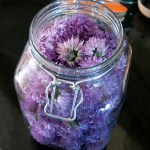
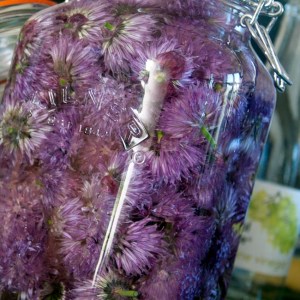
Put the flowers into your jarThen put all your flowers in your jar. Mine is a 2l kilner jar but use whatever you have conveniently to hand – probably not something quite this large! Mine happens to be filled but it doesn’t need to be, 1/4 to 1/3rd full will still give you a lovely infusion, though the colour won’t be so striking.

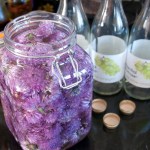
Top up with vinegarNow top up with your choice of vinegar. To give you an idea, the 2l jar filled with flowers took just over 1.5l of vinegar to fill it all the way to the top.

Keep the vinegar bottles – you can re-fill them with the infused vinegar later. As an extra bonus, the labels came off these bottles pleasingly easily!

Now, close your jar, and put it somewhere cool and dark for a couple of weeks.  I’m planning to infuse it for 3 – 4 weeks, but  keep an eye on it and have the occasional taste, as it may be that you’re happy with it earlier. Once you’re happy, strain the vinegar through a fine sieve or a muslin back into the vinegar bottles, label, and store in a kitchen cupboard or larder until you’re ready to use it.

Infusing in kilner jar

There you go – simplicity itself! It’s thrifty, too – just the price of some basic vinegar, and a little bit of time, give you this gorgeous very special condiment. Make some this weekend, I promise you won’t regret it. In a few weeks you’ll be enjoying this gorgeous, fresh, oniony-summery-savoury note with all your favourite salads and summer dishes.  But keep some back, too, for later in the year. Like elderflower cordial, it brings an amazing bottled aroma and taste of summer to your table in the colder, darker months!

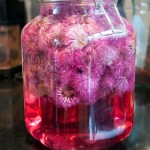
Look at this amazing colour!

P.S. Just a quick update to give you an idea of the colour – this is my vinegar jar after just 48 hours infusing in the cupboard under the stairs. Gorgeous, isn’t it?

Read more from the Country Skills blog >>
The Eurovision Drinking Game – because in the country, you make your own fun!

Making your own entertainment is, most definitely, a country skill. Living out of town, you don’t have access to restaurants, bars and cinemas without resorting to the car or a rather expensive cab. There’s the pub, and village activities – a great sense of community, but necessarily limited in it’s options!

European FlagsIt’s been said that, while the rest of Europe may feel embarrassed or nonplussed, sometimes, by the cultural festival that is the annual Eurovision Song Contest, the British are the only ones who seem to think it’s a drinking game. [If you’re not European, then I’m sorry, the rest of this post is likely to be pretty confusing!].

There are many variations, of course, but this one one is *mine*. I started developing it when I was still a student, and a number of victims have ‘play-tested’ it for me over the years (you know who you are!). Some even remembered enough the next day to make suggestions for improvements, which have been incorporated over time.

So, revised and refreshed, in time for the 2013 Eurovision Song Contest, which this Saturday will come from Malmo, in Sweden, it’s time to offer it up as a game for the world to enjoy! Break out the home-brewed cider, and play along!

Introduction –

This game is based on the songs and performances that make up the Eurovision Song Contest. Features of songs and performances are identified, and carry drinking forfeits (usually ‘take a swig’ with a small number of exceptions).

Euro shot glassesEveryone at the party *could* play for every song, but that may be unwise! Better, probably, to divide up the performances between the party-goers, either by drawing lots before the contest starts, or drawing straws between the performances, which adds a more immediate sense of peril and means some people might end up amusingly and disproportionately ‘picked on’ (clustering in random distributions is a bitch!).

Obviously, if it’s a very small party, not all songs need to be allocated, and likewise, in a big group, more than one player can play for any given song. (Also see ‘variations’ suggested below.) Non-drinkers & children can still have fun by identifying and shouting out the trigger rules when they appear.

And now, the rules –

Begin any song that you’re playing with a fully-charged glass.

These are the ‘trigger’ features of songs and performances for which the player should drink. These features can appear more than once in a performance (and sadly, often do!), and ‘score’ each time they appear – so the famous ‘Bucks Fizz’ skirt removal would be a single costume change, because it happened in one go, but a song that repeatedly swaps languages or makes major-to-minor-and-back-again key transitions gets a drink on each switch.

Sheet MusicThe song itself –

  • Song is not in an official language of the country being represented
  • Change of language
  • Change of key
  • Change of tempo
  • Wordless lyrics (da dum da, mana mana mana, lalalala)

Military 'uniform'The performer, costume and performance –

  • Performer(s) not of nationality represented
  • Folk costume
  • Folk instrument
  • Folk dance
  • Weapons (with an extra-big swig if they’re ‘folk’ weapons – axes, pitchforks, flaming torches etc)
  • Uniforms – military & civil (including costume references to same – epaulettes, insignia, military-looking hats and suchlike)
  • Flags & banners
  • PyrotechnicsPyrotechnics
  • Costume change
  • Underwear as outerwear
  • Spandex, lurex, sequins
  • Leather, rubber, PVC, bondage wear
  • LEDs or other lighting incorporated into costumes
  • Fur, feathers, wings
  • Trapeze or wire-work
  • Magic, circus themes

and, last but not least

  • Performer does not appear to be human – note this rule applies whether the performer *is* human underneath or not! – This is the big forfeit. Down the remains of your drink.

Russian folk-dancersThe half-time performance (or the ‘Riverdance’ slot) –

Traditionally the host country puts on a performance on during the ‘voting gap’. Everyone plays for this one. Use the same forfeit list above, but all penalties are doubled.

Voting –

I haven’t got rules for the voting – in my experience the mood of the assembled party generally doesn’t require any further ‘lifting’ by that stage in the evening!

Variations –

Rather than allocating countries’ songs to players by ballot, the enthusiastic party host could assemble a trivia question for each country in the contest (as simple or as fiendish as they like!). Players getting it wrong would play that country’s song. Of course, this is less fun if the host was planning on playing too, as they’ll know all the answers.

Well, that’s it, folks! Have fun at all your Eurovision parties, and if you do decide to try these rules, do let me know how you found them, and any suggestions you might have for improving them in future years.

And remember, please drink responsibly (*ahem!*), and definitely don’t drink and drive, attempt DIY, deep fat frying, change important passwords or operate heavy machinery. Finally, your hangover is your problem, not mine, so don’t come crying to me in the morning!

Read more from the Country Skills blog >>

Easily Hooked – oops, I seem to have taken up crochet!

We had so much to do in the garden this weekend, but the weather hasn’t been friendly!  At least we managed to get the turf cleared from the unpromising rectangle of old ridge & furrow grass which is to be my experimental cut flower patch – watch this space for more (and photos!) in due course.  The greenhouse seedlings continue to thrive, though I’m struggling to believe the tomato seedlings are ever going to grow up big and strong enough to fruit! This time of year in the garden is always a mix of hope and doubt, without much to show yet for our efforts!

Stormy spring beech tree

But it’s raining, and there’s nothing to be done outside for the time being!

I hate to have my hands unoccupied (stop giggling there in the back!) so I suppose it was only a matter of time before I gave in and took up crochet.  Many years ago (half a lifetime, really!) I learned to knit, got good enough at it to make myself a jumper, and mastered some fiddly cable work, but it never really grabbed me.  I’ve always been impressed by the flexibility of crochet work, the variety of shapes and textures which crochet seemed to be able to achieve compared to two-needle yarn craft.  And then, about three weeks ago, by chance, I stumbled over the first part of a learn-to-crochet part-work magazine, complete with a 3.5mm hook, two balls of yarn, and a guide to basic stitches. All for 99p.

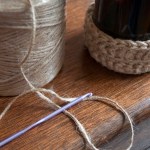
Well, I couldn’t resist. I started tinkering with a few stitches and patterns from the starter pack.  I did a bit of playing and made a little round basket out of some jute garden twine, just to see if I could.  It’s the simplest thing, with just a circle of double crochet stitches for the base, made without turning, and sides the same, but turned between rows, picking up only the front loop of the  V to add a horizontal stripe.

Jute basket bottom    Jute Basket inside    Jute basket detail with twine

It makes a lovely coaster for the bottle-cut vase I made a few weeks ago, using the bottle cutting jig I made last year.  Better still, it was surprisingly easy to make, despite the less than promising choice of yarn!

Jute basket with bottle vase

So that was it, really, I was hooked.  Obviously a single hook and a big ball of garden twine wasn’t going to get me very far, so I scurried off to the internet for a few supplies (oops!) – a couple of books for inspiration, a lucky-dip selection of yarns, and of course a set of different sized hooks.  I was good to go!

What do you make first but a scarf? Of course!

Crochet scarfI’m really happy with my first effort, the pattern is from Sue Whiting’s ‘The Crochet Bible’, which has served me really well as a crochet primer so far!  For a complete novice it was a nice simple project which gave a pleasingly complex-looking result, and came together over the course of just over a week.  I used a heather-coloured yarn I got in my mystery-pack, and I’m thrilled with the result.  The photo doesn’t quite do it justice, it’s not as blue as that!

Dave kindly offered to model it for you all, so you can see it a bit more clearly. (He continues to do very well, thank you for asking!)

Dave the dog

Of course, I couldn’t stop at just the one project.  The current one is straight out of my own head, a crochet string-bag for the summer – I think it would be great for a day at the beach.  I’ve used two of the colours of yarn in my lucky-dip pack that I think I’d struggle to wear – an orange that can only be described as ‘health & safety high-viz’ and a bright sunny lemon yellow.  I’m after a relaxed, cool, hippy-ethnic look, and I think we’re headed in the right direction – more photos, and instructions, once it’s finished, but here’s a sneak-peek of the work in progress..!

String bag - work in progress

Finally, some sad news this weekend from my hens – Gertie, my white hen, and the final member of my original hybrid quartet, went the way of all things on Saturday.  So RIP, dear Gertie.  All good things come to an end…  There’s always been a white hen in my hen-house.  I feel rather bereft.

Read more from the Country Skills blog >>