Signs of Summer – if you can believe it!

No one in the UK (or probably elsewhere!) can have missed the fact that today marks the peak of the Diamond Jubilee celebrations for Dear Queen Lizzie.  It’s June!  The British weather is a vexatious, tricky beast at the best of times (why else would we all spend so much time talking about it?), and of course it’s done its thing and provided the cold grey drizzle to put the lie to the gorgeous hot sunny spell we were enjoying not a week ago.  But despite all of this (10 degrees centigrade!  In June! I ask you?) and the cheerful, if slightly damp collection of people crowded into the village hall this lunchtime for beer, bunting, and a cracking hog roast, I know summer’s here.  How?

Elderflower buds, just breaking

That’s how!  The elderflowers are opening!

Elderflowers in the hedgerowSome of you will have some sense of how exciting this is, perhaps.  The scent of them is just so glorious, and the excitement starts to build towards the elderflower cordial and champagne brewing that the next few weeks will hopefully bring!

Keep your eyes open for these now, and look forward to a couple of great recipes over the next few weeks!  In the meantime, I hope the bad-weather plans in place have allowed everyone with jubilee parties to get a bit of fun, despite the grotty conditions!

Read more from the Country Skills blog >>

Sourdough Saga: Episode 1 – failure to launch

I’ve wanted a sourdough starter for ever so long – for as long as I’ve known and understood the sourdough process, I think.  Traditionally baked sourdough is *the* great bread, by definition, in my opinion.  With its wonderful texture and complex richness of flavour, it leaves the industrial ‘Chorleywood Process’ sliced white loaf so far behind that they’re hardly recognisable as the same animal.

So when I saw that one of my favourite food bloggers, The Rowdy Chowgirl, had brewed herself up a starter recently, it made my mind up.  I was going to do it, and I was going to do it NOW.  Well, just as soon as I tracked down a bag of rye flour, anyway.  And a couple of weekends ago, after following several different lines of reading and research, I got down to business.  ‘What’s that?’ asked Hubby, as he wandered into the kitchen to see me stirring a bowl of what could only be described as goo.  ‘A sourdough starter,’ I replied.  He thought about it for a moment.  ‘You realise you’re going to have to take that thing on holiday with you, don’t you?’  I tried to reassure him that I’d read about stashing it in the refrigerator for a period of time if necessary.  He seemed unconvinced.

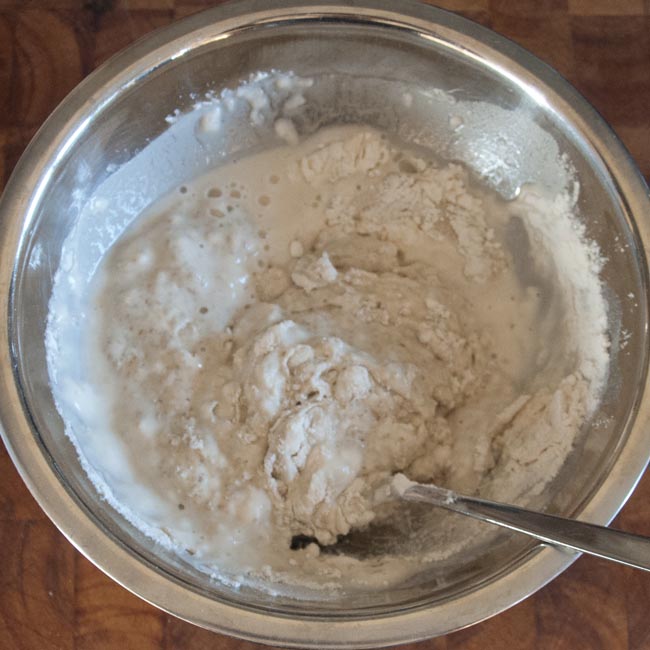
Initial mix with rye flour

I broadly used the directions from The Fresh Loaf, except that I don’t have US-type measuring cups, and there’s nothing called AP flour on the shelves in the UK.  So I guessed a bit at quantities and used stoneground bread flour for the day 2 and subsequent additions.  I also used my tap water rather than the mineral or filtered water suggested – mostly on the basis that it’s nice tasting water without an obvious chlorine hit, and I brew with it regularly without adulterating it in any way, so I went ahead and assumed there wasn’t anything in it greatly damaging to yeasty beasties.

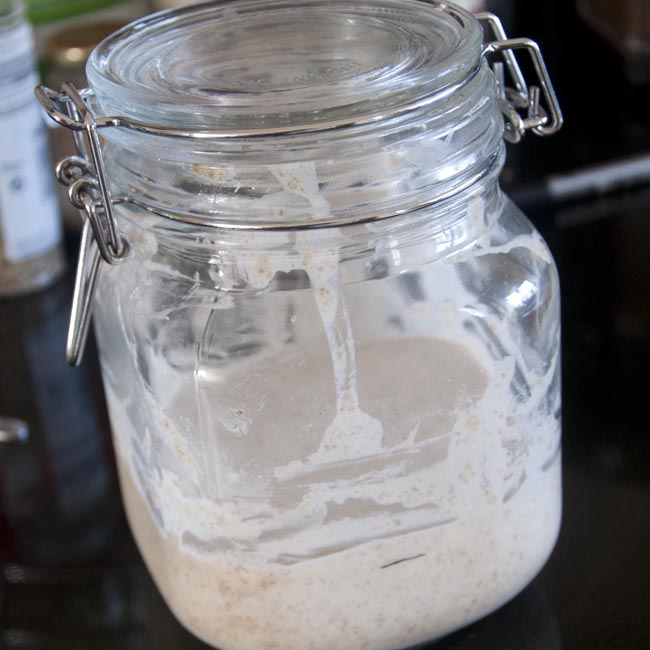
My starter was a thick batter-like consistency.  Thicker the first day when it was rye flour, and then it thinned down a bit with subsequent additions.  I used a 1l kilner jar I had lying around, with the gasket removed so that it wasn’t a sealed container, which I thought was a reasonable match for ‘cover loosely’.  I put it to rest the first day in the boiler cupboard, which is a coupe of degrees warmer than the rest of the kitchen.

After 24 hours, nothing much had happened, much as I expected.  I made the first additions with plain flour, and stashed it back in the cupboard.   It smelt… well, not exactly unpleasant, but definitely an ‘off’ smell, if you know what I mean.  But, forewarned by lots of other sourdough devotees, I plugged gamely on.

After 48 hours     Gordon's Alive!

24 hours after that, it had gone mental, doubled in size, and all bubbly and awesome.  I was convinced I’d cracked it.  I even named it, Gordon.  Because, you know, ‘Gordon’s Alive!?’  Anyway, as we all know, pride comes before a fall.

Feeding timeI discarded half the mix and added more flour and water as instructed (well, kinda).  Made my mark on the side of the container as instructed, and left it a few degrees colder in the kitchen this time.

Growing, but only a littleAfter another day had passed, the mix had risen a little in the jar, but only about 1/3rd and nothing like the doubling that the instructions called on me to wait for.  So, I was patient.  Another 24 hours on and no further progress, I mixed in a few teaspoons of rye flour to help things along.  Still nothing more than a few scanty bubbles breaking surface.

Very scanty bubbles48 hours after adding the rye flour ‘booster’, I opened the jar and got a distinctly ‘musty’ damp sort of smell.  On closer inspection the batter on the sides of the jar had started growing what was unmistakably black mould.  Downhearted, I chucked the whole lot in the bin, disassembled the kilner jar and stuck that in the dishwasher.  What I’d hoped was going to be a weekend of experimental baking lost, sadly, though given the hot spell of weather that was probably no bad thing!

Some really kind feedback from @mannafromdevon, a baker on twitter, suggested that it might have been worth  trying to rescue the ‘good stuff’ from underneath, and carrying on with feeding, but it was too late for sourdough-1, condemned to the rubbish.  But their other advice, ‘Don’t Give Up’, stuck, and I’ve already started sourdough-2, which seems, so far, to be continuing in the tradition of acting as if it’s also read the sourdough primers, and wants no truck with them.

The thing that struck me most reading around the subject is that there seemed to be as many specific processes for getting a sourdough starter going as there are people who have written on the subject.  There were even (remarkably concise!) directions on the back of my bag of rye flour!  In my day job, when there are as many different ‘expert’ opinions on a subject as you can find ‘experts’ to ask, it’s usually a sign that there’s no one really good answer, just a lot of different approaches, many of which work most of the time…   Wish me luck, I’m not giving up until I get there!  This may take some time…

NextSourdough Saga: Episode 2 – keep calm and carry on?

Read all the posts in the Sourdough Saga >>

Read more from the Country Skills blog >>

Smoked Trout – so simple, so tasty, and all home-made

Smoked trout – like its close cousin smoked salmon – is one of the great ‘luxury’ foods.  I find I prefer it – the finished product, while it looks very similar to salmon, has a more delicate flavour with less of the aggressively-fishy oiliness which can characterise smoked salmon.  It’s much less readily available, too – and can certainly be expensive, a quick google suggests prices from £40 – £80 a kilo direct from a number of British producers.  Expect further mark-up in a smart London delicatessen!
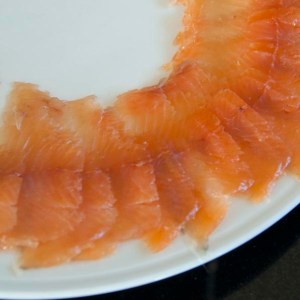
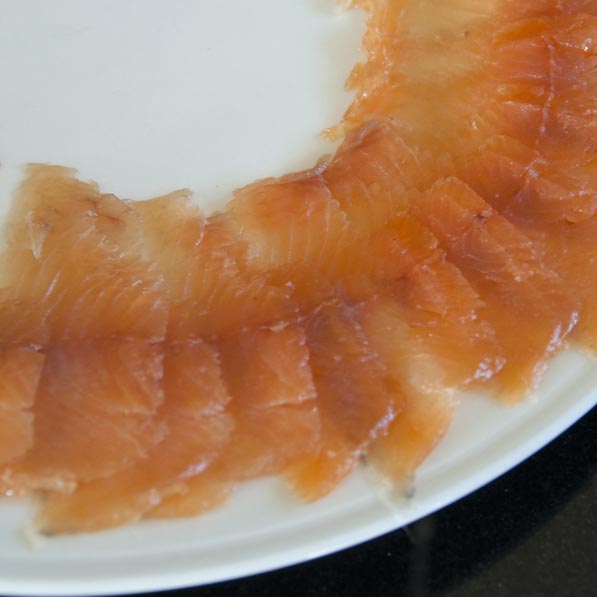
Sliced home-smoked trout

Of course, if I were just writing this in praise of smoked trout and telling you to go and buy some from a smokehouse on the internet, it wouldn’t be the country skills blog!  Making smoked trout at home is straightforward, and produces a first-class product which is the match of anything you’ll buy from even the most up-market smokehouse or deli counter.  Better still, it costs a fraction of the commercial product.  The two fillets of rainbow trout I cured and smoked for this post cost the princely sum of £1.53, with a combined final weight of a little over 200g – including other ingredients and consumables, that’s a total cost of well below £10/kg.  A little luxury, then, that we can all afford to enjoy a bit more often!

You’re going to be eating this fish raw, effectively, so freshness is of the essence.  Choose a lovely fresh whole trout – with bright clear eyes, red gills and no ‘fishy’ smell – and have it descaled and filleted for you by the fishmonger (or do it yourself – it’s not that tricky really!).  Good quality farmed trout is readily available, even on supermarket fish counters, and if you can get hold of a lovely fresh wild fish, even better!  Avoid pre-packed fillets, whose freshness it is more difficult to be certain of.  Wash the fillets off carefully under the tap, to remove all the mucus coating from the skin.  Make sure you’ve removed all the rib bones and pin-bones (the small pointy bones that run along the middle of the fillet) – a pair of tweezers is very useful here.  This will take a few minutes, but is worth the effort to do properly.  Then rinse the fillets and dry them carefully with kitchen towel.   Weigh the fillets and make a note of this weight.

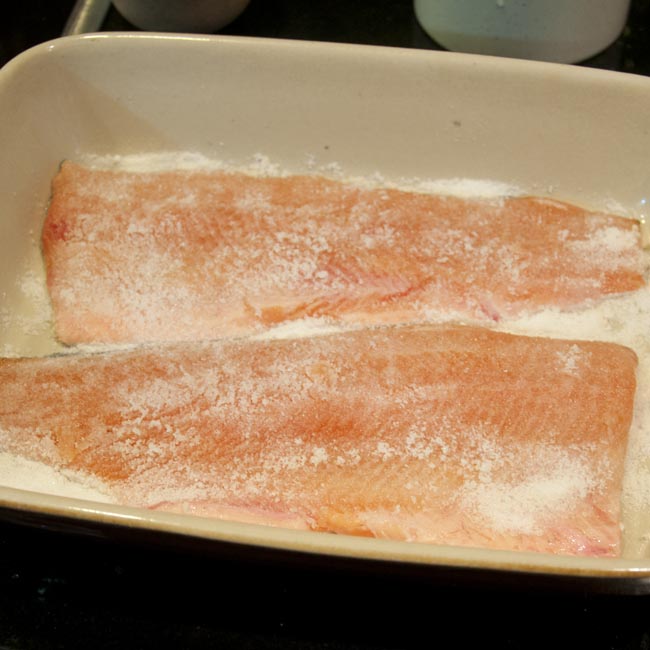
Trout fillets with cure appliedThe cure I use for trout and salmon is very simple – made up of 1/3rd sugar (golden caster sugar is my favourite here) and 2/3rd table salt.   I favour a short curing time – just overnight – with an excess of dry-cure so that the cure stays saturated throughout.  Be generous – you can afford to be, since the ingredient cost is very low – in the scale of pence for a couple of fillets.
Weighed down for curingYou want a thin layer of cure in your non-metallic dish below the fish, and a good coating over the top.  The photo gives a good idea of the sort of coating you’re aiming for.

You then want to weigh down the fillets to help draw water out – you’ll need to improvise something – I found a couple of plastic ‘take-away’ containers fitted very nicely in my dish, and then weighed them down with tin cans.  Don’t use anything metallic in direct contact with the curing fish.  Put the salted fillets in the fridge.
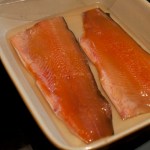
Cured fillets, next morningI would tend to get the cure going when I get home from work, having collected my fresh fish on the way home – so just before bed I turn the fillets over in the cure, and replace the weights before putting them back in the refrigerator.  The next morning, there will be quite a lot of liquid in the dish and most of the cure will have dissolved. Take the fillets out of the dish, noting the change in texture – the skin will have taken on a harder, almost cardboard character, and the flesh will be firmer and more translucent.  Rinse and dry the fillets, and weigh them again, and note down the reduction in weight.  My fillets had dropped from a starting weight of 256g to 220g at this stage – a 14% water loss.  You’re aiming for a final loss of ~18% by the end of the process, so that’s well on target. Now place the fillets on an open plate, uncovered, in the refrigerator for 24 hours before cold smoking.

You may have read this far, and are now thinking ‘well, that’s no use to me – who has a cold smoker at home?!’.  At it’s simplest, cold smoking requires two things – a source of cold smoke (from smouldering sawdust, for instance), and a space in which to contain it.  Last year, I built a wooden tower smoker, but there’s no need to start with a construction project.  A cardboard box, or a (clean!) upturned bin or barrel, rigged up creatively with a rack or two, will do just as well for the occasional smoking job!

ProQ cold smoke generator, litYou will need a smoke source, and I can heartily recommend the ProQ Cold Smoke Generator, which is a nifty little gadget which entirely takes any stress or complication out of the process.  It’s a little pricey (around £35 at this time), but will pay for itself incredibly quickly once you get the smoking bug!  It reliably provides 10 – 12 hours of cold smoke (depending on the temperature, humidity, and your sawdust choice) with very little heat production.  Have a look at the Supplier’s List for suggested sources of smoking and curing supplies.
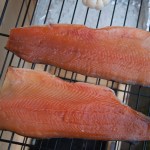
Trout fillets, loaded in the smokerChoose a day without too much wind or rain (the occasional shower isn’t important), and where the temperature is roughly between 5 degrees and 15 degrees centigrade.  I’ve successfully smoked between 0 and 5 degrees but smoke penetration is less effective.  Colder, and your fish will freeze rather than taking smoke.  Warmer and the risk of spoilage increases considerably – though cold smoking temperatures up to about 20 degrees are cited in some places.  Get the smoker going first thing in the morning, and leave it for the day – though I would keep it under much closer supervision if using a cardboard box!.

I used a mix of alder and maple sawdust for this smoker burn (about 10% maple) – this produced a gorgeous neutral smoke-flavour with very little bitterness and with a noticeable ‘sweet’ note, presumably from the maple.  It’s definitely a mix I’ll use again in the future.
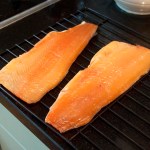
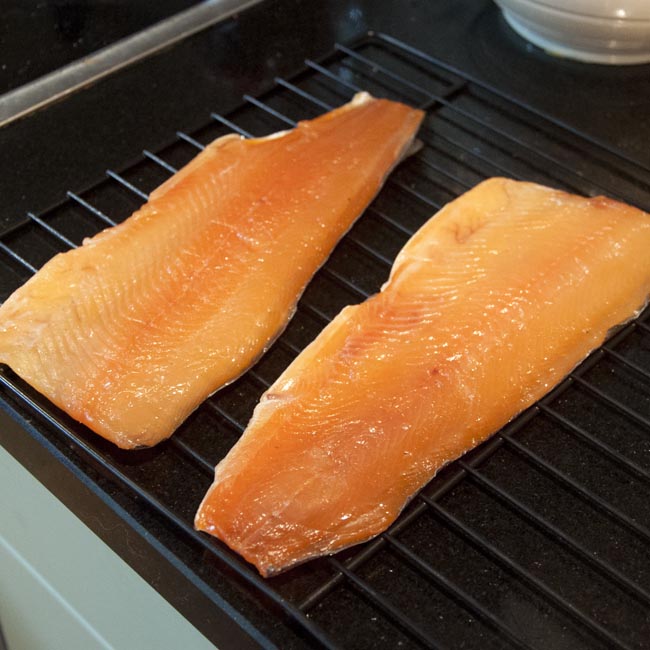
Trout, fresh from the smokerOnce the smoke generator has burned all the way through, unload your smoker, and take a final weight on your fillets. They should have lost another 4 – 5 %.  They will have a lovely orange-pink colour with a noticeable translucency and a glossy surface.  Then wrap them tightly in cling film, and freeze them.  Smoking fish in this way isn’t really a preserving mechanism, and storage time in the fridge is about 3 – 4 days.  Even if I’m going to eat them very soon, though, I tend to freeze them at this stage – a day or two in the freezer should ensure any parasites which may be present in the fish have been killed off.  You can keep them frozen for a couple of weeks without too much loss of quality, but after a month or so you’ll start to notice the deterioration.

Sliced smoked trout fillet

Once thawed, I slice the smoked trout thinly with a sharp knife, starting at the ‘head’ end of the fillet, at about a 45 degree angle.  There’s a bit of a knack to this, but you’ll get good at it really quickly – and who cares if the slices are thicker, or a bit uneven?  This produces small, almost translucent slices which are great for nibbles.  I love to serve these with water biscuits or oatcakes (or your preferred sort of cracker), cream cheese – or a soft goat’s cheese is also very nice, freshly ground black pepper and a squeeze of lemon juice.  But the limit is really your imagination.  Smoked trout with scrambled eggs on a toasted muffin is a beautifully indulgent breakfast!

I really do hope you chose to give home-smoked trout a try, and that however you prepare and enjoy it, it brings you as much foodie pleasure as it brings me!

Read more from the Country Skills blog >>

Banner320-260

Bacon Basics – bacon-in-a-bag method for ‘dry’ curing at home

Readers (& participants) in the Big Bacon Challenge will have noticed how little effort is involved in making dry cured bacon at home.  While I was teaching myself to make bacon by this process (which involves daily application of dry cure to the piece of meat), I came across several references to bag methods of ‘dry’ curing.

In this ‘bacon in a bag’ method, you apply the cure to your meat, put the whole thing in a plastic bag, seal it up, and leave it in the fridge for several days, turning occasionally, and adding fresh cure once in mid-process.  It removes the trivial once-daily intervention in the curing process, and the need to find space for a dish in the fridge for the length of the curing process, so might be even easier for busy busy folk… *if*, that is, the results stack up in terms of flavour and quality.

I used my normal black pepper cure for this experiment.  My total cure weight was 10% of the weight of the meat and made up of 4 parts of supracure to 1 part of dark soft brown sugar with about a teaspoon of freshly ground black pepper added (see here for more advice on mixing your dry cure).

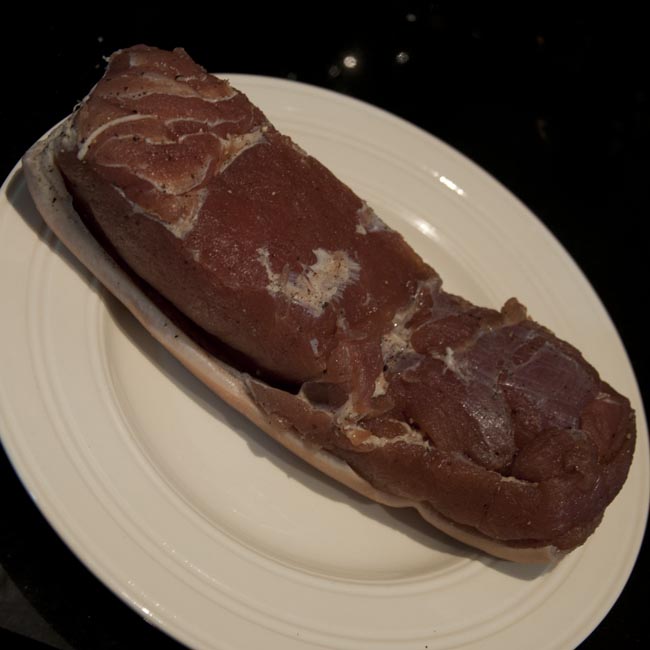
Dry cure applied, in bagIn addition to your piece of belly or loin pork and cure, you need a nice large freezer bag which is reasonably robust, and some sort of clip or bag tie to seal it.  Sprinkle a bit of your cure into the bottom of the bag, place the washed and dried piece of pork in the bag skin-side down, and then continue to rub cure on the meat until you’ve used about half of your total dry curing mix.  Seal the bag excluding as much air as possible, and put it in the fridge.

After 3 days, pickle in bagTurn the bag over from time to time (I turned it every time I went into the fridge for something else, but once a day is fine).  You will notice quite a lot of pickle accumulating in the bag.  After two days for belly, or three days for loin, take the bag out of the fridge.

Drain the pickle, and apply the rest of the cure, before returning the bag to the fridge for another three days.  Effectively we’re curing in a very concentrated brine made from the applied salt and the meat’s own water.  By this stage, at around the half-way mark, it’s already showing the changes I’d expect from successfully-curing bacon, which is a good sign!

Bacon out to restAfter these three days have passed (making a total curing time of five or six days depending on your bacon cut), take the bacon out of the fridge.  Remove it from the bag, rinse it off under the tap, pat dry carefully with kitchen paper, and return it to the fridge un-covered on a plate for 24 hours to finish drying and form a pellicle (that glossy, slightly tacky surface layer).  After that, wrap it loosely in a piece of baking paper and keep it in the fridge until you want to slice it and eat it.

I rested mine for three days before slicing – I was planning to put it through the smoker but the weather on my day off wasn’t particularly suitable.

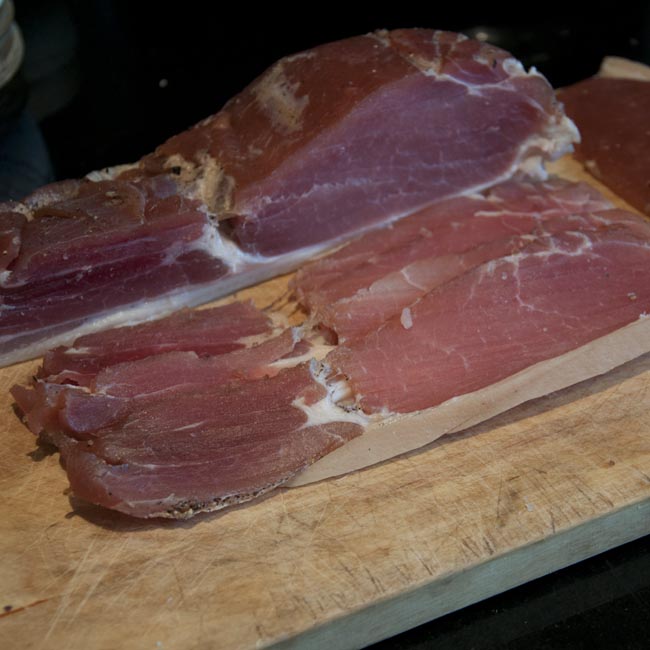
Sliced for breakfast this morning, the texture and appearance on slicing was exactly as I have come to expect from my home dry-cured back bacon.

Sliced bacon

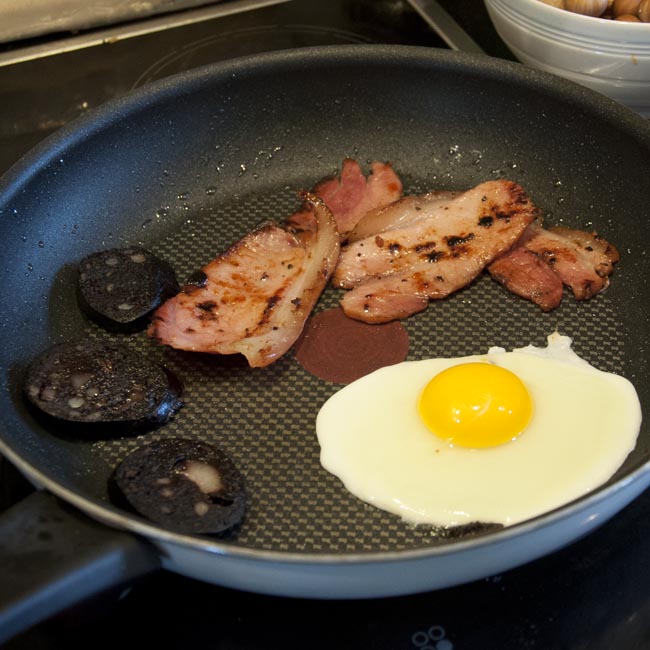
I sliced away but retained the outside piece for lardons before carefully preparing four slices for frying.  The piece of loin pork I used was very lean, and needed a little olive oil to the frying pan to really get things going.  The bacon re-arranged itself in the pan as the rind buckled, but didn’t noticeably shrink, and there certainly wasn’t any of that nasty white watery muck we’re so used to seeing in commercial bacon!

Bacon for breakfastBreakfast this morning was my bacon with some butcher’s black pudding and a fresh home-reared egg, served on a toasted English muffin.  What could be nicer on a lazy Saturday?

And tasting wise?  I would say I couldn’t detect a difference between bacon prepared this way, and my usual technique – but with one caveat.  One of my slices was the second-slice from the edge after the one I’d held over for lardons.  This slice, quite unlike the others, was unpalatably salty, with almost a salt ‘sting’ on the tongue.  I think this can probably be ascribed to the concentration of cure applied at once in this method, despite a good long resting period, the outside surfaces of this bacon are quite aggressively salted.  I would cut off a thicker end-slice in future when using this method – probably somewhere between 5mm and 10mm of the end grain at both ends.  Used in a stew or sauce, it would be fine, but it’s less than ideal to eat as sliced bacon.

So, if you want an *even* easier method for home-cured bacon, do give this one a whirl!  For me, though, it’s likely to be a technique I fall back on when I know I’m going to have a really busy week and still want some bacon for the following weekend.

See more Smoking & Curing posts >>

Read more from the Country Skills blog >>

Piecing It Together – fabrics, quilting, and an amazing shop

I discovered the most amazing Aladdin’s cave of a fabric shop yesterday – friends took me along to The Bramble Patch in Weedon, Northants, and oh my goodness I was in heaven!  The Bramble Patch is really a quilting shop, but houses a veritable treasure trove of fabrics (including hundreds of fat quarters), patterns, kits, and accessories.  Kid in a candy store just doesn’t describe my feeling about places like this!

Fat Quarters at The Bramble Patch

I’m slightly in two minds about quilting – I think the end results can be stunning – particularly some the contemporary abstract / geometric patterns, and would love to have a gorgeous family quilt and be able to say ‘I made that’.

On the other hand, I’m a quick and dirty sort of seamstress.  I can’t see much merit in taking twice as long over a sewing project to achieve perfection – ‘good enough’ is good enough for me!  Quilting – and I would love to be proven wrong here – strikes me as the end of the sewing crafts spectrum that rewards accuracy and carefulness, rather than my ‘that’ll do’ attitude!

The range of patterns and kits on offer is really quite impressive – not to mention tempting! – in particular, some very sweet jubilee and union jack cushion covers.

Fat QuartersMuch to my husband’s apparent relief, I managed to escape with only five new fat quarters for the fabric stash – what he doesn’t quite appreciate, I think, is the brain-full of ideas and inspiration I’ve come away with too!

I’m extremely tempted to go on one of the quilting courses they offer (and no doubt much more of my hard-earned cash is liable to go their way in the future!) – in the meantime I’d welcome any tips and leads on utter-beginner quilting skills & project ideas you might know about!

Read more from the Country Skills blog >>

Inspirations – Isabella Beeton’s ‘Book of Household Management’

I like to think that, had she been alive today, Mrs Beeton would have been a blogger.  Before her death in 1865 aged 28, which followed the birth of her fourth child, she wrote prolifically.  Her husband, Samuel Beeton, was a publisher, and much of the material in the book was first printed in the form of articles in ladies’ magazines between 1859 and 1861 before then emerging in one volume as the book we would recognise as ‘Household Management’.

It’s fair to say that much of the material in ‘Household Management’ was collected (plagiarised, according to some less charitable commentators) and edited together, rather than being original to Isabella Beeton, but she probably invented the modern mode of laying out recipes – with an ingredient list at the top, followed by directions and cooking instructions – something we take for granted today.  While it is to a great degree a recipe book, it also contains wonderful snippets of advice on all aspects of victorian life – on medicine, the law, clothing, manners, the rearing of livestock, and of course famously the selection management of one’s servants.

Most of the recipes stand the test of time quite well – do avoid however the recommendation to boil carrots for about three hours – there are some wonderful snippets which are utterly of their period and richly reward the reader’s attention, though perhaps not their imitation!

Mrs Beeton on Whooping Cough:  “This is a purely spasmodic disease, and is only infectious through the faculty of imitation, a habit that all children are remarkably apt to fall into, and even where adults have contracted whooping-cough, it has been from the same cause, and is as readily accounted for, on the principle of imitation, as that the gaping of one person will excite or predispose a whole party to follow the same spasmodic example.” Her recommendations for treatment are… equally surprising!

On paying visits of courtesy (to be done after luncheon!): “They are uniformly required after dining at a friend’s house, or after a ball, picnic, or any other party.  These visits should be short, a stay from fifteen to twenty minutes being quite sufficient.  A lady paying a visit may remove her boa or neckerchief, but neither her shawl nor bonnet.”  So there you go, boa off, bonnet on – are we clear?

There are some marvellous-looking (not yet tested here!) recipes for home-brewed – and sometimes fortified – wines, as well as curing and preserving – after all it’s a book from the years before refrigeration – and for this reason alone deserves to be on everyone’s bookshelf and dipped into regularly.  Obviously we’d all like an old hardback copy complete with colour plates, but as it is widely available in paperback reprint (my well thumbed copy is a recent Wordsworth Edition) and is free to download in a variety of e-reader formats, albeit often without it’s illustrations, you really have no excuse!

Read more from the Country Skills blog >>

Big Bacon Challenge: Rounding Up – volunteers’ feedback

A few weeks ago now, all my lovely volunteers for the Big Bacon Challenge made their first batches of home-cured streaky or back bacon.  Several of them have blogged about their experiments, so I’d like to bring together some of their comments and reports.  I wanted to show as many people as possible that making your own bacon at home is not only incredibly simple and straightforward, but produces some of the best bacon you will ever have eaten – these reviews I hope go some way to supporting that!

Streaky bacon mid-curing, with dry curing mix applied

‘Ghoti’ writes about her bacon over on LiveJournal:  My favourite exerpt from her report – “So, in summary: utterly delicious, and a three year old can make it.”

‘Amlees’ wrote up her bacon day-by-day at Alison Was Here, and her collected bacon challenge posts can be found here:  “So the bacon is cured and rested and ready to eat.  John cuts thick slices and fries them for breakfast, with an egg on the side.  The bacon is delicious and satisfying, if a little salty. (…)  However, the bacon is as good as the bacon we normally buy (the expensive dry-cured kind).”

Finally (for now at least) ‘5greenway’ wrote on the Very Berry Handmade blog about their bacon in two posts – at the start and end of the process – “So, the process was really easy. But it would all count for nothing if the bacon wasn’t up to scratch… Just looking at it before cooking, we suspected it’d be pretty good, but it tasted even better than we expected. Not too salty, a nice flavour from the cure & a kind of melt in the mouth texture.”

I’m informed by several of my volunteers that they have since bought their own supply of curing salt and continue to make home-made bacon (and other goodies!), so I’m declaring the challenge a success!

A great big THANK YOU to all of my volunteers, and if any of you have any further feedback, please do comment or email so that I can include it here!

All the Big Bacon Challenge posts will be collected under the ‘BigBaconChallenge’ category heading – so go there to read them all!

Read more from the Country Skills blog >>

With Apologies for the Hiatus – it’s been a busy month!

There’s been a lot going on the past few weeks – my little sister’s wedding, the reason for the wedding bunting I’ve been making since Christmas, beginning a new job, and finally, now that we’re home from a much needed holiday, spring is well under way and we’re seriously behind on our garden preparations!

Congratulations to the bride and groom on a gorgeous wedding – very much their personal style and lots of beautiful handmade touches to the ceremony and reception. I was particularly taken by the home-grown baskets of bulbs as table centres, and the handmade pyrography favours.  The bunting was pleasingly well-recieved!

At the wedding

Normal service on the Country Skills blog will be resumed very shortly – including a round-up of my volunteers’ thoughts on their big bacon challenge results, more foraging tips, and how to make your very own home-cured ham!

Read more from the Country Skills blog >>

Foraging Skills – how to get ahead!

I’ve been thinking about foraging recently.  There’s very little quite as special as a lovely – and free! – treat garnered from a hedge.  I’m thinking about a wild mushroom risotto, pots of crab apple jelly, a steaming blackberry crumble or a bubbling demijohn of rosehip wine.  Foraging is really an autumn sport, though, borne from the season of mists and mellow fruitfulness, so why am I writing about it now?

The thing that makes a really good forager isn’t being able to spot a laden crab apple tree at three hundred paces  – it’s knowing where that tree is in the first place.  Being a successful forager depends on keeping your eyes open all year round – if you notice things now, and remember them, you’re well on target for a bumper summer and autumn foraging season.

So just now, keep your eyes open for these, and make a mental note –

Hazel catkins in hedge

They’re hazel catkins, and where they’re hanging in profusion from the naked branches of hedges and shrubby trees now, there should be some lovely cob nuts in the autumn – they’ll be much harder to see then, when there are leaves on the tree, and hazels growing in mixed planting aren’t especially distinctive looking.  Watch like a hawk though, come autumn, and pick them slightly green and sweet – because the mice will want them too!

A little note on the legality of foraging – if the item is being grown as a crop, then it’s not foraging, it’s scrumping (or stealing!).  It’s very unlikely that cob nuts or blackberries growing in a field hedge are intended as a food crop, but the nuts and sloes in my garden hedge definitely are!  So if it looks like someone’s caring for a tree or a hedge, it’s in an orchard or garden or looks intentionally planted, tread with care!  That said, there at lots of edible crops grown incidentally on trees planted ornamentally, on streets and in council amenity spaces, particularly in urban areas – foraging doesn’t have to be just a country pursuit! – look out for apples, plums and cherries, too!

Read more from the Country Skills blog >>

Big Bacon Challenge: after the challenge – what now?

You’ve come to the end of the bacon challenge, hopefully sampled your efforts and agreed they are *good*, so where do you go from here?

I was very pleased (a teeny bit smug, even?) to hear that one of my volunteers has already dived in and ordered her own supply of Supracure – if you want to do the same, I can heartily recommend both HotSmoked and Weschenfelder (details in my Suppliers List) for curing and smoking supplies.  Both sell Supracure in 2kg packs for about six or seven pounds.

Before considering whether to do the same, and make curing a regular part of your culinary routine, it’s worth giving the costings a little thought.  By necessity this is just a snapshot – since food prices are constantly shifting – but it gives an indication.

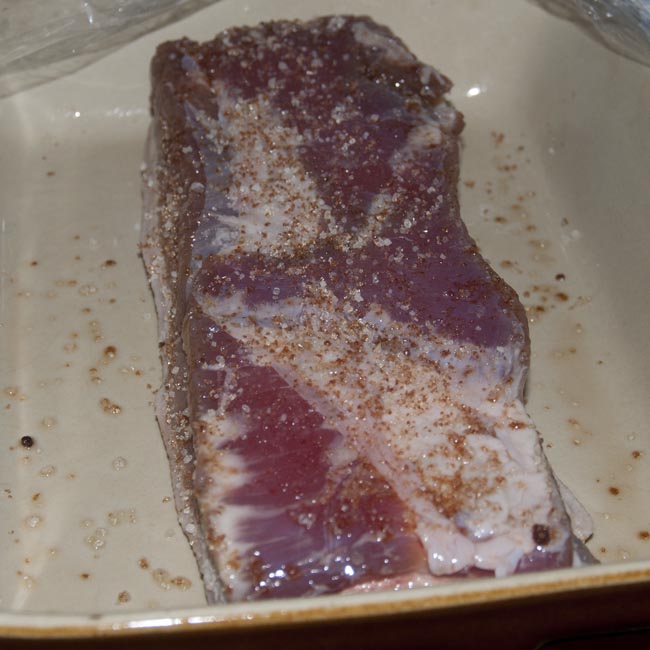
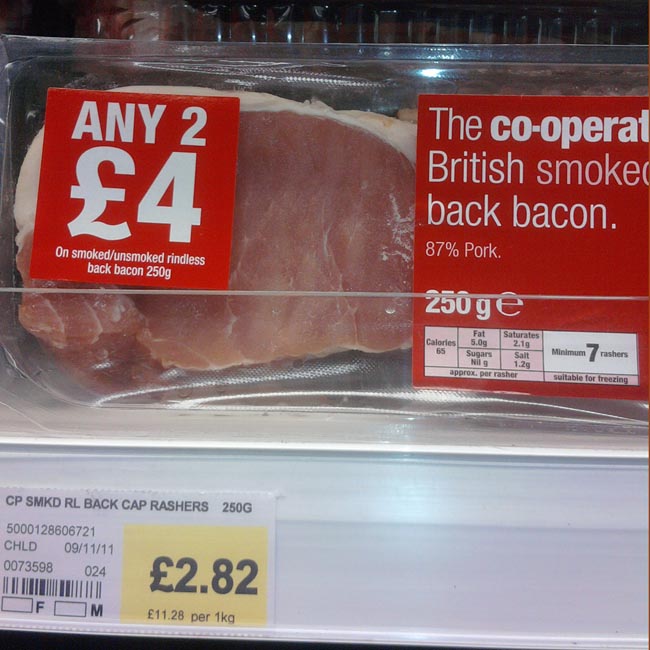
Retail-packed back baconLet’s look at 1kg of back bacon.  On the basic recipe this will take 1kg of pork loin, 80g of curing salt and 20 g of sugar.  We’ll ignore the sugar for convenience, since it’s a small quantity and you almost certainly have it already.  The curing salt costs – round figures – about 30p.  So really it’s just the meat we need to consider.  You can generally get hold of bog-standard own-brand back bacon on ‘2 packs for £4’ type offers where the pack size is between 230g and 250g. Bearing in mind this bacon is about 13% added water, let’s call that an equivalent per kilo cost of about £9.

Compare with this, Tesco this week list their Rind-on Pork Loin Roasting Joint at 3.99/kg – admittedly a half-price special offer, but even the full cost of £7.99/kg represents a *small* saving.  The key to really making this work is to buy whatever’s cheap this week – be it loin or belly, or even belly slices.  It’s a pretty safe bet most supermarkets will be discounting something suitable at any given time.  Of course it pays to be flexible, but if you only like back bacon, buy loin when it’s cheap and freeze it – or make a big batch all at once and then freeze it once it’s bacon – personally I can see no difference in quality from doing this, though obviously you should do one or the other, not both!

To even start to compare like with like, though, it’s really good dry cured butcher’s bacon you need to consider – a spot of quick googling suggests this is for sale from various producers at about £15/kg.  So it’s clear that with a bit of canniness, not only is the end product fantastic, but there’s an easy 50% saving to be made on the cheap & nasty brine-injected supermarket commercial bacon offering, and a tidy 75% off the nearest equivalent butcher’s bacon.  Streaky bacon is usually a little cheaper than back, but since belly pork is a cheap cut par excellence, the maths for home-cured streaky bacon generally adds up just fine without depending on special offers.

Convinced?  Then you’ll need to decide what to try next.

My usual ‘house’ cure is actually a black pepper cure – essentially the cure we used for the Big Bacon Challenge, but with 3 grams of freshly ground black pepper (I recommend a pestle and mortar for this) added per 50-60g of cure mix (curing 500 – 600g of bacon).  This cure is great with or without smoking the bacon after curing – more of which later.

Juniper and Bay cure, and ingredientsIf your taste runs more to cooking bacon for stews and sauces than to breakfast rashers, perhaps try the bay and juniper cure, which produces a lovely deep rich aromatic flavour.

The limit to what to add to cures really is your imagination – within some basic limits on proportion of salt and sugar (I’ve used between 20% and 33% sugar with great success) – do some reading (perhaps look in the Library for inspiration) and see what you fancy!

I can’t leave the subject of bacon curing without a brief mention of smoking.  Not everyone likes smoked bacon, of course – though since commercial ‘smoked’ bacon has concentrated smoke-flavour added to the brine, and bears about as much resemblance to the real thing as Nescafé does to a real steaming espresso, perhaps it deserves a second chance..?

I’m British, so when I think about smoking bacon we’re talking about cold smoking.

The key to this process is bathing your cured meat in cold smoke over a period of several hours (I usually smoke my bacon for 10 – 12 hours), so you either have to produce your smoke consistently, and with as little heat as possible, within the smoking box, or produce hotter smoke at a distance from the box and then ‘duct’ it in allowing time for it to cool down.  It’s a tinkerer’s paradise, so please do consider it for a bit of a mad project – there are as many designs for DIY smokers as there are people who build them I think!

ProQ cold smoke generator, lit

We designed and built a wooden tower smoker – effectively just a fancy wooden box with some shelves in it – which I fill with smoke using a commercially available cold smoke sawdust burner.  I probably could have constructed a smoke generator very similar for not much money, but I wanted to start with something that would Just Work, the cost wasn’t prohibitive (around £20) and I don’t regret the decision.  It’s a great piece of culinary gear, think how much fun – and flavour! – you could have with smoked trout and salmon, smoked salt, smoked garlic and chillies, as well as your bacon!

Finally, a big thank-you to all my Big Bacon Challenge volunteers – looking forward very much to hearing what you all thought of your efforts  – and to the rest of my readers, thank you for your patience with the bacon-centric tone of the blog the last couple of weeks, normal service will be resumed very soon!

All the Big Bacon Challenge posts will be collected under the ‘BigBaconChallenge’ category heading – so go there to read them all!

Read more from the Country Skills blog >>