Venison Pie, from Darina Allen’s ‘Forgotten Skills of Cooking’ – Cooking the Books, week 1

“Hi, my name is Kate, and I have a cookbook problem…”

Some of my library

I just can’t resist them. A nice cookbook is such a marvellous object, it’s a thing of beauty, solidly bound and gloriously illustrated, as well as containing the promise – such promise! – of tasty food to come. So, I buy cookbooks (and people buy them for me, too, of course), and continue to buy them until they overflow our bookshelves and end up living in piles under coffee tables and stacked against the walls of our little cottage. As I said, it’s a problem. Last year sometime, I had a quick count up – and stopped counting when I got close to 100.

All those books – all those different recipes – and yet it’s relatively rare that I cook something completely new. For all the usual reasons – busy lives, habit, and having a really good set of family-staple recipes we come back to time after time. But it’s good to push out of your culinary comfort zone – for how else do we learn? – and with such a wonderful resource at my fingertips (and, sometimes, underfoot!) I really have no excuses!

So to welcome in 2014 – and in lieu of a New Year’s resolution – I’ve decided to set myself the challenge, once a week if I possibly can, to cook a brand new recipe form one of my cookbooks, and write it up for the blog, adding a little review of the book itself. Obviously such a silly endeavour needs a name, so I think we’ll call it ‘Cooking The Books’.

Inside-page viewToday’s recipe is Venison Pie, and was chosen because Hubby found some lovely wild venison at the Farmers’ Market. The recipe is from Darina Allen’s beautiful big hardback cookbook ‘Forgotten Skills of Cooking’, which came to me as a gift from my Dad last year.

I’ve scaled down the quantities because there are only two of us (the original recipe serves 8), and made a couple of minor modifications to account for ingredient availability. In general I’m trying to stay as close to the original recipes as I can – or what’s the point, really? This will, inevitably, affect my choice of recipes  – I really don’t want this challenge to end up filling my kitchen cupboards and fridge with half-used packs of ingredients that just go to waste! Actually, thinking about it, this is a big factor in why I don’t often cook from cookbooks. But enough housekeeping – let’s get on with the cooking!

Start by preparing your venison. Darina’s recipe calls for venison shoulder, cut into pieces, but I had a ~1lb pack of already-cut stewing venison. It’s worth taking a little time to trim out any particularly obvious gristly bits from your meat at this stage. Also try to pull out any deer hairs you discover in your meat (which isn’t a particularly unusual thing to find with wild venison, because of the way it’s shot, handled and butchered).

Now mix the meat into a marinade consisting of –

  • IngredientsA small glass of red wine (use something you’ll want to drink – not only is this always excellent advice for cooking with wine, but there’ll be another 5 glasses left in the bottle!)
  • A small onion (I used a red one, but a yellow one, or even a couple of shallots would be fine) halved and sliced.
  • A bouquet garni consisting of a bay leaf, sprig of thyme and some parsley stalks
  • A tablespoon each of brandy and olive oil
  • Salt and cracked black pepper to season (I used two big pinches of pepper and one of salt)

In the marinadeIdeally you might allow this to marinade overnight, but even a few hours will make a big difference. Cover the bowl and place it in the fridge. If, like me, you’re going to use frozen prepared puff pastry to finish the pie, now would be a good time to take it out of the freezer, and either place in the fridge to defrost overnight, or out on the side in the kitchen if it needs to defrost faster than that. Pastry is always better worked reasonably cold,so once it’s defrosted, put it in the fridge so it’s nice and firm.

Once your meat has marinaded to your satisfaction (I gave it three hours), drain the meat in a colander over a bowl, retaining the marinading liquid.  While it’s draining, get together the ingredients and equipment you’ll need for the next stage –

  • Home-cured bacon lardons80-100g of dry cured streaky bacon or pancetta, chopped into lardons or cubes. I used my home-cured ‘Christmas’ bacon (with bay, juniper, allspice and molasses in the cure, lightly smoked), which I happen to have around at the moment. It’s really worth seeking out good dry cured bacon if you’re not going to make your own!
  • A small onion, chopped reasonably finely
  • Half a carrot, diced reasonably small
  • A small clove of garlic
  • 200ml of beef stock (I used a stock cube – I know, I know…)

Venison coated in flourPat the pieces of meat dry with kitchen paper and coat them in seasoned flour (I needed about 2 tablespoons). I picked the meat out of the sliced onions, but this probably isn’t necessary. This bit of the process is pretty faffy, to be honest, and is something I tend not to bother with when making stews. Let me just say, though, it produces the most wonderful, silky, rich gravy, so I may be using this trick a lot more in the future!

Meanwhile, in a frying pan, fry off the bacon until it starts to brown and donates some of that lovely bacon fat. Once it’s done, transfer the bacon to a big saucepan.  Now brown the floured venison in the bacon fat. You may need to add a little extra olive oil. Transfer this to the pan once there’s some nice colour, and fry off the onions, carrot and garlic for a few minutes before adding them to the pan as well.

Ready to simmerI couldn’t see why I’d waste the nice sliced onion from the marinade (and the recipe doesn’t appear to specify what should be done with it), so into the frying that went until it softened nicely, and joined the rest of the ingredients in the saucepan.

Now we’re called to deglaze the pan with the wine marinade, and transfer this to the saucepan with all the meat and vegetables before topping up the pan with the beef stock (pre-heated, if it’s proper stock) until the meat and vegetables are just covered. I added a bit of extra water and a slosh more wine to make up the volume. Finally add back the bouquet garni from the marinade, cover the pan and simmer very gently on a low heat for about an hour and a half (or a bit longer if required), until the venison is beautifully tender. Keep a reasonably close eye on it, stirring occasionally, and make sure it doesn’t catch on the bottom of the pan.

Once you’re happy the venison is perfectly cooked, you can take it off the heat. Time to add the last few bits, which are –

  • Saute sliced mushroomsA good handful of mushrooms. Darina wants wild ones if possible. I managed to get some oyster mushrooms and something a little bit cep-looking calling itself a ‘king oyster’ at our local supermarket, I added a couple of chestnut button mushrooms.
  • A handful of cooked chestnuts – these were the vaccuum-packed sort, left over from Christmas. The recipe says these should be omitted if you’re making a pie rather than a stew, but I couldn’t miss the opportunity to use them up!
  • A few teaspoons of homemade apricot jam. The recipe wanted redcurrant jelly, but I didn’t have any. I have a feeling crab apple jelly would work very well here, too.
  • Olive oil
  • Salt and pepper if required to season.
  • And not forgetting your block of defrosted puff pastry!

Wash out your frying pan and heat up a couple of spoonfuls of olive oil. Saute the mushrooms until colouring slightly, and once they’re done, add them to the pan with the chestnuts, cut in halves. Now taste to check your seasoning. The recipe suggests you might slike to add some redcurrant jelly, or a pinch of sugar, or possibly even some lemon juice at this stage depending on how things are coming together.

Filling in the dishI did find there was a slightly lacking sweet / acid note so substituted about three teaspoons of my homemade French apricot jam (avoiding the whole bits of fruit), one at a time and tasting carefully in between. It’s slightly miraculous, actually – makes such a huge difference to the final flavour. Add a bit more salt and pepper at this stage if required.
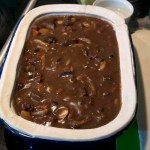
Edged with pastryYou could serve it now and call it a venison stew, and it would be wonderful with mashed potatoes on a cold winter’s night. But we’re going the whole hog and turning it into a pie, so transfer the filling into your chosen pie tin – I’ve used my gorgeous, very traditional, white and blue enamelware dish. Get your block of puff pastry out of the fridge and roll it out.

Finished pastry lidThe book suggests a way of attaching the pie crust in a two-stage process, fist attaching a strip of pastry all around the edge brushing with  water beneath and on top, before adding the pastry lid, trimming the excess, scalloping the edge with the handle of a spoon, and egg-wash the surface, adding some decoration if you wish.

Pierce the centre of the crust and put into a piping hot oven for 10-15 minutes before turning the heat down to about 190C until the crust is golden and the contents bubbling hot. If your oven has a hot-spot (most do) don’t forget to turn the pie around at some point to keep the colour even.

Hot from the oven

That’s it – isn’t it beautiful? Time to serve with your choice of accompaniments. Hubby requested roast potatoes, so we had those and steamed broccoli to go with it.

'Serving suggestion'What can I say? It looks pretty spanking, and tastes glorious. I love the way the late addition of the sauteed mushrooms means they retain their separate flavour, texture and identity in the dish. The venison is perfectly tender, the gravy is rich and thick and full of  beautifully balanced flavour. These quantities will feed four, I would say.

I heartily recommend you make this pie!

This is undoubtedly a time-consuming and relatively labour intensive recipe, with four separate preparation stages. Consequently it generates quite a bit of washing up, too – I counted a saucepan & lid, a frying pan, a pie dish, two mixing bowls, a colander, chopping board and knives, garlic crusher, pastry board (or your kitchen worktop), rolling pin, an assortment of spoons of different sizes, a spatula, and I’m sure I’ve forgotten a few bits. But nothing unusual and no gadgets or gizmos required. I started marinading the venison just after lunch, and we eventually ate around 7.

Serving timeIt’s a reasonably complex recipe, but no part of it is particularly technically demanding and no special skills are required – anyone who can follow a slightly complicated set of instructions should be able to cope! While there are a lot of ingredients, they’re quite ‘standard’ ones and pretty much all of them were already in my fridge and kitchen cupboards, which was a big bonus.

Perhaps something a bit quicker and simpler for next week..?

**
Cover shot‘Forgotten Skills of Cooking’ by Darina Allen.
Kyle Cathie Ltd, 2009. ISBN 978-1-85626-788-5.
Hardcover, full colour, 600 pages.

[Full disclosure: This is my book, which was a gift from my Dad. I have received no payment or sponsorship for this post, nor have I accepted a review copy. I do not have an amazon affiliate account and do not profit from any links provided.]

This is a fabulous book, full of unexpected surprises – I only realised after I’d written about the copper-cleaning power of salt and lemon juice the other day that this is one of the tips in the back of this wide-ranging tome! As well as a really good range of hearty traditional recipes, both sweet and savoury, with a focus on quality local seasonal ingredients, there are – amongst many other things! – instructions for buttermaking and producing your own clotted cream, curing and smoking techniques for meat and fish, yeasted and sourdough bread baking, and even advice on choosing livestock. It’s also a beautiful book, richly illustrated and nicely printed, which never hurts.

I would say that it deserves a place on any cookbook shelf, particularly so if, like me, you’re more interested in traditional farmhouse, country food and techniques  than in ‘cheffy’, restaurant-style cooking.

‘Cooking the Books’ is my self-imposed blog challenge for 2014 – I’ll be trying to cook a new recipe from one of my (rather extensive!) collection of cookbooks once a week, write it up and review it. Wish me luck!

Read more from the Country Skills blog >>

Courgette or Zucchini – this is a pickle you will relish!

Not so very long ago, though it’s hard to believe it now, the long hot days of summer were with us and the vegetable garden was in full flood. As well as the tomato glut, I did end up with a few more courgettes than I knew what to do with.

Garden-fresh courgettes

Now, I absolutely abhor the idea of wasting food I’ve gone to the trouble of growing – but I struggled a little to work out what to do with a kilo of courgettes all needing using up at once! Pickles, of course, are the almost-universal solution to making tasty preserves from gluts of vegetables. So I had a flick through some of my cookbooks, and when that didn’t turn up anything I particularly fancied, I did what we all do and turned to the blogosphere. The pickled courgettes I eventually made are based on this recipe for zucchini pickles, from Lottie + Doof.

For my quantities of courgettes,  I used –

  • 1kg of garden courgettes, mixed sizes (smaller ones are better, but use what you have!)
  • Two small onions
  • 6 tbsp sea salt
  • 1l of cider vinegar
  • 300g of golden caster sugar
  • 3 tsp of mustard powder (Colman’s, of course)
  • 3 tsp whole mustard seeds, lightly crushed in a pestle and mortar
  • 2 tsp of powdered turmeric

The dreaded mandolinYou will also need a mandolin (unless you’re both very patient and a remarkably precise slicer of vegetables), a mixing bowl, sterilised jars with plastic-lined lids (my quantities filled two 1lb jars perfectly), and a salad spinner (if you have one) or a clean tea-towel.

Sliced courgettesSet the mandolin about 1.5mm thick, and then use it slice up all the courgettes, lengthways or slightly on the diagonal, using the guard and taking great care not to also slice your fingers! I’m quite terrified of my mandolin (reasonably, I think!) and I really have to psych myself up to use it, but for a recipe like this there really is no alternative.

Sliced vegetables with saltThen peel the onions, and put them through the mandolin on the same setting. Once all your vegetables are sliced, mix them together in a bowl with the 6 tablespoons of sea salt (yes, I know it seems like a lot, don’t worry, it’s not staying in the finished product!), and top up with ice cold water, mixing gently until the salt is all dissolved. Add some ice cubes if needed to keep the temperature down, and put to one side for about an hour.

Pickling vinegarWhile the sliced courgettes are marinading in their brine, prepare the pickling vinegar, combining the vinegar, sugar, mustard powder, mustard seeds and turmeric powder in a saucepan, and bring to a simmer for two or three minutes.  Then allow the vinegar to cool to room temperature (you can speed this process up by immersing the pan in a sink of cold water). It’s a rather ghastly colour, but don’t be put off!

In the salad spinnerBack to our courgettes – once they’ve sat in the salt water for an hour or so, you can taste one of the pieces, which should be quite crisp and gently salted.  Drain off the salt water and then, using the salad spinner if you have one, finish getting them as dry as possible. If you haven’t got a salad spinner, dry them carefully in small batches in a folded tea towel, trying not to damage or break them if possible.

Mix the vinegar and vegetablesFinally, combine the cold vinegar with the courgette and onion in a bowl and mix carefully, before packing the mixture into sterilised jars. There may be extra vinegar, which you can discard (unless you can think of something really creative to do with it!).  Refrigerate for at least a day before tasting, but longer is better.

I started the first jar more or less straight away, in the spirit of experimentation, but the second I kept unopened for Christmas. It’s a very good pickle, pretty much immediately after making. It has a definite sweetness and I think I might reduce the sugar a little in future batches. The mustard flavour is present, but quite soft and subtle. The onion, too, is clearly present but not overwhelming, and tastes less ‘raw’ as the pickle matures. I don’t know whether I would bother with quite so much turmeric, next time, but it does give a very pretty colour to the finished pickle. It’s great with burgers and sausages, and goes particularly well in a salt beef sandwich.

Pickled courgettes on toasted sandwich

I must admit, writing up this recipe had rather fallen through the cracks until I had some yesterday with a wonderful grilled ham and cheese open sandwich. It is *just* fabulous, the icing on the cake of a wonderful lunch made from wonderful things – home-made sourdough, home-cured ham, and even our homegrown ‘sundried’ tomatoes. The mustard note takes this from comfort food to pure gourmet delight.  It’s quite wonderful.

So next summer, when you’re faced with a courgette glut, or find some lovely fresh courgettes in your local market, grab them and make this pickle. You won’t regret it!

Read more from the Country Skills blog >>

Grow A Taste of the Exotic East – propagate & grow your own lemongrass

It was James Martin, during the masterclass I attended last year, who first whetted my appetite for growing my own lemongrass. Two things were worrying me, though. Firstly, we have cold winters here – it’s usual to get nights down to well below -10C during the winter, and lemongrass is a tropical plant. Secondly, and more prosaically, was where on earth I was going to get hold of a lemongrass plant?

Some months later, with the idea still in the back of my mind, I stumbled across a blog which suggested you could propagate lemongrass successfully from stalks bought for cooking – yep, those rather dry, slightly disappointing bunches of grey-white woody stems from the supermarket. (I regret I didn’t make a note of the blog that inspired me, and I can’t find it now, so can’t give credit.) But the process was very simple.  Immerse your lemongrass stalks in a bit of water, in a vase on a bright window sill. Change the water daily, and wait for it to root. Once you’ve got good roots, plant them out. That’s it.

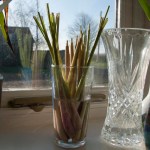
The lemongrass stemsWell, that sounded like a horticultural challenge at my sort of level! And what was to lose, apart from a quid or so for a bunch of lemongrass. (The observant among you will notice there are two different ‘sets’ of lemongrass stems here – the shorter bunch came from the supermarket, whereas the slightly taller ones came from our local Thai market. Neither cost more than a pound.)

The first thing you’ll see, within a few days, is some fresh green growth emerging from the top of your stems.  Then, after a week or so, with a bit of luck, root buds will appear.  Do change the water for fresh every day (I forgot for a few days and it all got a bit manky, algae-ish and unpromising-looking in there), and try to keep them in a nice bright, warm situation.

Growing nicelyFour weeks later, my stems looked like this (I separated the different sets of stems into two separate pint glasses because they looked a bit crowded as the roots started to grow) with primary and secondary roots showing, and lots of new top-growth. With secondary roots present, I felt pretty confident potting up the lemon grass.

Good root growthI’m surprised – but thrilled – to be able to report that *every single one* of the stems rooted successfully.  The Thai market lemongrass rooted a bit faster than the supermarket stuff – I suspect it was rather fresher! – but a week later, that was ready to pot up, too.

Potted up and in the greenhouseI decided to split the stems up and pot them on into three terracotta pots.  Keep these well watered especially for the first few days, since the roots are pretty puny and they’re used to having all the water they can drink. I kept them on the same sunny window sill for a couple of weeks, as the nights were still rather cold, but now they’re out on the greenhouse staging.

I’m thrilled to see some brand new stems emerging over the past few days.  Of course, I’m anticipating them coming back indoors onto a sunny window sill through the winter – like other warm climate plants like chillies, they don’t appreciate temperatures below 10C, so somehow I can’t see them surviving outside, even in the unheated greenhouse!

New stems emerging

All I can say is – propagating lemongrass like this is cheap, it’s simple, and it works – try it! If you enjoy cooking Thai or other East Asian food, or fusion dishes, there’s nothing better than your very own freshly grown and harvested lemon grass! I can’t wait!

Read more from the Country Skills blog >>

The Eurovision Drinking Game – because in the country, you make your own fun!

Making your own entertainment is, most definitely, a country skill. Living out of town, you don’t have access to restaurants, bars and cinemas without resorting to the car or a rather expensive cab. There’s the pub, and village activities – a great sense of community, but necessarily limited in it’s options!

European FlagsIt’s been said that, while the rest of Europe may feel embarrassed or nonplussed, sometimes, by the cultural festival that is the annual Eurovision Song Contest, the British are the only ones who seem to think it’s a drinking game. [If you’re not European, then I’m sorry, the rest of this post is likely to be pretty confusing!].

There are many variations, of course, but this one one is *mine*. I started developing it when I was still a student, and a number of victims have ‘play-tested’ it for me over the years (you know who you are!). Some even remembered enough the next day to make suggestions for improvements, which have been incorporated over time.

So, revised and refreshed, in time for the 2013 Eurovision Song Contest, which this Saturday will come from Malmo, in Sweden, it’s time to offer it up as a game for the world to enjoy! Break out the home-brewed cider, and play along!

Introduction –

This game is based on the songs and performances that make up the Eurovision Song Contest. Features of songs and performances are identified, and carry drinking forfeits (usually ‘take a swig’ with a small number of exceptions).

Euro shot glassesEveryone at the party *could* play for every song, but that may be unwise! Better, probably, to divide up the performances between the party-goers, either by drawing lots before the contest starts, or drawing straws between the performances, which adds a more immediate sense of peril and means some people might end up amusingly and disproportionately ‘picked on’ (clustering in random distributions is a bitch!).

Obviously, if it’s a very small party, not all songs need to be allocated, and likewise, in a big group, more than one player can play for any given song. (Also see ‘variations’ suggested below.) Non-drinkers & children can still have fun by identifying and shouting out the trigger rules when they appear.

And now, the rules –

Begin any song that you’re playing with a fully-charged glass.

These are the ‘trigger’ features of songs and performances for which the player should drink. These features can appear more than once in a performance (and sadly, often do!), and ‘score’ each time they appear – so the famous ‘Bucks Fizz’ skirt removal would be a single costume change, because it happened in one go, but a song that repeatedly swaps languages or makes major-to-minor-and-back-again key transitions gets a drink on each switch.

Sheet MusicThe song itself –

  • Song is not in an official language of the country being represented
  • Change of language
  • Change of key
  • Change of tempo
  • Wordless lyrics (da dum da, mana mana mana, lalalala)

Military 'uniform'The performer, costume and performance –

  • Performer(s) not of nationality represented
  • Folk costume
  • Folk instrument
  • Folk dance
  • Weapons (with an extra-big swig if they’re ‘folk’ weapons – axes, pitchforks, flaming torches etc)
  • Uniforms – military & civil (including costume references to same – epaulettes, insignia, military-looking hats and suchlike)
  • Flags & banners
  • PyrotechnicsPyrotechnics
  • Costume change
  • Underwear as outerwear
  • Spandex, lurex, sequins
  • Leather, rubber, PVC, bondage wear
  • LEDs or other lighting incorporated into costumes
  • Fur, feathers, wings
  • Trapeze or wire-work
  • Magic, circus themes

and, last but not least

  • Performer does not appear to be human – note this rule applies whether the performer *is* human underneath or not! – This is the big forfeit. Down the remains of your drink.

Russian folk-dancersThe half-time performance (or the ‘Riverdance’ slot) –

Traditionally the host country puts on a performance on during the ‘voting gap’. Everyone plays for this one. Use the same forfeit list above, but all penalties are doubled.

Voting –

I haven’t got rules for the voting – in my experience the mood of the assembled party generally doesn’t require any further ‘lifting’ by that stage in the evening!

Variations –

Rather than allocating countries’ songs to players by ballot, the enthusiastic party host could assemble a trivia question for each country in the contest (as simple or as fiendish as they like!). Players getting it wrong would play that country’s song. Of course, this is less fun if the host was planning on playing too, as they’ll know all the answers.

Well, that’s it, folks! Have fun at all your Eurovision parties, and if you do decide to try these rules, do let me know how you found them, and any suggestions you might have for improving them in future years.

And remember, please drink responsibly (*ahem!*), and definitely don’t drink and drive, attempt DIY, deep fat frying, change important passwords or operate heavy machinery. Finally, your hangover is your problem, not mine, so don’t come crying to me in the morning!

Read more from the Country Skills blog >>

Growing and Healing – back after an unscheduled break from blogging

So the blog’s been quiet for a bit! Sorry about that! I feel like I owe you all a bit of an explanation, so here goes – 

Back at the end of March, Hubby and I set off for a well-earned holiday, our annual-if-we-can-manage it ski trip.  We left my lovely in-laws looking after the house, garden, Dave the dog and the gaggle of poultry. A few days into our holiday, news came that Dave wasn’t well.  We tried not to worry – after all, we were almost half-way around the world, and there wasn’t anything we could do from there – he was in good hands and had been to the vets.  The days went by and rather than getting better, he was getting sicker.  By Easter weekend, he was in the hospital on a drip, having refused food for most of a week. By the time we arrived home the following week, he’d been admitted to a specialist referral centre – they were concerned that his liver might be failing, and didn’t know why.

We both hate to leave Dave and had been looking forward to the joyous welcome-home he normally gives us.  Instead the house was silent. We went to visit him at the referral hospital and he barely had the strength to give us a squeak of greeting.  A few more days went by, and after a CT scan which yielded a few answers, perhaps – ruled out some really sinister possibilities anyway – and a plan, kind of, he was fitted with a feeding tube.  Meanwhile, in a silent house, we were both struggling to keep our heads above water.  Times like this, if there were ever any doubt, we know what these creatures we invite into our lives truly mean to us.  I wonder if they understand how much they’re loved.

Dave with his feeding tubeAfter five day with the specialists, still not eating for himself but being fed through a tube inserted through the skin of his neck and into his oesophagus, Dave came home for us to care for.  He was incredibly weak and I really feared we wouldn’t be able to bring him back to health.

But one pill at a time, one liquidised-feed at a time, his strength returned and he started to eat for us again.  A week and a half ago his feeding tube came out, and he has continued to do better in the days since.  He’s still taking a pharmacy full of medication, and looks like a patchwork dog with all the hair that was clipped off to allow investigation and treatment, but over the last few days I finally feel like we’re getting our wonderful, beloved dog back, and while there are never any guarantees in this life, we have hope, and real joy.

Dave enjoying the sunshine

Some of you have been following the saga of Dave dog’s illness on twitter, and I would like to thank you all from the very bottom of my heart for your kind words and thoughts over these past few very difficult weeks.  They’ve been an immense source of strength and comfort, and have meant the world to me.

Of course, it’s a truism that whatever our personal turmoil, time doesn’t stand still.

It’s spring! At last! It really did feel like the winter that would never end! And while the blog has been quiet, we’ve still been very busy.

Dave the dogThe greenhouse we built in March is now stuffed full of seed trays and little emerging seedlings.  It has been performing wonderfully, and the automatic opening vent – a birthday present for myself and admittedly a bit of an indulgence – has been working brilliantly and prevented it becoming a seedling-cooking device on sunny days when we’re not around!  Incidentally, the giant climbing triffid in the foreground is one of my hop plants, grown from a bare root rhizome this year. It’s quite something, isn’t it!

Vegetable bedsOutside, we’ve almost finished sorting out the vegetable beds, and the potatoes are planted.  Now I just need to get a bed prepared for the cutting flower patch I’m experimenting with this year!

My window ledges are packed with chillies, tomatoes, and other things too tender yet to survive in the unheated greenhouse.  I’m hoping we’ve now had the last of the really cold nights and they may be able to go into the greenhouse in the next few days.

Chilli seedlingsI’m especially pleased with my chilli plants, despite an initial disaster (top tip here – don’t take your beautiful heated-propagator-raised chilli seedings outside on even a lovely sunny early March afternoon to prick out and pot on), the survivors, and second sowing are now thriving. I’ve grown two varieties – ‘Vampire’ (the purple-leaved ones in this photo) and ‘Twilight’ this year.  What is it about naming chilli varieties, incidentally???

Seedlings for the cut flower patchStarting these seedlings, and waiting for them to grow, has been the most amazing therapy and displacement activity against the stresses and worries of the past few weeks.  Seeing them start to grow and thrive is always such a great source of faith and hope for the year to come, but this year it’s felt particularly poignant somehow!

Oh, and I seem to have accidentally taken up crochet… more of which, no doubt, another day!

Thanks for your patience in the hiatus, folks, and I’m hoping that more normal (and frequent) blogging service will now be resumed!

Read more from the Country Skills blog >>

Living in Glass Houses – DIY greenhouse build

I have to admit to having wanted a decent greenhouse for as long as I can remember. Growing up, my grandmother’s neighbours had a beautiful greenhouse and vegetable garden, which I used to admire from over the fence, and I suspect my life-long enthusiasm for the glass-house springs in part from this!

Dave, showing off his new greenhouse!

Apologies, incidentally, for the quality of the photography in this post – I made the mistake of thinking I had enough on my hands and that photos from my mobile phone would be ‘good enough’ rather than worrying about the SLR as well as everything else.  The photos took ages to tidy up and even now aren’t really up to my usual standard!

A little while after Christmas, while we were watching telly, I asked hubby whether we were really going to get on and build a greenhouse this year.  Yes, he agreed, we definitely were. So I did a bit of digging around, and had more or less decided that for what we required, a baby polytunnel was probably going to be more cost effective and sensible.  Then, deploying his superior (well, so he says) google skills, he turned up a 6ft x 10ft aluminium and polycarbonate greenhouse for about the sort of price I was finding for tunnels.  It seemed like a no brainer, so we got on and ordered it. It arrived a week or so later.

It’s been sat in the garden in two boxes since then, of course, because the weather we’ve had this winter can only be described as ‘not compatible with construction projects’.  As it happens, I’ve given up complaining about the weather for Lent (yes, it’s been that bad!), so I’ll spare you the details.  It finally started to dry out a little a couple of weeks ago, so we finally had a window to get going with the ground works.

The intended site for the greenhouse is on our ‘paddock’, which is a scrappy bit of ridge and furrow pasture land, most of which we planted for an orchard three years ago.  The grass is very established and the land isn’t level (the clue is in the ‘ridge and furrow’!). The only way we were ever going to get a level frame for the greenhouse was to dig a ‘slot’ for it out of the pasture grass to level it, and set a frame of breeze-blocks on which to rest the building.

You’ll need a good spade, a turf cutting tool and ideally, a mattock. We measured out the 6ft by 10ft rectangle and got to work.  Once we’d cleared the space, it occurred to us to consider in more detail the ‘6 x 10ft (aprox)’ size given on the greenhouse packaging.  It turned out the greenhouse was sized in something that could only be described as ‘metric feet’ by its German manufacturers.  Armed with the metric measurements, we enlarged the slot by a reasonably generous margin, and turned in for the evening, pleased with ourselves for having completely cleared the required space, and confident we could crack right on with building the greenhouse the following day.

The next day dawned cold.  Really cold – barely above freezing, in fact, despite being late February.  Undaunted, we put on our ski jackets and thick woollen socks, and headed back out to the greenhouse site. We’d gathered together enough lightweight breeze blocks to do the job – the sort that are made from a sort of concrete ‘froth’, a bit like an aero bar, and would float, if you let them.  Our sophisticated building and levelling tools were the spade and mattock from the previous day, a spirit level, and some string.  The blocks themselves were to act as ‘squaring’ guides, in due course.  And, as we hadn’t yet managed to pick up a bag of sharp sand, we had only the soil itself to use to pack the blocks straight and level.

Assembling the brake blocksThe first course of blocks assembled itself quite straightforwardly.  The mattock is a great help in cutting a clean trench, and then the blocks just go in one after another, with a check on level and height adjustment on each.  After setting the corner as square as we could using one of the blocks for reference, a couple of pegs and a length of string set the alignment for the next course.  Things were going well!

Two courses more or less complete, we wanted to make sure we had the right dimensions for the greenhouse, so we decided to get out the base from the kit and get that assembled for reference.  This done – and it was nice and straightforward (though it revealed that the assembly instructions were a ~50 page pictographic document, in the IKEA tradition) – we offered the frame to the greenhouse site, and discovered our slot was too narrow, given the width of the blocks.  In a stroke of good luck, we also discovered the base build could be bodged to use only whole blocks, which was a huge bonus.

Three courses placedCarrying on with the cut, measure, level, we had three courses installed.  We laid out, crudely, the blocks for the fourth course.  Inevitably, this is when you discover that, rather than a neat rectangle, and despite your most careful efforts, you’ve built some sort of trapezoid only theoretically known to mathematics. A bit of head-scratching and adjustments to the squaring, requiring a bit of extra turf cutting, and we put down the fourth course.

Greenhouse base, complete

It had been trying to snow all afternoon, and we’d been outside for five continuous hours laying the foundation blocks. It seemed apparent that one of the corners (the back one, in this photo) was lower than it should have been, but we were running out of energy, and light.  We tidied up and came back indoors, and gave up for the weekend.

Pro-tip: you know you’re really, properly, cold to the core when you *start* shivering several minutes after you get into a nice warm bath…

Skip ahead, then, through a working week to this weekend.  Finishing the greenhouse was our main order of business.  The weather, at least, is improving – no snow this weekend and even moments of sunshine!

Fixing the base down onto the blocksFirst up on Saturday, completing the levelling of the base.  Easy enough with the base frame sitting on top to confirm our suspicion that the back corner was ‘down’.  We’d got hold of a bag of sharp sand, so correcting this by lifting the two sides progressively was pretty straight forward.

Then, after placing the base as square as we could on top of the blocks, we marked the fixing holes, drilled these out with a hand drill, and then after placing rawlplugs, screwed the greenhouse frame down into place.  (Hint – mark carefully, and then *check* – it’s annoying when the holes aren’t quite in the right place!)  Skip any holes which are really close to an edge, as the block will just crumble away. Note that we’ve used no mortar at all in constructing this base.  You could, of course, if you wanted a more permanent foundation.

Out of the ground at lastThe sun was thinking about coming out, and we were ready, finally, to get the greenhouse build out of the ground.  The construction guide is purely pictorial, and weighing in at 51 pictographic pages, is something out of a flat-pack-furniture-phobe’s screaming nightmare. In the end, it’s just a question of following the instructions, as carefully as you can.

Our greenhouse was manufactured by ‘Palram’ and is a ‘crystal clear’ (read vaccuum-formed, single-ply) polycarbonate glazed aluminium framed greenhouse.  We bought it via B&Q but their greenhouses are stocked by lots of different retailers.  We’d built a tiny (6ft x 4ft) polycarbonate and aluminium greenhouse in our previous townhouse garden, and I was expecting the same, two-ply corrugated polycarbonate glazing that we’d had before, and which we were very pleased with.  I can only surmise that the insulation properties of this single-ply material won’t be as impressive as the other option.  And handling the glazing panels, which seemed alarmingly lightweight, was a bit hairy in places.  That said, once complete, the finished greenhouse does seem reassuringly ‘solid’. So, time will tell!

Side panels installedBut, back to the build.  Proceed carefully according to your pictograms.  Those on the cover informed me two people would be required, and that was certainly the case – at various times this build would have been completely impossible to perform single-handed. I was expecting to assemble the four walls individually and then combine them, but this wasn’t the case – the whole thing came vertically out of the base, acquiring glazing as it went, and then the build continued up into the gables and finally onto the roof.

We made one mistake (repeated at all four corners), which gave us some trouble until we noticed what we’d done wrong – fortunately our efforts at mitigation only involved some very slight trimming of some edges of the polycarbonate panels, nothing with any lasting consequences. Hint – if there’s more than one possible hole you could screw in, check, and check again before committing (and stop that giggling at the back!).

I gave a few small blood sacrifices on the sharp metal edges of the frame while threading the glazing panels.  The instructions tell you to wear gloves, of course, but it’s impossible to do this while fiddling with the 120 pairs of small metal nuts and bolts that hold this monstrous Meccano set together, and in the end I gave up, and suffered the consequences.  Overall we felt that, at least where it came to the glazing panels, the manufacturing tolerances were probably wider than the assembly ones, which made things a bit tricky from time to time.

Greenhouse roof installedGetting the roof apex installed did require a ladder (at least for us – though we’re both a little on the short side!), which isn’t on the list of required equipment.  It would have been a bit of a nuisance if we hadn’t had one conveniently available!  With the sun setting, and the roof on – missing only the final fitting of the window vent, and the door – and after seven hours solid work, we gave up and went to the pub for a well-earned steak dinner and a couple of pints of rather nice Ringwood bitter.

This morning, after a more sedate Sunday breakfast, we got on with the finishing-up tasks. The window went in quite straightforwardly.  The door was a bit fiddlier but posed no major challenges (and is very thoughtfully designed, in fact). By lunchtime, we had a completed greenhouse frame and glazing.

Hubby had work to do this afternoon, so after a whistle-stop trip to Wickes, he got on with that while I cracked on with the inside of the greenhouse.  I was hoping, rather ambitiously, to finish this evening with the hard-standing for the staging installed, as well as a paving slab path, the staging fitted, and the borders initially dug-over with a ceremonial planting – perhaps a row of early carrots, or something – completed.

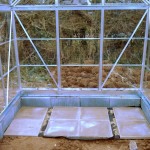
Laying the slabsLevelling the ground and installing the slabs was probably, in fairness, a good worked example of why you shouldn’t let amateurs do hard-landscaping!  The soil at the back of the greenhouse, where the staging was going, produced a rich vein of solid clay, the kind that would probably have made a victorian brick-maker’s month.  Again, we wanted to avoid concrete or mortar, so the paving slabs are to be laid directly onto a layer of landscape fabric on top of the soil, using some ‘pads’ of sharp sand to help level them.

Hard standing installedThere are gaps between my slabs, which I’ll fill with some gravel once I’ve remembered to buy a bag.  Eight blocks across the back of the greenhouse provide a space for some shelving, and then a five-block path runs between the two greenhouse borders from the door.  I’m hoping that the slabs will also provide some useful heat-sink effect to hold warmth into the evenings as the temperature drops.

It’s around this stage in the process, when you’re raking the soil under the pathway to a fine tilth, while treading your precious borders harder and harder, that you remember that gardening is about pretty flowers in the same way that house-building is about paint colours for the hall.  In the end, it’s mostly hard labour!

Greenhouse staging 'installed'Just as I was ready to give myself a big pat on the back and congratulate myself on a job well done, I realised I had a small problem with my (great, cheap!) greenhouse staging.  The pack, describing itself as 2ft 11in (x2) greenhouse shelving (and I’d measured the gap!!) turned out to have the ‘aprox’ behaviour in the, compulsory, unhelpful direction.  They don’t fit!  Until I decide whether I want to take a hacksaw to eight lengths of steel tubing, they’re installed at a rather ‘jaunty’ angle…

No ceremonial carrots, but three big pots of compost with my newly-arrived hop rhizomes in them, pending the preparation of their final planting site.  There’ll also be a water butt to collect the run-off from the roof and reduce the distance I have to walk to fill the watering can.

Completed greenhouse

I think we’re both, it’s fair to say, seriously pleased with our efforts, even though it’s been physically very demanding and taken about twice as long as we had imagined it would.

To finish, and following Ross’s example in his excellent barn door guest blog post, some summaries:

Costings –

  • Greenhouse kit, including base & glazing – ~£350
  • Breezeblocks – £32
  • Paving slabs – £32
  • Sharp sand – £1.81
  • Landscape fabric – can’t remember, it was in the back of the shed

Time invested –

  • Ground clearance ~1 day, two people (or a bit longer for one)
  • Installing breeze-blocks ~1 day, two people
  • Greenhouse build ~ 1 day, two people (if you get up sharpish or have more hours of light than we did!) allowing extra if you want to do silly things with paving slabs inside.

Lessons learnt –

  • Measure, then measure again. Then have someone else measure too.  Don’t trust the measurements on packets, especially when they may be ‘metric’ feet-and-inches!
  • Wear gloves, unless you want to discover quite how sharp the sliced edges of extruded aluminium components can be.
  • Consider the weather forecast.  It can be really *really* cold in February! And finally,
  • If there is more than one possible hole… insert your own joke here.

I can’t wait to really get growing!

Read more from the Country Skills blog >>

Built Like A Barn Door – or, how to make your own shed doors [Guest Blogger]

Lemon TreeOur Guest Blogger is Ross, from Christchurch, NZ.  

You may recall the lovely series of lemon-glut busting recipes which Ross has shared with the blog.  As well as all that preserving, he’s been doing some DIY lately – and I was so impressed by this new shed door that I rather cheekily asked him for a write-up!

So, as they say, now for something completely different! But something which is still undoubtedly a very useful country skill – woodwork.

Scenario

We have a shed. It’s timber-framed, and until recently it was clad with asbestos boards. We got some professionals in to remove and dispose of it properly, and then had a local builder come and reclad the shed in plywood. So far so good, but his quote didn’t include reinstating the door – which, to be fair, was old, rotting, and had a sliding track which was ruined when the asbestos guys ripped it off.

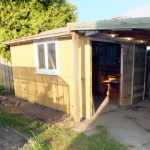
Shed, doorlessWhat to do?

The aperture was 190-191cm high and 140-141cm wide. (Yes, the edges are not parallel; what do you expect?) An unusual size, and if I did get a door made to fit that, I’d also have to shell out for delivery as it wouldn’t fit in the car. Such a wide door would have quite a large swing, which could be a bother.

I got some door designs from various DIY books and websites. The traditional basic ledged-and-braced door design – described as having a “rustic” feel – would certainly work for us. In short, you lay out some planks side-by-side, then nail or screw two horizontals and a diagonal to keep them together, and there’s your door.

Single door panelI don’t have a good picture of the design that doesn’t infringe somebody else’s copyright, but – skipping ahead a bit – here’s what one of ours looks like.

I rapidly came to the idea of a double door to reduce the swing size. But if I made a pair of ledged and braced doors, I’d still have the same problem getting the parts home from our local DIY barn as the wood would be too long to fit in the car.

There was a bit of head-scratching, and a few minutes more spent getting the splinters out from under my fingernails, before I realised what I could do. Stable doors. That is to say, a pair of doors with the ability to swing independently but which fill the frame vertically.

So, to deal with the swing issue as well, I’d make a double stable door. That is to say, four doorlets to fill the space. What could possibly go wrong? I should point out that, between my partner and I, we have limited tools, skill and experience. We have an electric drill and a Workmate, and know what end of a hammer to hold (beginners please note, not the metal end), but New Yankee Workshop this ain’t…

Design

door drawingHere’s the design. H for hinge, S for a door-stop, and the brown rectangles are tower bolts.

If you compare it with other ledge and brace doors, you’ll notice this is a modified design. Traditionally the ledges would both be a little distance in from the top and bottom of each door. Here I have moved the central ledges nearly flush to the edge, for convenience in bolting them together. (I still needed to be able to bolt one side at the top and bottom, but I figured I would use off-cuts to extend the ledges where I needed to. You probably don’t want both ledges to be flush with the edges in case you need to shrink the doors later.)

So I spent a good while in Mitre 10 figuring out which of their available pre-cut timber widths would give me a reasonably convenient time of assembling it all. (I had hoped to find tongue and groove, but they don’t keep any. That was OK as their regular boards are uniform enough; some are a bit warpy but not too bad.)

It broke down like this:

  • Right side: 7x 13.5cm x 9mm boards per door
  • Left side: 2x 23cm x 9mm boards per door
  • Bottom half: Boards to be 1.2m long, uncut
  • Top half: The same 1.2m boards, to be initially cut a few cm too long, then later cut to fit precisely.
  • Ledges (horizontals): Cut to same width as their respective doorlets. I realised later they need to be a little smaller to allow for the swing of the door.
  • Braces (diagonals): Pythagoras tells us that these are going to be longer than the verticals or the horizontals. As they’re blocks with a non-zero width the length will be slightly longer than by Pythagoras, but it worked out within about 1%.

You may notice that (7 x 13.5cm) + (2 x 23cm) comes to 140.5cm, for an aperture that varies between 140 and 141cm in width. This would prove to be annoying later.

Assembling each doorlet

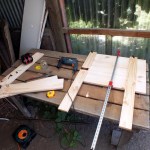
Assembling the doorletLay out your panels side by side. Use a spare block of wood to square up the ends. (For the 7-panel doorlets I did this in two stages, four boards then three, as my working area wasn’t quite wide enough.)

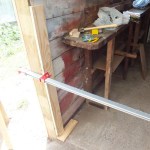
Clamp the ledges into place. I also used a sash clamp to hold the planks together laterally; I don’t know whether this was essential but I suspect I’d have needed more G-clamps if I hadn’t.

Then pin the ledges to the planks. You can do this with nails but I used screws (drilling pilot holes first, of course). I attached each end of the ledge to its corresponding board with three screws, then put one screw into each intermediate board; the same for the other ledge. This may have been overkill.

Next cut and attach the braces. We just marked these with a pencil and steel rule, then sawed as close as we could to the line (fixing up later). The braces have to fit well as they spread the weight of the door. I fixed each ledge with two screws into each end board and one into each intermediate. On reflection this was definitely overkill.

Then paint, varnish, or apply whatever decoration you wish. For efficiency we painted only the outward faces at this point (we have still to paint the shed exterior, after all) – in a less clement climate you might be well advised to paint all of it before hanging to try and prevent damp getting in and warping the wood to next week and back again.

The hinge conundrum

I had read in my DIY book that a tee-hinge was “traditional” for this sort of design of door, so I bought some without thinking much about it. Mistake! For an outward-opening door, it was only going to be possible to put these on the outside of the door, with the screws exposed to all comers: no good for security. (Thank you, Mitre 10 returns policy…!)

I replaced them with some ordinary door hinges, of the kind that doesn’t require you to cut a rebate into the frame.

It’s important to think about where the hinges will attach to, on both the door and the frame. You can’t put screws into the end-grain of a block of wood and expect them to hold. Similarly, putting them into the side of the plywood cladding would have been hopeless. These were going to have to go into a door frame, the shed’s timber framing, or something securely attached thereto.

Shed frameOn one side I had the timber stud. No worries – just have to chisel away a small section of the plywood edge so I could attach the hinges properly into the stud and not foul their pins.

Existing shed constructionOn the other side things were a bit more interesting. There’s no frame to be seen – just the edges of the interior wooden cladding, and a bit raggedy at that.

Adding part-frameTurns out the frame is just behind, so I bought a couple more boards to act as a part-frame, which I attached with long screws through the inner cladding and into the frame.

Hanging the doors

Finally, it was time to hang the doors. You can hang a single door yourself, but it’s a bit troublesome and involves a couple of wedges; much easier with a spare pair of hands. (Sadly, I didn’t have a third pair of hands to photograph this process.)

I started out with the lower two doorlets. Obviously, the bottom doors don’t go all the way down to the deck; you want them to sit slightly off the ground (one source I read said 6mm) for clearance over any debris that may lurk. First fit the hinges (remembering not to put screws into the end grain of a ledge); then put the door into its open position, jacked off the ground; mark the positions of the holes, drill your pilots, then screw it into place.

Except, if you’re me, at some point in this process you think “hey, if I cut rebates for the hinges on that side, even if they don’t need it, I’ll save the couple of mm that will mean I don’t have to trim the doors.” Mistake! I’ve never cut rebates before, and they were distinctly less than even. Worse, the rebates I cut were sufficiently deep that when closing the doorlets fully the pressure tried to rip the hinges off! I ended up packing the hinges with cardboard and crossing my fingers. This may yet come back to bite me, but at least it’s “only” a matter of turning the fake-frames over and rehanging two of the doors, right…?

Offering up the second (larger) door it was clear I was going to have to trim a few mm off the edge for it to fit. On hanging it I found I had somehow managed to give them a 6mm height differential. I wasn’t worried; they swung well, and it’s not surprising as the ground isn’t flat, but if only I had realised this first and hung one to match the other…

Bottom doorlets installedBy now it was getting late. I had bought four heavy-duty tower bolts for securing the doors to each other and the frame, so I used one of them to keep the doors from swinging freely, then called it a night.

Fitting the upper two doors was very much like the lower two, but less close to the ground. We offered each up in turn and trimmed them to fit vertically, as planned.

On closing them for the first time (one at a time), one of the ledges prevented the other door from closing, so we cut a bevel into it. Then the doors fitted!… just. Very very tight, not really usable, so we spent a few minutes hand-sanding the mating edges down. It’s just about usable. I am reticent to take more off yet until the doors have hung for a couple of weeks as they may settle, changing their shape subtly.

Door furniture

All doorlets with boltMy plan for using the door was to treat the whole thing as a double door most of the time. I fitted a tower bolt across each vertical pair to keep them together; this is why I put the central ledges where they are.

Most of the time we won’t need the full width of the door so will only open the larger half. I fitted a tower bolt vertically at the top and bottom half of the smaller pair to secure them. (I added a couple of off-cuts in the corners, butting up to the ledges, so I could attach the bolts with the same deep screws I had been using on the rest of the door. The shed sits on a concrete slab, so making a hole for the bottom bolt to drop into required a couple of minutes with a big masonry bit.)

Inside view, bolts installedThe door is secured by a hasp, staple and padlock across the top pair. I may fit a further tower bolt inside the bottom pair so we can have it held fast while the top pair are open stable-style.

A couple of door stops (not yet fitted at the time of writing) will complete the security, preventing the larger half of the door from being forced inwards when the shed is unattended.

Next steps

After the doors have had time to settle (a few weeks) I will have a good look at them and see if I need to adjust or re-trim anything. I suspect I will want to plane a few mm horizontally off the upper doors where they stick. You can see they don’t sit perfectly; can I claim some sort of amateur’s privilege?

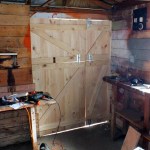
Finished, doors closed

If you have a big gap between double doors you might want to fit an astragal. I may yet fit one on ours – depends how much I remove after it has had time to settle.

Materials and costings

[The costings won’t be of too much use if you’re not in NZ, but they give you an idea. At the time of writing the exchange rate is about NZ$1.90 to £1.]

  • Materials cost: $384.08  – of which $233 was wood, $97 door furniture, $44 paint.
  • Consumables: Sandpaper and sanding block; several dozen screws.
  • Tools used: hammer, wood chisels, electric drill (several different wood bits, a countersink, and a big masonry bit I bought specially so the bottom bolt could drop into the floor), screwdriver bits for the drill (a big sanity saver!), hand plane, G-clamps, 1.2m sash clamp (bought specially for this project; $48.15). Black & Decker Workmate.
  • Time taken: The lion’s share of three days, including trips to the DIY shop. A little more time will be needed after the doors have had time to settle.
  • Labour cost: zero!

The satisfaction of doing it ourselves: *Priceless!*

Lessons learned:

Think through your design. No, really. Don’t assume that hinges will be so inconsequential as to not require thought.

Mortising rebates is hard – or, at least, I don’t have the knack. Beware, it’s very easy to cut too much, which you can’t easily undo.

If you buy hinges that don’t require to be rebated, don’t cut rebates for them!

Remember that the door swings. A thick door, or one thickened by ledges and other attachments flush with the edge, is harder to swing than a thin one.

When hanging a pair of doors that you can see the tops of (e.g. a double stable door like this project), you might want to try and make sure the tops are level.

Ross is an expat thirtysomething Brit who went to the Shakey Isles in search of adventure. Works in technology, enjoys creating, has a love-hate relationship with his kitchen.

Thanks, Ross, for this great DIY tutorial!

It’s been so much fun having these guest blog posts from Ross – and they seem to have been appreciated, too!  So if any readers out there have favourite ‘country skills’ they’d like to share with the blog – particularly if, like Ross, you live on the other side of the world, or have great ‘urban’ country skills – then drop me a line on kate@countryskillsblog.com and we can have a chat!

Read more from the Country Skills blog >>

When Life Gives You Lemons – Part 5: sweet lemon pickle [Guest Blogger]

Lemon TreeOur Guest Blogger is Ross, from Christchurch, NZ.  

You may recall the lovely series of lemon-glut busting recipes which Ross shared with us back in November last year.  He’s back today, with another lovely lemon preserve.  He says of this one “This recipe is a keeper! Much, much nicer than the hot oily one.”

Sweet lemon (or lime) pickle

The hot lemon pickle recipe is, well, hot. Great if that’s what you’re looking for, but sometimes you want something sweeter, less oily and less incendiary. This pickle is easier to make, too.

Prep time: 20 mins
Maturing time: 3-4 weeks

This makes somewhere over 1kg of pickle (I didn’t think to weigh it).

  • About 500g of lemons. (Or limes. Confusingly, the two words seem to often be used interchangeably in Indian English. I haven’t tried this recipe with limes but I expect it’ll be just as great.)
  • 100g salt
  • 500g white sugar
  • 250g demerara sugar (Note: Some recipes call for grated jaggery. If you can get hold of some, great!)
  • 1 tsp turmeric
  • 1 tbsp chilli powder of your desired heat

This recipe is almost entirely jar-based. You need space to throw the salt and sugar around, so it’s back to our old friend the large kilner jar – sterilised, of course.

Wash and dry the fruit. As usual, make sure you’ve removed any wax.

Squeeze a few fruits until you’ve collected about 125ml (1/2 cup) of juice. Keep the skins!

Cut the skins, and the remaining whole fruit, into pieces that are the right sort of size that you want to find in your pickle. This might be eighths or quarters, depending on your taste and the size of the fruit. Put all the chopped pieces into the jar.

Mix the juice, salt and turmeric, pour it over the fruit.

Compress the fruit in the jar so that it’s all covered by liquid.

When you add the sugar, it sinks.Put the lid on and leave the jar in a warm sunny place. While it’s ‘cooking’, give the mixture a good shake-up every couple of days. You’re waiting until the fruit has softened; expect this to take about a week and a half, longer if it’s cold.

Throw in the sugar and mix well.

Put the jar in a safe place (doesn’t have to be sunny this time) for another week and a half or so. The sugar sinks, so give it a good stir every couple of days. Before adding the chilli.When most or all of the sugar has dissolved, it’s ready. I found three distinct layers – floating lemon pieces, the denser sugary syrup, and the undissolved sugar.

After adding the chilliFinally, add the chilli powder and stir well.

It’s now ready to bottle and/or eat immediately. If you bottle it later, be sure to stir well as the fruit tends to rise in the sugary mixture.

No need to refrigerate. Apparently it keeps for over a year if you leave it in a cool dry place – but it’s so yummy, I’m not sure it’ll be around that long!

The finished product

Afterword:

I’ll be making more of this, it’s awesome with poppadoms or as a side with a curry.

You could probably try this recipe to good effect with other citrus fruit, but the combination of the sour lemons and sugar really works well on the taste buds.

Ross is an expat thirtysomething Brit who went to the Shakey Isles in search of adventure. Works in technology, enjoys creating, has a love-hate relationship with his kitchen.

If you’ve enjoyed this recipe, have a look at Ross’s other lemon glut-busting recipes for lemonadelemon liqueur, and lemon sorbet (which you might be needing, if you decide to experiment the hot pickle!).

Read more from the Country Skills blog >>

Stocking Fillers – perfect home-made giblet stock – Blog Advent (24)

We made it, WE MADE IT!  First of all, a huge thank-you to those of you who’ve followed me through this little blogging adventure, for your kind comments, ‘likes’, and contributions.  We did it!  24 days of daily blogs for Advent.  Well, it’s Christmas tomorrow, NORAD is tracking Santa towards us as I type (best get to bed before he gets here!), the Boxing Day ham is boiled and glazed, the gifts are wrapped, and the giblet stock is made.

Giblets are so often overlooked.  The grotty little plastic bag that accompanies any ‘special’ roasting bird (sadly now completely absent from generic supermarket chickens) and which, I fear, most people will be throwing away some time tomorrow morning.  Offal is so horribly out of fashion that an awful lot of people – certainly those who aren’t of the older generation – have no idea where to start.

Last year, on Christmas morning, while I was waiting for my guests to wake up, I blogged my ‘how to’ for giblet stock.  I didn’t have any photos at the time, so here it is again, in the hope it’ll be useful to some of you, re-edited and with some new photographs to help you along!

If you’ve bought a bird for roasting today, there’s a good chance it’s come with a little plastic packet of ‘bits’.  Whatever you do, don’t throw them away!

All the gibletsThese bits are the giblets – the offal – from top-left, clockwise –  the neck (in one or two pieces), the gizzard, the liver, and the heart.  The gizzard is a thick, muscular structure with two hard abrasive grinding plates that the bird uses to crush up corn and other food items to make them digestible.  

Giblet stock is quick, simple, and makes the most wonderful Christmas gravy.

I have a goose this year, but the following applies just as well if you have a chicken or turkey.  Personally, I use the goose heart and liver in one of my stuffings, so only the neck and gizzard are available for the stock.  But if you’re not going to use the heart and liver this way, just chop them roughly and add them to the stock-pot with the rest of your giblet meat.

Stock vegetables, herbs and spicesIn addition to the giblets, you need the following:

  • Stock vegetables.  I use one onion (red or white) and a couple of carrots.  I don’t like celery so I don’t use it, even though it’s the often-quoted third member of the stock vegetable trinity.  But if you do like it, you should add a couple of sticks.
  • A bouquet garni.  This is just a posh culinary term for some herbs. I use some bay leaves, rosemary, and sage, along with some whole peppercorns.  Dried herbs are fine, if you don’t have fresh to hand.
  • Water.  Glug of white wine (optional).
  • A splash of olive oil.

Prepared gizzardsPrepare your gizzard by cutting away and discarding the hard plates (use a small sharp knife inserted below and parallel to the plates).  It can be a bit tricky to get your knife through the outer membrane, but once it’s in, as long as it’s sharp enough, you can just run it behind the plate.  Discard the hard plate material, along with any grotty-looking offcuts.  Then, simply chop the rest of the meat roughly into cubes.

Brown giblets and vegetablesAdd a splash of olive oil to a nice big saucepan, and brown the neck and gizzard meat, and then add the roughly chopped onion and carrots and sautee for a couple of minutes.  Now add about a litre of water (and the splash of white wine if you want) and the bouquet garni, bring to the boil and simmer for about an hour.  

Stock, before simmeringOnce you’re happy with your stock, strain it, discarding the solids, and return the stock to the pot and boil again until reduced in volume by half.  That’s it.  Set aside in the refrigerator until you make your gravy (the stock will easily keep overnight – so make it on Christmas Eve if you have time). You won’t regret it!

Well, here we are – the advent candle is all but burned down, and the Blog Advent journey is over.  I’d love to say it’s been an undiluted pleasure – more than one evening I’ve got home from work, sat down after dinner, and muttered something about ‘still having to do the sodding blog!’, but it’s great to know that I can do it, even at this time of year.

Advent - day 24

I plan to have a few days off now – I think Hubby’s feeling like a bit of a blog-widow!  I wish you all a wonderful Christmas (don’t forget that tomorrow is only the start of the 12 Days of Christmas, which go on until Epiphany – it’s not called Twelfth Night for nothing!), and after the dust has settled I’ll have a few updates, and things which are still secrets for now, to share with you.

Merry Christmas everyone!

I’m trying to write a post a day during Advent, so, please come along with me while I try to Blog Advent – the Country Skills Way – and forgive me if I don’t quite manage it!

Read more from the Country Skills blog >>
Pressing The Flesh – home-made coarse farmhouse pate – Blog Advent (23)

While I suppose a lot of people have their eyes firmly on Christmas Day at the moment – family and friends, food and drink, gifts and treats – I’m also looking through and out the other side, to Boxing Day.  Probably if I’m honest I put more time and effort – certainly ahead of time – into the food on Boxing Day than I do to the food on Christmas Day itself.  After all, Christmas dinner, in the end, more or less boils down to a roast dinner with pretensions!

Boxing Day dinner so often is Christmas leftovers – but in my house it’s a feast of cold cuts.  The ham, which I smoked earlier this month, is slowly defrosting ready for cooking tomorrow. I have a handful of lovely cheeses, all ready.  The spiced plum chutney I made in the summer is now nicely matured.  The sourdough, of course, I made yesterday.  There may be some leftover goose, depending on our appetites.  There’s a game pie, which we collected today from our local farm shop butcher.  And to complete the feast, of course, we’ll be wanting some pate.  I’ve always bought this in the past, and always been slightly disappointed compared to the rest of the wonderful spread.

This recipe is mostly inspired by Delia Smiths’ recipe for Coarse Country Pate, and by the Farmhouse Pate recipe in Raymond Blanc’s classic ‘Cooking For Friends’ which I picked up in the Oxfam shop last time I was in Launceston.

Pate ingredientsTo make this pate, you will require –

  • 800g of really good quality minced pork.  Mine was a mix of minced shoulder and minced belly pork from the butcher. The unidentified packs of minced pork in the supermarket will work, of course, but I suspect at the expense of flavour and quality.
  • 275g of smoked streaky bacon.  I used my home-cure smoked Christmas bacon – so I suppose you could substitute the most expensive artisanal pancetta money can buy… not that I’m biased!  More seriously, make sure it’s dry cured, you don’t want nasty phosphate water from smoke-flavour brine-injected bacon leaking out into your pate!
  • 225g of liver.  Strictly the recipes call for pigs’ liver, but I couldn’t get any this morning I used lambs.  Actually I prefer lambs’ liver, it’s softer and creamier in flavour, but it will be interesting to see how this affects the flavours.
  • To season, 20 each of juniper berries and mixed peppercorns, a teaspoon of salt (I used smoked salt, but this isn’t compulsory), a pinch of mace, two crushed cloves of garlic, and a heaped teaspoon of chopped fresh thyme leaves (dry would do, but make it a level teaspoon).
  • To lubricate, a small glass of dry white wine, and a single measure of brandy.
  • Finally, to decorate, some bay leaves, a few more juniper berries, and a couple of slices of streaky bacon.
  • A 2lb loaf tin, or terrine, and a roasting tin big enough to contain it.

SeasoningsMince up the bacon in a food processor, leaving a bit of texture to it (how much texture is up to you!).  Then, seperately, mince up the liver, again to leave a bit of texture though this will go smoother faster, so watch carefully!  Combine all of these together in a mixing bowl, do it thoroughly and for goodness’ sake use your hands!  Now crush the juniper berries and peppercorns in a pestle and mortar along with the salt.  Add the herbs and spices to the meats, and again mix as thoroughly as you can.  Finally, add the liquids, and mix again.

LubricantsSomething magical happens when the wine and brandy mix with the meats – what started out a bit like a big bowl of sausage meat suddenly becomes silky and the aromas, oh my! Allow the bowl to rest for an hour or so in a coolish place.

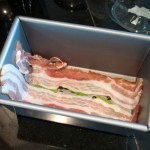
Arrange the bay leaves and juniper berries in the bottom of your loaf tin.  Now take your two rashers of streaky bacon, and place then between two sheets of baking parchment.  Roll them out really thin with a rolling pin. They will easily double in width, and a bit more.  To get them into the loaf tin, I cut away all but the parchment under them, and push this rasher-side-down into the bottom of the loaf tin before carefully peeling away the paper.

Bay leaves & juniper berries   Streaky bacon  Rolled out streaky bacon

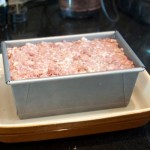
Now pack all the pate mix into the tin, levelling it carefully.  Put the loaf tin into the roasting tin and fill this half way up with boiling water, and put the whole lot in an oven at 150 degrees for an hour and three quarters.

Bacon in tin  Before cooking  After cooking

The block of pate will shrink back from the sides of the tin during cooking, and will be surrounded by fat and jelly juices. Let it stand until nearly cool, and then it’s time to press the pate.  It’s pressed for two reasons – firstly, to compact it and reduce the risk of it crumbling when you slice it, but secondly – and just as importantly for me! – to compact the bottom so you can turn it out neatly!  It smells *wonderful*, just as I would have hoped.  To press it, I covered the top with a double layer of tinfoil, put an old tupperware container on top, and then piled it up with all the weight I could muster.  So, four tins of beans, and four litres of fruit juice ought to do the trick!

Pressing the pate

Once it’s had a really good squeeze, and cooled right down to room temperature, put the pate and whatever weight you can conveniently keep on top of it, move it into the fridge, where it will keep quite happily in its juices and rest and improve for three days before serving.

It’s a new recipe to me, so I’ll be back to tell you how it worked out!  But the smell, oh my, I can’t see it being anything other than lovely!  With crusty (maybe toasted, even?) home-made sourdough.  And pickles!

Advent - day 23

I’m trying to write a post a day during Advent, so, please come along with me while I try to Blog Advent – the Country Skills Way – and forgive me if I don’t quite manage it!

Read more from the Country Skills blog >>