Saint Nicholas – Blog Advent (6)

December 6th is St Nicholas Day, a celebration which was a big part of my early childhood and meets with mostly blank looks when I mention it to friends here in the UK.  My early years were spent in rural Switzerland, and my early memories of the Christmas season are very much from that part of the world.  St Nick of course is the pattern for Father Christmas, but in much of Europe his celebration is separated out from Christmas itself.

I recall St Nicholas Day parades, when St Nick, in full regalia, was carried through the town on a horse or donkey-drawn cart, throwing out wonderful gingerbread cakes to the children.  I can almost taste them now!

On the night of December the 5th, children leave their shoes (preferably nicely polished!) out on the step for St Nicholas.  He comes and fills the shoes of the good little children with sweets and small toys and knick-nacks (I remember getting a French knitting loom in the form of a soldier, one year).  There are variations in the tradition, of course, depending on where you are in the world, but generally St Nicholas has a not very nice sidekick, known as ‘Père Fouettard’ (roughly translated, ‘Father Whip’) or Black Peter (with a blacked-up face which is either very un-PC, or has been retro-fixed to describe him as a chimney sweep!), in the part of the world I was in, but he comes with different names and identities in different places.

If you read up on this on Wikipedia, you’ll find it asserted that although St Nick’s nasty sidekick is supposed to bring punishment, or at least make sure that St Nick doesn’t bring gifts to the bad little children, this is some sort of an empty threat, and of course all the children get gifts.  Well, I remember vividly at my Swiss infants’ school (and I’m not so *very* old), that while the rest of us got sweets and chocolates, Black Pete brought only a piece of coal to the ‘bad’ child in the class.  Imagine that, these days?

Advent - day 6

I’m trying to write a post a day during Advent, so, please come along with me while I try to Blog Advent – the Country Skills Way – and forgive me if I don’t quite manage it!

Read more from the Country Skills blog >>

We’re On A Roll – recycled gift box – Blog Advent (5)

Just a really quick, simple Christmas gift wrapping tip for you all tonight – I can’t even claim it’s original, since I saw the idea on Pinterest a few months ago, but it stayed with me as something cute, and really rather useful!

Finished wrap

You will require...Here’s a cheap, quick, attractive, and recycled way to wrap small gifts this holiday season, using only things you already have – the cardboard centre of a toilet roll (or kitchen towel roll, or the centre of a roll of wrapping paper), some small scraps of wrapping paper, and some ribbon, raffia, or twine.  Yep, a toilet roll centre.  Nothing but the best here at the Country Skills Blog!

Wrapped and flattenedStart by wrapping the cardboard roll in a piece of wrapping paper – I had some gold tissue paper lying around, so I used that.  Tuck in the ends.  Now flatten the tube.

Fold over endsThis is the cute bit.  Simply fold the ends towards the centre to form a small curved box.  You’ll need to form the fold along a bit of a curve.  It’s worth playing with an unwrapped tube first, just to get a sense of the shape you’re after.  Hell, it’s something to do instead of the sudoku while you’re sitting on the throne!

Completed boxAnd here’s your completed box.  Just tuck whatever special little gift you’re wrapping inside, perhaps folded into an extra piece of tissue paper, and tie it up in a bow with some ribbon, raffia, twine or even knitting yarn!  Gift boxes can be so expensive – this one looks a million dollars, is a great solution to the ‘fiddly little package’ problem, and costs nothing!

Dave's tube!I was going to show you a bigger one made from a section of wrapping paper tube, but Dave thought better of the idea.  He says you all seem like smart people and he’s sure you can work it out for yourselves!

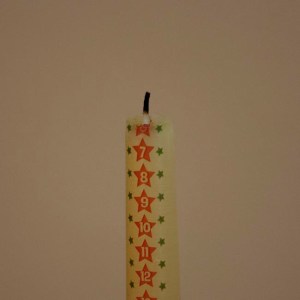
Now I’ve got a little confession to make – last night, while I was writing up the hazel and twine Christmas star decorations, I took my eye off the advent candle and we got a bit ahead of ourselves – all of today’s candle burned and half of tomorrow’s!  Oops!  It looks a bit sad tonight!

Advent - day 5

I’m trying to write a post a day during Advent, so, please come along with me while I try to Blog Advent – the Country Skills Way – and forgive me if I don’t quite manage it!

Read more from the Country Skills blog >>

Star of Wonder – simple twig and twine decorations – Blog Advent (4)

Blogging on work nights is a bit of a challenge – but here’s what I’ve been up to the past few days, in bits and pieces, finished off during my lunch break today – some really pretty, simple, twig and twine Christmas star decorations (I wrongly described these as Star of David decorations – they’re not of course, but you could easily make those if you prefer them!).

Hazel stars

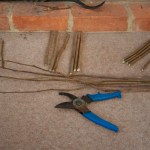
Preparing your twigsMine use some thin hazel ‘whips’ we pruned from our hedge a few weeks ago, but anything would do – willow or ash would be particularly suitable as they tend to grow nice and straight, but a quick scavenge around the garden, park or woods should yield something you can use.  The only other things you need are some string (I used jute twine because I think it’s pretty, but raffia or plain cotton or linen string will do just fine), and some fabric glue (I’ll get to this later).

Arrange your piecesCut your twigs into even lengths using garden cutters – I wanted different sized stars, so I cut the thicker ends of the twigs into longer pieces than thinner bits.

Now, I’m going to pause the how-to quickly to teach you a little trick you really need to know, and it’s a knot known (to me anyway) as a ‘packer’s hitch’ – I’m informed by my sister, who knows better, that it’s properly called a clove hitch!  It’s a self-tightening double loop, so is ideal for this sort of job – or any other situation when you’d otherwise be calling out for someone’s finger to hold the knot for you!  I’ve illustrated it below, but basically you form two loops in the same direction, then take the second and pass it behind the first.  Anything you pass through the centre of the two loops is caught in your noose, pulling the ends tightens it but because the way the knot is constructed, it’s very unlikely to loosen itself again.  Tying a second throw over the top, as in a reef knot, secures the hitch permanently.

How to tie a packer's hitch

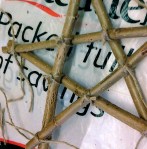
Points of star, tiedForm a packers hitch, and use it to tie the tips of two of the twigs together.  Don’t complete the knot with a second throw at this point, you’re just loosely securing the ends.  Work your way around all five points of your star.

Now, have a bit of a play with your twigs to make sure you’re happy with the shape, the more even the better, but twigs are an organic thing, so the aren’t always straight or completely even!  That’s part of the beauty of these little decorations.

Knots placedOnce you’re happy with the shape, start tying the twigs together where they cross over in the centre. I use a knot which crosses over to stabilise the joint.  Make sure you arrange these so that the knots are on the same side as those from the packer’s hitches!  Just like these hitches, don’t complete the knots, just tie the first throw.

This is the time to decide which point of your star is the top, if you’re planning to hang it.  If so, replace the packers hitch on the top point with one made with a much longer piece of twine, so there’ll be plenty of length to work with.  If you want a string of stars, do the same thing with the centre point at the bottom, letting a long tail hang down.

With centre knots completeNow, go around all of these knots and put a blob of glue on the knot – I used fabric glue, because it was what I had to hand, but anything which goes on or dries to clear should be fine.  Now tie your knots nice and tight, and add an extra throw, if you like.  The glue is to stop the knots unravelling when you cut the tails off really short, which is what you’re going to do next.  Now do the same with the packers hitches at the points, making sure that you tie everything as tight as possible before securing the knots down with a blob of glue.

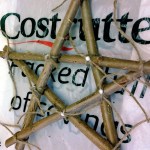
Finished starsIncidentally, I apologise for the classy ‘Costcutter’ bag, it was protecting my table at work from the consequences of my lunchtime activities!

That’s it, you’re done, if you want to be.  I think they look great ‘au naturel’, but I’m planning to get out my gold spray paint and just add a slight ‘burnish’ which I think will really add that final detail to the finish.  You could spray them any colour (or combination of colours!) to suit your decor.  Also consider adding glitter, beads… whatever takes your fancy!

This would make a really good kid’s Christmas craft, I think – no dangerous parts (assuming a grown up cuts the twigs up!), fiddly enough to be challenging without being overwhelming, with a pretty end product, and knot-tying skills to boot!  Perhaps one to try with a group of children at a Christmas party, club or youth group?

Advent - day 4

I’m trying to write a post a day during Advent, so, please come along with me while I try to Blog Advent – the Country Skills Way – and forgive me if I don’t quite manage it!

Read more from the Country Skills blog >>

All Things Bright And Beautiful – Blog Advent (3)

I’ll be honest and say, I’m not a huge fan of outdoor Christmas home-illuminations!  Yes, sometimes you see some gorgeous efforts – a beautifully lit tree in a front garden, or some little tasteful icicles adorning a gutter – but so often, they’re really really naff!

This little home-made decoration is my concession to fairy lights around the front door, and hangs in the tall thin window which we have just to the side.  I think it’s really lovely, festive and welcoming, don’t you?

Front door lights

It was so quick to make, out of a small piece of left-over silver organza, and a cheap string of LED Christmas lights, so I thought I’d share it with you lot.  You can easily adapt the idea to fit any window or door which particularly needs a bit of sparkle!

Centre joinConstruction is very simple, it’s just a tube, closed at the top, and open at the bottom.  My fabric was too wide and not long enough, so there’s a join in the middle – this isn’t a problem! The open bottom needs to be hemmed, but nothing else does. I think the seams add a nice additional texture in the way the lights play on the fabric, so I didn’t make any effort to cut them really narrow or press them flat.  This is the reason I’ve left the long seam in the middle of the decoration, too, rather than trying to hide it away to one side.

Top detailThe wire for the lights goes in at the bottom (conveniently, your plug socket is likely to be down there somewhere!), and loops over a  few stitches up in the top of the tube before hanging back down again.  If you’re making this for a wider window, you could have two or three of these supporting clusters of stitches, and loop the lights over each in turn.  Finally, there’s a little loop right at the top to hang the decoration from.

Front door lightsI used my sewing machine, but it’s simple enough that you could easily run it up by hand if you don’t have convenient access to one.  This is what it looks like from indoors, it makes a lovely addition to the doorway from both sides, I think!

This is likely to be our only real decoration until we get the tree in a week or two – but it gives us an exciting promise of sparkly pretty things to come!

Advent - day 3I’m trying to write a post a day during Advent, so, please come along with me while I try to Blog Advent – the Country Skills Way – and forgive me if I don’t quite manage it!

Read more from the Country Skills blog >>

No Smoke Without Fire – Boxing Day ham and Christmas bacon – Blog Advent (2)

This morning, bright and early (probably a little *too* early after last night’s lovely Christmas dinner with some excellent friends!) and in the freezing cold, I got my smoker out and set up.  For the past couple of weeks, my fridge has been half full of partly cured pork products.  Well, the curing finished last week, and today it was time for some smoke!

Smoker, set up ready

What you can see hanging there is my boxing day ham, and a batch of Christmas streaky bacon.  For more information on my DIY cold smoker, you can have a look at the smoking and curing posts, collected here.  For suggested UK supplies of smoking and curing ingredients and paraphernalia, have a look at my suppliers list.

The little sawdust-burning ProQ cold-smoke generator has served me very well in the course of the last year or so, but we had a bit of excitement with it this morning, after the tea light which is used to start the sawdust smouldering decided to overheat and do a striking impression of a miniature chip pan fire!  You’ll be relieved to hear, I’m sure, that no serious harm was done to the bacon, and that I still have my eyebrows!  It was however alarming enough that I’m going to look into alternative ways of starting the smoulder in future.

Boxing-Day Ham

Baked home-cured hamThe amazing colour of the ham comes from the same treacle-based cure I blogged about using earlier this year, though in deference to the larger piece of pork leg, and the fact that this time, it has the bone in, I allowed a curing time of 10 days.  The only other change was the addition of a couple of fresh bay leaves to the curing solution.  The gorgeous 2.5kg piece of pork leg came from our local farm shop butcher, who has wonderful meat.

Between now and Boxing Day, once it’s rested for 48 hours to let the smoke flavours permeate, I’ll wrap it up and put it in the freezer.  I’m expecting that, once boiled and glazed, it will look a lot like this – I can’t wait to see what difference the smoke makes!

Christmas Bacon

Gorgeous pork bellyThe bacon is mostly intended for gifts (except for the biggest piece, which is mine-all-mine!).  It was a great success last year, and seemed popular with its recipients!

It’s been curing over the last week, using a bacon-in-a-bag technique I’ve been refining over the last year.   Nearly all my home-cured bacon is made this way now, and I’ve settled on an 8% cure for most purposes, made up with between 66-75% curing salt and 25-33% sugar.

This total batch was about 2.5kg in weight.  In addition to the meat, I used –

  • AromaticsSupracure – 133g  (see my other curing posts for more information about this pre-mixed curing salt)
  • Mollasses sugar – 66g
  • Aromatics, consisting of 4 bay leaves, 20 juniper berries, 40 allspice berries, one clove, and about 1/4 of a whole nutmeg
  • Two large strong freezer bags

Prepared bacon cureGrind up all the spices in a spice grinder (except the nutmeg, which you’ll probably be safer grating by hand), and then mix the spices into the salt and sugar.  Prepare the pork belly by trimming it if required and then slicing into the appropriate pieces.

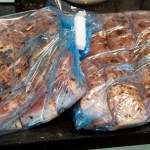
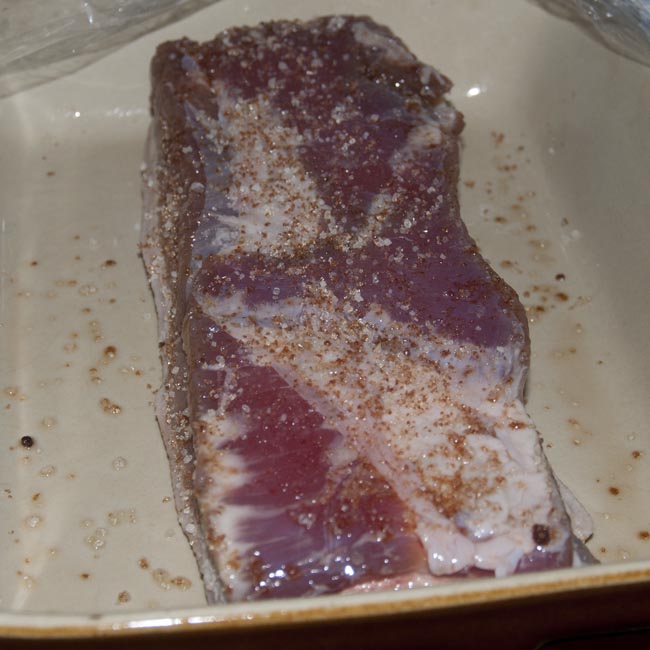
With cure rubbed inNow rub about half of the cure generously over all the surfaces of the pork, and pack it into the freezer bags.  Put these in the fridge and turn them over at least once a day, alternating which one is on top if you have more than one bag.

In two days (three if you’re using pork loin rather than belly), pour off any liquid which has accumulated in the bag – this may be very little if you started with excellent quality meat that hasn’t had water added! – and apply the rest of your cure mixture before returning to the fridge for a further 3 days, turning daily as before.

Bacon in a bagAfter your 5 or 6 days in total have elapsed, take the bacon out of the bag, rinse it carefully under cold tap water, dry with kitchen towel, and place on open racks or uncovered on plates in the fridge for another day (or ideally two) to allow the pellicle to form – this is a sticky glossy surface which will develop on the surface of the bacon.

Then, you can eat your bacon, or, as I did today, smoke it.

I’ve used a mix of beech and apple sawdust for todays smoke run, it gives quite a strong, aromatic smoke which I think will stand up well against the robust flavours in both the ham brine and the bacon cure.

The bacon will be frozen, wrapped as individual pieces in waxed baking paper, until we use ours to make our pigs-in-blankets on Christmas day (it was amazing last year!), or give it as gifts.

Advent - day 2

I’m trying to write a post a day during Advent, so, please come along with me while I try to Blog Advent – the Country Skills Way – and forgive me if I don’t quite manage it!

Read more from the Country Skills blog >>

Like a Candle in the Dark – Blog Advent (1)

It’s the first of December, and secular Advent is with us at last.  Kids (young and old!) all over the world have broken open the first window of their Advent calendars this morning, and the countdown to Christmas is well and truly on!

Advent candle

I started candle making last year, in a very small way, and mused at the time whether my advent candle, this year, might be home-made.  Well, here it is!  I’m quite pleased with it!

Advent - day 1

Candle making is a great little craft, though it can be a bit time consuming.  I’ve had an Advent candle for many years, and it’s such an important part of my pre-Christmas traditions that I wanted to get it right.

Incidentally, these instructions are equally relevant to making almost any sort of pillar or taper candle.  My consumables (wax, transfers etc) mainly came from Making Your Own Candles (see the suppliers list for more details).

Candle moulds and wickTo make a candle like this one, you’re going to need the following –

  • A taper candle mould (mine were cheap, plastic, and came from eBay – more sophisticated models are available!)
  • Appropriate candle wax – I used 90% of a paraffin pillar blend, and 10% beeswax
  • Candle dye and scent (optional)
  • Waterslide transfers for the Advent days (you can skip this if you’re just making dinner candles!).  You can buy waterslide transfer papers for laser printing yourself, or buy the transfers already printed from a candle supplies shop.
  • Wick – I used LX8 for these taper candles – wick sustainers and mould seal
  • Basic candle-making equipment – some sort of double boiler (mine is a large tin can in an old pan), a jam thermometer, an a stirring stick of some sort.  These should not also be used for food!
  • Kitchen scales, hob, fridge and freezer.

Wax beads with stirrer and dyeFirst, assemble your moulds if required, and then work out their volume (I filled them with water, and then weighed the water).  This will let you work out how much wax they will take to fill.  Wax is about 10% less dense than water, so reduce your weight by 10% and that’s the amount of wax you need.

Each of my taper moulds took about 60g of water, which I adjusted down to 55g of wax made up 50g of paraffin and 5g of beeswax.  I also added a 1g chip of fudge-coloured dye to the 110g of wax (that’s the orange thing you can se in the wax tin).  Now warm the water in your double boiler up until the wax starts to melt.  This should start at about 65C.  Try to keep the water below 75 to ensure the wax stays safely below its flashpoint (the temperature at which it’s at risk of catching fire).  The lower the temperature you keep your melted wax while working with it, the less shrinkage will happen as it cools, which is likely to give you a better result, so be patient and let it melt slowly!

Wick fixed with mould sealMeanwhile, prepare your moulds, feeding the wick through the wick hole at the bottom and plugging this with some mould sealant (I use generic white-tack of the sort you’d use to fix posters to the wall, and this seems to work fine).  Then turn the moulds the ‘right’ way up, and secure the other end of the wick to a wick sustainer, again using some of the tack.

If you’re adding scent to your candle wax, do this now, just before pouring, to reduce the amount of scent you will lose by evaporation from the hot wax.  I added a few drops of sweet orange and ginger essential oils to give a gentle festive scent – but there are lots of commercially prepared specialist candle scents, which, unsurprisingly, you should use according to the directions that come with them!
Moulds ready for pouringOnce your moulds are ready, you can start pouring the melted wax.  Do this carefully but steadily.  You can see that I placed my moulds in a tin just in case the mould seal failed, to avoid molten wax going all over the kitchen.  Fill both moulds all the way to the top.  You will have some left over wax, if you’ve calculated right. This is good news.  Put your filled moulds somewhere cold such as the refrigerator, or outside, for about an hour.

Candles with voids around wicksMeanwhile, either keep your wax melted (this involves watching it carefully all the time) or pour it out into a container like the tinfoil tray and let it set for now. After about an hour, retrieve your candle moulds.  You’ll notice that there’s a massive great ‘well’ in the centre of your candles.  Give this a bit of a poke with a kebab skewer to make sure there aren’t any hidden voids, then re-melt the wax you have left over, and use it to top up the moulds again, right to the top.

Finished candles in mouldsReturn the candles to your cold place to finish setting for a few hours.  When you get them out again, they should look a bit like this.  Now you need to release them from their moulds. Shrinkage is your friend here, so I stuck mine in the freezer for about half an hour.  Then I could pop the cap from the bottom of the mould and gently ease the candle out – well, that’s the theory at least.

Candle free from mouldAs you can see from this next photo, on this particular candle – the first I made, I ended up accidentally breaking the rounded top of the candle in the process. Well, you live and learn, and subsequent efforts were more successful!  Freezing is a big help, as is giving the mould a brisk but gentle tap before gently pushing up from the ‘pointy end’.

You can tidy up and ‘finish’ the bottom of the candle by trimming the wick and then melting the bottom against a hot iron or any other hot surface to melt it down flat.  Obviously, choose your hot surface judiciously and don’t use your laundry iron or anything that’s for food use!

If you’re just making a dinner candle – congratulations, you’re done!  If it’s an advent candle you’re set on, there’s just one more step to go.

Plain candles with waterslide transfersApplying the waterslide transfers turned out to be surprisingly straightforward.  Cut these to size, if required, then soak the transfers in a bowl of tap water for about a minute.  This will allow the clear film which forms the transfer itself to come away from the paper backing.

waterslide transfer soakingThen, very gently place the film on the surface of the candle and smooth it out.  It won’t stick down fully for a couple of minutes as it dries, so you have plenty of time to straighten it out and get rid of any bubbles or wrinkles, I found wiping it gently with a damp piece of kitchen towel was very helpful.

I’m really happy with mine – isn’t it gorgeous!  It’s a lovely warm honey colour, and has a gentle fruity scent from the essential oil additions.

Candle and calendar

Of course, many people prefer an Advent calendar to a candle – those of you who were early readers of this blog may remember my fabric Advent calendar project from last year.  You can see more photos and instructions for the calendar over here.

I’m trying to write a post a day during Advent, so, please come along with me while I try to Blog Advent – the Country Skills Way – and forgive me if I don’t quite manage it!

Read more from the Country Skills blog >>

Holidays Are Coming… and it’s very nearly Advent!

There’s no escaping the fact that winter has well and truly arrived, and that Advent, and Christmas, are just around the corner!  Christmas is probably my favourite time of year, which is a bit odd, I suppose, as I really really don’t get on with winter.  The cold, and especially the long dark months, seem to sap my energy.  I’m sure I evolved from a creature that hibernated, because honestly I could curl up under a rock in the middle of November and not come out until March.  But Christmas – Christmas is a bright, beautiful jewel in an otherwise dark and barren winter landscape.  The lights and sparkles, the food, the drink, and above all, the laughter and joy of loved ones, friends and family.

Every year that goes by, I seem to spend less money on a ‘commercial’ Christmas, and more time and effort on home-made, food and drink, gifts and decorations.  So the next few weeks are going to be really busy!  Never mind the inevitable – welcome, but time consuming – increase in social commitments, works parties, people visiting. Of course, what everyone needs with all this going on is an extra time-sink.

The thought occurred to me a couple of weeks ago that it would be really fun (fun?!?) to try to blog daily, from December 1st to Christmas Eve – about my Christmas preparations, food and drink, making and doing, building up to the big day…

So, please come along with me while I try to Blog Advent – the Country Skills Way – and forgive me if I don’t quite manage it!

Read more from the Country Skills blog >>
Big Bacon Challenge: Rounding Up – volunteers’ feedback

A few weeks ago now, all my lovely volunteers for the Big Bacon Challenge made their first batches of home-cured streaky or back bacon.  Several of them have blogged about their experiments, so I’d like to bring together some of their comments and reports.  I wanted to show as many people as possible that making your own bacon at home is not only incredibly simple and straightforward, but produces some of the best bacon you will ever have eaten – these reviews I hope go some way to supporting that!

Streaky bacon mid-curing, with dry curing mix applied

‘Ghoti’ writes about her bacon over on LiveJournal:  My favourite exerpt from her report – “So, in summary: utterly delicious, and a three year old can make it.”

‘Amlees’ wrote up her bacon day-by-day at Alison Was Here, and her collected bacon challenge posts can be found here:  “So the bacon is cured and rested and ready to eat.  John cuts thick slices and fries them for breakfast, with an egg on the side.  The bacon is delicious and satisfying, if a little salty. (…)  However, the bacon is as good as the bacon we normally buy (the expensive dry-cured kind).”

Finally (for now at least) ‘5greenway’ wrote on the Very Berry Handmade blog about their bacon in two posts – at the start and end of the process – “So, the process was really easy. But it would all count for nothing if the bacon wasn’t up to scratch… Just looking at it before cooking, we suspected it’d be pretty good, but it tasted even better than we expected. Not too salty, a nice flavour from the cure & a kind of melt in the mouth texture.”

I’m informed by several of my volunteers that they have since bought their own supply of curing salt and continue to make home-made bacon (and other goodies!), so I’m declaring the challenge a success!

A great big THANK YOU to all of my volunteers, and if any of you have any further feedback, please do comment or email so that I can include it here!

All the Big Bacon Challenge posts will be collected under the ‘BigBaconChallenge’ category heading – so go there to read them all!

Read more from the Country Skills blog >>

Big Bacon Challenge: after the challenge – what now?

You’ve come to the end of the bacon challenge, hopefully sampled your efforts and agreed they are *good*, so where do you go from here?

I was very pleased (a teeny bit smug, even?) to hear that one of my volunteers has already dived in and ordered her own supply of Supracure – if you want to do the same, I can heartily recommend both HotSmoked and Weschenfelder (details in my Suppliers List) for curing and smoking supplies.  Both sell Supracure in 2kg packs for about six or seven pounds.

Before considering whether to do the same, and make curing a regular part of your culinary routine, it’s worth giving the costings a little thought.  By necessity this is just a snapshot – since food prices are constantly shifting – but it gives an indication.

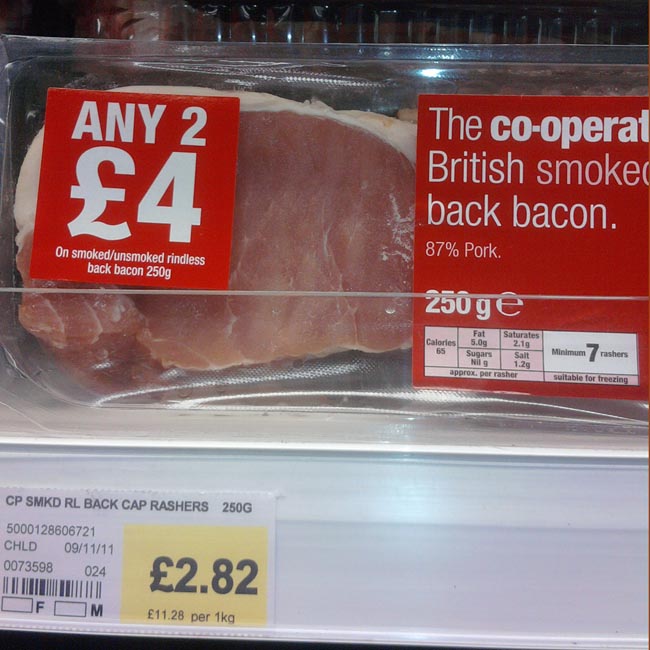
Retail-packed back baconLet’s look at 1kg of back bacon.  On the basic recipe this will take 1kg of pork loin, 80g of curing salt and 20 g of sugar.  We’ll ignore the sugar for convenience, since it’s a small quantity and you almost certainly have it already.  The curing salt costs – round figures – about 30p.  So really it’s just the meat we need to consider.  You can generally get hold of bog-standard own-brand back bacon on ‘2 packs for £4’ type offers where the pack size is between 230g and 250g. Bearing in mind this bacon is about 13% added water, let’s call that an equivalent per kilo cost of about £9.

Compare with this, Tesco this week list their Rind-on Pork Loin Roasting Joint at 3.99/kg – admittedly a half-price special offer, but even the full cost of £7.99/kg represents a *small* saving.  The key to really making this work is to buy whatever’s cheap this week – be it loin or belly, or even belly slices.  It’s a pretty safe bet most supermarkets will be discounting something suitable at any given time.  Of course it pays to be flexible, but if you only like back bacon, buy loin when it’s cheap and freeze it – or make a big batch all at once and then freeze it once it’s bacon – personally I can see no difference in quality from doing this, though obviously you should do one or the other, not both!

To even start to compare like with like, though, it’s really good dry cured butcher’s bacon you need to consider – a spot of quick googling suggests this is for sale from various producers at about £15/kg.  So it’s clear that with a bit of canniness, not only is the end product fantastic, but there’s an easy 50% saving to be made on the cheap & nasty brine-injected supermarket commercial bacon offering, and a tidy 75% off the nearest equivalent butcher’s bacon.  Streaky bacon is usually a little cheaper than back, but since belly pork is a cheap cut par excellence, the maths for home-cured streaky bacon generally adds up just fine without depending on special offers.

Convinced?  Then you’ll need to decide what to try next.

My usual ‘house’ cure is actually a black pepper cure – essentially the cure we used for the Big Bacon Challenge, but with 3 grams of freshly ground black pepper (I recommend a pestle and mortar for this) added per 50-60g of cure mix (curing 500 – 600g of bacon).  This cure is great with or without smoking the bacon after curing – more of which later.

Juniper and Bay cure, and ingredientsIf your taste runs more to cooking bacon for stews and sauces than to breakfast rashers, perhaps try the bay and juniper cure, which produces a lovely deep rich aromatic flavour.

The limit to what to add to cures really is your imagination – within some basic limits on proportion of salt and sugar (I’ve used between 20% and 33% sugar with great success) – do some reading (perhaps look in the Library for inspiration) and see what you fancy!

I can’t leave the subject of bacon curing without a brief mention of smoking.  Not everyone likes smoked bacon, of course – though since commercial ‘smoked’ bacon has concentrated smoke-flavour added to the brine, and bears about as much resemblance to the real thing as Nescafé does to a real steaming espresso, perhaps it deserves a second chance..?

I’m British, so when I think about smoking bacon we’re talking about cold smoking.

The key to this process is bathing your cured meat in cold smoke over a period of several hours (I usually smoke my bacon for 10 – 12 hours), so you either have to produce your smoke consistently, and with as little heat as possible, within the smoking box, or produce hotter smoke at a distance from the box and then ‘duct’ it in allowing time for it to cool down.  It’s a tinkerer’s paradise, so please do consider it for a bit of a mad project – there are as many designs for DIY smokers as there are people who build them I think!

ProQ cold smoke generator, lit

We designed and built a wooden tower smoker – effectively just a fancy wooden box with some shelves in it – which I fill with smoke using a commercially available cold smoke sawdust burner.  I probably could have constructed a smoke generator very similar for not much money, but I wanted to start with something that would Just Work, the cost wasn’t prohibitive (around £20) and I don’t regret the decision.  It’s a great piece of culinary gear, think how much fun – and flavour! – you could have with smoked trout and salmon, smoked salt, smoked garlic and chillies, as well as your bacon!

Finally, a big thank-you to all my Big Bacon Challenge volunteers – looking forward very much to hearing what you all thought of your efforts  – and to the rest of my readers, thank you for your patience with the bacon-centric tone of the blog the last couple of weeks, normal service will be resumed very soon!

All the Big Bacon Challenge posts will be collected under the ‘BigBaconChallenge’ category heading – so go there to read them all!

Read more from the Country Skills blog >>

Big Bacon Challenge: time to share and enjoy!

You’ve made your bacon, and now it’s time to sample it!

You can do anything with your home-cured bacon you can do with shop-bought bacon, and more.  Of course you can slice it and fry or grill it as part of a full english breakfast (or in a floury bap with ketchup, or in a sandwich with lettuce tomato and mayo).  You can dice it and enjoy it in stews and pasta sauces (think lardons or pancetta).  Really the only limit is your imagination.

Sliced home-cured streaky bacon

I recommend you sample your bacon for the first time cooked very plainly – sliced and fried or grilled – since you’ll get the best sense of what the flavour and texture is like this way.  Get a nice sharp long-bladed knife – it’s worth taking the extra couple of minutes to sharpen this if the blade isn’t quite up to scratch – and slice the bacon as thinly as you can.

Sliced home-cured baconYou’re not going to get it as thin as commercial bacon, but that’s fine – aim for about 2mm thickness, this should be very achievable with some practice.  It’s worth cutting a thicker piece off first to get a nice flat edge – this won’t go to waste as you can dice it for a stew or a sauce later.  Leave the rind on – you don’t have to eat it, you can always trim it off later.

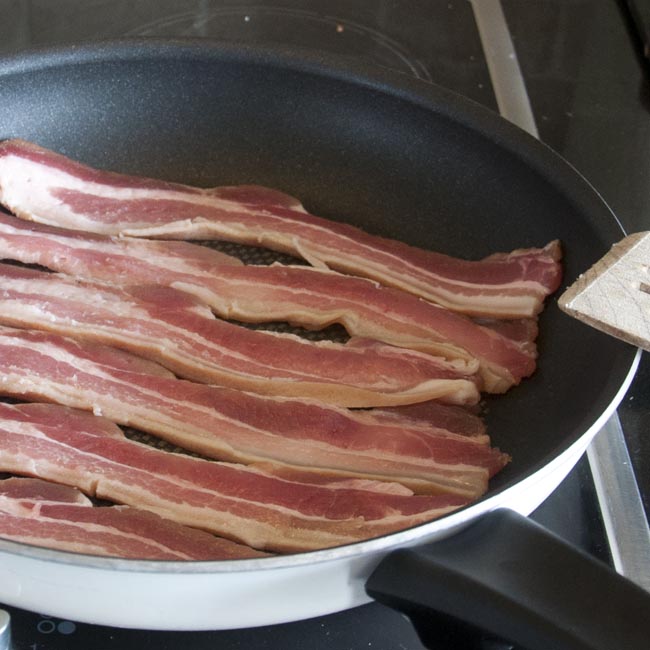
Bacon in the panPut your sliced rashers into your frying pan on the hob, and wait for the sizzle.  This really will be the first sign you get that things are cooking.  What you won’t get is the pan full of white liquid we’re all so familiar with from commercial bacon, in fact it will stay completely dry until later in the cooking process when the fat starts to render.

Frying bacon in panCook your bacon, turning occasionally, until the fat is rendering and you have some lovely golden caramelised areas.  This bacon will take longer to cook than stuff from a packet – it’s sliced thicker, and it’s a lot denser, so be patient and take the time.

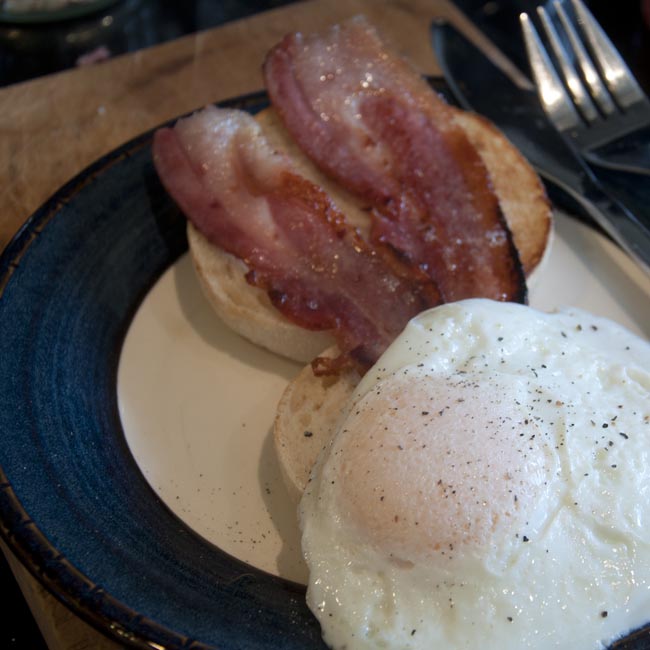
Bacon & egg breakfastThen serve in whatever way you like – we had ours with a fried egg and toasted muffin for breakfast.  The hens get a mention for the gorgeous fresh egg, too!

If there’s any bacon left over, wrap it up in the paper again and put it back in the fridge.  It will keep at least a week and usually two.  Don’t be tempted to seal it in a plastic bag, cling film or in a tupperware box, it’s a natural product and needs to breathe!

When you taste your bacon, please let me know what you think of it!  In the last post of the bacon challenge series, I’ll suggest some ideas of places your new skill might take you next!

All the Big Bacon Challenge posts will be collected under the ‘BigBaconChallenge’ category heading – so go there to read them all!

Read more from the Country Skills blog >>