Pain de Savoie, from Paul Hollywood’s ‘Bread’ – Cooking the Books, week 2

We seem to have ended the Christmas season with rather a lot of lovely cheese in the fridge! So today’s challenge was to find a recipe in my cookbook collection which would let me use some of it to make something absolutely scrummy. I haven’t baked any bread for a couple of weeks and remembered that Paul Hollywood might have something that would suit… So I dug out ‘Paul Hollywood’s Bread’, which accompanied last year’s popular BBC TV series.
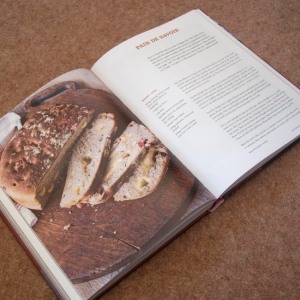
Bread inner page view

And there it was – Pain de Savoie – a lovely looking loaf stuffed with cheese (yes!) and bacon (even better!). Savoie is an alpine region, and as everyone knows, mountain folk have all the best gorgeous stodgy winter comfort food. I had high hopes!

To make this loaf, I used –

  • White & rye flour400g of strong white bread flour
  • 100g of organic rye flour
  • 1 small tsp of sea salt (I can’t bring myself to put more than this into a loaf)
  • 7g pack of fast action dried yeast (oddly, the recipe wanted 8g)
  • 150g of home-cured smoked streaky bacon, rind removed, and cut into lardons
  • 200g of wonderful aged Gruyère
  • Olive oil
  • 330ml of tepid water

Start by weighing your flours and combining in a large mixing bowl, add the salt, yeast, a generous tablespoon of olive oil, and then mix in about two thirds of the water, using your fingers.

Roughly mixed ingredientsThis should roughly combine the dry ingredients but leave them a little dry, so add the remaining water progressively until all the dry ingredients come together as a ball, leaving the sides of the bowl reasonably clean. I found I had just over 50ml left over, but this will depend on the characteristics of your flours. The dough should look a little like this before kneading.

Now knead for 5-10 minutes until it becomes smooth and elastic. You’ll notice the difference – it may take longer than this if you’re not accustomed to kneading, but you’ll get there! I have wholeheartedly adopted Paul’s recommendation of kneading dough on an oiled surface, after a lifetime of using flour – I don’t think it makes very much difference to the dough, but it doesn’t half reduce the mess you make of your kitchen!

After kneadingOnce you’re done, the dough ball will look like this. [You’re supposed to add the fried & cooled lardons at this stage. I suffered an unfortunate spot of reading comprehension fail, and didn’t.] Oil the mixing bowl and put the dough ball back inside, cover with a piece of oiled PVC-free cling film, and set aside for a couple of hours until it’s doubled or more in size.

Ignore anything you might have heard about putting dough to rise somewhere warm like an airing cupboard, just sitting out on the kitchen counter should be fine, unless it’s very very cold, in which case I’ve done well with putting the bowl in the oven with just the oven light turned on. Letting bread rise in a warm environment certainly will speed the process up, but at the expense of the flavour that develops with a slower, lower temperature rise – and if you wanted tasteless bread, you’d just eat the junk from the supermarket.

Fried bacon lardonsIf like me you’ve forgotten to include your lardons, now is the time to fry them until golden. I used my home-cured black pepper bacon, which is lightly smoked. Incidentally, this is what really good dry-cured bacon should look like, when you’re frying it. See that lovely, clear bacon fat in the pan? That’s all that should ever leak out. And because it’s not wet, and doesn’t leach phosphate water, it fries to a beautiful golden caramelised surface. Fabulous. Once it’s cooked, set aside to cool. And try not to sample too many pieces in the name of ‘quality control, eh?

Combine with baconI turned the dough out onto the work surface, knocked it back into a rough rectangle, and sprinkled over the cooled bacon pieces before rolling it up into a rough sausage and cutting it into three (very roughly) equal sized pieces. Each of these pieces I kneaded a little to get the bacon well combined and formed into balls. [If you had already added the bacon before the dough proved for the first time, you could just cut the dough into thirds, knock them back gently and form into balls, and go straight ahead to assembling the loaf in the loaf tin. But I hadn’t, so…]
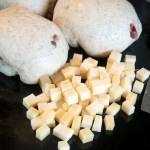
Dough balls and cheese cubesAfter kneading the little dough balls, they were a bit tight, so I gave them a little time to relax before moving on to the next stage. About half an hour did the trick. In the meantime, cut your cheese up into ~1cm cubes. The original recipe calls for Comté, which would be glorious. This Gruyère, which happened to be what I had in the fridge, and will be a pretty good match, but really any good firm well flavoured cheese will do very nicely – I think a decent mature cheddar would work a treat!

Assemble the breadOil your tin – the recipe calls for a 20cm ‘springform’ tin. I haven’t got one of those, but I do have an 8″ loose-bottomed cake tin I usually use for Christmas cake. Paul says to roll out the dough with a rolling pin into tin-sized rounds. I just pushed it out with my fingertips, which seemed to work fine. After putting the first circle of dough in the bottom of the oiled tin, spread out half the cheese cubes over the surface, repeat with the second ball of dough, and then finally press the third circle of dough over the top. Sprinkle the top with a little bit of rye flour, and cover with the clingfilm for another hour or so until it’s nicely risen.

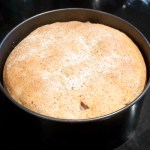
Before rising  Nicely risen  Fresh from the oven

Once you’re happy, pre-heat your oven to 220 and, once it’s up to temperature, slide the tin into the oven and bake for half an hour. It should come out a lovely rich mid-brown colour on top.

Rest in the tin for 10 minutes before turning out onto a wire rack to cool for as long as you can bear it, before carving off a thick slice, adding a bit of lovely unsalted butter, and cramming it in your mouth.
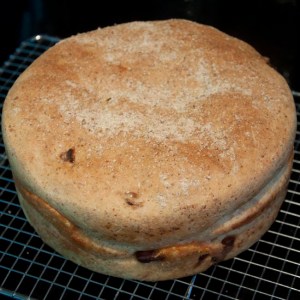
Cooling

This is really really good bread. The rye flour gives it a lovely nutty flavour without making it heavy. The cheese has melted during baking to leave quite striking square holes in the dough. Hubby compared it to a really good cheese and bacon sandwich, and I suppose that’s it, really. It’s a thing of great simplicity, but simple things can be fabulous and this really is. But of course the simpler the dish, the more it depends on the quality of the ingredients. So, make it! But be sure to use really good cheese and bacon, m’kay?

Share and enjoy!

Technically, it’s not difficult, though having a ‘feel’ for bread dough will obviously be helpful. Not much equipment required and relatively minimal washing up – kitchen scales, a large mixing bowl, and a deep round cake tin are essential. A dough scraper is useful but not actually necessary. If you don’t have a wire cooling rack, it’s perfectly reasonable to use a (cold!) oven rack

**

Bread cover shot‘Paul Hollywood’s Bread’
Bloomsbury Publishing PLC, 2013. ISBN 978-14088-4069-6
Hardcover, full colour, 224 pages. RRP £20.

[Full disclosure: This is my book, which I bought in the traditional way! I have received no payment or sponsorship for this post, nor have I accepted a review copy. I do not have an amazon affiliate account and do not profit from any links provided.]

This is a really great book for anyone interested in bread baking, whether you’ve never baked a loaf before and just want to know how to get started, or have a fair amount of baking experience, there’s something for you here. I would definitely recommend it to any keen but inexperienced home-bakers, as the techniques are well explained and the book is quite lavishly illustrated with step-by-step photography.

Sourdough baking is even covered a little, though after my experiences with getting a sourdough starter going a couple of years ago, I think the process given for this may be a tad on the optimistically simple side! (Incidentally, if you’re just taking up baking, and particularly if you’re interested in sourdough, I would also recommend ‘River Cottage Handbook No. 3 – Bread’ by Daniel Stevens)

There are some lovely unusual bread recipes, such as this one, and one or two ‘extras’ to accompany them, and there should be something new to try here even if you’re already a confident baker!

‘Cooking the Books’ is my self-imposed blog challenge for 2014 – I’ll be trying to cook a new recipe from one of my (rather extensive!) collection of cookbooks once a week, write it up and review it. Wish me luck!

Read more from the Country Skills blog >>

Venison Pie, from Darina Allen’s ‘Forgotten Skills of Cooking’ – Cooking the Books, week 1

“Hi, my name is Kate, and I have a cookbook problem…”

Some of my library

I just can’t resist them. A nice cookbook is such a marvellous object, it’s a thing of beauty, solidly bound and gloriously illustrated, as well as containing the promise – such promise! – of tasty food to come. So, I buy cookbooks (and people buy them for me, too, of course), and continue to buy them until they overflow our bookshelves and end up living in piles under coffee tables and stacked against the walls of our little cottage. As I said, it’s a problem. Last year sometime, I had a quick count up – and stopped counting when I got close to 100.

All those books – all those different recipes – and yet it’s relatively rare that I cook something completely new. For all the usual reasons – busy lives, habit, and having a really good set of family-staple recipes we come back to time after time. But it’s good to push out of your culinary comfort zone – for how else do we learn? – and with such a wonderful resource at my fingertips (and, sometimes, underfoot!) I really have no excuses!

So to welcome in 2014 – and in lieu of a New Year’s resolution – I’ve decided to set myself the challenge, once a week if I possibly can, to cook a brand new recipe form one of my cookbooks, and write it up for the blog, adding a little review of the book itself. Obviously such a silly endeavour needs a name, so I think we’ll call it ‘Cooking The Books’.

Inside-page viewToday’s recipe is Venison Pie, and was chosen because Hubby found some lovely wild venison at the Farmers’ Market. The recipe is from Darina Allen’s beautiful big hardback cookbook ‘Forgotten Skills of Cooking’, which came to me as a gift from my Dad last year.

I’ve scaled down the quantities because there are only two of us (the original recipe serves 8), and made a couple of minor modifications to account for ingredient availability. In general I’m trying to stay as close to the original recipes as I can – or what’s the point, really? This will, inevitably, affect my choice of recipes  – I really don’t want this challenge to end up filling my kitchen cupboards and fridge with half-used packs of ingredients that just go to waste! Actually, thinking about it, this is a big factor in why I don’t often cook from cookbooks. But enough housekeeping – let’s get on with the cooking!

Start by preparing your venison. Darina’s recipe calls for venison shoulder, cut into pieces, but I had a ~1lb pack of already-cut stewing venison. It’s worth taking a little time to trim out any particularly obvious gristly bits from your meat at this stage. Also try to pull out any deer hairs you discover in your meat (which isn’t a particularly unusual thing to find with wild venison, because of the way it’s shot, handled and butchered).

Now mix the meat into a marinade consisting of –

  • IngredientsA small glass of red wine (use something you’ll want to drink – not only is this always excellent advice for cooking with wine, but there’ll be another 5 glasses left in the bottle!)
  • A small onion (I used a red one, but a yellow one, or even a couple of shallots would be fine) halved and sliced.
  • A bouquet garni consisting of a bay leaf, sprig of thyme and some parsley stalks
  • A tablespoon each of brandy and olive oil
  • Salt and cracked black pepper to season (I used two big pinches of pepper and one of salt)

In the marinadeIdeally you might allow this to marinade overnight, but even a few hours will make a big difference. Cover the bowl and place it in the fridge. If, like me, you’re going to use frozen prepared puff pastry to finish the pie, now would be a good time to take it out of the freezer, and either place in the fridge to defrost overnight, or out on the side in the kitchen if it needs to defrost faster than that. Pastry is always better worked reasonably cold,so once it’s defrosted, put it in the fridge so it’s nice and firm.

Once your meat has marinaded to your satisfaction (I gave it three hours), drain the meat in a colander over a bowl, retaining the marinading liquid.  While it’s draining, get together the ingredients and equipment you’ll need for the next stage –

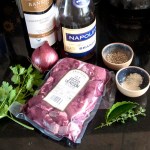
  • Home-cured bacon lardons80-100g of dry cured streaky bacon or pancetta, chopped into lardons or cubes. I used my home-cured ‘Christmas’ bacon (with bay, juniper, allspice and molasses in the cure, lightly smoked), which I happen to have around at the moment. It’s really worth seeking out good dry cured bacon if you’re not going to make your own!
  • A small onion, chopped reasonably finely
  • Half a carrot, diced reasonably small
  • A small clove of garlic
  • 200ml of beef stock (I used a stock cube – I know, I know…)

Venison coated in flourPat the pieces of meat dry with kitchen paper and coat them in seasoned flour (I needed about 2 tablespoons). I picked the meat out of the sliced onions, but this probably isn’t necessary. This bit of the process is pretty faffy, to be honest, and is something I tend not to bother with when making stews. Let me just say, though, it produces the most wonderful, silky, rich gravy, so I may be using this trick a lot more in the future!

Meanwhile, in a frying pan, fry off the bacon until it starts to brown and donates some of that lovely bacon fat. Once it’s done, transfer the bacon to a big saucepan.  Now brown the floured venison in the bacon fat. You may need to add a little extra olive oil. Transfer this to the pan once there’s some nice colour, and fry off the onions, carrot and garlic for a few minutes before adding them to the pan as well.

Ready to simmerI couldn’t see why I’d waste the nice sliced onion from the marinade (and the recipe doesn’t appear to specify what should be done with it), so into the frying that went until it softened nicely, and joined the rest of the ingredients in the saucepan.

Now we’re called to deglaze the pan with the wine marinade, and transfer this to the saucepan with all the meat and vegetables before topping up the pan with the beef stock (pre-heated, if it’s proper stock) until the meat and vegetables are just covered. I added a bit of extra water and a slosh more wine to make up the volume. Finally add back the bouquet garni from the marinade, cover the pan and simmer very gently on a low heat for about an hour and a half (or a bit longer if required), until the venison is beautifully tender. Keep a reasonably close eye on it, stirring occasionally, and make sure it doesn’t catch on the bottom of the pan.

Once you’re happy the venison is perfectly cooked, you can take it off the heat. Time to add the last few bits, which are –

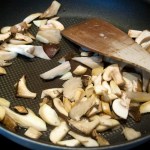
  • Saute sliced mushroomsA good handful of mushrooms. Darina wants wild ones if possible. I managed to get some oyster mushrooms and something a little bit cep-looking calling itself a ‘king oyster’ at our local supermarket, I added a couple of chestnut button mushrooms.
  • A handful of cooked chestnuts – these were the vaccuum-packed sort, left over from Christmas. The recipe says these should be omitted if you’re making a pie rather than a stew, but I couldn’t miss the opportunity to use them up!
  • A few teaspoons of homemade apricot jam. The recipe wanted redcurrant jelly, but I didn’t have any. I have a feeling crab apple jelly would work very well here, too.
  • Olive oil
  • Salt and pepper if required to season.
  • And not forgetting your block of defrosted puff pastry!

Wash out your frying pan and heat up a couple of spoonfuls of olive oil. Saute the mushrooms until colouring slightly, and once they’re done, add them to the pan with the chestnuts, cut in halves. Now taste to check your seasoning. The recipe suggests you might slike to add some redcurrant jelly, or a pinch of sugar, or possibly even some lemon juice at this stage depending on how things are coming together.

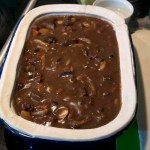
Filling in the dishI did find there was a slightly lacking sweet / acid note so substituted about three teaspoons of my homemade French apricot jam (avoiding the whole bits of fruit), one at a time and tasting carefully in between. It’s slightly miraculous, actually – makes such a huge difference to the final flavour. Add a bit more salt and pepper at this stage if required.

Edged with pastryYou could serve it now and call it a venison stew, and it would be wonderful with mashed potatoes on a cold winter’s night. But we’re going the whole hog and turning it into a pie, so transfer the filling into your chosen pie tin – I’ve used my gorgeous, very traditional, white and blue enamelware dish. Get your block of puff pastry out of the fridge and roll it out.

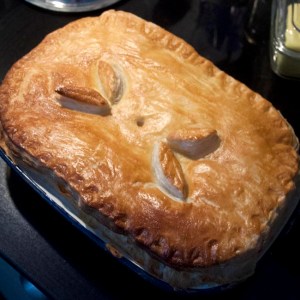
Finished pastry lidThe book suggests a way of attaching the pie crust in a two-stage process, fist attaching a strip of pastry all around the edge brushing with  water beneath and on top, before adding the pastry lid, trimming the excess, scalloping the edge with the handle of a spoon, and egg-wash the surface, adding some decoration if you wish.

Pierce the centre of the crust and put into a piping hot oven for 10-15 minutes before turning the heat down to about 190C until the crust is golden and the contents bubbling hot. If your oven has a hot-spot (most do) don’t forget to turn the pie around at some point to keep the colour even.

Hot from the oven

That’s it – isn’t it beautiful? Time to serve with your choice of accompaniments. Hubby requested roast potatoes, so we had those and steamed broccoli to go with it.

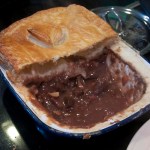
'Serving suggestion'What can I say? It looks pretty spanking, and tastes glorious. I love the way the late addition of the sauteed mushrooms means they retain their separate flavour, texture and identity in the dish. The venison is perfectly tender, the gravy is rich and thick and full of  beautifully balanced flavour. These quantities will feed four, I would say.

I heartily recommend you make this pie!

This is undoubtedly a time-consuming and relatively labour intensive recipe, with four separate preparation stages. Consequently it generates quite a bit of washing up, too – I counted a saucepan & lid, a frying pan, a pie dish, two mixing bowls, a colander, chopping board and knives, garlic crusher, pastry board (or your kitchen worktop), rolling pin, an assortment of spoons of different sizes, a spatula, and I’m sure I’ve forgotten a few bits. But nothing unusual and no gadgets or gizmos required. I started marinading the venison just after lunch, and we eventually ate around 7.

Serving timeIt’s a reasonably complex recipe, but no part of it is particularly technically demanding and no special skills are required – anyone who can follow a slightly complicated set of instructions should be able to cope! While there are a lot of ingredients, they’re quite ‘standard’ ones and pretty much all of them were already in my fridge and kitchen cupboards, which was a big bonus.

Perhaps something a bit quicker and simpler for next week..?

**
Cover shot‘Forgotten Skills of Cooking’ by Darina Allen.
Kyle Cathie Ltd, 2009. ISBN 978-1-85626-788-5.
Hardcover, full colour, 600 pages.

[Full disclosure: This is my book, which was a gift from my Dad. I have received no payment or sponsorship for this post, nor have I accepted a review copy. I do not have an amazon affiliate account and do not profit from any links provided.]

This is a fabulous book, full of unexpected surprises – I only realised after I’d written about the copper-cleaning power of salt and lemon juice the other day that this is one of the tips in the back of this wide-ranging tome! As well as a really good range of hearty traditional recipes, both sweet and savoury, with a focus on quality local seasonal ingredients, there are – amongst many other things! – instructions for buttermaking and producing your own clotted cream, curing and smoking techniques for meat and fish, yeasted and sourdough bread baking, and even advice on choosing livestock. It’s also a beautiful book, richly illustrated and nicely printed, which never hurts.

I would say that it deserves a place on any cookbook shelf, particularly so if, like me, you’re more interested in traditional farmhouse, country food and techniques  than in ‘cheffy’, restaurant-style cooking.

‘Cooking the Books’ is my self-imposed blog challenge for 2014 – I’ll be trying to cook a new recipe from one of my (rather extensive!) collection of cookbooks once a week, write it up and review it. Wish me luck!

Read more from the Country Skills blog >>

Stocking Fillers – perfect home-made giblet stock – Blog Advent (24)

We made it, WE MADE IT!  First of all, a huge thank-you to those of you who’ve followed me through this little blogging adventure, for your kind comments, ‘likes’, and contributions.  We did it!  24 days of daily blogs for Advent.  Well, it’s Christmas tomorrow, NORAD is tracking Santa towards us as I type (best get to bed before he gets here!), the Boxing Day ham is boiled and glazed, the gifts are wrapped, and the giblet stock is made.

Giblets are so often overlooked.  The grotty little plastic bag that accompanies any ‘special’ roasting bird (sadly now completely absent from generic supermarket chickens) and which, I fear, most people will be throwing away some time tomorrow morning.  Offal is so horribly out of fashion that an awful lot of people – certainly those who aren’t of the older generation – have no idea where to start.

Last year, on Christmas morning, while I was waiting for my guests to wake up, I blogged my ‘how to’ for giblet stock.  I didn’t have any photos at the time, so here it is again, in the hope it’ll be useful to some of you, re-edited and with some new photographs to help you along!

If you’ve bought a bird for roasting today, there’s a good chance it’s come with a little plastic packet of ‘bits’.  Whatever you do, don’t throw them away!

All the gibletsThese bits are the giblets – the offal – from top-left, clockwise –  the neck (in one or two pieces), the gizzard, the liver, and the heart.  The gizzard is a thick, muscular structure with two hard abrasive grinding plates that the bird uses to crush up corn and other food items to make them digestible.  

Giblet stock is quick, simple, and makes the most wonderful Christmas gravy.

I have a goose this year, but the following applies just as well if you have a chicken or turkey.  Personally, I use the goose heart and liver in one of my stuffings, so only the neck and gizzard are available for the stock.  But if you’re not going to use the heart and liver this way, just chop them roughly and add them to the stock-pot with the rest of your giblet meat.

Stock vegetables, herbs and spicesIn addition to the giblets, you need the following:

  • Stock vegetables.  I use one onion (red or white) and a couple of carrots.  I don’t like celery so I don’t use it, even though it’s the often-quoted third member of the stock vegetable trinity.  But if you do like it, you should add a couple of sticks.
  • A bouquet garni.  This is just a posh culinary term for some herbs. I use some bay leaves, rosemary, and sage, along with some whole peppercorns.  Dried herbs are fine, if you don’t have fresh to hand.
  • Water.  Glug of white wine (optional).
  • A splash of olive oil.

Prepared gizzardsPrepare your gizzard by cutting away and discarding the hard plates (use a small sharp knife inserted below and parallel to the plates).  It can be a bit tricky to get your knife through the outer membrane, but once it’s in, as long as it’s sharp enough, you can just run it behind the plate.  Discard the hard plate material, along with any grotty-looking offcuts.  Then, simply chop the rest of the meat roughly into cubes.

Brown giblets and vegetablesAdd a splash of olive oil to a nice big saucepan, and brown the neck and gizzard meat, and then add the roughly chopped onion and carrots and sautee for a couple of minutes.  Now add about a litre of water (and the splash of white wine if you want) and the bouquet garni, bring to the boil and simmer for about an hour.  

Stock, before simmeringOnce you’re happy with your stock, strain it, discarding the solids, and return the stock to the pot and boil again until reduced in volume by half.  That’s it.  Set aside in the refrigerator until you make your gravy (the stock will easily keep overnight – so make it on Christmas Eve if you have time). You won’t regret it!

Well, here we are – the advent candle is all but burned down, and the Blog Advent journey is over.  I’d love to say it’s been an undiluted pleasure – more than one evening I’ve got home from work, sat down after dinner, and muttered something about ‘still having to do the sodding blog!’, but it’s great to know that I can do it, even at this time of year.

Advent - day 24

I plan to have a few days off now – I think Hubby’s feeling like a bit of a blog-widow!  I wish you all a wonderful Christmas (don’t forget that tomorrow is only the start of the 12 Days of Christmas, which go on until Epiphany – it’s not called Twelfth Night for nothing!), and after the dust has settled I’ll have a few updates, and things which are still secrets for now, to share with you.

Merry Christmas everyone!

I’m trying to write a post a day during Advent, so, please come along with me while I try to Blog Advent – the Country Skills Way – and forgive me if I don’t quite manage it!

Read more from the Country Skills blog >>
Pressing The Flesh – home-made coarse farmhouse pate – Blog Advent (23)

While I suppose a lot of people have their eyes firmly on Christmas Day at the moment – family and friends, food and drink, gifts and treats – I’m also looking through and out the other side, to Boxing Day.  Probably if I’m honest I put more time and effort – certainly ahead of time – into the food on Boxing Day than I do to the food on Christmas Day itself.  After all, Christmas dinner, in the end, more or less boils down to a roast dinner with pretensions!

Boxing Day dinner so often is Christmas leftovers – but in my house it’s a feast of cold cuts.  The ham, which I smoked earlier this month, is slowly defrosting ready for cooking tomorrow. I have a handful of lovely cheeses, all ready.  The spiced plum chutney I made in the summer is now nicely matured.  The sourdough, of course, I made yesterday.  There may be some leftover goose, depending on our appetites.  There’s a game pie, which we collected today from our local farm shop butcher.  And to complete the feast, of course, we’ll be wanting some pate.  I’ve always bought this in the past, and always been slightly disappointed compared to the rest of the wonderful spread.

This recipe is mostly inspired by Delia Smiths’ recipe for Coarse Country Pate, and by the Farmhouse Pate recipe in Raymond Blanc’s classic ‘Cooking For Friends’ which I picked up in the Oxfam shop last time I was in Launceston.

Pate ingredientsTo make this pate, you will require –

  • 800g of really good quality minced pork.  Mine was a mix of minced shoulder and minced belly pork from the butcher. The unidentified packs of minced pork in the supermarket will work, of course, but I suspect at the expense of flavour and quality.
  • 275g of smoked streaky bacon.  I used my home-cure smoked Christmas bacon – so I suppose you could substitute the most expensive artisanal pancetta money can buy… not that I’m biased!  More seriously, make sure it’s dry cured, you don’t want nasty phosphate water from smoke-flavour brine-injected bacon leaking out into your pate!
  • 225g of liver.  Strictly the recipes call for pigs’ liver, but I couldn’t get any this morning I used lambs.  Actually I prefer lambs’ liver, it’s softer and creamier in flavour, but it will be interesting to see how this affects the flavours.
  • To season, 20 each of juniper berries and mixed peppercorns, a teaspoon of salt (I used smoked salt, but this isn’t compulsory), a pinch of mace, two crushed cloves of garlic, and a heaped teaspoon of chopped fresh thyme leaves (dry would do, but make it a level teaspoon).
  • To lubricate, a small glass of dry white wine, and a single measure of brandy.
  • Finally, to decorate, some bay leaves, a few more juniper berries, and a couple of slices of streaky bacon.
  • A 2lb loaf tin, or terrine, and a roasting tin big enough to contain it.

SeasoningsMince up the bacon in a food processor, leaving a bit of texture to it (how much texture is up to you!).  Then, seperately, mince up the liver, again to leave a bit of texture though this will go smoother faster, so watch carefully!  Combine all of these together in a mixing bowl, do it thoroughly and for goodness’ sake use your hands!  Now crush the juniper berries and peppercorns in a pestle and mortar along with the salt.  Add the herbs and spices to the meats, and again mix as thoroughly as you can.  Finally, add the liquids, and mix again.

LubricantsSomething magical happens when the wine and brandy mix with the meats – what started out a bit like a big bowl of sausage meat suddenly becomes silky and the aromas, oh my! Allow the bowl to rest for an hour or so in a coolish place.

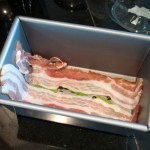
Arrange the bay leaves and juniper berries in the bottom of your loaf tin.  Now take your two rashers of streaky bacon, and place then between two sheets of baking parchment.  Roll them out really thin with a rolling pin. They will easily double in width, and a bit more.  To get them into the loaf tin, I cut away all but the parchment under them, and push this rasher-side-down into the bottom of the loaf tin before carefully peeling away the paper.

Bay leaves & juniper berries   Streaky bacon  Rolled out streaky bacon

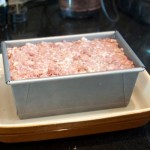
Now pack all the pate mix into the tin, levelling it carefully.  Put the loaf tin into the roasting tin and fill this half way up with boiling water, and put the whole lot in an oven at 150 degrees for an hour and three quarters.

Bacon in tin  Before cooking  After cooking

The block of pate will shrink back from the sides of the tin during cooking, and will be surrounded by fat and jelly juices. Let it stand until nearly cool, and then it’s time to press the pate.  It’s pressed for two reasons – firstly, to compact it and reduce the risk of it crumbling when you slice it, but secondly – and just as importantly for me! – to compact the bottom so you can turn it out neatly!  It smells *wonderful*, just as I would have hoped.  To press it, I covered the top with a double layer of tinfoil, put an old tupperware container on top, and then piled it up with all the weight I could muster.  So, four tins of beans, and four litres of fruit juice ought to do the trick!

Pressing the pate

Once it’s had a really good squeeze, and cooled right down to room temperature, put the pate and whatever weight you can conveniently keep on top of it, move it into the fridge, where it will keep quite happily in its juices and rest and improve for three days before serving.

It’s a new recipe to me, so I’ll be back to tell you how it worked out!  But the smell, oh my, I can’t see it being anything other than lovely!  With crusty (maybe toasted, even?) home-made sourdough.  And pickles!

Advent - day 23

I’m trying to write a post a day during Advent, so, please come along with me while I try to Blog Advent – the Country Skills Way – and forgive me if I don’t quite manage it!

Read more from the Country Skills blog >>

Not Long Now – final preparations for Christmas – Blog Advent (22)

So, somehow it’s got to be the final weekend before Christmas, and it feels like only a few days ago that we hung out the fabric advent calendar, and I started on my mad-cap plan to blog every day in Advent, as if there wasn’t enough to do in the run up to Christmas!

There’s always a lot to do in the final few days, and while today has been almost entirely occupied with preparations for the big day, there’s not an awful lot in there which is very blog-worthy, mostly for reason of avoiding spoilers for guests and gift recipients reading this blog.

christmas sourdough

The sourdough loaves for Christmas and Boxing Day are baked.  Sourdough has been one of my great discoveries this year – I really can’t figure out how I lived without great home-baked bread!  On Christmas Day, we’ll have it as a starter, with home-cured and smoked trout and goats’ cheese.  On Boxing Day, it will be part of the traditional day-after spread of cold ham, meats, pates, cheese, pies and pickles – and I think it’s going to stand up to that, really, very well!

We did our final shop for food and drinks today – it’s always a blasted nuisance, but fortunately we’ve planned ahead and sourced as much from local suppliers, farm shops, and home-made as we could, so it was less of a chore than it might have been.  Good to feel everything is under control, and we collect the goose from the local farm butcher’s tomorrow.

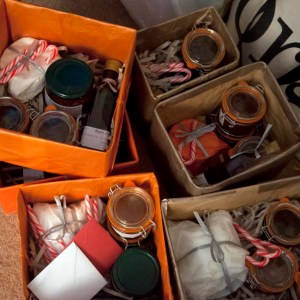
I spent quite a bit of time this afternoon sorting out, labelling, and wrapping the Christmas gift hampers that are a big part of my gift giving for close family and friends.  I know that some of them read this blog, so no details for now I’m afraid!  But here they are, all packed in recycled boxes (I’ve been saving, begging and borrowing Amazon boxes and suchlike from colleagues the last few weeks!), and the contain jams and preserves (which, if you’ve been paying attention over the last six months, you may have had a hint about!), hedgerow liqueurs, and some other home-made surprises which I’ve carefully not been writing about here!

Hampers almost ready to go

And we’re very close now, three sleeps ’till Christmas, and the Advent candle that started burning 22 days ago is now very nearly gone…

Advent - day 22

I’m trying to write a post a day during Advent, so, please come along with me while I try to Blog Advent – the Country Skills Way – and forgive me if I don’t quite manage it!

Read more from the Country Skills blog >>
Not The End Of The World – but the beginning of the return of the light – Blog Advent (21)

We’ve made it to December the 21st, and while this might be a bit premature, I feel reasonably confident in saying that it’s not the end of the world!

Winter sunrise

It is, however, the Solstice.  Hurray!  In the northern hemisphere, the shortest day is over and the light is coming back into the world.  We’re a few days from celebrating Christmas, of course, but there’s very little doubt that the early Christian churches essentially crashed the existing, pagan, solstice parties for the second biggest ‘do’ of their religious year.

Like a lot of people, I feel the dark days of winter pressing down on me.  I joke sometimes that I must have evolved from something that hibernated, because I could quite happily pull the duvet over my head in mid November and not come out until March.  Honestly, I really wish I could!  Christmas is a bright light shining from the long dark days of winter, and I fully understand why our forefathers would have celebrated the arrival of the solstice – and the return of the light – with much feasting and drinking, even though the hardest, hungriest days of winter were still to come.

Token reindeer!I’m always fascinated to find out how we come to hold the folk beliefs that we do, so I was particularly interested to hear a couple of years ago about the Sami goddess of spring and fertility. Her name is Beaivi (or variant spellings), and she was widely worshipped among the people of Fennoscandia (broadly modern Scandinavia).  Her main celebration was winter solstice, when she was believed to fly through the sky with her daughter in sled of reindeer antlers.  Her followers would sacrifice a white female reindeer, and thread pieces of the meat onto a wooden stick, twist it into a circle, and decorate it with bright ribbons.

Beaivi, incidentally, is the goddess of fertility and sanity – particularly beautifully observed, I would say, as both are brought back by the light of spring.

Santa ClausThe Father Christmas / Santa Claus character is such a great cultural cocktail of a myth.  Clearly there’s some northern European solstice god(dess) in the mix –  at least that’s the best theory I can find about how the reindeer got there!   Add to this a good measure of Christian crusades Saint (step forward, St Nick!), and then top up with a generous glug CocaCola!  Since, while the Victorians had all but invented modern Father Christmas, his suit is not usually one of red with white trim – his colours ran much more to the spruce green!  It’s not entirely clear that CocaCola were the first people to dress him in red and white, at the start of the 20th century, but certainly they popularised the choice, and then published it widely.  Well, consider the branding…  **holidays are coming… holidays are coming…**

Jolly Fat ManSo the jolly fat man, with a red suit and a big white beard, rides around in a sleigh pulled by reindeer (they’ve got off lightly, then, since Beaivi’s day), bringing toys to all the good boys and girls, but no longer threatening the bad boys and girls with a lump of coal and a righteous beating…

But Dasher, Dancer, Prancer, Vixen, Comet, Cupid, Donner, and Blitzen (and their latterly-discovered friend, Rudolf) have an identity problem, because at this time of year, the only reindeer with antlers are the female ones!

Incidentally, if you haven’t yet come across Terry Pratchett’s ‘Hogfather’, I can heartily recommend it for a great bit of seasonal reading (or viewing, the TV adaptation from a few years back is remarkably good), it’s a fabulous bit of sideways-on myth re-imagining!

Advent - day 21

I’m trying to write a post a day during Advent, so, please come along with me while I try to Blog Advent – the Country Skills Way – and forgive me if I don’t quite manage it!

Read more from the Country Skills blog >>

Light ‘Em Up – candles in Christmas trees – Blog Advent (20)

Like Scrooge, we’re all haunted, a little bit, by the ghosts of our Christmases past.  In my ‘Blog Advent’ post on December 6, I wrote a little about my memories of St Nicholas, from the time I spent growing up in Switzerland as a young child.  These were my formative Christmas memories, so of course I hark back to them every year.

A very Swiss tree

One tradition which is still widely practiced in Switzerland and Germany – and not at all, in the UK – is the habit of putting real candles in domestic Christmas trees.  I love this – it feels so utterly ‘proper’ and festive to me!  Yes, of course it’s a fire risk – but so is any lit candle or open fire.  Our neighbours, in the small Swiss village where we lived, seemed to manage to avoid setting fire to their houses every year!

Tree candlesHubby is very British about this – the whole idea seems to him like a huge fire hazard just waiting to burst into a ball of flames.  I asked him to suggest a title for this post and his suggestion ‘Flaming Torch of Christmas Death!’ rather sums up his position on the issue!  It’s not so black and white, to me – after all, people were managing to set fire to their living rooms with the small incandescent Christmas tree lightbulbs well into the 21st century.

But all good relationships are about compromise, so while I wait for him to come around to my way of thinking (this, folks, may well be some time!) I picked up these pretty hanging baubles designed to take tea light candles.  Rather than equip them with a naked flame, I’ve used some LED tea lights which, while not *quite* convincingly the real deal, flicker gently with a warm golden light, and, at least out of the corner of your eye, might just be little candle flames in my tree.

Compromise candles

Not many days left on the advent candle, either!  I had so many bits and pieces I wanted to get done today – my last weekday off between now and Christmas – but instead I spent most of it gently nursing this nasty cold.  Here’s hoping it’s gone by the weekend!

Advent - day 20

I’m trying to write a post a day during Advent, so, please come along with me while I try to Blog Advent – the Country Skills Way – and forgive me if I don’t quite manage it!

Read more from the Country Skills blog >>

Life’s A Beach – driftwood decorations – Blog Advent (19)

It feels like a very long time since we were on the beach in Cornwall with Dave, back in October!  Dave adores the beach – the seaside is his favourite ever place.

Dave on the beach

After he was done posing for his portrait (well, doesn’t the backdrop suit him??), I indulged in a spot of beach combing along the strand line, and collected up some pieces of driftwood. Only small lengths, the longest was about 8 inches long.  They had to fit in my pocket!

Driftwood Christmas tree

I put them together into this small driftwood Christmas tree.  It’s lashed together with jute twine, a bit like the twig and twine star decorations I made earlier this month.  If you wanted it a bit more solid, it would be simple to add a blob of hot glue or other adhesive between the ‘stem’ and the ‘branches’ before wrapping with twine or ribbon in whatever decorative way you favour.  It makes a very pretty hanging decoration – I’ve got it on the end of a bookcase in the hall.

The scale is a question only for your imagination and your driftwood supply!  I had visions of making a tree a couple of feet high, possibly hanging, with a thick piece of jute rope threaded through a drilled hole in the centre of each of the driftwood branches.  An idea for the future, perhaps – I need to live a lot closer to the sea!

Advent - day 19

I’m trying to write a post a day during Advent, so, please come along with me while I try to Blog Advent – the Country Skills Way – and forgive me if I don’t quite manage it!

Read more from the Country Skills blog >>
Take Your Medicine – my perfect hot toddy – Blog Advent (18)

One of the Christmas traditions I don’t relish, but seem to ‘enjoy’ every year all the same, is my traditional pre-Christmas cold!  Well, it’s here again, and almost perfectly on schedule! You have to look for the silver lining at times like this, and the up-side of a filthy winter cold is the perfect excuse for a beautiful hot toddy.  It’s medicinal, honest!

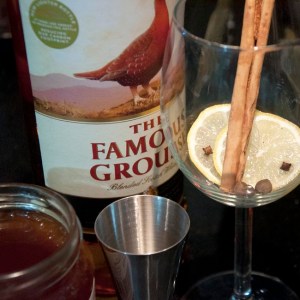
Toddy ingredients

My toddy is whisky based.  But don’t use your best single malt – if your nasal passages are as stuffed up as mine, there’s no chance of you knowing the difference!  You also need some honey, a lemon, a few cloves, three or four whole allspice berries, and a cinnamon stick.  Oh, and some hot water.

Cut two thin slices from your lemon and stud each with a couple of cloves.  Put these in your glass (I use a big red wine glass which I know can take the heat – they’re the glasses I use for mulled wine – but a tumbler or a glass with a handle are more traditional!) along with your allspice berries and cinnamon stick.  From what’s left of your lemon, cut a wedge amounting to about a quarter of a lemon and squeeze the juice into the glass.  Add two teaspoons of the honey (more or less to taste – that’s my personal preference) and a double measure of whisky, and stir with your cinnamon stick until combined.

Now top up with water from the kettle, which you’ve allowed to go just off the boil.   If you’re not *that* keen on cinnamon, take the stick out at this point, otherwise leave all the whole spices in.  Stick your nose in the glass and breathe deeply – you should be able to appreciate the spicy aromatic hit through even the thickest head cold.  Then sip, and enjoy.  All the Christmas spices with a bonus dose of vitamin C, and some lovely soothing whisky.  Drink it while it’s still piping hot.

How could something that tastes so wonderful fail to be good for you???   You know, I think I may be poorly enough that I need to take a second dose!

Advent - day 18

I’m trying to write a post a day during Advent, so, please come along with me while I try to Blog Advent – the Country Skills Way – and forgive me if I don’t quite manage it!

Read more from the Country Skills blog >>

The Icing On The Cake – how I decorate my Christmas cake – Blog Advent (17)

Christmas cake is a real ‘anchor’ for me, one of those food experiences that connects back, right through my life and my family history.  I wrote a bit last year about how baking the cake takes me back, every year.  I learned my cake from my grandmother – she learned it from Delia! – and I’ve only ever baked it and decorated it this one way.

The Icing On The Cake

After it’s been baked, usually some time in early November, I wrap it up in a few layers of greaseproof paper and stash it away in a tin. To keep it happy, it gets a tot of booze every week or so.  For the last few years I’ve baked it with, and then fed it on calvados (French apple brandy), because I think it adds an extra lovely fruity note compared to the traditional sort.

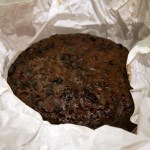
Before dressingOnce it’s nicely sozzled, and in time for Christmas, it’s time to get it all dressed up in its party frock!  More years than I can count, I’ve ended up decorating the cake on Christmas Eve – but I’ve been a bit better organised this year (well, OK, I wanted to make sure it was all ready in case someone fancied a slice this weekend!).

Brushing on the jamI ice my cake in two layers, first a nice thick layer of marzipan, and then a layer of royal icing.  Finally, the cake gets a decorative marzipan poinsettia to top it off.

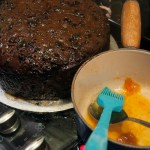
First, to make sure the marzipan sticks down securely, I brush the cake with melted apricot jam, slightly loosened with some water and warmed in a pan on the hob.  A desert spoon of jam or so is plenty.  Brush it on generously with a pastry brush.  This is home-made jam, so has some big chunks of apricot in it, which isn’t a problem, just work around them and leave them in the pan!

Rolled out marzipanNow roll out your marzipan.  Mine was bought (sorry!) nice golden marzipan.  There’s about a kilo here. When working with marzipan, use icing sugar to dust down your surfaces and rolling pin, the same way you’d use flour when working with bread or pastry. Roll the marzipan out to the thickness you prefer, and make sure that it’s plenty bigger than the cake and sides in all directions.

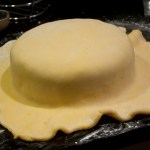
Lay the marzipan overI know the baking aficionados on telly would have you apply your marzipan in two pieces – a round piece for the top of the cake, and a long thin band around the side.  I can’t see any reason to do this, for this cake at least – if you’re careful it’s possible to get a perfect layer with a one-piece approach.  In fact, the only merit I can see to the two-piece approach would be if you’re trying to get a sharp, 90 degree edge between the top and sides of your cake – in which case you’ve already started by cutting the top off – what a waste!  Gently place the big, rolled out piece of marzipan straight over the centre of the cake.

With sides flushNow, very gently, using the palms of your hands (dusted with icing sugar as required) push the ‘skirts’ inwards, towards the sides of the cake.  As you can see, I managed to get it all to sit snugly against the side of the cake.  But if you muck it up and get folds?  Just trim off the excess marzipan from the fold with a sharp knife, and stick the edges back together using a little bit of tap water.  The icing will conceal a multitude of sins!

Marzipan - doneTrim off the excess marzipan. I used the edge of the board as a cutting guide.  This sounds a bit generous, but it’s about the distance you want to leave.  I’ve over-trimmed in the past, and had to add extra marzipan back, so I now subscribe to the adage that you can always cut more later!  Once cut, gently nudge the marzipan in towards the base of the cake all around.  Anywhere you have an excess of marzipan, trim a bit more at this stage. You’ll be surprised how little there is, though.  Wrap up any extra marzipan you have left over tightly in cling film, and store in the fridge.

Ideally, let the marzipan dry out for a couple of days before applying the icing, though I’ve done it all in one night from time to time when necessary!  This gap is supposed to reduce the oiliness in the marzipan to reduce the risk of this ‘striking through’ and discolouring the icing.  I’m not sure how or whether this works, to be honest, and I’d love to say I’ve noticed a difference.  But I had time this year, so I gave it the 48 hours.

Royal icing ingredientsMy royal icing is made up of 3 large egg whites (I weigh my home-produced eggs and compare them to the egg size guide for this sort of cooking, since obviously they don’t come out of the hens graded!) 500g of icing sugar, and a teaspoon of glycerine.  I have forgotten the glycerine once or twice – it’s not a disaster if you can’t get any, but doing so does mean the icing sets very hard, so mind your dentures!

Whisk icingStart by spooning your icing sugar into your egg whites a bit at a time, stirring as you go.  It will look horrible and lumpy until right at the end, so don’t despair. Once it’s all incorporated, and you have a heavy gloppy-sort of consistency, start beating the mix with an electric whisk.  You really do want the electric whisk for this job – trust me, I’ve made royal icing with just a hand whisk one year, it’s *incredibly* hard work! – and ideally, if you have one, use your stand mixer.

Stiff peaksEven with an electric whisk it will take about ten minutes to get to the consistency you want, and I found that even with a handheld whisk I tended to get to the ‘I’m bored, sod it, that’ll do’ stage before the mix was really done!

Stir through glycerineYou’re after ‘stiff peaks’, which roughly means that the icing stays in whatever shape you place it in.  If you stop the whisk, you’ll get an idea pretty quickly by watching what happens to the ripples in the icing, which should be very stable.  You can test this by raising some peaks with the point of a knife, or your spatula.  If they stay there, you’re done.  Add your spoon of glycerine and stir this through the mix.  It adds a lovely shine to the icing.

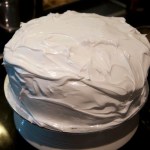
Now, start slapping it onto the cake.

Apply the icing 1  Apply the icing 2  Apply the icing 3

Rough is good – you’re after a ‘snow scene’ effect, though I’ll be honest and say I’ve never seen a snow scene quite like this!

Store extra icingStill, it’s what my grandmother’s cake looked like, so it is with mine!  Once you’re happy you have a good covering, spoon any extra icing into a small plastic bag, and tie this off securely, excluding all air, and stick this bag in the fridge for later.  The icing now needs to set for at least 24 hours.  Then, it’s time for the final flourish.  For me, it has to be a poinsettia pattern in marzipan, but you could just as easily add holly leaves & berries, or even a Christmas tree, using a very similar approach.

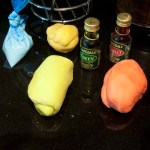
Colouring your marzipanDig out the surplus marzipan from the fridge, and divide it into uneven thirds (two larger, one smaller).  Dye the two larger portions red and green using food colouring.  I find putting a sheet of cling film down on the kitchen counter when playing with food dye seriously simplifies the clean-up.  Also use plenty of icing sugar to stop things sticking.

Coloured marzipanIt was around this point that I remembered that last year, I’d made a mental note to try to find some better food colouring – I’m sure the food colouring my grandmother had only ever took a couple of drops, I seemed to have to ladle this stuff in by the spoonful!   Mind you, it was probably full of nasty artificial colours we’re not allowed to use these days…   You’ll get there eventually, even if your food dye is as wimpy as mine, and have the building blocks of your final decoration.

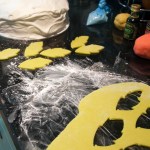
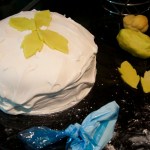
Prepare your leavesRoll out your green marzipan, and cut out a first set of six poinsettia leaves (or however many holly leaves, whatever you fancy).  I do this freehand, but you could easily cut make yourself a paper or card template.  Snip the corner off the bag of royal icing, and you have a little prepared piping bag.  Blob a little onto the centre of the cake and use it to glue down your leaves.  Then carry on with the red leaves, in much the same way. Finally, finish with some plain yellow berries in the centre.

Add green leaves  ... then red...  and finish with berries

Dab the marzipan with a damp piece of kitchen paper to remove any loose icing sugar, and finish with a ribbon, if you like.

That’s it, all done!  Round about now, I get to feel quite proud, very Christmassy, and revel in the connection to decades of family Christmas tradition.

Advent - day 17

I’m trying to write a post a day during Advent, so, please come along with me while I try to Blog Advent – the Country Skills Way – and forgive me if I don’t quite manage it!

Read more from the Country Skills blog >>