The Icing On The Cake – how I decorate my Christmas cake – Blog Advent (17)

Christmas cake is a real ‘anchor’ for me, one of those food experiences that connects back, right through my life and my family history.  I wrote a bit last year about how baking the cake takes me back, every year.  I learned my cake from my grandmother – she learned it from Delia! – and I’ve only ever baked it and decorated it this one way.

The Icing On The Cake

After it’s been baked, usually some time in early November, I wrap it up in a few layers of greaseproof paper and stash it away in a tin. To keep it happy, it gets a tot of booze every week or so.  For the last few years I’ve baked it with, and then fed it on calvados (French apple brandy), because I think it adds an extra lovely fruity note compared to the traditional sort.

Before dressingOnce it’s nicely sozzled, and in time for Christmas, it’s time to get it all dressed up in its party frock!  More years than I can count, I’ve ended up decorating the cake on Christmas Eve – but I’ve been a bit better organised this year (well, OK, I wanted to make sure it was all ready in case someone fancied a slice this weekend!).

Brushing on the jamI ice my cake in two layers, first a nice thick layer of marzipan, and then a layer of royal icing.  Finally, the cake gets a decorative marzipan poinsettia to top it off.

First, to make sure the marzipan sticks down securely, I brush the cake with melted apricot jam, slightly loosened with some water and warmed in a pan on the hob.  A desert spoon of jam or so is plenty.  Brush it on generously with a pastry brush.  This is home-made jam, so has some big chunks of apricot in it, which isn’t a problem, just work around them and leave them in the pan!

Rolled out marzipanNow roll out your marzipan.  Mine was bought (sorry!) nice golden marzipan.  There’s about a kilo here. When working with marzipan, use icing sugar to dust down your surfaces and rolling pin, the same way you’d use flour when working with bread or pastry. Roll the marzipan out to the thickness you prefer, and make sure that it’s plenty bigger than the cake and sides in all directions.

Lay the marzipan overI know the baking aficionados on telly would have you apply your marzipan in two pieces – a round piece for the top of the cake, and a long thin band around the side.  I can’t see any reason to do this, for this cake at least – if you’re careful it’s possible to get a perfect layer with a one-piece approach.  In fact, the only merit I can see to the two-piece approach would be if you’re trying to get a sharp, 90 degree edge between the top and sides of your cake – in which case you’ve already started by cutting the top off – what a waste!  Gently place the big, rolled out piece of marzipan straight over the centre of the cake.

With sides flushNow, very gently, using the palms of your hands (dusted with icing sugar as required) push the ‘skirts’ inwards, towards the sides of the cake.  As you can see, I managed to get it all to sit snugly against the side of the cake.  But if you muck it up and get folds?  Just trim off the excess marzipan from the fold with a sharp knife, and stick the edges back together using a little bit of tap water.  The icing will conceal a multitude of sins!

Marzipan - doneTrim off the excess marzipan. I used the edge of the board as a cutting guide.  This sounds a bit generous, but it’s about the distance you want to leave.  I’ve over-trimmed in the past, and had to add extra marzipan back, so I now subscribe to the adage that you can always cut more later!  Once cut, gently nudge the marzipan in towards the base of the cake all around.  Anywhere you have an excess of marzipan, trim a bit more at this stage. You’ll be surprised how little there is, though.  Wrap up any extra marzipan you have left over tightly in cling film, and store in the fridge.

Ideally, let the marzipan dry out for a couple of days before applying the icing, though I’ve done it all in one night from time to time when necessary!  This gap is supposed to reduce the oiliness in the marzipan to reduce the risk of this ‘striking through’ and discolouring the icing.  I’m not sure how or whether this works, to be honest, and I’d love to say I’ve noticed a difference.  But I had time this year, so I gave it the 48 hours.

Royal icing ingredientsMy royal icing is made up of 3 large egg whites (I weigh my home-produced eggs and compare them to the egg size guide for this sort of cooking, since obviously they don’t come out of the hens graded!) 500g of icing sugar, and a teaspoon of glycerine.  I have forgotten the glycerine once or twice – it’s not a disaster if you can’t get any, but doing so does mean the icing sets very hard, so mind your dentures!

Whisk icingStart by spooning your icing sugar into your egg whites a bit at a time, stirring as you go.  It will look horrible and lumpy until right at the end, so don’t despair. Once it’s all incorporated, and you have a heavy gloppy-sort of consistency, start beating the mix with an electric whisk.  You really do want the electric whisk for this job – trust me, I’ve made royal icing with just a hand whisk one year, it’s *incredibly* hard work! – and ideally, if you have one, use your stand mixer.

Stiff peaksEven with an electric whisk it will take about ten minutes to get to the consistency you want, and I found that even with a handheld whisk I tended to get to the ‘I’m bored, sod it, that’ll do’ stage before the mix was really done!

Stir through glycerineYou’re after ‘stiff peaks’, which roughly means that the icing stays in whatever shape you place it in.  If you stop the whisk, you’ll get an idea pretty quickly by watching what happens to the ripples in the icing, which should be very stable.  You can test this by raising some peaks with the point of a knife, or your spatula.  If they stay there, you’re done.  Add your spoon of glycerine and stir this through the mix.  It adds a lovely shine to the icing.

Now, start slapping it onto the cake.

Apply the icing 1  Apply the icing 2  Apply the icing 3

Rough is good – you’re after a ‘snow scene’ effect, though I’ll be honest and say I’ve never seen a snow scene quite like this!

Store extra icingStill, it’s what my grandmother’s cake looked like, so it is with mine!  Once you’re happy you have a good covering, spoon any extra icing into a small plastic bag, and tie this off securely, excluding all air, and stick this bag in the fridge for later.  The icing now needs to set for at least 24 hours.  Then, it’s time for the final flourish.  For me, it has to be a poinsettia pattern in marzipan, but you could just as easily add holly leaves & berries, or even a Christmas tree, using a very similar approach.

Colouring your marzipanDig out the surplus marzipan from the fridge, and divide it into uneven thirds (two larger, one smaller).  Dye the two larger portions red and green using food colouring.  I find putting a sheet of cling film down on the kitchen counter when playing with food dye seriously simplifies the clean-up.  Also use plenty of icing sugar to stop things sticking.

Coloured marzipanIt was around this point that I remembered that last year, I’d made a mental note to try to find some better food colouring – I’m sure the food colouring my grandmother had only ever took a couple of drops, I seemed to have to ladle this stuff in by the spoonful!   Mind you, it was probably full of nasty artificial colours we’re not allowed to use these days…   You’ll get there eventually, even if your food dye is as wimpy as mine, and have the building blocks of your final decoration.

Prepare your leavesRoll out your green marzipan, and cut out a first set of six poinsettia leaves (or however many holly leaves, whatever you fancy).  I do this freehand, but you could easily cut make yourself a paper or card template.  Snip the corner off the bag of royal icing, and you have a little prepared piping bag.  Blob a little onto the centre of the cake and use it to glue down your leaves.  Then carry on with the red leaves, in much the same way. Finally, finish with some plain yellow berries in the centre.


Add green leaves  ... then red...  and finish with berries

Dab the marzipan with a damp piece of kitchen paper to remove any loose icing sugar, and finish with a ribbon, if you like.

That’s it, all done!  Round about now, I get to feel quite proud, very Christmassy, and revel in the connection to decades of family Christmas tradition.

Advent - day 17

I’m trying to write a post a day during Advent, so, please come along with me while I try to Blog Advent – the Country Skills Way – and forgive me if I don’t quite manage it!

Read more from the Country Skills blog >>

Oh, Crumbs! – homemade breadcrumbs for your Christmas cooking – Blog Advent (12)

I hate wasting my home-baked sourdough.  Of course, I try to make sure it all gets eaten when it’s at its best, but sometimes life interferes with your best laid plans, and you’re going away for the weekend with a third of a loaf still sat on the side, or the last roll in the batch is looking a bit dry to be appetising.  So when it looks like there’s some good bread about to go to waste, I chuck it in a bag in the freezer.

Lovely golden breadcrumbsBreadcrumbs are such a useful store cupboard staple.  At Christmas especially, they go into stuffings, and Christmas puddings, as a crunchy topping for fish pie…  I’m going to need some in a few days when I make my batch of Christmas sausages.  And the shop bought kind contain all sorts of preservatives, stabilisers, and even, believe it or not, yellow food dye for that ‘golden’ crumb!  Yuck!

It’s so easy to make your own.  Slice up your bread into normal-thickness slices (about 1cm / half an inch) before you put it in the freezer.  Once you have enough for a batch, get them out of the freezer and lay them out on a baking sheet.  Put them in a low oven at about 125 – 150 C.  After about an hour, get them out and carefully break them up as much as you can (don’t burn your fingers!), before returning them to the oven until they’re thoroughly dry and crispy.

Bread after dryingThey’ll take on a little colour around the edges, but don’t let them burn!  I’ve seen advice to cut the crusts off and not use end pieces for breadcrumbs, because they’ll tend to take on more colour during the drying process and you don’t want this.  Since that’s most of what I usually have left over, I’ve just ignored this advice, with no ill-effect that I can detect!  Once they’re completely dry, take them out of the oven and wait for them to cool fully.

Breaking up the crumbI’ve made the mistake of trying to put these straight in my food processor – they’re really quite hard and it doesn’t work very well!  You might be able to get away with it if your breadcrumbs are being made from ‘white fluff’ commercial sliced bread, but with real sourdough there’s quite a lot of substance to your bread, and the pieces just seem to bounce around the bowl.  Start by transferring the crusty chunks in batches into a large freezer bag, and crunching them up with a heavy rolling pin (a heavy skillet or saucepan would work well, too!).

In the food processorYou could just keep crushing the crumbs by hand until you get the finish you want, but if you’re lazy, like me, and have access to a food processor, then you can transfer the chunks to that once they’re all well under a cm in size, and then process them until they’re the texture you’re after.  I’ve left some bigger pieces in here for texture (if I want finer crumbs later I can always sift them through a collander before use), but you can keep going until it’s the consistency of sand if you prefer.

Now just transfer your breadcrumbs to an airtight container, where they should happily store at room temperature for at least a couple of weeks – this is assuming you’ve dried them properly – moisture is your enemy!  If you want to keep them longer, put them into to a sealed bag and store in the freezer, where they should be fine for 2 – 3 months.  If in doubt, watch out for any signs of mould or musty smells.  If they do start to go off, Hubby – who was my glamorous assistant this evening – asked me to remind you that they’ll still do fine for ground bait for any fisherman or woman in your family!

It’s the 12th of December today, which means we’re now half way through my Blog Advent challenge!  I’m exhausted, but really enjoying it too!  Thank you all so much for reading along so far – I hope I can come up with another dozen days worth!

Advent - day 12

I’m trying to write a post a day during Advent, so, please come along with me while I try to Blog Advent – the Country Skills Way – and forgive me if I don’t quite manage it!

Read more from the Country Skills blog >>

Brilliant Bangers – in praise of the full English breakfast

Those of you who come here regularly will know this isn’t the sort of food blog (if it’s even a food blog, really?) where I regularly post photos of my meals.  This time, though, I’m making an exception.

This was my Sunday breakfast –

Full English breakfast

What’s so special about that, you might wonder?  Well, everything on that plate was made here, by us.  I’m not going to claim to have grown the mushrooms or the tomato, or churned the butter, but the bacon was home-cured and smoked, the bread was my own sourdough, the eggs were laid in the garden by our hens, and, most excitingly for me, the sausages were made here, in my very own kitchen.  Even the ketchup is homemade.

This blog started with bacon, over a year ago, and curing and smoking have been among the recurring themes as the months have gone by.  The trouble with sausages is that they’re so often so disappointing, so much less than they ought to be, a disposal route for otherwise less than tempting ingredients and fillers.  Of course, the more lovely the rest of your breakfast – the fresher and richer your eggs, the tastier your home-cured bacon – the more obvious the deficiencies of your bangers become.

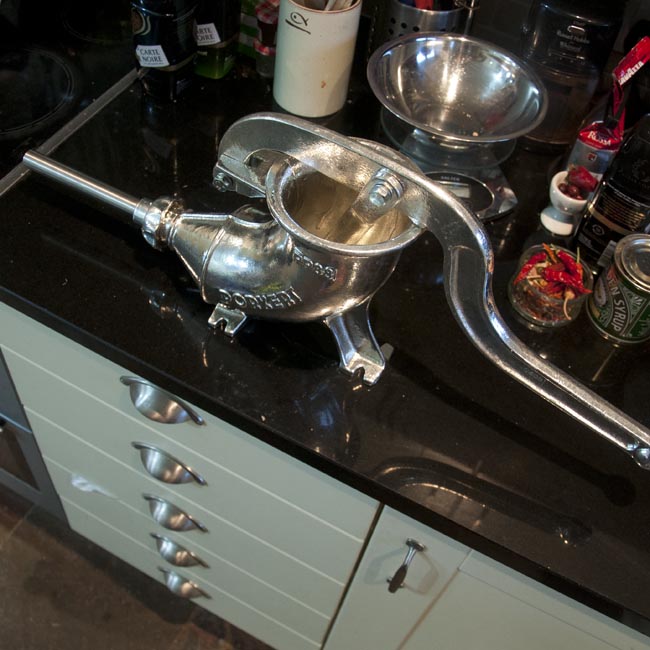
The Porkert PP88I’ve wanted to make sausages for a very long time – so long, in fact, that we received a sausage press (the rather wonderful chromed cast-iron, sparsely named Czech ‘Porkert PP88’) as a wedding gift over six years ago.  I regret that, until last weekend, it hadn’t yet managed to have an outing!  I finally decided that enough was enough, and ordered some sausage skins from Weschenfelder, which arrived very promptly last week.  A trip to our friendly local farm shop butcher provided us with 1kg of minced pork shoulder, and we were ready to rock!

Sausage mixTo the kilo of minced pork, we added a bit short of the recommended 200g of breadcrumbs (I didn’t have enough – they were a mix anyway of shop-bought breadcrumbs I had in the cupboard, and a couple of slices of dried and crushed homemade sourdough), 200ml of water (this, along with the breadcrumb, is essential for getting the mix to a consistency where it will pass through the sausage press), a teaspoon of salt and a half a teaspoon of crushed black pepper.

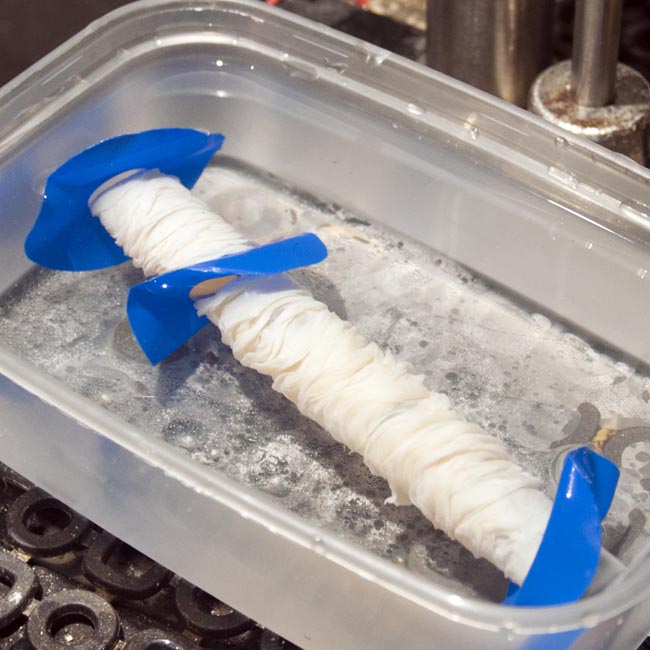
Soaking sausage casingsThe sausage skins were already soaking in warm water – we had bought the ready spooled sheep’s casing as Hubby’s preference runs to smaller bangers.  Sausage skins are not pleasant smelling things!  So, don’t sniff them, would be my advice.  A lot of the odour disappears once they’ve been soaked, so I’d recommend trying not to think about it too much in the meantime!

Ours probably hadn’t been soaked for as long as they ought to, since when I loaded the first length, they were very tricky to feed onto the nozzle of the sausage stuffer – I put it down to inexperience, but the second length, which had had about half an hour longer to soak, went on much more easily.  As they can soak for 12 hours or so without harm, get started with the soaking early!

Feed your skins onto the nozzleOK, so there’s no polite way of saying this – there’s something unavoidably prepucial about sausage skins!  Feed your skins onto the nozzle of the sausage stuffer (ours were quite a snug fit on the 20mm nozzle), leaving a couple of inches, untied, dangling free from the tip.  And try not to contemplate the resemblance to condoms too closely!

Don’t overfill your sausage stuffing press, especially if it’s manually powered like ours!  Add a couple of hand-fulls to the barrel and start to push down steadily.  We discovered around this time that we didn’t have the mechanical advantage at counter height to operate the lever usefully, and moved the whole sausage pressing rig down onto the kitchen floor. Really, we should have had mounting bolts to allow us to seat the press firmly in position, but we had to make do without.  Something to add to my ‘fantasy kitchen’ wish-list, I guess!

Filling sausagesPut a nice shallow tray (a baking sheet is ideal) under the sausage press to catch the sausages as they’re filled.  Once you get the sausage meat flowing, you want to kind of let it fill the casing and pull it off the nozzle itself as it goes.  This is definitely a two man job with any kind of manual press, I’m afraid!  Don’t pull the skin away from the nozzle unless it seems to be getting stuck, but equally don’t let the skin be over-filled, as you’re going to need a bit of ‘freedom’ when you come to twist and link the sausages.

The skins will split in places – you might have weakened them when you were incompetently loading them! – but don’t worry, it’s not a disaster. Carry on until you run out of sausage meat, or skins!

Linked sausagesNow it’s time to link your sausages.  I looked at various diagrams and instructions in books and on the web, but in the end I just fiddled with them until they did what I wanted – one of these days I’ll try to take photos but it never made much sense to me at the time!  Still, by the end of the process I had two strings of traditionally linked sausages.  The first  – on the left – are noticeably ‘scrappier’ than the second, but I’m really thrilled with all of them.

It’s advised to hang them to dry for a while – the cabinet doors were useful here – and then let them rest overnight before eating them.  We refrigerated one breakfast’s worth and put the rest in the freezer.

They’re great sausages.  They cooked well under the grill, but I’ll admit the first mouthful was almost underwhelming, I worried they were bland but then realised that they were, by any commercial standard, just seriously ‘under-seasonned’ compared to what my taste-buds were expecting.  I have to say I’m now rather worried about how much salt must be in shop-bought bangers!  But on the second bite, the lovely sweet pork flavour came through beautifully.  I’m looking forward to experimenting with some herbs, spices, and other flavours in future batches – we intentionally kept this batch quite plain as a ‘baseline’!

Finished sausages

So, homemade sausages – the last part of the Holy Trinity of the great Full English breakfast of sausage, bacon and eggs.  Go on, try it!  And no doubt, there will be more sausage making posts in the future!

Read more from the Country Skills blog >>

When Life Gives You Lemons – Part 4: lemon pickle [Guest Blogger]

Today’s Guest Blogger is Ross, from Christchurch, NZ.

Lemon pickle

This one is a bit friskier, with the smoking hot oil making the kitchen smell strongly of mustard for a while – you have been warned!

This made about 1kg of pickle for me (including some excess oil).

  • 8 lemons,
  • 150g salt,
  • 25g fenugreek; 25g mustard powder; 50g chilli powder; 8g turmeric. (I used mild chilli powder from my local Indian supermarket, and the end product still had a bit of a kick; if you prefer it incendiary, then use the hot stuff.)
  • 300ml mustard oil; 1/2 tsp asafoetida (hing); 12g mustard seeds (crushed).

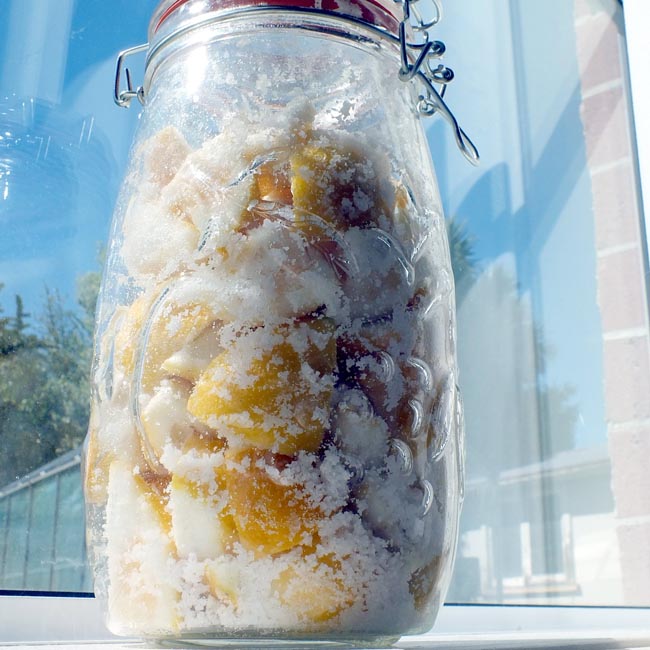
Salted lemonsStart by sterilising a large glass jar – a kilner-type jar like the one pictured is ideal.

Wash the lemons, dry, cut into eighths; you don’t have to remove the pips, but I did.

Put the lemons in the jar. Add the salt and shake it all up well to spread it all over them.

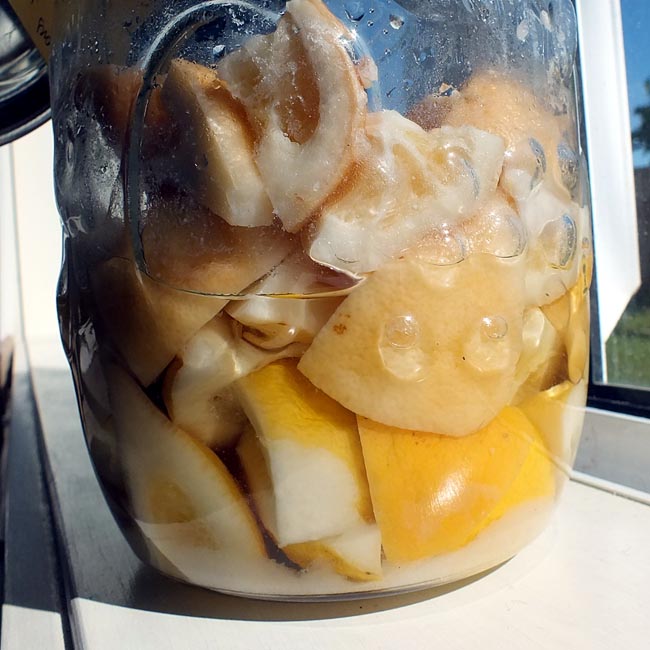
Lemons, after saltingCover; leave in a warm place for 1-2 weeks. (I put it on the windowsill which catches the sun nicely.) The juice leeches out of the lemons; where they’re exposed to the air, the lemon pieces soften and go a dull brown colour.

Mix the fenugreek, mustard powder, chilli powder and turmeric. Add this to the jar and shake it around gently. Re-cover and put it back into the warm for 2-3 days.

With all the spicesTransfer the lemon pieces and spices to a large saucepan.

Heat the mustard oil in a large frying pan. Fry the mustard seeds and asafoetida.

Keep heating the oil until it starts to smoke, then pour it over the lemons. (This is where it gets a bit frisky.)

Mix well. Allow to cool, transfer to a bowl, cover once more and leave in the warm for another week or so.

Lemon pickle

Now it is ready to put into jars; I tried (without huge success) to decant the excess oil. Then you can give some to your friends as presents, or to your enemies as a chemical weapon…

Ross is an expat thirtysomething Brit who went to the Shakey Isles in search of adventure. Works in technology, enjoys creating, has a love-hate relationship with his kitchen.

Warm thanks go out to Ross for these four great blog posts – hopefully he’ll be back with some more antipodean country skills for the blog in the future!  Have a look at Ross’s other lemon glut-busting recipes for lemonade and lemon liqueur, and lemon sorbet (which you’ll be needing, after sampling this pickle, I think!).

I hope you’ve all enjoyed this contribution from a great guest blogger as much as I have!

Read more from the Country Skills blog >>

When Life Gives You Lemons – Part 3: lemon sorbet [Guest Blogger]

Lemon TreeToday’s Guest Blogger is Ross, from Christchurch, NZ.

Lemon sorbet

Next up, to cleanse the palate, a simple sorbet. Note that if you have an ice cream maker it’ll make life easier, but it’s not mandatory (I don’t have one).

This recipe uses 8 lemons, and makes about 2.5 cups of sorbet.

  • Make up some simple syrup (see post 1 of this series) with 1 cup of water and 1 cup of sugar.
  • While it’s cooling, zest most of the lemons. You’re looking for about 2 tsp of zest – the finer, the better – I reckoned I had enough after six lemons.
  • Juice the lemons. You’re looking for about a cup of juice.
  • Mix the juice, zest and cooled syrup. Chill well (I left mine in the fridge for a couple of hours).

Now freeze. If you have an ice cream maker, you’re all set – but I don’t. That’s OK, it just means a bit more effort. The end product is a water ice, not a block of solid ice, so all you have to do is fluff it up a bit as it freezes.

Lemon Sorbet

  • I split the mixture into a couple of clean shallow plastic tubs and put them in the freezer.
  • After a few hours it was semi-solid; I mashed it up with a fork, then put it back in the freezer. Ideally I’d have done this again after a few more hours, but it was late in the evening so I left it overnight. This was maybe a bit too long as it was nearly solid so was a lot of work! (You could probably use a blender instead, but I don’t have one.)
  • Then put it back in the freezer. After 12-24 hours it’s frozen enough to serve.

Ross is an expat thirtysomething Brit who went to the Shakey Isles in search of adventure. Works in technology, enjoys creating, has a love-hate relationship with his kitchen.

Have a look at Ross’s other lemon glut-busting recipes for lemonade and lemon liqueur.  Coming up soon, lemon pickle.  Watch this space!

Read more from the Country Skills blog >>

When Life Gives You Lemons – Part 2: lemon liqueur, or ‘limoncello’ [Guest Blogger]

Today’s Guest Blogger is Ross, from Christchurch, NZ.

Lemon Liqueur

I did the first part of this at the same time as I made up some lemonade. This was a small test batch but will scale up directly.

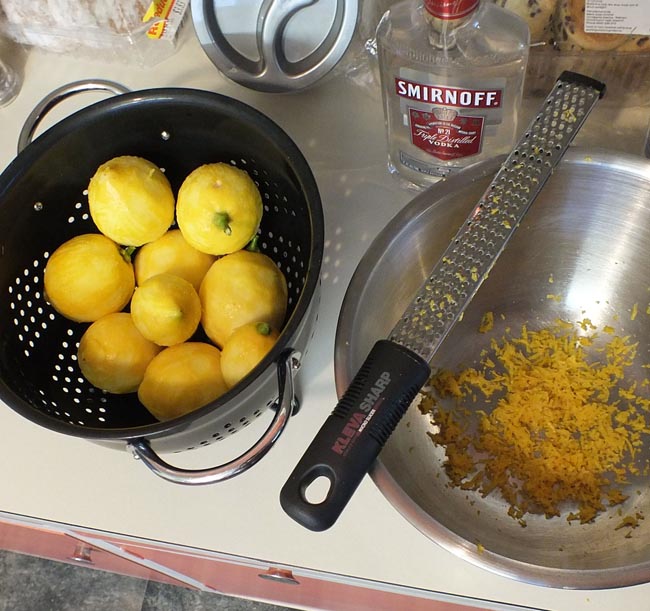
IngredientsIngredients –

  • A half bottle of vodka (375ml) – not flavoured, you want something as pure and tasteless as you can find.
  •  8 lemons (zest only). Go for lemons with thick peels if you can, to maximise the amount of zest.

Sterilise a large sealable jar. This is the same as for making jam – a careful clean, rinse well, then dry in a slow oven.

Scrub and dry the lemons, make sure you’ve removed any wax. Now zest them; be very careful not to take any pith or you will spoil the result.

While the jar was cooling, I juiced the lemons to make the lemonade.

Lemon liqueur, infusingPut the zest into the jar and add the vodka. Make sure all the zest is covered, then seal it up and stash in a cool dark place for a while. I found a number of different recipes suggesting anything from 2 to 45 days; I left it for two weeks.

… time passes …

Make sure your bottles are clean and dry. You’ll end up with slightly more by volume than just the vodka.

Prepare a simple sugar syrup, and let it cool.

The amount of syrup you need is whatever will dilute your starting liquid to the desired strength (traditional limoncello is 30-32% ABV). In my case (375ml of 37.5% ABV vodka) this calls for 80ml of syrup.

Combine the infused alcohol with the syrup. Stir well. Optionally, say some recipes, let it rest for a few more weeks (I didn’t).

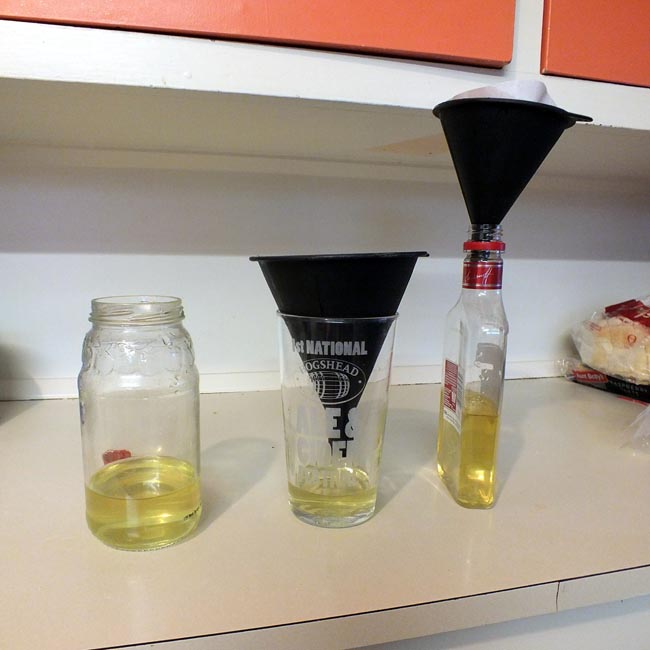
Filtering set-upNow filter carefully; for best results filter more than once. I started out with a sieve, then switched to coffee filters. I filtered it four times, which might be excessive; I set up a little production line (pictured). The filtering was slow, and the setup easy to knock over; I found myself longing for some clamp-stands like I used in chemistry class in high school. Unsurprisingly, the filters clogged quite readily; I got through several of them.

Bottle directly from the last filtration; the liqueur should be clear but coloured. At this point the product is very sweet and sharp. Let it mature in the bottle for at least a week; both the sharpness and the cloying sweetness melt away. Serve cold (direct from the fridge, or even the freezer). It’s dynamite-strong; take care!

Next steps?

This wasn’t real limoncello; apparently the genuine stuff is made with grain alcohol which pulls more flavour out of the lemon. (Grain alcohol as in 95% ABV – yes, almost pure ethanol – 190 proof in old money. It’s difficult to find on the shelves, but here in New Zealand it’s legal to distill spirits for personal use. There might be another blog post in here along those lines, but that’s a project for another day…)

Ross is an expat thirtysomething Brit who went to the Shakey Isles in search of adventure. Works in technology, enjoys creating, has a love-hate relationship with his kitchen.

Coming soon, more lemon glut-busting recipes from Ross – lemon sorbet, and lemon pickle.  Watch this space!

Read more from the Country Skills blog >>

When Life Gives You Lemons – Part 1: Lemonade! [Guest Blogger]

Today’s Guest Blogger is Ross, from Christchurch, NZ.

Lemon TreeWhat to do when life gives you lemons?

We have a lemon tree. Consequently, we have a lot of lemons. It’s just turning to spring here in New Zealand as I am starting to write this, it’s our first spring in this house, and we have a crop ready to harvest.

As a long time reader of the Country Skills Blog I went fishing for suggestions. There is plenty of marmalade on here, which I must get round to trying out sometime, and everybody has heard of traditional old-style lemonade, but what other interesting things can we do with them…?

Studying some recipes I found recipes for a lemon liqueur not entirely unlike limoncello, which use only the zest of the lemon, whereas lemonade uses only the juice. A perfect combination for the first experiments!

Simple Sugar Syrup

This comes up in a few of these recipes, so I’ll describe it once.

Take roughly equal volumes of sugar and water. Mix and heat in a small pan; boil gently until the sugar has dissolved leaving you with a clear syrup. You usually want to leave it to cool before you do anything else with it; if not, take care – it’s like napalm.

Fresh Homemade Lemonade

Lemonade 1Ingredients:

  • Lemons (juice only),
  • sugar,
  • (optional) fresh mint to garnish.

120ml of lemon juice + 1/2 cup sugar makes about 650ml lemonade.

Juice however many lemons. I got about 120ml from the eight lemons I used for my test batch of limoncello; I could have probably got some more from them if I had tried harder.

Lemon JuiceMake up some simple syrup following directions above. I used the same volumes of water and of sugar as I had lemon juice – near enough 1/2 measuring cup of each.

Let the syrup cool, then transfer to a jug. Add the lemon juice, then more water to dilute: three times as much water as you put into the syrup, so I used 1 1/2 cups. Chill well before serving. If you have any fresh mint to hand (I didn’t), it would make an excellent garnish.

Ross is an expat thirtysomething Brit who went to the Shakey Isles in search of adventure. Works in technology, enjoys creating, has a love-hate relationship with his kitchen.

Coming up soon, more lemon glut-busting recipes from Ross – lemon liqueur, sorbet, and lemon pickle.  Watch this space!

Read more from the Country Skills blog >>
Sourdough Saga: Episode 7 – six months on, life with my sourdough starter

Back in May of this year, I started my experiment with creating – and baking with – a sourdough starter.  Now that November is nearly with us, almost six months on, what is the starter like to live with, and what effect has its appearance in my home had on my life?

In July, when I gave a ‘clone’ of my starter to my sister as a gift, I wrote her a guide to looking after her starter.   My starter is less cosseted these days – it drinks tap water, and has survived several rounds of being abandoned in the fridge for a couple of weeks or longer between feedings.  After long periods of abandonment, the starter has a sharp vinegary smell, and either a layer of greyish water on the surface, or an even more unattractive and worrying-looking layer of ‘fuzz’.  But every time, after pouring or scraping this away, and feeding the starter, it has sprung back to life.

Sourdough loaf selection

My starter has successfully baked white, wholemeal, malted mutligrain and spelt loaves (and a variety of combinations of these flours) – in fact, the flour used for sourdough loaves seems to make very little difference, probably because of the longer proving and working time compared to a quick-yeasted loaf.  The loaves are continuing to get better, too – with a nice even crumb and springy texture these days.  Last week, on holiday in a rented cottage in Cornwall, I even managed to bake a batch of sourdough in the borrowed kitchen and unknown oven! (Why, yes, I did take my starter on holiday with me, why do you ask..?)

I use less salt in my batch than I did to start with, but otherwise my method remains the same as for my very first loaf.  I often bake a double quantity, and freeze one loaf.  I’ve added cheese, herbs, and sun dried tomatoes to loaves, with great success.  More recently, I haven’t used the stand mixer for some batches, but worked the dough entirely by hand instead.  A plastic dough scraper, which I bought from eBay for 99p, is a great help and not exactly an investment that broke the bank!  As you can see from the photo, I’ve baked rolls, free-formed loaves, and even a loaf in a tin.  The sourdough pizza was *amazing*, too.  It all works brilliantly, so the limit should only be your imagination!

Several ‘clones’ of my starter are now in new homes with family and friends, and they report baking very successfully with their starters too.  So you see, if my Dad can do it, so can you!  There are even rumours of my starter making it into small-scale commercial production, so watch this space!

As an aside – when I was growing up, I sometimes wondered about the Lord’s Prayer – specifically, the fixation with ‘daily bread’.  After all, what was so exciting about bread? Well, it’s a bit like the first time you’re outdoors, on a crisp clear night somewhere really, really dark, and look up and see the infinite billions of stars and the Milky Way spread above you, and the phrase ‘majesty of the heavens’ suddenly makes sense as something other than a weak metaphor – in an earlier time, before we filled the skies with artificial light (and our larders with artificial food), these things were seriously impressive!  Good bread may genuinely change your world – your food world, at least!

The downside?  Well, all other bread is a disappointment, frankly! I did get a couple of really nice non-sourdough white loaves from a bakers’ shop while we were on holiday, which made a pleasant change.  But, basically, you’re never going to want to buy bread from the supermarket again – even the stuff from the phoney-bakers-shops they have in store these days is a total let-down, and as for the plastic-wrap ‘chorleywood’ sliced white, well…

All of which means that regular baking days have become a feature of our already rather busy lives.  Now, I wouldn’t have it any other way.  And, yes, you’ve guessed it, today is a baking day!

Read all the posts in the Sourdough Saga >>

Read more from the Country Skills blog >>

Offally Good – liver with bacon and onions, fast fresh frugal food

Offal certainly divides opinions!  One of my favourite ever dishes is liver, bacon and onions – so simple, really just three ingredients –  I’ll order it in a pub whenever it’s on the menu, but sadly it’s often a disappointment.  When it comes to liver, freshness is everything.  It doesn’t reward maturation!  Lamb’s  and calf’s livers are the ones to choose – pig’s liver has a nasty bitter flavour, which some people seem to believe can be mitigated by doing things like soaking the liver in milk before cooking.  Don’t bother!  Get the best, freshest lamb or calf liver you can, it needs very little preparation, and makes a wonderful meal.

Liver, bacon and onion

As much of our meat as we can manage comes from the little farm-shop butcher just up the road from us.  Chris, the butcher and farmer, knows us quite well these days – so when my husband was in there last week, Chris happened to mention he’d just that very day come back from taking a few lambs in to slaughter.  He had the ‘plucks’ (the slaughterhouse term for the heart, lungs and liver).  A lovely fresh lamb’s liver, inevitably, made its way into the shopping bag!

Fresh lamb's liverGood fresh liver is dark burgundy in colour, firm but yielding in texture.  There will probably be some blood in the packaging, wash this off and pat it dry.  Fresh raw liver has almost no smell. It shouldn’t be mushy, crumble, or disintegrate under gentle pressure – if it does, then a process known as ‘autolysis’ has started, and the liver is starting to break down.  Blotchiness and pale areas can also suggest less than ideal freshness, or issues with the health of the liver.  This liver, in thick slices, was beautiful.

Liver slicesThere will be some fibrous tissue in the liver,  you can trim this away as you slice the liver into pieces.  I like my liver in bite sized pieces, cut on the diagonal from the original thick slices.  Try to keep the pieces as even sized as you can, so they will cook evenly.

Prepared trimmed liver piecesDecide what you want to serve with your liver, bacon and onions – mashed potato is traditional, but don’t let that stop you.  Ours was for lunch, so we enjoyed it with a little gravy, and warm buttered toasted muffins.  If you want side dishes, get started with those first – the liver will take less than ten minutes, and you want to serve it as soon as it’s ready.

As well as your lovely fresh lamb’s liver, to serve two you will require –

  • Bacon pieces and sliced onionsOne onion, peeled and sliced thinly from root to tip
  • Four slices – or two thick pieces – of dry cured bacon, cut into chunks
  • Pepper, olive oil, flour or gravy granules (optional)

Slice an onion into thin slices from tip to root, some dry cured bacon into pieces.  Use the very best bacon you can – my home-cured maple bacon is perfect – the last thing you want is that nasty bacon-water from commercially produced bacon leaking out into your pan.

Add liver to pan & fry offFry off your bacon and onion in a large frying pan until starting to caramelise.  Add a very little bit of olive oil if you need to.  Once it’s starting to show a little colour, push it to one side  in the pan.  Now add the liver and fry off until the pieces are just a little bit pink in the middle.  You’re nearly done – just time to make the gravy.  Mix the onion and bacon back among the cooked liver.

Cooked liver piecesNow add a generous splash of boiling water to the pan, and stir it all around to capture all the lovely pan flavours.  If you want your gravy a little thicker, thicken it by your preferred method.  Gastropub recipes often have red wine in the gravy – I’m not sure this is an improvement, simplicity is everything here!  You probably won’t need to add any salt – the bacon has enough – but season with pepper to your taste.

Making gravy

Serve, and enjoy!  This is such great comfort food – it’s food for the soul as well as the body!  And a timely reminder to me that I need to remember to enjoy offal much more often!

Read more from the Country Skills blog >>
Cooking with James Martin – pea and watercress soup

Earlier this year, I was privileged to be invited to spend the day ‘Cooking with James Martin’ with a group of other foodies and bloggers.  We enjoyed some amazing dishes, and I did promise at the time to share the recipes with you.  Time has rather run away with me the last few months, but here, belatedly, is the first recipe – ‘Pea and Watercress Soup with Deep Fried Egg’. 

Pea and Watercress Soup, presentation

While we were very kindly provided with recipes after the event, I made notes at the time and my notes and recollections vary from the recipes we were given in various ways – that’s the art, I suppose!  The recipe I present here is closer to what I remember James cooking on the day, than to the ‘official’ recipe.  How much of the miss-match is due to errors and omissions on my part, and how much to revisions on his, I wouldn’t like to say!

This is a beautiful summer soup and an absolutely amazing colour.  James served it with a crispy-on-the-ouside, soft-on-the-inside deep fried soft boiled egg, which was an amazingly ‘cheffy’ touch, but I think the soup would stand up very well without it, if it seems a bit faffy for you.

To make this soup, you will require –

  • 1l of good quality vegetable stock (the nicer the better – but nice bouillon powder would probably do at a pinch)
  • 500g of frozen peas
  • 300g fresh watercress
  • 100g of flat leaf parsley
  • 1 shallot, chopped
  • 150ml of double cream (see later note)
  • Decent knob of butter
  • Small handfull of asparagus spears (optional)
  • Salt and pepper
  • Blender, either the stick-type hand blender or, for a smoother finish, a food processor blender jug would probably work better

James MartinBlanch the watercress and flat leaf parsley by immersing very briefly in boiling salted water, and then removing straight away.  Squeeze it out in a tea towel to remove as much water as possible and set aside

Now melt the butter in a saucepan (or wide chef’s pan, if you have one), add the shallot and fry gently until translucent.  My recipe mentions some garlic here, but I don’t recall any being used, you could add a minced clove of garlic if you like though!  Once the onion is translucent, add the stock to the pan, along with the peas and chopped asparagus, and simmer for 2 – 3 minutes, so that the peas are just soft but still bright vivid green.

Blended soupNow take the pan off the heat, add the blanched watercress and flat-leaf parsley (the recipe also says the cream – I don’t remember any cream but it could well be an oversight on my part!) and blend aggressively until it looks almost luminescent green.  Season to taste with salt and pepper.

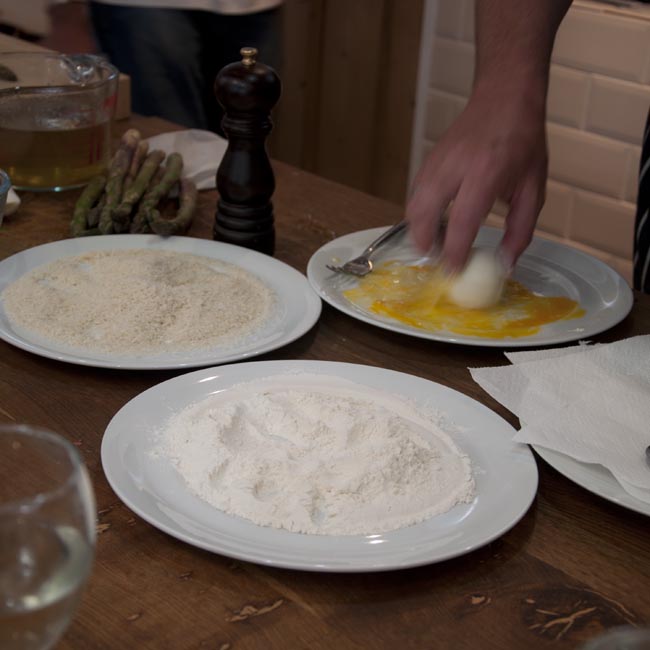
Bread-crumbing egg for deep fryingJames soft boiled some eggs (5 minutes), and once cold, peeled and coated in breadcrumbs (flour, egg wash and then crumbs) before deep frying until golden brown.  The egg adds a lovely richness and texture balance to the final dish, but for me, thinking about this as a dish to cook at home, the deep frying was a flourish too far. I think floating a poached egg in the soup would achieve a very similar effect.

Bring the soup up to temperature, without boiling, and serve in your prettiest bowls, placing the egg in the centre.  James added some crispy fried bacon bits, which add a nice crunch and salty-savoury note.  You could add a sprinkle of crispy breadcrumbs or small croutons to increase the crunch if you liked – particularly if you’re skipping the crunchy deep-fried egg.  The finished effect, it struck me at the time, is very much ‘ham, egg and peas’, but taken apart and put back together again all fresh and inside-out!  The final presentation flourish is celery cress & coriander cress, sprinkled over.  They don’t sell celery cress or coriander cress in my local co-op, and it’s the wrong time of year to sprout my own, so I suppose I’ll have to make do with a few reserved flat-leaf parsley leaves!

Really Important Note – You know that ghastly grey-green colour and slightly odd sulphurous odour that tinned peas have? This soup depends for it’s amazing colour and fresh flavour on absolute freshness and minimal cooking.  It will not re-heat!  Well, not without turning grey.  So don’t prepare it in advance and expect it to be any good re-heated for your dinner party.  You have been warned!

If thats got your appetite going, have a look at the collected James Martin recipe posts, here…

Read more from the Country Skills blog >>