
Built Like A Barn Door – or, how to make your own shed doors [Guest Blogger]

Lemon TreeOur Guest Blogger is Ross, from Christchurch, NZ.  

You may recall the lovely series of lemon-glut busting recipes which Ross has shared with the blog.  As well as all that preserving, he’s been doing some DIY lately – and I was so impressed by this new shed door that I rather cheekily asked him for a write-up!

So, as they say, now for something completely different! But something which is still undoubtedly a very useful country skill – woodwork.

Scenario

We have a shed. It’s timber-framed, and until recently it was clad with asbestos boards. We got some professionals in to remove and dispose of it properly, and then had a local builder come and reclad the shed in plywood. So far so good, but his quote didn’t include reinstating the door – which, to be fair, was old, rotting, and had a sliding track which was ruined when the asbestos guys ripped it off.
Shed, doorlessWhat to do?

The aperture was 190-191cm high and 140-141cm wide. (Yes, the edges are not parallel; what do you expect?) An unusual size, and if I did get a door made to fit that, I’d also have to shell out for delivery as it wouldn’t fit in the car. Such a wide door would have quite a large swing, which could be a bother.

I got some door designs from various DIY books and websites. The traditional basic ledged-and-braced door design – described as having a “rustic” feel – would certainly work for us. In short, you lay out some planks side-by-side, then nail or screw two horizontals and a diagonal to keep them together, and there’s your door.

Single door panelI don’t have a good picture of the design that doesn’t infringe somebody else’s copyright, but – skipping ahead a bit – here’s what one of ours looks like.

I rapidly came to the idea of a double door to reduce the swing size. But if I made a pair of ledged and braced doors, I’d still have the same problem getting the parts home from our local DIY barn as the wood would be too long to fit in the car.

There was a bit of head-scratching, and a few minutes more spent getting the splinters out from under my fingernails, before I realised what I could do. Stable doors. That is to say, a pair of doors with the ability to swing independently but which fill the frame vertically.

So, to deal with the swing issue as well, I’d make a double stable door. That is to say, four doorlets to fill the space. What could possibly go wrong? I should point out that, between my partner and I, we have limited tools, skill and experience. We have an electric drill and a Workmate, and know what end of a hammer to hold (beginners please note, not the metal end), but New Yankee Workshop this ain’t…

Design

door drawingHere’s the design. H for hinge, S for a door-stop, and the brown rectangles are tower bolts.

If you compare it with other ledge and brace doors, you’ll notice this is a modified design. Traditionally the ledges would both be a little distance in from the top and bottom of each door. Here I have moved the central ledges nearly flush to the edge, for convenience in bolting them together. (I still needed to be able to bolt one side at the top and bottom, but I figured I would use off-cuts to extend the ledges where I needed to. You probably don’t want both ledges to be flush with the edges in case you need to shrink the doors later.)

So I spent a good while in Mitre 10 figuring out which of their available pre-cut timber widths would give me a reasonably convenient time of assembling it all. (I had hoped to find tongue and groove, but they don’t keep any. That was OK as their regular boards are uniform enough; some are a bit warpy but not too bad.)

It broke down like this:

  • Right side: 7x 13.5cm x 9mm boards per door
  • Left side: 2x 23cm x 9mm boards per door
  • Bottom half: Boards to be 1.2m long, uncut
  • Top half: The same 1.2m boards, to be initially cut a few cm too long, then later cut to fit precisely.
  • Ledges (horizontals): Cut to same width as their respective doorlets. I realised later they need to be a little smaller to allow for the swing of the door.
  • Braces (diagonals): Pythagoras tells us that these are going to be longer than the verticals or the horizontals. As they’re blocks with a non-zero width the length will be slightly longer than by Pythagoras, but it worked out within about 1%.

You may notice that (7 x 13.5cm) + (2 x 23cm) comes to 140.5cm, for an aperture that varies between 140 and 141cm in width. This would prove to be annoying later.

Assembling each doorlet
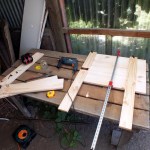
Assembling the doorletLay out your panels side by side. Use a spare block of wood to square up the ends. (For the 7-panel doorlets I did this in two stages, four boards then three, as my working area wasn’t quite wide enough.)

Clamp the ledges into place. I also used a sash clamp to hold the planks together laterally; I don’t know whether this was essential but I suspect I’d have needed more G-clamps if I hadn’t.

Then pin the ledges to the planks. You can do this with nails but I used screws (drilling pilot holes first, of course). I attached each end of the ledge to its corresponding board with three screws, then put one screw into each intermediate board; the same for the other ledge. This may have been overkill.

Next cut and attach the braces. We just marked these with a pencil and steel rule, then sawed as close as we could to the line (fixing up later). The braces have to fit well as they spread the weight of the door. I fixed each ledge with two screws into each end board and one into each intermediate. On reflection this was definitely overkill.

Then paint, varnish, or apply whatever decoration you wish. For efficiency we painted only the outward faces at this point (we have still to paint the shed exterior, after all) – in a less clement climate you might be well advised to paint all of it before hanging to try and prevent damp getting in and warping the wood to next week and back again.

The hinge conundrum

I had read in my DIY book that a tee-hinge was “traditional” for this sort of design of door, so I bought some without thinking much about it. Mistake! For an outward-opening door, it was only going to be possible to put these on the outside of the door, with the screws exposed to all comers: no good for security. (Thank you, Mitre 10 returns policy…!)

I replaced them with some ordinary door hinges, of the kind that doesn’t require you to cut a rebate into the frame.

It’s important to think about where the hinges will attach to, on both the door and the frame. You can’t put screws into the end-grain of a block of wood and expect them to hold. Similarly, putting them into the side of the plywood cladding would have been hopeless. These were going to have to go into a door frame, the shed’s timber framing, or something securely attached thereto.

Shed frameOn one side I had the timber stud. No worries – just have to chisel away a small section of the plywood edge so I could attach the hinges properly into the stud and not foul their pins.

Existing shed constructionOn the other side things were a bit more interesting. There’s no frame to be seen – just the edges of the interior wooden cladding, and a bit raggedy at that.
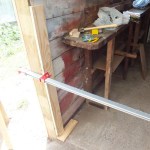
Adding part-frameTurns out the frame is just behind, so I bought a couple more boards to act as a part-frame, which I attached with long screws through the inner cladding and into the frame.

Hanging the doors

Finally, it was time to hang the doors. You can hang a single door yourself, but it’s a bit troublesome and involves a couple of wedges; much easier with a spare pair of hands. (Sadly, I didn’t have a third pair of hands to photograph this process.)

I started out with the lower two doorlets. Obviously, the bottom doors don’t go all the way down to the deck; you want them to sit slightly off the ground (one source I read said 6mm) for clearance over any debris that may lurk. First fit the hinges (remembering not to put screws into the end grain of a ledge); then put the door into its open position, jacked off the ground; mark the positions of the holes, drill your pilots, then screw it into place.

Except, if you’re me, at some point in this process you think “hey, if I cut rebates for the hinges on that side, even if they don’t need it, I’ll save the couple of mm that will mean I don’t have to trim the doors.” Mistake! I’ve never cut rebates before, and they were distinctly less than even. Worse, the rebates I cut were sufficiently deep that when closing the doorlets fully the pressure tried to rip the hinges off! I ended up packing the hinges with cardboard and crossing my fingers. This may yet come back to bite me, but at least it’s “only” a matter of turning the fake-frames over and rehanging two of the doors, right…?

Offering up the second (larger) door it was clear I was going to have to trim a few mm off the edge for it to fit. On hanging it I found I had somehow managed to give them a 6mm height differential. I wasn’t worried; they swung well, and it’s not surprising as the ground isn’t flat, but if only I had realised this first and hung one to match the other…

Bottom doorlets installedBy now it was getting late. I had bought four heavy-duty tower bolts for securing the doors to each other and the frame, so I used one of them to keep the doors from swinging freely, then called it a night.

Fitting the upper two doors was very much like the lower two, but less close to the ground. We offered each up in turn and trimmed them to fit vertically, as planned.

On closing them for the first time (one at a time), one of the ledges prevented the other door from closing, so we cut a bevel into it. Then the doors fitted!… just. Very very tight, not really usable, so we spent a few minutes hand-sanding the mating edges down. It’s just about usable. I am reticent to take more off yet until the doors have hung for a couple of weeks as they may settle, changing their shape subtly.

Door furniture

All doorlets with boltMy plan for using the door was to treat the whole thing as a double door most of the time. I fitted a tower bolt across each vertical pair to keep them together; this is why I put the central ledges where they are.

Most of the time we won’t need the full width of the door so will only open the larger half. I fitted a tower bolt vertically at the top and bottom half of the smaller pair to secure them. (I added a couple of off-cuts in the corners, butting up to the ledges, so I could attach the bolts with the same deep screws I had been using on the rest of the door. The shed sits on a concrete slab, so making a hole for the bottom bolt to drop into required a couple of minutes with a big masonry bit.)
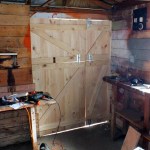
Inside view, bolts installedThe door is secured by a hasp, staple and padlock across the top pair. I may fit a further tower bolt inside the bottom pair so we can have it held fast while the top pair are open stable-style.

A couple of door stops (not yet fitted at the time of writing) will complete the security, preventing the larger half of the door from being forced inwards when the shed is unattended.

Next steps

After the doors have had time to settle (a few weeks) I will have a good look at them and see if I need to adjust or re-trim anything. I suspect I will want to plane a few mm horizontally off the upper doors where they stick. You can see they don’t sit perfectly; can I claim some sort of amateur’s privilege?

Finished, doors closed

If you have a big gap between double doors you might want to fit an astragal. I may yet fit one on ours – depends how much I remove after it has had time to settle.

Materials and costings

[The costings won’t be of too much use if you’re not in NZ, but they give you an idea. At the time of writing the exchange rate is about NZ$1.90 to £1.]

  • Materials cost: $384.08  – of which $233 was wood, $97 door furniture, $44 paint.
  • Consumables: Sandpaper and sanding block; several dozen screws.
  • Tools used: hammer, wood chisels, electric drill (several different wood bits, a countersink, and a big masonry bit I bought specially so the bottom bolt could drop into the floor), screwdriver bits for the drill (a big sanity saver!), hand plane, G-clamps, 1.2m sash clamp (bought specially for this project; $48.15). Black & Decker Workmate.
  • Time taken: The lion’s share of three days, including trips to the DIY shop. A little more time will be needed after the doors have had time to settle.
  • Labour cost: zero!

The satisfaction of doing it ourselves: *Priceless!*

Lessons learned:

Think through your design. No, really. Don’t assume that hinges will be so inconsequential as to not require thought.

Mortising rebates is hard – or, at least, I don’t have the knack. Beware, it’s very easy to cut too much, which you can’t easily undo.

If you buy hinges that don’t require to be rebated, don’t cut rebates for them!

Remember that the door swings. A thick door, or one thickened by ledges and other attachments flush with the edge, is harder to swing than a thin one.

When hanging a pair of doors that you can see the tops of (e.g. a double stable door like this project), you might want to try and make sure the tops are level.

Ross is an expat thirtysomething Brit who went to the Shakey Isles in search of adventure. Works in technology, enjoys creating, has a love-hate relationship with his kitchen.

Thanks, Ross, for this great DIY tutorial!

It’s been so much fun having these guest blog posts from Ross – and they seem to have been appreciated, too!  So if any readers out there have favourite ‘country skills’ they’d like to share with the blog – particularly if, like Ross, you live on the other side of the world, or have great ‘urban’ country skills – then drop me a line on kate@countryskillsblog.com and we can have a chat!

Read more from the Country Skills blog >>

Relight My Fire – DIY recycled wax and wood-shaving firelighters

The chimney sweep came this week, and with the equinox just passed, the nights are palpably drawing in.  We use the wood-burning stove in our living room for an awful lot of our heating in the winter – the alternative for us, living off the beaten track (and off the gas main!) is our oil-fired boiler, which is both expensive and not terribly environmentally considerate.  But even if you’re not using your fire daily, there’s nothing better than a real wood fire as the nights get colder and darker!

Firelighter burning well

We have a fire most nights in the winter, and that brings with it a requirement for firelighting.  We cut our own kindling wood from our log supply (well, I say ‘we’ – Hubby does it!) so it’s not as tinder-dry as the bags of kiln-dried kindling sticks you can buy at great expense.  While I’ve succeeded in lighting the fire with newspaper, cardboard and kindling, it’s a frustrating exercise, doesn’t always work first time, and we tend to use a firelighter to get the kindling going nice and quickly and conveniently.  There’s only one downside – the white firelighter blocks you get from the co-op or the garage *stink* of kerosene.  I don’t want them in my living room!  And while I occasionally see the nicer wax & sawdust type for sale locally, I can’t buy them reliably.

But they gave me an idea – with the waste-wax I have available from old candles (believe me, I’m really bad at throwing things away, even stuff like this!), the really grotty old stuff that really can’t be recycled into new candles, from melt pools, stained with soot, with old wick and ash and even match-heads in it, in different colours and scents, could I make my own?

The answer is resoundingly *yes*, but with a caveat…

Equipment and 'ingredients' (1)You want about equal volumes of wax and closely packed wood shavings.  I was hoping to use some wood-shop waste, to make the whole thing completely free and recycled, but the stuff I could get hold of was too fine and dusty and mixed with big chunks of ‘stuff’.  I think the shavings produced when hubby breaks out the wood-turning lathe would be ideal, so I’ll save those in future.

'Ingredients' (2)For this batch I used a cup of wood shavings I stole from the supply we keep for the henhouse, it’s a tiny amount and probably cost a couple of pence at most (and technically I suppose is a recycled by-product, anyway!).  You also want an egg box (I had a few old dozen-sized egg boxes that have been damaged beyond useful re-use), and a double-boiler arrangement for melting your wax, preferably with an inner container you don’t want to use again for ‘clean’ candle-making, and a thermometer for safety.

Take your dirty grotty old wax and put it all into the double boiler, and heat the water up to about 75 degrees celsius.  This should allow you to melt the wax down without getting too close to the flash point of your wax.  I’ve used an old can which previously held malt extract for home-brewing, it’s about the perfect size for melting candle wax.  Really, any dirty old wax goes here, and don’t worry about trying to remove old bits of burnt or unburnt wick, wick sustainers, matchsticks, or anything like that.  Add more wax in stages as the contents of the can melt down, until you have the sort of volume of melted wax you need (it was about 1/3rd of the can, once melted, for me).

This part of the process is where my caveat comes in – it took a bit over an hour to melt down all this wax, during which I couldn’t really leave the wax unattended on the stove (though I did get the chance to have a nice chat on the phone with my little sister).  The time investment in making these as a standalone project probably, for me at least, make the cost / benefit of this project a bit suspect!  There may be ways around this, more of which later!

Melted wax with about half the shavings addedOnce all your grotty old wax has melted down (it will smell quite peculiar if, like mine, it contains fruity, citrussy and maple-syrup scented candle-waxes!), add your shavings in batches, stirring as you go.  You want most of the wax to be absorbed into the shavings, leaving just a little bit of ‘free’ wax to set the mix as it cools.  Pack the mix into the wells of the egg boxes, filling them to the top, and squeeze down the contents with your fingers (wait for it to cool partially before doing this, if you like).

Firelighters settingMy mix made an almost perfect dozen firelighters (I also made two ‘experimental’ lighters with rolled-up cardboard in the well). Allow the firelighters to cool, and then separate them (tear, or cut into the underside of the egg carton to get things going).  Mine look like rather suspect pink raw minced beef products because of the red waxes that went into the mix!  There’s a very subtle smell about them if you stick them right up to your nose, but nothing unpleasant.

So far so good, right?  But it’s all ‘for nowt’ if they don’t actually light fires!  Would they do the job?  Would all the wax melt and dribble out and make a mess of my lovely newly-serviced wood stove?

Setting fire to the lighter & kindlingBuild your kindling ‘jenga pile’, and nestle the fire lighter in the centre.  Then set fire to the cardboard edge of the lighter with a match, and watch it go!  It burned amazingly well, cleanly, with no wax dripping, and got up to a really good temperature, the kindling wood was snapping, fizzing and crackling almost immediately and the fire got off to a roaring start!

I suspect actually about half the total volume of firelighter would have done the job – a whole egg-well seemed a bit generous.  I might under-fill the wells a bit in future and see if it still does the job.

But ‘in future’, if the process is this time consuming?  Well, if the performance of these firelighters weren’t quite so good, I suspect I wouldn’t be making them again.  I think it will be a task that I do ‘in the background’ in a second can when I’m using the double-boiler for clean candle-making anyway (I’ll be doing quite a bit of this in the build up to Christmas!).  If you’re doing any similar candle craft, and have space for a second melting pot (or if you have one of those natty thermostatically controlled wax melting gadgets that you can set-and-forget to a greater extent) then I can thoroughly recommend making these free, recycled little firelighters.

Keep those home-fires burning bright!

Enjoy your fires this winter, folks (and have a look at my useful little tip for cleaning the glass on a wood-burning stove, while you’re at it)!

Read more from the Country Skills blog >>

Using Your Bottle – self-watering planter success!

Earlier in the week I wrote about my last batch of bottle cutting experiments.  Just a quick post to update, especially about the self-watering planter which, I had to admit, I had my doubts about!

Self-watering planter

Well, it works!  The compost is staying moist, the water level in the reservoir is very slowly – but visibly – dropping, and the basil seems to be thriving!  There seems to be an added bonus with this design, which is that the glass captures the heat from sunshine much more effectively than traditional pots.  The soil feels quite warm to the touch on a sunny day, which can only do good things for the plants’ growth over the winter, right?

So, many more of these to come, I think!  Hubby not too sure about me filling up our windowsills with recycled wine bottles, but I’m sure he’ll come around!

Read more from the Country Skills blog >>

Using Your Bottle – testing some ideas for bottle cutting crafts

I’ve been wanting to play some more with the bottle cutting jig since my first attempts at bottle cutting a few weeks ago.  This weekend I found a few hours and raided some bottles from the neighbours’ recycling bins, and got to work.

Almost completed bottle cutting projects

My success rate this time stayed stubbornly around the 1:3 mark.  It’s becoming clear that two things are combining to be a problem.  The first is that accuracy in the score mark is absolutely critical – if you don’t get a perfectly straight even score that meets neatly, there’s no chance of the bottle breaking cleanly.  The second is that bottles are *rubbish*.  Of the bottles I’ve cut – and failed to cut – so far, not one is made up of even thickness glass, and most of them aren’t even anywhere near round in section!  This makes getting an even score more challenging, as well as tending to make the bottle break unevenly as a result of the variable thickness of glass.   There are a handful of gadgets on the market (and one interesting looking one, called the Kinkajou, about to come on the market) which might well improve my hit rate on nice reliable score lines, but I’m still trying to keep this a low-cost hobby for now!

Glass cutting jigStill, a couple of hours work (mostly removing labels!) got me three new nicely cut bottles – a 500ml green cider bottle, and two punt-bottled wine bottles, one of which I cut long, and discarded the top to make a vase, and the other cut more centrally to give a top and bottom section.  Sanding down (see my previous post for more details of the cutting process) gave me safe cut edges.

I’ve really wanted to play with etching, because I’ve seen some beautiful glass decorating projects, but hubby really wasn’t very enamoured with the idea of me using concentrated acid paste in the kitchen (and I can kind of see his point!).  I settled on using some frosted-glass effect spray paint made by plastikote.  This slightly offends one of my fundamental design principles, actually, but never mind!

The ideas for using the bottles were mostly gleaned from Pinterest, which is a new and rather addictive time-sink (those of you who’ve also discovered this can have a browse of my boards here).  I used some black sticky-back vinyl as a masking material for two of the pieces.

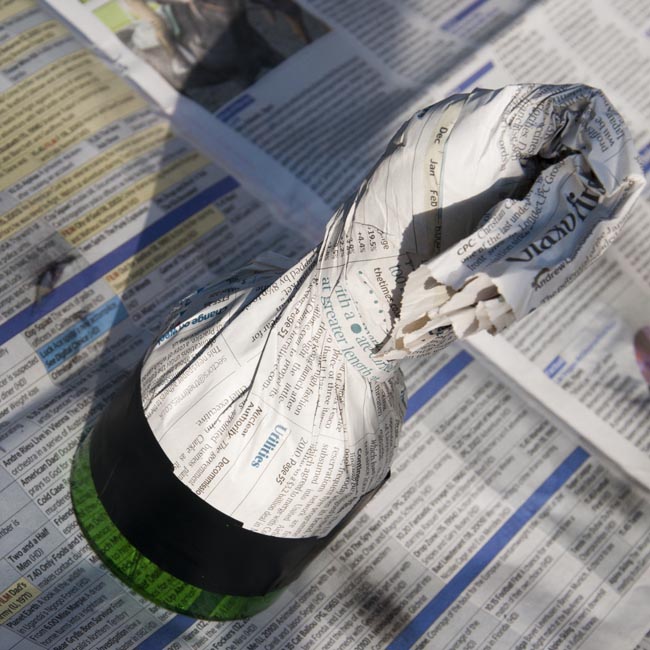
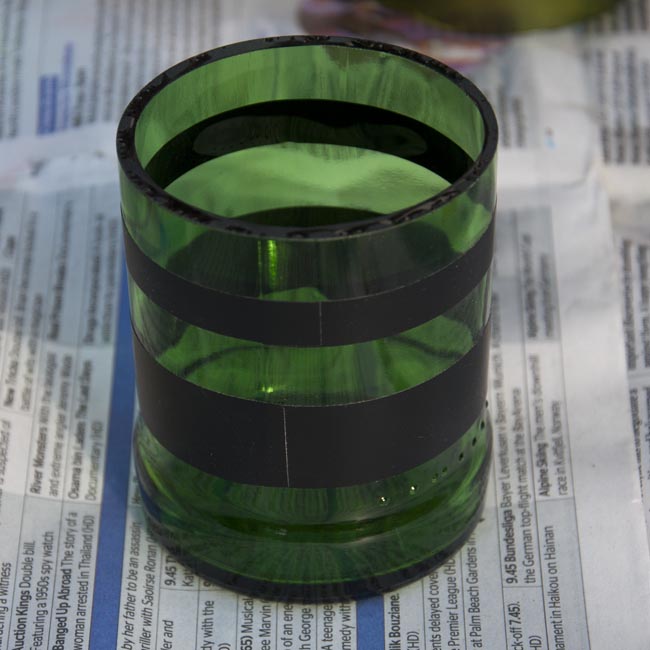
Masked-off bottle topIsn’t it great when you discover that the bits and bobs you’ve bought for one craft can be pressed into service for another?  I dug out the rotary cutter, ruler and cutting mat I bought for quilting, and got to work cutting strips of vinyl.  Two to wrap around the bottom of the cider bottle, to give a striped finish, and the off-cut with some newspaper to mask off all but the edge of the cut-off top of the wine bottle.

Masked tealight holderThis vinyl is a great masking material for glass, as it adheres tightly, stretches just a little to account for the wonkiness of the bottles, and comes away cleanly without leaving any residue.  The resulting cider bottle makes a very pretty tealight holder which would make a lovely little gift.

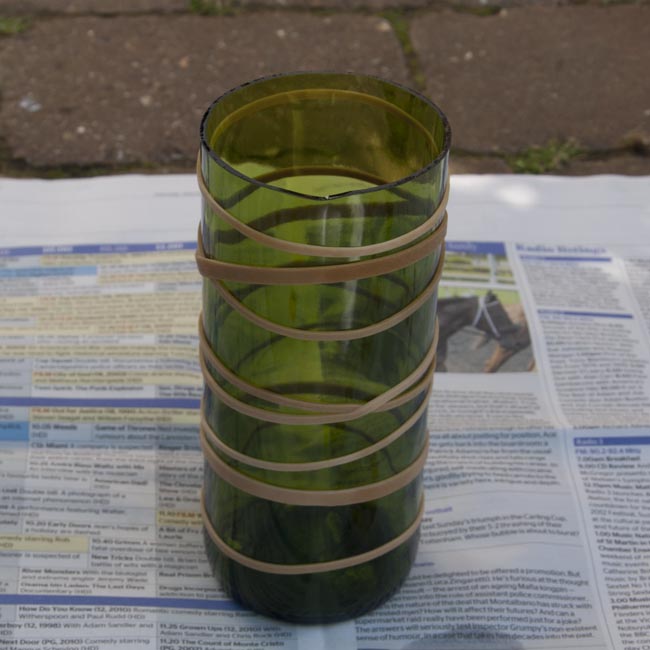
Masked vase with rubber bandsFor the bottle destined to be a vase, I borrowed another idea in wide circulation on pinterest and applied rubber bands, some overlapping, rising and falling. The first thing to note about this approach is that the rubber bands don’t arrange themselves  – it actually takes quite a lot of faffing to get a pleasing arrangement of lines.  They’re not an ideal masking material, either.  As you apply the instructed two or three layers of the frosting paint, some will settle on the top edge of the rubber bands (this is much less of a problem with vinyl which is very thin and doesn’t collect ‘overspray’ in this way).

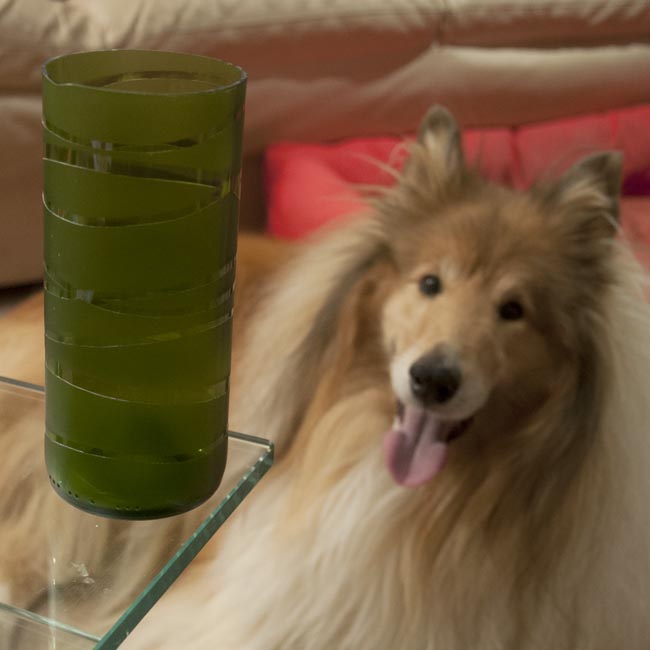
Dave with vaseThe rubber bands came off easily once the paint had dried overnight, but it took quite a lot of delicate trimming away of the extra paint with a scalpel blade to get a reasonable finish.  I’m still not entirely happy with the outcome, and if I try this approach again I’ll try to get away with one, perhaps two layers of paint rather than the three I used.  Still, the result is quite pretty, isn’t it?  Dave said he wanted to be in the photo, and who am I to disappoint him?

Landscape fabric with stringFinally, and perhaps most interesting for me, is the bottle cut in half.  I’ve made a self-watering herb planter, based on a photo I saw – guess where? – that’s right, pinterest again.  The top of the bottle is up-ended inside the bottom.  I lined it with a cut rectangle of landscape fabric about 4″ by 8″, one half of which I threaded through with a bunch of jute string. Fold this in half with the string dangling through the neck of the bottle. Then, fill with compost and plant (in my case, with some rather sorry-looking home-grown basil I always forget to water).

This is where I admit to being a really neglectful gardner.  I’m full of enthusiasm, but when it comes down to it I have a nasty habit of forgetting to water, to pot on, to plant out…  my garden thrives on it’s own resources more than on my care, and my houseplants have to have a strong will to survive!

Self-watering wine bottle planter

So if this contraption actually works (and the jury is still out on this – it’s early days) then it’s going to change my window-sill gardening forever.  Herbs that will water themselves!  In a planter which is recycled, free, and really pretty, rather than something ugly and plastic and more suited to greenhouse shelving than living room windows.

I’ll update with more photos of the herb planter once it’s clear whether there’s any merit to the design.  In the meantime I suspect there’s quite a bit more mileage in breaking bottles for fun and (perhaps??) profit…

Read more from the Country Skills blog >>
Bottling It – a first ‘crack’ at recycled glass craft

Some time ago, I came across a blog claiming that you could cut wine bottles with a burning bit of string soaked in acetone.  This sounded hilarious fun, but also a tad more dangerous and unpredictable than I was entirely happy with!  The idea didn’t desert me, though, and as time went by I was thinking of more and more different ways I might use recycled wine bottles, if only I could neatly (and safely!) cut them in half.  Green Glass make some beautiful drinking glasses out of recycled bottles, which were another source of inspiration.  This is a real ‘upcycling’ craft (a word which often seems to be an excuse for selling overpriced old junk on etsy!) creating something pretty and useful out of the contents of your recycling box!

Glass craft - candle holder

So I did what we all do, and broke out a bit of depth-first google searching.  A few idle lunch-breaks worth of reading later, and I eventually decided that I was happy to experiment with a cutting process where hot and cold water are used to ‘crack’ a line scored on the outside of the bottle with a diamond-tip glass cutting tool.

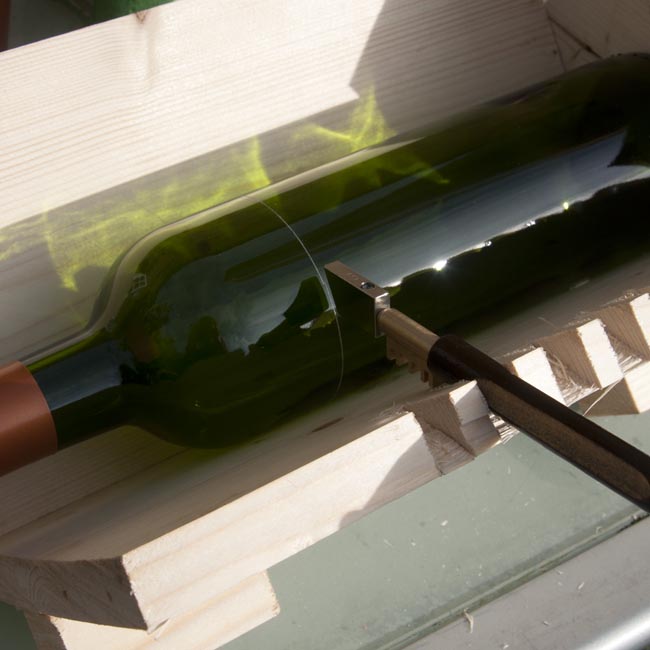
DIY cutting jigOf course, the knack is getting the score line straight.  People will sell you various bottle cutting jigs and devices that work on this principle, but I didn’t want to buy any expensive kit for this, at least to start with.

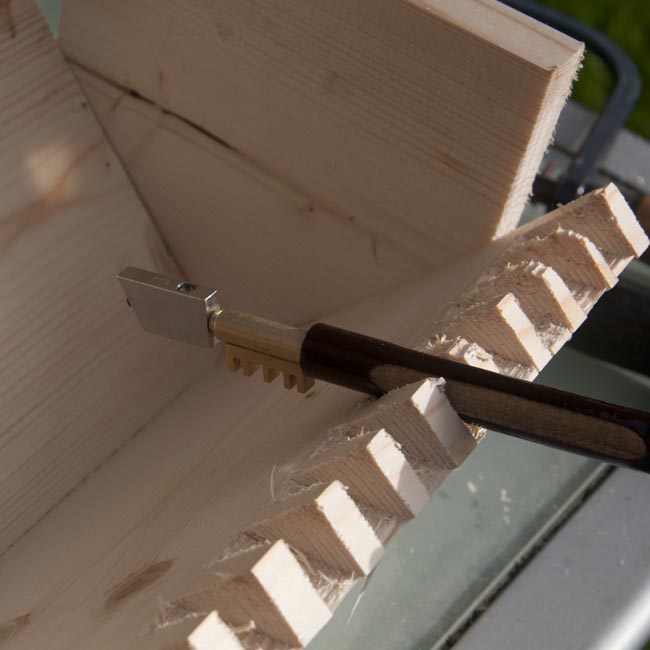
Jig with cutting toolA bit of thought and collaboration from my lovely husband, and we built this contraption out of leftover wood from the shed.  It’s a v-shaped cradle to hold the bottle with a solid end, and notches cut in the side to stabilise the handle of the cutting tool.  The cutting tool itself came from amazon and cost a couple of pounds.

Give some thought to what you want from your bottle, and whether the traditional bump found in the bottom of most bottles (called a ‘punt’, apparently – here I was thinking a punt was a flat bottomed boat propelled with a pole on shallow rivers in British university cities) is a use or a hindrance.  It might be fine if you want to make a vase, for instance, but not so useful if you want a candle-holder.  Some bottles are tapered or squared-off, and these you probably also want to avoid!  Now, give your bottle a good scrub and remove all the labels. You should to do this first, before there are any sharp edges to work around!

Scoring the bottlePut your bottle in the jig, place the glass cutting tool in an appropriate slot and gently press the scoring head against the side of the bottle.  Now, very slowly, rotate the bottle against the point of the cutting tool.  You’re aiming to complete a perfect full rotation, without leaving a gap or ‘over-writing’ the start of your line at the end.  If the score line isn’t complete and perfectly straight, the bottle isn’t going to crack evenly.

Accuracy is everything, as it’s a one-shot deal and mistakes cannot be corrected later – but on the plus side, the bottles are free and only destined for the recycling bin in any case, so try not to fret about it too much!  My success rate so far for a clean break is about 1 in 3 – not great but it’s early days and I suspect practice will help improve this somewhat.

Once you’ve scored your line, it’s time to get it to crack.  Different approaches are advocated, but I went for the simplest one.  Boil a kettle of water.  Holding the bottle over the sink, pour freshly boiled water gently over the score line, rotating the bottle slowly.  After a few seconds, put the bottle under the cold running tap and repeat the process of rotating it.  I haven’t got any photos of this bit, because both my hands were a bit occupied at the time!

Uneven breakYou’ll have to do this a few times, but you’ll see – and perhaps hear – the score lines start to give way.  If you’re really lucky, the bottle will break cleanly straight along the score line.  This one didn’t!  The fracture line wavered quite dramatically above and below the score line over about 1/3rd of the circumference.  I’m not sure why, whether it was to do with the score line, or the fact the bottle itself which was quite uneven in thickness.  Whichever it was, it’s a dead loss, so throw it away and fetch another one from the recycling bin.

Other approaches I’ve seen advocated include candle flame followed by ice cube, and tapping the bottle from the inside near the score line, though this requires a crank-headed tapping tool. I have no idea if these approaches might result in a better success rate – certainly tapping may give a different, more controlled break than hot/cold shock.

Fortunately, my first try (when I wasn’t taking photographs – typical eh?) did break cleanly, giving me a goblet about four inches high which I wanted for a candle holder.  It broke with a very slight ‘notch’, which I was able to crack off using the glass cutting tool to give essentially a clean cut.  A very *sharp* clean cut.

Sandpaper to grind the edgesSuccess!  But that’s not it, of course, since you’d have a candle holder specifically designed to maim the unwary, which is a silly enough thing to keep around your own house, never mind consider giving as a gift.  Those sharp sheared glass edges are going to have to go.  My approach is low tech – wet, fine grade silicon carbide sandpaper.  I used a slightly coarser grade to take the edges down initially, and then finished with some really fine paper.

Working wet greatly reduces the production of glass dust, which is nasty dangerous stuff that you should not be inhaling.  Work in a well ventilated area (outside, for me!) and ideally wear a dust mask.  Feel the edge *very* gently and tentatively with a fingertip to check the sharp edges are gone to your satisfaction.

Carefully work on the edges as well as the flat cut surface.  A little piece of sand paper wrapped around a pencil or something similar is good for the inside edge without scratching the glass.  I’ve seen the use of a dremel advocated – I can see how that would work really well but you’d want to be really careful about dust, probably dipping the grinding head in water every few seconds to keep it wet.  You’ll want to do much more careful and comprehensive smoothing work on the rim if you want to use your cut bottle as a drinking glass – but your extra efforts may well be worth it!

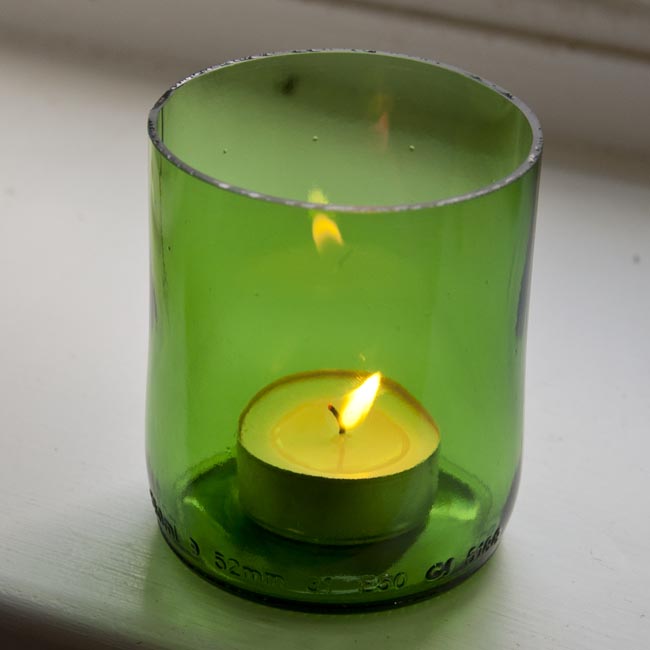
Finished candle holderThe result is really pleasing, the cut edge after sanding has a mostly-frosted appearance but still shows some evidence of the manner of its birth.   It’s not a perfect, machined straight line, but just has that little bit of hand-crafted variability.  You could etch the glass now (something I’m looking into!) or paint it if you liked, but you’re the proud owner of a hand-made recycled glass candle holder.

I used this with a tea light for a test burn, as much as anything to check that the heating from a candle wasn’t going to cause  unexpected cracking or breakage after the bottle’s relatively rough treatment!  And to get photographs, of course.  I expect this will look even better with a votive candle, but I didn’t have one to hand.

Finished candle holder

This was just a first attempt – but I had a lot of fun and will certainly be doing some more bottle cutting in time for Christmas!  I love that the detail of the bottle is still very much part of the finished piece too.  Definitely something to try – though probably a craft for grown-ups!

For a few ideas, try my next post on bottle cutting – ‘Using Your Bottle – testing some ideas for bottle cutting crafts’.

Finally, an apology to those of you who were emailed a part-finished version of this blog post yesterday – a mistake on my part, I’m afraid!  I’ll try to restrain my itchy mouse-finger from wandering over the ‘Publish’ button so enthusiastically!

Read more from the Country Skills blog >>

Banner320-260

Signs of Summer – hedgerow posy

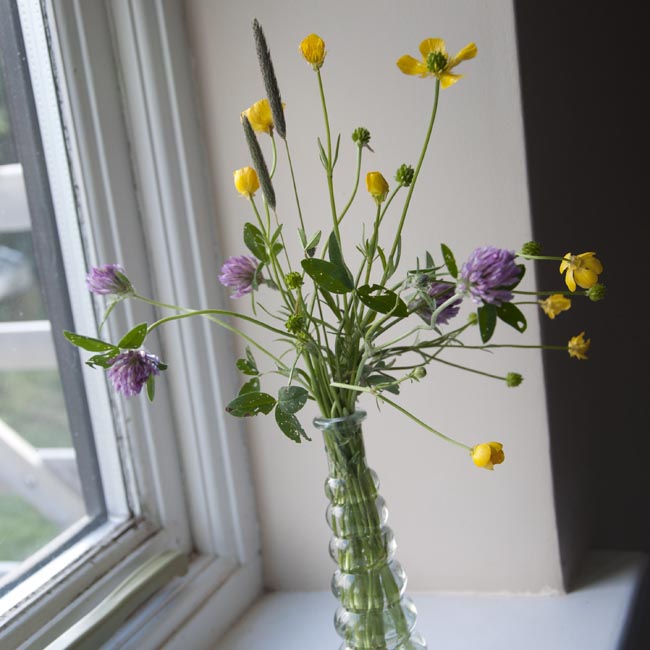
It’s great to see the field margins and roadsides crowded with flowers at this time of year, isn’t it?  I couldn’t resist, and picked a small posy from our paddock – red clover, buttercups and grasses.  It looks a treat on my window sill.

Hedgerow posy

Go and pick one of your own – it’s a little bit of summer, for you to enjoy indoors!  Beautiful, and best of all, completely free!

Read more from the Country Skills blog >>

Adventures in Quilting – my first jelly roll, and baby steps in a new craft

A couple of weeks ago, friends introduced me to a wonderful local quilting shop, The Bramble Patch in Weedon, Northants.  All those beautiful fabrics made an impression on me, and I’ve been thinking about possible projects ever since.  Today I was back for a return visit, and whereas last time I escaped with five pretty fat quarters and a relatively small hole in my wallet, today’s visit was a bit more costly!

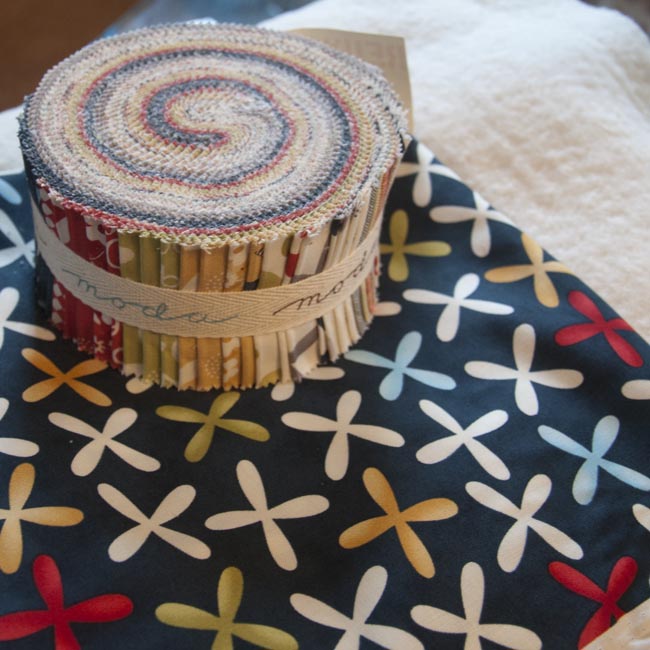
Jelly roll, fabrics & batting

I came home with a jelly roll – my first *ever* jelly roll – ‘Reunion’ by Moda, a metre of quilt batting, a metre and a half of a matching fabric from the Reunion collection to use as backing, as well as a couple of necessary bits and bobs.  I love the idea of jelly rolls – little strips of lots and lots of co-ordinating fabrics.  I would never buy even fat quarters of such a wide range of fabrics, and the diminutive size of the strips (just 2 1/2 inches wide) is its own challenge.  This collection is particularly lovely – in turns fresh and colourful, classic and muted.

Reunion by Moda fabric collection

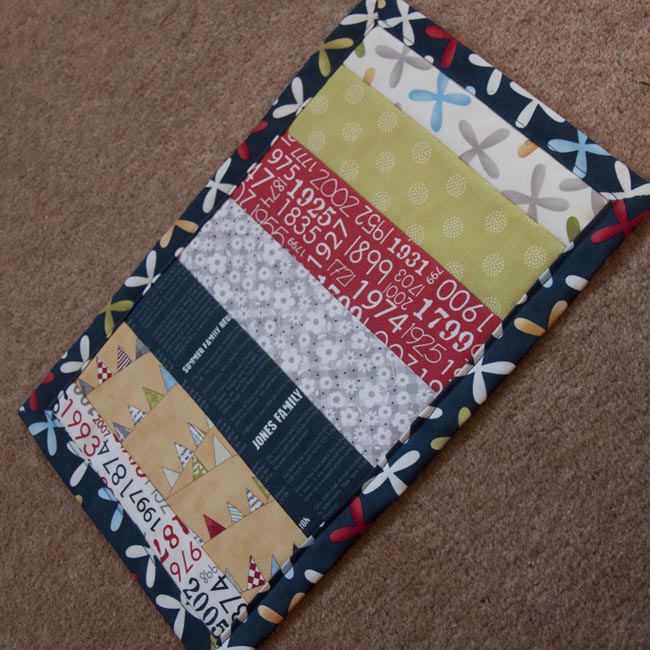
My project, after consideration, is a set of six place mats and a co-ordinating table runner. I hope that the small size of the working pieces and the limited scope of the project should make it one I can pull off without too much stress or anxiety!  In deference to my complete lack of prior quilting experience, and relative lack of sophisticated general sewing skills, I’ve chosen the simplest possible pattern – just stripes of colour laid next to one another, edged by turning the backing fabric to the front side.  It’s such a pretty fabric and it saves a lot of faff with binding!

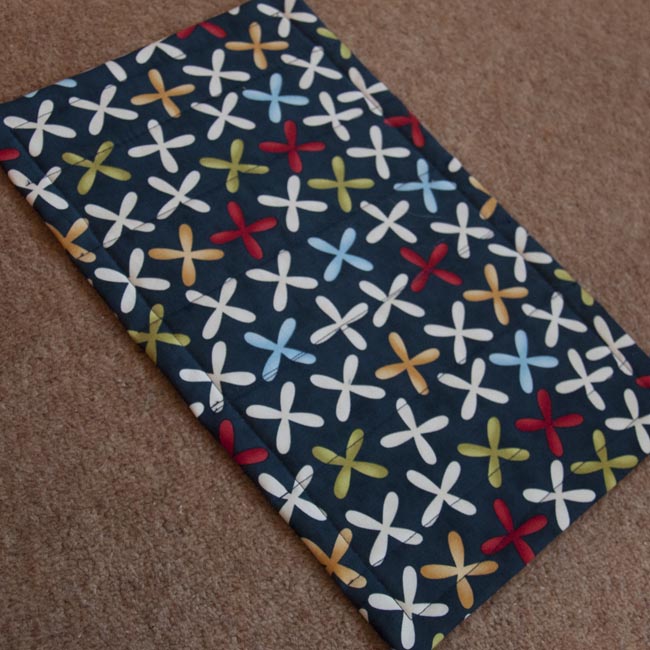
Finished place mat - front     Finished place mat - back

This is my first place mat – the size was chosen with my narrow dining table in mind and is about 22 x 36cm.  The more observant among you will notice one doubled seam where I messed up slightly – this just adds to the cosy hand-made feeling, in my opinion, and in any case is only visible from the back.  I’ll post a full how-to in due course once I’ve finished making it up as I go along – although talk about the blind leading the blind!  The backing fabric was folded over and the corners mitred by hand before being sewn down in a single row close to the edge.  I’m quite pleased with the final result, not bad for a first effort, eh?

Read more from the Country Skills blog >>

Piecing It Together – fabrics, quilting, and an amazing shop

I discovered the most amazing Aladdin’s cave of a fabric shop yesterday – friends took me along to The Bramble Patch in Weedon, Northants, and oh my goodness I was in heaven!  The Bramble Patch is really a quilting shop, but houses a veritable treasure trove of fabrics (including hundreds of fat quarters), patterns, kits, and accessories.  Kid in a candy store just doesn’t describe my feeling about places like this!

Fat Quarters at The Bramble Patch

I’m slightly in two minds about quilting – I think the end results can be stunning – particularly some the contemporary abstract / geometric patterns, and would love to have a gorgeous family quilt and be able to say ‘I made that’.

On the other hand, I’m a quick and dirty sort of seamstress.  I can’t see much merit in taking twice as long over a sewing project to achieve perfection – ‘good enough’ is good enough for me!  Quilting – and I would love to be proven wrong here – strikes me as the end of the sewing crafts spectrum that rewards accuracy and carefulness, rather than my ‘that’ll do’ attitude!

The range of patterns and kits on offer is really quite impressive – not to mention tempting! – in particular, some very sweet jubilee and union jack cushion covers.

Fat QuartersMuch to my husband’s apparent relief, I managed to escape with only five new fat quarters for the fabric stash – what he doesn’t quite appreciate, I think, is the brain-full of ideas and inspiration I’ve come away with too!

I’m extremely tempted to go on one of the quilting courses they offer (and no doubt much more of my hard-earned cash is liable to go their way in the future!) – in the meantime I’d welcome any tips and leads on utter-beginner quilting skills & project ideas you might know about!

Read more from the Country Skills blog >>

With Apologies for the Hiatus – it’s been a busy month!

There’s been a lot going on the past few weeks – my little sister’s wedding, the reason for the wedding bunting I’ve been making since Christmas, beginning a new job, and finally, now that we’re home from a much needed holiday, spring is well under way and we’re seriously behind on our garden preparations!

Congratulations to the bride and groom on a gorgeous wedding – very much their personal style and lots of beautiful handmade touches to the ceremony and reception. I was particularly taken by the home-grown baskets of bulbs as table centres, and the handmade pyrography favours.  The bunting was pleasingly well-recieved!

At the wedding

Normal service on the Country Skills blog will be resumed very shortly – including a round-up of my volunteers’ thoughts on their big bacon challenge results, more foraging tips, and how to make your very own home-cured ham!

Read more from the Country Skills blog >>

Feedback on Country Skills – hyacinths, candles and chickens

I love hearing from my blog readers, especially if you’ve tried out something I’ve written about!

After I wrote my butchery tutorial ‘how to portion a chicken’, blog reader asciiqwerty contacted me to me to let me know how she’d got on following my instructions, and sent me this photo of her finished portioned chicken.

Portioned, skinned and boned out chicken

This time the portions have all been skinned, and the thigh portions have the bones removed – this would make them great for using in a stir-fry or a curry.  She commented particularly on the size of the chicken breasts – which weighed in at about 200g each.  A supermarket pack of two chicken breasts will usually be about 250g in total, so you can see how much more you get for our money.  Well done asciiqwerty, and I hope it was as tasty!

Moving away from food, back at Christmas I made hyacinth bulbs with hydrogel beads, in recycled jam-jars, as gifts for friends and relatives.  I kept one for myself, of course, and thought you might like to see how it all worked out when it came into flower a few weeks ago.

Hyacinth bulb in flower, with hydrogel beads

The smell was amazing, and after this flowerhead died back and I cut it down, the bulb produced a second unexpected bonus flower!  The hyacinth stayed nice and compact and didn’t fall over despite not being secured by anything other than the roots in the jar of beads, which I was very pleased with.

Finally, the recycled chunk candle I made a few weeks back.  I was amazed with this, it turned out so much better than I’d anticipated.

Recycled wax chunk candle

After looking initially as if the melt pool would be a bit pathetic in the centre, it actually burned down very nearly edge-to-edge leaving a thin shell which the candlelight flickered through like stained glass.  I burned it every night for several hours after work, and it lasted a whole fortnight – I’d estimate around 45 hours burn time.

I’d love to hear about any successes (or otherwise!) you might have had trying out country skills – either in the comments, @countryskills on twitter, or by email at countryskillsblog@gmail.com.   Or perhaps there’s something you do that you think I should try – I’m always happy to hear new ideas, so please get in touch!

Read more from the Country Skills blog >>