Sourdough Saga: Episode 7 – six months on, life with my sourdough starter

Back in May of this year, I started my experiment with creating – and baking with – a sourdough starter.  Now that November is nearly with us, almost six months on, what is the starter like to live with, and what effect has its appearance in my home had on my life?

In July, when I gave a ‘clone’ of my starter to my sister as a gift, I wrote her a guide to looking after her starter.   My starter is less cosseted these days – it drinks tap water, and has survived several rounds of being abandoned in the fridge for a couple of weeks or longer between feedings.  After long periods of abandonment, the starter has a sharp vinegary smell, and either a layer of greyish water on the surface, or an even more unattractive and worrying-looking layer of ‘fuzz’.  But every time, after pouring or scraping this away, and feeding the starter, it has sprung back to life.

Sourdough loaf selection

My starter has successfully baked white, wholemeal, malted mutligrain and spelt loaves (and a variety of combinations of these flours) – in fact, the flour used for sourdough loaves seems to make very little difference, probably because of the longer proving and working time compared to a quick-yeasted loaf.  The loaves are continuing to get better, too – with a nice even crumb and springy texture these days.  Last week, on holiday in a rented cottage in Cornwall, I even managed to bake a batch of sourdough in the borrowed kitchen and unknown oven! (Why, yes, I did take my starter on holiday with me, why do you ask..?)

I use less salt in my batch than I did to start with, but otherwise my method remains the same as for my very first loaf.  I often bake a double quantity, and freeze one loaf.  I’ve added cheese, herbs, and sun dried tomatoes to loaves, with great success.  More recently, I haven’t used the stand mixer for some batches, but worked the dough entirely by hand instead.  A plastic dough scraper, which I bought from eBay for 99p, is a great help and not exactly an investment that broke the bank!  As you can see from the photo, I’ve baked rolls, free-formed loaves, and even a loaf in a tin.  The sourdough pizza was *amazing*, too.  It all works brilliantly, so the limit should only be your imagination!

Several ‘clones’ of my starter are now in new homes with family and friends, and they report baking very successfully with their starters too.  So you see, if my Dad can do it, so can you!  There are even rumours of my starter making it into small-scale commercial production, so watch this space!

As an aside – when I was growing up, I sometimes wondered about the Lord’s Prayer – specifically, the fixation with ‘daily bread’.  After all, what was so exciting about bread? Well, it’s a bit like the first time you’re outdoors, on a crisp clear night somewhere really, really dark, and look up and see the infinite billions of stars and the Milky Way spread above you, and the phrase ‘majesty of the heavens’ suddenly makes sense as something other than a weak metaphor – in an earlier time, before we filled the skies with artificial light (and our larders with artificial food), these things were seriously impressive!  Good bread may genuinely change your world – your food world, at least!

The downside?  Well, all other bread is a disappointment, frankly! I did get a couple of really nice non-sourdough white loaves from a bakers’ shop while we were on holiday, which made a pleasant change.  But, basically, you’re never going to want to buy bread from the supermarket again – even the stuff from the phoney-bakers-shops they have in store these days is a total let-down, and as for the plastic-wrap ‘chorleywood’ sliced white, well…

All of which means that regular baking days have become a feature of our already rather busy lives.  Now, I wouldn’t have it any other way.  And, yes, you’ve guessed it, today is a baking day!

Read all the posts in the Sourdough Saga >>

Read more from the Country Skills blog >>

Offally Good – liver with bacon and onions, fast fresh frugal food

Offal certainly divides opinions!  One of my favourite ever dishes is liver, bacon and onions – so simple, really just three ingredients –  I’ll order it in a pub whenever it’s on the menu, but sadly it’s often a disappointment.  When it comes to liver, freshness is everything.  It doesn’t reward maturation!  Lamb’s  and calf’s livers are the ones to choose – pig’s liver has a nasty bitter flavour, which some people seem to believe can be mitigated by doing things like soaking the liver in milk before cooking.  Don’t bother!  Get the best, freshest lamb or calf liver you can, it needs very little preparation, and makes a wonderful meal.

Liver, bacon and onion

As much of our meat as we can manage comes from the little farm-shop butcher just up the road from us.  Chris, the butcher and farmer, knows us quite well these days – so when my husband was in there last week, Chris happened to mention he’d just that very day come back from taking a few lambs in to slaughter.  He had the ‘plucks’ (the slaughterhouse term for the heart, lungs and liver).  A lovely fresh lamb’s liver, inevitably, made its way into the shopping bag!

Fresh lamb's liverGood fresh liver is dark burgundy in colour, firm but yielding in texture.  There will probably be some blood in the packaging, wash this off and pat it dry.  Fresh raw liver has almost no smell. It shouldn’t be mushy, crumble, or disintegrate under gentle pressure – if it does, then a process known as ‘autolysis’ has started, and the liver is starting to break down.  Blotchiness and pale areas can also suggest less than ideal freshness, or issues with the health of the liver.  This liver, in thick slices, was beautiful.

Liver slicesThere will be some fibrous tissue in the liver,  you can trim this away as you slice the liver into pieces.  I like my liver in bite sized pieces, cut on the diagonal from the original thick slices.  Try to keep the pieces as even sized as you can, so they will cook evenly.

Prepared trimmed liver piecesDecide what you want to serve with your liver, bacon and onions – mashed potato is traditional, but don’t let that stop you.  Ours was for lunch, so we enjoyed it with a little gravy, and warm buttered toasted muffins.  If you want side dishes, get started with those first – the liver will take less than ten minutes, and you want to serve it as soon as it’s ready.

As well as your lovely fresh lamb’s liver, to serve two you will require –

  • Bacon pieces and sliced onionsOne onion, peeled and sliced thinly from root to tip
  • Four slices – or two thick pieces – of dry cured bacon, cut into chunks
  • Pepper, olive oil, flour or gravy granules (optional)

Slice an onion into thin slices from tip to root, some dry cured bacon into pieces.  Use the very best bacon you can – my home-cured maple bacon is perfect – the last thing you want is that nasty bacon-water from commercially produced bacon leaking out into your pan.

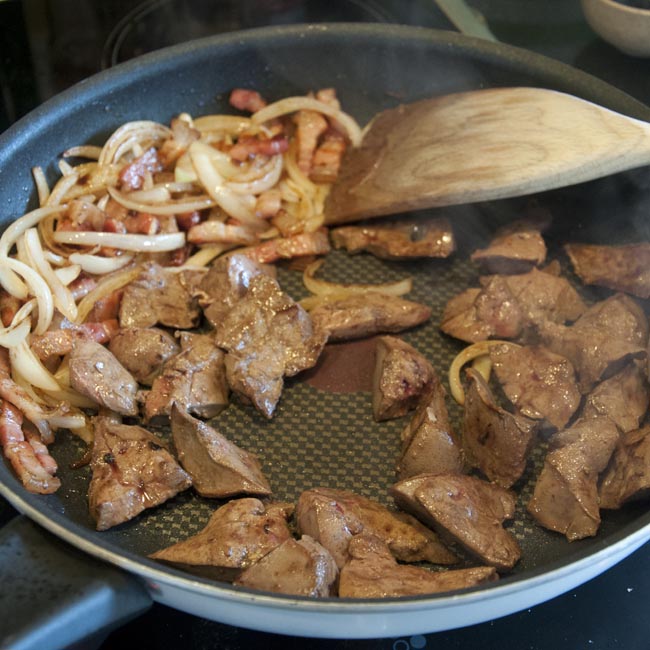
Add liver to pan & fry offFry off your bacon and onion in a large frying pan until starting to caramelise.  Add a very little bit of olive oil if you need to.  Once it’s starting to show a little colour, push it to one side  in the pan.  Now add the liver and fry off until the pieces are just a little bit pink in the middle.  You’re nearly done – just time to make the gravy.  Mix the onion and bacon back among the cooked liver.

Cooked liver piecesNow add a generous splash of boiling water to the pan, and stir it all around to capture all the lovely pan flavours.  If you want your gravy a little thicker, thicken it by your preferred method.  Gastropub recipes often have red wine in the gravy – I’m not sure this is an improvement, simplicity is everything here!  You probably won’t need to add any salt – the bacon has enough – but season with pepper to your taste.

Making gravy

Serve, and enjoy!  This is such great comfort food – it’s food for the soul as well as the body!  And a timely reminder to me that I need to remember to enjoy offal much more often!

Read more from the Country Skills blog >>

Cooking with James Martin – pea and watercress soup

Earlier this year, I was privileged to be invited to spend the day ‘Cooking with James Martin’ with a group of other foodies and bloggers.  We enjoyed some amazing dishes, and I did promise at the time to share the recipes with you.  Time has rather run away with me the last few months, but here, belatedly, is the first recipe – ‘Pea and Watercress Soup with Deep Fried Egg’. 

Pea and Watercress Soup, presentation

While we were very kindly provided with recipes after the event, I made notes at the time and my notes and recollections vary from the recipes we were given in various ways – that’s the art, I suppose!  The recipe I present here is closer to what I remember James cooking on the day, than to the ‘official’ recipe.  How much of the miss-match is due to errors and omissions on my part, and how much to revisions on his, I wouldn’t like to say!

This is a beautiful summer soup and an absolutely amazing colour.  James served it with a crispy-on-the-ouside, soft-on-the-inside deep fried soft boiled egg, which was an amazingly ‘cheffy’ touch, but I think the soup would stand up very well without it, if it seems a bit faffy for you.

To make this soup, you will require –

  • 1l of good quality vegetable stock (the nicer the better – but nice bouillon powder would probably do at a pinch)
  • 500g of frozen peas
  • 300g fresh watercress
  • 100g of flat leaf parsley
  • 1 shallot, chopped
  • 150ml of double cream (see later note)
  • Decent knob of butter
  • Small handfull of asparagus spears (optional)
  • Salt and pepper
  • Blender, either the stick-type hand blender or, for a smoother finish, a food processor blender jug would probably work better

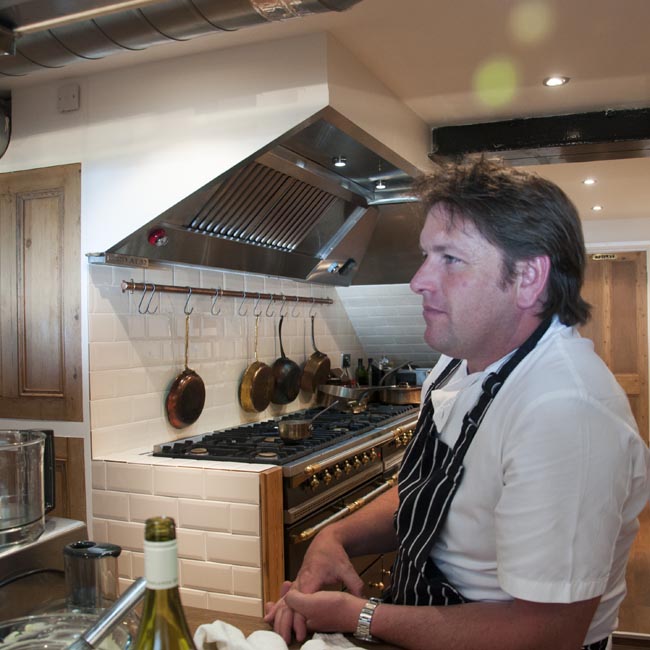
James MartinBlanch the watercress and flat leaf parsley by immersing very briefly in boiling salted water, and then removing straight away.  Squeeze it out in a tea towel to remove as much water as possible and set aside

Now melt the butter in a saucepan (or wide chef’s pan, if you have one), add the shallot and fry gently until translucent.  My recipe mentions some garlic here, but I don’t recall any being used, you could add a minced clove of garlic if you like though!  Once the onion is translucent, add the stock to the pan, along with the peas and chopped asparagus, and simmer for 2 – 3 minutes, so that the peas are just soft but still bright vivid green.

Blended soupNow take the pan off the heat, add the blanched watercress and flat-leaf parsley (the recipe also says the cream – I don’t remember any cream but it could well be an oversight on my part!) and blend aggressively until it looks almost luminescent green.  Season to taste with salt and pepper.

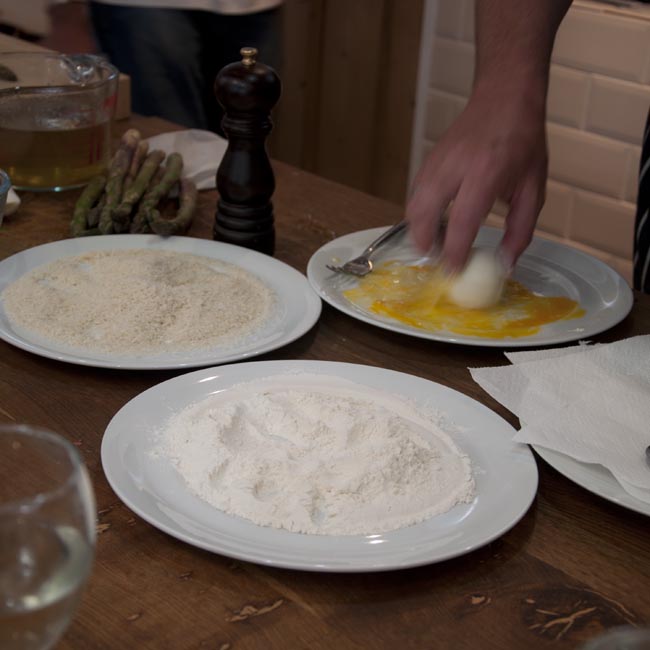
Bread-crumbing egg for deep fryingJames soft boiled some eggs (5 minutes), and once cold, peeled and coated in breadcrumbs (flour, egg wash and then crumbs) before deep frying until golden brown.  The egg adds a lovely richness and texture balance to the final dish, but for me, thinking about this as a dish to cook at home, the deep frying was a flourish too far. I think floating a poached egg in the soup would achieve a very similar effect.

Bring the soup up to temperature, without boiling, and serve in your prettiest bowls, placing the egg in the centre.  James added some crispy fried bacon bits, which add a nice crunch and salty-savoury note.  You could add a sprinkle of crispy breadcrumbs or small croutons to increase the crunch if you liked – particularly if you’re skipping the crunchy deep-fried egg.  The finished effect, it struck me at the time, is very much ‘ham, egg and peas’, but taken apart and put back together again all fresh and inside-out!  The final presentation flourish is celery cress & coriander cress, sprinkled over.  They don’t sell celery cress or coriander cress in my local co-op, and it’s the wrong time of year to sprout my own, so I suppose I’ll have to make do with a few reserved flat-leaf parsley leaves!

Really Important Note – You know that ghastly grey-green colour and slightly odd sulphurous odour that tinned peas have? This soup depends for it’s amazing colour and fresh flavour on absolute freshness and minimal cooking.  It will not re-heat!  Well, not without turning grey.  So don’t prepare it in advance and expect it to be any good re-heated for your dinner party.  You have been warned!

If thats got your appetite going, have a look at the collected James Martin recipe posts, here…

Read more from the Country Skills blog >>

Happy Birthday – and a new home for the blog!

Doesn’t time fly!  I can’t quite believe it was a year ago (well, near enough) that I sat down and wrote ‘Bringing Home the Bacon’, and the Country Skills blog was born.  And it just so happens that while we’re on the subject of milestones, this is also the blog’s 100th post!

Well, everyone likes a birthday celebration, don’t they, and what’s a birthday without presents and candles?

First Birthday Candle

So, there’s the candle, and now for the present – the Country Skills blog has a new home at https://countryskillsblog.com/ although old links via the wordpress.com domain will continue to work through the magic of redirects.

I’d like to thank all my lovely readers – both regular and occasional! – for taking the time to stop by my little blog in the last year, and particularly those who’ve paused to comment or ‘like’, and helped me feel I’m not talking to myself!  Some of you have really helped me out – I don’t think the Sourdough Saga would have come to such a successful conclusion without your advice and feedback – and for that I thank you all from the bottom of my heart.

Here’s to many more years happy blogging!  Please do let me know what you think, I’m always happy to hear suggestions!

Read more from the Country Skills blog >>

Clucking Mayhem – introductions, is the worst over?

Five weeks ago, I drove a 200 mile round trip to bring home three new hens to add to my little backyard flock. Introducing new hens is always a difficult process, they can be remarkably opinionated creatures and don’t enjoy having new housemates!  The ‘pecking order’ is a very real, and sometimes rather violent thing.  For the sake of both my new and existing hens, I wanted to achieve as gentle and stress-free an introduction process as I possibly could, and made arrangements to take my time about it.  You can catch up with the story so far, from coming home, first introductions, and settling in together.

Reasonably settled?

The weekend before last, once the hens were reasonably settled living together, but sleeping mostly apart, I took the second henhouse out of the run, leaving a dodge-board for the small girls to get out of sight behind if necessary.  There was a bit of stress around bedtime the first couple of nights, but the girls are now all bedding down comfortably side by side on the perches, and during the day, apart from the odd scuffle, are mixing, feeding, preening and generally getting on with happy relaxed henny-things!  Egg production is down, but then it’s well into autumn and more dark than light these days so that’s hardly surprising.

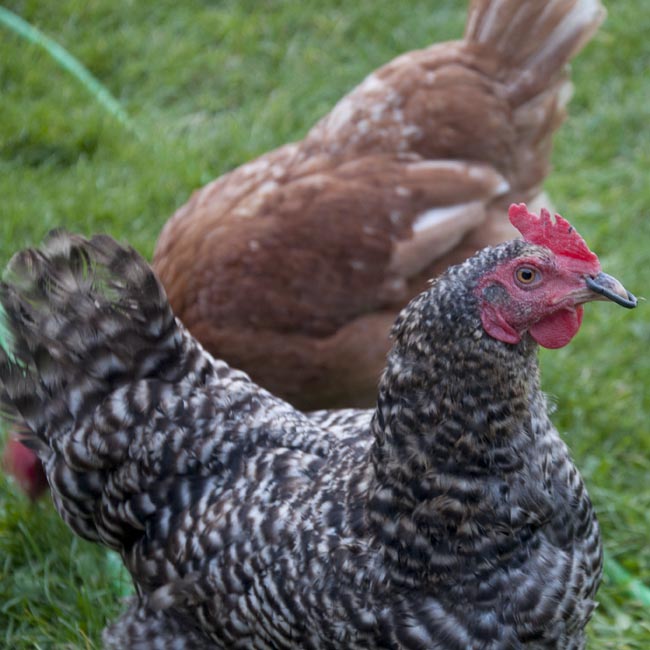
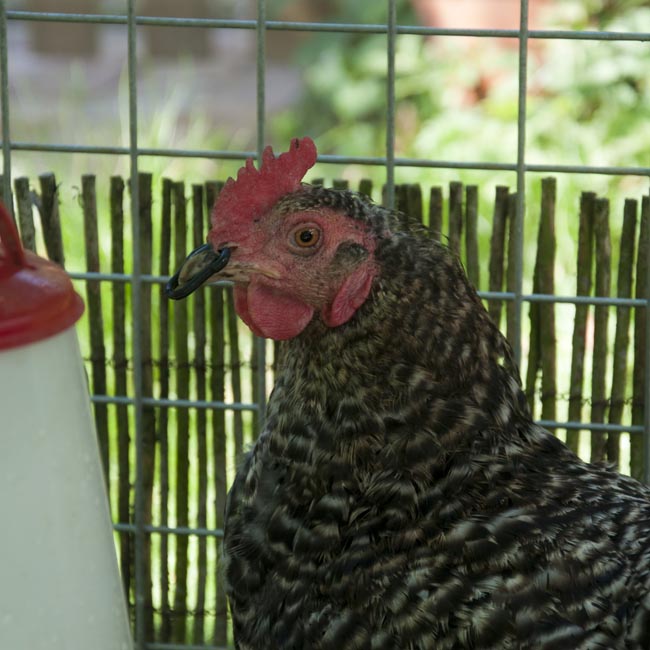
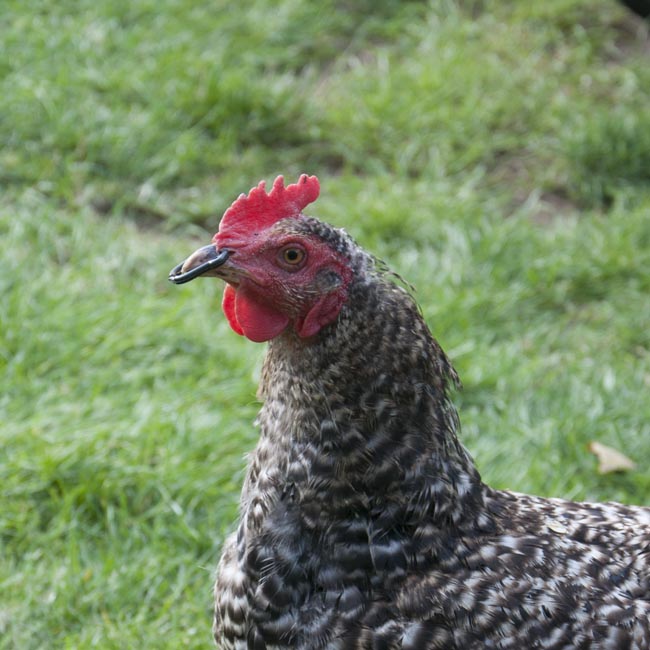
Flora continues to wear her bit – her behaviour is the last remaining problem, it’s not really her fault, I suppose, but things would be really nice and settled without her disturbing influence on the flock.  I think – though it might be wishful thinking – that the frequency and savagery of her attempted attacks on the other girls are reducing a little.  With a bit of luck, in another month or so, the headgear can come off.  In the meantime it seems to be causing her very little difficulty, she’s eating well and laying better than anyone else at the moment, giving an egg almost every day.

Midge is growing up fast, with more comb and wattle than she had when she first arrived, and a hunger to match the growth rate.  I’d love to think we’d get some eggs from her soon, though I suppose it may not be until spring.

With a bit of luck – though I hate to put it in black and white and jinx it! – things are settling nicely now.  I had in mind that things would take about a month to bed down and we’re pretty much on that target.  I really hope the girls can get on with enjoying their seasonal treats (the Halloween pumpkins are going down rather well just now!) and lay me lots of nice tasty eggs for a long time to come!

Read more from the Country Skills blog >>

More Clucking Mayhem – the poultry palaver continues

Just over a week after we mixed the two groups of hens, it’s gone time for an update on progress!  Well, I still have six hens (hey, you’ve got to look on the bright side).

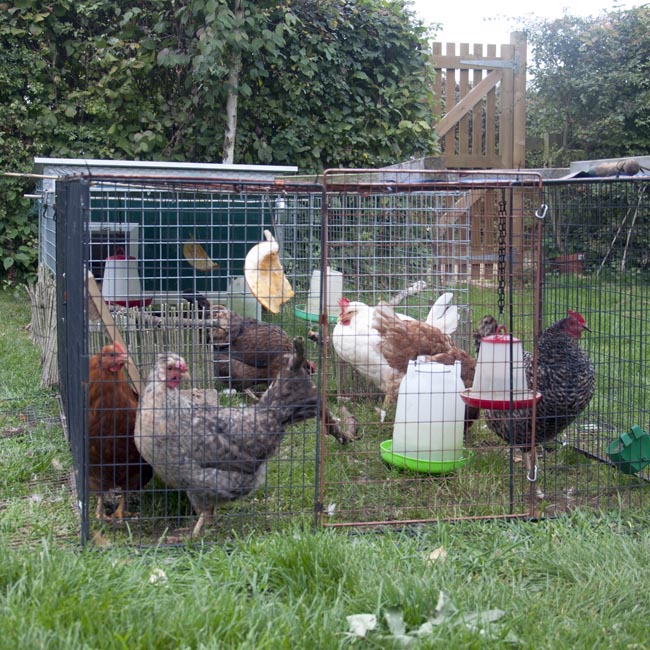
They’re all living together in the run during the day, though the three new girls have still been choosing to bunk in the temporary hen-house at night.  Tonight, for the first time, though, Agnes is asleep with the original trio in the ‘big house’, leaving only Doris and Midge in the temporary accommodation.  Doris is still using the temporary housing to lay, whereas Agnes has been laying in the main coop for a few days now.  The pecking order that established on that first morning out in the garden still appears to be in force, with the strange Agnes > Mabel > Flora > Agnes loop surviving for now.

Flora with Mabel

Speaking of Flora, she’s still wearing her bumper bit.  Flora has turned out to be the real problem – I suspect without her presence in the flock everyone would be living essentially in harmony by now.  Gertie and Mabel, the two other members of the ‘original’ trio are happy to be side-by-side with the new girls and only scuffle with them very occasionally.  Flora has a bad temper, a bad attitude, and seems to spend her life spoiling for a fight.  It doesn’t help that she’s also unusually stupid, even by chicken standards.  Thick and bad tempered, what a winning combination!  Until she’s spending less time trying to thrash poor Doris and Midge into submission, the muzzle is going to have to stay on.

In terms of the effect the bit is having on Flora, it’s less marked than I’d anticipated.  She can eat and drink from the normal feeders and drinkers (we made sure of this before taking the additional open drinker out of the enclosure) and goes to bed every night with a bulging crop.  She seems to be able to graze to at least an extent, and remains (sadly!) able to bully the other hens, though less so than if she could pull feathers too!  The only obvious consequence is in her ability to preen herself.

I suppose it stands to reason that a device primarily designed to stop hens pulling feathers out of other hens would also impair their ability to closely comb their own.  Flora is looking really quite tatty, but it’s something she’s going to have to live with for now.  Despite her muzzle, she still has the girls terrified, chases them to cower behind the hen house, and if they don’t get away fast enough she’ll leap on their backs while they cower and try to pull neck feathers.  I don’t doubt that given the opportunity she’d be doing them real damage, there’s a genuine ferocity to her attacks and I don’t know how long it’s going to take for that to settle down.  Soon, I hope, for her sake as well as everyone else’s!

The next bridge to cross is removing the temporary coop so that all six girls are bunking together.  They could do with the space back in the extension run, and the nights are getting colder, the open-doored temporary house is no place for any of the girls to be sleeping on a cold winter’s night.  We’ve had our first frost here now, so it won’t be long before they’ll really want to be tucked up warm at night!

Still, only just two and a half weeks after I brought the three new girls home in a carrier, overall things are going pretty well.  After the experience of introductions last time, I’d reckoned it would take a month to get things settled and so far I think we’re pretty much on target for that, with a bit of luck.  How long Flora is going to have to be muzzled, though, I don’t want to guess at this point!

Stay tuned for more, folks, from the ongoing poultry palaver!

Read more from the Country Skills blog >>

Clucking Mayhem – chicken introductions, poultry politics and a bit on the side

I’m blogging from the garden right now, because I’m on hen watch. For the last four hours, my three new hens, and three existing birds, have been free ranging together.  After just over a week of living in adjoining but separate runs, I’m hoping this is the next stage in getting them to co-exist happily as a group of six.

Gertie and Midge

Mixing groups of hens is difficult.  Yes, they look sweet and innocent, don’t they?  But hens’ social structures are complex, and established and enforced by drawing blood (or worse!) if necessary.  That pecking order you’ve heard thrown about as a metaphor?  Well, it’s real.  And nasty.  It’s at times like this that you don’t get to forget than hens really are little dinosaurs at heart.  Genuine pint-sized feathery little T-Rexes.  Next time you get to spend some time watching hens, have a look in their faintly-reptilian eyes and tell me it isn’t so!

Home advantage is a big thing, so I expect the new girls to come off worse, and end up at the bottom of the new pecking order.  It’s more complicated than it might be, though, because Agnes and Doris are adult hens – the same age as Flora from the original trio.  To be honest, I was expecting the whole thing to degenerate into an explosion of swearing and flying feathers as soon as the six were out together.  It didn’t, much to my surprise!

My existing three, as far as I can tell, are ranked with Gertie (the white hen) at the top of the pile, Mabel the Isa Brown in the middle, and speckeldy-grey Flora at the bottom of the stack.  Flora was introduced to the flock last year, and got a bit of a nasty kicking in the process, mostly from Mabel who seemed to declare herself ‘enforcer’.  She still gets the sharp end of Mabel and Gertie’s short temper sometimes, particularly when there’s a tasty morsel or two they don’t want to share.

Midge and DorisThe new girls have established with Agnes, the Welsummer (and biggest of the bunch) at the top, Doris the small but adult Legbar in the middle, and Midge, the New Hampshire Red pullet at the bottom.  Agnes flexes her muscles, on occasion, though things have settled nicely.  Midge and Doris are pretty much inseparable, but Doris does occasionally remind Midge who’s in charge.

What’s really interesting to me at the moment is that Gertie and Agnes seem to have settled on what can only be described as an armed truce.  Neither has taken beak or claw to the other (well, if you ingnore Gertie pitching Agnes out of her favorite dust bath – Gertie is *very* protective of her dust bath), and they’ve been very much in each others strike range without hackles up or much in the way of posturing.  Agnes seems to have yielded subtly – she will give over to Gertie, but only just as much as necessary.  I don’t know what Gertie’s secret is, she just seems to exude natural authority!  It gets odder still.  Agnes seems to have established above Mabel (who runs for cover when she sees Agnes coming) but below Flora (who has a similar effect on the otherwise unflappable Agnes).  No doubt this is going to take some sorting out down the line, since I’m not sure pecking orders permit loops!

Flora is a fascinating character.  I suspect it’s the same cycle of abuse that’s described in humans.  She was the hen who reacted most violently to the arrival of the newcomers last week – lunging at them through the bars and even drawing blood on Agnes’ comb on the first day.  She’s declared herself ‘enforcer’ this time around, and thrown herself into the role with gusto, lunging straight at Agnes the first opportunity she got, landing on her back and really viciously pulling out neck feathers.  I’m not surprised Agnes is afraid of her!

Flora's bitThere’s a substantive difference between Flora’s attacks and those of the other bids.  The other hens will peck, will grab and pull feathers, even fly at each other feet first, but generally speaking, just enough to make their point.  Flora’s attacks are really aggressive, no-holds barred, with malice aforethought.  It became clear over the first half hour or so that if left to her own devices, Flora was going to injure one or more of the new birds, possibly seriously, so we decided to catch her and fit her with a bumper bit.

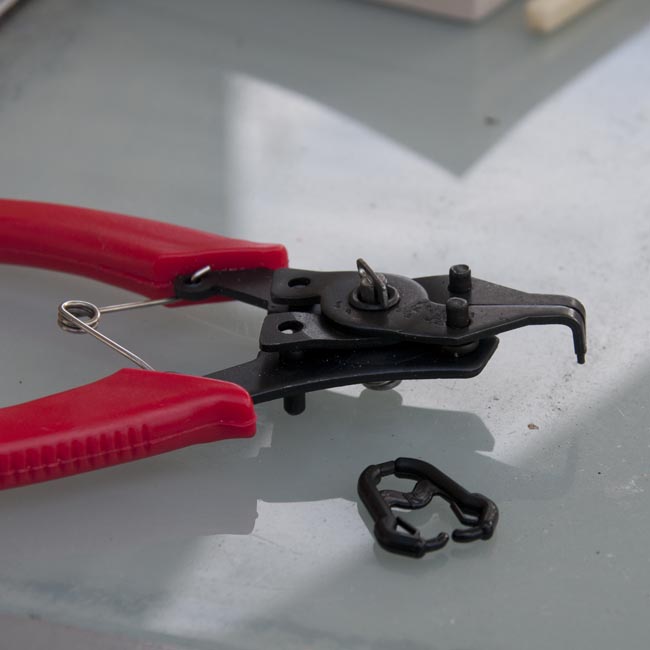
Bumper bit & pliersThis is a little plastic device which sits with a pair of prongs in the nostrils (a bit like the earpieces of a stethoscope), and has a flat bar across the mouth between the top and bottom beak and a ‘bumper’ type bar which wraps outside the mouth around the front of the beak.  By stopping the upper and lower beak coming together normally, it’s designed to prevent feather and skin pulling, and the ‘roll-bar’ in front of the point of the beak should stop her using this as a sharp weapon!

Flora wearing her bitIt’s the first time I’ve used a bit and it wasn’t a decision I made lightly.  While Flora can drink, and eat with the bit in, it does restrict her choices.  She can munch down on pellets and corn just as well as always, but grazing and preening are more difficult. Immediately after it was fitted, she was obviously aware of it and rather unhappy, she rubbed her beak on the floor and scratched at it with her feet.  But she’s settled with it now, and is foraging around the garden normally.

It hasn’t entirely disarmed her (or improved her temper!) – she’s still throwing her weight around – but the damage she’s able to inflict has been greatly reduced, as has the general level of anxiety amongst the other bids.  I’m hoping we can restrict the use of the bit to the shortest period of time we can – ideally a few days to a week or so – though we’ll have to see how the rest of the politics settle down.

Doris and Midge are going to be at the bottom of the new pecking order, but apart from the initial attacks from Flora, and the odd ‘establishment peck’ from the other hens, seem to have been mostly left alone for now.  I’ll be watching these two with particular concern when we house the girls this evening, as they may well get a rougher time when they haven’t got so many options for getting out of the way.

All the hens have been in and out of the open, now combined houses-and-runs.  Gertie seems particularly entranced by the new contraption-house!  We have two feeding stations and three drinkers in place at the moment to reduce unpleasantries associated with competition for resources.  The second house will be staying for now, as an option for any hens who don’t fancy running the gauntlet of the main coop!

Agnes enjoys a dust bath

Over all, mostly so far I’m startled by how well things have gone today.  It’s been a huge improvement on the last set of introductions – but then I learned a lot from that experience! I don’t for a minute believe that things will continue to go this smoothly, but it’s a really nice place to be starting from!

Stay tuned, folks, as the ‘clucking mayhem’ continues!

Read more from the Country Skills blog >>

Getting Clucky – welcome the new hens!

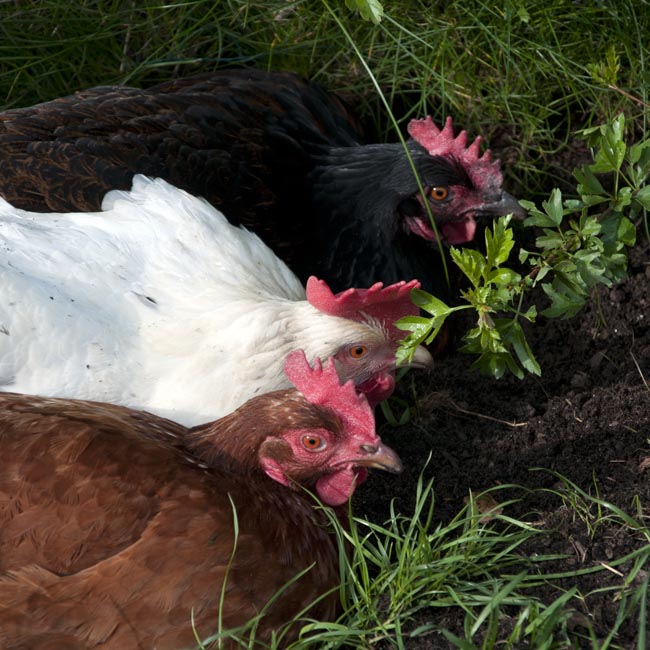
Three of my hens!I’ve kept hens for about three years now.  Until this week I still had three of my original four hybrid hens, but sadly on Monday Spot, my beautiful Rhode Rock (the black hen in this trio), passed away.  This was sad in itself, but also left me with three hens, one of whom (Gertie) hasn’t laid for some time, and the other two (Mabel, and younger hen Flora who came into the flock as a pullet last year) are moulting and won’t lay me anything for a few weeks at best – at worst they won’t think about it again until the days start to lengthen again.

Since my first four pullets came into lay, I haven’t bought a single box of commercial eggs (admittedly hen-keeping neighbours and colleagues have provided the occasional half dozen when my needs have exceeded my supply!).  So, I had an egg supply problem, and one that I didn’t want to solve by going back to retail eggs.  We thought about this for a while, and decided it was time to bring in a few more hens.

This wasn’t a decision we made lightly – last year, after losing Hazel, the first of my four original girls, we introduced two new pullets to our flock. The process was hugely stressful – hens can be vicious creatures, and it’s when when they turn nasty that you really see them for the tiny little feathered dinosaurs they are!  Flora and Daisy eventually settled well, but the introduction process was ghastly (and at times, brutal).  Sadly, we then lost Daisy tragically young last Christmas.

Dave welcomes the new girlsOn Thursday, I drove a 200 mile round trip to see a chicken supplier, Chris at Poultry Park in Newent, who I knew from our previous life in Gloucestershire.  I came home with three traditional breed birds – two hens, a Cream Legbar (Legbars lay blue eggs) and a Welsummer, both a year old and ‘retired’ breeding birds, and an 18 week old New Hampshire Red pullet.  Dave, our collie, was immediately intrigued by the new arrivals, and came very sweetly to say hello!

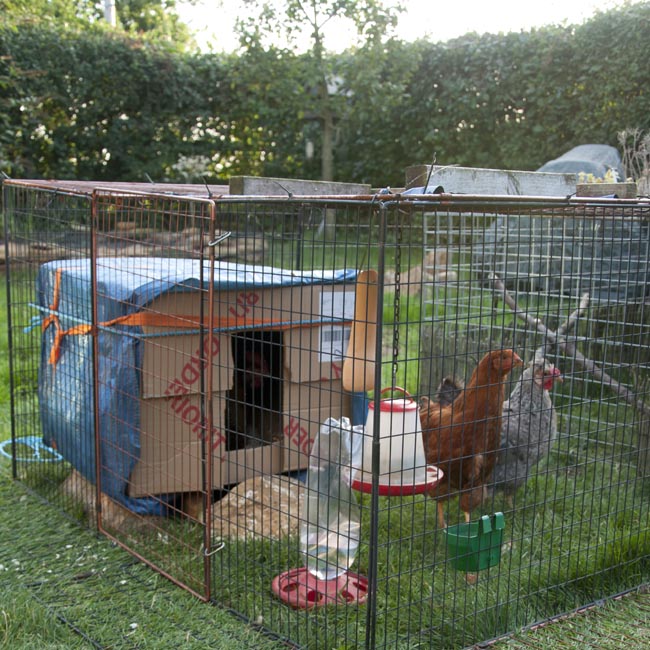
The new girlsThe new girls have moved into a run extension at the bottom of the old girls’ run.  The idea is to allow them some time to get used to the sight, sound, and smell of each other before introducing them to the same living space.  I tried the ‘short, sharp shock’ introduction approach last time, and wished I hadn’t, so it’s slowly-slowly this time.

The existing trio of hens were not impressed by the arrival of the new three girls, and Thursday afternoon was a chorus of sometimes angry chickeny-shouting in the garden.

First 'contraption' temporary hen-houseTheir first night, the new hens roosted in a ‘contraption’ of a henhouse we put together from an old cardboard box, a hedgerow stick, and a tarpaulin.  Necessity is the mother of invention, or so they say!  Anyway, the New Hampshire pullet (now called Midge) didn’t appreciate our efforts and decided to sleep out on the roof rather than inside the house with the other two!

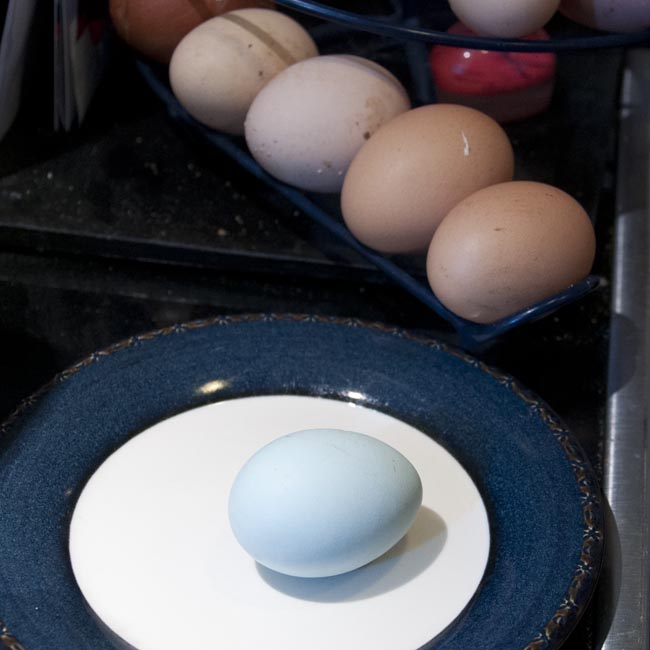
Egg of brightest blueOn her very first afternoon with us, the Cream Legbar (now named Dorris) laid us an egg.  This egg.  A *blue* egg.  I’ve *always* coveted a hen that lays blue eggs.

If only it were all that simple, of course.  There’s a lot to do, yet, before the new girls can be settled in nicely with the existing trio.

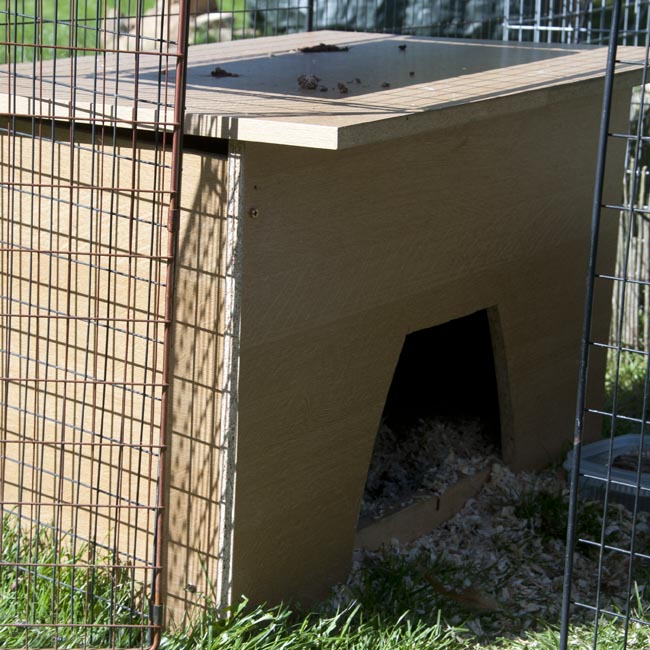
New, improved 'contraption 2'On Friday evening, I got home to find my lovely husband half-way through building a new contraption out of the remains of an old laminate-chipboard office desk. I would have taken photographs, but it was getting late and we had to get the job done!  The new house is a huge improvement, much more robust and seems appreciated by all three girls, who are happily sleeping and (in the case of the adult hens) laying eggs inside it.

The three new girls are new to each other, too, of course – and with two of them being adult hens, there’s been some politics to work out.  Agnes, the Welsummer, is the biggest of the batch, and has decided to assert her authority.  This was all getting a bit nasty on Friday and by Saturday Dorris and Midge were looking a bit cowed, hiding away in the house with Agnes strutting about outside, or worse, guarding the pop-hole to the henhouse.

We resorted to applying some anti-peck spray to the neck and shoulder feathers of the two smaller hens.  They’ve also had several spells of free ranging time this weekend, and whether it’s that, or the slight re-arrangements we’ve also made to the space and the feeding arrangements, or just time passing, relationships seem a bit better and less stressed. By this evening with everyone was out in the run, eating and drinking and scratching around together and only occasional outbreaks of pecking-order politics.  Gertie, Mabel and Flora seem less on edge and more settled back in their normal daily routine, too. They’re even giving the odd egg!

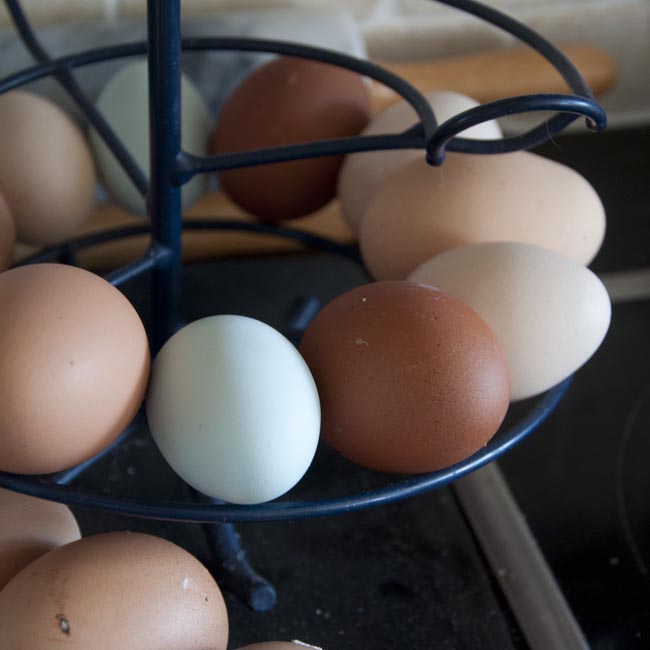
Egg skelter

All seems relatively settled for now, and with Agnes also laying some gorgeous chocolate-brown eggs, after three years of hen keeping, finally, I’ve got the egg basket (well, egg-skelter) of my long-held dreams.  Yes, I know they all taste the same, but aren’t they beautiful?

I expect the next few weeks to involve more than their usual share of stresses and difficult moments – never a dull moment with pets and livestock!  I’ll keep you posted!

Read more from the Country Skills blog >>

From the Bookshelf – foragers’ field guides

It felt like autumn was in the air this morning. Harvest is well under way (and didn’t I know it at gone bedtime last night, with the combine still beavering away under floodlights in the field next door!) and Keats’ ‘season of mists and mellow fruitfulness’ is just around the corner. Autumn is a gift to foragers (human and animal alike!) and at this time of year, whoever you are, and whether you live in the town or the country, there is a bounty of marvellous free food just waiting to be gathered up, and the traditional British hedgerow is definitely the place to be going looking for it!

There are the wild fruit nearly everyone knows, of course – most of us would recognise a bramble (wild blackberry), a crab apple or a rose hip. But there are rarer (or at least, less well recognised) autumn fruit that are just as worthy of attention. Can you confidently recognise elderberries and rowans? What about telling the difference between damsons, sloes and bullaces? Are wild raspberries or hops growing in your local hedges? Did you spot the distinctive spring showing of your local cob nut trees, and the blossom of the blackthorn, and manage to commit them to memory? If you’re relatively new to foraging, or even if you’ve been doing it all your life and think you know the offerings of your local hedgerows, verges, and field margins (and don’t dismiss roundabouts!) intimately, a good field guide is essential to getting the most out of your local foraging opportunities.

[Full disclosure: ‘The Hedgerow Handbook’ came to me free of charge as a review copy from Random House. I bought ‘River Cottage Handbook No.7 – Hedgerow’ with my own money, a couple of years ago.  I do not have an amazon affiliate account, any links provided are for interest and convenience, and I don’t profit from them in any way!]

The Hedgerow Handbook, by Adele Nozedar‘The Hedgerow Handbook’, by Adele Nozedar, (illustrations by Lizzie Harper).
Square Peg / Random House, 2012.
ISBN 978-0-224-08671-4. RRP £12.99.
See this book at amazon.co.uk

The first thing you notice is what a beautiful little book this is, graced inside and out with the loveliest hand-drawn botanical illustrations.  It’s a pretty little hardback, nicely printed on quality paper, and has great ‘object’ qualities, to be handled, flicked through, and admired – all of the things that make physical books so special compared to their digital cousins.

The illustrations are a huge strength of this particular guide – hand-illustrations are always better than photographs for identification, as they allow all the relevant details and characteristics of a plant – and different stages of its life cycle, such as buds and leaves, flowers and fruit – to be shown together, when this would be impractical in a single photo. Illustrations also tend to be clearer, and generalise the appearance of a species rather than showing a particular ‘individual’ growing in a particular place at a particular time.

Inside page viewArranged alphabetically, each hedgerow plant in the book is fully illustrated, the illustration accompanied by a useful description of its habit (and habitat). Culinary and traditional medicinal uses are then briefly discussed, along with curiosities and anecdotes, and folklore associated with the plant – after which Adele shares one or more recipes.

There are some really exciting and unusual recipes here that I can’t wait to try, at an appropriate opportunity – it’s not just the usual suspects like blackberry jam and elderflower champagne.  The idea of pickled ash keys is intriguing, and I’ll definitely be looking out for these when they’re young and tender again next spring. There are plants in this book that I would never have thought were edible – for instance, I’d somewhere along the line picked up the conviction that ox-eye daisies were poisonous, it turns out the buds can be pickled, and the young flowers deep fried in tempura batter.

As a gardener, I’m delighted to to discover that in addition to nettles, other pernicious weeds like cleavers and ground elder can also offer up, if not a square meal, then at least a free green vegetable dish!

Of course, knowing you can eat cleavers in theory is all very well – it’s essential I think that a sensible suggestion is also made as to what you might like to do with them, and this, along with the really wide range of species included, is a real strength of this book.  Recipe suggestions include preserves, cordials, and country wines, as well as savoury dishes and deserts, and make a really interesting and inspiring collection.

If I had to make any criticism at all of this little book, it would be that I’m not quite sure alphabetical order is the most obvious organisation for a field guide – arrangement by season or habit / habitat feel more natural. A note of possible confusion species, and how to avoid making these mistakes, is often a feature of guides like this, and is missing here – though the quality of the illustrations and annotations make going astray quite unlikely.  Finally, for me, the author’s enthusiasm for herbal medicine was sometimes a bit distracting – but I must confess to liking my medicine firmly evidence-based!

All in all this is a great practical little book that should be on your shelf if you enjoy a spot of hedgerow foraging – and you needn’t be in the country to find it useful!  Being such a pretty little book, I think it would also make a really lovely gift!

River Cottage Handbook No.7 - Hedgerow‘River Cottage Handbook No.7 – Hedgerow’, by John Wright.
Bloomsbury Publishing Ltd, 2010.
ISBN 978-1-4088-0185-7.  RRP £14.99.
See this book on amazon.co.uk

Another pretty little hardback without a slip-cover, this one is bright and full of photographs.  With the commentary on illustrations above in mind, this isn’t ideal – but considering that, they’re good photographs and ‘do the job’!

This book starts with a good comprehensive section on the generalities of foraging before moving on to identification of about 70 edible species.  After this, some of the potentially poisonous species are also identified – useful!  The back section of the book is set aside for recipes.

The front section of this book is especially useful, covering the legal aspects of taking plants and flowers from the wild in the UK, as well as a great tabular guide to the growing and harvesting seasons of the various species.  The set of edible species listed overlaps quite considerably, though not completely, with those in ‘The Hedgerow Handbook’ – as you would expect from two books covering the same ground.

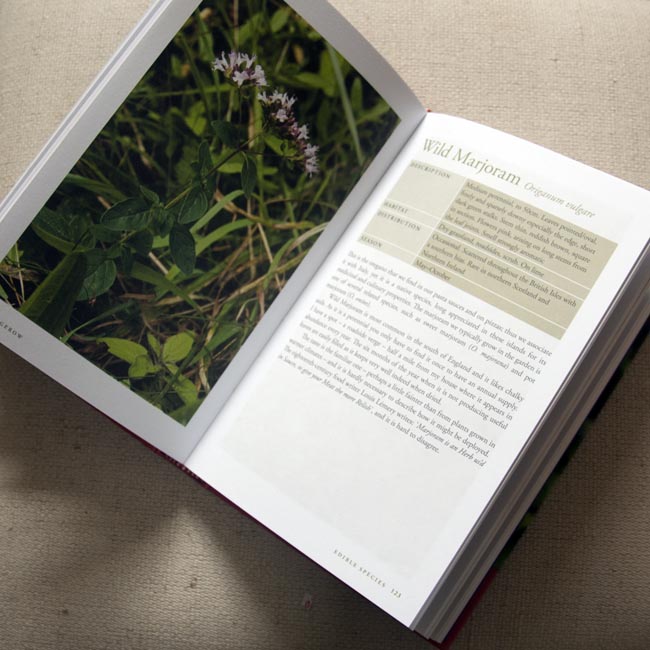
Inside page viewFor each plant, one or more photographs are provided, along with a useful summary covering description, habitat, season and distribution.  Combined with the introductory section, this makes it a really useful practical field guide.

It’s reassuring – and really interesting, actually! – to be able to confidently identify the toxic hedgerow species, and the third section covers these – the hemlocks, nightshades, foxgloves and suchlike.

The recipes, when we finally get to them, are much sparser on the ground, and do contain some ‘usual suspects’ like elderflower cordial, but are generally of nice quality, and well fleshed-out and illustrated.

As a whole the book does sit very well among the others in the ‘River Cottage Handbook’ series (which I have to confess to having acquired, um, all of so far), and avoids duplication.  This does mean that other recipes for foraged foods turn up in other handbooks, particularly the Pam Corbin ‘Preserves’ book.  Mushrooms and costal foraging also have their own volumes, which are very similarly presented and also very competent, interesting little books.  I would definitely recommend this volume, but be aware it’s likely to act as a ‘gateway’ purchase to the rest of the series!

Both of these are cracking little books which I can thoroughly recommend to you. Whichever you choose (hell, get both, you know you want to!) I hope you find them really useful for your autumn foraging efforts, and for many years to come!

Read more from the Country Skills blog >>

Getting In A Pickle – gorgeous spiced plum chutney

Accidents in the kitchen always seem to happen when everything’s just at that critical point… and any cook worth their salt, when scalded by a volcanic eruption of boiling sugar and vinegar, is likely to think ‘never mind my arm, have to save the chutney!’

So it was Thursday evening.  The chutney is fine, incidentally, thank you for asking!

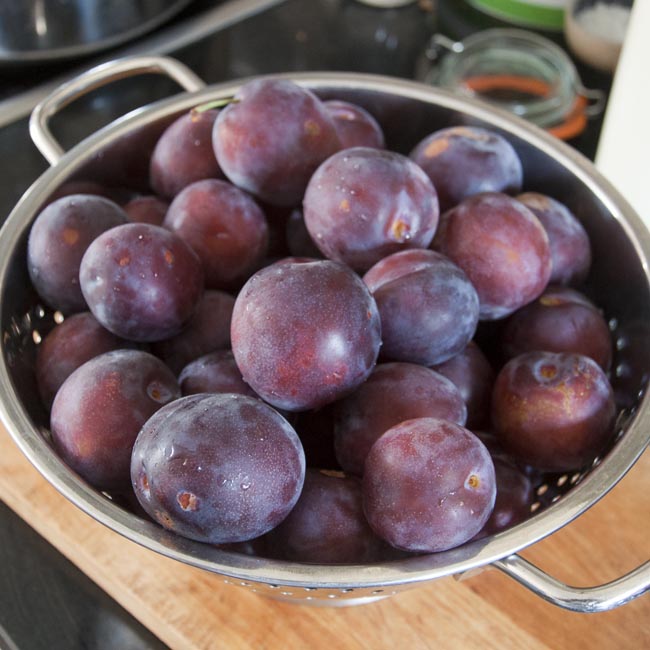
Red plumsAs well as bringing some beautiful French apricots back from their holidays, my lovely in-laws also arrived with a couple of kilos of fabulous red plums.  This put me in a real quandary, let me tell you.  Plum jam is one of my favourite things in the whole world.  But then this spiced plum chutney (originally Delia’s, credit where credit’s due!) is my very very favourite chutney.  It has a lovely fruity character topped with just a subtle hint of Christmas spices, and is wonderful with a lovely sharp mature cheddar, or a slice of home-cooked ham.

What eventually made my mind up was my jam jar situation.  I’ve done a lot of preserving in the last few weeks – it is that time of year after all! – and the jars I have left are a motley bunch.  Quite a lot of them have held things like sauces, curry pastes, and even pickles and chutneys.  The sorts of aromas that ‘hang around’ jars and lids, despite your best cleaning and sterilisation efforts.  It’s not really the flavour sensation you want with your breakfast jam!

This chutney is full of big flavours, and will swamp any faint ‘eau de korma’ residue it might have to deal with!

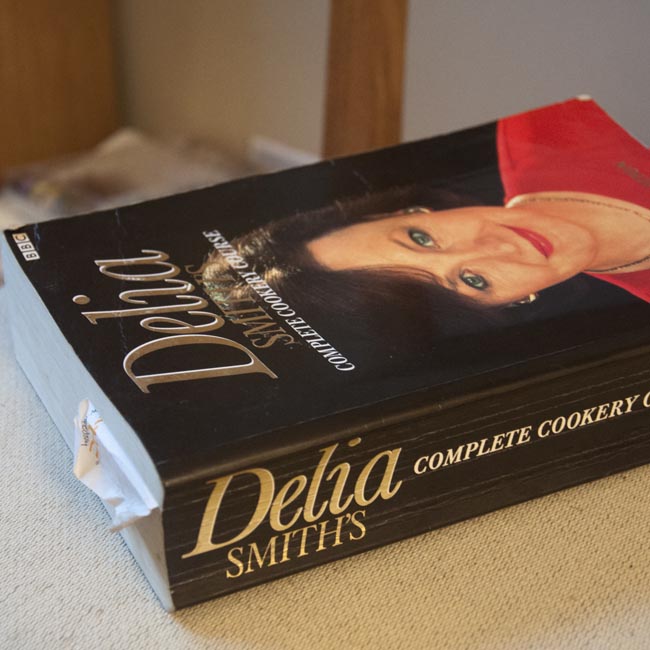
My well thumbed 'bible'The recipe is somewhat modified from the one in my very well thumbed copy of the Delia Smith ‘Complete Cookery Course’, reprinted from the 1982 edition.  Conveniently, it’s also available at ‘Delia Online’, here.  I’m not going to duplicate the recipe, since it’s freely available for you to read, but I changed the quantities and slightly modified some of the ingredients to suit my 2kg batch of plums, and what I had in the cupboard.

This is a BIG batch of chutney, producing 9 jars about 1lb in size, and a further eight small kilner-type jars, plus a bit extra which wasn’t quite a full pound jar.  I estimate in total it makes about 12lb, or 6kg.  It needs a very big pan – my large stock pot was over half filled, before reducing, and has a capacity of about 15l.  Unless you’re planning on eating an awful lot of chutney, giving lots of it away, or selling it (I think it would go really well at a farmer’s market!) I’d probably suggest scaling these quantities down to half or even a third (Delia’s original quantities are for 1.3kg of plums, which is still a very big batch).

I used the following –

  • 2kg of dark red / purple plums.  The tart / acid ‘cooking’ sort are probably better than sweet eating plums for this recipe.
  • Four smallish Bramley apples, totalling about 800g in weight.
  • 5 large-ish onions
  • 5 cloves of garlic
  • 3 teaspoons of ground ginger
  • 750g of seedless raisins
  • 750g each of soft brown and demerera sugar
  • 3 pints of malt vinegar (excuse the switch to imperial measures – this is about 1.7 litres, malt vinegar comes in pint-bottles in these parts, so it’s a measure of convenience).
  • 3 desert spoons of salt
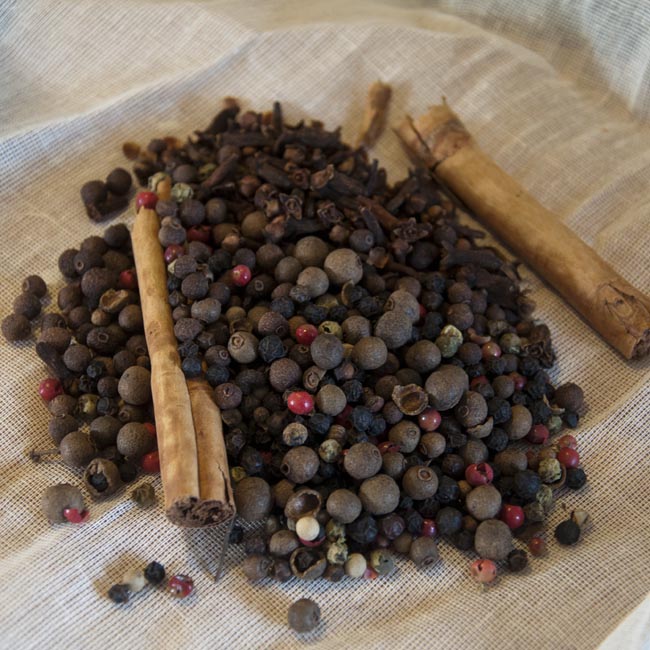
  • a large cinnamon stick, 15g of whole allspice berries, and 20g of mixed peppercorns (the mix was about 1/3rd allspice berries, oddly), and a tablespoon of whole cloves, all tied up in a muslin parcel.
  • A giant stock-pot, food processor, and enough jam jars to contain your chutney (lots, and lots, of jam jars!), which should have plastic-lined lids to help resist the vinegar.

Whole spices with muslin

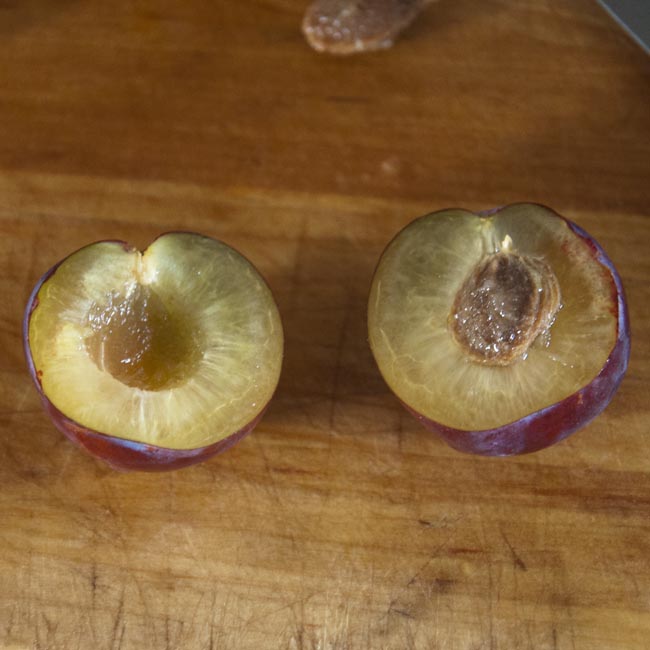
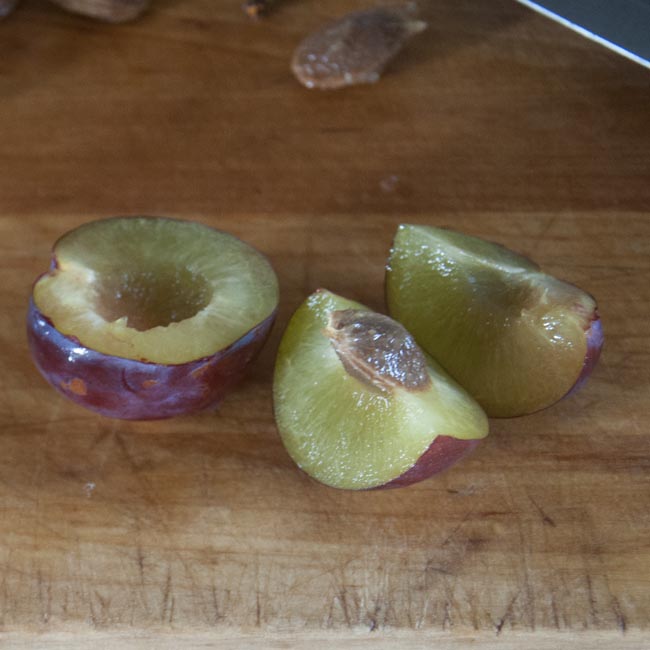
First wash, then stone and quarter all your plums. I find the quickest way to do this is to first slice along the line of the plum, down the visible ‘seam’, and divide the plum in two. The stone will cling to one of the halves, and especially with the smaller firm-textured cooking plums, won’t want to come out easily.

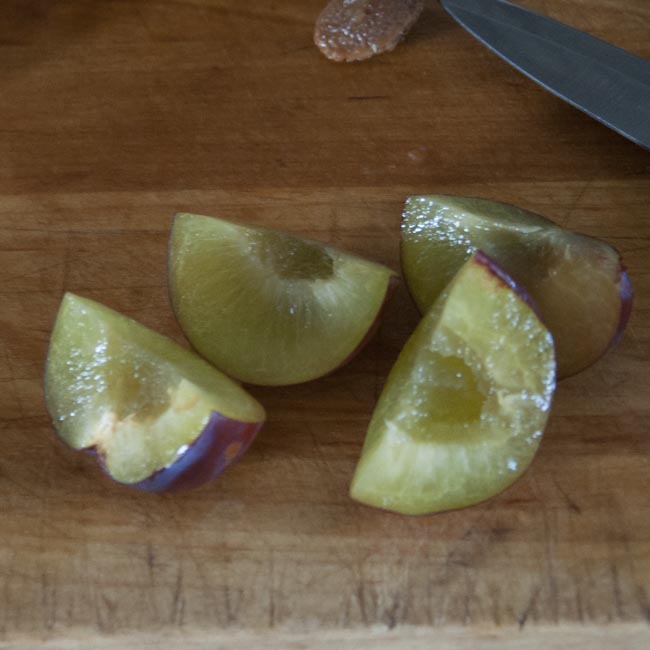
Stoning plums - 1   Stoning plums - 2   Stoning plums - 3

Take this half, and slice in half again, across the sort axis of the stone this time. The stone will now be sticking conveniently out of one of your quarters, and can easily be pushed free.  Cut your other half into quarters, too, and you’re done.  Incidentally, stoning plums can stain your fingers and fingernails a rather attractive nicotine brown colour, I think as a result of the tannins, so if you care about this, consider wearing gloves!

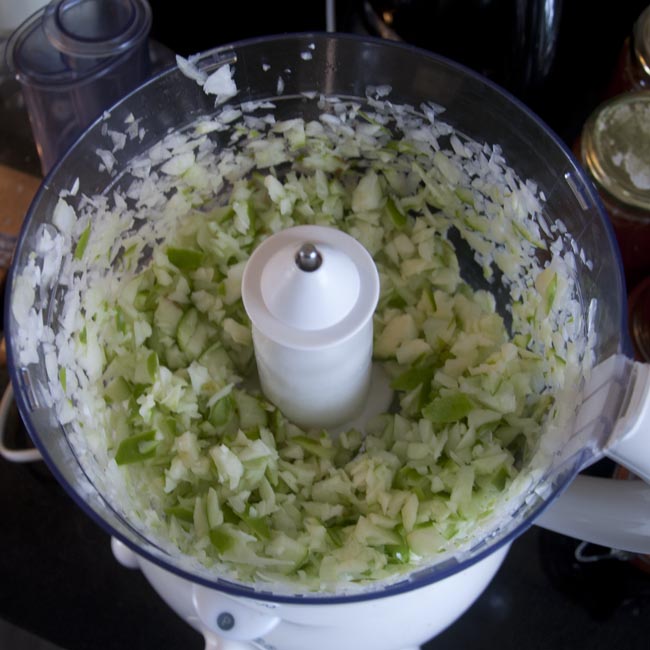
Chopped apple in food processorThe recipe calls for minced onion and apple.  I put mine through my food processor in batches, but left some nice texture in both.  The first time I made this recipe I didn’t have a decent food processor and diced all the apples and onions very finely by hand.  It works, but I can’t say I can recommend it!

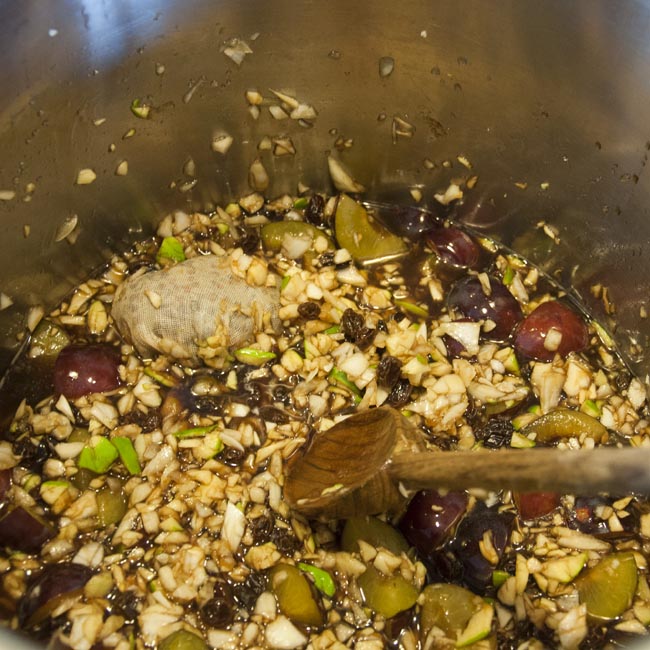
Mixed ingredients in panAfter your fresh ingredient preparation, it’s very simple really.   Add all the other fresh, dry, and liquid ingredients, and toss in your spice bundle (Delia recommends tying your bundle of spices to the pan handle, but I really can’t see any benefit to this!).  Bring everything to a simmer, stirring to mix as it all comes up to temperature.  Your kitchen will smell rather like Christmas-gone-wrong about now – festive spices mixed inexplicably with onion and vinegar.

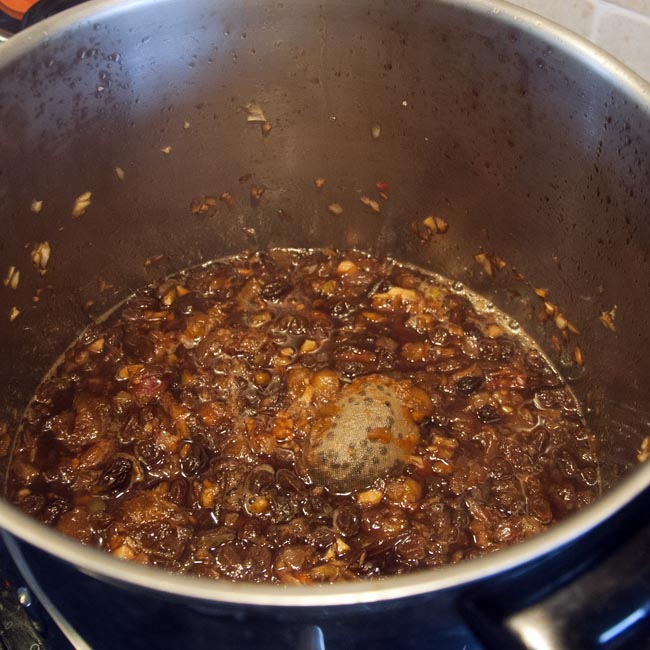
Cooking away nicelyThen let it bubble, stirring occasionally, for about three hours (my mixture was about six inches deep in my very big stock pot – a wider pan, or a smaller batch, which would allow the mix to sit in a shallower layer will reduce noticeably faster) until the mixture is reduced, glutinous, and the vinegar mixture has thickened so that it doesn’t immediately flow back into a channel cleared with a spoon.  I had to ladle out a couple of spoon-fulls into a bowl to check this.

As it starts to reach this stage, it will tend to ‘glob’ with really big bubbles, particularly when stirred, so learn from my experience and take care to protect your hands and arms from scalding!  This is the point that it’s at risk of sticking and burning, too, so keep stirring when you think you’re getting close.  Once it’s ready, fish out the spice bag, and bottle straight away into your hot sterilised jars.

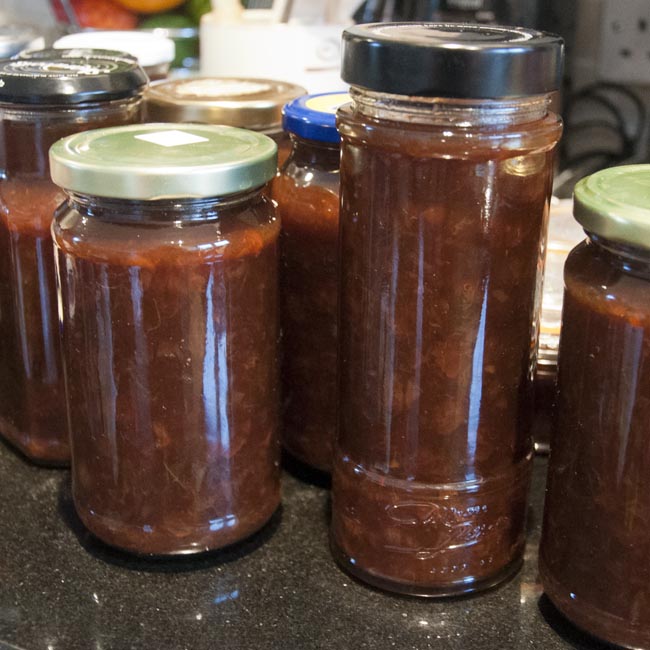
Bottled chutney

It will be at it’s best if you allow it to mature for at least three months before eating – just in time for Christmas, then! – though I had some of the ‘extra’ today with some bread and cheese, and it’s already very good!  It will keep very well, too – I’ve eaten this chutney after at least four years’ storage.

Now, I wonder if I can get hold of some more plums to make some jam, too …

Read more from the Country Skills blog >>