Happy Birthday – and a new home for the blog!

Doesn’t time fly!  I can’t quite believe it was a year ago (well, near enough) that I sat down and wrote ‘Bringing Home the Bacon’, and the Country Skills blog was born.  And it just so happens that while we’re on the subject of milestones, this is also the blog’s 100th post!

Well, everyone likes a birthday celebration, don’t they, and what’s a birthday without presents and candles?

First Birthday Candle

So, there’s the candle, and now for the present – the Country Skills blog has a new home at https://countryskillsblog.com/ although old links via the wordpress.com domain will continue to work through the magic of redirects.

I’d like to thank all my lovely readers – both regular and occasional! – for taking the time to stop by my little blog in the last year, and particularly those who’ve paused to comment or ‘like’, and helped me feel I’m not talking to myself!  Some of you have really helped me out – I don’t think the Sourdough Saga would have come to such a successful conclusion without your advice and feedback – and for that I thank you all from the bottom of my heart.

Here’s to many more years happy blogging!  Please do let me know what you think, I’m always happy to hear suggestions!

Read more from the Country Skills blog >>

Meet the Family – Dave the dog

This is Dave, our eight year old rough collie.  He’s the ‘face’ of the country skills blog and twitter avatar, too. 🙂

I took this photo yesterday night, while he was ‘hanging out’ on the sofa, enjoying the new sheepskins we brought back recently from Yorkshire.  I should add, he’s not allowed on the sofa, really – but he sprained his elbow a few days ago and is feeling a bit sorry for himself, so has extra privileges just now!  I love how his coat blends and contrasts with the fleeces in this picture.

I hope all of your pets (if you have them) are enjoying good health today, and are as much a source of joy to you as Dave is to us!

Read more from the Country Skills blog >>

Cooking with James Martin – a little taste of the treats on offer!

Our day at Food at 52  with James Martin was in two halves.  Our participation was called for in the morning as we were pressed into service as a rag-tag team of commis chefs in the preparation of the first three dishes – which made up our menu for lunch.  James guided and instructed and was only occasionally scathing of our efforts!

In the afternoon, already replete with amazing food, and enjoying a nice drop (or two!) of Sauvignon Blanc, we got to sit back and relax as James prepared a further six dishes while we watched, asked questions, and then struggled despite our already full bellies to taste all his wonderful creations.

Here’s a quick whizz through the wonderful dishes we tasted – hopefully I’ll be able to post some recipes in due course!

Lunch Menu

Thai crab risottoThai crab risotto – This was the first dish we tasted and was definitely one of the stand-out recipes of the day for me.  It has amazing complex & multi-layered flavours in exquisite balance, and despite how much is ‘going on’ in this dish somehow manages to taste crisp and clean and not at all muddled.  James described this as his ‘signature dish’ and I can completely see why – it knocks every risotto I’ve ever tasted into a cocked hat!

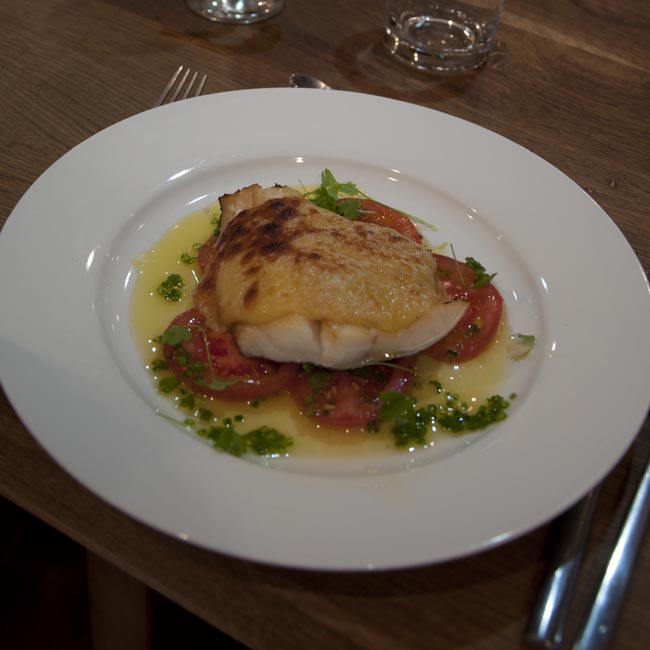
Smoked haddock rarebitSmoked haddock rarebit with confit tomatoes – An unusual twist on a Welsh rarebit, with the cheese-based layer built on top of a lovely naturally smoked haddock fillet.  Served with a confit tomato salad (which will definitely be making it into my culinary repertoire) it’s a lovely dish for an English summer’s day, balancing the clean crisp flavours of the tomatoes with the comforting warmth of smoked fish and grilled cheese.

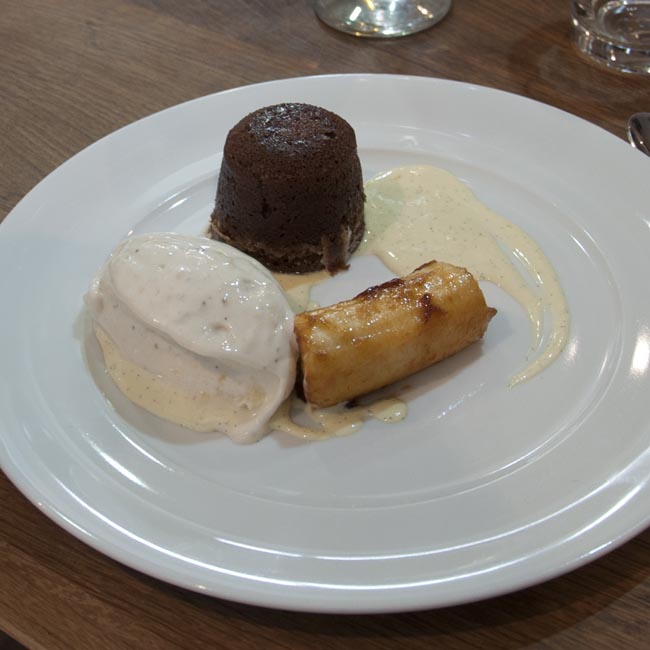
Hot chocolate mousseWarm chocolate mouse with banana ice cream & custard – The freshly made ‘last minute’ banana ice cream is actually the star of this dish for me.  It’s packed with really distinct flavours and heaps of texture.  Perhaps it’s because I’m not that much of a chocoholic – the chocolate pudding is tasty, and gooey in the middle, but very similar to things I’ve had before.  The custard involved a lot of hard work, and is clearly something I should master, but I’m not that much of a custard fan and I’m not convinced it adds that much when you already have the gorgeous banana ice cream.

Demonstration Dishes

Pea and watercress soupPea and watercress soup served with a deep-fried egg – This soup is an amazing colour (no Photoshop trickery here!) and has a lovely fresh pea flavour.  I’ll certainly be playing with this soup recipe at home, though I have to admit to being a bit mystified by the soft boiled egg crumbed and deep-fried and served in the centre in a style – I’m afraid – a bit reminiscent of the famous Australian ‘meat pie floater’! It’s a dramatic ‘cheffy’ touch to finish the dish but I’m not entirely convinced it adds anything that a poached egg wouldn’t in terms of flavour (in fact I suspect I’d prefer the latter) and the crispy texture it imparts is duplicated in the streaky bacon garnish.  Think ham and egg with peas, but all taken apart and put back together again!

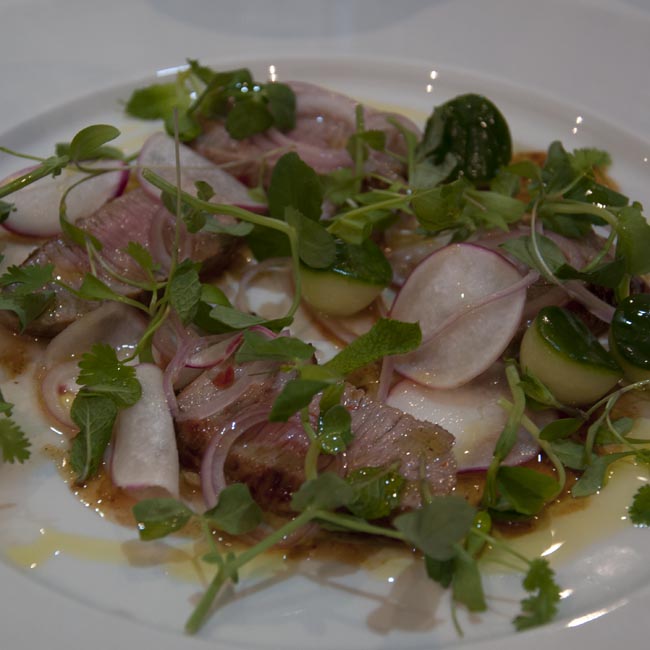
Pea and watercress soupLamb with chilli pickle – This is a great little dish, James described it as ‘bar food’ and it would be ideal for nibbles with drinks, but also makes a lovely light lunch or supper dish if you’re looking to impress someone!  Great fresh flavours with a lovely crisp tang from the freshly prepared pickled vegetables, and the lovely tender pink lamb loin is the perfect counterpoint.

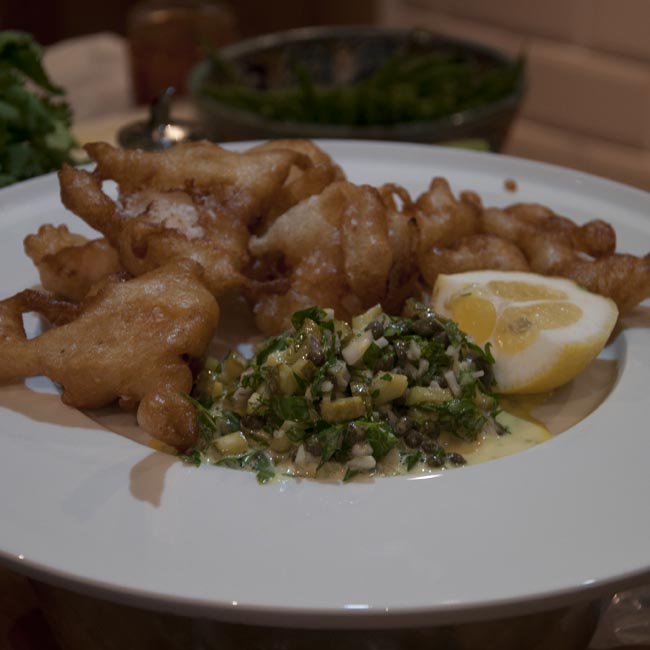
Cod cheeks with tartar sauceVodka-and-tonic battered cod cheeks with tartare sauce – The batter was an unusual concoction, with the cocktail-cupboard ingredients and made ‘live’ with yeast, quite unlike anything I’ve ever seen before.  It fries up lovely and crisp and keeps the cod cheeks gorgeous and moist.  The freshly made tartare sauce is the first such I’ve ever actually liked!  I don’t batter and deep-fry much, but it looks like a  great party-piece!  I can imagine diving into a big bowl of this with a load of friends around a table, perhaps with some slightly spiced potato wedges.

Seared tuna with 'Japanese slaw'Seared tuna in spiced apricot marinade with ‘Japanese slaw’ – A beautiful dish to look at on the plate with some lovely flavours – there’s an almost North African vibe with the fruit & spice flavours.  By this stage in the tasting I was really struggling to eat another bite, but was very glad I did.  We don’t often cook fresh tuna at home but I will certainly adapt this marinade next time we do, as it just lifts that slightly bland character it can have while letting the flavour still shine through.

And now for some desert!  We now felt so full we could pop…

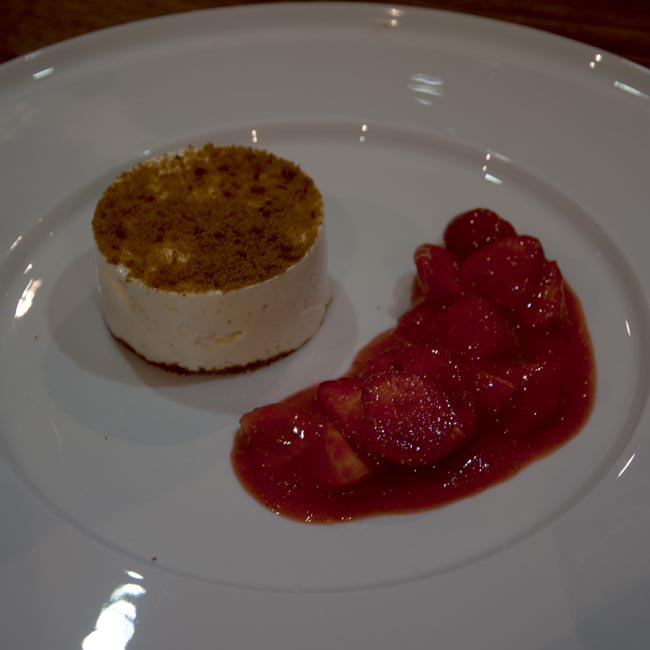
Strawberry cheesecakeStrawberry vanilla cheesecake – James introduced us to this dish, which is one that he developed for Thomas Cook‘s refreshed airline menu.  This is a wonderful quick simple & impressive little desert which you can imagine being able to adapt almost infinitely with different fruits in season and flavours in the cheesecake mix & biscuit crumb.  I particularly liked that this wasn’t an over-sweet dish, letting the flavours of the fresh English strawberries and the slightly acid-note from the cheese shine through.  It isn’t at all cloying and has an almost palate-cleansing quality, nice and fresh – just the thing when you’d eaten quite as much as we had!  All in all a great little dish and definitely another one for the repertoire!

Cheat's GateauxLast, but quite definitely not least, James’ rather marvellously named Bullshit (or “Cheat’s”, for polite company!) Gateaux seems quite the work of patissier’s art.  Just look at it!  In fact it’s startlingly simple – well, for the most part! There’s a story behind this cake – and the name – which I hope to share with you soon..!

For the time being here’s a little snapshot of the man himself doing some of his famous sugar-craft!

Sugar spinning

I hope this has really whetted your appetite for more details of these dishes – writing about them and going through the photos has certainly made me hungry!  I can safely say it’s the most amazing day’s foodie indulgence I’ve enjoyed in a very long time.  I can’t wait to experiment some more with the recipes and let you know how I got on!

Read more from the Country Skills blog >>

Cooking with James Martin – some initial thoughts & photos!

The big day was today – I’m finally back home from London (seriously, Londoners, how do you survive the Tube these days?!) exhausted but seriously excited about today’s cullinary adventure!  The competition winners met up with famous chef James Martin at the ‘Food at 52‘ cookery school in Clerkenwell, and he spent the day sharing with us some of the tricks of his trade and feeding us until we nearly popped (while he himself seemed to survive on a diet of Diet Coke and Red Bull!).  The whole event was thanks to Thomas Cook, with whom we heard James had been collaborating on aeroplane catering.

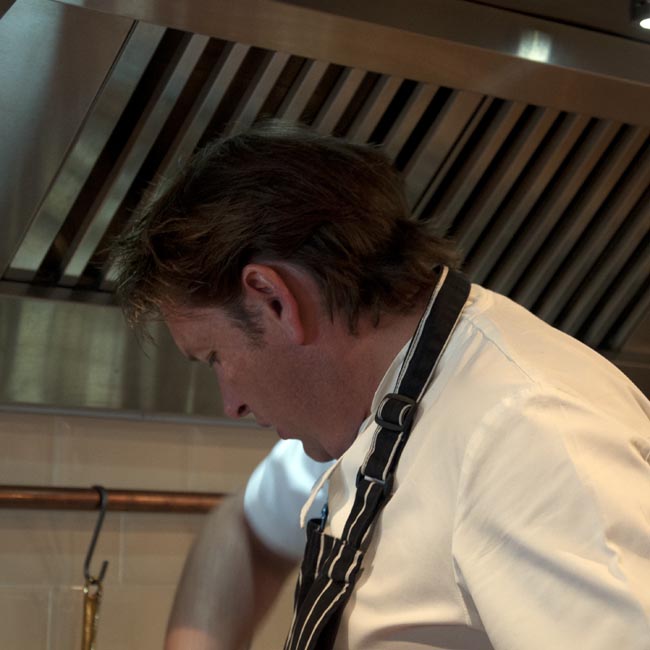
James Martin

There are recipes and tips to share with you, and we’ll get to those in due course (probably once I’ve re-cooked at least some of the recipes to iron out quantities etc!) but I just wanted to share a few initial ‘teaser’ photos featuring some of the marvellous ingredients we got to ‘play’ with today.

Brown crab  Ingredients  More ingredients

It’s also been a great opportunity to meet other keen cooks and bloggers, and I hope some fun things will come of that in the future, too!

Look forward to more blogging on the subject once I’ve had a good night’s sleep (perhaps several!) and caught up on myself a little!

Read more from the Country Skills blog >>

Exciting news – and a bit of a tease!

A little while ago, I entered a recipe competition with a variation on my jerk marinade, thinking ‘here goes nothing!’.  Last weekend, I received an email – I nearly deleted the winning notification – I mean, what else do you do with emails which start ‘CONGRATULATIONS!’ and go on to tell you you’ve won something??

1st Prize!

I was a bit gobsmacked, truth be told.  I’m the sort of person who never wins anything – not even a colouring competition when I was a kid!  In fact, the only thing I’ve ever won was a Blue Peter Badge (those of you outside the UK will have to look that one up!).

So, one day next week, I get to travel to a secret London location and spend the day enjoying a masterclass with one of my favourite celebrity chefs!  How cool is that??

I’m so excited about this (does it make me a prize-winning food writer, I wonder?) and can’t wait to share all the details & photos with you all after the event!

Read more from the Country Skills blog >>

Opinion – thinking about animals as food, and food as animals

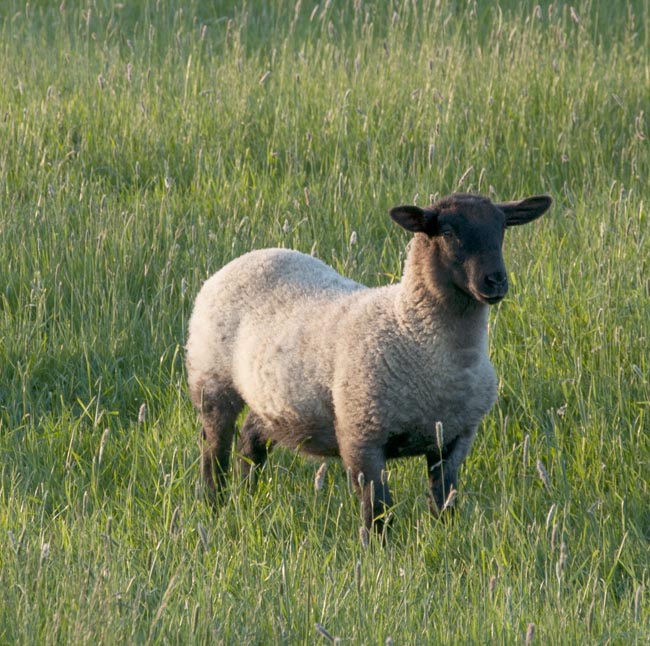
Look at this little lamb – isn’t he just gorgeous? All floppy ears, crinkly coat and frantic tail.

Growing lamb

Now think about eating him – a wonderful slow-roasted shoulder, perhaps, sweet and tender, running with glorious juice and served with a dollop of lovely mint sauce, or a couple of little chops, grilled to your liking with boiled potatoes & greens.

How does that juxtaposition make you feel?  Be honest now…

Hungry? If so, congratulations. You’ve passed!  But perhaps, if you’re honest, it makes you a bit uncomfortable? Unsettled? Maybe even faintly disgusted?  If you’re a vegetarian, you get to leave now, if you like, but if you’re a meat eater then you really should stay and read on.

So many of us today are so divorced from our food, and how it’s produced.  Its appearance on the supermarket shelf, all sanitised and shrink wrapped, so we’re not even used to the touch or smell of it, has allowed this huge chasm – this disconnect – to open up in our minds between our food and where it comes from.  We wince when we’re reminded, very often – how would you feel if you saw a whole roast suckling pig, a chicken dressed for cooking with head and feet still attached (probably on TV in some ‘less civillised’ country), or if you watched a whole side of beef being carried into a traditional butcher’s shop?

Back to our lamb – I’d like to argue that there’s nothing wrong with thinking about him as food – that’s his *purpose*, plain and simple.  If he wasn’t going to be eaten, he wouldn’t have been born.  In a few months, he WILL be on someone’s dinner plate.  Mine, I hope, since he looks to be growing rather nicely and will have enjoyed a cracking life out on that lovely pasture with his ewe and all his little lamby friends!  It’s imperative that we can think of livestock as meat, and step over that chasm, because we also need to make a habit of thinking of the meat on those supermarket chiller shelves as animals.

When you’re grabbing that matching pair of rather sterile-looking chicken breast fillets, sealed airtight in their protective atmosphere, from the chiller shelf, do you have a picture in your mind of the chicken who died to provide them?  It seems to me that to be ethical consumers of meat, we *must* carry just such images with us.  Allowing that disconnect to exist in our thought processes allows us all, thoughtlessly, to make bad choices.  We might say the right things about preferring free range, organic, or higher welfare meat and eggs,  but when push comes to shove, how often and how easily do we pick up that chicken salad sandwich, pork pie, or pack of BBQ burgers without the origin of the meat even crossing our minds?

Unless we’re prepared to think about our food – *really* think about it  – taking time in particular to think about the animals that have provided our meat, how they lived, and how they died, then we cannot possibly claim to be ethical meat eaters.  And if you can’t, or won’t, if ignorance is bliss, if you’d rather close your mind to the idea, and think prettier, less uncomfortable thoughts, if you prefer to pick up the packet of anonymous animal protein, and ignore its source and its story, do you really think you deserve to enjoy the fruits of these animals’ sacrifice?

Read more from the Country Skills blog >>

Gosh, an award!

A very long time ago (goodness, back in March!) I got an unexpected blog comment from The Bead Den Craftivities awarding me this beauty –

It’s taken me forever to do anything about it, for which I can only apologise!  The rules of the award are quite simple, and require me to do the following –

First – and most importantly – to thank the person who awarded it to me.  So, thank you so very much to The Bead Den – and do go back and read the nomination post here, since it contains links to lots and lots of other worthwhile things.  The rest of the blog is also great, of course, and well worth your attention!

Second – to tell you all seven things about me you probably didn’t know.  This was hard (and the main thing to be honest that’s slowed me down these almost-two-months!). So here goes nothing!

  1. I’m a master mariner’s granddaughter.  Mostly this means I’m good at tying knots, and seem to have inherited a genetic resistance to motion sickness!  Once upon a time I could do semaphore and morse code, too, but I’ve forgotten how.
  2. I learned to love real ale aged 19 (university has a lot to answer for!).  Ten years later, aged 29, I started to brew my own.
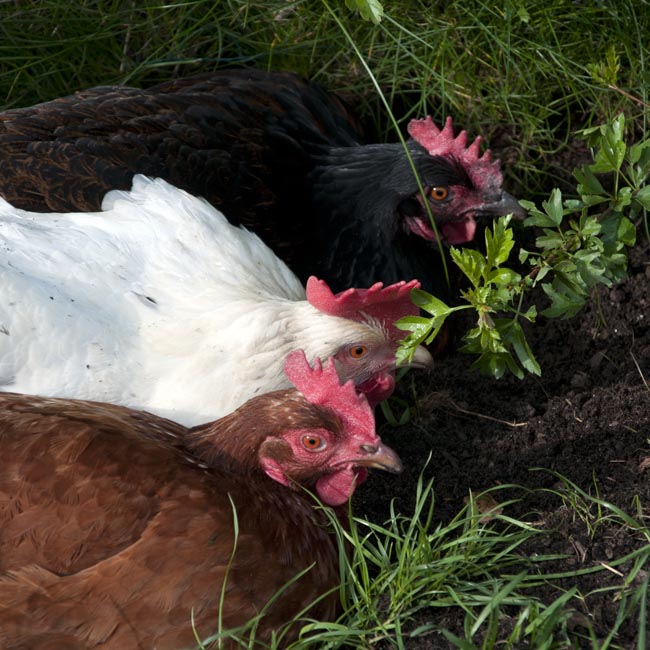
  3. Three of my hens!I have four hens – Gertie, Mabel, Flora, and Spot.  I can heartily endorse back-yard hen keeping, which is a source of great joy (and fantastic eggs!).  Hens make wonderful pets.
  4. I have a 2.1 in Computer Science from the University of Cambridge.  This has no bearing whatsoever on my day job!
  5. I love learning new things, which tends to mean I acquire a new hobby at least once a year – much to my husband’s distress, as he points out (quite rightly!) that there’s no room in our small cottage for any more of my ‘stuff’.   When the hobby turns out to produce something he can eat or drink, he’s a bit more easily mollified!
  6. I have no formal training in cooking, sewing, brewing, curing, butchery, horticulture, photography, writing (beyond GCSE English!), chandlery, or really any of the other skills in this blog – I do have a habit of thinking ‘how hard can it be?’ and just giving things a try!  I have to remind myself from time to time that the other key question is ‘what could possibly go wrong??’.
  7. I adore the information, inspiration, and new perspectives which I get from fellow bloggers, and it’s great to think that in a small way I can contribute to that rich community!  [Ok, perhaps this doesn’t really qualify as ‘surprisng’ but I was really struggling for number 7!]

Third – to nominate seven more bloggers for this wonderful (and pretty, isn’t it?) award.  There’s no obligation here, folks, if you’ve been given this award before, I’m sorry to bother you again, and if you have better things to do, that’s just dandy!  But without further ado, and in no particular order, here are my seven nominees (along with a quick note about why I think their blogs are so great, and always look forward new posts) –

From Belly to Bacon – charcuterie, what more is there to say?

Very Berry Handmade – amazing fabrics, designs & sewing inspiration

The Rowdy Chowgirl – great food, and fermentation – just what every girl needs!

Into Mind – fashion & clothing customisation

Domestic Diva, M.D. – fabulous anecdotes & comfort food

Happiness Stan Lives Here – lots of red-meat based solid grub

Conker & Indigo Recipes – great food & photos

Finally, I have to go and comment on all their blogs to let them know they’ve won (and with apologies for the, um, kreativ spelling) – I hope they’re suitably psyched, or at least not too irritated with me!

Read more from the Country Skills blog >>

Inspirations – Isabella Beeton’s ‘Book of Household Management’

I like to think that, had she been alive today, Mrs Beeton would have been a blogger.  Before her death in 1865 aged 28, which followed the birth of her fourth child, she wrote prolifically.  Her husband, Samuel Beeton, was a publisher, and much of the material in the book was first printed in the form of articles in ladies’ magazines between 1859 and 1861 before then emerging in one volume as the book we would recognise as ‘Household Management’.

It’s fair to say that much of the material in ‘Household Management’ was collected (plagiarised, according to some less charitable commentators) and edited together, rather than being original to Isabella Beeton, but she probably invented the modern mode of laying out recipes – with an ingredient list at the top, followed by directions and cooking instructions – something we take for granted today.  While it is to a great degree a recipe book, it also contains wonderful snippets of advice on all aspects of victorian life – on medicine, the law, clothing, manners, the rearing of livestock, and of course famously the selection management of one’s servants.

Most of the recipes stand the test of time quite well – do avoid however the recommendation to boil carrots for about three hours – there are some wonderful snippets which are utterly of their period and richly reward the reader’s attention, though perhaps not their imitation!

Mrs Beeton on Whooping Cough:  “This is a purely spasmodic disease, and is only infectious through the faculty of imitation, a habit that all children are remarkably apt to fall into, and even where adults have contracted whooping-cough, it has been from the same cause, and is as readily accounted for, on the principle of imitation, as that the gaping of one person will excite or predispose a whole party to follow the same spasmodic example.” Her recommendations for treatment are… equally surprising!

On paying visits of courtesy (to be done after luncheon!): “They are uniformly required after dining at a friend’s house, or after a ball, picnic, or any other party.  These visits should be short, a stay from fifteen to twenty minutes being quite sufficient.  A lady paying a visit may remove her boa or neckerchief, but neither her shawl nor bonnet.”  So there you go, boa off, bonnet on – are we clear?

There are some marvellous-looking (not yet tested here!) recipes for home-brewed – and sometimes fortified – wines, as well as curing and preserving – after all it’s a book from the years before refrigeration – and for this reason alone deserves to be on everyone’s bookshelf and dipped into regularly.  Obviously we’d all like an old hardback copy complete with colour plates, but as it is widely available in paperback reprint (my well thumbed copy is a recent Wordsworth Edition) and is free to download in a variety of e-reader formats, albeit often without it’s illustrations, you really have no excuse!

Read more from the Country Skills blog >>

Big Bacon Challenge: Rounding Up – volunteers’ feedback

A few weeks ago now, all my lovely volunteers for the Big Bacon Challenge made their first batches of home-cured streaky or back bacon.  Several of them have blogged about their experiments, so I’d like to bring together some of their comments and reports.  I wanted to show as many people as possible that making your own bacon at home is not only incredibly simple and straightforward, but produces some of the best bacon you will ever have eaten – these reviews I hope go some way to supporting that!

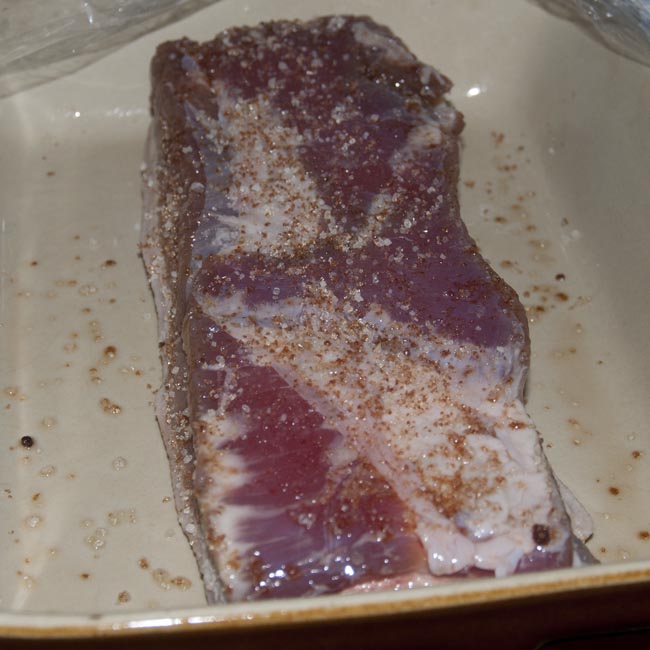
Streaky bacon mid-curing, with dry curing mix applied

‘Ghoti’ writes about her bacon over on LiveJournal:  My favourite exerpt from her report – “So, in summary: utterly delicious, and a three year old can make it.”

‘Amlees’ wrote up her bacon day-by-day at Alison Was Here, and her collected bacon challenge posts can be found here:  “So the bacon is cured and rested and ready to eat.  John cuts thick slices and fries them for breakfast, with an egg on the side.  The bacon is delicious and satisfying, if a little salty. (…)  However, the bacon is as good as the bacon we normally buy (the expensive dry-cured kind).”

Finally (for now at least) ‘5greenway’ wrote on the Very Berry Handmade blog about their bacon in two posts – at the start and end of the process – “So, the process was really easy. But it would all count for nothing if the bacon wasn’t up to scratch… Just looking at it before cooking, we suspected it’d be pretty good, but it tasted even better than we expected. Not too salty, a nice flavour from the cure & a kind of melt in the mouth texture.”

I’m informed by several of my volunteers that they have since bought their own supply of curing salt and continue to make home-made bacon (and other goodies!), so I’m declaring the challenge a success!

A great big THANK YOU to all of my volunteers, and if any of you have any further feedback, please do comment or email so that I can include it here!

All the Big Bacon Challenge posts will be collected under the ‘BigBaconChallenge’ category heading – so go there to read them all!

Read more from the Country Skills blog >>

Hamming It Up – home-cured ham, boiled and glazed

A great ham sandwich is one of life’s special pleasures, isn’t it?  A few weeks ago I spotted a big chunk of pork leg on special offer at our local co-op.  It was too much to resist – after all the experimenting with bacon, it was time to add another pork product to the collection.  Time to make a home-cured ham!

I decided to base my cure on a Wiltshire cure, which is a traditional British cure with treacle, juniper and coriander.  The process is a bit more involved and time-consuming than dry cured bacon, but your end result is well worth it!

You will require –
  • Pork legA nice big piece of pork (ideally leg), untied from any net or string it might be wearing when you buy it.  My piece was about 1.5kg in weight.
  • A non-metallic container big enough to hold your piece of pork with some space to spare.  I used a big tupperware box I had hanging around.
  • Kitchen scales, measuring jug, pestle and mortar, and a dinner plate.
  • Curing salt – pre-mixed type such as supracure (see the Suppliers List for more details)
  • Black treacle
  • Juniper berries
  • Black peppercorns
  • Coriander leaf (preferably fresh, or dried if not)
Large tupperware box

The weight of the pork isn’t terribly important, as the amount of brine you need is as much dictated by the size of your container, and the curing time is more to do with thickness than total size.  Estimate the amount of curing brine you will require by putting the pork in the box, bucket or bowl and just covering it with water, then take the pork out and measure the water.  I needed just over 3 litres.  This is also washes any liquid or debris from the surface of the pork.

My brine was made in the following proportions – given per litre of cure for simplicity:
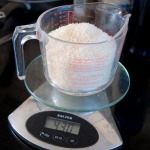
  • Curing salts130g of supracure
  • 90g of black treacle
  • 5g of juniper berries
  • 2g of black peppercorns
  • a big spoonful of dried coriander (be generous, and if you have fresh available so much the better)
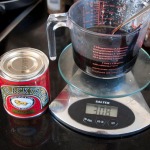
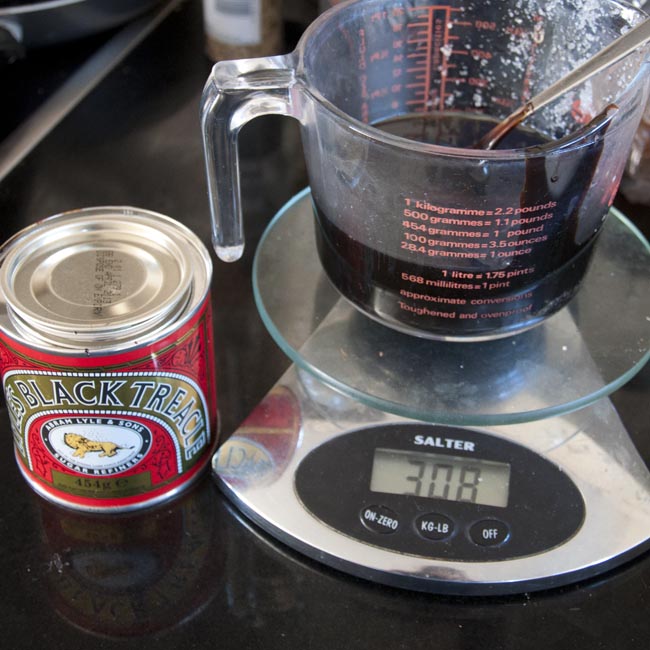
Black treacleRemember you’re aiming for these ingredients to be included *in* a litre of brine, not added to a litre of water, so add the dry ingredients to a measuring jug and then add the water so that you can keep track of the total volumes.  You’ll need to add boiling water to the cure ingredients to help dissolve them, once they’re dissolved top up to your total volume with cold water.
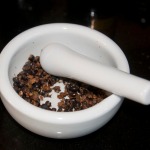
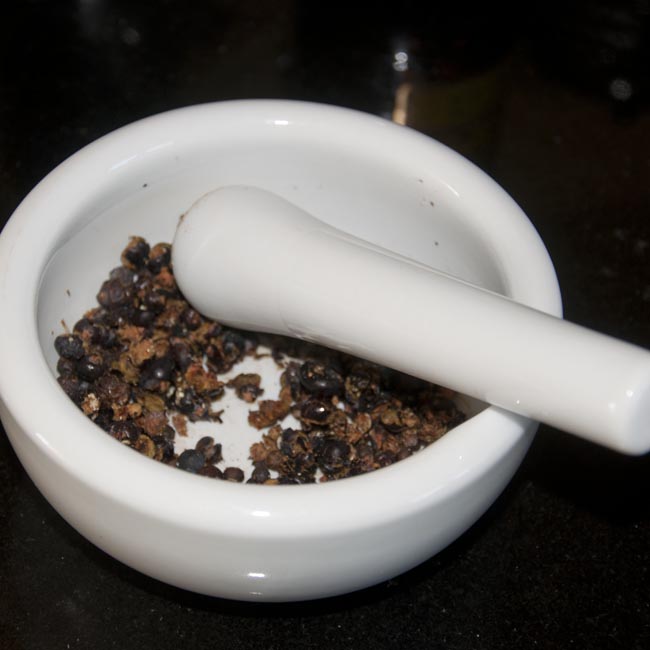
Crushing juniper berries and peppercornsGently crush the juniper and peppercorns in a pestle and mortar, just enough to crack them open and release the aromas.   Add these and the coriander to the brine and refrigerate until cold.

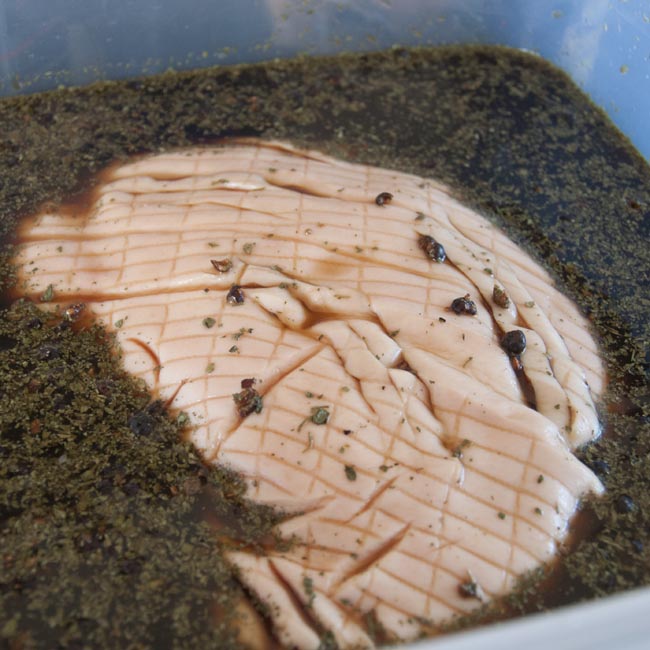
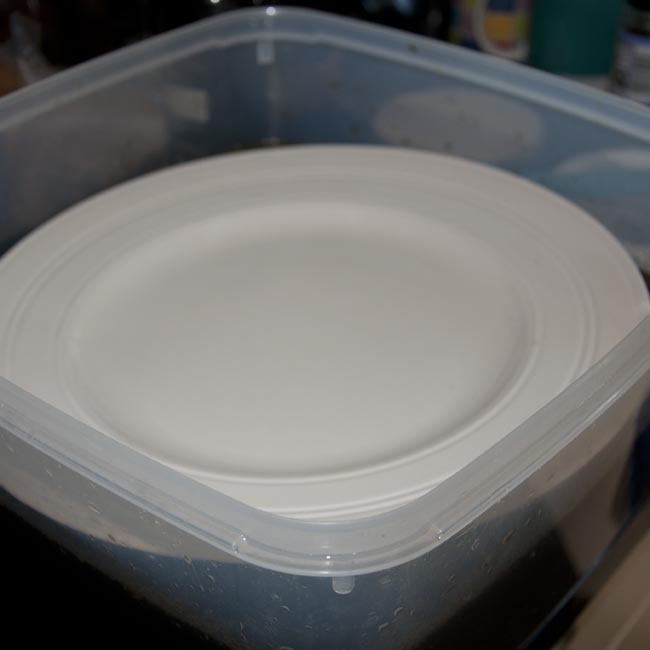
Once the brine has cooled, add the pork, and weigh it down with the dinner plate so that it doesn’t bob up out of the brine solution.  Loosely cover the box with cling film, and place in the fridge.
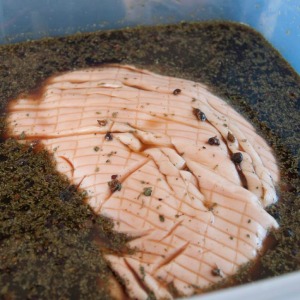
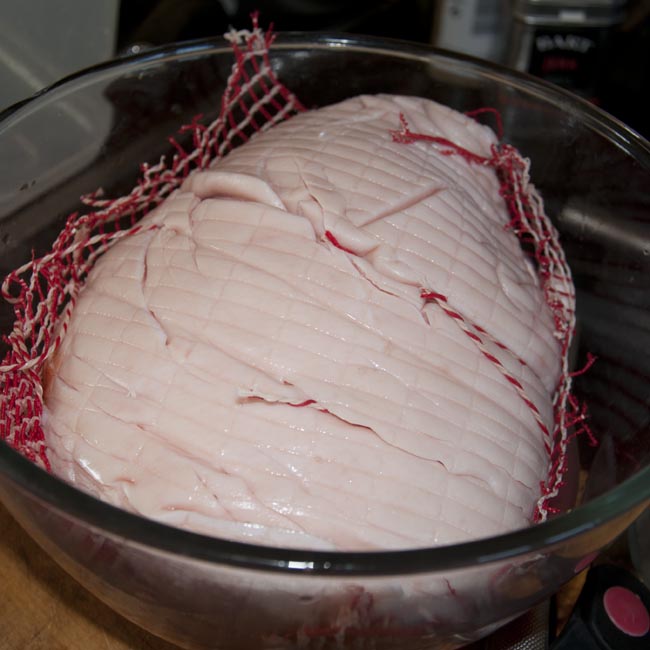
Ham in brine

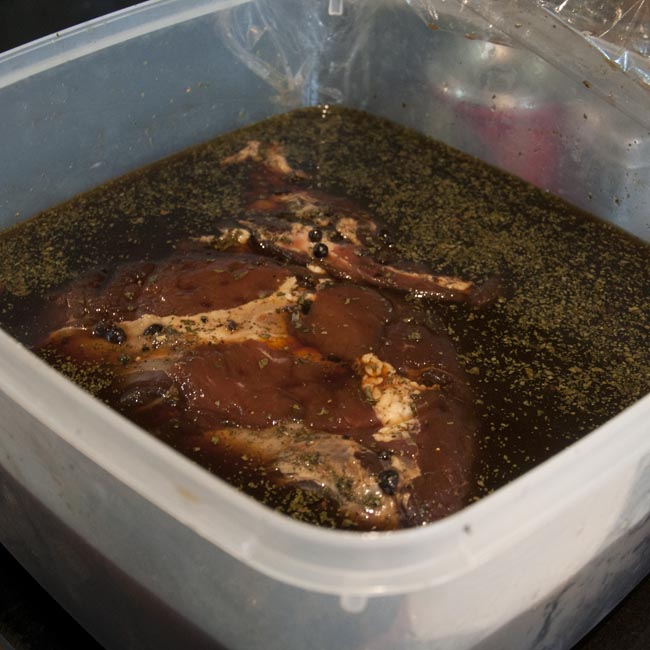
Plate placed over curing hamNow, once a day, turn the meat over in the brine.  This will help the cure penetrate equally.  Very soon you’ll start to notice the meat and rind darkening as they absorb the treacle, and taking on a firmer texture.
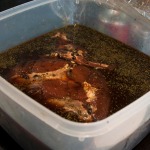
Ham in brine after 5 daysAdvice on the subject of curing time appears hugely variable and for my piece of pork I found advice ranging from 5 to 15 days – I’ll come back to this later, but as I wanted the ham for a specific date I took a punt and went for the shortest advised curing time of five days – based on a rule of thumb of 1 day of curing per inch thickness of meat.
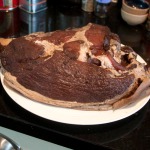
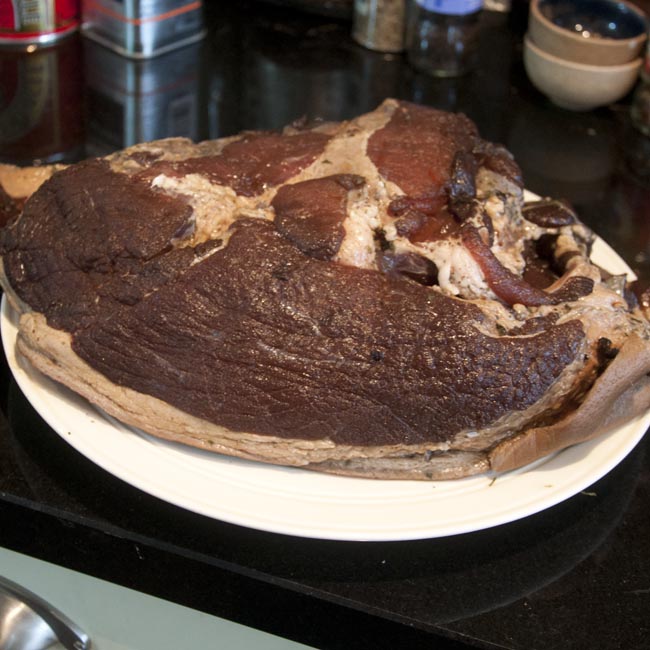
Cured ham, resting on plateAfter your curing time is up, remove the ham from the brine, rinse it carefully under the tap, dry with kitchen towel and place on an open plate in the fridge.  I rested my ham for just one day, because I was in a hurry to eat it – but I suggest it would be better to rest it for 2 – 3 days before cooking.

It will have completely changed appearance from the pork leg that went into the cure – the meat is a dark mahogany colour and the rind a warm brown.

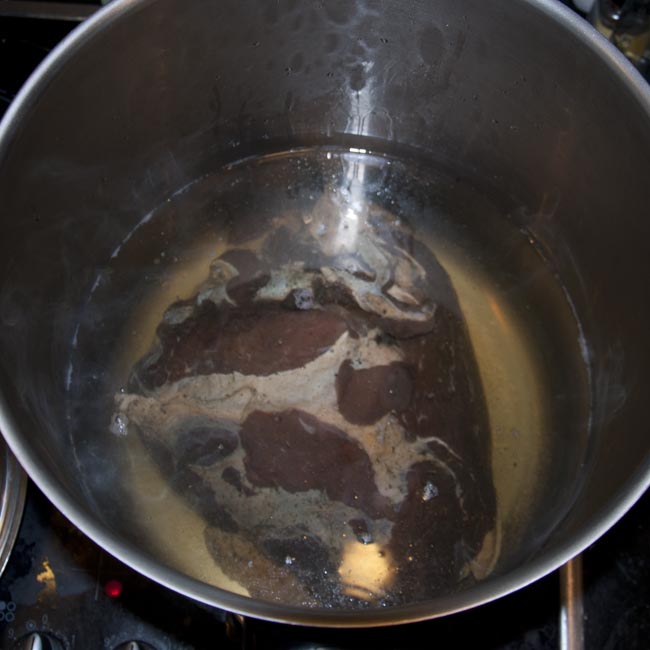
You can now cook your ham however you like – I prefer to boil mine first, until it reaches an internal temperature of 70 celsius.   I changed the water after the first 20 minutes, this helps reduce the saltiness in the final cooked ham.
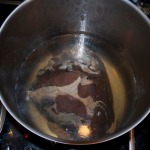
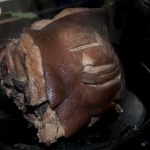
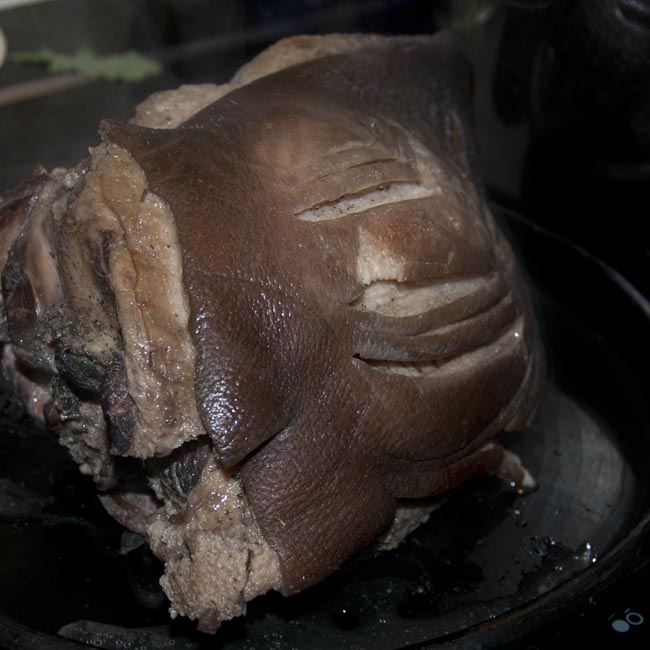
Putting the ham on to boil    The ham after boiling, rind side showing    WIth rind removed, and fat scored

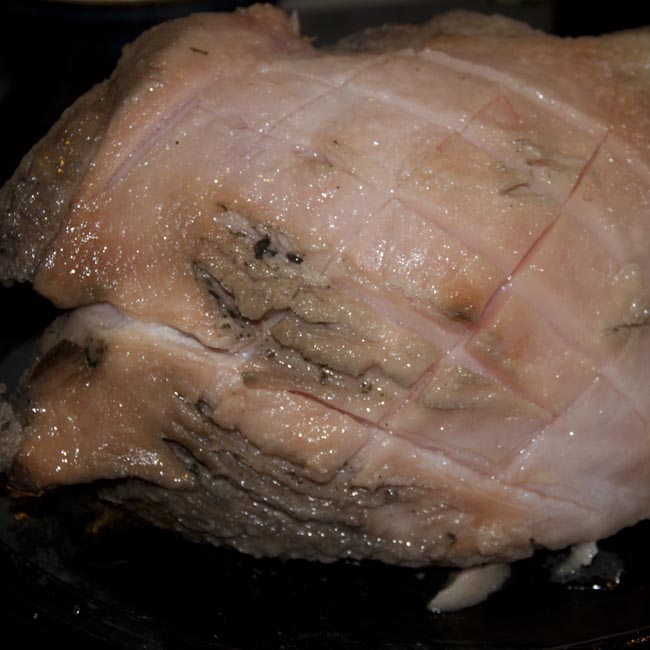
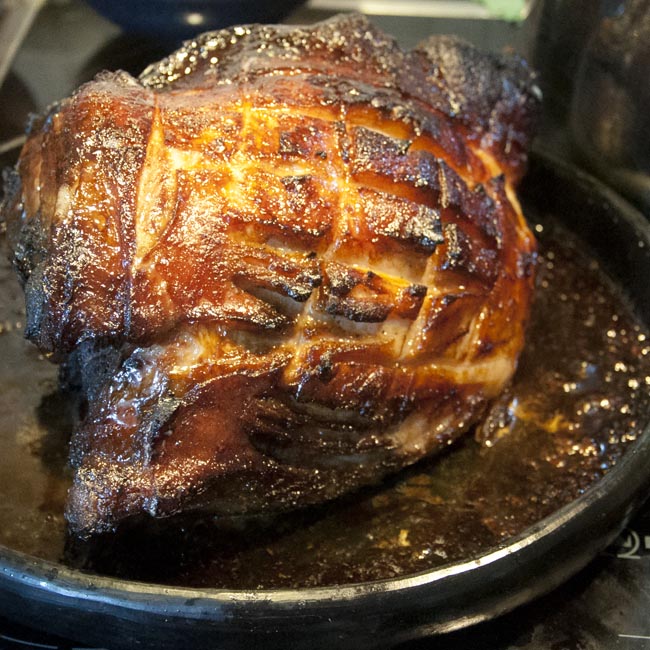
Then, I remove the rind, score the fat, glaze with treacle and finish in a hot oven for 20 minutes.  Once the ham has cooled (if you can wait that long!), slice and sample.
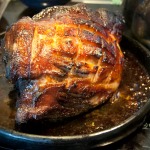
Treacle-glazed Wiltshire cured ham, fresh from the oven

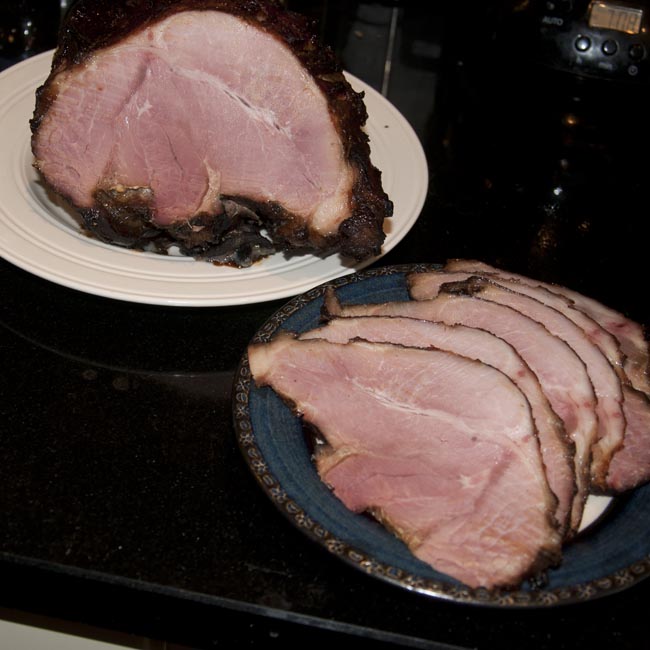
The fist thing you’ll notice is that it’s undeniably ham – it has that characteristic pink colour, and gently salty-sweet ham flavour – but what flavour, nothing but the very best traditional ham, this, no added water, none of the strange gristly bits we’re all so used to in commercial re-formed ham.  The treacle flavour is very much to the fore, a bitter-sweet deep note, and the aromatic flavours from the juniper are just about detectable.
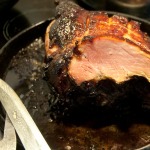
First slice!What would I do differently next time?  I would have used more juniper, but I didn’t have enough in the cupboard.  I would definitely use fresh coriander if I had some, as this flavour was pretty much lost using the dry herb.  I would also cure for a few more days – maybe seven or eight for this size of pork leg.  Right in the centre of the ham, I found a small patch of meat that hadn’t cured through, and was the grey colour of cooked pork rather than the pink of cooked ham.  A longer curing period would hopefully have avoided this.

I might also have rested the ham for longer, and increasing the resting time might have delt with the evenness-of-cure issue by allowing more time for the cure to balance through the meat without increased curing time, but I wanted to use it to make a ham sandwiches to feed some very good friends the next weekend.  Plain, or with mustard, or pickle, the giant pile of sandwiches went down extremely well!
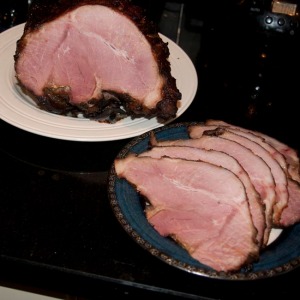
Sliced finished cured and glazed ham

On a slightly different note – the Country Skills Blog is six months, and 50 posts old today!  Thanks to all of you for reading and commenting so kindly, and I hope you continue to enjoy the blog for many more months, years, and posts to come!

Read more from the Country Skills blog >>