Unknown's avatar

About Kate Watson

Brewster, cook, poultry-keeper, curer & smoker, in other words, jill of all trades and mistress of none!

The Key, The Secret? – spicy pickled ash keys

I first came across the idea of pickled ash keys in Adele Nozedar’s lovely book ‘The Hedgerow Handbook, which I reviewed last year. I was intrigued at the time, but it was the wrong time of year to forage nice young ash keys (actually, I think I may have been a little late this year, too, but more of that later).

A lovely veteran ash treeAsh trees have been in the news lately, at least in the UK, with the arrival last year of ash dieback, a fungal disease now threatening some of the great, veteran trees of the British landscape. Historically, oak, elm and ash were the ‘big three’ trees in these parts, majestic and long-lived, our elms sadly disappeared for the most part several decades ago, succumbing to Dutch elm disease, and it seems now as if the ash, too, may be at risk of all but disappearing from our landscape.

Ash keysBefore too long, ash keys (the twisted seeds of the ash tree, which hang in luxurious bunches from the branches of some – but not all – ash trees at this time of year) may be a vanishing treat, the caviar of the forager’s larder. So why not try them now, before it’s too late? Incidentally, don’t confuse the common ash with the mountain ash, or rowan tree, which produces clusters of (also highly forageable!) bright orange or red berries in autumn.

So, you’ve found a local ash tree positively dripping with lovely young, green ash keys. What now?

After pickingWell, first, you’ll need to pick some, obviously. I made rather a large batch of pickled ash keys, starting with about 800g (approximately a mean couple of pounds). The older they get, the tougher and stringier they will become, so pick them as young and tender as you can.

As well as your ash keys, you will require –

  • 1.5l / 3 UK pints of white distilled malt vinegar (spirit vinegar)
  • 3 tbsp of paprika
  • 3 tbsp of curry powder (I used a medium madras powder, because it was what I had on the shelf)
  • 1.5 tbsp of cayenne pepper
  • 4 tbsp sea salt
  • a heaped teaspoon of whole mixed peppercorns
  • a level teaspoon of whole yellow mustard seed
  • 6 – 8 garlic cloves
  • 12 small hot dried red chillies (I used my own home-grown and dried little chillies left over from last year)
  • A large stainless steel or enamel saucepan or stockpot, a smaller pan (also non-reactive), large colander, a fine sieve and a piece of muslin, and enough jam jars for your batch.

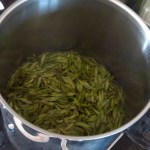
Washed ash keysPick all the ash keys free from their bunches, and wash them carefully. The first part of the process involves gently simmering your ash keys for about an hour and a half, in all, in four changes of water.  This process, while irritatingly time consuming and faffy, reduces the bitterness of the ash keys which would otherwise make them rather unpleasant to eat.

Simmering the ash keysThe smell that this process generates is not very promising – it will smell rather like you’re boiling up a pot full of bits of tree, which you are, of course. But this abates each time you change the water, and after the fourth water change the colour of the ash keys is closer to olive green than to the bright green that you started with, and if you have a speculative nibble on one (I couldn’t resist), it’s quite stringy, not particularly strong tasting, but not noticeably bitter.

Spiced vinegar steepingWhile your keys are simmering away gently, you need to make your spiced vinegar. In your smaller saucepan, combine the spirit vinegar, paprika, cayenne pepper, and curry powder, bring to the boil and then take immediately off the heat.

Strain the spiced vinegarThis smells quite marvellous. Once it’s cooled a bit (you can help it along by sitting the saucepan in a sink full of cold water), strain it through the muslin in the sieve, and if you’re not quite ready to use it, you can use a funnel to put it back inside the vinegar bottles for safekeeping. Incidentally, I’d forgotten I had some muslin and initially tried to strain the vinegar through a paper coffee filter. I can report this was very frustrating and a huge waste of time, effort and coffee filters. So, now you know not to bother!

Ash keys mixed with saltOnce the ash keys have done their four turns around the simmer 20 minutes, strain, change water circuit, they’re an olive-green colour and ready to be stewed (yes, some more!). Add the 4 tbsp of sea salt, and plenty of fresh water, and bring to a brisk boil for a quarter of an hour, before turning the heat down, covering, and simmering for another 60 minutes before finally straining again.

At the end of this, they will have softened a fair bit, and have a gently salted taste, and you will probably be royally fed up of boiling up ash keys. Don’t worry, it’s nearly done!

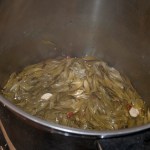
Strained spiced vinegar, set aside  Chillies, peppercorns, garlic & mustard  Ash keys in spiced vinegar with garlic and chillies

Now, add to the strained ash keys the spiced vinegar, along with the whole dried chillies, peppercorns, mustard seeds and peeled whole garlic cloves. Bring to a brisk boil for 15 minutes, and take off the heat. That’s it, you’re (essentially!) done, and your house probably smells like a very strange hybrid of a chip shop and a curry house. Set the pickled ash keys aside to cool. I left mine overnight, because it was pretty late by the time I finished them, and my big stock pot holds its heat quite stubbornly.

Fill your jarsWash, dry and sterilise your jam jars in the oven, then allow to cool before filling. I used 13 little ‘dumpy’ jars and two 330ml pickle jars for my batch. Assume you need at least the volume of your vinegar, and probably a bit extra, in jar capacity. Pack the ash keys, along with the chillies, garlic, peppercorns and mustard seeds, evenly but quite tightly into your jars. Once you’ve done this, fill the jars right to the brim with the spiced vinegar, and seal.

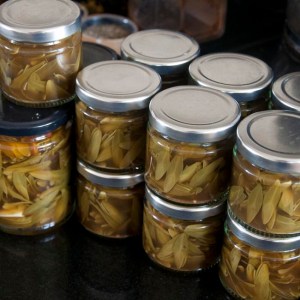
Filled jars of pickled ash keys

Don’t they make a pretty little lot? They need to be matured now in a cool, dark place for at least 2 – 3 months. But I did have a taste, and the omens are really promising – there’s a long but gentle heat from the combination of the whole chillies and the spiced vinegar, a little garlic note, and out of nowhere a subtle but noticeably ‘olive’ flavour from the ash keys themselves.  The acidity is not at all harsh, which is unexpected, there’s an almost sweet character which must come from the keys themselves as there’s no sugar in the pickle. They are, though, still a bit stringy (though much less so than earlier in the cooking process) – I think if I’d picked in May rather than leaving it until June, this may have helped! I expect they’ll continue to soften while they steep in their jars of vinegar.

All in all, then, a bit of a revelation, these ash keys! I’m not sure what I was expecting, but I don’t think it was much like this! I can’t wait to see what they’re like in a couple of months time, but I think they’ll make a very nice substitute for olives or capers, and will probably go a treat with a nice mature cheddar.

Read more from the Country Skills blog >>

Simple Summer Sewing – make a quick, cheap, pretty beach and pool cover-up

I can’t take the credit for the idea here – I’d seen a photo of something similar on Pinterest some time ago, and tracked instructions on the ‘Vie en Rose’ blog (and you should go and take a look at these, the rest of the post will make a lot more sense!) at the time. Then I more or less forgot about it until I started thinking about what to pack for our summer holiday. It seemed the perfect alternative to a sarong, easier to wear and a bit more ‘shaped’.

So I picked up some remaindered floral print cotton jersey on Ebay for about a fiver, and got started with it on my day off a week or two ago.  I’d offered up a sarong to get an idea of how wide a piece of fabric I needed, and came to the conclusion that the ‘ideal’ size was about 10cm wider than the width of fabric I had.  Slightly irritating.

Rather than chop a lengthwise section from my 2.5m length (seemed wasteful!), I decided to take a punt on the 1.6m width and hope the bit of stretch in the jersey and the inherent ‘forgivingness’ of the pattern would let me get away with it.  This decision rather forced my hand in terms of hemming – no spare fabric for this, and worse, I was going to have to use the selvedge, rather than trimming it, too. I know, I know, two cardinal sins of sewing and dressmaking just there. But do bear with me, this is quick and cheerful stuff, but the result is surprisingly good!!

Decide roughly how long you want your wrap, measuring from about armpit length downwards, and make this the width of your piece of jersey fabric.  Make sure all the edges are nice and straight as you cut your piece, as these will be your finished edges. I used a cutting mat and roller for speed and convenience, but you could manage carefully with fabric scissors.

Shape the armsThe only piece of shaping required is around the arm holes. I used a strappy top I own as a reference template. Line it up at the top of the ‘body’ and mark out the arm shape. If you fold the fabric in half, you can cut both sides together, so they’ll be symmetrical.

Cut the arm shapingMark (this is the reverse side!) with a pen or pencil. Then just cut carefully along the mark.

Now it’s just a question of working out how to attach a for each shoulder. I measured the strappy top from where I’d stopped shaping the arm hole, up to the seam at the top of the shoulder, and then back down to the seam at the underarm.

Measure for the strapsThis gave me a length of about 40cm as an estimate for the strap length. The blog tutorial I found made braided straps, and you could certainly do this.  I had my sewing machine conveniently to hand, so it was just as quick to make tubes – I cut two lengths about 2.5cm wide and 40 cm long, sewed along the length with right sides together, trimmed the seam allowance and then turned them carefully the right way out.  This was actually pretty fiddly and time consuming, but I think gives a nice finish.

Straps sewn in placeOnce your straps are ready, safety pin them in place and try on your cover up. This will allow you to adjust the strap length to suit your preferences (I shortened mine by about 5cm in the end).  Now, I can see no reason at all to post photos of myself in my bathing suit on the internet, so you’ll have to refer to the original tutorial for fitting photographs. Once you’ve decided on the right strap length, hand sew the straps in place firmly.

If you’re using a solid coloured fabric, this should give a pretty nice finish, but you can see with my contrasting print it’s all rather scruffy!  But it’s done. Try it on and flounce about in it a bit, pretending to be standing by a beach bar somewhere delightfully tropical.

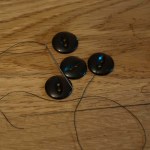
Buttons!I wasn’t quite happy with the strap sewing, so I gave it some thought. Eventually it was a colleague who suggested buttons, which were an inspired solution.  I had a dig around, eventually found my button box, and excavated these four pretty little off-black beauties.

Strap with buttons in placeSewn in place over the strap joins, they completely conceal my scruffy sewing.  Hurray!

I’ve considered shaping the short edges on a slight angle to cut away the worst of the selvedge, but although I know it’s there, it really isn’t obvious, so I’ll probably leave it for now. If it annoys me later, I’ve always got the option!

Finished beach wrapWell, there it is! I’m really pleased with it, I think it’ll work beautifully as a cover-up over swim wear, for the beach of the pool this summer.  It’s such a quick ‘make’, not sure I agree with the ’20 minute’ assertion, but certainly well under an hour, all told. And all for well under a fiver. Practical summer style on a serious budget!

Fun crochet beach bagIncidentally, I’ve also finished the crochet beach bag I was working on a few weeks ago. I’ll  do a full tutorial at some stage when I re-make it (there were a few details I got wrong with this one that I’d like to do right next time!), but I’m still pretty thrilled with it, it’ll do very nicely by the pool this summer with plenty of space for a paperback, the sunscreen, sunglasses, and of course the cover up!

I’m feeling rather excited about the summer now… Bring it on!

Read more from the Country Skills blog >>

Grow A Taste of the Exotic East – propagate & grow your own lemongrass

It was James Martin, during the masterclass I attended last year, who first whetted my appetite for growing my own lemongrass. Two things were worrying me, though. Firstly, we have cold winters here – it’s usual to get nights down to well below -10C during the winter, and lemongrass is a tropical plant. Secondly, and more prosaically, was where on earth I was going to get hold of a lemongrass plant?

Some months later, with the idea still in the back of my mind, I stumbled across a blog which suggested you could propagate lemongrass successfully from stalks bought for cooking – yep, those rather dry, slightly disappointing bunches of grey-white woody stems from the supermarket. (I regret I didn’t make a note of the blog that inspired me, and I can’t find it now, so can’t give credit.) But the process was very simple.  Immerse your lemongrass stalks in a bit of water, in a vase on a bright window sill. Change the water daily, and wait for it to root. Once you’ve got good roots, plant them out. That’s it.

The lemongrass stemsWell, that sounded like a horticultural challenge at my sort of level! And what was to lose, apart from a quid or so for a bunch of lemongrass. (The observant among you will notice there are two different ‘sets’ of lemongrass stems here – the shorter bunch came from the supermarket, whereas the slightly taller ones came from our local Thai market. Neither cost more than a pound.)

The first thing you’ll see, within a few days, is some fresh green growth emerging from the top of your stems.  Then, after a week or so, with a bit of luck, root buds will appear.  Do change the water for fresh every day (I forgot for a few days and it all got a bit manky, algae-ish and unpromising-looking in there), and try to keep them in a nice bright, warm situation.

Growing nicelyFour weeks later, my stems looked like this (I separated the different sets of stems into two separate pint glasses because they looked a bit crowded as the roots started to grow) with primary and secondary roots showing, and lots of new top-growth. With secondary roots present, I felt pretty confident potting up the lemon grass.

Good root growthI’m surprised – but thrilled – to be able to report that *every single one* of the stems rooted successfully.  The Thai market lemongrass rooted a bit faster than the supermarket stuff – I suspect it was rather fresher! – but a week later, that was ready to pot up, too.

Potted up and in the greenhouseI decided to split the stems up and pot them on into three terracotta pots.  Keep these well watered especially for the first few days, since the roots are pretty puny and they’re used to having all the water they can drink. I kept them on the same sunny window sill for a couple of weeks, as the nights were still rather cold, but now they’re out on the greenhouse staging.

I’m thrilled to see some brand new stems emerging over the past few days.  Of course, I’m anticipating them coming back indoors onto a sunny window sill through the winter – like other warm climate plants like chillies, they don’t appreciate temperatures below 10C, so somehow I can’t see them surviving outside, even in the unheated greenhouse!

New stems emerging

All I can say is – propagating lemongrass like this is cheap, it’s simple, and it works – try it! If you enjoy cooking Thai or other East Asian food, or fusion dishes, there’s nothing better than your very own freshly grown and harvested lemon grass! I can’t wait!

Read more from the Country Skills blog >>

Chive Flower Vinegar – a liquid taste of summer – make this NOW!

If you have chives in your garden, and live in the northern hemisphere, it’s a good bet you’ve got chive flowers now. Please, if you do nothing else this weekend, don’t let all that beautiful chive blossom go to waste – seize the opportunity to make some chive flower vinegar!

Chive flowers growing in the garden

I made this for the first time last year, just a small batch in a 330ml jam jar, with white wine vinegar and about a dozen chive flowers from the garden. It was *glorious*.

The vinegar is somewhere between a slight blush pink and a brash almost pinky-purple, and has a lovely fresh onion flavour which complements salads and savoury dishes perfectly. I guarded my single bottle of 2012 vintage chive flower vinegar jealously, knowing it would be a year before I’d be able to make any more.

But this story, sadly, has a tragic end.  On Christmas Eve, while I was buzzing around the kitchen trying to do all of those last minute things, I opened an over-full kitchen cupboard and my precious bottle of chive flower vinegar tumbled off the shelf, bounced on the counter, and smashed into a million pieces on the slate floor. The kitchen was filled with the gorgeous fresh smell of chives. I could have cried. Instead, I mopped, not at all comforted by the fact that the floor came up absolutely *beautiful* from its vinegar rinse!

It’s fair to say that I’ve been waiting for chive flower season ever since. And now it’s here. Usually, I’d wait to blog a recipe or process like this until it was complete and I could show it to you all the way through. But you need to make this now – not in a few weeks time when the vinegar will be infused and ready to bottle – so here goes.

So, for your very own, glorious chive flower vinegar, you will need to get together the following –

  • Gather all your lovely, fresh, open chive flowers.  Even if you only have about a dozen, it’s worth making a small batch (I successfully made about a 330ml volume of vinegar in a large jam jar lat year). Pick them with as little stem as you can, and give them a good shake to dislodge any resident insect life.
  • I like to use white wine vinegar, though I know others use cider vinegar, rice wine vinegar, or even white malt vinegar. Champagne vinegar would be a ‘premium’ choice. Choose something light coloured to bring out the  lovely colour of the chive flowers.
  • A jar the right size to take all your chive flowers and vinegar. A kilner-type jar with a rubber gasket is ideal, but a large jam jar will do fine, as long as it has a plastic-lined lid. Wash and dry the jar carefully before use.
  • A colander to wash the flowers, and a salad spinner, if you have one (I don’t).

Wash and dry your chive flowersI’m going to come clean here, and admit that I didn’t grow all of these chive flowers. Hubby was able to scrounge them from a lovely kitchen garden!  After removing as much of the stalk as you can, give them a good wash to remove any bugs and insects – a few ants were all that seemed to come in on these ones – and give them a good shake to remove any water, or put them in a salad spinner for a few turns.

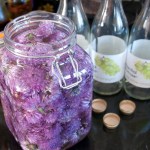
Put the flowers into your jarThen put all your flowers in your jar. Mine is a 2l kilner jar but use whatever you have conveniently to hand – probably not something quite this large! Mine happens to be filled but it doesn’t need to be, 1/4 to 1/3rd full will still give you a lovely infusion, though the colour won’t be so striking.

Top up with vinegarNow top up with your choice of vinegar. To give you an idea, the 2l jar filled with flowers took just over 1.5l of vinegar to fill it all the way to the top.

Keep the vinegar bottles – you can re-fill them with the infused vinegar later. As an extra bonus, the labels came off these bottles pleasingly easily!

Now, close your jar, and put it somewhere cool and dark for a couple of weeks.  I’m planning to infuse it for 3 – 4 weeks, but  keep an eye on it and have the occasional taste, as it may be that you’re happy with it earlier. Once you’re happy, strain the vinegar through a fine sieve or a muslin back into the vinegar bottles, label, and store in a kitchen cupboard or larder until you’re ready to use it.

Infusing in kilner jar

There you go – simplicity itself! It’s thrifty, too – just the price of some basic vinegar, and a little bit of time, give you this gorgeous very special condiment. Make some this weekend, I promise you won’t regret it. In a few weeks you’ll be enjoying this gorgeous, fresh, oniony-summery-savoury note with all your favourite salads and summer dishes.  But keep some back, too, for later in the year. Like elderflower cordial, it brings an amazing bottled aroma and taste of summer to your table in the colder, darker months!

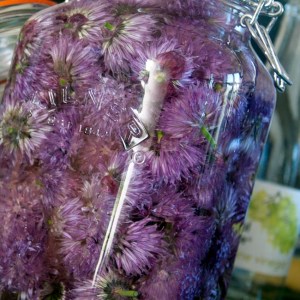
Look at this amazing colour!

P.S. Just a quick update to give you an idea of the colour – this is my vinegar jar after just 48 hours infusing in the cupboard under the stairs. Gorgeous, isn’t it?

Read more from the Country Skills blog >>

The Eurovision Drinking Game – because in the country, you make your own fun!

Making your own entertainment is, most definitely, a country skill. Living out of town, you don’t have access to restaurants, bars and cinemas without resorting to the car or a rather expensive cab. There’s the pub, and village activities – a great sense of community, but necessarily limited in it’s options!

European FlagsIt’s been said that, while the rest of Europe may feel embarrassed or nonplussed, sometimes, by the cultural festival that is the annual Eurovision Song Contest, the British are the only ones who seem to think it’s a drinking game. [If you’re not European, then I’m sorry, the rest of this post is likely to be pretty confusing!].

There are many variations, of course, but this one one is *mine*. I started developing it when I was still a student, and a number of victims have ‘play-tested’ it for me over the years (you know who you are!). Some even remembered enough the next day to make suggestions for improvements, which have been incorporated over time.

So, revised and refreshed, in time for the 2013 Eurovision Song Contest, which this Saturday will come from Malmo, in Sweden, it’s time to offer it up as a game for the world to enjoy! Break out the home-brewed cider, and play along!

Introduction –

This game is based on the songs and performances that make up the Eurovision Song Contest. Features of songs and performances are identified, and carry drinking forfeits (usually ‘take a swig’ with a small number of exceptions).

Euro shot glassesEveryone at the party *could* play for every song, but that may be unwise! Better, probably, to divide up the performances between the party-goers, either by drawing lots before the contest starts, or drawing straws between the performances, which adds a more immediate sense of peril and means some people might end up amusingly and disproportionately ‘picked on’ (clustering in random distributions is a bitch!).

Obviously, if it’s a very small party, not all songs need to be allocated, and likewise, in a big group, more than one player can play for any given song. (Also see ‘variations’ suggested below.) Non-drinkers & children can still have fun by identifying and shouting out the trigger rules when they appear.

And now, the rules –

Begin any song that you’re playing with a fully-charged glass.

These are the ‘trigger’ features of songs and performances for which the player should drink. These features can appear more than once in a performance (and sadly, often do!), and ‘score’ each time they appear – so the famous ‘Bucks Fizz’ skirt removal would be a single costume change, because it happened in one go, but a song that repeatedly swaps languages or makes major-to-minor-and-back-again key transitions gets a drink on each switch.

Sheet MusicThe song itself –

  • Song is not in an official language of the country being represented
  • Change of language
  • Change of key
  • Change of tempo
  • Wordless lyrics (da dum da, mana mana mana, lalalala)

Military 'uniform'The performer, costume and performance –

  • Performer(s) not of nationality represented
  • Folk costume
  • Folk instrument
  • Folk dance
  • Weapons (with an extra-big swig if they’re ‘folk’ weapons – axes, pitchforks, flaming torches etc)
  • Uniforms – military & civil (including costume references to same – epaulettes, insignia, military-looking hats and suchlike)
  • Flags & banners
  • PyrotechnicsPyrotechnics
  • Costume change
  • Underwear as outerwear
  • Spandex, lurex, sequins
  • Leather, rubber, PVC, bondage wear
  • LEDs or other lighting incorporated into costumes
  • Fur, feathers, wings
  • Trapeze or wire-work
  • Magic, circus themes

and, last but not least

  • Performer does not appear to be human – note this rule applies whether the performer *is* human underneath or not! – This is the big forfeit. Down the remains of your drink.

Russian folk-dancersThe half-time performance (or the ‘Riverdance’ slot) –

Traditionally the host country puts on a performance on during the ‘voting gap’. Everyone plays for this one. Use the same forfeit list above, but all penalties are doubled.

Voting –

I haven’t got rules for the voting – in my experience the mood of the assembled party generally doesn’t require any further ‘lifting’ by that stage in the evening!

Variations –

Rather than allocating countries’ songs to players by ballot, the enthusiastic party host could assemble a trivia question for each country in the contest (as simple or as fiendish as they like!). Players getting it wrong would play that country’s song. Of course, this is less fun if the host was planning on playing too, as they’ll know all the answers.

Well, that’s it, folks! Have fun at all your Eurovision parties, and if you do decide to try these rules, do let me know how you found them, and any suggestions you might have for improving them in future years.

And remember, please drink responsibly (*ahem!*), and definitely don’t drink and drive, attempt DIY, deep fat frying, change important passwords or operate heavy machinery. Finally, your hangover is your problem, not mine, so don’t come crying to me in the morning!

Read more from the Country Skills blog >>

Easily Hooked – oops, I seem to have taken up crochet!

We had so much to do in the garden this weekend, but the weather hasn’t been friendly!  At least we managed to get the turf cleared from the unpromising rectangle of old ridge & furrow grass which is to be my experimental cut flower patch – watch this space for more (and photos!) in due course.  The greenhouse seedlings continue to thrive, though I’m struggling to believe the tomato seedlings are ever going to grow up big and strong enough to fruit! This time of year in the garden is always a mix of hope and doubt, without much to show yet for our efforts!

Stormy spring beech tree

But it’s raining, and there’s nothing to be done outside for the time being!

I hate to have my hands unoccupied (stop giggling there in the back!) so I suppose it was only a matter of time before I gave in and took up crochet.  Many years ago (half a lifetime, really!) I learned to knit, got good enough at it to make myself a jumper, and mastered some fiddly cable work, but it never really grabbed me.  I’ve always been impressed by the flexibility of crochet work, the variety of shapes and textures which crochet seemed to be able to achieve compared to two-needle yarn craft.  And then, about three weeks ago, by chance, I stumbled over the first part of a learn-to-crochet part-work magazine, complete with a 3.5mm hook, two balls of yarn, and a guide to basic stitches. All for 99p.

Well, I couldn’t resist. I started tinkering with a few stitches and patterns from the starter pack.  I did a bit of playing and made a little round basket out of some jute garden twine, just to see if I could.  It’s the simplest thing, with just a circle of double crochet stitches for the base, made without turning, and sides the same, but turned between rows, picking up only the front loop of the  V to add a horizontal stripe.

Jute basket bottom    Jute Basket inside    Jute basket detail with twine

It makes a lovely coaster for the bottle-cut vase I made a few weeks ago, using the bottle cutting jig I made last year.  Better still, it was surprisingly easy to make, despite the less than promising choice of yarn!

Jute basket with bottle vase

So that was it, really, I was hooked.  Obviously a single hook and a big ball of garden twine wasn’t going to get me very far, so I scurried off to the internet for a few supplies (oops!) – a couple of books for inspiration, a lucky-dip selection of yarns, and of course a set of different sized hooks.  I was good to go!

What do you make first but a scarf? Of course!

Crochet scarfI’m really happy with my first effort, the pattern is from Sue Whiting’s ‘The Crochet Bible’, which has served me really well as a crochet primer so far!  For a complete novice it was a nice simple project which gave a pleasingly complex-looking result, and came together over the course of just over a week.  I used a heather-coloured yarn I got in my mystery-pack, and I’m thrilled with the result.  The photo doesn’t quite do it justice, it’s not as blue as that!

Dave kindly offered to model it for you all, so you can see it a bit more clearly. (He continues to do very well, thank you for asking!)

Dave the dog

Of course, I couldn’t stop at just the one project.  The current one is straight out of my own head, a crochet string-bag for the summer – I think it would be great for a day at the beach.  I’ve used two of the colours of yarn in my lucky-dip pack that I think I’d struggle to wear – an orange that can only be described as ‘health & safety high-viz’ and a bright sunny lemon yellow.  I’m after a relaxed, cool, hippy-ethnic look, and I think we’re headed in the right direction – more photos, and instructions, once it’s finished, but here’s a sneak-peek of the work in progress..!

String bag - work in progress

Finally, some sad news this weekend from my hens – Gertie, my white hen, and the final member of my original hybrid quartet, went the way of all things on Saturday.  So RIP, dear Gertie.  All good things come to an end…  There’s always been a white hen in my hen-house.  I feel rather bereft.

Read more from the Country Skills blog >>

Growing and Healing – back after an unscheduled break from blogging

So the blog’s been quiet for a bit! Sorry about that! I feel like I owe you all a bit of an explanation, so here goes – 

Back at the end of March, Hubby and I set off for a well-earned holiday, our annual-if-we-can-manage it ski trip.  We left my lovely in-laws looking after the house, garden, Dave the dog and the gaggle of poultry. A few days into our holiday, news came that Dave wasn’t well.  We tried not to worry – after all, we were almost half-way around the world, and there wasn’t anything we could do from there – he was in good hands and had been to the vets.  The days went by and rather than getting better, he was getting sicker.  By Easter weekend, he was in the hospital on a drip, having refused food for most of a week. By the time we arrived home the following week, he’d been admitted to a specialist referral centre – they were concerned that his liver might be failing, and didn’t know why.

We both hate to leave Dave and had been looking forward to the joyous welcome-home he normally gives us.  Instead the house was silent. We went to visit him at the referral hospital and he barely had the strength to give us a squeak of greeting.  A few more days went by, and after a CT scan which yielded a few answers, perhaps – ruled out some really sinister possibilities anyway – and a plan, kind of, he was fitted with a feeding tube.  Meanwhile, in a silent house, we were both struggling to keep our heads above water.  Times like this, if there were ever any doubt, we know what these creatures we invite into our lives truly mean to us.  I wonder if they understand how much they’re loved.

Dave with his feeding tubeAfter five day with the specialists, still not eating for himself but being fed through a tube inserted through the skin of his neck and into his oesophagus, Dave came home for us to care for.  He was incredibly weak and I really feared we wouldn’t be able to bring him back to health.

But one pill at a time, one liquidised-feed at a time, his strength returned and he started to eat for us again.  A week and a half ago his feeding tube came out, and he has continued to do better in the days since.  He’s still taking a pharmacy full of medication, and looks like a patchwork dog with all the hair that was clipped off to allow investigation and treatment, but over the last few days I finally feel like we’re getting our wonderful, beloved dog back, and while there are never any guarantees in this life, we have hope, and real joy.

Dave enjoying the sunshine

Some of you have been following the saga of Dave dog’s illness on twitter, and I would like to thank you all from the very bottom of my heart for your kind words and thoughts over these past few very difficult weeks.  They’ve been an immense source of strength and comfort, and have meant the world to me.

Of course, it’s a truism that whatever our personal turmoil, time doesn’t stand still.

It’s spring! At last! It really did feel like the winter that would never end! And while the blog has been quiet, we’ve still been very busy.

Dave the dogThe greenhouse we built in March is now stuffed full of seed trays and little emerging seedlings.  It has been performing wonderfully, and the automatic opening vent – a birthday present for myself and admittedly a bit of an indulgence – has been working brilliantly and prevented it becoming a seedling-cooking device on sunny days when we’re not around!  Incidentally, the giant climbing triffid in the foreground is one of my hop plants, grown from a bare root rhizome this year. It’s quite something, isn’t it!

Vegetable bedsOutside, we’ve almost finished sorting out the vegetable beds, and the potatoes are planted.  Now I just need to get a bed prepared for the cutting flower patch I’m experimenting with this year!

My window ledges are packed with chillies, tomatoes, and other things too tender yet to survive in the unheated greenhouse.  I’m hoping we’ve now had the last of the really cold nights and they may be able to go into the greenhouse in the next few days.

Chilli seedlingsI’m especially pleased with my chilli plants, despite an initial disaster (top tip here – don’t take your beautiful heated-propagator-raised chilli seedings outside on even a lovely sunny early March afternoon to prick out and pot on), the survivors, and second sowing are now thriving. I’ve grown two varieties – ‘Vampire’ (the purple-leaved ones in this photo) and ‘Twilight’ this year.  What is it about naming chilli varieties, incidentally???

Seedlings for the cut flower patchStarting these seedlings, and waiting for them to grow, has been the most amazing therapy and displacement activity against the stresses and worries of the past few weeks.  Seeing them start to grow and thrive is always such a great source of faith and hope for the year to come, but this year it’s felt particularly poignant somehow!

Oh, and I seem to have accidentally taken up crochet… more of which, no doubt, another day!

Thanks for your patience in the hiatus, folks, and I’m hoping that more normal (and frequent) blogging service will now be resumed!

Read more from the Country Skills blog >>

Overheard In The Salon – “You can get bacon from a butchers??”

Hair Salon NeopI had my hair cut last week.  This is only worthy of mention because it’s at best a bi-annual event for me.  Sitting there in your tinfoil bonnet, of course, there’s nothing to do except listen to the other customers and staff, or flick through weeks-old celebrity gossip magazines.  I chose the former.  Here’s the highlight of what I overheard, between two of the hairdressers during their tea break –

“So, they’ve said about processed food, you’re only supposed to eat one rasher of bacon a day”
“What? Bacon’s not processed food?”
“Yeah it is.  The bacon in the pack in your fridge, that’s processed food.  But if you get it from a butcher’s, it’s not.”
“You can get bacon from a butchers??”

Donner KebabIn the news that morning, the reports of a big impressive prospective mortality study involving analysis of participants’ consumption of processed meats.  It’s an odd category, that they’ve chosen – to include all cured and salted products, sausages, donner kebabs, but not all burgers.  Confusing enough that my hairdressers had a fairly poor grasp of the parameters, anyway.   Better perhaps if they’d restricted themselves to cured & smoked products, or gone wider and included all meat products that don’t arrive on the plate as recognisable pieces of whole muscle protein, without intervention beyond cooking.  For me, there are too many variables.

Cured meats contain salt in quite large quantities – of course they do, they’re salt-cured!  So does a bag of salt & vinegar crisps.  They will often contain nitrites – but then so does celery.  Mince-based processed meat products are generally higher in fat – they’re made from fattier cuts, and extra is often added as a bulking agent – but it’s perfectly possible to make a sausage from just minced pork shoulder, a bit of rusk or breadcrumb and some herbs and seasoning.  And it’s also perfectly possible to eat a very fatty, salty, meat-based meal that isn’t ‘processed’ in the slightest.

As with all giant lifestyle studies, the confounding factors are going to be enormous, too.  Do people who eat more processed meat eat less fresh fruit and vegetables, statistically speaking? Probably.  Are they heavier or lighter smokers or drinkers than the comparison population?  Attempts will have been made to correct for all of this, of course, but these are pretty blunt statistical instruments.

Mortality studies are always a problem for me.  I hate to break it to you, but your risk of mortality, my risk of mortality, the lifetime risk of mortality for everyone (and everything) currently alive on this planet, is 100%.  So you start looking at timeframe-mortality risks.  1 year.  5 year.  20 year.  The main risk factor for timeframe mortality?  Age, obviously – if you’re 80 going into a 20 year mortality study, things aren’t looking so good for you coming out the other side.  Then genetics – the intrinsic, inherited factors in your biology over which you have no control.  Then, I suppose, occupation and activities – if you’re a commercial deep diver, an alaskan crab fisherman, or like to race motorbikes or fly small aircraft, then these are going to have some effect.  A very very *very* long way down the list is what you had for breakfast!

Processed meat selectionMy hairdressers are right, though, about supermarket franken-bacon.  Give me proper dry-cured smoke-smoked bacon or ham any day, rather than the nasties that come in supermarket packs, injected as they are with a brine already including a ‘natural’ liquid smoke extract (no, really) among many other exciting additives.  Say no to that nasty leakage of milky phosphate water, and get some decent stuff from your local butcher (surprising an idea as that might seem to some!).  Say no to reconstituted ‘ham’ all gristle and mis-matched re-formed fat and muscle fibres.

If you needed any more reasons to want to avoid processed ‘junk’ foods, after the ongoing horsemeat-adulteration saga, look no further than this absolutely horrifying NYT article on The Extraordinary Science of Junk Food.

Of course we should all be trying to eat a balanced diet, mostly of fresh, local, good quality ingredients.  We should probably all, in the affluent West (and increasingly affluent East) be eating less meat, if we want to feed the world and pass the planet on to future generations in any kind of state at all.  But there are so many better reasons for that than trying to extend our survival.  Do it for the sake of good food, good flavour, and do it for the health of our environment.

Bacon for breakfast

So relax, enjoy your good quality butchers’ or home-cured bacons, hams, salt beef and bangers, and kick the supermarket junk.  Choose fresh, choose seasonal, choose local, and choose foods grown and reared, prepared and cooked with care, instead of being manufactured in anonymous processing plants at the end of a convoluted international commodity supply chain, down to a price selected by supermarket accountants.  I don’t see that you can go very far wrong!

Read more from the Country Skills blog >>

Don’t be Sour – a dalliance with yeasted ‘quick’ bread

Regular readers of the blog (and those familiar with the intermittent Sourdough Saga series of posts) will know that I *love* my sourdough starter. It’s fair to say I love it like another pet, like a member of the family.  I feed it and care for it (and, admittedly, stash it in the fridge for a fortnight at the time – please note that this is not generally advisable treatment of household pets!) and in return it rewards me and feeds me with some of the very best bread I’ve ever eaten, anywhere in the world.  It seems a more than fair exchange for my time and effort!

Sourdough loaf selection

The beauty of a sourdough loaf, its rich deep flavours and developed texture, are the result of the long, slow, patient process of fermenting, kneading and raising, followed by a blistering hot (and preferably steamy!) baking oven.  My ‘big batch’ of sourdough bread makes two large loaves, or two smaller loaves plus some rolls or a pizza, uses 1.25kg of flour, and lasts us about 10 – 14 days, freezing the second loaf.  But making it takes about 24 hours, starting the night before baking with the creation of the sponge, followed by a whole day during which the dough has to be kneaded and shaped periodically, finally baking around dinner time.  It’s not a chore – to me at least! – but it does require a whole day at home, and of course I don’t always have that pleasure!  The trouble with getting used to really fabulous home-baked bread is that nothing that you can get in the shops comes anywhere close.

So, obviously, I needed a solution for good, home-baked, ’emergency bread’.  The sort that, if I needed to, I could start in the evening after I get home from work, and have baked and out of the oven before I go to bed – about a 3 hour window.  Yes, you could use a bread machine in that time frame (and we have done, in the past), but I find the bread too sugared and salty when made according to the instructions, and highly ‘unpredictable’ in its behaviour if you start deviating from the recommended formulae!

Sourdough loaves keep basically forever (she says, without a scrap of exaggeration!), in that they don’t go off the same way as yeasted loaves (they’re protected from mould growth, it turns out, by one of the fermentation products of linoleic acid – you can read the paper, in the Journal of Environmental Microbiology, here).  Sure, they go stale and dry with time and exposure to air, but they don’t go furry – and once they’re too dry to eat, you can turn them into breadcrumbs, so there’s no waste, either!  My emergency loaf needs to be a yeasted loaf, and obviously needs a smaller batch size, so that we’ll get a chance to finish eating it while it’s still at its best!

I asked around on Twitter (what did we do before Twitter, folks?) and the lovely Lisa (@Cookwitch) offered me her version of a recipe for Pain D’Epi, which looked like it might well fit the bill.  I was pretty pleased with my first attempt at it a couple of weeks ago, but didn’t think to take photos at the time (bad food blogger, no biscuit!).  We’re out of bread again, I was working this morning, and I fancied something nice to go with breakfast tomorrow, so I’m making it again right now.

As I make it, you want the following –

  • 275g of strong bread flour (white flour is traditional, and it won’t be a ‘Pain D’Epi’ otherwise, obviously, but use whatever you like – or a mix, if you have ‘rag-tag’ ends hanging around like I usually do)
  • 175ml of warm water
  • 7g sachet of fast-action bread yeast (the sort that comes in the little double-sachets of small yeast pellets, that you can buy everywhere)
  • A scant half-teaspoon of sea salt
  • A good ‘glug’ of olive oil

Start by combining all the dry ingredients in a bowl and mix together – you could use a whisk, but I’d use my fingers!  Now add the 175ml of warm water, and combine to form a dough.  Add a little bit more flour or water if you need to get the consistency right, just not ‘sticky’ but not too dry as a dry dough will make too dense a loaf.

Kneading your doughNow give your dough a really good knead on a floured work surface.  Set aside 10 minutes to do this, and really give it the time and effort.  This is a single-levened bread, so this is the one and only chance that you get to develop the gluten in the flour and consequently the texture in your final loaf.  Once the dough is starting to develop a silky, elastic texture, rather than just feeling like play-dough, add a generous glug of olive oil and continue to work this in.

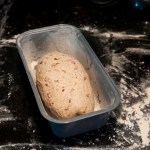
Shaped loaf in tinOnce you’re happy with the texture, shape your loaf, and either put it in an oiled and floured 1lb loaf tin, or shape it as required and place it on a sheet of oiled baking parchment on a good thin metal baking sheet.

I would guess that this batch could also make about 8 reasonable-sized dinner rolls, though I haven’t tried this myself.  The traditional form of the Pain D’Epi, as you might infer from the name if you’re francophone, is in the shape of an ear of corn – you can see the finished effect, and how you achieve it (surprisingly straightforwardly, using scissors!) here.  It’s a great tear-and-share shape and I really must try it some day!

Covered with oiled cling filmBut back to my loaf, which is sitting in its much more traditional British loaf tin.  Cover the tin loosely with oiled cling-film (PVC-free, please, especially if you’re using it with oily food), and put it somewhere warm.  Mine is going by the fire this evening – because yes, we have the fire going in what, really, is mid-March. Isn’t that depressing?

Allow it to rise for an hour or two, depending on temperature, until it has at least doubled in size (and filled the tin nicely, if you’re using one).  The initial preparation and kneading takes about 15 minutes, which means that I can usually squeeze it in while dinner’s cooking.

Risen loafOnce the loaf is nicely raised, score the surface with a sharp knife in a pretty pattern of your preference (or construct ears of corn, if you’re feeling flash!) and put it into a pre-heated oven at 200 degrees centigrade for about half an hour – it will rise some more in the oven, if you’re lucky (though not anywhere like so much as I’m used to with the well-developed sourdough) and is done when it’s a lovely golden colour all over and the base sounds hollow when you tap it.  I tend to take tin loaves out of their tins and return them to the oven for a final few minutes to get a nice crispy crust all over.  Free-formed loaves may benefit from being taken off their baking sheets and placed straight on the oven rack, in the same way, to make sure they’re not at all soggy-bottomed!

Baked loaf, coolingOnce your loaf is baked, take it out of the oven and allow to cool on a wire cake-cooling type rack if you have one – I only bought mine very recently, and always used to use a cold oven rack I’d taken out before starting to bake the bread, which unsurprisingly works just fine!  Revel in the lovely smell of fresh bread that now permeates your house, and look forwards to the morning!

Overall, this is a really quick, useful, ’emergency bread’ recipe, that seems to work very nicely with all sorts of flours (today’s loaf was made with some malted granary bread flour I had sitting around at the back of the baking ingredients shelf).  It’s streets ahead of anything you can buy from the supermarket or corner shop, though it doesn’t quite stack up in terms of flavour and texture against slower-fermented yeasted loaves that you might make at home, or buy from a good artisan bakery.  Texture wise it does tend to be a bit ‘cakey’ and edges towards being a little on the heavy side, which I ascribe to the single kneading and rising cycle and lack of opportunity for gluten development.  Still, these are knit-picky complaints when you consider how quick and convenient it is to make, and how much nicer it is than any of the commercial alternatives!

Finished loaf

I wrote, back in June of last year, after my first successful sourdough loaf, that “the bar for ‘good bread’ has just shot skywards in our household, and I suspect things may never be quite the same again.”  I was right.  I’m such a bread-snob now!  But this is good, quick, simple bread, and definitely earns a place at our table.

Read all the posts in the Sourdough Saga >>

Read more from the Country Skills blog >>

Living in Glass Houses – DIY greenhouse build

I have to admit to having wanted a decent greenhouse for as long as I can remember. Growing up, my grandmother’s neighbours had a beautiful greenhouse and vegetable garden, which I used to admire from over the fence, and I suspect my life-long enthusiasm for the glass-house springs in part from this!

Dave, showing off his new greenhouse!

Apologies, incidentally, for the quality of the photography in this post – I made the mistake of thinking I had enough on my hands and that photos from my mobile phone would be ‘good enough’ rather than worrying about the SLR as well as everything else.  The photos took ages to tidy up and even now aren’t really up to my usual standard!

A little while after Christmas, while we were watching telly, I asked hubby whether we were really going to get on and build a greenhouse this year.  Yes, he agreed, we definitely were. So I did a bit of digging around, and had more or less decided that for what we required, a baby polytunnel was probably going to be more cost effective and sensible.  Then, deploying his superior (well, so he says) google skills, he turned up a 6ft x 10ft aluminium and polycarbonate greenhouse for about the sort of price I was finding for tunnels.  It seemed like a no brainer, so we got on and ordered it. It arrived a week or so later.

It’s been sat in the garden in two boxes since then, of course, because the weather we’ve had this winter can only be described as ‘not compatible with construction projects’.  As it happens, I’ve given up complaining about the weather for Lent (yes, it’s been that bad!), so I’ll spare you the details.  It finally started to dry out a little a couple of weeks ago, so we finally had a window to get going with the ground works.

The intended site for the greenhouse is on our ‘paddock’, which is a scrappy bit of ridge and furrow pasture land, most of which we planted for an orchard three years ago.  The grass is very established and the land isn’t level (the clue is in the ‘ridge and furrow’!). The only way we were ever going to get a level frame for the greenhouse was to dig a ‘slot’ for it out of the pasture grass to level it, and set a frame of breeze-blocks on which to rest the building.

You’ll need a good spade, a turf cutting tool and ideally, a mattock. We measured out the 6ft by 10ft rectangle and got to work.  Once we’d cleared the space, it occurred to us to consider in more detail the ‘6 x 10ft (aprox)’ size given on the greenhouse packaging.  It turned out the greenhouse was sized in something that could only be described as ‘metric feet’ by its German manufacturers.  Armed with the metric measurements, we enlarged the slot by a reasonably generous margin, and turned in for the evening, pleased with ourselves for having completely cleared the required space, and confident we could crack right on with building the greenhouse the following day.

The next day dawned cold.  Really cold – barely above freezing, in fact, despite being late February.  Undaunted, we put on our ski jackets and thick woollen socks, and headed back out to the greenhouse site. We’d gathered together enough lightweight breeze blocks to do the job – the sort that are made from a sort of concrete ‘froth’, a bit like an aero bar, and would float, if you let them.  Our sophisticated building and levelling tools were the spade and mattock from the previous day, a spirit level, and some string.  The blocks themselves were to act as ‘squaring’ guides, in due course.  And, as we hadn’t yet managed to pick up a bag of sharp sand, we had only the soil itself to use to pack the blocks straight and level.

Assembling the brake blocksThe first course of blocks assembled itself quite straightforwardly.  The mattock is a great help in cutting a clean trench, and then the blocks just go in one after another, with a check on level and height adjustment on each.  After setting the corner as square as we could using one of the blocks for reference, a couple of pegs and a length of string set the alignment for the next course.  Things were going well!

Two courses more or less complete, we wanted to make sure we had the right dimensions for the greenhouse, so we decided to get out the base from the kit and get that assembled for reference.  This done – and it was nice and straightforward (though it revealed that the assembly instructions were a ~50 page pictographic document, in the IKEA tradition) – we offered the frame to the greenhouse site, and discovered our slot was too narrow, given the width of the blocks.  In a stroke of good luck, we also discovered the base build could be bodged to use only whole blocks, which was a huge bonus.

Three courses placedCarrying on with the cut, measure, level, we had three courses installed.  We laid out, crudely, the blocks for the fourth course.  Inevitably, this is when you discover that, rather than a neat rectangle, and despite your most careful efforts, you’ve built some sort of trapezoid only theoretically known to mathematics. A bit of head-scratching and adjustments to the squaring, requiring a bit of extra turf cutting, and we put down the fourth course.

Greenhouse base, complete

It had been trying to snow all afternoon, and we’d been outside for five continuous hours laying the foundation blocks. It seemed apparent that one of the corners (the back one, in this photo) was lower than it should have been, but we were running out of energy, and light.  We tidied up and came back indoors, and gave up for the weekend.

Pro-tip: you know you’re really, properly, cold to the core when you *start* shivering several minutes after you get into a nice warm bath…

Skip ahead, then, through a working week to this weekend.  Finishing the greenhouse was our main order of business.  The weather, at least, is improving – no snow this weekend and even moments of sunshine!

Fixing the base down onto the blocksFirst up on Saturday, completing the levelling of the base.  Easy enough with the base frame sitting on top to confirm our suspicion that the back corner was ‘down’.  We’d got hold of a bag of sharp sand, so correcting this by lifting the two sides progressively was pretty straight forward.

Then, after placing the base as square as we could on top of the blocks, we marked the fixing holes, drilled these out with a hand drill, and then after placing rawlplugs, screwed the greenhouse frame down into place.  (Hint – mark carefully, and then *check* – it’s annoying when the holes aren’t quite in the right place!)  Skip any holes which are really close to an edge, as the block will just crumble away. Note that we’ve used no mortar at all in constructing this base.  You could, of course, if you wanted a more permanent foundation.

Out of the ground at lastThe sun was thinking about coming out, and we were ready, finally, to get the greenhouse build out of the ground.  The construction guide is purely pictorial, and weighing in at 51 pictographic pages, is something out of a flat-pack-furniture-phobe’s screaming nightmare. In the end, it’s just a question of following the instructions, as carefully as you can.

Our greenhouse was manufactured by ‘Palram’ and is a ‘crystal clear’ (read vaccuum-formed, single-ply) polycarbonate glazed aluminium framed greenhouse.  We bought it via B&Q but their greenhouses are stocked by lots of different retailers.  We’d built a tiny (6ft x 4ft) polycarbonate and aluminium greenhouse in our previous townhouse garden, and I was expecting the same, two-ply corrugated polycarbonate glazing that we’d had before, and which we were very pleased with.  I can only surmise that the insulation properties of this single-ply material won’t be as impressive as the other option.  And handling the glazing panels, which seemed alarmingly lightweight, was a bit hairy in places.  That said, once complete, the finished greenhouse does seem reassuringly ‘solid’. So, time will tell!

Side panels installedBut, back to the build.  Proceed carefully according to your pictograms.  Those on the cover informed me two people would be required, and that was certainly the case – at various times this build would have been completely impossible to perform single-handed. I was expecting to assemble the four walls individually and then combine them, but this wasn’t the case – the whole thing came vertically out of the base, acquiring glazing as it went, and then the build continued up into the gables and finally onto the roof.

We made one mistake (repeated at all four corners), which gave us some trouble until we noticed what we’d done wrong – fortunately our efforts at mitigation only involved some very slight trimming of some edges of the polycarbonate panels, nothing with any lasting consequences. Hint – if there’s more than one possible hole you could screw in, check, and check again before committing (and stop that giggling at the back!).

I gave a few small blood sacrifices on the sharp metal edges of the frame while threading the glazing panels.  The instructions tell you to wear gloves, of course, but it’s impossible to do this while fiddling with the 120 pairs of small metal nuts and bolts that hold this monstrous Meccano set together, and in the end I gave up, and suffered the consequences.  Overall we felt that, at least where it came to the glazing panels, the manufacturing tolerances were probably wider than the assembly ones, which made things a bit tricky from time to time.

Greenhouse roof installedGetting the roof apex installed did require a ladder (at least for us – though we’re both a little on the short side!), which isn’t on the list of required equipment.  It would have been a bit of a nuisance if we hadn’t had one conveniently available!  With the sun setting, and the roof on – missing only the final fitting of the window vent, and the door – and after seven hours solid work, we gave up and went to the pub for a well-earned steak dinner and a couple of pints of rather nice Ringwood bitter.

This morning, after a more sedate Sunday breakfast, we got on with the finishing-up tasks. The window went in quite straightforwardly.  The door was a bit fiddlier but posed no major challenges (and is very thoughtfully designed, in fact). By lunchtime, we had a completed greenhouse frame and glazing.

Hubby had work to do this afternoon, so after a whistle-stop trip to Wickes, he got on with that while I cracked on with the inside of the greenhouse.  I was hoping, rather ambitiously, to finish this evening with the hard-standing for the staging installed, as well as a paving slab path, the staging fitted, and the borders initially dug-over with a ceremonial planting – perhaps a row of early carrots, or something – completed.

Laying the slabsLevelling the ground and installing the slabs was probably, in fairness, a good worked example of why you shouldn’t let amateurs do hard-landscaping!  The soil at the back of the greenhouse, where the staging was going, produced a rich vein of solid clay, the kind that would probably have made a victorian brick-maker’s month.  Again, we wanted to avoid concrete or mortar, so the paving slabs are to be laid directly onto a layer of landscape fabric on top of the soil, using some ‘pads’ of sharp sand to help level them.
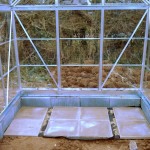
Hard standing installedThere are gaps between my slabs, which I’ll fill with some gravel once I’ve remembered to buy a bag.  Eight blocks across the back of the greenhouse provide a space for some shelving, and then a five-block path runs between the two greenhouse borders from the door.  I’m hoping that the slabs will also provide some useful heat-sink effect to hold warmth into the evenings as the temperature drops.

It’s around this stage in the process, when you’re raking the soil under the pathway to a fine tilth, while treading your precious borders harder and harder, that you remember that gardening is about pretty flowers in the same way that house-building is about paint colours for the hall.  In the end, it’s mostly hard labour!

Greenhouse staging 'installed'Just as I was ready to give myself a big pat on the back and congratulate myself on a job well done, I realised I had a small problem with my (great, cheap!) greenhouse staging.  The pack, describing itself as 2ft 11in (x2) greenhouse shelving (and I’d measured the gap!!) turned out to have the ‘aprox’ behaviour in the, compulsory, unhelpful direction.  They don’t fit!  Until I decide whether I want to take a hacksaw to eight lengths of steel tubing, they’re installed at a rather ‘jaunty’ angle…

No ceremonial carrots, but three big pots of compost with my newly-arrived hop rhizomes in them, pending the preparation of their final planting site.  There’ll also be a water butt to collect the run-off from the roof and reduce the distance I have to walk to fill the watering can.

Completed greenhouse

I think we’re both, it’s fair to say, seriously pleased with our efforts, even though it’s been physically very demanding and taken about twice as long as we had imagined it would.

To finish, and following Ross’s example in his excellent barn door guest blog post, some summaries:

Costings –

  • Greenhouse kit, including base & glazing – ~£350
  • Breezeblocks – £32
  • Paving slabs – £32
  • Sharp sand – £1.81
  • Landscape fabric – can’t remember, it was in the back of the shed

Time invested –

  • Ground clearance ~1 day, two people (or a bit longer for one)
  • Installing breeze-blocks ~1 day, two people
  • Greenhouse build ~ 1 day, two people (if you get up sharpish or have more hours of light than we did!) allowing extra if you want to do silly things with paving slabs inside.

Lessons learnt –

  • Measure, then measure again. Then have someone else measure too.  Don’t trust the measurements on packets, especially when they may be ‘metric’ feet-and-inches!
  • Wear gloves, unless you want to discover quite how sharp the sliced edges of extruded aluminium components can be.
  • Consider the weather forecast.  It can be really *really* cold in February! And finally,
  • If there is more than one possible hole… insert your own joke here.

I can’t wait to really get growing!

Read more from the Country Skills blog >>