Everyone loves a candle, they cast a lovely warm flickery light, and, chosen carefully, can fill a room with beautiful scent (sure, sometimes they can fill a room with the scent of cheap pot-pourri, but this is a matter of taste!). After Christmas, we had several left over candle ends around the house, and rather than throw them out, I wanted to do something creative and recycle them. But while there are lots of great candle-making kits out there, I didn’t really want to spend any money on the process. So this is a candle-making project that, with the exception of some wick and a wick sustainer, you can do entirely with things that you already have around your home and kitchen.

For this project, you will need –
- Two old candle-ends, preferably one coloured & scented and one plain, total weight 300 – 400g
- Empty Pringles tin (I recommend starting with a full one, and working on it!)
- Large saucepan, a trivet (or an old saucer or side plate), and a large empty tin can (I used an empty malt extract can from home brewing, but any large catering size tin can will do)
- Stirrer (I used a large wooden lollipop stick, anything will do but not something you plan to use with food!)
- Chopping surface (again ideally not one you plan to use for food use in future)
- Large knife
- 6in length of appropriate wick, a wick sustainer, and something to use as a wick pin (a kebab stick is ideal)
- Kitchen hob
- Scales
- Jam / sugar / preserving thermometer, old tea strainer (recommended but not absolutely required)
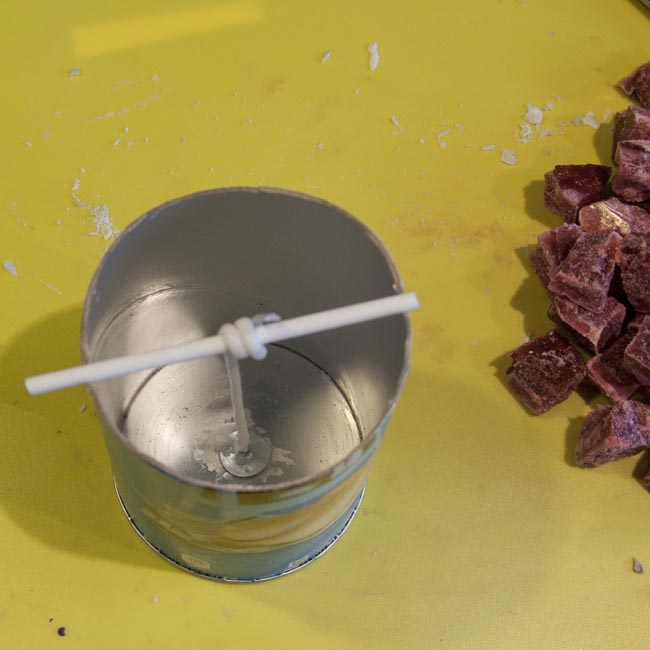
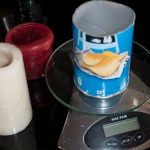 Gather up your equipment, starting with the knife and the pringles tin. Cut the Pringles tin down to about 4″ high using your knife, and make a couple of ‘notches’ in the top on opposite sides of the top.
You’ll need to get an estimate of the capacity of your candle mould, so put a sandwich bag inside the Pringles tin, put it on the scales to zero, and then fill the bag with water to about a 1/2″ below the top. The weight in grams of water is a good estimate of the volume in mls, as wax is slightly less dense than water (it floats on water, after all), you can reduce this estimate by about 10% to get the weight in wax required to fill the mould to this level. I came up with 300g and used around 270g as a target weight of wax.
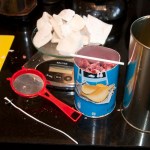 Now, cut up your coloured candle. Try to cut it into even cubes a bit bigger than half an inch cubed, but it’s likely you’ll struggle, and if the pieces are a bit rough, don’t worry. From what you’ve chopped up, sort to one side and weigh all the sensible chunks, leaving the dust and small fragments aside (wrap these up for another project). Weigh your coloured chunks (mine weighed about 140g) and put them in the mould to check how high up they come. Ideally this will be about the target ‘fill’ level. Now roughly chunk up your white wax candle. It doesn’t matter what size and shape these pieces end up, but the smaller they are the faster they’ll melt. When working with old candles, try to avoid including the ‘melt pool’ from the candle as this will be dirty wax and may well include bits of old burnt wick and suchlike, which you don’t want in your shiny new candle.
A word about wicks, before we go on – the size and construction of wick you need depends on the chemistry of the candle-wax and the width of the melt pool you want in your candle (which is closely related to the diameter of your candle, usually). When working with recycled waxes, the chemistry involves a fair bit of guesswork. I assumed the waxes were a basic paraffin pillar blend, since this is the most usual situation for commercial candles manufactured to a price point. There’s a useful wick size guide here. (See my suppliers list and library for more reading.) I used an LX16 wick which should have been a good match for the ~70mm diameter Pringles mould. Secure the end of the wick into the wick sustainer using pliers.
 Now, start melting your wax. Put the white wax into the large tin, and put the tin inside your saucepan on the trivet. Fill the saucepan with water so that it comes up the side of the tin about an inch and a half. Use the thermometer, if you have one, in the water. You don’t want this to boil, but ideally it should stay around 75 degrees centigrade, which should be enough to melt the wax without risk of overheating. The flash-point of wax is quite close to the melting point, and at the flash point the wax is at risk of catching fire, particularly if you have a naked flame in the vicinity (for instance, if you’re using a gas hob), so be careful and heat the wax very gently.
 Once the wax is melted, you need to prime the wick, which just means dipping the wick into the wax so that it can be absorbed onto the surface of the cotton. Also dip the sustainer in the wax, and use this to secure the sustainer to the centre of the bottom of the Pringles tin. Stretch the wick up vertically and wrap it around the wick pin to keep it centred in the mould.
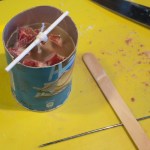 Now, arrange the chunks of coloured wax in the mould around the wick, trying to make sure you don’t close off any pockets which would prevent the melted wax filling all the gaps. When you’re happy, pour about 90% of the melted wax into the mould, pouring through the tea strainer if you see any ‘bits’ in it. Keep the remaining 10% over a low heat to keep it liquid, and continue to keep a close eye on it.
 The wax will shrink as it cools and this will form a dip or a ‘well’ near the wick, which will affect the candle as it burns. Encourage the candle to cool by putting the mould inside a plastic bag and immersing it into a bowl of water. You will need to weigh it down to keep it immersed, I used a marble pestle, but anything heavy will do. This is of course quite faffy, and if it’s a nice cold day, you’d probably do as well to put the mould outside for half an hour or so.
As the wax sets and you start to see a well forming near the wick, make a couple of holes in this area with a skewer. Once the surface of the wax is springy but not hard to the touch, pour over the rest of the wax tapping the mould to make sure it goes into the holes you’ve made near the wick. Now set the mould somewhere nice and cold to set – in the fridge if it’s a warm day, or outside if it’s January in the UK.

After a couple of hours the wax will have set hard. I was expecting to have to sacrifice the Pringles can at the end of the moulding, but the wax had shrunk back nicely from the sides, and I was able to ease the candle out without having to destroy the mould – however your results may vary and I wouldn’t lose to much sleep about it if you have to break the mould away from the candle. Trim the wick so that about 1cm is proud from the surface of the wax.

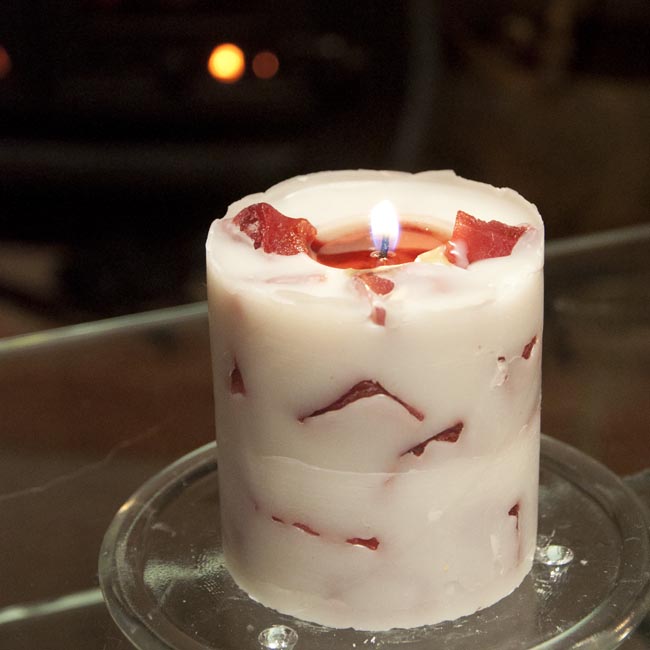
 I’m thrilled with the results, which I think are very pretty for a first effort. The white wax is a little bit ‘dirty’ which I probably could have concealed by using a little bit of ivory or honey-coloured candle dye. I poured the bulk of the white wax in two ‘goes’ and you can see the line between them, which is something I’d avoid in future.
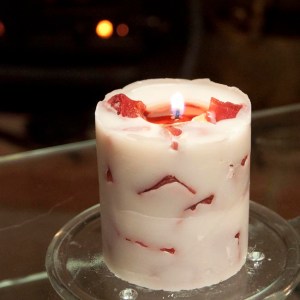
My only real criticism of the finished candle would be that I chose too small a wick – the melt pool the candle produces is quite a bit narrower than the body of the candle, and stops short of the sides by about half an inch all the way around. I suspect this is to do with the chemistry of the original white candle, which we stopped burning for a very similar reason – lesson learned! If I re-make this candle with the remains of the white wax from this batch I’ll use an LX20 wick which may give a better result. The melt pool is very pretty though, a lovely dark pink colour from the mixed waxes and gives a gentle berry aroma. For the cost of a new piece of wick, and a little bit of kitchen chemistry, it’s a beautiful, and extremely thrifty, scented candle.
Read more from the Country Skills blog >>


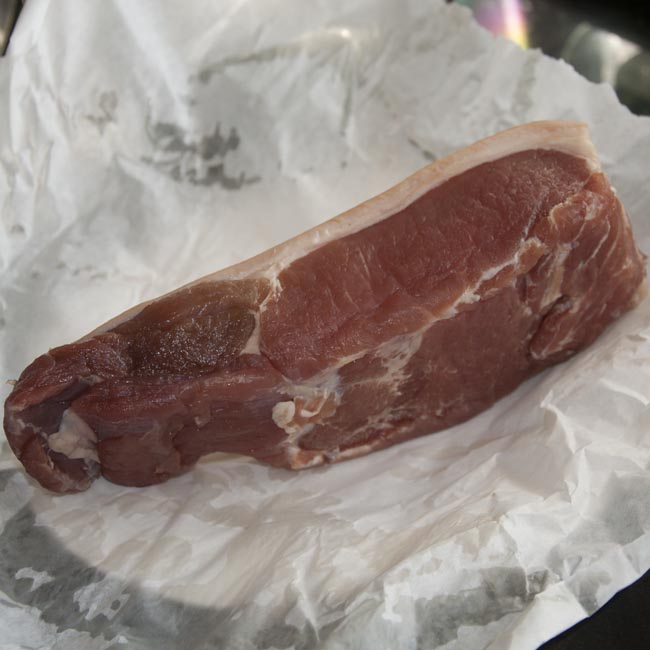
 First of all you may need to do a bit of preparation with your pork. If it came as a tied ‘joint’, cut all the string and flatten it out. Rinse it under cold water before drying carefully with some paper towel if there’s any loose material on the surface left over from butchering, or if it seems ‘wet’ – this is more likely to be the case if it’s been vac-packed or previously frozen.
 A loin piece should require no further preparation, though you might want to trim away any really loose bits of meat. If your belly piece has come from a butcher or farm shop there may still be ribs on the inside surface. Trim these away from the rest of the meat, preserving as much flesh as possible. You also want the non-skin side to be able to absorb the cure as well as possible, so if there’s a thin layer of fat on this surface, you want to remove it. It should peel away carefully, or use a sharp knife.
 The total cure weight is going to be 10% of the weight of the meat – so for 600g I’m looking for a total weight of cure of 60g, which is going to be 80% curing salt and 20% sugar – so in my case 48g of salt and 12g of soft brown sugar. Mix these together thoroughly in your airtight container.
 You’re ready to take your first steps in the ancient culinary alchemy of curing!
 Take some of your dry cure and rub it all over all the surfaces of your meat. There’s no hard and fast rule about how much to use for this first application, but I tend to use about 1/3rd of the total cure mix. The cure will absorb least well through the skin, so while you should still rub some of the cure onto this surface, concentrate on getting the cure in to contact with the meat.
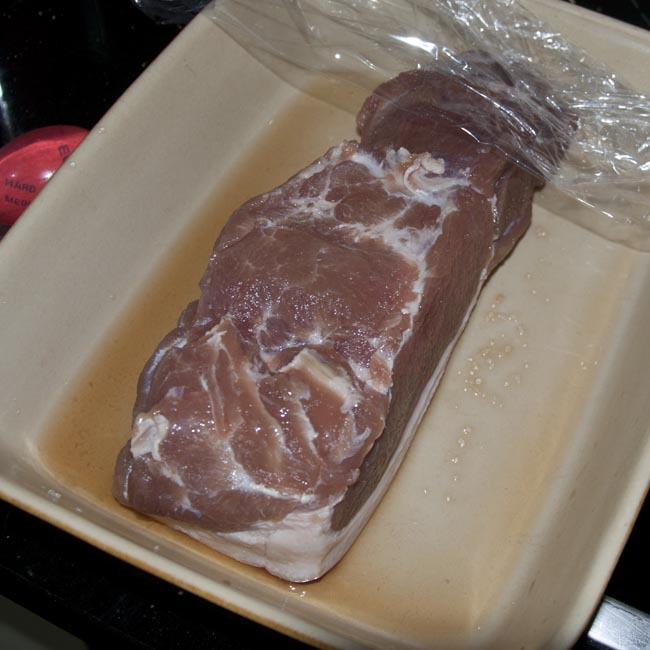
 Now place your cured pork into your non-metallic dish, cover loosely with cling film, and put it in the fridge until tomorrow. If you peek later, don’t worry if you start to see liquid in the bottom of the dish – this is quite normal and shows something’s happening!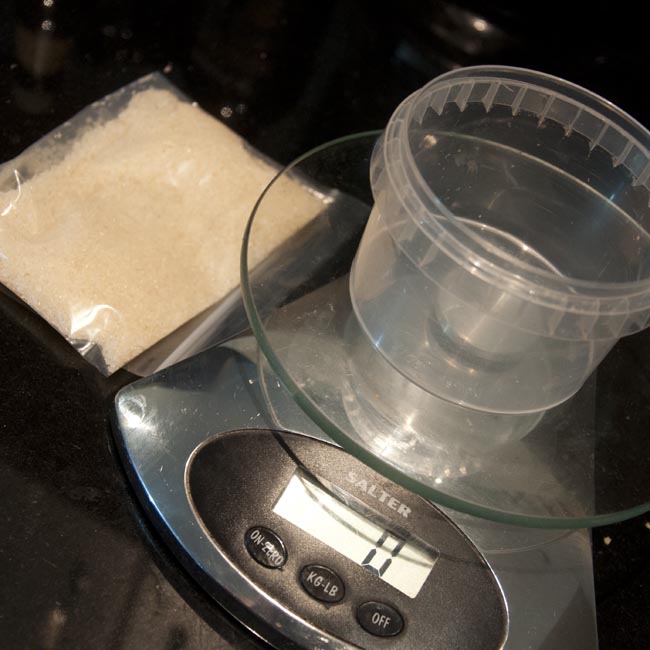














 Country Skills for Modern Life