Get Stuffed – filled glass bauble decorations – Blog Advent (11)

Just a quick decoration ideas blog this evening – a lovely personal way to brighten up plain glass Christmas baubles.

Filled baubles

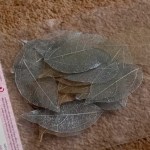
These are a handful I made this evening, using some feathers I gathered up from my hens earlier in the year when they were moulting, as well as some left over metallic skeleton leaves from last year’s Christmas crackers.  Last year, I made a few with shredded up knitting wool – the little tutorial I wrote then goes through the basic process, so I won’t repeat myself.

Glass bauble with feathers  Metallic skeleton leaves  Chicken feathers

The rather scary surgical-looking forceps in the image above aren’t compulsory, but are a very useful tool for feeding feathers and leaves through the small opening to the bauble, and arranging them inside if necessary.  I picked these up in a pack of mixed instruments for a couple of quid from a craft supplier on eBay, they’ve come in very handy for one thing and another!  But if you haven’t got anything like that, a pair of tweezers will work almost as well.  Do get real glass baubles – they’re much more attractive that the plastic ones and usually much easier to break into, too!

You could use anything you like, of course – pretty sand from a favourite holiday beach, little shells, glitter, or artificial snow with some small Christmas decorations might make an interesting seasonal twist?  I’m really looking forward to getting the tree up on Thursday to see how they work with all my other decorations!

Advent - day 11

I’m trying to write a post a day during Advent, so, please come along with me while I try to Blog Advent – the Country Skills Way – and forgive me if I don’t quite manage it!

Read more from the Country Skills blog >>

Warm Fingers Never Felt So Good – mittens from washing machine felt – Blog Advent (10)

A couple of months ago, I shared a bit of a teaser with you about working with washing machine felt, with a simple technique for making a pair of five minute fingerless gloves.

These mittens are slightly more time consuming, but still really really simple and quick, an easy little hand sewing project to do in an evening in front of the TV.  Better still, they’d make a great personal gift!

Machine felt mittens

You’ll need the following –

  • A washing machine felted sweater.  See here for details on the (easy!) process.
  • Some scrap cardboard, a pencil and scissors for the mitten template.  A tailor’s chalk pencil is useful but not essential.
  • Some thick thread for assembling your gloves.  I used some multicoloured scrap knitting yarn in contrasting / coordinating colours.  Knitting yarn, incidentally, makes really really *rubbish* sewing thread, so see if you have something better – embroidery floss would be great, or how about some really thin (3mm) ribbon? Decorative and contrasting is good – I like the effect – but you could go for something to blend into your sweater felt if you prefer.
  • A really chunky hand sewing needle.  I used one intended for use on sacking fabric with a bit of a spade-end, which makes a nice big hole in the thick felt so that the double thickness of thread passes through more easily.

TemplateTo start creating your template, draw around your hand on the cardboard.  This is the time to decide how long you want the cuffs of your mittens.  Also, I suggest you have your fingers in a relaxed position slightly apart, not all cramped together – this should make the mittens more comfy later!

Next, I measured around the knuckles on my hand and compared the measurement to the appropriate part of the flat silhouette drawing on the card.  You’ll find the circumference is more than twice the silhouette measure – your hand has depth! – for me this was about an extra 2cm.  I don’t need a seam allowance for these mittens (more on this later) so I added about 5mm all the way around the hand silhouette.  Smooth the shape off at this stage to make it nice and pleasing.  [Those of you who have ever drawn a glove or mitten patten will spot my deliberate mistake here – if you haven’t, then I suggest you read the rest of the post *before* you go ahead and cut out your template!]

Mark up feltCut out your cardboard pattern, and using tailors chalk if you have it (or anything else that will draw on your felt, if you don’t) mark up four copies onto the felt.  Arrange the cuff end against the waistband of your felted jumper – this way, you get to cheat and use the waistband detail from the jumper for the cuff of your mittens.
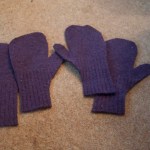
Mitten halvesThe great thing about washing machine felt is that you’ve taken a knit fabric that would unravel, and solved this problem.  You can slice it up just as you like and it behaves very much like polar fleece (and actually, if you have some scrap polar fleece – or you’re allergic to wool – it would make a great substitute fabric for this project). Now cut out your four mitten shapes and assemble them in pairs.

I mentioned earlier that I wasn’t including a seam allowance in the template.  This is because the felt is really quite bulky fabric – great for nice warm toasty fingers in your mittens, but it would be really very cumbersome if you had it doubled – or more – at the seams. I’d guessed there must be edge-to-edge stitches, though I hadn’t used them before, and a bit of googling turned up a perfect solution for this project, which is called ‘Old German stitch’.
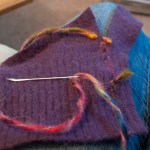
Old German stitchHopefully this image illustrates it usefully, but briefly, you assemble the two edges to each other, with the thread emerging on top of one edge, passing into the gap, and going into the other piece from below, emerging on top, passing back through the gap, and so on.  This produces an edge to edge seam without overlap which, because the thread crosses through the gap every time, is protected from the problem of the edges overriding which you’d likely get if you used a slip stitch.
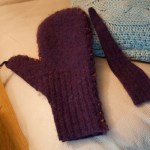
Sewing around to thumb, with insert pieceNow, you can start to sew.  I started at the wristband on the little-finger side of the pattern, and worked around progressively until I reached the tip of the thumb.  I’ve mentioned that knitting yarn makes horrible sewing thread.  This particular yarn tended to shred itself, after a while, and had hideous knot-holding properties which made it really challenging to start, finish, and join.  Don’t say I haven’t warned you!

It’s at this point that my rookie pattern-cutting mistake becomes painfully obvious.  The mitten is the perfect size on the palm and fingers, but far far too narrow on the wrist.  A quick bit of wrist and mitten measuring confirmed that at the cuff, we were going to be about 5cm short.  The only solution – other than starting again with a new sweater! – was to add an insert piece – a triangle, 5cm across the short edge, and as tall as the distance from thumb-tip to cuff.  You can see this in the photo just above.

Three pieces, assembledIf you don’t want to make this as a three-piece pattern, then you should get this wrist circumference incorporated properly into your pattern template in the first place, adding an extra ~2.5cm to the cuff end below the thumb.  Actually, I really like the three part shape, though it was a complete accident.  I think it adds a nice detail, and gives proper ‘depth’ to the thumb construction.

Finished mittensYou’re done at this stage, if you want to be.  I decided I wasn’t bored of hand sewing yet, so I went on to add a row of blanket stitch along the cuff.

These are really great, warm, practical mitts. I’ve been wearing them loads over the past few weeks.  They’re not waterproof, but they’re warm and cozy and have stood up really well so far to plenty of use.

Better still, the world is your oyster in terms of colours (so go on, raid that pile of old sweaters in the back of your wardrobe!) and detailing.  You could even embroider the back of the hands, if you were feeling especially keen!

So, if you want to create a special, warming handmade gift this Christmas, you still have plenty of time to make these.  Go on, you know you want to!

Advent - day 10

I’m trying to write a post a day during Advent, so, please come along with me while I try to Blog Advent – the Country Skills Way – and forgive me if I don’t quite manage it!

Read more from the Country Skills blog >>

About The Tree – and a bit of a cop-out – Blog Advent (9)

Today, we went to our local independent plant nursery / garden centre and bought our Christmas tree.  It’s still in its net in the garden at the moment, in a bucket of water, so I haven’t got any photos – but buying our tree is one of the real lines in the sand for me, a marker that Christmas is really just around the corner.

We have a real, cut, British-grown tree.  I couldn’t do without a real tree, I’m afraid.  The smell of a real spruce tree in the house is so much part of my Christmas that it doesn’t ‘count’ without it!  Never mind that artificial trees just look… well, sorry, they’re naff.  Even the really expensive classy ones are just wrong, too symmetrical for a start, with none of the natural character and variability.

Last year's treeWhile I’d love to have a tree in a pot, I’ve never managed to keep one looking good for the next year, and I prefer the soft-needled non-drop varieties of tree that don’t seem to appreciate being grown that way.  I gather in some parts of the country you can ‘hire’ a tree in a pot that then gets looked after for you until next year, which sounds perfect, but doesn’t seem to be happening yet in our part of the world!

I’m very pleased with the tree we’ve got this year – it should be a nice height in our living room, reaching almost all the way to our (low!) ceiling, but there’s plenty of space between the branches for the baubles and decorations.  I don’t mind a tree which is a bit ‘bushy’ at the bottom, since a quick snip of the secateurs sorts out that problem and gives you a bonus supply of greenery for your other decorations!

Dave the dogDave is always a bit confused about the appearance of a tree in the house – but takes it all on in the good spirits you’d expect from him!  He’s such a dude!

Sorry – today’s little blog post is a bit of a cop-out, I’m afraid.  I spent my ‘blogging’ time today re-jigging my ‘Handmade Christmas’ index page with more photos and some of the new Blog Advent posts, so do go and have a browse if you haven’t had a look recently!

Advent - day 9

I’m trying to write a post a day during Advent, so, please come along with me while I try to Blog Advent – the Country Skills Way – and forgive me if I don’t quite manage it!

Read more from the Country Skills blog >>

Can’t See The Tree For The Lights – invisible outdoor decorations – Blog Advent (8)

I know I’ve said I don’t like outdoor decorations much, but I make an exception for simple, fresh, crisp white lights.  I love the solar outdoor fairy lights that have become available over the last few years, for very reasonable prices.  The last couple of years I’ve strung a string through the bare branches of the small apple tree in our garden – but I thought I’d try something different this year!

Light Tree

This outdoor ‘tree’ smothered in light is so simple and very effective!  You need a set of outdoor solar lights – this was a string of 100 lights on a 12m strand, six bamboo canes – mine were old 6ft ones I had lying around from the veg patch this summer, and some string.  You could obviously make a bigger or a smaller tree, depending on your preferences and the lights you have available.

Arrange your canesStart by arranging the bamboo canes in a rough circle.  This is really easy in our lawn this winter because it’s been so wet recently!

Form into teepee shapeNow tie the tops together firmly with some string or wire, whatever you have to hand, so that the canes are in a teepee shape.  You don’t need a garden, of course, you could also create this in a pot planter on a sunny patio or balcony.

Wrapped with lightsFinally, set up your solar lights.  Usually these come with a small photovoltaic cell on a spike – you can install this in the centre of the ‘tree’.  Then, starting at the top, just wind the lights around and around your tree, spreading them out as evenly as you can.  Secure the ends with string if necessary, leave the lights to charge and wait for sunset.

I like it just simple as it is – but you could add some extra ‘tree’ details if you liked, like a star topper or some cheap plastic baubles.  I rather like the fact it almost entirely disappears into the garden during the day, and only becomes a feature after dark.

Advent - day 8

I’m trying to write a post a day during Advent, so, please come along with me while I try to Blog Advent – the Country Skills Way – and forgive me if I don’t quite manage it!

Read more from the Country Skills blog >>

A Festive Welcome – recycled fabric wreath – Blog Advent (7)

For many years I made a Christmas wreath every year out of spruce, holly and ivy, around a straw wreath-form which had been knocking around for years.  Eventually it fell apart, and instead of buying a new one, I made this – it was made really quickly, and I didn’t expect it to last as well as it has, but it’s now been our front door decoration for four or five years, and looks as good as ever.

Fabric Wreath

It’s another recycled craft, really.  At the base, it’s a wire coat hanger, shaped into a circle with the hook folded over into a triangular hanger for the wreath.  I wrapped this around with the sort of brown packing paper that turns up in all your festive purchases from online retailers at this time if year – just scrunch the paper lengthwise into a sausage shape and wrap it around and around, securing with some sticky tape here and there when you need to.  Use newspaper, if you haven’t got packing paper.  You could even use plastic packing wrap, or bubble wrap – whatever you have to hand, really, as long as it ends up with your coat hanger fairly evenly wrapped.

Now measure the circumference of your wrapped hanger, and get the long measurement from the hook all the way around the outside edge.  Add about an inch for hemming, and this is your fabric requirement.  I was lucky to have some blue and green-based tartan curtain offcuts, but you can use whatever you like.  Fancy a runched-effect?  Use a longer piece of fabric than you need.  If you have a sewing machine to hand, roughly sew your half inch hems on all four sides of your rectangle (I did this really really roughly, with a wide zig-zag stitch!).  If not, then just press them down with an iron to fold them over.

Back view - seamWrap your fabric around your homemade wreath form, starting at the hanger.  Slip-stitch the long seam by hand in as discreet a colour thread as you have. Don’t worry about making this beautiful, though, since it’s going to end up on the back!  Once that’s done, join the two ends of the tube around the hook.  Perhaps ladder stitch this part to make the join as tidy as possible, though if you look at mine I’ve covered the evidence with ribbon!

Really, that’s it – find some pretty Christmas ribbon in a coordinating colour and wrap it around, perhaps add a bow at the top.  Hang it on your door to welcome your festive guests!

Advent - day 7

I’m trying to write a post a day during Advent, so, please come along with me while I try to Blog Advent – the Country Skills Way – and forgive me if I don’t quite manage it!

Read more from the Country Skills blog >>
Saint Nicholas – Blog Advent (6)

December 6th is St Nicholas Day, a celebration which was a big part of my early childhood and meets with mostly blank looks when I mention it to friends here in the UK.  My early years were spent in rural Switzerland, and my early memories of the Christmas season are very much from that part of the world.  St Nick of course is the pattern for Father Christmas, but in much of Europe his celebration is separated out from Christmas itself.

I recall St Nicholas Day parades, when St Nick, in full regalia, was carried through the town on a horse or donkey-drawn cart, throwing out wonderful gingerbread cakes to the children.  I can almost taste them now!

On the night of December the 5th, children leave their shoes (preferably nicely polished!) out on the step for St Nicholas.  He comes and fills the shoes of the good little children with sweets and small toys and knick-nacks (I remember getting a French knitting loom in the form of a soldier, one year).  There are variations in the tradition, of course, depending on where you are in the world, but generally St Nicholas has a not very nice sidekick, known as ‘Père Fouettard’ (roughly translated, ‘Father Whip’) or Black Peter (with a blacked-up face which is either very un-PC, or has been retro-fixed to describe him as a chimney sweep!), in the part of the world I was in, but he comes with different names and identities in different places.

If you read up on this on Wikipedia, you’ll find it asserted that although St Nick’s nasty sidekick is supposed to bring punishment, or at least make sure that St Nick doesn’t bring gifts to the bad little children, this is some sort of an empty threat, and of course all the children get gifts.  Well, I remember vividly at my Swiss infants’ school (and I’m not so *very* old), that while the rest of us got sweets and chocolates, Black Pete brought only a piece of coal to the ‘bad’ child in the class.  Imagine that, these days?

Advent - day 6

I’m trying to write a post a day during Advent, so, please come along with me while I try to Blog Advent – the Country Skills Way – and forgive me if I don’t quite manage it!

Read more from the Country Skills blog >>

We’re On A Roll – recycled gift box – Blog Advent (5)

Just a really quick, simple Christmas gift wrapping tip for you all tonight – I can’t even claim it’s original, since I saw the idea on Pinterest a few months ago, but it stayed with me as something cute, and really rather useful!

Finished wrap

You will require...Here’s a cheap, quick, attractive, and recycled way to wrap small gifts this holiday season, using only things you already have – the cardboard centre of a toilet roll (or kitchen towel roll, or the centre of a roll of wrapping paper), some small scraps of wrapping paper, and some ribbon, raffia, or twine.  Yep, a toilet roll centre.  Nothing but the best here at the Country Skills Blog!

Wrapped and flattenedStart by wrapping the cardboard roll in a piece of wrapping paper – I had some gold tissue paper lying around, so I used that.  Tuck in the ends.  Now flatten the tube.

Fold over endsThis is the cute bit.  Simply fold the ends towards the centre to form a small curved box.  You’ll need to form the fold along a bit of a curve.  It’s worth playing with an unwrapped tube first, just to get a sense of the shape you’re after.  Hell, it’s something to do instead of the sudoku while you’re sitting on the throne!

Completed boxAnd here’s your completed box.  Just tuck whatever special little gift you’re wrapping inside, perhaps folded into an extra piece of tissue paper, and tie it up in a bow with some ribbon, raffia, twine or even knitting yarn!  Gift boxes can be so expensive – this one looks a million dollars, is a great solution to the ‘fiddly little package’ problem, and costs nothing!

Dave's tube!I was going to show you a bigger one made from a section of wrapping paper tube, but Dave thought better of the idea.  He says you all seem like smart people and he’s sure you can work it out for yourselves!

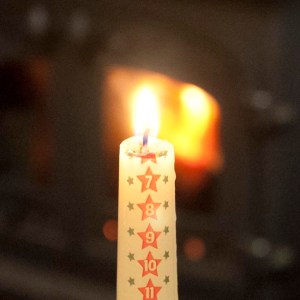
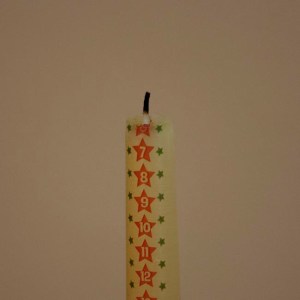
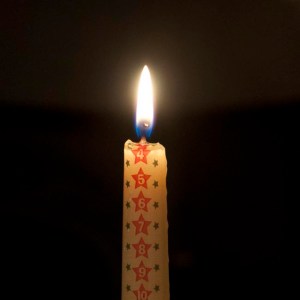
Now I’ve got a little confession to make – last night, while I was writing up the hazel and twine Christmas star decorations, I took my eye off the advent candle and we got a bit ahead of ourselves – all of today’s candle burned and half of tomorrow’s!  Oops!  It looks a bit sad tonight!

Advent - day 5

I’m trying to write a post a day during Advent, so, please come along with me while I try to Blog Advent – the Country Skills Way – and forgive me if I don’t quite manage it!

Read more from the Country Skills blog >>

Star of Wonder – simple twig and twine decorations – Blog Advent (4)

Blogging on work nights is a bit of a challenge – but here’s what I’ve been up to the past few days, in bits and pieces, finished off during my lunch break today – some really pretty, simple, twig and twine Christmas star decorations (I wrongly described these as Star of David decorations – they’re not of course, but you could easily make those if you prefer them!).

Hazel stars

Preparing your twigsMine use some thin hazel ‘whips’ we pruned from our hedge a few weeks ago, but anything would do – willow or ash would be particularly suitable as they tend to grow nice and straight, but a quick scavenge around the garden, park or woods should yield something you can use.  The only other things you need are some string (I used jute twine because I think it’s pretty, but raffia or plain cotton or linen string will do just fine), and some fabric glue (I’ll get to this later).

Arrange your piecesCut your twigs into even lengths using garden cutters – I wanted different sized stars, so I cut the thicker ends of the twigs into longer pieces than thinner bits.

Now, I’m going to pause the how-to quickly to teach you a little trick you really need to know, and it’s a knot known (to me anyway) as a ‘packer’s hitch’ – I’m informed by my sister, who knows better, that it’s properly called a clove hitch!  It’s a self-tightening double loop, so is ideal for this sort of job – or any other situation when you’d otherwise be calling out for someone’s finger to hold the knot for you!  I’ve illustrated it below, but basically you form two loops in the same direction, then take the second and pass it behind the first.  Anything you pass through the centre of the two loops is caught in your noose, pulling the ends tightens it but because the way the knot is constructed, it’s very unlikely to loosen itself again.  Tying a second throw over the top, as in a reef knot, secures the hitch permanently.

How to tie a packer's hitch

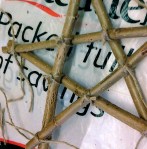
Points of star, tiedForm a packers hitch, and use it to tie the tips of two of the twigs together.  Don’t complete the knot with a second throw at this point, you’re just loosely securing the ends.  Work your way around all five points of your star.

Now, have a bit of a play with your twigs to make sure you’re happy with the shape, the more even the better, but twigs are an organic thing, so the aren’t always straight or completely even!  That’s part of the beauty of these little decorations.

Knots placedOnce you’re happy with the shape, start tying the twigs together where they cross over in the centre. I use a knot which crosses over to stabilise the joint.  Make sure you arrange these so that the knots are on the same side as those from the packer’s hitches!  Just like these hitches, don’t complete the knots, just tie the first throw.

This is the time to decide which point of your star is the top, if you’re planning to hang it.  If so, replace the packers hitch on the top point with one made with a much longer piece of twine, so there’ll be plenty of length to work with.  If you want a string of stars, do the same thing with the centre point at the bottom, letting a long tail hang down.

With centre knots completeNow, go around all of these knots and put a blob of glue on the knot – I used fabric glue, because it was what I had to hand, but anything which goes on or dries to clear should be fine.  Now tie your knots nice and tight, and add an extra throw, if you like.  The glue is to stop the knots unravelling when you cut the tails off really short, which is what you’re going to do next.  Now do the same with the packers hitches at the points, making sure that you tie everything as tight as possible before securing the knots down with a blob of glue.

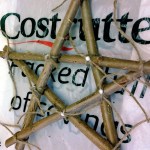
Finished starsIncidentally, I apologise for the classy ‘Costcutter’ bag, it was protecting my table at work from the consequences of my lunchtime activities!

That’s it, you’re done, if you want to be.  I think they look great ‘au naturel’, but I’m planning to get out my gold spray paint and just add a slight ‘burnish’ which I think will really add that final detail to the finish.  You could spray them any colour (or combination of colours!) to suit your decor.  Also consider adding glitter, beads… whatever takes your fancy!

This would make a really good kid’s Christmas craft, I think – no dangerous parts (assuming a grown up cuts the twigs up!), fiddly enough to be challenging without being overwhelming, with a pretty end product, and knot-tying skills to boot!  Perhaps one to try with a group of children at a Christmas party, club or youth group?

Advent - day 4

I’m trying to write a post a day during Advent, so, please come along with me while I try to Blog Advent – the Country Skills Way – and forgive me if I don’t quite manage it!

Read more from the Country Skills blog >>

All Things Bright And Beautiful – Blog Advent (3)

I’ll be honest and say, I’m not a huge fan of outdoor Christmas home-illuminations!  Yes, sometimes you see some gorgeous efforts – a beautifully lit tree in a front garden, or some little tasteful icicles adorning a gutter – but so often, they’re really really naff!

This little home-made decoration is my concession to fairy lights around the front door, and hangs in the tall thin window which we have just to the side.  I think it’s really lovely, festive and welcoming, don’t you?

Front door lights

It was so quick to make, out of a small piece of left-over silver organza, and a cheap string of LED Christmas lights, so I thought I’d share it with you lot.  You can easily adapt the idea to fit any window or door which particularly needs a bit of sparkle!

Centre joinConstruction is very simple, it’s just a tube, closed at the top, and open at the bottom.  My fabric was too wide and not long enough, so there’s a join in the middle – this isn’t a problem! The open bottom needs to be hemmed, but nothing else does. I think the seams add a nice additional texture in the way the lights play on the fabric, so I didn’t make any effort to cut them really narrow or press them flat.  This is the reason I’ve left the long seam in the middle of the decoration, too, rather than trying to hide it away to one side.

Top detailThe wire for the lights goes in at the bottom (conveniently, your plug socket is likely to be down there somewhere!), and loops over a  few stitches up in the top of the tube before hanging back down again.  If you’re making this for a wider window, you could have two or three of these supporting clusters of stitches, and loop the lights over each in turn.  Finally, there’s a little loop right at the top to hang the decoration from.

Front door lightsI used my sewing machine, but it’s simple enough that you could easily run it up by hand if you don’t have convenient access to one.  This is what it looks like from indoors, it makes a lovely addition to the doorway from both sides, I think!

This is likely to be our only real decoration until we get the tree in a week or two – but it gives us an exciting promise of sparkly pretty things to come!

Advent - day 3I’m trying to write a post a day during Advent, so, please come along with me while I try to Blog Advent – the Country Skills Way – and forgive me if I don’t quite manage it!

Read more from the Country Skills blog >>

No Smoke Without Fire – Boxing Day ham and Christmas bacon – Blog Advent (2)

This morning, bright and early (probably a little *too* early after last night’s lovely Christmas dinner with some excellent friends!) and in the freezing cold, I got my smoker out and set up.  For the past couple of weeks, my fridge has been half full of partly cured pork products.  Well, the curing finished last week, and today it was time for some smoke!

Smoker, set up ready

What you can see hanging there is my boxing day ham, and a batch of Christmas streaky bacon.  For more information on my DIY cold smoker, you can have a look at the smoking and curing posts, collected here.  For suggested UK supplies of smoking and curing ingredients and paraphernalia, have a look at my suppliers list.

The little sawdust-burning ProQ cold-smoke generator has served me very well in the course of the last year or so, but we had a bit of excitement with it this morning, after the tea light which is used to start the sawdust smouldering decided to overheat and do a striking impression of a miniature chip pan fire!  You’ll be relieved to hear, I’m sure, that no serious harm was done to the bacon, and that I still have my eyebrows!  It was however alarming enough that I’m going to look into alternative ways of starting the smoulder in future.

Boxing-Day Ham

Baked home-cured hamThe amazing colour of the ham comes from the same treacle-based cure I blogged about using earlier this year, though in deference to the larger piece of pork leg, and the fact that this time, it has the bone in, I allowed a curing time of 10 days.  The only other change was the addition of a couple of fresh bay leaves to the curing solution.  The gorgeous 2.5kg piece of pork leg came from our local farm shop butcher, who has wonderful meat.

Between now and Boxing Day, once it’s rested for 48 hours to let the smoke flavours permeate, I’ll wrap it up and put it in the freezer.  I’m expecting that, once boiled and glazed, it will look a lot like this – I can’t wait to see what difference the smoke makes!

Christmas Bacon

Gorgeous pork bellyThe bacon is mostly intended for gifts (except for the biggest piece, which is mine-all-mine!).  It was a great success last year, and seemed popular with its recipients!

It’s been curing over the last week, using a bacon-in-a-bag technique I’ve been refining over the last year.   Nearly all my home-cured bacon is made this way now, and I’ve settled on an 8% cure for most purposes, made up with between 66-75% curing salt and 25-33% sugar.

This total batch was about 2.5kg in weight.  In addition to the meat, I used –

  • AromaticsSupracure – 133g  (see my other curing posts for more information about this pre-mixed curing salt)
  • Mollasses sugar – 66g
  • Aromatics, consisting of 4 bay leaves, 20 juniper berries, 40 allspice berries, one clove, and about 1/4 of a whole nutmeg
  • Two large strong freezer bags

Prepared bacon cureGrind up all the spices in a spice grinder (except the nutmeg, which you’ll probably be safer grating by hand), and then mix the spices into the salt and sugar.  Prepare the pork belly by trimming it if required and then slicing into the appropriate pieces.

With cure rubbed inNow rub about half of the cure generously over all the surfaces of the pork, and pack it into the freezer bags.  Put these in the fridge and turn them over at least once a day, alternating which one is on top if you have more than one bag.

In two days (three if you’re using pork loin rather than belly), pour off any liquid which has accumulated in the bag – this may be very little if you started with excellent quality meat that hasn’t had water added! – and apply the rest of your cure mixture before returning to the fridge for a further 3 days, turning daily as before.

Bacon in a bagAfter your 5 or 6 days in total have elapsed, take the bacon out of the bag, rinse it carefully under cold tap water, dry with kitchen towel, and place on open racks or uncovered on plates in the fridge for another day (or ideally two) to allow the pellicle to form – this is a sticky glossy surface which will develop on the surface of the bacon.

Then, you can eat your bacon, or, as I did today, smoke it.

I’ve used a mix of beech and apple sawdust for todays smoke run, it gives quite a strong, aromatic smoke which I think will stand up well against the robust flavours in both the ham brine and the bacon cure.

The bacon will be frozen, wrapped as individual pieces in waxed baking paper, until we use ours to make our pigs-in-blankets on Christmas day (it was amazing last year!), or give it as gifts.

Advent - day 2

I’m trying to write a post a day during Advent, so, please come along with me while I try to Blog Advent – the Country Skills Way – and forgive me if I don’t quite manage it!

Read more from the Country Skills blog >>