Growing and Healing – back after an unscheduled break from blogging

So the blog’s been quiet for a bit! Sorry about that! I feel like I owe you all a bit of an explanation, so here goes – 

Back at the end of March, Hubby and I set off for a well-earned holiday, our annual-if-we-can-manage it ski trip.  We left my lovely in-laws looking after the house, garden, Dave the dog and the gaggle of poultry. A few days into our holiday, news came that Dave wasn’t well.  We tried not to worry – after all, we were almost half-way around the world, and there wasn’t anything we could do from there – he was in good hands and had been to the vets.  The days went by and rather than getting better, he was getting sicker.  By Easter weekend, he was in the hospital on a drip, having refused food for most of a week. By the time we arrived home the following week, he’d been admitted to a specialist referral centre – they were concerned that his liver might be failing, and didn’t know why.

We both hate to leave Dave and had been looking forward to the joyous welcome-home he normally gives us.  Instead the house was silent. We went to visit him at the referral hospital and he barely had the strength to give us a squeak of greeting.  A few more days went by, and after a CT scan which yielded a few answers, perhaps – ruled out some really sinister possibilities anyway – and a plan, kind of, he was fitted with a feeding tube.  Meanwhile, in a silent house, we were both struggling to keep our heads above water.  Times like this, if there were ever any doubt, we know what these creatures we invite into our lives truly mean to us.  I wonder if they understand how much they’re loved.

Dave with his feeding tubeAfter five day with the specialists, still not eating for himself but being fed through a tube inserted through the skin of his neck and into his oesophagus, Dave came home for us to care for.  He was incredibly weak and I really feared we wouldn’t be able to bring him back to health.

But one pill at a time, one liquidised-feed at a time, his strength returned and he started to eat for us again.  A week and a half ago his feeding tube came out, and he has continued to do better in the days since.  He’s still taking a pharmacy full of medication, and looks like a patchwork dog with all the hair that was clipped off to allow investigation and treatment, but over the last few days I finally feel like we’re getting our wonderful, beloved dog back, and while there are never any guarantees in this life, we have hope, and real joy.

Dave enjoying the sunshine

Some of you have been following the saga of Dave dog’s illness on twitter, and I would like to thank you all from the very bottom of my heart for your kind words and thoughts over these past few very difficult weeks.  They’ve been an immense source of strength and comfort, and have meant the world to me.

Of course, it’s a truism that whatever our personal turmoil, time doesn’t stand still.

It’s spring! At last! It really did feel like the winter that would never end! And while the blog has been quiet, we’ve still been very busy.

Dave the dogThe greenhouse we built in March is now stuffed full of seed trays and little emerging seedlings.  It has been performing wonderfully, and the automatic opening vent – a birthday present for myself and admittedly a bit of an indulgence – has been working brilliantly and prevented it becoming a seedling-cooking device on sunny days when we’re not around!  Incidentally, the giant climbing triffid in the foreground is one of my hop plants, grown from a bare root rhizome this year. It’s quite something, isn’t it!

Vegetable bedsOutside, we’ve almost finished sorting out the vegetable beds, and the potatoes are planted.  Now I just need to get a bed prepared for the cutting flower patch I’m experimenting with this year!

My window ledges are packed with chillies, tomatoes, and other things too tender yet to survive in the unheated greenhouse.  I’m hoping we’ve now had the last of the really cold nights and they may be able to go into the greenhouse in the next few days.

Chilli seedlingsI’m especially pleased with my chilli plants, despite an initial disaster (top tip here – don’t take your beautiful heated-propagator-raised chilli seedings outside on even a lovely sunny early March afternoon to prick out and pot on), the survivors, and second sowing are now thriving. I’ve grown two varieties – ‘Vampire’ (the purple-leaved ones in this photo) and ‘Twilight’ this year.  What is it about naming chilli varieties, incidentally???

Seedlings for the cut flower patchStarting these seedlings, and waiting for them to grow, has been the most amazing therapy and displacement activity against the stresses and worries of the past few weeks.  Seeing them start to grow and thrive is always such a great source of faith and hope for the year to come, but this year it’s felt particularly poignant somehow!

Oh, and I seem to have accidentally taken up crochet… more of which, no doubt, another day!

Thanks for your patience in the hiatus, folks, and I’m hoping that more normal (and frequent) blogging service will now be resumed!

Read more from the Country Skills blog >>

Living in Glass Houses – DIY greenhouse build

I have to admit to having wanted a decent greenhouse for as long as I can remember. Growing up, my grandmother’s neighbours had a beautiful greenhouse and vegetable garden, which I used to admire from over the fence, and I suspect my life-long enthusiasm for the glass-house springs in part from this!

Dave, showing off his new greenhouse!

Apologies, incidentally, for the quality of the photography in this post – I made the mistake of thinking I had enough on my hands and that photos from my mobile phone would be ‘good enough’ rather than worrying about the SLR as well as everything else.  The photos took ages to tidy up and even now aren’t really up to my usual standard!

A little while after Christmas, while we were watching telly, I asked hubby whether we were really going to get on and build a greenhouse this year.  Yes, he agreed, we definitely were. So I did a bit of digging around, and had more or less decided that for what we required, a baby polytunnel was probably going to be more cost effective and sensible.  Then, deploying his superior (well, so he says) google skills, he turned up a 6ft x 10ft aluminium and polycarbonate greenhouse for about the sort of price I was finding for tunnels.  It seemed like a no brainer, so we got on and ordered it. It arrived a week or so later.

It’s been sat in the garden in two boxes since then, of course, because the weather we’ve had this winter can only be described as ‘not compatible with construction projects’.  As it happens, I’ve given up complaining about the weather for Lent (yes, it’s been that bad!), so I’ll spare you the details.  It finally started to dry out a little a couple of weeks ago, so we finally had a window to get going with the ground works.

The intended site for the greenhouse is on our ‘paddock’, which is a scrappy bit of ridge and furrow pasture land, most of which we planted for an orchard three years ago.  The grass is very established and the land isn’t level (the clue is in the ‘ridge and furrow’!). The only way we were ever going to get a level frame for the greenhouse was to dig a ‘slot’ for it out of the pasture grass to level it, and set a frame of breeze-blocks on which to rest the building.

You’ll need a good spade, a turf cutting tool and ideally, a mattock. We measured out the 6ft by 10ft rectangle and got to work.  Once we’d cleared the space, it occurred to us to consider in more detail the ‘6 x 10ft (aprox)’ size given on the greenhouse packaging.  It turned out the greenhouse was sized in something that could only be described as ‘metric feet’ by its German manufacturers.  Armed with the metric measurements, we enlarged the slot by a reasonably generous margin, and turned in for the evening, pleased with ourselves for having completely cleared the required space, and confident we could crack right on with building the greenhouse the following day.

The next day dawned cold.  Really cold – barely above freezing, in fact, despite being late February.  Undaunted, we put on our ski jackets and thick woollen socks, and headed back out to the greenhouse site. We’d gathered together enough lightweight breeze blocks to do the job – the sort that are made from a sort of concrete ‘froth’, a bit like an aero bar, and would float, if you let them.  Our sophisticated building and levelling tools were the spade and mattock from the previous day, a spirit level, and some string.  The blocks themselves were to act as ‘squaring’ guides, in due course.  And, as we hadn’t yet managed to pick up a bag of sharp sand, we had only the soil itself to use to pack the blocks straight and level.

Assembling the brake blocksThe first course of blocks assembled itself quite straightforwardly.  The mattock is a great help in cutting a clean trench, and then the blocks just go in one after another, with a check on level and height adjustment on each.  After setting the corner as square as we could using one of the blocks for reference, a couple of pegs and a length of string set the alignment for the next course.  Things were going well!

Two courses more or less complete, we wanted to make sure we had the right dimensions for the greenhouse, so we decided to get out the base from the kit and get that assembled for reference.  This done – and it was nice and straightforward (though it revealed that the assembly instructions were a ~50 page pictographic document, in the IKEA tradition) – we offered the frame to the greenhouse site, and discovered our slot was too narrow, given the width of the blocks.  In a stroke of good luck, we also discovered the base build could be bodged to use only whole blocks, which was a huge bonus.

Three courses placedCarrying on with the cut, measure, level, we had three courses installed.  We laid out, crudely, the blocks for the fourth course.  Inevitably, this is when you discover that, rather than a neat rectangle, and despite your most careful efforts, you’ve built some sort of trapezoid only theoretically known to mathematics. A bit of head-scratching and adjustments to the squaring, requiring a bit of extra turf cutting, and we put down the fourth course.

Greenhouse base, complete

It had been trying to snow all afternoon, and we’d been outside for five continuous hours laying the foundation blocks. It seemed apparent that one of the corners (the back one, in this photo) was lower than it should have been, but we were running out of energy, and light.  We tidied up and came back indoors, and gave up for the weekend.

Pro-tip: you know you’re really, properly, cold to the core when you *start* shivering several minutes after you get into a nice warm bath…

Skip ahead, then, through a working week to this weekend.  Finishing the greenhouse was our main order of business.  The weather, at least, is improving – no snow this weekend and even moments of sunshine!

Fixing the base down onto the blocksFirst up on Saturday, completing the levelling of the base.  Easy enough with the base frame sitting on top to confirm our suspicion that the back corner was ‘down’.  We’d got hold of a bag of sharp sand, so correcting this by lifting the two sides progressively was pretty straight forward.

Then, after placing the base as square as we could on top of the blocks, we marked the fixing holes, drilled these out with a hand drill, and then after placing rawlplugs, screwed the greenhouse frame down into place.  (Hint – mark carefully, and then *check* – it’s annoying when the holes aren’t quite in the right place!)  Skip any holes which are really close to an edge, as the block will just crumble away. Note that we’ve used no mortar at all in constructing this base.  You could, of course, if you wanted a more permanent foundation.

Out of the ground at lastThe sun was thinking about coming out, and we were ready, finally, to get the greenhouse build out of the ground.  The construction guide is purely pictorial, and weighing in at 51 pictographic pages, is something out of a flat-pack-furniture-phobe’s screaming nightmare. In the end, it’s just a question of following the instructions, as carefully as you can.

Our greenhouse was manufactured by ‘Palram’ and is a ‘crystal clear’ (read vaccuum-formed, single-ply) polycarbonate glazed aluminium framed greenhouse.  We bought it via B&Q but their greenhouses are stocked by lots of different retailers.  We’d built a tiny (6ft x 4ft) polycarbonate and aluminium greenhouse in our previous townhouse garden, and I was expecting the same, two-ply corrugated polycarbonate glazing that we’d had before, and which we were very pleased with.  I can only surmise that the insulation properties of this single-ply material won’t be as impressive as the other option.  And handling the glazing panels, which seemed alarmingly lightweight, was a bit hairy in places.  That said, once complete, the finished greenhouse does seem reassuringly ‘solid’. So, time will tell!

Side panels installedBut, back to the build.  Proceed carefully according to your pictograms.  Those on the cover informed me two people would be required, and that was certainly the case – at various times this build would have been completely impossible to perform single-handed. I was expecting to assemble the four walls individually and then combine them, but this wasn’t the case – the whole thing came vertically out of the base, acquiring glazing as it went, and then the build continued up into the gables and finally onto the roof.

We made one mistake (repeated at all four corners), which gave us some trouble until we noticed what we’d done wrong – fortunately our efforts at mitigation only involved some very slight trimming of some edges of the polycarbonate panels, nothing with any lasting consequences. Hint – if there’s more than one possible hole you could screw in, check, and check again before committing (and stop that giggling at the back!).

I gave a few small blood sacrifices on the sharp metal edges of the frame while threading the glazing panels.  The instructions tell you to wear gloves, of course, but it’s impossible to do this while fiddling with the 120 pairs of small metal nuts and bolts that hold this monstrous Meccano set together, and in the end I gave up, and suffered the consequences.  Overall we felt that, at least where it came to the glazing panels, the manufacturing tolerances were probably wider than the assembly ones, which made things a bit tricky from time to time.

Greenhouse roof installedGetting the roof apex installed did require a ladder (at least for us – though we’re both a little on the short side!), which isn’t on the list of required equipment.  It would have been a bit of a nuisance if we hadn’t had one conveniently available!  With the sun setting, and the roof on – missing only the final fitting of the window vent, and the door – and after seven hours solid work, we gave up and went to the pub for a well-earned steak dinner and a couple of pints of rather nice Ringwood bitter.

This morning, after a more sedate Sunday breakfast, we got on with the finishing-up tasks. The window went in quite straightforwardly.  The door was a bit fiddlier but posed no major challenges (and is very thoughtfully designed, in fact). By lunchtime, we had a completed greenhouse frame and glazing.

Hubby had work to do this afternoon, so after a whistle-stop trip to Wickes, he got on with that while I cracked on with the inside of the greenhouse.  I was hoping, rather ambitiously, to finish this evening with the hard-standing for the staging installed, as well as a paving slab path, the staging fitted, and the borders initially dug-over with a ceremonial planting – perhaps a row of early carrots, or something – completed.

Laying the slabsLevelling the ground and installing the slabs was probably, in fairness, a good worked example of why you shouldn’t let amateurs do hard-landscaping!  The soil at the back of the greenhouse, where the staging was going, produced a rich vein of solid clay, the kind that would probably have made a victorian brick-maker’s month.  Again, we wanted to avoid concrete or mortar, so the paving slabs are to be laid directly onto a layer of landscape fabric on top of the soil, using some ‘pads’ of sharp sand to help level them.
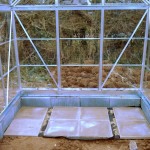
Hard standing installedThere are gaps between my slabs, which I’ll fill with some gravel once I’ve remembered to buy a bag.  Eight blocks across the back of the greenhouse provide a space for some shelving, and then a five-block path runs between the two greenhouse borders from the door.  I’m hoping that the slabs will also provide some useful heat-sink effect to hold warmth into the evenings as the temperature drops.

It’s around this stage in the process, when you’re raking the soil under the pathway to a fine tilth, while treading your precious borders harder and harder, that you remember that gardening is about pretty flowers in the same way that house-building is about paint colours for the hall.  In the end, it’s mostly hard labour!

Greenhouse staging 'installed'Just as I was ready to give myself a big pat on the back and congratulate myself on a job well done, I realised I had a small problem with my (great, cheap!) greenhouse staging.  The pack, describing itself as 2ft 11in (x2) greenhouse shelving (and I’d measured the gap!!) turned out to have the ‘aprox’ behaviour in the, compulsory, unhelpful direction.  They don’t fit!  Until I decide whether I want to take a hacksaw to eight lengths of steel tubing, they’re installed at a rather ‘jaunty’ angle…

No ceremonial carrots, but three big pots of compost with my newly-arrived hop rhizomes in them, pending the preparation of their final planting site.  There’ll also be a water butt to collect the run-off from the roof and reduce the distance I have to walk to fill the watering can.

Completed greenhouse

I think we’re both, it’s fair to say, seriously pleased with our efforts, even though it’s been physically very demanding and taken about twice as long as we had imagined it would.

To finish, and following Ross’s example in his excellent barn door guest blog post, some summaries:

Costings –

  • Greenhouse kit, including base & glazing – ~£350
  • Breezeblocks – £32
  • Paving slabs – £32
  • Sharp sand – £1.81
  • Landscape fabric – can’t remember, it was in the back of the shed

Time invested –

  • Ground clearance ~1 day, two people (or a bit longer for one)
  • Installing breeze-blocks ~1 day, two people
  • Greenhouse build ~ 1 day, two people (if you get up sharpish or have more hours of light than we did!) allowing extra if you want to do silly things with paving slabs inside.

Lessons learnt –

  • Measure, then measure again. Then have someone else measure too.  Don’t trust the measurements on packets, especially when they may be ‘metric’ feet-and-inches!
  • Wear gloves, unless you want to discover quite how sharp the sliced edges of extruded aluminium components can be.
  • Consider the weather forecast.  It can be really *really* cold in February! And finally,
  • If there is more than one possible hole… insert your own joke here.

I can’t wait to really get growing!

Read more from the Country Skills blog >>

Getting In A Pickle – gorgeous spiced plum chutney

Accidents in the kitchen always seem to happen when everything’s just at that critical point… and any cook worth their salt, when scalded by a volcanic eruption of boiling sugar and vinegar, is likely to think ‘never mind my arm, have to save the chutney!’

So it was Thursday evening.  The chutney is fine, incidentally, thank you for asking!

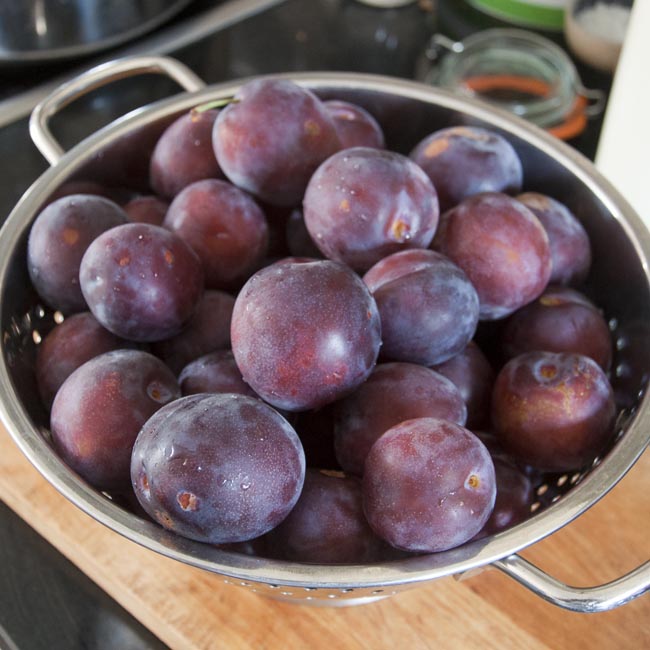
Red plumsAs well as bringing some beautiful French apricots back from their holidays, my lovely in-laws also arrived with a couple of kilos of fabulous red plums.  This put me in a real quandary, let me tell you.  Plum jam is one of my favourite things in the whole world.  But then this spiced plum chutney (originally Delia’s, credit where credit’s due!) is my very very favourite chutney.  It has a lovely fruity character topped with just a subtle hint of Christmas spices, and is wonderful with a lovely sharp mature cheddar, or a slice of home-cooked ham.

What eventually made my mind up was my jam jar situation.  I’ve done a lot of preserving in the last few weeks – it is that time of year after all! – and the jars I have left are a motley bunch.  Quite a lot of them have held things like sauces, curry pastes, and even pickles and chutneys.  The sorts of aromas that ‘hang around’ jars and lids, despite your best cleaning and sterilisation efforts.  It’s not really the flavour sensation you want with your breakfast jam!

This chutney is full of big flavours, and will swamp any faint ‘eau de korma’ residue it might have to deal with!

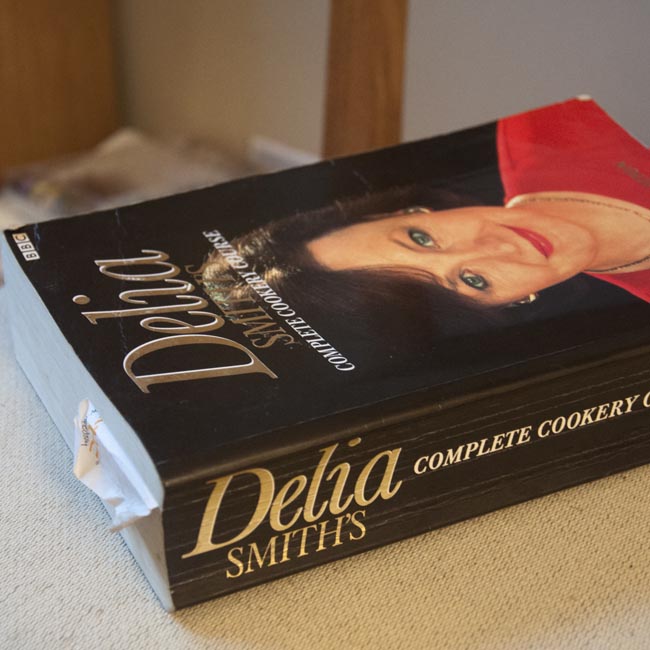
My well thumbed 'bible'The recipe is somewhat modified from the one in my very well thumbed copy of the Delia Smith ‘Complete Cookery Course’, reprinted from the 1982 edition.  Conveniently, it’s also available at ‘Delia Online’, here.  I’m not going to duplicate the recipe, since it’s freely available for you to read, but I changed the quantities and slightly modified some of the ingredients to suit my 2kg batch of plums, and what I had in the cupboard.

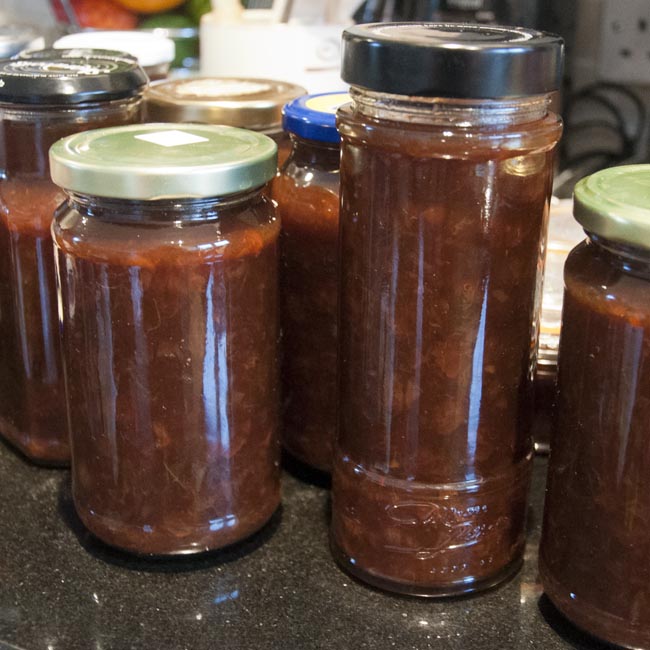
This is a BIG batch of chutney, producing 9 jars about 1lb in size, and a further eight small kilner-type jars, plus a bit extra which wasn’t quite a full pound jar.  I estimate in total it makes about 12lb, or 6kg.  It needs a very big pan – my large stock pot was over half filled, before reducing, and has a capacity of about 15l.  Unless you’re planning on eating an awful lot of chutney, giving lots of it away, or selling it (I think it would go really well at a farmer’s market!) I’d probably suggest scaling these quantities down to half or even a third (Delia’s original quantities are for 1.3kg of plums, which is still a very big batch).

I used the following –

  • 2kg of dark red / purple plums.  The tart / acid ‘cooking’ sort are probably better than sweet eating plums for this recipe.
  • Four smallish Bramley apples, totalling about 800g in weight.
  • 5 large-ish onions
  • 5 cloves of garlic
  • 3 teaspoons of ground ginger
  • 750g of seedless raisins
  • 750g each of soft brown and demerera sugar
  • 3 pints of malt vinegar (excuse the switch to imperial measures – this is about 1.7 litres, malt vinegar comes in pint-bottles in these parts, so it’s a measure of convenience).
  • 3 desert spoons of salt
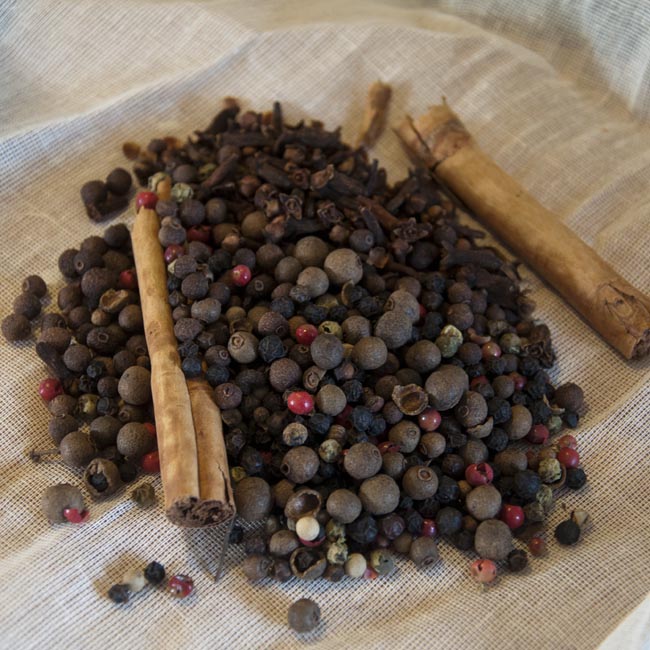
  • a large cinnamon stick, 15g of whole allspice berries, and 20g of mixed peppercorns (the mix was about 1/3rd allspice berries, oddly), and a tablespoon of whole cloves, all tied up in a muslin parcel.
  • A giant stock-pot, food processor, and enough jam jars to contain your chutney (lots, and lots, of jam jars!), which should have plastic-lined lids to help resist the vinegar.

Whole spices with muslin

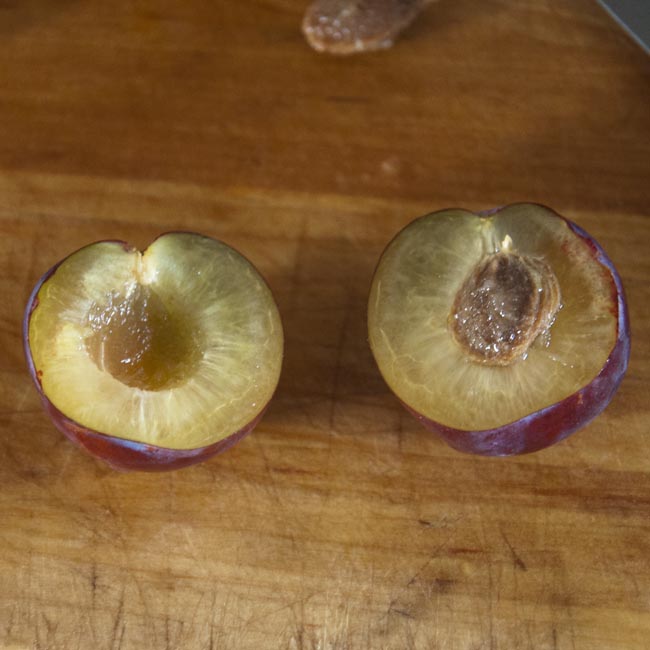
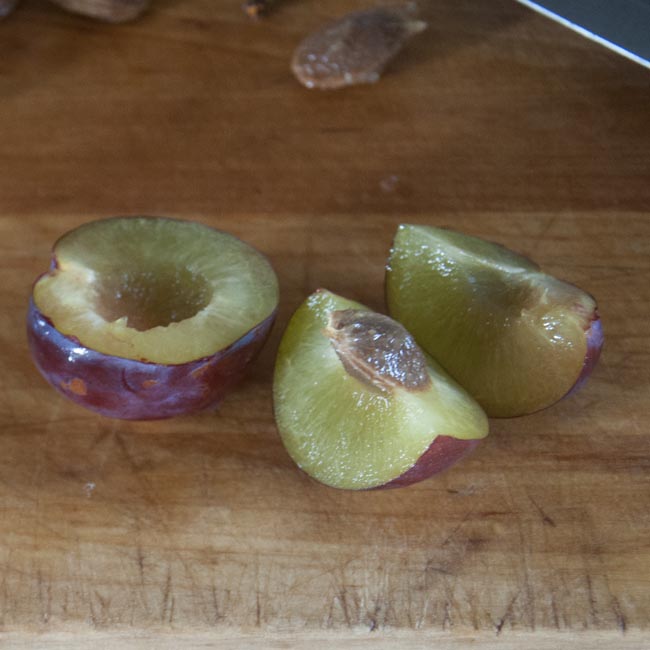
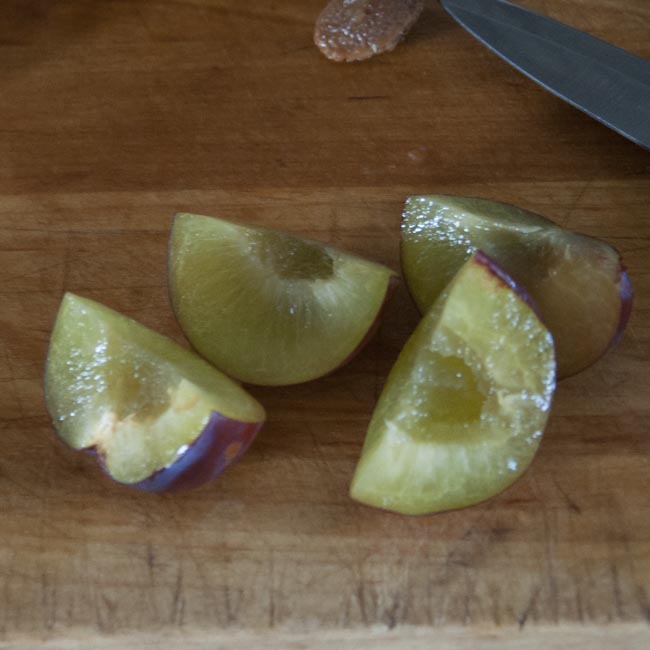
First wash, then stone and quarter all your plums. I find the quickest way to do this is to first slice along the line of the plum, down the visible ‘seam’, and divide the plum in two. The stone will cling to one of the halves, and especially with the smaller firm-textured cooking plums, won’t want to come out easily.

Stoning plums - 1   Stoning plums - 2   Stoning plums - 3

Take this half, and slice in half again, across the sort axis of the stone this time. The stone will now be sticking conveniently out of one of your quarters, and can easily be pushed free.  Cut your other half into quarters, too, and you’re done.  Incidentally, stoning plums can stain your fingers and fingernails a rather attractive nicotine brown colour, I think as a result of the tannins, so if you care about this, consider wearing gloves!

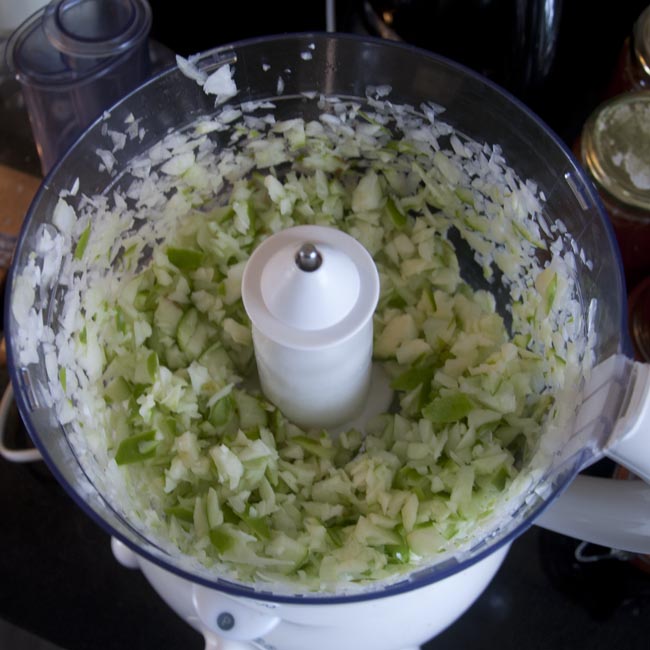
Chopped apple in food processorThe recipe calls for minced onion and apple.  I put mine through my food processor in batches, but left some nice texture in both.  The first time I made this recipe I didn’t have a decent food processor and diced all the apples and onions very finely by hand.  It works, but I can’t say I can recommend it!

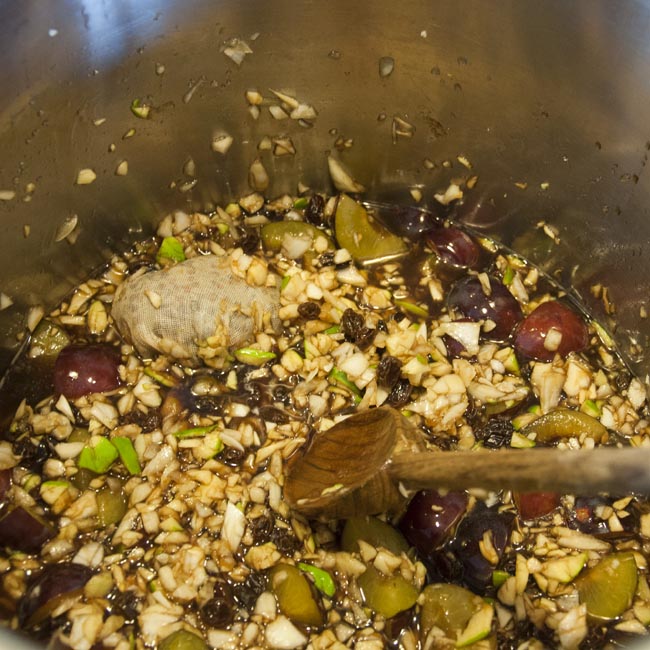
Mixed ingredients in panAfter your fresh ingredient preparation, it’s very simple really.   Add all the other fresh, dry, and liquid ingredients, and toss in your spice bundle (Delia recommends tying your bundle of spices to the pan handle, but I really can’t see any benefit to this!).  Bring everything to a simmer, stirring to mix as it all comes up to temperature.  Your kitchen will smell rather like Christmas-gone-wrong about now – festive spices mixed inexplicably with onion and vinegar.

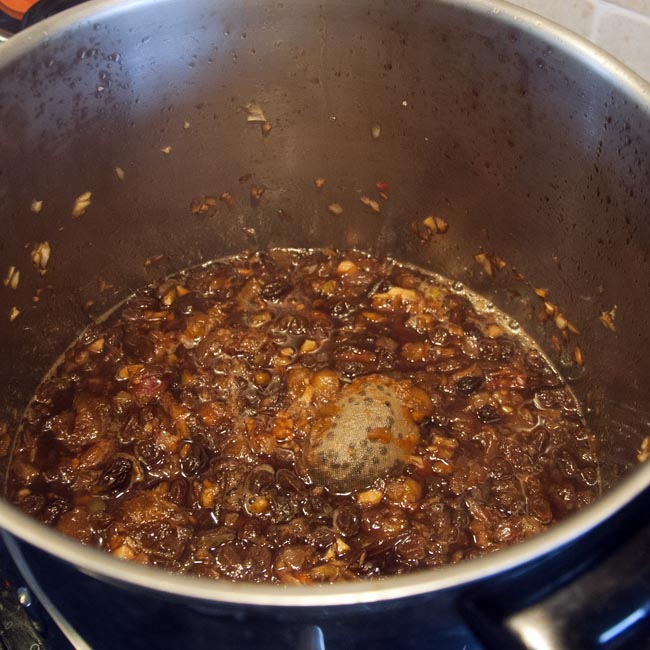
Cooking away nicelyThen let it bubble, stirring occasionally, for about three hours (my mixture was about six inches deep in my very big stock pot – a wider pan, or a smaller batch, which would allow the mix to sit in a shallower layer will reduce noticeably faster) until the mixture is reduced, glutinous, and the vinegar mixture has thickened so that it doesn’t immediately flow back into a channel cleared with a spoon.  I had to ladle out a couple of spoon-fulls into a bowl to check this.

As it starts to reach this stage, it will tend to ‘glob’ with really big bubbles, particularly when stirred, so learn from my experience and take care to protect your hands and arms from scalding!  This is the point that it’s at risk of sticking and burning, too, so keep stirring when you think you’re getting close.  Once it’s ready, fish out the spice bag, and bottle straight away into your hot sterilised jars.

Bottled chutney

It will be at it’s best if you allow it to mature for at least three months before eating – just in time for Christmas, then! – though I had some of the ‘extra’ today with some bread and cheese, and it’s already very good!  It will keep very well, too – I’ve eaten this chutney after at least four years’ storage.

Now, I wonder if I can get hold of some more plums to make some jam, too …

Read more from the Country Skills blog >>

This Is My Jam – French apricot with kirsch

We had a visit from my in-laws this week, on their way back from holidaying in France.  It’s always lovely to see them, but this time was particularly special – they brought with them 2kg each of beautiful French apricots and plums.  So today, my day off, was always going to be about preserving!

I wanted to make some really nice authentic French apricot jam, so this is as simple as it comes – apricots, sugar, a squeeze of lemon juice… and just a little ‘twist’!

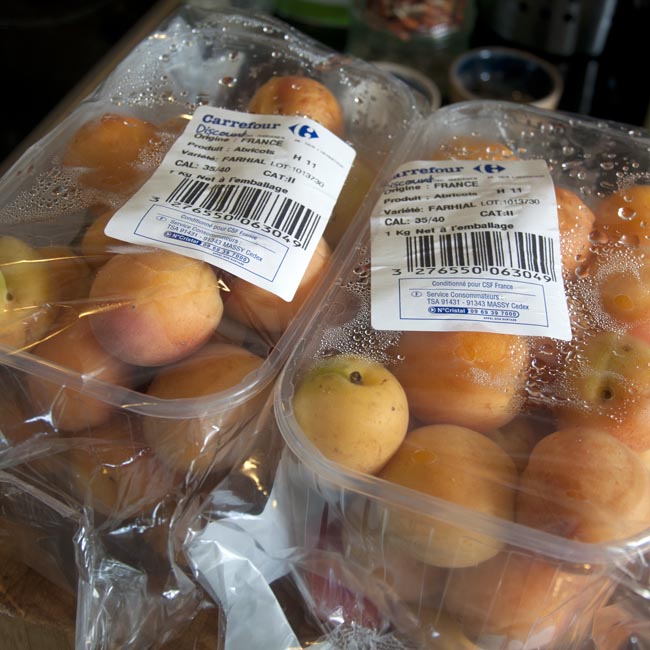
For this jam, you will require –Fresh French apricots

  • 2kg of French apricots (well, OK, anyone’s apricots will do, I suppose!) not too ripe.
  • 2kg of golden caster sugar (as a general rule, I prefer to use the least-refined sugar that I can get away with in any given situation)
  • 3 slightly sorry-looking lemons from the fruit bowl (the sorry state is not compulsory, and two nice big fresh juicy lemons will do well here!)
  • Half a pint of water
  • A couple of tablespoon measures of kirsch (or other eau-de-vie of your preference)
  • Generous sized preserving pan, not aluminium
  • Enough jam jars to contain your batch.  I always wash and sterilise more than I think I’ll need, as it doesn’t do to run out at bottling time!

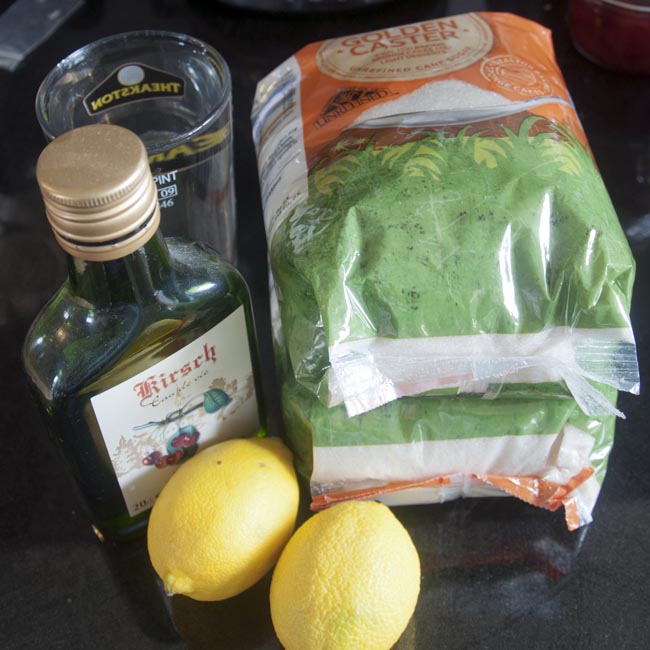
IngredientsObviously you can scale the quantities to suit your apricot supply – they’re very nice convenient multiples!  I find 2kg of fruit is a good useful batch size, easily manageable with the equipment I’ve got, and makes enough jam to generously repay the investment in time and effort.

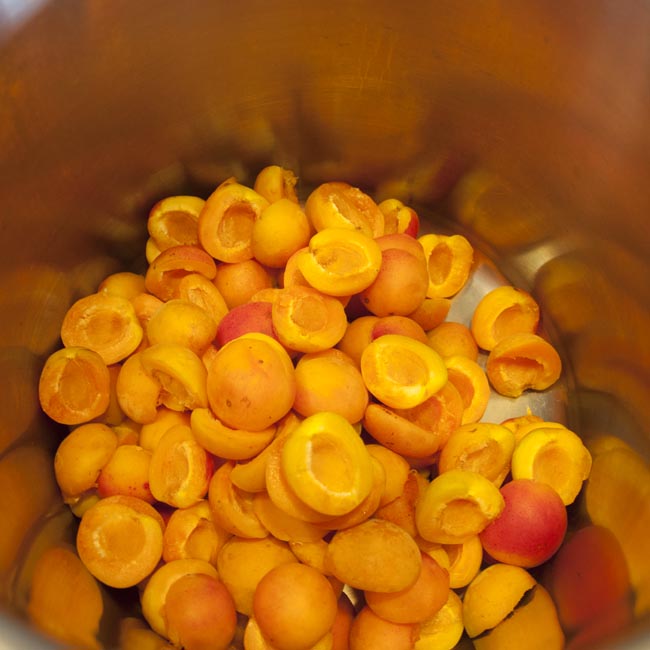
Apricot halvesWash your apricots, then halve them and remove the stones.  Don’t throw the stones away just yet!  Put all your half apricots into your pan, and add the half pint of water, and bring this to a gentle simmer.  Stew the apricots very gently until they’re just soft, and the juice has run.

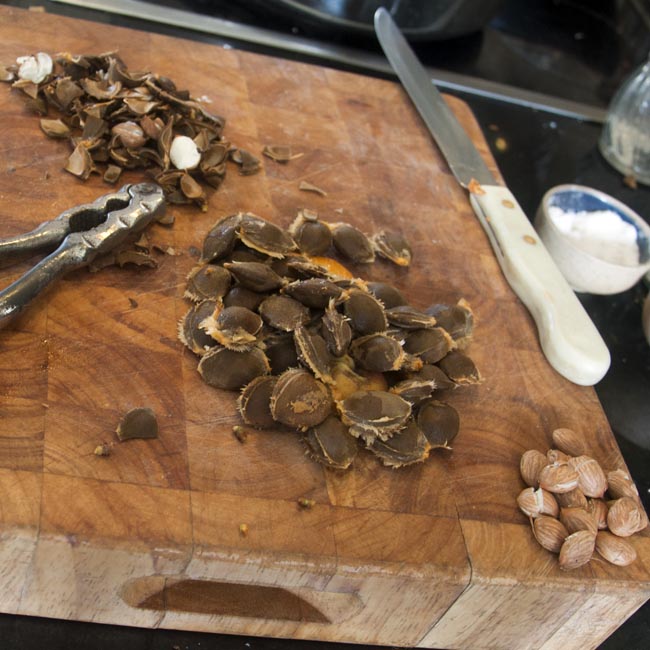
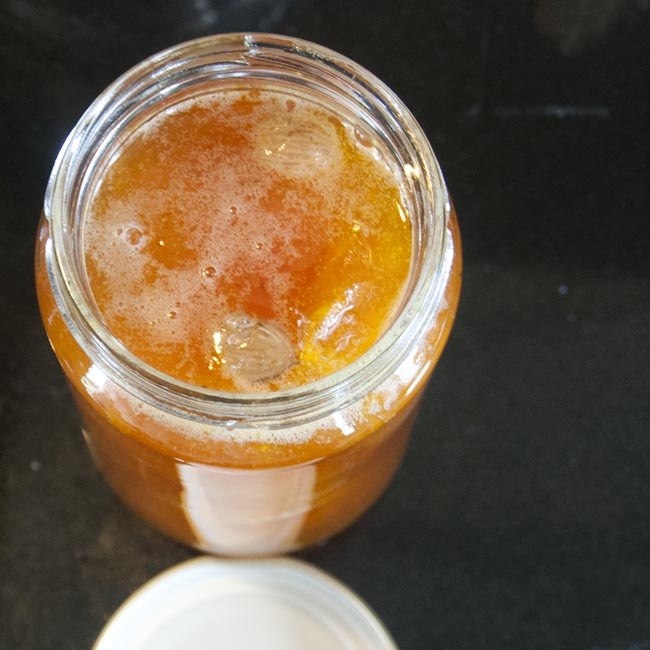
Apricot kernelsWhile your apricots are stewing, take your nutcracker (if you have one) and gently crack about a dozen of the reserved apricot stones.  Inside you’ll find the kernels – they look like little almonds, and this is no coincidence, as almonds and apricots are closely related, so closely in fact that you shouldn’t grow apricot and almond trees nearby one another!  You can add these to the jars of jam at bottling time (about one per jar), which will infuse a lovely subtle bitter-almond flavour into your jam – this is completely optional, of course, if you can’t be bothered with the faff (or can’t lay your hands on a nutcracker!).

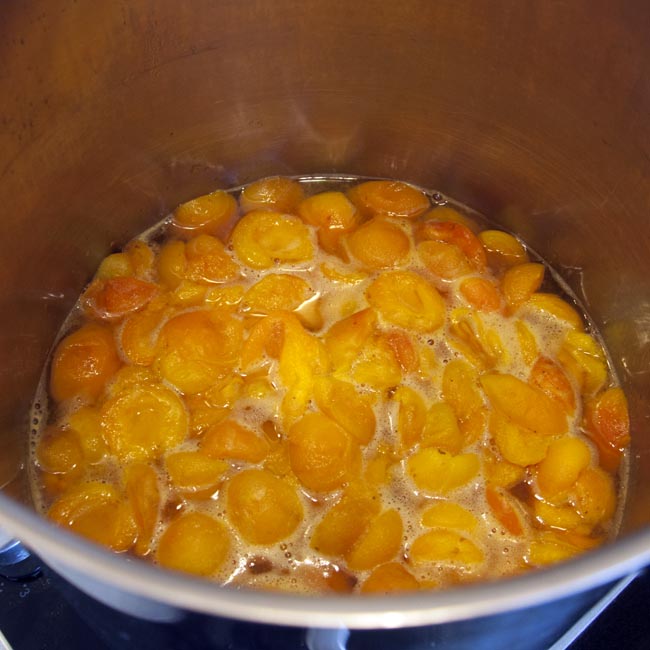
Gently stewed apricotsPut your clean jam jars and lids into a cold oven and set it to 150C.  Now add the sugar and heat gently until it’s all dissolved – you might find adding it in portions is easier and results in less trauma to the apricot pieces.

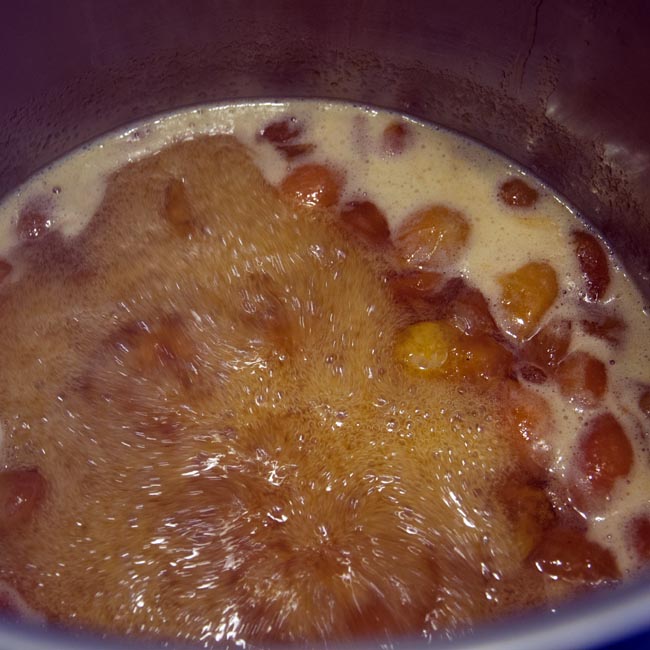
At a rolling boilNow turn up the heat and boil the jam until it reaches a set.  This didn’t seem to take very long at all for me (though I have to admit to being distracted by sorting and cleaning out the *next* batch of jars at this point) and the natural pectin in the apricots seemed to be adequate.

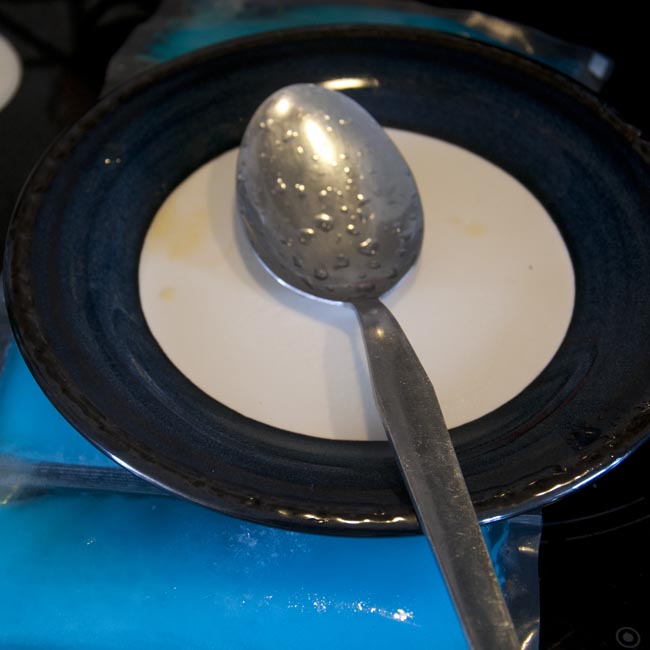
Cold saucerI tested the set using the cold-saucer technique (I often forget to freeze the saucer, so this is my usual approach – placing a saucer on top of a freezer block, the sort you’d use to keep a chill bag cool).  I’m not after a firm set for this jam so I was satisfied as soon as I got a bit of a wrinkle on top of the sample.   Once it looks like you’re getting there, juice the lemons and stir the juice into the jam.  Get the first batch of jars out of the oven ready to go.  Finally add the kirsch and stir in briskly.

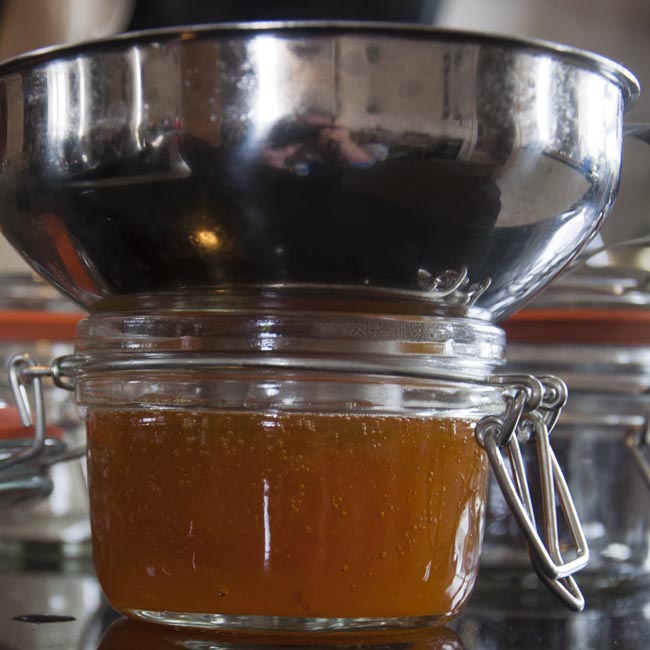
Bubbles at bottling timeNow start bottling your jam immediately, using a large-aperture funnel if you have one.  If you’re doing this right, you’ll be able to see bubbles rising in your jam as it hits the hot glass of the jam jar.

In the jar with the apricot kernelsFill a small number of jars at a time (2 or 3), don’t forget to add a kernel or two to each jar before adding a wax disk (if you like).  Secure the lids down tightly, before getting the next few jars out of the oven.

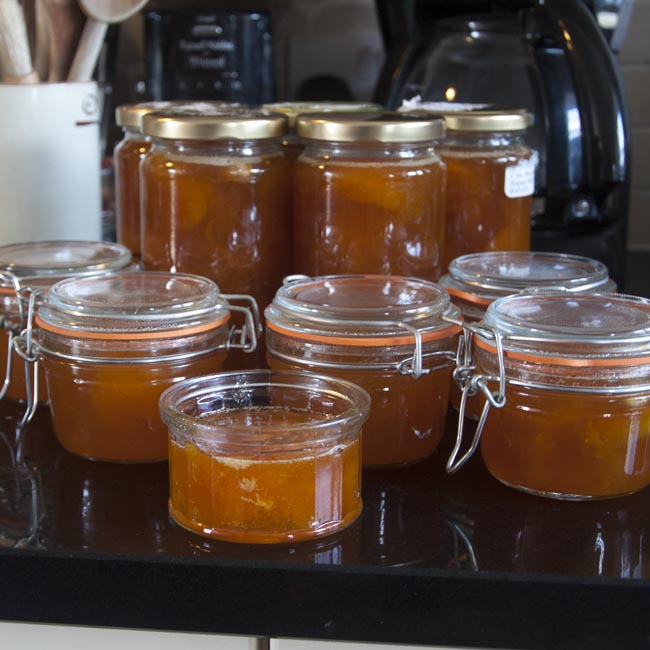
I was pleased with the yield of this batch, five good big jars with about a half litre capacity, five little mini-kilner-alikes (it would have been six, but one developed an alarming crack during sterilising!), and a cruet-worth for my breakfast over the next few days.

Finished batch

It’s gorgeous jam, too, with the subtle note of the kirsch just evident against the lovely deep rich apricot.  The balance of sweet and acid is very pleasing.  The set seems to have come out as I wanted – not a firm set, but not runny either, just like a traditional French apricot jam should be!

Now all I want is a crusty baguette, some unsalted butter, and an excuse to really tuck in!

Read more from the Country Skills blog >>

A Taste of Summer – strawberry and lavender jam

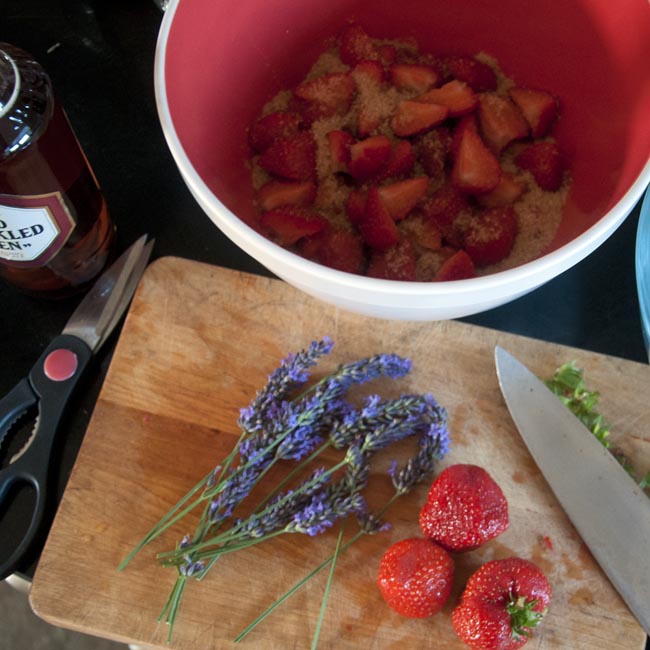
The last of the Scottish strawberries are in the shops right now, at bargain prices.  I saw some yesterday and couldn’t help myself – jam making was really not on my list of things to do this weekend (which is dedicated to sitting in a field listening to folk music!) but my timing is impeccable as usual – and they won’t be there next week.  So, 2kg of fresh ripe strawberries came home with me.  My garden is full of lavender, so the match was too good to ignore.  Why make something that you can buy anywhere, when you can make something really special and a bit unique just as easily?

Strawberries & lavender flowers

To make this jam, you will require –

  • 2kg of fresh ripe strawberries
  • Two dozen (freshly picked!) lavender flowers.  You could substitute dry lavender, the quantity will be a matter of guesswork though!
  • Juice of two lemons and one orange.  Also some of the grated zest if you wish.
  • About 700g of sugar (I prefer unrefined golden sugar)
  • Pectin (optional – but will improve the set)
  • A large mixing bowl, big enough to contain all your fruit
  • Large saucepan
  • Enough jars to contain your jam

Ideally, start this in the evening before you want to cook your jam.  If you haven’t got the luxury of time, though, starting four hours or so ahead will still make a big difference.

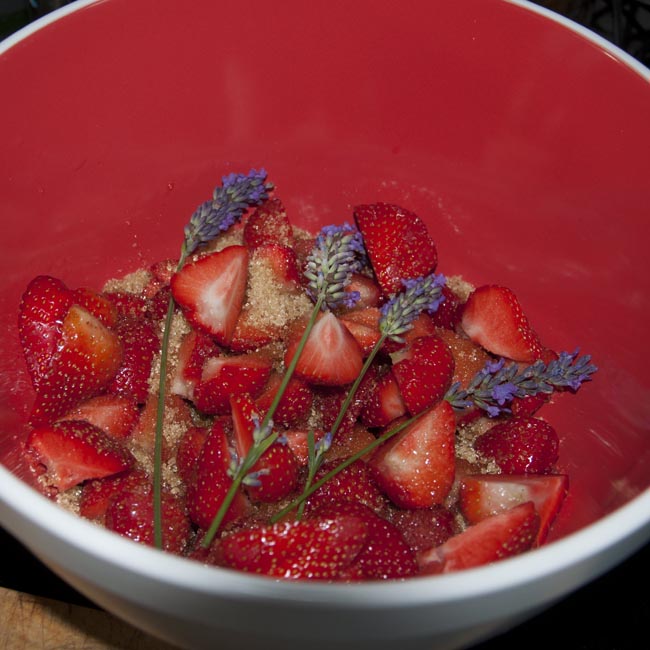
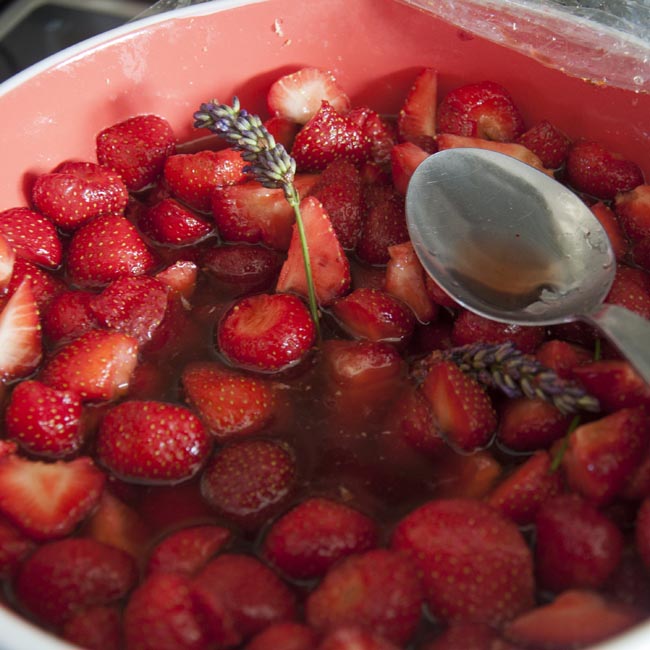
Layering lavender with sugar and strawberries.Wash and prepare your strawberries, removing the little green ‘hat’ (I use a finger nail to dig these out – but the tip of a knife or the point of a potato peeler do very well) and halving or quartering to a consistent sized piece.  You can leave the smallest fruits whole. Layer these in a large bowl, sprinkling sugar over each layer as you go.  Every couple of layers add a few sprigs of your lavender, you’re aiming to add about half of them to the bowl at this stage.

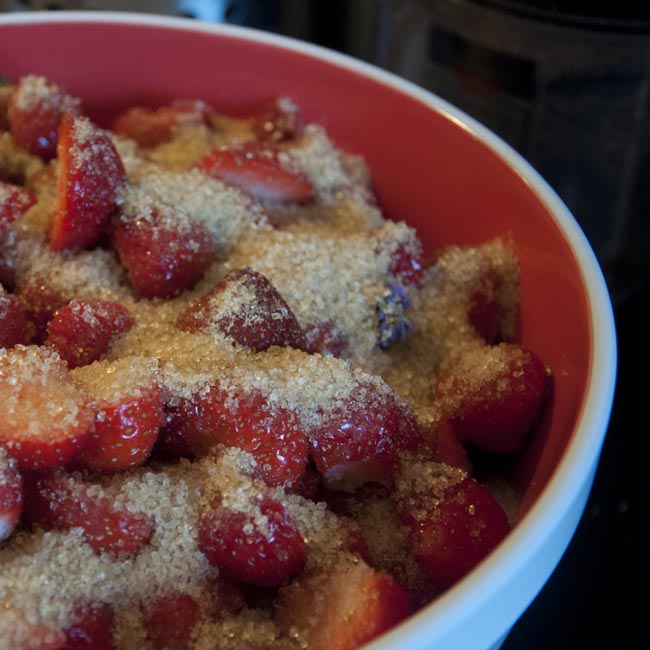
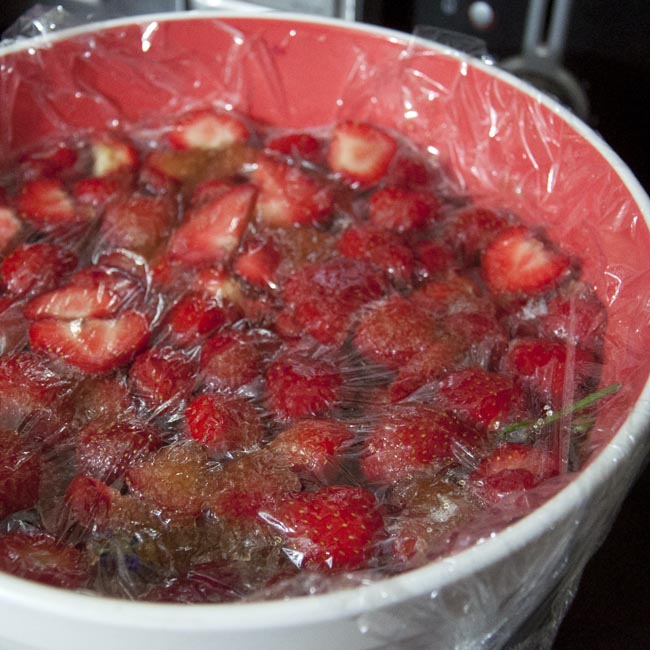
Filled bowl of strawberriesCarry on until you’ve added all the strawberries, about a dozen lavender sprigs, and nearly all the sugar (hold a few tablespoons back if you’re planning on using pectin powder).  Squeeze your lemons and orange and add the juice to the bowl. Grate some lemon zest, too, if you fancy it.  Then cover your bowl with cling film and place it in the fridge overnight (or at least for a few hours) to macerate.

After four hoursAfter a few hours you can see the sugar has already started drawing liquid from the fruit, and is essentially all dissolved.  Our aim here is to somewhat dehydrate the strawberries, increasing the chance of them holding together through the jam-making process rather than collapsing into mush, while providing ourselves with a cooking liquor without having to add liquid, which would ‘water down’ the flavour of the finished jam.

Strawberries in syrup, next morning.By morning, this syrup will cover the strawberries.  Just on it’s own, this would make a gorgeous desert, with ice cream and perhaps some meringue?

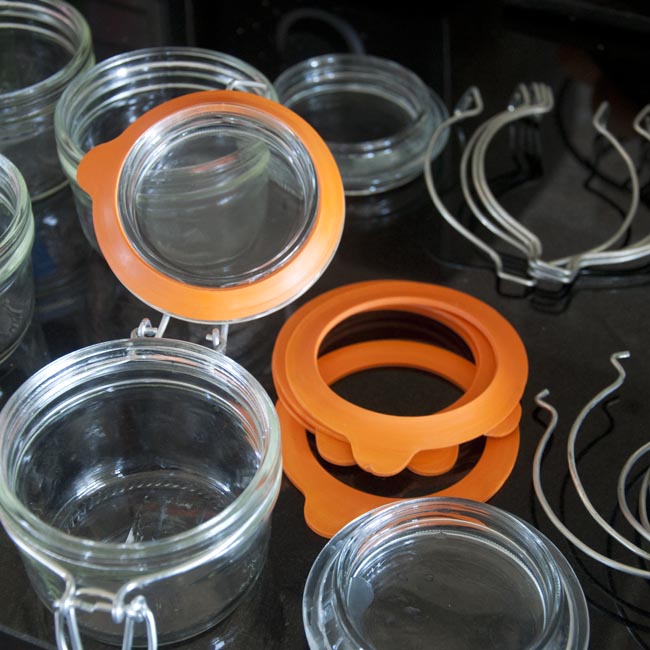
Before you start to cook your jam, prepare all your jars.  I sterilise my jam jars by running them through the dishwasher for a good wash (you could wash by hand instead) before placing the jars and lids in a cold oven and bringing it up to 150C.

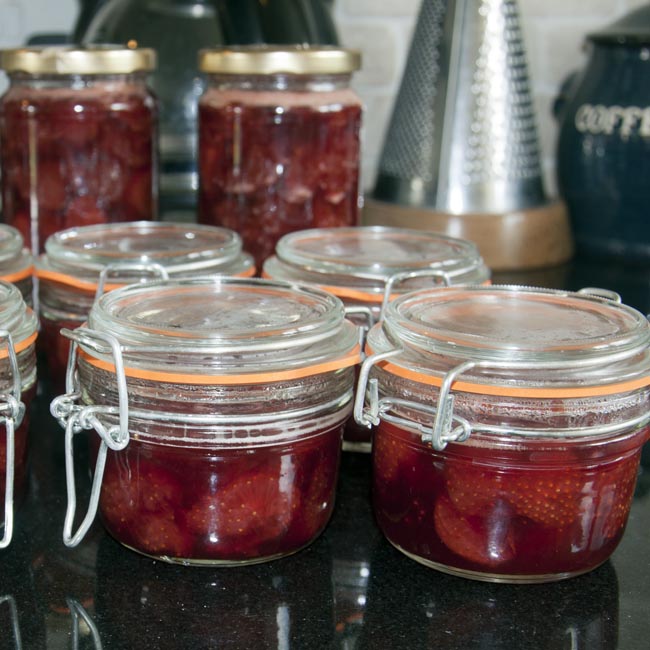
Mini kilner-type jarsFor this batch of jam I was using a few small kilner-type jars for giving as gifts, as well as some from my usual recycled stock for personal consumption!  The little kilner jars were disassembled for washing, and then put back together before sterilising in the oven.

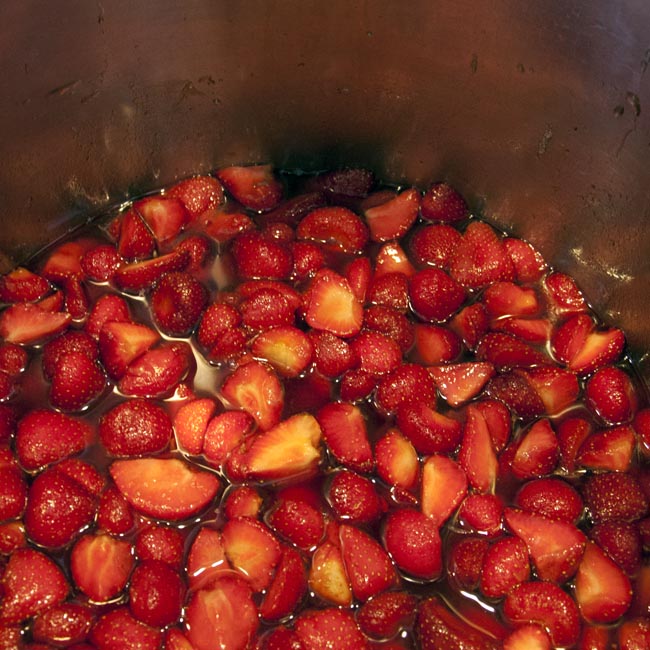
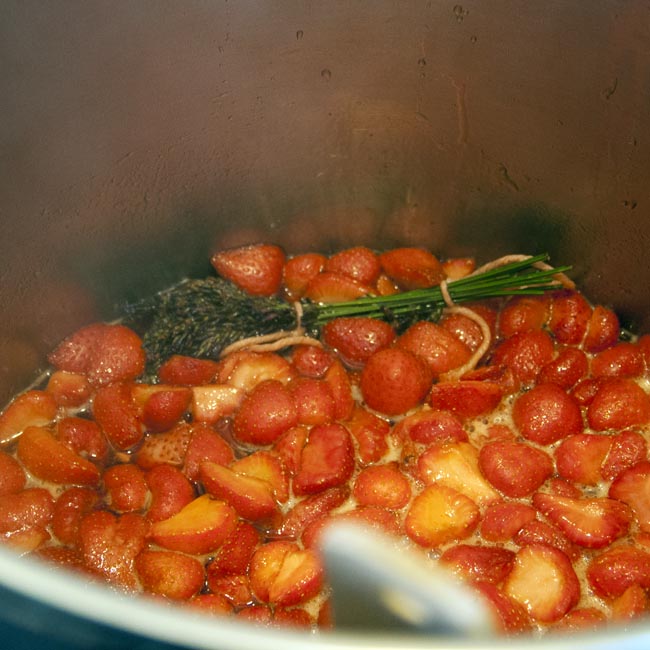
Once your jam jars are all ready in the oven, it’s time to start cooking the jam.  Pour all the strawberries and syrup into a generously sized pan (avoid aluminium – my ‘jam pan’ is stainless steel, and is actually a big stock pot, one of these days I’ll get my hands on a lovely traditional copper preserving pan, but that day hasn’t come yet!).

Strawberries & syrup, in the preserving panFish out the sprigs of lavender that have been marinading in the syrup overnight, and throw these away.  Add your pectin powder, if you’re using it.  It helps to combine it well with a few tablespoons of sugar first, as this will help it dissolve evenly in the jam and not form clumps.  I only had one sachet of pectin in the cupboard, which was a bit under half the recommended amount for the batch size, but decided to chuck it in anyway.  Strawberries are notoriously poor in pectin and if you’re going to use extra (or preserving sugar, to which it’s already added – often also with some citric acid) this is the jam to do it with.

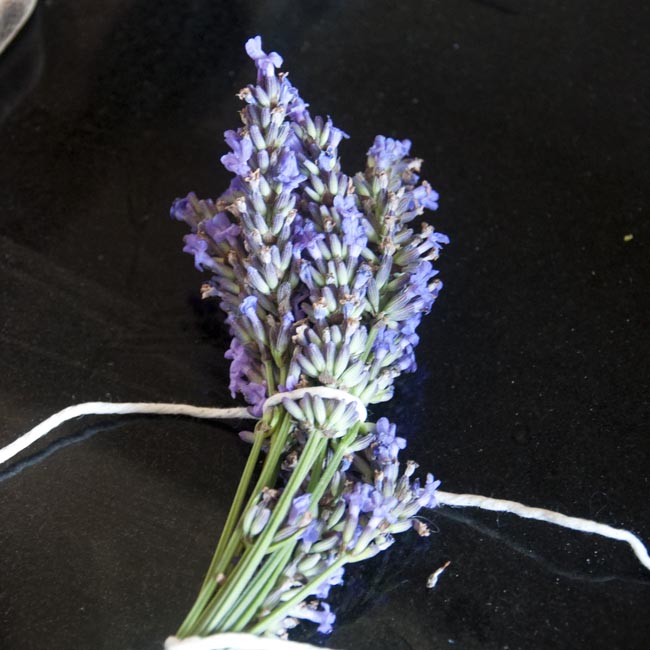
Lavender 'bouquet garni'Now, go and cut another dozen lavender flowers, and tie them together with string in a little posy like a bouquet garni.  If you’re not using fresh lavender, you’ll want to tie a couple of teaspoons of dried lavender flowers in a muslin bag – or I tend to use a tea ball.  Using fresh flowers rather than dry sprigs will greatly increase the chance the flower heads will stay attached to the stem, rather than breaking off and floating around in your jam.

Jam, coming to the boilAdd your bunch of lavender to your strawberries in the pan and bring the mix up to the boil, making sure all the sugar is fully dissolved.  I simmered mine gently for about ten minutes before brining the heat up to get a hard rolling boil.  How long you leave your lavender in is to some degree a matter of personal taste – and tasting is exactly what you need to be doing here!  I took my bunch out after the initial simmer, but then decided I didn’t have the flavour I wanted and threw it back in for another ten minutes or so of the hard boil.

Stir gently, trying to avoid breaking up the strawberries any more than necessary.  Now you’re trying to find the setting point, which you’re expecting to start to arrive after about ten to fifteen minutes of hard rolling boil.  Use your preferred method (mine is usually the cold-saucer approach), there’s a useful little ‘how to’ here.  As I mentioned, strawberry jam can be difficult to set without additional pectin, and I was struggling to get a set – rather than risk over-boiling my jam and ruining the fresh flavour, colour and texture of the strawberries, I decided to go ahead and bottle, expecting I would get a jam that would come out of the jar with a spoon, rather than a knife… not going to win any prizes at the show with these, but these are the crosses we bear!

Jam, in jarsOnce you’re happy that your jam has reached setting point – or not! – pour it boiling hot into the piping hot sterilised jars fresh from your oven, and seal the lids down immediately.  I don’t feel post-bottling steps are necessary for jams, whose acidity & sugar level should produce really good preserving qualities.

I had a taste on lovely freshly baked bread for breakfast yesterday.  It’s a runny jam, but the pieces of whole strawberry give it a really lovely texture.  The lavender flavour is clearly perceptible, but subtle and not intrusive.  All in all, it’s a really great preserve that I fully intend to make again in years to come (though I may go the whole hog with the pectin to get a set next time) – highly recommended!

Read more from the Country Skills blog >>

Signs of Summer – hedgerow posy

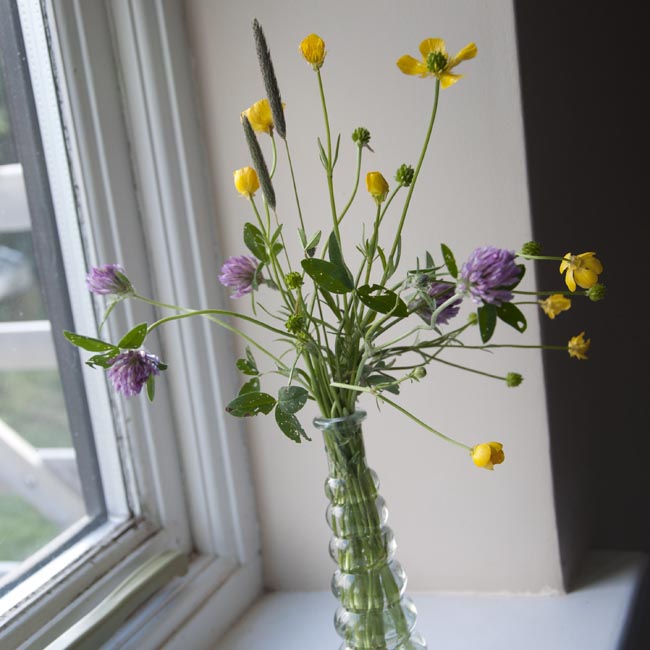
It’s great to see the field margins and roadsides crowded with flowers at this time of year, isn’t it?  I couldn’t resist, and picked a small posy from our paddock – red clover, buttercups and grasses.  It looks a treat on my window sill.

Hedgerow posy

Go and pick one of your own – it’s a little bit of summer, for you to enjoy indoors!  Beautiful, and best of all, completely free!

Read more from the Country Skills blog >>

Signs of Spring – the lambs are arriving!

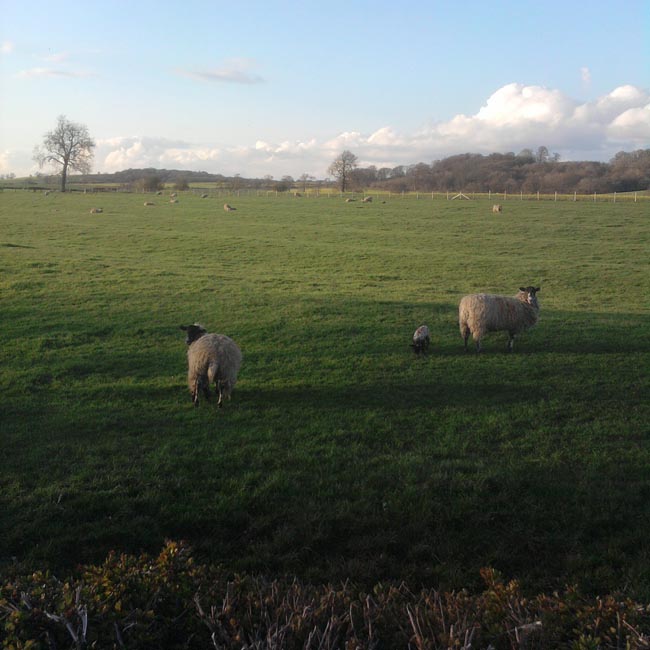
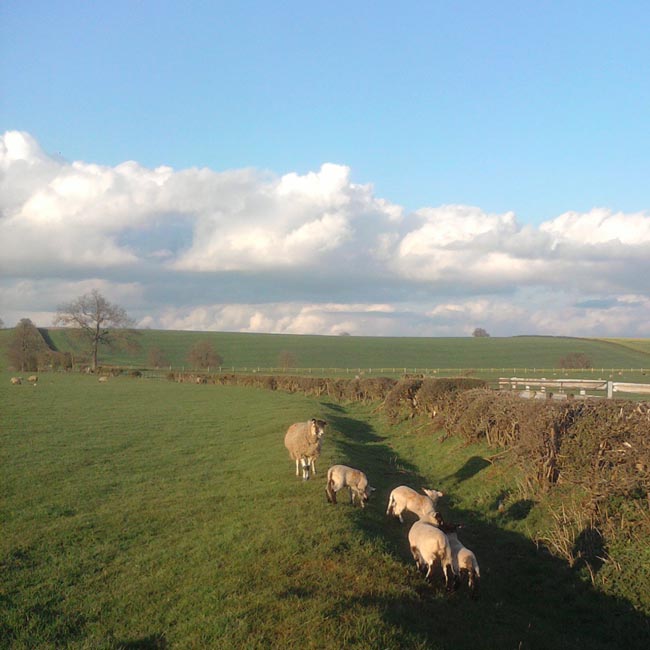
Not much to say today, folks.  Just thought I’d share some photos of lambs that I shot yesterday evening just before sunset on my mobile phone camera.  Aren’t they wonderful? (The lambs, that is, the matter of the greatness or otherwise of the photos is left as an exercise for the reader…)


Read more from the Country Skills blog >>

Foraging Skills – blossom watch

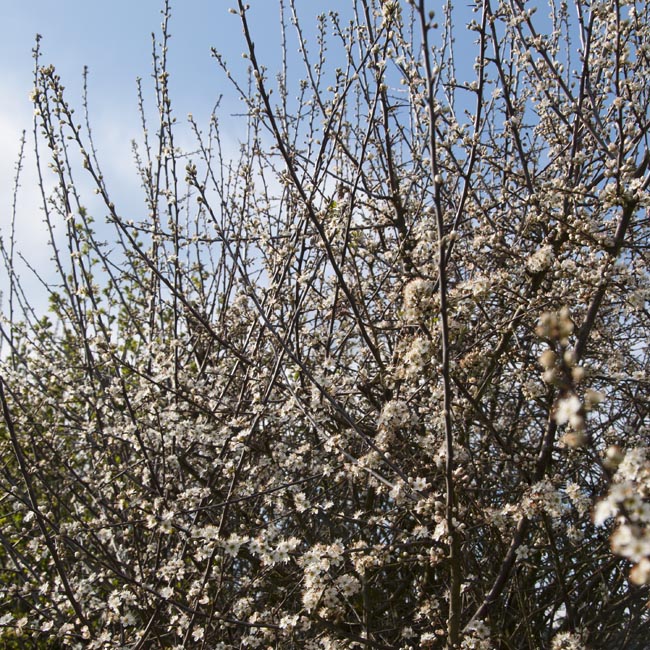
Spring is in full flood now, with bulb flowers and that lovely acid spring green colour of young leaves appearing everywhere.  You’re likely to be seeing lots of frothy white blossom in the hedges, and that’s worth keeping your eyes out for.  The sort you’re looking for is on otherwise naked branches, and spread evenly over the bush rather than forming clusters.

Blackthorn blossom

This is the blackthorn (the name is no coincidence!) or sloe bush.  So if you’re a fan of sloe gin (and let’s face it, isn’t everyone?) and fancy making some this autumn, make a note of any really good stands of blossom you see in the next week or two.  Final identification takes a slightly closer look – single small white flowers, armed with some nasty spikes on dark coloured wood.  The leaves, when they appear, will be small and rounded.

Blackthorn blossom - close up

You’ll notice that the blossom extends quite a long way inside the bush – this is one of the things that’s going to make picking, when you get to it, a bit of a challenge!

Read more from the Country Skills blog >>

Foraging Skills – how to get ahead!

I’ve been thinking about foraging recently.  There’s very little quite as special as a lovely – and free! – treat garnered from a hedge.  I’m thinking about a wild mushroom risotto, pots of crab apple jelly, a steaming blackberry crumble or a bubbling demijohn of rosehip wine.  Foraging is really an autumn sport, though, borne from the season of mists and mellow fruitfulness, so why am I writing about it now?

The thing that makes a really good forager isn’t being able to spot a laden crab apple tree at three hundred paces  – it’s knowing where that tree is in the first place.  Being a successful forager depends on keeping your eyes open all year round – if you notice things now, and remember them, you’re well on target for a bumper summer and autumn foraging season.

So just now, keep your eyes open for these, and make a mental note –

Hazel catkins in hedge

They’re hazel catkins, and where they’re hanging in profusion from the naked branches of hedges and shrubby trees now, there should be some lovely cob nuts in the autumn – they’ll be much harder to see then, when there are leaves on the tree, and hazels growing in mixed planting aren’t especially distinctive looking.  Watch like a hawk though, come autumn, and pick them slightly green and sweet – because the mice will want them too!

A little note on the legality of foraging – if the item is being grown as a crop, then it’s not foraging, it’s scrumping (or stealing!).  It’s very unlikely that cob nuts or blackberries growing in a field hedge are intended as a food crop, but the nuts and sloes in my garden hedge definitely are!  So if it looks like someone’s caring for a tree or a hedge, it’s in an orchard or garden or looks intentionally planted, tread with care!  That said, there at lots of edible crops grown incidentally on trees planted ornamentally, on streets and in council amenity spaces, particularly in urban areas – foraging doesn’t have to be just a country pursuit! – look out for apples, plums and cherries, too!

Read more from the Country Skills blog >>

Homemade Gifts – hyacinth bulb and hydrogel beads in a jar

Lovely, fragrant bulb flowers are one of the first signs of spring.  I especially love hyacinths, with their intoxicating perfume, and particularly growing indoors just a little bit out of season.  They’re like a floral promise that the end of winter *will* be along, just around the corner.

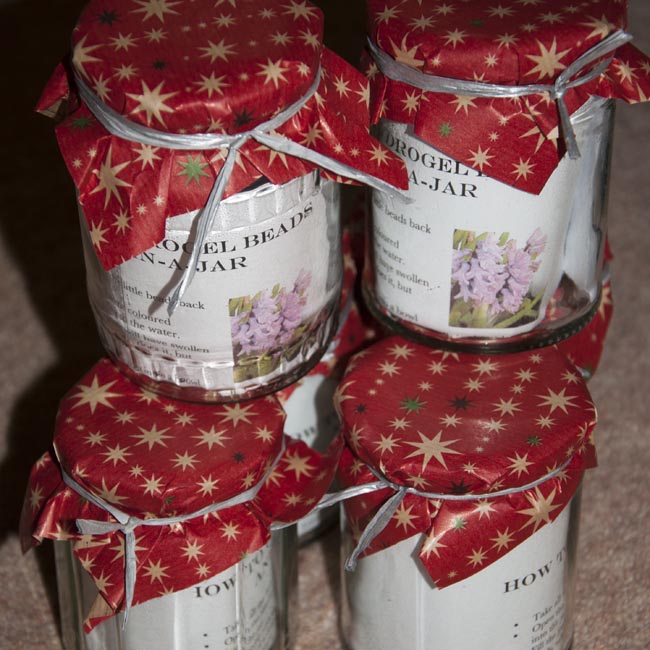
Hyacinth Jars, ready to give

Many of the gifts for my friends and family have been homemade this year – of course I couldn’t write about them before the big day, because that might have ruined the surprise! One of my favourites is a ‘prepared’ hyacinth bulb (heat/cold treated for indoor forcing – this is important, as unprepared ‘garden’ bulbs won’t flower if grown in this way) in a jam jar with hydrogel beads (sometimes called ‘water crystals’).  Hydrogel beads are one of the coolest, weirdest things I’ve come across in a long while.  They start out as a tiny little packet of small clear-plastic looking ballbearing things, but when soaked in water overnight, the contents of the tiny little packet will swell up to fill a whole jam jar.  Better still, the ‘reconstituted’ hydrogel has a refractive index so close to water that they’re essentially invisible if they’re below a fluid level, which, you have to concede, is very cool, in a geeky sort of way.

Once you’ve got over the excitement of the whole thing (I know, right?), how do you make them either into a gift or into a lovely spring treat for your own window ledge?

Hyacinth Jar - 'ingredients'For gifting, simply pack up the pouch of dry hydrogel beads and the prepared hyacinth bulb into a washed and dried recycled jam jar (I took the opportunity to use up some of the pickle jars with too much residual ‘taint’ to use as jam or jelly jars), with an instruction sheet (we’ll get to that).  Do up the lid (but don’t worry if you don’t have one) and top it with a pretty bonnet of fabric or Christmas wrapping paper tied on with ribbon.  What could be sweeter?

No, you can’t have my instruction sheet, write one yourself!  But the process is very straightforward.

  • First, you’ll need to reconstitute your hydrogel beads.  Do this in the jam jar, by emptying the tiny pack of beads into the jar and topping up with warm tap water.  I know it seems very very unlikely that this will work, but indulge me here, and leave them overnight.  The next morning, marvel as you discover the beads filling the jar.  It’s very cool.  If you wanted to be a bit psychedelic, you could add a drop or two of food dye to the water to start with, and this will be taken up by the beads.
  • Drain the beads, leaving them in the jar.  Marvel some more.
  • You want the fattest part of the bulb to sit in the ‘neck’ part of the jar, so work out if you need to remove some beads to get the level right, then place the hyacinth bulb on top of the beads.
  • Top up with water to just below the base of the bulb.
  • Now place the bulb in a cool dark place (a larder cupboard is ideal, an airing cupboard isn’t!).
  • Once there are roots growing and green growth is visible in the top of the bulb, move it into a bright place.  This will take a week or two.
  • Keep the water topped up every so often but avoid having water directly in contact with the base of the bulb as this will encourage mould to grow and may make the bulb rot.  The hydrogel beads will make it a lot more forgiving of marginal drying out than a traditional hyacinth bulb vase.
  • Wait for the hyacinth to flower, which will take another three or four weeks.  You may need to find some way to help keep it propped up, though usually they flower in quite a compact way so you might be lucky!

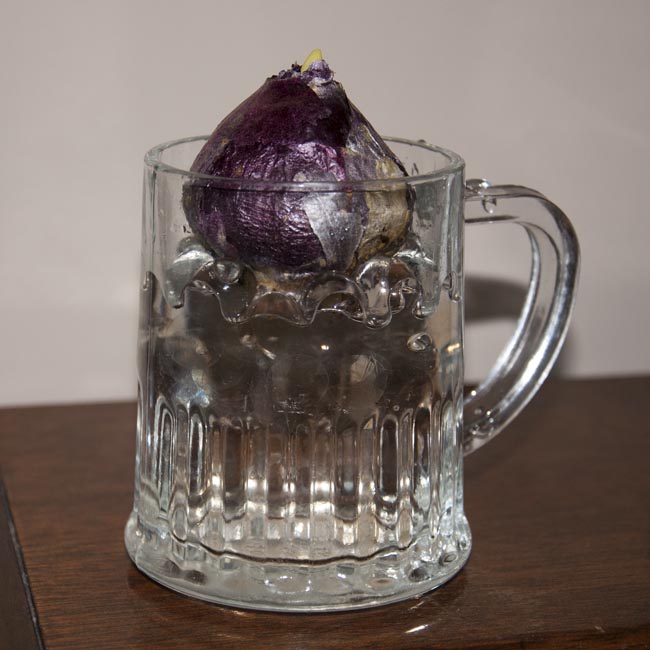
Hyacinth tankardOf course, you don’t need to restrict yourself to jam jars, all sorts of receptacles will do the trick!

These make a very original, eye catching and fun little gift – I used mine as stocking fillers and as part of hampers.  They cost very little, I sourced the bulbs for just under a pound each (in packs of twelve) and they hydrogel packs come in about £3 for ten.  I have three of the bulbs growing together on hydrogel in a small vase, which I started a couple of weeks ago, and they seem to be going well, with great root growth and a nice bit of green emerging!