Bloggers – Your Country (Skills Blog) Needs You!

I’m still looking for a handful of volunteers for Kate’s Big Country Skills Bacon Challenge!

If you want to try something new and very cool – making your own bacon at home – and have a UK postal address, get in touch, and I’ll provide the curing salt.  Then, just brag about your bacon wherever you blog and to whoever will listen!

Thank you everyone, I now have a full set of volunteers!  Instructions, and hopefully feedback, coming soon!

Finally – Kate’s Big Country Skills Bacon Challenge is here!

I love home-cured bacon, and I think you will too!  The experience of making streaky bacon for the first time was one of the main motivations behind setting up this blog, and more recently I’ve had great success with home-cured back bacon, too.  And yet despite how simple it is, and how wonderful the final product, the most common reaction I get is ‘Oh but that sounds very complicated, you’re braver than me!’.

Home-cured back bacon

In order encourage as many people as possible to try this simplest of all foody experiences, I’ve come up with the following, very simple plan.  I’m calling it ‘Kate’s Big Country Skills Bacon Challenge’.

I will post an 80g pack of ‘Supracure’ curing salt (enough to cure up to 1kg of bacon) to the first 10 people to send me their UK postal address.

Then, I’ll post day-by-day instructions to follow.

Thank you everyone, I now have a full set of volunteers!  Instructions, and hopefully feedback, coming soon!

That’s it, simple as that!  All I want from you in return is to make your bacon, and to write about it, take photos of it, tweet about it, post to facebook about it and generally brag to anyone who’ll listen about how awesome, easy and worthwhile it is!  With any luck, for some of you it may even become a habit of a lifetime.

In order to make your very own bacon, you will need to provide a piece of fresh pork belly or pork loin up to 1kg in weight (ideally with the skin on), a non-metallic dish big enough to hold the meat, ~20g of sugar (soft dark sugar is best), some cling film, a refrigerator, and a couple of minutes a day for five consecutive days.

Read more from the Country Skills blog >>

Feedback on Country Skills – hyacinths, candles and chickens

I love hearing from my blog readers, especially if you’ve tried out something I’ve written about!

After I wrote my butchery tutorial ‘how to portion a chicken’, blog reader asciiqwerty contacted me to me to let me know how she’d got on following my instructions, and sent me this photo of her finished portioned chicken.

Portioned, skinned and boned out chicken

This time the portions have all been skinned, and the thigh portions have the bones removed – this would make them great for using in a stir-fry or a curry.  She commented particularly on the size of the chicken breasts – which weighed in at about 200g each.  A supermarket pack of two chicken breasts will usually be about 250g in total, so you can see how much more you get for our money.  Well done asciiqwerty, and I hope it was as tasty!

Moving away from food, back at Christmas I made hyacinth bulbs with hydrogel beads, in recycled jam-jars, as gifts for friends and relatives.  I kept one for myself, of course, and thought you might like to see how it all worked out when it came into flower a few weeks ago.

Hyacinth bulb in flower, with hydrogel beads

The smell was amazing, and after this flowerhead died back and I cut it down, the bulb produced a second unexpected bonus flower!  The hyacinth stayed nice and compact and didn’t fall over despite not being secured by anything other than the roots in the jar of beads, which I was very pleased with.

Finally, the recycled chunk candle I made a few weeks back.  I was amazed with this, it turned out so much better than I’d anticipated.

Recycled wax chunk candle

After looking initially as if the melt pool would be a bit pathetic in the centre, it actually burned down very nearly edge-to-edge leaving a thin shell which the candlelight flickered through like stained glass.  I burned it every night for several hours after work, and it lasted a whole fortnight – I’d estimate around 45 hours burn time.

I’d love to hear about any successes (or otherwise!) you might have had trying out country skills – either in the comments, @countryskills on twitter, or by email at countryskillsblog@gmail.com.   Or perhaps there’s something you do that you think I should try – I’m always happy to hear new ideas, so please get in touch!

Read more from the Country Skills blog >>

Back To Basics – home cured back bacon from start to delicious end

Home cured streaky bacon has been a constant fixture in my house since I first made it back in October – in fact I’ve not bought any ‘commercial’ bacon since.  Back bacon used to be our house favourite though, before I started curing.  A couple of weeks ago I saw a tied pork loin ‘roasting’ joint for sale half-price in the local co-op, and it seemed to good to refuse.

Home-cured back bacon

For home-cured back bacon, you will require –

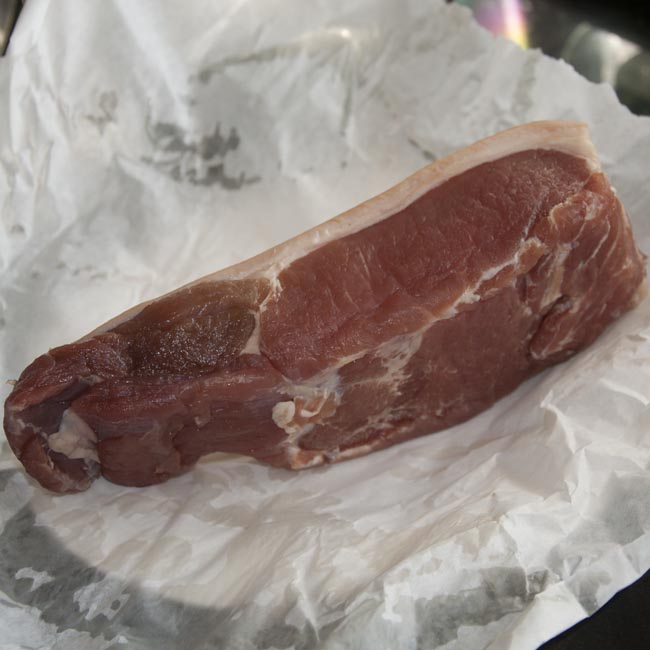
  • Ingredients for home-cured back baconA piece of pork loin.  The roasting joint was a bit big so I cut it in half to give me a piece about 650g in weight.
  • Curing salt such as Supracure (see the Suppliers List for details), 8% of the total weight of the meat, and
  • Sugar (soft brown sugar is ideal) 2% of the total weight of the meat, to make a total cure weight of 10%
  • A non-metallic dish big enough to contain the meat, and some cling film to cover.
That’s it – I wanted to keep the first effort as simple as possible!

First day - dry-cure rubbed in

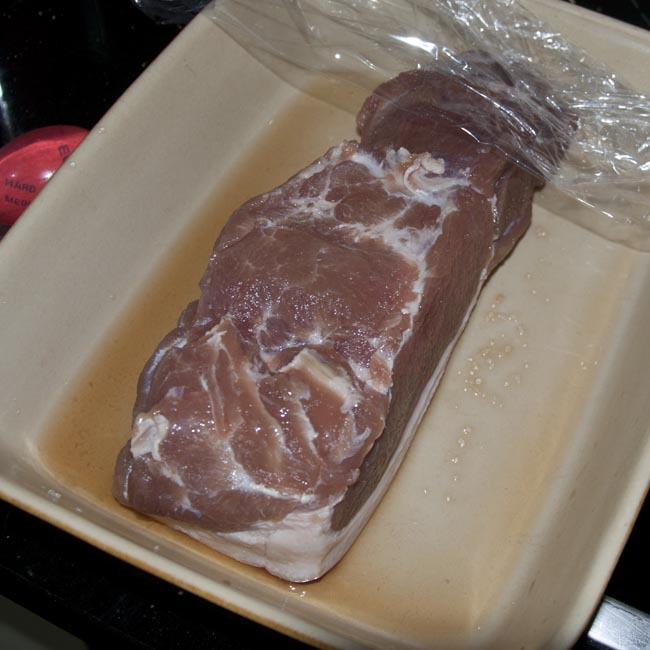
Weigh out the cure ingredients and mix them together well.  Now rub about a quarter of the cure mix all over the pork, including on the skin.  You can see it start to draw out moisture from the meat straight away.  Cover the dish loosely with some cling film, and put it in the fridge until tomorrow.

Second day - with 'pickle' in dishThe next day, there will be some liquid in the bottom of the dish.  This is the ‘pickle’ and is made up of some of the curing mix dissolved in the liquid that’s been drawn out of the meat.  It’s completely normal, so don’t worry.  Pour it away, or your dry-cure will pretty quickly turn into a brine cure.  Now take about a quarter of the remaining cure and rub it all over the meat again.  Put it back in the dish the other way up to last time (so skin side up, if you started skin-side down).

Third day - the bacon should be changing texture by this timeRepeat this process for another three days (so that you’ve rubbed cure into the bacon five days running).  By day 3 you should notice a distinct difference in the texture of the meat, it will be firmer in consistency and a bit darker pink in colour.

Finished back bacon, ready to sliceOn the sixth day (so one day longer than the streaky bacon process – this is because the meat is thicker than belly pork), remove the bacon from the dish, rinse it under the tap, dry it carefully with kitchen towel, wrap it loosely with greaseproof paper and put it back in the fridge.  Ideally, wait a couple of days before you start eating it, do let it rest at least overnight.

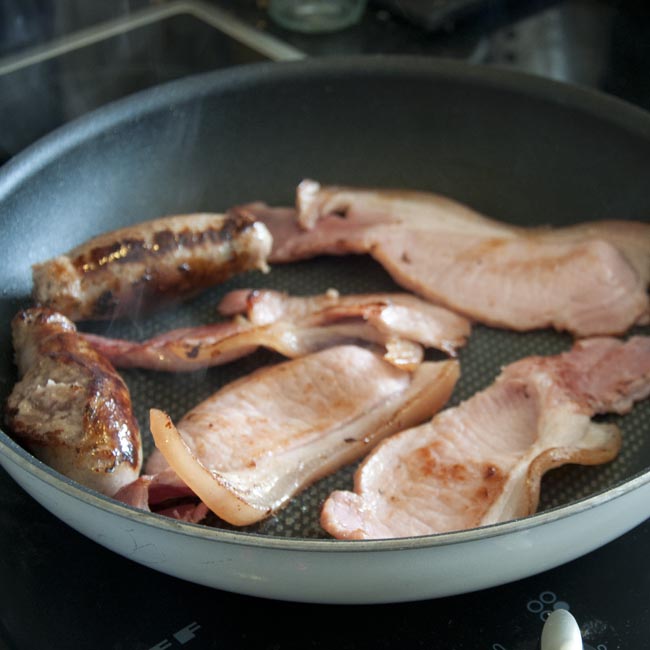
Home-cured bacon, fryingThen slice your amazing bacon with a sharp knife, and cook however you prefer.  I like to pan-fry my back bacon.  This one is gorgeous and I can only heartily recommend you make some for yourself!

Read more from the Country Skills blog >>


Banner320-260

A little egg-centricity – all about the chicken and the egg

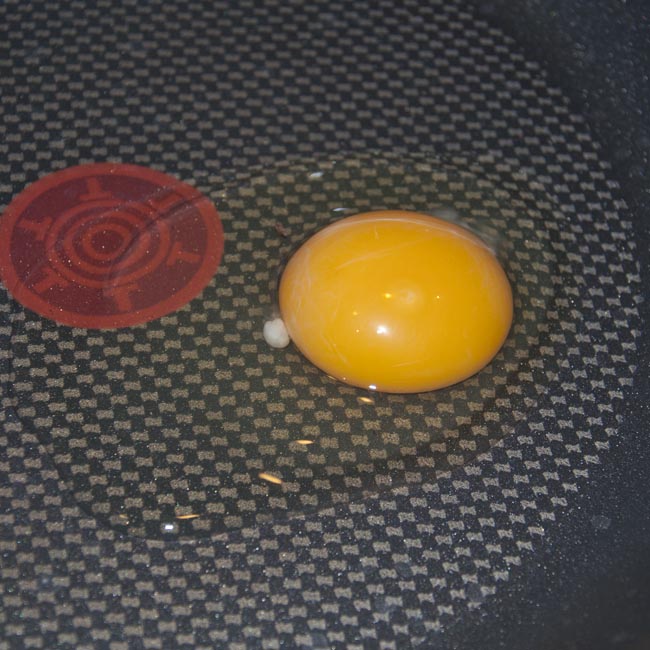
Nothing beats a really fresh free range egg.  For breakfast, fried or poached, boiled or scrambled, or for lunch in an omelette, a really fresh egg – preferably laid this morning – is head and shoulders above any other egg you’ve ever tasted.  You can see the difference straight away, even before you crack it – the shell may well be a bit grubby, and a slightly funny shape, an unexpected or uneven colour.  When you crack it open, the egg white is firm and ‘sits up’ in the pan, and the yolk is a deep orange, and bigger than you expected – if beaten, the raw egg is a rich dark yellow, rather than off-white.  In your mouth the yolk is velvety and rich, creamy and almost sweet with a luxuriant almost-custard quality and the white is firm but never rubbery – a million miles away from the flaccid anaemic and tasteless output of battery cages and the supermarket supply chain.
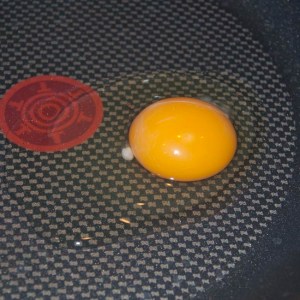
Fresh egg

It’s a sad fact that in the supermarket dominated, urban West, most people have probably never tasted a really good, fresh egg.  We think of eggs as being uniform, sized and graded, cheap and frankly, dull.  But they’re a natural product, and they vary – in size, colour and shape – and from the very firmest, freshest example, to the end of their storage life when the egg white is watery and the best of the flavour is gone.

I said nothing beats a very fresh egg, but of course that depends what you’re doing with it. If you want to beat the egg and use it to help with raising – in baking, or a soufflé – or you want hard boiled eggs peeled for a Salade Niçoise, then the very freshest eggs aren’t for you.  The egg white – the albumen – is actually in two parts.  The outer albumen is quite watery, you can see it spread out in the pan in the photo above.  The inner albumen is much more firm in a very fresh egg (but in an egg which has been stored for some time you probably won’t be able to see a distinction between the two).  In a very fresh egg this inner albumen has too much structure and tends to want to hold together, which doesn’t allow the batter to rise properly.  Furthermore, if you hard boil a really fresh egg and then remove the shell, the outer albumen will come away with the shell, which is a waste and makes for a scruffy-looking boiled egg.  Eggs about a week old are best for baking and hard boiling – realistically you won’t get eggs much fresher than this from the supermarket, though.
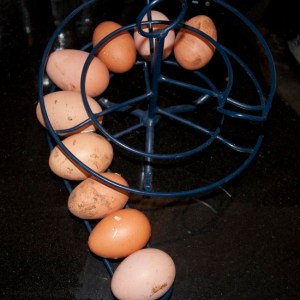
Egg storage

These are my eggs, and three things are obvious – first the range of shapes and sizes, secondly that they’re in some sort of wire device (it’s called an Egg Skelter, and I wouldn’t be without it) and not in the fridge, and thirdly that, frankly, they’re a bit grubby!

The size variability is something that you have to make adjustments for with ungraded eggs.  My approach is to weigh them and then adjust according to standard size references.  The Lion Egg Scheme people have a size guide here.

Fresh eggs will keep safely at room temperature for 3 weeks (it’s no coincidence that this is the length of time they have to stay ‘fresh’ under a warm hen if being hatched!), but if you do put them in the fridge, then you need to leave them there.  If eggs are removed from refrigeration, moisture condenses on the outside of the shell and can then be drawn through into the inside of the egg by osmosis, potentially pulling pathogens from outside the shell into the egg itself and increasing the risk of food poisoning.  My eggs don’t sit around for anything like three weeks (if I have a glut I know plenty of people who are happy to help me deal with it!) so storage at room temperature is ideal.  Better still, the egg skelter enforces first-in-first-out use, which is trickier with other storage systems.

So you’d think washing the dirt from the outside of the egg would be a good idea, right?  In fact dissolving these contaminants in water, and disrupting the outside surface of the shell, also increase the risk of pathogen entry.  Much better to leave grubby eggs as they are, and rub off any loose dirt and mud from the surface just before use.  Egg washing is not permitted in the production chain for commercial shell eggs in the UK, on a risk assessment basis, though it is common practice in other countries including the US (they tend to wash in a chlorine solution – because bleach is what you want in your eggs!).  This goes some way to explaining the obsession with clean eggs in intensive production systems – and the resulting battery cages (improved, but not yet gone), as ‘dirty’ eggs are downgraded.

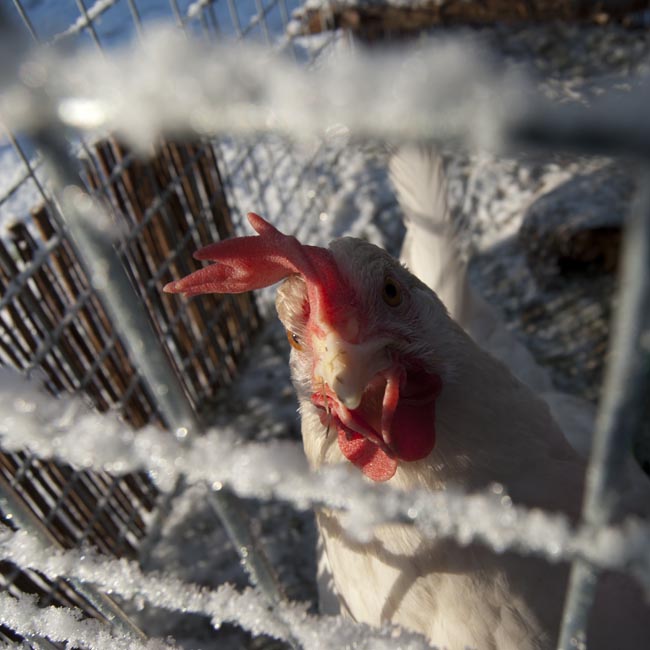
I’ve kept hens for two and a half years now.  I wasn’t expecting get as attached to them as I have, they’re fascinating animals.  Funny feathery little dinosaur-descendants they certainly are, they’re inquisitive, social (and not always sociable!) little creatures.  Only when you’ve watched hens scratch around for bugs, enjoy a bit of a flap and a wing stretch, and then settle down into a well-earned and apparently thoroughly indulgent dust bath, can you really start to understand how inhumane intensive cost-led egg production systems are.  This is Gertie, by the way, my ‘top hen’, being a bit confused by her first sight of snow, and wondering what I’m doing with that camera.

Outdoor hen

You may not be able to keep your own poultry, but if only for the sake of your palate (never mind the quality of life of the poor intensive egg-producing bird) it’s worth seeking out the best and freshest outdoor reared eggs you can find – farmers markets and farm shops are a great place to start – or ask around, you may be surprised to find a colleague keeps backyard hens, and if you’re really super nice to them, they may be prepared to share! Then, enjoy your wonderful, freshest eggs, with the best home cured bacon for the most amazing breakfast fry-up you’ve ever tasted.

Read more from the Country Skills blog >>

Heston Blumenthal – how not to roast a chicken

I saw Heston Blumenthal the other night on TV with his roast chicken recipe, and I wish I hadn’t.  His suggestions really worry me.  Leaving aside his recommendation to brine the bird before roasting (because what we all need in our western diets, ladies and gentlemen, is more salt!), he advocates roasting the bird at 90 degrees centigrade (70, even, in a fan oven!) for several hours to a target internal temperature of 60C in the thickest part of the breast.  While I have no doubt that this treatment results in a marvellously moist tender bird (it’s barely cooked after all!) the food safety implications of the process are pretty horrifying.

All raw meat is contaminated with bacteria. This is just a fact of life – after all, meat is dead animal, and animals have bacteria in and on them in life which are impossible to remove in the course of processing.

Poultry meat in particular is high risk.  A UK study published in 2000 identified Campylobacter jejuni in 83.3% of supermarket chicken that they sampled.  I would go as far as to say, I almost guarantee that any raw chicken you purchase will be contaminated with Campylobacter, Salmonella or E. coli, and the risks are probably higher with free range birds which aren’t raised in a sealed environment.

The reason we don’t all have food poisoning all the time is that cooking – the application of heat – is extremely effective in killing these pathogens.  Here’s the problem – Salmonella requires a temperature of 60C for 10 minutes to be effectively killed. Campylobacter also needs to get to 60C, though it’s a bit  more fragile so a minute or two should do trick.  E. coli is more robust – but less common in poultry meat – and needs to be heated to 72C.  The universal advice for safe cooking of poultry meat takes all of this into account and advises the thickest (and hence least heated) part of the meat should reach a minimum temperature of 75C for at least 10 minutes.

On these numbers you can see how Heston’s recipe might *just about* not be gastrointestinal suicide, but you would want to be very confident of your temperatures.  The trouble is, any error in measurement – if your probe isn’t really in the absolutely coldest part of the bird – is going to read higher than the true lowest temperature, making it very easy to overestimate the minimum temperature and have parts of your bird below 60C.

To be quite honest, I don’t care how tender and succulent this roast bird might end up – it amounts to food hygiene russian roulette!  I’ll be staying away from the Fat Duck, I think.

Please, if you want a wonderful succulent roast chicken, buy a good free-range bird with some good fat under the skin, add some lovely flavours in the cavity (I like a quartered lemon with some whole cloves of garlic and a handful of thyme), a little bit of salt and pepper on the skin with a couple of rashers of bacon if you fancy it, and then roast at about 180C to a safe internal temperature.  Rest for 20 – 30 minutes before carving, and enjoy a tasty, succulent, and above all safe roast dinner!

Read more from the Country Skills blog >>

Basic Butchery – how to portion a chicken

A whole roast chicken is a wonderful treat – more on that later – but it’s not the sort of meal most people want to wait for on a week night after work.

We eat a huge amount of chicken in the UK, and a lot of that is bought pre-portionned and packed from the supermarket, it’s certainly convenient and the portion sizes are more practical.  We’re in love with breast meat in this country, to the extent that the UK is a net importer of white chicken meat – mostly from Thailand and other East-Asian countries – and an exporter of leg meat.  When you think about it, that’s pretty bizzare, not great for the environment (think of the fuel involved in sending the ‘wrong’ chicken backwards and forwards half way around the world!), and leaves us eating lower health and welfare-standard poultry meat than would have been produced in the UK.

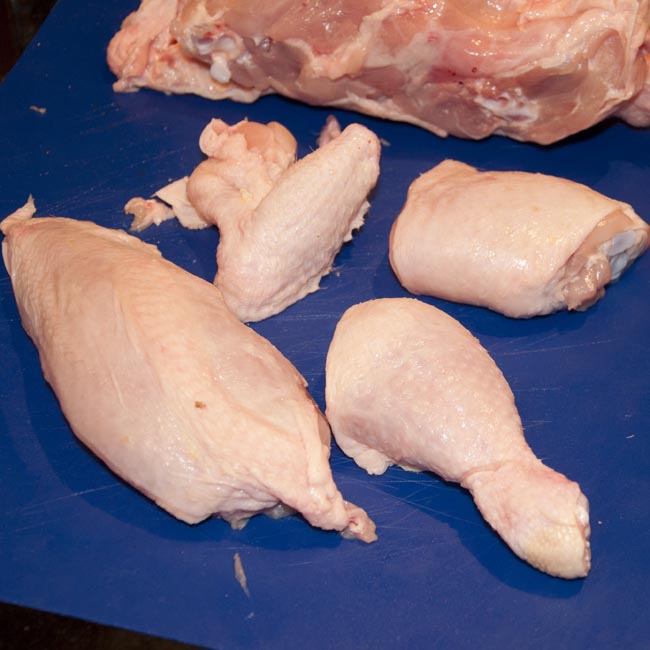
Fully portioned chicken

It’s really easy to portion up a whole chicken, and learning this basic butchery skill will save you money.  Even if you just buy a ‘bog-standard’ roasting bird from the supermarket, you get more for your money buying a whole bird and cutting it up yourself, and the savings are even better if you’re buying free range or organic chicken.  And with a bit of kitchen creativity, one whole chicken can provide three or four meals for two people, as well as a lovely batch of chicken stock – bargain!

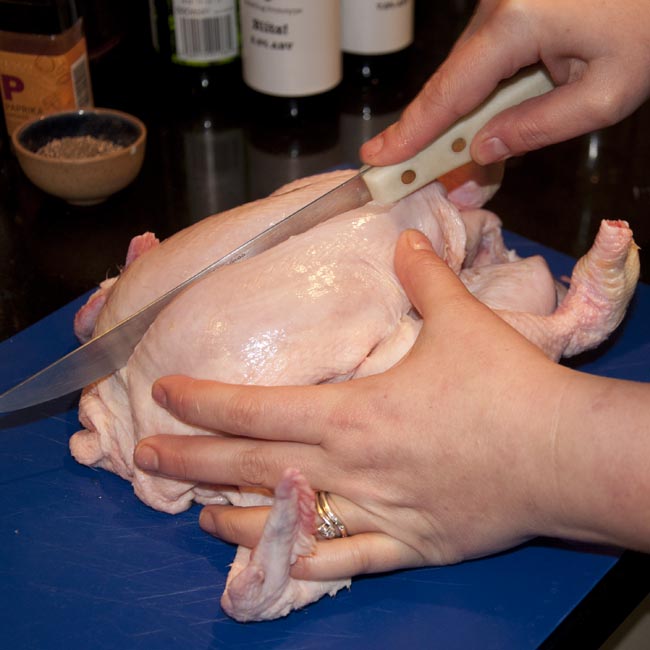
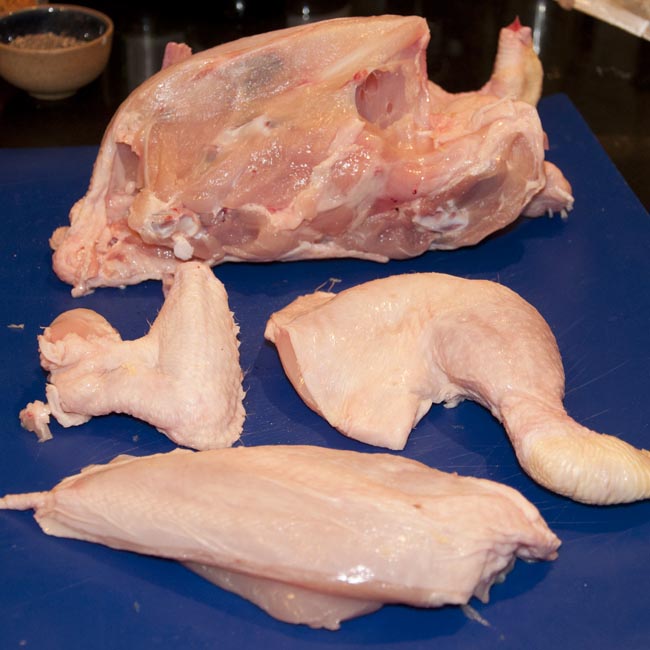
First, un-wrap your whole chicken and remove any trussing string / elastic holding the legs together.  Pat it dry with kitchen towel as this will help with handling it while you’re cutting it up.  You will need a very sharp knife with a long but reasonably slender blade.  Feel down the centre of the bird, and you should feel a bone running the full length – this is the ‘keel bone’.  Starting on this line, cut downwards parallel to the bone along the full length until your knife stops.

You can now pull the top of the breast away from the keel bone to get a better look at what’s going on.  The bone beneath the knife is the ribcage, so continue carefully cutting the breast meat away from this.  If you work carefully you’ll leave surprisingly little meat behind on the carcass.  After you’ve done this a few times, you’ll get a lot quicker, but speed is not of the essence the first few times.

Once the breast meat is mostly free from the bone, cut the skin between the breast and the thigh and finish removing the breast from the bird.

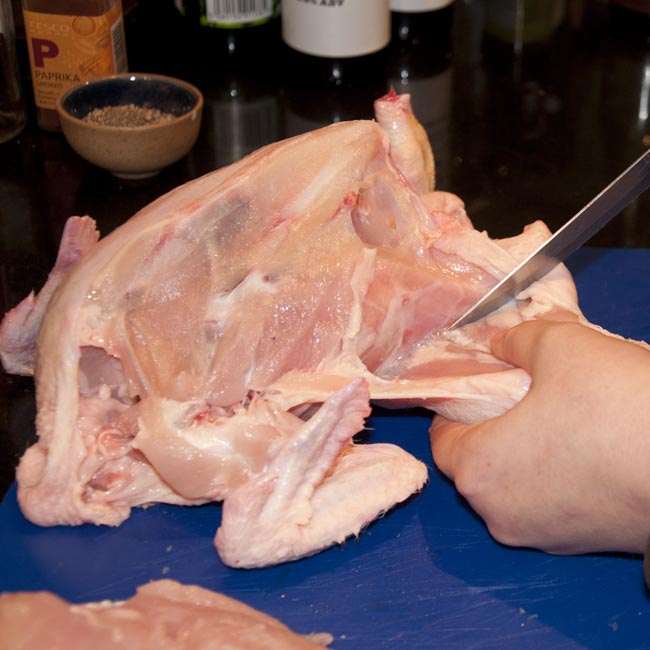
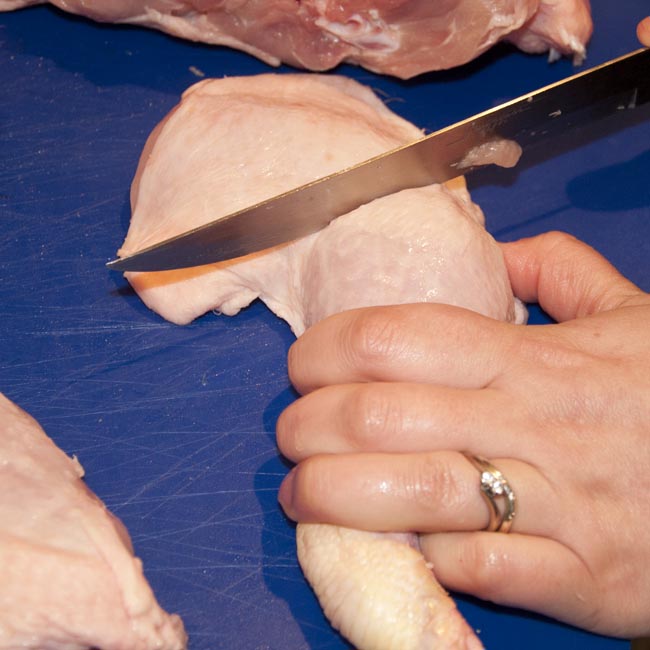
Portioning chicken - step 4Now we need to detach the legs.  Grasp the thigh and extend the leg away from the body.  You should be able to feel the hip joint (indicated with the knife point in this photo).  Insert the knife firmly into the joint to separate the leg from the body, then cut the leg meat away from the torso leaving as little as possible behind.

Portioning chicken - step 5

Grasping the wing in the same way, identify the joint and push the knife firmly through it, separating the wing from the body of the bird.

Portioning chicken - step 6Congratulations, you’re half way there!  Repeat the process on the other side of the bird.

You will now have two breasts, two legs, two wings, and the remains of the body.  Put the body in a saucepan ready to make stock.  You may be happy with the portions you have now, but more commonly we’d divide the legs into thigh and drumstick portions

Portioning chicken - step 7Grasp the leg, and feel where the joint moves between the thigh and the drumstick.  Simply cut down firmly along this line.   If you’re accurate your knife will pass through the joint space, but the bone here is actually quite soft so if you’re not quite on target, you should be able to cut through anyway, it will just take a little bit more force.   Cut off the ‘knuckle’ part at the bottom of the drumstick in the same way, and discard these (the only bit of waste in the process, as it happens!).

Portioning chicken - step 8You’re there – one whole chicken transformed into two breast portions, two thighs, two drumsticks and two wings, to do with as you please.  With practice it’s less than a five minute job.  Better still, think of the costings.  With standard supermarket chicken (I costed this in my local co-op the other day), starting with a £4 bird, and bearing in mind two breast fillets retail for £3 (smaller fillets than you’ll get from a roasting bird, with the skin off and frequently robbed of their ‘mini fillets’, too!), you’ve just got two thighs, two drumsticks, two wings, and a pint of excellent fresh chicken stock for £1.  Use what you want today, and bag and freeze the rest.  How’s that for thrifty!

I said I’d come back to roasting chicken.  That’s for the next post!

Read more from the Country Skills blog >>

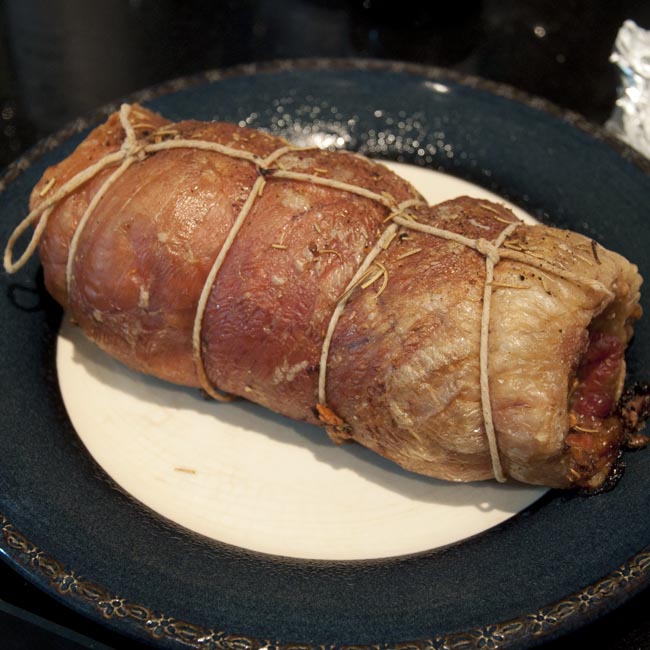
Frugal Food – stuffed breast of lamb, roast dinner on a budget

Breast of lamb is a rather unfashionable cut these days.  In my household it’s usually known as ‘lamb belly’ by analogy with the matching cut of pork.  It’s made up of the abdominal body wall, starting with some ribs just in front of the diaphragm and extending backwards. Folded in three and wrapped in cling-film, it’s a rather uninspiring looking cut. You won’t get it at the supermarket, and it won’t be on display at the butchers, but if you ask it’s likely you’ll get a whole one for not much more than £1.  With a very little bit of effort, you have one of the most cost effective (and tasty!) roast dinners you can buy.

We first discovered breast of lamb when we started buying half-lambs from local smallholders.  I wish I’d discovered it when I was a student, I could have had some fantastic roast Sunday dinners on a budget!

This is a great meal made almost entirely from the store cupboard.  You will need:

  • One breast of lamb
  • Some breadcrumbs
  • An onion (red or white)
  • Garlic, several cloves
  • Rosemary, thyme, sage (fresh or dried)
  • One egg
  • Kitchen / butchers string
  • Potatoes / parsnips / sweet potatoes / swede
  • Some green veg (I had some frozen peas, but anything will do)
Deboned breast of lamb

Deboned breast of lamb

First of all you have a little bit of butchery to do.  It’s unlikely the ribs will have been trimmed out, so you’ll have to do this yourself.  Be careful, and patiently cut around and along each rib with a paring knife and lift it out from the ‘inside’ of the breast.  With practice this is no more than a five minute job, though it might take a bit longer to start with.  It’s likely your breast has been in the fridge, so the meat will be cold.  Stop if you notice your fingertips getting numb, and rinse them under warm water to warm them up again – you’ll have less sensory feedback from cold fingertips and you’re much more likely to make a mistake and cut yourself – which is not the aim of the exercise!

Stuffing ingredients

Try to preserve as much meat as you can attached to the breast – but if you accidentally cut a piece off (and there are some annoying bits of diaphragm which are quite tricky to keep attached) just put it back as you’ll be rolling and tying the ‘joint’ later.

Stuffing on the breast of lamb

Now make the stuffing.  Mix the finely chopped onion, crushed / minced garlic, breadcrumbs, herbs and egg together.  Season with a bit of salt and pepper.  Then spread this across the inside of the breast and roll it up, starting at the narrow end (where the ribs weren’t).

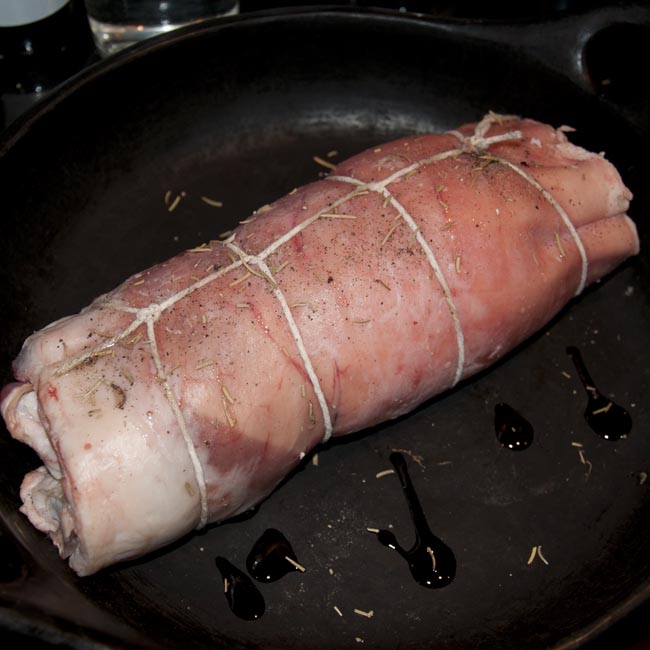
Tied rolled breast of lamb

Tie the rolled joint up with string using a butchers knot.  This involves making a series of linked  loops and tying off at both ends, and is a useful knack to learn.  It’s also not dissimilar to the knotting technique used for casting a cow!  Put the rolled join in a roasting dish, drizzle with olive oil, sprinkle with pepper and dried rosemary, and put into a low oven (about 160C) for two and a half hours.

Roasted breast of lambPrepare whatever roast veggies you prefer (I did spuds and sweet potato) and start these at the appropriate time.  You could even have yorkshire puddings (we did!).

Carved roasted stuffed breast of lambThen in due course get the joint out to rest, prepare your green veg and gravy, and dish up.  Add some nice fruit jelly, if you have some.  Crab apple and chilli jelly was a perfect accompaniment.

This is a fabulous roast dinner, and will serve three or four for nearly nothing – we’re greedy so it fed two hungry adults!  Serve with a nice beer or a glass of red wine, and enjoy!

Roast breast of lamb with all the trimmings, served and ready to enjoy

Read more from the Country Skills blog >>

Happy New Year!

Here’s wishing all of you a very happy 2012, and hoping your new year’s celebrations went with a bang!  I should have written this yesterday, of course, but timeliness has never been one of my more natural talents (as people still waiting on Christmas cards from me will attest)!

Fireworks

I’m ambitious to do experiment with even more creative, country skills and crafts next year, and write about them too!  On my list is more brewing (cider, beer, and of course country wines), more curing and smoking, and experiments with sewing, crafting, recycling and thrift.  More food and recipes, of course, as well as some fruit & veg growing as the season starts to get warmer.  I also plan to write a little about my hens and poultry keeping, and to try some new crafts – at the moment I’m reading about candle and soap making, so watch this space.  Perhaps this year my Advent candle might even be homemade!

Thank you to all of you who have been reading the blog since it started back in October 2011 – both here on WordPress and in the syndicated feeds – your comments and feedback mean a lot to me and are very helpful, so please keep them coming!  I’d love to hear of any suggestions you might have for things I should be looking into and trying, too!

Handmade Christmas – cracking crackers!

Christmas crackers are great, and an essential part of Christmas dinner in my house.  I mean, what’s not to like about adults wearing silly paper hats after a lovely meal and plenty of wine?  But the ones I’ve bought always seem to contain absolute rubbish which no one would ever want.  How about making your own, with the traditional silly paper hat and motto, but with the added bonus of a small, thoughtful gift, an after dinner chocolate, or both?  Well, it’s simple and fun, here’s how!

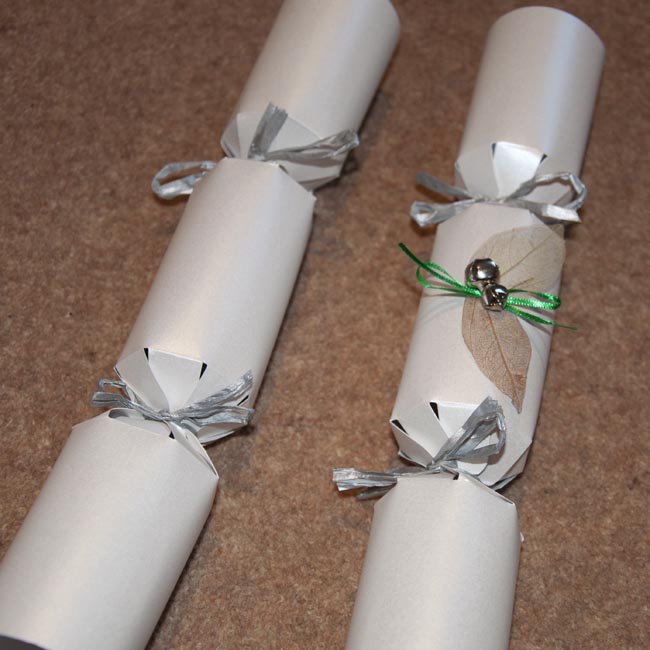
Handmade Christmas crackers

You will need:

  • Some cracker ‘blanks’, these are widely available from craft shops and on the internet in various sizes, colours and pack sizes.  I chose plain silver ones.
  • Cracker ‘snaps’, if these aren’t included with the blanks, one for each cracker you plan to make.
  • Ribbon, wool, raffia or string, for tying the crackers up, as decorative as you like.
  • Decorations for your crackers, if you want.  I used metallic leaf skeletons, some ribbon and a couple of small jingle-bells, all glued in place, but be creative, anything from the card making section of the craft shop is a good place to start, or how about some decoupage with last year’s Christmas cards?
  • Finally, cracker gifts!  I found some quite cute keyring gadgets of various kinds and also added a nice after-dinner chocolate.  If the gifts are for specific guests, put name-labels on the crackers.
  • Scissors, sticky tape, and clear glue.
  • Make hats and mottos yourself!

Making them couldn’t be easier and is a crafty relaxing way to spend a dark December evening.

First three steps of cracker constructionStart by sticking one end of the cracker snap onto the cracker blank with sticky tape.  Then roll the cracker blank using the tabs (cracker blanks have slightly varying designs, so follow the instructions that come with yours!).  Pinch, twist and tie up one end of the cracker with the string, ribbon, or other thread you’re using – I used silver paper raffia.

Decorating the finished crackersNow fill your cracker with all the bits and pieces, and tie up the other end of the barrel in the same way.  Once you’ve tied this up, stick the second end of the cracker snap into place.  You can decorate the crackers now however you like!

‘But what about my hat and motto’, you may be thinking?  I did see hat-and-motto sets for sale, but they’re awfully expensive considering what you get, a cheap tissue paper crown and a small slip of paper.

Making the hats couldn’t be simpler.  Get some Christmas wrapping paper, I used the end of a roll of white and silver metallic paper which I had knocking around.  First, measure the circumference of your head (unless it’s unusually large or small, in which case perhaps find someone with a more ‘representative’ head to measure – then again, you’ve made them, so perhaps it’s only fair to claim the perk of a cracker hat which fits for once!).  Now cut some pieces of wrapping paper twice as wide as the finished hat you want, and about 1cm longer than the circumference you’ve measured.  Using clear sticky tape, stick the paper into a loop.

Making paper crowns for crackers

Now fold the loop flat (image 1), then in half, then fold each of the halves into three, so that you’re now on the central panel of the film-strip above.  Now fold this in half one last time, then make a single diagonal cut half-way up the paper.  Unfold your two zig-zag topped crowns.  It’s like being back in primary school!  And since they’re neatly folded, tie them that way with ribbon or a small elastic band.

For the mottos, anything goes!  Good (or bad!) jokes, limericks (or haikus?), brain teasers, interesting facts, or even thoughts for the season or personal wishes for your family and friends’ year to come – make them pretty in a word processing package, print them out, cut into strips and fold them up with your paper hats.

Crackers needn’t just be for Christmas – they’re a lovely creative way to package small, special gifts.  An unusual way to wrap a special piece of jewellery, perhaps even a surprise ring?  Or consider using crackers to package wedding favours?