Don’t be Sour – a dalliance with yeasted ‘quick’ bread

Regular readers of the blog (and those familiar with the intermittent Sourdough Saga series of posts) will know that I *love* my sourdough starter. It’s fair to say I love it like another pet, like a member of the family.  I feed it and care for it (and, admittedly, stash it in the fridge for a fortnight at the time – please note that this is not generally advisable treatment of household pets!) and in return it rewards me and feeds me with some of the very best bread I’ve ever eaten, anywhere in the world.  It seems a more than fair exchange for my time and effort!

Sourdough loaf selection

The beauty of a sourdough loaf, its rich deep flavours and developed texture, are the result of the long, slow, patient process of fermenting, kneading and raising, followed by a blistering hot (and preferably steamy!) baking oven.  My ‘big batch’ of sourdough bread makes two large loaves, or two smaller loaves plus some rolls or a pizza, uses 1.25kg of flour, and lasts us about 10 – 14 days, freezing the second loaf.  But making it takes about 24 hours, starting the night before baking with the creation of the sponge, followed by a whole day during which the dough has to be kneaded and shaped periodically, finally baking around dinner time.  It’s not a chore – to me at least! – but it does require a whole day at home, and of course I don’t always have that pleasure!  The trouble with getting used to really fabulous home-baked bread is that nothing that you can get in the shops comes anywhere close.

So, obviously, I needed a solution for good, home-baked, ’emergency bread’.  The sort that, if I needed to, I could start in the evening after I get home from work, and have baked and out of the oven before I go to bed – about a 3 hour window.  Yes, you could use a bread machine in that time frame (and we have done, in the past), but I find the bread too sugared and salty when made according to the instructions, and highly ‘unpredictable’ in its behaviour if you start deviating from the recommended formulae!

Sourdough loaves keep basically forever (she says, without a scrap of exaggeration!), in that they don’t go off the same way as yeasted loaves (they’re protected from mould growth, it turns out, by one of the fermentation products of linoleic acid – you can read the paper, in the Journal of Environmental Microbiology, here).  Sure, they go stale and dry with time and exposure to air, but they don’t go furry – and once they’re too dry to eat, you can turn them into breadcrumbs, so there’s no waste, either!  My emergency loaf needs to be a yeasted loaf, and obviously needs a smaller batch size, so that we’ll get a chance to finish eating it while it’s still at its best!

I asked around on Twitter (what did we do before Twitter, folks?) and the lovely Lisa (@Cookwitch) offered me her version of a recipe for Pain D’Epi, which looked like it might well fit the bill.  I was pretty pleased with my first attempt at it a couple of weeks ago, but didn’t think to take photos at the time (bad food blogger, no biscuit!).  We’re out of bread again, I was working this morning, and I fancied something nice to go with breakfast tomorrow, so I’m making it again right now.

As I make it, you want the following –

  • 275g of strong bread flour (white flour is traditional, and it won’t be a ‘Pain D’Epi’ otherwise, obviously, but use whatever you like – or a mix, if you have ‘rag-tag’ ends hanging around like I usually do)
  • 175ml of warm water
  • 7g sachet of fast-action bread yeast (the sort that comes in the little double-sachets of small yeast pellets, that you can buy everywhere)
  • A scant half-teaspoon of sea salt
  • A good ‘glug’ of olive oil

Start by combining all the dry ingredients in a bowl and mix together – you could use a whisk, but I’d use my fingers!  Now add the 175ml of warm water, and combine to form a dough.  Add a little bit more flour or water if you need to get the consistency right, just not ‘sticky’ but not too dry as a dry dough will make too dense a loaf.

Kneading your doughNow give your dough a really good knead on a floured work surface.  Set aside 10 minutes to do this, and really give it the time and effort.  This is a single-levened bread, so this is the one and only chance that you get to develop the gluten in the flour and consequently the texture in your final loaf.  Once the dough is starting to develop a silky, elastic texture, rather than just feeling like play-dough, add a generous glug of olive oil and continue to work this in.
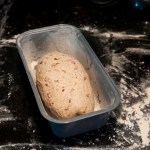
Shaped loaf in tinOnce you’re happy with the texture, shape your loaf, and either put it in an oiled and floured 1lb loaf tin, or shape it as required and place it on a sheet of oiled baking parchment on a good thin metal baking sheet.

I would guess that this batch could also make about 8 reasonable-sized dinner rolls, though I haven’t tried this myself.  The traditional form of the Pain D’Epi, as you might infer from the name if you’re francophone, is in the shape of an ear of corn – you can see the finished effect, and how you achieve it (surprisingly straightforwardly, using scissors!) here.  It’s a great tear-and-share shape and I really must try it some day!

Covered with oiled cling filmBut back to my loaf, which is sitting in its much more traditional British loaf tin.  Cover the tin loosely with oiled cling-film (PVC-free, please, especially if you’re using it with oily food), and put it somewhere warm.  Mine is going by the fire this evening – because yes, we have the fire going in what, really, is mid-March. Isn’t that depressing?

Allow it to rise for an hour or two, depending on temperature, until it has at least doubled in size (and filled the tin nicely, if you’re using one).  The initial preparation and kneading takes about 15 minutes, which means that I can usually squeeze it in while dinner’s cooking.

Risen loafOnce the loaf is nicely raised, score the surface with a sharp knife in a pretty pattern of your preference (or construct ears of corn, if you’re feeling flash!) and put it into a pre-heated oven at 200 degrees centigrade for about half an hour – it will rise some more in the oven, if you’re lucky (though not anywhere like so much as I’m used to with the well-developed sourdough) and is done when it’s a lovely golden colour all over and the base sounds hollow when you tap it.  I tend to take tin loaves out of their tins and return them to the oven for a final few minutes to get a nice crispy crust all over.  Free-formed loaves may benefit from being taken off their baking sheets and placed straight on the oven rack, in the same way, to make sure they’re not at all soggy-bottomed!
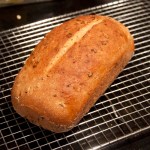
Baked loaf, coolingOnce your loaf is baked, take it out of the oven and allow to cool on a wire cake-cooling type rack if you have one – I only bought mine very recently, and always used to use a cold oven rack I’d taken out before starting to bake the bread, which unsurprisingly works just fine!  Revel in the lovely smell of fresh bread that now permeates your house, and look forwards to the morning!

Overall, this is a really quick, useful, ’emergency bread’ recipe, that seems to work very nicely with all sorts of flours (today’s loaf was made with some malted granary bread flour I had sitting around at the back of the baking ingredients shelf).  It’s streets ahead of anything you can buy from the supermarket or corner shop, though it doesn’t quite stack up in terms of flavour and texture against slower-fermented yeasted loaves that you might make at home, or buy from a good artisan bakery.  Texture wise it does tend to be a bit ‘cakey’ and edges towards being a little on the heavy side, which I ascribe to the single kneading and rising cycle and lack of opportunity for gluten development.  Still, these are knit-picky complaints when you consider how quick and convenient it is to make, and how much nicer it is than any of the commercial alternatives!

Finished loaf

I wrote, back in June of last year, after my first successful sourdough loaf, that “the bar for ‘good bread’ has just shot skywards in our household, and I suspect things may never be quite the same again.”  I was right.  I’m such a bread-snob now!  But this is good, quick, simple bread, and definitely earns a place at our table.

Read all the posts in the Sourdough Saga >>

Read more from the Country Skills blog >>

Living in Glass Houses – DIY greenhouse build

I have to admit to having wanted a decent greenhouse for as long as I can remember. Growing up, my grandmother’s neighbours had a beautiful greenhouse and vegetable garden, which I used to admire from over the fence, and I suspect my life-long enthusiasm for the glass-house springs in part from this!

Dave, showing off his new greenhouse!

Apologies, incidentally, for the quality of the photography in this post – I made the mistake of thinking I had enough on my hands and that photos from my mobile phone would be ‘good enough’ rather than worrying about the SLR as well as everything else.  The photos took ages to tidy up and even now aren’t really up to my usual standard!

A little while after Christmas, while we were watching telly, I asked hubby whether we were really going to get on and build a greenhouse this year.  Yes, he agreed, we definitely were. So I did a bit of digging around, and had more or less decided that for what we required, a baby polytunnel was probably going to be more cost effective and sensible.  Then, deploying his superior (well, so he says) google skills, he turned up a 6ft x 10ft aluminium and polycarbonate greenhouse for about the sort of price I was finding for tunnels.  It seemed like a no brainer, so we got on and ordered it. It arrived a week or so later.

It’s been sat in the garden in two boxes since then, of course, because the weather we’ve had this winter can only be described as ‘not compatible with construction projects’.  As it happens, I’ve given up complaining about the weather for Lent (yes, it’s been that bad!), so I’ll spare you the details.  It finally started to dry out a little a couple of weeks ago, so we finally had a window to get going with the ground works.

The intended site for the greenhouse is on our ‘paddock’, which is a scrappy bit of ridge and furrow pasture land, most of which we planted for an orchard three years ago.  The grass is very established and the land isn’t level (the clue is in the ‘ridge and furrow’!). The only way we were ever going to get a level frame for the greenhouse was to dig a ‘slot’ for it out of the pasture grass to level it, and set a frame of breeze-blocks on which to rest the building.

You’ll need a good spade, a turf cutting tool and ideally, a mattock. We measured out the 6ft by 10ft rectangle and got to work.  Once we’d cleared the space, it occurred to us to consider in more detail the ‘6 x 10ft (aprox)’ size given on the greenhouse packaging.  It turned out the greenhouse was sized in something that could only be described as ‘metric feet’ by its German manufacturers.  Armed with the metric measurements, we enlarged the slot by a reasonably generous margin, and turned in for the evening, pleased with ourselves for having completely cleared the required space, and confident we could crack right on with building the greenhouse the following day.

The next day dawned cold.  Really cold – barely above freezing, in fact, despite being late February.  Undaunted, we put on our ski jackets and thick woollen socks, and headed back out to the greenhouse site. We’d gathered together enough lightweight breeze blocks to do the job – the sort that are made from a sort of concrete ‘froth’, a bit like an aero bar, and would float, if you let them.  Our sophisticated building and levelling tools were the spade and mattock from the previous day, a spirit level, and some string.  The blocks themselves were to act as ‘squaring’ guides, in due course.  And, as we hadn’t yet managed to pick up a bag of sharp sand, we had only the soil itself to use to pack the blocks straight and level.

Assembling the brake blocksThe first course of blocks assembled itself quite straightforwardly.  The mattock is a great help in cutting a clean trench, and then the blocks just go in one after another, with a check on level and height adjustment on each.  After setting the corner as square as we could using one of the blocks for reference, a couple of pegs and a length of string set the alignment for the next course.  Things were going well!

Two courses more or less complete, we wanted to make sure we had the right dimensions for the greenhouse, so we decided to get out the base from the kit and get that assembled for reference.  This done – and it was nice and straightforward (though it revealed that the assembly instructions were a ~50 page pictographic document, in the IKEA tradition) – we offered the frame to the greenhouse site, and discovered our slot was too narrow, given the width of the blocks.  In a stroke of good luck, we also discovered the base build could be bodged to use only whole blocks, which was a huge bonus.

Three courses placedCarrying on with the cut, measure, level, we had three courses installed.  We laid out, crudely, the blocks for the fourth course.  Inevitably, this is when you discover that, rather than a neat rectangle, and despite your most careful efforts, you’ve built some sort of trapezoid only theoretically known to mathematics. A bit of head-scratching and adjustments to the squaring, requiring a bit of extra turf cutting, and we put down the fourth course.

Greenhouse base, complete

It had been trying to snow all afternoon, and we’d been outside for five continuous hours laying the foundation blocks. It seemed apparent that one of the corners (the back one, in this photo) was lower than it should have been, but we were running out of energy, and light.  We tidied up and came back indoors, and gave up for the weekend.

Pro-tip: you know you’re really, properly, cold to the core when you *start* shivering several minutes after you get into a nice warm bath…

Skip ahead, then, through a working week to this weekend.  Finishing the greenhouse was our main order of business.  The weather, at least, is improving – no snow this weekend and even moments of sunshine!

Fixing the base down onto the blocksFirst up on Saturday, completing the levelling of the base.  Easy enough with the base frame sitting on top to confirm our suspicion that the back corner was ‘down’.  We’d got hold of a bag of sharp sand, so correcting this by lifting the two sides progressively was pretty straight forward.

Then, after placing the base as square as we could on top of the blocks, we marked the fixing holes, drilled these out with a hand drill, and then after placing rawlplugs, screwed the greenhouse frame down into place.  (Hint – mark carefully, and then *check* – it’s annoying when the holes aren’t quite in the right place!)  Skip any holes which are really close to an edge, as the block will just crumble away. Note that we’ve used no mortar at all in constructing this base.  You could, of course, if you wanted a more permanent foundation.

Out of the ground at lastThe sun was thinking about coming out, and we were ready, finally, to get the greenhouse build out of the ground.  The construction guide is purely pictorial, and weighing in at 51 pictographic pages, is something out of a flat-pack-furniture-phobe’s screaming nightmare. In the end, it’s just a question of following the instructions, as carefully as you can.

Our greenhouse was manufactured by ‘Palram’ and is a ‘crystal clear’ (read vaccuum-formed, single-ply) polycarbonate glazed aluminium framed greenhouse.  We bought it via B&Q but their greenhouses are stocked by lots of different retailers.  We’d built a tiny (6ft x 4ft) polycarbonate and aluminium greenhouse in our previous townhouse garden, and I was expecting the same, two-ply corrugated polycarbonate glazing that we’d had before, and which we were very pleased with.  I can only surmise that the insulation properties of this single-ply material won’t be as impressive as the other option.  And handling the glazing panels, which seemed alarmingly lightweight, was a bit hairy in places.  That said, once complete, the finished greenhouse does seem reassuringly ‘solid’. So, time will tell!

Side panels installedBut, back to the build.  Proceed carefully according to your pictograms.  Those on the cover informed me two people would be required, and that was certainly the case – at various times this build would have been completely impossible to perform single-handed. I was expecting to assemble the four walls individually and then combine them, but this wasn’t the case – the whole thing came vertically out of the base, acquiring glazing as it went, and then the build continued up into the gables and finally onto the roof.

We made one mistake (repeated at all four corners), which gave us some trouble until we noticed what we’d done wrong – fortunately our efforts at mitigation only involved some very slight trimming of some edges of the polycarbonate panels, nothing with any lasting consequences. Hint – if there’s more than one possible hole you could screw in, check, and check again before committing (and stop that giggling at the back!).

I gave a few small blood sacrifices on the sharp metal edges of the frame while threading the glazing panels.  The instructions tell you to wear gloves, of course, but it’s impossible to do this while fiddling with the 120 pairs of small metal nuts and bolts that hold this monstrous Meccano set together, and in the end I gave up, and suffered the consequences.  Overall we felt that, at least where it came to the glazing panels, the manufacturing tolerances were probably wider than the assembly ones, which made things a bit tricky from time to time.

Greenhouse roof installedGetting the roof apex installed did require a ladder (at least for us – though we’re both a little on the short side!), which isn’t on the list of required equipment.  It would have been a bit of a nuisance if we hadn’t had one conveniently available!  With the sun setting, and the roof on – missing only the final fitting of the window vent, and the door – and after seven hours solid work, we gave up and went to the pub for a well-earned steak dinner and a couple of pints of rather nice Ringwood bitter.

This morning, after a more sedate Sunday breakfast, we got on with the finishing-up tasks. The window went in quite straightforwardly.  The door was a bit fiddlier but posed no major challenges (and is very thoughtfully designed, in fact). By lunchtime, we had a completed greenhouse frame and glazing.

Hubby had work to do this afternoon, so after a whistle-stop trip to Wickes, he got on with that while I cracked on with the inside of the greenhouse.  I was hoping, rather ambitiously, to finish this evening with the hard-standing for the staging installed, as well as a paving slab path, the staging fitted, and the borders initially dug-over with a ceremonial planting – perhaps a row of early carrots, or something – completed.

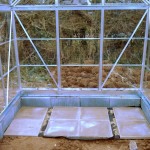
Laying the slabsLevelling the ground and installing the slabs was probably, in fairness, a good worked example of why you shouldn’t let amateurs do hard-landscaping!  The soil at the back of the greenhouse, where the staging was going, produced a rich vein of solid clay, the kind that would probably have made a victorian brick-maker’s month.  Again, we wanted to avoid concrete or mortar, so the paving slabs are to be laid directly onto a layer of landscape fabric on top of the soil, using some ‘pads’ of sharp sand to help level them.

Hard standing installedThere are gaps between my slabs, which I’ll fill with some gravel once I’ve remembered to buy a bag.  Eight blocks across the back of the greenhouse provide a space for some shelving, and then a five-block path runs between the two greenhouse borders from the door.  I’m hoping that the slabs will also provide some useful heat-sink effect to hold warmth into the evenings as the temperature drops.

It’s around this stage in the process, when you’re raking the soil under the pathway to a fine tilth, while treading your precious borders harder and harder, that you remember that gardening is about pretty flowers in the same way that house-building is about paint colours for the hall.  In the end, it’s mostly hard labour!

Greenhouse staging 'installed'Just as I was ready to give myself a big pat on the back and congratulate myself on a job well done, I realised I had a small problem with my (great, cheap!) greenhouse staging.  The pack, describing itself as 2ft 11in (x2) greenhouse shelving (and I’d measured the gap!!) turned out to have the ‘aprox’ behaviour in the, compulsory, unhelpful direction.  They don’t fit!  Until I decide whether I want to take a hacksaw to eight lengths of steel tubing, they’re installed at a rather ‘jaunty’ angle…

No ceremonial carrots, but three big pots of compost with my newly-arrived hop rhizomes in them, pending the preparation of their final planting site.  There’ll also be a water butt to collect the run-off from the roof and reduce the distance I have to walk to fill the watering can.

Completed greenhouse

I think we’re both, it’s fair to say, seriously pleased with our efforts, even though it’s been physically very demanding and taken about twice as long as we had imagined it would.

To finish, and following Ross’s example in his excellent barn door guest blog post, some summaries:

Costings –

  • Greenhouse kit, including base & glazing – ~£350
  • Breezeblocks – £32
  • Paving slabs – £32
  • Sharp sand – £1.81
  • Landscape fabric – can’t remember, it was in the back of the shed

Time invested –

  • Ground clearance ~1 day, two people (or a bit longer for one)
  • Installing breeze-blocks ~1 day, two people
  • Greenhouse build ~ 1 day, two people (if you get up sharpish or have more hours of light than we did!) allowing extra if you want to do silly things with paving slabs inside.

Lessons learnt –

  • Measure, then measure again. Then have someone else measure too.  Don’t trust the measurements on packets, especially when they may be ‘metric’ feet-and-inches!
  • Wear gloves, unless you want to discover quite how sharp the sliced edges of extruded aluminium components can be.
  • Consider the weather forecast.  It can be really *really* cold in February! And finally,
  • If there is more than one possible hole… insert your own joke here.

I can’t wait to really get growing!

Read more from the Country Skills blog >>

Built Like A Barn Door – or, how to make your own shed doors [Guest Blogger]

Lemon TreeOur Guest Blogger is Ross, from Christchurch, NZ.  

You may recall the lovely series of lemon-glut busting recipes which Ross has shared with the blog.  As well as all that preserving, he’s been doing some DIY lately – and I was so impressed by this new shed door that I rather cheekily asked him for a write-up!

So, as they say, now for something completely different! But something which is still undoubtedly a very useful country skill – woodwork.

Scenario

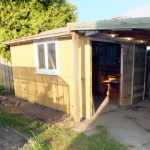
We have a shed. It’s timber-framed, and until recently it was clad with asbestos boards. We got some professionals in to remove and dispose of it properly, and then had a local builder come and reclad the shed in plywood. So far so good, but his quote didn’t include reinstating the door – which, to be fair, was old, rotting, and had a sliding track which was ruined when the asbestos guys ripped it off.

Shed, doorlessWhat to do?

The aperture was 190-191cm high and 140-141cm wide. (Yes, the edges are not parallel; what do you expect?) An unusual size, and if I did get a door made to fit that, I’d also have to shell out for delivery as it wouldn’t fit in the car. Such a wide door would have quite a large swing, which could be a bother.

I got some door designs from various DIY books and websites. The traditional basic ledged-and-braced door design – described as having a “rustic” feel – would certainly work for us. In short, you lay out some planks side-by-side, then nail or screw two horizontals and a diagonal to keep them together, and there’s your door.

Single door panelI don’t have a good picture of the design that doesn’t infringe somebody else’s copyright, but – skipping ahead a bit – here’s what one of ours looks like.

I rapidly came to the idea of a double door to reduce the swing size. But if I made a pair of ledged and braced doors, I’d still have the same problem getting the parts home from our local DIY barn as the wood would be too long to fit in the car.

There was a bit of head-scratching, and a few minutes more spent getting the splinters out from under my fingernails, before I realised what I could do. Stable doors. That is to say, a pair of doors with the ability to swing independently but which fill the frame vertically.

So, to deal with the swing issue as well, I’d make a double stable door. That is to say, four doorlets to fill the space. What could possibly go wrong? I should point out that, between my partner and I, we have limited tools, skill and experience. We have an electric drill and a Workmate, and know what end of a hammer to hold (beginners please note, not the metal end), but New Yankee Workshop this ain’t…

Design

door drawingHere’s the design. H for hinge, S for a door-stop, and the brown rectangles are tower bolts.

If you compare it with other ledge and brace doors, you’ll notice this is a modified design. Traditionally the ledges would both be a little distance in from the top and bottom of each door. Here I have moved the central ledges nearly flush to the edge, for convenience in bolting them together. (I still needed to be able to bolt one side at the top and bottom, but I figured I would use off-cuts to extend the ledges where I needed to. You probably don’t want both ledges to be flush with the edges in case you need to shrink the doors later.)

So I spent a good while in Mitre 10 figuring out which of their available pre-cut timber widths would give me a reasonably convenient time of assembling it all. (I had hoped to find tongue and groove, but they don’t keep any. That was OK as their regular boards are uniform enough; some are a bit warpy but not too bad.)

It broke down like this:

  • Right side: 7x 13.5cm x 9mm boards per door
  • Left side: 2x 23cm x 9mm boards per door
  • Bottom half: Boards to be 1.2m long, uncut
  • Top half: The same 1.2m boards, to be initially cut a few cm too long, then later cut to fit precisely.
  • Ledges (horizontals): Cut to same width as their respective doorlets. I realised later they need to be a little smaller to allow for the swing of the door.
  • Braces (diagonals): Pythagoras tells us that these are going to be longer than the verticals or the horizontals. As they’re blocks with a non-zero width the length will be slightly longer than by Pythagoras, but it worked out within about 1%.

You may notice that (7 x 13.5cm) + (2 x 23cm) comes to 140.5cm, for an aperture that varies between 140 and 141cm in width. This would prove to be annoying later.

Assembling each doorlet

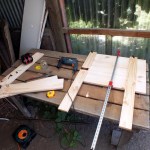
Assembling the doorletLay out your panels side by side. Use a spare block of wood to square up the ends. (For the 7-panel doorlets I did this in two stages, four boards then three, as my working area wasn’t quite wide enough.)

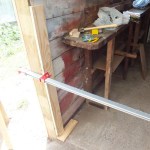
Clamp the ledges into place. I also used a sash clamp to hold the planks together laterally; I don’t know whether this was essential but I suspect I’d have needed more G-clamps if I hadn’t.

Then pin the ledges to the planks. You can do this with nails but I used screws (drilling pilot holes first, of course). I attached each end of the ledge to its corresponding board with three screws, then put one screw into each intermediate board; the same for the other ledge. This may have been overkill.

Next cut and attach the braces. We just marked these with a pencil and steel rule, then sawed as close as we could to the line (fixing up later). The braces have to fit well as they spread the weight of the door. I fixed each ledge with two screws into each end board and one into each intermediate. On reflection this was definitely overkill.

Then paint, varnish, or apply whatever decoration you wish. For efficiency we painted only the outward faces at this point (we have still to paint the shed exterior, after all) – in a less clement climate you might be well advised to paint all of it before hanging to try and prevent damp getting in and warping the wood to next week and back again.

The hinge conundrum

I had read in my DIY book that a tee-hinge was “traditional” for this sort of design of door, so I bought some without thinking much about it. Mistake! For an outward-opening door, it was only going to be possible to put these on the outside of the door, with the screws exposed to all comers: no good for security. (Thank you, Mitre 10 returns policy…!)

I replaced them with some ordinary door hinges, of the kind that doesn’t require you to cut a rebate into the frame.

It’s important to think about where the hinges will attach to, on both the door and the frame. You can’t put screws into the end-grain of a block of wood and expect them to hold. Similarly, putting them into the side of the plywood cladding would have been hopeless. These were going to have to go into a door frame, the shed’s timber framing, or something securely attached thereto.

Shed frameOn one side I had the timber stud. No worries – just have to chisel away a small section of the plywood edge so I could attach the hinges properly into the stud and not foul their pins.

Existing shed constructionOn the other side things were a bit more interesting. There’s no frame to be seen – just the edges of the interior wooden cladding, and a bit raggedy at that.

Adding part-frameTurns out the frame is just behind, so I bought a couple more boards to act as a part-frame, which I attached with long screws through the inner cladding and into the frame.

Hanging the doors

Finally, it was time to hang the doors. You can hang a single door yourself, but it’s a bit troublesome and involves a couple of wedges; much easier with a spare pair of hands. (Sadly, I didn’t have a third pair of hands to photograph this process.)

I started out with the lower two doorlets. Obviously, the bottom doors don’t go all the way down to the deck; you want them to sit slightly off the ground (one source I read said 6mm) for clearance over any debris that may lurk. First fit the hinges (remembering not to put screws into the end grain of a ledge); then put the door into its open position, jacked off the ground; mark the positions of the holes, drill your pilots, then screw it into place.

Except, if you’re me, at some point in this process you think “hey, if I cut rebates for the hinges on that side, even if they don’t need it, I’ll save the couple of mm that will mean I don’t have to trim the doors.” Mistake! I’ve never cut rebates before, and they were distinctly less than even. Worse, the rebates I cut were sufficiently deep that when closing the doorlets fully the pressure tried to rip the hinges off! I ended up packing the hinges with cardboard and crossing my fingers. This may yet come back to bite me, but at least it’s “only” a matter of turning the fake-frames over and rehanging two of the doors, right…?

Offering up the second (larger) door it was clear I was going to have to trim a few mm off the edge for it to fit. On hanging it I found I had somehow managed to give them a 6mm height differential. I wasn’t worried; they swung well, and it’s not surprising as the ground isn’t flat, but if only I had realised this first and hung one to match the other…

Bottom doorlets installedBy now it was getting late. I had bought four heavy-duty tower bolts for securing the doors to each other and the frame, so I used one of them to keep the doors from swinging freely, then called it a night.

Fitting the upper two doors was very much like the lower two, but less close to the ground. We offered each up in turn and trimmed them to fit vertically, as planned.

On closing them for the first time (one at a time), one of the ledges prevented the other door from closing, so we cut a bevel into it. Then the doors fitted!… just. Very very tight, not really usable, so we spent a few minutes hand-sanding the mating edges down. It’s just about usable. I am reticent to take more off yet until the doors have hung for a couple of weeks as they may settle, changing their shape subtly.

Door furniture

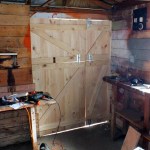
All doorlets with boltMy plan for using the door was to treat the whole thing as a double door most of the time. I fitted a tower bolt across each vertical pair to keep them together; this is why I put the central ledges where they are.

Most of the time we won’t need the full width of the door so will only open the larger half. I fitted a tower bolt vertically at the top and bottom half of the smaller pair to secure them. (I added a couple of off-cuts in the corners, butting up to the ledges, so I could attach the bolts with the same deep screws I had been using on the rest of the door. The shed sits on a concrete slab, so making a hole for the bottom bolt to drop into required a couple of minutes with a big masonry bit.)

Inside view, bolts installedThe door is secured by a hasp, staple and padlock across the top pair. I may fit a further tower bolt inside the bottom pair so we can have it held fast while the top pair are open stable-style.

A couple of door stops (not yet fitted at the time of writing) will complete the security, preventing the larger half of the door from being forced inwards when the shed is unattended.

Next steps

After the doors have had time to settle (a few weeks) I will have a good look at them and see if I need to adjust or re-trim anything. I suspect I will want to plane a few mm horizontally off the upper doors where they stick. You can see they don’t sit perfectly; can I claim some sort of amateur’s privilege?

Finished, doors closed

If you have a big gap between double doors you might want to fit an astragal. I may yet fit one on ours – depends how much I remove after it has had time to settle.

Materials and costings

[The costings won’t be of too much use if you’re not in NZ, but they give you an idea. At the time of writing the exchange rate is about NZ$1.90 to £1.]

  • Materials cost: $384.08  – of which $233 was wood, $97 door furniture, $44 paint.
  • Consumables: Sandpaper and sanding block; several dozen screws.
  • Tools used: hammer, wood chisels, electric drill (several different wood bits, a countersink, and a big masonry bit I bought specially so the bottom bolt could drop into the floor), screwdriver bits for the drill (a big sanity saver!), hand plane, G-clamps, 1.2m sash clamp (bought specially for this project; $48.15). Black & Decker Workmate.
  • Time taken: The lion’s share of three days, including trips to the DIY shop. A little more time will be needed after the doors have had time to settle.
  • Labour cost: zero!

The satisfaction of doing it ourselves: *Priceless!*

Lessons learned:

Think through your design. No, really. Don’t assume that hinges will be so inconsequential as to not require thought.

Mortising rebates is hard – or, at least, I don’t have the knack. Beware, it’s very easy to cut too much, which you can’t easily undo.

If you buy hinges that don’t require to be rebated, don’t cut rebates for them!

Remember that the door swings. A thick door, or one thickened by ledges and other attachments flush with the edge, is harder to swing than a thin one.

When hanging a pair of doors that you can see the tops of (e.g. a double stable door like this project), you might want to try and make sure the tops are level.

Ross is an expat thirtysomething Brit who went to the Shakey Isles in search of adventure. Works in technology, enjoys creating, has a love-hate relationship with his kitchen.

Thanks, Ross, for this great DIY tutorial!

It’s been so much fun having these guest blog posts from Ross – and they seem to have been appreciated, too!  So if any readers out there have favourite ‘country skills’ they’d like to share with the blog – particularly if, like Ross, you live on the other side of the world, or have great ‘urban’ country skills – then drop me a line on kate@countryskillsblog.com and we can have a chat!

Read more from the Country Skills blog >>

Stocking Fillers – perfect home-made giblet stock – Blog Advent (24)

We made it, WE MADE IT!  First of all, a huge thank-you to those of you who’ve followed me through this little blogging adventure, for your kind comments, ‘likes’, and contributions.  We did it!  24 days of daily blogs for Advent.  Well, it’s Christmas tomorrow, NORAD is tracking Santa towards us as I type (best get to bed before he gets here!), the Boxing Day ham is boiled and glazed, the gifts are wrapped, and the giblet stock is made.

Giblets are so often overlooked.  The grotty little plastic bag that accompanies any ‘special’ roasting bird (sadly now completely absent from generic supermarket chickens) and which, I fear, most people will be throwing away some time tomorrow morning.  Offal is so horribly out of fashion that an awful lot of people – certainly those who aren’t of the older generation – have no idea where to start.

Last year, on Christmas morning, while I was waiting for my guests to wake up, I blogged my ‘how to’ for giblet stock.  I didn’t have any photos at the time, so here it is again, in the hope it’ll be useful to some of you, re-edited and with some new photographs to help you along!

If you’ve bought a bird for roasting today, there’s a good chance it’s come with a little plastic packet of ‘bits’.  Whatever you do, don’t throw them away!

All the gibletsThese bits are the giblets – the offal – from top-left, clockwise –  the neck (in one or two pieces), the gizzard, the liver, and the heart.  The gizzard is a thick, muscular structure with two hard abrasive grinding plates that the bird uses to crush up corn and other food items to make them digestible.  

Giblet stock is quick, simple, and makes the most wonderful Christmas gravy.

I have a goose this year, but the following applies just as well if you have a chicken or turkey.  Personally, I use the goose heart and liver in one of my stuffings, so only the neck and gizzard are available for the stock.  But if you’re not going to use the heart and liver this way, just chop them roughly and add them to the stock-pot with the rest of your giblet meat.

Stock vegetables, herbs and spicesIn addition to the giblets, you need the following:

  • Stock vegetables.  I use one onion (red or white) and a couple of carrots.  I don’t like celery so I don’t use it, even though it’s the often-quoted third member of the stock vegetable trinity.  But if you do like it, you should add a couple of sticks.
  • A bouquet garni.  This is just a posh culinary term for some herbs. I use some bay leaves, rosemary, and sage, along with some whole peppercorns.  Dried herbs are fine, if you don’t have fresh to hand.
  • Water.  Glug of white wine (optional).
  • A splash of olive oil.

Prepared gizzardsPrepare your gizzard by cutting away and discarding the hard plates (use a small sharp knife inserted below and parallel to the plates).  It can be a bit tricky to get your knife through the outer membrane, but once it’s in, as long as it’s sharp enough, you can just run it behind the plate.  Discard the hard plate material, along with any grotty-looking offcuts.  Then, simply chop the rest of the meat roughly into cubes.

Brown giblets and vegetablesAdd a splash of olive oil to a nice big saucepan, and brown the neck and gizzard meat, and then add the roughly chopped onion and carrots and sautee for a couple of minutes.  Now add about a litre of water (and the splash of white wine if you want) and the bouquet garni, bring to the boil and simmer for about an hour.  

Stock, before simmeringOnce you’re happy with your stock, strain it, discarding the solids, and return the stock to the pot and boil again until reduced in volume by half.  That’s it.  Set aside in the refrigerator until you make your gravy (the stock will easily keep overnight – so make it on Christmas Eve if you have time). You won’t regret it!

Well, here we are – the advent candle is all but burned down, and the Blog Advent journey is over.  I’d love to say it’s been an undiluted pleasure – more than one evening I’ve got home from work, sat down after dinner, and muttered something about ‘still having to do the sodding blog!’, but it’s great to know that I can do it, even at this time of year.

Advent - day 24

I plan to have a few days off now – I think Hubby’s feeling like a bit of a blog-widow!  I wish you all a wonderful Christmas (don’t forget that tomorrow is only the start of the 12 Days of Christmas, which go on until Epiphany – it’s not called Twelfth Night for nothing!), and after the dust has settled I’ll have a few updates, and things which are still secrets for now, to share with you.

Merry Christmas everyone!

I’m trying to write a post a day during Advent, so, please come along with me while I try to Blog Advent – the Country Skills Way – and forgive me if I don’t quite manage it!

Read more from the Country Skills blog >>

Pressing The Flesh – home-made coarse farmhouse pate – Blog Advent (23)

While I suppose a lot of people have their eyes firmly on Christmas Day at the moment – family and friends, food and drink, gifts and treats – I’m also looking through and out the other side, to Boxing Day.  Probably if I’m honest I put more time and effort – certainly ahead of time – into the food on Boxing Day than I do to the food on Christmas Day itself.  After all, Christmas dinner, in the end, more or less boils down to a roast dinner with pretensions!

Boxing Day dinner so often is Christmas leftovers – but in my house it’s a feast of cold cuts.  The ham, which I smoked earlier this month, is slowly defrosting ready for cooking tomorrow. I have a handful of lovely cheeses, all ready.  The spiced plum chutney I made in the summer is now nicely matured.  The sourdough, of course, I made yesterday.  There may be some leftover goose, depending on our appetites.  There’s a game pie, which we collected today from our local farm shop butcher.  And to complete the feast, of course, we’ll be wanting some pate.  I’ve always bought this in the past, and always been slightly disappointed compared to the rest of the wonderful spread.

This recipe is mostly inspired by Delia Smiths’ recipe for Coarse Country Pate, and by the Farmhouse Pate recipe in Raymond Blanc’s classic ‘Cooking For Friends’ which I picked up in the Oxfam shop last time I was in Launceston.

Pate ingredientsTo make this pate, you will require –

  • 800g of really good quality minced pork.  Mine was a mix of minced shoulder and minced belly pork from the butcher. The unidentified packs of minced pork in the supermarket will work, of course, but I suspect at the expense of flavour and quality.
  • 275g of smoked streaky bacon.  I used my home-cure smoked Christmas bacon – so I suppose you could substitute the most expensive artisanal pancetta money can buy… not that I’m biased!  More seriously, make sure it’s dry cured, you don’t want nasty phosphate water from smoke-flavour brine-injected bacon leaking out into your pate!
  • 225g of liver.  Strictly the recipes call for pigs’ liver, but I couldn’t get any this morning I used lambs.  Actually I prefer lambs’ liver, it’s softer and creamier in flavour, but it will be interesting to see how this affects the flavours.
  • To season, 20 each of juniper berries and mixed peppercorns, a teaspoon of salt (I used smoked salt, but this isn’t compulsory), a pinch of mace, two crushed cloves of garlic, and a heaped teaspoon of chopped fresh thyme leaves (dry would do, but make it a level teaspoon).
  • To lubricate, a small glass of dry white wine, and a single measure of brandy.
  • Finally, to decorate, some bay leaves, a few more juniper berries, and a couple of slices of streaky bacon.
  • A 2lb loaf tin, or terrine, and a roasting tin big enough to contain it.

SeasoningsMince up the bacon in a food processor, leaving a bit of texture to it (how much texture is up to you!).  Then, seperately, mince up the liver, again to leave a bit of texture though this will go smoother faster, so watch carefully!  Combine all of these together in a mixing bowl, do it thoroughly and for goodness’ sake use your hands!  Now crush the juniper berries and peppercorns in a pestle and mortar along with the salt.  Add the herbs and spices to the meats, and again mix as thoroughly as you can.  Finally, add the liquids, and mix again.

LubricantsSomething magical happens when the wine and brandy mix with the meats – what started out a bit like a big bowl of sausage meat suddenly becomes silky and the aromas, oh my! Allow the bowl to rest for an hour or so in a coolish place.

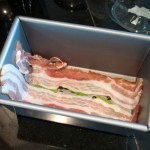
Arrange the bay leaves and juniper berries in the bottom of your loaf tin.  Now take your two rashers of streaky bacon, and place then between two sheets of baking parchment.  Roll them out really thin with a rolling pin. They will easily double in width, and a bit more.  To get them into the loaf tin, I cut away all but the parchment under them, and push this rasher-side-down into the bottom of the loaf tin before carefully peeling away the paper.

Bay leaves & juniper berries   Streaky bacon  Rolled out streaky bacon

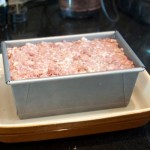
Now pack all the pate mix into the tin, levelling it carefully.  Put the loaf tin into the roasting tin and fill this half way up with boiling water, and put the whole lot in an oven at 150 degrees for an hour and three quarters.

Bacon in tin  Before cooking  After cooking

The block of pate will shrink back from the sides of the tin during cooking, and will be surrounded by fat and jelly juices. Let it stand until nearly cool, and then it’s time to press the pate.  It’s pressed for two reasons – firstly, to compact it and reduce the risk of it crumbling when you slice it, but secondly – and just as importantly for me! – to compact the bottom so you can turn it out neatly!  It smells *wonderful*, just as I would have hoped.  To press it, I covered the top with a double layer of tinfoil, put an old tupperware container on top, and then piled it up with all the weight I could muster.  So, four tins of beans, and four litres of fruit juice ought to do the trick!

Pressing the pate

Once it’s had a really good squeeze, and cooled right down to room temperature, put the pate and whatever weight you can conveniently keep on top of it, move it into the fridge, where it will keep quite happily in its juices and rest and improve for three days before serving.

It’s a new recipe to me, so I’ll be back to tell you how it worked out!  But the smell, oh my, I can’t see it being anything other than lovely!  With crusty (maybe toasted, even?) home-made sourdough.  And pickles!

Advent - day 23

I’m trying to write a post a day during Advent, so, please come along with me while I try to Blog Advent – the Country Skills Way – and forgive me if I don’t quite manage it!

Read more from the Country Skills blog >>

Not Long Now – final preparations for Christmas – Blog Advent (22)

So, somehow it’s got to be the final weekend before Christmas, and it feels like only a few days ago that we hung out the fabric advent calendar, and I started on my mad-cap plan to blog every day in Advent, as if there wasn’t enough to do in the run up to Christmas!

There’s always a lot to do in the final few days, and while today has been almost entirely occupied with preparations for the big day, there’s not an awful lot in there which is very blog-worthy, mostly for reason of avoiding spoilers for guests and gift recipients reading this blog.

christmas sourdough

The sourdough loaves for Christmas and Boxing Day are baked.  Sourdough has been one of my great discoveries this year – I really can’t figure out how I lived without great home-baked bread!  On Christmas Day, we’ll have it as a starter, with home-cured and smoked trout and goats’ cheese.  On Boxing Day, it will be part of the traditional day-after spread of cold ham, meats, pates, cheese, pies and pickles – and I think it’s going to stand up to that, really, very well!

We did our final shop for food and drinks today – it’s always a blasted nuisance, but fortunately we’ve planned ahead and sourced as much from local suppliers, farm shops, and home-made as we could, so it was less of a chore than it might have been.  Good to feel everything is under control, and we collect the goose from the local farm butcher’s tomorrow.

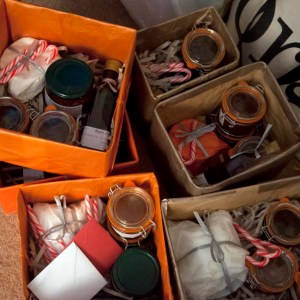
I spent quite a bit of time this afternoon sorting out, labelling, and wrapping the Christmas gift hampers that are a big part of my gift giving for close family and friends.  I know that some of them read this blog, so no details for now I’m afraid!  But here they are, all packed in recycled boxes (I’ve been saving, begging and borrowing Amazon boxes and suchlike from colleagues the last few weeks!), and the contain jams and preserves (which, if you’ve been paying attention over the last six months, you may have had a hint about!), hedgerow liqueurs, and some other home-made surprises which I’ve carefully not been writing about here!

Hampers almost ready to go

And we’re very close now, three sleeps ’till Christmas, and the Advent candle that started burning 22 days ago is now very nearly gone…

Advent - day 22

I’m trying to write a post a day during Advent, so, please come along with me while I try to Blog Advent – the Country Skills Way – and forgive me if I don’t quite manage it!

Read more from the Country Skills blog >>

Not The End Of The World – but the beginning of the return of the light – Blog Advent (21)

We’ve made it to December the 21st, and while this might be a bit premature, I feel reasonably confident in saying that it’s not the end of the world!

Winter sunrise

It is, however, the Solstice.  Hurray!  In the northern hemisphere, the shortest day is over and the light is coming back into the world.  We’re a few days from celebrating Christmas, of course, but there’s very little doubt that the early Christian churches essentially crashed the existing, pagan, solstice parties for the second biggest ‘do’ of their religious year.

Like a lot of people, I feel the dark days of winter pressing down on me.  I joke sometimes that I must have evolved from something that hibernated, because I could quite happily pull the duvet over my head in mid November and not come out until March.  Honestly, I really wish I could!  Christmas is a bright light shining from the long dark days of winter, and I fully understand why our forefathers would have celebrated the arrival of the solstice – and the return of the light – with much feasting and drinking, even though the hardest, hungriest days of winter were still to come.

Token reindeer!I’m always fascinated to find out how we come to hold the folk beliefs that we do, so I was particularly interested to hear a couple of years ago about the Sami goddess of spring and fertility. Her name is Beaivi (or variant spellings), and she was widely worshipped among the people of Fennoscandia (broadly modern Scandinavia).  Her main celebration was winter solstice, when she was believed to fly through the sky with her daughter in sled of reindeer antlers.  Her followers would sacrifice a white female reindeer, and thread pieces of the meat onto a wooden stick, twist it into a circle, and decorate it with bright ribbons.

Beaivi, incidentally, is the goddess of fertility and sanity – particularly beautifully observed, I would say, as both are brought back by the light of spring.

Santa ClausThe Father Christmas / Santa Claus character is such a great cultural cocktail of a myth.  Clearly there’s some northern European solstice god(dess) in the mix –  at least that’s the best theory I can find about how the reindeer got there!   Add to this a good measure of Christian crusades Saint (step forward, St Nick!), and then top up with a generous glug CocaCola!  Since, while the Victorians had all but invented modern Father Christmas, his suit is not usually one of red with white trim – his colours ran much more to the spruce green!  It’s not entirely clear that CocaCola were the first people to dress him in red and white, at the start of the 20th century, but certainly they popularised the choice, and then published it widely.  Well, consider the branding…  **holidays are coming… holidays are coming…**

Jolly Fat ManSo the jolly fat man, with a red suit and a big white beard, rides around in a sleigh pulled by reindeer (they’ve got off lightly, then, since Beaivi’s day), bringing toys to all the good boys and girls, but no longer threatening the bad boys and girls with a lump of coal and a righteous beating…

But Dasher, Dancer, Prancer, Vixen, Comet, Cupid, Donner, and Blitzen (and their latterly-discovered friend, Rudolf) have an identity problem, because at this time of year, the only reindeer with antlers are the female ones!

Incidentally, if you haven’t yet come across Terry Pratchett’s ‘Hogfather’, I can heartily recommend it for a great bit of seasonal reading (or viewing, the TV adaptation from a few years back is remarkably good), it’s a fabulous bit of sideways-on myth re-imagining!

Advent - day 21

I’m trying to write a post a day during Advent, so, please come along with me while I try to Blog Advent – the Country Skills Way – and forgive me if I don’t quite manage it!

Read more from the Country Skills blog >>

Light ‘Em Up – candles in Christmas trees – Blog Advent (20)

Like Scrooge, we’re all haunted, a little bit, by the ghosts of our Christmases past.  In my ‘Blog Advent’ post on December 6, I wrote a little about my memories of St Nicholas, from the time I spent growing up in Switzerland as a young child.  These were my formative Christmas memories, so of course I hark back to them every year.

A very Swiss tree

One tradition which is still widely practiced in Switzerland and Germany – and not at all, in the UK – is the habit of putting real candles in domestic Christmas trees.  I love this – it feels so utterly ‘proper’ and festive to me!  Yes, of course it’s a fire risk – but so is any lit candle or open fire.  Our neighbours, in the small Swiss village where we lived, seemed to manage to avoid setting fire to their houses every year!

Tree candlesHubby is very British about this – the whole idea seems to him like a huge fire hazard just waiting to burst into a ball of flames.  I asked him to suggest a title for this post and his suggestion ‘Flaming Torch of Christmas Death!’ rather sums up his position on the issue!  It’s not so black and white, to me – after all, people were managing to set fire to their living rooms with the small incandescent Christmas tree lightbulbs well into the 21st century.

But all good relationships are about compromise, so while I wait for him to come around to my way of thinking (this, folks, may well be some time!) I picked up these pretty hanging baubles designed to take tea light candles.  Rather than equip them with a naked flame, I’ve used some LED tea lights which, while not *quite* convincingly the real deal, flicker gently with a warm golden light, and, at least out of the corner of your eye, might just be little candle flames in my tree.

Compromise candles

Not many days left on the advent candle, either!  I had so many bits and pieces I wanted to get done today – my last weekday off between now and Christmas – but instead I spent most of it gently nursing this nasty cold.  Here’s hoping it’s gone by the weekend!

Advent - day 20

I’m trying to write a post a day during Advent, so, please come along with me while I try to Blog Advent – the Country Skills Way – and forgive me if I don’t quite manage it!

Read more from the Country Skills blog >>

Life’s A Beach – driftwood decorations – Blog Advent (19)

It feels like a very long time since we were on the beach in Cornwall with Dave, back in October!  Dave adores the beach – the seaside is his favourite ever place.

Dave on the beach

After he was done posing for his portrait (well, doesn’t the backdrop suit him??), I indulged in a spot of beach combing along the strand line, and collected up some pieces of driftwood. Only small lengths, the longest was about 8 inches long.  They had to fit in my pocket!

Driftwood Christmas tree

I put them together into this small driftwood Christmas tree.  It’s lashed together with jute twine, a bit like the twig and twine star decorations I made earlier this month.  If you wanted it a bit more solid, it would be simple to add a blob of hot glue or other adhesive between the ‘stem’ and the ‘branches’ before wrapping with twine or ribbon in whatever decorative way you favour.  It makes a very pretty hanging decoration – I’ve got it on the end of a bookcase in the hall.

The scale is a question only for your imagination and your driftwood supply!  I had visions of making a tree a couple of feet high, possibly hanging, with a thick piece of jute rope threaded through a drilled hole in the centre of each of the driftwood branches.  An idea for the future, perhaps – I need to live a lot closer to the sea!

Advent - day 19

I’m trying to write a post a day during Advent, so, please come along with me while I try to Blog Advent – the Country Skills Way – and forgive me if I don’t quite manage it!

Read more from the Country Skills blog >>

Take Your Medicine – my perfect hot toddy – Blog Advent (18)

One of the Christmas traditions I don’t relish, but seem to ‘enjoy’ every year all the same, is my traditional pre-Christmas cold!  Well, it’s here again, and almost perfectly on schedule! You have to look for the silver lining at times like this, and the up-side of a filthy winter cold is the perfect excuse for a beautiful hot toddy.  It’s medicinal, honest!

Toddy ingredients

My toddy is whisky based.  But don’t use your best single malt – if your nasal passages are as stuffed up as mine, there’s no chance of you knowing the difference!  You also need some honey, a lemon, a few cloves, three or four whole allspice berries, and a cinnamon stick.  Oh, and some hot water.

Cut two thin slices from your lemon and stud each with a couple of cloves.  Put these in your glass (I use a big red wine glass which I know can take the heat – they’re the glasses I use for mulled wine – but a tumbler or a glass with a handle are more traditional!) along with your allspice berries and cinnamon stick.  From what’s left of your lemon, cut a wedge amounting to about a quarter of a lemon and squeeze the juice into the glass.  Add two teaspoons of the honey (more or less to taste – that’s my personal preference) and a double measure of whisky, and stir with your cinnamon stick until combined.

Now top up with water from the kettle, which you’ve allowed to go just off the boil.   If you’re not *that* keen on cinnamon, take the stick out at this point, otherwise leave all the whole spices in.  Stick your nose in the glass and breathe deeply – you should be able to appreciate the spicy aromatic hit through even the thickest head cold.  Then sip, and enjoy.  All the Christmas spices with a bonus dose of vitamin C, and some lovely soothing whisky.  Drink it while it’s still piping hot.

How could something that tastes so wonderful fail to be good for you???   You know, I think I may be poorly enough that I need to take a second dose!

Advent - day 18

I’m trying to write a post a day during Advent, so, please come along with me while I try to Blog Advent – the Country Skills Way – and forgive me if I don’t quite manage it!

Read more from the Country Skills blog >>