Feedback on Country Skills – hyacinths, candles and chickens

I love hearing from my blog readers, especially if you’ve tried out something I’ve written about!

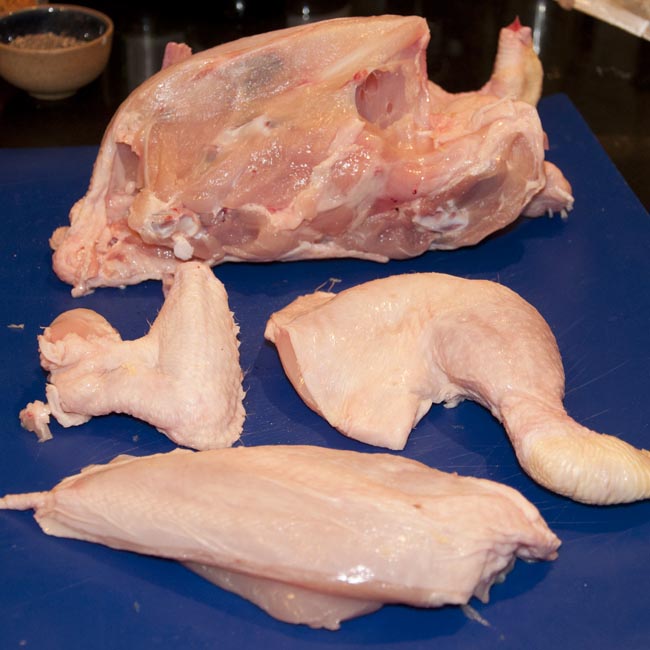
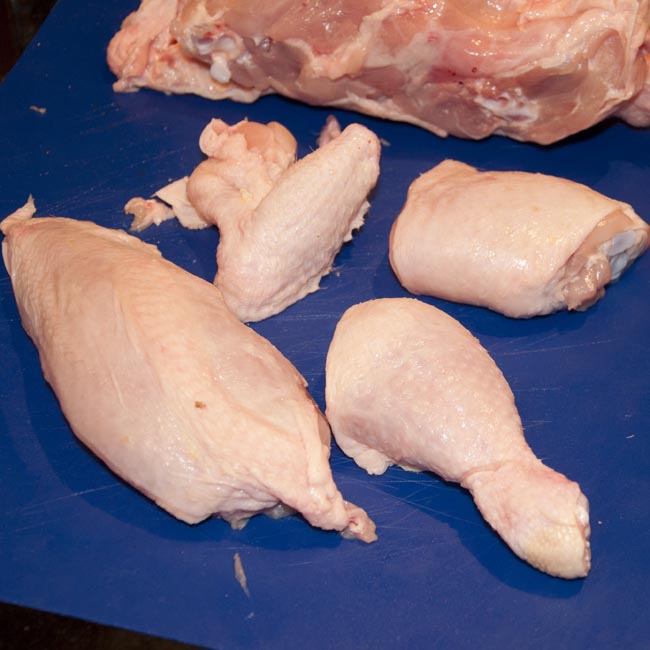
After I wrote my butchery tutorial ‘how to portion a chicken’, blog reader asciiqwerty contacted me to me to let me know how she’d got on following my instructions, and sent me this photo of her finished portioned chicken.

Portioned, skinned and boned out chicken

This time the portions have all been skinned, and the thigh portions have the bones removed – this would make them great for using in a stir-fry or a curry.  She commented particularly on the size of the chicken breasts – which weighed in at about 200g each.  A supermarket pack of two chicken breasts will usually be about 250g in total, so you can see how much more you get for our money.  Well done asciiqwerty, and I hope it was as tasty!

Moving away from food, back at Christmas I made hyacinth bulbs with hydrogel beads, in recycled jam-jars, as gifts for friends and relatives.  I kept one for myself, of course, and thought you might like to see how it all worked out when it came into flower a few weeks ago.

Hyacinth bulb in flower, with hydrogel beads

The smell was amazing, and after this flowerhead died back and I cut it down, the bulb produced a second unexpected bonus flower!  The hyacinth stayed nice and compact and didn’t fall over despite not being secured by anything other than the roots in the jar of beads, which I was very pleased with.

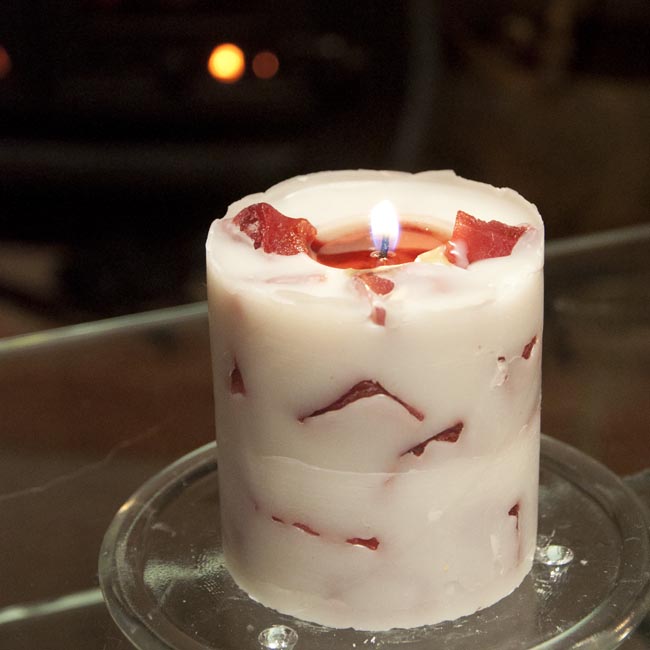
Finally, the recycled chunk candle I made a few weeks back.  I was amazed with this, it turned out so much better than I’d anticipated.

Recycled wax chunk candle

After looking initially as if the melt pool would be a bit pathetic in the centre, it actually burned down very nearly edge-to-edge leaving a thin shell which the candlelight flickered through like stained glass.  I burned it every night for several hours after work, and it lasted a whole fortnight – I’d estimate around 45 hours burn time.

I’d love to hear about any successes (or otherwise!) you might have had trying out country skills – either in the comments, @countryskills on twitter, or by email at countryskillsblog@gmail.com.   Or perhaps there’s something you do that you think I should try – I’m always happy to hear new ideas, so please get in touch!

Read more from the Country Skills blog >>

Back To Basics – home cured back bacon from start to delicious end

Home cured streaky bacon has been a constant fixture in my house since I first made it back in October – in fact I’ve not bought any ‘commercial’ bacon since.  Back bacon used to be our house favourite though, before I started curing.  A couple of weeks ago I saw a tied pork loin ‘roasting’ joint for sale half-price in the local co-op, and it seemed to good to refuse.

Home-cured back bacon

For home-cured back bacon, you will require –

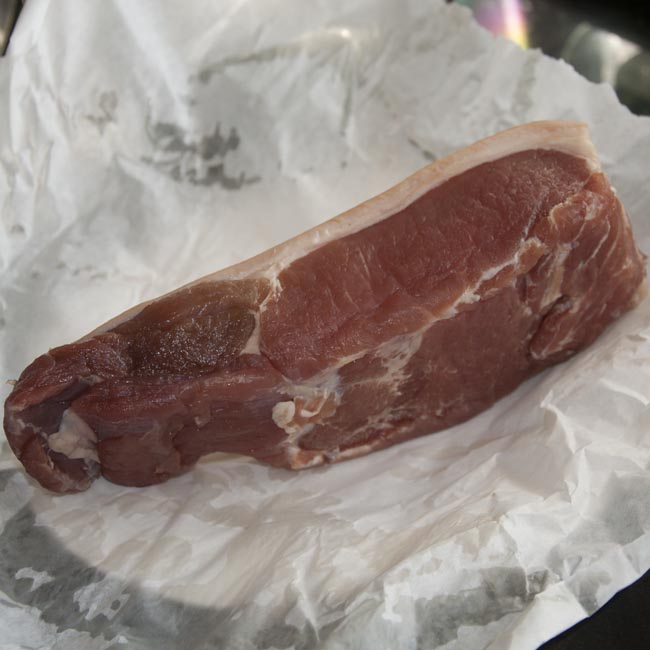
  • Ingredients for home-cured back baconA piece of pork loin.  The roasting joint was a bit big so I cut it in half to give me a piece about 650g in weight.
  • Curing salt such as Supracure (see the Suppliers List for details), 8% of the total weight of the meat, and
  • Sugar (soft brown sugar is ideal) 2% of the total weight of the meat, to make a total cure weight of 10%
  • A non-metallic dish big enough to contain the meat, and some cling film to cover.
That’s it – I wanted to keep the first effort as simple as possible!

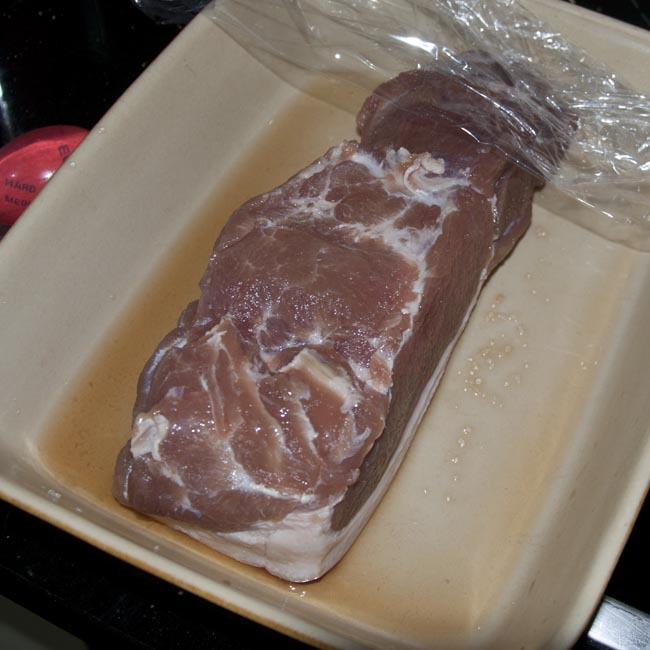
First day - dry-cure rubbed in

Weigh out the cure ingredients and mix them together well.  Now rub about a quarter of the cure mix all over the pork, including on the skin.  You can see it start to draw out moisture from the meat straight away.  Cover the dish loosely with some cling film, and put it in the fridge until tomorrow.

Second day - with 'pickle' in dishThe next day, there will be some liquid in the bottom of the dish.  This is the ‘pickle’ and is made up of some of the curing mix dissolved in the liquid that’s been drawn out of the meat.  It’s completely normal, so don’t worry.  Pour it away, or your dry-cure will pretty quickly turn into a brine cure.  Now take about a quarter of the remaining cure and rub it all over the meat again.  Put it back in the dish the other way up to last time (so skin side up, if you started skin-side down).

Third day - the bacon should be changing texture by this timeRepeat this process for another three days (so that you’ve rubbed cure into the bacon five days running).  By day 3 you should notice a distinct difference in the texture of the meat, it will be firmer in consistency and a bit darker pink in colour.

Finished back bacon, ready to sliceOn the sixth day (so one day longer than the streaky bacon process – this is because the meat is thicker than belly pork), remove the bacon from the dish, rinse it under the tap, dry it carefully with kitchen towel, wrap it loosely with greaseproof paper and put it back in the fridge.  Ideally, wait a couple of days before you start eating it, do let it rest at least overnight.

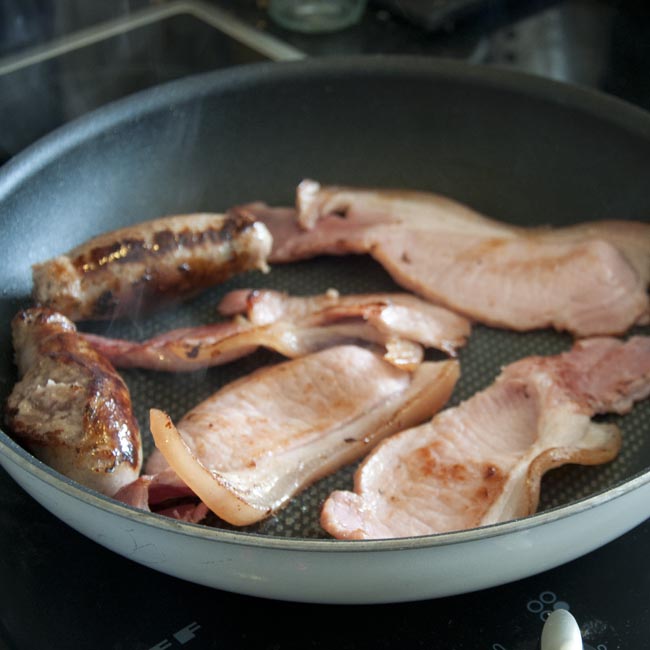
Home-cured bacon, fryingThen slice your amazing bacon with a sharp knife, and cook however you prefer.  I like to pan-fry my back bacon.  This one is gorgeous and I can only heartily recommend you make some for yourself!

Read more from the Country Skills blog >>


Banner320-260

That Wedding Bunting – now well underway!

The quick and simple Christmas Bunting was only ever a dry-run for the big task – I’d promised my sister bunting to decorate the village hall for her wedding reception.    Time is ticking on, so I’ve been getting on over the last few weeks.

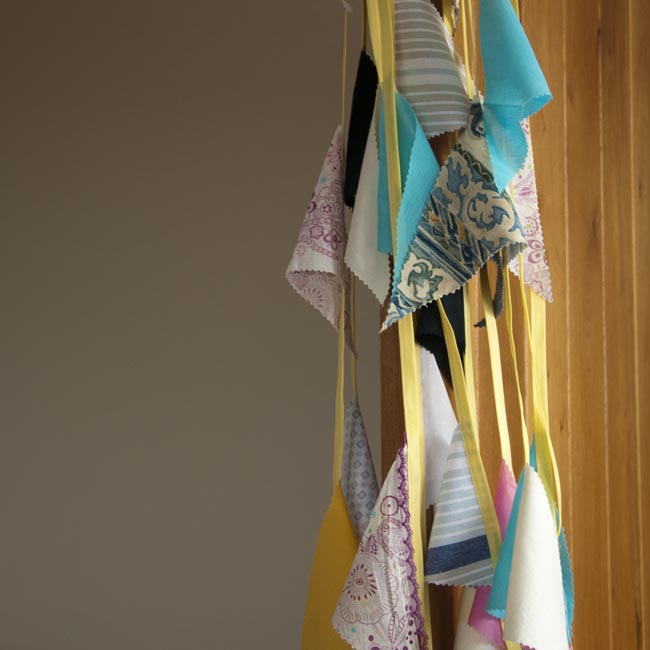
Wedding bunting, complete

My plan was eventually to make 6 strings of 10m length each, in pursuit of which I’ve begged, borrowed and not *exactly* stolen all manner of fabric scraps, old clothes and bits and pieces.  I also bought a 72 yard bolt of yellow double-fold bias tape from the US via the marvel that is ebay.  This time I’ve chosen a bigger pennant, 8″ long by 6″ across.  I’ve also tightened the spacing so there is 6″ between flags.

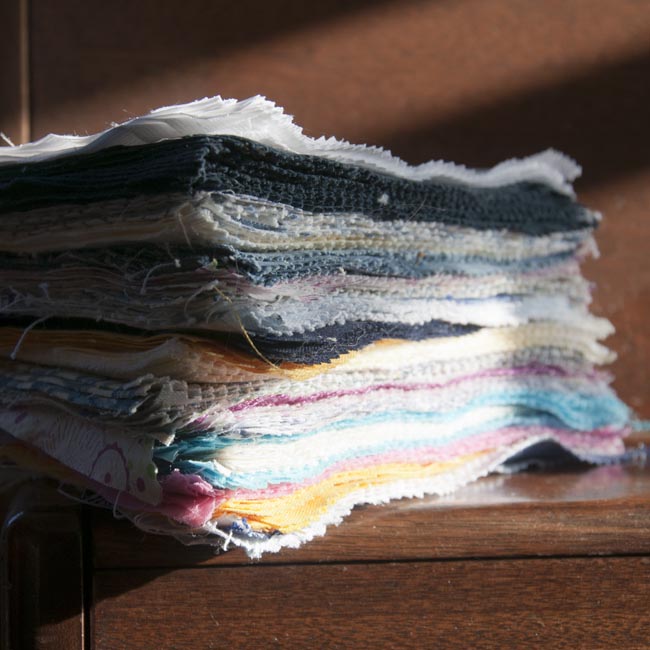
Bunting pennants, laid outIt’s a great selection of colours and patterns, garnered from friends, family, work colleagues, the back of my wardrobe, and freecycle.  The fabrics come from three sets of curtains, three blouses, a pair of jeans and a pair of cords, one pair of jim-jams, two offcuts of woollen suit fabric, some polyester scarf material, and one tea towel.

Bunting pennants, cut and ironedA bit of back-of-envelope calculation and I worked out I needed 29 flags per string.  I drew a new template on cardboard from a packing box.  Words cannot express what a slow boring job cutting out 180 triangles is, but with perseverance, and sat cross-legged on the floor in front of the telly evening after evening, we got there in the end.

Bunting pennants, sorted into groupsAfter ironing and sorting into piles, time to assemble the bunting.  Bias tape has quite a lot of ‘give’ in it, so peel a load off the roll and give it all a good stretch, this will also help it lie flat.  I measured 10m lengths and then found the middle of each.  Then starting in the middle, pin the pennants one at a time into the fold of the bias tape, measuring the gap between them approximately.  After that, it’s just a matter of running the whole length through your sewing machine using appropriate complimentary – or if you like, contrasting – thread.  Try to avoid skewering your fingers on the pins too often.

Completed bunting

There it is – I hope she likes it!  Only four more strings to assemble before it’s all done!

Read more from the Country Skills blog >>

A little egg-centricity – all about the chicken and the egg

Nothing beats a really fresh free range egg.  For breakfast, fried or poached, boiled or scrambled, or for lunch in an omelette, a really fresh egg – preferably laid this morning – is head and shoulders above any other egg you’ve ever tasted.  You can see the difference straight away, even before you crack it – the shell may well be a bit grubby, and a slightly funny shape, an unexpected or uneven colour.  When you crack it open, the egg white is firm and ‘sits up’ in the pan, and the yolk is a deep orange, and bigger than you expected – if beaten, the raw egg is a rich dark yellow, rather than off-white.  In your mouth the yolk is velvety and rich, creamy and almost sweet with a luxuriant almost-custard quality and the white is firm but never rubbery – a million miles away from the flaccid anaemic and tasteless output of battery cages and the supermarket supply chain.

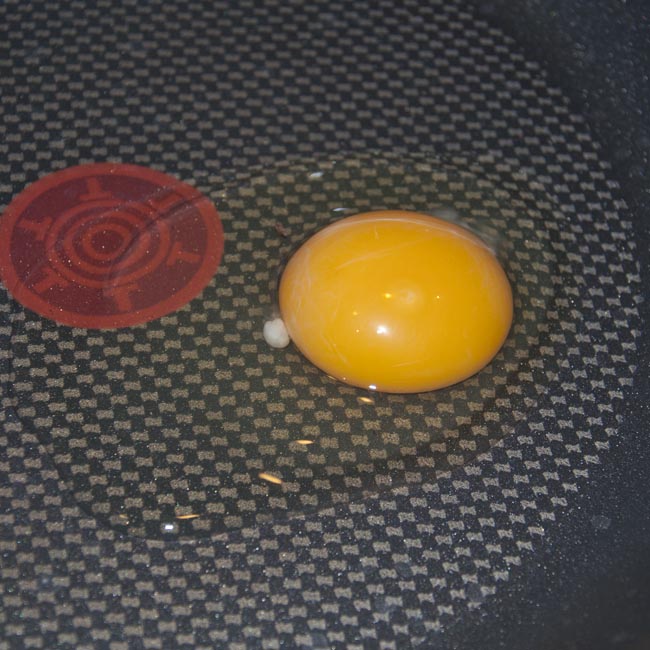
Fresh egg

It’s a sad fact that in the supermarket dominated, urban West, most people have probably never tasted a really good, fresh egg.  We think of eggs as being uniform, sized and graded, cheap and frankly, dull.  But they’re a natural product, and they vary – in size, colour and shape – and from the very firmest, freshest example, to the end of their storage life when the egg white is watery and the best of the flavour is gone.

I said nothing beats a very fresh egg, but of course that depends what you’re doing with it. If you want to beat the egg and use it to help with raising – in baking, or a soufflé – or you want hard boiled eggs peeled for a Salade Niçoise, then the very freshest eggs aren’t for you.  The egg white – the albumen – is actually in two parts.  The outer albumen is quite watery, you can see it spread out in the pan in the photo above.  The inner albumen is much more firm in a very fresh egg (but in an egg which has been stored for some time you probably won’t be able to see a distinction between the two).  In a very fresh egg this inner albumen has too much structure and tends to want to hold together, which doesn’t allow the batter to rise properly.  Furthermore, if you hard boil a really fresh egg and then remove the shell, the outer albumen will come away with the shell, which is a waste and makes for a scruffy-looking boiled egg.  Eggs about a week old are best for baking and hard boiling – realistically you won’t get eggs much fresher than this from the supermarket, though.

Egg storage

These are my eggs, and three things are obvious – first the range of shapes and sizes, secondly that they’re in some sort of wire device (it’s called an Egg Skelter, and I wouldn’t be without it) and not in the fridge, and thirdly that, frankly, they’re a bit grubby!

The size variability is something that you have to make adjustments for with ungraded eggs.  My approach is to weigh them and then adjust according to standard size references.  The Lion Egg Scheme people have a size guide here.

Fresh eggs will keep safely at room temperature for 3 weeks (it’s no coincidence that this is the length of time they have to stay ‘fresh’ under a warm hen if being hatched!), but if you do put them in the fridge, then you need to leave them there.  If eggs are removed from refrigeration, moisture condenses on the outside of the shell and can then be drawn through into the inside of the egg by osmosis, potentially pulling pathogens from outside the shell into the egg itself and increasing the risk of food poisoning.  My eggs don’t sit around for anything like three weeks (if I have a glut I know plenty of people who are happy to help me deal with it!) so storage at room temperature is ideal.  Better still, the egg skelter enforces first-in-first-out use, which is trickier with other storage systems.

So you’d think washing the dirt from the outside of the egg would be a good idea, right?  In fact dissolving these contaminants in water, and disrupting the outside surface of the shell, also increase the risk of pathogen entry.  Much better to leave grubby eggs as they are, and rub off any loose dirt and mud from the surface just before use.  Egg washing is not permitted in the production chain for commercial shell eggs in the UK, on a risk assessment basis, though it is common practice in other countries including the US (they tend to wash in a chlorine solution – because bleach is what you want in your eggs!).  This goes some way to explaining the obsession with clean eggs in intensive production systems – and the resulting battery cages (improved, but not yet gone), as ‘dirty’ eggs are downgraded.

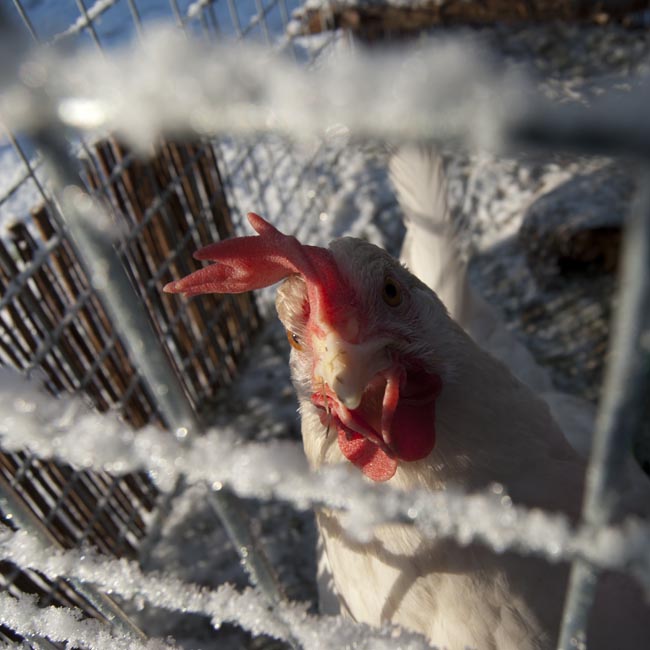
I’ve kept hens for two and a half years now.  I wasn’t expecting get as attached to them as I have, they’re fascinating animals.  Funny feathery little dinosaur-descendants they certainly are, they’re inquisitive, social (and not always sociable!) little creatures.  Only when you’ve watched hens scratch around for bugs, enjoy a bit of a flap and a wing stretch, and then settle down into a well-earned and apparently thoroughly indulgent dust bath, can you really start to understand how inhumane intensive cost-led egg production systems are.  This is Gertie, by the way, my ‘top hen’, being a bit confused by her first sight of snow, and wondering what I’m doing with that camera.

Outdoor hen

You may not be able to keep your own poultry, but if only for the sake of your palate (never mind the quality of life of the poor intensive egg-producing bird) it’s worth seeking out the best and freshest outdoor reared eggs you can find – farmers markets and farm shops are a great place to start – or ask around, you may be surprised to find a colleague keeps backyard hens, and if you’re really super nice to them, they may be prepared to share! Then, enjoy your wonderful, freshest eggs, with the best home cured bacon for the most amazing breakfast fry-up you’ve ever tasted.

Read more from the Country Skills blog >>

Waxing Frugal – making a recycled scented chunk candle

Everyone loves a candle, they cast a lovely warm flickery light, and, chosen carefully, can fill a room with beautiful scent (sure, sometimes they can fill a room with the scent of cheap pot-pourri, but this is a matter of taste!).  After Christmas, we had several left over candle ends around the house, and rather than throw them out, I wanted to do something creative and recycle them.  But while there are lots of great candle-making kits out there, I didn’t really want to spend any money on the process.  So this is a candle-making project that, with the exception of some wick and a wick sustainer, you can do entirely with things that you already have around your home and kitchen.

Recycled chunk candle, burning

For this project, you will need –

  • Two old candle-ends, preferably one coloured & scented and one plain, total weight 300 – 400g
  • Empty Pringles tin (I recommend starting with a full one, and working on it!)
  • Large saucepan, a trivet (or an old saucer or side plate), and a large empty tin can (I used an empty malt extract can from home brewing, but any large catering size tin can will do)
  • Stirrer (I used a large wooden lollipop stick, anything will do but not something you plan to use with food!)
  • Chopping surface (again ideally not one you plan to use for food use in future)
  • Large knife
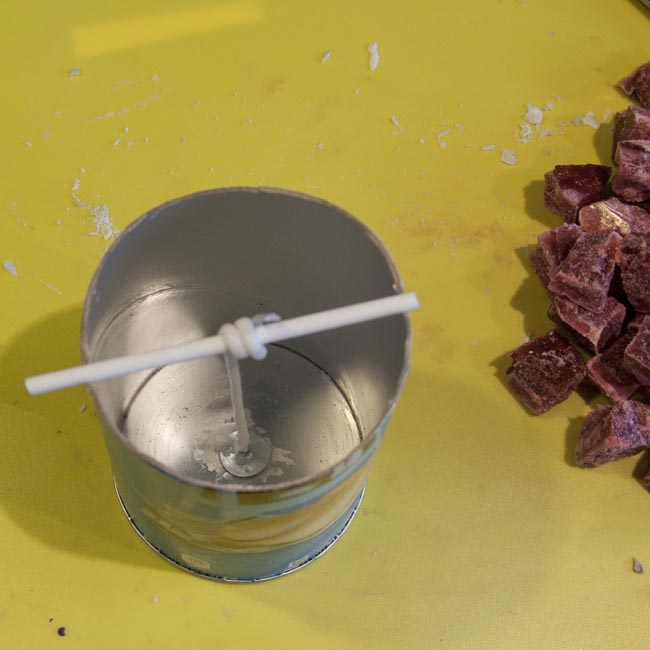
  • 6in length of appropriate wick, a wick sustainer, and something to use as a wick pin (a kebab stick is ideal)
  • Kitchen hob
  • Scales
  • Jam / sugar / preserving thermometer, old tea strainer (recommended but not absolutely required)
Basic equipmentGather up your equipment, starting with the knife and the pringles tin.  Cut the Pringles tin down to about 4″ high using your knife, and make a couple of ‘notches’ in the top on opposite sides of the top.

You’ll need to get an estimate of the capacity of your candle mould, so put a sandwich bag inside the Pringles tin, put it on the scales to zero, and then fill the bag with water to about a 1/2″ below the top.  The weight in grams of water is a good estimate of the volume in mls, as wax is slightly less dense than water (it floats on water, after all), you can reduce this estimate by about 10% to get the weight in wax required to fill the mould to this level. I came up with 300g and used around 270g as a target weight of wax.
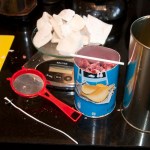
Prepared waxNow, cut up your coloured candle.  Try to cut it into even cubes a bit bigger than half an inch cubed, but it’s likely you’ll struggle, and if the pieces are a bit rough, don’t worry. From what you’ve chopped up, sort to one side and weigh all the sensible chunks, leaving the dust and small fragments aside (wrap these up for another project).  Weigh your coloured chunks (mine weighed about 140g) and put them in the mould to check how high up they come. Ideally this will be about the target ‘fill’ level.  Now roughly chunk up your white wax candle.  It doesn’t matter what size and shape these pieces end up, but the smaller they are the faster they’ll melt.   When working with old candles, try to avoid including the ‘melt pool’ from the candle as this will be dirty wax and may well include bits of old burnt wick and suchlike, which you don’t want in your shiny new candle.

A word about wicks, before we go on – the size and construction of wick you need depends on the chemistry of the candle-wax and the width of the melt pool you want in your candle (which is closely related to the diameter of your candle, usually).  When working with recycled waxes, the chemistry involves a fair bit of guesswork.  I assumed the waxes were a basic paraffin pillar blend, since this is the most usual situation for commercial candles manufactured to a price point.  There’s a useful wick size guide here.  (See my suppliers list and library for more reading.)  I used an LX16 wick which should have been a good match for the ~70mm diameter Pringles mould.  Secure the end of the wick into the wick sustainer using pliers.

Melting waxNow, start melting your wax.  Put the white wax into the large tin, and put the tin inside your saucepan on the trivet.  Fill the saucepan with water so that it comes up the side of the tin about an inch and a half.  Use the thermometer, if you have one, in the water.  You don’t want this to boil, but ideally it should stay around 75 degrees centigrade, which should be enough to melt the wax without risk of overheating.  The flash-point of wax is quite close to the melting point, and at the flash point the wax is at risk of catching fire, particularly if you have a naked flame in the vicinity (for instance, if you’re using a gas hob), so be careful and heat the wax very gently.

Primed wick in situOnce the wax is melted, you need to prime the wick, which just means dipping the wick into the wax so that it can be absorbed onto the surface of the cotton.  Also dip the sustainer in the wax, and use this to secure the sustainer to the centre of the bottom of the Pringles tin.  Stretch the wick up vertically and wrap it around the wick pin to keep it centred in the mould.
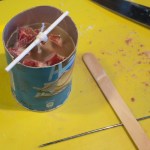
Chunk candle with poured waxNow, arrange the chunks of coloured wax in the mould around the wick, trying to make sure you don’t close off any pockets which would prevent the melted wax filling all the gaps.  When you’re happy, pour about 90% of the melted wax into the mould, pouring through the tea strainer if you see any ‘bits’ in it.  Keep the remaining 10% over a low heat to keep it liquid, and continue to keep a close eye on it.

Cooling candle by immersionThe wax will shrink as it cools and this will form a dip or a ‘well’ near the wick, which will affect the candle as it burns.  Encourage the candle to cool by putting the mould inside a plastic bag and immersing it into a bowl of water.  You will need to weigh it down to keep it immersed, I used a marble pestle, but anything heavy will do.  This is of course quite faffy, and if it’s a nice cold day, you’d probably do as well to put the mould outside for half an hour or so.

As the wax sets and you start to see a well forming near the wick, make a couple of holes in this area with a skewer.  Once the surface of the wax is springy but not hard to the touch, pour over the rest of the wax tapping the mould to make sure it goes into the holes you’ve made near the wick.  Now set the mould somewhere nice and cold to set – in the fridge if it’s a warm day, or outside if it’s January in the UK.

Candle cooling in mould

After a couple of hours the wax will have set hard.  I was expecting to have to sacrifice the Pringles can at the end of the moulding, but the wax had shrunk back nicely from the sides, and I was able to ease the candle out without having to destroy the mould – however your results may vary and I wouldn’t lose to much sleep about it if you have to break the mould away from the candle.  Trim the wick so that about 1cm is proud from the surface of the wax.

Recycled chunk candleRecycled chunk candleI’m thrilled with the results, which I think are very pretty for a first effort.  The white wax is a little bit ‘dirty’ which I probably could have concealed by using a little bit of ivory or honey-coloured candle dye.  I poured the bulk of the white wax in two ‘goes’ and you can see the line between them, which is something I’d avoid in future.
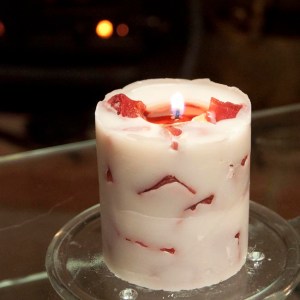
Recycled chunk candle, with melt pool

My only real criticism of the finished candle would be that I chose too small a wick – the melt pool the candle produces is quite a bit narrower than the body of the candle, and stops short of the sides by about half an inch all the way around.  I suspect this is to do with the chemistry of the original white candle, which we stopped burning for a very similar reason – lesson learned!  If I re-make this candle with the remains of the white wax from this batch I’ll use an LX20 wick which may give a better result.  The melt pool is very pretty though, a lovely dark pink colour from the mixed waxes and gives a gentle berry aroma.  For the cost of a new piece of wick, and a little bit of kitchen chemistry, it’s a beautiful, and extremely thrifty, scented candle.

Read more from the Country Skills blog >>

Basic Butchery – how to portion a chicken

A whole roast chicken is a wonderful treat – more on that later – but it’s not the sort of meal most people want to wait for on a week night after work.

We eat a huge amount of chicken in the UK, and a lot of that is bought pre-portionned and packed from the supermarket, it’s certainly convenient and the portion sizes are more practical.  We’re in love with breast meat in this country, to the extent that the UK is a net importer of white chicken meat – mostly from Thailand and other East-Asian countries – and an exporter of leg meat.  When you think about it, that’s pretty bizzare, not great for the environment (think of the fuel involved in sending the ‘wrong’ chicken backwards and forwards half way around the world!), and leaves us eating lower health and welfare-standard poultry meat than would have been produced in the UK.

Fully portioned chicken

It’s really easy to portion up a whole chicken, and learning this basic butchery skill will save you money.  Even if you just buy a ‘bog-standard’ roasting bird from the supermarket, you get more for your money buying a whole bird and cutting it up yourself, and the savings are even better if you’re buying free range or organic chicken.  And with a bit of kitchen creativity, one whole chicken can provide three or four meals for two people, as well as a lovely batch of chicken stock – bargain!

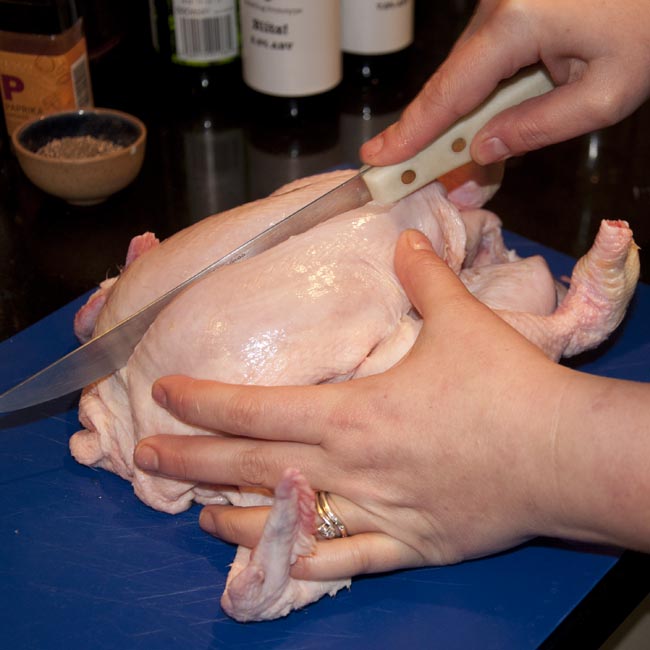
First, un-wrap your whole chicken and remove any trussing string / elastic holding the legs together.  Pat it dry with kitchen towel as this will help with handling it while you’re cutting it up.  You will need a very sharp knife with a long but reasonably slender blade.  Feel down the centre of the bird, and you should feel a bone running the full length – this is the ‘keel bone’.  Starting on this line, cut downwards parallel to the bone along the full length until your knife stops.

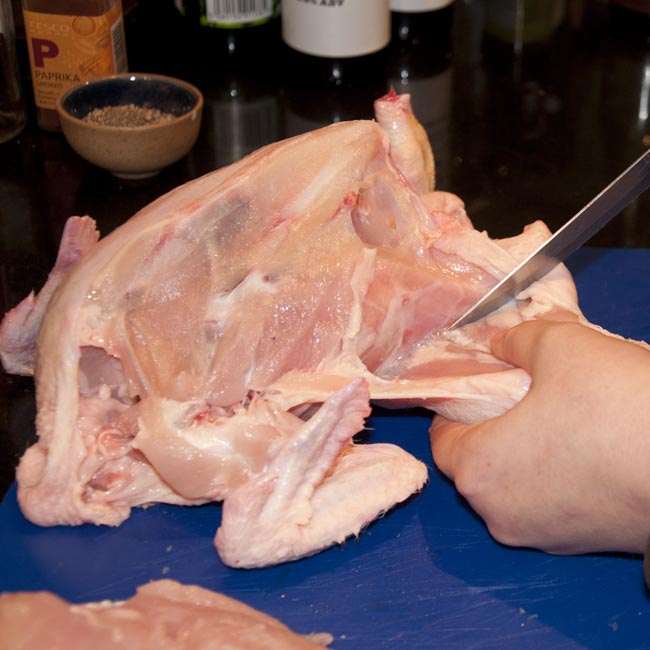
You can now pull the top of the breast away from the keel bone to get a better look at what’s going on.  The bone beneath the knife is the ribcage, so continue carefully cutting the breast meat away from this.  If you work carefully you’ll leave surprisingly little meat behind on the carcass.  After you’ve done this a few times, you’ll get a lot quicker, but speed is not of the essence the first few times.

Once the breast meat is mostly free from the bone, cut the skin between the breast and the thigh and finish removing the breast from the bird.

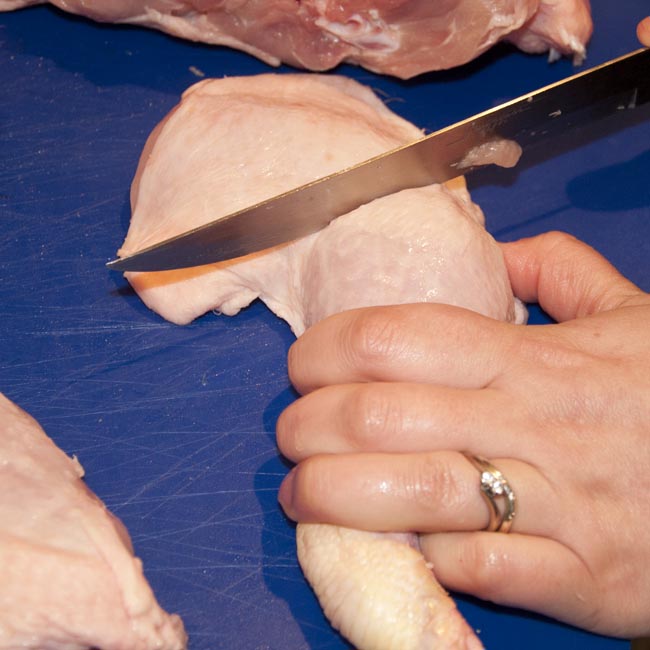
Portioning chicken - step 4Now we need to detach the legs.  Grasp the thigh and extend the leg away from the body.  You should be able to feel the hip joint (indicated with the knife point in this photo).  Insert the knife firmly into the joint to separate the leg from the body, then cut the leg meat away from the torso leaving as little as possible behind.

Portioning chicken - step 5

Grasping the wing in the same way, identify the joint and push the knife firmly through it, separating the wing from the body of the bird.

Portioning chicken - step 6Congratulations, you’re half way there!  Repeat the process on the other side of the bird.

You will now have two breasts, two legs, two wings, and the remains of the body.  Put the body in a saucepan ready to make stock.  You may be happy with the portions you have now, but more commonly we’d divide the legs into thigh and drumstick portions

Portioning chicken - step 7Grasp the leg, and feel where the joint moves between the thigh and the drumstick.  Simply cut down firmly along this line.   If you’re accurate your knife will pass through the joint space, but the bone here is actually quite soft so if you’re not quite on target, you should be able to cut through anyway, it will just take a little bit more force.   Cut off the ‘knuckle’ part at the bottom of the drumstick in the same way, and discard these (the only bit of waste in the process, as it happens!).

Portioning chicken - step 8You’re there – one whole chicken transformed into two breast portions, two thighs, two drumsticks and two wings, to do with as you please.  With practice it’s less than a five minute job.  Better still, think of the costings.  With standard supermarket chicken (I costed this in my local co-op the other day), starting with a £4 bird, and bearing in mind two breast fillets retail for £3 (smaller fillets than you’ll get from a roasting bird, with the skin off and frequently robbed of their ‘mini fillets’, too!), you’ve just got two thighs, two drumsticks, two wings, and a pint of excellent fresh chicken stock for £1.  Use what you want today, and bag and freeze the rest.  How’s that for thrifty!

I said I’d come back to roasting chicken.  That’s for the next post!

Read more from the Country Skills blog >>

Last Minute Christmas – perfect giblet stock

If you’ve bought a bird for roasting today, there’s a good chance it’s come with a little plastic packet of ‘bits’.  Whatever you do, don’t throw them away!

These bits are the giblets – the offal – usually the neck (in one or two pieces), the heart, the liver, and the gizzard.  The gizzard is thick, muscular structure with two hard abrasive grinding plates that the bird uses to crush up corn and other food items to make them digestible.  Giblet stock is quick, simple, and makes the most wonderful Christmas gravy.

I have a goose this year, but the following applies just as well if you have a chicken or turkey.  Personally, I use the goose heart and liver in one of my stuffings, so only the neck and gizzard are available for the stock.

In addition to the giblets, you need the following:

  • Stock vegetables.  I use one onion (red or white) and a couple of carrots, I don’t like celery so I don’t use it, even though it’s the often-quoted third member of the stock vegetable trinity.
  • A bouquet garni.  This is just a posh culinary term for some herbs. I use some bay leaves, rosemary, thyme and sage, along with some whole pepercorns and a few juniper berries.  Dried is fine.
  • Water.  Glug of white wine (optional).
  • A splash of olive oil.

Prepare your gizzard by cutting away and discarding the hard plates (use a small sharp knife inserted below and parallel to the plates) and chopping the rest of the meat roughly

Put the splash of olive oil into a nice big saucepan, and brown the neck and gizzard meat, and then add the roughly chopped onion and carrots and sautee for a couple of minutes.  Now add about a litre of water (and the splash of white wine if you want) and the bouquet garni, bring to the boil and simmer for about an hour.  Strain, discard the solids, and return the stock to the pot and boil again until reduced in volume by half.  That’s it.  Set aside in the refrigerator until you make your gravy later. You won’t regret it!

Tinker and Try Again – second burn of the DIY cold smoker

It was obvious on the first burn of the DIY cold smoker that despite my best woodworking efforts (I do *not* possess joinery skills!) it leaked like a sieve from almost every edge and corner.  It was always going to be an iterative design process, so we broke out the mastic and panel pins and sealed the sides as best we could.  Then I cut and fixed batons along the edges of the slate roof to improve the seal between this and the sides of the smoker box.   After leaving it overnight for the mastic to go off, it was time for the second burn.

The morning dawned unconvincingly, grey damp and foggy.  Even the hens seemed unimpressed when I opened their pop door before turning my attention to getting the smoker set up for its second outing.

Smoker set for second burnI chose a mix of oak (~70%) and apple (~30%) dusts for my second burn.  In the smoker I had a whole side of cured salmon, my experimental Christmas bacon, a slab of cheddar, the bulb and a half of garlic from my first smoker run which hadn’t already been eaten, and a mix of already-smoked and unsmoked chillies.  Oh, and a little muslin bag of sea salt.  It was more or less full.

The smoker was greatly improved by the modifications, and breathed whisps of smoke out through the intended ventilation gap at the front steadily for about 11 hours.  The burn time was longer on this occasion, and I’m not sure whether that was due to the different mix of wood dusts or the weather (it stayed damp and foggy all day and never got above about 7 degrees celsius).  The apple smoke smelt wonderful, sweeter and softer than the 100% oak from the previous burn.

I plan to write more about the salmon in due course.  The bacon took the smoke very nicely and I’m very pleased with the results.  The garlic has definitely benefitted from a longer total time in the smoker, so I suspect I’ll batch garlic smoking to weekends I plan to run the smoker for two consecutive days to give a stronger smoke.

The cheese was a request from a friend, so we await the verdict!  As for the salt, it *smells* of smoke, though that may be the muslin.  I’m gratified that it doesn’t appear to smell of salmon at all.  It looks entirely unchanged – photos of caramel-brown smoked salt I’ve seen on other blogs aren’t the case here, though most of those have been hot-smoker efforts – but I look forward to tasting it soon!

Read more DIY Cold Smoker & Home-Curing posts >>

Read more from the Country Skills blog >>

Heat and Light – how to clean the glass on a wood-burning stove

Everyone loves a real fire!  In common with lots of people in rural homes without access to the mains gas network, we use a multi-fuel stove for some of our heating.  Wood burning stoves are becoming more popular in urban areas, too.

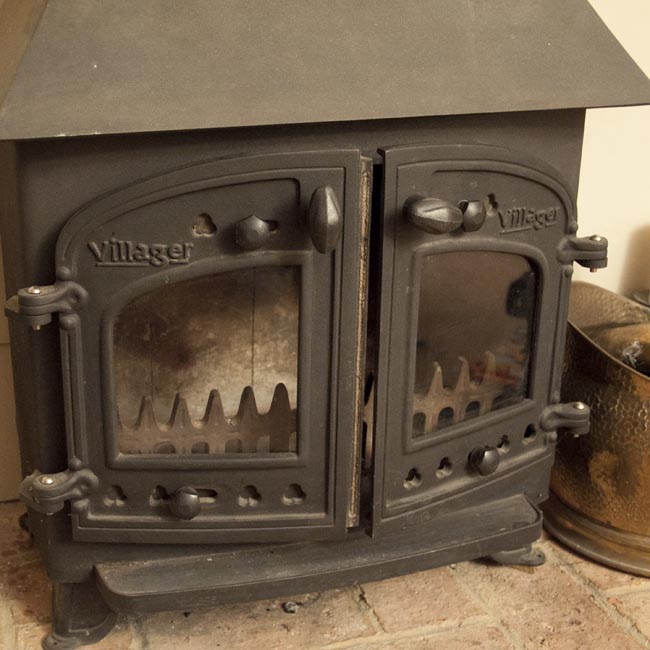
Wood-burning stove

If you have an old stove, it’s likely that before too long you’ll find yourself having to work out how to get the soot off the glass.

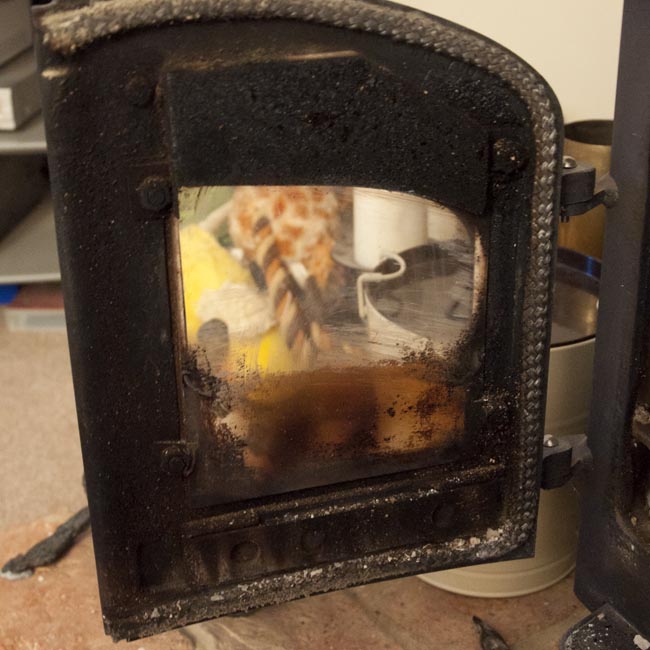
Sooty glass on wood burning stoveI’ve tried oven cleaner.  I’ve tried multisurface cleaner.  I’ve tried a pan scourer, soap and hot water.  Giving it a damn good scrub works a bit, but is very hard work.  I’ve even tried expensive, specifically designed cleaner for the glass on multi-fuel stoves.  Nothing worked convincingly or easily, and the stuff in the aerosol stank, too.  Meanwhile the glass was getting blacker and blacker, and we were deprived of the gorgeous sight of flickering flames, to the point that we were wondering how easy it would be to replace the glass.

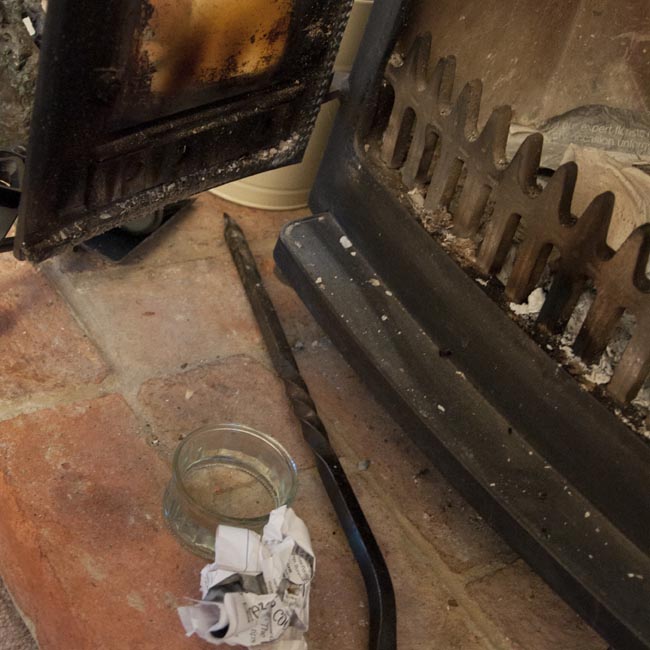
Necessary equipmentThe answer is as easy as could be.  No solvents or volatile chemicals, very little effort, and you have all the things you need already.  Strange as it may seem, you need some newspaper, some ash, some tap water, and a very little elbow grease.  And a wood-burning or multi-fuel stove, of course, but if you haven’t got one, you probably haven’t bothered to read this far.

Time: 30 minutes – Difficulty: simple – Cost: free

Glass half cleanedScrunch up about half a sheet of newspaper.  Dip it in the water and squeeze out the excess.  Then dip it into the ash.  Now use this, gently, to rub the glass.  You should notice it working straight away, which is very gratifying.  The water and ash forms a really fine abrasive slurry, which lifts the soot from the glass with very little effort.  When the paper starts to get really black and stops working again, get a new piece, and repeat the process as often as required.  Getting both doors of my fire cleaned took about half an hour.  They’re *sparkling*.

Job done!A small word of warning – if your glass has some sort of clever protective coating, this approach may not do it any good…  Then again, if your glass has some sort of clever protective coating, and is still sooted up, you might reasonably take the view that it’s not working anyway!

Go on, try it!  I know it sounds mad but I promise you won’t be disappointed!

Read more from the Country Skills blog >>

Medlars – an experiment with strange fruit

Have you met a Medlar?  Medlars on tree

The Medlar is known less politely as the ‘dog’s bottom fruit’ (and other related and even less polite descriptive names, discovery of which is left as an exercise for the reader!), and was once very popular, these days it seems to have been more or less forgotten, at least as a culinary fruit.  The Royal Horticultural Society describes Medlars by reference to their flowers and habit before their fruit.  They’re in the same horticultural family as roses, filed somewhere between pears and hawthorn.

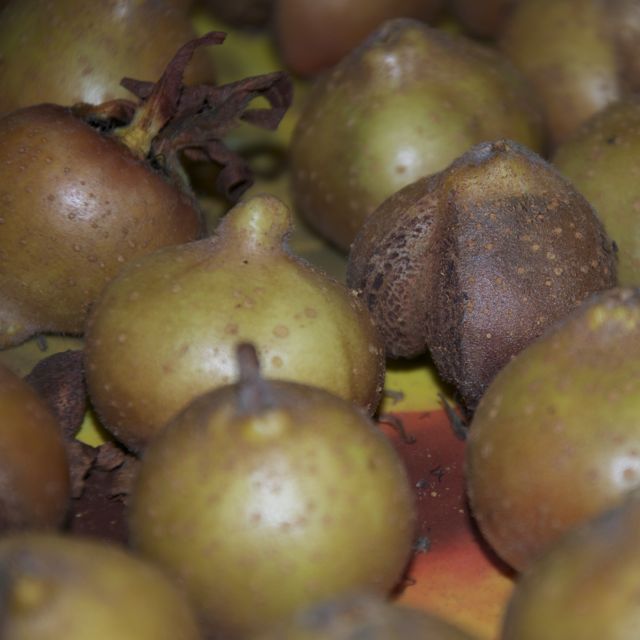
Bletting medlarsI was lucky enough to be able to harvest a lovely little medlar tree, which yielded about a third of a carrier-bag full of fruit.  While late October / early November is the right time to pick medlars, they aren’t actually ripe and need to go through a process of ‘bletting’, where they are allowed to ripen fully in a frost-free, cool dark place.  The only place I have for a tray of fruit is the spare room, which while dark-ish and undoubtedly frost-free, is at house temperature.  Bletting is supposed to take 2 – 3 weeks, during which the fruit will soften and become a dark brown to black colour.  If it all goes well, I plan to make some medlar jelly, so I’ll be back in due course to let you know!