Bottling It – a first ‘crack’ at recycled glass craft

Some time ago, I came across a blog claiming that you could cut wine bottles with a burning bit of string soaked in acetone.  This sounded hilarious fun, but also a tad more dangerous and unpredictable than I was entirely happy with!  The idea didn’t desert me, though, and as time went by I was thinking of more and more different ways I might use recycled wine bottles, if only I could neatly (and safely!) cut them in half.  Green Glass make some beautiful drinking glasses out of recycled bottles, which were another source of inspiration.  This is a real ‘upcycling’ craft (a word which often seems to be an excuse for selling overpriced old junk on etsy!) creating something pretty and useful out of the contents of your recycling box!

Glass craft - candle holder

So I did what we all do, and broke out a bit of depth-first google searching.  A few idle lunch-breaks worth of reading later, and I eventually decided that I was happy to experiment with a cutting process where hot and cold water are used to ‘crack’ a line scored on the outside of the bottle with a diamond-tip glass cutting tool.

DIY cutting jigOf course, the knack is getting the score line straight.  People will sell you various bottle cutting jigs and devices that work on this principle, but I didn’t want to buy any expensive kit for this, at least to start with.
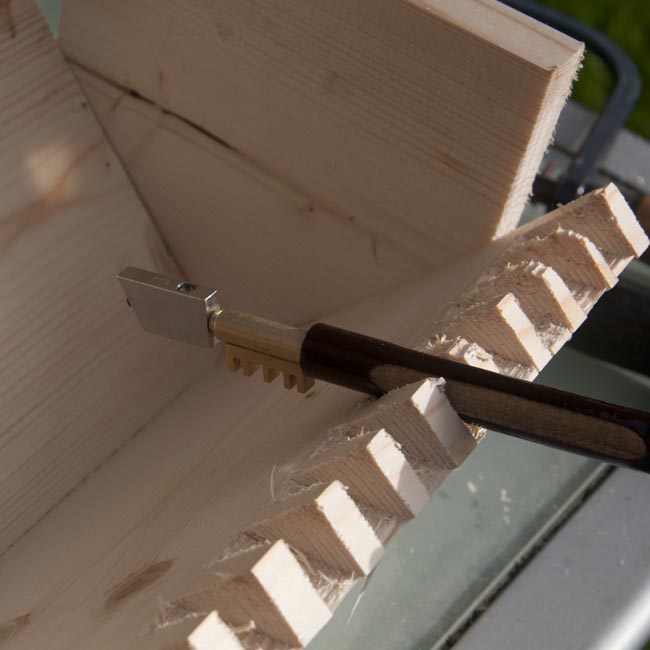
Jig with cutting toolA bit of thought and collaboration from my lovely husband, and we built this contraption out of leftover wood from the shed.  It’s a v-shaped cradle to hold the bottle with a solid end, and notches cut in the side to stabilise the handle of the cutting tool.  The cutting tool itself came from amazon and cost a couple of pounds.

Give some thought to what you want from your bottle, and whether the traditional bump found in the bottom of most bottles (called a ‘punt’, apparently – here I was thinking a punt was a flat bottomed boat propelled with a pole on shallow rivers in British university cities) is a use or a hindrance.  It might be fine if you want to make a vase, for instance, but not so useful if you want a candle-holder.  Some bottles are tapered or squared-off, and these you probably also want to avoid!  Now, give your bottle a good scrub and remove all the labels. You should to do this first, before there are any sharp edges to work around!

Scoring the bottlePut your bottle in the jig, place the glass cutting tool in an appropriate slot and gently press the scoring head against the side of the bottle.  Now, very slowly, rotate the bottle against the point of the cutting tool.  You’re aiming to complete a perfect full rotation, without leaving a gap or ‘over-writing’ the start of your line at the end.  If the score line isn’t complete and perfectly straight, the bottle isn’t going to crack evenly.

Accuracy is everything, as it’s a one-shot deal and mistakes cannot be corrected later – but on the plus side, the bottles are free and only destined for the recycling bin in any case, so try not to fret about it too much!  My success rate so far for a clean break is about 1 in 3 – not great but it’s early days and I suspect practice will help improve this somewhat.

Once you’ve scored your line, it’s time to get it to crack.  Different approaches are advocated, but I went for the simplest one.  Boil a kettle of water.  Holding the bottle over the sink, pour freshly boiled water gently over the score line, rotating the bottle slowly.  After a few seconds, put the bottle under the cold running tap and repeat the process of rotating it.  I haven’t got any photos of this bit, because both my hands were a bit occupied at the time!

Uneven breakYou’ll have to do this a few times, but you’ll see – and perhaps hear – the score lines start to give way.  If you’re really lucky, the bottle will break cleanly straight along the score line.  This one didn’t!  The fracture line wavered quite dramatically above and below the score line over about 1/3rd of the circumference.  I’m not sure why, whether it was to do with the score line, or the fact the bottle itself which was quite uneven in thickness.  Whichever it was, it’s a dead loss, so throw it away and fetch another one from the recycling bin.

Other approaches I’ve seen advocated include candle flame followed by ice cube, and tapping the bottle from the inside near the score line, though this requires a crank-headed tapping tool. I have no idea if these approaches might result in a better success rate – certainly tapping may give a different, more controlled break than hot/cold shock.

Fortunately, my first try (when I wasn’t taking photographs – typical eh?) did break cleanly, giving me a goblet about four inches high which I wanted for a candle holder.  It broke with a very slight ‘notch’, which I was able to crack off using the glass cutting tool to give essentially a clean cut.  A very *sharp* clean cut.

Sandpaper to grind the edgesSuccess!  But that’s not it, of course, since you’d have a candle holder specifically designed to maim the unwary, which is a silly enough thing to keep around your own house, never mind consider giving as a gift.  Those sharp sheared glass edges are going to have to go.  My approach is low tech – wet, fine grade silicon carbide sandpaper.  I used a slightly coarser grade to take the edges down initially, and then finished with some really fine paper.

Working wet greatly reduces the production of glass dust, which is nasty dangerous stuff that you should not be inhaling.  Work in a well ventilated area (outside, for me!) and ideally wear a dust mask.  Feel the edge *very* gently and tentatively with a fingertip to check the sharp edges are gone to your satisfaction.

Carefully work on the edges as well as the flat cut surface.  A little piece of sand paper wrapped around a pencil or something similar is good for the inside edge without scratching the glass.  I’ve seen the use of a dremel advocated – I can see how that would work really well but you’d want to be really careful about dust, probably dipping the grinding head in water every few seconds to keep it wet.  You’ll want to do much more careful and comprehensive smoothing work on the rim if you want to use your cut bottle as a drinking glass – but your extra efforts may well be worth it!

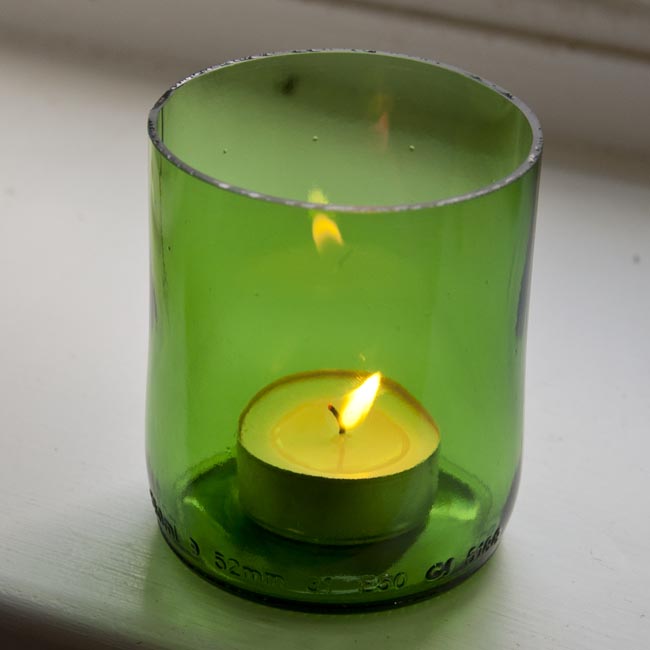
Finished candle holderThe result is really pleasing, the cut edge after sanding has a mostly-frosted appearance but still shows some evidence of the manner of its birth.   It’s not a perfect, machined straight line, but just has that little bit of hand-crafted variability.  You could etch the glass now (something I’m looking into!) or paint it if you liked, but you’re the proud owner of a hand-made recycled glass candle holder.

I used this with a tea light for a test burn, as much as anything to check that the heating from a candle wasn’t going to cause  unexpected cracking or breakage after the bottle’s relatively rough treatment!  And to get photographs, of course.  I expect this will look even better with a votive candle, but I didn’t have one to hand.
Finished candle holder

This was just a first attempt – but I had a lot of fun and will certainly be doing some more bottle cutting in time for Christmas!  I love that the detail of the bottle is still very much part of the finished piece too.  Definitely something to try – though probably a craft for grown-ups!

For a few ideas, try my next post on bottle cutting – ‘Using Your Bottle – testing some ideas for bottle cutting crafts’.

Finally, an apology to those of you who were emailed a part-finished version of this blog post yesterday – a mistake on my part, I’m afraid!  I’ll try to restrain my itchy mouse-finger from wandering over the ‘Publish’ button so enthusiastically!

Read more from the Country Skills blog >>

Banner320-260

Feedback on Country Skills – hyacinths, candles and chickens

I love hearing from my blog readers, especially if you’ve tried out something I’ve written about!

After I wrote my butchery tutorial ‘how to portion a chicken’, blog reader asciiqwerty contacted me to me to let me know how she’d got on following my instructions, and sent me this photo of her finished portioned chicken.

Portioned, skinned and boned out chicken

This time the portions have all been skinned, and the thigh portions have the bones removed – this would make them great for using in a stir-fry or a curry.  She commented particularly on the size of the chicken breasts – which weighed in at about 200g each.  A supermarket pack of two chicken breasts will usually be about 250g in total, so you can see how much more you get for our money.  Well done asciiqwerty, and I hope it was as tasty!

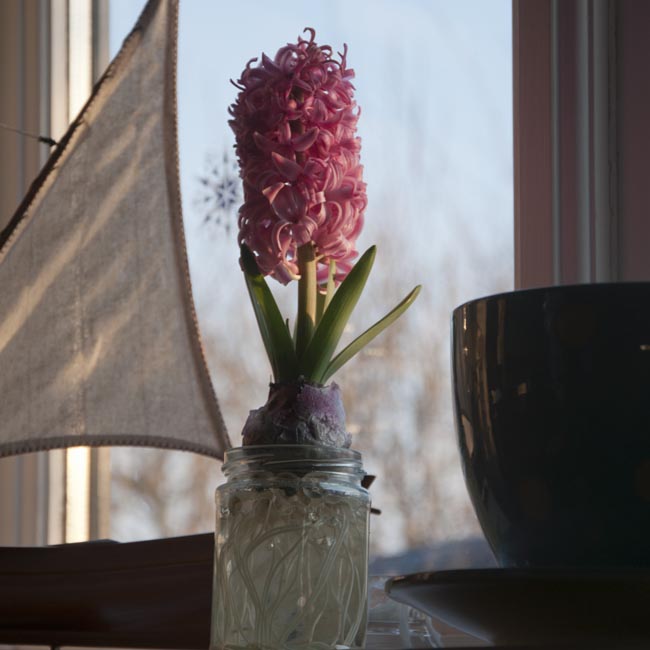
Moving away from food, back at Christmas I made hyacinth bulbs with hydrogel beads, in recycled jam-jars, as gifts for friends and relatives.  I kept one for myself, of course, and thought you might like to see how it all worked out when it came into flower a few weeks ago.

Hyacinth bulb in flower, with hydrogel beads

The smell was amazing, and after this flowerhead died back and I cut it down, the bulb produced a second unexpected bonus flower!  The hyacinth stayed nice and compact and didn’t fall over despite not being secured by anything other than the roots in the jar of beads, which I was very pleased with.

Finally, the recycled chunk candle I made a few weeks back.  I was amazed with this, it turned out so much better than I’d anticipated.

Recycled wax chunk candle

After looking initially as if the melt pool would be a bit pathetic in the centre, it actually burned down very nearly edge-to-edge leaving a thin shell which the candlelight flickered through like stained glass.  I burned it every night for several hours after work, and it lasted a whole fortnight – I’d estimate around 45 hours burn time.

I’d love to hear about any successes (or otherwise!) you might have had trying out country skills – either in the comments, @countryskills on twitter, or by email at countryskillsblog@gmail.com.   Or perhaps there’s something you do that you think I should try – I’m always happy to hear new ideas, so please get in touch!

Read more from the Country Skills blog >>

Waxing Frugal – making a recycled scented chunk candle

Everyone loves a candle, they cast a lovely warm flickery light, and, chosen carefully, can fill a room with beautiful scent (sure, sometimes they can fill a room with the scent of cheap pot-pourri, but this is a matter of taste!).  After Christmas, we had several left over candle ends around the house, and rather than throw them out, I wanted to do something creative and recycle them.  But while there are lots of great candle-making kits out there, I didn’t really want to spend any money on the process.  So this is a candle-making project that, with the exception of some wick and a wick sustainer, you can do entirely with things that you already have around your home and kitchen.

Recycled chunk candle, burning

For this project, you will need –

  • Two old candle-ends, preferably one coloured & scented and one plain, total weight 300 – 400g
  • Empty Pringles tin (I recommend starting with a full one, and working on it!)
  • Large saucepan, a trivet (or an old saucer or side plate), and a large empty tin can (I used an empty malt extract can from home brewing, but any large catering size tin can will do)
  • Stirrer (I used a large wooden lollipop stick, anything will do but not something you plan to use with food!)
  • Chopping surface (again ideally not one you plan to use for food use in future)
  • Large knife
  • 6in length of appropriate wick, a wick sustainer, and something to use as a wick pin (a kebab stick is ideal)
  • Kitchen hob
  • Scales
  • Jam / sugar / preserving thermometer, old tea strainer (recommended but not absolutely required)

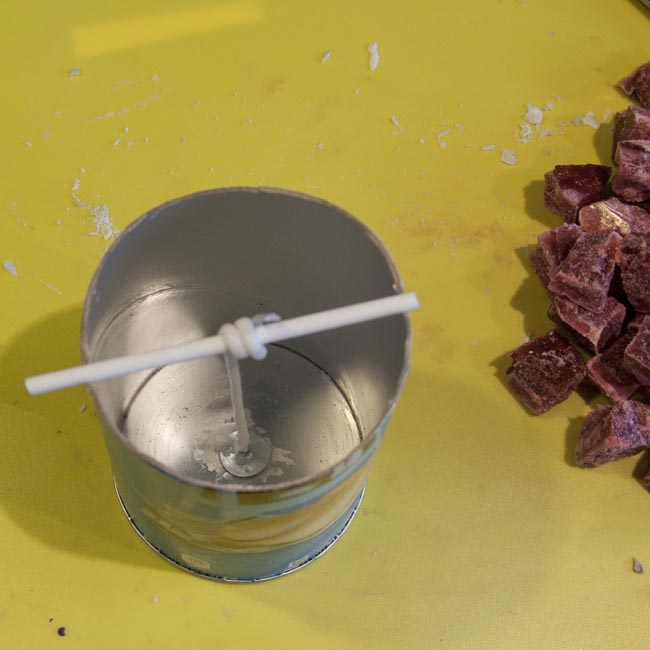
Basic equipmentGather up your equipment, starting with the knife and the pringles tin.  Cut the Pringles tin down to about 4″ high using your knife, and make a couple of ‘notches’ in the top on opposite sides of the top.

You’ll need to get an estimate of the capacity of your candle mould, so put a sandwich bag inside the Pringles tin, put it on the scales to zero, and then fill the bag with water to about a 1/2″ below the top.  The weight in grams of water is a good estimate of the volume in mls, as wax is slightly less dense than water (it floats on water, after all), you can reduce this estimate by about 10% to get the weight in wax required to fill the mould to this level. I came up with 300g and used around 270g as a target weight of wax.

Prepared waxNow, cut up your coloured candle.  Try to cut it into even cubes a bit bigger than half an inch cubed, but it’s likely you’ll struggle, and if the pieces are a bit rough, don’t worry. From what you’ve chopped up, sort to one side and weigh all the sensible chunks, leaving the dust and small fragments aside (wrap these up for another project).  Weigh your coloured chunks (mine weighed about 140g) and put them in the mould to check how high up they come. Ideally this will be about the target ‘fill’ level.  Now roughly chunk up your white wax candle.  It doesn’t matter what size and shape these pieces end up, but the smaller they are the faster they’ll melt.   When working with old candles, try to avoid including the ‘melt pool’ from the candle as this will be dirty wax and may well include bits of old burnt wick and suchlike, which you don’t want in your shiny new candle.

A word about wicks, before we go on – the size and construction of wick you need depends on the chemistry of the candle-wax and the width of the melt pool you want in your candle (which is closely related to the diameter of your candle, usually).  When working with recycled waxes, the chemistry involves a fair bit of guesswork.  I assumed the waxes were a basic paraffin pillar blend, since this is the most usual situation for commercial candles manufactured to a price point.  There’s a useful wick size guide here.  (See my suppliers list and library for more reading.)  I used an LX16 wick which should have been a good match for the ~70mm diameter Pringles mould.  Secure the end of the wick into the wick sustainer using pliers.

Melting waxNow, start melting your wax.  Put the white wax into the large tin, and put the tin inside your saucepan on the trivet.  Fill the saucepan with water so that it comes up the side of the tin about an inch and a half.  Use the thermometer, if you have one, in the water.  You don’t want this to boil, but ideally it should stay around 75 degrees centigrade, which should be enough to melt the wax without risk of overheating.  The flash-point of wax is quite close to the melting point, and at the flash point the wax is at risk of catching fire, particularly if you have a naked flame in the vicinity (for instance, if you’re using a gas hob), so be careful and heat the wax very gently.

Primed wick in situOnce the wax is melted, you need to prime the wick, which just means dipping the wick into the wax so that it can be absorbed onto the surface of the cotton.  Also dip the sustainer in the wax, and use this to secure the sustainer to the centre of the bottom of the Pringles tin.  Stretch the wick up vertically and wrap it around the wick pin to keep it centred in the mould.

Chunk candle with poured waxNow, arrange the chunks of coloured wax in the mould around the wick, trying to make sure you don’t close off any pockets which would prevent the melted wax filling all the gaps.  When you’re happy, pour about 90% of the melted wax into the mould, pouring through the tea strainer if you see any ‘bits’ in it.  Keep the remaining 10% over a low heat to keep it liquid, and continue to keep a close eye on it.

Cooling candle by immersionThe wax will shrink as it cools and this will form a dip or a ‘well’ near the wick, which will affect the candle as it burns.  Encourage the candle to cool by putting the mould inside a plastic bag and immersing it into a bowl of water.  You will need to weigh it down to keep it immersed, I used a marble pestle, but anything heavy will do.  This is of course quite faffy, and if it’s a nice cold day, you’d probably do as well to put the mould outside for half an hour or so.

As the wax sets and you start to see a well forming near the wick, make a couple of holes in this area with a skewer.  Once the surface of the wax is springy but not hard to the touch, pour over the rest of the wax tapping the mould to make sure it goes into the holes you’ve made near the wick.  Now set the mould somewhere nice and cold to set – in the fridge if it’s a warm day, or outside if it’s January in the UK.

Candle cooling in mould

After a couple of hours the wax will have set hard.  I was expecting to have to sacrifice the Pringles can at the end of the moulding, but the wax had shrunk back nicely from the sides, and I was able to ease the candle out without having to destroy the mould – however your results may vary and I wouldn’t lose to much sleep about it if you have to break the mould away from the candle.  Trim the wick so that about 1cm is proud from the surface of the wax.

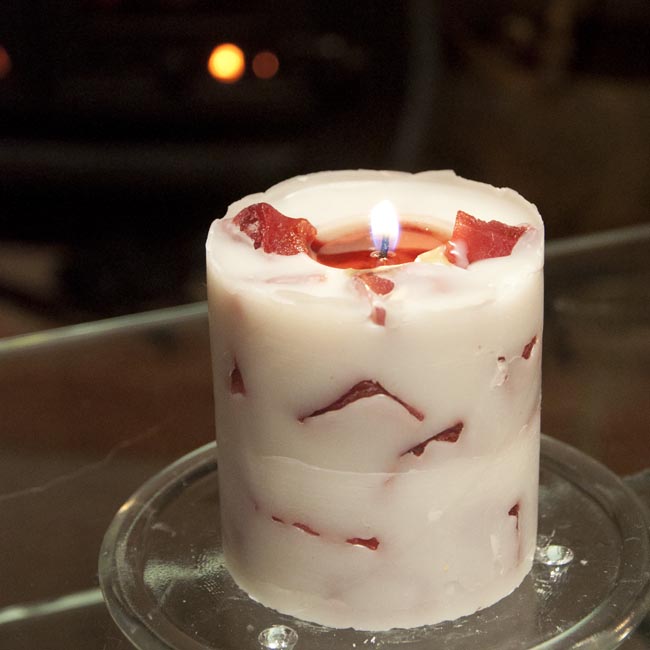
Recycled chunk candleRecycled chunk candleI’m thrilled with the results, which I think are very pretty for a first effort.  The white wax is a little bit ‘dirty’ which I probably could have concealed by using a little bit of ivory or honey-coloured candle dye.  I poured the bulk of the white wax in two ‘goes’ and you can see the line between them, which is something I’d avoid in future.

Recycled chunk candle, with melt pool

My only real criticism of the finished candle would be that I chose too small a wick – the melt pool the candle produces is quite a bit narrower than the body of the candle, and stops short of the sides by about half an inch all the way around.  I suspect this is to do with the chemistry of the original white candle, which we stopped burning for a very similar reason – lesson learned!  If I re-make this candle with the remains of the white wax from this batch I’ll use an LX20 wick which may give a better result.  The melt pool is very pretty though, a lovely dark pink colour from the mixed waxes and gives a gentle berry aroma.  For the cost of a new piece of wick, and a little bit of kitchen chemistry, it’s a beautiful, and extremely thrifty, scented candle.

Read more from the Country Skills blog >>
Handmade Christmas – cracking crackers!

Christmas crackers are great, and an essential part of Christmas dinner in my house.  I mean, what’s not to like about adults wearing silly paper hats after a lovely meal and plenty of wine?  But the ones I’ve bought always seem to contain absolute rubbish which no one would ever want.  How about making your own, with the traditional silly paper hat and motto, but with the added bonus of a small, thoughtful gift, an after dinner chocolate, or both?  Well, it’s simple and fun, here’s how!

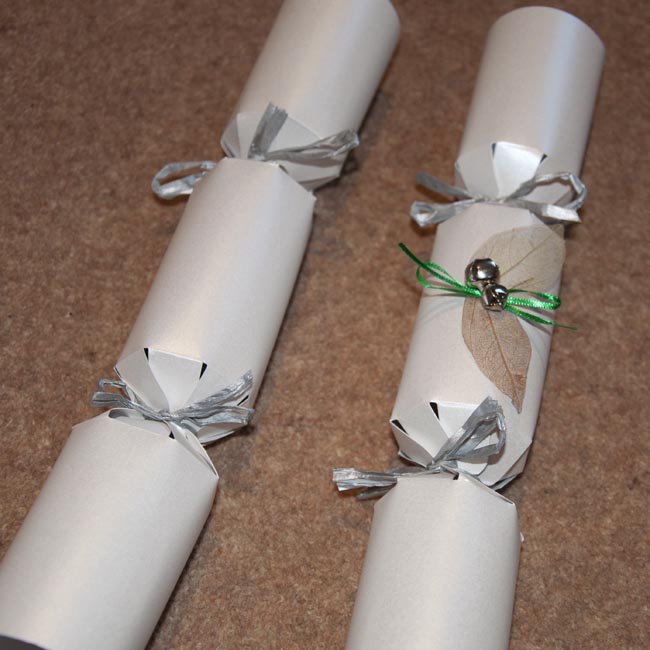
Handmade Christmas crackers

You will need:

  • Some cracker ‘blanks’, these are widely available from craft shops and on the internet in various sizes, colours and pack sizes.  I chose plain silver ones.
  • Cracker ‘snaps’, if these aren’t included with the blanks, one for each cracker you plan to make.
  • Ribbon, wool, raffia or string, for tying the crackers up, as decorative as you like.
  • Decorations for your crackers, if you want.  I used metallic leaf skeletons, some ribbon and a couple of small jingle-bells, all glued in place, but be creative, anything from the card making section of the craft shop is a good place to start, or how about some decoupage with last year’s Christmas cards?
  • Finally, cracker gifts!  I found some quite cute keyring gadgets of various kinds and also added a nice after-dinner chocolate.  If the gifts are for specific guests, put name-labels on the crackers.
  • Scissors, sticky tape, and clear glue.
  • Make hats and mottos yourself!

Making them couldn’t be easier and is a crafty relaxing way to spend a dark December evening.

First three steps of cracker constructionStart by sticking one end of the cracker snap onto the cracker blank with sticky tape.  Then roll the cracker blank using the tabs (cracker blanks have slightly varying designs, so follow the instructions that come with yours!).  Pinch, twist and tie up one end of the cracker with the string, ribbon, or other thread you’re using – I used silver paper raffia.

Decorating the finished crackersNow fill your cracker with all the bits and pieces, and tie up the other end of the barrel in the same way.  Once you’ve tied this up, stick the second end of the cracker snap into place.  You can decorate the crackers now however you like!

‘But what about my hat and motto’, you may be thinking?  I did see hat-and-motto sets for sale, but they’re awfully expensive considering what you get, a cheap tissue paper crown and a small slip of paper.

Making the hats couldn’t be simpler.  Get some Christmas wrapping paper, I used the end of a roll of white and silver metallic paper which I had knocking around.  First, measure the circumference of your head (unless it’s unusually large or small, in which case perhaps find someone with a more ‘representative’ head to measure – then again, you’ve made them, so perhaps it’s only fair to claim the perk of a cracker hat which fits for once!).  Now cut some pieces of wrapping paper twice as wide as the finished hat you want, and about 1cm longer than the circumference you’ve measured.  Using clear sticky tape, stick the paper into a loop.

Making paper crowns for crackers

Now fold the loop flat (image 1), then in half, then fold each of the halves into three, so that you’re now on the central panel of the film-strip above.  Now fold this in half one last time, then make a single diagonal cut half-way up the paper.  Unfold your two zig-zag topped crowns.  It’s like being back in primary school!  And since they’re neatly folded, tie them that way with ribbon or a small elastic band.

For the mottos, anything goes!  Good (or bad!) jokes, limericks (or haikus?), brain teasers, interesting facts, or even thoughts for the season or personal wishes for your family and friends’ year to come – make them pretty in a word processing package, print them out, cut into strips and fold them up with your paper hats.

Crackers needn’t just be for Christmas – they’re a lovely creative way to package small, special gifts.  An unusual way to wrap a special piece of jewellery, perhaps even a surprise ring?  Or consider using crackers to package wedding favours?

Handmade Christmas – decorated glass baubles

I have to confess to having a bit of a ‘problem’ when it comes to Christmas tree decorations – I love them.  Every year I try to add one or two (ok, sometimes a few more than one or two!) new pieces, to go on my tree year after year.  In recent years I’ve tried to make some of these rather than buying them, and this year I’ve bought nothing, which is a first!

Finished bauble on my tree

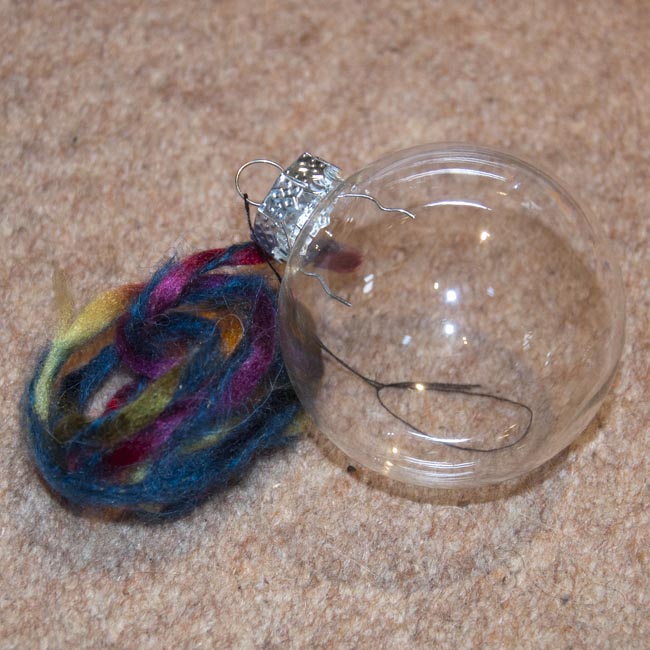
What I added to my tree this year were four lovely clear glass baubles which I already had, but which I have filled with wool fibres, giving what I hope you’ll agree is rather a lovely effect.

Bauble & woolMaking these is very simple – you will require:

  • Some plain clear glass baubles, any size but I used 6cm ones.  I bought them from a website a couple of years ago, but I gather they’re often available in craft shops before Christmas.
  • Wool scraps, as pretty and colourful as you can find.  I begged these from a friend who’s a keen knitter.

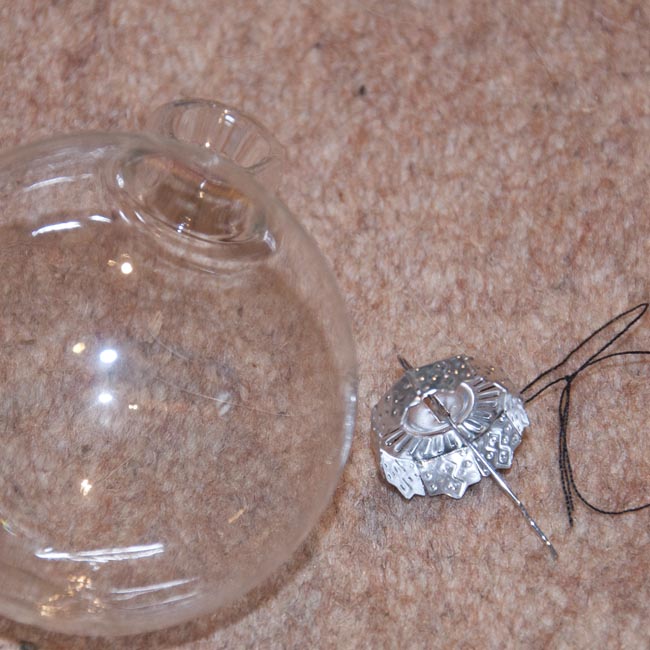
Glass bauble with top removedFirst, gently remove the top from the bauble.  With the normal design of blown glass bauble, you do this by squeezing together the sides of the metal hanging loop, which moves the ends together allowing you to (very carefully, broken bauble glass is sharp!) lift the metal crown from the bauble.

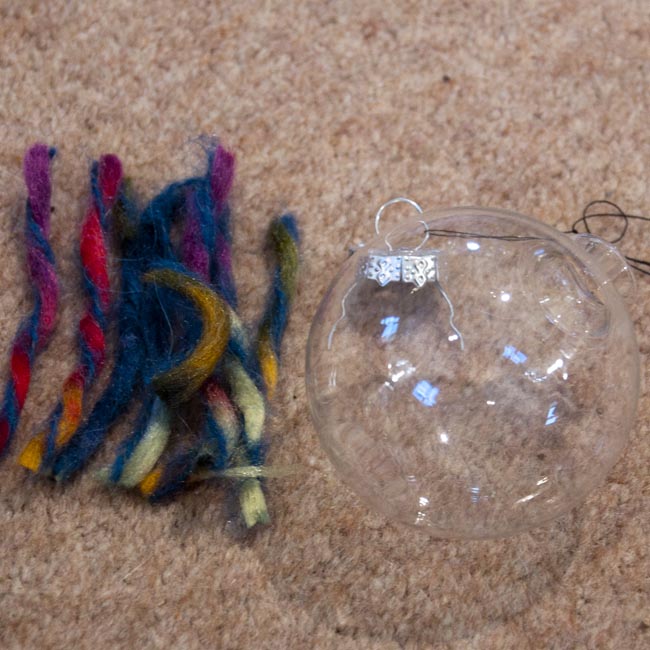
Bauble with cut lengths of woolNow take your length of wool – about a foot (30cm or 12″) is probably quite enough depending on how thick and fluffy it is.  Cut this into approximately 5cm / 2″ lengths.

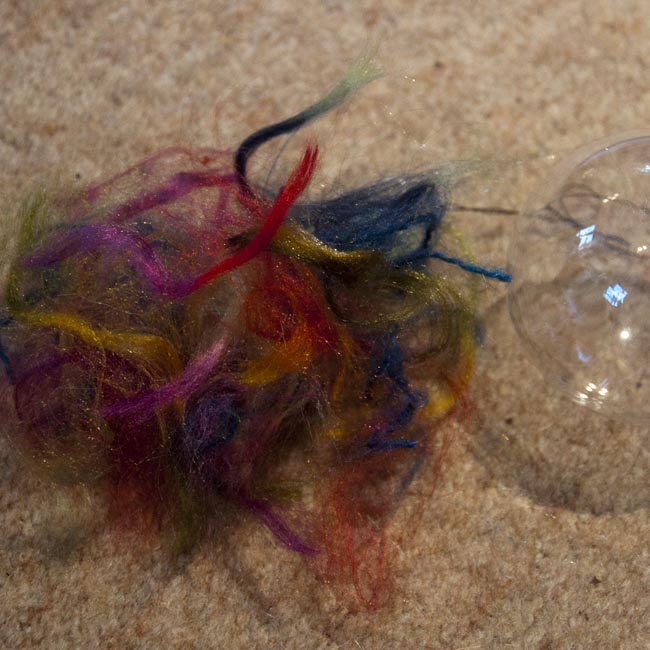
Teased apart wool fibresThen tease the wool apart gently into it’s component fibres.  Depending on the thickness and spinning type of the wool this might be more or less difficult, the wool I had was quite a loose structure and came apart very simply.  At this stage you need to assess whether you have enough fibres, since you want enough to loosely fill your bauble.

Inserting fibresFinally, use something like a chopstick or a pencil to gently push the fibres inside your bauble, and re-attach the cap.

That’s it, all done in only a minute or two, and the colours and effects you can achieve are only limited by your imagination (and wool collection!).  It’s so simple to create a colourful, textured, unique bauble for the price of a plain clear glass one, and these would make lovely gifts, too!  I’ve also seen pretty things done with ribbons, fabric scraps, or glitter inside clear baubles, so why not get creative!

Updated for 2012why limit yourself to wool, there are other things you can fill baubles with, too!

See more crafty ideas for a Handmade Christmas >>

Read more from the Country Skills blog >>

Homemade Gifts – hyacinth bulb and hydrogel beads in a jar

Lovely, fragrant bulb flowers are one of the first signs of spring.  I especially love hyacinths, with their intoxicating perfume, and particularly growing indoors just a little bit out of season.  They’re like a floral promise that the end of winter *will* be along, just around the corner.

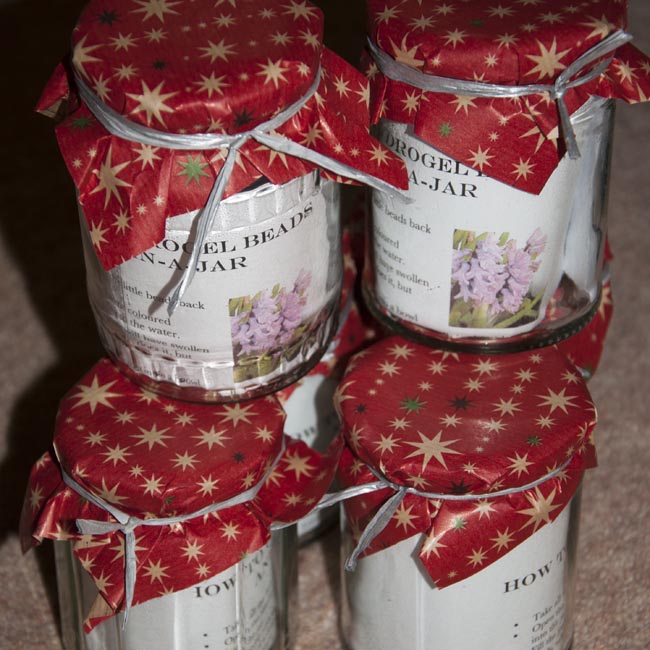
Hyacinth Jars, ready to give

Many of the gifts for my friends and family have been homemade this year – of course I couldn’t write about them before the big day, because that might have ruined the surprise! One of my favourites is a ‘prepared’ hyacinth bulb (heat/cold treated for indoor forcing – this is important, as unprepared ‘garden’ bulbs won’t flower if grown in this way) in a jam jar with hydrogel beads (sometimes called ‘water crystals’).  Hydrogel beads are one of the coolest, weirdest things I’ve come across in a long while.  They start out as a tiny little packet of small clear-plastic looking ballbearing things, but when soaked in water overnight, the contents of the tiny little packet will swell up to fill a whole jam jar.  Better still, the ‘reconstituted’ hydrogel has a refractive index so close to water that they’re essentially invisible if they’re below a fluid level, which, you have to concede, is very cool, in a geeky sort of way.

Once you’ve got over the excitement of the whole thing (I know, right?), how do you make them either into a gift or into a lovely spring treat for your own window ledge?

Hyacinth Jar - 'ingredients'For gifting, simply pack up the pouch of dry hydrogel beads and the prepared hyacinth bulb into a washed and dried recycled jam jar (I took the opportunity to use up some of the pickle jars with too much residual ‘taint’ to use as jam or jelly jars), with an instruction sheet (we’ll get to that).  Do up the lid (but don’t worry if you don’t have one) and top it with a pretty bonnet of fabric or Christmas wrapping paper tied on with ribbon.  What could be sweeter?

No, you can’t have my instruction sheet, write one yourself!  But the process is very straightforward.

  • First, you’ll need to reconstitute your hydrogel beads.  Do this in the jam jar, by emptying the tiny pack of beads into the jar and topping up with warm tap water.  I know it seems very very unlikely that this will work, but indulge me here, and leave them overnight.  The next morning, marvel as you discover the beads filling the jar.  It’s very cool.  If you wanted to be a bit psychedelic, you could add a drop or two of food dye to the water to start with, and this will be taken up by the beads.
  • Drain the beads, leaving them in the jar.  Marvel some more.
  • You want the fattest part of the bulb to sit in the ‘neck’ part of the jar, so work out if you need to remove some beads to get the level right, then place the hyacinth bulb on top of the beads.
  • Top up with water to just below the base of the bulb.
  • Now place the bulb in a cool dark place (a larder cupboard is ideal, an airing cupboard isn’t!).
  • Once there are roots growing and green growth is visible in the top of the bulb, move it into a bright place.  This will take a week or two.
  • Keep the water topped up every so often but avoid having water directly in contact with the base of the bulb as this will encourage mould to grow and may make the bulb rot.  The hydrogel beads will make it a lot more forgiving of marginal drying out than a traditional hyacinth bulb vase.
  • Wait for the hyacinth to flower, which will take another three or four weeks.  You may need to find some way to help keep it propped up, though usually they flower in quite a compact way so you might be lucky!

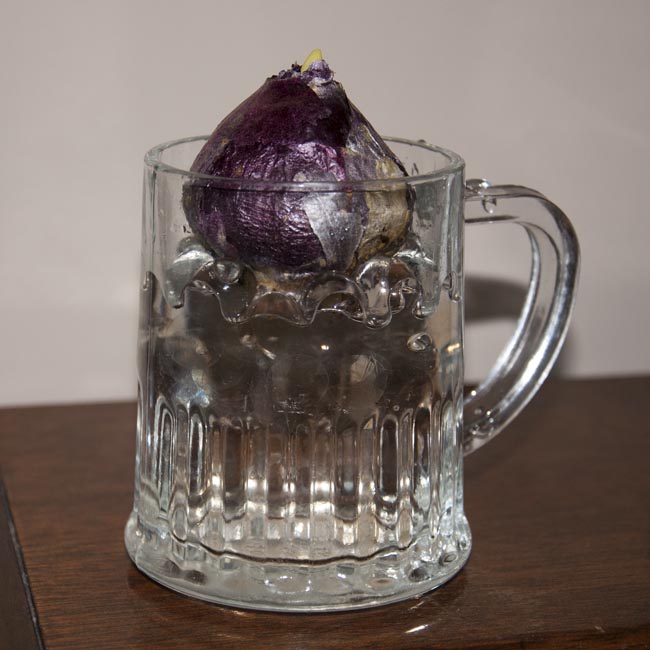
Hyacinth tankardOf course, you don’t need to restrict yourself to jam jars, all sorts of receptacles will do the trick!

These make a very original, eye catching and fun little gift – I used mine as stocking fillers and as part of hampers.  They cost very little, I sourced the bulbs for just under a pound each (in packs of twelve) and they hydrogel packs come in about £3 for ten.  I have three of the bulbs growing together on hydrogel in a small vase, which I started a couple of weeks ago, and they seem to be going well, with great root growth and a nice bit of green emerging!

Last Minute Christmas – perfect giblet stock

If you’ve bought a bird for roasting today, there’s a good chance it’s come with a little plastic packet of ‘bits’.  Whatever you do, don’t throw them away!

These bits are the giblets – the offal – usually the neck (in one or two pieces), the heart, the liver, and the gizzard.  The gizzard is thick, muscular structure with two hard abrasive grinding plates that the bird uses to crush up corn and other food items to make them digestible.  Giblet stock is quick, simple, and makes the most wonderful Christmas gravy.

I have a goose this year, but the following applies just as well if you have a chicken or turkey.  Personally, I use the goose heart and liver in one of my stuffings, so only the neck and gizzard are available for the stock.

In addition to the giblets, you need the following:

  • Stock vegetables.  I use one onion (red or white) and a couple of carrots, I don’t like celery so I don’t use it, even though it’s the often-quoted third member of the stock vegetable trinity.
  • A bouquet garni.  This is just a posh culinary term for some herbs. I use some bay leaves, rosemary, thyme and sage, along with some whole pepercorns and a few juniper berries.  Dried is fine.
  • Water.  Glug of white wine (optional).
  • A splash of olive oil.

Prepare your gizzard by cutting away and discarding the hard plates (use a small sharp knife inserted below and parallel to the plates) and chopping the rest of the meat roughly

Put the splash of olive oil into a nice big saucepan, and brown the neck and gizzard meat, and then add the roughly chopped onion and carrots and sautee for a couple of minutes.  Now add about a litre of water (and the splash of white wine if you want) and the bouquet garni, bring to the boil and simmer for about an hour.  Strain, discard the solids, and return the stock to the pot and boil again until reduced in volume by half.  That’s it.  Set aside in the refrigerator until you make your gravy later. You won’t regret it!

‘Tis the season… Happy Advent, everyone!

Advent candle

We lit our advent candle this evening, which marks the real start of the Christmas season for me.  And this morning I had a chocolate Euro out of the ‘1’ pouch on the fabric advent calendar.  So, Happy Advent, everyone, and I hope your homemade Christmas plans are all coming along well!

Counting Down the Days – making an ‘everlasting’ fabric Advent calendar

Time: about 6 hours – Patience: how many sleeps is it ’till Christmas?? – Difficulty: a little fiddly in places

Advent calendars have always been such an important part of the countdown to Christmas for me.  But aren’t they often just a little bit of a disappointment?  The chocolate calendars so often contain the lowest grottiest grade of milk chocolate imaginable, and the plain card ones are, well, a bit plain!

Completed Advent Calendar

The last few years I’ve seen a few beautiful fabric advent calendars with pockets, which sadly have always been a bit rich for my wallet.  So after I’d got out my bits and pieces of Christmas fabric scraps for bunting making a couple of weeks ago, I thought, surely I might be able to make something of my own?

You will need –

  • A large piece of heavy fabric for the backing.  The piece I used was about 45 x 80 cm, but obviously this will vary according to your design.
  • Enough scrap Christmas-coloured fabric for 24 pockets and something pretty for the top of your tree.
  • Some way of applying numbers to your pockets (felt, paint, embroidery…)
  • A bamboo cane and some ribbon.
  • A sewing machine capable of straight and zig-zag stitch, matching and contrasting threads.

Backing fabricI was lucky to have some quite heavy, checked, gold-coloured fabric in my scraps bag which was big enough to use as backing fabric.  Even better, the approximately 1″ squares of the pattern made a fantastic layout grid for the advent calendar, saving me a huge amount of hassle.

Calendar doodle I doodled out some boxes, and realised with some pleasure that I could build up a stylised Christmas tree out of square pockets using a very convenient 24 squares – result.

Then I had a dive around the random collection of Christmas fabric scraps I’ve collected over the years, particularly the annoying-sized offcuts  I never seem to be able to bring myself to throw out on the basis they’ll come in handy some day!  Out of some card, I cut myself a pocket template based on the squares of the backing fabric, two boxes wide and two and a half boxes high.  I used this to mark up, and then cut out my 24 pockets out of a mix of fabrics, using pinking shears.

Layout patchesNow it’s time to play about with your pockets to decide on a pleasing arrangement of the different fabrics.  It took a few tries but I pretty quickly came up with an arrangement I was happy with.  It’s also the time to decide how you want to arrange your numbers.   I decided to count them down from 24 at the top of the tree, down to 1 in the pot, but you could arrange them randomly or in some other pattern of your choosing.

I was feeling really chuffed at having found 24 small felt numbers from a craft supplier to use on the calendar pockets.  I can in no way recommend that you do the same thing, and here’s why –  having decided on the layout of the patches, it’s time to number them.  The felt numbers were far too small and fiddly to sew on with my machine, so I hand stitched them to the pockets.  It took me a whole evening in front of the TV (not joking, it took over three hours – as much as the rest of the project put together!).  There must be faster ways – I suppose I could have used fabric glue but I didn’t have any.  Fabric paint or iron on numbers may be a solution.  Of course if you have a marvellous programmable embroidery machine, you could just embroider them on.  If you do, you should know that I’m extremely jealous!

Trimmed pocket

Hemming pocketOnce all your numbers are in place (or before, if you’re paining or ironing on) iron your pockets with the top hem folded over, and then just trim the corners of the fold with the pinking shears.  Then stitch the hem over with a closely matched colour of thread.  Now is the time to cut and hem your backing fabric, too.  I used a wide zig-zag stitch to do the hemming, which avoided having to do any other finishing.  Give yourself enough fabric top and bottom to hem a pocket big enough to thread a bamboo cane through later.

Now lay out all your prepared pockets.  Also cut yourself a star, or other decoration for the top of your tree, out of a suitably spangly fabric.  Now it’s time to sew the pockets onto the backing fabric, which you will have to do a row at a time starting at the top.  First pin your star in place and then, with an appropriate contrasting thread, appliqué it in place. I used zigzag stitch, because I like the effect, and a dark red / burgundy thread, but you should do whatever you like!

Applique starThen, a row at a time, do the same with the pockets, sewing the sides and bottom onto the backing fabric using a zigzag stitch.  Try to make sure you catch both sides of adjoining pockets in the stitch.  Obviously don’t stitch the tops of the pockets if you’re going to want to put anything in them!  Oh, and mind your fingers on the pins as you work – or at least, try not to stab yourself *too* often.
If you don’t quite manage to catch all the edges, you can correct this later by hand using matching rather than contrasting fabric to make the corrections.  It will look hand-made, which is the point, after all!

Once you’re all done, cut two lengths of bamboo, one a bit longer than the other, and some suitably coloured ribbon to hang the calendar with.  I used a spot of fabric glue (yes, I’d learnt my lesson and bought some by then!) on both ends of the top bamboo cane to stop the tied-on ribbon from slipping.  I also used a little scrap of ribbon to tie a jingle bell to a tiny peg to use as a marker to move along from pocket to pocket as December ticks away.

That’s it, sit back and admire your handiwork!  And perhaps pour yourself a nice beverage – go on, you’ve earned it!

Scaling Up – second attempt at smoked salmon

Buoyed up by the success of my first attempt at curing and smoking a very small salmon tail fillet, and tempted by the whole sides of salmon that appear in the shops at this time of year, I thought ‘hey, why not?’ and asked my husband to pick one up when he was shopping.  Having got it home and looked at it, in all it’s 1.75kg glory, and about an inch and a half thick at it’s thickest point, I did wonder if I hadn’t perhaps bitten off a bit more than I could chew…  so like any sensible experimental cook, I put the thought firmly to the back of my mind and got on with it anyway.

Before curing I decided to add a bit of flavour to the fillet in the form of a bit of a whisky infusion, so a tot of Laphroaig went into the bag with the fillet for an hour or two.  In retrospect I should have got the fillet out, washed and dried it and deprived it of its pin bones before doing anything with whisky, as I’m pretty sure that most of the flavour I added got washed away at this slightly later preparation stage.   Lesson learned!

After that, I cut the fillet in half (none of my oven dishes is anything like long enough to take a whole fillet in one go, and my fish kettle is metal and not really suitable for curing) and rubbed it generously with the cure mix which, as last time, is 2/3rds table salt and 1/3rd golden caster sugar.  In aiming for a very short cure period (about 6 hours) I’m keen to make sure the pickle doesn’t become unsaturated, so I use a lot more cure mix than I probably need to in order to get maximum water extraction during the short contact time.  I made up about a pound of cure mix, though I didn’t use it all.

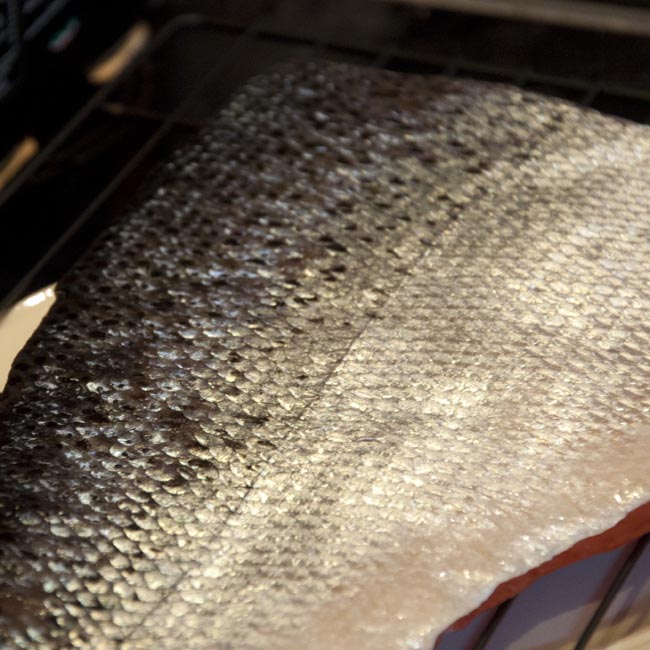
Cured salmon skinOnce rubbed in the cure, with a thin layer in the dish beneath the fish, I covered the fillet pieces with cling film and weighed them down with most of the canned goods in my larder!  I turned them every couple of hours.  At the end of the six hours a really quite striking amount of liquid had been drawn out of the fillet by the osmotic action of the salt and sugar.  More striking than that was the effect of the curing process on the salmon skin, which had reverted from the rather soft pliable texture you expect, to a firm, almost cardboard-like texture with the beautiful blue iridescence you would normally see only in the skin of a freshly caught fish.  More culinary alchemy, and quite beautiful!

Cured salmon before smokingAfter washing and drying, the salmon pieces went into my fridge on open racks overnight.

The next morning, they were part of the second smoker run, and smoked for 10 hours over a mix of oak and apple wood.

After smoking I portionned the fish for freezing, which also gave me a good chance to examine it in cross-section.  The thinner tail piece is perfect, I think.  I cut some slivers from the surface and tasted them fresh from the smoker, it’s some of the best smoked salmon I have ever tasted – a gentle saltiness and sweetness, the oiliness of the fish mixing with a soft smoky flavour and perhaps, with a little faith, even the faint bite of the whisky in the background.  In cross section it is an even translucent orange-pink all the way through and a nice firm texture.

The thicker head-end half of the fillet is not quite such an unmitigated success.  There is a clear visual and textural distinction between the skin 1/3rd of the piece and the rest, with the flesh nearest the skin softer, pinker, and with more distinct fat-lines visible.  In all respects, this part of the fish is much closer in appearance to a fresh fillet than to a cured and smoked one.  I can only assume that the cure mix was not able to penetrate well through the skin (which in retrospect I should have checked was properly scaled) and had not had the time in the cure to be reached from the other side.   It’s not a terrible disaster as these pieces are now frozen and will be perfect to use in dishes like the creamy smoked-salmon pasta, but I don’t think they’re suitable for eating raw.

The options for addressing this, as far as I can tell are –

  1. Skin the fillet – not appealing as a plan, as it will reduce the structural integrity of the fillet and make it harder to slice thinly as smoked salmon later, also I think skinned fillets are a lot less visually appealing!
  2. Cure the salmon for longer, perhaps 8 – 10 hours – also not very appealing, as the flavour of the salmon is, in my opinion, perfect as it is, and I would not like it any saltier
  3. Do something to the skin side to help it absorb the cure better – certainly making sure the skin is fully scaled may well help here, but I’m also tempted to do something in the way of shallow piercing / scarifying of the skin to help the cure penetrating.  I have ordered (Amazon to the rescue again) a device called a blade tenderiser, intended for making lots of stab incisions in steaks before cooking, which I think with some minor modification to control the stabbing-depth may well do exactly what I want to the skin on the thick end of the fillet without too much faff.

Watch this space for the third effort – I’m running out of time before Christmas now so the third time had better be the charm!