Brilliant Bangers – in praise of the full English breakfast

Those of you who come here regularly will know this isn’t the sort of food blog (if it’s even a food blog, really?) where I regularly post photos of my meals.  This time, though, I’m making an exception.

This was my Sunday breakfast –

Full English breakfast

What’s so special about that, you might wonder?  Well, everything on that plate was made here, by us.  I’m not going to claim to have grown the mushrooms or the tomato, or churned the butter, but the bacon was home-cured and smoked, the bread was my own sourdough, the eggs were laid in the garden by our hens, and, most excitingly for me, the sausages were made here, in my very own kitchen.  Even the ketchup is homemade.

This blog started with bacon, over a year ago, and curing and smoking have been among the recurring themes as the months have gone by.  The trouble with sausages is that they’re so often so disappointing, so much less than they ought to be, a disposal route for otherwise less than tempting ingredients and fillers.  Of course, the more lovely the rest of your breakfast – the fresher and richer your eggs, the tastier your home-cured bacon – the more obvious the deficiencies of your bangers become.
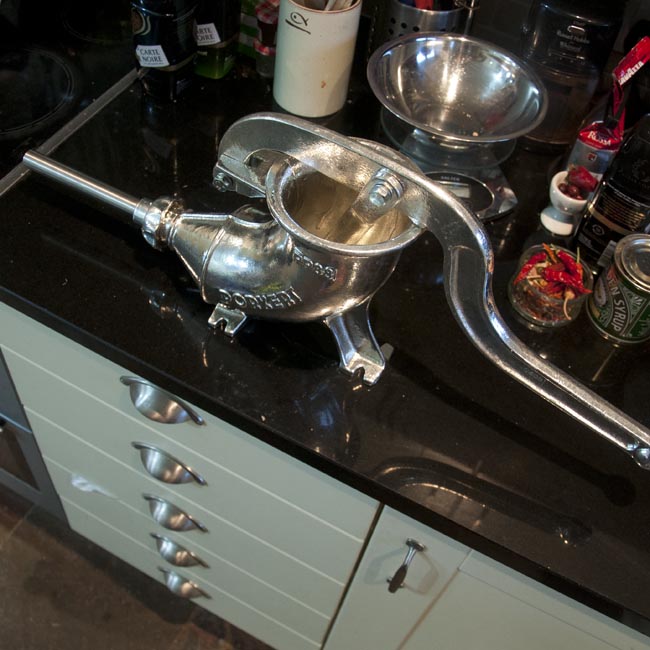
The Porkert PP88I’ve wanted to make sausages for a very long time – so long, in fact, that we received a sausage press (the rather wonderful chromed cast-iron, sparsely named Czech ‘Porkert PP88’) as a wedding gift over six years ago.  I regret that, until last weekend, it hadn’t yet managed to have an outing!  I finally decided that enough was enough, and ordered some sausage skins from Weschenfelder, which arrived very promptly last week.  A trip to our friendly local farm shop butcher provided us with 1kg of minced pork shoulder, and we were ready to rock!

Sausage mixTo the kilo of minced pork, we added a bit short of the recommended 200g of breadcrumbs (I didn’t have enough – they were a mix anyway of shop-bought breadcrumbs I had in the cupboard, and a couple of slices of dried and crushed homemade sourdough), 200ml of water (this, along with the breadcrumb, is essential for getting the mix to a consistency where it will pass through the sausage press), a teaspoon of salt and a half a teaspoon of crushed black pepper.
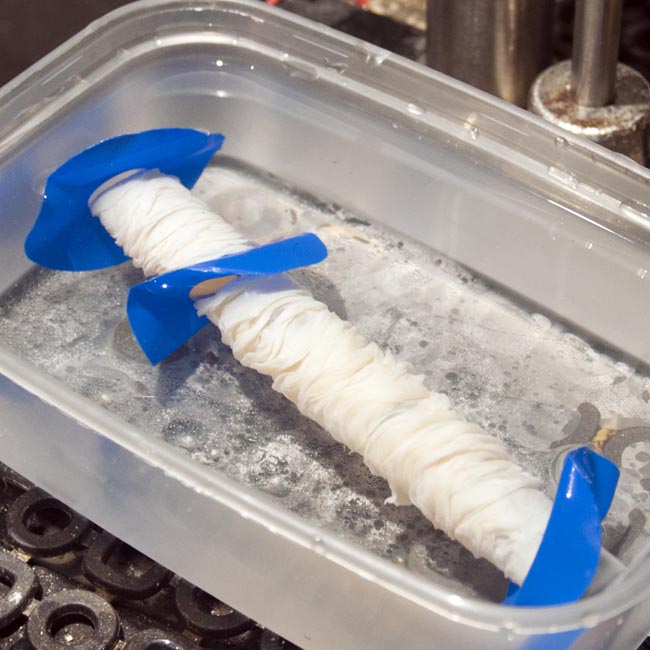
Soaking sausage casingsThe sausage skins were already soaking in warm water – we had bought the ready spooled sheep’s casing as Hubby’s preference runs to smaller bangers.  Sausage skins are not pleasant smelling things!  So, don’t sniff them, would be my advice.  A lot of the odour disappears once they’ve been soaked, so I’d recommend trying not to think about it too much in the meantime!

Ours probably hadn’t been soaked for as long as they ought to, since when I loaded the first length, they were very tricky to feed onto the nozzle of the sausage stuffer – I put it down to inexperience, but the second length, which had had about half an hour longer to soak, went on much more easily.  As they can soak for 12 hours or so without harm, get started with the soaking early!

Feed your skins onto the nozzleOK, so there’s no polite way of saying this – there’s something unavoidably prepucial about sausage skins!  Feed your skins onto the nozzle of the sausage stuffer (ours were quite a snug fit on the 20mm nozzle), leaving a couple of inches, untied, dangling free from the tip.  And try not to contemplate the resemblance to condoms too closely!

Don’t overfill your sausage stuffing press, especially if it’s manually powered like ours!  Add a couple of hand-fulls to the barrel and start to push down steadily.  We discovered around this time that we didn’t have the mechanical advantage at counter height to operate the lever usefully, and moved the whole sausage pressing rig down onto the kitchen floor. Really, we should have had mounting bolts to allow us to seat the press firmly in position, but we had to make do without.  Something to add to my ‘fantasy kitchen’ wish-list, I guess!

Filling sausagesPut a nice shallow tray (a baking sheet is ideal) under the sausage press to catch the sausages as they’re filled.  Once you get the sausage meat flowing, you want to kind of let it fill the casing and pull it off the nozzle itself as it goes.  This is definitely a two man job with any kind of manual press, I’m afraid!  Don’t pull the skin away from the nozzle unless it seems to be getting stuck, but equally don’t let the skin be over-filled, as you’re going to need a bit of ‘freedom’ when you come to twist and link the sausages.

The skins will split in places – you might have weakened them when you were incompetently loading them! – but don’t worry, it’s not a disaster. Carry on until you run out of sausage meat, or skins!

Linked sausagesNow it’s time to link your sausages.  I looked at various diagrams and instructions in books and on the web, but in the end I just fiddled with them until they did what I wanted – one of these days I’ll try to take photos but it never made much sense to me at the time!  Still, by the end of the process I had two strings of traditionally linked sausages.  The first  – on the left – are noticeably ‘scrappier’ than the second, but I’m really thrilled with all of them.

It’s advised to hang them to dry for a while – the cabinet doors were useful here – and then let them rest overnight before eating them.  We refrigerated one breakfast’s worth and put the rest in the freezer.

They’re great sausages.  They cooked well under the grill, but I’ll admit the first mouthful was almost underwhelming, I worried they were bland but then realised that they were, by any commercial standard, just seriously ‘under-seasonned’ compared to what my taste-buds were expecting.  I have to say I’m now rather worried about how much salt must be in shop-bought bangers!  But on the second bite, the lovely sweet pork flavour came through beautifully.  I’m looking forward to experimenting with some herbs, spices, and other flavours in future batches – we intentionally kept this batch quite plain as a ‘baseline’!

Finished sausages

So, homemade sausages – the last part of the Holy Trinity of the great Full English breakfast of sausage, bacon and eggs.  Go on, try it!  And no doubt, there will be more sausage making posts in the future!

Read more from the Country Skills blog >>

Offally Good – liver with bacon and onions, fast fresh frugal food

Offal certainly divides opinions!  One of my favourite ever dishes is liver, bacon and onions – so simple, really just three ingredients –  I’ll order it in a pub whenever it’s on the menu, but sadly it’s often a disappointment.  When it comes to liver, freshness is everything.  It doesn’t reward maturation!  Lamb’s  and calf’s livers are the ones to choose – pig’s liver has a nasty bitter flavour, which some people seem to believe can be mitigated by doing things like soaking the liver in milk before cooking.  Don’t bother!  Get the best, freshest lamb or calf liver you can, it needs very little preparation, and makes a wonderful meal.

Liver, bacon and onion

As much of our meat as we can manage comes from the little farm-shop butcher just up the road from us.  Chris, the butcher and farmer, knows us quite well these days – so when my husband was in there last week, Chris happened to mention he’d just that very day come back from taking a few lambs in to slaughter.  He had the ‘plucks’ (the slaughterhouse term for the heart, lungs and liver).  A lovely fresh lamb’s liver, inevitably, made its way into the shopping bag!

Fresh lamb's liverGood fresh liver is dark burgundy in colour, firm but yielding in texture.  There will probably be some blood in the packaging, wash this off and pat it dry.  Fresh raw liver has almost no smell. It shouldn’t be mushy, crumble, or disintegrate under gentle pressure – if it does, then a process known as ‘autolysis’ has started, and the liver is starting to break down.  Blotchiness and pale areas can also suggest less than ideal freshness, or issues with the health of the liver.  This liver, in thick slices, was beautiful.

Liver slicesThere will be some fibrous tissue in the liver,  you can trim this away as you slice the liver into pieces.  I like my liver in bite sized pieces, cut on the diagonal from the original thick slices.  Try to keep the pieces as even sized as you can, so they will cook evenly.

Prepared trimmed liver piecesDecide what you want to serve with your liver, bacon and onions – mashed potato is traditional, but don’t let that stop you.  Ours was for lunch, so we enjoyed it with a little gravy, and warm buttered toasted muffins.  If you want side dishes, get started with those first – the liver will take less than ten minutes, and you want to serve it as soon as it’s ready.

As well as your lovely fresh lamb’s liver, to serve two you will require –

  • Bacon pieces and sliced onionsOne onion, peeled and sliced thinly from root to tip
  • Four slices – or two thick pieces – of dry cured bacon, cut into chunks
  • Pepper, olive oil, flour or gravy granules (optional)

Slice an onion into thin slices from tip to root, some dry cured bacon into pieces.  Use the very best bacon you can – my home-cured maple bacon is perfect – the last thing you want is that nasty bacon-water from commercially produced bacon leaking out into your pan.

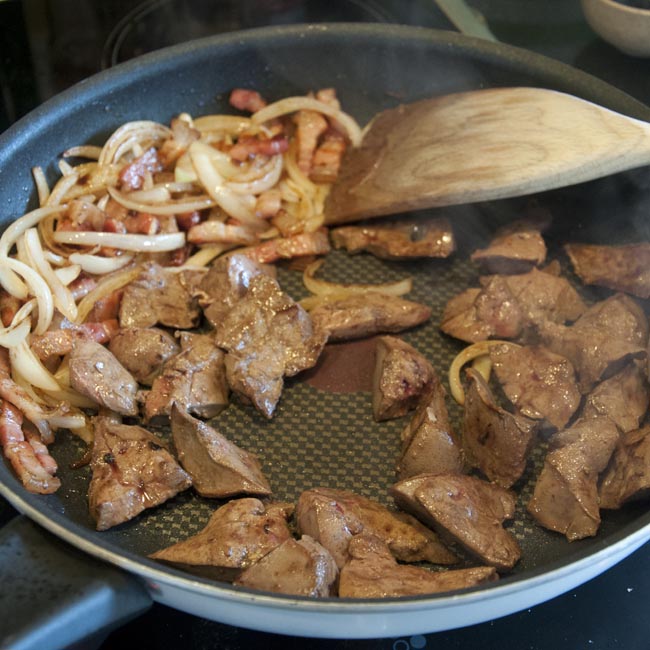
Add liver to pan & fry offFry off your bacon and onion in a large frying pan until starting to caramelise.  Add a very little bit of olive oil if you need to.  Once it’s starting to show a little colour, push it to one side  in the pan.  Now add the liver and fry off until the pieces are just a little bit pink in the middle.  You’re nearly done – just time to make the gravy.  Mix the onion and bacon back among the cooked liver.

Cooked liver piecesNow add a generous splash of boiling water to the pan, and stir it all around to capture all the lovely pan flavours.  If you want your gravy a little thicker, thicken it by your preferred method.  Gastropub recipes often have red wine in the gravy – I’m not sure this is an improvement, simplicity is everything here!  You probably won’t need to add any salt – the bacon has enough – but season with pepper to your taste.

Making gravy

Serve, and enjoy!  This is such great comfort food – it’s food for the soul as well as the body!  And a timely reminder to me that I need to remember to enjoy offal much more often!

Read more from the Country Skills blog >>

Cooking with James Martin – a little taste of the treats on offer!

Our day at Food at 52  with James Martin was in two halves.  Our participation was called for in the morning as we were pressed into service as a rag-tag team of commis chefs in the preparation of the first three dishes – which made up our menu for lunch.  James guided and instructed and was only occasionally scathing of our efforts!

In the afternoon, already replete with amazing food, and enjoying a nice drop (or two!) of Sauvignon Blanc, we got to sit back and relax as James prepared a further six dishes while we watched, asked questions, and then struggled despite our already full bellies to taste all his wonderful creations.

Here’s a quick whizz through the wonderful dishes we tasted – hopefully I’ll be able to post some recipes in due course!

Lunch Menu

Thai crab risottoThai crab risotto – This was the first dish we tasted and was definitely one of the stand-out recipes of the day for me.  It has amazing complex & multi-layered flavours in exquisite balance, and despite how much is ‘going on’ in this dish somehow manages to taste crisp and clean and not at all muddled.  James described this as his ‘signature dish’ and I can completely see why – it knocks every risotto I’ve ever tasted into a cocked hat!

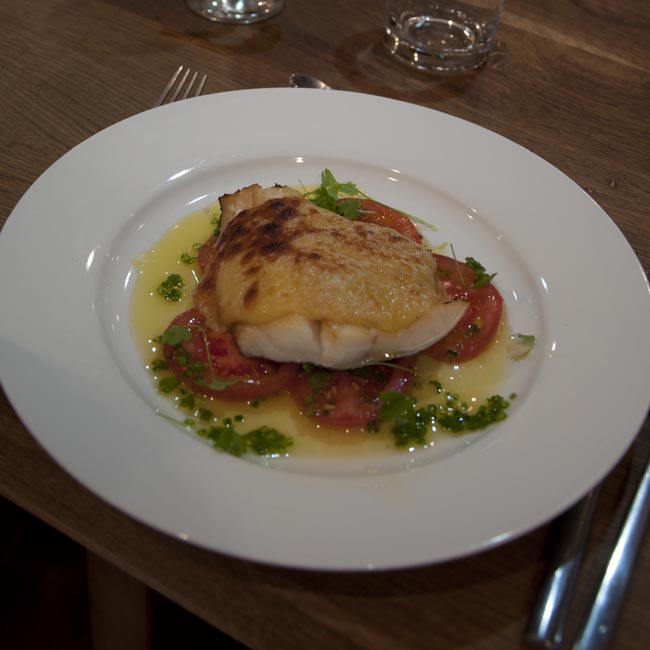
Smoked haddock rarebitSmoked haddock rarebit with confit tomatoes – An unusual twist on a Welsh rarebit, with the cheese-based layer built on top of a lovely naturally smoked haddock fillet.  Served with a confit tomato salad (which will definitely be making it into my culinary repertoire) it’s a lovely dish for an English summer’s day, balancing the clean crisp flavours of the tomatoes with the comforting warmth of smoked fish and grilled cheese.

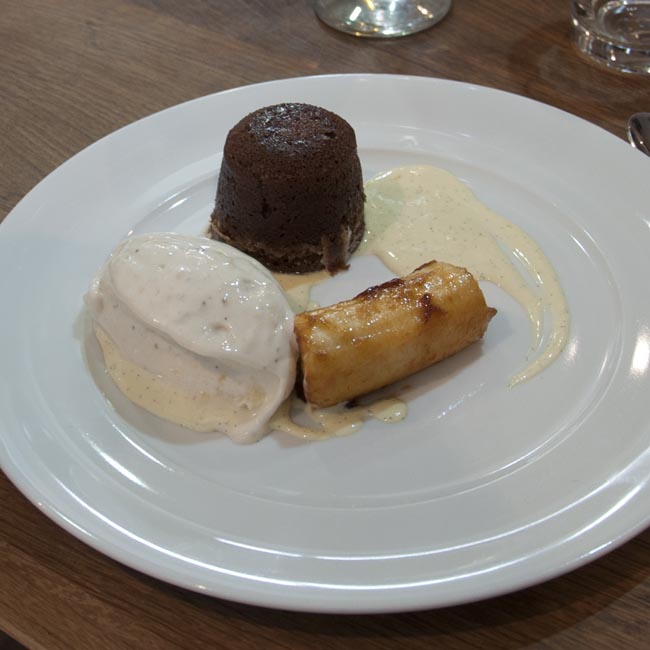
Hot chocolate mousseWarm chocolate mouse with banana ice cream & custard – The freshly made ‘last minute’ banana ice cream is actually the star of this dish for me.  It’s packed with really distinct flavours and heaps of texture.  Perhaps it’s because I’m not that much of a chocoholic – the chocolate pudding is tasty, and gooey in the middle, but very similar to things I’ve had before.  The custard involved a lot of hard work, and is clearly something I should master, but I’m not that much of a custard fan and I’m not convinced it adds that much when you already have the gorgeous banana ice cream.

Demonstration Dishes

Pea and watercress soupPea and watercress soup served with a deep-fried egg – This soup is an amazing colour (no Photoshop trickery here!) and has a lovely fresh pea flavour.  I’ll certainly be playing with this soup recipe at home, though I have to admit to being a bit mystified by the soft boiled egg crumbed and deep-fried and served in the centre in a style – I’m afraid – a bit reminiscent of the famous Australian ‘meat pie floater’! It’s a dramatic ‘cheffy’ touch to finish the dish but I’m not entirely convinced it adds anything that a poached egg wouldn’t in terms of flavour (in fact I suspect I’d prefer the latter) and the crispy texture it imparts is duplicated in the streaky bacon garnish.  Think ham and egg with peas, but all taken apart and put back together again!

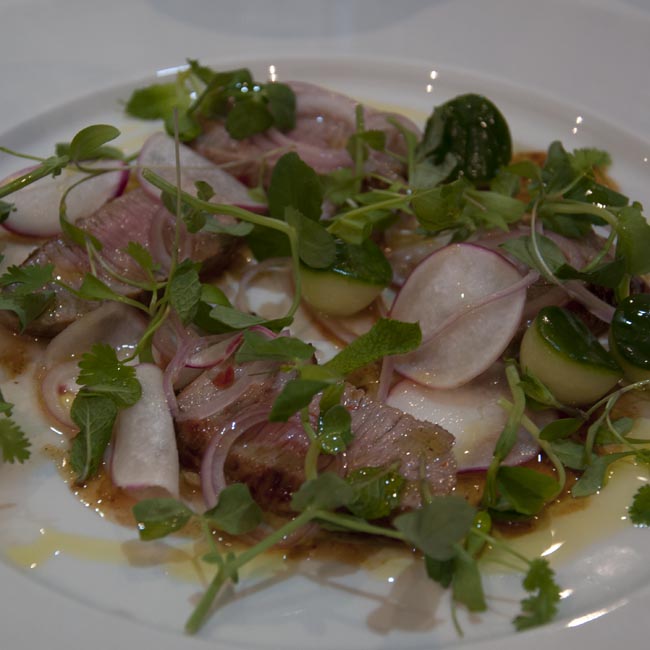
Pea and watercress soupLamb with chilli pickle – This is a great little dish, James described it as ‘bar food’ and it would be ideal for nibbles with drinks, but also makes a lovely light lunch or supper dish if you’re looking to impress someone!  Great fresh flavours with a lovely crisp tang from the freshly prepared pickled vegetables, and the lovely tender pink lamb loin is the perfect counterpoint.

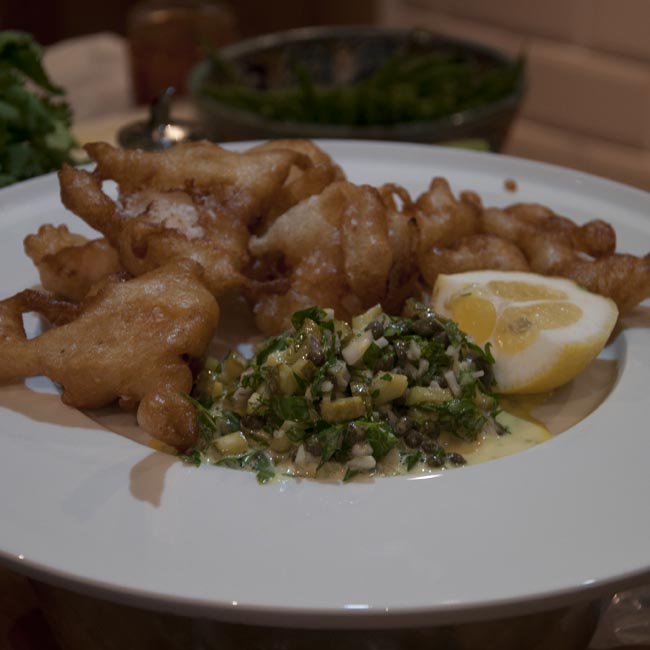
Cod cheeks with tartar sauceVodka-and-tonic battered cod cheeks with tartare sauce – The batter was an unusual concoction, with the cocktail-cupboard ingredients and made ‘live’ with yeast, quite unlike anything I’ve ever seen before.  It fries up lovely and crisp and keeps the cod cheeks gorgeous and moist.  The freshly made tartare sauce is the first such I’ve ever actually liked!  I don’t batter and deep-fry much, but it looks like a  great party-piece!  I can imagine diving into a big bowl of this with a load of friends around a table, perhaps with some slightly spiced potato wedges.

Seared tuna with 'Japanese slaw'Seared tuna in spiced apricot marinade with ‘Japanese slaw’ – A beautiful dish to look at on the plate with some lovely flavours – there’s an almost North African vibe with the fruit & spice flavours.  By this stage in the tasting I was really struggling to eat another bite, but was very glad I did.  We don’t often cook fresh tuna at home but I will certainly adapt this marinade next time we do, as it just lifts that slightly bland character it can have while letting the flavour still shine through.

And now for some desert!  We now felt so full we could pop…

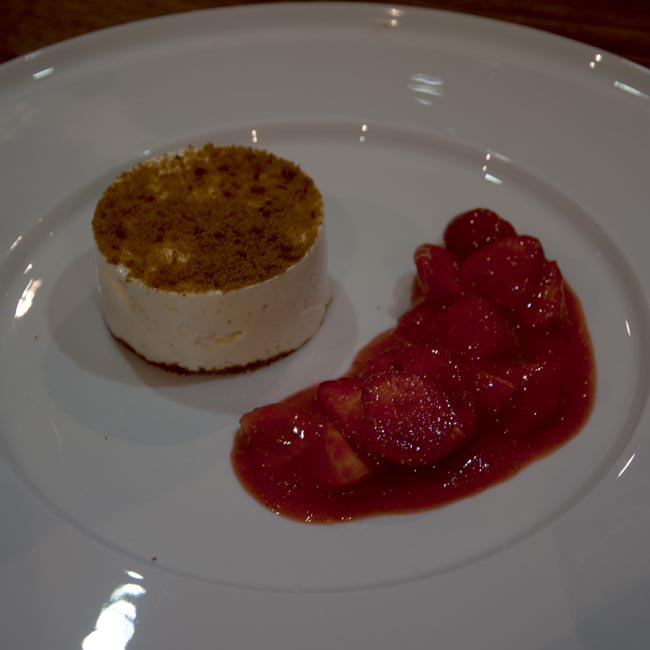
Strawberry cheesecakeStrawberry vanilla cheesecake – James introduced us to this dish, which is one that he developed for Thomas Cook‘s refreshed airline menu.  This is a wonderful quick simple & impressive little desert which you can imagine being able to adapt almost infinitely with different fruits in season and flavours in the cheesecake mix & biscuit crumb.  I particularly liked that this wasn’t an over-sweet dish, letting the flavours of the fresh English strawberries and the slightly acid-note from the cheese shine through.  It isn’t at all cloying and has an almost palate-cleansing quality, nice and fresh – just the thing when you’d eaten quite as much as we had!  All in all a great little dish and definitely another one for the repertoire!

Cheat's GateauxLast, but quite definitely not least, James’ rather marvellously named Bullshit (or “Cheat’s”, for polite company!) Gateaux seems quite the work of patissier’s art.  Just look at it!  In fact it’s startlingly simple – well, for the most part! There’s a story behind this cake – and the name – which I hope to share with you soon..!

For the time being here’s a little snapshot of the man himself doing some of his famous sugar-craft!

Sugar spinning

I hope this has really whetted your appetite for more details of these dishes – writing about them and going through the photos has certainly made me hungry!  I can safely say it’s the most amazing day’s foodie indulgence I’ve enjoyed in a very long time.  I can’t wait to experiment some more with the recipes and let you know how I got on!

Read more from the Country Skills blog >>

Basic Butchery – how to butcher & portion a pork belly

Pork belly is such a wonderful and versatile cut, and so under-rated here in the UK.  Most of my bacon making is with belly, so we get through quite a lot of it.  As a result I tend to buy it most-of-a-belly at a time!  The process of butchering it to remove the ribs and prepare it for curing or roasting is quite simple, and worth learning, since it means you’ll end up with precisely the piece of meat you want for the task at hand, and a couple of little bonus items, too!

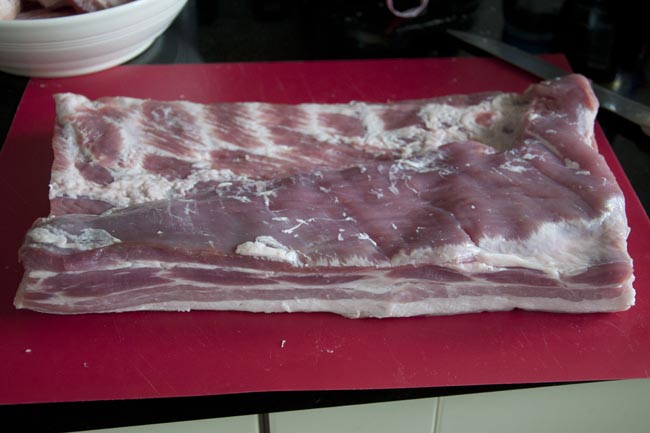
Large piece of pork belly

Your butcher will probably offer to prepare your belly for you, removing the ribs and trimming it to your preference, but you never quite seem to get exactly what you were after, somehow!  Doing the job yourself means you get exactly what you want.  This is my starting point – just under 2kg piece of pork belly .

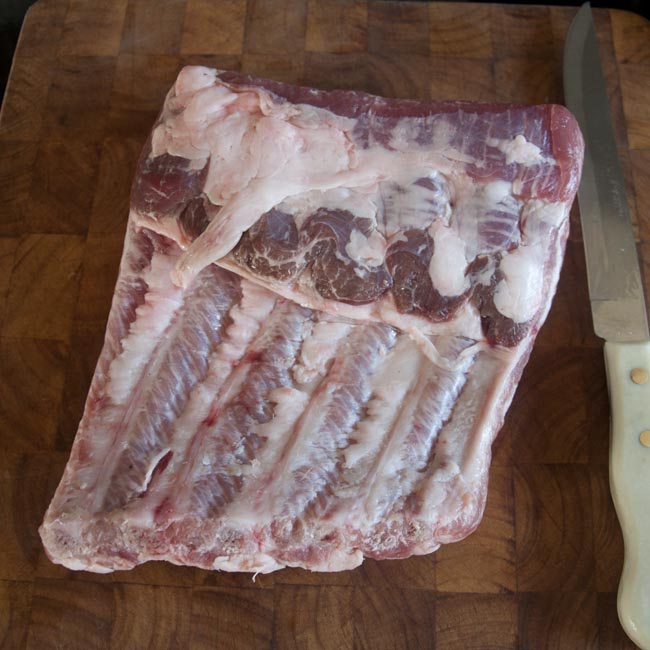
Peel away the inner layer of fatStart by removing the layer of fat on the inside of the belly piece, if there’s one there.  You shouldn’t need your knife for this, it should just pull away if you work gently beneath it with your fingers, leaving a clean muscle surface beneath.  Once you’ve removed it, set it to one side (I usually keep an ‘offcuts’ plate or bowl handy when I’m portioning or butchering meats).  This is effectively pork suet.

Belly portion with fat removedNow you can get a better look at the anatomy of your piece of meat.  As it’s laid out in the photo here, the ribs are on the left, you can see the flap of diaphragm meat lying above them.  On the right side of the belly is a band of smooth muscle.  The ends of the ribs lie almost exactly where the visible edge of this muscle joins the diaphragm.

Cut beneath ribsTake a long, thin bladed, sharp knife and first cut beneath the ribs, as close as possible to them to reduce wastage.  The piece has been rotated 180 degrees from where it was in the previous photograph so that the ribs are now bottom right.  You should be able to feel roughly where the ribs end, so extend your cut beneath them as close as possible to this level.

Finding the ends of the ribsNow gently slice beneath the strap-like muscle we identified earlier, where it lies over the ends of the ribs, and peel it back,  You’ll find the ends of the ribs and the strips of cartilage which link them together.  Gently slice around these and then back underneath. By lifting the rib section it should now be quite easy to join up with the cut beneath and remove this as a block.

Rack of ribs, as removedEither put the rack of ribs to one side, or cut them up into individual ribs at this stage.  This couldn’t be simpler – just feel for the gap between each pair of ribs and slice down the centre parallel to them, your knife, if it’s nice and sharp, should cut straight through the connecting cartilage.

Ribs, divided up.You can trim away any strips of cartilage that area easy to identify – you can see this top left.  That bit is genuinely wastage, incidentally, so chuck it away if you want!  Bag your butchered ribs up, label them, and freeze them for another day (they’re great done on the BBQ with a jerk marinade!).

Pork belly with ribs removed

Now let’s turn our attention back to the pork belly itself.

You can really see now that mine is anything but rectangular! It’s actually sitting ‘upside down’ in terms of how it was on the pig – the top as we look at that photo is the part closest to the middle of the pig’s body, the rib side is towards the back.  As we get closer to the abdominal midline, the proportion of fat to muscle increases, so I trimmed the piece to rectangular, discarding the part which is most top-left in this photograph.

Pork belly, trimmedBecause I’m planning to prepare the belly as streaky bacon, this will give me more manageable, even chunks.  You can see the effect of the trimming in this photograph – the piece has been rotated again so the rib-side is now away from us.  Add your trimmings to the ‘offcuts’ bowl.

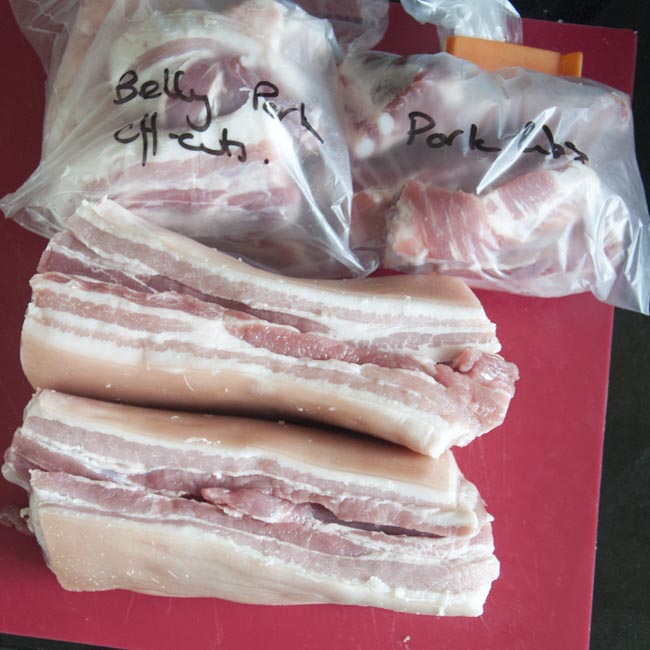
Belly pieces, divided upNow simply divide up your belly as you like.  Mine weighed almost exactly 1.6kg at this point, so I divided it evenly into four ~400g pieces.   A large piece like this would be fantastic roasted slowly whole, too, perhaps with chinese spices, for a special meal for a big gathering!  Roast pork belly has the *best* crackling.

Bag your ribs and your offcuts – these will make fantastic quite fatty minced pork for adding to any minced-meat dish that requires extra juiciness and succulence, or for sausages.  Then sit back and admire your work.

Fully-butchered pork belly

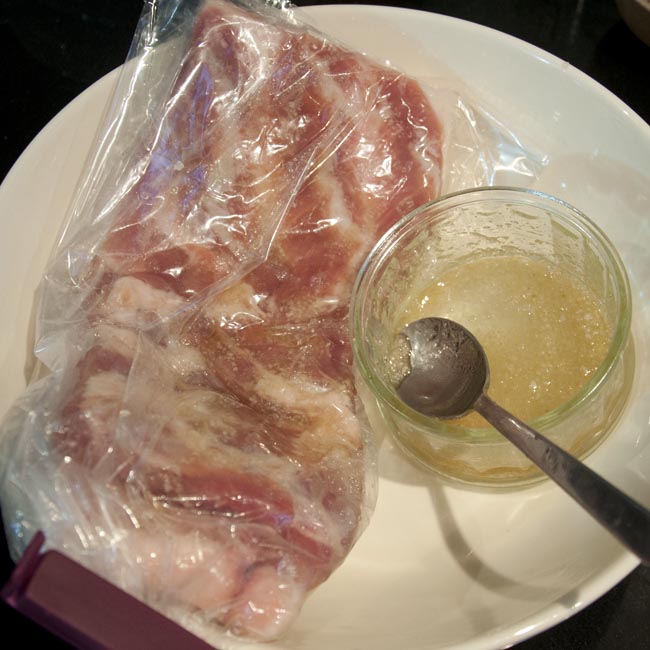
My belly portions were for curing, so I prepared a maple syrup cure made up of 100g of supracure and 90g of pure maple syrup, applied about half to all the bellies, and then bagged them together in the fridge. (More discussion of the bacon-in-a-bag ‘dry’ cure method can be found here.)

Belly pieces with maple syrup cureI’ll apply the second half after 48 hours and re-arrange the bellies so they’re skin-side together for the second half of the curing process.  The total curing time would normally be 5 days for belly pork, but these pieces are thicker than usual, so I may decide to let them go a day longer, depending on the texture and appearance at the 5 day mark.  It would be great to get some maple smoke into some of them – but that’ll depend on the weather.  I’ll keep you posted!

Read more DIY Cold Smoker & Home-Curing posts >>

Read more from the Country Skills blog >>

Banner320-260

Opinion – thinking about animals as food, and food as animals

Look at this little lamb – isn’t he just gorgeous? All floppy ears, crinkly coat and frantic tail.

Growing lamb

Now think about eating him – a wonderful slow-roasted shoulder, perhaps, sweet and tender, running with glorious juice and served with a dollop of lovely mint sauce, or a couple of little chops, grilled to your liking with boiled potatoes & greens.

How does that juxtaposition make you feel?  Be honest now…

Hungry? If so, congratulations. You’ve passed!  But perhaps, if you’re honest, it makes you a bit uncomfortable? Unsettled? Maybe even faintly disgusted?  If you’re a vegetarian, you get to leave now, if you like, but if you’re a meat eater then you really should stay and read on.

So many of us today are so divorced from our food, and how it’s produced.  Its appearance on the supermarket shelf, all sanitised and shrink wrapped, so we’re not even used to the touch or smell of it, has allowed this huge chasm – this disconnect – to open up in our minds between our food and where it comes from.  We wince when we’re reminded, very often – how would you feel if you saw a whole roast suckling pig, a chicken dressed for cooking with head and feet still attached (probably on TV in some ‘less civillised’ country), or if you watched a whole side of beef being carried into a traditional butcher’s shop?

Back to our lamb – I’d like to argue that there’s nothing wrong with thinking about him as food – that’s his *purpose*, plain and simple.  If he wasn’t going to be eaten, he wouldn’t have been born.  In a few months, he WILL be on someone’s dinner plate.  Mine, I hope, since he looks to be growing rather nicely and will have enjoyed a cracking life out on that lovely pasture with his ewe and all his little lamby friends!  It’s imperative that we can think of livestock as meat, and step over that chasm, because we also need to make a habit of thinking of the meat on those supermarket chiller shelves as animals.

When you’re grabbing that matching pair of rather sterile-looking chicken breast fillets, sealed airtight in their protective atmosphere, from the chiller shelf, do you have a picture in your mind of the chicken who died to provide them?  It seems to me that to be ethical consumers of meat, we *must* carry just such images with us.  Allowing that disconnect to exist in our thought processes allows us all, thoughtlessly, to make bad choices.  We might say the right things about preferring free range, organic, or higher welfare meat and eggs,  but when push comes to shove, how often and how easily do we pick up that chicken salad sandwich, pork pie, or pack of BBQ burgers without the origin of the meat even crossing our minds?

Unless we’re prepared to think about our food – *really* think about it  – taking time in particular to think about the animals that have provided our meat, how they lived, and how they died, then we cannot possibly claim to be ethical meat eaters.  And if you can’t, or won’t, if ignorance is bliss, if you’d rather close your mind to the idea, and think prettier, less uncomfortable thoughts, if you prefer to pick up the packet of anonymous animal protein, and ignore its source and its story, do you really think you deserve to enjoy the fruits of these animals’ sacrifice?

Read more from the Country Skills blog >>

Maple Bacon – and a bonus summer salad

Every so often I ask my lovely husband for ideas – most recently last time I was making streaky bacon.  ‘What cure shall I use?’ I called out from the kitchen.  ‘Maple!’ he replied.  Right oh, maple bacon.  It’s a new one for us.  I ferreted around in the cupboard and dug out a bottle of pure maple syrup.  This was sounding plausible, after all!

[This bacon was made using a variation on the bacon-in-a-bag technique I wrote about the other week, so you should probably go and read that first if you’re not familiar with it.]

For my bacon, I used –

  • 480g piece of pork belly from our local farm butchers’ shop
  • 30g of supracure
  • 26g of pure maple syrup (really, buy the good stuff, not the blended rubbish)
  • A plastic bag big enough to contain the pork, and a sealed container for the cure.

I was aiming for an 8% total cure weight to the meat (lower than the 10% I normally use), with a 1/3rd to 2/3rd ratio of sugar to salt. This was in deference to the rather aggressive salt flavour I got from the outside pieces of my last bacon-in-a-bag effort.  I got the ratio right but slightly overcooked the total quantity, in this event.  You’re thinking now that my arithmetic doesn’t add up, and that 56g is clearly well over 10% of 480g.  You have to consider that maple syrup is about 40% water to 60% sugar (check the nutritional analysis on the back of the bottle for your particular sugar) so my 26g of syrup is in effect 15g of maple sugar, for a total dry-equivalent cure weight of 45g or ~9%.

Bacon-in-a-bag with maple cureThe mix of salt and syrup is not so much a dry cure, more of a ‘gloop’.  Put the pork in the plastic bag and rub all over with half the cure, massaging in well.  Seal the bag, excluding as much air as possible, and place it in the refrigerator.  Store the rest of the cure in an airtight container.  At least once a day (but in practice I tend to do this whenever I’m going to the fridge and remember) give the meat a bit of a massage, and return to the fridge the other way up.

Maple bacon after curingAfter two days, I poured off the pickle, and applied the rest of the cure.  After three more days (a total cure time of 5 days), remove the bacon from the fridge, rinse it under cold running water, dry carefully with kitchen paper and then wrap loosely in baking parchment and return it to the fridge for at least 24 hours (and preferably a few days) to rest.

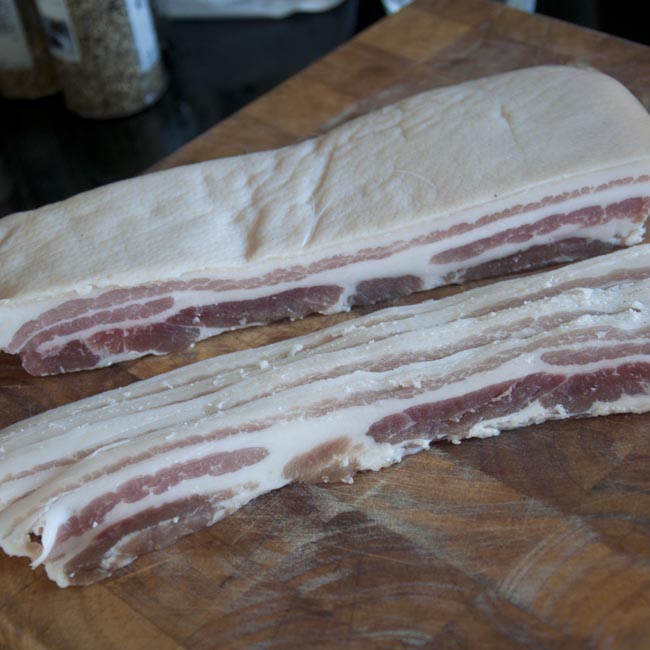
Maple bacon, slicedYou’ll notice that compared to our previous bacon, this one is a lot paler in colour, and retains a much whiter rind.  Most of the change in the meat before and after curing is in the texture, with a slight pink flush to the meat.  This is because we’ve not added colour by using a dark sugar in this cure.  It slices very nicely!

Bacon pieces fryingAt this time of year, with the warmer weather, perhaps you don’t fancy a bacon roll so much as in winter?  For lunch on a hot day, I love a spinach and bacon salad.  It’s the quickest and simplest of light summer lunches.  First slice your bacon into lardons, and fry it off until slighty crispy.  This bacon cooks beautifully, caramelising very rapidly and rendering off lovely clean clear bacon fat.

Spinach and bacon salad with balsamic dressing

Then, toss your crispy bacon pieces, while still warm, into a big bowl of baby leaf spinach, dressing with balsamic vinegar and olive oil.

The empty bowl

Doesn’t it look appetising??  It didn’t last long here!

We had a few more rashers for breakfast this morning.  We will certainly be making this one over and over again in the future.  In summary – this is great bacon, subtly flavoured, gently salted, with a gorgeous traditional bacon flavour.  Make it!

Read more DIY Cold Smoker & Home-Curing posts >>

Read more from the Country Skills blog >>

Jerk Pork Ribs – a bargain BBQ treat

Regular readers of the blog will know that I love to advocate using great quality bargain cuts of meat, even if that means a little bit of extra preparation.  Using the less fashionable cuts means getting to enjoy great, outdoor reared, higher welfare meat without having to shell out the premium price tag – and these cuts also reward the creative cook by being, very often, some of the most interesting to eat!

Jerk ribs on the BBQ

I often have a couple of bags of pork ribs in the freezer, as offcuts from the pork belly I make my streaky bacon from.  From that point of view, these ribs are basically free.  Last time we had some friends over and I wanted a few extra, my butcher sold me a 6 -7 inch chunk for 50p.  If you’re buying them as ‘ribs’ in packs from the supermarket, rather than as offcuts, you’ll pay more, of course.  Yet another reason to cultivate your friendly local butcher, and develop a few basic butchery skills yourself.

Pork rib sectionThis is how I expect your ribs will arrive – as a roughly square or rectangular piece with more or less loose tissue (from the diaphrgagm) attached to the inner (concave) side.  There should not be very much meat on the outer (convex) side, as the belly meat should have been cut away.

If the belly is still there, you can either remove it and prepare it seperately – as bacon, or as a roast pork belly – or you can leave it attached and make really thick juicy ‘streaky ribs’.  Beware, though, as these will be very fatty and consequently encourage your BBQ to flare up when cooked over coals.  Pork belly is so wonderful, there are better ways to prepare it, in my opinion!

Separating ribsYou need to divide up your rib portion into separate ribs, and this couldn’t be simpler.  Looking at this inner side, feel where the ribs are with your finger tips, and identify the gap between them.  Using a nice, sharp, long knife, place the blade midway between the ribs and cut parallel to them.  Butchered ribsThere’s some cartilage attachment up at the ‘knuckle’ end of the ribs, but any plausibly sharp blade should slide straight through this (bonus hint – keep your kitchen knives *really* sharp – a sharp knife is a safe knife!).

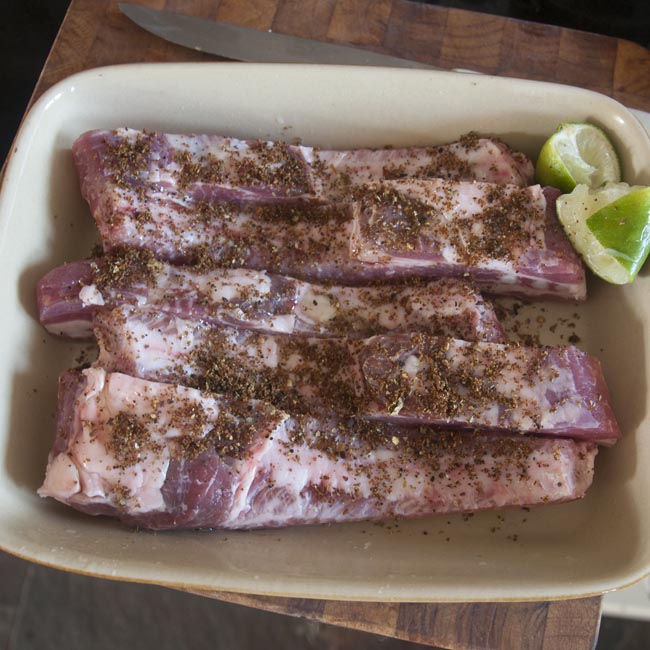
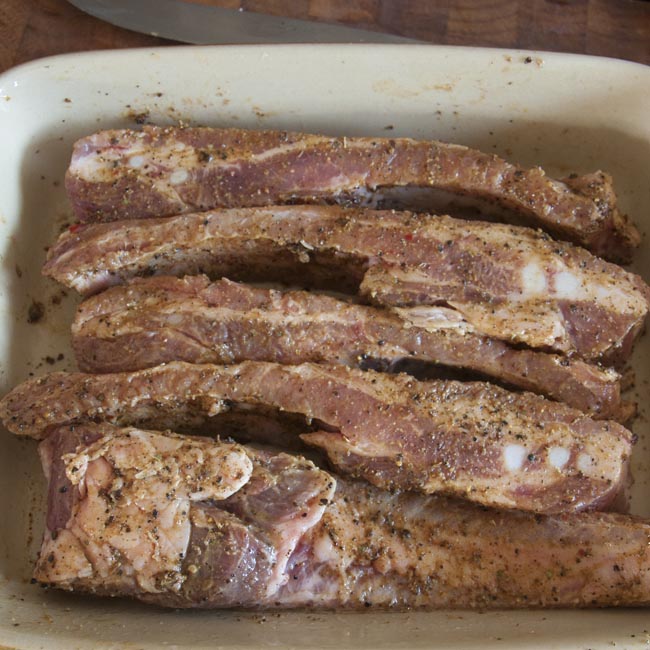
Ribs with seasoning appliedCarry on until all your ribs are divided up.  Now find a nice big dish large enough to contain them all reasonably snugly. Squeeze over the juice of half a lime, and a big glug of olive oil. Then sprinkle generously with your home-made dry jerk seasoning mix and rub in all over.  Turn the ribs over and apply some more mix to the other side.

Ribs, restingOnce you’ve finished applying your rub, wash your hands carefully or they’ll end up stained an attractive nicotine-yellow from the turmeric.  Cover the ribs and set aside in the fridge for at least an hour – if you’re able –  before cooking.

Once your BBQ charcoal is smouldering gently, without any flame, put your ribs on the grill and cook until done.  If I’m cooking for a large party, I like to start these ribs in the oven and then just finish them on the BBQ for that lovely open fire flavour without the extended cooking time.  You’ll still get a great result.  Then, sit back, and enjoy your tasty, juicy, spicy, bargain ribs with a nice cold drink!

Read more from the Country Skills blog >>
BBQ Treats – home-made thyme and tomato beef burgers

A really good, home-made burger is such a treat, hot from the BBQ, under the grill or even pan-fried, when the ingredients are great you can’t go far wrong!  Making your BBQ burgers from scratch means you know exactly what’s gone into them, too, which is no bad thing.

Burgers cooking over charcoal

To make four generous sized burgers, you will require –

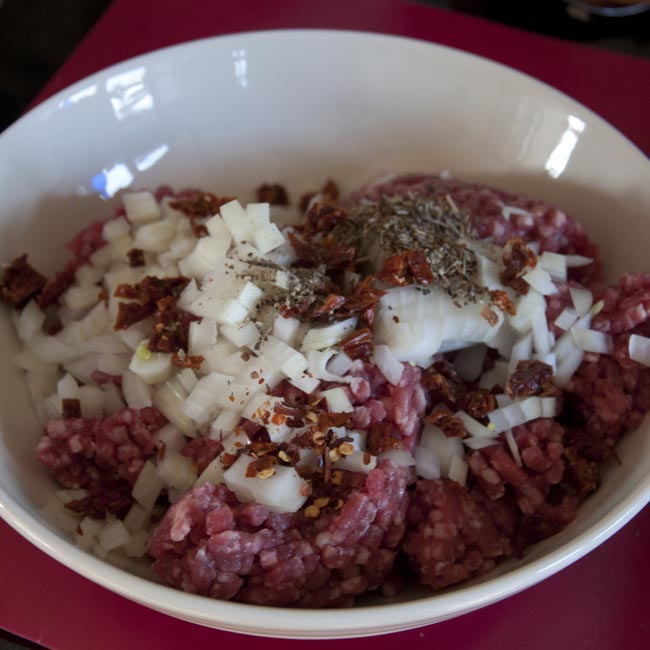
  • Ingredients ready for mixing1lb of good quality lean beef mince – don’t skimp and buy rubbish here, butcher’s is best!
  • Half an onion, finely chopped
  • Four or five sun-dried tomatoes, sliced up as fine as you can
  • Two garlic cloves, minced
  • One and a half teaspoons of dried thyme
  • Half a teaspoon of chilli flakes, and
  • A generous pinch of black pepper

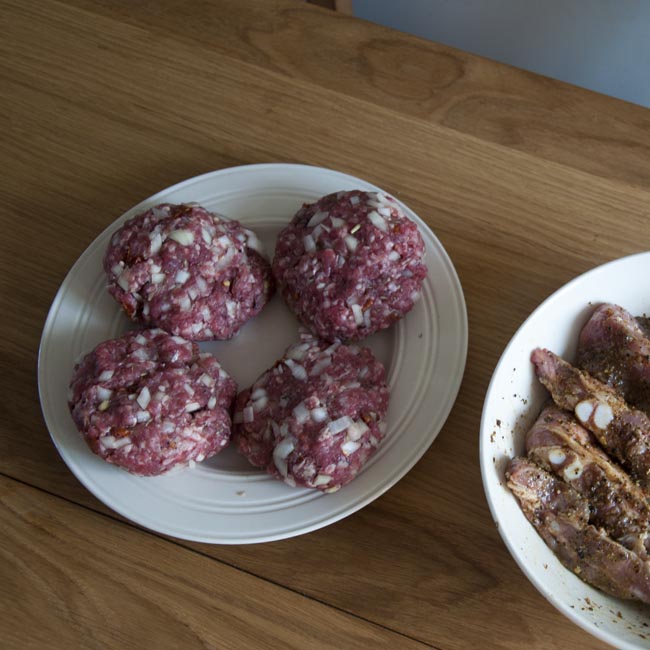
Ready to cookMix all the ingredients in a bowl, mushing them together with your fingers until they combine.  Then divide into four and shape by hand into thick burger patties.  If you have the time to return the burgers to the fridge for an hour or so, this will just firm them up a bit and reduce the risk of them falling apart on the grill.  If you’ve made more burgers than you want to eat today, interleave them with greaseproof paper before putting them in a bag, and they’ll keep in the fridge for a couple of days, or can be frozen.

When you’re ready to start cooking, place your burgers gently on the BBQ grill, and cook through nice and slowly – resist the temptation to move them or turn them until the bottom is cooking well.  Interfering with them too soon is the best way of losing your hard-earned burger into the charcoal!

Then, enjoy in a nice fresh crispy burger bun with a good dollop of sun-dried tomato ketchup, and a generous handful of salad leaves.  The thyme adds a lovely aromatic note, and the tomato a delicate sweetness to the meat that I think you’ll find rather pleasing!  I love to eat these burgers outdoors, with a cold beer or a nice crisp glass of dry white wine.

Read more from the Country Skills blog >>

Jerk Seasoning – perfect for BBQ season, when weather permits?

Summer is here – so it’s got to be time to break out the BBQ!  Never mind the weather – here in the Midlands we’re in the middle of one of the wettest droughts anyone can remember, it’s rained continuously for several weeks now.  What better to give you a taste of the Caribbean sun – even if the local one isn’t co-operating! –  than home-made jerk pork or chicken kebabs cooked over a charcoal grill, served with a cold beer or a rum cocktail?

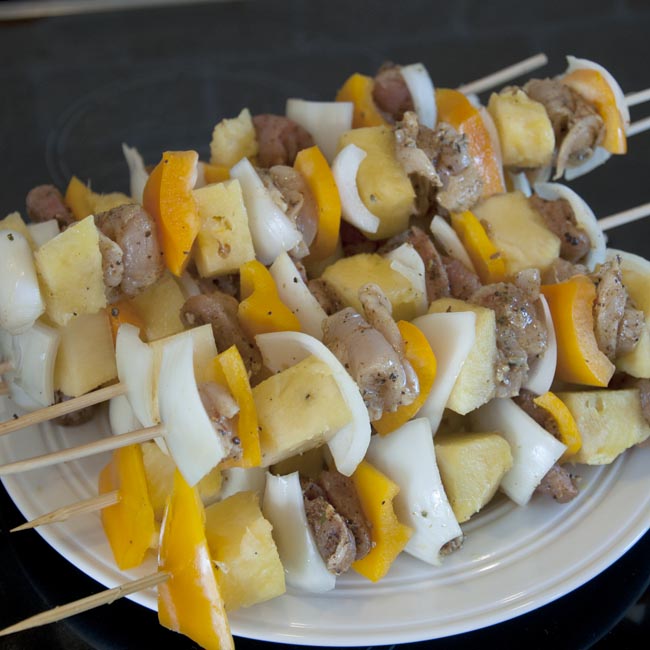
Jerk pork kebabs with pineapple, onion and pepper

[Please excuse the mix of weights & measures in this recipe – I created it more or less by eye trying to match a store-bought one.  Mine’s better.]

Making this dry jerk seasoning is really easy if you have a spice grinder.  If you don’t, you could either try using a pestle and mortar (though this may take you a very long time!), or you may be able to make something comparable using all pre-ground spices, though you’ll have to experiment a bit with the quantities and the texture won’t be so nice.  I don’t think you can buy ground bay leaves though, so I’ll leave that as an initiative test!

To make the dry jerk seasoning, take:

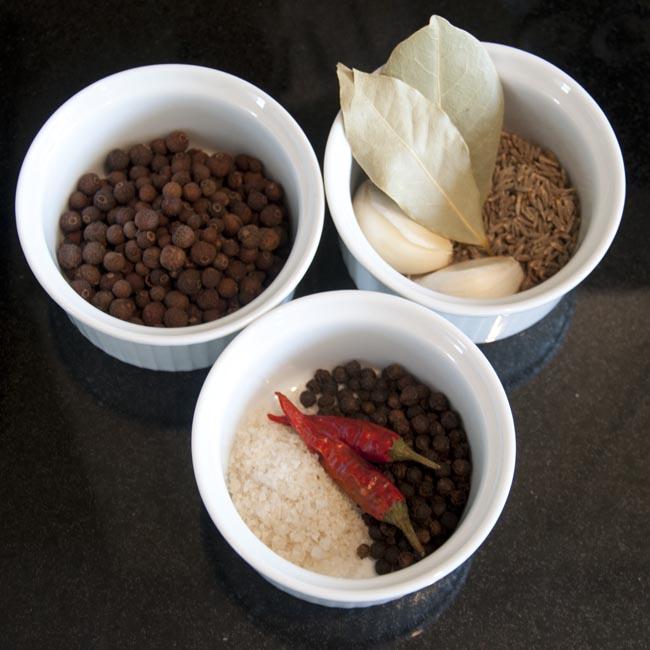
  • Whole spices for jerk seasoning15g whole allspice berries
  • 6g whole black peppercorns
  • 6g sea salt – I used salt that I’d smoked over alder and maple wood, for that bit of extra smokey BBQ flavour.  Plain salt is just fine though!
  • 2 tsp chilli flakes – or a couple of whole dried chillies – obviously the heat of the recipe will be affected by your choices here!
  • 2 tsp whole cumin seeds
  • 2 cloves of garlic, peeled
  • 2 bay leaves

Put all of these together in your spice mill and grind to a coarse powder.

Then add:

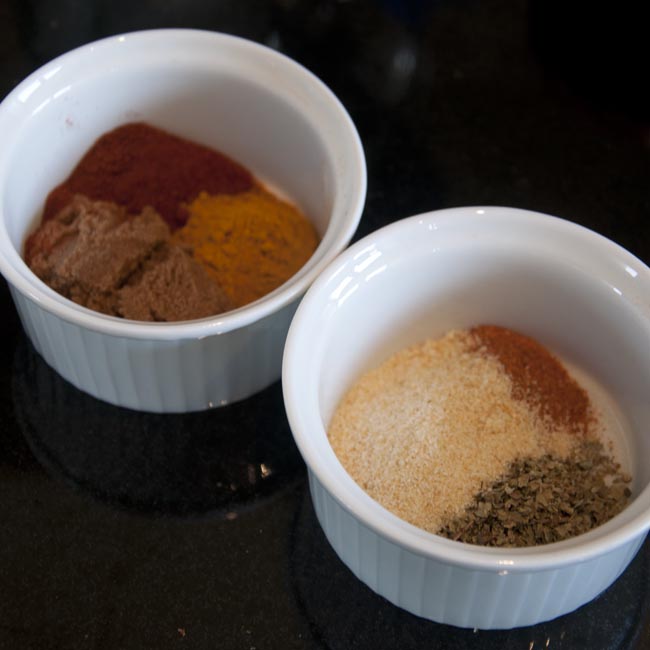
  • Ground spices for jerk seasoning1 tsp chilli powder (strength to taste)
  • 2 tsp dried oregano
  • 2 tsp onion powder
  • 2 tsp soft dark brown sugar
  • 1 tsp paprika (smoked, if you have it, and hot or mild to taste)
  • 1 tsp turmeric

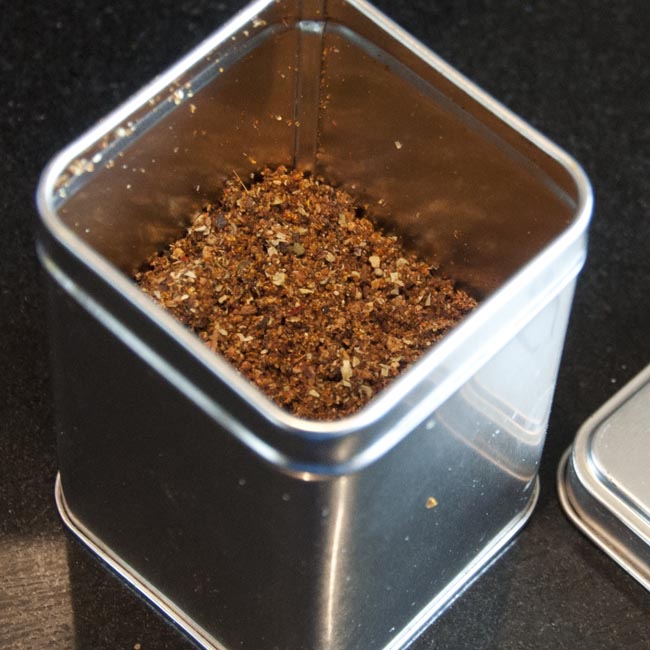
Dry jerk seasoningAnd mix well, working out all the little clumps that may have formed around the soft sugar or minced garlic, which are a bit more moist than the rest of the ingredients. Store in a small airtight container – a jam jar is ideal. It will keep well for several months at room temperature.

To use, mix as a marinade with whatever meat you want to jerk at a ratio of 2 tsp dried spice mix, with aprox 1 tbsp freshly squeezed lime juice and 2 tbsp olive oil. Rub in well with your hands and leave to infuse for a couple of hours in the fridge if possible.

The turmeric is mostly for colour and will dye your fingernails a really attractive shade of nicotine yellow. You might like to consider wearing gloves when rubbing in the marinade, or just leaving the turmeric out of the recipe, if you prefer.

Yesterday, I prepared jerk chicken drumsticks, legs, and wings for the BBQ, and jerk pork kebabs with pineapple, pepper & onion.

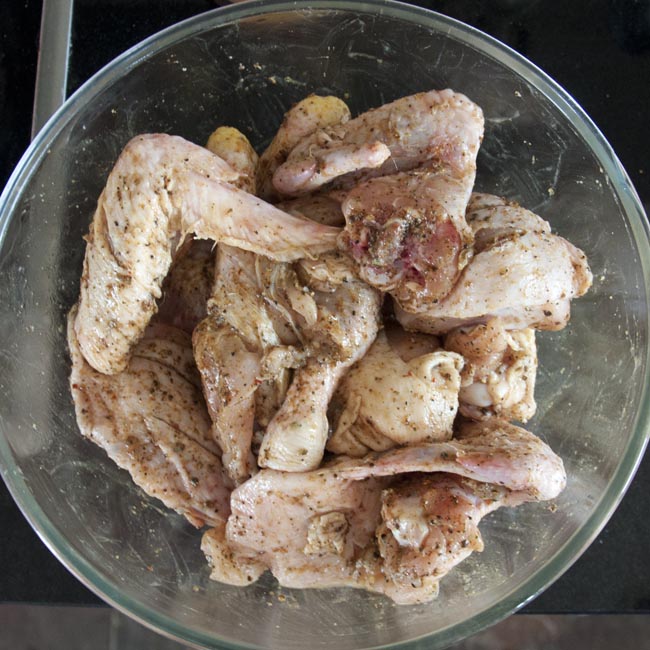
Chicken pieces in jerk marinadeThe jerk chicken portions couldn’t be more straightforward.  Either buy a pack of leg pieces from the butcher, or if you’re in the habit of portioning chicken at home, dig a couple of packs of legs & wings out of the freezer. Slash through the skin and into the meat several times on each portion – this helps the cure penetrate and also helps the thicker portions of the chicken cook evenly over the charcoal grill. Then squeeze over the juice of a whole lime, a good glug of olive oil, and several teaspoons of the jerk seasoning – I ended up using about 6 spoonfuls to get a good degree of coating on all the pieces.

Cover the bowl with cling film and leave in the fridge for several hours if possible before cooking, though you can cook immediately and the flavour will still be pretty good!  Cook over a charcoal grill, slowly, so that it cooks through without burning (a little bit of blackening on the outside is traditional, though!).  If you’re in any doubt whether the chicken is completely cooked, take it off the bbq, and place in an oven dish in a 200C oven for 10 – 15 minutes to finish cooking all the way through.  Of course, you can cook these entirely in the oven, if the weather’s not co-operating!

Prepared jerk pork kebabs with pineappleAny pork will do for the kebabs, really – I used half a pork tenderloin I had in the freezer. Cut into strips, and marinade like the chicken, with lime juice, oil and the dry seasoning mix.  Allow these to marinade for several hours if possible.  Prepare fresh pineapple by slicing thickly, removing the skin and cutting into square pieces.  Also slice a couple of onions and sweet peppers into similar sized pieces.  Then, just before cooking,  thread the marinaded pork onto skewers with the chunks of pineapple, onion and sweet pepper.

Kebabs cooking over charcoal

Get some good friends together, and marinade gently in some good drink and good company, while your jerk kebabs cook gently over a charcoal grill, then serve with salad & warmed pitta bread, and your choice of sauce (I quite like sweet chilli with this!).  Yum!  Dig in, and enjoy an early taste of summer!

Read more from the Country Skills blog >>

What’s Your Beef? Beth’s wonderful home-cured salt beef

Salt beef is quite a rarity these days.  I’m aware our American cousins (to whom it’s corned beef) think of it as an Irish thing and eat it with cabbage at St Patrick’s the way we eat haggis, neeps and tatties on Burns Night.  Despite having Irish heritage, I’ve never eaten salt beef, in this context or any other (honestly, Irish-American folks, that’s one tradition you’ve made up all for yourselves!).  But I was very excited to experiment with the idea when I saw a lovely rolled brisket of beef at our local farm butcher’s shop.

Cold sliced home-cured salt beef

A bit of asking around family brought me the information that my sister-in-law, Beth, and her family, were keen salt beef curers and consumers.  She kindly shared her recipe & process with me, which I’ve adapted slightly to suit my purposes.

Raw rolled beef brisket

You will require the following to salt your beef –

  • Piece of rolled beef brisket, mine was about 1kg, which was about right for a meal for two plus cold cuts, or would have served four for dinner.  You may need to find a real butcher’s shop, since brisket, despite being great value, is rather unfashionable and rarely available in the supermarket.
  • Curing salt (I used supracure, which is the pre-mixed salt-and-saltpetre mix I use for making bacon).  Alternately you can use plain salt with (or without) added saltpetre.  You won’t get quite the same flavour without the saltpetre, and the beef will be grey rather than the characteristic dark pink colour of salt beef.
  • Dark sugar, whatever sort you prefer
  • Whole peppercorns, juniper berries, cloves, bay leaves (dry or fresh), and a few sprigs of fresh thyme.  Or experiment with any other herbs / spices you think might work well!
  • A non-metallic bowl big enough to completely submerge your beef in
  • Large saucepan, kitchen scales & measuring jug

Herbs & spices for the brineOnce you’ve gathered all your tools and ingredients together, you need to make your brine.  First, work out how much brine you need.  Put your beef in the bowl and cover it completely with water.  Then take the beef out, and measure the water. That’s your target volume.

Now, for each litre of brine you require, weigh out the following into the saucepan –

  • 300g of supracure
  • 100g of dark sugar
  • Approximately 10 peppercorns, 6 juniper berries
  • A bay leaf, a clove, and a sprig of thyme (or whatever herbs and spices you fancy!)

Add the required volume of water (the more observant among you will notice that you’re going to end up with slightly more brine than you actually wanted, due to adding the dry ingredients – this is fine, don’t worry!) and heat to dissolve all the dry ingredients.  Boil the brine briskly for a few minutes, and then allow to cool (refrigerate once it’s at room temperature to get it down to about 5 degrees centigrade).

Beef in the brineOnce the brine is cold, add your beef.  Weigh it down with a small plate or saucer if required to keep it fully submerged.  This is quite a ‘hard’ (concentrated) brine and the beef will tend to want to float up in it.  Now put the bowl of brine & beef in the fridge, and apart from turning the beef over in the cure once a day, if you remember to, leave it alone. My 1kg piece of beef was in the brine for 5 days.  You’ll want a longer curing time for larger pieces of beef, perhaps up to 10 days or so.

After your curing time has elapsed, take your beef out of the brine.  It will have become considerably denser and firmer in texture (surprisingly so, in fact), as well as darker in colour.

After curing, soaking in fresh water

The alchemy that is salt-curing has happened now, so you’re going to want to soak the salt beef for 24 hours to reduce the saltiness of the finished product a bit.  Wash off the beef and submerge it in clean tap water (it will sink, so you don’t need to weigh it down this time) and return it to the fridge.  Change the water at least once during the 24 hours.

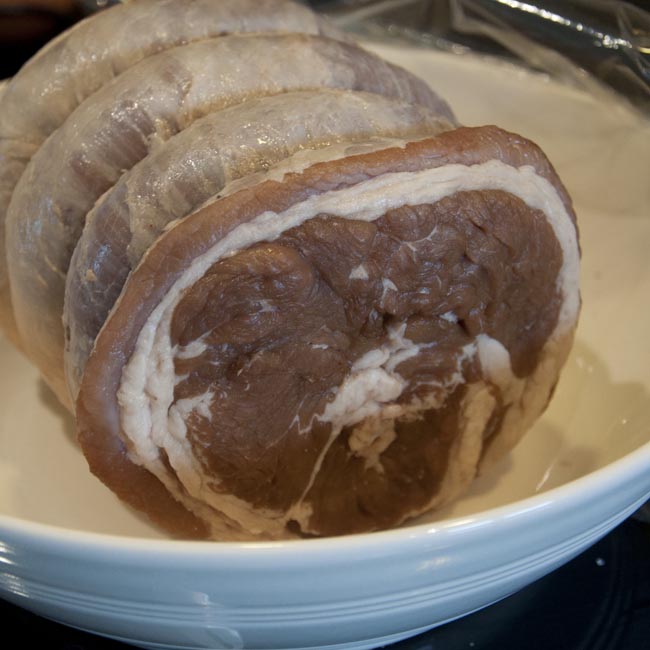
Salt beef after 24 hours soaking in fresh waterNow, either cook it straight away, or remove from the soaking water, and return, covered, to the fridge for a day or two until you plan to prepare it.

Salt beef with stock vegetablesI prepared my salt beef in the simplest way, by poaching it gently.  Add a quartered onion, a handful of roughly chopped carrots, a bay leaf and some peppercorns to the saucepan, and cover the beef with water.  You could also add some celery, but I don’t particularly like it.

Poaching liquid, after cookingBring to the boil and then simmer, covered, very gently for two and a half hours (longer for larger pieces), until it yields easily to a fork. Then remove it from the poaching water and rest for half an hour, covered with foil. The water you’ve poached the beef in will now look like a rich beef broth.

Sliced poached salt beefAfter resting, slice your beef thickly (it’ll fall apart if you try to slice it too thinly) and serve with your choice of side dishes.  Potatoes and cabbage appeared to be traditional (at least in some circles!) so I opted for boiled new potatoes and wilted spring greens, served with a white sauce made from a roux, some of the poaching liquor, a glug of cream and a big spoon of hot horseradish.

Salt beef with potatoes and spring greens

It was beautiful, though I say so myself.  The beef, served hot, is incredibly tender and succulent.  Cooled and sliced, the rest of the salt beef is also beautiful and will make cracking sandwiches.  It’s firm and dense, slices nicely, and has a lovely gentle aromatic flavour.  Home-cured salt beef is sure to become a regular culinary feature in our household.  If any of you have favourite ways of preparing or serving salt beef, I’d love to hear them.  Finally, thank you so much to Beth for her recipe and guidance, and I hope you all consider giving salt beef a try some time!

Read more from the Country Skills blog >>