Halloween Rib Cage T-Shirt – five minute fancy dress

Oh no – you’ve got a Halloween party this evening, and to call your costume an afterthought is, sadly, dramatically to over-estimate the amount of thought that has actually gone into it so far!  We’re just back from a lovely week in Cornwall, eating great food and walking the dog on the beach.  I’d completely forgotten about our village pub’s ‘costume optional’ Halloween event this evening until we got home about an hour ago!

Halloween Rib Cage T-shirt

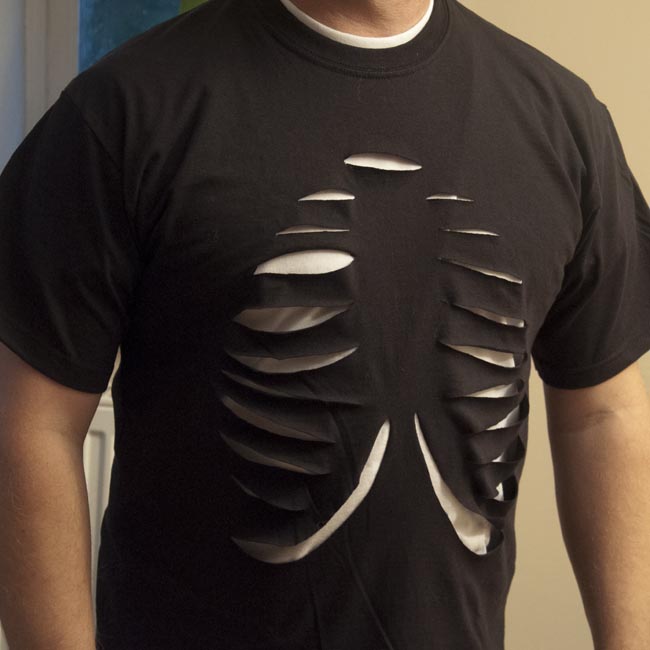
But, all is not lost.  Look at my natty outfit (kindly modelled here by Hubby)!

This really is a five minute costume project.  It’s thrifty, too, and no sewing required.  You’ll just need to round up the following –

  • A ‘sacrificial’ black t-shirt,
  • a white-t-shirt that you’ll get to wear again,
  • a cutting mat, small rotary cutter, and a tailor’s chalk / pencil, and
  • a basic grasp of human anatomy (google images can help you with this bit!)

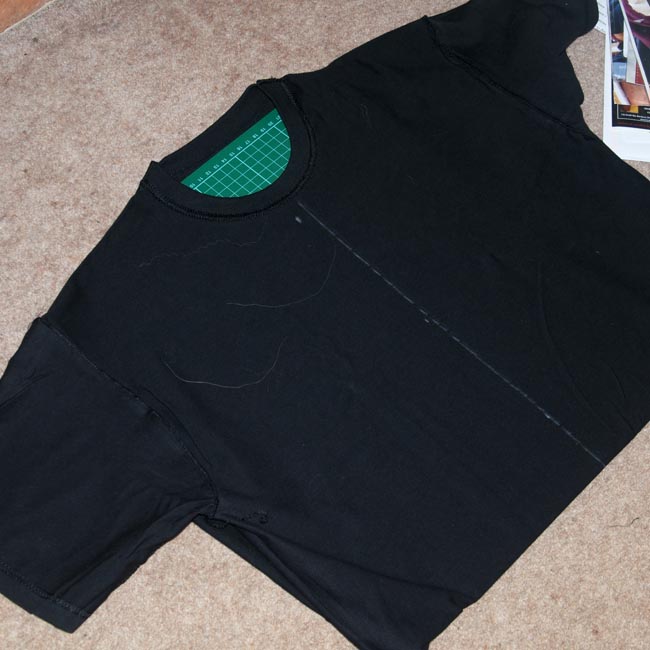
Find the approximate centre lineStarting with the black t-shirt inside out, mark out the centre line as best you can.  This will be surprisingly difficult to do with any accuracy as the quality control on these things is always shockingly poor, so a decent best guess at it is perfectly alright.

Mark out ribsNext, using the tailor’s chalk, mark out a set of ribs to one side of your centre line.  There are lots of rib cages in google images to look at, and I found the PDF template for a much more complicated version of this project on marthastewart.com was a useful guide to the general size and shape of the ribs.  Remember to offer up to the white shirt you’re planning to wear underneath to make sure you’re not massively ‘out’ when it comes to necklines.

Fold for cuttingNow, fold the t-shirt in half along your centre line, so that you have both halves of the front of the shirt front-to-front and your chalk markings showing, and the cutting mat underneath.

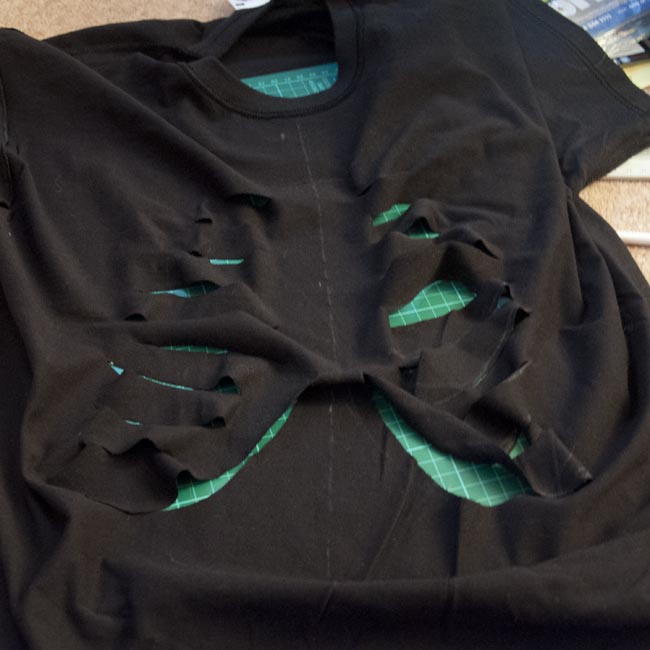
Cut along markings with rotary cutterCut carefully along the rib markings with your cutting wheel, through both layers of t-shirt, so that the pattern is cut as close as possible to identically on both sides of your chest.

That’s it, unfold your t-shirt, and put the cutting mat inside so you can tidy up any bits the cutter hasn’t cut cleanly.

And you’re done.  Simple, or what?

You could do the back now – but don’t cut the same pattern, as the back of the rib cage differs quite a bit from the front!  But if you can’t be bothered, pair it with a cape (or a long dark coat!), dark trousers or a black skirt and knee boots, and – if you’re feeling especially keen! – a scythe made from a broomstick with a cardboard and tinfoil blade.  You’re all set!

Time to get ready to party without feeling like you’ve completely failed to go to any trouble!  Enjoy your parties, folks, and have a ghoulish good time!

Read more from the Country Skills blog >>

Offally Good – liver with bacon and onions, fast fresh frugal food

Offal certainly divides opinions!  One of my favourite ever dishes is liver, bacon and onions – so simple, really just three ingredients –  I’ll order it in a pub whenever it’s on the menu, but sadly it’s often a disappointment.  When it comes to liver, freshness is everything.  It doesn’t reward maturation!  Lamb’s  and calf’s livers are the ones to choose – pig’s liver has a nasty bitter flavour, which some people seem to believe can be mitigated by doing things like soaking the liver in milk before cooking.  Don’t bother!  Get the best, freshest lamb or calf liver you can, it needs very little preparation, and makes a wonderful meal.

Liver, bacon and onion

As much of our meat as we can manage comes from the little farm-shop butcher just up the road from us.  Chris, the butcher and farmer, knows us quite well these days – so when my husband was in there last week, Chris happened to mention he’d just that very day come back from taking a few lambs in to slaughter.  He had the ‘plucks’ (the slaughterhouse term for the heart, lungs and liver).  A lovely fresh lamb’s liver, inevitably, made its way into the shopping bag!

Fresh lamb's liverGood fresh liver is dark burgundy in colour, firm but yielding in texture.  There will probably be some blood in the packaging, wash this off and pat it dry.  Fresh raw liver has almost no smell. It shouldn’t be mushy, crumble, or disintegrate under gentle pressure – if it does, then a process known as ‘autolysis’ has started, and the liver is starting to break down.  Blotchiness and pale areas can also suggest less than ideal freshness, or issues with the health of the liver.  This liver, in thick slices, was beautiful.

Liver slicesThere will be some fibrous tissue in the liver,  you can trim this away as you slice the liver into pieces.  I like my liver in bite sized pieces, cut on the diagonal from the original thick slices.  Try to keep the pieces as even sized as you can, so they will cook evenly.

Prepared trimmed liver piecesDecide what you want to serve with your liver, bacon and onions – mashed potato is traditional, but don’t let that stop you.  Ours was for lunch, so we enjoyed it with a little gravy, and warm buttered toasted muffins.  If you want side dishes, get started with those first – the liver will take less than ten minutes, and you want to serve it as soon as it’s ready.

As well as your lovely fresh lamb’s liver, to serve two you will require –

  • Bacon pieces and sliced onionsOne onion, peeled and sliced thinly from root to tip
  • Four slices – or two thick pieces – of dry cured bacon, cut into chunks
  • Pepper, olive oil, flour or gravy granules (optional)

Slice an onion into thin slices from tip to root, some dry cured bacon into pieces.  Use the very best bacon you can – my home-cured maple bacon is perfect – the last thing you want is that nasty bacon-water from commercially produced bacon leaking out into your pan.

Add liver to pan & fry offFry off your bacon and onion in a large frying pan until starting to caramelise.  Add a very little bit of olive oil if you need to.  Once it’s starting to show a little colour, push it to one side  in the pan.  Now add the liver and fry off until the pieces are just a little bit pink in the middle.  You’re nearly done – just time to make the gravy.  Mix the onion and bacon back among the cooked liver.

Cooked liver piecesNow add a generous splash of boiling water to the pan, and stir it all around to capture all the lovely pan flavours.  If you want your gravy a little thicker, thicken it by your preferred method.  Gastropub recipes often have red wine in the gravy – I’m not sure this is an improvement, simplicity is everything here!  You probably won’t need to add any salt – the bacon has enough – but season with pepper to your taste.

Making gravy

Serve, and enjoy!  This is such great comfort food – it’s food for the soul as well as the body!  And a timely reminder to me that I need to remember to enjoy offal much more often!

Read more from the Country Skills blog >>

Felt Like This – washing machine felt, and five minute fingerless gloves

I have a confession to make – I can be a bit of a hoarder!  I’m at my worst when it comes to clothes, even when they’re worn out, damaged, or utterly unsuitable, not even good enough for the charity shop, I look at all the lovely fabric and can’t bring myself to throw them out. Instead, they end up pushed to the back of the cupboard, or in bags and piles for ‘doing something with’, one day.

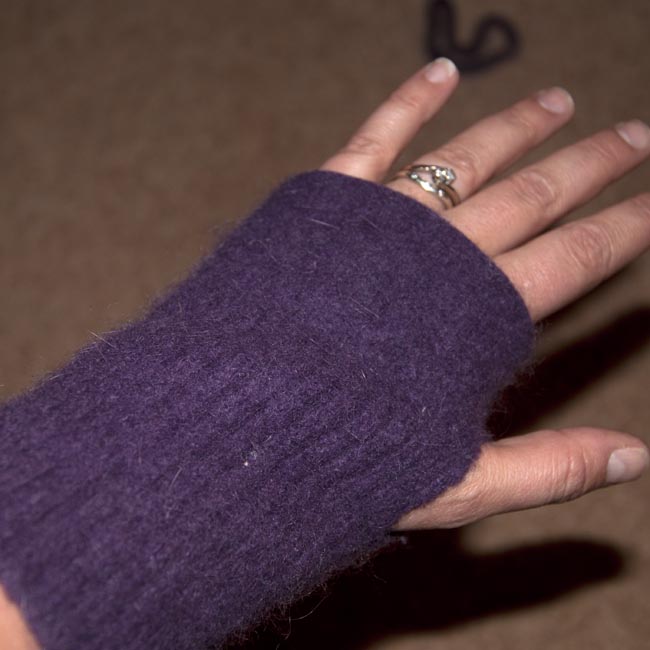
Finished fingerless gloves

Browsing around the web a few months ago, I came across a reference to washing-machine felt, a technique for taking unwanted woollen knitwear and turning it into a wool felt which can then be used in other projects.  All the tutorials I found seemed to hinge on also having access to a tumble dryer (which I don’t), but I had a dig about in the back of the wardrobe, rounded up three dead jumpers (two of which had already suffered and shrunk a little in the wash) and decided to give it a go.  It’s important that the jumpers you’re felting are entirely – or almost entirely – made of natural woollen fibre, as polyester and other synthetics won’t felt properly.  Mine ranged from 80% to 100% wool.

The 'donor' jumpers, before feltingI threw them all in the washing machine with a scoop of normal detergent, and selected a 60 degree cotton wash with all the ‘extras’ selected – extra dirty, extra spin, you know the sort of things.  Kids, this is not a good or friendly thing to do to knitwear (do kids these days even wear woollens??).  The jumpers came out of the machine half the size they went in, and undeniably now made of felt.  Success – and no dryer required!  After a couple of days drying, I was ready to have a play.

The fabric you’ve made will now behave very much like manufactured felt (though it’s a bit thicker than the stuff you buy by the square foot at the craft shop – and rather more robust) or polar fleece. You can cut it without it unravelling, and the edges don’t need finishing.

Cut lengths from sleeves

For a really quick satisfying up-cycle from your first washing machine felt sweater, how about a pair of fingerless felt gloves?

Work out how long you want your gloves, and cut the appropriate length from the sleeves of the felted jumper.

Offer up for thumb position

You’ll probably want the cuffs of the sleeves to be the cuffs of the new gloves.

Snip thumb holesNow decide where you want your thumb holes, turn the sleeves inside out, and snip out that part of the seam from the inside of the sleeve, leaving a slit of the right length to fit your thumb through.  Err on the small size, you can always cut more later.

Completed fingerless gloveThat’s it, if you want it to be!  Not even five minutes work.

But you can embellish these gloves really easily, if you like.  The sky’s the limit, really, for embroidery and embellishment, but I decided simply to add some blanket stitch to the unfinished edges and thumb holes, using some pretty multicoloured contrasting knitting wool I had lying around.  Blanket stitching the cut edges, like I did, has the added bonus that it should stop the seam coming undone as time goes by.

Quickest, simplest fabric recycling project ever, isn’t it?  Anyone can do this, so give it a go!

Read more from the Country Skills blog >>

Happy Birthday – and a new home for the blog!

Doesn’t time fly!  I can’t quite believe it was a year ago (well, near enough) that I sat down and wrote ‘Bringing Home the Bacon’, and the Country Skills blog was born.  And it just so happens that while we’re on the subject of milestones, this is also the blog’s 100th post!

Well, everyone likes a birthday celebration, don’t they, and what’s a birthday without presents and candles?

First Birthday Candle

So, there’s the candle, and now for the present – the Country Skills blog has a new home at https://countryskillsblog.com/ although old links via the wordpress.com domain will continue to work through the magic of redirects.

I’d like to thank all my lovely readers – both regular and occasional! – for taking the time to stop by my little blog in the last year, and particularly those who’ve paused to comment or ‘like’, and helped me feel I’m not talking to myself!  Some of you have really helped me out – I don’t think the Sourdough Saga would have come to such a successful conclusion without your advice and feedback – and for that I thank you all from the bottom of my heart.

Here’s to many more years happy blogging!  Please do let me know what you think, I’m always happy to hear suggestions!

Read more from the Country Skills blog >>

Relight My Fire – DIY recycled wax and wood-shaving firelighters

The chimney sweep came this week, and with the equinox just passed, the nights are palpably drawing in.  We use the wood-burning stove in our living room for an awful lot of our heating in the winter – the alternative for us, living off the beaten track (and off the gas main!) is our oil-fired boiler, which is both expensive and not terribly environmentally considerate.  But even if you’re not using your fire daily, there’s nothing better than a real wood fire as the nights get colder and darker!

Firelighter burning well

We have a fire most nights in the winter, and that brings with it a requirement for firelighting.  We cut our own kindling wood from our log supply (well, I say ‘we’ – Hubby does it!) so it’s not as tinder-dry as the bags of kiln-dried kindling sticks you can buy at great expense.  While I’ve succeeded in lighting the fire with newspaper, cardboard and kindling, it’s a frustrating exercise, doesn’t always work first time, and we tend to use a firelighter to get the kindling going nice and quickly and conveniently.  There’s only one downside – the white firelighter blocks you get from the co-op or the garage *stink* of kerosene.  I don’t want them in my living room!  And while I occasionally see the nicer wax & sawdust type for sale locally, I can’t buy them reliably.

But they gave me an idea – with the waste-wax I have available from old candles (believe me, I’m really bad at throwing things away, even stuff like this!), the really grotty old stuff that really can’t be recycled into new candles, from melt pools, stained with soot, with old wick and ash and even match-heads in it, in different colours and scents, could I make my own?

The answer is resoundingly *yes*, but with a caveat…

Equipment and 'ingredients' (1)You want about equal volumes of wax and closely packed wood shavings.  I was hoping to use some wood-shop waste, to make the whole thing completely free and recycled, but the stuff I could get hold of was too fine and dusty and mixed with big chunks of ‘stuff’.  I think the shavings produced when hubby breaks out the wood-turning lathe would be ideal, so I’ll save those in future.

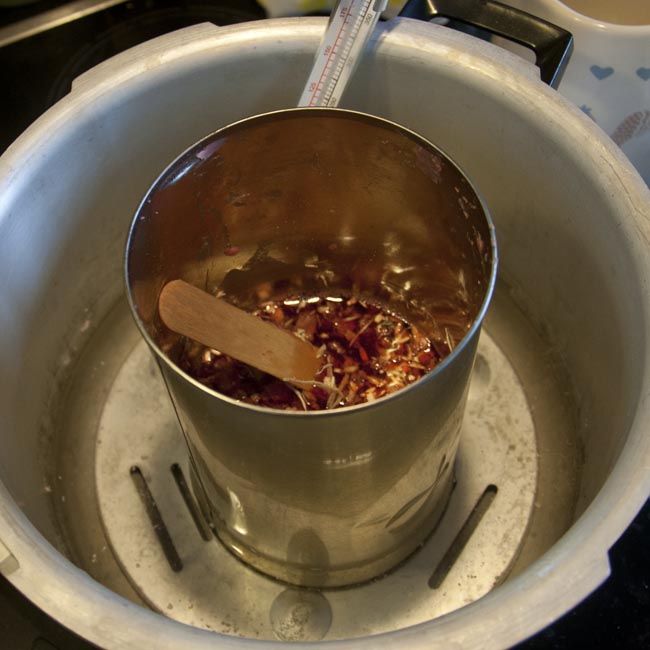
'Ingredients' (2)For this batch I used a cup of wood shavings I stole from the supply we keep for the henhouse, it’s a tiny amount and probably cost a couple of pence at most (and technically I suppose is a recycled by-product, anyway!).  You also want an egg box (I had a few old dozen-sized egg boxes that have been damaged beyond useful re-use), and a double-boiler arrangement for melting your wax, preferably with an inner container you don’t want to use again for ‘clean’ candle-making, and a thermometer for safety.

Take your dirty grotty old wax and put it all into the double boiler, and heat the water up to about 75 degrees celsius.  This should allow you to melt the wax down without getting too close to the flash point of your wax.  I’ve used an old can which previously held malt extract for home-brewing, it’s about the perfect size for melting candle wax.  Really, any dirty old wax goes here, and don’t worry about trying to remove old bits of burnt or unburnt wick, wick sustainers, matchsticks, or anything like that.  Add more wax in stages as the contents of the can melt down, until you have the sort of volume of melted wax you need (it was about 1/3rd of the can, once melted, for me).

This part of the process is where my caveat comes in – it took a bit over an hour to melt down all this wax, during which I couldn’t really leave the wax unattended on the stove (though I did get the chance to have a nice chat on the phone with my little sister).  The time investment in making these as a standalone project probably, for me at least, make the cost / benefit of this project a bit suspect!  There may be ways around this, more of which later!

Melted wax with about half the shavings addedOnce all your grotty old wax has melted down (it will smell quite peculiar if, like mine, it contains fruity, citrussy and maple-syrup scented candle-waxes!), add your shavings in batches, stirring as you go.  You want most of the wax to be absorbed into the shavings, leaving just a little bit of ‘free’ wax to set the mix as it cools.  Pack the mix into the wells of the egg boxes, filling them to the top, and squeeze down the contents with your fingers (wait for it to cool partially before doing this, if you like).

Firelighters settingMy mix made an almost perfect dozen firelighters (I also made two ‘experimental’ lighters with rolled-up cardboard in the well). Allow the firelighters to cool, and then separate them (tear, or cut into the underside of the egg carton to get things going).  Mine look like rather suspect pink raw minced beef products because of the red waxes that went into the mix!  There’s a very subtle smell about them if you stick them right up to your nose, but nothing unpleasant.

So far so good, right?  But it’s all ‘for nowt’ if they don’t actually light fires!  Would they do the job?  Would all the wax melt and dribble out and make a mess of my lovely newly-serviced wood stove?

Setting fire to the lighter & kindlingBuild your kindling ‘jenga pile’, and nestle the fire lighter in the centre.  Then set fire to the cardboard edge of the lighter with a match, and watch it go!  It burned amazingly well, cleanly, with no wax dripping, and got up to a really good temperature, the kindling wood was snapping, fizzing and crackling almost immediately and the fire got off to a roaring start!

I suspect actually about half the total volume of firelighter would have done the job – a whole egg-well seemed a bit generous.  I might under-fill the wells a bit in future and see if it still does the job.

But ‘in future’, if the process is this time consuming?  Well, if the performance of these firelighters weren’t quite so good, I suspect I wouldn’t be making them again.  I think it will be a task that I do ‘in the background’ in a second can when I’m using the double-boiler for clean candle-making anyway (I’ll be doing quite a bit of this in the build up to Christmas!).  If you’re doing any similar candle craft, and have space for a second melting pot (or if you have one of those natty thermostatically controlled wax melting gadgets that you can set-and-forget to a greater extent) then I can thoroughly recommend making these free, recycled little firelighters.

Keep those home-fires burning bright!

Enjoy your fires this winter, folks (and have a look at my useful little tip for cleaning the glass on a wood-burning stove, while you’re at it)!

Read more from the Country Skills blog >>

Using Your Bottle – self-watering planter success!

Earlier in the week I wrote about my last batch of bottle cutting experiments.  Just a quick post to update, especially about the self-watering planter which, I had to admit, I had my doubts about!

Self-watering planter

Well, it works!  The compost is staying moist, the water level in the reservoir is very slowly – but visibly – dropping, and the basil seems to be thriving!  There seems to be an added bonus with this design, which is that the glass captures the heat from sunshine much more effectively than traditional pots.  The soil feels quite warm to the touch on a sunny day, which can only do good things for the plants’ growth over the winter, right?

So, many more of these to come, I think!  Hubby not too sure about me filling up our windowsills with recycled wine bottles, but I’m sure he’ll come around!

Read more from the Country Skills blog >>

Using Your Bottle – testing some ideas for bottle cutting crafts

I’ve been wanting to play some more with the bottle cutting jig since my first attempts at bottle cutting a few weeks ago.  This weekend I found a few hours and raided some bottles from the neighbours’ recycling bins, and got to work.

Almost completed bottle cutting projects

My success rate this time stayed stubbornly around the 1:3 mark.  It’s becoming clear that two things are combining to be a problem.  The first is that accuracy in the score mark is absolutely critical – if you don’t get a perfectly straight even score that meets neatly, there’s no chance of the bottle breaking cleanly.  The second is that bottles are *rubbish*.  Of the bottles I’ve cut – and failed to cut – so far, not one is made up of even thickness glass, and most of them aren’t even anywhere near round in section!  This makes getting an even score more challenging, as well as tending to make the bottle break unevenly as a result of the variable thickness of glass.   There are a handful of gadgets on the market (and one interesting looking one, called the Kinkajou, about to come on the market) which might well improve my hit rate on nice reliable score lines, but I’m still trying to keep this a low-cost hobby for now!

Glass cutting jigStill, a couple of hours work (mostly removing labels!) got me three new nicely cut bottles – a 500ml green cider bottle, and two punt-bottled wine bottles, one of which I cut long, and discarded the top to make a vase, and the other cut more centrally to give a top and bottom section.  Sanding down (see my previous post for more details of the cutting process) gave me safe cut edges.

I’ve really wanted to play with etching, because I’ve seen some beautiful glass decorating projects, but hubby really wasn’t very enamoured with the idea of me using concentrated acid paste in the kitchen (and I can kind of see his point!).  I settled on using some frosted-glass effect spray paint made by plastikote.  This slightly offends one of my fundamental design principles, actually, but never mind!

The ideas for using the bottles were mostly gleaned from Pinterest, which is a new and rather addictive time-sink (those of you who’ve also discovered this can have a browse of my boards here).  I used some black sticky-back vinyl as a masking material for two of the pieces.

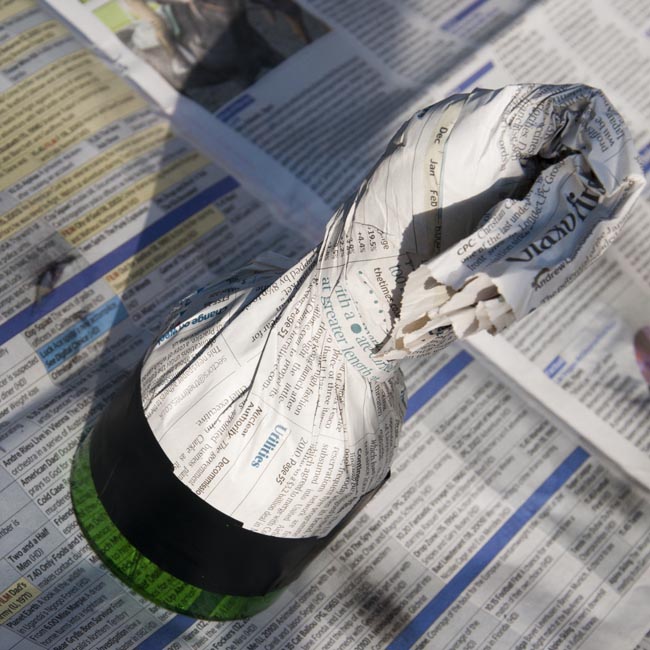
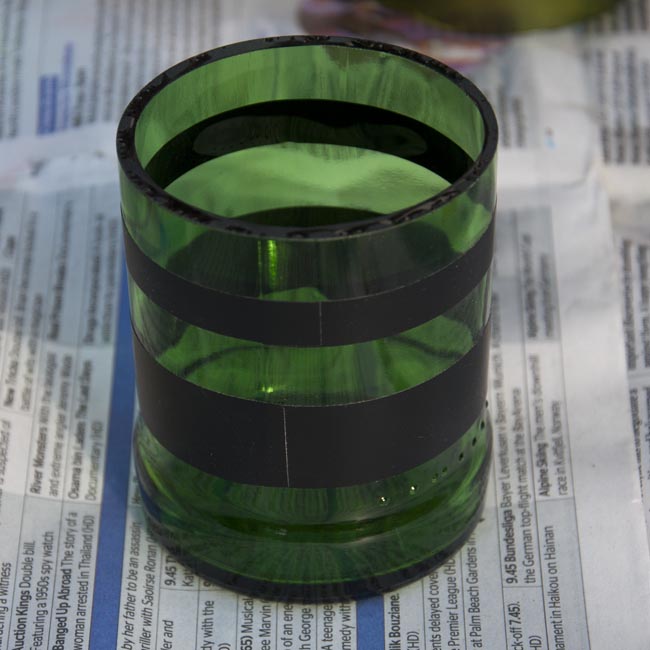
Masked-off bottle topIsn’t it great when you discover that the bits and bobs you’ve bought for one craft can be pressed into service for another?  I dug out the rotary cutter, ruler and cutting mat I bought for quilting, and got to work cutting strips of vinyl.  Two to wrap around the bottom of the cider bottle, to give a striped finish, and the off-cut with some newspaper to mask off all but the edge of the cut-off top of the wine bottle.

Masked tealight holderThis vinyl is a great masking material for glass, as it adheres tightly, stretches just a little to account for the wonkiness of the bottles, and comes away cleanly without leaving any residue.  The resulting cider bottle makes a very pretty tealight holder which would make a lovely little gift.

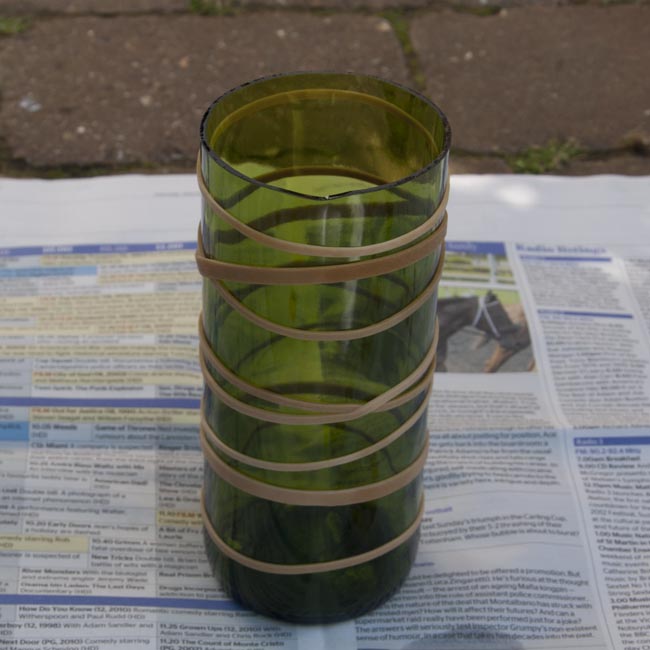
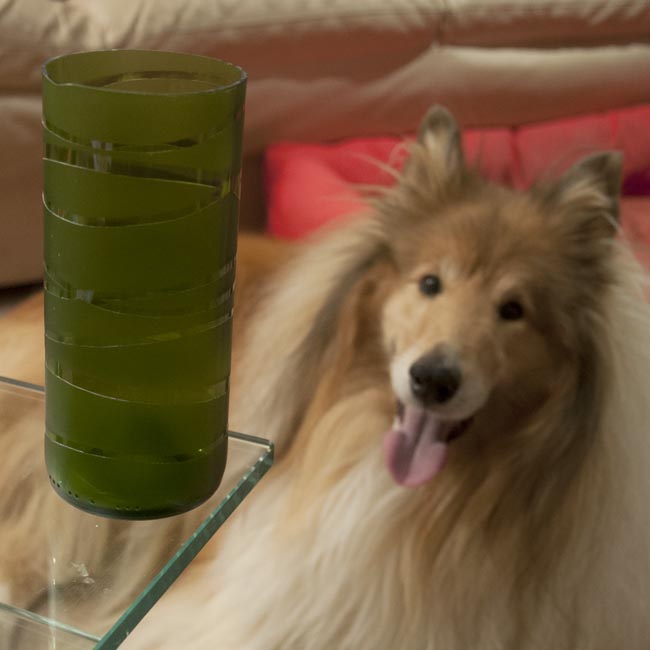
Masked vase with rubber bandsFor the bottle destined to be a vase, I borrowed another idea in wide circulation on pinterest and applied rubber bands, some overlapping, rising and falling. The first thing to note about this approach is that the rubber bands don’t arrange themselves  – it actually takes quite a lot of faffing to get a pleasing arrangement of lines.  They’re not an ideal masking material, either.  As you apply the instructed two or three layers of the frosting paint, some will settle on the top edge of the rubber bands (this is much less of a problem with vinyl which is very thin and doesn’t collect ‘overspray’ in this way).

Dave with vaseThe rubber bands came off easily once the paint had dried overnight, but it took quite a lot of delicate trimming away of the extra paint with a scalpel blade to get a reasonable finish.  I’m still not entirely happy with the outcome, and if I try this approach again I’ll try to get away with one, perhaps two layers of paint rather than the three I used.  Still, the result is quite pretty, isn’t it?  Dave said he wanted to be in the photo, and who am I to disappoint him?

Landscape fabric with stringFinally, and perhaps most interesting for me, is the bottle cut in half.  I’ve made a self-watering herb planter, based on a photo I saw – guess where? – that’s right, pinterest again.  The top of the bottle is up-ended inside the bottom.  I lined it with a cut rectangle of landscape fabric about 4″ by 8″, one half of which I threaded through with a bunch of jute string. Fold this in half with the string dangling through the neck of the bottle. Then, fill with compost and plant (in my case, with some rather sorry-looking home-grown basil I always forget to water).

This is where I admit to being a really neglectful gardner.  I’m full of enthusiasm, but when it comes down to it I have a nasty habit of forgetting to water, to pot on, to plant out…  my garden thrives on it’s own resources more than on my care, and my houseplants have to have a strong will to survive!

Self-watering wine bottle planter

So if this contraption actually works (and the jury is still out on this – it’s early days) then it’s going to change my window-sill gardening forever.  Herbs that will water themselves!  In a planter which is recycled, free, and really pretty, rather than something ugly and plastic and more suited to greenhouse shelving than living room windows.

I’ll update with more photos of the herb planter once it’s clear whether there’s any merit to the design.  In the meantime I suspect there’s quite a bit more mileage in breaking bottles for fun and (perhaps??) profit…

Read more from the Country Skills blog >>

Bottling It – a first ‘crack’ at recycled glass craft

Some time ago, I came across a blog claiming that you could cut wine bottles with a burning bit of string soaked in acetone.  This sounded hilarious fun, but also a tad more dangerous and unpredictable than I was entirely happy with!  The idea didn’t desert me, though, and as time went by I was thinking of more and more different ways I might use recycled wine bottles, if only I could neatly (and safely!) cut them in half.  Green Glass make some beautiful drinking glasses out of recycled bottles, which were another source of inspiration.  This is a real ‘upcycling’ craft (a word which often seems to be an excuse for selling overpriced old junk on etsy!) creating something pretty and useful out of the contents of your recycling box!
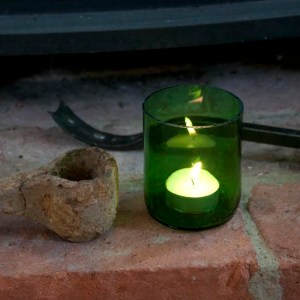
Glass craft - candle holder

So I did what we all do, and broke out a bit of depth-first google searching.  A few idle lunch-breaks worth of reading later, and I eventually decided that I was happy to experiment with a cutting process where hot and cold water are used to ‘crack’ a line scored on the outside of the bottle with a diamond-tip glass cutting tool.
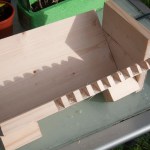
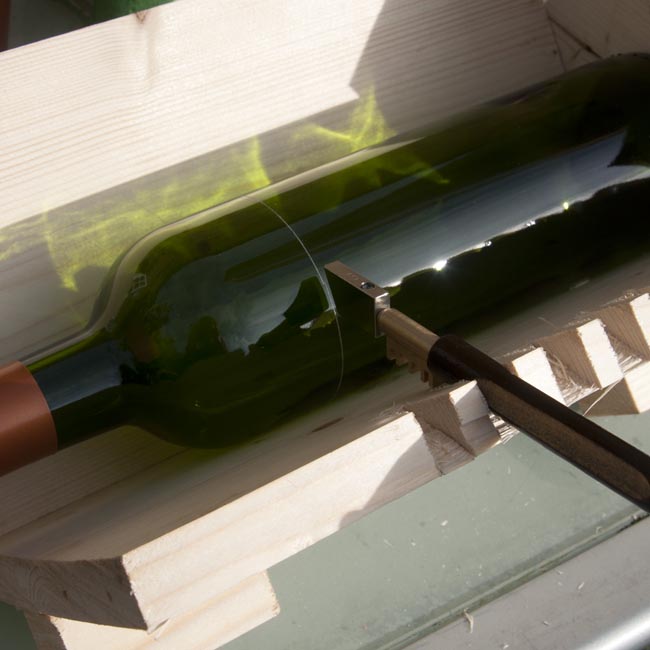
DIY cutting jigOf course, the knack is getting the score line straight.  People will sell you various bottle cutting jigs and devices that work on this principle, but I didn’t want to buy any expensive kit for this, at least to start with.

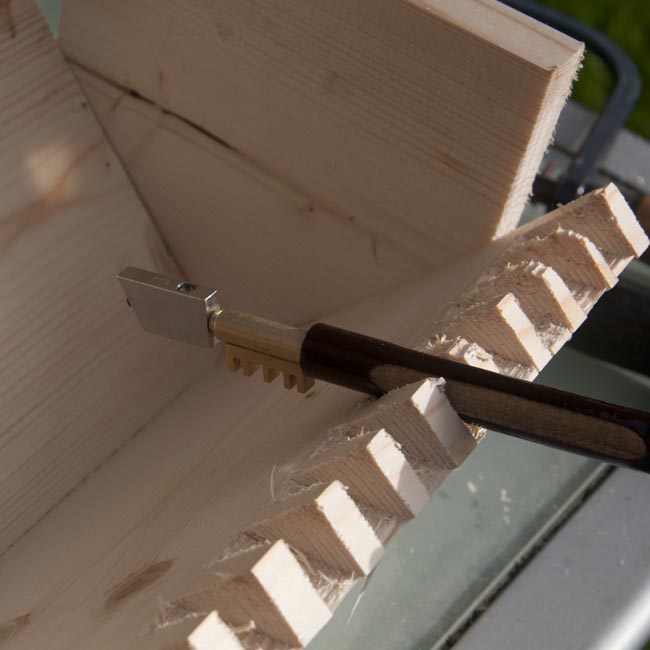
Jig with cutting toolA bit of thought and collaboration from my lovely husband, and we built this contraption out of leftover wood from the shed.  It’s a v-shaped cradle to hold the bottle with a solid end, and notches cut in the side to stabilise the handle of the cutting tool.  The cutting tool itself came from amazon and cost a couple of pounds.

Give some thought to what you want from your bottle, and whether the traditional bump found in the bottom of most bottles (called a ‘punt’, apparently – here I was thinking a punt was a flat bottomed boat propelled with a pole on shallow rivers in British university cities) is a use or a hindrance.  It might be fine if you want to make a vase, for instance, but not so useful if you want a candle-holder.  Some bottles are tapered or squared-off, and these you probably also want to avoid!  Now, give your bottle a good scrub and remove all the labels. You should to do this first, before there are any sharp edges to work around!

Scoring the bottlePut your bottle in the jig, place the glass cutting tool in an appropriate slot and gently press the scoring head against the side of the bottle.  Now, very slowly, rotate the bottle against the point of the cutting tool.  You’re aiming to complete a perfect full rotation, without leaving a gap or ‘over-writing’ the start of your line at the end.  If the score line isn’t complete and perfectly straight, the bottle isn’t going to crack evenly.

Accuracy is everything, as it’s a one-shot deal and mistakes cannot be corrected later – but on the plus side, the bottles are free and only destined for the recycling bin in any case, so try not to fret about it too much!  My success rate so far for a clean break is about 1 in 3 – not great but it’s early days and I suspect practice will help improve this somewhat.

Once you’ve scored your line, it’s time to get it to crack.  Different approaches are advocated, but I went for the simplest one.  Boil a kettle of water.  Holding the bottle over the sink, pour freshly boiled water gently over the score line, rotating the bottle slowly.  After a few seconds, put the bottle under the cold running tap and repeat the process of rotating it.  I haven’t got any photos of this bit, because both my hands were a bit occupied at the time!

Uneven breakYou’ll have to do this a few times, but you’ll see – and perhaps hear – the score lines start to give way.  If you’re really lucky, the bottle will break cleanly straight along the score line.  This one didn’t!  The fracture line wavered quite dramatically above and below the score line over about 1/3rd of the circumference.  I’m not sure why, whether it was to do with the score line, or the fact the bottle itself which was quite uneven in thickness.  Whichever it was, it’s a dead loss, so throw it away and fetch another one from the recycling bin.

Other approaches I’ve seen advocated include candle flame followed by ice cube, and tapping the bottle from the inside near the score line, though this requires a crank-headed tapping tool. I have no idea if these approaches might result in a better success rate – certainly tapping may give a different, more controlled break than hot/cold shock.

Fortunately, my first try (when I wasn’t taking photographs – typical eh?) did break cleanly, giving me a goblet about four inches high which I wanted for a candle holder.  It broke with a very slight ‘notch’, which I was able to crack off using the glass cutting tool to give essentially a clean cut.  A very *sharp* clean cut.

Sandpaper to grind the edgesSuccess!  But that’s not it, of course, since you’d have a candle holder specifically designed to maim the unwary, which is a silly enough thing to keep around your own house, never mind consider giving as a gift.  Those sharp sheared glass edges are going to have to go.  My approach is low tech – wet, fine grade silicon carbide sandpaper.  I used a slightly coarser grade to take the edges down initially, and then finished with some really fine paper.

Working wet greatly reduces the production of glass dust, which is nasty dangerous stuff that you should not be inhaling.  Work in a well ventilated area (outside, for me!) and ideally wear a dust mask.  Feel the edge *very* gently and tentatively with a fingertip to check the sharp edges are gone to your satisfaction.

Carefully work on the edges as well as the flat cut surface.  A little piece of sand paper wrapped around a pencil or something similar is good for the inside edge without scratching the glass.  I’ve seen the use of a dremel advocated – I can see how that would work really well but you’d want to be really careful about dust, probably dipping the grinding head in water every few seconds to keep it wet.  You’ll want to do much more careful and comprehensive smoothing work on the rim if you want to use your cut bottle as a drinking glass – but your extra efforts may well be worth it!

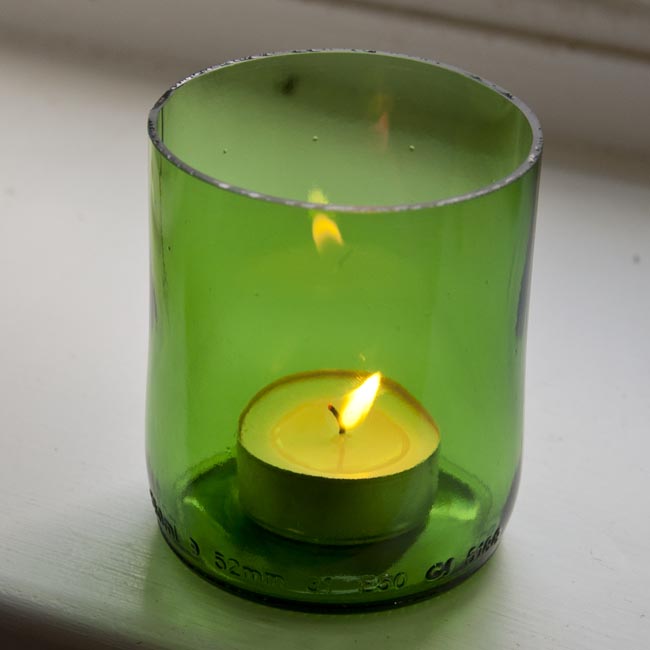
Finished candle holderThe result is really pleasing, the cut edge after sanding has a mostly-frosted appearance but still shows some evidence of the manner of its birth.   It’s not a perfect, machined straight line, but just has that little bit of hand-crafted variability.  You could etch the glass now (something I’m looking into!) or paint it if you liked, but you’re the proud owner of a hand-made recycled glass candle holder.

I used this with a tea light for a test burn, as much as anything to check that the heating from a candle wasn’t going to cause  unexpected cracking or breakage after the bottle’s relatively rough treatment!  And to get photographs, of course.  I expect this will look even better with a votive candle, but I didn’t have one to hand.
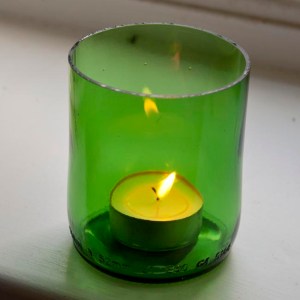
Finished candle holder

This was just a first attempt – but I had a lot of fun and will certainly be doing some more bottle cutting in time for Christmas!  I love that the detail of the bottle is still very much part of the finished piece too.  Definitely something to try – though probably a craft for grown-ups!

For a few ideas, try my next post on bottle cutting – ‘Using Your Bottle – testing some ideas for bottle cutting crafts’.

Finally, an apology to those of you who were emailed a part-finished version of this blog post yesterday – a mistake on my part, I’m afraid!  I’ll try to restrain my itchy mouse-finger from wandering over the ‘Publish’ button so enthusiastically!

Read more from the Country Skills blog >>

Banner320-260

Getting In A Pickle – gorgeous spiced plum chutney

Accidents in the kitchen always seem to happen when everything’s just at that critical point… and any cook worth their salt, when scalded by a volcanic eruption of boiling sugar and vinegar, is likely to think ‘never mind my arm, have to save the chutney!’

So it was Thursday evening.  The chutney is fine, incidentally, thank you for asking!

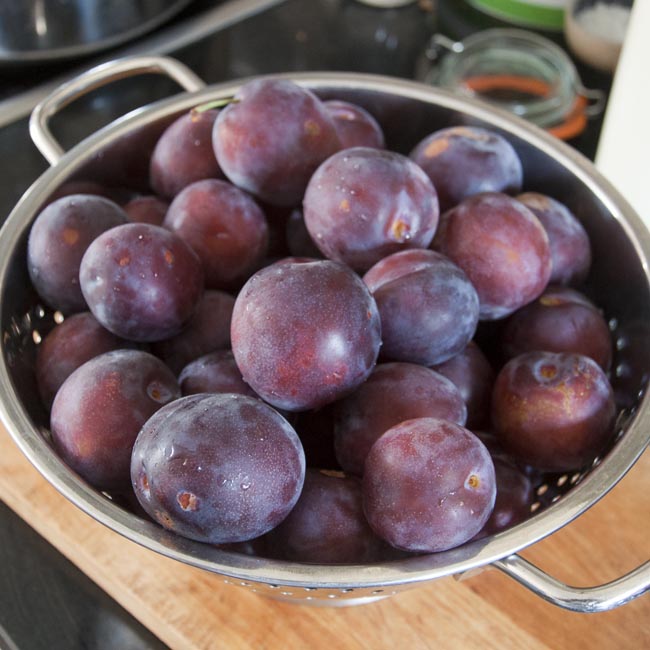
Red plumsAs well as bringing some beautiful French apricots back from their holidays, my lovely in-laws also arrived with a couple of kilos of fabulous red plums.  This put me in a real quandary, let me tell you.  Plum jam is one of my favourite things in the whole world.  But then this spiced plum chutney (originally Delia’s, credit where credit’s due!) is my very very favourite chutney.  It has a lovely fruity character topped with just a subtle hint of Christmas spices, and is wonderful with a lovely sharp mature cheddar, or a slice of home-cooked ham.

What eventually made my mind up was my jam jar situation.  I’ve done a lot of preserving in the last few weeks – it is that time of year after all! – and the jars I have left are a motley bunch.  Quite a lot of them have held things like sauces, curry pastes, and even pickles and chutneys.  The sorts of aromas that ‘hang around’ jars and lids, despite your best cleaning and sterilisation efforts.  It’s not really the flavour sensation you want with your breakfast jam!

This chutney is full of big flavours, and will swamp any faint ‘eau de korma’ residue it might have to deal with!

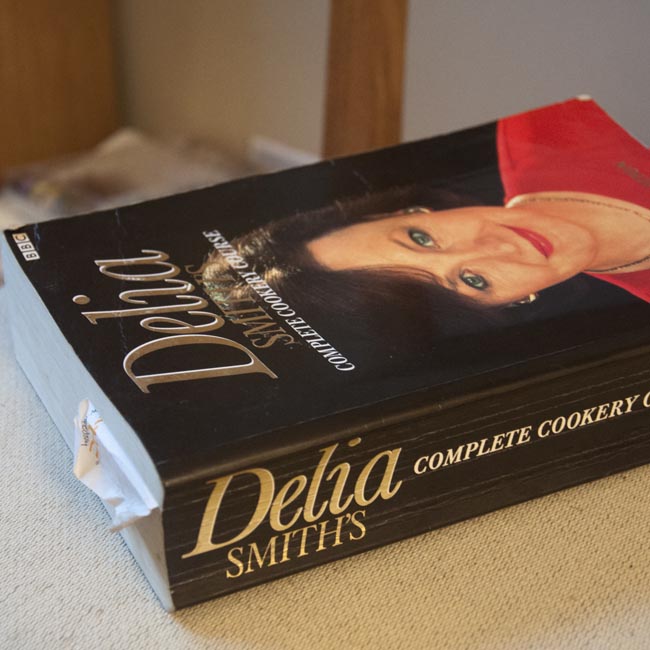
My well thumbed 'bible'The recipe is somewhat modified from the one in my very well thumbed copy of the Delia Smith ‘Complete Cookery Course’, reprinted from the 1982 edition.  Conveniently, it’s also available at ‘Delia Online’, here.  I’m not going to duplicate the recipe, since it’s freely available for you to read, but I changed the quantities and slightly modified some of the ingredients to suit my 2kg batch of plums, and what I had in the cupboard.

This is a BIG batch of chutney, producing 9 jars about 1lb in size, and a further eight small kilner-type jars, plus a bit extra which wasn’t quite a full pound jar.  I estimate in total it makes about 12lb, or 6kg.  It needs a very big pan – my large stock pot was over half filled, before reducing, and has a capacity of about 15l.  Unless you’re planning on eating an awful lot of chutney, giving lots of it away, or selling it (I think it would go really well at a farmer’s market!) I’d probably suggest scaling these quantities down to half or even a third (Delia’s original quantities are for 1.3kg of plums, which is still a very big batch).

I used the following –

  • 2kg of dark red / purple plums.  The tart / acid ‘cooking’ sort are probably better than sweet eating plums for this recipe.
  • Four smallish Bramley apples, totalling about 800g in weight.
  • 5 large-ish onions
  • 5 cloves of garlic
  • 3 teaspoons of ground ginger
  • 750g of seedless raisins
  • 750g each of soft brown and demerera sugar
  • 3 pints of malt vinegar (excuse the switch to imperial measures – this is about 1.7 litres, malt vinegar comes in pint-bottles in these parts, so it’s a measure of convenience).
  • 3 desert spoons of salt
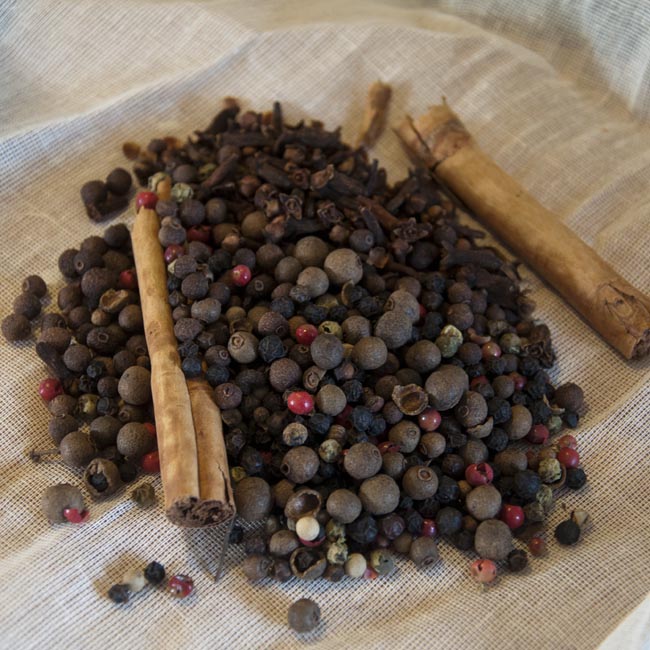
  • a large cinnamon stick, 15g of whole allspice berries, and 20g of mixed peppercorns (the mix was about 1/3rd allspice berries, oddly), and a tablespoon of whole cloves, all tied up in a muslin parcel.
  • A giant stock-pot, food processor, and enough jam jars to contain your chutney (lots, and lots, of jam jars!), which should have plastic-lined lids to help resist the vinegar.

Whole spices with muslin

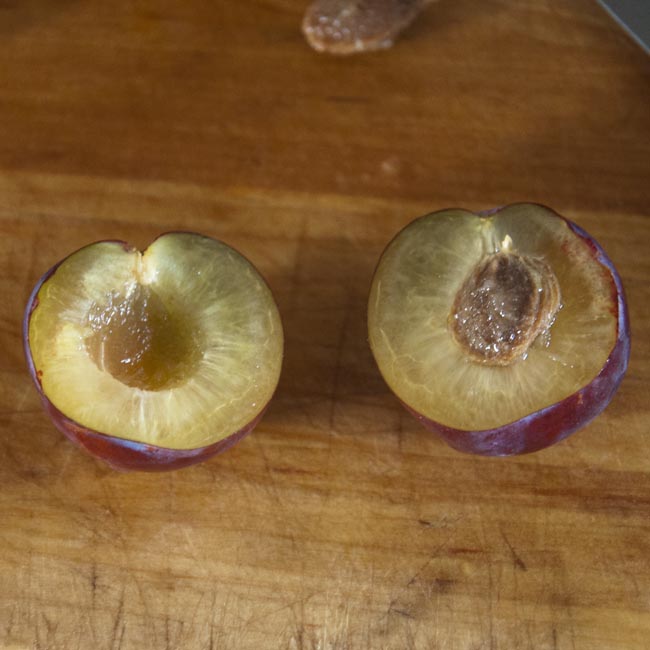
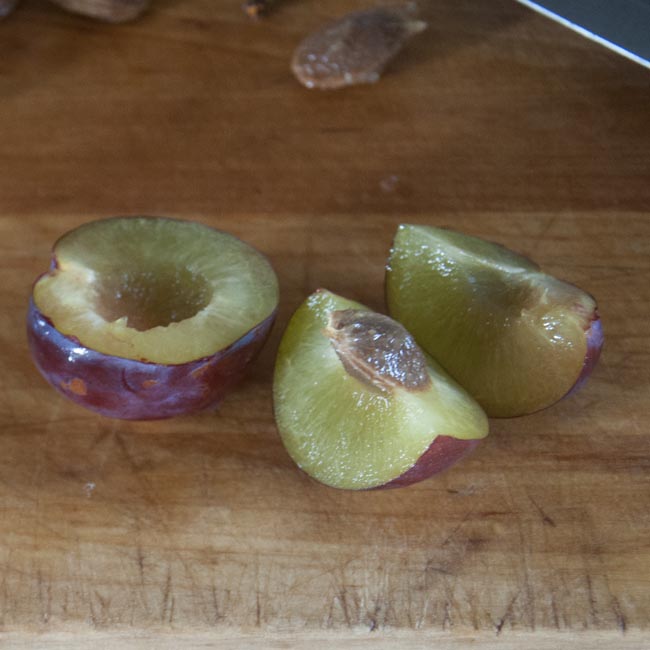
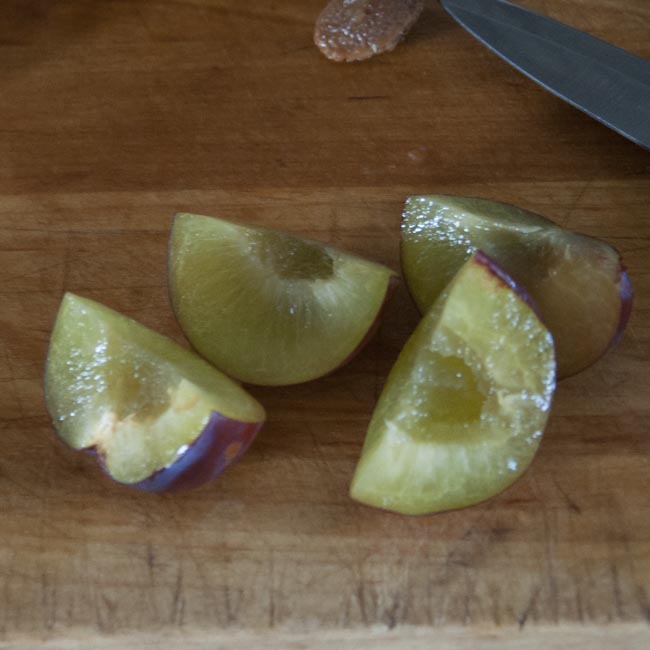
First wash, then stone and quarter all your plums. I find the quickest way to do this is to first slice along the line of the plum, down the visible ‘seam’, and divide the plum in two. The stone will cling to one of the halves, and especially with the smaller firm-textured cooking plums, won’t want to come out easily.

Stoning plums - 1   Stoning plums - 2   Stoning plums - 3

Take this half, and slice in half again, across the sort axis of the stone this time. The stone will now be sticking conveniently out of one of your quarters, and can easily be pushed free.  Cut your other half into quarters, too, and you’re done.  Incidentally, stoning plums can stain your fingers and fingernails a rather attractive nicotine brown colour, I think as a result of the tannins, so if you care about this, consider wearing gloves!

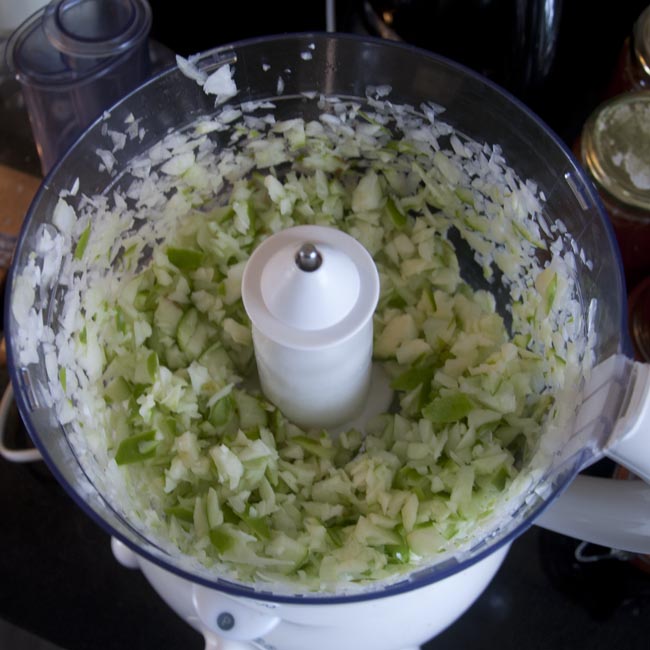
Chopped apple in food processorThe recipe calls for minced onion and apple.  I put mine through my food processor in batches, but left some nice texture in both.  The first time I made this recipe I didn’t have a decent food processor and diced all the apples and onions very finely by hand.  It works, but I can’t say I can recommend it!

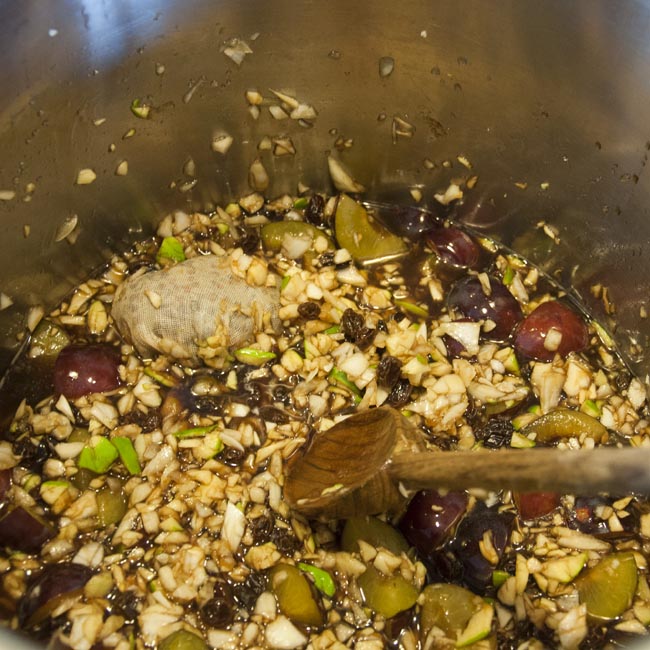
Mixed ingredients in panAfter your fresh ingredient preparation, it’s very simple really.   Add all the other fresh, dry, and liquid ingredients, and toss in your spice bundle (Delia recommends tying your bundle of spices to the pan handle, but I really can’t see any benefit to this!).  Bring everything to a simmer, stirring to mix as it all comes up to temperature.  Your kitchen will smell rather like Christmas-gone-wrong about now – festive spices mixed inexplicably with onion and vinegar.

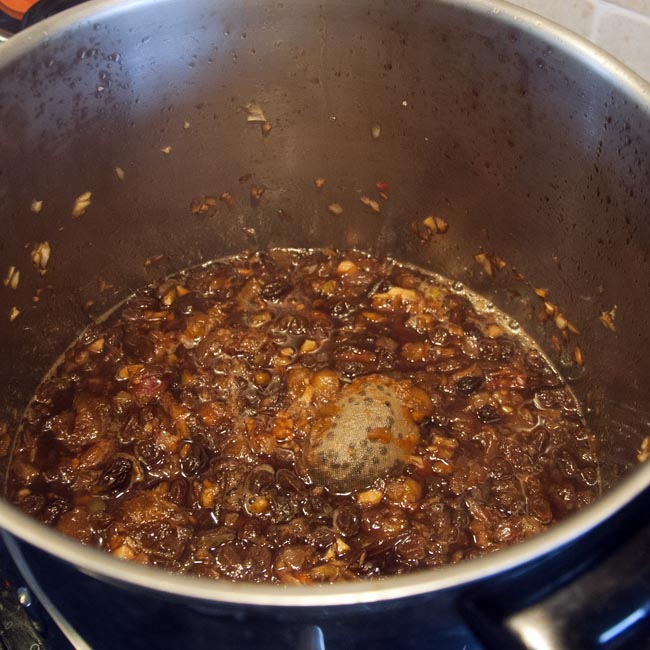
Cooking away nicelyThen let it bubble, stirring occasionally, for about three hours (my mixture was about six inches deep in my very big stock pot – a wider pan, or a smaller batch, which would allow the mix to sit in a shallower layer will reduce noticeably faster) until the mixture is reduced, glutinous, and the vinegar mixture has thickened so that it doesn’t immediately flow back into a channel cleared with a spoon.  I had to ladle out a couple of spoon-fulls into a bowl to check this.

As it starts to reach this stage, it will tend to ‘glob’ with really big bubbles, particularly when stirred, so learn from my experience and take care to protect your hands and arms from scalding!  This is the point that it’s at risk of sticking and burning, too, so keep stirring when you think you’re getting close.  Once it’s ready, fish out the spice bag, and bottle straight away into your hot sterilised jars.

Bottled chutney

It will be at it’s best if you allow it to mature for at least three months before eating – just in time for Christmas, then! – though I had some of the ‘extra’ today with some bread and cheese, and it’s already very good!  It will keep very well, too – I’ve eaten this chutney after at least four years’ storage.

Now, I wonder if I can get hold of some more plums to make some jam, too …

Read more from the Country Skills blog >>

This Is My Jam – French apricot with kirsch

We had a visit from my in-laws this week, on their way back from holidaying in France.  It’s always lovely to see them, but this time was particularly special – they brought with them 2kg each of beautiful French apricots and plums.  So today, my day off, was always going to be about preserving!

I wanted to make some really nice authentic French apricot jam, so this is as simple as it comes – apricots, sugar, a squeeze of lemon juice… and just a little ‘twist’!

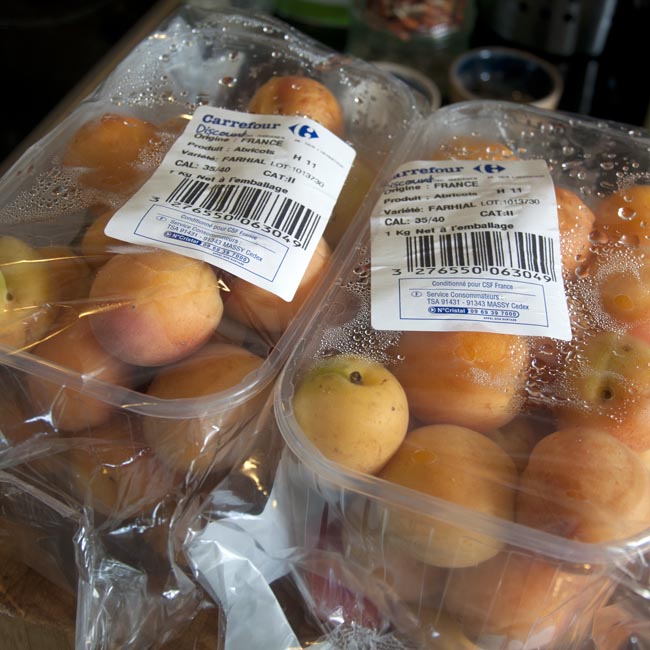
For this jam, you will require –Fresh French apricots

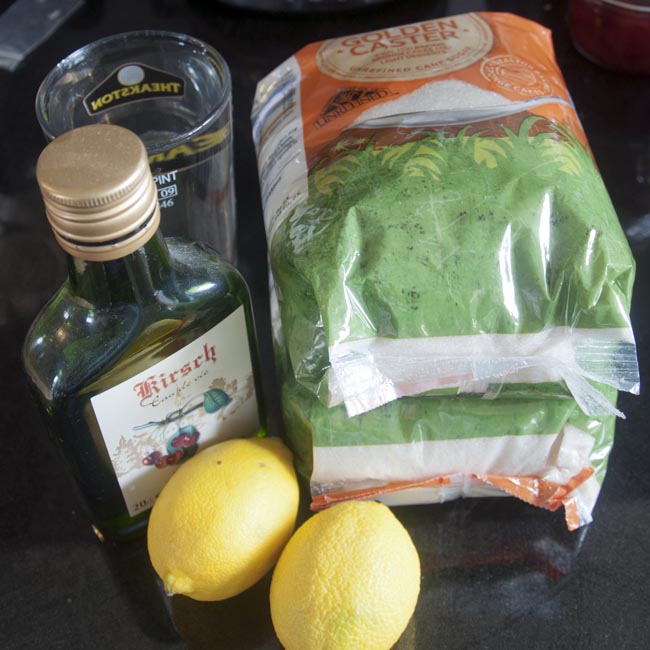
  • 2kg of French apricots (well, OK, anyone’s apricots will do, I suppose!) not too ripe.
  • 2kg of golden caster sugar (as a general rule, I prefer to use the least-refined sugar that I can get away with in any given situation)
  • 3 slightly sorry-looking lemons from the fruit bowl (the sorry state is not compulsory, and two nice big fresh juicy lemons will do well here!)
  • Half a pint of water
  • A couple of tablespoon measures of kirsch (or other eau-de-vie of your preference)
  • Generous sized preserving pan, not aluminium
  • Enough jam jars to contain your batch.  I always wash and sterilise more than I think I’ll need, as it doesn’t do to run out at bottling time!

IngredientsObviously you can scale the quantities to suit your apricot supply – they’re very nice convenient multiples!  I find 2kg of fruit is a good useful batch size, easily manageable with the equipment I’ve got, and makes enough jam to generously repay the investment in time and effort.

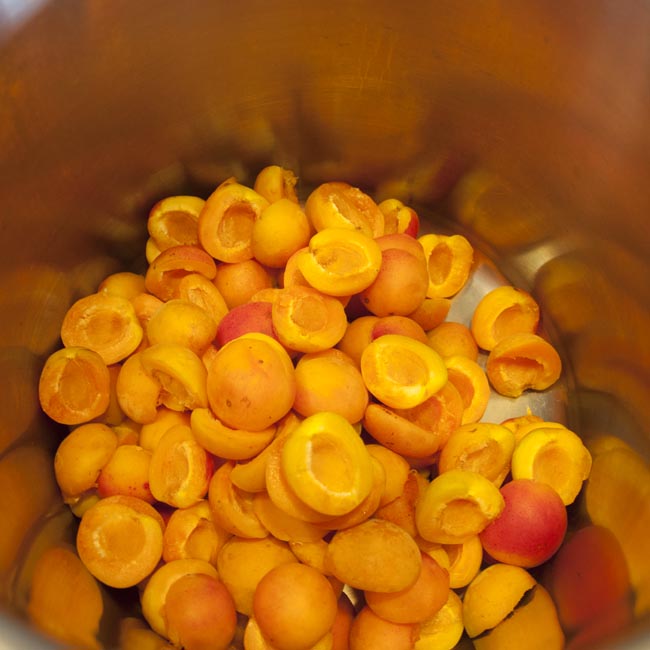
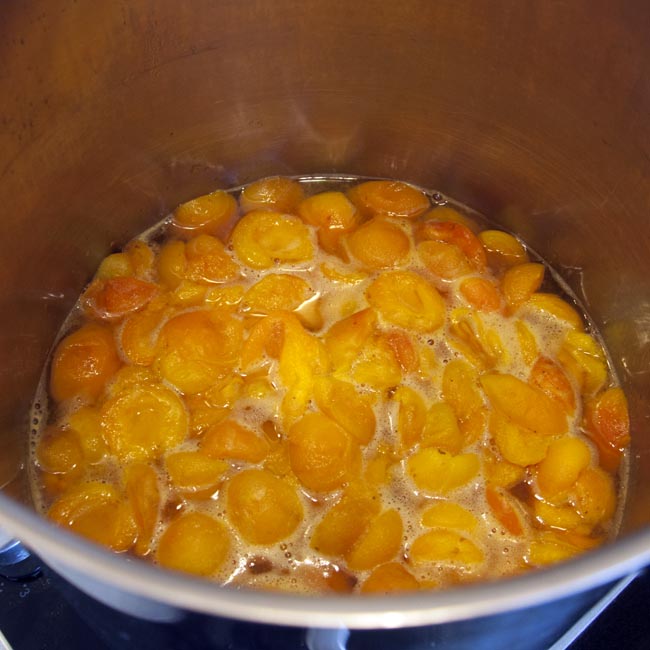
Apricot halvesWash your apricots, then halve them and remove the stones.  Don’t throw the stones away just yet!  Put all your half apricots into your pan, and add the half pint of water, and bring this to a gentle simmer.  Stew the apricots very gently until they’re just soft, and the juice has run.

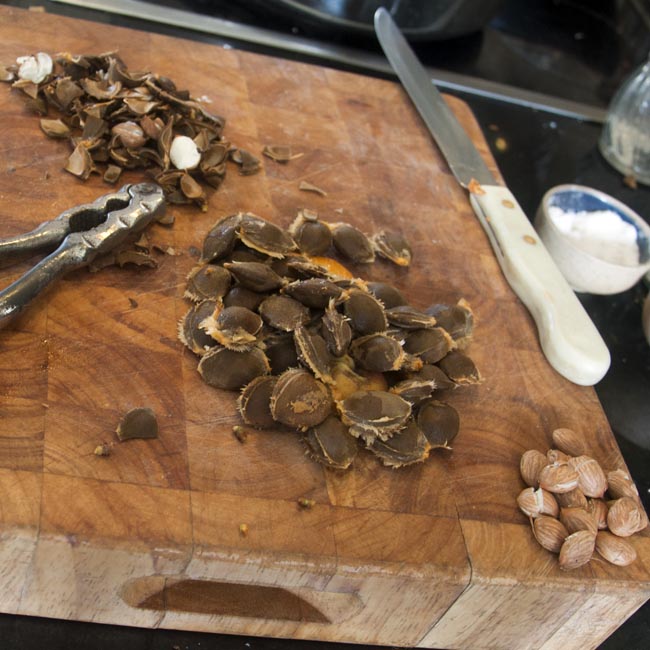
Apricot kernelsWhile your apricots are stewing, take your nutcracker (if you have one) and gently crack about a dozen of the reserved apricot stones.  Inside you’ll find the kernels – they look like little almonds, and this is no coincidence, as almonds and apricots are closely related, so closely in fact that you shouldn’t grow apricot and almond trees nearby one another!  You can add these to the jars of jam at bottling time (about one per jar), which will infuse a lovely subtle bitter-almond flavour into your jam – this is completely optional, of course, if you can’t be bothered with the faff (or can’t lay your hands on a nutcracker!).

Gently stewed apricotsPut your clean jam jars and lids into a cold oven and set it to 150C.  Now add the sugar and heat gently until it’s all dissolved – you might find adding it in portions is easier and results in less trauma to the apricot pieces.

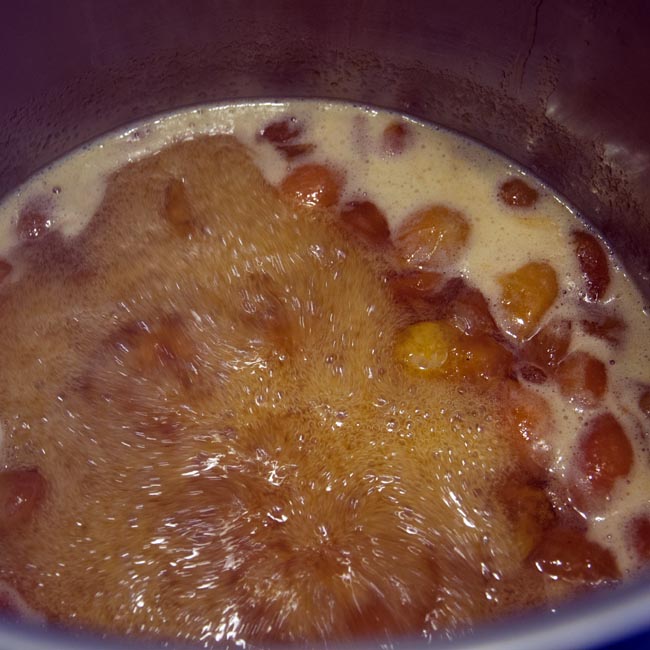
At a rolling boilNow turn up the heat and boil the jam until it reaches a set.  This didn’t seem to take very long at all for me (though I have to admit to being distracted by sorting and cleaning out the *next* batch of jars at this point) and the natural pectin in the apricots seemed to be adequate.

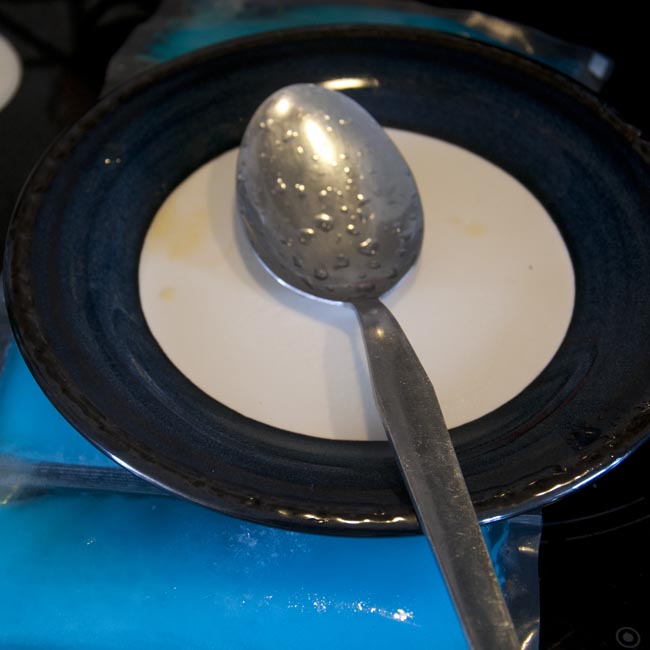
Cold saucerI tested the set using the cold-saucer technique (I often forget to freeze the saucer, so this is my usual approach – placing a saucer on top of a freezer block, the sort you’d use to keep a chill bag cool).  I’m not after a firm set for this jam so I was satisfied as soon as I got a bit of a wrinkle on top of the sample.   Once it looks like you’re getting there, juice the lemons and stir the juice into the jam.  Get the first batch of jars out of the oven ready to go.  Finally add the kirsch and stir in briskly.

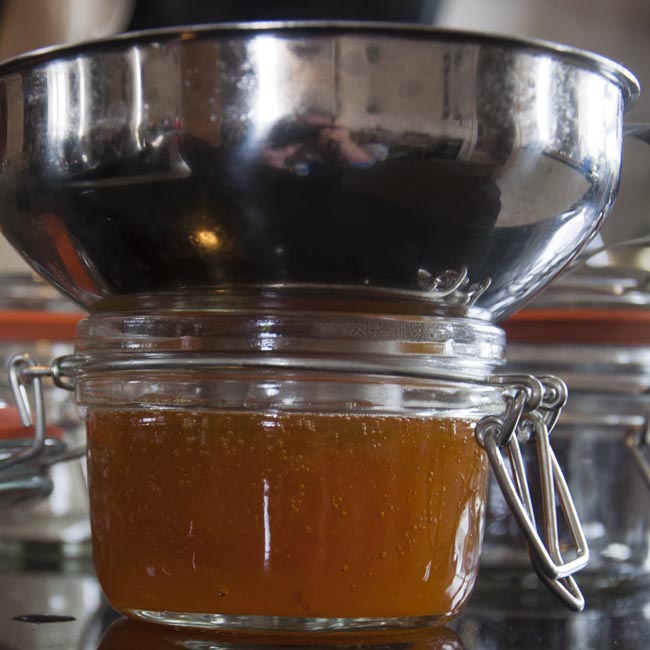
Bubbles at bottling timeNow start bottling your jam immediately, using a large-aperture funnel if you have one.  If you’re doing this right, you’ll be able to see bubbles rising in your jam as it hits the hot glass of the jam jar.
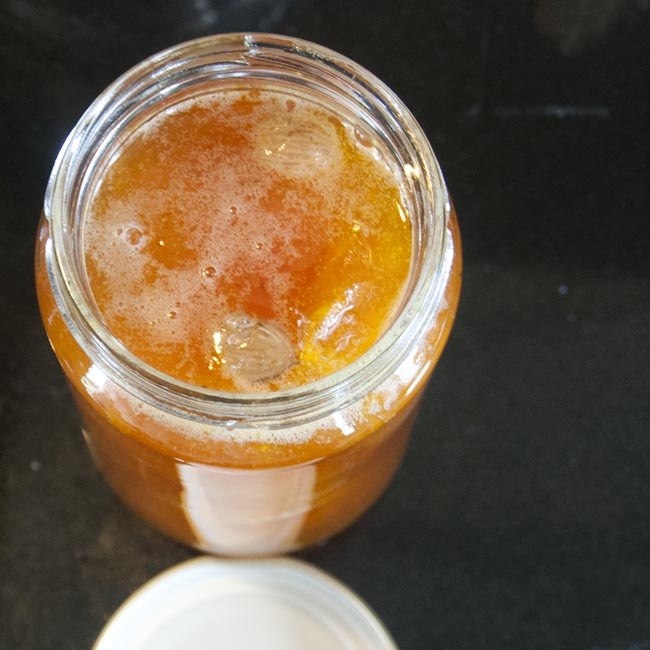
In the jar with the apricot kernelsFill a small number of jars at a time (2 or 3), don’t forget to add a kernel or two to each jar before adding a wax disk (if you like).  Secure the lids down tightly, before getting the next few jars out of the oven.

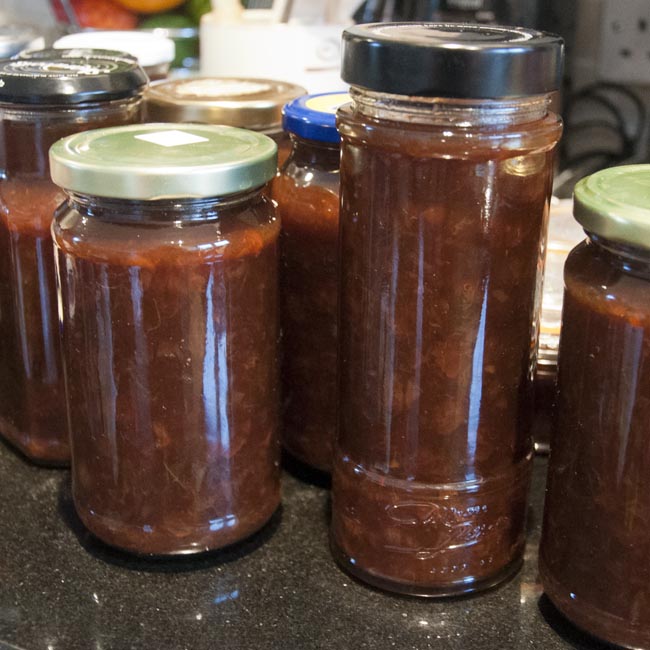
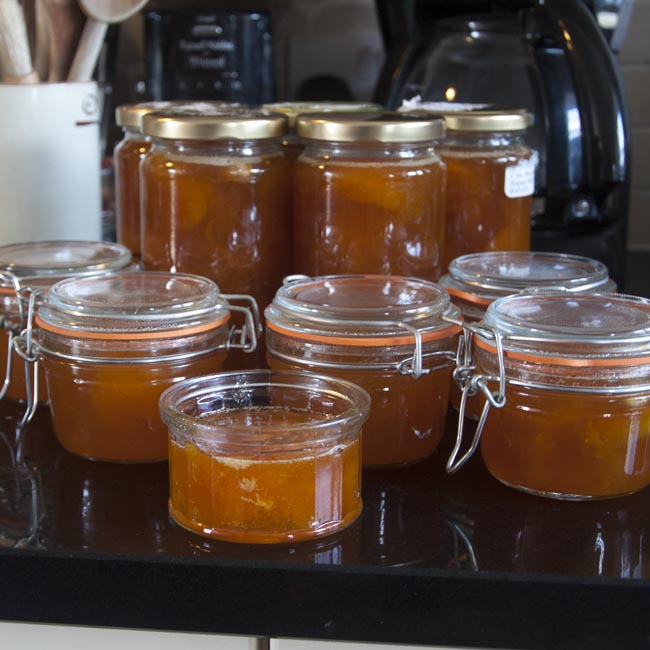
I was pleased with the yield of this batch, five good big jars with about a half litre capacity, five little mini-kilner-alikes (it would have been six, but one developed an alarming crack during sterilising!), and a cruet-worth for my breakfast over the next few days.

Finished batch

It’s gorgeous jam, too, with the subtle note of the kirsch just evident against the lovely deep rich apricot.  The balance of sweet and acid is very pleasing.  The set seems to have come out as I wanted – not a firm set, but not runny either, just like a traditional French apricot jam should be!

Now all I want is a crusty baguette, some unsalted butter, and an excuse to really tuck in!

Read more from the Country Skills blog >>