Last of the Harvest – bonus ‘accidental’ elderflower-infused marmalade

Today, I was planning to bottle my elderflower cordial, and make a couple of sourdough loaves for next week.  As if that wasn’t enough for a Sunday, we also had a load of rock to collect.  So of course, I had to find something *else* that needed doing, too!

Elderflower cordial, steeping

After separating the cordial from the fruit and flowers, I was about to chuck them, but suddenly couldn’t bring myself to do it.  I could almost hear my grandmother sighing, ‘all that lovely fruit…’  All that lovely fruit – four whole lemons and oranges.  It was too good to waste, and had been soaking in a sugar syrup of utter deliciousness for three days, which surely had to be a good thing?

It’s been a very long time since I made marmalade, but there’s a long family tradition of doing it – my Mum makes it every year, and Grandma did, before her.  Our ‘family’ marmalade is dark, and rich, and often has hit of whisky or rum in it.  This ‘accidental’ marmalade is nothing like it!  I dug out Pam Corbin’s ‘Preserves’ (in the River Cottage Handbooks series) and realised neither of her recipes really did what I wanted, but perhaps, by using aspects of both, I could get something sensible!

Finely sliced citrus fruitI sliced my rescued fruit slices up quite finely, removing all the pips.  The three days soaking in the sugar syrup had got them some way towards being candied – the skins already a little bit softened and less juice in the flesh than a fresh orange or lemon.

Coming up to the boil

The total weight of sliced up citrus fruit was about 1.3kg (made up of four lemons, and four large sweet oranges), to which I added 2kg of mixed sugar (mostly golden caster & granulated sugars, but with a bit of refined caster sugar to make up the volume) and 1.5l of water.  I also gave the big handful of elderflowers a good squeeze to extract the last of their flavour, before throwing these away.

Return all the ingredients into the big pan they’d been steeping in for the cordial, and bring up to a nice simmer, covered, for about an hour until the peels are nice and tender.   While this is happening, assemble your jam jars and lids (I ended up with ten, mixed sizes, scavenged from my ‘saved jars’ pile) give them a careful wash, and place them in a cold oven ready for sterilising.  I bring mine to 150C and keep them there for ten minutes before I turn the oven off.

At a nice rolling boilWhen you’re happy with the texture of your citrus peel, take the lid off, turn the heat up, and boil it all as hard as you can for about 15 minutes, until it gets to setting point (I favour the cold saucer approach to checking for set – though interestingly for this particular marmalade there was a dramatic increase in the amount of foam produced as setting point was reached, which was a bit of a give away).

Filling jarsOnce you’ve reached a set, take the pan off the heat, and just wait for the bubbles to stop, give it a stir to re-incorporate any froth from the surface, and then ladle into your hot jars fresh from the oven.  I’m really messy at ladling, so I love my wide-mouthed jar funnel. Fit the lid tightly, and up-end the jars a couple of times to make sure the boiling hot jam comes into contact with all the surfaces.

If you’re American, at this point in proceedings you’ll probably feel compelled to do something with a water bath.  I’m afraid our friends over the Atlantic don’t like this way of filling jars, they seem to regard it with great suspicion as being likely to kill you with botulism or other similar nasties.  All I can say is, it’s the only way I, or anyone else in my family, has *ever* filled jam jars, and so far we’ve all lived to tell the tale!  (More seriously, this is a nice sweet, acid concoction, and consequently pretty un-friendly to clostridial species, so you should have very little to worry about!)

Filled marlalade jarsI’m really pleased with these little beauties!  The colour is gorgeous, a real bright rich orange, and the flavour is beautifully balanced.  I’d love to say I can taste the elderflower – if it’s there it’s very subtle – but the mix of oranges and lemons gives a really nice clean crisp flavour.

It’s not an overpoweringly bitter marmalade like some of the Seville orange marmalades can be, but instead has a lovely three way balance between the acidity of the citrus flesh, the sugar sweetness, and a bitter note imparted by the pith and peel.

'Accidental' marmalade

I wish I could offer you a taste – all I can do is encourage you to make your own!  I’m so looking forward to this on a lovely thick slice of my fresh sourdough loaf for tomorrow’s breakfast.

Read more from the Country Skills blog >>

Sourdough Saga: Episode 5 – how to look after your starter

Imagine, if you will, someone arriving at your house for a party, and bringing with them as a gift a rather odd looking jar with a label on it which says ‘Feeeeeed meee!’… Congratulations on being the new owner of a bouncing baby sourdough starter.  It’s rather a rude hostess present, I suppose, a bit like giving someone a puppy without asking them first (ok, maybe not *quite* that bad!).  But now you have this living thing someone’s entrusted you with, and you’re stuck having to look after it.

What sort of person would do such a thing, you might ask? Guess what I took to my little sister and her husband yesterday…

Feeeeed mee!

Isn’t it pretty?  I had to promise her a full set of care instructions, so here they are!

I keep my starter in the fridge between uses.  So far I’ve been feeding & baking once a week, so I haven’t tried to extend the gap between feedings more than this, though I believe it may be possible to go two or three weeks.  My starter is a wholemeal starter, but you could convert it to white flour, progressively, if you prefer.

Assuming you’re planning to bake on a Sunday, this would be my schedule –

  • On Friday morning, take your starter out of the fridge, stir in a couple of teaspoons of wholemeal flour, and leave it on the countertop (I like to think the beasties would appreciate a small breakfast snack as they come up to an active temperature).
  • Friday evening, once you’re home from work, it’s time to feed your starter.  In a bowl on your kitchen scales, weigh out equal weights of wholemeal flour and warm water (about blood heat) and combine to form a loose paste.  The starter has been started and fed on cheap bottled water so far, filtered water would be absolutely fine, if you have it, and converting my starters to tap water has also been successful (but might be a bit of a gamble if your water is particularly high in chlorine / chloramine).  I use locally stoneground wholemeal flour – avoid anything bleached or treated.
  • The total weight of the feed should be about equal to the starter that’s in your jar.  I’ve written the weight of the empty jar on the lid for you to simplify working this out!
  • Combine the feed with the starter (you could do this in the jar but I prefer to tip it all out into the bowl to give it a really good energetic mix) and put it back in the jar.  Leave the jar on the countertop for the next 24 hours.
  • Watch in wonder as the whole thing fills with bubbles and doubles in size over about the first 12 – 18 hours, before it settles back down a little.
  • On Saturday evening, take a good ladle-full or two of your starter (about half the total volume) and use it to start your overnight sponge.  Return the rest of the starter to its spot in the fridge.
  • On Sunday morning, let the baking begin!

If you’re not baking this week, do all of this but then discard the ladle-full of active fed starter (or better still, use it to start a new jar of starter to give to a friend?).

When you get your starter out of the fridge next week, you may find a layer of greyish liquid has formed on top, and the smell isn’t quite what you expect.  This doesn’t seem to be a problem, I’ve just been pouring the liquid off the top before going ahead and feeding the starter in the normal way.  I imagine this would be more marked if you went longer between feedings.

I hope you sourdough starter gives you as much baking pleasure as I’ve already had from mine!

Read all the posts in the Sourdough Saga >>

Read more from the Country Skills blog >>

Signs of Summer – hedgerow posy

It’s great to see the field margins and roadsides crowded with flowers at this time of year, isn’t it?  I couldn’t resist, and picked a small posy from our paddock – red clover, buttercups and grasses.  It looks a treat on my window sill.

Hedgerow posy

Go and pick one of your own – it’s a little bit of summer, for you to enjoy indoors!  Beautiful, and best of all, completely free!

Read more from the Country Skills blog >>

Basic Butchery – how to butcher & portion a pork belly

Pork belly is such a wonderful and versatile cut, and so under-rated here in the UK.  Most of my bacon making is with belly, so we get through quite a lot of it.  As a result I tend to buy it most-of-a-belly at a time!  The process of butchering it to remove the ribs and prepare it for curing or roasting is quite simple, and worth learning, since it means you’ll end up with precisely the piece of meat you want for the task at hand, and a couple of little bonus items, too!

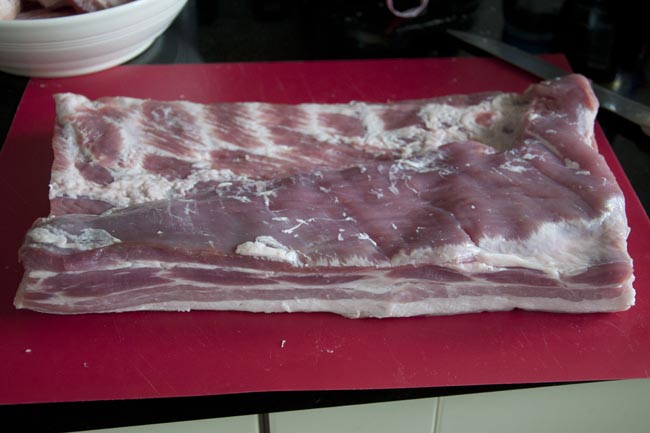
Large piece of pork belly

Your butcher will probably offer to prepare your belly for you, removing the ribs and trimming it to your preference, but you never quite seem to get exactly what you were after, somehow!  Doing the job yourself means you get exactly what you want.  This is my starting point – just under 2kg piece of pork belly .

Peel away the inner layer of fatStart by removing the layer of fat on the inside of the belly piece, if there’s one there.  You shouldn’t need your knife for this, it should just pull away if you work gently beneath it with your fingers, leaving a clean muscle surface beneath.  Once you’ve removed it, set it to one side (I usually keep an ‘offcuts’ plate or bowl handy when I’m portioning or butchering meats).  This is effectively pork suet.

Belly portion with fat removedNow you can get a better look at the anatomy of your piece of meat.  As it’s laid out in the photo here, the ribs are on the left, you can see the flap of diaphragm meat lying above them.  On the right side of the belly is a band of smooth muscle.  The ends of the ribs lie almost exactly where the visible edge of this muscle joins the diaphragm.

Cut beneath ribsTake a long, thin bladed, sharp knife and first cut beneath the ribs, as close as possible to them to reduce wastage.  The piece has been rotated 180 degrees from where it was in the previous photograph so that the ribs are now bottom right.  You should be able to feel roughly where the ribs end, so extend your cut beneath them as close as possible to this level.

Finding the ends of the ribsNow gently slice beneath the strap-like muscle we identified earlier, where it lies over the ends of the ribs, and peel it back,  You’ll find the ends of the ribs and the strips of cartilage which link them together.  Gently slice around these and then back underneath. By lifting the rib section it should now be quite easy to join up with the cut beneath and remove this as a block.

Rack of ribs, as removedEither put the rack of ribs to one side, or cut them up into individual ribs at this stage.  This couldn’t be simpler – just feel for the gap between each pair of ribs and slice down the centre parallel to them, your knife, if it’s nice and sharp, should cut straight through the connecting cartilage.

Ribs, divided up.You can trim away any strips of cartilage that area easy to identify – you can see this top left.  That bit is genuinely wastage, incidentally, so chuck it away if you want!  Bag your butchered ribs up, label them, and freeze them for another day (they’re great done on the BBQ with a jerk marinade!).

Pork belly with ribs removed

Now let’s turn our attention back to the pork belly itself.

You can really see now that mine is anything but rectangular! It’s actually sitting ‘upside down’ in terms of how it was on the pig – the top as we look at that photo is the part closest to the middle of the pig’s body, the rib side is towards the back.  As we get closer to the abdominal midline, the proportion of fat to muscle increases, so I trimmed the piece to rectangular, discarding the part which is most top-left in this photograph.

Pork belly, trimmedBecause I’m planning to prepare the belly as streaky bacon, this will give me more manageable, even chunks.  You can see the effect of the trimming in this photograph – the piece has been rotated again so the rib-side is now away from us.  Add your trimmings to the ‘offcuts’ bowl.

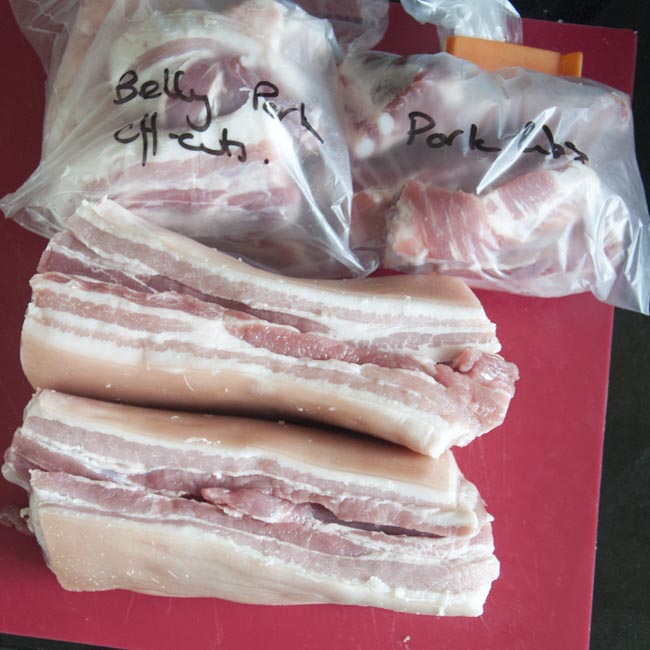
Belly pieces, divided upNow simply divide up your belly as you like.  Mine weighed almost exactly 1.6kg at this point, so I divided it evenly into four ~400g pieces.   A large piece like this would be fantastic roasted slowly whole, too, perhaps with chinese spices, for a special meal for a big gathering!  Roast pork belly has the *best* crackling.

Bag your ribs and your offcuts – these will make fantastic quite fatty minced pork for adding to any minced-meat dish that requires extra juiciness and succulence, or for sausages.  Then sit back and admire your work.

Fully-butchered pork belly

My belly portions were for curing, so I prepared a maple syrup cure made up of 100g of supracure and 90g of pure maple syrup, applied about half to all the bellies, and then bagged them together in the fridge. (More discussion of the bacon-in-a-bag ‘dry’ cure method can be found here.)

Belly pieces with maple syrup cureI’ll apply the second half after 48 hours and re-arrange the bellies so they’re skin-side together for the second half of the curing process.  The total curing time would normally be 5 days for belly pork, but these pieces are thicker than usual, so I may decide to let them go a day longer, depending on the texture and appearance at the 5 day mark.  It would be great to get some maple smoke into some of them – but that’ll depend on the weather.  I’ll keep you posted!

Read more DIY Cold Smoker & Home-Curing posts >>

Read more from the Country Skills blog >>

Banner320-260

Ice and a Slice – a great little tip for your summer drinks!

Summer is finally here – what could be nicer on a sunny afternoon than a lovely long drink over ice, with a slice or two of lemon or lime?  And how often does half a citrus fruit end up mouldering in the door of the fridge until it’s completely useless and inedible?  Even worse perhaps, how frustrating is it when there’s no edible lime in the fruit bowl just when you really really fancy that G&T?

Sliced lemon and lime

Here’s my top tip to save waste and avoid citrus fruit frustration this summer – freeze them!

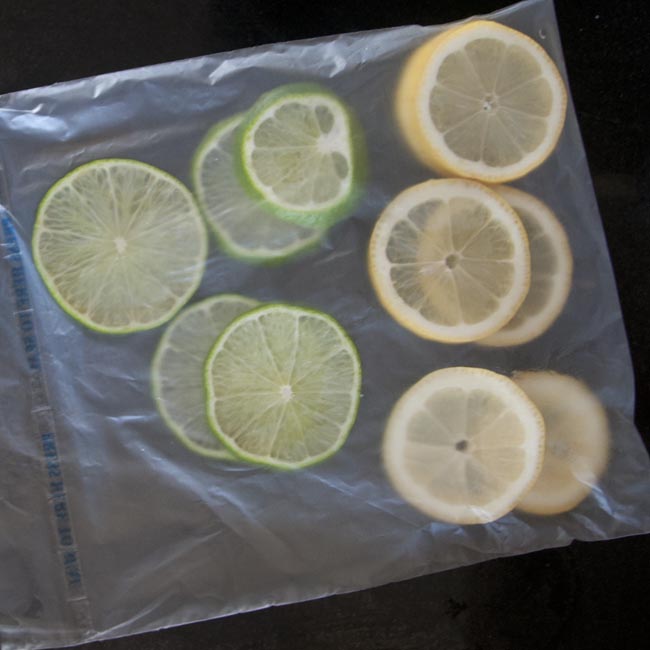
Sliced lemon and lime, bagged for freezingWhen you’ve sliced what you want, keep going, and finish slicing the whole fruit.  Pack them in a bag (I like using ziplock sandwich bags, if I have them, because I can re-use them time and time again).  I lay them in the bag in twos, if I can, since that’s how I tend to use them in drinks.  Put them in the top of the freezer with the ice-cube trays, job done!  Couldn’t be much simpler, could it, really?

Citrus fruit portions from the freezerHere are a couple of bags of frozen lemon and orange segments I pulled out of my freezer just now.  I freeze all sorts of pieces – half lemons can be defrosted in the microwave (a few 10s blasts should do the trick) and used in cooking and baking (microwaving fresh citrus fruits briefly before juicing is also a useful tip and greatly increases the juice extraction!).  The slices go in drinks, of course (or into the cavity of whole fish before baking!) and the segments are multi purpose – great in a long drink or squeezed over whatever you like.

No need to defrost before using, if it’s a long cold one you’re after.  Just toss the slice or segment into your glass with the ice, and pour over your drink of choice.  The citrus flavour will take a little longer to diffuse into your drink than a fresh slice, but it will all happen as the lemon thaws – which is almost instantaneous for a slice, slightly longer for a segment perhaps but patience is a virtue!  Sit back, and enjoy – and never waste a lime, or go without your wedge of lemon again!

Your long cold drink, ready to go!

Read more from the Country Skills blog >>

Better than Branded – homemade sun-dried tomato ketchup

It’s too early in the year to have a glut of tomatoes, but I wanted to try my hand at home-made tomato ketchup.  The commercial offering is so ubiquitous, how many of us pause to think what’s in it, or if we could make it better ourselves?  I wondered if using sun-dried tomatoes, the dry-packed sort, might give me a shortcut to a sauce that would pack a real concentrated tomato punch.  Well, they do – with the added bonus of not requiring the extended cooking time required to drive excess water off fresh tomatoes.

To make a little over a litre of sun dried tomato ketchup, you will require the following –

  • 250g of dry-packed sun dried tomatoes
  • Two small to medium sized yellow onions
  • 5 cloves of garlic
  • Whole red chilli
  • Red wine vinegar
  • Balsamic vinegar
  • Fresh ginger
  • Soft brown sugar
  • Ground allspice
  • A carton of apple juice
  • Food processor, ideally with blender attachment, or hand-held liquidiser

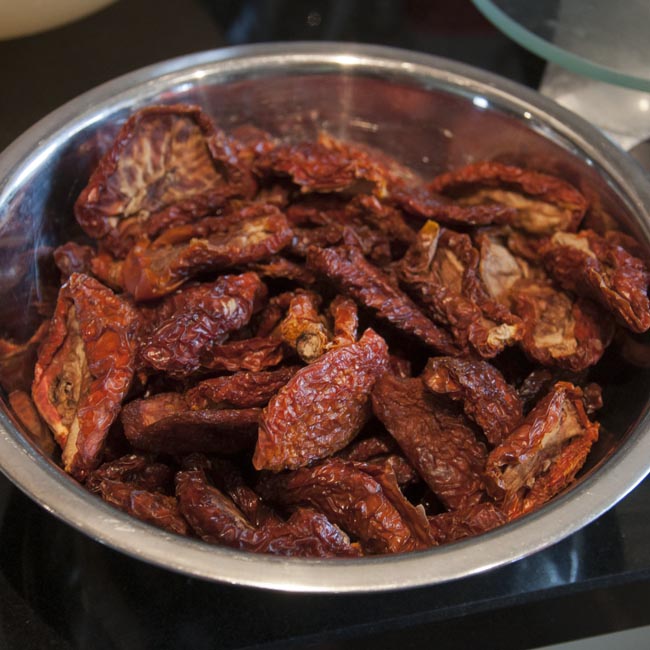
Sun dried tomatoesPut the tomatoes in a bowl and pour over enough freshly boiled water to cover.  Roughly chop the onions (or peel, quarter, and chop in the food processor).  Mince the garlic.  Once the tomatoes have been soaking for about half an hour, pour off – but reserve! – the soaking liquid.  Roughly chop the tomatoes by hand or put them through the food processor.  Also finely chop the whole chilli (it can go through the machine with the tomatoes).

Frying onions & garlicNow put a glug of olive oil (or your preferred cooking oil) in the bottom of a large pan, and then start to fry off the onions, adding the garlic when the onion has gone translucent, but not taken on any colour.  Fry until just colouring and then add the chopped tomatoes & chilli, mix together and add the tomato-soaking liquid back in.  This liquid will have taken on some lovely flavour from the tomatoes (which is why we’re using it).  Note however that dry-packed tomatoes are preserved with salt, so if reducing the amount of salt in your diet is important to you, you should discard this liquid and instead add enough apple juice to allow you to start to stew the tomatoes.

Stewing tomatoes & onionsAt this stage, the whole process becomes a matter of personal taste.  I added about a cm of fresh grated ginger to the pot, along with a quarter of a teaspoon of allspice.  I started by adding 50ml of red wine vinegar, a glug of balsamic vinegar, and a tablespoon of soft dark brown sugar.  Keep tasting the mix as it cooks, and adjust your seasoning as required.

Ketchup in blenderOnce it’s been bubbling away for about twenty minutes, pour the contents of the pan into your blender, or take the pan off the hob and use your handheld blender.  Start to liquidise the mix, adding apple juice as you go until you achieve your desired consistency. I stopped short of blending mine completely smooth, because I like it to have a little texture –  a sort of hybrid ketchup/salsa feeling.  I ended up adding about half a litre of apple juice in total.

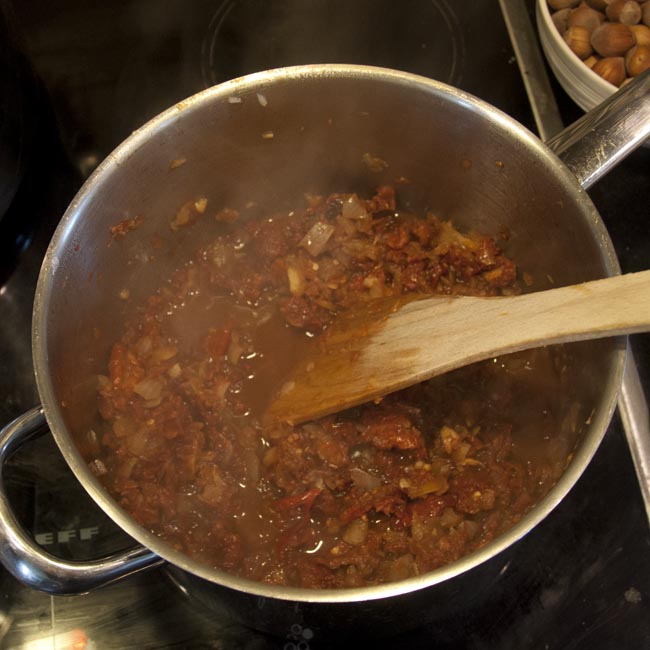
Ketchup bubblingNow return your mix to the hob and set it bubbling again.  This is the time to make the final adjustments to your flavours.  I ended up adding an extra splash of wine vinegar at this stage, along with another half tablespoon of sugar.  Remember that you’re tasting the ketchup hot, once it’s cold, most flavours, but particularly vinegar flavours, will be less marked, so if a really sharp vinegar is to your taste, make sure you dial it in now!

Once it’s cooked and seasoned to your satisfaction, pack your ketchup into sterilised jars or bottles while still piping hot, and seal tightly.  Old glass salad dressing bottles are great (and will have plasticised lids, which will help protect the metal from the vinegar).  I would expect this to keep similarly to chutney, and to have a shelf life of several months in a cool dark place.  Keep it in the fridge once opened and eat up reasonably quickly!

Bottled ketchup

Try it – it’s gorgeous, sharp and sweet and packed with concentrated tomato flavour.  I tasted it alongside commercial ketchup today and it makes the branded stuff taste like red acidic sugar water.  It will make a great burger relish, and goes beautifully with oven baked spicy potato wedges.

Read more from the Country Skills blog >>

Inspirations – Isabella Beeton’s ‘Book of Household Management’

I like to think that, had she been alive today, Mrs Beeton would have been a blogger.  Before her death in 1865 aged 28, which followed the birth of her fourth child, she wrote prolifically.  Her husband, Samuel Beeton, was a publisher, and much of the material in the book was first printed in the form of articles in ladies’ magazines between 1859 and 1861 before then emerging in one volume as the book we would recognise as ‘Household Management’.

It’s fair to say that much of the material in ‘Household Management’ was collected (plagiarised, according to some less charitable commentators) and edited together, rather than being original to Isabella Beeton, but she probably invented the modern mode of laying out recipes – with an ingredient list at the top, followed by directions and cooking instructions – something we take for granted today.  While it is to a great degree a recipe book, it also contains wonderful snippets of advice on all aspects of victorian life – on medicine, the law, clothing, manners, the rearing of livestock, and of course famously the selection management of one’s servants.

Most of the recipes stand the test of time quite well – do avoid however the recommendation to boil carrots for about three hours – there are some wonderful snippets which are utterly of their period and richly reward the reader’s attention, though perhaps not their imitation!

Mrs Beeton on Whooping Cough:  “This is a purely spasmodic disease, and is only infectious through the faculty of imitation, a habit that all children are remarkably apt to fall into, and even where adults have contracted whooping-cough, it has been from the same cause, and is as readily accounted for, on the principle of imitation, as that the gaping of one person will excite or predispose a whole party to follow the same spasmodic example.” Her recommendations for treatment are… equally surprising!

On paying visits of courtesy (to be done after luncheon!): “They are uniformly required after dining at a friend’s house, or after a ball, picnic, or any other party.  These visits should be short, a stay from fifteen to twenty minutes being quite sufficient.  A lady paying a visit may remove her boa or neckerchief, but neither her shawl nor bonnet.”  So there you go, boa off, bonnet on – are we clear?

There are some marvellous-looking (not yet tested here!) recipes for home-brewed – and sometimes fortified – wines, as well as curing and preserving – after all it’s a book from the years before refrigeration – and for this reason alone deserves to be on everyone’s bookshelf and dipped into regularly.  Obviously we’d all like an old hardback copy complete with colour plates, but as it is widely available in paperback reprint (my well thumbed copy is a recent Wordsworth Edition) and is free to download in a variety of e-reader formats, albeit often without it’s illustrations, you really have no excuse!

Read more from the Country Skills blog >>

Feedback on Country Skills – hyacinths, candles and chickens

I love hearing from my blog readers, especially if you’ve tried out something I’ve written about!

After I wrote my butchery tutorial ‘how to portion a chicken’, blog reader asciiqwerty contacted me to me to let me know how she’d got on following my instructions, and sent me this photo of her finished portioned chicken.

Portioned, skinned and boned out chicken

This time the portions have all been skinned, and the thigh portions have the bones removed – this would make them great for using in a stir-fry or a curry.  She commented particularly on the size of the chicken breasts – which weighed in at about 200g each.  A supermarket pack of two chicken breasts will usually be about 250g in total, so you can see how much more you get for our money.  Well done asciiqwerty, and I hope it was as tasty!

Moving away from food, back at Christmas I made hyacinth bulbs with hydrogel beads, in recycled jam-jars, as gifts for friends and relatives.  I kept one for myself, of course, and thought you might like to see how it all worked out when it came into flower a few weeks ago.

Hyacinth bulb in flower, with hydrogel beads

The smell was amazing, and after this flowerhead died back and I cut it down, the bulb produced a second unexpected bonus flower!  The hyacinth stayed nice and compact and didn’t fall over despite not being secured by anything other than the roots in the jar of beads, which I was very pleased with.

Finally, the recycled chunk candle I made a few weeks back.  I was amazed with this, it turned out so much better than I’d anticipated.

Recycled wax chunk candle

After looking initially as if the melt pool would be a bit pathetic in the centre, it actually burned down very nearly edge-to-edge leaving a thin shell which the candlelight flickered through like stained glass.  I burned it every night for several hours after work, and it lasted a whole fortnight – I’d estimate around 45 hours burn time.

I’d love to hear about any successes (or otherwise!) you might have had trying out country skills – either in the comments, @countryskills on twitter, or by email at countryskillsblog@gmail.com.   Or perhaps there’s something you do that you think I should try – I’m always happy to hear new ideas, so please get in touch!

Read more from the Country Skills blog >>

A little egg-centricity – all about the chicken and the egg

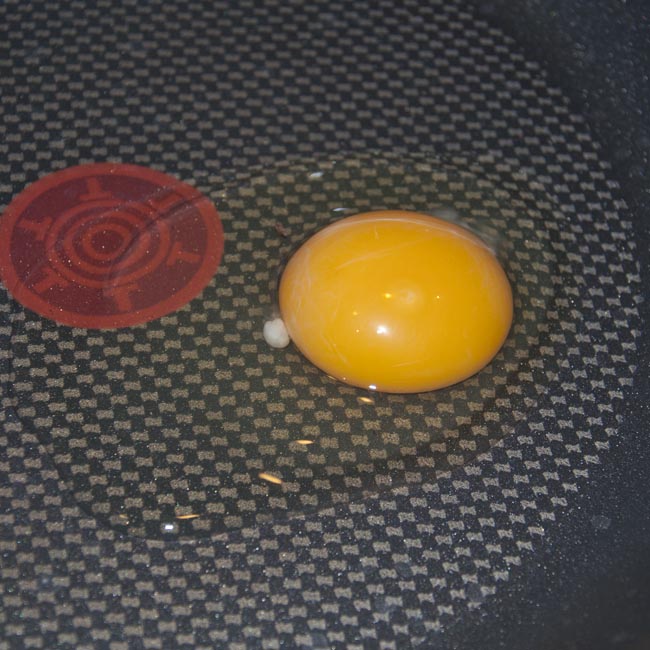
Nothing beats a really fresh free range egg.  For breakfast, fried or poached, boiled or scrambled, or for lunch in an omelette, a really fresh egg – preferably laid this morning – is head and shoulders above any other egg you’ve ever tasted.  You can see the difference straight away, even before you crack it – the shell may well be a bit grubby, and a slightly funny shape, an unexpected or uneven colour.  When you crack it open, the egg white is firm and ‘sits up’ in the pan, and the yolk is a deep orange, and bigger than you expected – if beaten, the raw egg is a rich dark yellow, rather than off-white.  In your mouth the yolk is velvety and rich, creamy and almost sweet with a luxuriant almost-custard quality and the white is firm but never rubbery – a million miles away from the flaccid anaemic and tasteless output of battery cages and the supermarket supply chain.

Fresh egg

It’s a sad fact that in the supermarket dominated, urban West, most people have probably never tasted a really good, fresh egg.  We think of eggs as being uniform, sized and graded, cheap and frankly, dull.  But they’re a natural product, and they vary – in size, colour and shape – and from the very firmest, freshest example, to the end of their storage life when the egg white is watery and the best of the flavour is gone.

I said nothing beats a very fresh egg, but of course that depends what you’re doing with it. If you want to beat the egg and use it to help with raising – in baking, or a soufflé – or you want hard boiled eggs peeled for a Salade Niçoise, then the very freshest eggs aren’t for you.  The egg white – the albumen – is actually in two parts.  The outer albumen is quite watery, you can see it spread out in the pan in the photo above.  The inner albumen is much more firm in a very fresh egg (but in an egg which has been stored for some time you probably won’t be able to see a distinction between the two).  In a very fresh egg this inner albumen has too much structure and tends to want to hold together, which doesn’t allow the batter to rise properly.  Furthermore, if you hard boil a really fresh egg and then remove the shell, the outer albumen will come away with the shell, which is a waste and makes for a scruffy-looking boiled egg.  Eggs about a week old are best for baking and hard boiling – realistically you won’t get eggs much fresher than this from the supermarket, though.

Egg storage

These are my eggs, and three things are obvious – first the range of shapes and sizes, secondly that they’re in some sort of wire device (it’s called an Egg Skelter, and I wouldn’t be without it) and not in the fridge, and thirdly that, frankly, they’re a bit grubby!

The size variability is something that you have to make adjustments for with ungraded eggs.  My approach is to weigh them and then adjust according to standard size references.  The Lion Egg Scheme people have a size guide here.

Fresh eggs will keep safely at room temperature for 3 weeks (it’s no coincidence that this is the length of time they have to stay ‘fresh’ under a warm hen if being hatched!), but if you do put them in the fridge, then you need to leave them there.  If eggs are removed from refrigeration, moisture condenses on the outside of the shell and can then be drawn through into the inside of the egg by osmosis, potentially pulling pathogens from outside the shell into the egg itself and increasing the risk of food poisoning.  My eggs don’t sit around for anything like three weeks (if I have a glut I know plenty of people who are happy to help me deal with it!) so storage at room temperature is ideal.  Better still, the egg skelter enforces first-in-first-out use, which is trickier with other storage systems.

So you’d think washing the dirt from the outside of the egg would be a good idea, right?  In fact dissolving these contaminants in water, and disrupting the outside surface of the shell, also increase the risk of pathogen entry.  Much better to leave grubby eggs as they are, and rub off any loose dirt and mud from the surface just before use.  Egg washing is not permitted in the production chain for commercial shell eggs in the UK, on a risk assessment basis, though it is common practice in other countries including the US (they tend to wash in a chlorine solution – because bleach is what you want in your eggs!).  This goes some way to explaining the obsession with clean eggs in intensive production systems – and the resulting battery cages (improved, but not yet gone), as ‘dirty’ eggs are downgraded.

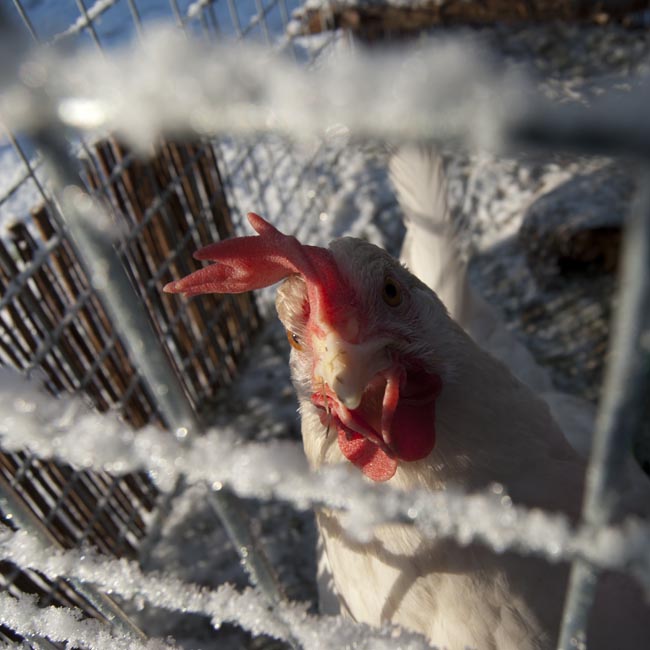
I’ve kept hens for two and a half years now.  I wasn’t expecting get as attached to them as I have, they’re fascinating animals.  Funny feathery little dinosaur-descendants they certainly are, they’re inquisitive, social (and not always sociable!) little creatures.  Only when you’ve watched hens scratch around for bugs, enjoy a bit of a flap and a wing stretch, and then settle down into a well-earned and apparently thoroughly indulgent dust bath, can you really start to understand how inhumane intensive cost-led egg production systems are.  This is Gertie, by the way, my ‘top hen’, being a bit confused by her first sight of snow, and wondering what I’m doing with that camera.

Outdoor hen

You may not be able to keep your own poultry, but if only for the sake of your palate (never mind the quality of life of the poor intensive egg-producing bird) it’s worth seeking out the best and freshest outdoor reared eggs you can find – farmers markets and farm shops are a great place to start – or ask around, you may be surprised to find a colleague keeps backyard hens, and if you’re really super nice to them, they may be prepared to share! Then, enjoy your wonderful, freshest eggs, with the best home cured bacon for the most amazing breakfast fry-up you’ve ever tasted.

Read more from the Country Skills blog >>

Heston Blumenthal – how not to roast a chicken

I saw Heston Blumenthal the other night on TV with his roast chicken recipe, and I wish I hadn’t.  His suggestions really worry me.  Leaving aside his recommendation to brine the bird before roasting (because what we all need in our western diets, ladies and gentlemen, is more salt!), he advocates roasting the bird at 90 degrees centigrade (70, even, in a fan oven!) for several hours to a target internal temperature of 60C in the thickest part of the breast.  While I have no doubt that this treatment results in a marvellously moist tender bird (it’s barely cooked after all!) the food safety implications of the process are pretty horrifying.

All raw meat is contaminated with bacteria. This is just a fact of life – after all, meat is dead animal, and animals have bacteria in and on them in life which are impossible to remove in the course of processing.

Poultry meat in particular is high risk.  A UK study published in 2000 identified Campylobacter jejuni in 83.3% of supermarket chicken that they sampled.  I would go as far as to say, I almost guarantee that any raw chicken you purchase will be contaminated with Campylobacter, Salmonella or E. coli, and the risks are probably higher with free range birds which aren’t raised in a sealed environment.

The reason we don’t all have food poisoning all the time is that cooking – the application of heat – is extremely effective in killing these pathogens.  Here’s the problem – Salmonella requires a temperature of 60C for 10 minutes to be effectively killed. Campylobacter also needs to get to 60C, though it’s a bit  more fragile so a minute or two should do trick.  E. coli is more robust – but less common in poultry meat – and needs to be heated to 72C.  The universal advice for safe cooking of poultry meat takes all of this into account and advises the thickest (and hence least heated) part of the meat should reach a minimum temperature of 75C for at least 10 minutes.

On these numbers you can see how Heston’s recipe might *just about* not be gastrointestinal suicide, but you would want to be very confident of your temperatures.  The trouble is, any error in measurement – if your probe isn’t really in the absolutely coldest part of the bird – is going to read higher than the true lowest temperature, making it very easy to overestimate the minimum temperature and have parts of your bird below 60C.

To be quite honest, I don’t care how tender and succulent this roast bird might end up – it amounts to food hygiene russian roulette!  I’ll be staying away from the Fat Duck, I think.

Please, if you want a wonderful succulent roast chicken, buy a good free-range bird with some good fat under the skin, add some lovely flavours in the cavity (I like a quartered lemon with some whole cloves of garlic and a handful of thyme), a little bit of salt and pepper on the skin with a couple of rashers of bacon if you fancy it, and then roast at about 180C to a safe internal temperature.  Rest for 20 – 30 minutes before carving, and enjoy a tasty, succulent, and above all safe roast dinner!

Read more from the Country Skills blog >>