
Home-brew has a bit of a mixed reputation, it’s fair to say! This is my method for making great, simple, real cider (hard cider, for those of you West of the Atlantic!) with almost no investment in special equipment. Sounds too good to be true? Follow these instructions, and in just a few weeks time you can be drinking great cider (at least as good as most commercial bottled ciders you can buy!) that you’ve made yourself, and all for only a few pence more than the cost of cheap retail apple juice. I just wish I’d known how to do this when I was a student – it would have saved me a fortune and quite possibly made me rather popular, too!
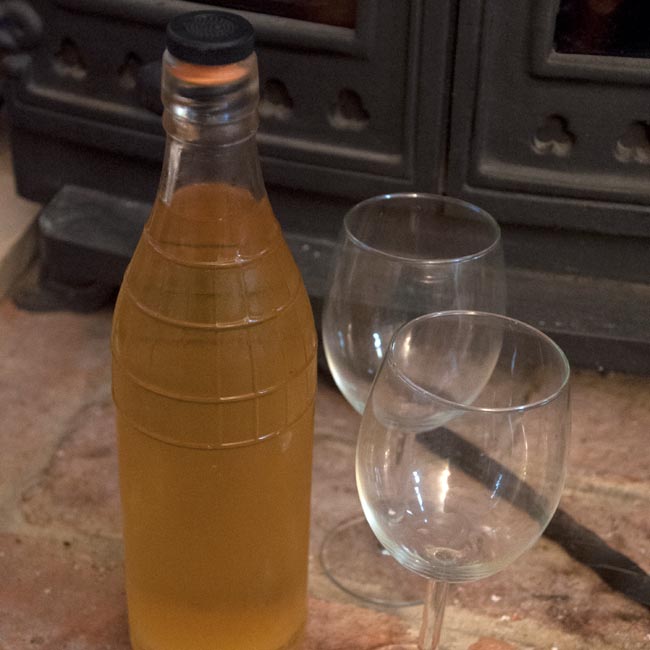
Last autumn, I made real ‘Real Cider’ from fresh apples. I promised then I’d post quicker and simpler instructions for a short-cut brew. Well, rather belatedly, here they are!
First a brief note on the law – I have no idea if home brewing is legal in your country or jurisdiction, or what restrictions might apply. If you’re restricted (by age, local religious observance, or otherwise!) from buying, possessing or consuming alcohol, it’s very likely local law enforcement may take an interest in you brewing it yourself, so please take appropriate advice! In the UK, I believe home brewing is legal for personal consumption, however sale and distilling are tightly restricted.
The minimum set of ingredients and equipment you require are –
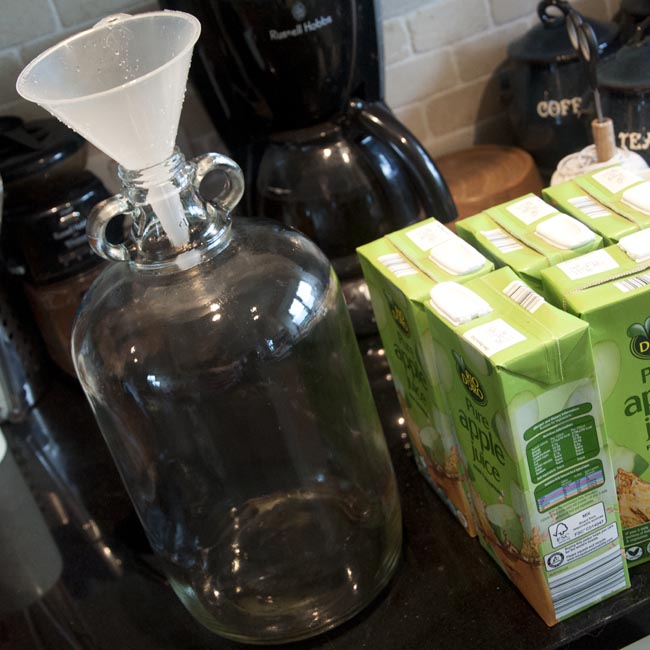
 5 litres of ‘pure apple juice’ (the clear, cheap, from concentrate variety from your local discount supermarket is fine, but it should contain no additives or preservatives)
- Half a mug of very strong tea (use two tea bags – plain ones unless you fancy an unusual experimental flavour sensation!)
- Wine yeast (this is widely available online or from your local friendly home-brew shop, and is cheapest in small pots rather than individual sachets – you could use bakers yeast as an emergency substitute, but it’s prone to producing strange flavours!)
- A glass demijohn, or an empty 5l mineral water bottle
- Home-brew steriliser (you could use Milton fluid as an alternative)
In another couple of weeks, you’ll also need to have gathered together –
- A length of syphon tubing (between 1m and 1.5m or 4ft to 6ft in length)
- Bottles, sufficient to contain your cider. These must be able to take pressure. Empty plastic screw-top fizzy drinks bottles are great for a first effort, and free. The plastic will be somewhat gas permeable, so the cider won’t keep terribly well in them, but I doubt you’ll be laying down your first brew long-term! Beer or champagne bottles are fine, but require special capping tools and equipment. Please note that SCREW TOP GLASS WINE BOTTLES ARE COMPLETELY UNSUITABLE and are very likely to result in dangerously explosive bottles.
- A few teaspoons each of sugar, and of a non-fermentable sweetener such as ‘Splenda’.
You might also like to add the following, which are not essential but will make the process simpler or more reliable –
- A drilled rubber bung (or grommet) & bubbler airlock, to fit your bottle or demijohn. If you don’t have these, you’ll need enough cotton wool to firmly plug the neck of your fermenter. [How to set up and use a bubbler airlock]
- Yeast nutrient (This contains all the trace elements and minerals required for healthy yeast growth. Apple juice is already pretty good for these, however, so it shouldn’t be necessary.)
- A kitchen funnel
- Bottle brush
- Hydrometer [How to use a hydrometer]
- Racking cane and tap or bottler attachment for your syphon tubing.
- Capping device and / or appropriate caps, gaskets, stoppers and closures, if you prefer to use recycled beer or champagne bottles.
If you’re lucky enough still to have a local home-brew shop, now is the time to go and make friends! You’ll get tons of helpful advice and guidance, and while the item costs are likely to be higher than from web retailers, you save on postage which can be a big consideration with small purchases. There are also lots of home-brew suppliers on the Internet, of course. I tend to use http://www.the-home-brew-shop.co.uk/ for most of my home-brew purchases, Amazon and eBay are also full of useful retailers for odd bits and bobs. Freecycle is the best source I can find for old-fashioned glass demijohns, and people are often giving away bottles, buckets, and other unwanted brewing items, it’s well worth posting a ‘wanted’ notice, these have served me very well for supplies in the past.
A quick totting up suggests you can get all you need for less than a tenner, and nearly everything except the apple juice is re-usable over and over (or at least, in the case of yeast and steriliser, for a good few batches!).
The process is really very straightforward, and divides neatly into four –
- Fermentation
- Bottling
- Secondary fermentation, and
- Drinking!

Stage 1 – Fermentation
First, wash out your demijohn very carefully, and sterilise it following the instructions on your steriliser solution. Second hand glass demijohns have often been abandonned in a slightly grubby state and will need a little TLC to get back into a usable state (a cranked bottle brush will be helpful if so). Pay close attention to the instructions that come with your steriliser solution, particularly where it comes to strength, contact time, and rinsing, since lack of attention to sterilisation and rinsing are responsible for most home-brew failures. While you’re at it, sterilise anything else you’re going to be using – including the bung, bubbler airlock, and a funnel if you think you’ll need it. Don’t neglect cleanliness, it’s critical to the success of any home-brewing enterprise. Sometimes I think home-brewing is really just washing up with benefits!
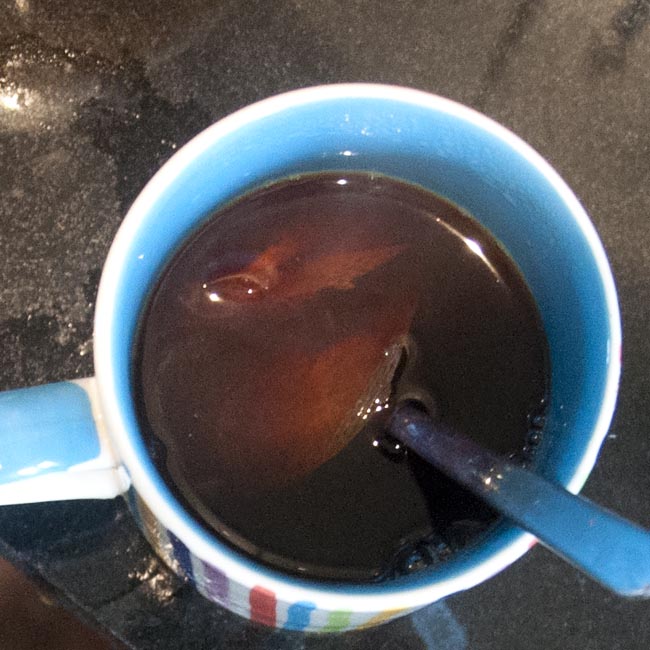 Pour four litres of the apple juice carefully into your demijohn. There will be some bubbly froth on top, this is fine (the juice will be nicely oxygenated). The demijohn will not be full – this is intentional! Add your half mug of very strong luke-warm tea, which provides some tannin for the cider, as apple juice intended for drinking will generally be quite poor in tannin.
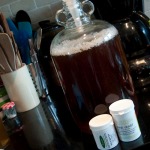
Add a teaspoon of yeast, and one of yeast nutrient if you have it to hand, and fit the bung and airlock or stopper the bottle with your cotton wool, tightly enough to stop bugs getting in.
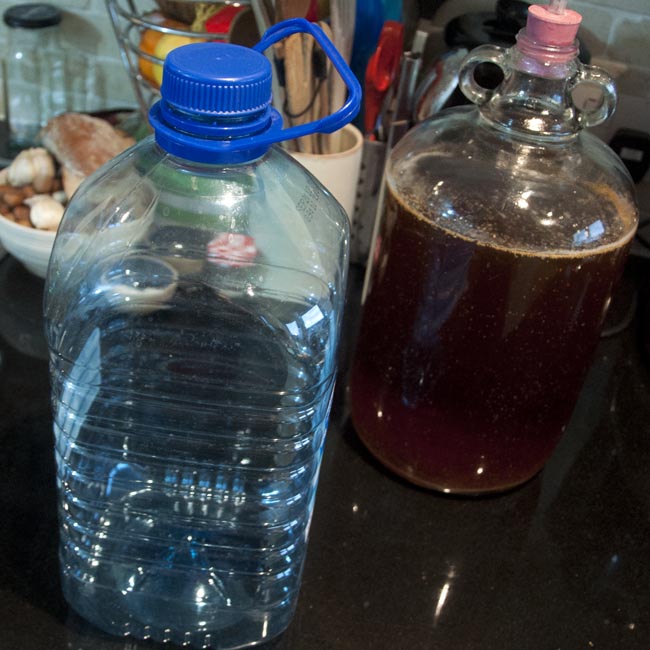 Now put your demijohn somewhere safe at room temperature (18 – 21 degrees is ideal, warmer temperatures such you’d have in an airing cupboard will certainly speed the process up, but are likely to be too warm and can produce ‘off’ flavours) and wait for the magic. If you’re lucky, this should start within as little as six hours or so, though this depends on how active your yeasty beasties are, and the prevailing temperature. While you could put it in a dark cupboard, I think you’ll want to keep it out somewhere where you can see it!
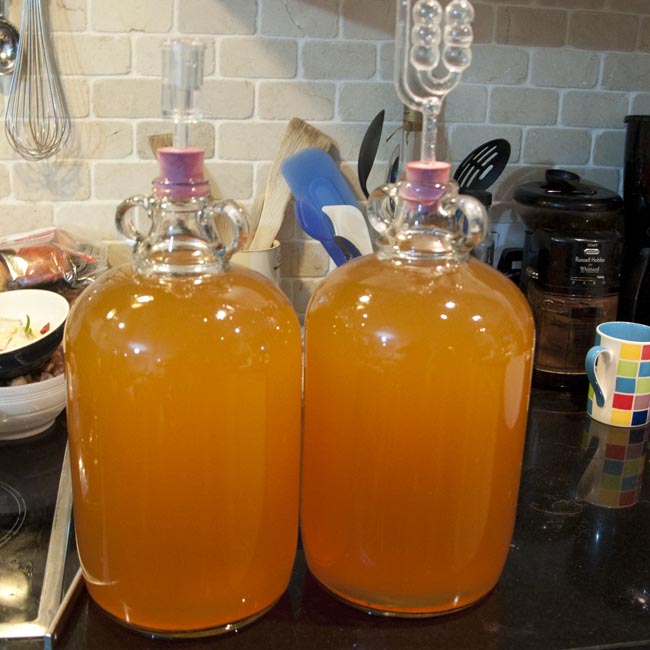
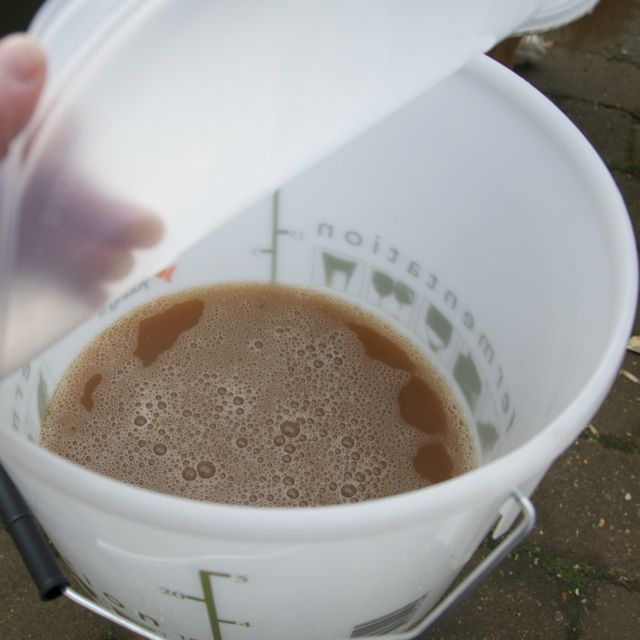
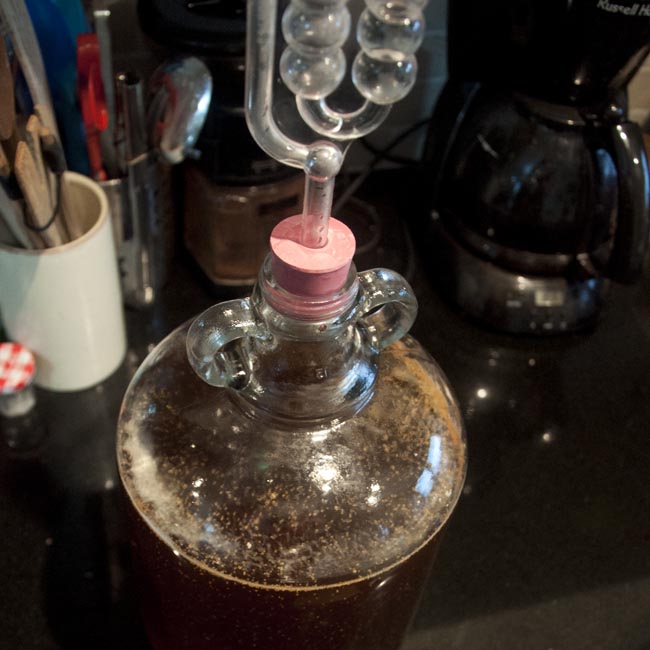 The first thing you’re likely to notice is the pellets of yeast starting to float around in the juice. Within 24 hours, there will probably be bubbles coming through the airlock. You can see the meniscus of the airlock water is pushed around in the photo on the left. If you’re anything like me, you’ll feel compelled to stand around and watch it go ‘glug’. The apple juice will become more and more cloudy, ending up rather a murky muddy brown colour, and will form a thick layer of frothy foam on top, which may also include some visible yeasty ‘crud’ – this is why we’ve under-filled the demijohn for now, you don’t want the froth trying to force its way out of the airlock!
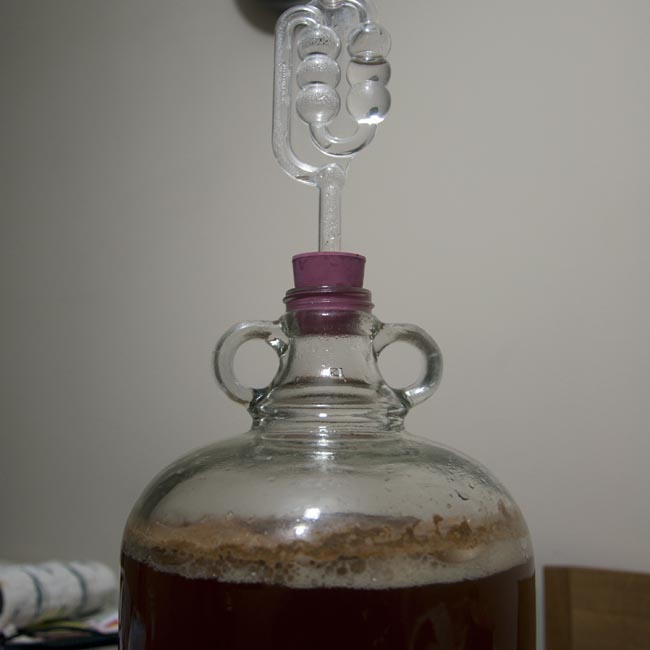 If you’re using an airlock, timing the bubbles as they escape is a great way of gauging how fast your cider is fermenting. The rate of fermentation will speed up as the yeast population multiplies, and then will start to fall again as the sugars in the mix get used up. At peak activity, you can expect a bubble every two seconds or possibly even slightly faster. For me this usually happens about a week after fermentation starts, though it depends on temperature, the sugar content of your apple juice, and how viable your yeast was in the first place. You will notice a layer of yeast forming on the bottom of the demijohn, too, which is quite normal.
If you’re not using an airlock then you’ll have to rely more on appearances to judge when peak fermentation has passed. As things start to slow down a little, you’ll notice the frothy crud on the surface reducing and being replaced by a layer of much ‘cleaner’ looking bubbles, and the contents of the demijohn will appear to be ‘fizzing’.
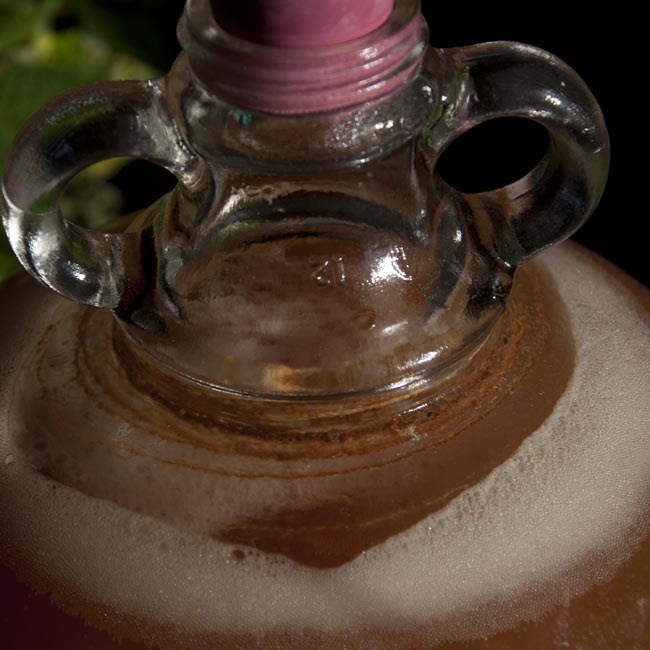 Once this has happened (and the rate of bubbles through your airlock has reduced to one every four or five seconds) carefully remove the stopper, without contaminating it, and top up with the rest of your apple juice, to half an inch or so below where the shoulder of the demijohn meets the neck, before re-stoppering. You’re adding a nice dollop of extra sugar, so expect the fermentation to speed up again for a bit, but hopefully it shouldn’t foam the way it did to start with.
Apart from providing a useful gauge of fermentation rate, the airlock serves another important purpose – it allows the waste gas from fermentation out, so that the demijohn doesn’t pressurise (which would be extremely hazardous!), but prevents exchange with the oxygen in the atmosphere. This keeps the cider bathed in carbon dioxide, which prevents oxidation of your cider – oxidation leads to spoilage, and even allows the accidental creation of cider vinegar if appropriate microorganisms are present.
Why, then, have I suggested you could go ahead without one? Carbon dioxide, conveniently, is heavier than air, so while the cider is actively fermenting, it will form a protective blanket over the cider and should prevent oxidation. The key detail here is ‘actively fermenting’. With an airlock fitted, there’s no rush to do anything once fermentation finishes, as the blanket of carbon dioxide is retained in the demijohn. This gives the option of a longer period ‘resting’ in the demijohn, either for convenience or maturation, once fermentation is finished. The cotton wool plug will keep bugs out (at least it will if it’s fitted properly!), but won’t stop the progressive exchange of gasses from the atmosphere once there’s no active CO2 production forcing the air out, so accurate identification of the end of fermentation and rapid bottling at this stage is particularly important.
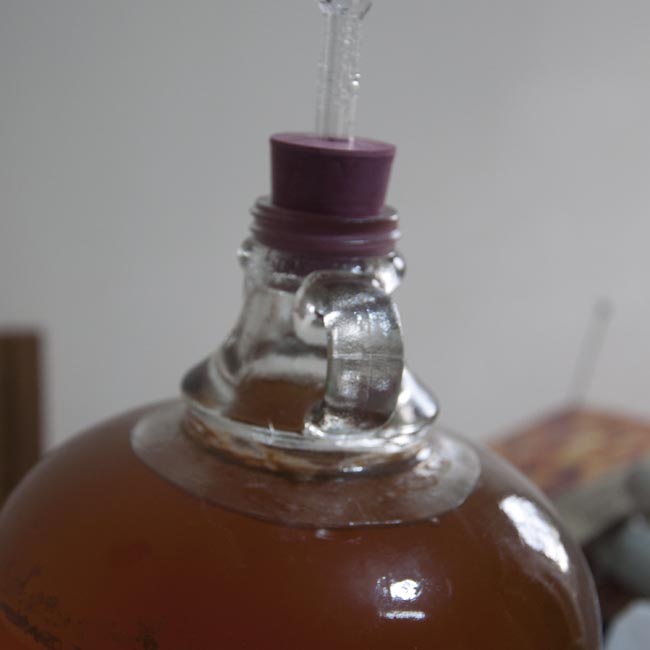 Now you just need to wait for it to finish fermenting. The rate of bubbles (and fizzing in the cider) should slow down progressively, and eventually stop. When it does, there should be no visible bubbles rising in the demijohn, no layer of bubbles on the surface, and no activity in the airlock. The cider will start to ‘drop clear’, that’s to say the yeast in suspension will settle to the bottom and the liquid will be clear again – and look surprisingly like it did in the very beginning. From topping up to dropping clear, in a 4.5 to 5 litre volume, tends to take about a fortnight to three weeks. Be patient here and don’t rush it, but also don’t leave things too long if you’re using a cotton wool plug (if you’re ‘under lock’, you can ignore it for as long as you like – I’ve left cider at this stage for several months before bottling with no ill-effect). If the end of fermentation coincides with a particularly chilly day, maybe give it a day or two to see if it re-starts when things warm up a little again.
The only cast-iron way of knowing whether your cider has finished fermenting fully (or is ‘fermented out’ in the jargon of brewing, that’s to say, fermented until there are no fermentable sugars left) is with a hydrometer. In any case hydrometers are really cool-looking, delicate pieces of laboratory glassware and it’s almost worth buying one just because they’re so neat! Rarely, fermentation can stop before this point, a situation known as a ‘stuck fermentation’ leaving sugars behind that could let fermentation re-start in an unpredictable way in the bottle. The risk here is that you could accidentally create ‘bottle bombs’ which pressurise excessively during storage and risk exploding (please don’t dismiss the potential hazard of flying shards of glass shrapnel!). For this same reason, do not under any circumstances be tempted to bottle early in an attempt to achieve a sweeter cider – the only safe approach is to ferment out to get a completely dry cider, and then correct this ‘issue’ (if, that is, a bone-dry cider isn’t to your taste!) later on in the process.
Your finishing gravity, if using a hydrometer, should be near enough 1.000, and be stable for at least 24 hours. It goes without saying that the hydrometer and jar, like everything you allow into contact with your cider, must be carefully sterilised and rinsed before every use! For extra brewing-geek credit, if you also take the starting gravity of the apple juice before you start fermenting it, you can work out the alcohol content of your final brew. There are calculators on various websites to help you with the maths! To be quite honest, I tend not to bother with the hydrometer when I’m making this cider – so it’s a bit of ‘do as I say and not as I do’!
When you’re confident your cider has fermented out fully, and it’s dropped clear in the demijohn, it’s time to bottle.
Stage 2 – Bottling
Sterilise all your bottles and caps following the directions with your steriliser, and rinse very carefully. Also sterilise and rinse your syphon tube and any associated nick-nacks (racking cane, tap / bottling stick etc). Place your demijohn on the table or kitchen work top, and your bottles on the floor below them.
Into each of the bottles, you want to have added a small amount of sugar, this is to allow secondary fermentation in the bottle – but just a small controlled amount. This process is known as ‘priming’. This will produce a little carbon dioxide – in a pressurised container this time – and make your cider sparkling, which is how most people like it! You can also add some non-fermentable sweetener if you want your cider slightly sweeter. I favour ‘Splenda’, which seems to lack the bitter back-taste you get with some artificial sweeteners. If you’re going to use something else check carefully that it really *is* non-ferementable.
I add one teaspoon of sugar per litre of cider (half a teaspoon in a pint bottle, about 3/4rs of a teaspoon in a 750ml). These should be safe quantities and shouldn’t create any bottle bombs, while providing a nice sparkle. Do not be tempted to exceed them! I enjoy quite a dry cider, so I add a matching amount of Splenda – you can adjust this to your taste, though, so experiment. Put the sugar and sweetener, if using, into your bottles before you start to syphon, since adding it afterwards tends to make everything fizz over (it’s somewhat reminiscent of the Mentos-in-cola trick, but a bit less dramatic!). If you’d rather avoid artificial sweeteners but don’t enjoy a dry cider, you can top up your cider with a splash of apple juice in the glass at serving time.
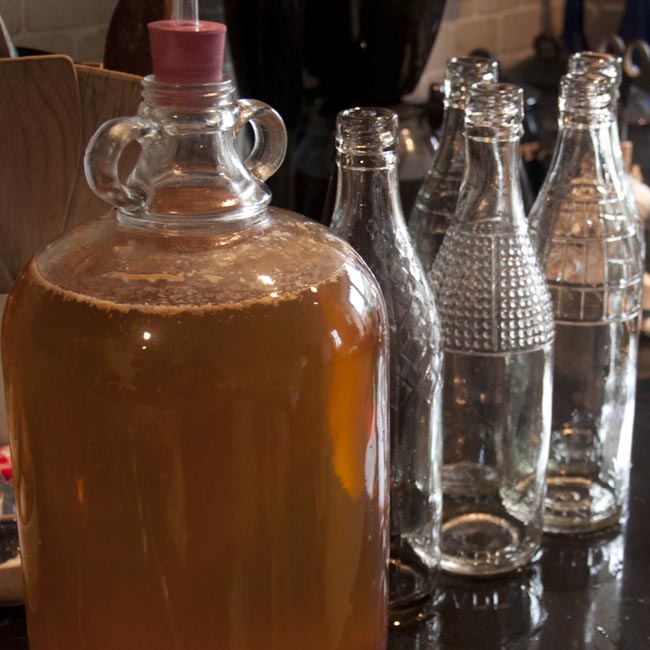 If you can secure the use of a glamorous assistant, they will come in very handy for bottling, since you can leave them in control of the top bit of the syphon tube. [How to syphon your home-brew.] If you have a racking cane, siphoning can be a one-handed job, as the ‘u-bend’ attachment should stop the yeast sediment being drawn into the syphon. Without one you’ll need some way of keeping the tube out of the bottom of the demijohn. In the absence of an assistant, you can rig something up with string and tie the syphon tube to the neck of the demijohn at an appropriate depth. A spare pair of hands is more reliable, though!
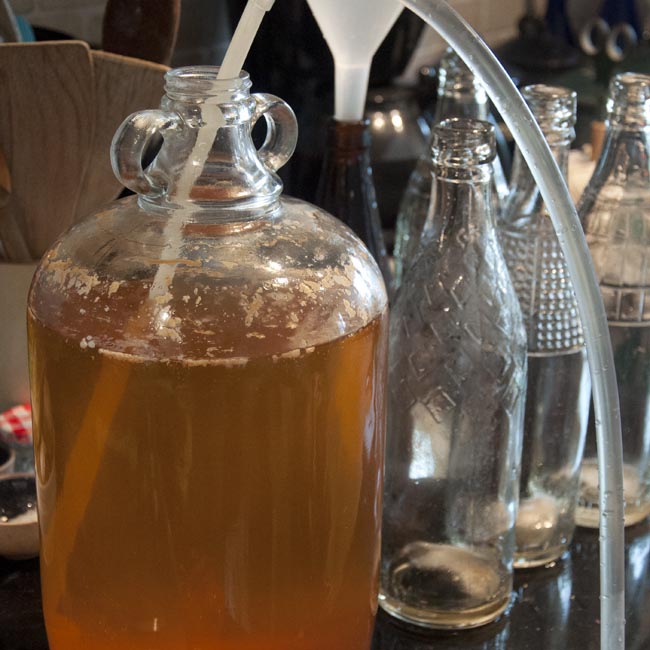 You may well be wondering why the faff with a syphon tube when you could just pour the cider into the bottles with a funnel. There are two reasons, really – the first is to reduce the amount of yeast sediment disturbed, which in turn will reduce the amount of sediment in your bottles, and in your finished drink. The second is our old friend oxidation – correctly performed, siphoning minimises the contact between the air and your precious cider.
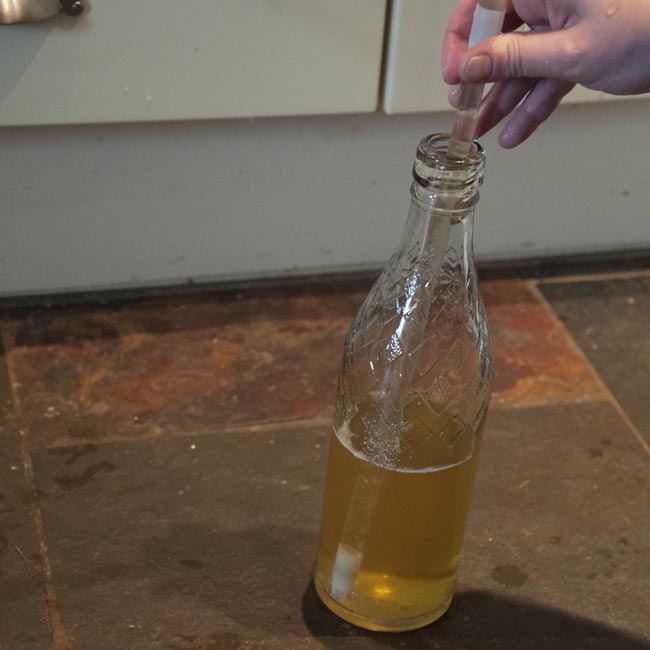 So, carefully syphon your cider into your bottles, leaving about a 1″ space at the top. A ‘bottling stick’ or a tap in your syphon tube makes controlling the flow a lot easier. You want to fill the bottles with the end of your syphon tube right at the bottom of your bottle, so that it stays under the fluid level and minimises exposure of the cider to the air. There’s a bit of a knack to syphon-filling bottles, but you’ll get there eventually. Do put newspaper or something absorbent down on the floor if it’s not easy to clean! Try to avoid drawing yeast sediment or crud into your bottles from the demijohn as much as you can, but don’t worry too much about it, it’s not a disaster! Any extra cider that isn’t a full bottle’s worth? Drink it – it’s your first taste of your brew, and while it’s not ‘finished’ yet, it’s definitely cider, in a flat, old-fashionned-scrumpy kind of way!
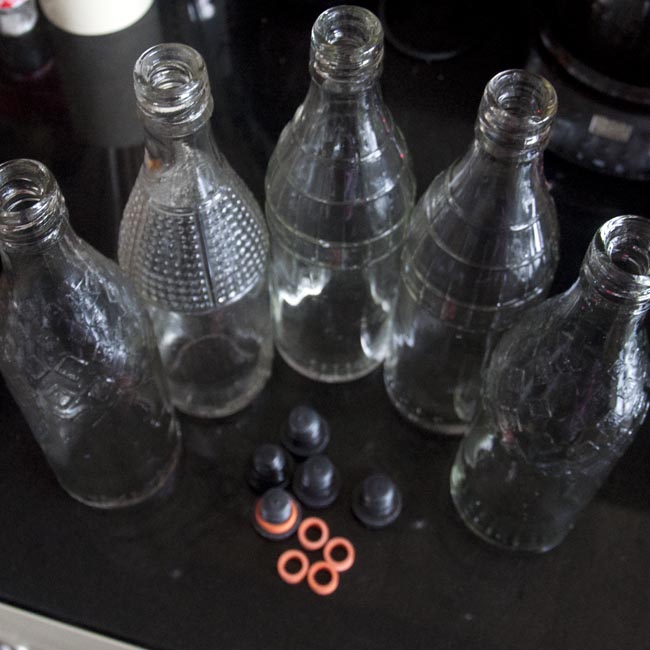 About my bottles, incidentally – they’re old lucozade-type inner-threaded fizzy drink bottles with rubber-gasket stoppers, which I was given by a lovely chap on Freecycle. They’re more or less the perfect home-brew bottles as they’ll take some pressure but don’t require capping equipment, and aren’t gas-porous like plastic, so if you’re offered any, snap them up, even if they need a bit of TLC, new stoppers and gaskets remain available from home-brew suppliers. Obviously, discard any chipped or cracked bottles, since these are at high risk of explosion!
Stage 3 – Secondary fermentation
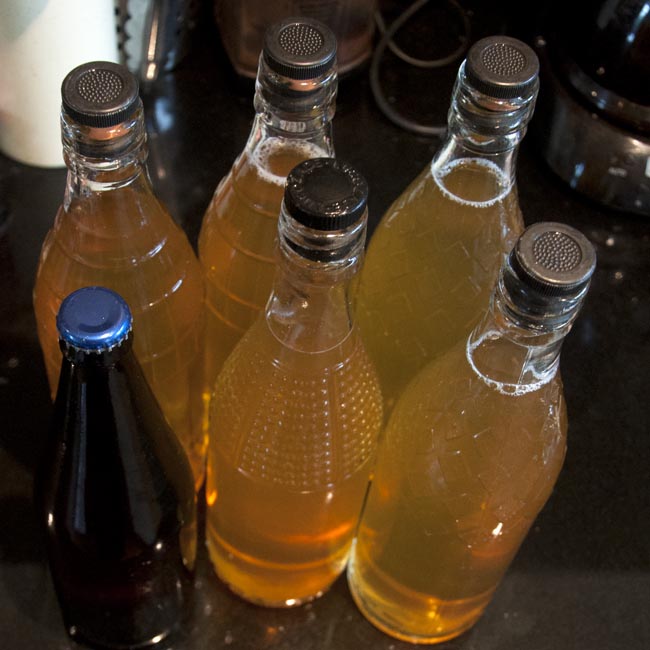 Now seal your bottles tightly, up-end them a few times to dissolve the sugars, and then stash them somewhere, upright, for a couple of weeks for the secondary fermentation to complete. If they’re clear bottles, you can monitor this – the contents will go slightly cloudy, before clearing again, ‘throwing’ a thin layer of yeast on the bottom of the bottle. Once they’re clear, they’re ready to drink (though they will keep for at least a year – I bet you won’t wait that long though!).
Stage 4 – Drinking!
Chill in the fridge door (keeping the bottle upright will minimise disturbance of the yeast sediment) and then open on a suitable occasion to share with good friends – let’s face it, they’ll *have* to be good friends to be willing to be guinea-pigs for sampling your first home-brew experiment! The bottle should open with a gentle ‘pssssst!’. Pour your cider gently, but all in one go, leaving as much of the sediment behind as you can. Don’t worry if you get some yeast in the glass, though, it looks quite traditional and won’t spoil the flavour – and contains lots of lovely B vitamins!
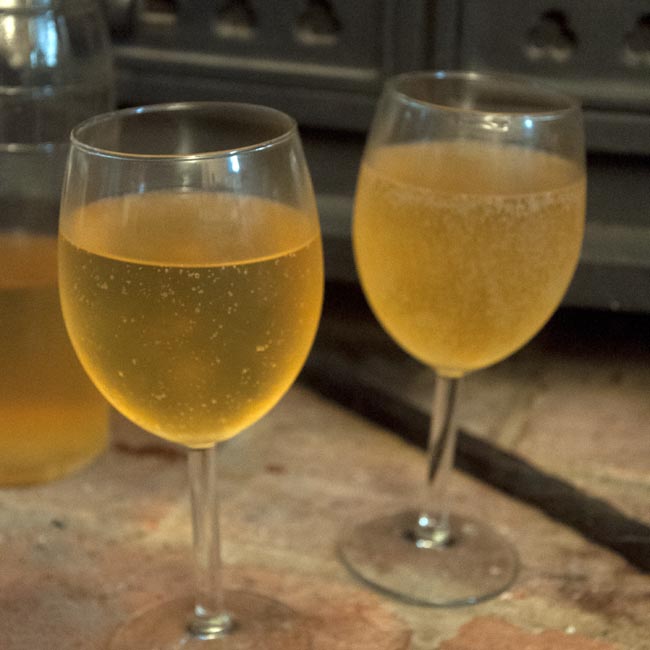
Sit back and enjoy – your care and patience has hopefully been richly rewarded with a perfect crisp cold glass of home-brewed cider. Get going now, and you’ll be all set when summer finally arrives!
Read more from the Country Skills blog >>















 Country Skills for Modern Life