Unknown's avatar

About Kate Watson

Brewster, cook, poultry-keeper, curer & smoker, in other words, jill of all trades and mistress of none!

April Showers Bring May Flowers

It’s finally feeling like summer is coming. But a time of year that would normally see me full of excitement and plans for the garden and kitchen is instead leaving me feeling bereft!

It’s not something I’ve been talking about here, but for the last six months, Hubby and I have been negotiating the frequently infuriating, frustrating, and quite honestly heartbreaking process of surrendering our beautiful home to the Department for Transport so that their friends at HS2 can build a high speed railway line through it. In some respects our entire time here –  in this beautiful piece of rural England, in the cottage that we hoped might be our home for the rest of our lives – has been overshadowed by HS2, which was announced six months after we arrived, ironically on the very day that a huge box of bare-rooted saplings – the orchard I had always wanted – arrived in my kitchen.

So, this year, there have been no window sills full of seed trays. No greenhouse full of tomatoes and chillies (no greenhouse at all, any more – it has gone to live with a friend in the village). No cut flower patch. I’ve had to sit on my green fingers, and it’s been the worst kind of torture.

My poor potted orchard!The only thing we’ve done that could be considered to be ‘gardening’ has been the heartbreaking task of digging up my beloved orchard trees – which will otherwise end up under three metres of backfill – and transferring them into pots, and which felt like nothing more than an act of vandalism.

Of course, just to make me feel worse, everything has decided to blossom this year, most of them for the first time ever! I’m assuming this year’s fruit harvest is a write off, but hopefully my precious trees will survive the abuse, and go on to thrive in their new home.

In six weeks time (fates willing!) we – with the hens, and the trees, and Dave dog – should be just starting to find our feet in our new home in Cornwall. We decided to take the plunge, and make the move we’ve been talking about for years as ‘some day’, to make an opportunity out of what could so easily be a small personal tragedy.

Elderflower buds, just breakingFor now, though, the elder is starting to burst into flower, and yet another highlight of my culinary year is about to pass me by. I could cry!

While there will almost certainly be no elderflower champagne for me this year, there’s no reason you should miss out!
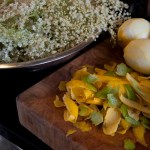
Zested citrus & elderflowersElderflower ‘champagne’ was a great favourite of my grandmother’s, and a few years ago, just after we moved to the cottage, I decided to explore it for myself. It’s been my gateway to a great adventure with all sorts of home-brewing, and is still one of my favourites. It’s so simple, everyone should give it a go!

However, there are two little ‘gotchas’ that I’ve come across with elderflower champagne. Firstly, this live-bottled brew can over-pressurise and create ‘bottle bombs’. Not something that has happened to me personally, thank goodness, but this is mostly because I absolutely insist on using only plastic soft-drinks bottles for this feisty little number. Secondly, if you make this brew with whole flowerheads (and I usually do – it’s a lot of hard work otherwise!), rather than hand-stripping the flowers first, it has a very short shelf life.

Ready to drink!While it’s still actively fermenting in the bottle, all is well, but after three or four weeks, as the brew is ‘fermented out’ and starts to drop clear in the bottle, the flavour begins to turn bitter. Insidiously at first, but pretty soon it will be undrinkably unpleasant. So don’t try to lay this stuff down – enjoy it at its fresh best, start drinking just as soon as you like, once the bottles have pressurised, and enjoy the batch as the sweetness diminishes (and the potency increases!) over the next couple of weeks.

Elderflower cordial, steepingElderflower cordial is another great favourite, and my larder will be the poorer for not getting a batch laid in this year. Again, home-made is the simplest of things. There are no gotchas here, and since I found out about using a little campden powder (wine-makers sulphite), I’m quite happy to lay it down in wine bottles in a cool dark place, where it keeps perfectly for at least a year. If you’d rather not use sulphites, then make a small batch and keep it in the fridge, or freeze a larger quantity using well washed plastic milk bottles or tetra-packs that have held fruit juice.

Diluted with sparkling water, with a handful of ice, it’s a wonderful refreshing drink on a hot day, and a taste of summer in the depths of winter. And the leftover citrus fruit makes a wonderful elderflower-infused marmalade, too!

Last year I made a small experimental batch of elderflower and lemon gin, and some elderflower vinegar. I can report that both of these were excellent – though the lemon gin would have benefited from having the rind removed after a couple of days, leaving just the elderflower to infuse for longer, as the citrus overwhelms the floral character a little.

The elderflower vinegar has amazed me (and the very small number of people I’ve shared it with!). It captures absolutely all of the beautiful sweet scent of the fresh elderflowers, without sugariness, and makes a quite remarkable simple floral vinaigrette! It’s so good that I may just try to make some this year, even if I can’t manage anything else with the house move imminent!

While I’m on the subject of flower vinegars, I absolutely must mention (and heartily recommend to you!) chive flower vinegar, since chive flower season is here or just around the corner. This is remarkable stuff – for a start, just look at the colour!

Chive flower vinegar

The flavour is great – all the fresh onioniness of chives, but without the ‘hot’ character that often comes from raw alliums. It is the simplest thing to make – even a jam jar quantity with a dozen or so chive flowers will be worth your effort – and keeps at least a year in a cool dark place (do beware light – the colour will degrade very quickly even if it’s not in direct sunlight!).

So there you go – May flowers; the figurative ones are hopefully just around the corner, and as for the real ones, they not just for looking at, but for eating too! So enjoy them! And while you do, spare a little thought for us poor up-rooted souls..?

More of this to come!This wonderful little cottage has been so good to us – we have learned so much from being here, and this blog undoubtedly owes its existence to our having made it our home. It’s going to be a real wrench to leave (and heartbreaking to think about what will happen to this little patch of heaven soon) but hopefully, for us, it’s a step on the way to another, bigger adventure!

Read more from the Country Skills blog >>

Lean Lamb Hotpot, from The Hairy Dieters – Cooking the Books, week 19

This little cookbook was an impulse purchase when it came out a couple of years ago, like many impulse purchases soon relegated to the shelves and mostly ignored. But I was looking for something to help me empty the freezer and this hotpot was just the job to use up a couple of lamb chops!

[Yes, I know I’m running behind with these blog posts! Life is a bit doolally just now, I’m afraid. But if everything goes well there might even be two further ‘Cooking the Books‘ posts before the end of this week!]

To make this hotpot for two, you will need a casserole dish with a lid (or some stout tin foil) and –

  • Hotpot ingredients350g lamb chops or leg steaks, deboned, trimmed, and cut into pieces 2-3cm in size
  • 1 onion
  • 3 carrots
  • 250g potatoes
  • Lamb stock cube (enough for 300ml reconstituted)
  • Fresh or dried rosemary and thyme
  • Worcestershire sauce
  • Oil
  • Plain flour
  • Salt and pepper

Preheat your oven to 170C. I’m not on a diet (if you read this blog regularly, that hopefully goes without saying!) so I was less than entirely fussy about trimming ‘any visible fat’ off the lamb. I did trim off the biggest chunks, though!

Brown off the lambSeason the lamb a little and fry brown it off in batches in a frying pan with a little oil (just a single teaspoon, if you’re following the recipe!) before transferring to the casserole dish. I also softened the onion and *whisper it* added a crushed clove of garlic, which may not be quite traditional for a proper Lancashire hotpot!

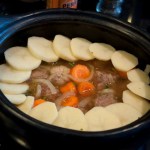
Mix ingredients in casserole dishPeel and cut the carrots into chunks. Add the carrots and onions to the meat in the casserole dish, sprinkle over 1.5tbsp of plain flour, and mix well. Make up 300ml of lamb stock with the stock cube (mine made 450ml, so I used 2/3rds) and add this to the casserole dish, along with a generous pinch each of dried rosemary and thyme and a tablespoon of Worcestershire sauce. Finally add a big pinch of black pepper, and mix well.

Arrange sliced potatoesPeel and slice the potatoes about 5mm thick, and arrange them decoratively over the top. Add an extra sprinkle of pepper over the top, cover snugly and pop in the oven for 1hr.

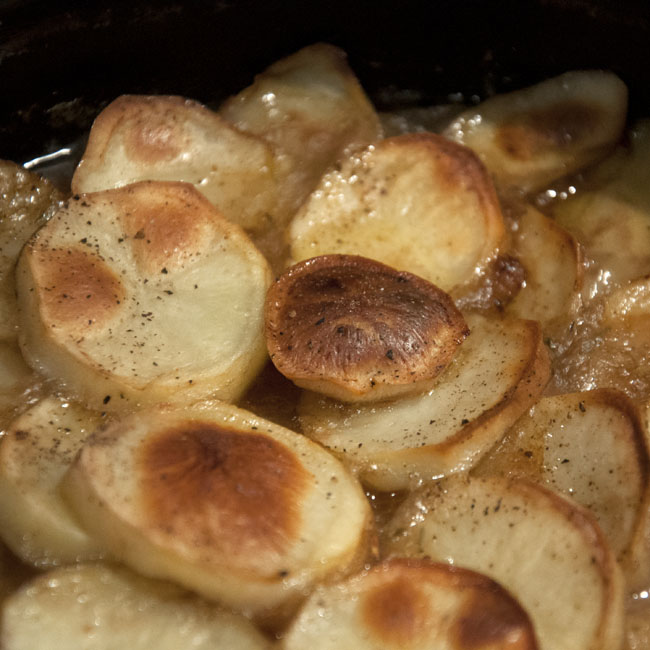
Browned on topAfter an hour, take off the lid and return to the oven for a further 45 minutes. The hot pot is done when the potatoes are beautifully browned.

Serve with lovely seasonal steamed vegetables, and enjoy!

Tuck in!

**
The Hairy Dieters, by Dave Myers and Si King
Weidenfeld & Nicolson, 2012
ISBN 978-0-297-86905-4
Soft cover, 192 pages, full colour. RRP £14.99.

Hairy Dieters - cover[Full disclosure: This is my book, which I bought. I have received no payment or sponsorship for this post, nor have I accepted a review copy. I do not have an amazon affiliate account and do not profit from any links provided.]

I think I’ve been a bit unfair to this cookbook – it was bought with ‘good intentions’, particularly because I hoped it might contain some packed-lunch inspiration. The ‘lunchbox’ section at the back turned out to be rather short and a bit disappointing, and so it went to live on the shelves, more or less ignored until I got it out again last week for the blog challenge.

Hairy Dieters - page viewUnusually – particularly as I’m having to be especially fussy about using what I’ve got and not buying random ingredients just now – I had a choice between several different recipes, and didn’t need to substitute creatively, either!

These recipes are, first and foremost, good decent food, selected because they happen to be lower in fat / calories / whatever. Now, I fundamentally don’t like diet recipes, because they tend to include a raft of nasty ‘cheats’ to con the flavour back into food which has been lost due to removing fats, oils, and carbs. There’s none of this here, just normal store-cupboard ingredients; if you soft-pedal on the slightly obsessive fat-avoidance, there’s some great stuff here. From Si and Dave of ‘Hairy Bikers’ fame, I suppose that should come as no real surprise!

There are plenty of recipes here that I’m going to want to make in the future – from the cassoulet, to a selection of ‘fake-away’ curries and Chinese meals, stews, pies, and one-pot suppers. Ignore the ‘diet’ marketing, and add this little cookbook to your collection – this is a (coincidentally healthy) weekday-supper goldmine!

‘Cooking the Books’ is my self-imposed blog challenge for 2014 – I’ll be trying to cook a new recipe from one of my (rather extensive!) collection of cookbooks once a week, write it up and review it. Wish me luck!

Read more from the Country Skills blog >>

The Eurovision Drinking Game – 2014 Edition

Dear visitor – this post is preserved for archival purposes.  Click here to view the fully updated Eurovision 2015 Drinking Game Rules (with bonus ‘Fair Dinkum’ Aussie round).

The 2014 Eurovision Song Contest is due to take place in Copenhagen, Denmark, on Saturday May the 10th. So, without further ado, I present to you – The Eurovision Drinking Game, 2014.

Get those bottles open!Could this be the very best Eurovision Song Contest drinking game on the internet? With all due modesty, I think it might be! Like so many good and worthwhile ideas, these rules started life at a drunken student party, well over a decade ago. They have been carefully curated and updated over the years, and play-tested by a number of kind ‘volunteers’, some of whom even remembered enough the next morning to provide helpful feedback and suggestions!

How to play –

This is a forfeit game. A variety of features of both the song and the performance have been selected, and their appearance triggers a drinking forfeit. This is usually (but not always!) ‘take a swig’.

European FlagsYou will need to divide up the countries and songs between your players. The best way to do this will depend on your personal preferences, and the number of people at your party. It’s probably unwise (though it may well be very entertaining!) for everyone at the party to play for every song. A small party might only want to play a subset of the songs available. You could allocate the songs by ballot at the start of the party, or draw straws before each song. The choice is yours!

The Songs – 

Begin any song that you are playing with a fully-charged glass.

Musical scoreSelected features of the song and performance trigger forfeits. These features can appear more than once in a performance (and sadly, often do!), and ‘score’ each time they appear – so the infamous ‘Bucks Fizz’ skirt removal would represent a single costume change, because it happened in one go, but a song that repeatedly swaps languages or makes major-to-minor-and-back-again key transitions triggers a forfeit on each switch.

Take a drink for each instance of the following:

The song –

    • Is not in an official language of the country being represented
    • Change of language
    • Change of key (take an extra swig if the key change is so egregiously telegraphed you can see it coming for miles)
    • Change of tempo
    • Wordless lyrics (da dum da, mana mana mana, lalalala)

Russian folk-dancersThe performer, costume and performance –

    • Performer(s) not of nationality represented
    • Folk costume
    • Folk instrument 
    • Folk dance
    • Weapons (with an extra-big swig if they’re ‘folk’ weapons – axes, pitchforks, flaming torches etc)
    • Uniforms – military & civil (including costume references to same – epaulettes, insignia, military-looking hats and suchlike)
    • 'Policewomen'Flags & banners
    • Pyrotechnics, smoke, fog
    • Costume change
    • Bare feet, bare torsos
    • Underwear as outerwear
    • Spandex, lurex, sequins
    • Leather, rubber, PVC, bondage wear
    • LEDs or other lighting incorporated into costumes
    • Fur, feathers, wings
    • Trapeze or wire-work
    • PyrotechnicsMagic, circus themes
    • ‘Booby Prize’ This is the big forfeit, down the remains of your drink! – Performer does not appear to be human (note this rule applies whether or not the performer is human underneath!)

The half-time performance (or the ‘Riverdance’ slot) –

Traditionally the host country puts on a performance on during the ‘voting gap’. Everyone plays for this segment. Use the same forfeit list, but all penalties are doubled.

For the convenience of all my lovely readers, I have made you a ‘cut-out-and-keep’ forfeit card this year. Click for the full-size version, print it out and hand out copies at your party, or save to your mobile devices and share the Eurovision love!

Your cut-out-and-keep forfeit card

Graphics for the cut-out-and-keep forfeit card are use under Creative Commons licenses, see links for details: Flags by Anka Pandrea, Glasses by Nora Raaum.

Voting –

The voting round should be considered advanced play, and may be unsuitable for novices. Nevertheless, these rules are intentionally kept simple. They need to be!

Voting!Before each set of results are announced, everyone guesses where the 12 points are going. If anyone gets this right, those who got it wrong take a swig.

‘Booby Prize’: Everyone downs their drink if the presenter gets the country they’re speaking to wrong, calls the national representative by the wrong name, or gets their pronunciation corrected by the national representative.

Well, that’s all, folks! Have fun at all your Eurovision parties, and if you do decide to try these rules, do let me know what you thought of them, and any suggestions you might have for improving them in future years. You can leave a comment, or tweet me @CountrySkills (where it’s likely some Eurovision live-tweeting may follow!).

And remember, please drink responsibly (*ahem!*), and definitely don’t drink and drive, attempt DIY, deep fat frying, change important passwords or operate heavy machinery. Finally, your hangover is your problem, not mine, so don’t come crying to me in the morning!

As our Danish hosts might say – “Bunden i vejret eller resten i håret!” (Bottoms up or the rest in your hair!)

Read more from the Country Skills blog >>

BBQ Tikka Chicken, from Feasting on Flames by Annette Yates – Cooking the Books, week 18

BBQ season is here! The evenings seem noticeably longer, almost every day, and it’s warm enough to hang around outside until sunset. And as if that wasn’t enough, it’s a bank holiday weekend here in the UK. So really, I had to go to the cookbook collection to find some BBQ cooking inspiration.

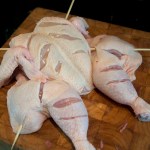
Finally insert skewers to hold shapeI have modified this recipe slightly – the original calls for six bone-in breast pieces, but I much prefer to do a whole bird. You could portion it up and cook the pieces separately, but I think doing it whole, as a spatchcock, is much more fun!

To make this, you will require –

  • One whole chicken, prepared as a spatchcock or divided into portions
  • 6 tbsp natural yoghurt
  • 1 small onion
  • Tikka BBQ ingredients2 large garlic cloves (I used smoked cloves, as I had them)
  • 2 tbsp garam masala
  • Zest and juice of one lemon
  • A thumb-size piece of fresh root ginger
  • 1 tsp malt vinegar
  • 1 tsp paprika (I used quite a mild, smoked paprika – you could use a hot paprika for a spicier result)
  • 1 tsp salt

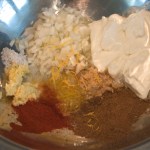
Ingredients before mixingFinely chop your onion, mince or crush the garlic cloves, remove the zest from the lemon with a grater or zester (or use a vegetable peeler and slice the peel finely), and grate the root ginger finely. For a smoother result, you could put the onion, garlic, lemon zest and ginger through a food processor to get a thick paste.

Combine all the ingredients in a large wide bowl, and mix.

Make incisions into chickenTake your chicken, and make several deep slices into the breast and thigh meat, to help the marinade permeate. Before you start rubbing the marinade into the chicken, it can be useful to set a small bowlful aside for basting onto the chicken during cooking – it’s important to set it aside now, if you’re going to do this, as the rest of the marinade is going to end up mixed with raw chicken juices, and probably shouldn’t be put back on later in the cooking process!

Rub in marinade and set asideRub the marinade all over your chicken, top and bottom, and into all the slices, cover, and set aside in the fridge for at least a couple of hours (longer is fine!).

You can either cook this chicken entirely on the BBQ, or do most of the cooking in the oven, and then finish it off over the coals.

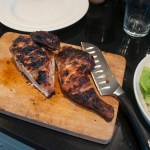
Cook over charcoalThe latter is a great idea if you’re not confident in cooking large items on the BBQ – I would roast it on a rack for about 1hr at 180C before finishing it over the coals. You can check that it’s essentially cooked with a meat thermometer before transferring to the BBQ grill. For a crispy skin, BBQ the ‘inside’ first, and then finish it skin-side down. Dividing the cooking like this is also really handy if you’re cooking for lots of people, as it leaves the BBQ grill free for cooking other items in the meantime!

Beautiful crispy skinFor full BBQ cooking, I like to start skin side down, turn over after about 20 minutes, and then turn back skin-side down to finish. Keep the chicken covered during cooking, with a tent of heavy tin foil or a BBQ lid (if you have one). We have a big old aluminium wok lid which is great for covering things while they cook on the BBQ. Keeping the chicken covered means it cooks much more quickly and evenly.

Divide up into portionsIf you’re going to cook this way, do use a meat thermometer to make sure your chicken is properly cooked through – you’re looking for a minimum internal temperature of 75C at the centre of the thickest part of the breast. If you’re at all unsure of your ability to find the thickest part, then shoot for a slightly higher temperature to give you a margin of safety.

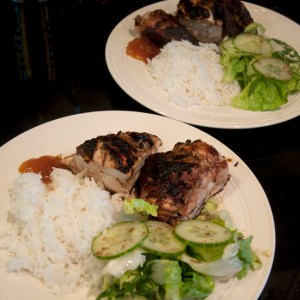
Once your chicken is cooked, divide up into portions using a sharp knife – for me, half a breast portion and a thigh or drumstick per person is a nice serving size. Serve with rice and a green salad dressed with a nice mustardy vinaigrette.

Serve your tikka chicken

This is a really subtly flavoured, aromatic tikka and will suit those with spice-sensitive tastebuds. If you like yours a bit hotter, use a hot paprika and add a whole finely chopped fresh or dried chilli (or the appropriate amount of dried chilli flakes).

**
Feasting on Flames - coverFeasting on Flames, by Annette Yates
The Apple Press (Quintet Publishing Ltd), 1998
ISBN 978-1-85076-954-0
Soft cover, 128 pages, full colour. RRP £8.99.

[Full disclosure: This is our book, which we bought. I have received no payment or sponsorship for this post, nor have I accepted a review copy. I do not have an amazon affiliate account and do not profit from any links provided.]

This paperback cookbook pretty much does what it says on the tin, with a good variety of fish, poultry, meat and vegetable dishes, and even some deserts, for cooking on the BBQ. These are accompanied by a collection of side dishes, and some menu suggestions, making this a pretty decent one-stop shop for anyone who wants to extend their BBQ cooking beyond the classic sausage, burger and drumstick fare we’re all so familiar with!

Feasting on Flames - page viewI like the fact that these recipes (like the tikka recipe above) are based on fresh ingredients, rather than taking the short-cuts of using prepared sauces and pastes, but it does mean the ingredient lists end up being quite long. They’re not unusual ingredients, though, on the whole, and should be in most people’s store cupboards. These are pretty quick, simple recipes, which cover a wide range of tastes and cuisines.

Is it a must-have book? No, probably not. It does what you’d expect, pretty competently, without any real ‘standout’ moments. There are, I imagine, many like it. If you get the chance to pick it up cheaply, by all means do, but I probably wouldn’t specifically seek it out. If it’s already on your shelf, and has been a bit neglected, maybe dig it out again and give it another look?

‘Cooking the Books’ is my self-imposed blog challenge for 2014 – I’ll be trying to cook a new recipe from one of my (rather extensive!) collection of cookbooks once a week, write it up and review it. Wish me luck!

Read more from the Country Skills blog >>
Basic Butchery – how to spatchcock a chicken (or any other poultry!)

This is a really useful kitchen skill to master – and really straightforward! If you can portion a chicken, you can definitely do this – actually, spatchcocking is quicker and simpler. Why spatchcock a bird? Well, it’s a fantastic way to prepare a whole bird for the BBQ or oven, it opens up the carcasse, making it more even in thickness, and allowing the air to circulate evenly around both sides. And if you’re adding flavour in the form of a marinade, it’s easy to coat the bird generously on both sides.

Whole chickenIf you want to prepare a whole bird for the BBQ or grill (and why wouldn’t you – it’s so much more exciting and impressive-looking than chicken portions!) then this is the very best way to go.

Start by un-trussing your chicken, removing any string or elastic from it.

Cut from parson's nose towards neck endTurn the bird breast side down, and identify the ‘parson’s nose’. Now, with a stout pair of kitchen scissors, start to cut from one side of the parson’s nose, straight along the length of the bird towards the neck end. You’re cutting just to the side of the backbone, and through ribs and other quite solid grissly bits (this will be much less obvious on a poussin, quail, pheasant or other small bird) so don’t worry if it seems a bit tough!

Repeat the process the other side of the parson’s nose and backbone, and remove it altogether. See, simple as that!

Remove backbone  With backbone removed  Flatten breast area

Turn the bird over so that the breast side is up,and press down firmly over the breast area so that the wishbone snaps and the bird lies flat. Trim off the knuckle parts of the legs, and any loose skin from the neck area to tidy things up.

Finally insert skewers to hold shape

Finally, take two long skewers (ideally you would use metal skewers but mine are too short – bamboo bbq skewers like these are fine though) and starting at the thickest part of the breast, thread them through diagonally, ending up passing right through the thigh on the other side of the bird.

You’re done. How easy was that? Marinade them however you like (how about a whole jerk chicken using my fabulous dry jerk rub?) and get that BBQ going! What better treat this Bank Holiday weekend!

Read more from the Country Skills blog >>
Pesto Pasta with Chorizo and Artichokes, from James Martin Easy Every Day – Cooking the Books, week 17

This is a book with good memories attached, it’s autographed and came directly from James Martin himself, at the masterclass I was privileged to attend a couple of years ago. For all that, I haven’t cooked from it very much at all – a good time to change that, then! I fancied something light and fresh, and this pasta recipe – particularly with the fresh home-made pesto, really caught my eye.

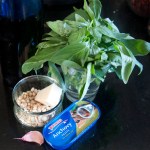
Pesto ingredientsFirst, you’ll need to make your pesto. You will need –

  • 50g of fresh basil,
  • A large juicy clove of garlic,
  • Three anchovy fillets,
  • A tablespoon of pine kernels,
  • 25g of parmesan, and
  • Olive oil

Toast the pine kernelsIn a dry pan, toast your pine kernels until they’re starting to go golden brown in places. Meanwhile, grate your parmesan cheese.

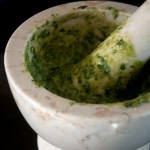
Now, you can do this the easy way, or the more interesting, but harder way! You can just fling all your ingredients into a food processor, blitz them up and add olive oil until you get the consistency you want. Easy, but boring, and for me the texture leaves a bit to be desired. So I prefer to make my pesto in a pestle and mortar. But don’t even consider this approach if your pestle and mortar isn’t of the very large and heavy variety – the sort that you might use for crushing the occasional fresh spices isn’t going to do the trick here!

Crushed garlic & pine kernelsStart by crushing your garlic roughly, then add the toasted pine kernels and break these up. You should add the anchovies at this stage, but I forgot so mine went in much later! It’s fine, though. Now roughly chop the basil into the mix a handful at a time, along with a bit of the grated parmesan, and a drizzle of oil, and work away at it. Yes, it is hard work, but you’ll get there in the end! Add as much olive oil as you need to get the consistency you want.

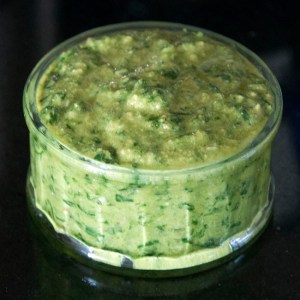
Fresh hand-made pestpThis fresh pesto is a beautiful colour – a lovely fresh bright green rather than the slightly brown colour of the stuff from a jar – and even if you’re buying your basil like I had to this time (regretfully, it came all the way from Kenya) and account for the full cost of a tin of anchovies, it still works out comparable in price to the shop bought stuff. Later in the year, when there’s plenty of home-grown basil available, it works out about half the price. So really, it’s a no-brainer.

Cover the pesto very snugly until you’re going to use it (I wrapped it tightly with cling film) – any leftover will keep in the fridge for several days in a jam jar. Pour in a little extra olive oil to form a layer over the surface to exclude all air, as the basil blackens quickly if exposed to oxygen. These quantities are generously enough for four people worth of pasta. I love how the handmade approach leaves variable-sized little bits of recognisable basil leaf in the mix, rather than rendering it all to a homogenous pulp!

Prepared fresh pesto

You can enjoy this pesto just as it is, stirred through freshly cooked pasta, with a sprinkling of parmesan. But I wanted something a little more complex. The recipe for ‘Pesto Pasta with Chorizo and Artichokes’ is on the page next door to the pesto recipe in James Martin’s book – but it’s really just a variation on our family favourite we know as ‘Pasta with Pesto and Stuff’ – where ‘stuff’ will often encompass some combination of bacon, chorizo, mozzarella, sun-dried tomatoes, artichoke hearts, olives… you get the idea. Perfect for a quick satisfying dinner straight from the store cupboard. What makes this variation special is the wonderful fresh pesto, and the thoughtful combination of additions.

Pesto pasta with chorizo and artichokesTo serve two, you will need –

  • About half a quantity of freshly made pesto (above)
  • 250g good quality dried pasta
  • 100g chorizo sausage
  • 100g artichoke hearts in olive oil
  • Parmesan
  • Salt, pepper, and olive oil

This is a really quick meal, if you’ve made the pesto ahead of time. (You could of course use pesto from a jar, but the result will be more ‘everyday family supper’ than ‘gastro treat’!)

Get a big pan of water boiling rapidly, and add a big pinch of sea salt and a glug of olive oil, before adding the pasta. I’ve said this before, but if you’re not in the habit of buying the really good, Italian, dried pasta, please do give it a go. Yes, it’s about twice as expensive as the supermarket own-brand stuff, but pasta is such a cheap ingredient that you’re really only talking an extra pound, or less, per pack. The difference is really striking – the cooked texture is much better, with a nice bite without going stodgy. The other mistake that many people make when cooking pasta is trying to cook it in too little, under-salted water. Use your biggest pan, the pasta loves plenty of space to move around. And don’t overcook it for goodness’ sake!

Thinly slice your chorizoAs soon as your pasta goes on, thinly slice your chorizo, and fry it gently in a frying pan, turning regularly, until it starts going crispy. Then set aside. Slice your artichoke hearts into segments, if they’re not that way already. Once your pasta is cooked, drain it, reserving about half a mug of the cooking water. Put the cooked pasta back in the pan, and pour over a glug of the seasoned olive oil from the artichoke jar, and toss them around so they don’t stick.

Now, quickly, mix in the pesto (about a desert spoon per person), the fried chorizo and the artichoke hearts, and some of the pasta water if you feel a bit of extra moisture is required. Shave over some nice curls of parmesan (you don’t need a special tool for this, a perfectly ordinary vegetable peeler works just fine!), a sprinkle of freshly ground black pepper, and serve immediately.

Pesto pasta ready to serve

Doesn’t it look mouthwatering? It tastes just as good as it looks, with wonderful peppery punchy aromatic freshness from the home-made pesto. Yes, the raw garlic is likely to hang around on the breath for a bit – you could use roast garlic instead but you’d sacrifice the hot bite that it contributes. Don’t leave out the anchovies, please, even if you don’t think you like them – they just augment the salty savouriness of the parmesan cheese (really effectively actually!), there’s nothing ‘fishy’ about this pesto, I promise! The cooked chorizo pieces have a lovely sweetness to them, and the artichoke hearts add a nice mild freshness.

This pesto is, I must admit, very similar to my previous home-made pesto recipe, except for the addition of the anchovies, which is inspired. It’s a small improvement but little incremental variations like this are so often the difference between ‘good’ and ‘fabulous’.

James Martin - cover**
Easy Every Day, by James Martin
Mitchell Beazley, 2012 (paperback edition)
ISBN 978-1-84533-667-7
Soft cover, 304 pages, full colour. RRP £14.99.

[Full disclosure: This book was autographed and given to me as part of a masterclass I attended with James Martin, which was a competition prize in 2012. I suppose, in some respects, it might be considered a review copy! I do not have an amazon affiliate account and do not profit from any links provided.]

James Martin - page viewThis book is actually a re-collection of recipes from two of James Martin’s older books, ‘Delicious!’ and ‘Eating in with James Martin’. There’s some really good stuff here – from pasta dishes like this one, and risottos, to lovely meat and fish recipes, breads, sweet treats, and even some preserves. There’s also a useful set of menu suggestions at the back, which makes picking three complementary courses for a special dinner a bit of a doddle.

Frontispiece - autographThe editorial slant is towards dishes that don’t require protracted preparation, and while in a lot of cases that gives lovely, simple, fresh results, there are some ingredients in use here, such as prepared tomato-flavoured pasta sauces for pizza toppings, which just feel like a shortcut too far for me; they’re not in my kitchen cupboards, I don’t like them – over-sweet and cloying – and I’m not going to be buying them just because James Martin says so!

That said, this is a minor gripe, really, in what is generally a really excellent collection of approachable recipes with a definite ‘wow’ factor. If you’re looking for a recipe book to help you find the confidence for dinner party entertaining – as well as some very posh family suppers! – this may be a good place to start.

‘Cooking the Books’ is my self-imposed blog challenge for 2014 – I’ll be trying to cook a new recipe from one of my (rather extensive!) collection of cookbooks once a week, write it up and review it. Wish me luck!

Read more from the Country Skills blog >>

Braised Beef with Horseradish, from The Slow Cooker Cookbook – Cooking the Books, week 16

I asked Hubby to select the cookbook for this week’s recipe and review, and of course he set me a challenge! The Slow Cooker Cookbook came into my possession by accident, mistakenly delivered as part of an order from Lakeland a few years ago; when I let them know, they said they didn’t want it back. So this rather smart-looking large format hardback made its home on my ‘tall cookbooks’ shelf and has been there, more or less ignored, ever since.

Slow Cooker Cookbook - coverThe main reason for this, you may have guessed, is that I don’t in fact own a slow cooker. I’ve had my eyes on one for a number of years, but I simply don’t have the storage space to put one away when not in use, or the counter space to leave it out all the time.

I’m currently coveting a Wonderbag, which if it works as well as they say it does, has most of the properties of a slow cooker without any power use – magic or what? But we’re on quite a tight budget just now, so purchases of new shiny things – even lovely energy saving ones! – are going to have to wait a while.

I knew we had a pack of lovely braising steaks in the freezer, so the recipe more or less chose itself. The rest of the ingredients are store cupboard and pantry standards – though there are rather a lot of them – which makes this a great economical recipe. I have made a few small modifications to suit the ingredients and quantities I had available. It would happily serve four – for the two of us it made two meals, and tasted just as good reheated on the second day.

To make this lovely braised beef dish, you will need about six hours, a large stock-pot, a frying pan, and –

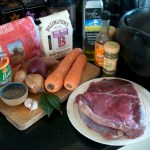
  • Braised beef ingredientsFour small or two large pieces of braising steak – about 700g / 1.5lb in all
  • Plain flour
  • Oil for shallow-frying (I used rapeseed oil)
  • Four medium onions. I used two large spindle-shaped shallots, one yellow and one red onion, because that’s what I had. The recipe calls for twelve small round shallots – but I really can’t see what difference it makes.
  • Two garlic cloves
  • 1/4 tsp ground ginger
  • 1 tsp curry powder
  • 3 tsp dark muscovado sugar
  • 1 1/2 tbsp Worcestershire sauce
  • 3 tbsp creamed horseradish
  • 700ml of beef stock (I used a mixture of beef stock cubes, and vegetable bouillon powder)
  • Red wine, if available. Substitute this up to half of stock.
  • Two large carrots. The recipe calls for baby carrots. I don’t like baby vegetables much (unless they’re thinnings from the veggie garden!) and even if I did, they tend not to be available in our local village co-op.
  • 2 bay leaves.
  • Dried thyme (my addition)
  • Salt and pepper.

On a plate, season a couple of tablespoons of plain flour with salt and pepper. Cut the braising steak into large pieces (probably about 3 x 3 inches or thereabouts) and dredge in the seasoned flour. In the frying pan, heat a little oil, and then fry the pieces of floured beef quickly, just for a minute or two until they start to brown. Only do a few pieces at once, so you don’t crowd the pan, and once they’re done, transfer them to the bottom of your stock pot.

Now slice your onions into quarters though the root, so as to keep the layers together, and peel off the skin. Fry these in a little oil until they’re just starting to go golden, then add the garlic (minced, crushed or chopped very finely), the ground ginger and curry powder, and fry on for a minute or two so the flavours combine and the garlic just softens. Once you’re happy with it, add the onion mixture to the stock pot on top of the beef.

Make up your stock mixture with boiling water, or if you’re using real beef stock, which obviously would be better, heat it to nearly boiling on the stove. Add the liquid to the stock pot, followed by the sugar, Worcestershire sauce, horseradish, bay leaves, and a big pinch of dried thyme. Peel the carrots and slice them into ‘baby carrot’ pieces – I halved each carrot and then sliced these pieces into quarters lengthways – and add these, along with a big pinch of black pepper. I wouldn’t add any salt at this stage, especially if you’ve used stock cubes or powders – you can always adjust the seasoning at the end of cooking if you find it lacking.

Everything in the potMix well to combine everything, and put the stock-pot on the hob to bring it to a simmer. Meanwhile, heat the oven to 180C. Once the pot is boiling, fit the lid and put the stock pot in the oven. After the first hour, turn the oven down to 120 C and allow it to cook on for another four hours. It’s not a bad idea to take it out every hour or so and give it a gentle stir, as it will tend to form a skin on the surface as this layer dries out a little.

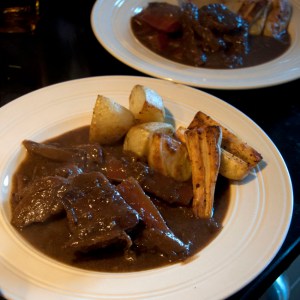
I served this lovely rich braised beef dish with roast potatoes and parsnips – I’m lucky to have two ovens, but if you only have the one then you can take the pot out of the oven and keep it just ticking over on the hob while you use the oven for your roast vegetables. In fact, you could do the whole thing on the hob, but it will require a fair bit more attention since it’s far more likely to catch and burn on the base of the pan.

I have to admit to having had my doubts about this recipe – the ground ginger and curry powder particularly I would never have thought to add to a dish of this sort. Through the long cooking process, they meld down into a deep complex earthy spicy character and lose their distinctive individual flavours. There’s a good but gentle heat to the finished dish, mostly from the horseradish. The braised beef is fork tender – the pieces break down further during cooking, yielding nice bite-sized pieces – and the carrots somehow avoid becoming mushy, developing instead a profound sweetness.

Braised beef - serve

I love this recipe, and will definitely be making it again. It’s a fabulous winter warmer, but would dress up (and scale up) very nicely for entertaining. It re-heats extremely well, so you could make it the day before, but given the long cooking process all the work for dinner is done just after lunchtime anyway, leaving plenty of time to sort out all the trimmings! For lunch today, we enjoyed the leftovers it with some lovely toasted buttered home-made bread, which was also great.

**
The Slow Cooker Cookbook, by Catherine Atkinson
Lorenz Books, 2008 (2nd edition)
ISBN 978-0-7548-1486-3
Hardcover, 256 pages, full colour. RRP £16.99.

[Full disclosure: This is my book (though it did come to me free of charge in slightly unusual circumstances!). I have received no payment or sponsorship for this post. I do not have an amazon affiliate account and do not profit from any links provided.]

Slow Cooker - page viewI must admit to having been a bit dismissive of this book – due to the lack of a slow cooker, yes, but also because these sorts of themed-collection cookbooks have a tendency to be a bit disappointing, and often feel cobbled-together to fill a gap in someone’s publication list, or as promotional items for some kitchen gadget or other.

Well, if the rest of the recipes in this book are anything like as good as this one, I’ve been neglecting a bit of a gem! Flicking through, I think it’s quite possible that they might be, though as the frontispiece credits 18 people in addition to the author for recipes, I can’t exclude a degree of variability! The book features a huge variety of different dishes – 220 in all, from the very traditional to the really quite unusual, and from a wide range of cuisines, though French influences seem predominant. There are the obvious braised and casserole dishes, like this one, but also far more unexpected things – I had no idea, for instance, that you might be able to make cakes and brownies in a slow cooker, or that they could be used as a ‘bain marie’ for cooking patés and terrines. Students with limited cooking facilities – take note!

I think there are recipes here which could help break regular slow cooker devotees out of a culinary rut, and plenty of ideas which are generally adaptable to slow one-pot cooking, with or without a slow cooker.

As for me, in due course – will I be buying a slow cooker, on the strength of this, or sticking with my instincts and trying that Wonderbag instead? I’m still not sure… watch this space!

‘Cooking the Books’ is my self-imposed blog challenge for 2014 – I’ll be trying to cook a new recipe from one of my (rather extensive!) collection of cookbooks once a week, write it up and review it. Wish me luck!

Read more from the Country Skills blog >>

Apple Of My Eye – apple and marzipan cake

A quick bonus recipe for you this evening – scribbling this down mostly for my own reference – as I definitely intend to make this again – but also because a couple of people on Twitter and elsewhere have asked for it.

Apple and Marzipan Cake

This rather spanking apple and marzipan cake is adapted from an apple cake recipe in the River Cottage Handbook ‘Cakes’ volume by Pam Corbin, adjusted for my taste and available store cupboard ingredients. Apologies for the lack of ‘making’ photographs – this one wasn’t really for the blog at all!

You will need –

  • 230g self raising flour
  • 20g wheat bran
  • 1/2 tsp bicarb of soda
  • 2 tsp ground nutmeg
  • 1/2 tsp mixed spice
  • Pinch of salt
  • 125g unsalted butter at room temperature
  • 125g soft brown sugar
  • Two decent sized apples – cookers or eaters, whatever you have that needs eating up, I used one of each.
  • 50g marzipan
  • 1 egg
  • 50ml milk

To decorate –

  • Another apple – ideally an eating apple
  • Handful of sliced almonds
  • 1 tbsp golden granulated sugar

First, set the oven to 180 C. Butter a 7″ or 8″ deep loose bottomed cake tin generously, and line the base.

Combine the flour, bran, bicarb, spices and salt in a large mixing bowl. The recipe called for a mix of white and wholemeal self raising flours, but I only had white so I made up the volume with a little bran, which after all is the stuff that you sift out to turn wholemeal flour into white flour in the first place! The spice mix is to my taste – cinnamon would be very traditional with apples, but Hubby doesn’t like it. The recipe called for ground cloves, but I find them medicinal-tasting and a bit overwhelming, so follow your inclination!

Chop up the softened butter roughly and rub it through the flour mixture with your fingers until it’s the consistency of breadcrumbs. Now mix in the soft brown sugar.

Peel & core your two apples (if they’re lovely freshly picked home-grown apples, you might consider leaving the skins on – but these had been stored a while, and looked it!) and chop them into dice about 1cm to a side, and do the same with the marzipan. Mix these cubes into the dry ingredients.

Beat your egg with a fork and mix in the milk. Add this liquid to the rest of the ingredients in the bowl. It won’t look like there’s enough – but if you keep moving the contents of the bowl around, eventually all the dry ingredients will combine with the liquids to form a rough batter. It won’t look like there’s enough ‘cake mix’ for the diced apple, either, but don’t let this bother you too much. Spoon the mix into a deep sided cake tin – something like a 7″ or 8″ tin you’d make a Christmas cake in, rather than a sponge tin. Level the mix as well as you can.

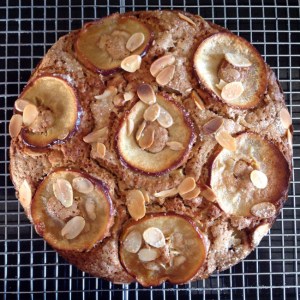
Now take your extra apple and core it, leaving the skin on. Slice reasonably thinly and arrange the slices over the top of the cake to decorate. Sprinkle over some sliced almonds. Finally, dust the top of the cake with a tablespoon of granulated sugar.

Pop it into the oven (turning if necessary to keep the cooking even) for about 45 minutes, then check to see if a skewer comes out clean. Mine actually needed about an hour in all to cook through. The batter, implausible as it might seem, will have managed to step up to the mark, and it will look like a nicely risen cake, rather than the chunky mess that went into the oven. Leave the cake in the tin for about half an hour after it comes out of the oven (it’s quite a crumbly texture and I suspect it would just fall apart if you took it out straight away) then ease it out of the tin and leave it on a wire rack to cool completely. It will then keep in an airtight cake tin for longer than it’ll take you to eat it (2-3 days, easily).

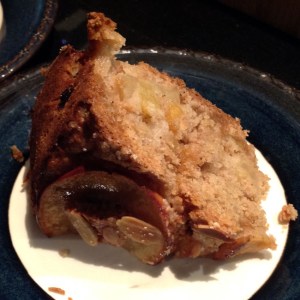
Sliced appearance

I love this cake! With nutmeg the dominant spice, it’s not over-sweet, has lots going on in the texture department, and is a very ‘grown-up’ sort of treat (though I’m quite sure that kids would love it too)! The marzipan adds lovely gooey sugary melty bits, which I just adore, while the texture of the rest of the cake is nice and light. The granulated sugar, apple slices and almonds add a lovely appearance to the top, too; and it’s a ‘self-decorating’ cake, which is a bonus – it comes out of the oven ready to go, which is a great time saver. And it looks utterly mouthwatering, which is even better!

Tuck in!

Hubby loves this, and I think you will to – so give it a try. Make yourself a nice cup of tea, and tuck in!

Read more from the Country Skills blog >>
Rhubarb Cocktails, from The River Cottage Year – Cooking the Books, week 15

Against the grain of this blog series, the recipe for this week is actually one that has been a regular pleasure going back all the way to my university days! I remember treating myself to this book, at about this time of year. It was an indulgence on my student budget, and a distraction, I suspect, from upcoming exams!

Love it or hate it (this is a bone of contention in my marriage – Hubby thinks it’s the Devil’s vegetable), it’s rhubarb season! This rhubarb syrup is delicate and fruity with subtle floral notes, and makes a glorious cocktail ingredient. It’s simplicity itself to make, too, and will keep in a jar or bottle in the fridge for longer than it will take you to drink it all (about a month, according to the recipe, but I’ve never managed to test this!).

You will need –

  • Rhubarb syrup ingredients400 – 500g of trimmed rhubarb (the pale pink forced rhubarb is fine, if that’s what’s available locally, and will produce a lovely syrup with a more delicate colour)
  • ~100g of sugar (I used golden granulated, but white sugar would be fine)
  • 2 oranges

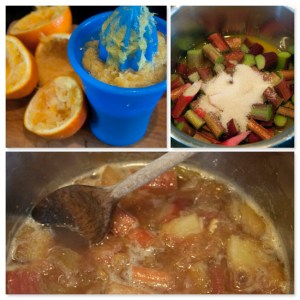
Chop your rhubarb into ~1″ chunks and put them in a saucepan. Add the juice of your oranges (I ended up using three because they were disappointingly un-juicy ones) and four tablespoons of sugar.

Stew the rhubarb until soft

Stew the rhubarb gently until soft, then strain it. You can eat the rhubarb after straining if you like – it’s very tasty with ice cream, and waste not want not! Pour the syrup into a clean bottle or jam jar and stick it in the fridge to chill until you’re ready to use it.

Strain the stewed rhubarb  Strained syrup  Store in a jam jar in the fridge

My favourite way of using this syrup is mixed with sparkling wine to make a rhubarb bellini – a ratio of syrup to fizz of about 1:4 seems perfect for me, and makes a fresh, cheerful cocktail with one of the unmistakable tastes of spring. It would make a lovely little aperitif, I think – how about making it this Easter?

Rhubarb Bellini

Through my student years I’ve taken little bottles of this nectar to a few parties, and experimented with some different (and, indeed, ‘different’!) variations. I can report it’s good with almost everything, but do beware, mixed with ice cold vodka, this is glorious, and far more quaffable than is really good for anyone!

River Cottage Year - cover**
The River Cottage Year, by Hugh Fearnley-Whittingstall
Hodder and Stoughton, 2003
ISBN 978-0-340-828212
Hardcover, 256 pages, full colour. RRP £18.99.

[Full disclosure: This is my book, which I bought. I have received no payment or sponsorship for this post, nor have I accepted a review copy. I do not have an amazon affiliate account and do not profit from any links provided.]

Full of highly seasonal recipes for garden produce and hedgerow ingredients, of course I was going to be drawn to this book. It’s a smaller book than many of the River Cottage tomes, but none the worse for it in my opinion.

River Cottage Year - page viewIf you grow your own, or shop at farmers markets, then this will give you some great inspiration for how to use your produce at it’s best and freshest, month by month. It’s not a vegetarian book, but with veggies the really obvious seasonal ingredients, there’s inevitably a fruit and veggies bias to the recipes, which, in a world where we’re now supposed to be eating seven-a-day, is probably no bad thing!

If you’re vegetarian, or cook for one regularly, I would definitely recommend you give this book a look. An honourable mention for fresh seafood dishes, too, which look stunning – unfortunately, living in the Midlands, these are of limited use to me at the moment. You never know, this may change..!

Really, what’s not to like?

‘Cooking the Books’ is my self-imposed blog challenge for 2014 – I’ll be trying to cook a new recipe from one of my (rather extensive!) collection of cookbooks once a week, write it up and review it. Wish me luck!

Read more from the Country Skills blog >>

Milk Loaf, from ‘How To Bake’ by Paul Hollywood – Cooking the Books, week 14

This bread, I have to tell you, is a revelation – a genuine flavour of my continental childhood. The first taste was one of those ‘madelaine’ moments, where time peels away and you’re no more than five or six years old again, standing in your childhood kitchen with a slice of bread and butter in your hand. Heaven.

Of course, milk bread may not have the same associations for you as it does for me. Still, I would suggest you give this bread a go, because, childhood memories or not, it’s marvellous.

For one large loaf, I used –

  • Milk loaf ingredients500g strong white bread flour
  • 30g unsalted butter (softened before use, if you keep it in the fridge)
  • 25g caster sugar
  • 320ml semi-skimmed milk
  • a 7g sachet of instant yeast
  • 1 tsp salt
  • Olive oil
  • Some extra milk for a milk wash before baking

In a large mixing bowl, rub the butter roughly through the flour until no large lumps remain. Then add the sugar, salt and yeast to the bowl, keeping the yeast and salt on opposite sides of the bowl. Add about two thirds of the milk, and mix gently using your fingers.

The recipe calls for the addition of warmed milk. To save on wastage, I warmed 250ml of milk to blood heat in the microwave, and used this for the initial addition. The rest of the milk, I added straight from the bottle. Add it a little at a time until you form a nice soft dough. My favourite way of judging this is to add the milk (or water, in a traditional bread recipe) until the dough is *just* getting a bit too wet, then add back a sprinkle of extra flour to compensate. That way, you know your dough is as well hydrated as it can be.

Before provingOil your work surface and knead the dough until it is soft, smooth, silky, and elastic. I love kneading bread, there’s something deeply therapeutic and – dare I say it? – sensual about it. Then return your dough to an oiled mixing bowl and cover loosely with cling film, and leave it to rise for a couple of hours.

Risen doughI find that this dough goes off like a rocket – it must be the sugar in the mix, the little yeasty beasties really set to and it rises like a balloon being inflated. Still, give it time (which develops flavour, too) and let it tripple or more in size.

For me, milk bread has to be in the form of a plaited loaf. It’s just traditional. This dough is remarkable, elastic stuff, something I learned to my cost the first time I made it. If you work it too much during knocking back, before trying to form your loaf, you will end up with tight springy little balls of dough that resist stubbornly any attempt to shape them into the long sausage-shapes you need to make your plait.

So, turn the risen dough out onto an oiled work surface, and divide it by eye into three even portions (they won’t end up even, but don’t worry about this too much!). Taking each one, knock it back gently and then immediately start folding the sides towards the centre to form your sausages. You may need to roll these a little, using your hands as if the dough is a rolling pin, to get the length you need.

Turn out your dough  Divide into three  Form into sausage shapes

Once you have your three pieces, join them together at one end, make a plait, and turn both ends under to make it tidy. Place your plaited loaf on a lined baking sheet, cover loosely again (I prefer oiled cling film), and set it aside to rise. Allow it to at least double, just be careful it doesn’t rise so fast it tries to escape from your baking sheet!

Place the plait on baking sheet  Cover loosely with oiled cling-film  And allow to rise!

Once it’s well risen, pre-heat your oven to 210 C. Brush the loaf gently all over with a little extra milk, and then slide it straight into the oven and bake it for 25 minutes until the crust is quite a dark brown colour and the loaf sounds hollow when tapped underneath. Cool on a wire rack (or on a cold oven shelf, which used to serve me perfectly well for cooling loaves and cakes before I bought a ‘proper’ one).

Brush with milk  Fresh from the oven!

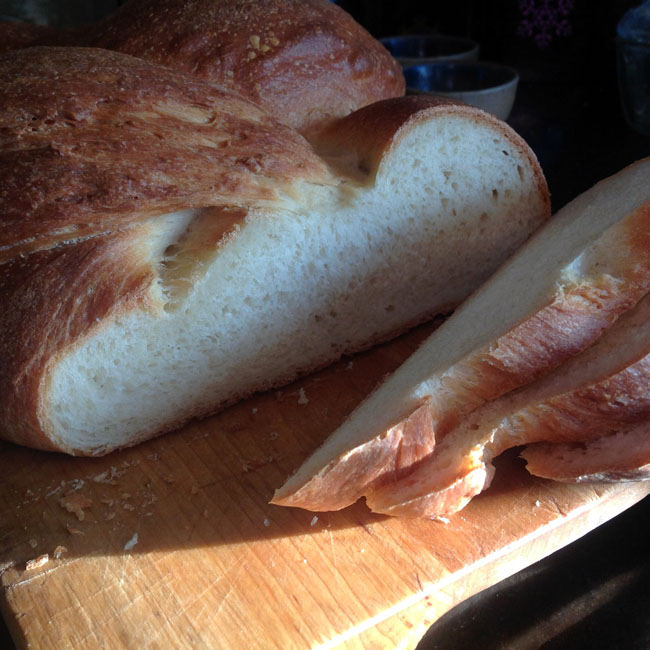
What can I say about this loaf that isn’t unbearably mawkish? Well, it’s pretty perfect. That dark, shiny crust conceals a wonderful soft even white crumb. It’s not sweet, despite the sugar addition, but has a rich smoothness from the milk. It’s wonderful on its own, with butter and jam, but also makes a quite marvellous soft bacon sandwich. I commend this loaf heartily to you.

Slice, and enjoy!


**
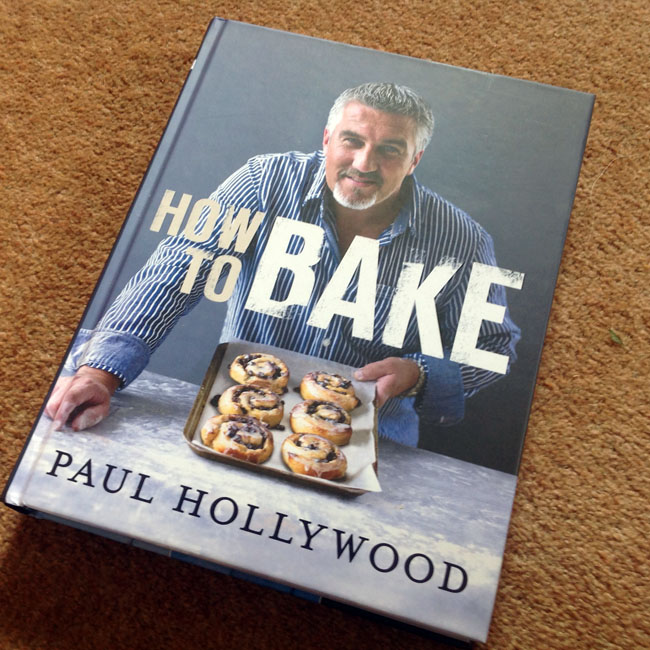
How to Bake - cover‘How To Bake’, by Paul Hollywood
Bloomsbury Publishing PLC, 2012
ISBN 978-1-4088-1949-4
Hardcover, 304 pages, full colour. RRP £20.

[Full disclosure: This is my book, which was a lovely recent birthday gift! I have received no payment or sponsorship for this post, nor have I accepted a review copy. I do not have an amazon affiliate account and do not profit from any links provided.]

I reviewed ‘Paul Hollywood’s Bread’ earlier in this series, and this book is it’s immediate predecessor, on the same imprint. As you’d expect, then, pretty much everything I said then also applies here – with lavish illustration throughout and good ‘step by step’ photography of the basic processes.

How to Bake - inner page viewThe scope of this book is a little wider than ‘Bread’, with chapters on basic and flavoured breads, an extensive section on sourdough baking, as well as good coverage of enriched doughs (croissants, pastries and brioche), and a decent selection of cakes, biscuits, puddings, pies and tarts, too. This additional breadth may or may not be a benefit, depending on your specific interests! This book lacks the accompanying ‘serving-suggestion’ recipe for each of the loaves that was a feature of ‘Bread’.

Overall I would definitely consider adding this book to your library if you’re at all interested in expanding your home baking repertoire. I can see myself experimenting with a lot more of these recipes in the future, and this milk loaf has jumped straight onto the ‘house standards’ list.

‘Cooking the Books’ is my self-imposed blog challenge for 2014 – I’ll be trying to cook a new recipe from one of my (rather extensive!) collection of cookbooks once a week, write it up and review it. Wish me luck!

Read more from the Country Skills blog >>

Banner320-260