Unknown's avatar

About Kate Watson

Brewster, cook, poultry-keeper, curer & smoker, in other words, jill of all trades and mistress of none!

Sinfully Simple Cider – yes, you really can brew this at home!

Home-brew has a bit of a mixed reputation, it’s fair to say!  This is my method for making great, simple, real cider (hard cider, for those of you West of the Atlantic!) with almost no investment in special equipment.  Sounds too good to be true? Follow these instructions, and in just a few weeks time you can be drinking great cider (at least as good as most commercial bottled ciders you can buy!) that you’ve made yourself, and all for only a few pence more than the cost of cheap retail apple juice.  I just wish I’d known how to do this when I was a student – it would have saved me a fortune and quite possibly made me rather popular, too!
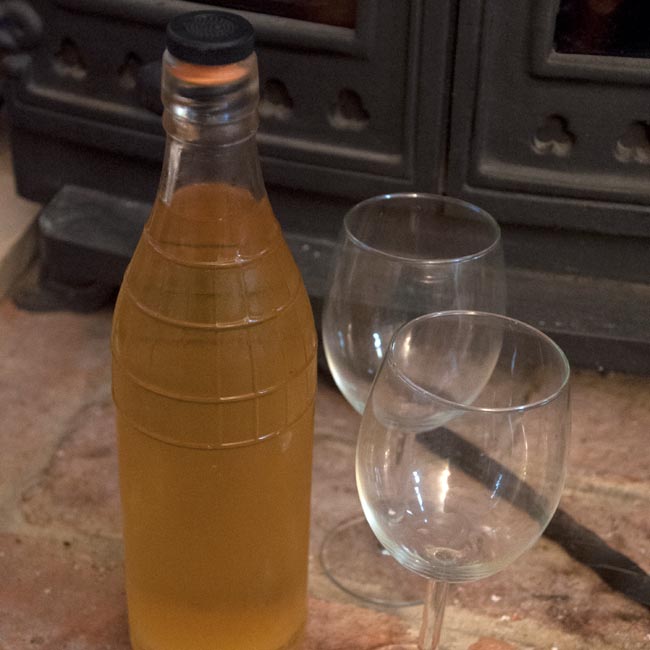
Chilled and ready to drink!

Last autumn, I made real ‘Real Cider’ from fresh apples.  I promised then I’d post quicker and simpler instructions for a short-cut brew.  Well, rather belatedly, here they are!

First a brief note on the law – I have no idea if home brewing is legal in your country or jurisdiction, or what restrictions might apply.  If you’re restricted (by age, local religious observance, or otherwise!) from buying, possessing or consuming alcohol, it’s very likely local law enforcement may take an interest in you brewing it yourself, so please take appropriate advice!  In the UK, I believe home brewing is legal for personal consumption, however sale and distilling are tightly restricted.  

The minimum set of ingredients and equipment you require are –
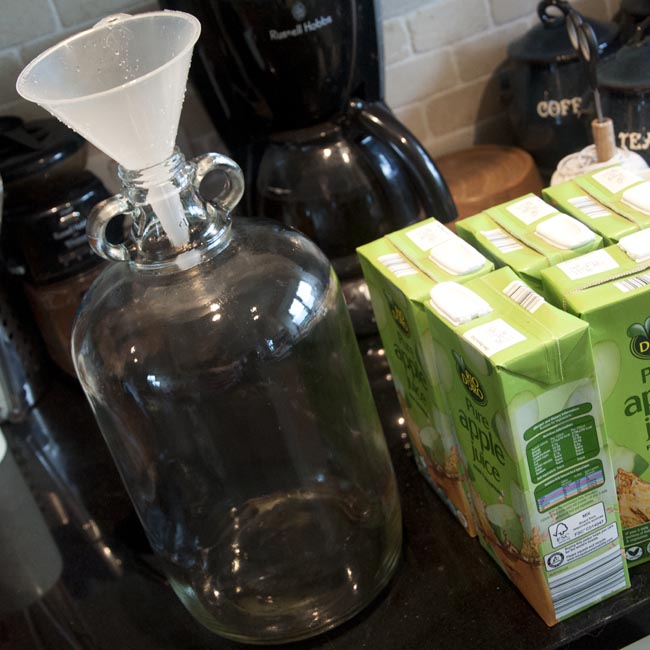
  • The necessary parts5 litres of ‘pure apple juice’ (the clear, cheap, from concentrate variety from your local discount supermarket is fine, but it should contain no additives or preservatives)
  • Half a mug of very strong tea (use two tea bags – plain ones unless you fancy an unusual experimental flavour sensation!)
  • Wine yeast (this is widely available online or from your local friendly home-brew shop, and is cheapest in small pots rather than individual sachets – you could use bakers yeast as an emergency substitute, but it’s prone to producing strange flavours!)
  • A glass demijohn, or an empty 5l mineral water bottle
  • Home-brew steriliser (you could use Milton fluid as an alternative)
In another couple of weeks, you’ll also need to have gathered together –

  • A length of syphon tubing (between 1m and 1.5m or 4ft to 6ft in length)
  • Bottles, sufficient to contain your cider.  These must be able to take pressure.  Empty plastic screw-top fizzy drinks bottles are great for a first effort, and free.  The plastic will be somewhat gas permeable, so the cider won’t keep terribly well in them, but I doubt you’ll be laying down your first brew long-term!  Beer or champagne bottles are fine, but require special capping tools and equipment.  Please note that SCREW TOP GLASS WINE BOTTLES ARE COMPLETELY UNSUITABLE and are very likely to result in dangerously explosive bottles.
  • A few teaspoons each of sugar, and of a non-fermentable sweetener such as ‘Splenda’.

You might also like to add the following, which are not essential but will make the process simpler or more reliable –

  • A drilled rubber bung (or grommet) & bubbler airlock, to fit your bottle or demijohn.  If you don’t have these, you’ll need enough cotton wool to firmly plug the neck of your fermenter. [How to set up and use a bubbler airlock]
  • Yeast nutrient (This contains all the trace elements and minerals required for healthy yeast growth.  Apple juice is already pretty good for these, however, so it shouldn’t be necessary.)
  • A kitchen funnel
  • Bottle brush
  • Hydrometer [How to use a hydrometer]
  • Racking cane and tap or bottler attachment for your syphon tubing.
  • Capping device and / or appropriate caps, gaskets, stoppers and closures, if you prefer to use recycled beer or champagne bottles.

If you’re lucky enough still to have a local home-brew shop, now is the time to go and make friends!  You’ll get tons of helpful advice and guidance, and while the item costs are likely to be higher than from web retailers, you save on postage which can be a big consideration with small purchases.  There are also lots of home-brew suppliers on the Internet, of course.  I tend to use http://www.the-home-brew-shop.co.uk/ for most of my home-brew purchases, Amazon and eBay are also full of useful retailers for odd bits and bobs.  Freecycle is the best source I can find for old-fashioned glass demijohns, and people are often giving away bottles, buckets, and other unwanted brewing items, it’s well worth posting a ‘wanted’ notice, these have served me very well for supplies in the past.

A quick totting up suggests you can get all you need for less than a tenner, and nearly everything except the apple juice is re-usable over and over (or at least, in the case of yeast and steriliser, for a good few batches!).

The process is really very straightforward, and divides neatly into four –

  1. Fermentation
  2. Bottling
  3. Secondary fermentation, and
  4. Drinking!

Banner320-260

Stage 1 – Fermentation

First, wash out your demijohn very carefully, and sterilise it following the instructions on your steriliser solution.  Second hand glass demijohns have often been abandonned in a slightly grubby state and will need a little TLC to get back into a usable state (a cranked bottle brush will be helpful if so).  Pay close attention to the instructions that come with your steriliser solution, particularly where it comes to strength, contact time, and rinsing, since lack of attention to sterilisation and rinsing are responsible for most home-brew failures.  While you’re at it, sterilise anything else you’re going to be using – including the bung, bubbler airlock, and a funnel if you think you’ll need it.  Don’t neglect cleanliness, it’s critical to the success of any home-brewing enterprise.  Sometimes I think home-brewing is really just washing up with benefits!
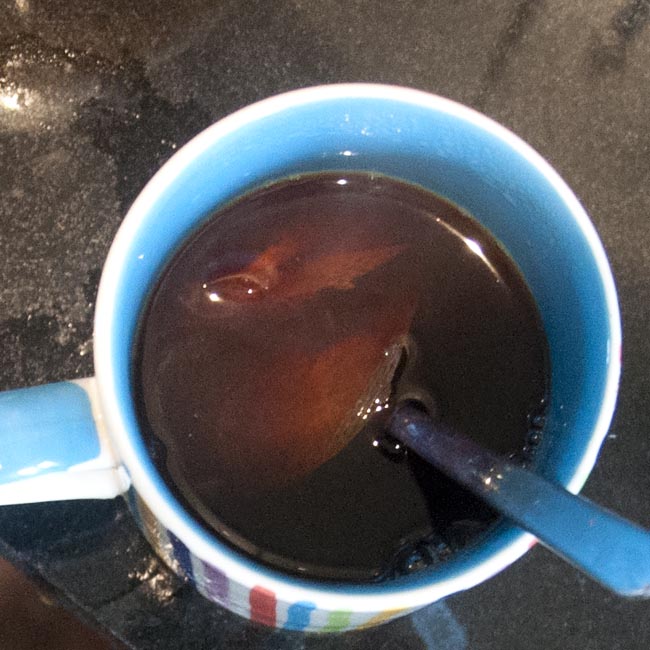
Now I just need my finite improbability generator!Pour four litres of the apple juice carefully into your demijohn.  There will be some bubbly froth on top, this is fine (the juice will be nicely oxygenated).   The demijohn will not be full – this is intentional!  Add your half mug of very strong luke-warm tea, which provides some tannin for the cider, as apple juice intended for drinking will generally be quite poor in tannin.
Apple juice in the demijohn

Add a teaspoon of yeast, and one of yeast nutrient if you have it to hand, and fit the bung and airlock or stopper the bottle with your cotton wool, tightly enough to stop bugs getting in.
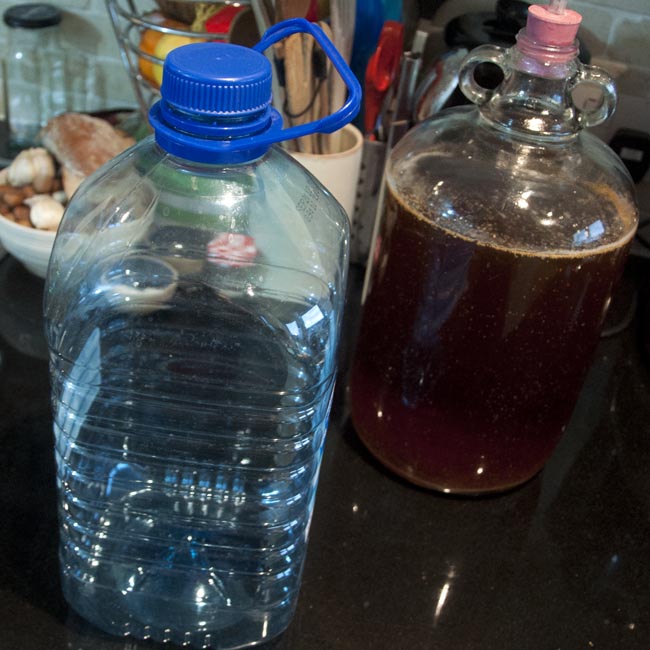
Can you see the family resemblance?Now put your demijohn somewhere safe at room temperature (18 – 21 degrees is ideal, warmer temperatures such you’d have in an airing cupboard will certainly speed the process up, but are likely to be too warm and can produce ‘off’ flavours) and wait for the magic.  If you’re lucky, this should start within as little as six hours or so, though this depends on how active your yeasty beasties are, and the prevailing temperature.  While you could put it in a dark cupboard, I think you’ll want to keep it out somewhere where you can see it!
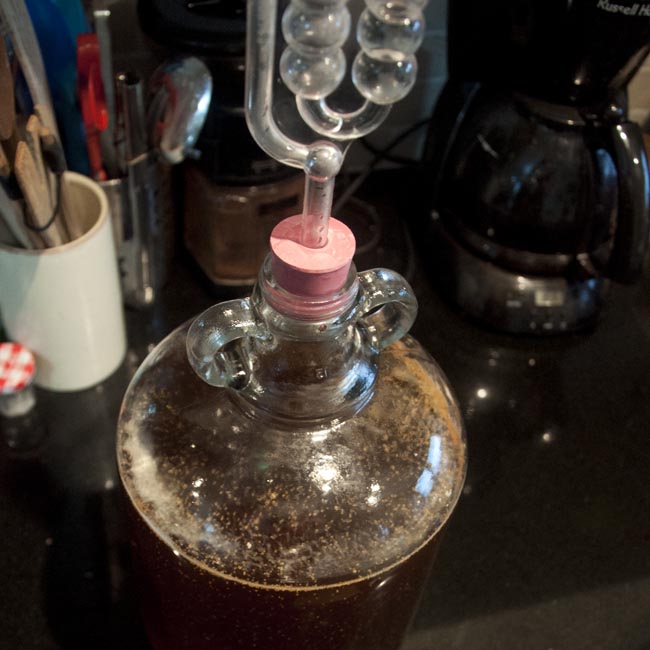
Yeast added and bung & airlock fittedThe first thing you’re likely to notice is the pellets of yeast starting to float around in the juice. Within 24 hours, there will probably be bubbles coming through the airlock.  You can see the meniscus of the airlock water is pushed around in the photo on the left.  If you’re anything like me, you’ll feel compelled to stand around and watch it go ‘glug’.  The apple juice will become more and more cloudy, ending up rather a murky muddy brown colour, and will form a thick layer of frothy foam on top, which may also include some visible yeasty ‘crud’ – this is why we’ve under-filled the demijohn for now, you don’t want the froth trying to force its way out of the airlock!
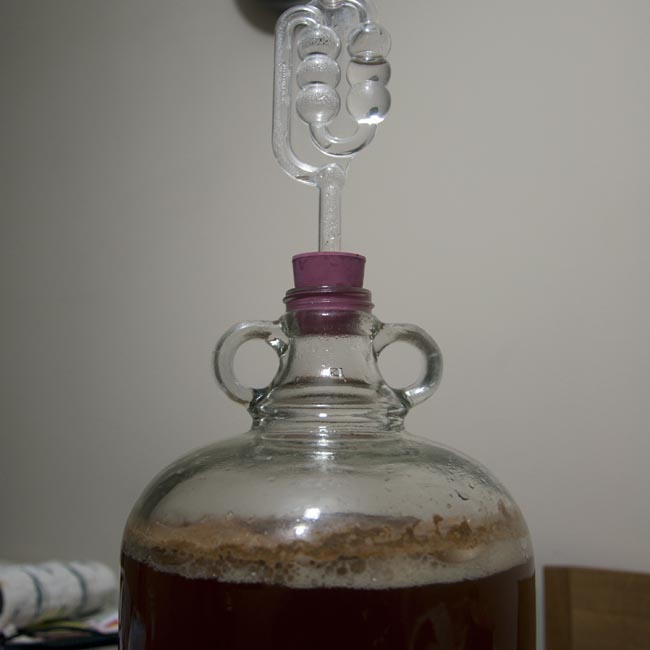
Froth and yeast crud on the surface of fermenting ciderIf you’re using an airlock, timing the bubbles as they escape is a great way of gauging how fast your cider is fermenting.  The rate of fermentation will speed up as the yeast population multiplies, and then will start to fall again as the sugars in the mix get used up.  At peak activity, you can expect a bubble every two seconds or possibly even slightly faster.  For me this usually happens about a week after fermentation starts, though it depends on temperature, the sugar content of your apple juice, and how viable your yeast was in the first place.  You will notice a layer of yeast forming on the bottom of the demijohn, too, which is quite normal.

If you’re not using an airlock then you’ll have to rely more on appearances to judge when peak fermentation has passed.  As things start to slow down a little, you’ll notice the frothy crud on the surface reducing and being replaced by a layer of much ‘cleaner’ looking bubbles, and the contents of the demijohn will appear to be ‘fizzing’.
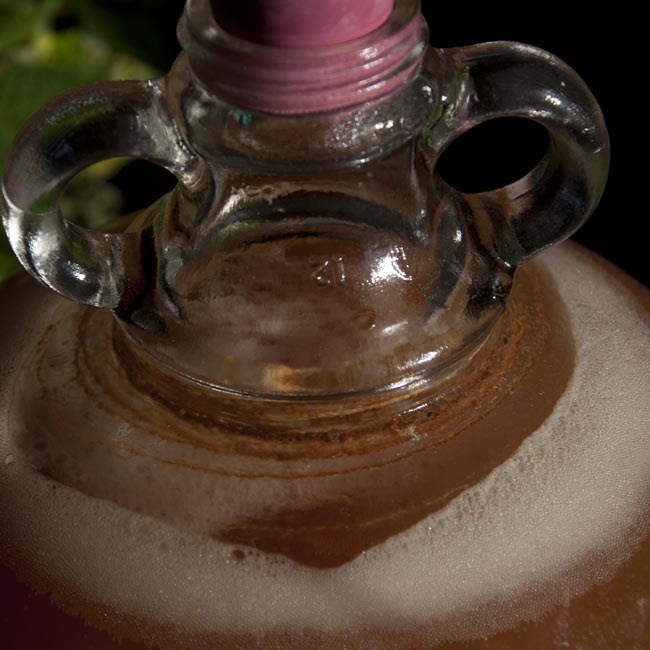
'Cleaner' bubbles on the surface, after topping-upOnce this has happened (and the rate of bubbles through your airlock has reduced to one every four or five seconds) carefully remove the stopper, without contaminating it, and top up with the rest of your apple juice, to half an inch or so below where the shoulder of the demijohn meets the neck, before re-stoppering.  You’re adding a nice dollop of extra sugar, so expect the fermentation to speed up again for a bit, but hopefully it shouldn’t foam the way it did to start with.

Apart from providing a useful gauge of fermentation rate, the airlock serves another important purpose – it allows the waste gas from fermentation out, so that the demijohn doesn’t pressurise (which would be extremely hazardous!), but prevents exchange with the oxygen in the atmosphere.  This keeps the cider bathed in carbon dioxide, which prevents oxidation of your cider – oxidation leads to spoilage, and even allows the accidental creation of cider vinegar if appropriate microorganisms are present.

Why, then, have I suggested you could go ahead without one?  Carbon dioxide, conveniently, is heavier than air, so while the cider is actively fermenting, it will form a protective blanket over the cider and should prevent oxidation.  The key detail here is ‘actively fermenting’.  With an airlock fitted, there’s no rush to do anything once fermentation finishes, as the blanket of carbon dioxide is retained in the demijohn.  This gives the option of a longer period ‘resting’ in the demijohn, either for convenience or maturation, once fermentation is finished.   The cotton wool plug will keep bugs out (at least it will if it’s fitted properly!), but won’t stop the progressive exchange of gasses from the atmosphere once there’s no active CO2 production forcing the air out, so accurate identification of the end of fermentation and rapid bottling at this stage is particularly important.
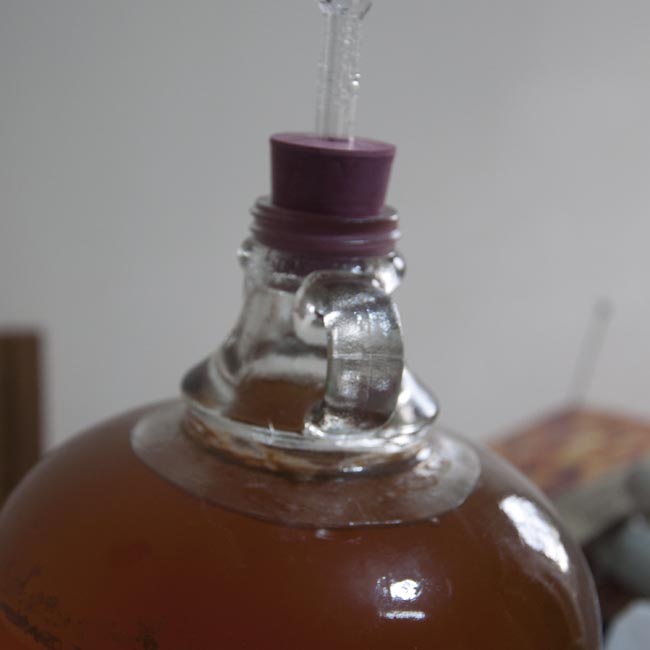
Fermented outNow you just need to wait for it to finish fermenting.  The rate of bubbles (and fizzing in the cider) should slow down progressively, and eventually stop.  When it does, there should be no visible bubbles rising in the demijohn, no layer of bubbles on the surface, and no activity in the airlock.  The cider will start to ‘drop clear’, that’s to say the yeast in suspension will settle to the bottom and the liquid will be clear again – and look surprisingly like it did in the very beginning. From topping up to dropping clear, in a 4.5 to 5 litre volume, tends to take about a fortnight to three weeks. Be patient here and don’t rush it, but also don’t leave things too long if you’re using a cotton wool plug (if you’re ‘under lock’, you can ignore it for as long as you like – I’ve left cider at this stage for several months before bottling with no ill-effect).  If the end of fermentation coincides with a particularly chilly day, maybe give it a day or two to see if it re-starts when things warm up a little again.

The only cast-iron way of knowing whether your cider has finished fermenting fully (or is ‘fermented out’ in the jargon of brewing, that’s to say, fermented until there are no fermentable sugars left) is with a hydrometer.  In any case hydrometers are really cool-looking, delicate pieces of laboratory glassware and it’s almost worth buying one just because they’re so neat!  Rarely, fermentation can stop before this point, a situation known as a ‘stuck fermentation’ leaving sugars behind that could let fermentation re-start in an unpredictable way in the bottle.  The risk here is that you could accidentally create ‘bottle bombs’ which pressurise excessively during storage and risk exploding (please don’t dismiss the potential hazard of flying shards of glass shrapnel!).  For this same reason, do not under any circumstances be tempted to bottle early in an attempt to achieve a sweeter cider – the only safe approach is to ferment out to get a completely dry cider, and then correct this ‘issue’ (if, that is, a bone-dry cider isn’t to your taste!) later on in the process.

Your finishing gravity, if using a hydrometer, should be near enough 1.000, and be stable for at least 24 hours.  It goes without saying that the hydrometer and jar, like everything you allow into contact with your cider, must be carefully sterilised and rinsed before every use!  For extra brewing-geek credit, if you also take the starting gravity of the apple juice before you start fermenting it, you can work out the alcohol content of your final brew.  There are calculators on various websites to help you with the maths!  To be quite honest, I tend not to bother with the  hydrometer when I’m making this cider – so it’s a bit of ‘do as I say and not as I do’!

When you’re confident your cider has fermented out fully, and it’s dropped clear in the demijohn, it’s time to bottle.

Stage 2 – Bottling

Sterilise all your bottles and caps following the directions with your steriliser, and rinse very carefully.  Also sterilise and rinse your syphon tube and any associated nick-nacks (racking cane, tap / bottling stick etc).  Place your demijohn on the table or kitchen work top, and your bottles on the floor below them.

Into each of the bottles, you want to have added a small amount of sugar, this is to allow secondary fermentation in the bottle – but just a small controlled amount.  This process is known as ‘priming’.  This will produce a little carbon dioxide – in a pressurised container this time – and make your cider sparkling, which is how most people like it!  You can also add some non-fermentable sweetener if you want your cider slightly sweeter.  I favour ‘Splenda’, which seems to lack the bitter back-taste you get with some artificial sweeteners.   If you’re going to use something else check carefully that it really *is* non-ferementable.

I add one teaspoon of sugar per litre of cider (half a teaspoon in a pint bottle, about 3/4rs of a teaspoon in a 750ml).  These should be safe quantities and shouldn’t create any bottle bombs, while providing a nice sparkle.  Do not be tempted to exceed them!  I enjoy quite a dry cider, so I add a matching amount of Splenda – you can adjust this to your taste, though, so experiment.  Put the sugar and sweetener, if using, into your bottles before you start to syphon, since adding it afterwards tends to make everything fizz over (it’s somewhat reminiscent of the Mentos-in-cola trick, but a bit less dramatic!).  If you’d rather avoid artificial sweeteners but don’t enjoy a dry cider, you can top up your cider with a splash of apple juice in the glass at serving time.
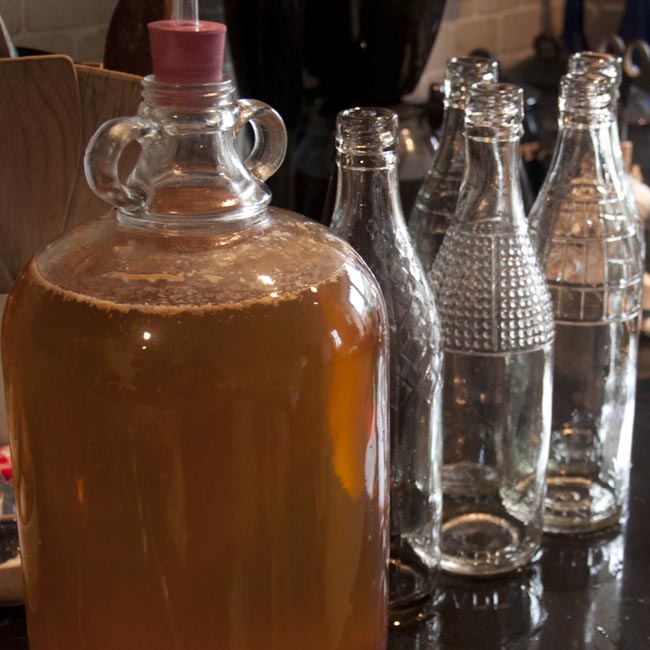
Ready for bottlingIf you can secure the use of a glamorous assistant, they will come in very handy for bottling, since you can leave them in control of the top bit of the syphon tube.  [How to syphon your home-brew.]  If you have a racking cane, siphoning can be a one-handed job, as the ‘u-bend’ attachment should stop the yeast sediment being drawn into the syphon.  Without one you’ll need some way of keeping the tube out of the bottom of the demijohn.  In the absence of an assistant, you can rig something up with string and tie the syphon tube to the neck of the demijohn at an appropriate depth.  A spare pair of hands is more reliable, though!
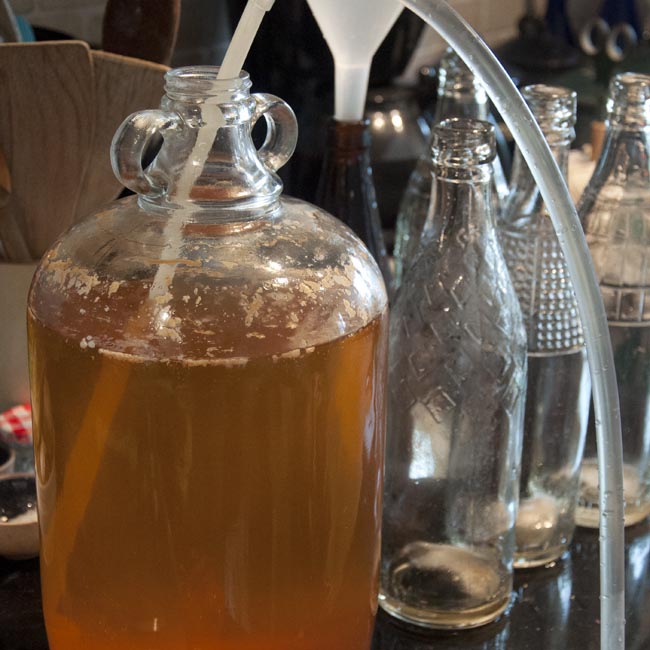
Racking cane in the demijohnYou may well be wondering why the faff with a syphon tube when you could just pour the cider into the bottles with a funnel.  There are two reasons, really – the first is to reduce the amount of yeast sediment disturbed, which in turn will reduce the amount of sediment in your bottles, and in your finished drink.  The second is our old friend oxidation – correctly performed, siphoning minimises the contact between the air and your precious cider.
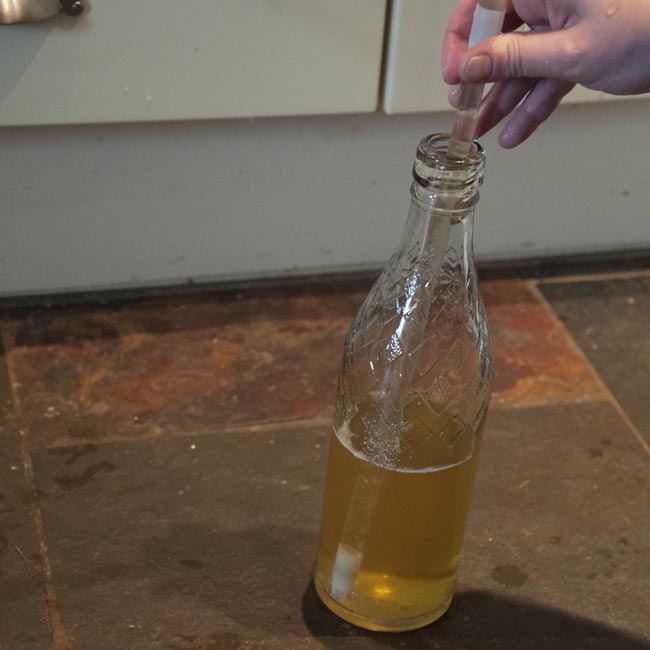
Filling bottles using a bottling stickSo, carefully syphon your cider into your bottles, leaving about a 1″ space at the top.  A ‘bottling stick’ or a tap in your syphon tube makes controlling the flow a lot easier.  You want to fill the bottles with the end of your syphon tube right at the bottom of your bottle, so that it stays under the fluid level and minimises exposure of the cider to the air.  There’s a bit of a knack to syphon-filling bottles, but you’ll get there eventually.  Do put newspaper or something absorbent down on the floor if it’s not easy to clean!  Try to avoid drawing yeast sediment or crud into your bottles from the demijohn as much as you can, but don’t worry too much about it, it’s not a disaster!  Any extra cider that isn’t a full bottle’s worth?  Drink it – it’s your first taste of your brew, and while it’s not ‘finished’ yet, it’s definitely cider, in a flat, old-fashionned-scrumpy kind of way!
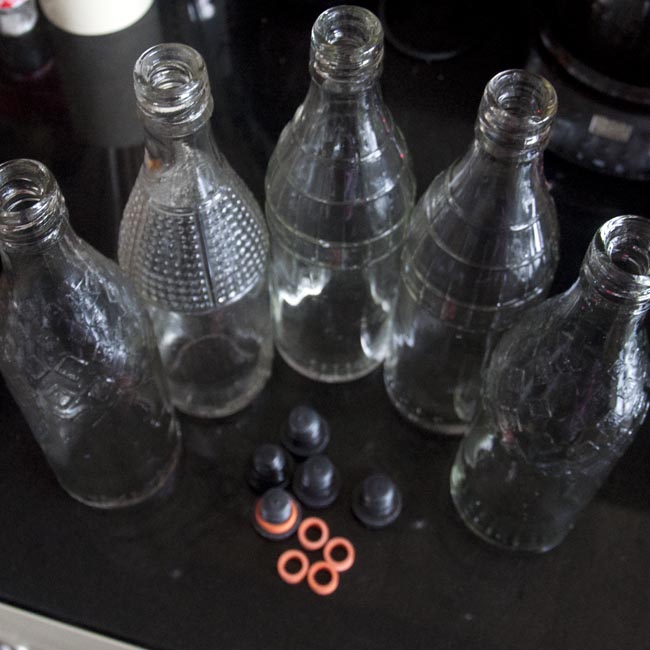
Sanitised bottlesAbout my bottles, incidentally – they’re old lucozade-type inner-threaded fizzy drink bottles with rubber-gasket stoppers, which I was given by a lovely chap on Freecycle.  They’re more or less the perfect home-brew bottles as they’ll take some pressure but don’t require capping equipment, and aren’t gas-porous like plastic, so if you’re offered any, snap them up, even if they need a bit of TLC, new stoppers and gaskets remain available from home-brew suppliers.  Obviously, discard any chipped or cracked bottles, since these are at high risk of explosion!

Stage 3 – Secondary fermentation
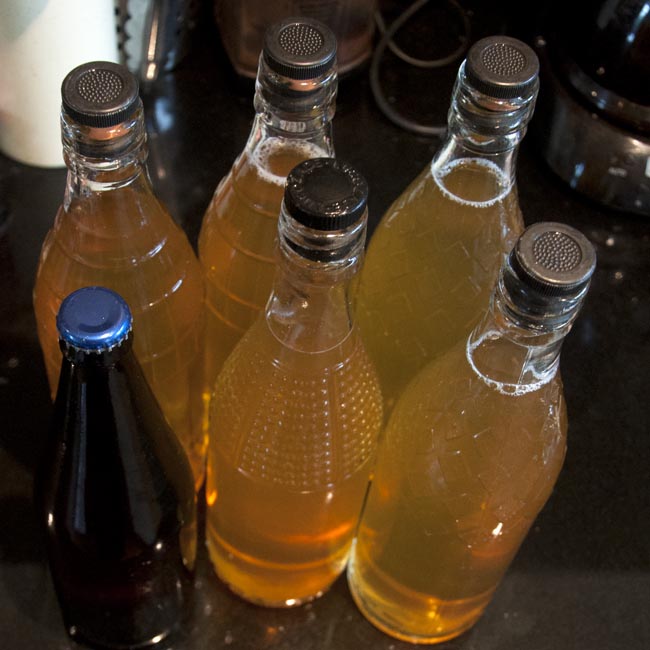
Filled bottles ready for conditioningNow seal your bottles tightly, up-end them a few times to dissolve the sugars, and then stash them somewhere, upright, for a couple of weeks for the secondary fermentation to complete.  If they’re clear bottles, you can monitor this – the contents will go slightly cloudy, before clearing again, ‘throwing’ a thin layer of yeast on the bottom of the bottle. Once they’re clear, they’re ready to drink (though they will keep for at least a year – I bet you won’t wait that long though!).

Stage 4 – Drinking!

Chill in the fridge door (keeping the bottle upright will minimise disturbance of the yeast sediment) and then open on a suitable occasion to share with good friends – let’s face it, they’ll *have* to be good friends to be willing to be guinea-pigs for sampling your first home-brew experiment!  The bottle should open with a gentle ‘pssssst!’.  Pour your cider gently, but all in one go, leaving as much of the sediment behind as you can.  Don’t worry if you get some yeast in the glass, though, it looks quite traditional and won’t spoil the flavour – and contains lots of lovely B vitamins!

Share and enjoy!

Sit back and enjoy – your care and patience has hopefully been richly rewarded with a perfect crisp cold glass of home-brewed cider.  Get going now, and you’ll be all set when summer finally arrives!

Read more from the Country Skills blog >>

Banner320-260

Sourdough Saga: Episode 6 – awesome home-made sourdough pizza

I’d heard good things about sourdough pizza bases.  Let me say, I was certainly not disappointed!  The Rowdy Chowgirl’s post on the subject was part of what inspired me to get my own sourdough project underway in the first place, and I followed her lead and went to The Traveller’s Lunchbox ‘The Pizza Project’ for inspiration and guidance.

Sourdough pizza - done!

It all starts with an overnight sponge, as usual.  I made a full two-loaf batch of dough.  I reduced the salt again, now down to 8g in the full batch (so just shy of half what I started out with for my first loaf), and had to use about 100g of wholemeal flour due to running out of white, but otherwise made up my usual dough, dividing it into two uneven halves straight after the balance of the flour and salt were incorporated.  To the smaller half, destined for the pizza crusts, I added a teaspoon of sugar.  I then treated the two balls of dough just the same – stretching and kneeding them every couple of hours between periods of resting –  until I added cheese and sundried tomatoes to the larger half and set it on it’s way to being another gorgeous loaf.

Shaped dough, resting.The pizza dough was divided into two balls for its final proving.  The dough remained very soft and just-handlable, which seemed ideal.  After proving (and after the loaf of cheese and tomato bread had already made its passage through the oven), I gently rolled the dough and then shaped it out by hand into two rough rectangles (I have a rectangular baking tray, and am not averse to funny-shaped pizza!) on baking parchment sheets.  This is a great idea – for which I can’t take the credit! – as the dough is soft and thin and would be nigh-on impossible to handle, I think, even with a peel.  You’ll want quite a lot of flour on the underside of your dough to stop it sticking to the parchment while you’re shaping it.

The tomato sauce for the pizzas is simplicity itself – one finely chopped onion, sweated down with some minced garlic in olive oil until soft, then add a tin of plum tomatoes, a good shake of mixed italian herbs, big pinch of pepper and a sprinkle of dried chilli flakes, a small spoon of vegetable bouillon powder (you could substitute half a stock cube) and a glug of balsamic vinegar.  Squish with a potato masher to get the required consistency, and bubble on the hob for about half an hour before allowing it to cool.  You could blend it, if you prefer a completely smooth sauce, but I like mine with a bit of texture.  Give it a taste, since you might find you want to add a small amount of sugar, depending on how sweet your tomatoes were to start with.

Pizza toppings, ready to go.Be sparing with your toppings – don’t overload the pizza and don’t over-complicate things, you want the great simple flavours to shine through.  I used some finely sliced cherry tomatoes, small pieces of my dry-cured maple bacon, a sliced mozarella ball and some crumbled goat’s cheese. Smear the sauce lightly over both pizza bases and then arrange your toppings over the top.  The quantity was about perfect for two largeish rectangular pizzas.  You’re not trying to plaster the pizza in cheese, since this will stop the moisture escaping from the dough and tomato sauce and turn what should be a glorious crispy crust into a disappointing soggy one.

Pizza, all ready to go into the ovenThe key to baking this pizza is a very very hot oven.  I pre-heated my little non-fan top oven to its highest temperature – allegedly 270 centigrade (I’ve not checked this with an oven thermometer, but it’s certainly reasonably blistering!) with the baking sheet inside.  The thicker and heavier your metal baking sheet, the better.  Getting the pizzas from kitchen counter to oven safely and quickly is really a two-man job, so get your glamorous assistant – wearing the best oven gloves you have at your disposal – to snatch the baking sheet out of the oven, closing the door behind them.

Before they burn their fingers through the gloves, use the baking parchment to slide your pizza off the side and onto the baking sheet.  Return it to the oven as quickly as possible, and watch the magic happen.  Seriously, I was sat cross-legged on the kitchen floor staring into the oven for this bit!  The edges of the pizza will start to rise and brown, and all the while the cheese first melts and then starts to go bubbly and golden.  To encourage it along a little, I put the grill on, too.

The pizza cooked in less than five minutes.  I didn’t remove the baking parchment half way through baking like others have suggested.  The paper did start to scorch a little but didn’t burst into flames.  It did come out of the oven slightly stuck to the underside of the pizza, tearing as I tried to remove it – not a disaster and easy enough to peel off – but I’d used quite lightweight baking parchment and I suspect better quality paper would solve this particular minor difficulty!

This is great pizza, and you should definitely make some.  The sourdough certainly adds a distinctive quality, producing a wonderful crispy crust with holes in, but also a pleasing ‘solidity’ which avoid straying into stodginess.  It’s nothing short of *amazing* fresh from the oven (we ate it standing up in the kitchen!) and is very nearly as good cold for lunch the next day.  The partly wholemeal flour in the dough adds a nice extra texture to the pizza, too.  There’s remarkably little ‘naughty’ here, either – certainly compared to commercial pizza offerings.  Something made out of such great, simple ingredients can’t possibly be bad for you!

So, home-made sourdough pizza crust – Just Do It!  I promise you will not be disappointed!

Read all the posts in the Sourdough Saga >>

Read more from the Country Skills blog >>

Sourdough Saga: Episode 5 – how to look after your starter

Imagine, if you will, someone arriving at your house for a party, and bringing with them as a gift a rather odd looking jar with a label on it which says ‘Feeeeeed meee!’… Congratulations on being the new owner of a bouncing baby sourdough starter.  It’s rather a rude hostess present, I suppose, a bit like giving someone a puppy without asking them first (ok, maybe not *quite* that bad!).  But now you have this living thing someone’s entrusted you with, and you’re stuck having to look after it.

What sort of person would do such a thing, you might ask? Guess what I took to my little sister and her husband yesterday…

Feeeeed mee!

Isn’t it pretty?  I had to promise her a full set of care instructions, so here they are!

I keep my starter in the fridge between uses.  So far I’ve been feeding & baking once a week, so I haven’t tried to extend the gap between feedings more than this, though I believe it may be possible to go two or three weeks.  My starter is a wholemeal starter, but you could convert it to white flour, progressively, if you prefer.

Assuming you’re planning to bake on a Sunday, this would be my schedule –

  • On Friday morning, take your starter out of the fridge, stir in a couple of teaspoons of wholemeal flour, and leave it on the countertop (I like to think the beasties would appreciate a small breakfast snack as they come up to an active temperature).
  • Friday evening, once you’re home from work, it’s time to feed your starter.  In a bowl on your kitchen scales, weigh out equal weights of wholemeal flour and warm water (about blood heat) and combine to form a loose paste.  The starter has been started and fed on cheap bottled water so far, filtered water would be absolutely fine, if you have it, and converting my starters to tap water has also been successful (but might be a bit of a gamble if your water is particularly high in chlorine / chloramine).  I use locally stoneground wholemeal flour – avoid anything bleached or treated.
  • The total weight of the feed should be about equal to the starter that’s in your jar.  I’ve written the weight of the empty jar on the lid for you to simplify working this out!
  • Combine the feed with the starter (you could do this in the jar but I prefer to tip it all out into the bowl to give it a really good energetic mix) and put it back in the jar.  Leave the jar on the countertop for the next 24 hours.
  • Watch in wonder as the whole thing fills with bubbles and doubles in size over about the first 12 – 18 hours, before it settles back down a little.
  • On Saturday evening, take a good ladle-full or two of your starter (about half the total volume) and use it to start your overnight sponge.  Return the rest of the starter to its spot in the fridge.
  • On Sunday morning, let the baking begin!

If you’re not baking this week, do all of this but then discard the ladle-full of active fed starter (or better still, use it to start a new jar of starter to give to a friend?).

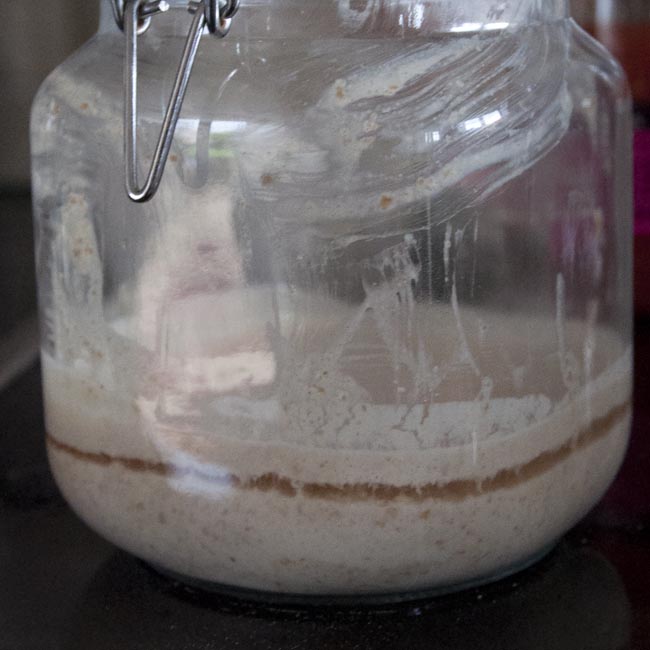
When you get your starter out of the fridge next week, you may find a layer of greyish liquid has formed on top, and the smell isn’t quite what you expect.  This doesn’t seem to be a problem, I’ve just been pouring the liquid off the top before going ahead and feeding the starter in the normal way.  I imagine this would be more marked if you went longer between feedings.

I hope you sourdough starter gives you as much baking pleasure as I’ve already had from mine!

Read all the posts in the Sourdough Saga >>

Read more from the Country Skills blog >>

Sourdough Saga: Episode 4 – cheese and sun dried tomato bread

After the gratifying – if unexpected! – success of my first sourdough loaf, I couldn’t wait to do it all again as soon as possible.  The first loaf didn’t last very long, either, and certainly didn’t get a chance to go stale!  So the next free day I had was dedicated to another baking day.  I used broadly the same technique as for my first loaf (see ‘Sourdough Saga: Episode 3‘ for details) but with double quantities, and a downward adjustment to the salt content (10g in total in a two loaf batch).

Second sourdough bake

There were a couple of new things – first, the loaf shape.  I wanted longer, narrower loaves, instead of the round I baked the first time.  I’d love a full set of lovely baker’s bannetons, but they’re expensive and I’ve got nowhere to store them, so I improvised with a couple of long thin serving dishes I was given for Christmas last year by a friend, lined once again with a clean tea towel dusted generously with rye flour.

Dish used for provingIt’s not quite the right shape, as you can see, and tilts up at the tips rather, but it allowed the final proving to produce a loaf of approximately the size and shape I was after.  The ridge on the inside of the dish does leave an imprint on the loaf, but it’s all character!

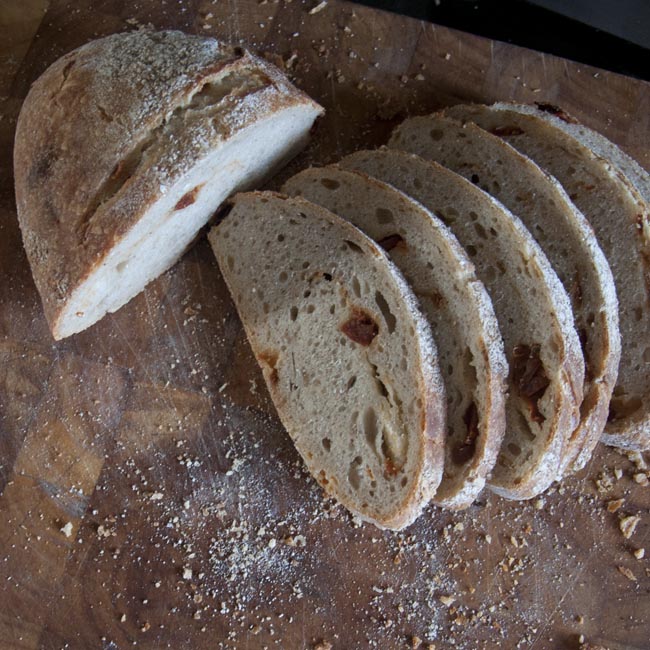
I had a generous handful of grated cheddar cheese and some sun-dried tomatoes left over from the previous day, so decided to make one of my loaves a cheese and tomato bread.  I incorporated the extra ingredients during the final kneading, sprinkled across the surface when it was flattened out, and then folded into the dough during the shaping of the loaf.

Sliced cheese and tomato sourdough loaf

I think the cheese and tomato make a great addition to this sourdough. Something about the cheese flavour mutes the lactic sour note quite noticeably, making this a sourdough loaf that might go down better with people who aren’t that keen on the distinctive ‘sourdough’ flavour. The chopped sun dried tomatoes add a lovely sweet herby note (they were stored in herb oil).

Texture-wise this loaf seemed to prove slightly less well than it’s unmodified brother, with a slightly denser texture and smaller holes.  I’m not sure if this is the result of the extra oil / fats incorporated with the additions, or whether it has more to do with the difficulty I had keeping my oven up to temperature when baking two loaves together.  On the salt question – I don’t notice a difference from the further reduction, and it’s likely I’ll reduce the salt again next time I bake a loaf.  All in all, this is a great loaf and one I’ll definitely make again in the future!

Read all the posts in the Sourdough Saga >>

Read more from the Country Skills blog >>

Cooking with James Martin – a little taste of the treats on offer!

Our day at Food at 52  with James Martin was in two halves.  Our participation was called for in the morning as we were pressed into service as a rag-tag team of commis chefs in the preparation of the first three dishes – which made up our menu for lunch.  James guided and instructed and was only occasionally scathing of our efforts!

In the afternoon, already replete with amazing food, and enjoying a nice drop (or two!) of Sauvignon Blanc, we got to sit back and relax as James prepared a further six dishes while we watched, asked questions, and then struggled despite our already full bellies to taste all his wonderful creations.

Here’s a quick whizz through the wonderful dishes we tasted – hopefully I’ll be able to post some recipes in due course!

Lunch Menu

Thai crab risottoThai crab risotto – This was the first dish we tasted and was definitely one of the stand-out recipes of the day for me.  It has amazing complex & multi-layered flavours in exquisite balance, and despite how much is ‘going on’ in this dish somehow manages to taste crisp and clean and not at all muddled.  James described this as his ‘signature dish’ and I can completely see why – it knocks every risotto I’ve ever tasted into a cocked hat!

Smoked haddock rarebitSmoked haddock rarebit with confit tomatoes – An unusual twist on a Welsh rarebit, with the cheese-based layer built on top of a lovely naturally smoked haddock fillet.  Served with a confit tomato salad (which will definitely be making it into my culinary repertoire) it’s a lovely dish for an English summer’s day, balancing the clean crisp flavours of the tomatoes with the comforting warmth of smoked fish and grilled cheese.

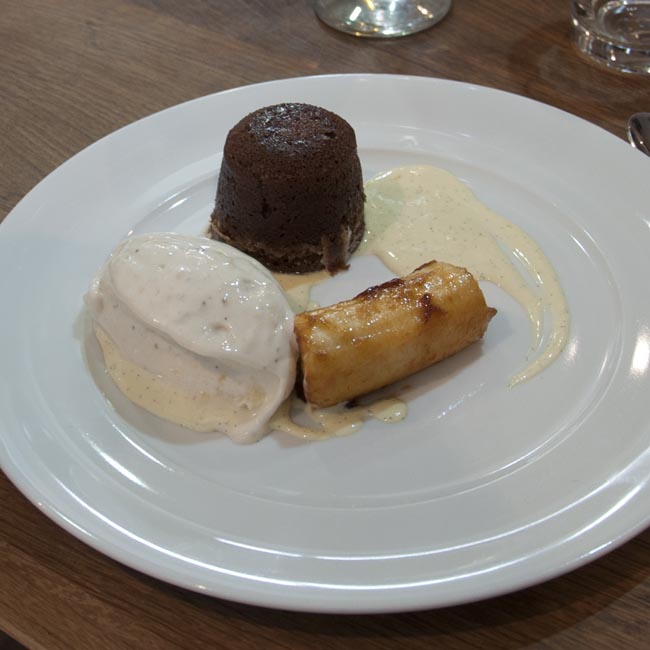
Hot chocolate mousseWarm chocolate mouse with banana ice cream & custard – The freshly made ‘last minute’ banana ice cream is actually the star of this dish for me.  It’s packed with really distinct flavours and heaps of texture.  Perhaps it’s because I’m not that much of a chocoholic – the chocolate pudding is tasty, and gooey in the middle, but very similar to things I’ve had before.  The custard involved a lot of hard work, and is clearly something I should master, but I’m not that much of a custard fan and I’m not convinced it adds that much when you already have the gorgeous banana ice cream.

Demonstration Dishes

Pea and watercress soupPea and watercress soup served with a deep-fried egg – This soup is an amazing colour (no Photoshop trickery here!) and has a lovely fresh pea flavour.  I’ll certainly be playing with this soup recipe at home, though I have to admit to being a bit mystified by the soft boiled egg crumbed and deep-fried and served in the centre in a style – I’m afraid – a bit reminiscent of the famous Australian ‘meat pie floater’! It’s a dramatic ‘cheffy’ touch to finish the dish but I’m not entirely convinced it adds anything that a poached egg wouldn’t in terms of flavour (in fact I suspect I’d prefer the latter) and the crispy texture it imparts is duplicated in the streaky bacon garnish.  Think ham and egg with peas, but all taken apart and put back together again!

Pea and watercress soupLamb with chilli pickle – This is a great little dish, James described it as ‘bar food’ and it would be ideal for nibbles with drinks, but also makes a lovely light lunch or supper dish if you’re looking to impress someone!  Great fresh flavours with a lovely crisp tang from the freshly prepared pickled vegetables, and the lovely tender pink lamb loin is the perfect counterpoint.

Cod cheeks with tartar sauceVodka-and-tonic battered cod cheeks with tartare sauce – The batter was an unusual concoction, with the cocktail-cupboard ingredients and made ‘live’ with yeast, quite unlike anything I’ve ever seen before.  It fries up lovely and crisp and keeps the cod cheeks gorgeous and moist.  The freshly made tartare sauce is the first such I’ve ever actually liked!  I don’t batter and deep-fry much, but it looks like a  great party-piece!  I can imagine diving into a big bowl of this with a load of friends around a table, perhaps with some slightly spiced potato wedges.

Seared tuna with 'Japanese slaw'Seared tuna in spiced apricot marinade with ‘Japanese slaw’ – A beautiful dish to look at on the plate with some lovely flavours – there’s an almost North African vibe with the fruit & spice flavours.  By this stage in the tasting I was really struggling to eat another bite, but was very glad I did.  We don’t often cook fresh tuna at home but I will certainly adapt this marinade next time we do, as it just lifts that slightly bland character it can have while letting the flavour still shine through.

And now for some desert!  We now felt so full we could pop…

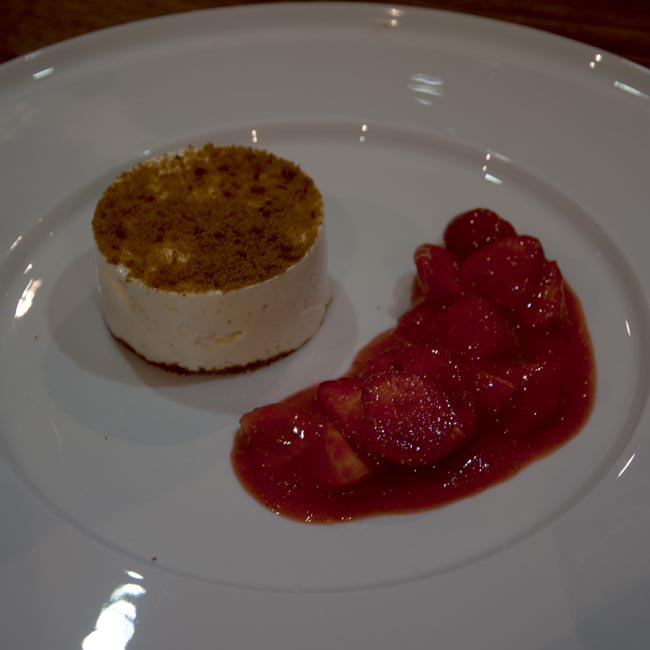
Strawberry cheesecakeStrawberry vanilla cheesecake – James introduced us to this dish, which is one that he developed for Thomas Cook‘s refreshed airline menu.  This is a wonderful quick simple & impressive little desert which you can imagine being able to adapt almost infinitely with different fruits in season and flavours in the cheesecake mix & biscuit crumb.  I particularly liked that this wasn’t an over-sweet dish, letting the flavours of the fresh English strawberries and the slightly acid-note from the cheese shine through.  It isn’t at all cloying and has an almost palate-cleansing quality, nice and fresh – just the thing when you’d eaten quite as much as we had!  All in all a great little dish and definitely another one for the repertoire!

Cheat's GateauxLast, but quite definitely not least, James’ rather marvellously named Bullshit (or “Cheat’s”, for polite company!) Gateaux seems quite the work of patissier’s art.  Just look at it!  In fact it’s startlingly simple – well, for the most part! There’s a story behind this cake – and the name – which I hope to share with you soon..!

For the time being here’s a little snapshot of the man himself doing some of his famous sugar-craft!

Sugar spinning

I hope this has really whetted your appetite for more details of these dishes – writing about them and going through the photos has certainly made me hungry!  I can safely say it’s the most amazing day’s foodie indulgence I’ve enjoyed in a very long time.  I can’t wait to experiment some more with the recipes and let you know how I got on!

Read more from the Country Skills blog >>

Cooking with James Martin – some initial thoughts & photos!

The big day was today – I’m finally back home from London (seriously, Londoners, how do you survive the Tube these days?!) exhausted but seriously excited about today’s cullinary adventure!  The competition winners met up with famous chef James Martin at the ‘Food at 52‘ cookery school in Clerkenwell, and he spent the day sharing with us some of the tricks of his trade and feeding us until we nearly popped (while he himself seemed to survive on a diet of Diet Coke and Red Bull!).  The whole event was thanks to Thomas Cook, with whom we heard James had been collaborating on aeroplane catering.

James Martin

There are recipes and tips to share with you, and we’ll get to those in due course (probably once I’ve re-cooked at least some of the recipes to iron out quantities etc!) but I just wanted to share a few initial ‘teaser’ photos featuring some of the marvellous ingredients we got to ‘play’ with today.

Brown crab  Ingredients  More ingredients

It’s also been a great opportunity to meet other keen cooks and bloggers, and I hope some fun things will come of that in the future, too!

Look forward to more blogging on the subject once I’ve had a good night’s sleep (perhaps several!) and caught up on myself a little!

Read more from the Country Skills blog >>

Exciting news – and a bit of a tease!

A little while ago, I entered a recipe competition with a variation on my jerk marinade, thinking ‘here goes nothing!’.  Last weekend, I received an email – I nearly deleted the winning notification – I mean, what else do you do with emails which start ‘CONGRATULATIONS!’ and go on to tell you you’ve won something??

1st Prize!

I was a bit gobsmacked, truth be told.  I’m the sort of person who never wins anything – not even a colouring competition when I was a kid!  In fact, the only thing I’ve ever won was a Blue Peter Badge (those of you outside the UK will have to look that one up!).

So, one day next week, I get to travel to a secret London location and spend the day enjoying a masterclass with one of my favourite celebrity chefs!  How cool is that??

I’m so excited about this (does it make me a prize-winning food writer, I wonder?) and can’t wait to share all the details & photos with you all after the event!

Read more from the Country Skills blog >>

Sourdough Saga: Episode 3 – good things come to those who wait!

A week ago, and with a certain amount of frustration, I stashed a very promising looking sourdough starter in the refrigerator, knowing I didn’t have a plausible baking day for another seven days.  Despite having lots going on, those seven days have been torture, in their way.  I’ve not looked forward to a day off quite so much for a very long time!

Sourdough - success at last!

On Tuesday morning, in preparation for today’s much longed-for baking day, I ‘rescued’ my jar of starter from the fridge.  It had ‘fallen’ back from it’s bubbly heights and seemed more like a pot of goo than a bubbly ferment.  But I’d been expecting this.  I gave it a couple of teaspoons of fresh flour just for a small snack, something to munch on while it warmed back up to room temperature, and went to work.  Some promising bubbles greeted me on my return, so Tuesday night it got a proper feeding.  This had the expected – but gratifying! – result of a decent doubling in size by Wednesday evening.  Pleased that the starter seemed nice and active, I constructed my ‘overnight sponge’ on Wednesday night.

The recipe for my first sourdough loaf is a slightly modified version of one of the sourdoughs in ‘River Cottage Handbook No.3 – Bread’ by Daniel Stevens (ISBN 978-0-7475-9533-5) which has been staring at me accusingly from between it’s very beautiful covers since it first moved onto my kitchen book-shelf a couple of years ago.

My sponge consisted of the following parts –

  • A ladle-full of my (wholemeal) starter
  • 325ml of warm water (a mix of cold tap water and some hot from the kettle)
  • 250g of locally stoneground strong white bread flour

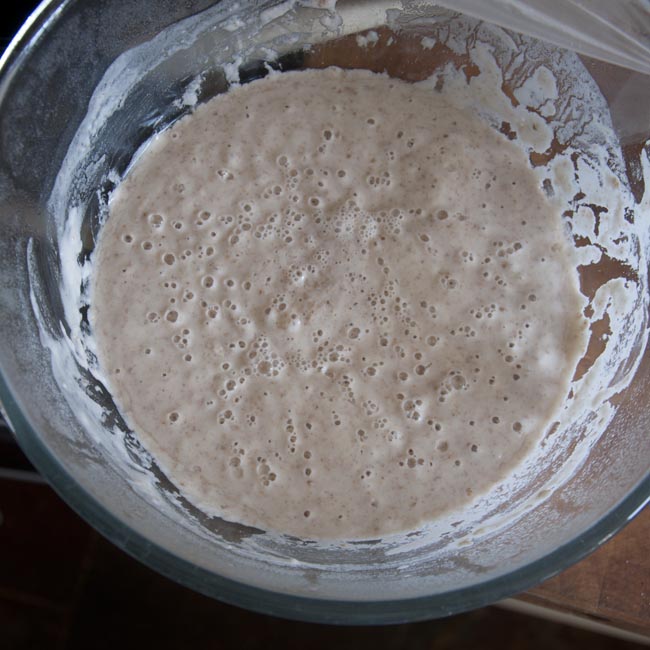
Overnight sponge, in the morningThese are mixed by hand in the bowl, covered loosely with cling film, and left to ferment overnight.  This morning, after I couldn’t bear to stay in bed any longer out of curiosity for how my bread was going, I was met with this – a lovely bubbly bowl of promising things!

I put the coffee machine on for my essential morning brew.  So distracted was I by my marvellous bubbly sponge, the jug was half-way full of pale brown water before I realised I’d forgotten to add any ground coffee!

The sponge, when I stirred it and then poured it off into a second bowl, was an amazing ‘stringy’ consistency, more like melted cheese than anything I’ve encountered in bread-making before – I assume in some way from the alchemy of the microorganisms within it.

To the sponge, then, I added –

  • A further 300g of strong white bread flour
  • 7g of salt [Edit, 15/7/2012 – I now use about half this amount of salt, with no ill effect]
  • A ‘glug’ of olive oil

Dough in the mixerAfter mixing the sponge, flour and salt roughly by hand, I put the lot into my (rather lightweight!) stand mixer, dough hooks fitted, and started it going.  It certainly gave the dough (and itself!) a heck of a work-out.  After a couple of minutes I added a good glug of olive oil and left it to work for about ten minutes.  I was told to expect quite a wet dough and certainly this was tricky to handle, sticky and rather ill-manered!  I don’t have a dough scraper so I was rather grateful for the mechanical assistance – though I’m not sure how many batches of sourdough my stand mixer has in it, it seemed to find it quite an effort!

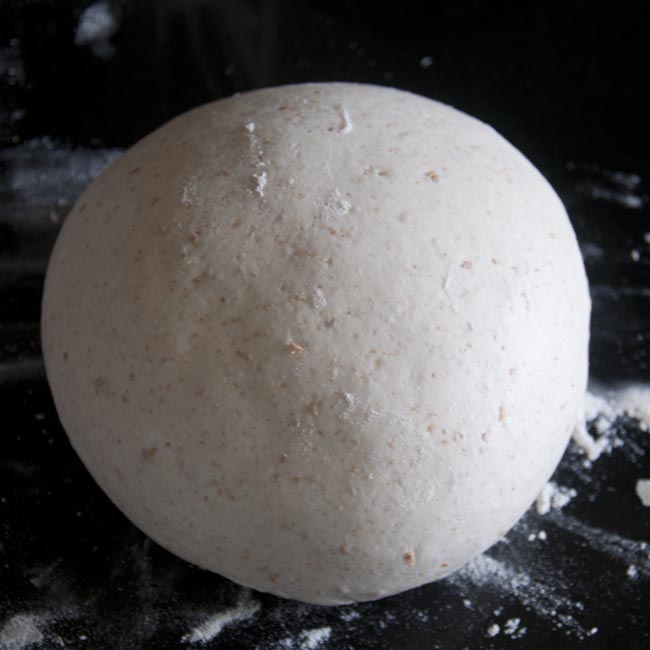
Dough, before first riseAfter kneading, I formed it into a rough round and oiled the bowl before setting the dough in it to rest for the first time.  Before this first resting period it looks like this, and after a couple of hours, to be honest, it looked just the same, if possibly *slightly* bigger in the bowl.

Formed into a roundFlour your surface, and then turn out the bowl of dough – squash it out into a rough rectangle with your fingers, and then ‘knead’ it gently back into a tight round before returning it to the oiled bowl for another hour or so. Put the bowl somewhere warm, but not hot – on a cool day, the oven with the light (but no heat!) on makes a good resting environment.  You’re going to repeat this process of resting, flattening and re-forming your ball a couple of times during the day.

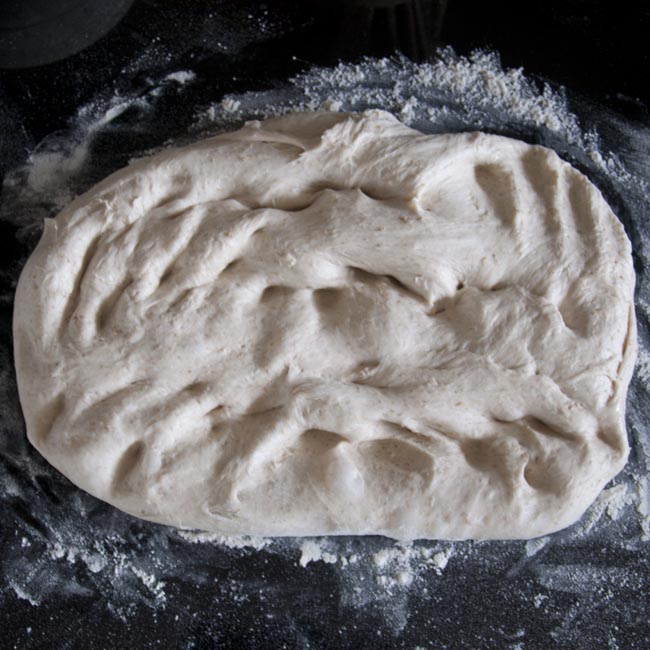
Dough, flattened with fingertips for final timeA couple of hours before my planned baking time, I turned the dough out for the last time.  It’s springier, silkier and lighter, with some noticeable bubbles now when you handle it. Form it into a round again but this time, rather than returning it to an oiled bowl, it would rather be in a proving basket.

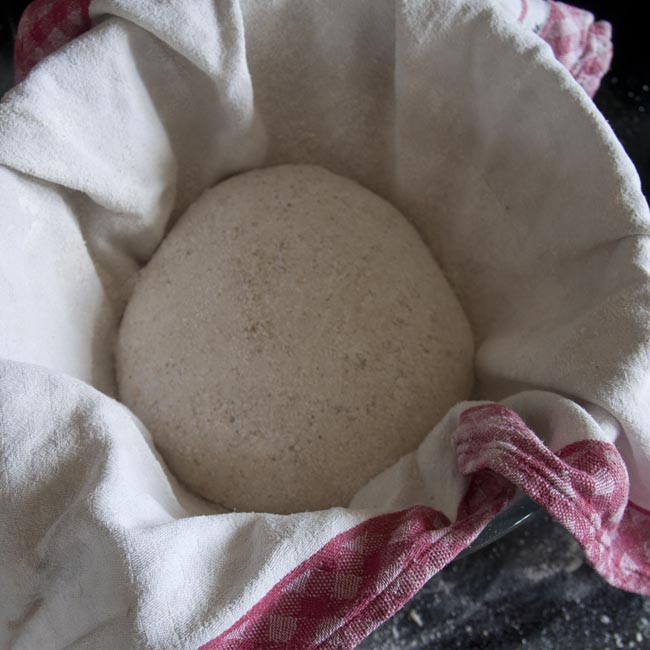
In the ad-hoc 'proving basket'I don’t have one of those, so I used a mixing bowl lined with a clean tea-towel which I’d dusted generously with rye flour.  I had very little faith that this was going to result in anything other than a disappointing sticky mess when the dough adhered to the cloth, but I’m a good girl and do as I’m told. Covered loosely with a piece of cling film, I left this patiently for another three hours.

I’d read all sorts of advice about the critical baking process – involving dutch ovens (I don’t own one), squirty-bottles of water (likewise!) for steam creation, and even things that look a bit like chicken bricks to approximate a traditional wood-fired oven.  I went with what I actually had – a round black stoneware baking dish for the bread, and a stainless steel roaster to hold some water in the bottom of the oven.  I heated it up to it’s maximum temperature (230C on the dial – 20 below what was recommended) and pre-heated the stoneware dish.  Once it was all up to temperature, and after adding a kettle-full of boiling water to the roaster in the bottom of the oven, I tried to gently turn out the floured dough onto the baking dish.  It seemed like a bit of a disaster, to be honest – ending up rather crumpled and misshapen.  I cut a cross-hatched pattern crudely into the top, and reassuring myself it was all about the flavour, bundled it back into the blasting hot oven.

I couldn’t tear myself away from it, and ended up sat cross-legged on the kitchen floor peering through the oven door as a miracle started to happen.  First the crumpled side seemed to stretch itself back into shape, and then, I’ll be damned if it didn’t start to rise!  Ten minutes into baking and I turned the oven down to 190.  The amazing rising act continued – first, it stretched its way languorously into the slashes, stretching them nicely across the surface.  And then, it started to climb vertically upwards, lifting its edges off the baking tray.  I’ve never seen a loaf perform an act like it – I can only assume it’s the result of the clever changes to the gluten that result from the extended rising and proving time.  It was like something out of the Incredible Hulk.

Out of the oven - at last!After 40 minutes the crust was a lovely warm mid-brown colour, but the bottom was still a bit soggy.  I took it off the baking dish and returned it to the oven upside down for another 10 minutes.  Hubby came home to find me stood expectantly in the kitchen.  After that, I couldn’t wait any longer, and pulled it out of the oven.  The smell of baking bread that filled the kitchen – and the house – was quite amazing.

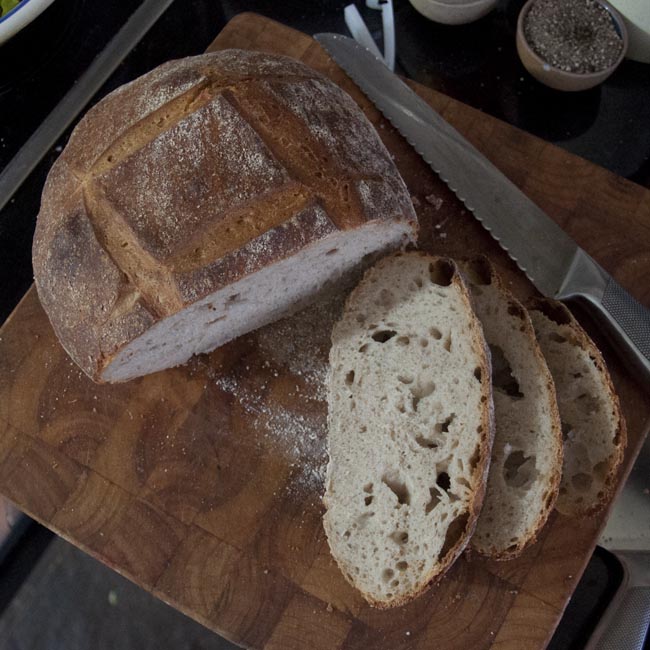
An hour later, we slice and sample it.  I genuinely wasn’t expecting anything this good from my first effort.  There are some lovely big holes in the dough, the crust is amazingly crisp but very thin – and retains a remarkable elasticity.

Sliced sourdough loaf

The texture of the bread is springy and extremely satisfying.  There is a definite, recognisable, but not overwhelming ‘sourdough’ flavour.  I *adore* it.  The whole process – from starting the sponge to eating the loaf – took about 24 hours, and I don’t regret one of them.  The actual ‘working’ time today was about an hour and a half, and left plenty of time for popping to the shops, taking the dog for a walk, and so on.

The bar for ‘good bread’ has just shot skywards in our household, and I suspect things may never be quite the same again.

Read all the posts in the Sourdough Saga >>

Read more from the Country Skills blog >>
Sourdough Saga: Episode 2 – keep calm and carry on?

So sourdough-1 went in the bin, and after a thorough clean out, sourdough-2 began…

Split starterI started initially with rye flour again, but used bottled water this time.  My initial batter was far too thin (I started with equal volumes of flour and water rather than equal weights – not quite sure what I was thinking really!), on day 2 when I got the initial bacterial bubble-up the whole thing split like curdled milk.  Thanks to some more supportive advice from twitter, I didn’t panic.  Keep calm and carry on, so they say.  Too much water, not enough flour, feed and perhaps move somewhere slightly cooler.  Done.

Do all starters get talked to this much?  Never has an inanimate object of mine been so cajoled & pleaded with.  I speak to it softly, encourage its efforts, and wish it goodnight and good morning.  My husband wonders if I’m losing my marbles… if only just a little bit!

I got my hands on some locally stoneground wholemeal flour, so I switched to this for feedings. As the batter was still on the thin side, I didn’t pause for doubling at day 3, but carried on with daily feeding.  Because the material on the sides of the jar was the first to grow mould last time, I made a habit of swilling out the jar to clean the sides at each feeding. The smell was good (quite yeasty and sourdoughy!) but only a few scant bubbles were rising to the surface.

More great advice came flooding in after I published Episode 1 of the Sourdough Saga – including the recommendation not to cover the starter.   Perhaps this was where I was going wrong, even with the lid lightly resting on the top of the jar, was I  suffocating my starter by depriving it of air?  A week after starting and not much was happening, so this seemed a theory worth pursuing.  Discarding the lid from the jar, I strapped a little kitchen-towel bonnet over the starter jar with a rubber band.  Things did start to look a bit more active on the surface of the starter at around that time.  Had I got something right at last?

The next morning dawned to apparent disaster.  Literally overnight, the whole top of my starter had bloomed with creamy-coloured velvety mould!  I was so upset I didn’t even think to photograph it.  More desperate scratching through the deeper sourdough-focused recesses of the internets ensued.  Someone promised that even really neglected starters, all moulded over, could be resuscitated – but since mine had never yet really come to life, could it work for me?  Had I perhaps caused this mouldy horror by leaving my starter uncovered for the surface to dry out?

Out of sheer bloody-mindedness, and muttering something about ‘not giving up now’ under my breath, I scratched the furry stuff from the surface of my starter as well as I could.  What was left, I mixed with more flour and water (gently warmed, this time) and tipped back into the jar.  The starter had developed a ‘winey’ smell I wasn’t at all sure I liked.  I got rid of its bonnet, reverting to the loose glass lid, turned my back on it, and leaving it without even my usual gentle words of encouragement, went out for the day, expecting to find more mould & disaster on my return.

Bubbled up and at least doubled in size

Six hours later, you might have knocked me down with a feather.  The damned thing had bubbled up to very nearly twice the size I’d left it, and was a sponge of small even holes visible through the sides of the jar.  I nearly wept.  Instead, I swore, colourfully.  Not a trace of fuzzy mould was visible.  In fact, a better impression of all the ‘happy, thriving starters’ whose photos I’d been coveting on other, more successful blogs, I couldn’t imagine.

I tried to share with my lovely husband quite what an exciting turn of events this was.  He seemed pleased for me, also somewhat (indulgently) nonplussed.

I left it overnight, and fed it again in the morning.  Coming home from work tonight, I found it doubled again.  I can’t quite believe it.  It looks so good, but I can’t convince myself there isn’t still something wrong with it now?  I’ve fed it again this evening, getting the volume up so there’s enough to harvest for a loaf or two.  Can I just use it, soon?  What, if anything, should I be worrying about now??  It looks great, and smells great, it grows like a weed, does that mean it *is* great?  Is there any way of telling?

This whole process has been the most insane and unexpected emotional roller-coaster ride.  Is this just all sent to make me *really grateful* for my new daily bread??  More importantly, my wise blog friends, can I make a mostly-white loaf from a wholemeal starter, or should I stick to matching flour for now?  So many questions – so much to discover!

What have I learnt, that might help others trying to navigate the gloomy labyrinth of sourdough starter art and science?  Not much, to be honest!  Only that there doesn’t seem to be a one-size-fits all set of instructions.  In the end, what seemed to work for me – despite the odd speed-bump on the road! –  was nice fresh stoneground wholemeal flour, slightly warmed bottled water, and a willingness to just keep discarding and feeding day after day until things eventually came together.  My starter hadn’t read the timetable, and probably neither has anyone else’s!

Finally, I’d like to offer a huge vote of thanks to everyone – both on wordpress and on twitter –  who’s offered me guidance and support on my sourdough journey so far – I would never have guessed there were so many great sourdough bakers out there, so generous with their time, knowledge, and advice!

Next – Sourdough Saga: Episode 3 – good things come to those who wait!

Read all the posts in the Sourdough Saga >>

Read more from the Country Skills blog >>

Signs of Summer – hedgerow posy

It’s great to see the field margins and roadsides crowded with flowers at this time of year, isn’t it?  I couldn’t resist, and picked a small posy from our paddock – red clover, buttercups and grasses.  It looks a treat on my window sill.

Hedgerow posy

Go and pick one of your own – it’s a little bit of summer, for you to enjoy indoors!  Beautiful, and best of all, completely free!

Read more from the Country Skills blog >>