Like a Candle in the Dark – Blog Advent (1)

It’s the first of December, and secular Advent is with us at last.  Kids (young and old!) all over the world have broken open the first window of their Advent calendars this morning, and the countdown to Christmas is well and truly on!

Advent candle

I started candle making last year, in a very small way, and mused at the time whether my advent candle, this year, might be home-made.  Well, here it is!  I’m quite pleased with it!

Advent - day 1

Candle making is a great little craft, though it can be a bit time consuming.  I’ve had an Advent candle for many years, and it’s such an important part of my pre-Christmas traditions that I wanted to get it right.

Incidentally, these instructions are equally relevant to making almost any sort of pillar or taper candle.  My consumables (wax, transfers etc) mainly came from Making Your Own Candles (see the suppliers list for more details).

Candle moulds and wickTo make a candle like this one, you’re going to need the following –

  • A taper candle mould (mine were cheap, plastic, and came from eBay – more sophisticated models are available!)
  • Appropriate candle wax – I used 90% of a paraffin pillar blend, and 10% beeswax
  • Candle dye and scent (optional)
  • Waterslide transfers for the Advent days (you can skip this if you’re just making dinner candles!).  You can buy waterslide transfer papers for laser printing yourself, or buy the transfers already printed from a candle supplies shop.
  • Wick – I used LX8 for these taper candles – wick sustainers and mould seal
  • Basic candle-making equipment – some sort of double boiler (mine is a large tin can in an old pan), a jam thermometer, an a stirring stick of some sort.  These should not also be used for food!
  • Kitchen scales, hob, fridge and freezer.
Wax beads with stirrer and dyeFirst, assemble your moulds if required, and then work out their volume (I filled them with water, and then weighed the water).  This will let you work out how much wax they will take to fill.  Wax is about 10% less dense than water, so reduce your weight by 10% and that’s the amount of wax you need.

Each of my taper moulds took about 60g of water, which I adjusted down to 55g of wax made up 50g of paraffin and 5g of beeswax.  I also added a 1g chip of fudge-coloured dye to the 110g of wax (that’s the orange thing you can se in the wax tin).  Now warm the water in your double boiler up until the wax starts to melt.  This should start at about 65C.  Try to keep the water below 75 to ensure the wax stays safely below its flashpoint (the temperature at which it’s at risk of catching fire).  The lower the temperature you keep your melted wax while working with it, the less shrinkage will happen as it cools, which is likely to give you a better result, so be patient and let it melt slowly!

Wick fixed with mould sealMeanwhile, prepare your moulds, feeding the wick through the wick hole at the bottom and plugging this with some mould sealant (I use generic white-tack of the sort you’d use to fix posters to the wall, and this seems to work fine).  Then turn the moulds the ‘right’ way up, and secure the other end of the wick to a wick sustainer, again using some of the tack.

If you’re adding scent to your candle wax, do this now, just before pouring, to reduce the amount of scent you will lose by evaporation from the hot wax.  I added a few drops of sweet orange and ginger essential oils to give a gentle festive scent – but there are lots of commercially prepared specialist candle scents, which, unsurprisingly, you should use according to the directions that come with them!
Moulds ready for pouringOnce your moulds are ready, you can start pouring the melted wax.  Do this carefully but steadily.  You can see that I placed my moulds in a tin just in case the mould seal failed, to avoid molten wax going all over the kitchen.  Fill both moulds all the way to the top.  You will have some left over wax, if you’ve calculated right. This is good news.  Put your filled moulds somewhere cold such as the refrigerator, or outside, for about an hour.

Candles with voids around wicksMeanwhile, either keep your wax melted (this involves watching it carefully all the time) or pour it out into a container like the tinfoil tray and let it set for now. After about an hour, retrieve your candle moulds.  You’ll notice that there’s a massive great ‘well’ in the centre of your candles.  Give this a bit of a poke with a kebab skewer to make sure there aren’t any hidden voids, then re-melt the wax you have left over, and use it to top up the moulds again, right to the top.

Finished candles in mouldsReturn the candles to your cold place to finish setting for a few hours.  When you get them out again, they should look a bit like this.  Now you need to release them from their moulds. Shrinkage is your friend here, so I stuck mine in the freezer for about half an hour.  Then I could pop the cap from the bottom of the mould and gently ease the candle out – well, that’s the theory at least.

Candle free from mouldAs you can see from this next photo, on this particular candle – the first I made, I ended up accidentally breaking the rounded top of the candle in the process. Well, you live and learn, and subsequent efforts were more successful!  Freezing is a big help, as is giving the mould a brisk but gentle tap before gently pushing up from the ‘pointy end’.

You can tidy up and ‘finish’ the bottom of the candle by trimming the wick and then melting the bottom against a hot iron or any other hot surface to melt it down flat.  Obviously, choose your hot surface judiciously and don’t use your laundry iron or anything that’s for food use!

If you’re just making a dinner candle – congratulations, you’re done!  If it’s an advent candle you’re set on, there’s just one more step to go.

Plain candles with waterslide transfersApplying the waterslide transfers turned out to be surprisingly straightforward.  Cut these to size, if required, then soak the transfers in a bowl of tap water for about a minute.  This will allow the clear film which forms the transfer itself to come away from the paper backing.
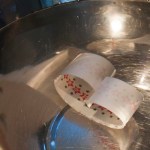
waterslide transfer soakingThen, very gently place the film on the surface of the candle and smooth it out.  It won’t stick down fully for a couple of minutes as it dries, so you have plenty of time to straighten it out and get rid of any bubbles or wrinkles, I found wiping it gently with a damp piece of kitchen towel was very helpful.

I’m really happy with mine – isn’t it gorgeous!  It’s a lovely warm honey colour, and has a gentle fruity scent from the essential oil additions.

Candle and calendar

Of course, many people prefer an Advent calendar to a candle – those of you who were early readers of this blog may remember my fabric Advent calendar project from last year.  You can see more photos and instructions for the calendar over here.

I’m trying to write a post a day during Advent, so, please come along with me while I try to Blog Advent – the Country Skills Way – and forgive me if I don’t quite manage it!

Read more from the Country Skills blog >>

Holidays Are Coming… and it’s very nearly Advent!

There’s no escaping the fact that winter has well and truly arrived, and that Advent, and Christmas, are just around the corner!  Christmas is probably my favourite time of year, which is a bit odd, I suppose, as I really really don’t get on with winter.  The cold, and especially the long dark months, seem to sap my energy.  I’m sure I evolved from a creature that hibernated, because honestly I could curl up under a rock in the middle of November and not come out until March.  But Christmas – Christmas is a bright, beautiful jewel in an otherwise dark and barren winter landscape.  The lights and sparkles, the food, the drink, and above all, the laughter and joy of loved ones, friends and family.

Every year that goes by, I seem to spend less money on a ‘commercial’ Christmas, and more time and effort on home-made, food and drink, gifts and decorations.  So the next few weeks are going to be really busy!  Never mind the inevitable – welcome, but time consuming – increase in social commitments, works parties, people visiting. Of course, what everyone needs with all this going on is an extra time-sink.

The thought occurred to me a couple of weeks ago that it would be really fun (fun?!?) to try to blog daily, from December 1st to Christmas Eve – about my Christmas preparations, food and drink, making and doing, building up to the big day…

So, please come along with me while I try to Blog Advent – the Country Skills Way – and forgive me if I don’t quite manage it!

Read more from the Country Skills blog >>

Sourdough Saga: Episode 7 – six months on, life with my sourdough starter

Back in May of this year, I started my experiment with creating – and baking with – a sourdough starter.  Now that November is nearly with us, almost six months on, what is the starter like to live with, and what effect has its appearance in my home had on my life?

In July, when I gave a ‘clone’ of my starter to my sister as a gift, I wrote her a guide to looking after her starter.   My starter is less cosseted these days – it drinks tap water, and has survived several rounds of being abandoned in the fridge for a couple of weeks or longer between feedings.  After long periods of abandonment, the starter has a sharp vinegary smell, and either a layer of greyish water on the surface, or an even more unattractive and worrying-looking layer of ‘fuzz’.  But every time, after pouring or scraping this away, and feeding the starter, it has sprung back to life.

Sourdough loaf selection

My starter has successfully baked white, wholemeal, malted mutligrain and spelt loaves (and a variety of combinations of these flours) – in fact, the flour used for sourdough loaves seems to make very little difference, probably because of the longer proving and working time compared to a quick-yeasted loaf.  The loaves are continuing to get better, too – with a nice even crumb and springy texture these days.  Last week, on holiday in a rented cottage in Cornwall, I even managed to bake a batch of sourdough in the borrowed kitchen and unknown oven! (Why, yes, I did take my starter on holiday with me, why do you ask..?)

I use less salt in my batch than I did to start with, but otherwise my method remains the same as for my very first loaf.  I often bake a double quantity, and freeze one loaf.  I’ve added cheese, herbs, and sun dried tomatoes to loaves, with great success.  More recently, I haven’t used the stand mixer for some batches, but worked the dough entirely by hand instead.  A plastic dough scraper, which I bought from eBay for 99p, is a great help and not exactly an investment that broke the bank!  As you can see from the photo, I’ve baked rolls, free-formed loaves, and even a loaf in a tin.  The sourdough pizza was *amazing*, too.  It all works brilliantly, so the limit should only be your imagination!

Several ‘clones’ of my starter are now in new homes with family and friends, and they report baking very successfully with their starters too.  So you see, if my Dad can do it, so can you!  There are even rumours of my starter making it into small-scale commercial production, so watch this space!

As an aside – when I was growing up, I sometimes wondered about the Lord’s Prayer – specifically, the fixation with ‘daily bread’.  After all, what was so exciting about bread? Well, it’s a bit like the first time you’re outdoors, on a crisp clear night somewhere really, really dark, and look up and see the infinite billions of stars and the Milky Way spread above you, and the phrase ‘majesty of the heavens’ suddenly makes sense as something other than a weak metaphor – in an earlier time, before we filled the skies with artificial light (and our larders with artificial food), these things were seriously impressive!  Good bread may genuinely change your world – your food world, at least!

The downside?  Well, all other bread is a disappointment, frankly! I did get a couple of really nice non-sourdough white loaves from a bakers’ shop while we were on holiday, which made a pleasant change.  But, basically, you’re never going to want to buy bread from the supermarket again – even the stuff from the phoney-bakers-shops they have in store these days is a total let-down, and as for the plastic-wrap ‘chorleywood’ sliced white, well…

All of which means that regular baking days have become a feature of our already rather busy lives.  Now, I wouldn’t have it any other way.  And, yes, you’ve guessed it, today is a baking day!

Read all the posts in the Sourdough Saga >>

Read more from the Country Skills blog >>

Happy Birthday – and a new home for the blog!

Doesn’t time fly!  I can’t quite believe it was a year ago (well, near enough) that I sat down and wrote ‘Bringing Home the Bacon’, and the Country Skills blog was born.  And it just so happens that while we’re on the subject of milestones, this is also the blog’s 100th post!

Well, everyone likes a birthday celebration, don’t they, and what’s a birthday without presents and candles?

First Birthday Candle

So, there’s the candle, and now for the present – the Country Skills blog has a new home at https://countryskillsblog.com/ although old links via the wordpress.com domain will continue to work through the magic of redirects.

I’d like to thank all my lovely readers – both regular and occasional! – for taking the time to stop by my little blog in the last year, and particularly those who’ve paused to comment or ‘like’, and helped me feel I’m not talking to myself!  Some of you have really helped me out – I don’t think the Sourdough Saga would have come to such a successful conclusion without your advice and feedback – and for that I thank you all from the bottom of my heart.

Here’s to many more years happy blogging!  Please do let me know what you think, I’m always happy to hear suggestions!

Read more from the Country Skills blog >>

From the Bookshelf – foragers’ field guides

It felt like autumn was in the air this morning. Harvest is well under way (and didn’t I know it at gone bedtime last night, with the combine still beavering away under floodlights in the field next door!) and Keats’ ‘season of mists and mellow fruitfulness’ is just around the corner. Autumn is a gift to foragers (human and animal alike!) and at this time of year, whoever you are, and whether you live in the town or the country, there is a bounty of marvellous free food just waiting to be gathered up, and the traditional British hedgerow is definitely the place to be going looking for it!

There are the wild fruit nearly everyone knows, of course – most of us would recognise a bramble (wild blackberry), a crab apple or a rose hip. But there are rarer (or at least, less well recognised) autumn fruit that are just as worthy of attention. Can you confidently recognise elderberries and rowans? What about telling the difference between damsons, sloes and bullaces? Are wild raspberries or hops growing in your local hedges? Did you spot the distinctive spring showing of your local cob nut trees, and the blossom of the blackthorn, and manage to commit them to memory? If you’re relatively new to foraging, or even if you’ve been doing it all your life and think you know the offerings of your local hedgerows, verges, and field margins (and don’t dismiss roundabouts!) intimately, a good field guide is essential to getting the most out of your local foraging opportunities.

[Full disclosure: ‘The Hedgerow Handbook’ came to me free of charge as a review copy from Random House. I bought ‘River Cottage Handbook No.7 – Hedgerow’ with my own money, a couple of years ago.  I do not have an amazon affiliate account, any links provided are for interest and convenience, and I don’t profit from them in any way!]

The Hedgerow Handbook, by Adele Nozedar‘The Hedgerow Handbook’, by Adele Nozedar, (illustrations by Lizzie Harper).
Square Peg / Random House, 2012.
ISBN 978-0-224-08671-4. RRP £12.99.
See this book at amazon.co.uk

The first thing you notice is what a beautiful little book this is, graced inside and out with the loveliest hand-drawn botanical illustrations.  It’s a pretty little hardback, nicely printed on quality paper, and has great ‘object’ qualities, to be handled, flicked through, and admired – all of the things that make physical books so special compared to their digital cousins.

The illustrations are a huge strength of this particular guide – hand-illustrations are always better than photographs for identification, as they allow all the relevant details and characteristics of a plant – and different stages of its life cycle, such as buds and leaves, flowers and fruit – to be shown together, when this would be impractical in a single photo. Illustrations also tend to be clearer, and generalise the appearance of a species rather than showing a particular ‘individual’ growing in a particular place at a particular time.

Inside page viewArranged alphabetically, each hedgerow plant in the book is fully illustrated, the illustration accompanied by a useful description of its habit (and habitat). Culinary and traditional medicinal uses are then briefly discussed, along with curiosities and anecdotes, and folklore associated with the plant – after which Adele shares one or more recipes.

There are some really exciting and unusual recipes here that I can’t wait to try, at an appropriate opportunity – it’s not just the usual suspects like blackberry jam and elderflower champagne.  The idea of pickled ash keys is intriguing, and I’ll definitely be looking out for these when they’re young and tender again next spring. There are plants in this book that I would never have thought were edible – for instance, I’d somewhere along the line picked up the conviction that ox-eye daisies were poisonous, it turns out the buds can be pickled, and the young flowers deep fried in tempura batter.

As a gardener, I’m delighted to to discover that in addition to nettles, other pernicious weeds like cleavers and ground elder can also offer up, if not a square meal, then at least a free green vegetable dish!

Of course, knowing you can eat cleavers in theory is all very well – it’s essential I think that a sensible suggestion is also made as to what you might like to do with them, and this, along with the really wide range of species included, is a real strength of this book.  Recipe suggestions include preserves, cordials, and country wines, as well as savoury dishes and deserts, and make a really interesting and inspiring collection.

If I had to make any criticism at all of this little book, it would be that I’m not quite sure alphabetical order is the most obvious organisation for a field guide – arrangement by season or habit / habitat feel more natural. A note of possible confusion species, and how to avoid making these mistakes, is often a feature of guides like this, and is missing here – though the quality of the illustrations and annotations make going astray quite unlikely.  Finally, for me, the author’s enthusiasm for herbal medicine was sometimes a bit distracting – but I must confess to liking my medicine firmly evidence-based!

All in all this is a great practical little book that should be on your shelf if you enjoy a spot of hedgerow foraging – and you needn’t be in the country to find it useful!  Being such a pretty little book, I think it would also make a really lovely gift!

River Cottage Handbook No.7 - Hedgerow‘River Cottage Handbook No.7 – Hedgerow’, by John Wright.
Bloomsbury Publishing Ltd, 2010.
ISBN 978-1-4088-0185-7.  RRP £14.99.
See this book on amazon.co.uk

Another pretty little hardback without a slip-cover, this one is bright and full of photographs.  With the commentary on illustrations above in mind, this isn’t ideal – but considering that, they’re good photographs and ‘do the job’!

This book starts with a good comprehensive section on the generalities of foraging before moving on to identification of about 70 edible species.  After this, some of the potentially poisonous species are also identified – useful!  The back section of the book is set aside for recipes.

The front section of this book is especially useful, covering the legal aspects of taking plants and flowers from the wild in the UK, as well as a great tabular guide to the growing and harvesting seasons of the various species.  The set of edible species listed overlaps quite considerably, though not completely, with those in ‘The Hedgerow Handbook’ – as you would expect from two books covering the same ground.

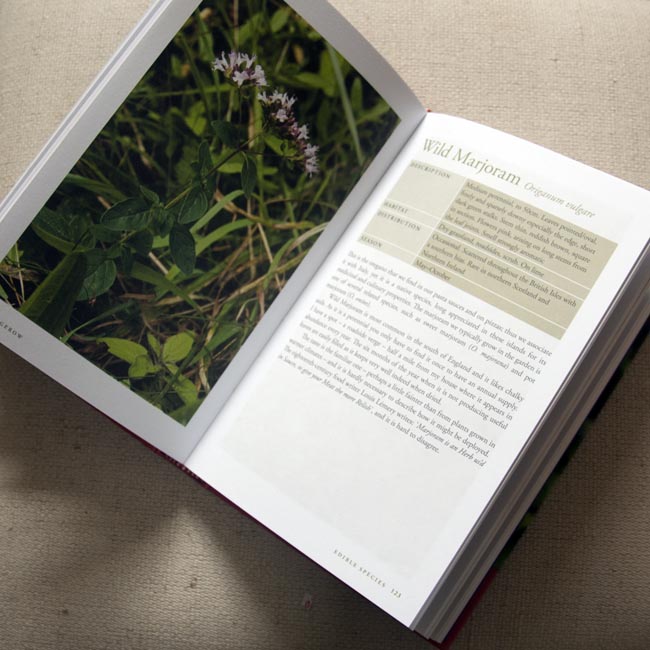
Inside page viewFor each plant, one or more photographs are provided, along with a useful summary covering description, habitat, season and distribution.  Combined with the introductory section, this makes it a really useful practical field guide.

It’s reassuring – and really interesting, actually! – to be able to confidently identify the toxic hedgerow species, and the third section covers these – the hemlocks, nightshades, foxgloves and suchlike.

The recipes, when we finally get to them, are much sparser on the ground, and do contain some ‘usual suspects’ like elderflower cordial, but are generally of nice quality, and well fleshed-out and illustrated.

As a whole the book does sit very well among the others in the ‘River Cottage Handbook’ series (which I have to confess to having acquired, um, all of so far), and avoids duplication.  This does mean that other recipes for foraged foods turn up in other handbooks, particularly the Pam Corbin ‘Preserves’ book.  Mushrooms and costal foraging also have their own volumes, which are very similarly presented and also very competent, interesting little books.  I would definitely recommend this volume, but be aware it’s likely to act as a ‘gateway’ purchase to the rest of the series!

Both of these are cracking little books which I can thoroughly recommend to you. Whichever you choose (hell, get both, you know you want to!) I hope you find them really useful for your autumn foraging efforts, and for many years to come!

Read more from the Country Skills blog >>

Under Pressure – this elderflower ‘champagne’ is a lively brew!

A couple of weeks ago I wrote about making this year’s batch of elderflower champagne, which included my usual warnings (shared with anyone who’ll listen at this time of year!) about the hazards of bottling a rather wild, actively fermenting brew in glass bottles.

Here’s why –

Under Pressure!

The bottle on the right is the ‘donor’ bottle, containing half a litre of sparkling water.  The bottles on the left are my elderflower champagne, about four days after bottling.  They were filled, originally, to about 5mm below the neck of the bottle.  You can see the pressure in the bottles – despite ‘degassing’ daily up to this point – has inflated the bottle like a balloon (it reminds me of one of those cartoon moon rockets!) creating a whole heap of extra headroom in the process. The bottom of the bottle is also noticeably pushed downwards.  Perhaps a passing materials specialist will tell us what internal pressure is required to produce this sort of effect, one of these days!

The little bit of ‘give’ in the plastic has allowed this to happen without catastrophe, which is a luxury that glass doesn’t give you.  So please, please, use plastic bottles for elderflower champagne.  The reinforced sort that have held fizzy drinks (lemonade, tonic water, or sparkling mineral water, like these), not the sort designed for non-carbonated water or drinks.  Yes, I know it looks a bit tatty, but really, why take the risk of a spectacular and dangerous bottle bomb?

And how’s the champagne, you might ask?  Why, very nice, thank you!  For all the hassle involved, I’m really pleased I just managed to make this year’s batch!

Read more from the Country Skills blog >>

Last of the Harvest – bonus ‘accidental’ elderflower-infused marmalade

Today, I was planning to bottle my elderflower cordial, and make a couple of sourdough loaves for next week.  As if that wasn’t enough for a Sunday, we also had a load of rock to collect.  So of course, I had to find something *else* that needed doing, too!

Elderflower cordial, steeping

After separating the cordial from the fruit and flowers, I was about to chuck them, but suddenly couldn’t bring myself to do it.  I could almost hear my grandmother sighing, ‘all that lovely fruit…’  All that lovely fruit – four whole lemons and oranges.  It was too good to waste, and had been soaking in a sugar syrup of utter deliciousness for three days, which surely had to be a good thing?

It’s been a very long time since I made marmalade, but there’s a long family tradition of doing it – my Mum makes it every year, and Grandma did, before her.  Our ‘family’ marmalade is dark, and rich, and often has hit of whisky or rum in it.  This ‘accidental’ marmalade is nothing like it!  I dug out Pam Corbin’s ‘Preserves’ (in the River Cottage Handbooks series) and realised neither of her recipes really did what I wanted, but perhaps, by using aspects of both, I could get something sensible!

Finely sliced citrus fruitI sliced my rescued fruit slices up quite finely, removing all the pips.  The three days soaking in the sugar syrup had got them some way towards being candied – the skins already a little bit softened and less juice in the flesh than a fresh orange or lemon.

Coming up to the boil

The total weight of sliced up citrus fruit was about 1.3kg (made up of four lemons, and four large sweet oranges), to which I added 2kg of mixed sugar (mostly golden caster & granulated sugars, but with a bit of refined caster sugar to make up the volume) and 1.5l of water.  I also gave the big handful of elderflowers a good squeeze to extract the last of their flavour, before throwing these away.

Return all the ingredients into the big pan they’d been steeping in for the cordial, and bring up to a nice simmer, covered, for about an hour until the peels are nice and tender.   While this is happening, assemble your jam jars and lids (I ended up with ten, mixed sizes, scavenged from my ‘saved jars’ pile) give them a careful wash, and place them in a cold oven ready for sterilising.  I bring mine to 150C and keep them there for ten minutes before I turn the oven off.

At a nice rolling boilWhen you’re happy with the texture of your citrus peel, take the lid off, turn the heat up, and boil it all as hard as you can for about 15 minutes, until it gets to setting point (I favour the cold saucer approach to checking for set – though interestingly for this particular marmalade there was a dramatic increase in the amount of foam produced as setting point was reached, which was a bit of a give away).

Filling jarsOnce you’ve reached a set, take the pan off the heat, and just wait for the bubbles to stop, give it a stir to re-incorporate any froth from the surface, and then ladle into your hot jars fresh from the oven.  I’m really messy at ladling, so I love my wide-mouthed jar funnel. Fit the lid tightly, and up-end the jars a couple of times to make sure the boiling hot jam comes into contact with all the surfaces.

If you’re American, at this point in proceedings you’ll probably feel compelled to do something with a water bath.  I’m afraid our friends over the Atlantic don’t like this way of filling jars, they seem to regard it with great suspicion as being likely to kill you with botulism or other similar nasties.  All I can say is, it’s the only way I, or anyone else in my family, has *ever* filled jam jars, and so far we’ve all lived to tell the tale!  (More seriously, this is a nice sweet, acid concoction, and consequently pretty un-friendly to clostridial species, so you should have very little to worry about!)

Filled marlalade jarsI’m really pleased with these little beauties!  The colour is gorgeous, a real bright rich orange, and the flavour is beautifully balanced.  I’d love to say I can taste the elderflower – if it’s there it’s very subtle – but the mix of oranges and lemons gives a really nice clean crisp flavour.

It’s not an overpoweringly bitter marmalade like some of the Seville orange marmalades can be, but instead has a lovely three way balance between the acidity of the citrus flesh, the sugar sweetness, and a bitter note imparted by the pith and peel.

'Accidental' marmalade

I wish I could offer you a taste – all I can do is encourage you to make your own!  I’m so looking forward to this on a lovely thick slice of my fresh sourdough loaf for tomorrow’s breakfast.

Read more from the Country Skills blog >>
Last of the Harvest – elderflower ‘champagne’

Elderflower champagne is one of the tastes of summer for me.  It’s quite unlike anything else, and doesn’t keep well, so it’s there, and then it’s gone.  This a really feisty brew which breaks all the rules of home-brewing.  Please, whatever you do, don’t try and generalise from this brew to any other country wines you might like to make!

For a batch of elderflower champagne, you’ll need the following ingredients and equipment –

  • 30-40 good quality elderflowers (depending on the size of the blooms)
  • 2.5kg of unrefined ‘golden’ granulated or caster sugar
  • 5 lemons (unwaxed if possible, otherwise carefully washed in detergent and rinsed before use)
  • 1 lime (as above)
  • 2 tbsp of white wine or cider vinegar
  • 3 – 4 litres of boiling water, plus extra cold
  • Wine yeast & nutrient (optional)
  • Brewing bucket, at least 12l in volume (and a second is very useful – this can double with your spare vessel for the cordial, though!) with lid, or a clean muslin to cover
  • Enough screw-top plastic fizzy drink bottles to contain your brew (10 – 12 litres in total).  Don’t even think about using glass bottles for this brew.

The first rule that gets broken here is sterilisation.  I don’t sterilise my buckets for elderflower brews – I figure I’m about to throw half a hedgerow into it, so sterility is a bit moot!  But do wash and rinse it very very carefully, and if you have any doubt about contamination from a previous dodgy brew then definitely break out the steriliser!

Put all the sugar in the bucket and add enough boiling water from the kettle to dissolve it fully.  Then top the bucket up to about 8l with cold water.  The result should be a blood-warm sugar solution.

Zested citrus & elderflowers

Peel the zest from the lemons and lime with a potato peeler, as thinly as possible (leaving the bitter white pith behind).  Then juice them, and add the zest and juice to the bucket.  Add the two tablespoons of vinegar.

What's left behindNow to the elderflowers.  You’ve selected them carefully, so they’re all lovely and full of nectar and pollen.  You want to add the flowers – but, unlike the elderflower cordial, you don’t just get to shake the bugs off and throw them in, I’m afraid!  This time, you want to add as little of the green stems as you can.  There are several ways of doing this.  I favour just plucking the flowers off pretty roughly with my fingertips.  You could use a fork to ‘comb’ through the little sprigs and pull the flowers off, but you will tend to take quite a lot of fine stem with you.  Or you could snip the flowers off with scissors.

The reason for this bit of faff is to do with a nasty bitter flavour that the stems can impart to your brew, which is what will make it undrinkable, eventually, with storage.  If you’re planning to drink all your elderflower champagne within a couple of weeks of bottling, you probably needn’t bother, but if you’re hoping to get a month or so of drinking out of them, some of the compounds extracted during brewing from the green stems will eventually be converted (by the yeast?  By oxidation? I don’t really know I’m afraid!) into an overpowering bitter note that will make your champagne entirely undrinkable.  If you minimise the stem, you should minimise the taint.

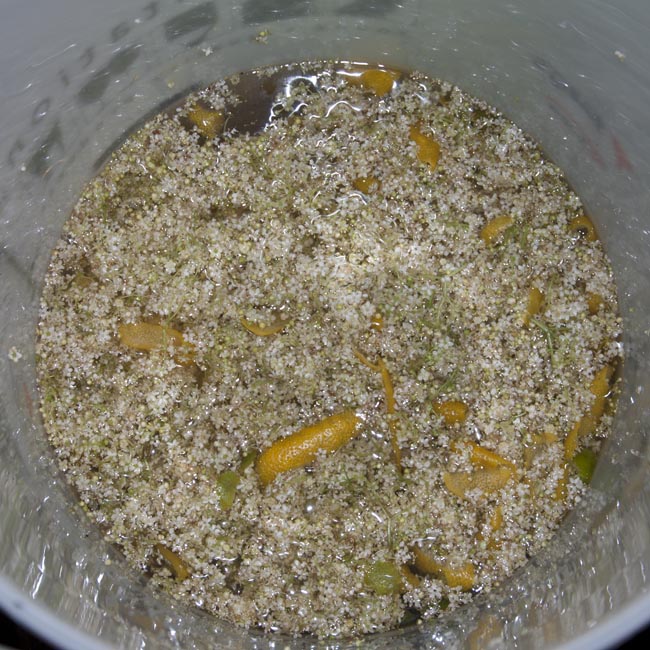
Ready to ferment - elderflower champagne in the bucket

Add all your flowers, then, and you should have an amazing smelling bucket full of flowers & citrus peel.  Top it up to about 11l.  Now add a teaspoon each of yeast and nutrient (if you have some).  Traditionally elderflower champagne is allowed to go on it’s own with the wild yeasts that are expected to be present on the flowers.  I find this unreliable, and want a good predictable outcome.  Loosely cover it with its lid or a double layer of muslin. This is home-brew faux-pas 2 – sorry, no airlock for me!

Signs of fermentation should be evident within a day or so, in the form of bubbles visibly rising to the surface (you may also get a froth, depending on how vigorous your fermentation is).  Watch for a bit, you’ll keep missing them and catching just a little movement in your peripheral vision.  You may also notice the slightly sharp smell of the carbon dioxide.

Leave your champagne to ferment for about five to seven days.  As if we haven’t broken enough rules already, this is where the whole process goes horribly ‘wrong’.  We’re going to make no effort to wait until our brew has ‘fermented out’ (see this cider-making post for discussion if you’re interested), so the brew is still actively fermenting, with the yeasts consuming sugars and producing alcohol and carbon dioxide, when it goes into the bottles.  This ‘quick and dirty’ short cut allows us to go from flowers-into-bucket to drinkable-brew in about a fortnight, which is quite remarkable.  It does however carry a pretty serious risk of producing ‘bottle bombs’ – a quick google for ‘elderflower champagne exploding bottles’ will illustrate how widespread a problem this is.

For this reason, I only use screw-top plastic fizzy drink bottles for my elderflower champagne.  Make sure they’re fizzy drink bottles – the 1 litre and half litre bottles seem most ‘stable’ though you can use the 2l cola or lemonade bottles if you like.  Don’t use bottles from non-sparkling water or fruit juices.  Do sterilise these with home-brew steriliser or milton solution, and rinse carefully before use.

After your brew’s been frothing for a week, filter it through a jelly bag or muslin-lined sieve into the second bucket to remove the solids, and syphon into your bottles (or use a jug and funnel, though this is another breach of ‘protocol’!) and screw the lids down tightly.  I was reminded when doing this this year that the filtration process is can be slow and frustrating – the yeast and pollens clog the jelly bag to a remarkable degree – and in future I suspect I’m going to use a much more open filter – I may even experiment with a nylon sieve (the sort you’d use to sift flour for baking) or something similar.  Using the jelly bag to filter my ~10kg batch took well over two hours, which frankly I could have done without!

Bottled elderflower champagneOnce your champagne is *finally* in your bottles, put them at room temperature somewhere secure where you can keep an eye on them (I tend to store the filled bottles in the washed and dried brewing buckets).

Every day or so, give the bottles a squeeze.  As the brew continues to ferment, the bottles will become harder and harder, and may even start to bulge alarmingly.  If you notice this starting to happen, release the pressure by very gently opening the lid a crack to let the carbon dioxide escape.  You may need to do this about once a day for the first week or so!

Under Pressure!You can see from the photo on the right the extent to which pressure can build up in these bottles – for comparison, the ‘donor’ bottle in it’s original state – the elderflower champagne bottles were filled to just below the neck, and the gas produced has inflated the bottles like balloons, producing a really large volume of extra head-room in the process.  Really, folks, don’t risk glass bottles with this brew!

As soon as you have pressure in the bottles, you can start drinking it – though I suggest waiting a week from bottling before taking your first sip.  As time goes by, the champagne will become ‘drier’ in flavour, and higher in alcohol as the sugars are consumed.  Don’t try to store this brew long-term – once you like the flavour of it, drink it and enjoy it!  I find that even with care, after four or five weeks the flavour is starting to deteriorate.

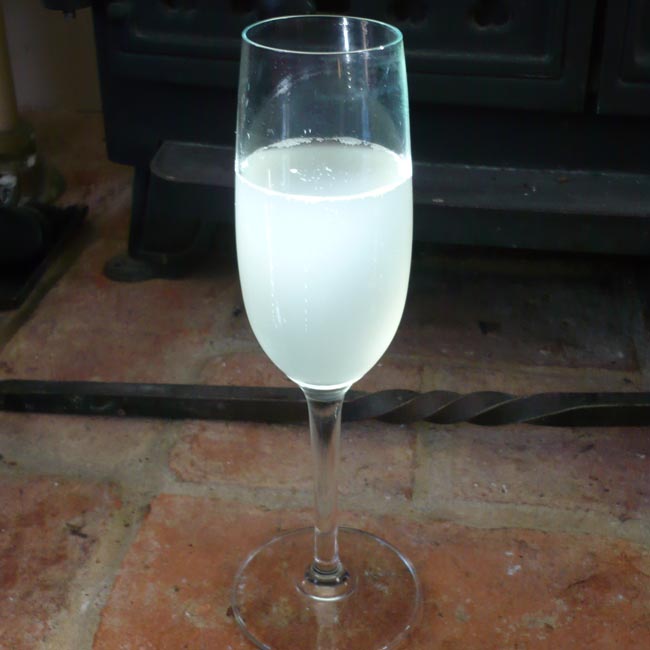
Ready to drink!

Pour, and enjoy this beautiful ephemeral effervescent flavour of summer!

Read more from the Country Skills blog >>

Last of the Harvest – home-made elderflower cordial

After you’ve picked your elderflowers, it’s time to make some gorgeous drinks with them.  Give them a good look over, and sort through.  Throw out any browning flowers.  Shake out any bugs but do not be tempted to wash them – you’ll wash all the flavour away!  You’ll be straining the ‘bits’ out later anyway, so don’t worry about the odd aphid making it through!

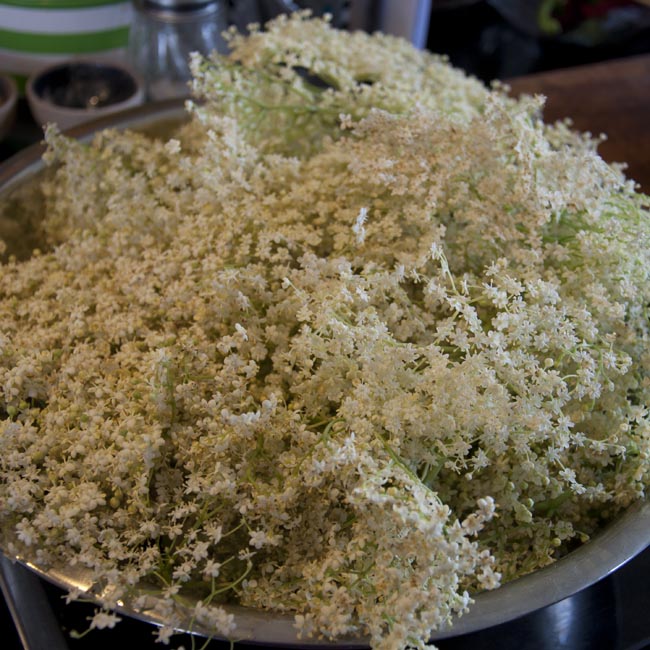
Freshly picked elderflowers

These are the ingredients and equipment you’ll need for the elderflower cordial.  You can scale these quantities up or down to suit yourself, but when I’ve gone to the effort of harvesting the flowers I can’t see the point in making much less than this at a time. –

  • About 70 nice elderflowers
  • 6lb (2.7kg) of un-refined ‘golden’ granulated or caster sugar
  • 6 UK pints (3.4l) of boiling water
  • 4 lemons (ideally unwaxed, failing that washed carefully in detergent & rinsed)
  • 4 oranges (likewise)
  • 4oz / 100g of citric acid (get this from a home-brew supplier, or a chemist’s)
  • Large stainless steel pan or food-grade plastic bucket big enough to hold all the ingredients (if you have a second one of these, this will also come in useful), with lid
  • Jug, jelly bag / fine strainer and muslin
  • Enough bottles to hold your cordial – I use recycled screw-top wine bottles, plastic bottles are also fine and you can freeze cordial in them.
  • Campden tablets / powder (optional – if you’re a wine-maker you probably have these anyway – they’ll allow you to store your cordial for long periods at room temperature, which is very useful!)

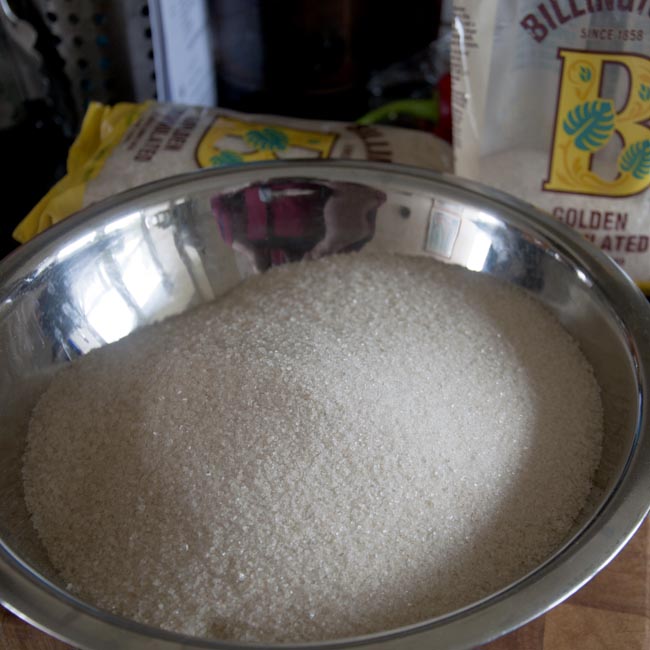
3lb of golden granulated sugarWeigh out all your sugar – I know there’s a lot of it, on the plus side you’ll be drinking this watered down so it’s not quite as bad as it looks (hey, who am I kidding?).  I’ve seen it asserted you can make this with ‘Splenda’ rather than sugar if you insist, but I haven’t tried it so can’t vouch for the results!

Dissolve your sugar in the boiling water, and add the citric acid.  Stir until it’s all fully dissolved.  Now wait until it’s cooled down (immersing your pan or bucket carefully in a sink full of cold water can speed this process up greatly).

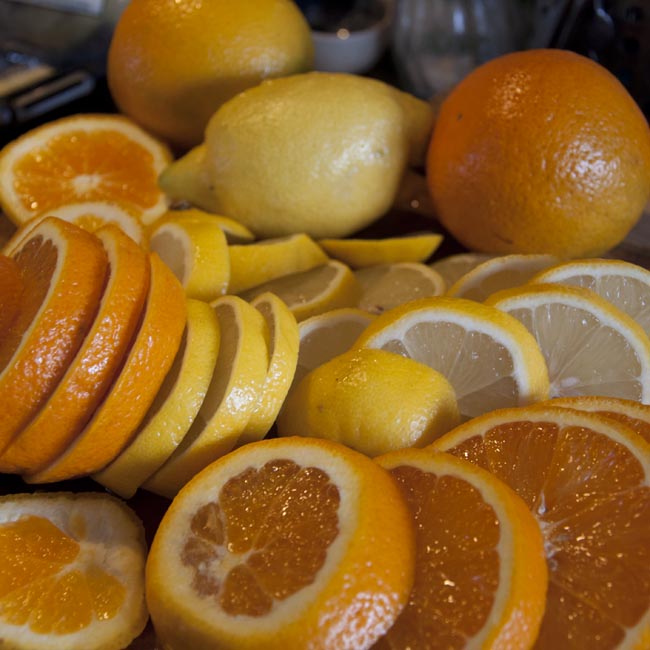
Sliced lemons and orangesSlice up your citrus fruit into thick slices (about 1cm thick), and add these to the cool sugar syrup.  Then add the elderflowers, one at a time so you can give them a good shake to dislodge any debris or creepy crawlies and discard any substandard flowers.

The smell will be amazing.  Steep for two or three days, covered, at room temperature.

Elderflower cordial, steeping

Straining the cordialOnce all the flavours have infused, it’s time to strain and bottle.  First, strain the cordial through the jelly bag or sieve lined with a layer of muslin.  I was about to discard the fruit with the elderflowers but couldn’t bring myself to do it – instead, I made a batch of ‘accidental’ marmalade, which is really very good!

Check your volume, then crush and add your campden (if using) at the doseage given on the pack – usually 1 tablet per gallon.  For me, the ingredients yielded just over a gallon (or 4.5l) of cordial, which was convenient for bottles, at a smidgen over six full wine bottles worth.

Stir well to dissolve, then allow your strained cordial to settle for at least 3 – 4 hours (or overnight) so that some of the sediment that’s survived the filtering – this will mostly be pollen, which is very small – will settle to the bottom of the bucket.  If you use a good fine jelly bag, there’ll be very little sediment to worry about.

Filling bottlesSterilise your bottles using home-brew steriliser (or in the oven like jam jars, but if so make sure you let them cool completely before filling – cold liquid into hot bottles is a recipe for disaster!).  Then fill them using a jug & funnel – you could use a syphon, and this might reduce your sediment a little, but it seems a lot of faff to me!

Filled bottlesWith campden, the bottles should store for a long while at room temperature (at least until next year’s elderflowers are ready – though I challenge you to save any that long!).  Without, they should keep in the fridge for a month or two, without refrigeration, there’s a significant risk that they start to ferment!  If you’re using plastic bottles, you can always stash them in the bottom of the deep freeze – they’ll keep for ages like that.

It looks lovely in a clear glass bottle, like fresh bottled sunshine (and we’ve had precious little of that this year!).  My favourite way to enjoy this cordial is with plenty of ice, a slice of lemon or lime, and sparkling water, in a tall glass on a hot summer’s afternoon.  But I also cherish it as an amazing taste of summer to remind you of the warmer, brighter days in the depths of a cold damp dark winter!

Read more from the Country Skills blog >>

Last of the Harvest – finally foraged the elderflowers!

I nearly missed this year’s elderflower season!  We’ve been having mad weather in the UK this year – a late, cold Spring and then so much rain in the past three months.  The elderflowers started late, and then meteorology managed to conspire with work and family commitments to leave me without a warm sunny day to go picking until today.  We’ve had a few heavy downpours in the past few days, with another one yesterday evening, and I was a bit worried there would be nothing left for me to pick.  A 5 mile, two hour foraging walk around the local lanes and byways eventually yielded the hundred good elderflower heads I needed.  They have never been so hard won!

I can’t remember when I started making elderflower cordial – it’s been well over a decade certainly (and before that – elderflower drinks are one of the things I really did learn from my grandmother!).  The desire to make my own elderflower champagne a couple of years ago drove the acquisition of my first small set of home-brew equipment – and what a great hobby (or can of worms, depending on your point of view!) that turned out to be.  Brewing came before curing and smoking and put me on the path to wanting to learn as much as I could about country skills – and hence, in the end, this blog.  So elderflowers and I go way back – they’ve had quite an influence on my life, one way and another!

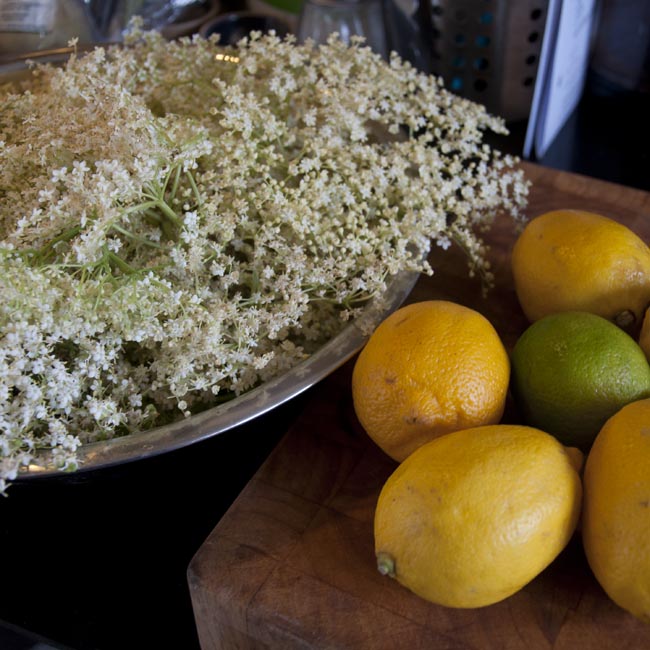
Elderflowers and citrus fruit

These days I make a batch each of elderflower cordial and champagne, at the same time.  In a good year I’ll do this a couple or three times, but sadly this year it’s a one-shot deal, so I’d better make the best of it!  To make both, in the quantities I make, you need about 100 good blooms.

Different quality elderflowersAn ideal quality elderflower is one where all the little flower heads are open, the petals pure white with a lovely buttery-yellow bloom of pollen on it.  As the blooms age, the pollen (and nectar, and the best of the flavour and scent) dissipates.  The flowers then start to appear whiter – still ok to use, but not quite as flavoursome.  Then they start to brown.  Browning blooms will not contribute the flavour you want, and should not be used.  The photo to the left shows great quality blooms at the back, adequate to front left and sub-standard (discard) to the front right.   There were too many adequate and poor flowers today – earlier in the flowering season it’s much easier to get nice flowers!

Now you’ve picked your flowers, you’ll want the recipes.  Here they are –

Read more from the Country Skills blog >>