Homemade Gifts – hyacinth bulb and hydrogel beads in a jar

Lovely, fragrant bulb flowers are one of the first signs of spring.  I especially love hyacinths, with their intoxicating perfume, and particularly growing indoors just a little bit out of season.  They’re like a floral promise that the end of winter *will* be along, just around the corner.
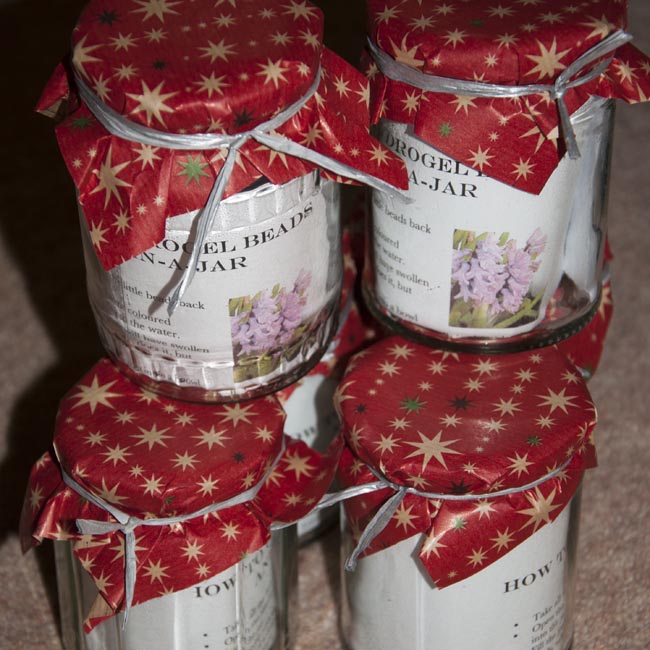
Hyacinth Jars, ready to give

Many of the gifts for my friends and family have been homemade this year – of course I couldn’t write about them before the big day, because that might have ruined the surprise! One of my favourites is a ‘prepared’ hyacinth bulb (heat/cold treated for indoor forcing – this is important, as unprepared ‘garden’ bulbs won’t flower if grown in this way) in a jam jar with hydrogel beads (sometimes called ‘water crystals’).  Hydrogel beads are one of the coolest, weirdest things I’ve come across in a long while.  They start out as a tiny little packet of small clear-plastic looking ballbearing things, but when soaked in water overnight, the contents of the tiny little packet will swell up to fill a whole jam jar.  Better still, the ‘reconstituted’ hydrogel has a refractive index so close to water that they’re essentially invisible if they’re below a fluid level, which, you have to concede, is very cool, in a geeky sort of way.

Once you’ve got over the excitement of the whole thing (I know, right?), how do you make them either into a gift or into a lovely spring treat for your own window ledge?

Hyacinth Jar - 'ingredients'For gifting, simply pack up the pouch of dry hydrogel beads and the prepared hyacinth bulb into a washed and dried recycled jam jar (I took the opportunity to use up some of the pickle jars with too much residual ‘taint’ to use as jam or jelly jars), with an instruction sheet (we’ll get to that).  Do up the lid (but don’t worry if you don’t have one) and top it with a pretty bonnet of fabric or Christmas wrapping paper tied on with ribbon.  What could be sweeter?

No, you can’t have my instruction sheet, write one yourself!  But the process is very straightforward.

  • First, you’ll need to reconstitute your hydrogel beads.  Do this in the jam jar, by emptying the tiny pack of beads into the jar and topping up with warm tap water.  I know it seems very very unlikely that this will work, but indulge me here, and leave them overnight.  The next morning, marvel as you discover the beads filling the jar.  It’s very cool.  If you wanted to be a bit psychedelic, you could add a drop or two of food dye to the water to start with, and this will be taken up by the beads.
  • Drain the beads, leaving them in the jar.  Marvel some more.
  • You want the fattest part of the bulb to sit in the ‘neck’ part of the jar, so work out if you need to remove some beads to get the level right, then place the hyacinth bulb on top of the beads.
  • Top up with water to just below the base of the bulb.
  • Now place the bulb in a cool dark place (a larder cupboard is ideal, an airing cupboard isn’t!).
  • Once there are roots growing and green growth is visible in the top of the bulb, move it into a bright place.  This will take a week or two.
  • Keep the water topped up every so often but avoid having water directly in contact with the base of the bulb as this will encourage mould to grow and may make the bulb rot.  The hydrogel beads will make it a lot more forgiving of marginal drying out than a traditional hyacinth bulb vase.
  • Wait for the hyacinth to flower, which will take another three or four weeks.  You may need to find some way to help keep it propped up, though usually they flower in quite a compact way so you might be lucky!
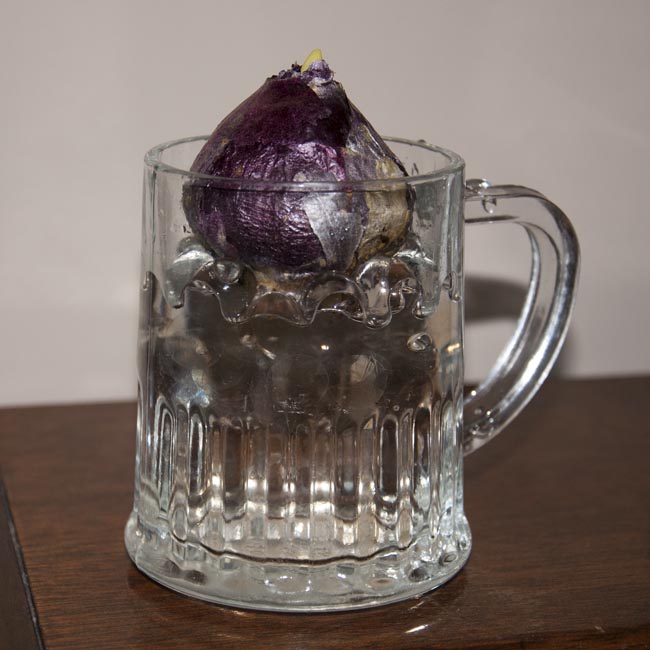
Hyacinth tankardOf course, you don’t need to restrict yourself to jam jars, all sorts of receptacles will do the trick!

These make a very original, eye catching and fun little gift – I used mine as stocking fillers and as part of hampers.  They cost very little, I sourced the bulbs for just under a pound each (in packs of twelve) and they hydrogel packs come in about £3 for ten.  I have three of the bulbs growing together on hydrogel in a small vase, which I started a couple of weeks ago, and they seem to be going well, with great root growth and a nice bit of green emerging!

Last Minute Christmas – perfect giblet stock

If you’ve bought a bird for roasting today, there’s a good chance it’s come with a little plastic packet of ‘bits’.  Whatever you do, don’t throw them away!

These bits are the giblets – the offal – usually the neck (in one or two pieces), the heart, the liver, and the gizzard.  The gizzard is thick, muscular structure with two hard abrasive grinding plates that the bird uses to crush up corn and other food items to make them digestible.  Giblet stock is quick, simple, and makes the most wonderful Christmas gravy.

I have a goose this year, but the following applies just as well if you have a chicken or turkey.  Personally, I use the goose heart and liver in one of my stuffings, so only the neck and gizzard are available for the stock.

In addition to the giblets, you need the following:

  • Stock vegetables.  I use one onion (red or white) and a couple of carrots, I don’t like celery so I don’t use it, even though it’s the often-quoted third member of the stock vegetable trinity.
  • A bouquet garni.  This is just a posh culinary term for some herbs. I use some bay leaves, rosemary, thyme and sage, along with some whole pepercorns and a few juniper berries.  Dried is fine.
  • Water.  Glug of white wine (optional).
  • A splash of olive oil.

Prepare your gizzard by cutting away and discarding the hard plates (use a small sharp knife inserted below and parallel to the plates) and chopping the rest of the meat roughly

Put the splash of olive oil into a nice big saucepan, and brown the neck and gizzard meat, and then add the roughly chopped onion and carrots and sautee for a couple of minutes.  Now add about a litre of water (and the splash of white wine if you want) and the bouquet garni, bring to the boil and simmer for about an hour.  Strain, discard the solids, and return the stock to the pot and boil again until reduced in volume by half.  That’s it.  Set aside in the refrigerator until you make your gravy later. You won’t regret it!

In Fermentation We Trust – apple juice turns into cider

On a lovely bright November weekend, I pressed a load of apples for cider-making.

For the next part of the process, you need to put together the following bits and bobs:

  • Your apple juice (which is already in a fermenting bucket with any luck – you’ll need the lid, if it’s one with a hole for an airlock, so much the better – if so, you’ll also need an airlock)
  • Wine or cider yeast, and yeast nutrient
  • A nice warm location at about 18 – 21 degrees celsius
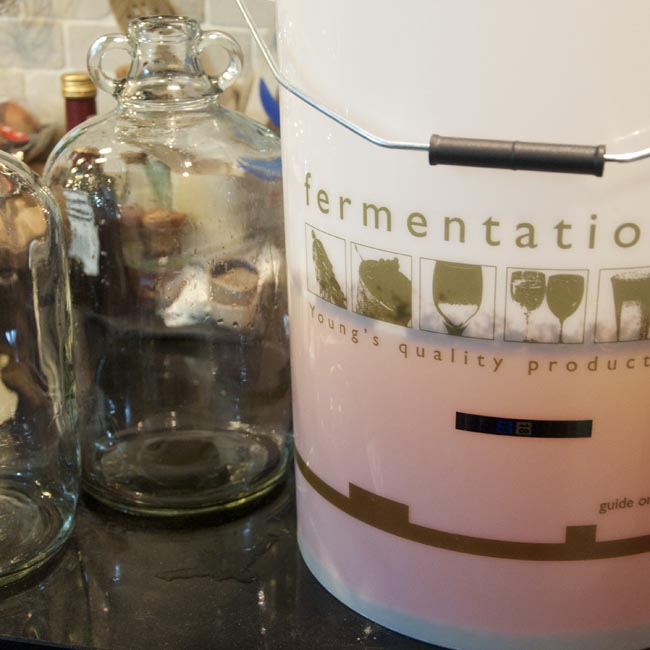
  • Enough demijohns (plus stoppers and airlocks) to contain the volume of apple juice you’ve collected.  All my demijohns have come from Freecycle, so it’s worth keeping your eyes open.  For recommendations of UK homebewing equipment suppliers, see the suppliers list.
  • A syphon
  • Homebrewing steriliser solution

Now, time to turn your wonderful juice into cider (for any Americans who might be reading, we mean hard cider – the traditional alcoholic sort).  Traditional ‘real cider’ makers would do nothing with it at this stage, and wait for the natural yeasts which you hope are already present on the apples to do their job and get fermenting.  There is an alternative approach which involves using campden (sulphite) tablets to kill off the wild yeasts and then adding some wine or cider yeast of your own, which with any luck should guaranteed a ‘clean’ culture of your chosen yeast strain.  I decided to go a third route, didn’t use any campden, but did add wine yeast and yeast nutrient to give the process a ‘kick-start’ and make sure that an appropriate culture was at least in there with a fighting chance!

Apple juice before fermentation

You should probably take the specific gravity of your apple juice before you start fermenting, as this will tell you something quite important – with a bit of arithmetic (or there are online SG to ABV calculators out there you could avail yourself of) you should be able to work out how alcoholic your cider ends up.  This is relevant both for keeping your driving licence, and for making sure your cider contains enough sugar, and therefore after fermentation, enough alcohol, to keep well.  You’re aiming for a minimum of about 3.5% ABV, real ciders can easily get up to about 8%.

I didn’t test my juice (do as I say not as I do, right?), but it tasted nice and sweet so I think it’s likely my cider is about the 6% mark. Invest in a glass hydrometer (they’re cheap, easy to use with a bit of practice, and ever such pretty bits of old-fashioned looking laboratory glassware), you won’t regret it!

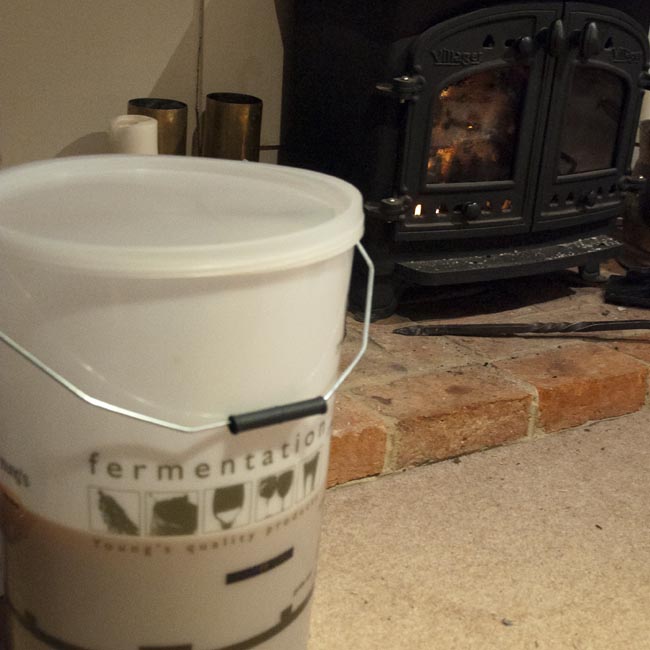
Fermenting by the fireThere is lots of advice that you should ferment your cider under lock.  I didn’t have an airlock capable bucket available so just kept the lid loosely on.  My experience from beer brewing is that the CO2 produced during fermentation will give a good blanket over the brewing liquor, being heavier than air, and oxidation shouldn’t be a problem at this stage as long as you don’t disturb the fermenting juice.  If your bucket does have an airlock, after adding the yeast and nutrient close the lid tightly and set up the airlock.  If it doesn’t, just fit the lid loosely so that the gas produced during fermentation will be able to escape without blowing the lid off!  Put your bucket in a nice warm place and try to avoid peeping.  Mine went by the fire in the living room for the first few days, as we were having a bit of a cold-snap.

Ready for rackingYou’ll be able to tell fermentation has started when you see bubbles through your airlock, or when a nice loose foam starts to form on top of your apple juice (because you’re not peeping, right?).  During fermentation, the dead yeast and quite a bit of the solids from the apple juice will settle out in the bottom of the bucket, and the colour of the juice changes from brown to a yellow-orange.  In general, the cider will not clear completely, but it will be brighter than it was before.

Top fermenting yeastOnce fermentation seems to have stopped (I gave mine a generous month), you’ll have a nice thick layer of debris on the bottom of the bucket with cider above it.  Now it’s time to ‘rack’ the cider into demijohns for bulk conditioning.  When I opened the bucket, I found rather an alarming-looking layer of yeast floating on the surface of the cider.  I can only assume that this was a wild, top-fermenting yeast strain, as it seems to have done nothing awful to the cider so far!

Clean and sterilise your equipment (demijohns, syphon, stoppers & airlocks) carefully this time, following the directions on your steriliser.  Now the cider has fermented you risk accidentally making cider vinegar if acetobacter bacteria were to get in.  It’s also important to avoid introducing oxygen into the cider at this stage – acetobacter need oxygen to make vinegar from alcohol, so even if there’s some contamination they’ll struggle to get going if the cider stays free of air.  Syphon carefully, keeping the outlet of the syphon below the level of the liquid and avoiding introducing bubbles.  Then fit your stoppers and airlocks and put the cider in a cool dark place to mature for a few months before bottling. Keep an occasional eye on your airlocks to make sure they’re not drying out.  I expect to leave mine in the demijohns until spring, and will then bottle into champagne bottles with a bit of priming sugar to make sparkling cider.

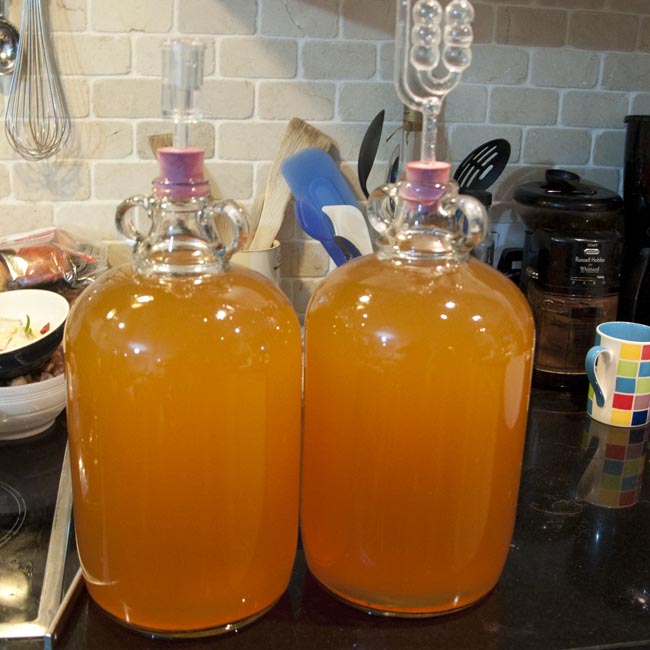
Filled demijohnsWe had a couple of pints more cider than fitted in the demijohns, and it would have been inconceivable to waste it – I can report that it is, already at this stage, definitely cider.  It’s a bit rough around the edges with quite a hard tannin that hopefully will mellow a bit with maturation, but has a lovely fresh apple aroma and definitely shows promise!

If you’re going to try it, I would recommend having a bit more of a read about the process before you start.  Some of my favourite books on home-brewing are listed in the library.

And if all that seems a bit complicated and labour-intensive, I’ll give you my directions for the quickest and easiest (and remarkably tasty!) home-brewed cider in the world very soon!

Meddlesome creatures – the return of the bletted medlars

After two and a half week’s bletting in the spare bedroom, about half the medlars looked unchanged, the other half had softened and darkened in colour, with skins that look and felt a bit like nicely ripened passion fruit.

Bletted medlars

I was itching to get on and, in any case, had read in a couple of places that having some un-bletted medlars in the mix would help with setting the jelly, as they are higher in pectins. Brilliant then – time to get going!

Medlars in different stages of blettingFermenting medlarOf course, I had to taste the bletted medlars – I can report they’re a very unattractive mid-brown squishy substance, with a gentle sweet and slightly floral, perfumed flavour.  Not unpleassant but nothing to get really excited about.  One of my medlars had started fermenting, it’s skin was tight with gas and there were bubbles escaping from the calyx (the ‘dog’s bottom’ bit of the fruit).  In the spirit of experimentation (and so you don’t have to!) I did have a little taste of the liquid leaking from this – again not unpleasant, a little more citrussy than the bletted medlar.  I may have to look into medlar wine recipes!  There were also a couple of medlars which were dry and hard and black in the middle.  I threw those ones away.

Bletted medlars on a plateAfter consulting a few different sources (many recommended adding apples to the mix – something I wasn’t keen to do as I really want to see what medlars taste like!) I settled on a very simple recipe – medlars, sugar, and just a squeeze of lemon juice into the stewing water, using my almost-all-purpose fruit jelly recipe.

The liquor that drained from the jelly bag nearly had me giving up in disappointment.  It was distinctly cloudy with a rather insipid pale brown colour, a bit like too-weak milky tea.  A quick taste, and it was quite bland apart from a dominant flavour of tannin – like I’d been boiling up dry leaves and bark for an hour.  It almost went down the sink, but since I wasn’t sure what it was meant to taste like, I decided to persevere.

Medlar jellyThe result is a revelation – dark golden in colour, sweet/acid with a gentle floral top note and a soft tannin base flavour, quite unlike anything else you’ve ever eaten – my husband tried for several minutes to work out what it tasted ‘like’ before giving up on the exercise. The set of my jelly is a bit softer than I would have liked – to my pint and a half of liquor I added a pound of preserving sugar and half a pound of golden caster I had lying around. The jelly had been boiling for well over half an hour at this stage so I suspect the main problem was shortage of pectin from the quite well-bletted medlars.  I don’t think it really matters!