Maple Bacon – and a bonus summer salad

Every so often I ask my lovely husband for ideas – most recently last time I was making streaky bacon.  ‘What cure shall I use?’ I called out from the kitchen.  ‘Maple!’ he replied.  Right oh, maple bacon.  It’s a new one for us.  I ferreted around in the cupboard and dug out a bottle of pure maple syrup.  This was sounding plausible, after all!

[This bacon was made using a variation on the bacon-in-a-bag technique I wrote about the other week, so you should probably go and read that first if you’re not familiar with it.]

For my bacon, I used –

  • 480g piece of pork belly from our local farm butchers’ shop
  • 30g of supracure
  • 26g of pure maple syrup (really, buy the good stuff, not the blended rubbish)
  • A plastic bag big enough to contain the pork, and a sealed container for the cure.

I was aiming for an 8% total cure weight to the meat (lower than the 10% I normally use), with a 1/3rd to 2/3rd ratio of sugar to salt. This was in deference to the rather aggressive salt flavour I got from the outside pieces of my last bacon-in-a-bag effort.  I got the ratio right but slightly overcooked the total quantity, in this event.  You’re thinking now that my arithmetic doesn’t add up, and that 56g is clearly well over 10% of 480g.  You have to consider that maple syrup is about 40% water to 60% sugar (check the nutritional analysis on the back of the bottle for your particular sugar) so my 26g of syrup is in effect 15g of maple sugar, for a total dry-equivalent cure weight of 45g or ~9%.

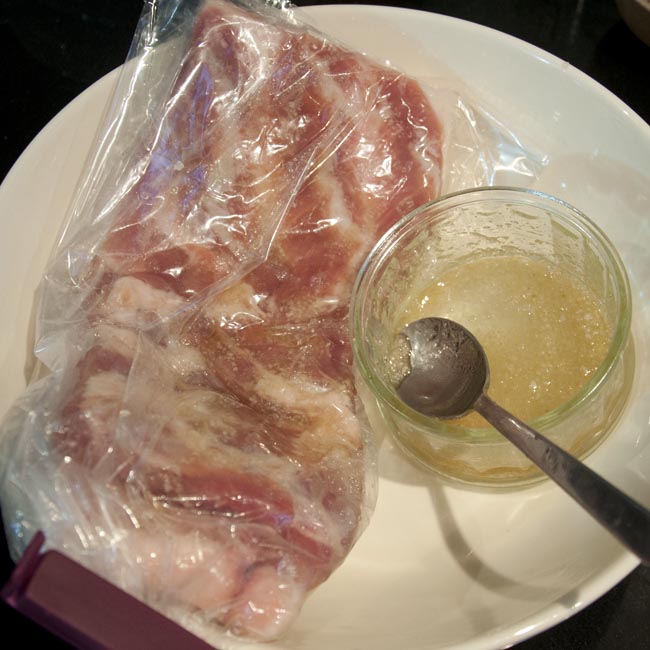
Bacon-in-a-bag with maple cureThe mix of salt and syrup is not so much a dry cure, more of a ‘gloop’.  Put the pork in the plastic bag and rub all over with half the cure, massaging in well.  Seal the bag, excluding as much air as possible, and place it in the refrigerator.  Store the rest of the cure in an airtight container.  At least once a day (but in practice I tend to do this whenever I’m going to the fridge and remember) give the meat a bit of a massage, and return to the fridge the other way up.

Maple bacon after curingAfter two days, I poured off the pickle, and applied the rest of the cure.  After three more days (a total cure time of 5 days), remove the bacon from the fridge, rinse it under cold running water, dry carefully with kitchen paper and then wrap loosely in baking parchment and return it to the fridge for at least 24 hours (and preferably a few days) to rest.

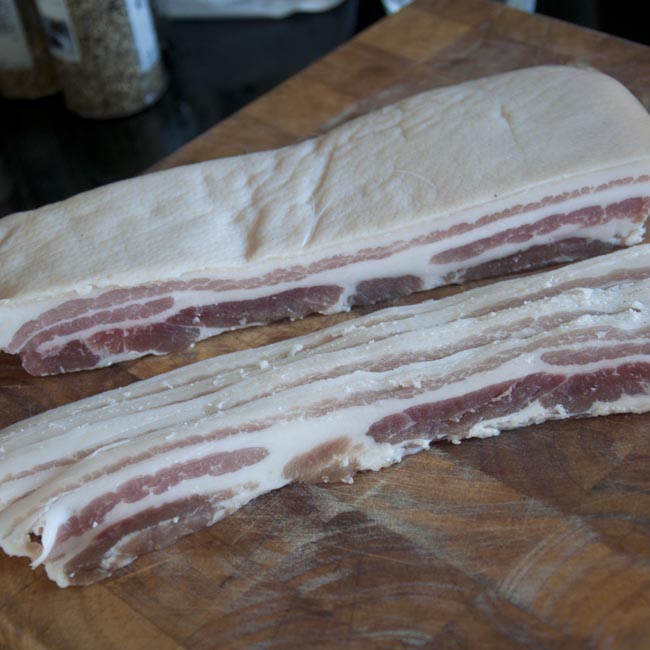
Maple bacon, slicedYou’ll notice that compared to our previous bacon, this one is a lot paler in colour, and retains a much whiter rind.  Most of the change in the meat before and after curing is in the texture, with a slight pink flush to the meat.  This is because we’ve not added colour by using a dark sugar in this cure.  It slices very nicely!

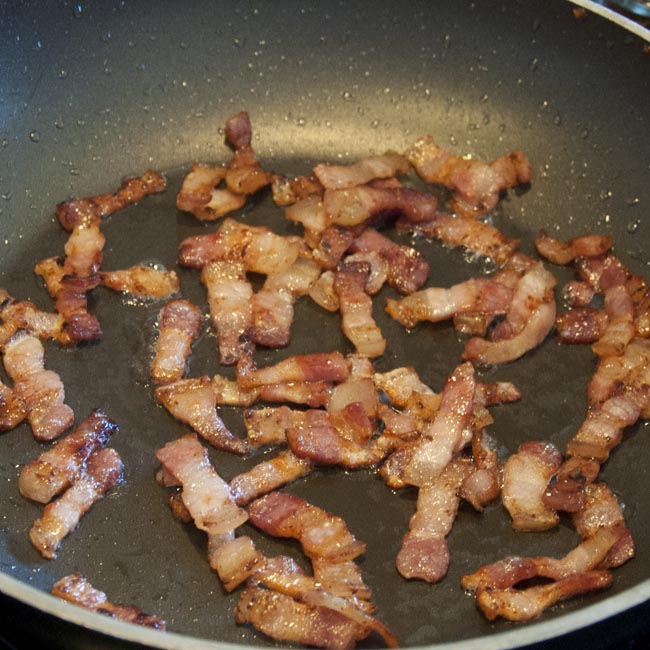
Bacon pieces fryingAt this time of year, with the warmer weather, perhaps you don’t fancy a bacon roll so much as in winter?  For lunch on a hot day, I love a spinach and bacon salad.  It’s the quickest and simplest of light summer lunches.  First slice your bacon into lardons, and fry it off until slighty crispy.  This bacon cooks beautifully, caramelising very rapidly and rendering off lovely clean clear bacon fat.

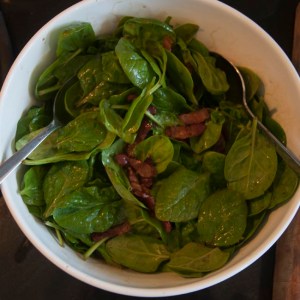
Spinach and bacon salad with balsamic dressing

Then, toss your crispy bacon pieces, while still warm, into a big bowl of baby leaf spinach, dressing with balsamic vinegar and olive oil.

The empty bowl

Doesn’t it look appetising??  It didn’t last long here!

We had a few more rashers for breakfast this morning.  We will certainly be making this one over and over again in the future.  In summary – this is great bacon, subtly flavoured, gently salted, with a gorgeous traditional bacon flavour.  Make it!

Read more DIY Cold Smoker & Home-Curing posts >>

Read more from the Country Skills blog >>

Jerk Pork Ribs – a bargain BBQ treat

Regular readers of the blog will know that I love to advocate using great quality bargain cuts of meat, even if that means a little bit of extra preparation.  Using the less fashionable cuts means getting to enjoy great, outdoor reared, higher welfare meat without having to shell out the premium price tag – and these cuts also reward the creative cook by being, very often, some of the most interesting to eat!

Jerk ribs on the BBQ

I often have a couple of bags of pork ribs in the freezer, as offcuts from the pork belly I make my streaky bacon from.  From that point of view, these ribs are basically free.  Last time we had some friends over and I wanted a few extra, my butcher sold me a 6 -7 inch chunk for 50p.  If you’re buying them as ‘ribs’ in packs from the supermarket, rather than as offcuts, you’ll pay more, of course.  Yet another reason to cultivate your friendly local butcher, and develop a few basic butchery skills yourself.

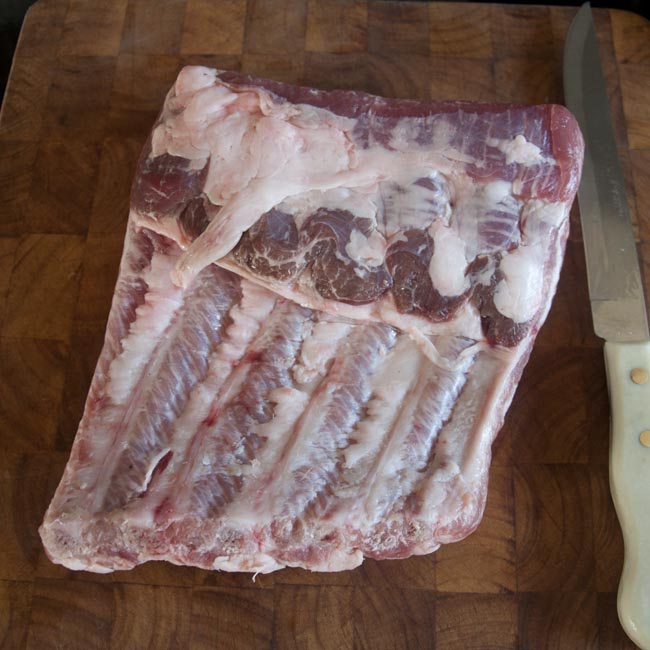
Pork rib sectionThis is how I expect your ribs will arrive – as a roughly square or rectangular piece with more or less loose tissue (from the diaphrgagm) attached to the inner (concave) side.  There should not be very much meat on the outer (convex) side, as the belly meat should have been cut away.

If the belly is still there, you can either remove it and prepare it seperately – as bacon, or as a roast pork belly – or you can leave it attached and make really thick juicy ‘streaky ribs’.  Beware, though, as these will be very fatty and consequently encourage your BBQ to flare up when cooked over coals.  Pork belly is so wonderful, there are better ways to prepare it, in my opinion!

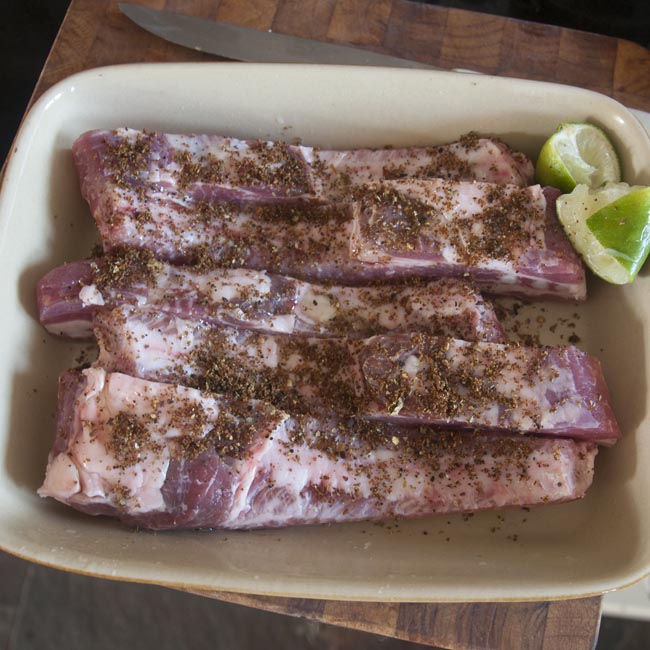
Separating ribsYou need to divide up your rib portion into separate ribs, and this couldn’t be simpler.  Looking at this inner side, feel where the ribs are with your finger tips, and identify the gap between them.  Using a nice, sharp, long knife, place the blade midway between the ribs and cut parallel to them.  Butchered ribsThere’s some cartilage attachment up at the ‘knuckle’ end of the ribs, but any plausibly sharp blade should slide straight through this (bonus hint – keep your kitchen knives *really* sharp – a sharp knife is a safe knife!).

Ribs with seasoning appliedCarry on until all your ribs are divided up.  Now find a nice big dish large enough to contain them all reasonably snugly. Squeeze over the juice of half a lime, and a big glug of olive oil. Then sprinkle generously with your home-made dry jerk seasoning mix and rub in all over.  Turn the ribs over and apply some more mix to the other side.

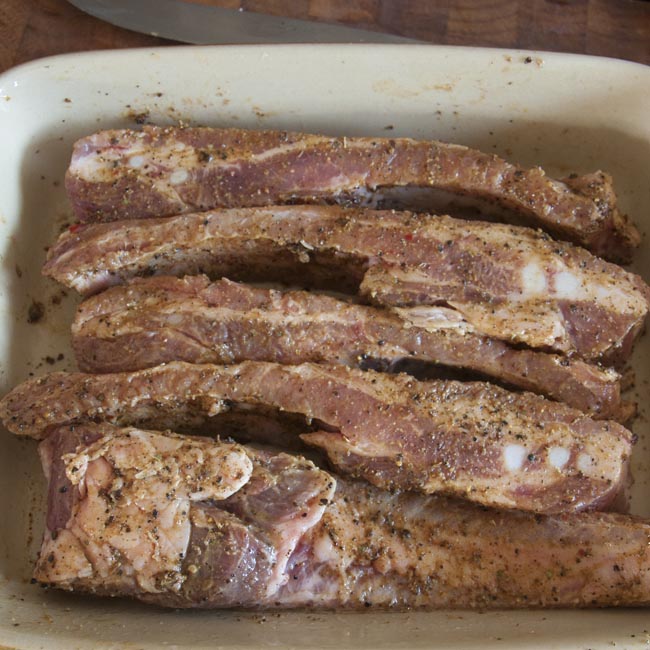
Ribs, restingOnce you’ve finished applying your rub, wash your hands carefully or they’ll end up stained an attractive nicotine-yellow from the turmeric.  Cover the ribs and set aside in the fridge for at least an hour – if you’re able –  before cooking.

Once your BBQ charcoal is smouldering gently, without any flame, put your ribs on the grill and cook until done.  If I’m cooking for a large party, I like to start these ribs in the oven and then just finish them on the BBQ for that lovely open fire flavour without the extended cooking time.  You’ll still get a great result.  Then, sit back, and enjoy your tasty, juicy, spicy, bargain ribs with a nice cold drink!

Read more from the Country Skills blog >>

BBQ Treats – home-made thyme and tomato beef burgers

A really good, home-made burger is such a treat, hot from the BBQ, under the grill or even pan-fried, when the ingredients are great you can’t go far wrong!  Making your BBQ burgers from scratch means you know exactly what’s gone into them, too, which is no bad thing.

Burgers cooking over charcoal

To make four generous sized burgers, you will require –

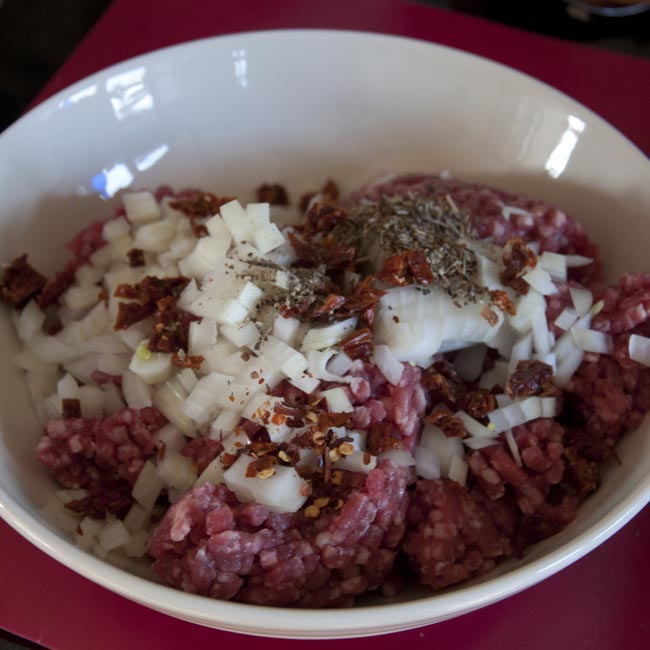
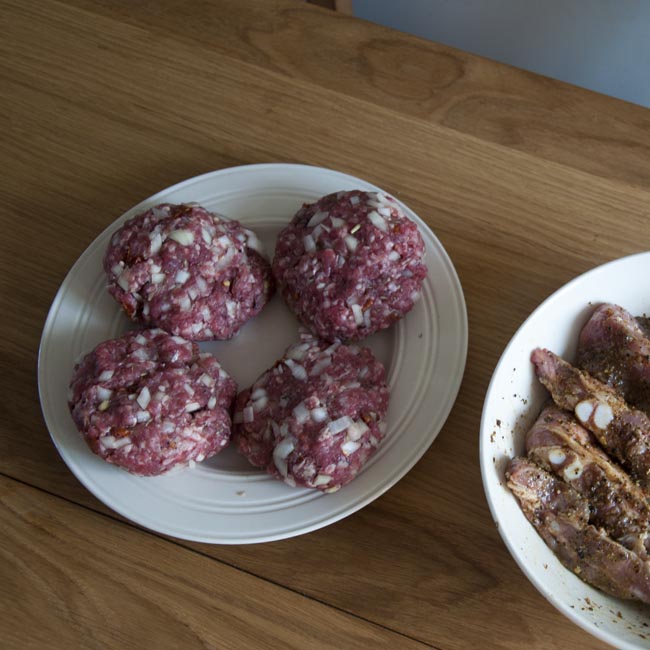
  • Ingredients ready for mixing1lb of good quality lean beef mince – don’t skimp and buy rubbish here, butcher’s is best!
  • Half an onion, finely chopped
  • Four or five sun-dried tomatoes, sliced up as fine as you can
  • Two garlic cloves, minced
  • One and a half teaspoons of dried thyme
  • Half a teaspoon of chilli flakes, and
  • A generous pinch of black pepper

Ready to cookMix all the ingredients in a bowl, mushing them together with your fingers until they combine.  Then divide into four and shape by hand into thick burger patties.  If you have the time to return the burgers to the fridge for an hour or so, this will just firm them up a bit and reduce the risk of them falling apart on the grill.  If you’ve made more burgers than you want to eat today, interleave them with greaseproof paper before putting them in a bag, and they’ll keep in the fridge for a couple of days, or can be frozen.

When you’re ready to start cooking, place your burgers gently on the BBQ grill, and cook through nice and slowly – resist the temptation to move them or turn them until the bottom is cooking well.  Interfering with them too soon is the best way of losing your hard-earned burger into the charcoal!

Then, enjoy in a nice fresh crispy burger bun with a good dollop of sun-dried tomato ketchup, and a generous handful of salad leaves.  The thyme adds a lovely aromatic note, and the tomato a delicate sweetness to the meat that I think you’ll find rather pleasing!  I love to eat these burgers outdoors, with a cold beer or a nice crisp glass of dry white wine.

Read more from the Country Skills blog >>

Signs of Spring – the lambs are arriving!

Not much to say today, folks.  Just thought I’d share some photos of lambs that I shot yesterday evening just before sunset on my mobile phone camera.  Aren’t they wonderful? (The lambs, that is, the matter of the greatness or otherwise of the photos is left as an exercise for the reader…)


Read more from the Country Skills blog >>

Foraging Skills – blossom watch

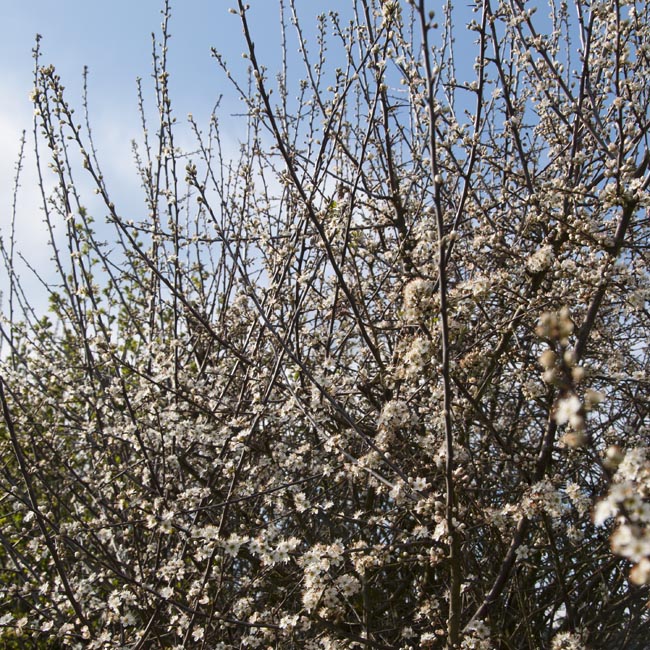
Spring is in full flood now, with bulb flowers and that lovely acid spring green colour of young leaves appearing everywhere.  You’re likely to be seeing lots of frothy white blossom in the hedges, and that’s worth keeping your eyes out for.  The sort you’re looking for is on otherwise naked branches, and spread evenly over the bush rather than forming clusters.

Blackthorn blossom

This is the blackthorn (the name is no coincidence!) or sloe bush.  So if you’re a fan of sloe gin (and let’s face it, isn’t everyone?) and fancy making some this autumn, make a note of any really good stands of blossom you see in the next week or two.  Final identification takes a slightly closer look – single small white flowers, armed with some nasty spikes on dark coloured wood.  The leaves, when they appear, will be small and rounded.

Blackthorn blossom - close up

You’ll notice that the blossom extends quite a long way inside the bush – this is one of the things that’s going to make picking, when you get to it, a bit of a challenge!

Read more from the Country Skills blog >>

Foraging Skills – how to get ahead!

I’ve been thinking about foraging recently.  There’s very little quite as special as a lovely – and free! – treat garnered from a hedge.  I’m thinking about a wild mushroom risotto, pots of crab apple jelly, a steaming blackberry crumble or a bubbling demijohn of rosehip wine.  Foraging is really an autumn sport, though, borne from the season of mists and mellow fruitfulness, so why am I writing about it now?

The thing that makes a really good forager isn’t being able to spot a laden crab apple tree at three hundred paces  – it’s knowing where that tree is in the first place.  Being a successful forager depends on keeping your eyes open all year round – if you notice things now, and remember them, you’re well on target for a bumper summer and autumn foraging season.

So just now, keep your eyes open for these, and make a mental note –

Hazel catkins in hedge

They’re hazel catkins, and where they’re hanging in profusion from the naked branches of hedges and shrubby trees now, there should be some lovely cob nuts in the autumn – they’ll be much harder to see then, when there are leaves on the tree, and hazels growing in mixed planting aren’t especially distinctive looking.  Watch like a hawk though, come autumn, and pick them slightly green and sweet – because the mice will want them too!

A little note on the legality of foraging – if the item is being grown as a crop, then it’s not foraging, it’s scrumping (or stealing!).  It’s very unlikely that cob nuts or blackberries growing in a field hedge are intended as a food crop, but the nuts and sloes in my garden hedge definitely are!  So if it looks like someone’s caring for a tree or a hedge, it’s in an orchard or garden or looks intentionally planted, tread with care!  That said, there at lots of edible crops grown incidentally on trees planted ornamentally, on streets and in council amenity spaces, particularly in urban areas – foraging doesn’t have to be just a country pursuit! – look out for apples, plums and cherries, too!

Read more from the Country Skills blog >>

Waxing Frugal – making a recycled scented chunk candle

Everyone loves a candle, they cast a lovely warm flickery light, and, chosen carefully, can fill a room with beautiful scent (sure, sometimes they can fill a room with the scent of cheap pot-pourri, but this is a matter of taste!).  After Christmas, we had several left over candle ends around the house, and rather than throw them out, I wanted to do something creative and recycle them.  But while there are lots of great candle-making kits out there, I didn’t really want to spend any money on the process.  So this is a candle-making project that, with the exception of some wick and a wick sustainer, you can do entirely with things that you already have around your home and kitchen.

Recycled chunk candle, burning

For this project, you will need –

  • Two old candle-ends, preferably one coloured & scented and one plain, total weight 300 – 400g
  • Empty Pringles tin (I recommend starting with a full one, and working on it!)
  • Large saucepan, a trivet (or an old saucer or side plate), and a large empty tin can (I used an empty malt extract can from home brewing, but any large catering size tin can will do)
  • Stirrer (I used a large wooden lollipop stick, anything will do but not something you plan to use with food!)
  • Chopping surface (again ideally not one you plan to use for food use in future)
  • Large knife
  • 6in length of appropriate wick, a wick sustainer, and something to use as a wick pin (a kebab stick is ideal)
  • Kitchen hob
  • Scales
  • Jam / sugar / preserving thermometer, old tea strainer (recommended but not absolutely required)
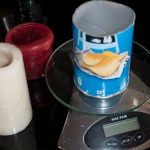
Basic equipmentGather up your equipment, starting with the knife and the pringles tin.  Cut the Pringles tin down to about 4″ high using your knife, and make a couple of ‘notches’ in the top on opposite sides of the top.

You’ll need to get an estimate of the capacity of your candle mould, so put a sandwich bag inside the Pringles tin, put it on the scales to zero, and then fill the bag with water to about a 1/2″ below the top.  The weight in grams of water is a good estimate of the volume in mls, as wax is slightly less dense than water (it floats on water, after all), you can reduce this estimate by about 10% to get the weight in wax required to fill the mould to this level. I came up with 300g and used around 270g as a target weight of wax.
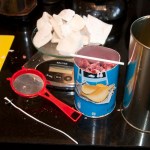
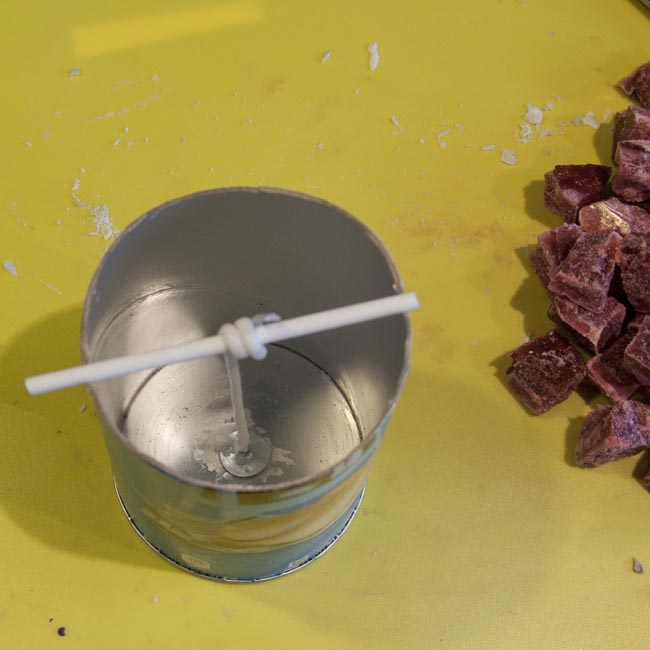
Prepared waxNow, cut up your coloured candle.  Try to cut it into even cubes a bit bigger than half an inch cubed, but it’s likely you’ll struggle, and if the pieces are a bit rough, don’t worry. From what you’ve chopped up, sort to one side and weigh all the sensible chunks, leaving the dust and small fragments aside (wrap these up for another project).  Weigh your coloured chunks (mine weighed about 140g) and put them in the mould to check how high up they come. Ideally this will be about the target ‘fill’ level.  Now roughly chunk up your white wax candle.  It doesn’t matter what size and shape these pieces end up, but the smaller they are the faster they’ll melt.   When working with old candles, try to avoid including the ‘melt pool’ from the candle as this will be dirty wax and may well include bits of old burnt wick and suchlike, which you don’t want in your shiny new candle.

A word about wicks, before we go on – the size and construction of wick you need depends on the chemistry of the candle-wax and the width of the melt pool you want in your candle (which is closely related to the diameter of your candle, usually).  When working with recycled waxes, the chemistry involves a fair bit of guesswork.  I assumed the waxes were a basic paraffin pillar blend, since this is the most usual situation for commercial candles manufactured to a price point.  There’s a useful wick size guide here.  (See my suppliers list and library for more reading.)  I used an LX16 wick which should have been a good match for the ~70mm diameter Pringles mould.  Secure the end of the wick into the wick sustainer using pliers.

Melting waxNow, start melting your wax.  Put the white wax into the large tin, and put the tin inside your saucepan on the trivet.  Fill the saucepan with water so that it comes up the side of the tin about an inch and a half.  Use the thermometer, if you have one, in the water.  You don’t want this to boil, but ideally it should stay around 75 degrees centigrade, which should be enough to melt the wax without risk of overheating.  The flash-point of wax is quite close to the melting point, and at the flash point the wax is at risk of catching fire, particularly if you have a naked flame in the vicinity (for instance, if you’re using a gas hob), so be careful and heat the wax very gently.

Primed wick in situOnce the wax is melted, you need to prime the wick, which just means dipping the wick into the wax so that it can be absorbed onto the surface of the cotton.  Also dip the sustainer in the wax, and use this to secure the sustainer to the centre of the bottom of the Pringles tin.  Stretch the wick up vertically and wrap it around the wick pin to keep it centred in the mould.
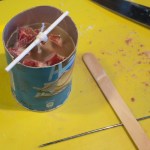
Chunk candle with poured waxNow, arrange the chunks of coloured wax in the mould around the wick, trying to make sure you don’t close off any pockets which would prevent the melted wax filling all the gaps.  When you’re happy, pour about 90% of the melted wax into the mould, pouring through the tea strainer if you see any ‘bits’ in it.  Keep the remaining 10% over a low heat to keep it liquid, and continue to keep a close eye on it.

Cooling candle by immersionThe wax will shrink as it cools and this will form a dip or a ‘well’ near the wick, which will affect the candle as it burns.  Encourage the candle to cool by putting the mould inside a plastic bag and immersing it into a bowl of water.  You will need to weigh it down to keep it immersed, I used a marble pestle, but anything heavy will do.  This is of course quite faffy, and if it’s a nice cold day, you’d probably do as well to put the mould outside for half an hour or so.

As the wax sets and you start to see a well forming near the wick, make a couple of holes in this area with a skewer.  Once the surface of the wax is springy but not hard to the touch, pour over the rest of the wax tapping the mould to make sure it goes into the holes you’ve made near the wick.  Now set the mould somewhere nice and cold to set – in the fridge if it’s a warm day, or outside if it’s January in the UK.

Candle cooling in mould

After a couple of hours the wax will have set hard.  I was expecting to have to sacrifice the Pringles can at the end of the moulding, but the wax had shrunk back nicely from the sides, and I was able to ease the candle out without having to destroy the mould – however your results may vary and I wouldn’t lose to much sleep about it if you have to break the mould away from the candle.  Trim the wick so that about 1cm is proud from the surface of the wax.

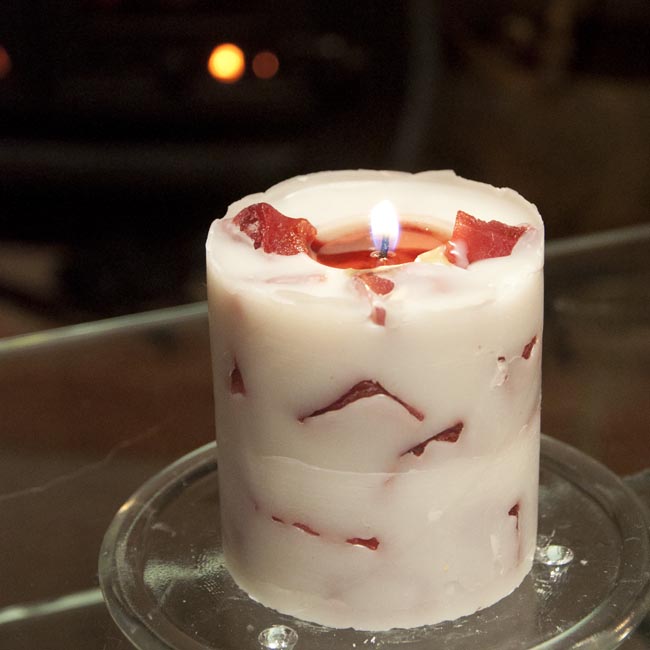
Recycled chunk candleRecycled chunk candleI’m thrilled with the results, which I think are very pretty for a first effort.  The white wax is a little bit ‘dirty’ which I probably could have concealed by using a little bit of ivory or honey-coloured candle dye.  I poured the bulk of the white wax in two ‘goes’ and you can see the line between them, which is something I’d avoid in future.
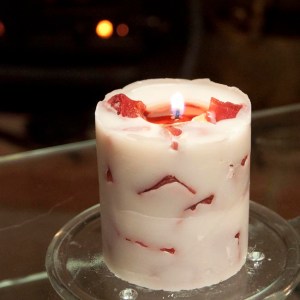
Recycled chunk candle, with melt pool

My only real criticism of the finished candle would be that I chose too small a wick – the melt pool the candle produces is quite a bit narrower than the body of the candle, and stops short of the sides by about half an inch all the way around.  I suspect this is to do with the chemistry of the original white candle, which we stopped burning for a very similar reason – lesson learned!  If I re-make this candle with the remains of the white wax from this batch I’ll use an LX20 wick which may give a better result.  The melt pool is very pretty though, a lovely dark pink colour from the mixed waxes and gives a gentle berry aroma.  For the cost of a new piece of wick, and a little bit of kitchen chemistry, it’s a beautiful, and extremely thrifty, scented candle.

Read more from the Country Skills blog >>

Happy New Year!

Here’s wishing all of you a very happy 2012, and hoping your new year’s celebrations went with a bang!  I should have written this yesterday, of course, but timeliness has never been one of my more natural talents (as people still waiting on Christmas cards from me will attest)!

Fireworks

I’m ambitious to do experiment with even more creative, country skills and crafts next year, and write about them too!  On my list is more brewing (cider, beer, and of course country wines), more curing and smoking, and experiments with sewing, crafting, recycling and thrift.  More food and recipes, of course, as well as some fruit & veg growing as the season starts to get warmer.  I also plan to write a little about my hens and poultry keeping, and to try some new crafts – at the moment I’m reading about candle and soap making, so watch this space.  Perhaps this year my Advent candle might even be homemade!
Thank you to all of you who have been reading the blog since it started back in October 2011 – both here on WordPress and in the syndicated feeds – your comments and feedback mean a lot to me and are very helpful, so please keep them coming!  I’d love to hear of any suggestions you might have for things I should be looking into and trying, too!

Handmade Christmas – cracking crackers!

Christmas crackers are great, and an essential part of Christmas dinner in my house.  I mean, what’s not to like about adults wearing silly paper hats after a lovely meal and plenty of wine?  But the ones I’ve bought always seem to contain absolute rubbish which no one would ever want.  How about making your own, with the traditional silly paper hat and motto, but with the added bonus of a small, thoughtful gift, an after dinner chocolate, or both?  Well, it’s simple and fun, here’s how!

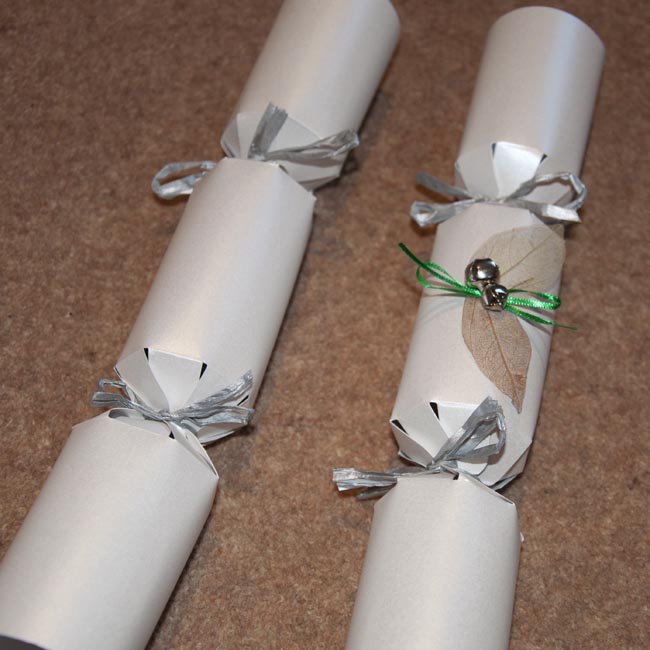
Handmade Christmas crackers

You will need:

  • Some cracker ‘blanks’, these are widely available from craft shops and on the internet in various sizes, colours and pack sizes.  I chose plain silver ones.
  • Cracker ‘snaps’, if these aren’t included with the blanks, one for each cracker you plan to make.
  • Ribbon, wool, raffia or string, for tying the crackers up, as decorative as you like.
  • Decorations for your crackers, if you want.  I used metallic leaf skeletons, some ribbon and a couple of small jingle-bells, all glued in place, but be creative, anything from the card making section of the craft shop is a good place to start, or how about some decoupage with last year’s Christmas cards?
  • Finally, cracker gifts!  I found some quite cute keyring gadgets of various kinds and also added a nice after-dinner chocolate.  If the gifts are for specific guests, put name-labels on the crackers.
  • Scissors, sticky tape, and clear glue.
  • Make hats and mottos yourself!

Making them couldn’t be easier and is a crafty relaxing way to spend a dark December evening.

First three steps of cracker constructionStart by sticking one end of the cracker snap onto the cracker blank with sticky tape.  Then roll the cracker blank using the tabs (cracker blanks have slightly varying designs, so follow the instructions that come with yours!).  Pinch, twist and tie up one end of the cracker with the string, ribbon, or other thread you’re using – I used silver paper raffia.

Decorating the finished crackersNow fill your cracker with all the bits and pieces, and tie up the other end of the barrel in the same way.  Once you’ve tied this up, stick the second end of the cracker snap into place.  You can decorate the crackers now however you like!

‘But what about my hat and motto’, you may be thinking?  I did see hat-and-motto sets for sale, but they’re awfully expensive considering what you get, a cheap tissue paper crown and a small slip of paper.

Making the hats couldn’t be simpler.  Get some Christmas wrapping paper, I used the end of a roll of white and silver metallic paper which I had knocking around.  First, measure the circumference of your head (unless it’s unusually large or small, in which case perhaps find someone with a more ‘representative’ head to measure – then again, you’ve made them, so perhaps it’s only fair to claim the perk of a cracker hat which fits for once!).  Now cut some pieces of wrapping paper twice as wide as the finished hat you want, and about 1cm longer than the circumference you’ve measured.  Using clear sticky tape, stick the paper into a loop.

Making paper crowns for crackers

Now fold the loop flat (image 1), then in half, then fold each of the halves into three, so that you’re now on the central panel of the film-strip above.  Now fold this in half one last time, then make a single diagonal cut half-way up the paper.  Unfold your two zig-zag topped crowns.  It’s like being back in primary school!  And since they’re neatly folded, tie them that way with ribbon or a small elastic band.

For the mottos, anything goes!  Good (or bad!) jokes, limericks (or haikus?), brain teasers, interesting facts, or even thoughts for the season or personal wishes for your family and friends’ year to come – make them pretty in a word processing package, print them out, cut into strips and fold them up with your paper hats.

Crackers needn’t just be for Christmas – they’re a lovely creative way to package small, special gifts.  An unusual way to wrap a special piece of jewellery, perhaps even a surprise ring?  Or consider using crackers to package wedding favours?

Handmade Christmas – decorated glass baubles

I have to confess to having a bit of a ‘problem’ when it comes to Christmas tree decorations – I love them.  Every year I try to add one or two (ok, sometimes a few more than one or two!) new pieces, to go on my tree year after year.  In recent years I’ve tried to make some of these rather than buying them, and this year I’ve bought nothing, which is a first!

Finished bauble on my tree

What I added to my tree this year were four lovely clear glass baubles which I already had, but which I have filled with wool fibres, giving what I hope you’ll agree is rather a lovely effect.

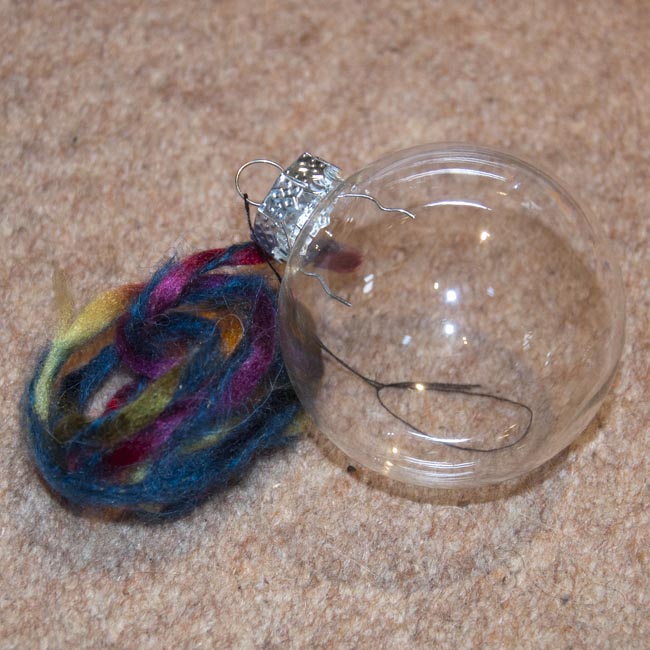
Bauble & woolMaking these is very simple – you will require:

  • Some plain clear glass baubles, any size but I used 6cm ones.  I bought them from a website a couple of years ago, but I gather they’re often available in craft shops before Christmas.
  • Wool scraps, as pretty and colourful as you can find.  I begged these from a friend who’s a keen knitter.

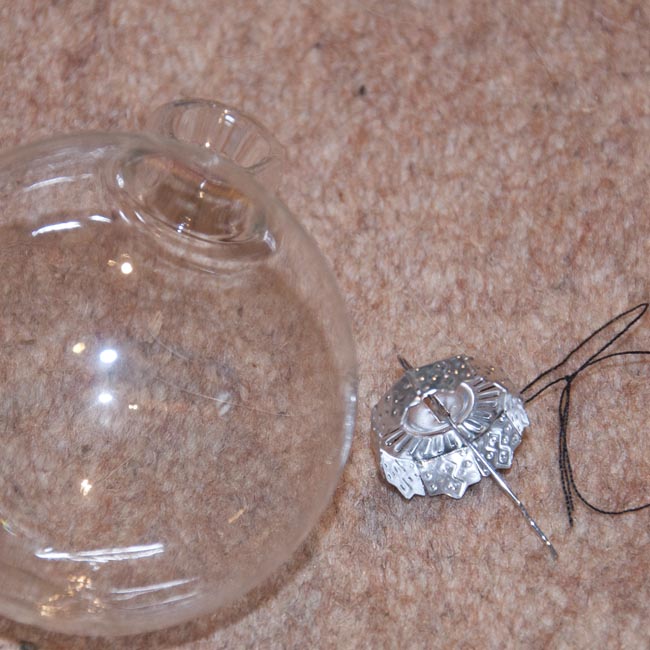
Glass bauble with top removedFirst, gently remove the top from the bauble.  With the normal design of blown glass bauble, you do this by squeezing together the sides of the metal hanging loop, which moves the ends together allowing you to (very carefully, broken bauble glass is sharp!) lift the metal crown from the bauble.

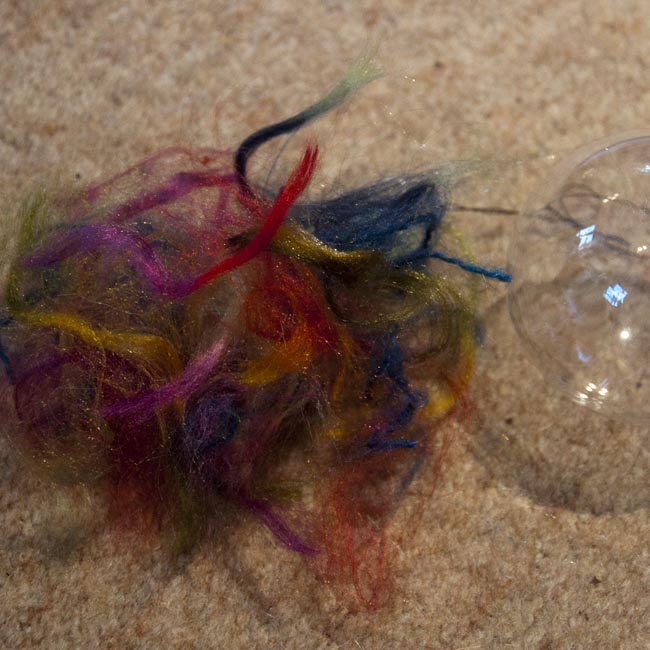
Bauble with cut lengths of woolNow take your length of wool – about a foot (30cm or 12″) is probably quite enough depending on how thick and fluffy it is.  Cut this into approximately 5cm / 2″ lengths.

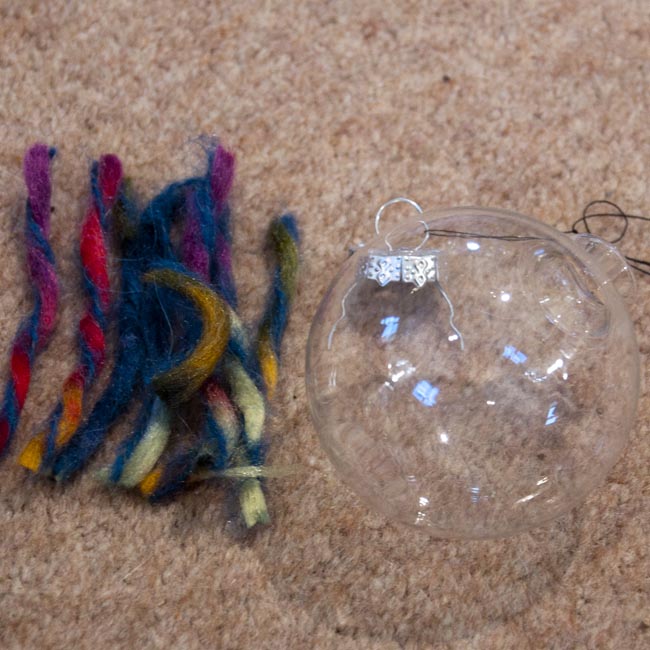
Teased apart wool fibresThen tease the wool apart gently into it’s component fibres.  Depending on the thickness and spinning type of the wool this might be more or less difficult, the wool I had was quite a loose structure and came apart very simply.  At this stage you need to assess whether you have enough fibres, since you want enough to loosely fill your bauble.

Inserting fibresFinally, use something like a chopstick or a pencil to gently push the fibres inside your bauble, and re-attach the cap.

That’s it, all done in only a minute or two, and the colours and effects you can achieve are only limited by your imagination (and wool collection!).  It’s so simple to create a colourful, textured, unique bauble for the price of a plain clear glass one, and these would make lovely gifts, too!  I’ve also seen pretty things done with ribbons, fabric scraps, or glitter inside clear baubles, so why not get creative!

Updated for 2012why limit yourself to wool, there are other things you can fill baubles with, too!

See more crafty ideas for a Handmade Christmas >>

Read more from the Country Skills blog >>