When Life Gives You Lemons – Part 3: lemon sorbet [Guest Blogger]

Lemon TreeToday’s Guest Blogger is Ross, from Christchurch, NZ.

Lemon sorbet

Next up, to cleanse the palate, a simple sorbet. Note that if you have an ice cream maker it’ll make life easier, but it’s not mandatory (I don’t have one).

This recipe uses 8 lemons, and makes about 2.5 cups of sorbet.

  • Make up some simple syrup (see post 1 of this series) with 1 cup of water and 1 cup of sugar.
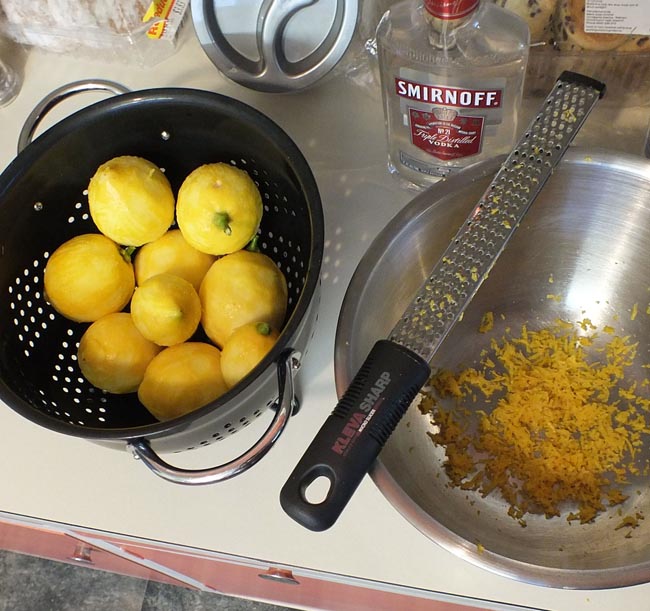
  • While it’s cooling, zest most of the lemons. You’re looking for about 2 tsp of zest – the finer, the better – I reckoned I had enough after six lemons.
  • Juice the lemons. You’re looking for about a cup of juice.
  • Mix the juice, zest and cooled syrup. Chill well (I left mine in the fridge for a couple of hours).

Now freeze. If you have an ice cream maker, you’re all set – but I don’t. That’s OK, it just means a bit more effort. The end product is a water ice, not a block of solid ice, so all you have to do is fluff it up a bit as it freezes.

Lemon Sorbet

  • I split the mixture into a couple of clean shallow plastic tubs and put them in the freezer.
  • After a few hours it was semi-solid; I mashed it up with a fork, then put it back in the freezer. Ideally I’d have done this again after a few more hours, but it was late in the evening so I left it overnight. This was maybe a bit too long as it was nearly solid so was a lot of work! (You could probably use a blender instead, but I don’t have one.)
  • Then put it back in the freezer. After 12-24 hours it’s frozen enough to serve.

Ross is an expat thirtysomething Brit who went to the Shakey Isles in search of adventure. Works in technology, enjoys creating, has a love-hate relationship with his kitchen.

Have a look at Ross’s other lemon glut-busting recipes for lemonade and lemon liqueur.  Coming up soon, lemon pickle.  Watch this space!

Read more from the Country Skills blog >>

When Life Gives You Lemons – Part 2: lemon liqueur, or ‘limoncello’ [Guest Blogger]

Today’s Guest Blogger is Ross, from Christchurch, NZ.

Lemon Liqueur

I did the first part of this at the same time as I made up some lemonade. This was a small test batch but will scale up directly.

IngredientsIngredients –

  • A half bottle of vodka (375ml) – not flavoured, you want something as pure and tasteless as you can find.
  •  8 lemons (zest only). Go for lemons with thick peels if you can, to maximise the amount of zest.

Sterilise a large sealable jar. This is the same as for making jam – a careful clean, rinse well, then dry in a slow oven.

Scrub and dry the lemons, make sure you’ve removed any wax. Now zest them; be very careful not to take any pith or you will spoil the result.

While the jar was cooling, I juiced the lemons to make the lemonade.

Lemon liqueur, infusingPut the zest into the jar and add the vodka. Make sure all the zest is covered, then seal it up and stash in a cool dark place for a while. I found a number of different recipes suggesting anything from 2 to 45 days; I left it for two weeks.

… time passes …

Make sure your bottles are clean and dry. You’ll end up with slightly more by volume than just the vodka.

Prepare a simple sugar syrup, and let it cool.

The amount of syrup you need is whatever will dilute your starting liquid to the desired strength (traditional limoncello is 30-32% ABV). In my case (375ml of 37.5% ABV vodka) this calls for 80ml of syrup.

Combine the infused alcohol with the syrup. Stir well. Optionally, say some recipes, let it rest for a few more weeks (I didn’t).

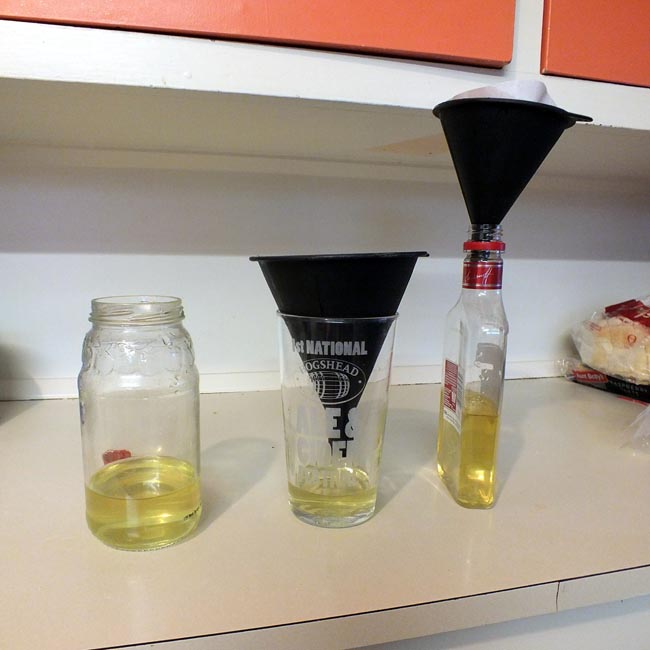
Filtering set-upNow filter carefully; for best results filter more than once. I started out with a sieve, then switched to coffee filters. I filtered it four times, which might be excessive; I set up a little production line (pictured). The filtering was slow, and the setup easy to knock over; I found myself longing for some clamp-stands like I used in chemistry class in high school. Unsurprisingly, the filters clogged quite readily; I got through several of them.

Bottle directly from the last filtration; the liqueur should be clear but coloured. At this point the product is very sweet and sharp. Let it mature in the bottle for at least a week; both the sharpness and the cloying sweetness melt away. Serve cold (direct from the fridge, or even the freezer). It’s dynamite-strong; take care!

Next steps?

This wasn’t real limoncello; apparently the genuine stuff is made with grain alcohol which pulls more flavour out of the lemon. (Grain alcohol as in 95% ABV – yes, almost pure ethanol – 190 proof in old money. It’s difficult to find on the shelves, but here in New Zealand it’s legal to distill spirits for personal use. There might be another blog post in here along those lines, but that’s a project for another day…)

Ross is an expat thirtysomething Brit who went to the Shakey Isles in search of adventure. Works in technology, enjoys creating, has a love-hate relationship with his kitchen.

Coming soon, more lemon glut-busting recipes from Ross – lemon sorbet, and lemon pickle.  Watch this space!

Read more from the Country Skills blog >>

When Life Gives You Lemons – Part 1: Lemonade! [Guest Blogger]

Today’s Guest Blogger is Ross, from Christchurch, NZ.

Lemon TreeWhat to do when life gives you lemons?

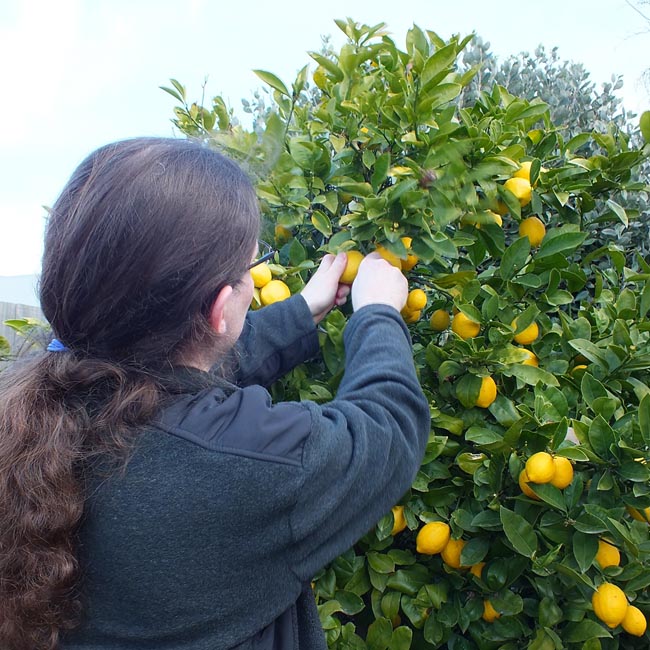
We have a lemon tree. Consequently, we have a lot of lemons. It’s just turning to spring here in New Zealand as I am starting to write this, it’s our first spring in this house, and we have a crop ready to harvest.

As a long time reader of the Country Skills Blog I went fishing for suggestions. There is plenty of marmalade on here, which I must get round to trying out sometime, and everybody has heard of traditional old-style lemonade, but what other interesting things can we do with them…?

Studying some recipes I found recipes for a lemon liqueur not entirely unlike limoncello, which use only the zest of the lemon, whereas lemonade uses only the juice. A perfect combination for the first experiments!

Simple Sugar Syrup

This comes up in a few of these recipes, so I’ll describe it once.

Take roughly equal volumes of sugar and water. Mix and heat in a small pan; boil gently until the sugar has dissolved leaving you with a clear syrup. You usually want to leave it to cool before you do anything else with it; if not, take care – it’s like napalm.

Fresh Homemade Lemonade

Lemonade 1Ingredients:

  • Lemons (juice only),
  • sugar,
  • (optional) fresh mint to garnish.

120ml of lemon juice + 1/2 cup sugar makes about 650ml lemonade.

Juice however many lemons. I got about 120ml from the eight lemons I used for my test batch of limoncello; I could have probably got some more from them if I had tried harder.

Lemon JuiceMake up some simple syrup following directions above. I used the same volumes of water and of sugar as I had lemon juice – near enough 1/2 measuring cup of each.

Let the syrup cool, then transfer to a jug. Add the lemon juice, then more water to dilute: three times as much water as you put into the syrup, so I used 1 1/2 cups. Chill well before serving. If you have any fresh mint to hand (I didn’t), it would make an excellent garnish.

Ross is an expat thirtysomething Brit who went to the Shakey Isles in search of adventure. Works in technology, enjoys creating, has a love-hate relationship with his kitchen.

Coming up soon, more lemon glut-busting recipes from Ross – lemon liqueur, sorbet, and lemon pickle.  Watch this space!

Read more from the Country Skills blog >>

Halloween Rib Cage T-Shirt – five minute fancy dress

Oh no – you’ve got a Halloween party this evening, and to call your costume an afterthought is, sadly, dramatically to over-estimate the amount of thought that has actually gone into it so far!  We’re just back from a lovely week in Cornwall, eating great food and walking the dog on the beach.  I’d completely forgotten about our village pub’s ‘costume optional’ Halloween event this evening until we got home about an hour ago!

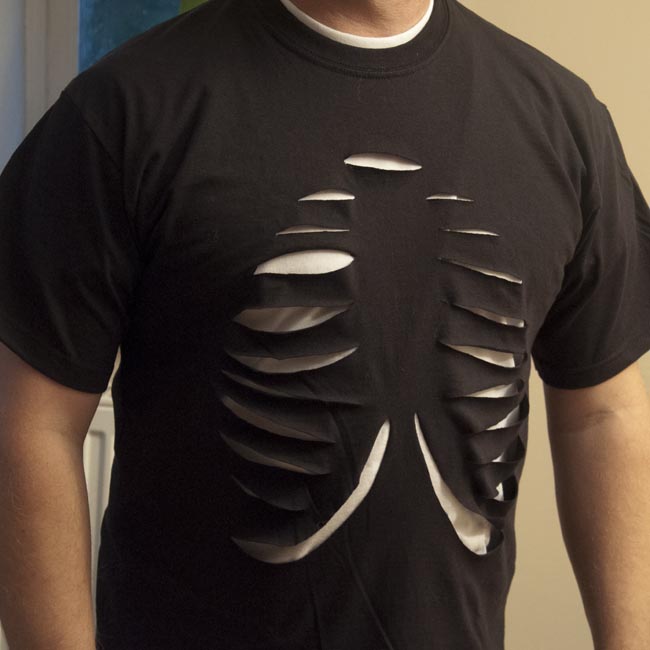
Halloween Rib Cage T-shirt

But, all is not lost.  Look at my natty outfit (kindly modelled here by Hubby)!

This really is a five minute costume project.  It’s thrifty, too, and no sewing required.  You’ll just need to round up the following –

  • A ‘sacrificial’ black t-shirt,
  • a white-t-shirt that you’ll get to wear again,
  • a cutting mat, small rotary cutter, and a tailor’s chalk / pencil, and
  • a basic grasp of human anatomy (google images can help you with this bit!)

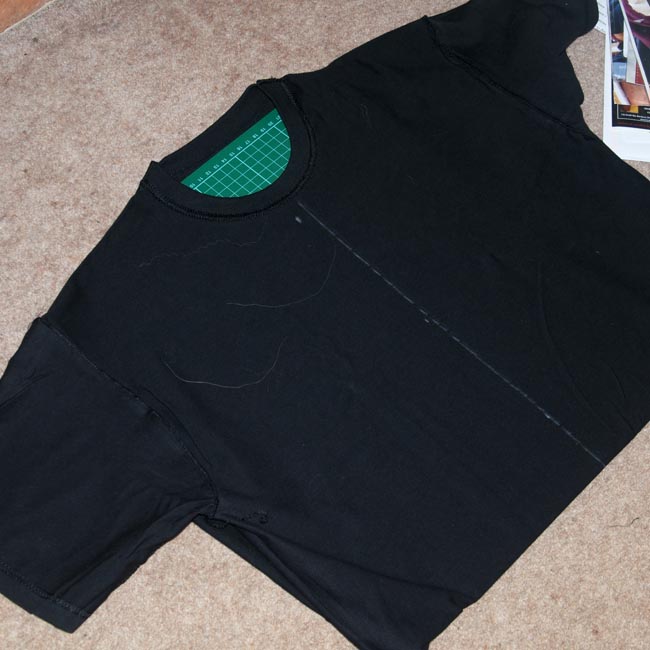
Find the approximate centre lineStarting with the black t-shirt inside out, mark out the centre line as best you can.  This will be surprisingly difficult to do with any accuracy as the quality control on these things is always shockingly poor, so a decent best guess at it is perfectly alright.

Mark out ribsNext, using the tailor’s chalk, mark out a set of ribs to one side of your centre line.  There are lots of rib cages in google images to look at, and I found the PDF template for a much more complicated version of this project on marthastewart.com was a useful guide to the general size and shape of the ribs.  Remember to offer up to the white shirt you’re planning to wear underneath to make sure you’re not massively ‘out’ when it comes to necklines.

Fold for cuttingNow, fold the t-shirt in half along your centre line, so that you have both halves of the front of the shirt front-to-front and your chalk markings showing, and the cutting mat underneath.

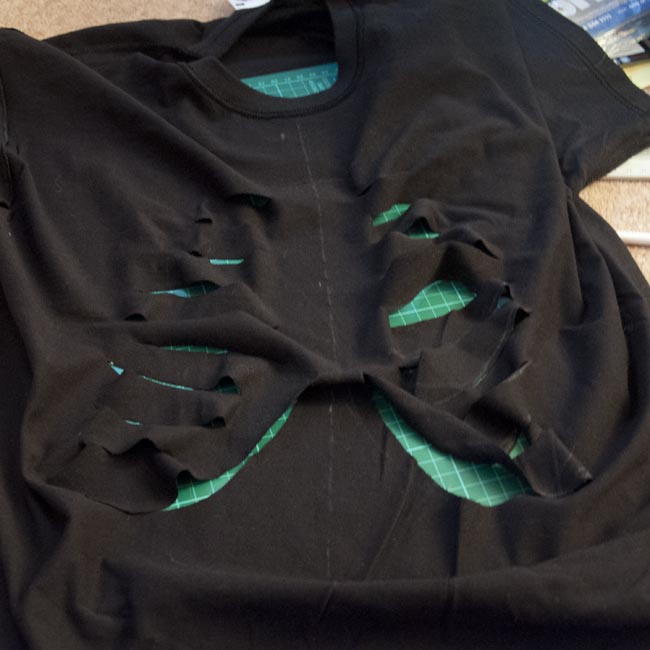
Cut along markings with rotary cutterCut carefully along the rib markings with your cutting wheel, through both layers of t-shirt, so that the pattern is cut as close as possible to identically on both sides of your chest.

That’s it, unfold your t-shirt, and put the cutting mat inside so you can tidy up any bits the cutter hasn’t cut cleanly.

And you’re done.  Simple, or what?

You could do the back now – but don’t cut the same pattern, as the back of the rib cage differs quite a bit from the front!  But if you can’t be bothered, pair it with a cape (or a long dark coat!), dark trousers or a black skirt and knee boots, and – if you’re feeling especially keen! – a scythe made from a broomstick with a cardboard and tinfoil blade.  You’re all set!

Time to get ready to party without feeling like you’ve completely failed to go to any trouble!  Enjoy your parties, folks, and have a ghoulish good time!

Read more from the Country Skills blog >>

Felt Like This – washing machine felt, and five minute fingerless gloves

I have a confession to make – I can be a bit of a hoarder!  I’m at my worst when it comes to clothes, even when they’re worn out, damaged, or utterly unsuitable, not even good enough for the charity shop, I look at all the lovely fabric and can’t bring myself to throw them out. Instead, they end up pushed to the back of the cupboard, or in bags and piles for ‘doing something with’, one day.

Finished fingerless gloves

Browsing around the web a few months ago, I came across a reference to washing-machine felt, a technique for taking unwanted woollen knitwear and turning it into a wool felt which can then be used in other projects.  All the tutorials I found seemed to hinge on also having access to a tumble dryer (which I don’t), but I had a dig about in the back of the wardrobe, rounded up three dead jumpers (two of which had already suffered and shrunk a little in the wash) and decided to give it a go.  It’s important that the jumpers you’re felting are entirely – or almost entirely – made of natural woollen fibre, as polyester and other synthetics won’t felt properly.  Mine ranged from 80% to 100% wool.

The 'donor' jumpers, before feltingI threw them all in the washing machine with a scoop of normal detergent, and selected a 60 degree cotton wash with all the ‘extras’ selected – extra dirty, extra spin, you know the sort of things.  Kids, this is not a good or friendly thing to do to knitwear (do kids these days even wear woollens??).  The jumpers came out of the machine half the size they went in, and undeniably now made of felt.  Success – and no dryer required!  After a couple of days drying, I was ready to have a play.

The fabric you’ve made will now behave very much like manufactured felt (though it’s a bit thicker than the stuff you buy by the square foot at the craft shop – and rather more robust) or polar fleece. You can cut it without it unravelling, and the edges don’t need finishing.

Cut lengths from sleeves

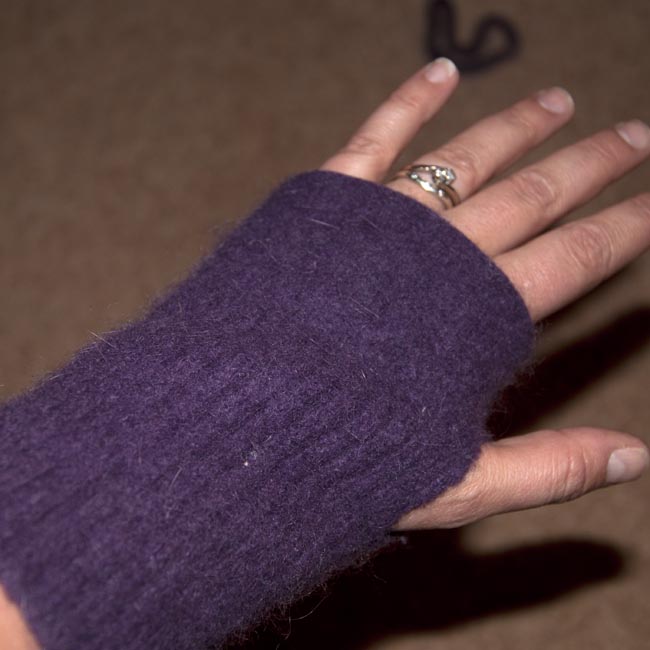
For a really quick satisfying up-cycle from your first washing machine felt sweater, how about a pair of fingerless felt gloves?

Work out how long you want your gloves, and cut the appropriate length from the sleeves of the felted jumper.

Offer up for thumb position

You’ll probably want the cuffs of the sleeves to be the cuffs of the new gloves.

Snip thumb holesNow decide where you want your thumb holes, turn the sleeves inside out, and snip out that part of the seam from the inside of the sleeve, leaving a slit of the right length to fit your thumb through.  Err on the small size, you can always cut more later.

Completed fingerless gloveThat’s it, if you want it to be!  Not even five minutes work.

But you can embellish these gloves really easily, if you like.  The sky’s the limit, really, for embroidery and embellishment, but I decided simply to add some blanket stitch to the unfinished edges and thumb holes, using some pretty multicoloured contrasting knitting wool I had lying around.  Blanket stitching the cut edges, like I did, has the added bonus that it should stop the seam coming undone as time goes by.

Quickest, simplest fabric recycling project ever, isn’t it?  Anyone can do this, so give it a go!

Read more from the Country Skills blog >>

Happy Birthday – and a new home for the blog!

Doesn’t time fly!  I can’t quite believe it was a year ago (well, near enough) that I sat down and wrote ‘Bringing Home the Bacon’, and the Country Skills blog was born.  And it just so happens that while we’re on the subject of milestones, this is also the blog’s 100th post!

Well, everyone likes a birthday celebration, don’t they, and what’s a birthday without presents and candles?

First Birthday Candle

So, there’s the candle, and now for the present – the Country Skills blog has a new home at https://countryskillsblog.com/ although old links via the wordpress.com domain will continue to work through the magic of redirects.

I’d like to thank all my lovely readers – both regular and occasional! – for taking the time to stop by my little blog in the last year, and particularly those who’ve paused to comment or ‘like’, and helped me feel I’m not talking to myself!  Some of you have really helped me out – I don’t think the Sourdough Saga would have come to such a successful conclusion without your advice and feedback – and for that I thank you all from the bottom of my heart.

Here’s to many more years happy blogging!  Please do let me know what you think, I’m always happy to hear suggestions!

Read more from the Country Skills blog >>

Relight My Fire – DIY recycled wax and wood-shaving firelighters

The chimney sweep came this week, and with the equinox just passed, the nights are palpably drawing in.  We use the wood-burning stove in our living room for an awful lot of our heating in the winter – the alternative for us, living off the beaten track (and off the gas main!) is our oil-fired boiler, which is both expensive and not terribly environmentally considerate.  But even if you’re not using your fire daily, there’s nothing better than a real wood fire as the nights get colder and darker!

Firelighter burning well

We have a fire most nights in the winter, and that brings with it a requirement for firelighting.  We cut our own kindling wood from our log supply (well, I say ‘we’ – Hubby does it!) so it’s not as tinder-dry as the bags of kiln-dried kindling sticks you can buy at great expense.  While I’ve succeeded in lighting the fire with newspaper, cardboard and kindling, it’s a frustrating exercise, doesn’t always work first time, and we tend to use a firelighter to get the kindling going nice and quickly and conveniently.  There’s only one downside – the white firelighter blocks you get from the co-op or the garage *stink* of kerosene.  I don’t want them in my living room!  And while I occasionally see the nicer wax & sawdust type for sale locally, I can’t buy them reliably.

But they gave me an idea – with the waste-wax I have available from old candles (believe me, I’m really bad at throwing things away, even stuff like this!), the really grotty old stuff that really can’t be recycled into new candles, from melt pools, stained with soot, with old wick and ash and even match-heads in it, in different colours and scents, could I make my own?

The answer is resoundingly *yes*, but with a caveat…

Equipment and 'ingredients' (1)You want about equal volumes of wax and closely packed wood shavings.  I was hoping to use some wood-shop waste, to make the whole thing completely free and recycled, but the stuff I could get hold of was too fine and dusty and mixed with big chunks of ‘stuff’.  I think the shavings produced when hubby breaks out the wood-turning lathe would be ideal, so I’ll save those in future.

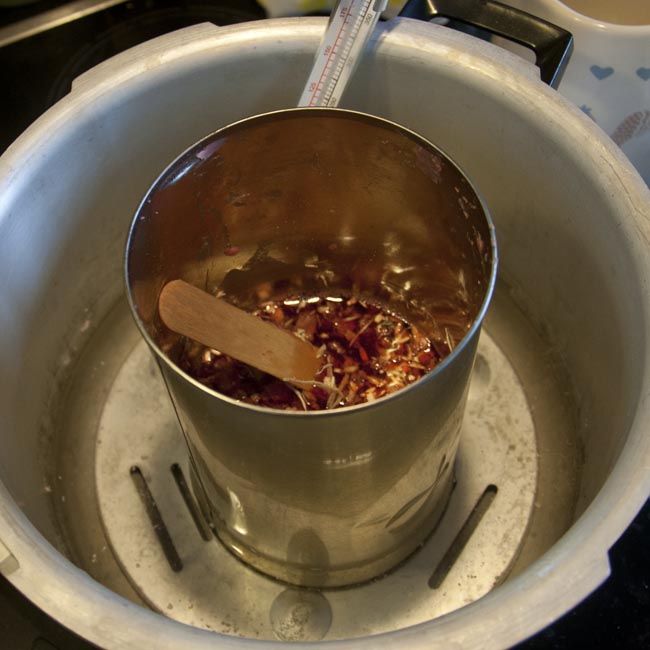
'Ingredients' (2)For this batch I used a cup of wood shavings I stole from the supply we keep for the henhouse, it’s a tiny amount and probably cost a couple of pence at most (and technically I suppose is a recycled by-product, anyway!).  You also want an egg box (I had a few old dozen-sized egg boxes that have been damaged beyond useful re-use), and a double-boiler arrangement for melting your wax, preferably with an inner container you don’t want to use again for ‘clean’ candle-making, and a thermometer for safety.

Take your dirty grotty old wax and put it all into the double boiler, and heat the water up to about 75 degrees celsius.  This should allow you to melt the wax down without getting too close to the flash point of your wax.  I’ve used an old can which previously held malt extract for home-brewing, it’s about the perfect size for melting candle wax.  Really, any dirty old wax goes here, and don’t worry about trying to remove old bits of burnt or unburnt wick, wick sustainers, matchsticks, or anything like that.  Add more wax in stages as the contents of the can melt down, until you have the sort of volume of melted wax you need (it was about 1/3rd of the can, once melted, for me).

This part of the process is where my caveat comes in – it took a bit over an hour to melt down all this wax, during which I couldn’t really leave the wax unattended on the stove (though I did get the chance to have a nice chat on the phone with my little sister).  The time investment in making these as a standalone project probably, for me at least, make the cost / benefit of this project a bit suspect!  There may be ways around this, more of which later!

Melted wax with about half the shavings addedOnce all your grotty old wax has melted down (it will smell quite peculiar if, like mine, it contains fruity, citrussy and maple-syrup scented candle-waxes!), add your shavings in batches, stirring as you go.  You want most of the wax to be absorbed into the shavings, leaving just a little bit of ‘free’ wax to set the mix as it cools.  Pack the mix into the wells of the egg boxes, filling them to the top, and squeeze down the contents with your fingers (wait for it to cool partially before doing this, if you like).

Firelighters settingMy mix made an almost perfect dozen firelighters (I also made two ‘experimental’ lighters with rolled-up cardboard in the well). Allow the firelighters to cool, and then separate them (tear, or cut into the underside of the egg carton to get things going).  Mine look like rather suspect pink raw minced beef products because of the red waxes that went into the mix!  There’s a very subtle smell about them if you stick them right up to your nose, but nothing unpleasant.

So far so good, right?  But it’s all ‘for nowt’ if they don’t actually light fires!  Would they do the job?  Would all the wax melt and dribble out and make a mess of my lovely newly-serviced wood stove?

Setting fire to the lighter & kindlingBuild your kindling ‘jenga pile’, and nestle the fire lighter in the centre.  Then set fire to the cardboard edge of the lighter with a match, and watch it go!  It burned amazingly well, cleanly, with no wax dripping, and got up to a really good temperature, the kindling wood was snapping, fizzing and crackling almost immediately and the fire got off to a roaring start!

I suspect actually about half the total volume of firelighter would have done the job – a whole egg-well seemed a bit generous.  I might under-fill the wells a bit in future and see if it still does the job.

But ‘in future’, if the process is this time consuming?  Well, if the performance of these firelighters weren’t quite so good, I suspect I wouldn’t be making them again.  I think it will be a task that I do ‘in the background’ in a second can when I’m using the double-boiler for clean candle-making anyway (I’ll be doing quite a bit of this in the build up to Christmas!).  If you’re doing any similar candle craft, and have space for a second melting pot (or if you have one of those natty thermostatically controlled wax melting gadgets that you can set-and-forget to a greater extent) then I can thoroughly recommend making these free, recycled little firelighters.

Keep those home-fires burning bright!

Enjoy your fires this winter, folks (and have a look at my useful little tip for cleaning the glass on a wood-burning stove, while you’re at it)!

Read more from the Country Skills blog >>

Using Your Bottle – self-watering planter success!

Earlier in the week I wrote about my last batch of bottle cutting experiments.  Just a quick post to update, especially about the self-watering planter which, I had to admit, I had my doubts about!

Self-watering planter

Well, it works!  The compost is staying moist, the water level in the reservoir is very slowly – but visibly – dropping, and the basil seems to be thriving!  There seems to be an added bonus with this design, which is that the glass captures the heat from sunshine much more effectively than traditional pots.  The soil feels quite warm to the touch on a sunny day, which can only do good things for the plants’ growth over the winter, right?

So, many more of these to come, I think!  Hubby not too sure about me filling up our windowsills with recycled wine bottles, but I’m sure he’ll come around!

Read more from the Country Skills blog >>

Using Your Bottle – testing some ideas for bottle cutting crafts

I’ve been wanting to play some more with the bottle cutting jig since my first attempts at bottle cutting a few weeks ago.  This weekend I found a few hours and raided some bottles from the neighbours’ recycling bins, and got to work.

Almost completed bottle cutting projects

My success rate this time stayed stubbornly around the 1:3 mark.  It’s becoming clear that two things are combining to be a problem.  The first is that accuracy in the score mark is absolutely critical – if you don’t get a perfectly straight even score that meets neatly, there’s no chance of the bottle breaking cleanly.  The second is that bottles are *rubbish*.  Of the bottles I’ve cut – and failed to cut – so far, not one is made up of even thickness glass, and most of them aren’t even anywhere near round in section!  This makes getting an even score more challenging, as well as tending to make the bottle break unevenly as a result of the variable thickness of glass.   There are a handful of gadgets on the market (and one interesting looking one, called the Kinkajou, about to come on the market) which might well improve my hit rate on nice reliable score lines, but I’m still trying to keep this a low-cost hobby for now!

Glass cutting jigStill, a couple of hours work (mostly removing labels!) got me three new nicely cut bottles – a 500ml green cider bottle, and two punt-bottled wine bottles, one of which I cut long, and discarded the top to make a vase, and the other cut more centrally to give a top and bottom section.  Sanding down (see my previous post for more details of the cutting process) gave me safe cut edges.

I’ve really wanted to play with etching, because I’ve seen some beautiful glass decorating projects, but hubby really wasn’t very enamoured with the idea of me using concentrated acid paste in the kitchen (and I can kind of see his point!).  I settled on using some frosted-glass effect spray paint made by plastikote.  This slightly offends one of my fundamental design principles, actually, but never mind!

The ideas for using the bottles were mostly gleaned from Pinterest, which is a new and rather addictive time-sink (those of you who’ve also discovered this can have a browse of my boards here).  I used some black sticky-back vinyl as a masking material for two of the pieces.

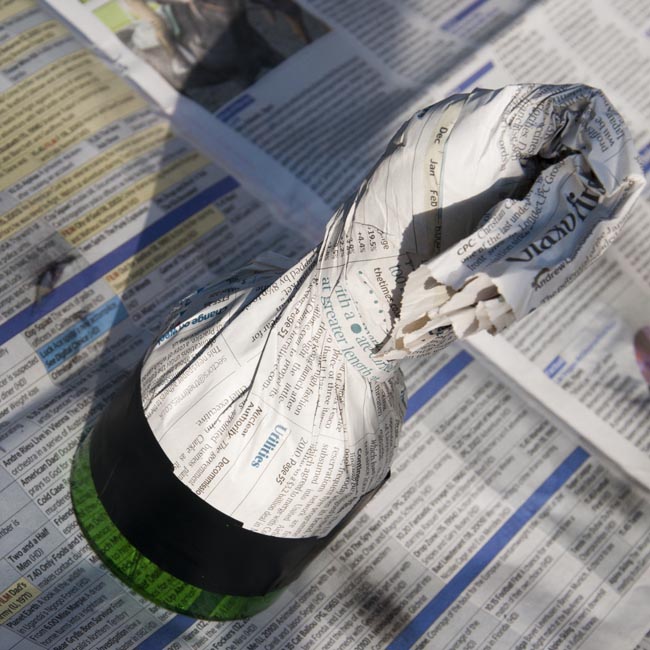
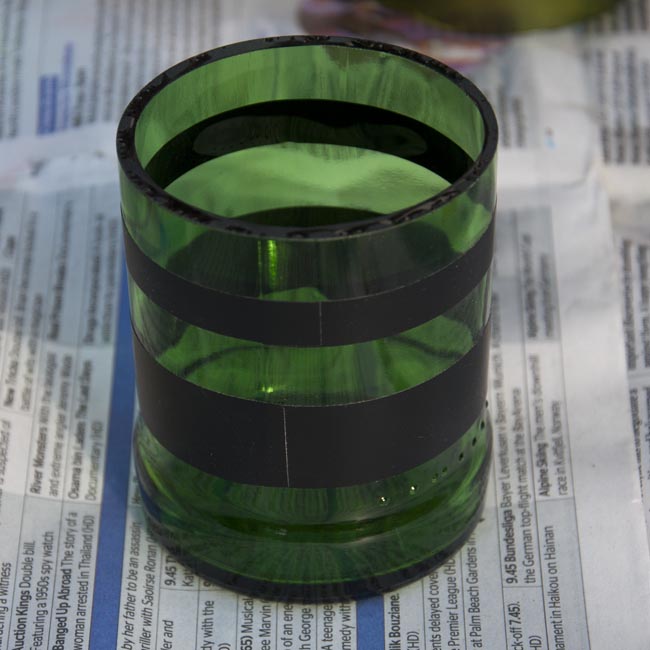
Masked-off bottle topIsn’t it great when you discover that the bits and bobs you’ve bought for one craft can be pressed into service for another?  I dug out the rotary cutter, ruler and cutting mat I bought for quilting, and got to work cutting strips of vinyl.  Two to wrap around the bottom of the cider bottle, to give a striped finish, and the off-cut with some newspaper to mask off all but the edge of the cut-off top of the wine bottle.

Masked tealight holderThis vinyl is a great masking material for glass, as it adheres tightly, stretches just a little to account for the wonkiness of the bottles, and comes away cleanly without leaving any residue.  The resulting cider bottle makes a very pretty tealight holder which would make a lovely little gift.

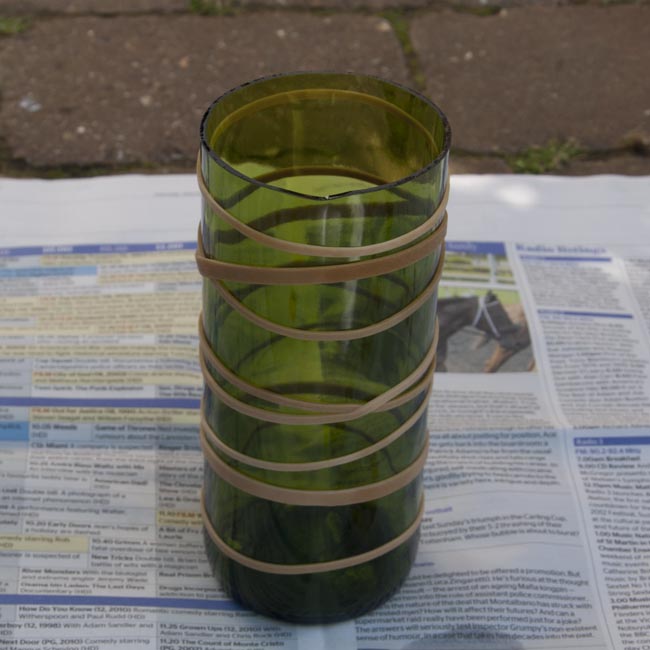
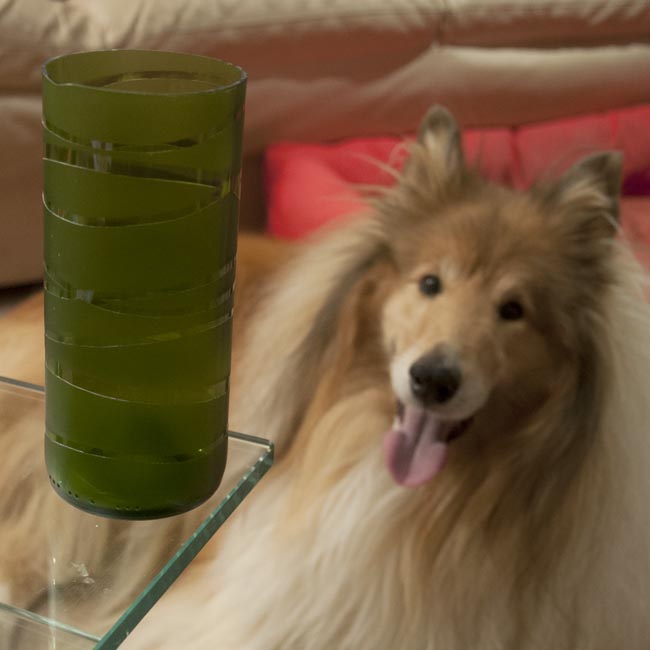
Masked vase with rubber bandsFor the bottle destined to be a vase, I borrowed another idea in wide circulation on pinterest and applied rubber bands, some overlapping, rising and falling. The first thing to note about this approach is that the rubber bands don’t arrange themselves  – it actually takes quite a lot of faffing to get a pleasing arrangement of lines.  They’re not an ideal masking material, either.  As you apply the instructed two or three layers of the frosting paint, some will settle on the top edge of the rubber bands (this is much less of a problem with vinyl which is very thin and doesn’t collect ‘overspray’ in this way).

Dave with vaseThe rubber bands came off easily once the paint had dried overnight, but it took quite a lot of delicate trimming away of the extra paint with a scalpel blade to get a reasonable finish.  I’m still not entirely happy with the outcome, and if I try this approach again I’ll try to get away with one, perhaps two layers of paint rather than the three I used.  Still, the result is quite pretty, isn’t it?  Dave said he wanted to be in the photo, and who am I to disappoint him?

Landscape fabric with stringFinally, and perhaps most interesting for me, is the bottle cut in half.  I’ve made a self-watering herb planter, based on a photo I saw – guess where? – that’s right, pinterest again.  The top of the bottle is up-ended inside the bottom.  I lined it with a cut rectangle of landscape fabric about 4″ by 8″, one half of which I threaded through with a bunch of jute string. Fold this in half with the string dangling through the neck of the bottle. Then, fill with compost and plant (in my case, with some rather sorry-looking home-grown basil I always forget to water).

This is where I admit to being a really neglectful gardner.  I’m full of enthusiasm, but when it comes down to it I have a nasty habit of forgetting to water, to pot on, to plant out…  my garden thrives on it’s own resources more than on my care, and my houseplants have to have a strong will to survive!

Self-watering wine bottle planter

So if this contraption actually works (and the jury is still out on this – it’s early days) then it’s going to change my window-sill gardening forever.  Herbs that will water themselves!  In a planter which is recycled, free, and really pretty, rather than something ugly and plastic and more suited to greenhouse shelving than living room windows.

I’ll update with more photos of the herb planter once it’s clear whether there’s any merit to the design.  In the meantime I suspect there’s quite a bit more mileage in breaking bottles for fun and (perhaps??) profit…

Read more from the Country Skills blog >>

Bottling It – a first ‘crack’ at recycled glass craft

Some time ago, I came across a blog claiming that you could cut wine bottles with a burning bit of string soaked in acetone.  This sounded hilarious fun, but also a tad more dangerous and unpredictable than I was entirely happy with!  The idea didn’t desert me, though, and as time went by I was thinking of more and more different ways I might use recycled wine bottles, if only I could neatly (and safely!) cut them in half.  Green Glass make some beautiful drinking glasses out of recycled bottles, which were another source of inspiration.  This is a real ‘upcycling’ craft (a word which often seems to be an excuse for selling overpriced old junk on etsy!) creating something pretty and useful out of the contents of your recycling box!
Glass craft - candle holder

So I did what we all do, and broke out a bit of depth-first google searching.  A few idle lunch-breaks worth of reading later, and I eventually decided that I was happy to experiment with a cutting process where hot and cold water are used to ‘crack’ a line scored on the outside of the bottle with a diamond-tip glass cutting tool.
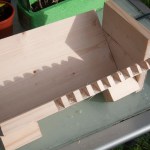
DIY cutting jigOf course, the knack is getting the score line straight.  People will sell you various bottle cutting jigs and devices that work on this principle, but I didn’t want to buy any expensive kit for this, at least to start with.

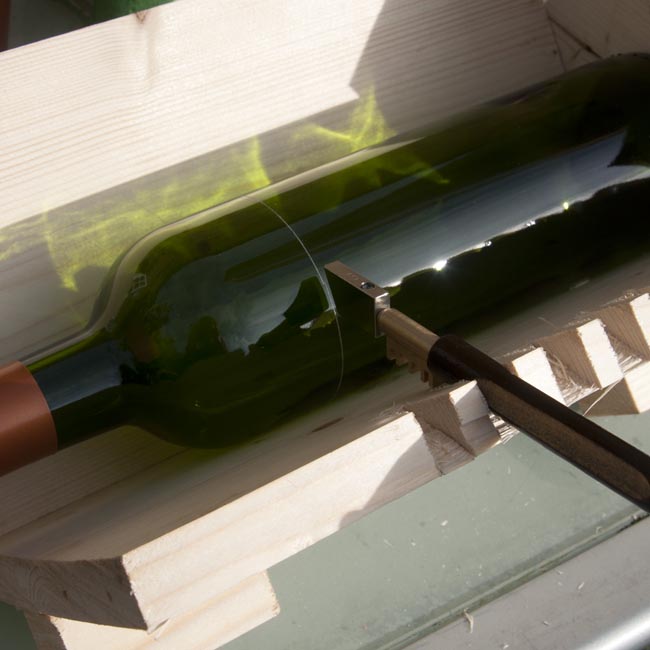
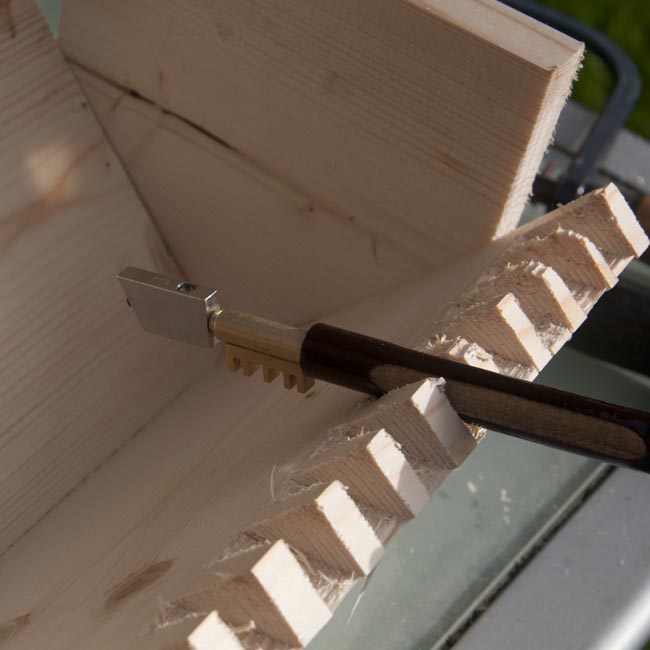
Jig with cutting toolA bit of thought and collaboration from my lovely husband, and we built this contraption out of leftover wood from the shed.  It’s a v-shaped cradle to hold the bottle with a solid end, and notches cut in the side to stabilise the handle of the cutting tool.  The cutting tool itself came from amazon and cost a couple of pounds.

Give some thought to what you want from your bottle, and whether the traditional bump found in the bottom of most bottles (called a ‘punt’, apparently – here I was thinking a punt was a flat bottomed boat propelled with a pole on shallow rivers in British university cities) is a use or a hindrance.  It might be fine if you want to make a vase, for instance, but not so useful if you want a candle-holder.  Some bottles are tapered or squared-off, and these you probably also want to avoid!  Now, give your bottle a good scrub and remove all the labels. You should to do this first, before there are any sharp edges to work around!

Scoring the bottlePut your bottle in the jig, place the glass cutting tool in an appropriate slot and gently press the scoring head against the side of the bottle.  Now, very slowly, rotate the bottle against the point of the cutting tool.  You’re aiming to complete a perfect full rotation, without leaving a gap or ‘over-writing’ the start of your line at the end.  If the score line isn’t complete and perfectly straight, the bottle isn’t going to crack evenly.

Accuracy is everything, as it’s a one-shot deal and mistakes cannot be corrected later – but on the plus side, the bottles are free and only destined for the recycling bin in any case, so try not to fret about it too much!  My success rate so far for a clean break is about 1 in 3 – not great but it’s early days and I suspect practice will help improve this somewhat.

Once you’ve scored your line, it’s time to get it to crack.  Different approaches are advocated, but I went for the simplest one.  Boil a kettle of water.  Holding the bottle over the sink, pour freshly boiled water gently over the score line, rotating the bottle slowly.  After a few seconds, put the bottle under the cold running tap and repeat the process of rotating it.  I haven’t got any photos of this bit, because both my hands were a bit occupied at the time!

Uneven breakYou’ll have to do this a few times, but you’ll see – and perhaps hear – the score lines start to give way.  If you’re really lucky, the bottle will break cleanly straight along the score line.  This one didn’t!  The fracture line wavered quite dramatically above and below the score line over about 1/3rd of the circumference.  I’m not sure why, whether it was to do with the score line, or the fact the bottle itself which was quite uneven in thickness.  Whichever it was, it’s a dead loss, so throw it away and fetch another one from the recycling bin.

Other approaches I’ve seen advocated include candle flame followed by ice cube, and tapping the bottle from the inside near the score line, though this requires a crank-headed tapping tool. I have no idea if these approaches might result in a better success rate – certainly tapping may give a different, more controlled break than hot/cold shock.

Fortunately, my first try (when I wasn’t taking photographs – typical eh?) did break cleanly, giving me a goblet about four inches high which I wanted for a candle holder.  It broke with a very slight ‘notch’, which I was able to crack off using the glass cutting tool to give essentially a clean cut.  A very *sharp* clean cut.

Sandpaper to grind the edgesSuccess!  But that’s not it, of course, since you’d have a candle holder specifically designed to maim the unwary, which is a silly enough thing to keep around your own house, never mind consider giving as a gift.  Those sharp sheared glass edges are going to have to go.  My approach is low tech – wet, fine grade silicon carbide sandpaper.  I used a slightly coarser grade to take the edges down initially, and then finished with some really fine paper.

Working wet greatly reduces the production of glass dust, which is nasty dangerous stuff that you should not be inhaling.  Work in a well ventilated area (outside, for me!) and ideally wear a dust mask.  Feel the edge *very* gently and tentatively with a fingertip to check the sharp edges are gone to your satisfaction.

Carefully work on the edges as well as the flat cut surface.  A little piece of sand paper wrapped around a pencil or something similar is good for the inside edge without scratching the glass.  I’ve seen the use of a dremel advocated – I can see how that would work really well but you’d want to be really careful about dust, probably dipping the grinding head in water every few seconds to keep it wet.  You’ll want to do much more careful and comprehensive smoothing work on the rim if you want to use your cut bottle as a drinking glass – but your extra efforts may well be worth it!

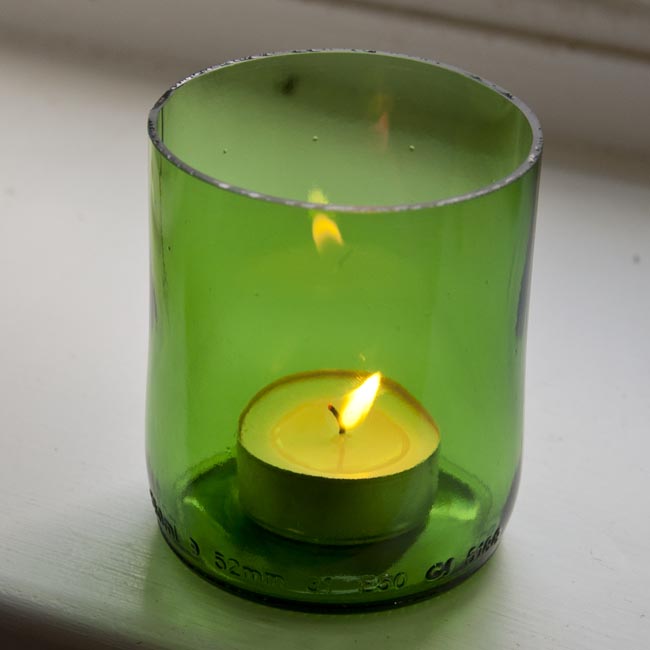
Finished candle holderThe result is really pleasing, the cut edge after sanding has a mostly-frosted appearance but still shows some evidence of the manner of its birth.   It’s not a perfect, machined straight line, but just has that little bit of hand-crafted variability.  You could etch the glass now (something I’m looking into!) or paint it if you liked, but you’re the proud owner of a hand-made recycled glass candle holder.

I used this with a tea light for a test burn, as much as anything to check that the heating from a candle wasn’t going to cause  unexpected cracking or breakage after the bottle’s relatively rough treatment!  And to get photographs, of course.  I expect this will look even better with a votive candle, but I didn’t have one to hand.
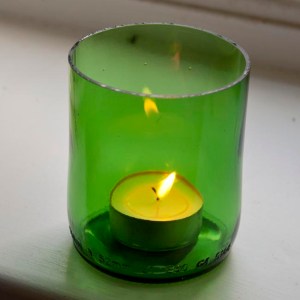
Finished candle holder

This was just a first attempt – but I had a lot of fun and will certainly be doing some more bottle cutting in time for Christmas!  I love that the detail of the bottle is still very much part of the finished piece too.  Definitely something to try – though probably a craft for grown-ups!

For a few ideas, try my next post on bottle cutting – ‘Using Your Bottle – testing some ideas for bottle cutting crafts’.

Finally, an apology to those of you who were emailed a part-finished version of this blog post yesterday – a mistake on my part, I’m afraid!  I’ll try to restrain my itchy mouse-finger from wandering over the ‘Publish’ button so enthusiastically!

Read more from the Country Skills blog >>

Banner320-260