Foraging Skills – blossom watch

Spring is in full flood now, with bulb flowers and that lovely acid spring green colour of young leaves appearing everywhere.  You’re likely to be seeing lots of frothy white blossom in the hedges, and that’s worth keeping your eyes out for.  The sort you’re looking for is on otherwise naked branches, and spread evenly over the bush rather than forming clusters.

Blackthorn blossom

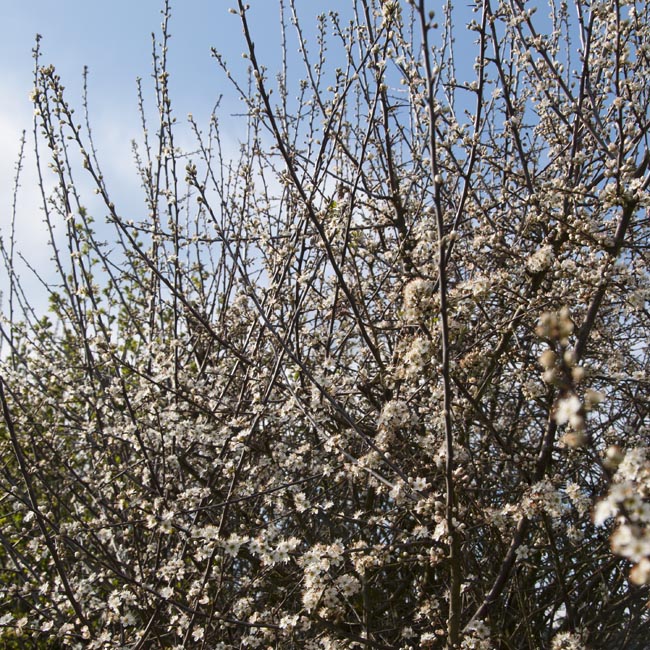
This is the blackthorn (the name is no coincidence!) or sloe bush.  So if you’re a fan of sloe gin (and let’s face it, isn’t everyone?) and fancy making some this autumn, make a note of any really good stands of blossom you see in the next week or two.  Final identification takes a slightly closer look – single small white flowers, armed with some nasty spikes on dark coloured wood.  The leaves, when they appear, will be small and rounded.

Blackthorn blossom - close up

You’ll notice that the blossom extends quite a long way inside the bush – this is one of the things that’s going to make picking, when you get to it, a bit of a challenge!

Read more from the Country Skills blog >>

That Wedding Bunting – now well underway!

The quick and simple Christmas Bunting was only ever a dry-run for the big task – I’d promised my sister bunting to decorate the village hall for her wedding reception.    Time is ticking on, so I’ve been getting on over the last few weeks.

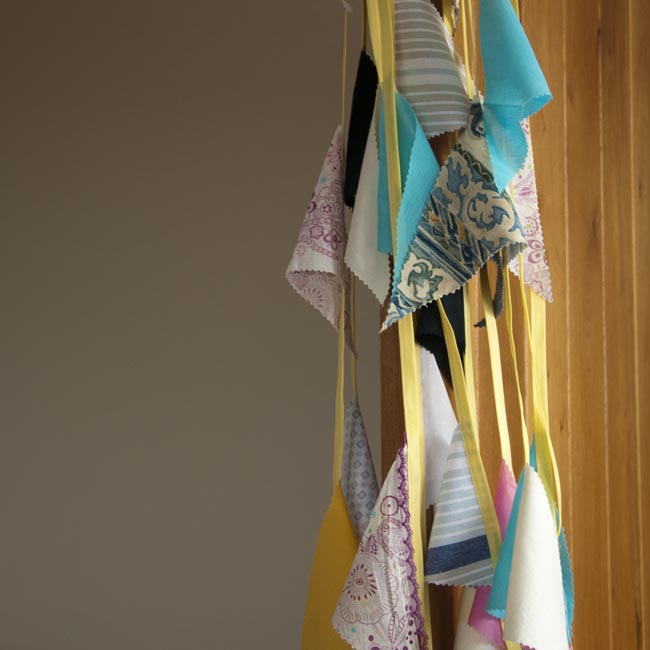
Wedding bunting, complete

My plan was eventually to make 6 strings of 10m length each, in pursuit of which I’ve begged, borrowed and not *exactly* stolen all manner of fabric scraps, old clothes and bits and pieces.  I also bought a 72 yard bolt of yellow double-fold bias tape from the US via the marvel that is ebay.  This time I’ve chosen a bigger pennant, 8″ long by 6″ across.  I’ve also tightened the spacing so there is 6″ between flags.

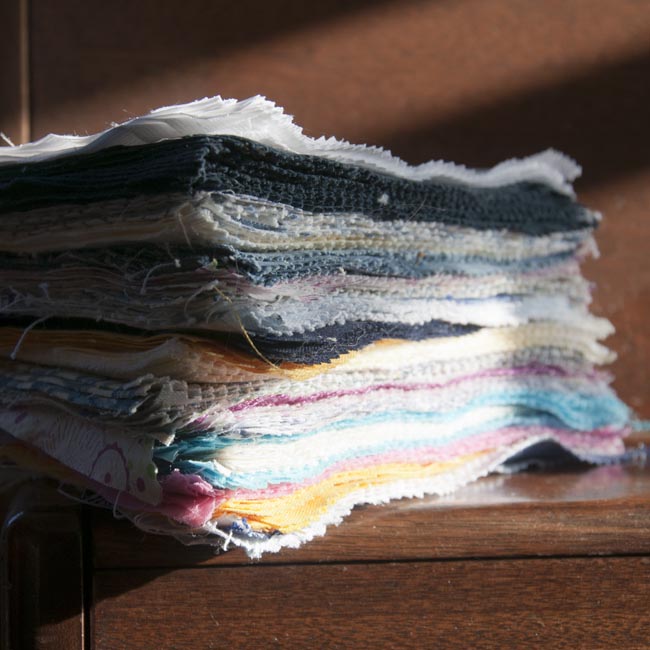
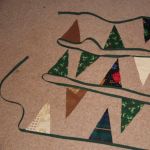
Bunting pennants, laid outIt’s a great selection of colours and patterns, garnered from friends, family, work colleagues, the back of my wardrobe, and freecycle.  The fabrics come from three sets of curtains, three blouses, a pair of jeans and a pair of cords, one pair of jim-jams, two offcuts of woollen suit fabric, some polyester scarf material, and one tea towel.

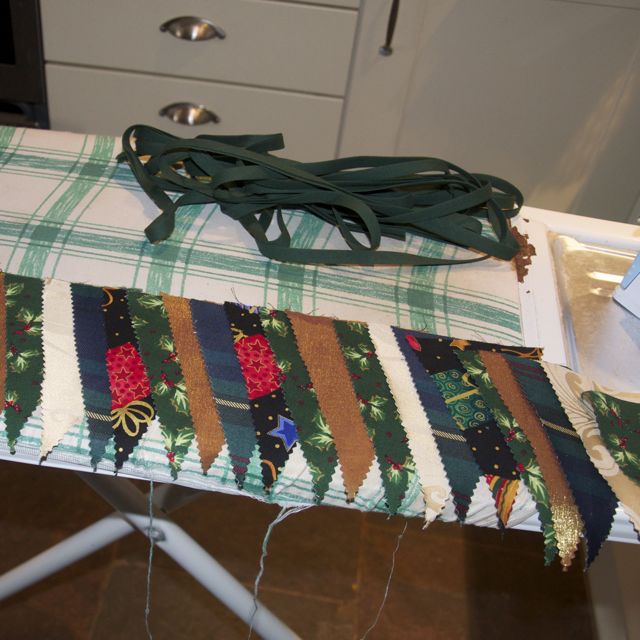
Bunting pennants, cut and ironedA bit of back-of-envelope calculation and I worked out I needed 29 flags per string.  I drew a new template on cardboard from a packing box.  Words cannot express what a slow boring job cutting out 180 triangles is, but with perseverance, and sat cross-legged on the floor in front of the telly evening after evening, we got there in the end.

Bunting pennants, sorted into groupsAfter ironing and sorting into piles, time to assemble the bunting.  Bias tape has quite a lot of ‘give’ in it, so peel a load off the roll and give it all a good stretch, this will also help it lie flat.  I measured 10m lengths and then found the middle of each.  Then starting in the middle, pin the pennants one at a time into the fold of the bias tape, measuring the gap between them approximately.  After that, it’s just a matter of running the whole length through your sewing machine using appropriate complimentary – or if you like, contrasting – thread.  Try to avoid skewering your fingers on the pins too often.

Completed bunting

There it is – I hope she likes it!  Only four more strings to assemble before it’s all done!

Read more from the Country Skills blog >>

A little egg-centricity – all about the chicken and the egg

Nothing beats a really fresh free range egg.  For breakfast, fried or poached, boiled or scrambled, or for lunch in an omelette, a really fresh egg – preferably laid this morning – is head and shoulders above any other egg you’ve ever tasted.  You can see the difference straight away, even before you crack it – the shell may well be a bit grubby, and a slightly funny shape, an unexpected or uneven colour.  When you crack it open, the egg white is firm and ‘sits up’ in the pan, and the yolk is a deep orange, and bigger than you expected – if beaten, the raw egg is a rich dark yellow, rather than off-white.  In your mouth the yolk is velvety and rich, creamy and almost sweet with a luxuriant almost-custard quality and the white is firm but never rubbery – a million miles away from the flaccid anaemic and tasteless output of battery cages and the supermarket supply chain.

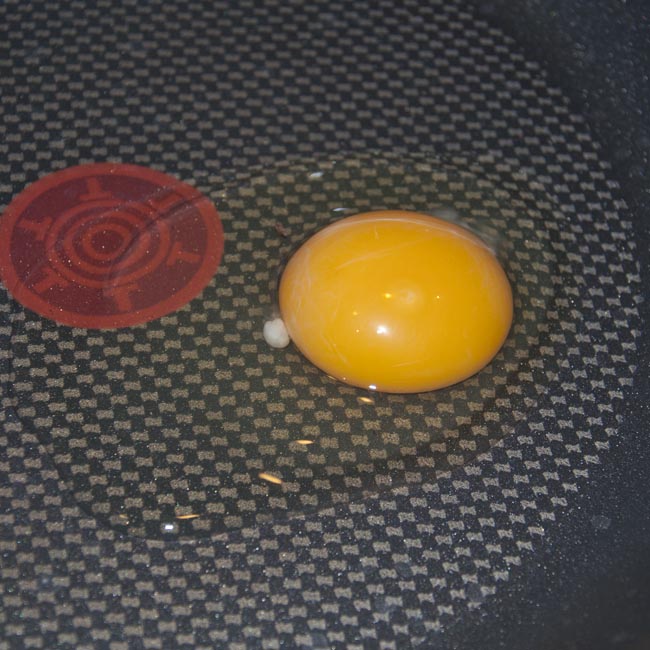
Fresh egg

It’s a sad fact that in the supermarket dominated, urban West, most people have probably never tasted a really good, fresh egg.  We think of eggs as being uniform, sized and graded, cheap and frankly, dull.  But they’re a natural product, and they vary – in size, colour and shape – and from the very firmest, freshest example, to the end of their storage life when the egg white is watery and the best of the flavour is gone.

I said nothing beats a very fresh egg, but of course that depends what you’re doing with it. If you want to beat the egg and use it to help with raising – in baking, or a soufflé – or you want hard boiled eggs peeled for a Salade Niçoise, then the very freshest eggs aren’t for you.  The egg white – the albumen – is actually in two parts.  The outer albumen is quite watery, you can see it spread out in the pan in the photo above.  The inner albumen is much more firm in a very fresh egg (but in an egg which has been stored for some time you probably won’t be able to see a distinction between the two).  In a very fresh egg this inner albumen has too much structure and tends to want to hold together, which doesn’t allow the batter to rise properly.  Furthermore, if you hard boil a really fresh egg and then remove the shell, the outer albumen will come away with the shell, which is a waste and makes for a scruffy-looking boiled egg.  Eggs about a week old are best for baking and hard boiling – realistically you won’t get eggs much fresher than this from the supermarket, though.

Egg storage

These are my eggs, and three things are obvious – first the range of shapes and sizes, secondly that they’re in some sort of wire device (it’s called an Egg Skelter, and I wouldn’t be without it) and not in the fridge, and thirdly that, frankly, they’re a bit grubby!

The size variability is something that you have to make adjustments for with ungraded eggs.  My approach is to weigh them and then adjust according to standard size references.  The Lion Egg Scheme people have a size guide here.

Fresh eggs will keep safely at room temperature for 3 weeks (it’s no coincidence that this is the length of time they have to stay ‘fresh’ under a warm hen if being hatched!), but if you do put them in the fridge, then you need to leave them there.  If eggs are removed from refrigeration, moisture condenses on the outside of the shell and can then be drawn through into the inside of the egg by osmosis, potentially pulling pathogens from outside the shell into the egg itself and increasing the risk of food poisoning.  My eggs don’t sit around for anything like three weeks (if I have a glut I know plenty of people who are happy to help me deal with it!) so storage at room temperature is ideal.  Better still, the egg skelter enforces first-in-first-out use, which is trickier with other storage systems.

So you’d think washing the dirt from the outside of the egg would be a good idea, right?  In fact dissolving these contaminants in water, and disrupting the outside surface of the shell, also increase the risk of pathogen entry.  Much better to leave grubby eggs as they are, and rub off any loose dirt and mud from the surface just before use.  Egg washing is not permitted in the production chain for commercial shell eggs in the UK, on a risk assessment basis, though it is common practice in other countries including the US (they tend to wash in a chlorine solution – because bleach is what you want in your eggs!).  This goes some way to explaining the obsession with clean eggs in intensive production systems – and the resulting battery cages (improved, but not yet gone), as ‘dirty’ eggs are downgraded.

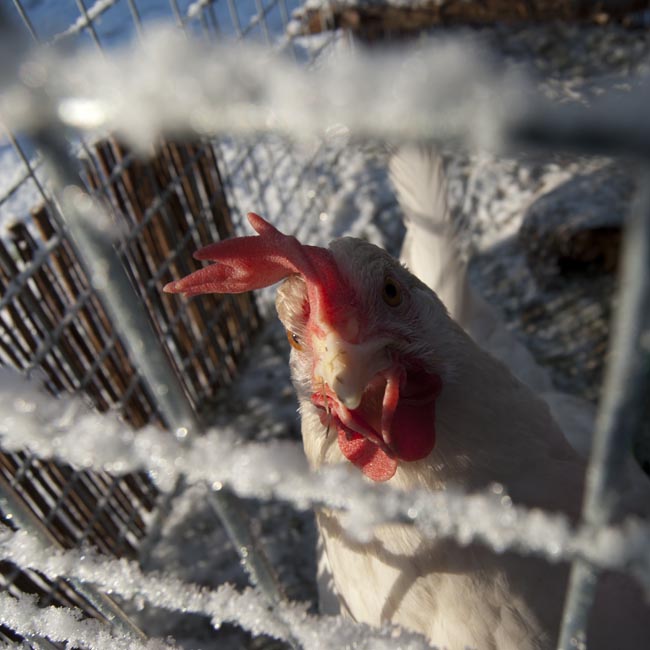
I’ve kept hens for two and a half years now.  I wasn’t expecting get as attached to them as I have, they’re fascinating animals.  Funny feathery little dinosaur-descendants they certainly are, they’re inquisitive, social (and not always sociable!) little creatures.  Only when you’ve watched hens scratch around for bugs, enjoy a bit of a flap and a wing stretch, and then settle down into a well-earned and apparently thoroughly indulgent dust bath, can you really start to understand how inhumane intensive cost-led egg production systems are.  This is Gertie, by the way, my ‘top hen’, being a bit confused by her first sight of snow, and wondering what I’m doing with that camera.

Outdoor hen

You may not be able to keep your own poultry, but if only for the sake of your palate (never mind the quality of life of the poor intensive egg-producing bird) it’s worth seeking out the best and freshest outdoor reared eggs you can find – farmers markets and farm shops are a great place to start – or ask around, you may be surprised to find a colleague keeps backyard hens, and if you’re really super nice to them, they may be prepared to share! Then, enjoy your wonderful, freshest eggs, with the best home cured bacon for the most amazing breakfast fry-up you’ve ever tasted.

Read more from the Country Skills blog >>

Waxing Frugal – making a recycled scented chunk candle

Everyone loves a candle, they cast a lovely warm flickery light, and, chosen carefully, can fill a room with beautiful scent (sure, sometimes they can fill a room with the scent of cheap pot-pourri, but this is a matter of taste!).  After Christmas, we had several left over candle ends around the house, and rather than throw them out, I wanted to do something creative and recycle them.  But while there are lots of great candle-making kits out there, I didn’t really want to spend any money on the process.  So this is a candle-making project that, with the exception of some wick and a wick sustainer, you can do entirely with things that you already have around your home and kitchen.

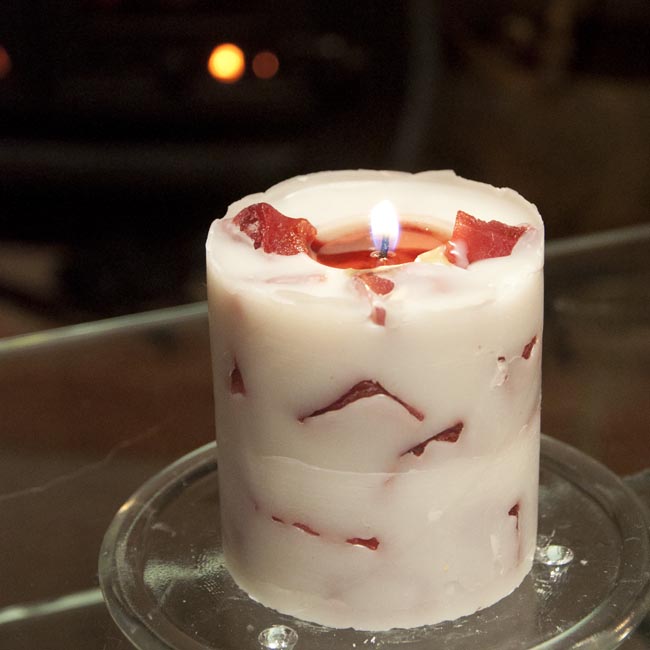
Recycled chunk candle, burning

For this project, you will need –

  • Two old candle-ends, preferably one coloured & scented and one plain, total weight 300 – 400g
  • Empty Pringles tin (I recommend starting with a full one, and working on it!)
  • Large saucepan, a trivet (or an old saucer or side plate), and a large empty tin can (I used an empty malt extract can from home brewing, but any large catering size tin can will do)
  • Stirrer (I used a large wooden lollipop stick, anything will do but not something you plan to use with food!)
  • Chopping surface (again ideally not one you plan to use for food use in future)
  • Large knife
  • 6in length of appropriate wick, a wick sustainer, and something to use as a wick pin (a kebab stick is ideal)
  • Kitchen hob
  • Scales
  • Jam / sugar / preserving thermometer, old tea strainer (recommended but not absolutely required)
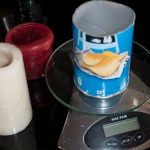
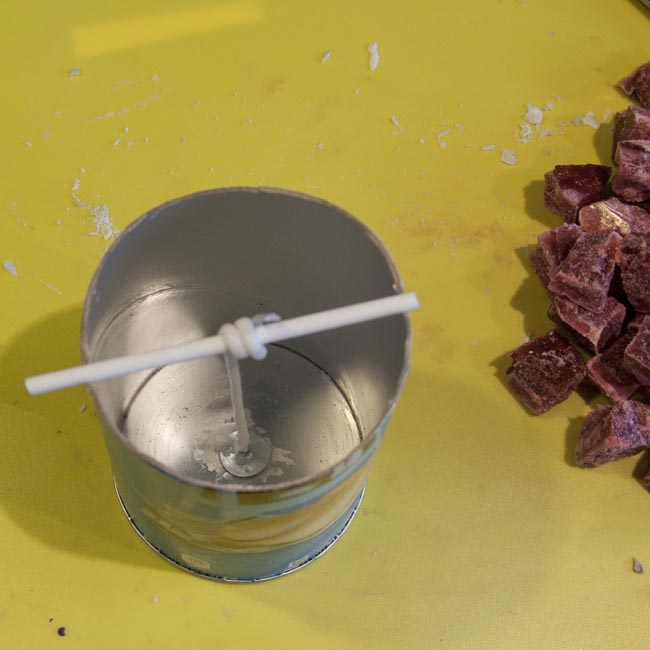
Basic equipmentGather up your equipment, starting with the knife and the pringles tin.  Cut the Pringles tin down to about 4″ high using your knife, and make a couple of ‘notches’ in the top on opposite sides of the top.

You’ll need to get an estimate of the capacity of your candle mould, so put a sandwich bag inside the Pringles tin, put it on the scales to zero, and then fill the bag with water to about a 1/2″ below the top.  The weight in grams of water is a good estimate of the volume in mls, as wax is slightly less dense than water (it floats on water, after all), you can reduce this estimate by about 10% to get the weight in wax required to fill the mould to this level. I came up with 300g and used around 270g as a target weight of wax.
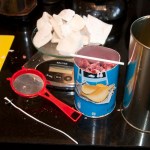
Prepared waxNow, cut up your coloured candle.  Try to cut it into even cubes a bit bigger than half an inch cubed, but it’s likely you’ll struggle, and if the pieces are a bit rough, don’t worry. From what you’ve chopped up, sort to one side and weigh all the sensible chunks, leaving the dust and small fragments aside (wrap these up for another project).  Weigh your coloured chunks (mine weighed about 140g) and put them in the mould to check how high up they come. Ideally this will be about the target ‘fill’ level.  Now roughly chunk up your white wax candle.  It doesn’t matter what size and shape these pieces end up, but the smaller they are the faster they’ll melt.   When working with old candles, try to avoid including the ‘melt pool’ from the candle as this will be dirty wax and may well include bits of old burnt wick and suchlike, which you don’t want in your shiny new candle.

A word about wicks, before we go on – the size and construction of wick you need depends on the chemistry of the candle-wax and the width of the melt pool you want in your candle (which is closely related to the diameter of your candle, usually).  When working with recycled waxes, the chemistry involves a fair bit of guesswork.  I assumed the waxes were a basic paraffin pillar blend, since this is the most usual situation for commercial candles manufactured to a price point.  There’s a useful wick size guide here.  (See my suppliers list and library for more reading.)  I used an LX16 wick which should have been a good match for the ~70mm diameter Pringles mould.  Secure the end of the wick into the wick sustainer using pliers.

Melting waxNow, start melting your wax.  Put the white wax into the large tin, and put the tin inside your saucepan on the trivet.  Fill the saucepan with water so that it comes up the side of the tin about an inch and a half.  Use the thermometer, if you have one, in the water.  You don’t want this to boil, but ideally it should stay around 75 degrees centigrade, which should be enough to melt the wax without risk of overheating.  The flash-point of wax is quite close to the melting point, and at the flash point the wax is at risk of catching fire, particularly if you have a naked flame in the vicinity (for instance, if you’re using a gas hob), so be careful and heat the wax very gently.

Primed wick in situOnce the wax is melted, you need to prime the wick, which just means dipping the wick into the wax so that it can be absorbed onto the surface of the cotton.  Also dip the sustainer in the wax, and use this to secure the sustainer to the centre of the bottom of the Pringles tin.  Stretch the wick up vertically and wrap it around the wick pin to keep it centred in the mould.
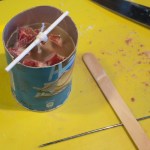
Chunk candle with poured waxNow, arrange the chunks of coloured wax in the mould around the wick, trying to make sure you don’t close off any pockets which would prevent the melted wax filling all the gaps.  When you’re happy, pour about 90% of the melted wax into the mould, pouring through the tea strainer if you see any ‘bits’ in it.  Keep the remaining 10% over a low heat to keep it liquid, and continue to keep a close eye on it.

Cooling candle by immersionThe wax will shrink as it cools and this will form a dip or a ‘well’ near the wick, which will affect the candle as it burns.  Encourage the candle to cool by putting the mould inside a plastic bag and immersing it into a bowl of water.  You will need to weigh it down to keep it immersed, I used a marble pestle, but anything heavy will do.  This is of course quite faffy, and if it’s a nice cold day, you’d probably do as well to put the mould outside for half an hour or so.

As the wax sets and you start to see a well forming near the wick, make a couple of holes in this area with a skewer.  Once the surface of the wax is springy but not hard to the touch, pour over the rest of the wax tapping the mould to make sure it goes into the holes you’ve made near the wick.  Now set the mould somewhere nice and cold to set – in the fridge if it’s a warm day, or outside if it’s January in the UK.

Candle cooling in mould

After a couple of hours the wax will have set hard.  I was expecting to have to sacrifice the Pringles can at the end of the moulding, but the wax had shrunk back nicely from the sides, and I was able to ease the candle out without having to destroy the mould – however your results may vary and I wouldn’t lose to much sleep about it if you have to break the mould away from the candle.  Trim the wick so that about 1cm is proud from the surface of the wax.

Recycled chunk candleRecycled chunk candleI’m thrilled with the results, which I think are very pretty for a first effort.  The white wax is a little bit ‘dirty’ which I probably could have concealed by using a little bit of ivory or honey-coloured candle dye.  I poured the bulk of the white wax in two ‘goes’ and you can see the line between them, which is something I’d avoid in future.
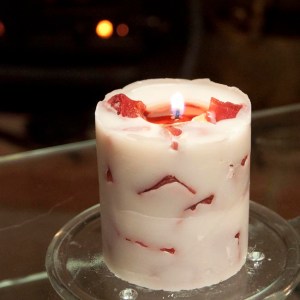
Recycled chunk candle, with melt pool

My only real criticism of the finished candle would be that I chose too small a wick – the melt pool the candle produces is quite a bit narrower than the body of the candle, and stops short of the sides by about half an inch all the way around.  I suspect this is to do with the chemistry of the original white candle, which we stopped burning for a very similar reason – lesson learned!  If I re-make this candle with the remains of the white wax from this batch I’ll use an LX20 wick which may give a better result.  The melt pool is very pretty though, a lovely dark pink colour from the mixed waxes and gives a gentle berry aroma.  For the cost of a new piece of wick, and a little bit of kitchen chemistry, it’s a beautiful, and extremely thrifty, scented candle.

Read more from the Country Skills blog >>

Frugal Food – stuffed breast of lamb, roast dinner on a budget

Breast of lamb is a rather unfashionable cut these days.  In my household it’s usually known as ‘lamb belly’ by analogy with the matching cut of pork.  It’s made up of the abdominal body wall, starting with some ribs just in front of the diaphragm and extending backwards. Folded in three and wrapped in cling-film, it’s a rather uninspiring looking cut. You won’t get it at the supermarket, and it won’t be on display at the butchers, but if you ask it’s likely you’ll get a whole one for not much more than £1.  With a very little bit of effort, you have one of the most cost effective (and tasty!) roast dinners you can buy.

We first discovered breast of lamb when we started buying half-lambs from local smallholders.  I wish I’d discovered it when I was a student, I could have had some fantastic roast Sunday dinners on a budget!

This is a great meal made almost entirely from the store cupboard.  You will need:

  • One breast of lamb
  • Some breadcrumbs
  • An onion (red or white)
  • Garlic, several cloves
  • Rosemary, thyme, sage (fresh or dried)
  • One egg
  • Kitchen / butchers string
  • Potatoes / parsnips / sweet potatoes / swede
  • Some green veg (I had some frozen peas, but anything will do)
Deboned breast of lamb

Deboned breast of lamb

First of all you have a little bit of butchery to do.  It’s unlikely the ribs will have been trimmed out, so you’ll have to do this yourself.  Be careful, and patiently cut around and along each rib with a paring knife and lift it out from the ‘inside’ of the breast.  With practice this is no more than a five minute job, though it might take a bit longer to start with.  It’s likely your breast has been in the fridge, so the meat will be cold.  Stop if you notice your fingertips getting numb, and rinse them under warm water to warm them up again – you’ll have less sensory feedback from cold fingertips and you’re much more likely to make a mistake and cut yourself – which is not the aim of the exercise!

Stuffing ingredients

Try to preserve as much meat as you can attached to the breast – but if you accidentally cut a piece off (and there are some annoying bits of diaphragm which are quite tricky to keep attached) just put it back as you’ll be rolling and tying the ‘joint’ later.

Stuffing on the breast of lamb

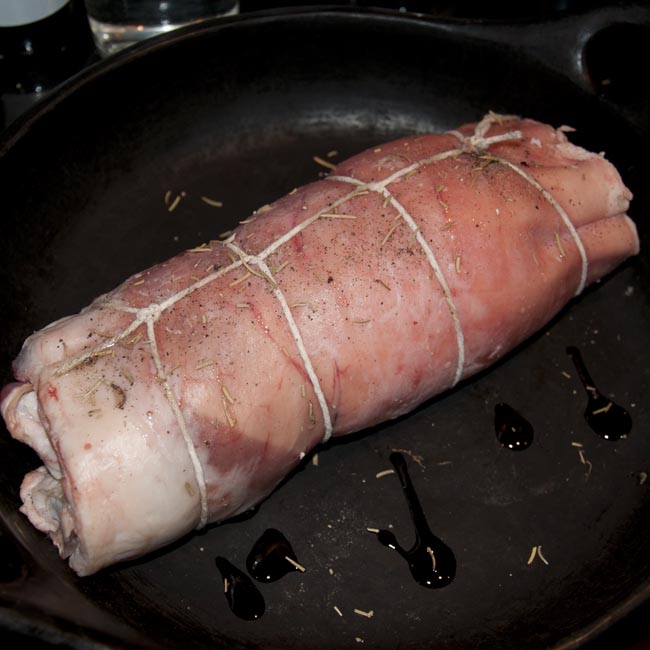
Now make the stuffing.  Mix the finely chopped onion, crushed / minced garlic, breadcrumbs, herbs and egg together.  Season with a bit of salt and pepper.  Then spread this across the inside of the breast and roll it up, starting at the narrow end (where the ribs weren’t).

Tied rolled breast of lamb

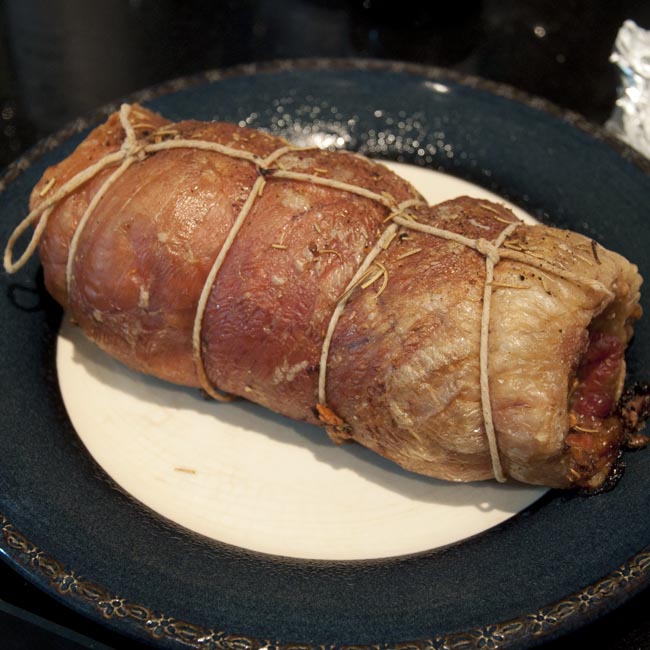
Tie the rolled joint up with string using a butchers knot.  This involves making a series of linked  loops and tying off at both ends, and is a useful knack to learn.  It’s also not dissimilar to the knotting technique used for casting a cow!  Put the rolled join in a roasting dish, drizzle with olive oil, sprinkle with pepper and dried rosemary, and put into a low oven (about 160C) for two and a half hours.

Roasted breast of lambPrepare whatever roast veggies you prefer (I did spuds and sweet potato) and start these at the appropriate time.  You could even have yorkshire puddings (we did!).

Carved roasted stuffed breast of lambThen in due course get the joint out to rest, prepare your green veg and gravy, and dish up.  Add some nice fruit jelly, if you have some.  Crab apple and chilli jelly was a perfect accompaniment.

This is a fabulous roast dinner, and will serve three or four for nearly nothing – we’re greedy so it fed two hungry adults!  Serve with a nice beer or a glass of red wine, and enjoy!

Roast breast of lamb with all the trimmings, served and ready to enjoy

Read more from the Country Skills blog >>
Handmade Christmas – decorated glass baubles

I have to confess to having a bit of a ‘problem’ when it comes to Christmas tree decorations – I love them.  Every year I try to add one or two (ok, sometimes a few more than one or two!) new pieces, to go on my tree year after year.  In recent years I’ve tried to make some of these rather than buying them, and this year I’ve bought nothing, which is a first!

Finished bauble on my tree

What I added to my tree this year were four lovely clear glass baubles which I already had, but which I have filled with wool fibres, giving what I hope you’ll agree is rather a lovely effect.

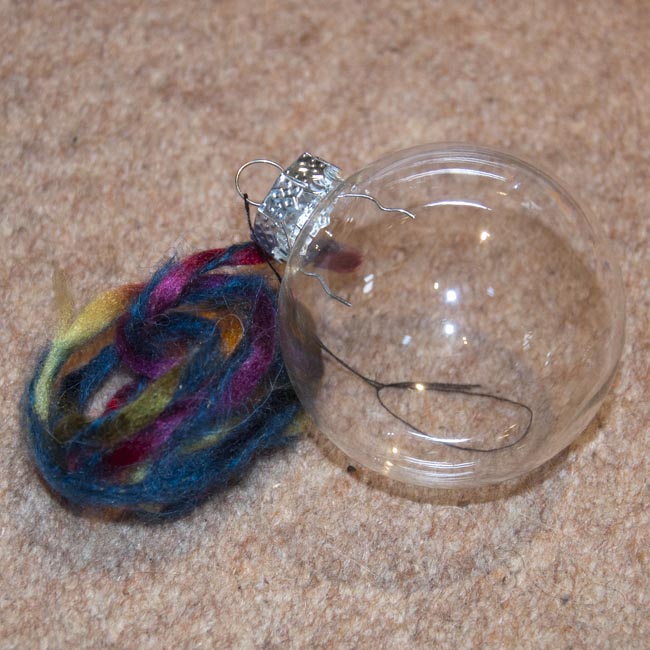
Bauble & woolMaking these is very simple – you will require:

  • Some plain clear glass baubles, any size but I used 6cm ones.  I bought them from a website a couple of years ago, but I gather they’re often available in craft shops before Christmas.
  • Wool scraps, as pretty and colourful as you can find.  I begged these from a friend who’s a keen knitter.

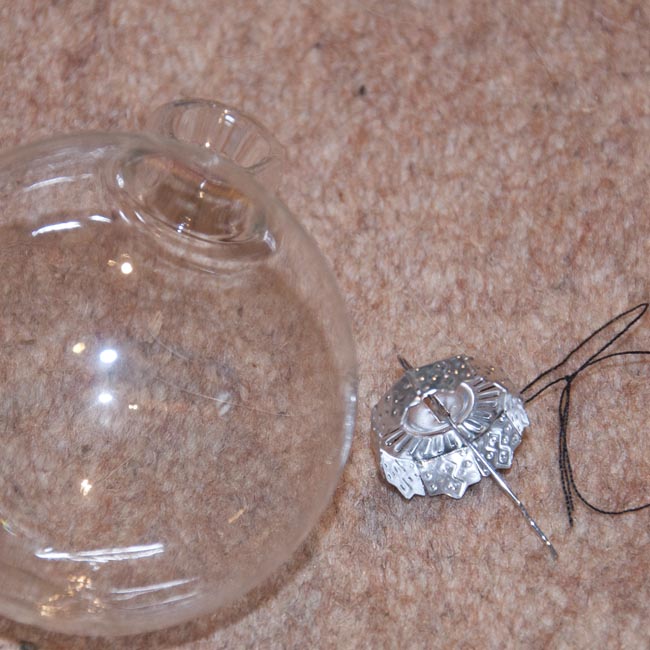
Glass bauble with top removedFirst, gently remove the top from the bauble.  With the normal design of blown glass bauble, you do this by squeezing together the sides of the metal hanging loop, which moves the ends together allowing you to (very carefully, broken bauble glass is sharp!) lift the metal crown from the bauble.

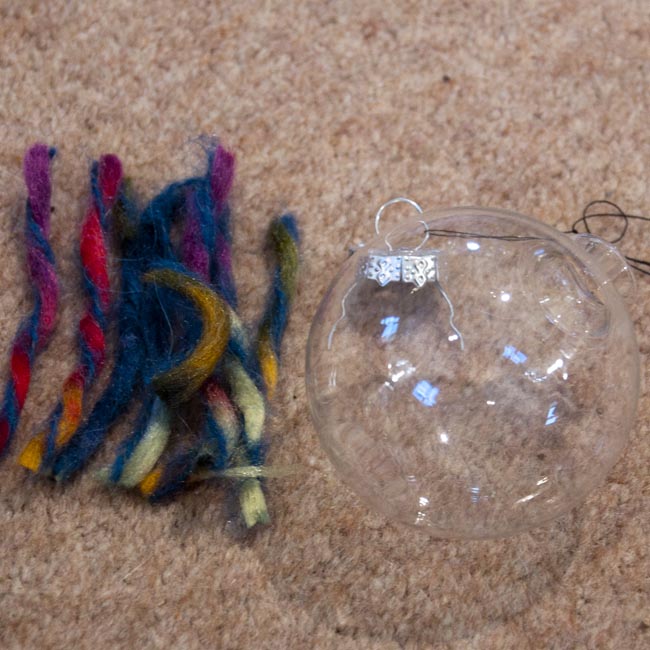
Bauble with cut lengths of woolNow take your length of wool – about a foot (30cm or 12″) is probably quite enough depending on how thick and fluffy it is.  Cut this into approximately 5cm / 2″ lengths.

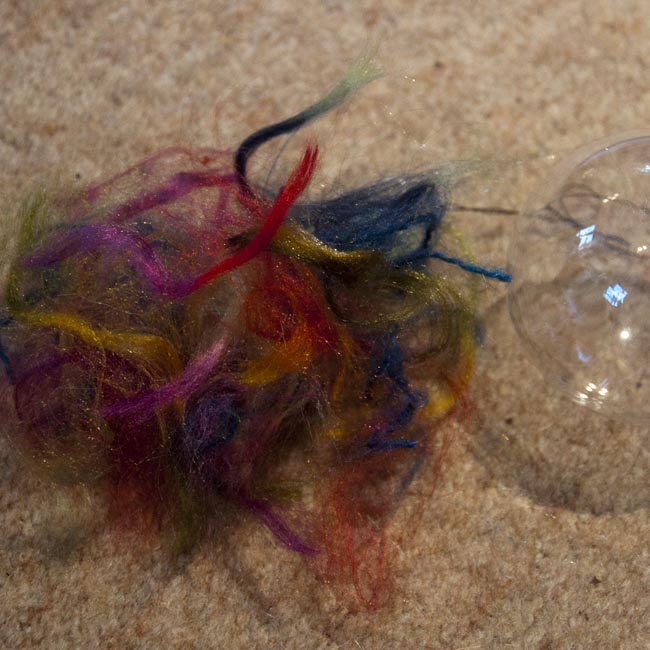
Teased apart wool fibresThen tease the wool apart gently into it’s component fibres.  Depending on the thickness and spinning type of the wool this might be more or less difficult, the wool I had was quite a loose structure and came apart very simply.  At this stage you need to assess whether you have enough fibres, since you want enough to loosely fill your bauble.

Inserting fibresFinally, use something like a chopstick or a pencil to gently push the fibres inside your bauble, and re-attach the cap.

That’s it, all done in only a minute or two, and the colours and effects you can achieve are only limited by your imagination (and wool collection!).  It’s so simple to create a colourful, textured, unique bauble for the price of a plain clear glass one, and these would make lovely gifts, too!  I’ve also seen pretty things done with ribbons, fabric scraps, or glitter inside clear baubles, so why not get creative!

Updated for 2012why limit yourself to wool, there are other things you can fill baubles with, too!

See more crafty ideas for a Handmade Christmas >>

Read more from the Country Skills blog >>

Deck the Halls – quick & easy Christmas bunting

Time: an hour or two – Difficulty: low (assuming you can use a sewing machine) – Cost: less than £5

Don’t you love bunting?  Not only is it very pretty, it seems to be bang on trend right now, if the smart interiors boutiques where I can’t afford to shop are anything to go by!

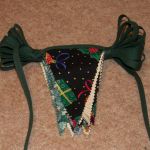
Christmas bunting

A while ago, I (maybe foolishly) volunteered to make a load of bunting to help decorate the village hall for my little sister’s wedding reception.  Before embarking on the epic effort, I thought it might be best to do a mini version to iron the kinks out of my process.  Christmas is coming, so what better than a bit of Christmas bunting for the hallway?

For this project, you will require –

  • A sewing machine (capable of straight stitch – so any sewing machine will do!)
  • Straight scissors and pinking shears
  • Scrap card for a template
  • Bias tape, as much as you want your bunting to be long, and the colour of your choice.  Double fold tape will save you the fold-and-iron process, but may not be as easy to get hold of.
  • Sewing thread to match or contrast with the bias tape.  I find if I’m trying to match a colour and I don’t have a really close match – as in this case, all my greens were too light or too yellow – it’s better to find a neutral colour which matches the tone.  I used a dark grey for this bunting.
  • Some suitably festive fabric.  I used mainly scraps left over from previous Christmas crafting.  If you want to use new fabric a single fat quarter should be enough to make 6m of bunting with quite modest 4″ x 6″ pennants spaced 6″ apart.

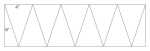
Bunting template

Realistically you probably have all of the non-consumables or none of them – 6m of bias tape cost me less than £2, and I had the leftover fabrics already.

This is a single-sided bunting, if you use printed fabrics like I have.  If you use fabrics which have two good sides, of course, you don’t need to worry about that.  I like the effect of the pinking-sheared edges, and it saves an awful lot of time over hemming.

My bunting templateStart by making your template.  I drew mine out for triangular pennants 6″ long and 4″ wide at the top (the whole template is 20″ x 6″).   If you’re using lots of small fabric scraps, you may also make to want a template for a single or a pair of pennants.  Give some thought to what spacing you’re going to want to have between your pennants.  I went for 6″ – the same as the length of the pennant.  Any more than this I think looks a bit sparse, closer and you’ll need more time and fabric to make extra pennants – at the end of the day it’s up to your taste!  Work out how may pennants you’re going to need by applying some basic primary school maths to the problem.   Remember to leave a bit more bias tape at the ends to give you enough to tie the bunting by.

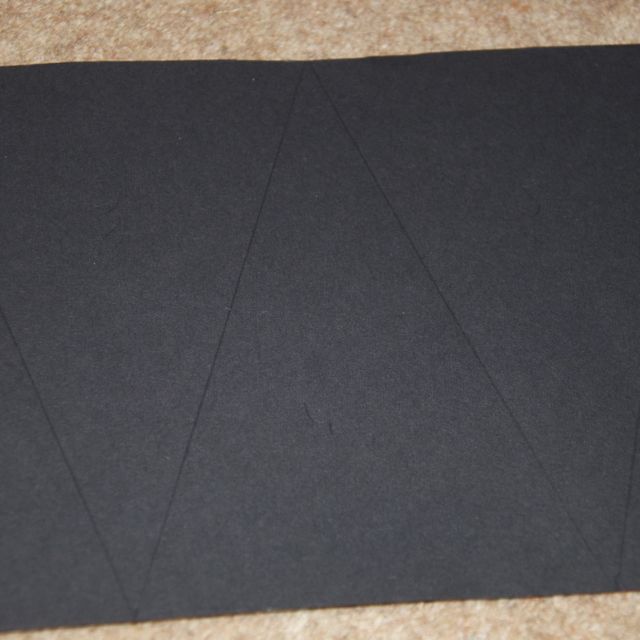
Bunting pennantsUsing your template, mark up your fabric.  I used a biro to mark up the back of the fabric.  You might want to use something a little less crude, if you have it!  Then cut the top of the pennants with the straight scissors, and the sides with the pinking shears.  You’ll notice the lines I’ve cut aren’t quite strictly straight, because my pinking shears aren’t long enough to cut the side in a single action.  I don’t think it matters!

After ironingOnce you’ve cut all your pennants, it’s probably a good time to iron them.  At the same time, if you’ve bought single fold bias tape (bias tape which has the two edges folded in but isn’t yet folded in half) then use the iron to fold this in half and set the fold. Then decide how you want your pennants ordered, if they’re not all the same.

Pinning pennants in placeNow, starting from the centre to ensure they’ll be evenly distributed, start pinning your pennants into the bias tape.  I marked my 6″ gap onto the edge of a piece of card to help me space them consistently – it’s quicker than using a measuring tape or a ruler every time.  Try to be reasonably accurate but don’t stress over it.

Sewing buntingOnce all your pennants are placed, it’s time to sew.  I just used a single row of straight-stitch as close to the open edge of the bias tape as it was practical to do quite quickly.  You could also use a zig-zag stitch, if you prefer.  As you get to each pennant, just make sure the top is placed as far into the fold of the tape as possible, and lying nice and flat, before you sew it in place.

Bunting, folded for storageChristmas bunting - completedThat’s it, keep sewing until you’ve reached the end of your tape and all the pennants are secured in place.

Doesn’t it look pretty?  I can’t wait for Christmas now!

Read more from the Country Skills blog >>