Handmade Christmas – cracking crackers!

Christmas crackers are great, and an essential part of Christmas dinner in my house.  I mean, what’s not to like about adults wearing silly paper hats after a lovely meal and plenty of wine?  But the ones I’ve bought always seem to contain absolute rubbish which no one would ever want.  How about making your own, with the traditional silly paper hat and motto, but with the added bonus of a small, thoughtful gift, an after dinner chocolate, or both?  Well, it’s simple and fun, here’s how!

Handmade Christmas crackers

You will need:

  • Some cracker ‘blanks’, these are widely available from craft shops and on the internet in various sizes, colours and pack sizes.  I chose plain silver ones.
  • Cracker ‘snaps’, if these aren’t included with the blanks, one for each cracker you plan to make.
  • Ribbon, wool, raffia or string, for tying the crackers up, as decorative as you like.
  • Decorations for your crackers, if you want.  I used metallic leaf skeletons, some ribbon and a couple of small jingle-bells, all glued in place, but be creative, anything from the card making section of the craft shop is a good place to start, or how about some decoupage with last year’s Christmas cards?
  • Finally, cracker gifts!  I found some quite cute keyring gadgets of various kinds and also added a nice after-dinner chocolate.  If the gifts are for specific guests, put name-labels on the crackers.
  • Scissors, sticky tape, and clear glue.
  • Make hats and mottos yourself!

Making them couldn’t be easier and is a crafty relaxing way to spend a dark December evening.

First three steps of cracker constructionStart by sticking one end of the cracker snap onto the cracker blank with sticky tape.  Then roll the cracker blank using the tabs (cracker blanks have slightly varying designs, so follow the instructions that come with yours!).  Pinch, twist and tie up one end of the cracker with the string, ribbon, or other thread you’re using – I used silver paper raffia.
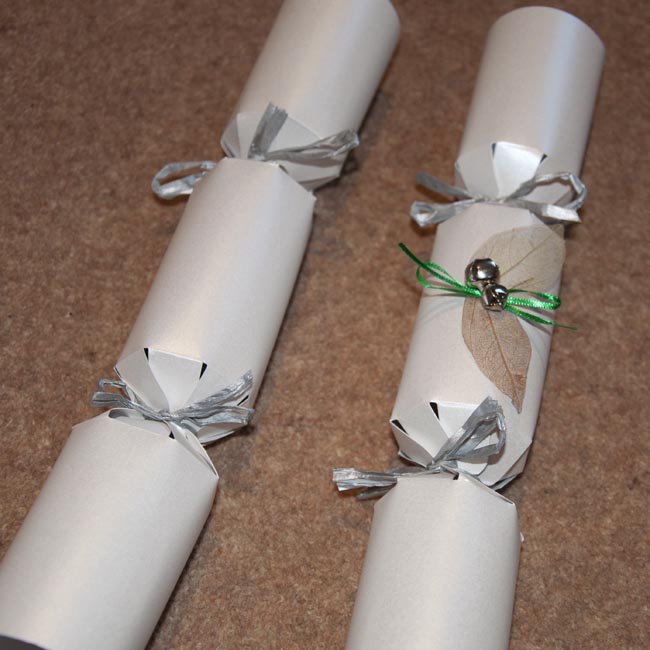
Decorating the finished crackersNow fill your cracker with all the bits and pieces, and tie up the other end of the barrel in the same way.  Once you’ve tied this up, stick the second end of the cracker snap into place.  You can decorate the crackers now however you like!

‘But what about my hat and motto’, you may be thinking?  I did see hat-and-motto sets for sale, but they’re awfully expensive considering what you get, a cheap tissue paper crown and a small slip of paper.

Making the hats couldn’t be simpler.  Get some Christmas wrapping paper, I used the end of a roll of white and silver metallic paper which I had knocking around.  First, measure the circumference of your head (unless it’s unusually large or small, in which case perhaps find someone with a more ‘representative’ head to measure – then again, you’ve made them, so perhaps it’s only fair to claim the perk of a cracker hat which fits for once!).  Now cut some pieces of wrapping paper twice as wide as the finished hat you want, and about 1cm longer than the circumference you’ve measured.  Using clear sticky tape, stick the paper into a loop.

Making paper crowns for crackers

Now fold the loop flat (image 1), then in half, then fold each of the halves into three, so that you’re now on the central panel of the film-strip above.  Now fold this in half one last time, then make a single diagonal cut half-way up the paper.  Unfold your two zig-zag topped crowns.  It’s like being back in primary school!  And since they’re neatly folded, tie them that way with ribbon or a small elastic band.

For the mottos, anything goes!  Good (or bad!) jokes, limericks (or haikus?), brain teasers, interesting facts, or even thoughts for the season or personal wishes for your family and friends’ year to come – make them pretty in a word processing package, print them out, cut into strips and fold them up with your paper hats.

Crackers needn’t just be for Christmas – they’re a lovely creative way to package small, special gifts.  An unusual way to wrap a special piece of jewellery, perhaps even a surprise ring?  Or consider using crackers to package wedding favours?

Handmade Christmas – decorated glass baubles

I have to confess to having a bit of a ‘problem’ when it comes to Christmas tree decorations – I love them.  Every year I try to add one or two (ok, sometimes a few more than one or two!) new pieces, to go on my tree year after year.  In recent years I’ve tried to make some of these rather than buying them, and this year I’ve bought nothing, which is a first!

Finished bauble on my tree

What I added to my tree this year were four lovely clear glass baubles which I already had, but which I have filled with wool fibres, giving what I hope you’ll agree is rather a lovely effect.

Bauble & woolMaking these is very simple – you will require:

  • Some plain clear glass baubles, any size but I used 6cm ones.  I bought them from a website a couple of years ago, but I gather they’re often available in craft shops before Christmas.
  • Wool scraps, as pretty and colourful as you can find.  I begged these from a friend who’s a keen knitter.

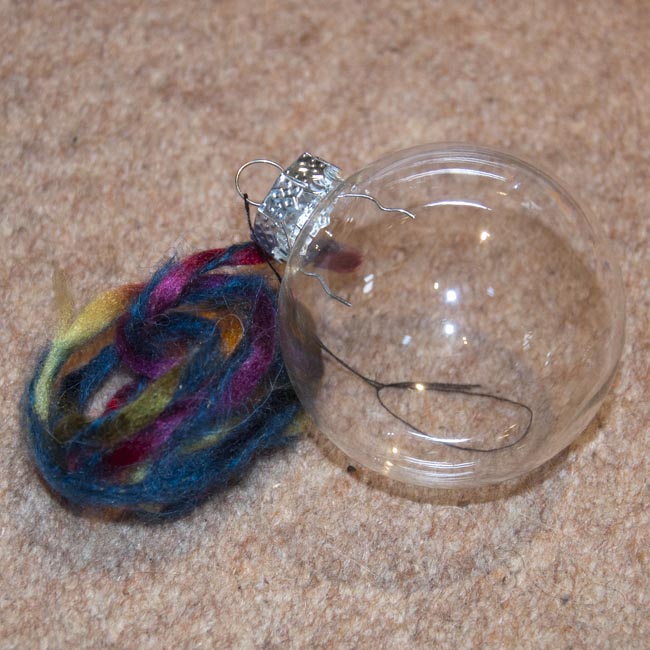
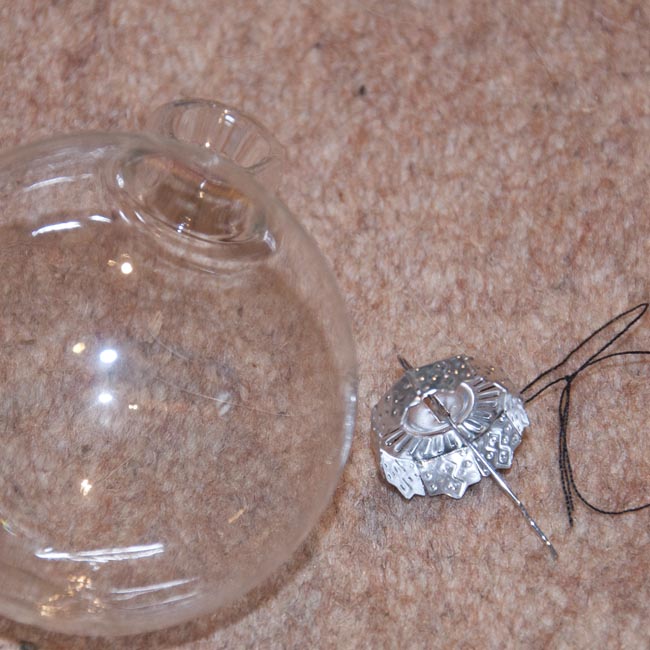
Glass bauble with top removedFirst, gently remove the top from the bauble.  With the normal design of blown glass bauble, you do this by squeezing together the sides of the metal hanging loop, which moves the ends together allowing you to (very carefully, broken bauble glass is sharp!) lift the metal crown from the bauble.

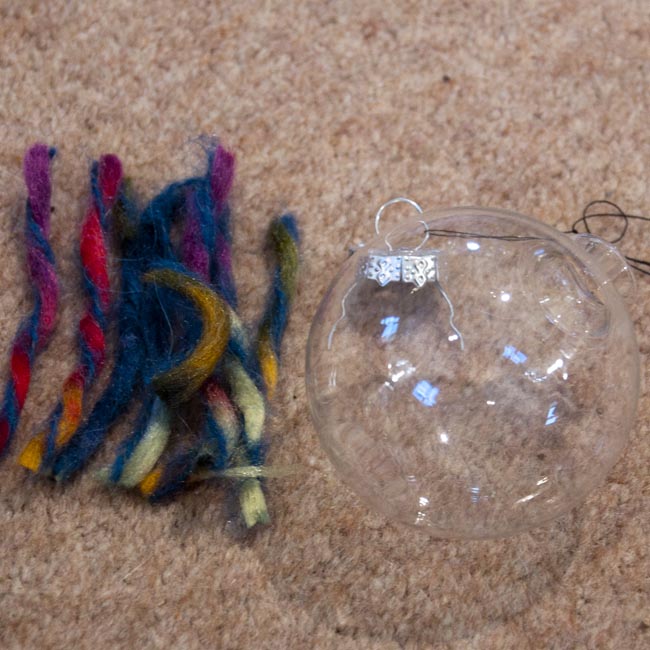
Bauble with cut lengths of woolNow take your length of wool – about a foot (30cm or 12″) is probably quite enough depending on how thick and fluffy it is.  Cut this into approximately 5cm / 2″ lengths.

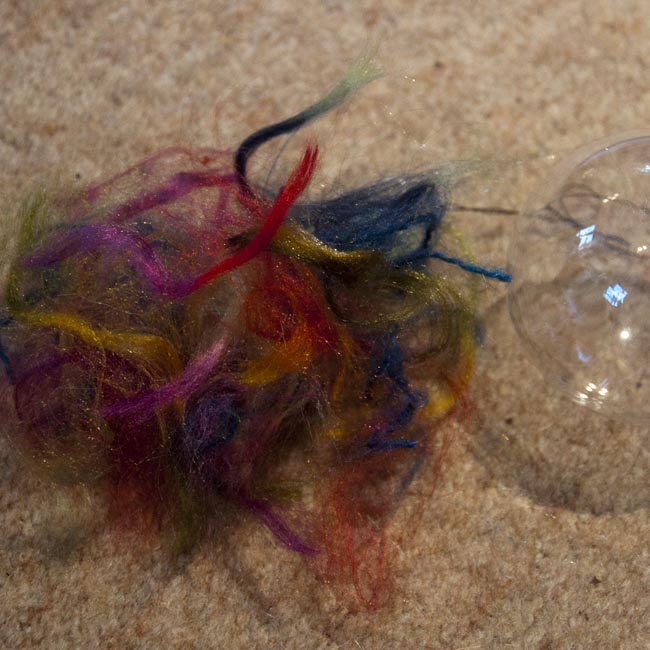
Teased apart wool fibresThen tease the wool apart gently into it’s component fibres.  Depending on the thickness and spinning type of the wool this might be more or less difficult, the wool I had was quite a loose structure and came apart very simply.  At this stage you need to assess whether you have enough fibres, since you want enough to loosely fill your bauble.

Inserting fibresFinally, use something like a chopstick or a pencil to gently push the fibres inside your bauble, and re-attach the cap.

That’s it, all done in only a minute or two, and the colours and effects you can achieve are only limited by your imagination (and wool collection!).  It’s so simple to create a colourful, textured, unique bauble for the price of a plain clear glass one, and these would make lovely gifts, too!  I’ve also seen pretty things done with ribbons, fabric scraps, or glitter inside clear baubles, so why not get creative!

Updated for 2012why limit yourself to wool, there are other things you can fill baubles with, too!

See more crafty ideas for a Handmade Christmas >>

Read more from the Country Skills blog >>

Last Minute Christmas – perfect giblet stock

If you’ve bought a bird for roasting today, there’s a good chance it’s come with a little plastic packet of ‘bits’.  Whatever you do, don’t throw them away!

These bits are the giblets – the offal – usually the neck (in one or two pieces), the heart, the liver, and the gizzard.  The gizzard is thick, muscular structure with two hard abrasive grinding plates that the bird uses to crush up corn and other food items to make them digestible.  Giblet stock is quick, simple, and makes the most wonderful Christmas gravy.

I have a goose this year, but the following applies just as well if you have a chicken or turkey.  Personally, I use the goose heart and liver in one of my stuffings, so only the neck and gizzard are available for the stock.

In addition to the giblets, you need the following:

  • Stock vegetables.  I use one onion (red or white) and a couple of carrots, I don’t like celery so I don’t use it, even though it’s the often-quoted third member of the stock vegetable trinity.
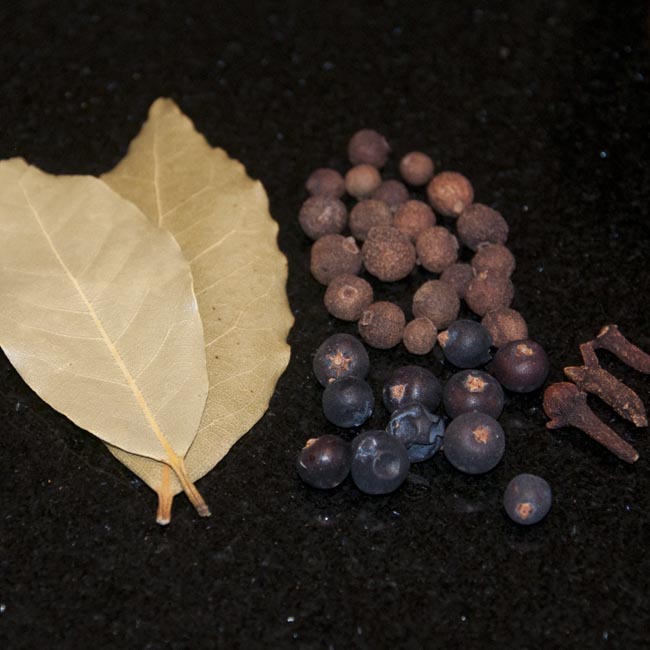
  • A bouquet garni.  This is just a posh culinary term for some herbs. I use some bay leaves, rosemary, thyme and sage, along with some whole pepercorns and a few juniper berries.  Dried is fine.
  • Water.  Glug of white wine (optional).
  • A splash of olive oil.

Prepare your gizzard by cutting away and discarding the hard plates (use a small sharp knife inserted below and parallel to the plates) and chopping the rest of the meat roughly

Put the splash of olive oil into a nice big saucepan, and brown the neck and gizzard meat, and then add the roughly chopped onion and carrots and sautee for a couple of minutes.  Now add about a litre of water (and the splash of white wine if you want) and the bouquet garni, bring to the boil and simmer for about an hour.  Strain, discard the solids, and return the stock to the pot and boil again until reduced in volume by half.  That’s it.  Set aside in the refrigerator until you make your gravy later. You won’t regret it!

Aromatics – experimenting with flavoured bacon cures

I’ve now made a couple of flavoured bacons, which I’ve then smoked in my DIY cold smoker.

Black pepper bacon – 

  • 770g piece of pork belly
  • Dry cure made up from 65g Supracure, 15g dark brown soft sugar (~10% total weight of the bacon in cure)
  • 3g of cracked black pepper added to the salt & sugar cure mix
  • Cured according to the Bringing Home the Bacon general instructions
  • Smoked for 10 hours using oak dust

This is a lovely eating bacon, and is likely to become one of our house staples.  The pepper adds mostly flavour, very little heat.  The sweet flavour from the sugar is subtle, but present, and adds nice balance.  It cooks well, too.  Highly recommended.  I think it would also be very nice unsmoked.

Christmas cure spicesChristmas bacon – first attempt

  • 530g piece of pork belly
  • 10% cure mix made up of 36g of Supracure and 17g of molasses sugar
  • One bay leaf, 10 allspice berries, 4 juniper berries, and the berry of one clove (the small ball bit on top of the stem), ground in a spice grinder and mixed well with the sugar & salt
  • Cured in the usual way and then cold smoked for 10 hours in a mix of oak and apple smoke

While the cure did smell a bit medicinal, with a dominant smell of clove, despite the tiny quantity of clove added, it did at least smell convincingly of Christmas.  The molasses sugar gives the cured bacon a really distinctive dark colour to the flesh and to the rind.  Smoked over apple and oak wood dust, it has a lovely sweet complex slightly spiced flavour, and is almost exactly what I was looking for in a Christmas bacon.  It is probably more suited to a cooking bacon (and would make awesome ‘pigs in blankets’ for Christmas dinner) but does also eat very well, caramelising beautifully, if my lunch today was anything to go by!

Heat and Light – how to clean the glass on a wood-burning stove

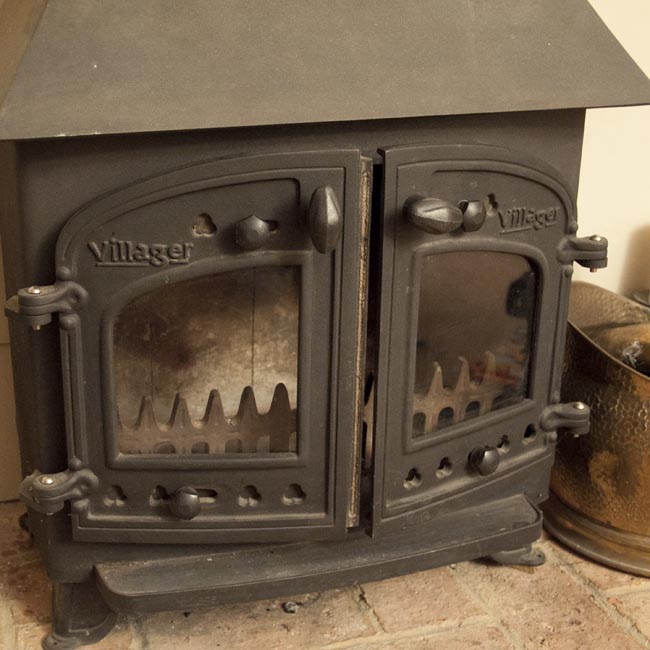
Everyone loves a real fire!  In common with lots of people in rural homes without access to the mains gas network, we use a multi-fuel stove for some of our heating.  Wood burning stoves are becoming more popular in urban areas, too.

Wood-burning stove

If you have an old stove, it’s likely that before too long you’ll find yourself having to work out how to get the soot off the glass.

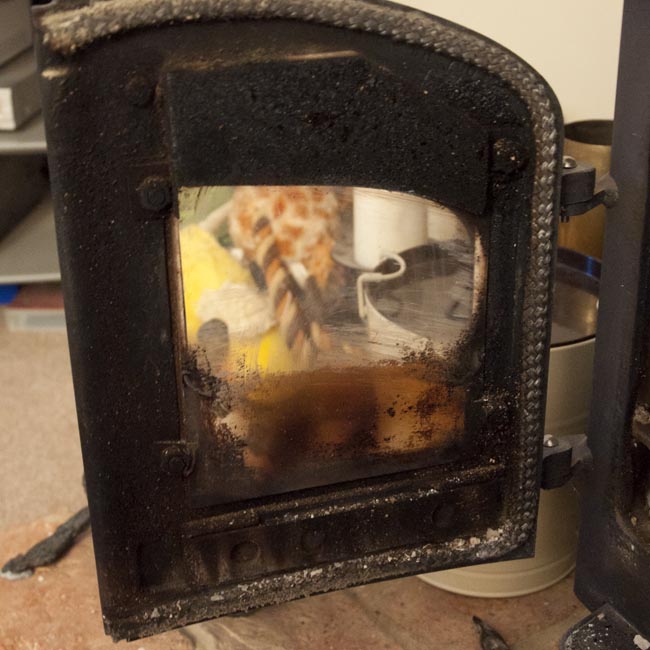
Sooty glass on wood burning stoveI’ve tried oven cleaner.  I’ve tried multisurface cleaner.  I’ve tried a pan scourer, soap and hot water.  Giving it a damn good scrub works a bit, but is very hard work.  I’ve even tried expensive, specifically designed cleaner for the glass on multi-fuel stoves.  Nothing worked convincingly or easily, and the stuff in the aerosol stank, too.  Meanwhile the glass was getting blacker and blacker, and we were deprived of the gorgeous sight of flickering flames, to the point that we were wondering how easy it would be to replace the glass.

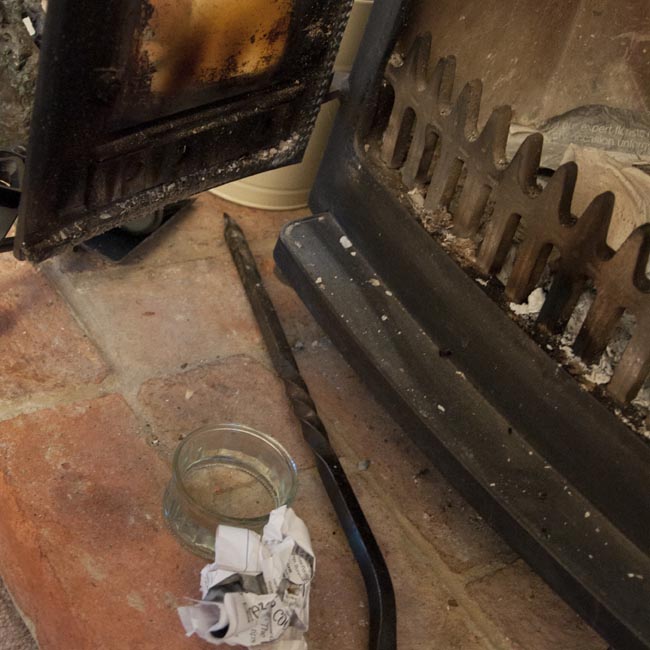
Necessary equipmentThe answer is as easy as could be.  No solvents or volatile chemicals, very little effort, and you have all the things you need already.  Strange as it may seem, you need some newspaper, some ash, some tap water, and a very little elbow grease.  And a wood-burning or multi-fuel stove, of course, but if you haven’t got one, you probably haven’t bothered to read this far.

Time: 30 minutes – Difficulty: simple – Cost: free

Glass half cleanedScrunch up about half a sheet of newspaper.  Dip it in the water and squeeze out the excess.  Then dip it into the ash.  Now use this, gently, to rub the glass.  You should notice it working straight away, which is very gratifying.  The water and ash forms a really fine abrasive slurry, which lifts the soot from the glass with very little effort.  When the paper starts to get really black and stops working again, get a new piece, and repeat the process as often as required.  Getting both doors of my fire cleaned took about half an hour.  They’re *sparkling*.

Job done!A small word of warning – if your glass has some sort of clever protective coating, this approach may not do it any good…  Then again, if your glass has some sort of clever protective coating, and is still sooted up, you might reasonably take the view that it’s not working anyway!

Go on, try it!  I know it sounds mad but I promise you won’t be disappointed!

Read more from the Country Skills blog >>

Almost-All-Purpose Any-Fruit Jelly

Time: about an hour – Patience: 4 or 5 hours – Difficulty: easy

Until this year I had never made fruit jellies, out of a misguided belief that the process was needlessly tedious and fiddly – but a bumper crop of crab apples scrumped from a hedge finally forced me to give it a go.  While there’s no escaping that it is a two-stage process – stewing fruit followed by straining and re-boiling with sugar – as hassle goes it’s certainly less trouble than taking stones out of plums for jam! Only the final boil and bottling requires your full attention, otherwise you can be getting on with other things – or putting your feet up with a well deserved cuppa!

Medlar jellies

You will require –

  • Fruit – single or mixed varieties – apples are a popular ‘base’ fruit with additions. A couple of kilos is a sensible quantity to try first time out and will probably make 6 jars or so.
  • Fresh herbs, chillies, spices… the only limit is your imagination
  • Juice of a lemon or orange, if you like
  • Sugar – I usually use preserving sugar for the additional pectin – this is particularly important for soft fruit which contain very little of their own pectins, apples and plums have quite a bit of their own and probably don’t really need supplementing. Still, it can’t hurt, right?
  • A saucepan with a bigger capacity than the volume of your fruit
  • A jelly bag / muslin strainer
  • Jam jars with lids, clean and dry. I like to re-use jam jars if I can, and save small pretty ones for jellies, to the eternal irritation of my husband who keeps finding empty jars all over the house. Jellies often have quite a delicate flavour, so do be careful the jars haven’t previously been used for pickles or curry sauce (give them a good suspicious sniff if in any doubt, and check the lids for staining – if so send them for recycling or use them for chutneys), as this could very easily taint your lovely jelly!

And this is how it’s done –

  • Stewing medlarsRoughly cut your fruit into pieces no more than about an inch square, removing any damaged / rotten areas (ignore this last detail in the case of bletted medlars, or you’ll have no fruit!)
  • Place the fruit in the saucepan and just cover with tap water. Add the citrus juice at this stage if desired.
  • Bring to the boil and then cover and simmer gently for an hour or so, stir from time to time but don’t mash.
  • Straining in the jelly bagSuspend your jelly bag over a bowl and spoon in your stewed fruit. A soup ladle is quite helpful here. A jelly bag is a really useful thing to have if you’re making jellies (who knew?) but can be a bit expensive. You can bodge your own with a tied muslin. Many jelly bags have stands, but I just tie mine to the handles of the eye-level kitchen cabinets.
  • The liquor that drains into the bowl will probably be cloudy. Don’t worry about this too much. You’ll see why in a bit.  Leave it to strain for at least a couple of hours.
  • When the flow of liquor from the jelly bag is almost exhausted, put the clean jam jars and lids in a cold oven and set the temperature to 150.
  • Now, when the dripping is essentially stopped, measure the volume of liquor you have, preferably in pints (please note this recipe uses UK Imperial weights and measures, not US ones).
  • Then weigh out the sugar you need, following the rule of thumb of one pound of sugar to one pint of liquid.
  • Return the liquor and the sugar to the (washed) pan, add any finely shredded herbs or spices (if you just want the flavour but not the pieces of herb or chilli etc in the jelly, you should have added them at the stewing stage so the pieces are filtered out – personally, I rather like the look of little nuggets of flavour in the final product), and bring gently up to the boil, stirring continuously.
  • You now have a pan of quite concentrated boiling sugar syrup, which you should under no circumstances leave unattended. It will probably froth a little and some scum may well rise to the surface. I’ve seen recommendations to skim this but I never bother.
  • At some point during the boiling process, with a bit of luck, the cloudiness will disappear entirely. No, I don’t know why, either. I think it’s that culinary alchemy again!
  • Keep stirring, and check for setting periodically. I put a couple of small saucers in the freezer ahead of time, then put a drop of the boiling syrup on the saucer, it will cool quickly and allow you to check the consistency. It’s ready when the cold jelly wrinkles when you push it with your finger.
  • Different jellies seem to reach setting point at very different rates, some will take as little as 10 minutes, so keep checking regularly. And tasting, of course.
  • Once your jelly has reached setting point, carefully get the hot sterilised jam jars out of the oven, fill with the hot jelly and tighten the lids fully. If you have any pieces in the jelly, watch to see if they’re trying to sink or float in the jars – if they are, then invert the jars every so often as they cool to mix the contents.
  • If you find, once they’re cold, that the jelly isn’t as set as you’d like, it’s perfectly alright to tip it back into the pan the next day, clean and re-sterilise the jars, and boil the jelly for a while longer. But assuming it’s mostly set, why would you bother unless you were planning an attempt on the local flower and produce show with it?
  • That’s it! Label, store, and enjoy at your leisure. They should keep at least a year in a cool dark place, but best to refrigerate after opening.

Doesn’t seem so hard, does it?  Now, don’t you want to know what happened to those medlars..?

Deck the Halls – quick & easy Christmas bunting

Time: an hour or two – Difficulty: low (assuming you can use a sewing machine) – Cost: less than £5

Don’t you love bunting?  Not only is it very pretty, it seems to be bang on trend right now, if the smart interiors boutiques where I can’t afford to shop are anything to go by!

Christmas bunting

A while ago, I (maybe foolishly) volunteered to make a load of bunting to help decorate the village hall for my little sister’s wedding reception.  Before embarking on the epic effort, I thought it might be best to do a mini version to iron the kinks out of my process.  Christmas is coming, so what better than a bit of Christmas bunting for the hallway?

For this project, you will require –

  • A sewing machine (capable of straight stitch – so any sewing machine will do!)
  • Straight scissors and pinking shears
  • Scrap card for a template
  • Bias tape, as much as you want your bunting to be long, and the colour of your choice.  Double fold tape will save you the fold-and-iron process, but may not be as easy to get hold of.
  • Sewing thread to match or contrast with the bias tape.  I find if I’m trying to match a colour and I don’t have a really close match – as in this case, all my greens were too light or too yellow – it’s better to find a neutral colour which matches the tone.  I used a dark grey for this bunting.
  • Some suitably festive fabric.  I used mainly scraps left over from previous Christmas crafting.  If you want to use new fabric a single fat quarter should be enough to make 6m of bunting with quite modest 4″ x 6″ pennants spaced 6″ apart.

Bunting template

Realistically you probably have all of the non-consumables or none of them – 6m of bias tape cost me less than £2, and I had the leftover fabrics already.

This is a single-sided bunting, if you use printed fabrics like I have.  If you use fabrics which have two good sides, of course, you don’t need to worry about that.  I like the effect of the pinking-sheared edges, and it saves an awful lot of time over hemming.

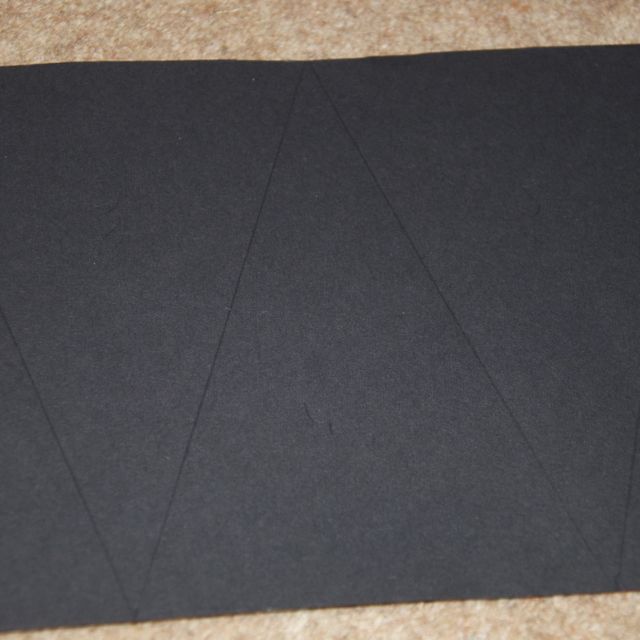
My bunting templateStart by making your template.  I drew mine out for triangular pennants 6″ long and 4″ wide at the top (the whole template is 20″ x 6″).   If you’re using lots of small fabric scraps, you may also make to want a template for a single or a pair of pennants.  Give some thought to what spacing you’re going to want to have between your pennants.  I went for 6″ – the same as the length of the pennant.  Any more than this I think looks a bit sparse, closer and you’ll need more time and fabric to make extra pennants – at the end of the day it’s up to your taste!  Work out how may pennants you’re going to need by applying some basic primary school maths to the problem.   Remember to leave a bit more bias tape at the ends to give you enough to tie the bunting by.

Bunting pennantsUsing your template, mark up your fabric.  I used a biro to mark up the back of the fabric.  You might want to use something a little less crude, if you have it!  Then cut the top of the pennants with the straight scissors, and the sides with the pinking shears.  You’ll notice the lines I’ve cut aren’t quite strictly straight, because my pinking shears aren’t long enough to cut the side in a single action.  I don’t think it matters!

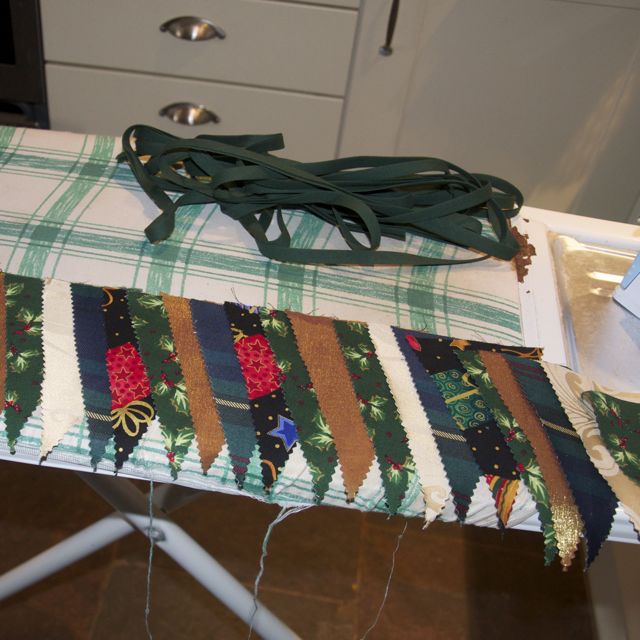
After ironingOnce you’ve cut all your pennants, it’s probably a good time to iron them.  At the same time, if you’ve bought single fold bias tape (bias tape which has the two edges folded in but isn’t yet folded in half) then use the iron to fold this in half and set the fold. Then decide how you want your pennants ordered, if they’re not all the same.

Pinning pennants in placeNow, starting from the centre to ensure they’ll be evenly distributed, start pinning your pennants into the bias tape.  I marked my 6″ gap onto the edge of a piece of card to help me space them consistently – it’s quicker than using a measuring tape or a ruler every time.  Try to be reasonably accurate but don’t stress over it.

Sewing buntingOnce all your pennants are placed, it’s time to sew.  I just used a single row of straight-stitch as close to the open edge of the bias tape as it was practical to do quite quickly.  You could also use a zig-zag stitch, if you prefer.  As you get to each pennant, just make sure the top is placed as far into the fold of the tape as possible, and lying nice and flat, before you sew it in place.

Bunting, folded for storageChristmas bunting - completedThat’s it, keep sewing until you’ve reached the end of your tape and all the pennants are secured in place.
Doesn’t it look pretty?  I can’t wait for Christmas now!

Read more from the Country Skills blog >>

Creamy home-smoked salmon pasta

Time: 10 minutes – Patience: 10 minutes – Difficulty: Simple – Knackyness: Low

Yesterday, I had a first experiment at curing and smoking salmon at home.  Tonight, I made a creamy smoked salmon pasta with the cold smoked fillet I’d produced.

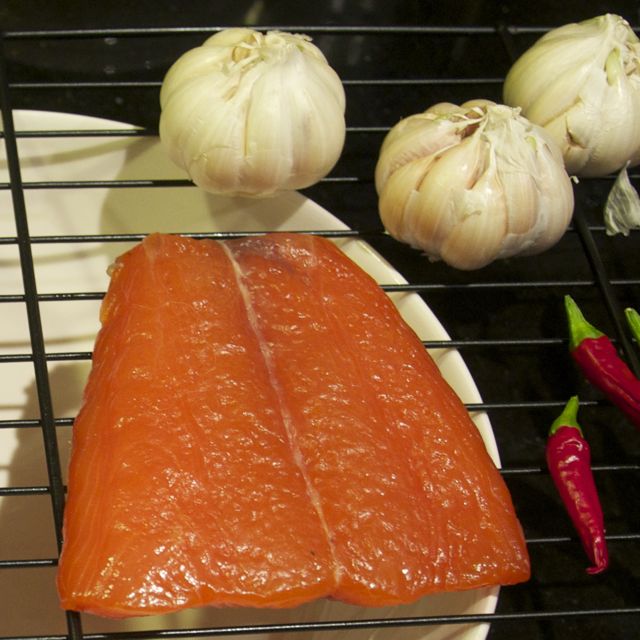
Smoked salmon pasta - some ingredientsIngredients –

  • One tail fillet of home-smoked salmon, around 100g
  • Two home-reared pullet’s eggs
  • One clove of home-smoked garlic, crushed
  • A small handful of grated parmesan or pecorino
  • A glug of double cream
  • Pasta of your choice, sufficient for two portions

Method –

  • In a dry frying pan, start to cook your whole smoked salmon fillet
  • In a large saucepan, bring some salted water to the boil
  • Add the pasta to the boiling water, along with a pinch of salt and a glug of olive oil
  • Once the salmon fillet is cooked, break it up into flakes in the pan, then add the crushed garlic clove and continue to fry gently for a couple more minutes
  • Meanwhile, in a bowl or jug, beat the eggs with a fork, add the glug of double cream and 2/3rds of the grated parmesan, along with a generous pinch of cracked black pepper
  • Once the pasta is cooked, drain and return to the saucepan.
  • Add the liquid ingredients to the frying pan with the salmon and garlic, and almost immediately transfer all of these into the drained pasta
  • Mix swiftly, the heat from the pasta will cook the egg, and the texture should end up thick and glossy.  But don’t worry if it looks a bit like scrambled egg with salmon in it, it will still taste marvellous
  • Serve into two bowls, topped with the rest of the grated parmesan

Simple, tasty, and all the key ingredients home-produced. And done in the ten minutes it takes to cook the pasta. What could be better?

Verdict on the smoked salmon? Undoubted success. Cooked in this dish it is distinctively and recognisably smoked salmon, has a good firm texture and slightly salty flavour and lovely smokey aroma.  Result!

I have an apology to make, however – it was a long day at work, and I was hungry… so I didn’t stop to take photos of the cooked dish, I just ate it!

Juniper and Bay cure for cooking bacon

This was my first experiment with adding aromatics to a bacon cure.  I’d picked up a pack of ‘thick streaky pork slices’ from the supermarket bargain-meats section – a pack of five pork belly slices about as thick as they were deep, and seven or eight inches long.  For the curing technique, see Bringing Home The Bacon.

I probably wouldn’t recommend using this as a cure for bacon you intend to slice and have for breakfast (though, if you like it, why not?), but it produces really excellent bacon for cutting into cubes and using in cooking.  My first batch was incorporated variously into a celeriac and sausage casserole, a lovely rich bolognese sauce, cauliflower cheese, and sliced and fried to crispy as a burger garnish.

To make 100g of cure (enough to cure about a kilo of belly pork), you will need:Juniper and Bay cure, and ingredients

  • 67g of Supracure (see Bringing Home the Bacon for more information on curing salt)
  • 33g of molasses sugar
  • 8 – 10 juniper berries
  • 1 bay leaf

Put the bay leaf and juniper berries in a spice grinder or pestle and mortar and grind to a medium texture. Add the sugar and Supracure to the grinder and mix well.  Store in an airtight container.  Thanks to the juniper berries, the cure will smell faintly of gin.  This is no bad thing in my opinion!

This is quite a dark coloured cure with a distinctive aroma – it adds a lovely and unusual flavour to dishes when used in cooking.  It seemed to go down well with the people to whom I experimentally fed it, anyway!

Christmas is coming, the gin is getting pink!

Time: 1hr — Patience: 2 – 3 months — Difficulty: Low — Knackyness: Low

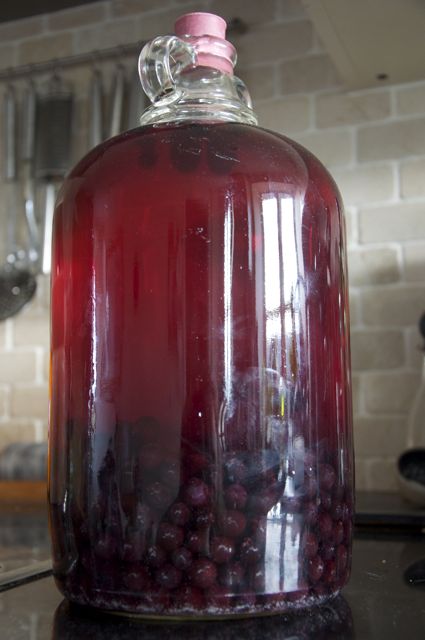
Sloe Gin maturing in demijohn

Sloe gin is a traditional country Christmastime treat, and is a liqueur made by flavouring gin with sloes (the fruit of the blackthorn bush) and sugar.  The traditional time to pick sloes is just after the first frost (so right now, for most of the UK!) as this both damages the cell walls of the sloes and changes their flavour, sweetening them.  You can make sloe gin very successfully with sloes picked before the first frost, but it’s wise to freeze them at least overnight before proceeding.

BE AWARE – Blackthorn isn’t called blackthorn for nothing!  The bushes are armed with vicious spikes, so proceed carefully and consider wearing gloves to pick with.  Personally I don’t, but as a result I give a blood sacrifice for my sloes every year.

This gin is very simple, and is sweetened to my taste.  You might find your palate runs to more or less sugar.  I’ve also seen gin recipes with spice additions such as a cinnamon stick, vanilla pods, and so on – so go ahead and experiment!

You will require –

  • A 1.5l bottle of cheap gin
  • 750g of sugar.  I like to use golden caster sugar, but you could experiment with other sugars
  • About a pint to a pint and a half of sloes, washed, dried (and frozen overnight if required)
  • An empty 1l glass screw-top bottle.
  • Kitchen scales, a measuring jug and, if available, a funnel.

Transfer 600ml of the gin from the 1.5l bottle to the clean 1l bottle, leaving 900ml behind.

Using the dry funnel, add 300g of sugar to the small bottle and 450g to the large one.

Fill up the remaining space in the bottles with the sloes.  Put any extras back in the freezer.

That’s it, really!

Give the bottles a good shake several times a day until all the sugar dissolves.  By this time it should have a similar appearance to the photo above, with colour starting to come into the gin.  Then put it in a cool dark place and forget about it for at least two months.

After that, strain the gin from the sloes and store in clean bottles.  In the past I’ve bought some pretty-looking 250ml bottles and used these for Christmas presents, which seem to be popular!  Add a couple of the excess sloes you put in the deep freeze to each bottle for that extra decorative touch.