Sourdough Saga: Episode 4 – cheese and sun dried tomato bread

After the gratifying – if unexpected! – success of my first sourdough loaf, I couldn’t wait to do it all again as soon as possible.  The first loaf didn’t last very long, either, and certainly didn’t get a chance to go stale!  So the next free day I had was dedicated to another baking day.  I used broadly the same technique as for my first loaf (see ‘Sourdough Saga: Episode 3‘ for details) but with double quantities, and a downward adjustment to the salt content (10g in total in a two loaf batch).

Second sourdough bake

There were a couple of new things – first, the loaf shape.  I wanted longer, narrower loaves, instead of the round I baked the first time.  I’d love a full set of lovely baker’s bannetons, but they’re expensive and I’ve got nowhere to store them, so I improvised with a couple of long thin serving dishes I was given for Christmas last year by a friend, lined once again with a clean tea towel dusted generously with rye flour.

Dish used for provingIt’s not quite the right shape, as you can see, and tilts up at the tips rather, but it allowed the final proving to produce a loaf of approximately the size and shape I was after.  The ridge on the inside of the dish does leave an imprint on the loaf, but it’s all character!

I had a generous handful of grated cheddar cheese and some sun-dried tomatoes left over from the previous day, so decided to make one of my loaves a cheese and tomato bread.  I incorporated the extra ingredients during the final kneading, sprinkled across the surface when it was flattened out, and then folded into the dough during the shaping of the loaf.

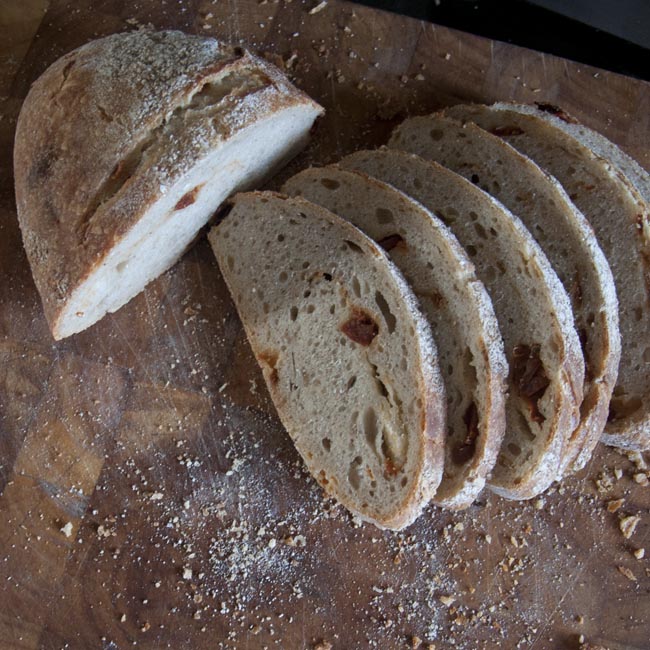
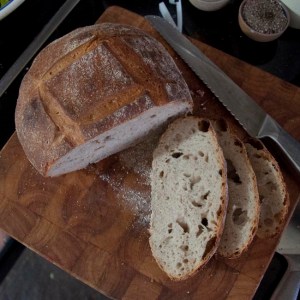
Sliced cheese and tomato sourdough loaf

I think the cheese and tomato make a great addition to this sourdough. Something about the cheese flavour mutes the lactic sour note quite noticeably, making this a sourdough loaf that might go down better with people who aren’t that keen on the distinctive ‘sourdough’ flavour. The chopped sun dried tomatoes add a lovely sweet herby note (they were stored in herb oil).

Texture-wise this loaf seemed to prove slightly less well than it’s unmodified brother, with a slightly denser texture and smaller holes.  I’m not sure if this is the result of the extra oil / fats incorporated with the additions, or whether it has more to do with the difficulty I had keeping my oven up to temperature when baking two loaves together.  On the salt question – I don’t notice a difference from the further reduction, and it’s likely I’ll reduce the salt again next time I bake a loaf.  All in all, this is a great loaf and one I’ll definitely make again in the future!

Read all the posts in the Sourdough Saga >>

Read more from the Country Skills blog >>

Sourdough Saga: Episode 3 – good things come to those who wait!

A week ago, and with a certain amount of frustration, I stashed a very promising looking sourdough starter in the refrigerator, knowing I didn’t have a plausible baking day for another seven days.  Despite having lots going on, those seven days have been torture, in their way.  I’ve not looked forward to a day off quite so much for a very long time!
Sourdough - success at last!

On Tuesday morning, in preparation for today’s much longed-for baking day, I ‘rescued’ my jar of starter from the fridge.  It had ‘fallen’ back from it’s bubbly heights and seemed more like a pot of goo than a bubbly ferment.  But I’d been expecting this.  I gave it a couple of teaspoons of fresh flour just for a small snack, something to munch on while it warmed back up to room temperature, and went to work.  Some promising bubbles greeted me on my return, so Tuesday night it got a proper feeding.  This had the expected – but gratifying! – result of a decent doubling in size by Wednesday evening.  Pleased that the starter seemed nice and active, I constructed my ‘overnight sponge’ on Wednesday night.

The recipe for my first sourdough loaf is a slightly modified version of one of the sourdoughs in ‘River Cottage Handbook No.3 – Bread’ by Daniel Stevens (ISBN 978-0-7475-9533-5) which has been staring at me accusingly from between it’s very beautiful covers since it first moved onto my kitchen book-shelf a couple of years ago.

My sponge consisted of the following parts –

  • A ladle-full of my (wholemeal) starter
  • 325ml of warm water (a mix of cold tap water and some hot from the kettle)
  • 250g of locally stoneground strong white bread flour

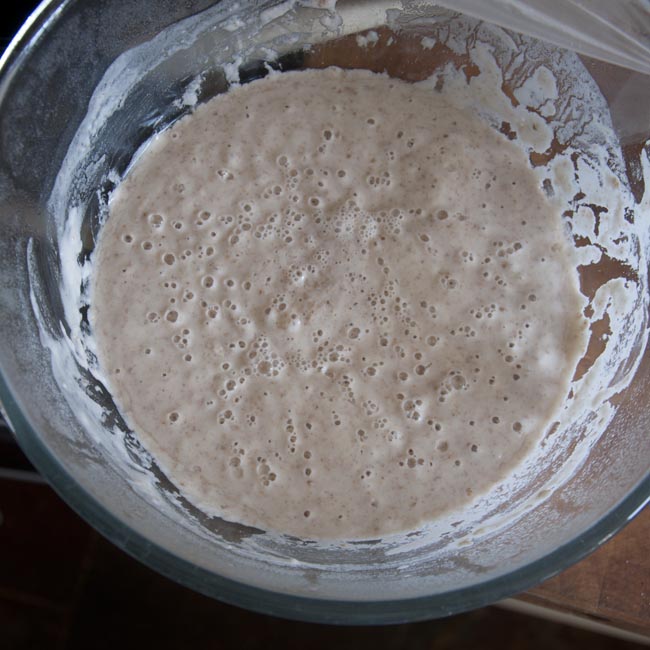
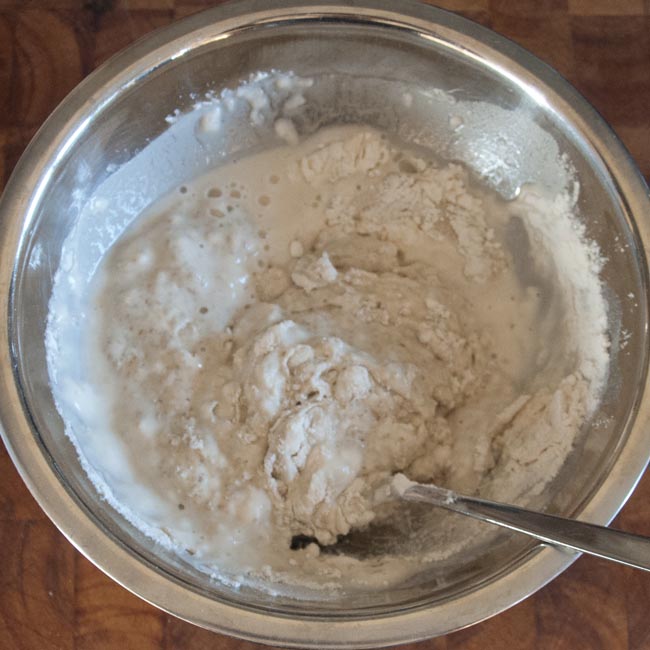
Overnight sponge, in the morningThese are mixed by hand in the bowl, covered loosely with cling film, and left to ferment overnight.  This morning, after I couldn’t bear to stay in bed any longer out of curiosity for how my bread was going, I was met with this – a lovely bubbly bowl of promising things!

I put the coffee machine on for my essential morning brew.  So distracted was I by my marvellous bubbly sponge, the jug was half-way full of pale brown water before I realised I’d forgotten to add any ground coffee!

The sponge, when I stirred it and then poured it off into a second bowl, was an amazing ‘stringy’ consistency, more like melted cheese than anything I’ve encountered in bread-making before – I assume in some way from the alchemy of the microorganisms within it.

To the sponge, then, I added –

  • A further 300g of strong white bread flour
  • 7g of salt [Edit, 15/7/2012 – I now use about half this amount of salt, with no ill effect]
  • A ‘glug’ of olive oil

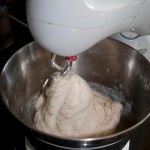
Dough in the mixerAfter mixing the sponge, flour and salt roughly by hand, I put the lot into my (rather lightweight!) stand mixer, dough hooks fitted, and started it going.  It certainly gave the dough (and itself!) a heck of a work-out.  After a couple of minutes I added a good glug of olive oil and left it to work for about ten minutes.  I was told to expect quite a wet dough and certainly this was tricky to handle, sticky and rather ill-manered!  I don’t have a dough scraper so I was rather grateful for the mechanical assistance – though I’m not sure how many batches of sourdough my stand mixer has in it, it seemed to find it quite an effort!

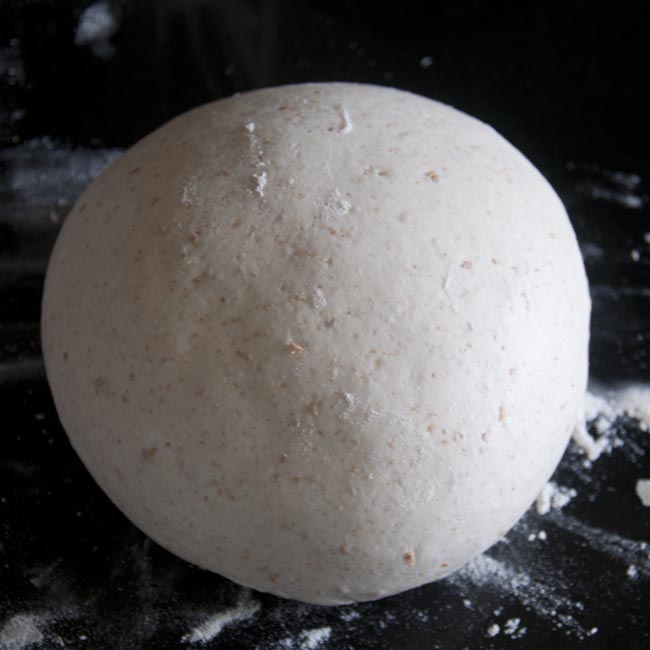
Dough, before first riseAfter kneading, I formed it into a rough round and oiled the bowl before setting the dough in it to rest for the first time.  Before this first resting period it looks like this, and after a couple of hours, to be honest, it looked just the same, if possibly *slightly* bigger in the bowl.
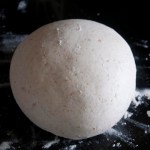
Formed into a roundFlour your surface, and then turn out the bowl of dough – squash it out into a rough rectangle with your fingers, and then ‘knead’ it gently back into a tight round before returning it to the oiled bowl for another hour or so. Put the bowl somewhere warm, but not hot – on a cool day, the oven with the light (but no heat!) on makes a good resting environment.  You’re going to repeat this process of resting, flattening and re-forming your ball a couple of times during the day.

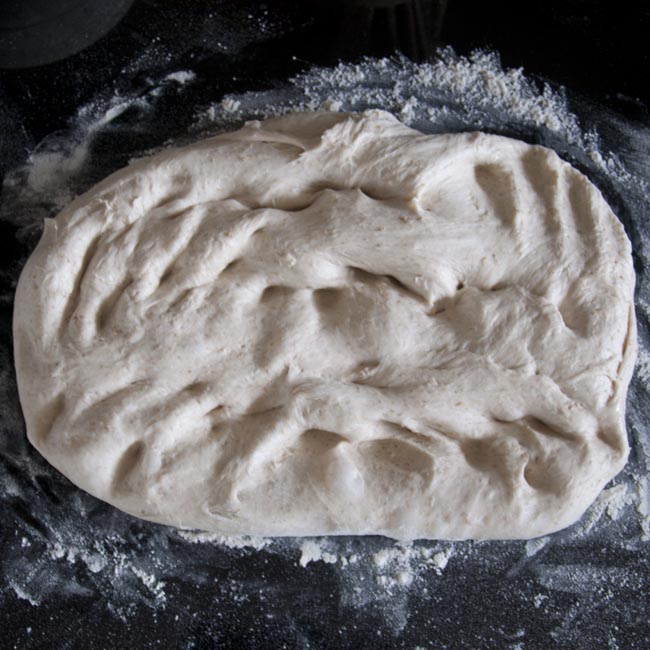
Dough, flattened with fingertips for final timeA couple of hours before my planned baking time, I turned the dough out for the last time.  It’s springier, silkier and lighter, with some noticeable bubbles now when you handle it. Form it into a round again but this time, rather than returning it to an oiled bowl, it would rather be in a proving basket.
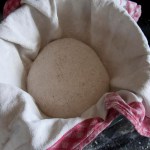
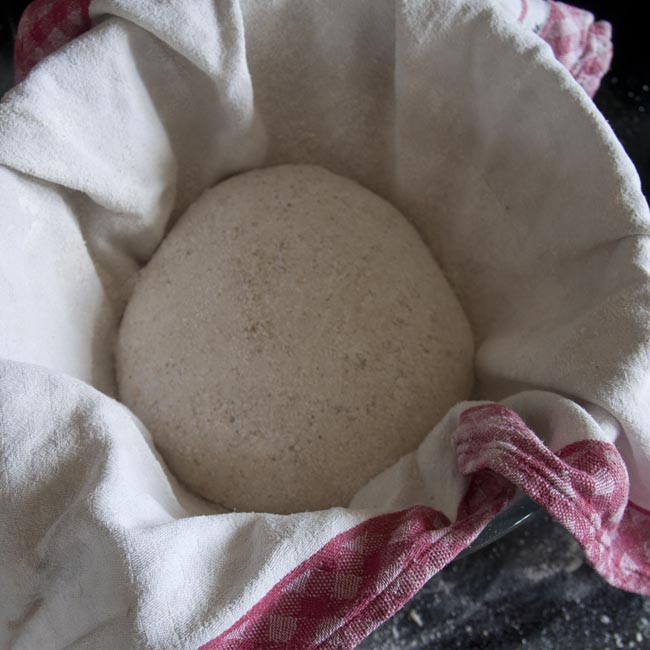
In the ad-hoc 'proving basket'I don’t have one of those, so I used a mixing bowl lined with a clean tea-towel which I’d dusted generously with rye flour.  I had very little faith that this was going to result in anything other than a disappointing sticky mess when the dough adhered to the cloth, but I’m a good girl and do as I’m told. Covered loosely with a piece of cling film, I left this patiently for another three hours.

I’d read all sorts of advice about the critical baking process – involving dutch ovens (I don’t own one), squirty-bottles of water (likewise!) for steam creation, and even things that look a bit like chicken bricks to approximate a traditional wood-fired oven.  I went with what I actually had – a round black stoneware baking dish for the bread, and a stainless steel roaster to hold some water in the bottom of the oven.  I heated it up to it’s maximum temperature (230C on the dial – 20 below what was recommended) and pre-heated the stoneware dish.  Once it was all up to temperature, and after adding a kettle-full of boiling water to the roaster in the bottom of the oven, I tried to gently turn out the floured dough onto the baking dish.  It seemed like a bit of a disaster, to be honest – ending up rather crumpled and misshapen.  I cut a cross-hatched pattern crudely into the top, and reassuring myself it was all about the flavour, bundled it back into the blasting hot oven.

I couldn’t tear myself away from it, and ended up sat cross-legged on the kitchen floor peering through the oven door as a miracle started to happen.  First the crumpled side seemed to stretch itself back into shape, and then, I’ll be damned if it didn’t start to rise!  Ten minutes into baking and I turned the oven down to 190.  The amazing rising act continued – first, it stretched its way languorously into the slashes, stretching them nicely across the surface.  And then, it started to climb vertically upwards, lifting its edges off the baking tray.  I’ve never seen a loaf perform an act like it – I can only assume it’s the result of the clever changes to the gluten that result from the extended rising and proving time.  It was like something out of the Incredible Hulk.

Out of the oven - at last!After 40 minutes the crust was a lovely warm mid-brown colour, but the bottom was still a bit soggy.  I took it off the baking dish and returned it to the oven upside down for another 10 minutes.  Hubby came home to find me stood expectantly in the kitchen.  After that, I couldn’t wait any longer, and pulled it out of the oven.  The smell of baking bread that filled the kitchen – and the house – was quite amazing.

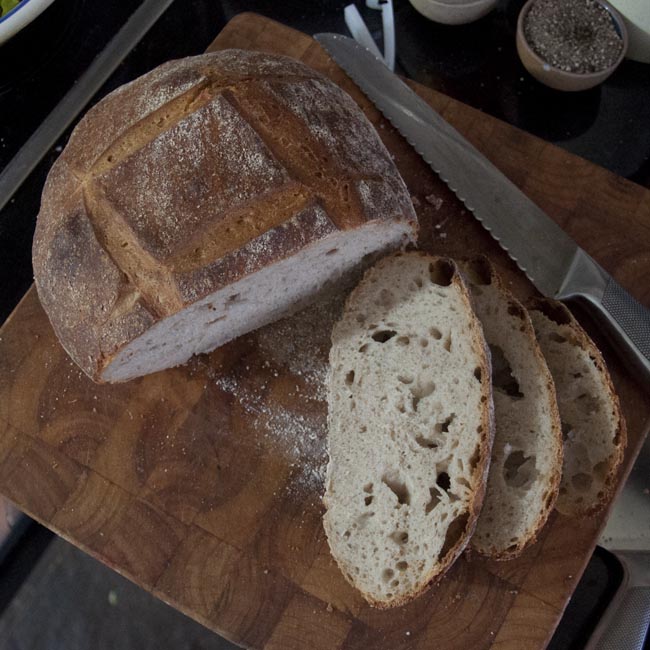
An hour later, we slice and sample it.  I genuinely wasn’t expecting anything this good from my first effort.  There are some lovely big holes in the dough, the crust is amazingly crisp but very thin – and retains a remarkable elasticity.
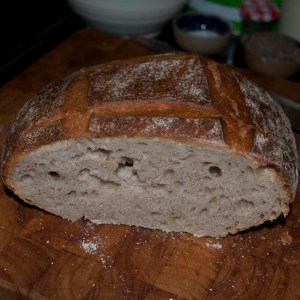
Sliced sourdough loaf

The texture of the bread is springy and extremely satisfying.  There is a definite, recognisable, but not overwhelming ‘sourdough’ flavour.  I *adore* it.  The whole process – from starting the sponge to eating the loaf – took about 24 hours, and I don’t regret one of them.  The actual ‘working’ time today was about an hour and a half, and left plenty of time for popping to the shops, taking the dog for a walk, and so on.

The bar for ‘good bread’ has just shot skywards in our household, and I suspect things may never be quite the same again.

Read all the posts in the Sourdough Saga >>

Read more from the Country Skills blog >>

Sourdough Saga: Episode 2 – keep calm and carry on?

So sourdough-1 went in the bin, and after a thorough clean out, sourdough-2 began…

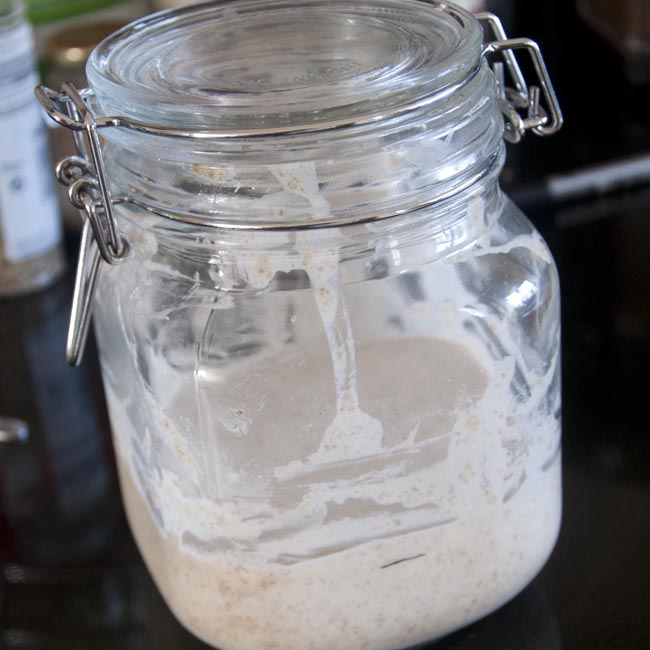
Split starterI started initially with rye flour again, but used bottled water this time.  My initial batter was far too thin (I started with equal volumes of flour and water rather than equal weights – not quite sure what I was thinking really!), on day 2 when I got the initial bacterial bubble-up the whole thing split like curdled milk.  Thanks to some more supportive advice from twitter, I didn’t panic.  Keep calm and carry on, so they say.  Too much water, not enough flour, feed and perhaps move somewhere slightly cooler.  Done.

Do all starters get talked to this much?  Never has an inanimate object of mine been so cajoled & pleaded with.  I speak to it softly, encourage its efforts, and wish it goodnight and good morning.  My husband wonders if I’m losing my marbles… if only just a little bit!

I got my hands on some locally stoneground wholemeal flour, so I switched to this for feedings. As the batter was still on the thin side, I didn’t pause for doubling at day 3, but carried on with daily feeding.  Because the material on the sides of the jar was the first to grow mould last time, I made a habit of swilling out the jar to clean the sides at each feeding. The smell was good (quite yeasty and sourdoughy!) but only a few scant bubbles were rising to the surface.

More great advice came flooding in after I published Episode 1 of the Sourdough Saga – including the recommendation not to cover the starter.   Perhaps this was where I was going wrong, even with the lid lightly resting on the top of the jar, was I  suffocating my starter by depriving it of air?  A week after starting and not much was happening, so this seemed a theory worth pursuing.  Discarding the lid from the jar, I strapped a little kitchen-towel bonnet over the starter jar with a rubber band.  Things did start to look a bit more active on the surface of the starter at around that time.  Had I got something right at last?

The next morning dawned to apparent disaster.  Literally overnight, the whole top of my starter had bloomed with creamy-coloured velvety mould!  I was so upset I didn’t even think to photograph it.  More desperate scratching through the deeper sourdough-focused recesses of the internets ensued.  Someone promised that even really neglected starters, all moulded over, could be resuscitated – but since mine had never yet really come to life, could it work for me?  Had I perhaps caused this mouldy horror by leaving my starter uncovered for the surface to dry out?

Out of sheer bloody-mindedness, and muttering something about ‘not giving up now’ under my breath, I scratched the furry stuff from the surface of my starter as well as I could.  What was left, I mixed with more flour and water (gently warmed, this time) and tipped back into the jar.  The starter had developed a ‘winey’ smell I wasn’t at all sure I liked.  I got rid of its bonnet, reverting to the loose glass lid, turned my back on it, and leaving it without even my usual gentle words of encouragement, went out for the day, expecting to find more mould & disaster on my return.

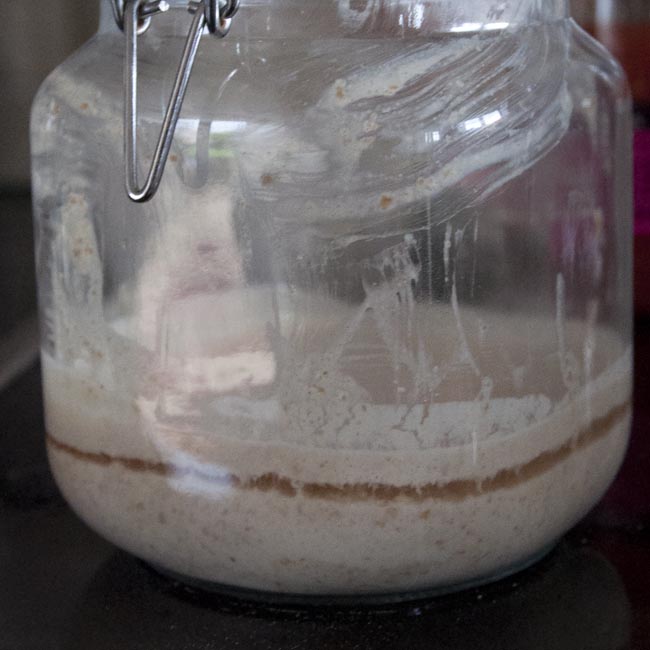
Bubbled up and at least doubled in size

Six hours later, you might have knocked me down with a feather.  The damned thing had bubbled up to very nearly twice the size I’d left it, and was a sponge of small even holes visible through the sides of the jar.  I nearly wept.  Instead, I swore, colourfully.  Not a trace of fuzzy mould was visible.  In fact, a better impression of all the ‘happy, thriving starters’ whose photos I’d been coveting on other, more successful blogs, I couldn’t imagine.

I tried to share with my lovely husband quite what an exciting turn of events this was.  He seemed pleased for me, also somewhat (indulgently) nonplussed.

I left it overnight, and fed it again in the morning.  Coming home from work tonight, I found it doubled again.  I can’t quite believe it.  It looks so good, but I can’t convince myself there isn’t still something wrong with it now?  I’ve fed it again this evening, getting the volume up so there’s enough to harvest for a loaf or two.  Can I just use it, soon?  What, if anything, should I be worrying about now??  It looks great, and smells great, it grows like a weed, does that mean it *is* great?  Is there any way of telling?

This whole process has been the most insane and unexpected emotional roller-coaster ride.  Is this just all sent to make me *really grateful* for my new daily bread??  More importantly, my wise blog friends, can I make a mostly-white loaf from a wholemeal starter, or should I stick to matching flour for now?  So many questions – so much to discover!

What have I learnt, that might help others trying to navigate the gloomy labyrinth of sourdough starter art and science?  Not much, to be honest!  Only that there doesn’t seem to be a one-size-fits all set of instructions.  In the end, what seemed to work for me – despite the odd speed-bump on the road! –  was nice fresh stoneground wholemeal flour, slightly warmed bottled water, and a willingness to just keep discarding and feeding day after day until things eventually came together.  My starter hadn’t read the timetable, and probably neither has anyone else’s!

Finally, I’d like to offer a huge vote of thanks to everyone – both on wordpress and on twitter –  who’s offered me guidance and support on my sourdough journey so far – I would never have guessed there were so many great sourdough bakers out there, so generous with their time, knowledge, and advice!

Next – Sourdough Saga: Episode 3 – good things come to those who wait!

Read all the posts in the Sourdough Saga >>

Read more from the Country Skills blog >>

Basic Butchery – how to butcher & portion a pork belly

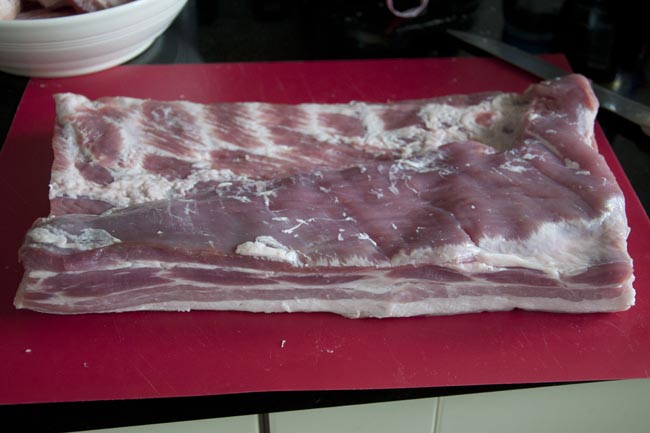
Pork belly is such a wonderful and versatile cut, and so under-rated here in the UK.  Most of my bacon making is with belly, so we get through quite a lot of it.  As a result I tend to buy it most-of-a-belly at a time!  The process of butchering it to remove the ribs and prepare it for curing or roasting is quite simple, and worth learning, since it means you’ll end up with precisely the piece of meat you want for the task at hand, and a couple of little bonus items, too!

Large piece of pork belly

Your butcher will probably offer to prepare your belly for you, removing the ribs and trimming it to your preference, but you never quite seem to get exactly what you were after, somehow!  Doing the job yourself means you get exactly what you want.  This is my starting point – just under 2kg piece of pork belly .

Peel away the inner layer of fatStart by removing the layer of fat on the inside of the belly piece, if there’s one there.  You shouldn’t need your knife for this, it should just pull away if you work gently beneath it with your fingers, leaving a clean muscle surface beneath.  Once you’ve removed it, set it to one side (I usually keep an ‘offcuts’ plate or bowl handy when I’m portioning or butchering meats).  This is effectively pork suet.

Belly portion with fat removedNow you can get a better look at the anatomy of your piece of meat.  As it’s laid out in the photo here, the ribs are on the left, you can see the flap of diaphragm meat lying above them.  On the right side of the belly is a band of smooth muscle.  The ends of the ribs lie almost exactly where the visible edge of this muscle joins the diaphragm.

Cut beneath ribsTake a long, thin bladed, sharp knife and first cut beneath the ribs, as close as possible to them to reduce wastage.  The piece has been rotated 180 degrees from where it was in the previous photograph so that the ribs are now bottom right.  You should be able to feel roughly where the ribs end, so extend your cut beneath them as close as possible to this level.

Finding the ends of the ribsNow gently slice beneath the strap-like muscle we identified earlier, where it lies over the ends of the ribs, and peel it back,  You’ll find the ends of the ribs and the strips of cartilage which link them together.  Gently slice around these and then back underneath. By lifting the rib section it should now be quite easy to join up with the cut beneath and remove this as a block.

Rack of ribs, as removedEither put the rack of ribs to one side, or cut them up into individual ribs at this stage.  This couldn’t be simpler – just feel for the gap between each pair of ribs and slice down the centre parallel to them, your knife, if it’s nice and sharp, should cut straight through the connecting cartilage.

Ribs, divided up.You can trim away any strips of cartilage that area easy to identify – you can see this top left.  That bit is genuinely wastage, incidentally, so chuck it away if you want!  Bag your butchered ribs up, label them, and freeze them for another day (they’re great done on the BBQ with a jerk marinade!).

Pork belly with ribs removed

Now let’s turn our attention back to the pork belly itself.

You can really see now that mine is anything but rectangular! It’s actually sitting ‘upside down’ in terms of how it was on the pig – the top as we look at that photo is the part closest to the middle of the pig’s body, the rib side is towards the back.  As we get closer to the abdominal midline, the proportion of fat to muscle increases, so I trimmed the piece to rectangular, discarding the part which is most top-left in this photograph.

Pork belly, trimmedBecause I’m planning to prepare the belly as streaky bacon, this will give me more manageable, even chunks.  You can see the effect of the trimming in this photograph – the piece has been rotated again so the rib-side is now away from us.  Add your trimmings to the ‘offcuts’ bowl.

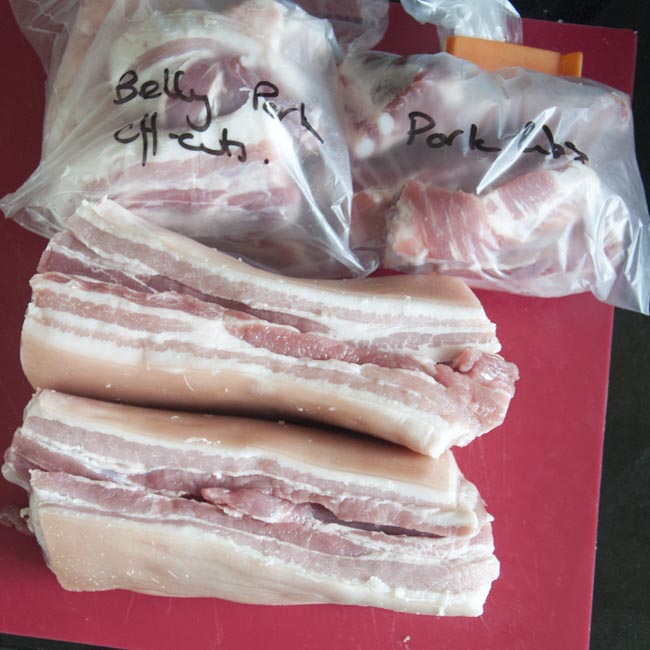
Belly pieces, divided upNow simply divide up your belly as you like.  Mine weighed almost exactly 1.6kg at this point, so I divided it evenly into four ~400g pieces.   A large piece like this would be fantastic roasted slowly whole, too, perhaps with chinese spices, for a special meal for a big gathering!  Roast pork belly has the *best* crackling.

Bag your ribs and your offcuts – these will make fantastic quite fatty minced pork for adding to any minced-meat dish that requires extra juiciness and succulence, or for sausages.  Then sit back and admire your work.

Fully-butchered pork belly

My belly portions were for curing, so I prepared a maple syrup cure made up of 100g of supracure and 90g of pure maple syrup, applied about half to all the bellies, and then bagged them together in the fridge. (More discussion of the bacon-in-a-bag ‘dry’ cure method can be found here.)

Belly pieces with maple syrup cureI’ll apply the second half after 48 hours and re-arrange the bellies so they’re skin-side together for the second half of the curing process.  The total curing time would normally be 5 days for belly pork, but these pieces are thicker than usual, so I may decide to let them go a day longer, depending on the texture and appearance at the 5 day mark.  It would be great to get some maple smoke into some of them – but that’ll depend on the weather.  I’ll keep you posted!

Read more DIY Cold Smoker & Home-Curing posts >>

Read more from the Country Skills blog >>

Banner320-260

Signs of Summer – if you can believe it!

No one in the UK (or probably elsewhere!) can have missed the fact that today marks the peak of the Diamond Jubilee celebrations for Dear Queen Lizzie.  It’s June!  The British weather is a vexatious, tricky beast at the best of times (why else would we all spend so much time talking about it?), and of course it’s done its thing and provided the cold grey drizzle to put the lie to the gorgeous hot sunny spell we were enjoying not a week ago.  But despite all of this (10 degrees centigrade!  In June! I ask you?) and the cheerful, if slightly damp collection of people crowded into the village hall this lunchtime for beer, bunting, and a cracking hog roast, I know summer’s here.  How?

Elderflower buds, just breaking

That’s how!  The elderflowers are opening!

Elderflowers in the hedgerowSome of you will have some sense of how exciting this is, perhaps.  The scent of them is just so glorious, and the excitement starts to build towards the elderflower cordial and champagne brewing that the next few weeks will hopefully bring!

Keep your eyes open for these now, and look forward to a couple of great recipes over the next few weeks!  In the meantime, I hope the bad-weather plans in place have allowed everyone with jubilee parties to get a bit of fun, despite the grotty conditions!

Read more from the Country Skills blog >>

Sourdough Saga: Episode 1 – failure to launch

I’ve wanted a sourdough starter for ever so long – for as long as I’ve known and understood the sourdough process, I think.  Traditionally baked sourdough is *the* great bread, by definition, in my opinion.  With its wonderful texture and complex richness of flavour, it leaves the industrial ‘Chorleywood Process’ sliced white loaf so far behind that they’re hardly recognisable as the same animal.

So when I saw that one of my favourite food bloggers, The Rowdy Chowgirl, had brewed herself up a starter recently, it made my mind up.  I was going to do it, and I was going to do it NOW.  Well, just as soon as I tracked down a bag of rye flour, anyway.  And a couple of weekends ago, after following several different lines of reading and research, I got down to business.  ‘What’s that?’ asked Hubby, as he wandered into the kitchen to see me stirring a bowl of what could only be described as goo.  ‘A sourdough starter,’ I replied.  He thought about it for a moment.  ‘You realise you’re going to have to take that thing on holiday with you, don’t you?’  I tried to reassure him that I’d read about stashing it in the refrigerator for a period of time if necessary.  He seemed unconvinced.

Initial mix with rye flour

I broadly used the directions from The Fresh Loaf, except that I don’t have US-type measuring cups, and there’s nothing called AP flour on the shelves in the UK.  So I guessed a bit at quantities and used stoneground bread flour for the day 2 and subsequent additions.  I also used my tap water rather than the mineral or filtered water suggested – mostly on the basis that it’s nice tasting water without an obvious chlorine hit, and I brew with it regularly without adulterating it in any way, so I went ahead and assumed there wasn’t anything in it greatly damaging to yeasty beasties.

My starter was a thick batter-like consistency.  Thicker the first day when it was rye flour, and then it thinned down a bit with subsequent additions.  I used a 1l kilner jar I had lying around, with the gasket removed so that it wasn’t a sealed container, which I thought was a reasonable match for ‘cover loosely’.  I put it to rest the first day in the boiler cupboard, which is a coupe of degrees warmer than the rest of the kitchen.

After 24 hours, nothing much had happened, much as I expected.  I made the first additions with plain flour, and stashed it back in the cupboard.   It smelt… well, not exactly unpleasant, but definitely an ‘off’ smell, if you know what I mean.  But, forewarned by lots of other sourdough devotees, I plugged gamely on.

After 48 hours     Gordon's Alive!

24 hours after that, it had gone mental, doubled in size, and all bubbly and awesome.  I was convinced I’d cracked it.  I even named it, Gordon.  Because, you know, ‘Gordon’s Alive!?’  Anyway, as we all know, pride comes before a fall.

Feeding timeI discarded half the mix and added more flour and water as instructed (well, kinda).  Made my mark on the side of the container as instructed, and left it a few degrees colder in the kitchen this time.

Growing, but only a littleAfter another day had passed, the mix had risen a little in the jar, but only about 1/3rd and nothing like the doubling that the instructions called on me to wait for.  So, I was patient.  Another 24 hours on and no further progress, I mixed in a few teaspoons of rye flour to help things along.  Still nothing more than a few scanty bubbles breaking surface.

Very scanty bubbles48 hours after adding the rye flour ‘booster’, I opened the jar and got a distinctly ‘musty’ damp sort of smell.  On closer inspection the batter on the sides of the jar had started growing what was unmistakably black mould.  Downhearted, I chucked the whole lot in the bin, disassembled the kilner jar and stuck that in the dishwasher.  What I’d hoped was going to be a weekend of experimental baking lost, sadly, though given the hot spell of weather that was probably no bad thing!

Some really kind feedback from @mannafromdevon, a baker on twitter, suggested that it might have been worth  trying to rescue the ‘good stuff’ from underneath, and carrying on with feeding, but it was too late for sourdough-1, condemned to the rubbish.  But their other advice, ‘Don’t Give Up’, stuck, and I’ve already started sourdough-2, which seems, so far, to be continuing in the tradition of acting as if it’s also read the sourdough primers, and wants no truck with them.

The thing that struck me most reading around the subject is that there seemed to be as many specific processes for getting a sourdough starter going as there are people who have written on the subject.  There were even (remarkably concise!) directions on the back of my bag of rye flour!  In my day job, when there are as many different ‘expert’ opinions on a subject as you can find ‘experts’ to ask, it’s usually a sign that there’s no one really good answer, just a lot of different approaches, many of which work most of the time…   Wish me luck, I’m not giving up until I get there!  This may take some time…

NextSourdough Saga: Episode 2 – keep calm and carry on?

Read all the posts in the Sourdough Saga >>

Read more from the Country Skills blog >>

Opinion – thinking about animals as food, and food as animals

Look at this little lamb – isn’t he just gorgeous? All floppy ears, crinkly coat and frantic tail.

Growing lamb

Now think about eating him – a wonderful slow-roasted shoulder, perhaps, sweet and tender, running with glorious juice and served with a dollop of lovely mint sauce, or a couple of little chops, grilled to your liking with boiled potatoes & greens.

How does that juxtaposition make you feel?  Be honest now…

Hungry? If so, congratulations. You’ve passed!  But perhaps, if you’re honest, it makes you a bit uncomfortable? Unsettled? Maybe even faintly disgusted?  If you’re a vegetarian, you get to leave now, if you like, but if you’re a meat eater then you really should stay and read on.

So many of us today are so divorced from our food, and how it’s produced.  Its appearance on the supermarket shelf, all sanitised and shrink wrapped, so we’re not even used to the touch or smell of it, has allowed this huge chasm – this disconnect – to open up in our minds between our food and where it comes from.  We wince when we’re reminded, very often – how would you feel if you saw a whole roast suckling pig, a chicken dressed for cooking with head and feet still attached (probably on TV in some ‘less civillised’ country), or if you watched a whole side of beef being carried into a traditional butcher’s shop?

Back to our lamb – I’d like to argue that there’s nothing wrong with thinking about him as food – that’s his *purpose*, plain and simple.  If he wasn’t going to be eaten, he wouldn’t have been born.  In a few months, he WILL be on someone’s dinner plate.  Mine, I hope, since he looks to be growing rather nicely and will have enjoyed a cracking life out on that lovely pasture with his ewe and all his little lamby friends!  It’s imperative that we can think of livestock as meat, and step over that chasm, because we also need to make a habit of thinking of the meat on those supermarket chiller shelves as animals.

When you’re grabbing that matching pair of rather sterile-looking chicken breast fillets, sealed airtight in their protective atmosphere, from the chiller shelf, do you have a picture in your mind of the chicken who died to provide them?  It seems to me that to be ethical consumers of meat, we *must* carry just such images with us.  Allowing that disconnect to exist in our thought processes allows us all, thoughtlessly, to make bad choices.  We might say the right things about preferring free range, organic, or higher welfare meat and eggs,  but when push comes to shove, how often and how easily do we pick up that chicken salad sandwich, pork pie, or pack of BBQ burgers without the origin of the meat even crossing our minds?

Unless we’re prepared to think about our food – *really* think about it  – taking time in particular to think about the animals that have provided our meat, how they lived, and how they died, then we cannot possibly claim to be ethical meat eaters.  And if you can’t, or won’t, if ignorance is bliss, if you’d rather close your mind to the idea, and think prettier, less uncomfortable thoughts, if you prefer to pick up the packet of anonymous animal protein, and ignore its source and its story, do you really think you deserve to enjoy the fruits of these animals’ sacrifice?

Read more from the Country Skills blog >>

Smoked Trout – so simple, so tasty, and all home-made

Smoked trout – like its close cousin smoked salmon – is one of the great ‘luxury’ foods.  I find I prefer it – the finished product, while it looks very similar to salmon, has a more delicate flavour with less of the aggressively-fishy oiliness which can characterise smoked salmon.  It’s much less readily available, too – and can certainly be expensive, a quick google suggests prices from £40 – £80 a kilo direct from a number of British producers.  Expect further mark-up in a smart London delicatessen!

Sliced home-smoked trout

Of course, if I were just writing this in praise of smoked trout and telling you to go and buy some from a smokehouse on the internet, it wouldn’t be the country skills blog!  Making smoked trout at home is straightforward, and produces a first-class product which is the match of anything you’ll buy from even the most up-market smokehouse or deli counter.  Better still, it costs a fraction of the commercial product.  The two fillets of rainbow trout I cured and smoked for this post cost the princely sum of £1.53, with a combined final weight of a little over 200g – including other ingredients and consumables, that’s a total cost of well below £10/kg.  A little luxury, then, that we can all afford to enjoy a bit more often!

You’re going to be eating this fish raw, effectively, so freshness is of the essence.  Choose a lovely fresh whole trout – with bright clear eyes, red gills and no ‘fishy’ smell – and have it descaled and filleted for you by the fishmonger (or do it yourself – it’s not that tricky really!).  Good quality farmed trout is readily available, even on supermarket fish counters, and if you can get hold of a lovely fresh wild fish, even better!  Avoid pre-packed fillets, whose freshness it is more difficult to be certain of.  Wash the fillets off carefully under the tap, to remove all the mucus coating from the skin.  Make sure you’ve removed all the rib bones and pin-bones (the small pointy bones that run along the middle of the fillet) – a pair of tweezers is very useful here.  This will take a few minutes, but is worth the effort to do properly.  Then rinse the fillets and dry them carefully with kitchen towel.   Weigh the fillets and make a note of this weight.
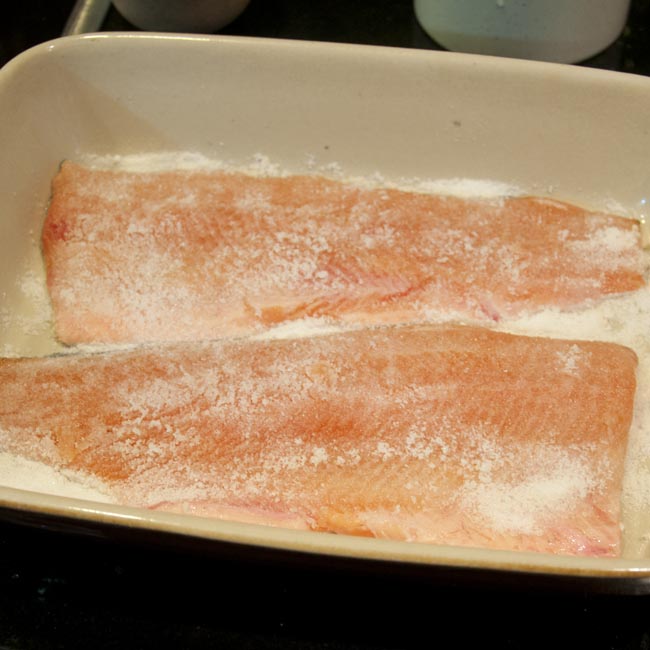
Trout fillets with cure appliedThe cure I use for trout and salmon is very simple – made up of 1/3rd sugar (golden caster sugar is my favourite here) and 2/3rd table salt.   I favour a short curing time – just overnight – with an excess of dry-cure so that the cure stays saturated throughout.  Be generous – you can afford to be, since the ingredient cost is very low – in the scale of pence for a couple of fillets.

Weighed down for curingYou want a thin layer of cure in your non-metallic dish below the fish, and a good coating over the top.  The photo gives a good idea of the sort of coating you’re aiming for.

You then want to weigh down the fillets to help draw water out – you’ll need to improvise something – I found a couple of plastic ‘take-away’ containers fitted very nicely in my dish, and then weighed them down with tin cans.  Don’t use anything metallic in direct contact with the curing fish.  Put the salted fillets in the fridge.

Cured fillets, next morningI would tend to get the cure going when I get home from work, having collected my fresh fish on the way home – so just before bed I turn the fillets over in the cure, and replace the weights before putting them back in the refrigerator.  The next morning, there will be quite a lot of liquid in the dish and most of the cure will have dissolved. Take the fillets out of the dish, noting the change in texture – the skin will have taken on a harder, almost cardboard character, and the flesh will be firmer and more translucent.  Rinse and dry the fillets, and weigh them again, and note down the reduction in weight.  My fillets had dropped from a starting weight of 256g to 220g at this stage – a 14% water loss.  You’re aiming for a final loss of ~18% by the end of the process, so that’s well on target. Now place the fillets on an open plate, uncovered, in the refrigerator for 24 hours before cold smoking.

You may have read this far, and are now thinking ‘well, that’s no use to me – who has a cold smoker at home?!’.  At it’s simplest, cold smoking requires two things – a source of cold smoke (from smouldering sawdust, for instance), and a space in which to contain it.  Last year, I built a wooden tower smoker, but there’s no need to start with a construction project.  A cardboard box, or a (clean!) upturned bin or barrel, rigged up creatively with a rack or two, will do just as well for the occasional smoking job!

ProQ cold smoke generator, litYou will need a smoke source, and I can heartily recommend the ProQ Cold Smoke Generator, which is a nifty little gadget which entirely takes any stress or complication out of the process.  It’s a little pricey (around £35 at this time), but will pay for itself incredibly quickly once you get the smoking bug!  It reliably provides 10 – 12 hours of cold smoke (depending on the temperature, humidity, and your sawdust choice) with very little heat production.  Have a look at the Supplier’s List for suggested sources of smoking and curing supplies.

Trout fillets, loaded in the smokerChoose a day without too much wind or rain (the occasional shower isn’t important), and where the temperature is roughly between 5 degrees and 15 degrees centigrade.  I’ve successfully smoked between 0 and 5 degrees but smoke penetration is less effective.  Colder, and your fish will freeze rather than taking smoke.  Warmer and the risk of spoilage increases considerably – though cold smoking temperatures up to about 20 degrees are cited in some places.  Get the smoker going first thing in the morning, and leave it for the day – though I would keep it under much closer supervision if using a cardboard box!.

I used a mix of alder and maple sawdust for this smoker burn (about 10% maple) – this produced a gorgeous neutral smoke-flavour with very little bitterness and with a noticeable ‘sweet’ note, presumably from the maple.  It’s definitely a mix I’ll use again in the future.

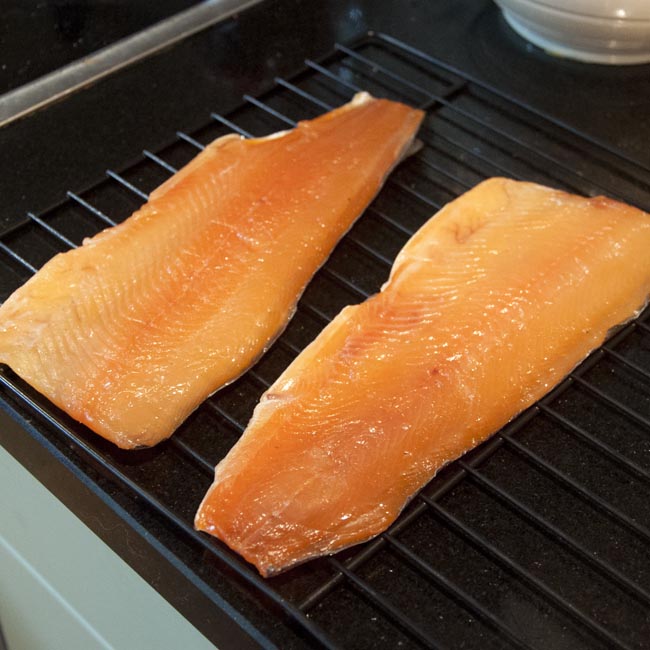
Trout, fresh from the smokerOnce the smoke generator has burned all the way through, unload your smoker, and take a final weight on your fillets. They should have lost another 4 – 5 %.  They will have a lovely orange-pink colour with a noticeable translucency and a glossy surface.  Then wrap them tightly in cling film, and freeze them.  Smoking fish in this way isn’t really a preserving mechanism, and storage time in the fridge is about 3 – 4 days.  Even if I’m going to eat them very soon, though, I tend to freeze them at this stage – a day or two in the freezer should ensure any parasites which may be present in the fish have been killed off.  You can keep them frozen for a couple of weeks without too much loss of quality, but after a month or so you’ll start to notice the deterioration.

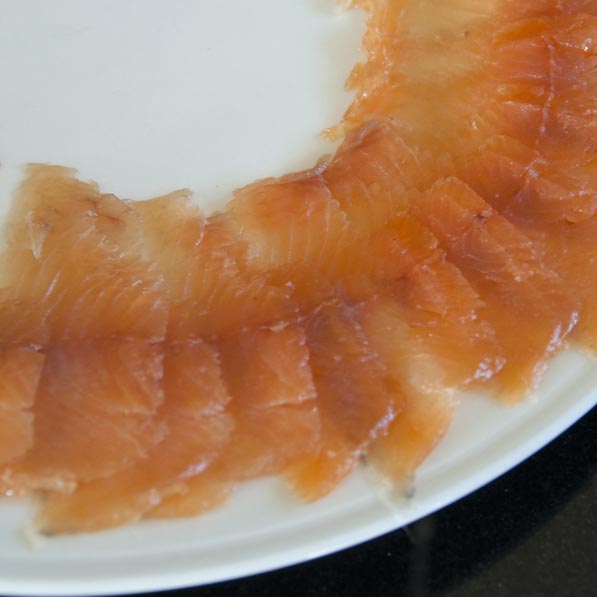
Sliced smoked trout fillet

Once thawed, I slice the smoked trout thinly with a sharp knife, starting at the ‘head’ end of the fillet, at about a 45 degree angle.  There’s a bit of a knack to this, but you’ll get good at it really quickly – and who cares if the slices are thicker, or a bit uneven?  This produces small, almost translucent slices which are great for nibbles.  I love to serve these with water biscuits or oatcakes (or your preferred sort of cracker), cream cheese – or a soft goat’s cheese is also very nice, freshly ground black pepper and a squeeze of lemon juice.  But the limit is really your imagination.  Smoked trout with scrambled eggs on a toasted muffin is a beautifully indulgent breakfast!

I really do hope you chose to give home-smoked trout a try, and that however you prepare and enjoy it, it brings you as much foodie pleasure as it brings me!

Read more from the Country Skills blog >>

Banner320-260