From the Bookshelf – ‘Self-Sufficiency Home Brewing’ by John Parkes

While the internet is always a great source of inspiration and information, I wouldn’t be without my eclectic (and ever growing!) personal collection of reference books.  I’ll put my hand up here and admit to having a book ‘problem’.  I love books.  Having all the basic information on a subject in one place, and arranged logically, does make getting a good solid grounding and basic understanding of a subject a lot more accessible than the scattergun depth-first approach you tend to end up with when following links online.

[Full disclosure – I bought this book, myself, with my own money, a couple of years ago. I do not have an amazon affiliate account, any links provided are for interest and convenience, and I don’t profit from them in any way!]

Cover‘Self-sufficiency Home Brewing’, John Parkes.
New Holland Publishers (UK) Ltd, 2009.
ISBN 978 184773 460 0.  RRP £7.99.
See this book on amazon.co.uk

This was one of the first brewing books I bought, and I would thoroughly recommend it as a basic guide to taking up brewing at home.  It’s a beer book, though it does cover all the basics of sterilisation / sanitisation, equipment, and so forth which would be relevant to brewing other drinks such as ciders, wines and meads.  It’s a convenient paperback format at a really good price, too (with handy folded-back covers for stashing bits and bobs of paperwork in, no less!).  It’s clearly and concisely written, and pleasantly produced & illustrated.

The first part of the book introduces your ingredients – grains, hops, yeasts and of course water – and the different styles of beer you can make with them.  This may be of interest to you if you want to learn more about beers and brewing, even if you’re not planning to make any of your own.

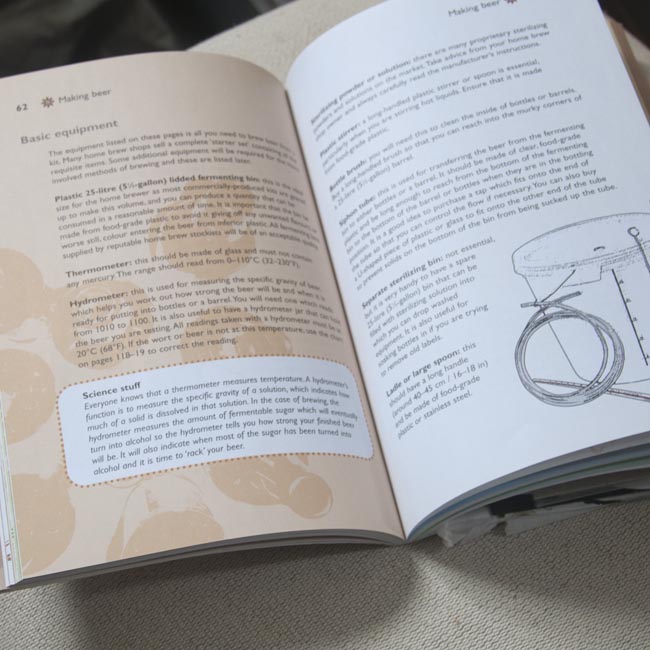
Inside page viewLater sections cover equipment – without suggesting that the first-time home brewer needs to acquire the proverbial ‘moon-onna-stick’ – and techniques for brewing from kits, from extract, and more advanced traditional all-grain techniques.

Finally, there are a good variety of recipes for extract & grain brewing to give you inspiration for creating your very own.  John explains the science behind the brewing processes clearly and logically, which is great if, like me, you feel the need to understand the ‘why’ of a process as well as the ‘what’!

With all my clutterIn summary, this is a great, accessible little book to take you from no home brewing experience at all, well into experimenting with a range of recipes and styles, before you’ll need to buy anything else.  I would heartily recommend it to newbie home-brewers, or simply the beer-positve / beer-curious, it will really expand your understanding and appreciation of your favourite tipple!

Read more from the Country Skills blog >>

Meet the Family – Dave the dog

This is Dave, our eight year old rough collie.  He’s the ‘face’ of the country skills blog and twitter avatar, too. 🙂

I took this photo yesterday night, while he was ‘hanging out’ on the sofa, enjoying the new sheepskins we brought back recently from Yorkshire.  I should add, he’s not allowed on the sofa, really – but he sprained his elbow a few days ago and is feeling a bit sorry for himself, so has extra privileges just now!  I love how his coat blends and contrasts with the fleeces in this picture.

I hope all of your pets (if you have them) are enjoying good health today, and are as much a source of joy to you as Dave is to us!

Read more from the Country Skills blog >>

Sourdough Saga: Episode 5 – how to look after your starter

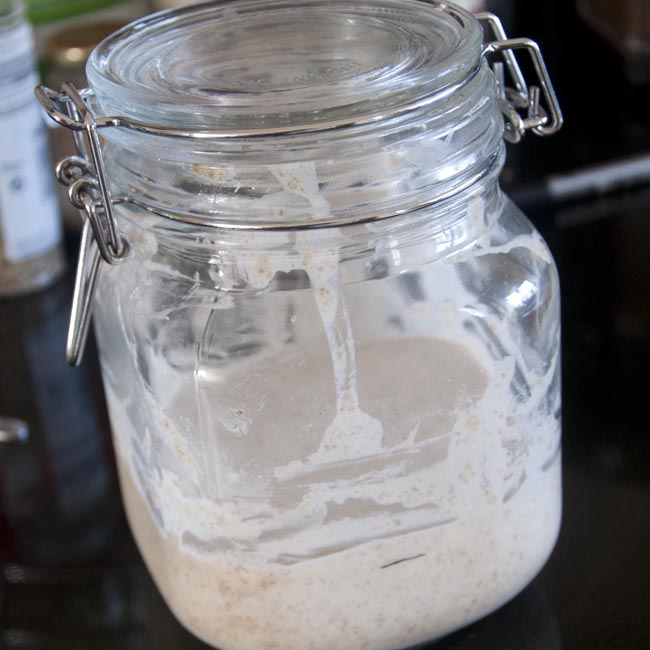
Imagine, if you will, someone arriving at your house for a party, and bringing with them as a gift a rather odd looking jar with a label on it which says ‘Feeeeeed meee!’… Congratulations on being the new owner of a bouncing baby sourdough starter.  It’s rather a rude hostess present, I suppose, a bit like giving someone a puppy without asking them first (ok, maybe not *quite* that bad!).  But now you have this living thing someone’s entrusted you with, and you’re stuck having to look after it.

What sort of person would do such a thing, you might ask? Guess what I took to my little sister and her husband yesterday…

Feeeeed mee!

Isn’t it pretty?  I had to promise her a full set of care instructions, so here they are!

I keep my starter in the fridge between uses.  So far I’ve been feeding & baking once a week, so I haven’t tried to extend the gap between feedings more than this, though I believe it may be possible to go two or three weeks.  My starter is a wholemeal starter, but you could convert it to white flour, progressively, if you prefer.

Assuming you’re planning to bake on a Sunday, this would be my schedule –

  • On Friday morning, take your starter out of the fridge, stir in a couple of teaspoons of wholemeal flour, and leave it on the countertop (I like to think the beasties would appreciate a small breakfast snack as they come up to an active temperature).
  • Friday evening, once you’re home from work, it’s time to feed your starter.  In a bowl on your kitchen scales, weigh out equal weights of wholemeal flour and warm water (about blood heat) and combine to form a loose paste.  The starter has been started and fed on cheap bottled water so far, filtered water would be absolutely fine, if you have it, and converting my starters to tap water has also been successful (but might be a bit of a gamble if your water is particularly high in chlorine / chloramine).  I use locally stoneground wholemeal flour – avoid anything bleached or treated.
  • The total weight of the feed should be about equal to the starter that’s in your jar.  I’ve written the weight of the empty jar on the lid for you to simplify working this out!
  • Combine the feed with the starter (you could do this in the jar but I prefer to tip it all out into the bowl to give it a really good energetic mix) and put it back in the jar.  Leave the jar on the countertop for the next 24 hours.
  • Watch in wonder as the whole thing fills with bubbles and doubles in size over about the first 12 – 18 hours, before it settles back down a little.
  • On Saturday evening, take a good ladle-full or two of your starter (about half the total volume) and use it to start your overnight sponge.  Return the rest of the starter to its spot in the fridge.
  • On Sunday morning, let the baking begin!

If you’re not baking this week, do all of this but then discard the ladle-full of active fed starter (or better still, use it to start a new jar of starter to give to a friend?).

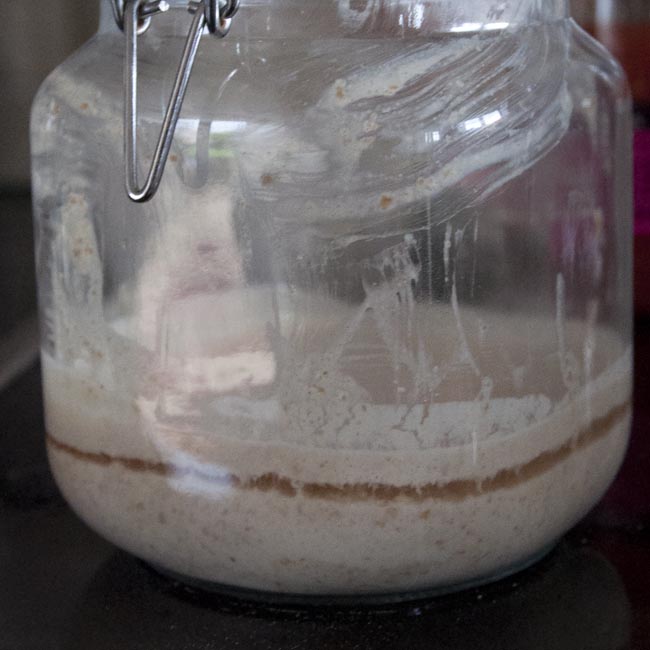
When you get your starter out of the fridge next week, you may find a layer of greyish liquid has formed on top, and the smell isn’t quite what you expect.  This doesn’t seem to be a problem, I’ve just been pouring the liquid off the top before going ahead and feeding the starter in the normal way.  I imagine this would be more marked if you went longer between feedings.

I hope you sourdough starter gives you as much baking pleasure as I’ve already had from mine!

Read all the posts in the Sourdough Saga >>

Read more from the Country Skills blog >>

Sourdough Saga: Episode 4 – cheese and sun dried tomato bread

After the gratifying – if unexpected! – success of my first sourdough loaf, I couldn’t wait to do it all again as soon as possible.  The first loaf didn’t last very long, either, and certainly didn’t get a chance to go stale!  So the next free day I had was dedicated to another baking day.  I used broadly the same technique as for my first loaf (see ‘Sourdough Saga: Episode 3‘ for details) but with double quantities, and a downward adjustment to the salt content (10g in total in a two loaf batch).

Second sourdough bake

There were a couple of new things – first, the loaf shape.  I wanted longer, narrower loaves, instead of the round I baked the first time.  I’d love a full set of lovely baker’s bannetons, but they’re expensive and I’ve got nowhere to store them, so I improvised with a couple of long thin serving dishes I was given for Christmas last year by a friend, lined once again with a clean tea towel dusted generously with rye flour.

Dish used for provingIt’s not quite the right shape, as you can see, and tilts up at the tips rather, but it allowed the final proving to produce a loaf of approximately the size and shape I was after.  The ridge on the inside of the dish does leave an imprint on the loaf, but it’s all character!

I had a generous handful of grated cheddar cheese and some sun-dried tomatoes left over from the previous day, so decided to make one of my loaves a cheese and tomato bread.  I incorporated the extra ingredients during the final kneading, sprinkled across the surface when it was flattened out, and then folded into the dough during the shaping of the loaf.

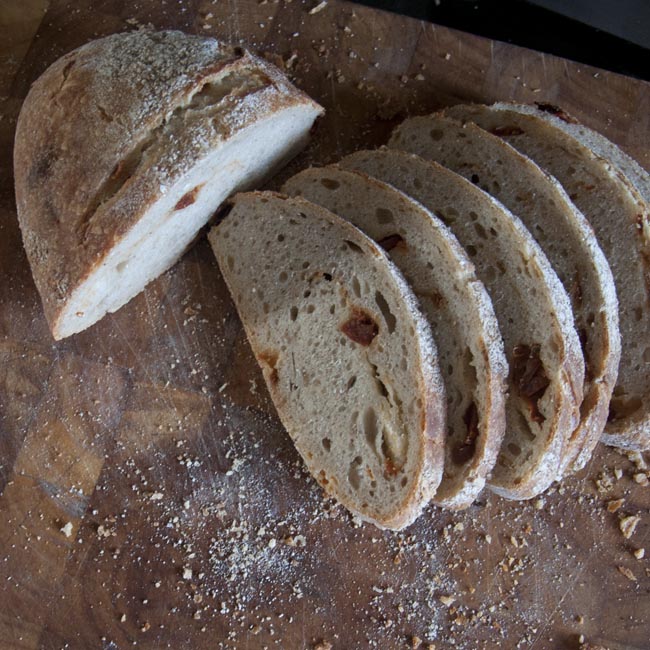
Sliced cheese and tomato sourdough loaf

I think the cheese and tomato make a great addition to this sourdough. Something about the cheese flavour mutes the lactic sour note quite noticeably, making this a sourdough loaf that might go down better with people who aren’t that keen on the distinctive ‘sourdough’ flavour. The chopped sun dried tomatoes add a lovely sweet herby note (they were stored in herb oil).

Texture-wise this loaf seemed to prove slightly less well than it’s unmodified brother, with a slightly denser texture and smaller holes.  I’m not sure if this is the result of the extra oil / fats incorporated with the additions, or whether it has more to do with the difficulty I had keeping my oven up to temperature when baking two loaves together.  On the salt question – I don’t notice a difference from the further reduction, and it’s likely I’ll reduce the salt again next time I bake a loaf.  All in all, this is a great loaf and one I’ll definitely make again in the future!

Read all the posts in the Sourdough Saga >>

Read more from the Country Skills blog >>

Cooking with James Martin – a little taste of the treats on offer!

Our day at Food at 52  with James Martin was in two halves.  Our participation was called for in the morning as we were pressed into service as a rag-tag team of commis chefs in the preparation of the first three dishes – which made up our menu for lunch.  James guided and instructed and was only occasionally scathing of our efforts!

In the afternoon, already replete with amazing food, and enjoying a nice drop (or two!) of Sauvignon Blanc, we got to sit back and relax as James prepared a further six dishes while we watched, asked questions, and then struggled despite our already full bellies to taste all his wonderful creations.

Here’s a quick whizz through the wonderful dishes we tasted – hopefully I’ll be able to post some recipes in due course!

Lunch Menu

Thai crab risottoThai crab risotto – This was the first dish we tasted and was definitely one of the stand-out recipes of the day for me.  It has amazing complex & multi-layered flavours in exquisite balance, and despite how much is ‘going on’ in this dish somehow manages to taste crisp and clean and not at all muddled.  James described this as his ‘signature dish’ and I can completely see why – it knocks every risotto I’ve ever tasted into a cocked hat!

Smoked haddock rarebitSmoked haddock rarebit with confit tomatoes – An unusual twist on a Welsh rarebit, with the cheese-based layer built on top of a lovely naturally smoked haddock fillet.  Served with a confit tomato salad (which will definitely be making it into my culinary repertoire) it’s a lovely dish for an English summer’s day, balancing the clean crisp flavours of the tomatoes with the comforting warmth of smoked fish and grilled cheese.

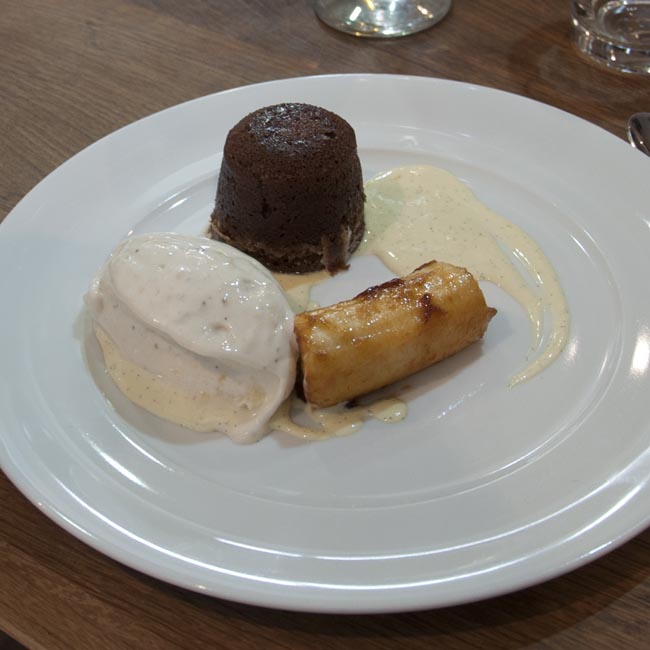
Hot chocolate mousseWarm chocolate mouse with banana ice cream & custard – The freshly made ‘last minute’ banana ice cream is actually the star of this dish for me.  It’s packed with really distinct flavours and heaps of texture.  Perhaps it’s because I’m not that much of a chocoholic – the chocolate pudding is tasty, and gooey in the middle, but very similar to things I’ve had before.  The custard involved a lot of hard work, and is clearly something I should master, but I’m not that much of a custard fan and I’m not convinced it adds that much when you already have the gorgeous banana ice cream.

Demonstration Dishes

Pea and watercress soupPea and watercress soup served with a deep-fried egg – This soup is an amazing colour (no Photoshop trickery here!) and has a lovely fresh pea flavour.  I’ll certainly be playing with this soup recipe at home, though I have to admit to being a bit mystified by the soft boiled egg crumbed and deep-fried and served in the centre in a style – I’m afraid – a bit reminiscent of the famous Australian ‘meat pie floater’! It’s a dramatic ‘cheffy’ touch to finish the dish but I’m not entirely convinced it adds anything that a poached egg wouldn’t in terms of flavour (in fact I suspect I’d prefer the latter) and the crispy texture it imparts is duplicated in the streaky bacon garnish.  Think ham and egg with peas, but all taken apart and put back together again!

Pea and watercress soupLamb with chilli pickle – This is a great little dish, James described it as ‘bar food’ and it would be ideal for nibbles with drinks, but also makes a lovely light lunch or supper dish if you’re looking to impress someone!  Great fresh flavours with a lovely crisp tang from the freshly prepared pickled vegetables, and the lovely tender pink lamb loin is the perfect counterpoint.

Cod cheeks with tartar sauceVodka-and-tonic battered cod cheeks with tartare sauce – The batter was an unusual concoction, with the cocktail-cupboard ingredients and made ‘live’ with yeast, quite unlike anything I’ve ever seen before.  It fries up lovely and crisp and keeps the cod cheeks gorgeous and moist.  The freshly made tartare sauce is the first such I’ve ever actually liked!  I don’t batter and deep-fry much, but it looks like a  great party-piece!  I can imagine diving into a big bowl of this with a load of friends around a table, perhaps with some slightly spiced potato wedges.

Seared tuna with 'Japanese slaw'Seared tuna in spiced apricot marinade with ‘Japanese slaw’ – A beautiful dish to look at on the plate with some lovely flavours – there’s an almost North African vibe with the fruit & spice flavours.  By this stage in the tasting I was really struggling to eat another bite, but was very glad I did.  We don’t often cook fresh tuna at home but I will certainly adapt this marinade next time we do, as it just lifts that slightly bland character it can have while letting the flavour still shine through.

And now for some desert!  We now felt so full we could pop…

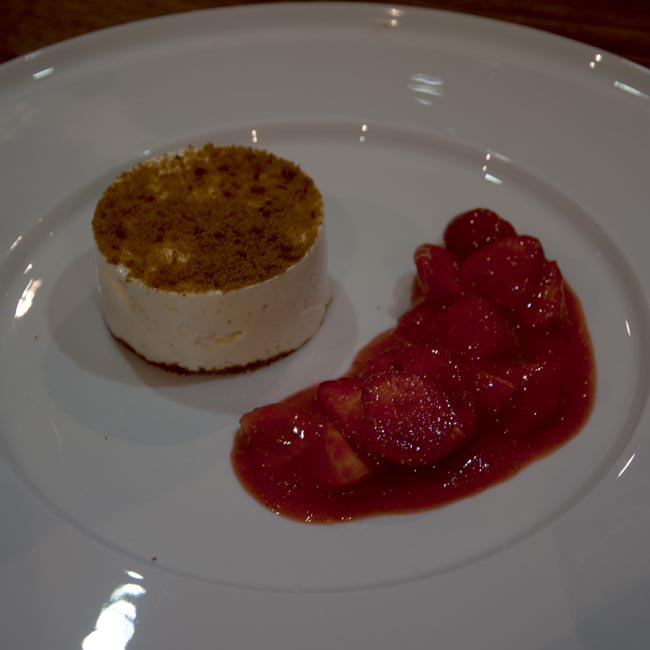
Strawberry cheesecakeStrawberry vanilla cheesecake – James introduced us to this dish, which is one that he developed for Thomas Cook‘s refreshed airline menu.  This is a wonderful quick simple & impressive little desert which you can imagine being able to adapt almost infinitely with different fruits in season and flavours in the cheesecake mix & biscuit crumb.  I particularly liked that this wasn’t an over-sweet dish, letting the flavours of the fresh English strawberries and the slightly acid-note from the cheese shine through.  It isn’t at all cloying and has an almost palate-cleansing quality, nice and fresh – just the thing when you’d eaten quite as much as we had!  All in all a great little dish and definitely another one for the repertoire!

Cheat's GateauxLast, but quite definitely not least, James’ rather marvellously named Bullshit (or “Cheat’s”, for polite company!) Gateaux seems quite the work of patissier’s art.  Just look at it!  In fact it’s startlingly simple – well, for the most part! There’s a story behind this cake – and the name – which I hope to share with you soon..!

For the time being here’s a little snapshot of the man himself doing some of his famous sugar-craft!

Sugar spinning

I hope this has really whetted your appetite for more details of these dishes – writing about them and going through the photos has certainly made me hungry!  I can safely say it’s the most amazing day’s foodie indulgence I’ve enjoyed in a very long time.  I can’t wait to experiment some more with the recipes and let you know how I got on!

Read more from the Country Skills blog >>

Cooking with James Martin – some initial thoughts & photos!

The big day was today – I’m finally back home from London (seriously, Londoners, how do you survive the Tube these days?!) exhausted but seriously excited about today’s cullinary adventure!  The competition winners met up with famous chef James Martin at the ‘Food at 52‘ cookery school in Clerkenwell, and he spent the day sharing with us some of the tricks of his trade and feeding us until we nearly popped (while he himself seemed to survive on a diet of Diet Coke and Red Bull!).  The whole event was thanks to Thomas Cook, with whom we heard James had been collaborating on aeroplane catering.

James Martin

There are recipes and tips to share with you, and we’ll get to those in due course (probably once I’ve re-cooked at least some of the recipes to iron out quantities etc!) but I just wanted to share a few initial ‘teaser’ photos featuring some of the marvellous ingredients we got to ‘play’ with today.

Brown crab  Ingredients  More ingredients

It’s also been a great opportunity to meet other keen cooks and bloggers, and I hope some fun things will come of that in the future, too!

Look forward to more blogging on the subject once I’ve had a good night’s sleep (perhaps several!) and caught up on myself a little!

Read more from the Country Skills blog >>

Exciting news – and a bit of a tease!

A little while ago, I entered a recipe competition with a variation on my jerk marinade, thinking ‘here goes nothing!’.  Last weekend, I received an email – I nearly deleted the winning notification – I mean, what else do you do with emails which start ‘CONGRATULATIONS!’ and go on to tell you you’ve won something??

1st Prize!

I was a bit gobsmacked, truth be told.  I’m the sort of person who never wins anything – not even a colouring competition when I was a kid!  In fact, the only thing I’ve ever won was a Blue Peter Badge (those of you outside the UK will have to look that one up!).

So, one day next week, I get to travel to a secret London location and spend the day enjoying a masterclass with one of my favourite celebrity chefs!  How cool is that??

I’m so excited about this (does it make me a prize-winning food writer, I wonder?) and can’t wait to share all the details & photos with you all after the event!

Read more from the Country Skills blog >>

Sourdough Saga: Episode 3 – good things come to those who wait!

A week ago, and with a certain amount of frustration, I stashed a very promising looking sourdough starter in the refrigerator, knowing I didn’t have a plausible baking day for another seven days.  Despite having lots going on, those seven days have been torture, in their way.  I’ve not looked forward to a day off quite so much for a very long time!
Sourdough - success at last!

On Tuesday morning, in preparation for today’s much longed-for baking day, I ‘rescued’ my jar of starter from the fridge.  It had ‘fallen’ back from it’s bubbly heights and seemed more like a pot of goo than a bubbly ferment.  But I’d been expecting this.  I gave it a couple of teaspoons of fresh flour just for a small snack, something to munch on while it warmed back up to room temperature, and went to work.  Some promising bubbles greeted me on my return, so Tuesday night it got a proper feeding.  This had the expected – but gratifying! – result of a decent doubling in size by Wednesday evening.  Pleased that the starter seemed nice and active, I constructed my ‘overnight sponge’ on Wednesday night.

The recipe for my first sourdough loaf is a slightly modified version of one of the sourdoughs in ‘River Cottage Handbook No.3 – Bread’ by Daniel Stevens (ISBN 978-0-7475-9533-5) which has been staring at me accusingly from between it’s very beautiful covers since it first moved onto my kitchen book-shelf a couple of years ago.

My sponge consisted of the following parts –

  • A ladle-full of my (wholemeal) starter
  • 325ml of warm water (a mix of cold tap water and some hot from the kettle)
  • 250g of locally stoneground strong white bread flour

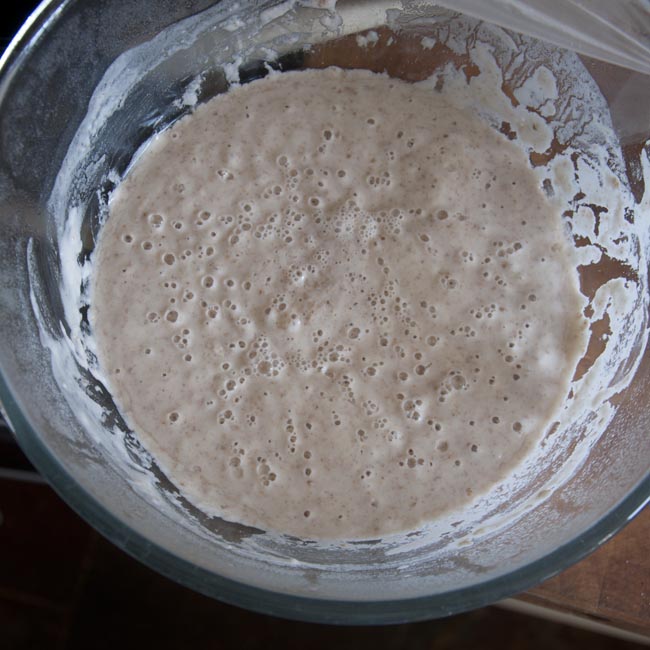
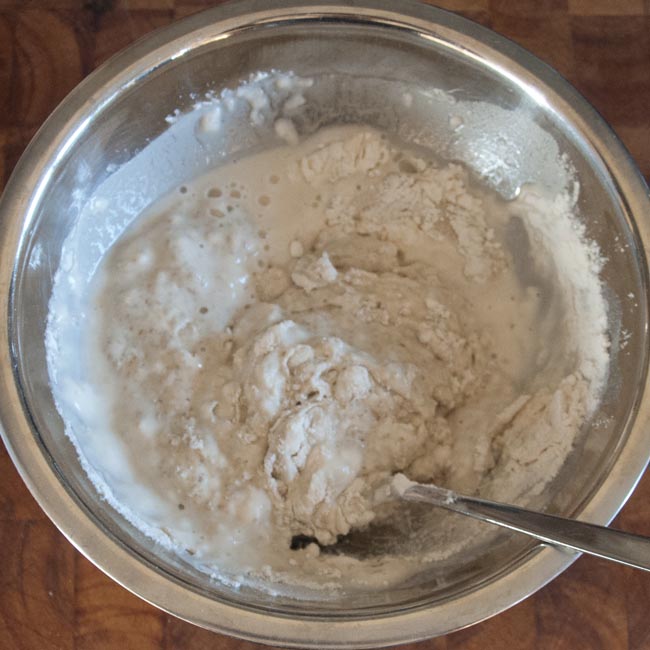
Overnight sponge, in the morningThese are mixed by hand in the bowl, covered loosely with cling film, and left to ferment overnight.  This morning, after I couldn’t bear to stay in bed any longer out of curiosity for how my bread was going, I was met with this – a lovely bubbly bowl of promising things!

I put the coffee machine on for my essential morning brew.  So distracted was I by my marvellous bubbly sponge, the jug was half-way full of pale brown water before I realised I’d forgotten to add any ground coffee!

The sponge, when I stirred it and then poured it off into a second bowl, was an amazing ‘stringy’ consistency, more like melted cheese than anything I’ve encountered in bread-making before – I assume in some way from the alchemy of the microorganisms within it.

To the sponge, then, I added –

  • A further 300g of strong white bread flour
  • 7g of salt [Edit, 15/7/2012 – I now use about half this amount of salt, with no ill effect]
  • A ‘glug’ of olive oil

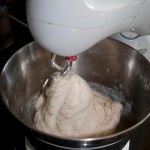
Dough in the mixerAfter mixing the sponge, flour and salt roughly by hand, I put the lot into my (rather lightweight!) stand mixer, dough hooks fitted, and started it going.  It certainly gave the dough (and itself!) a heck of a work-out.  After a couple of minutes I added a good glug of olive oil and left it to work for about ten minutes.  I was told to expect quite a wet dough and certainly this was tricky to handle, sticky and rather ill-manered!  I don’t have a dough scraper so I was rather grateful for the mechanical assistance – though I’m not sure how many batches of sourdough my stand mixer has in it, it seemed to find it quite an effort!

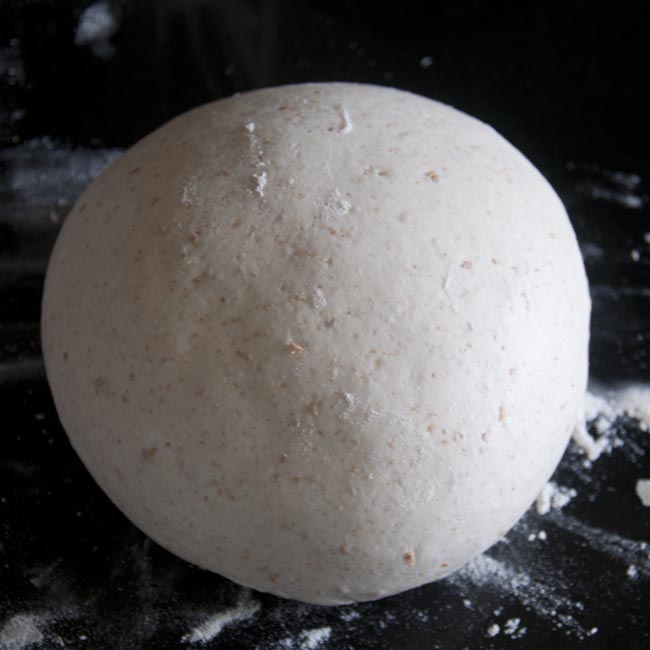
Dough, before first riseAfter kneading, I formed it into a rough round and oiled the bowl before setting the dough in it to rest for the first time.  Before this first resting period it looks like this, and after a couple of hours, to be honest, it looked just the same, if possibly *slightly* bigger in the bowl.
Formed into a roundFlour your surface, and then turn out the bowl of dough – squash it out into a rough rectangle with your fingers, and then ‘knead’ it gently back into a tight round before returning it to the oiled bowl for another hour or so. Put the bowl somewhere warm, but not hot – on a cool day, the oven with the light (but no heat!) on makes a good resting environment.  You’re going to repeat this process of resting, flattening and re-forming your ball a couple of times during the day.

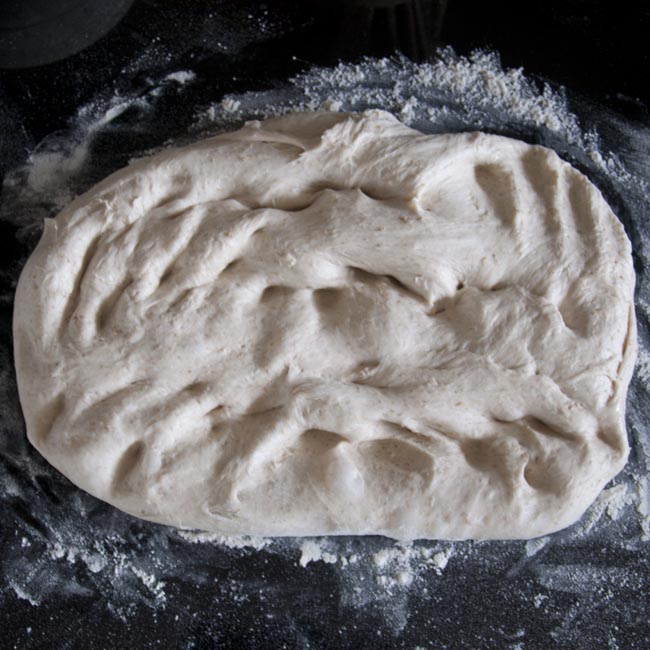
Dough, flattened with fingertips for final timeA couple of hours before my planned baking time, I turned the dough out for the last time.  It’s springier, silkier and lighter, with some noticeable bubbles now when you handle it. Form it into a round again but this time, rather than returning it to an oiled bowl, it would rather be in a proving basket.
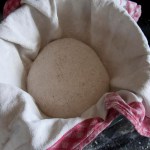
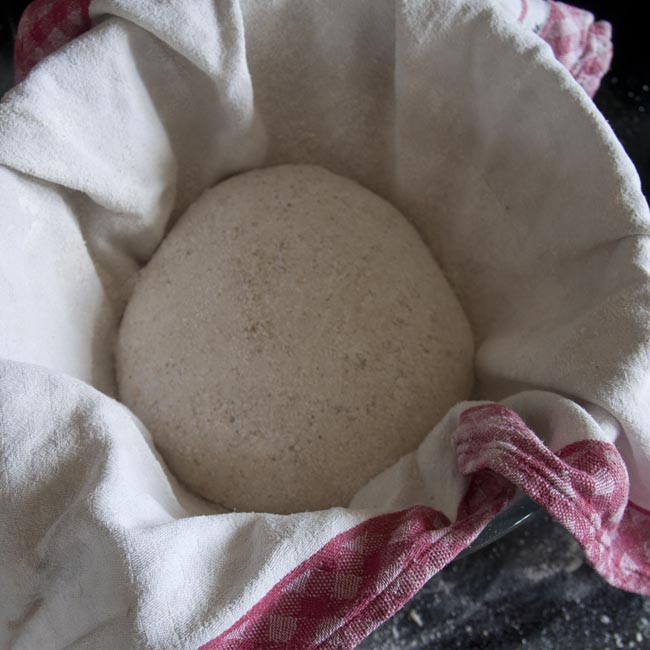
In the ad-hoc 'proving basket'I don’t have one of those, so I used a mixing bowl lined with a clean tea-towel which I’d dusted generously with rye flour.  I had very little faith that this was going to result in anything other than a disappointing sticky mess when the dough adhered to the cloth, but I’m a good girl and do as I’m told. Covered loosely with a piece of cling film, I left this patiently for another three hours.

I’d read all sorts of advice about the critical baking process – involving dutch ovens (I don’t own one), squirty-bottles of water (likewise!) for steam creation, and even things that look a bit like chicken bricks to approximate a traditional wood-fired oven.  I went with what I actually had – a round black stoneware baking dish for the bread, and a stainless steel roaster to hold some water in the bottom of the oven.  I heated it up to it’s maximum temperature (230C on the dial – 20 below what was recommended) and pre-heated the stoneware dish.  Once it was all up to temperature, and after adding a kettle-full of boiling water to the roaster in the bottom of the oven, I tried to gently turn out the floured dough onto the baking dish.  It seemed like a bit of a disaster, to be honest – ending up rather crumpled and misshapen.  I cut a cross-hatched pattern crudely into the top, and reassuring myself it was all about the flavour, bundled it back into the blasting hot oven.

I couldn’t tear myself away from it, and ended up sat cross-legged on the kitchen floor peering through the oven door as a miracle started to happen.  First the crumpled side seemed to stretch itself back into shape, and then, I’ll be damned if it didn’t start to rise!  Ten minutes into baking and I turned the oven down to 190.  The amazing rising act continued – first, it stretched its way languorously into the slashes, stretching them nicely across the surface.  And then, it started to climb vertically upwards, lifting its edges off the baking tray.  I’ve never seen a loaf perform an act like it – I can only assume it’s the result of the clever changes to the gluten that result from the extended rising and proving time.  It was like something out of the Incredible Hulk.

Out of the oven - at last!After 40 minutes the crust was a lovely warm mid-brown colour, but the bottom was still a bit soggy.  I took it off the baking dish and returned it to the oven upside down for another 10 minutes.  Hubby came home to find me stood expectantly in the kitchen.  After that, I couldn’t wait any longer, and pulled it out of the oven.  The smell of baking bread that filled the kitchen – and the house – was quite amazing.

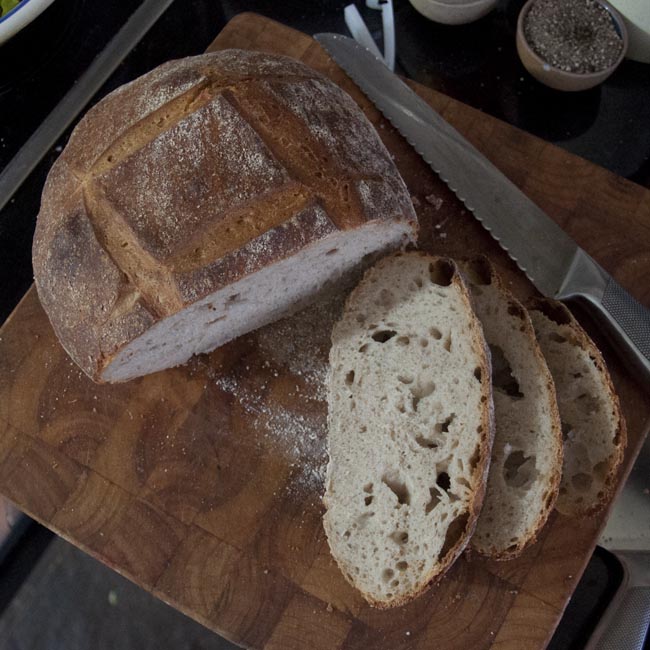
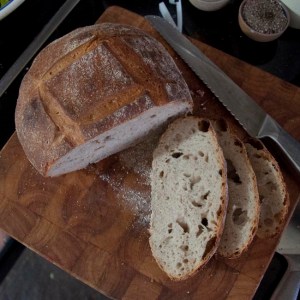
An hour later, we slice and sample it.  I genuinely wasn’t expecting anything this good from my first effort.  There are some lovely big holes in the dough, the crust is amazingly crisp but very thin – and retains a remarkable elasticity.
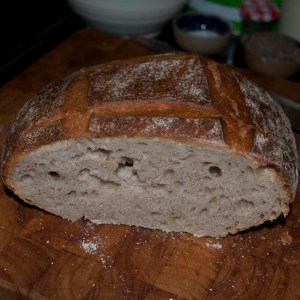
Sliced sourdough loaf

The texture of the bread is springy and extremely satisfying.  There is a definite, recognisable, but not overwhelming ‘sourdough’ flavour.  I *adore* it.  The whole process – from starting the sponge to eating the loaf – took about 24 hours, and I don’t regret one of them.  The actual ‘working’ time today was about an hour and a half, and left plenty of time for popping to the shops, taking the dog for a walk, and so on.

The bar for ‘good bread’ has just shot skywards in our household, and I suspect things may never be quite the same again.

Read all the posts in the Sourdough Saga >>

Read more from the Country Skills blog >>

Sourdough Saga: Episode 2 – keep calm and carry on?

So sourdough-1 went in the bin, and after a thorough clean out, sourdough-2 began…

Split starterI started initially with rye flour again, but used bottled water this time.  My initial batter was far too thin (I started with equal volumes of flour and water rather than equal weights – not quite sure what I was thinking really!), on day 2 when I got the initial bacterial bubble-up the whole thing split like curdled milk.  Thanks to some more supportive advice from twitter, I didn’t panic.  Keep calm and carry on, so they say.  Too much water, not enough flour, feed and perhaps move somewhere slightly cooler.  Done.

Do all starters get talked to this much?  Never has an inanimate object of mine been so cajoled & pleaded with.  I speak to it softly, encourage its efforts, and wish it goodnight and good morning.  My husband wonders if I’m losing my marbles… if only just a little bit!

I got my hands on some locally stoneground wholemeal flour, so I switched to this for feedings. As the batter was still on the thin side, I didn’t pause for doubling at day 3, but carried on with daily feeding.  Because the material on the sides of the jar was the first to grow mould last time, I made a habit of swilling out the jar to clean the sides at each feeding. The smell was good (quite yeasty and sourdoughy!) but only a few scant bubbles were rising to the surface.

More great advice came flooding in after I published Episode 1 of the Sourdough Saga – including the recommendation not to cover the starter.   Perhaps this was where I was going wrong, even with the lid lightly resting on the top of the jar, was I  suffocating my starter by depriving it of air?  A week after starting and not much was happening, so this seemed a theory worth pursuing.  Discarding the lid from the jar, I strapped a little kitchen-towel bonnet over the starter jar with a rubber band.  Things did start to look a bit more active on the surface of the starter at around that time.  Had I got something right at last?

The next morning dawned to apparent disaster.  Literally overnight, the whole top of my starter had bloomed with creamy-coloured velvety mould!  I was so upset I didn’t even think to photograph it.  More desperate scratching through the deeper sourdough-focused recesses of the internets ensued.  Someone promised that even really neglected starters, all moulded over, could be resuscitated – but since mine had never yet really come to life, could it work for me?  Had I perhaps caused this mouldy horror by leaving my starter uncovered for the surface to dry out?

Out of sheer bloody-mindedness, and muttering something about ‘not giving up now’ under my breath, I scratched the furry stuff from the surface of my starter as well as I could.  What was left, I mixed with more flour and water (gently warmed, this time) and tipped back into the jar.  The starter had developed a ‘winey’ smell I wasn’t at all sure I liked.  I got rid of its bonnet, reverting to the loose glass lid, turned my back on it, and leaving it without even my usual gentle words of encouragement, went out for the day, expecting to find more mould & disaster on my return.

Bubbled up and at least doubled in size

Six hours later, you might have knocked me down with a feather.  The damned thing had bubbled up to very nearly twice the size I’d left it, and was a sponge of small even holes visible through the sides of the jar.  I nearly wept.  Instead, I swore, colourfully.  Not a trace of fuzzy mould was visible.  In fact, a better impression of all the ‘happy, thriving starters’ whose photos I’d been coveting on other, more successful blogs, I couldn’t imagine.

I tried to share with my lovely husband quite what an exciting turn of events this was.  He seemed pleased for me, also somewhat (indulgently) nonplussed.

I left it overnight, and fed it again in the morning.  Coming home from work tonight, I found it doubled again.  I can’t quite believe it.  It looks so good, but I can’t convince myself there isn’t still something wrong with it now?  I’ve fed it again this evening, getting the volume up so there’s enough to harvest for a loaf or two.  Can I just use it, soon?  What, if anything, should I be worrying about now??  It looks great, and smells great, it grows like a weed, does that mean it *is* great?  Is there any way of telling?

This whole process has been the most insane and unexpected emotional roller-coaster ride.  Is this just all sent to make me *really grateful* for my new daily bread??  More importantly, my wise blog friends, can I make a mostly-white loaf from a wholemeal starter, or should I stick to matching flour for now?  So many questions – so much to discover!

What have I learnt, that might help others trying to navigate the gloomy labyrinth of sourdough starter art and science?  Not much, to be honest!  Only that there doesn’t seem to be a one-size-fits all set of instructions.  In the end, what seemed to work for me – despite the odd speed-bump on the road! –  was nice fresh stoneground wholemeal flour, slightly warmed bottled water, and a willingness to just keep discarding and feeding day after day until things eventually came together.  My starter hadn’t read the timetable, and probably neither has anyone else’s!

Finally, I’d like to offer a huge vote of thanks to everyone – both on wordpress and on twitter –  who’s offered me guidance and support on my sourdough journey so far – I would never have guessed there were so many great sourdough bakers out there, so generous with their time, knowledge, and advice!

Next – Sourdough Saga: Episode 3 – good things come to those who wait!

Read all the posts in the Sourdough Saga >>

Read more from the Country Skills blog >>

Sourdough Saga: Episode 1 – failure to launch

I’ve wanted a sourdough starter for ever so long – for as long as I’ve known and understood the sourdough process, I think.  Traditionally baked sourdough is *the* great bread, by definition, in my opinion.  With its wonderful texture and complex richness of flavour, it leaves the industrial ‘Chorleywood Process’ sliced white loaf so far behind that they’re hardly recognisable as the same animal.

So when I saw that one of my favourite food bloggers, The Rowdy Chowgirl, had brewed herself up a starter recently, it made my mind up.  I was going to do it, and I was going to do it NOW.  Well, just as soon as I tracked down a bag of rye flour, anyway.  And a couple of weekends ago, after following several different lines of reading and research, I got down to business.  ‘What’s that?’ asked Hubby, as he wandered into the kitchen to see me stirring a bowl of what could only be described as goo.  ‘A sourdough starter,’ I replied.  He thought about it for a moment.  ‘You realise you’re going to have to take that thing on holiday with you, don’t you?’  I tried to reassure him that I’d read about stashing it in the refrigerator for a period of time if necessary.  He seemed unconvinced.

Initial mix with rye flour

I broadly used the directions from The Fresh Loaf, except that I don’t have US-type measuring cups, and there’s nothing called AP flour on the shelves in the UK.  So I guessed a bit at quantities and used stoneground bread flour for the day 2 and subsequent additions.  I also used my tap water rather than the mineral or filtered water suggested – mostly on the basis that it’s nice tasting water without an obvious chlorine hit, and I brew with it regularly without adulterating it in any way, so I went ahead and assumed there wasn’t anything in it greatly damaging to yeasty beasties.

My starter was a thick batter-like consistency.  Thicker the first day when it was rye flour, and then it thinned down a bit with subsequent additions.  I used a 1l kilner jar I had lying around, with the gasket removed so that it wasn’t a sealed container, which I thought was a reasonable match for ‘cover loosely’.  I put it to rest the first day in the boiler cupboard, which is a coupe of degrees warmer than the rest of the kitchen.

After 24 hours, nothing much had happened, much as I expected.  I made the first additions with plain flour, and stashed it back in the cupboard.   It smelt… well, not exactly unpleasant, but definitely an ‘off’ smell, if you know what I mean.  But, forewarned by lots of other sourdough devotees, I plugged gamely on.

After 48 hours     Gordon's Alive!

24 hours after that, it had gone mental, doubled in size, and all bubbly and awesome.  I was convinced I’d cracked it.  I even named it, Gordon.  Because, you know, ‘Gordon’s Alive!?’  Anyway, as we all know, pride comes before a fall.

Feeding timeI discarded half the mix and added more flour and water as instructed (well, kinda).  Made my mark on the side of the container as instructed, and left it a few degrees colder in the kitchen this time.

Growing, but only a littleAfter another day had passed, the mix had risen a little in the jar, but only about 1/3rd and nothing like the doubling that the instructions called on me to wait for.  So, I was patient.  Another 24 hours on and no further progress, I mixed in a few teaspoons of rye flour to help things along.  Still nothing more than a few scanty bubbles breaking surface.

Very scanty bubbles48 hours after adding the rye flour ‘booster’, I opened the jar and got a distinctly ‘musty’ damp sort of smell.  On closer inspection the batter on the sides of the jar had started growing what was unmistakably black mould.  Downhearted, I chucked the whole lot in the bin, disassembled the kilner jar and stuck that in the dishwasher.  What I’d hoped was going to be a weekend of experimental baking lost, sadly, though given the hot spell of weather that was probably no bad thing!

Some really kind feedback from @mannafromdevon, a baker on twitter, suggested that it might have been worth  trying to rescue the ‘good stuff’ from underneath, and carrying on with feeding, but it was too late for sourdough-1, condemned to the rubbish.  But their other advice, ‘Don’t Give Up’, stuck, and I’ve already started sourdough-2, which seems, so far, to be continuing in the tradition of acting as if it’s also read the sourdough primers, and wants no truck with them.

The thing that struck me most reading around the subject is that there seemed to be as many specific processes for getting a sourdough starter going as there are people who have written on the subject.  There were even (remarkably concise!) directions on the back of my bag of rye flour!  In my day job, when there are as many different ‘expert’ opinions on a subject as you can find ‘experts’ to ask, it’s usually a sign that there’s no one really good answer, just a lot of different approaches, many of which work most of the time…   Wish me luck, I’m not giving up until I get there!  This may take some time…

NextSourdough Saga: Episode 2 – keep calm and carry on?

Read all the posts in the Sourdough Saga >>

Read more from the Country Skills blog >>