Pressing The Flesh – home-made coarse farmhouse pate – Blog Advent (23)

While I suppose a lot of people have their eyes firmly on Christmas Day at the moment – family and friends, food and drink, gifts and treats – I’m also looking through and out the other side, to Boxing Day.  Probably if I’m honest I put more time and effort – certainly ahead of time – into the food on Boxing Day than I do to the food on Christmas Day itself.  After all, Christmas dinner, in the end, more or less boils down to a roast dinner with pretensions!

Boxing Day dinner so often is Christmas leftovers – but in my house it’s a feast of cold cuts.  The ham, which I smoked earlier this month, is slowly defrosting ready for cooking tomorrow. I have a handful of lovely cheeses, all ready.  The spiced plum chutney I made in the summer is now nicely matured.  The sourdough, of course, I made yesterday.  There may be some leftover goose, depending on our appetites.  There’s a game pie, which we collected today from our local farm shop butcher.  And to complete the feast, of course, we’ll be wanting some pate.  I’ve always bought this in the past, and always been slightly disappointed compared to the rest of the wonderful spread.

This recipe is mostly inspired by Delia Smiths’ recipe for Coarse Country Pate, and by the Farmhouse Pate recipe in Raymond Blanc’s classic ‘Cooking For Friends’ which I picked up in the Oxfam shop last time I was in Launceston.

Pate ingredientsTo make this pate, you will require –

  • 800g of really good quality minced pork.  Mine was a mix of minced shoulder and minced belly pork from the butcher. The unidentified packs of minced pork in the supermarket will work, of course, but I suspect at the expense of flavour and quality.
  • 275g of smoked streaky bacon.  I used my home-cure smoked Christmas bacon – so I suppose you could substitute the most expensive artisanal pancetta money can buy… not that I’m biased!  More seriously, make sure it’s dry cured, you don’t want nasty phosphate water from smoke-flavour brine-injected bacon leaking out into your pate!
  • 225g of liver.  Strictly the recipes call for pigs’ liver, but I couldn’t get any this morning I used lambs.  Actually I prefer lambs’ liver, it’s softer and creamier in flavour, but it will be interesting to see how this affects the flavours.
  • To season, 20 each of juniper berries and mixed peppercorns, a teaspoon of salt (I used smoked salt, but this isn’t compulsory), a pinch of mace, two crushed cloves of garlic, and a heaped teaspoon of chopped fresh thyme leaves (dry would do, but make it a level teaspoon).
  • To lubricate, a small glass of dry white wine, and a single measure of brandy.
  • Finally, to decorate, some bay leaves, a few more juniper berries, and a couple of slices of streaky bacon.
  • A 2lb loaf tin, or terrine, and a roasting tin big enough to contain it.

SeasoningsMince up the bacon in a food processor, leaving a bit of texture to it (how much texture is up to you!).  Then, seperately, mince up the liver, again to leave a bit of texture though this will go smoother faster, so watch carefully!  Combine all of these together in a mixing bowl, do it thoroughly and for goodness’ sake use your hands!  Now crush the juniper berries and peppercorns in a pestle and mortar along with the salt.  Add the herbs and spices to the meats, and again mix as thoroughly as you can.  Finally, add the liquids, and mix again.

LubricantsSomething magical happens when the wine and brandy mix with the meats – what started out a bit like a big bowl of sausage meat suddenly becomes silky and the aromas, oh my! Allow the bowl to rest for an hour or so in a coolish place.

Arrange the bay leaves and juniper berries in the bottom of your loaf tin.  Now take your two rashers of streaky bacon, and place then between two sheets of baking parchment.  Roll them out really thin with a rolling pin. They will easily double in width, and a bit more.  To get them into the loaf tin, I cut away all but the parchment under them, and push this rasher-side-down into the bottom of the loaf tin before carefully peeling away the paper.

Bay leaves & juniper berries   Streaky bacon  Rolled out streaky bacon

Now pack all the pate mix into the tin, levelling it carefully.  Put the loaf tin into the roasting tin and fill this half way up with boiling water, and put the whole lot in an oven at 150 degrees for an hour and three quarters.
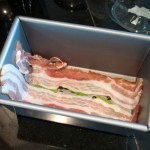
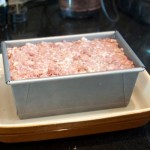
Bacon in tin  Before cooking  After cooking

The block of pate will shrink back from the sides of the tin during cooking, and will be surrounded by fat and jelly juices. Let it stand until nearly cool, and then it’s time to press the pate.  It’s pressed for two reasons – firstly, to compact it and reduce the risk of it crumbling when you slice it, but secondly – and just as importantly for me! – to compact the bottom so you can turn it out neatly!  It smells *wonderful*, just as I would have hoped.  To press it, I covered the top with a double layer of tinfoil, put an old tupperware container on top, and then piled it up with all the weight I could muster.  So, four tins of beans, and four litres of fruit juice ought to do the trick!

Pressing the pate

Once it’s had a really good squeeze, and cooled right down to room temperature, put the pate and whatever weight you can conveniently keep on top of it, move it into the fridge, where it will keep quite happily in its juices and rest and improve for three days before serving.

It’s a new recipe to me, so I’ll be back to tell you how it worked out!  But the smell, oh my, I can’t see it being anything other than lovely!  With crusty (maybe toasted, even?) home-made sourdough.  And pickles!

Advent - day 23

I’m trying to write a post a day during Advent, so, please come along with me while I try to Blog Advent – the Country Skills Way – and forgive me if I don’t quite manage it!

Read more from the Country Skills blog >>

The Icing On The Cake – how I decorate my Christmas cake – Blog Advent (17)

Christmas cake is a real ‘anchor’ for me, one of those food experiences that connects back, right through my life and my family history.  I wrote a bit last year about how baking the cake takes me back, every year.  I learned my cake from my grandmother – she learned it from Delia! – and I’ve only ever baked it and decorated it this one way.

The Icing On The Cake

After it’s been baked, usually some time in early November, I wrap it up in a few layers of greaseproof paper and stash it away in a tin. To keep it happy, it gets a tot of booze every week or so.  For the last few years I’ve baked it with, and then fed it on calvados (French apple brandy), because I think it adds an extra lovely fruity note compared to the traditional sort.

Before dressingOnce it’s nicely sozzled, and in time for Christmas, it’s time to get it all dressed up in its party frock!  More years than I can count, I’ve ended up decorating the cake on Christmas Eve – but I’ve been a bit better organised this year (well, OK, I wanted to make sure it was all ready in case someone fancied a slice this weekend!).

Brushing on the jamI ice my cake in two layers, first a nice thick layer of marzipan, and then a layer of royal icing.  Finally, the cake gets a decorative marzipan poinsettia to top it off.

First, to make sure the marzipan sticks down securely, I brush the cake with melted apricot jam, slightly loosened with some water and warmed in a pan on the hob.  A desert spoon of jam or so is plenty.  Brush it on generously with a pastry brush.  This is home-made jam, so has some big chunks of apricot in it, which isn’t a problem, just work around them and leave them in the pan!

Rolled out marzipanNow roll out your marzipan.  Mine was bought (sorry!) nice golden marzipan.  There’s about a kilo here. When working with marzipan, use icing sugar to dust down your surfaces and rolling pin, the same way you’d use flour when working with bread or pastry. Roll the marzipan out to the thickness you prefer, and make sure that it’s plenty bigger than the cake and sides in all directions.

Lay the marzipan overI know the baking aficionados on telly would have you apply your marzipan in two pieces – a round piece for the top of the cake, and a long thin band around the side.  I can’t see any reason to do this, for this cake at least – if you’re careful it’s possible to get a perfect layer with a one-piece approach.  In fact, the only merit I can see to the two-piece approach would be if you’re trying to get a sharp, 90 degree edge between the top and sides of your cake – in which case you’ve already started by cutting the top off – what a waste!  Gently place the big, rolled out piece of marzipan straight over the centre of the cake.

With sides flushNow, very gently, using the palms of your hands (dusted with icing sugar as required) push the ‘skirts’ inwards, towards the sides of the cake.  As you can see, I managed to get it all to sit snugly against the side of the cake.  But if you muck it up and get folds?  Just trim off the excess marzipan from the fold with a sharp knife, and stick the edges back together using a little bit of tap water.  The icing will conceal a multitude of sins!

Marzipan - doneTrim off the excess marzipan. I used the edge of the board as a cutting guide.  This sounds a bit generous, but it’s about the distance you want to leave.  I’ve over-trimmed in the past, and had to add extra marzipan back, so I now subscribe to the adage that you can always cut more later!  Once cut, gently nudge the marzipan in towards the base of the cake all around.  Anywhere you have an excess of marzipan, trim a bit more at this stage. You’ll be surprised how little there is, though.  Wrap up any extra marzipan you have left over tightly in cling film, and store in the fridge.

Ideally, let the marzipan dry out for a couple of days before applying the icing, though I’ve done it all in one night from time to time when necessary!  This gap is supposed to reduce the oiliness in the marzipan to reduce the risk of this ‘striking through’ and discolouring the icing.  I’m not sure how or whether this works, to be honest, and I’d love to say I’ve noticed a difference.  But I had time this year, so I gave it the 48 hours.

Royal icing ingredientsMy royal icing is made up of 3 large egg whites (I weigh my home-produced eggs and compare them to the egg size guide for this sort of cooking, since obviously they don’t come out of the hens graded!) 500g of icing sugar, and a teaspoon of glycerine.  I have forgotten the glycerine once or twice – it’s not a disaster if you can’t get any, but doing so does mean the icing sets very hard, so mind your dentures!

Whisk icingStart by spooning your icing sugar into your egg whites a bit at a time, stirring as you go.  It will look horrible and lumpy until right at the end, so don’t despair. Once it’s all incorporated, and you have a heavy gloppy-sort of consistency, start beating the mix with an electric whisk.  You really do want the electric whisk for this job – trust me, I’ve made royal icing with just a hand whisk one year, it’s *incredibly* hard work! – and ideally, if you have one, use your stand mixer.

Stiff peaksEven with an electric whisk it will take about ten minutes to get to the consistency you want, and I found that even with a handheld whisk I tended to get to the ‘I’m bored, sod it, that’ll do’ stage before the mix was really done!

Stir through glycerineYou’re after ‘stiff peaks’, which roughly means that the icing stays in whatever shape you place it in.  If you stop the whisk, you’ll get an idea pretty quickly by watching what happens to the ripples in the icing, which should be very stable.  You can test this by raising some peaks with the point of a knife, or your spatula.  If they stay there, you’re done.  Add your spoon of glycerine and stir this through the mix.  It adds a lovely shine to the icing.

Now, start slapping it onto the cake.

Apply the icing 1  Apply the icing 2  Apply the icing 3

Rough is good – you’re after a ‘snow scene’ effect, though I’ll be honest and say I’ve never seen a snow scene quite like this!

Store extra icingStill, it’s what my grandmother’s cake looked like, so it is with mine!  Once you’re happy you have a good covering, spoon any extra icing into a small plastic bag, and tie this off securely, excluding all air, and stick this bag in the fridge for later.  The icing now needs to set for at least 24 hours.  Then, it’s time for the final flourish.  For me, it has to be a poinsettia pattern in marzipan, but you could just as easily add holly leaves & berries, or even a Christmas tree, using a very similar approach.

Colouring your marzipanDig out the surplus marzipan from the fridge, and divide it into uneven thirds (two larger, one smaller).  Dye the two larger portions red and green using food colouring.  I find putting a sheet of cling film down on the kitchen counter when playing with food dye seriously simplifies the clean-up.  Also use plenty of icing sugar to stop things sticking.

Coloured marzipanIt was around this point that I remembered that last year, I’d made a mental note to try to find some better food colouring – I’m sure the food colouring my grandmother had only ever took a couple of drops, I seemed to have to ladle this stuff in by the spoonful!   Mind you, it was probably full of nasty artificial colours we’re not allowed to use these days…   You’ll get there eventually, even if your food dye is as wimpy as mine, and have the building blocks of your final decoration.

Prepare your leavesRoll out your green marzipan, and cut out a first set of six poinsettia leaves (or however many holly leaves, whatever you fancy).  I do this freehand, but you could easily cut make yourself a paper or card template.  Snip the corner off the bag of royal icing, and you have a little prepared piping bag.  Blob a little onto the centre of the cake and use it to glue down your leaves.  Then carry on with the red leaves, in much the same way. Finally, finish with some plain yellow berries in the centre.

Add green leaves  ... then red...  and finish with berries

Dab the marzipan with a damp piece of kitchen paper to remove any loose icing sugar, and finish with a ribbon, if you like.

That’s it, all done!  Round about now, I get to feel quite proud, very Christmassy, and revel in the connection to decades of family Christmas tradition.

Advent - day 17

I’m trying to write a post a day during Advent, so, please come along with me while I try to Blog Advent – the Country Skills Way – and forgive me if I don’t quite manage it!

Read more from the Country Skills blog >>

Fillets Of Fish – how to gut, clean, and fillet a trout – Blog Advent (16)

After the ‘fishmonger’ at Morrisons managed to completely ruin some beautiful fish with a bodged filleting job, there was no way I was letting them have another crack at the task!  The replacement trout we chose were completely unprepared – a bit of a job for us, but at least we could make sure it was done properly this time!

There’s a tradition of fish-eating at Christmas in many countries, with carp featuring on many European Christmas tables.  We’ll often have fish on Christmas Eve, and whole fish make a great celebration dish – salmon can be a fabulous alternative Christmas dinner for those not so keen on poultry or red meat.

Lovely fresh fish

A lot of people are frightened by fish preparation, and there’s really no need to be. There are knacks, sure, and you won’t be very fast to start with, but preparing a whole fish from scratch is actually really quite straightforward (and, really, not at all disgusting!).

You’ll need two knives, a small pointy paring-type knife for gutting, and a long, thin knife for filleting.  Both need to be very sharp.

Whole rainbow troutFirst, you’ll need to gut your fish.  In most cases, this will have been done for you, unless you’ve caught the fish yourself.  Fresh fish doesn’t smell, but can be very ‘slimy’! This mucus coating helps protect the fish’s skin and scales, in life, and helps it move smoothly through the water.  It’s worth taking a bit of time to remove this, if you can.  I find it easiest to wash the fish in cold water and wipe the mucus away with kitchen towel.  Going to a bit of trouble to do this will make the fish easier to keep hold of, and, especially if you’re trying knife skills you’re not familiar with, will probably improve your success and safety!

Gutting fishWIth a small sharp pointy knife, make small stab incision just behind the head, between the pectoral fins.  Without stabbing too deeply inside the abdomen, extend this incision lengthways until you get to the vent, just in front of the anal fin.  Reach into the abdomen and gently pull out the contents.

Remove abdominal contentsThe end of the gut should come away from the vent at the back, with some gentle traction. The attachment behind the head is stronger, pull this out as well as you can, and then cut it away with the knife.  There will probably be a bit of blood spilled at this point – just wash the cavity out with cold running water.

Your fish is now ready to cook, if you’re planning to prepare it whole.  If not, then it’s time to fillet it.  Put your small pointy knife away now, as you want a long, thin, sharp knife for this bit.

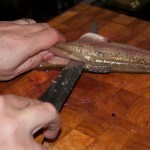
Position of first filleting cutPosition your fish on the board with the dorsal fin towards you (belly facing away).  Make a cut behind the gills and pectoral fins, into the flesh, perpendicular to the backbone.  Stop when you can feel the backbone, don’t cut through.

Starting to cut the filletNow turn the blade 90 degrees with the blade pointing towards the tail, and, grasping the head firmly, start to cut the flesh parallel with, and as close to the backbone as you can. Go slowly – it’s not a race!

Continuing to cut the filletAfter you’ve cut a little way, you’ll be able to hold onto the fillet instead of the head, which will make the whole process a lot easier to control.

Your first filletCarry on now, all the way to the tail.  Congratulations, you’ve got a fillet!  Don’t worry if there are ribs attached at this stage – we’ll get to that later.

Second filletPut your fillet to one side, turn the fish over, and do the same the other side.  The head of the fish will be facing the opposite direction, ad you may find the whole process a bit ‘backhanded’ this way around.  Just go slowly and take the time you need.  Personally I don’t find it helpful to work with the fish’s belly pointing towards me for the second side, but you may find it easier, so give it a go that way if you’re finding it particularly awkward.

You can see from this photo, it’s a tidy job and almost no waste!

Trim the ribsNow you want to tidy up your fillet.  Gently scrape, and wash away any bloody material on the fillet under running water.  Now, using your long thin knife, insert it under any ribs that are left attached, and trim these away, trying not to take any flesh with you.

Finished filletPin bones are the little bones that you’ll feel running from the front of your fillet towards the middle, along the lateral line of the fish.  If you’re planning to cook your fillet, I probably wouldn’t bother with them – they’re easy enough to pick out once the fish is cooked, and pretty small and soft in a fish of this size.  I’m curing and smoking this fish, so I tried to remove them all.  You can cut them out in a narrow ‘wedge’ of muscle, or pull them out individually with tweezers.  Both are quite fiddly and time consuming and leave a bit of a tear in the muscle, so try both and see which works best for you!

All Done!

Finally, trim away any fins and tidy up any ragged edges. I’m quite proud of this batch of fillets and I’m sure they’re going to make absolutely lovely smoked trout for Christmas food and gifts!  They’re in the fridge, curing, right now.

So don’t be afraid of that whole fish – it’s quite likely you too can do a better job of preparing and filleting it than whoever the supermarket has working behind their fish counter today!

Advent - day 16

I’m trying to write a post a day during Advent, so, please come along with me while I try to Blog Advent – the Country Skills Way – and forgive me if I don’t quite manage it!

Read more from the Country Skills blog >>

Banner320-260

Very Fishy – in a change from our scheduled programming, a complaint to Morrisons – Blog Advent (14)

I was really excited to find that the fish counter at our local Morrisons had two beautiful arctic char, and some very lovely looking rainbow trout.  I’ve been hoping I’d be able to find some to cure and smoke to add to my family Christmas ‘hampers’ (sorry, this is a spoiler for those of you who’ll be getting them).  Because I was buying two char and three trout, to save a little time I asked the fishmonger to fillet them for me.  This took an age, but I didn’t think much of it – I felt a bit sorry for the bloke, to be honest, since it was a bit of a big job!  Eventually they reappeared, heat-sealed into Morrisons’ white plastic fish-pouches, and I got on with the rest of my shopping.  The char was expensive – just over £10 for the two fish, but since it’s a rare and very special little fish, I figured that’s OK.

Ruined arctic char fillets

I opened the char this evening and nearly wanted to cry.  I’ve never seen such a mess.  I’m not a chef and have no formal training in this sort of thing, but I can – and *have* – filleted fish better than this.  Anyone can see that this is a total, utter, ghastly mess.  I spent 45 minutes trying to tidy up these fillets in the hope of saving them, but in the end I had to give up. They were uneven, still had all their ribs and fins attached, weren’t even split down the midline – one piece had a centimetre of flesh (nearly half an inch) still attached to the *other* side of the dorsal fin!  Great chunks of fish were missing, too.

They look like they’ve been filleted with a blunt bread-knife. The cut surface is completely macerated, with the layers of muscle ripped apart.  And one of the pieces, you can see, has a nasty blood clot within the flesh, which was connected to a cystic structure is the muscle – I don’t know exactly what this is, but I suspect it probably ought to have been grounds for rejecting the fillet or possibly even the whole fish.

As for the trout, well… see for yourselves.  Just more of the same.

Badly filleted rainbow trout  What a sad mess

I’m so angry and disappointed about this, mostly because it’s such a f*cking waste of beautiful fresh fish.  For goodness sake, Morrisons, is it too much to ask for you arrange to have fishmongers on your fish counters who can actually fillet a salmonid without making a complete dog’s dinner of it?  They’re about as simple a fish to fillet as it comes, after all!  I’d politely suggest they start with a sharp knife, and see how they go from there…

I’ll be taking it all back tomorrow.

Right, rant over.  I was going to share my decorated Christmas cake with you all tonight – perhaps tomorrow, eh?

Advent - day 14

I’m trying to write a post a day during Advent, so, please come along with me while I try to Blog Advent – the Country Skills Way – and forgive me if I don’t quite manage it!

Read more from the Country Skills blog >>

Oh, Crumbs! – homemade breadcrumbs for your Christmas cooking – Blog Advent (12)

I hate wasting my home-baked sourdough.  Of course, I try to make sure it all gets eaten when it’s at its best, but sometimes life interferes with your best laid plans, and you’re going away for the weekend with a third of a loaf still sat on the side, or the last roll in the batch is looking a bit dry to be appetising.  So when it looks like there’s some good bread about to go to waste, I chuck it in a bag in the freezer.

Lovely golden breadcrumbsBreadcrumbs are such a useful store cupboard staple.  At Christmas especially, they go into stuffings, and Christmas puddings, as a crunchy topping for fish pie…  I’m going to need some in a few days when I make my batch of Christmas sausages.  And the shop bought kind contain all sorts of preservatives, stabilisers, and even, believe it or not, yellow food dye for that ‘golden’ crumb!  Yuck!

It’s so easy to make your own.  Slice up your bread into normal-thickness slices (about 1cm / half an inch) before you put it in the freezer.  Once you have enough for a batch, get them out of the freezer and lay them out on a baking sheet.  Put them in a low oven at about 125 – 150 C.  After about an hour, get them out and carefully break them up as much as you can (don’t burn your fingers!), before returning them to the oven until they’re thoroughly dry and crispy.

Bread after dryingThey’ll take on a little colour around the edges, but don’t let them burn!  I’ve seen advice to cut the crusts off and not use end pieces for breadcrumbs, because they’ll tend to take on more colour during the drying process and you don’t want this.  Since that’s most of what I usually have left over, I’ve just ignored this advice, with no ill-effect that I can detect!  Once they’re completely dry, take them out of the oven and wait for them to cool fully.

Breaking up the crumbI’ve made the mistake of trying to put these straight in my food processor – they’re really quite hard and it doesn’t work very well!  You might be able to get away with it if your breadcrumbs are being made from ‘white fluff’ commercial sliced bread, but with real sourdough there’s quite a lot of substance to your bread, and the pieces just seem to bounce around the bowl.  Start by transferring the crusty chunks in batches into a large freezer bag, and crunching them up with a heavy rolling pin (a heavy skillet or saucepan would work well, too!).

In the food processorYou could just keep crushing the crumbs by hand until you get the finish you want, but if you’re lazy, like me, and have access to a food processor, then you can transfer the chunks to that once they’re all well under a cm in size, and then process them until they’re the texture you’re after.  I’ve left some bigger pieces in here for texture (if I want finer crumbs later I can always sift them through a collander before use), but you can keep going until it’s the consistency of sand if you prefer.

Now just transfer your breadcrumbs to an airtight container, where they should happily store at room temperature for at least a couple of weeks – this is assuming you’ve dried them properly – moisture is your enemy!  If you want to keep them longer, put them into to a sealed bag and store in the freezer, where they should be fine for 2 – 3 months.  If in doubt, watch out for any signs of mould or musty smells.  If they do start to go off, Hubby – who was my glamorous assistant this evening – asked me to remind you that they’ll still do fine for ground bait for any fisherman or woman in your family!

It’s the 12th of December today, which means we’re now half way through my Blog Advent challenge!  I’m exhausted, but really enjoying it too!  Thank you all so much for reading along so far – I hope I can come up with another dozen days worth!

Advent - day 12

I’m trying to write a post a day during Advent, so, please come along with me while I try to Blog Advent – the Country Skills Way – and forgive me if I don’t quite manage it!

Read more from the Country Skills blog >>

When Life Gives You Lemons – Part 4: lemon pickle [Guest Blogger]

Today’s Guest Blogger is Ross, from Christchurch, NZ.

Lemon pickle

This one is a bit friskier, with the smoking hot oil making the kitchen smell strongly of mustard for a while – you have been warned!

This made about 1kg of pickle for me (including some excess oil).

  • 8 lemons,
  • 150g salt,
  • 25g fenugreek; 25g mustard powder; 50g chilli powder; 8g turmeric. (I used mild chilli powder from my local Indian supermarket, and the end product still had a bit of a kick; if you prefer it incendiary, then use the hot stuff.)
  • 300ml mustard oil; 1/2 tsp asafoetida (hing); 12g mustard seeds (crushed).

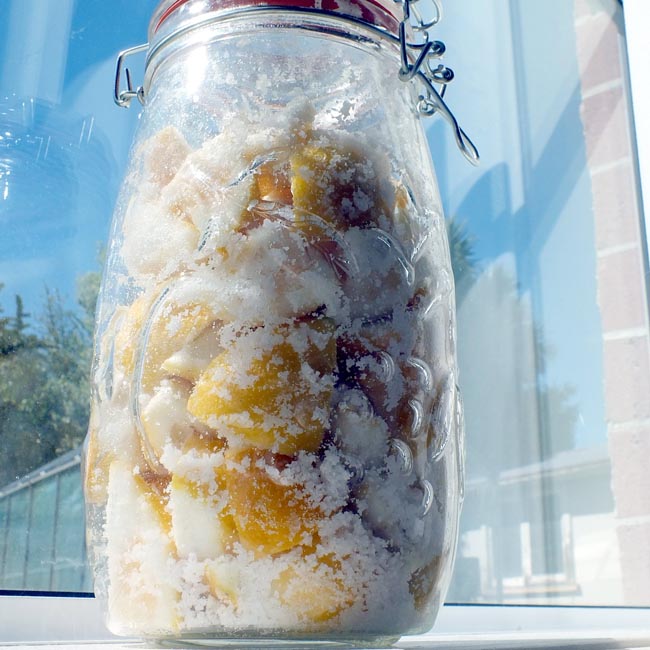
Salted lemonsStart by sterilising a large glass jar – a kilner-type jar like the one pictured is ideal.

Wash the lemons, dry, cut into eighths; you don’t have to remove the pips, but I did.

Put the lemons in the jar. Add the salt and shake it all up well to spread it all over them.

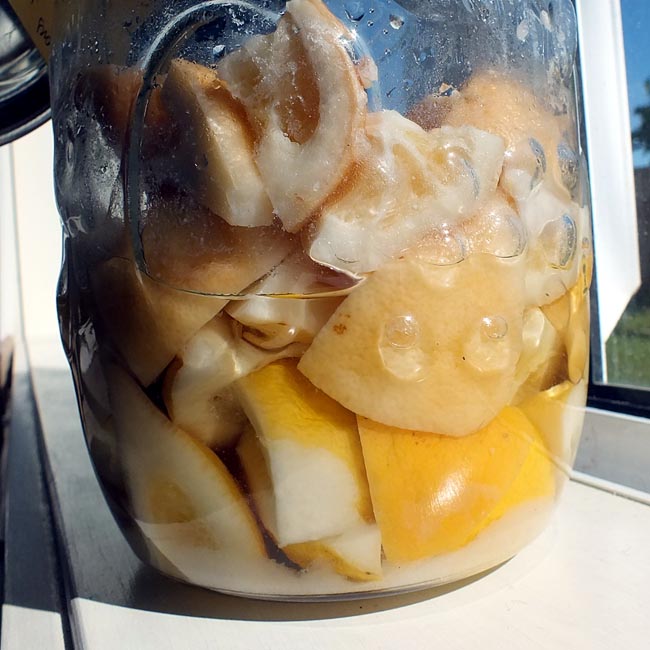
Lemons, after saltingCover; leave in a warm place for 1-2 weeks. (I put it on the windowsill which catches the sun nicely.) The juice leeches out of the lemons; where they’re exposed to the air, the lemon pieces soften and go a dull brown colour.

Mix the fenugreek, mustard powder, chilli powder and turmeric. Add this to the jar and shake it around gently. Re-cover and put it back into the warm for 2-3 days.

With all the spicesTransfer the lemon pieces and spices to a large saucepan.

Heat the mustard oil in a large frying pan. Fry the mustard seeds and asafoetida.

Keep heating the oil until it starts to smoke, then pour it over the lemons. (This is where it gets a bit frisky.)

Mix well. Allow to cool, transfer to a bowl, cover once more and leave in the warm for another week or so.

Lemon pickle

Now it is ready to put into jars; I tried (without huge success) to decant the excess oil. Then you can give some to your friends as presents, or to your enemies as a chemical weapon…

Ross is an expat thirtysomething Brit who went to the Shakey Isles in search of adventure. Works in technology, enjoys creating, has a love-hate relationship with his kitchen.

Warm thanks go out to Ross for these four great blog posts – hopefully he’ll be back with some more antipodean country skills for the blog in the future!  Have a look at Ross’s other lemon glut-busting recipes for lemonade and lemon liqueur, and lemon sorbet (which you’ll be needing, after sampling this pickle, I think!).

I hope you’ve all enjoyed this contribution from a great guest blogger as much as I have!

Read more from the Country Skills blog >>

When Life Gives You Lemons – Part 3: lemon sorbet [Guest Blogger]

Lemon TreeToday’s Guest Blogger is Ross, from Christchurch, NZ.

Lemon sorbet

Next up, to cleanse the palate, a simple sorbet. Note that if you have an ice cream maker it’ll make life easier, but it’s not mandatory (I don’t have one).

This recipe uses 8 lemons, and makes about 2.5 cups of sorbet.

  • Make up some simple syrup (see post 1 of this series) with 1 cup of water and 1 cup of sugar.
  • While it’s cooling, zest most of the lemons. You’re looking for about 2 tsp of zest – the finer, the better – I reckoned I had enough after six lemons.
  • Juice the lemons. You’re looking for about a cup of juice.
  • Mix the juice, zest and cooled syrup. Chill well (I left mine in the fridge for a couple of hours).

Now freeze. If you have an ice cream maker, you’re all set – but I don’t. That’s OK, it just means a bit more effort. The end product is a water ice, not a block of solid ice, so all you have to do is fluff it up a bit as it freezes.

Lemon Sorbet

  • I split the mixture into a couple of clean shallow plastic tubs and put them in the freezer.
  • After a few hours it was semi-solid; I mashed it up with a fork, then put it back in the freezer. Ideally I’d have done this again after a few more hours, but it was late in the evening so I left it overnight. This was maybe a bit too long as it was nearly solid so was a lot of work! (You could probably use a blender instead, but I don’t have one.)
  • Then put it back in the freezer. After 12-24 hours it’s frozen enough to serve.

Ross is an expat thirtysomething Brit who went to the Shakey Isles in search of adventure. Works in technology, enjoys creating, has a love-hate relationship with his kitchen.

Have a look at Ross’s other lemon glut-busting recipes for lemonade and lemon liqueur.  Coming up soon, lemon pickle.  Watch this space!

Read more from the Country Skills blog >>

When Life Gives You Lemons – Part 2: lemon liqueur, or ‘limoncello’ [Guest Blogger]

Today’s Guest Blogger is Ross, from Christchurch, NZ.

Lemon Liqueur

I did the first part of this at the same time as I made up some lemonade. This was a small test batch but will scale up directly.

IngredientsIngredients –

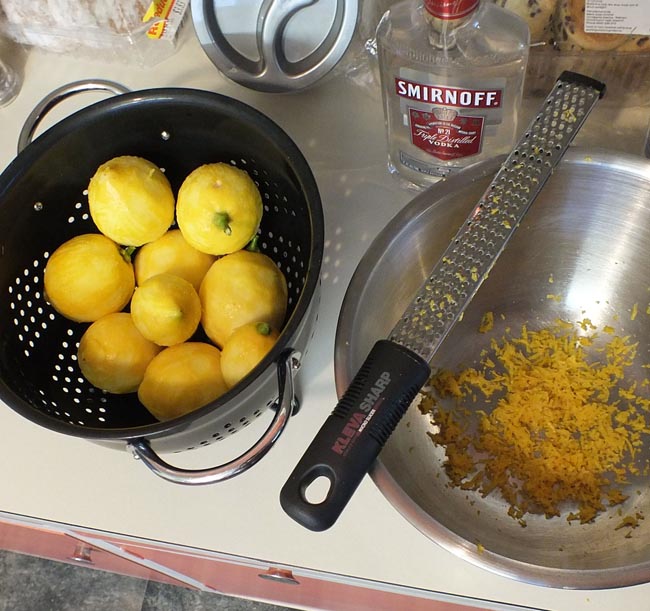
  • A half bottle of vodka (375ml) – not flavoured, you want something as pure and tasteless as you can find.
  •  8 lemons (zest only). Go for lemons with thick peels if you can, to maximise the amount of zest.

Sterilise a large sealable jar. This is the same as for making jam – a careful clean, rinse well, then dry in a slow oven.

Scrub and dry the lemons, make sure you’ve removed any wax. Now zest them; be very careful not to take any pith or you will spoil the result.

While the jar was cooling, I juiced the lemons to make the lemonade.

Lemon liqueur, infusingPut the zest into the jar and add the vodka. Make sure all the zest is covered, then seal it up and stash in a cool dark place for a while. I found a number of different recipes suggesting anything from 2 to 45 days; I left it for two weeks.

… time passes …

Make sure your bottles are clean and dry. You’ll end up with slightly more by volume than just the vodka.

Prepare a simple sugar syrup, and let it cool.

The amount of syrup you need is whatever will dilute your starting liquid to the desired strength (traditional limoncello is 30-32% ABV). In my case (375ml of 37.5% ABV vodka) this calls for 80ml of syrup.

Combine the infused alcohol with the syrup. Stir well. Optionally, say some recipes, let it rest for a few more weeks (I didn’t).

Filtering set-upNow filter carefully; for best results filter more than once. I started out with a sieve, then switched to coffee filters. I filtered it four times, which might be excessive; I set up a little production line (pictured). The filtering was slow, and the setup easy to knock over; I found myself longing for some clamp-stands like I used in chemistry class in high school. Unsurprisingly, the filters clogged quite readily; I got through several of them.

Bottle directly from the last filtration; the liqueur should be clear but coloured. At this point the product is very sweet and sharp. Let it mature in the bottle for at least a week; both the sharpness and the cloying sweetness melt away. Serve cold (direct from the fridge, or even the freezer). It’s dynamite-strong; take care!

Next steps?

This wasn’t real limoncello; apparently the genuine stuff is made with grain alcohol which pulls more flavour out of the lemon. (Grain alcohol as in 95% ABV – yes, almost pure ethanol – 190 proof in old money. It’s difficult to find on the shelves, but here in New Zealand it’s legal to distill spirits for personal use. There might be another blog post in here along those lines, but that’s a project for another day…)

Ross is an expat thirtysomething Brit who went to the Shakey Isles in search of adventure. Works in technology, enjoys creating, has a love-hate relationship with his kitchen.

Coming soon, more lemon glut-busting recipes from Ross – lemon sorbet, and lemon pickle.  Watch this space!

Read more from the Country Skills blog >>

When Life Gives You Lemons – Part 1: Lemonade! [Guest Blogger]

Today’s Guest Blogger is Ross, from Christchurch, NZ.

Lemon TreeWhat to do when life gives you lemons?

We have a lemon tree. Consequently, we have a lot of lemons. It’s just turning to spring here in New Zealand as I am starting to write this, it’s our first spring in this house, and we have a crop ready to harvest.

As a long time reader of the Country Skills Blog I went fishing for suggestions. There is plenty of marmalade on here, which I must get round to trying out sometime, and everybody has heard of traditional old-style lemonade, but what other interesting things can we do with them…?

Studying some recipes I found recipes for a lemon liqueur not entirely unlike limoncello, which use only the zest of the lemon, whereas lemonade uses only the juice. A perfect combination for the first experiments!

Simple Sugar Syrup

This comes up in a few of these recipes, so I’ll describe it once.

Take roughly equal volumes of sugar and water. Mix and heat in a small pan; boil gently until the sugar has dissolved leaving you with a clear syrup. You usually want to leave it to cool before you do anything else with it; if not, take care – it’s like napalm.

Fresh Homemade Lemonade

Lemonade 1Ingredients:

  • Lemons (juice only),
  • sugar,
  • (optional) fresh mint to garnish.

120ml of lemon juice + 1/2 cup sugar makes about 650ml lemonade.

Juice however many lemons. I got about 120ml from the eight lemons I used for my test batch of limoncello; I could have probably got some more from them if I had tried harder.

Lemon JuiceMake up some simple syrup following directions above. I used the same volumes of water and of sugar as I had lemon juice – near enough 1/2 measuring cup of each.

Let the syrup cool, then transfer to a jug. Add the lemon juice, then more water to dilute: three times as much water as you put into the syrup, so I used 1 1/2 cups. Chill well before serving. If you have any fresh mint to hand (I didn’t), it would make an excellent garnish.

Ross is an expat thirtysomething Brit who went to the Shakey Isles in search of adventure. Works in technology, enjoys creating, has a love-hate relationship with his kitchen.

Coming up soon, more lemon glut-busting recipes from Ross – lemon liqueur, sorbet, and lemon pickle.  Watch this space!

Read more from the Country Skills blog >>

Sourdough Saga: Episode 7 – six months on, life with my sourdough starter

Back in May of this year, I started my experiment with creating – and baking with – a sourdough starter.  Now that November is nearly with us, almost six months on, what is the starter like to live with, and what effect has its appearance in my home had on my life?

In July, when I gave a ‘clone’ of my starter to my sister as a gift, I wrote her a guide to looking after her starter.   My starter is less cosseted these days – it drinks tap water, and has survived several rounds of being abandoned in the fridge for a couple of weeks or longer between feedings.  After long periods of abandonment, the starter has a sharp vinegary smell, and either a layer of greyish water on the surface, or an even more unattractive and worrying-looking layer of ‘fuzz’.  But every time, after pouring or scraping this away, and feeding the starter, it has sprung back to life.

Sourdough loaf selection

My starter has successfully baked white, wholemeal, malted mutligrain and spelt loaves (and a variety of combinations of these flours) – in fact, the flour used for sourdough loaves seems to make very little difference, probably because of the longer proving and working time compared to a quick-yeasted loaf.  The loaves are continuing to get better, too – with a nice even crumb and springy texture these days.  Last week, on holiday in a rented cottage in Cornwall, I even managed to bake a batch of sourdough in the borrowed kitchen and unknown oven! (Why, yes, I did take my starter on holiday with me, why do you ask..?)

I use less salt in my batch than I did to start with, but otherwise my method remains the same as for my very first loaf.  I often bake a double quantity, and freeze one loaf.  I’ve added cheese, herbs, and sun dried tomatoes to loaves, with great success.  More recently, I haven’t used the stand mixer for some batches, but worked the dough entirely by hand instead.  A plastic dough scraper, which I bought from eBay for 99p, is a great help and not exactly an investment that broke the bank!  As you can see from the photo, I’ve baked rolls, free-formed loaves, and even a loaf in a tin.  The sourdough pizza was *amazing*, too.  It all works brilliantly, so the limit should only be your imagination!

Several ‘clones’ of my starter are now in new homes with family and friends, and they report baking very successfully with their starters too.  So you see, if my Dad can do it, so can you!  There are even rumours of my starter making it into small-scale commercial production, so watch this space!

As an aside – when I was growing up, I sometimes wondered about the Lord’s Prayer – specifically, the fixation with ‘daily bread’.  After all, what was so exciting about bread? Well, it’s a bit like the first time you’re outdoors, on a crisp clear night somewhere really, really dark, and look up and see the infinite billions of stars and the Milky Way spread above you, and the phrase ‘majesty of the heavens’ suddenly makes sense as something other than a weak metaphor – in an earlier time, before we filled the skies with artificial light (and our larders with artificial food), these things were seriously impressive!  Good bread may genuinely change your world – your food world, at least!

The downside?  Well, all other bread is a disappointment, frankly! I did get a couple of really nice non-sourdough white loaves from a bakers’ shop while we were on holiday, which made a pleasant change.  But, basically, you’re never going to want to buy bread from the supermarket again – even the stuff from the phoney-bakers-shops they have in store these days is a total let-down, and as for the plastic-wrap ‘chorleywood’ sliced white, well…

All of which means that regular baking days have become a feature of our already rather busy lives.  Now, I wouldn’t have it any other way.  And, yes, you’ve guessed it, today is a baking day!

Read all the posts in the Sourdough Saga >>

Read more from the Country Skills blog >>