When Life Gives You Lemons – Part 1: Lemonade! [Guest Blogger]

Today’s Guest Blogger is Ross, from Christchurch, NZ.

Lemon TreeWhat to do when life gives you lemons?

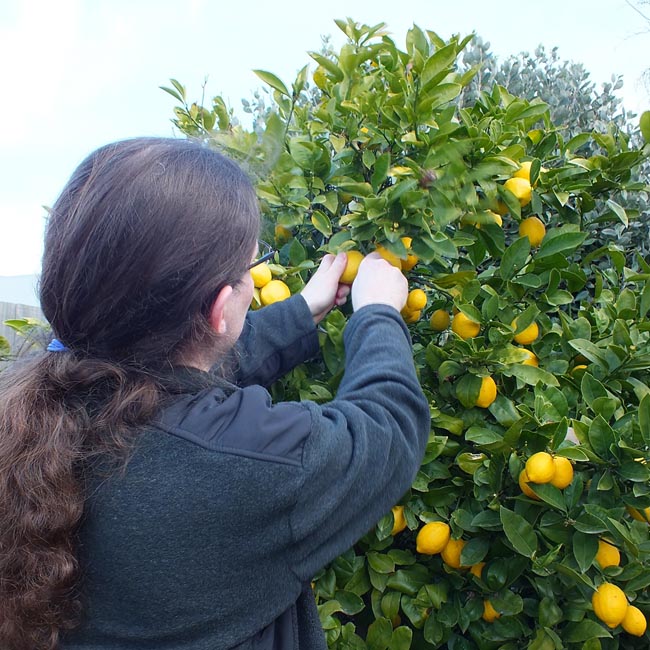
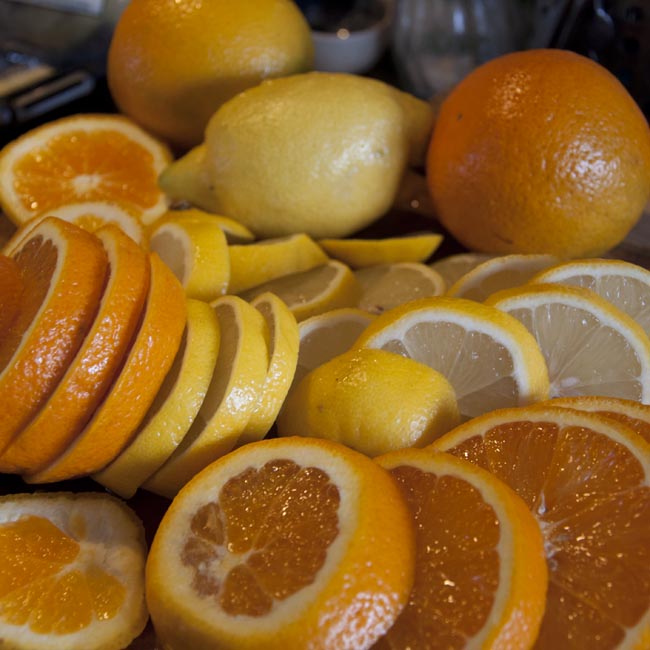
We have a lemon tree. Consequently, we have a lot of lemons. It’s just turning to spring here in New Zealand as I am starting to write this, it’s our first spring in this house, and we have a crop ready to harvest.

As a long time reader of the Country Skills Blog I went fishing for suggestions. There is plenty of marmalade on here, which I must get round to trying out sometime, and everybody has heard of traditional old-style lemonade, but what other interesting things can we do with them…?

Studying some recipes I found recipes for a lemon liqueur not entirely unlike limoncello, which use only the zest of the lemon, whereas lemonade uses only the juice. A perfect combination for the first experiments!

Simple Sugar Syrup

This comes up in a few of these recipes, so I’ll describe it once.

Take roughly equal volumes of sugar and water. Mix and heat in a small pan; boil gently until the sugar has dissolved leaving you with a clear syrup. You usually want to leave it to cool before you do anything else with it; if not, take care – it’s like napalm.

Fresh Homemade Lemonade

Lemonade 1Ingredients:

  • Lemons (juice only),
  • sugar,
  • (optional) fresh mint to garnish.

120ml of lemon juice + 1/2 cup sugar makes about 650ml lemonade.

Juice however many lemons. I got about 120ml from the eight lemons I used for my test batch of limoncello; I could have probably got some more from them if I had tried harder.

Lemon JuiceMake up some simple syrup following directions above. I used the same volumes of water and of sugar as I had lemon juice – near enough 1/2 measuring cup of each.

Let the syrup cool, then transfer to a jug. Add the lemon juice, then more water to dilute: three times as much water as you put into the syrup, so I used 1 1/2 cups. Chill well before serving. If you have any fresh mint to hand (I didn’t), it would make an excellent garnish.

Ross is an expat thirtysomething Brit who went to the Shakey Isles in search of adventure. Works in technology, enjoys creating, has a love-hate relationship with his kitchen.

Coming up soon, more lemon glut-busting recipes from Ross – lemon liqueur, sorbet, and lemon pickle.  Watch this space!

Read more from the Country Skills blog >>

Using Your Bottle – self-watering planter success!

Earlier in the week I wrote about my last batch of bottle cutting experiments.  Just a quick post to update, especially about the self-watering planter which, I had to admit, I had my doubts about!

Self-watering planter

Well, it works!  The compost is staying moist, the water level in the reservoir is very slowly – but visibly – dropping, and the basil seems to be thriving!  There seems to be an added bonus with this design, which is that the glass captures the heat from sunshine much more effectively than traditional pots.  The soil feels quite warm to the touch on a sunny day, which can only do good things for the plants’ growth over the winter, right?

So, many more of these to come, I think!  Hubby not too sure about me filling up our windowsills with recycled wine bottles, but I’m sure he’ll come around!

Read more from the Country Skills blog >>

Using Your Bottle – testing some ideas for bottle cutting crafts

I’ve been wanting to play some more with the bottle cutting jig since my first attempts at bottle cutting a few weeks ago.  This weekend I found a few hours and raided some bottles from the neighbours’ recycling bins, and got to work.

Almost completed bottle cutting projects

My success rate this time stayed stubbornly around the 1:3 mark.  It’s becoming clear that two things are combining to be a problem.  The first is that accuracy in the score mark is absolutely critical – if you don’t get a perfectly straight even score that meets neatly, there’s no chance of the bottle breaking cleanly.  The second is that bottles are *rubbish*.  Of the bottles I’ve cut – and failed to cut – so far, not one is made up of even thickness glass, and most of them aren’t even anywhere near round in section!  This makes getting an even score more challenging, as well as tending to make the bottle break unevenly as a result of the variable thickness of glass.   There are a handful of gadgets on the market (and one interesting looking one, called the Kinkajou, about to come on the market) which might well improve my hit rate on nice reliable score lines, but I’m still trying to keep this a low-cost hobby for now!

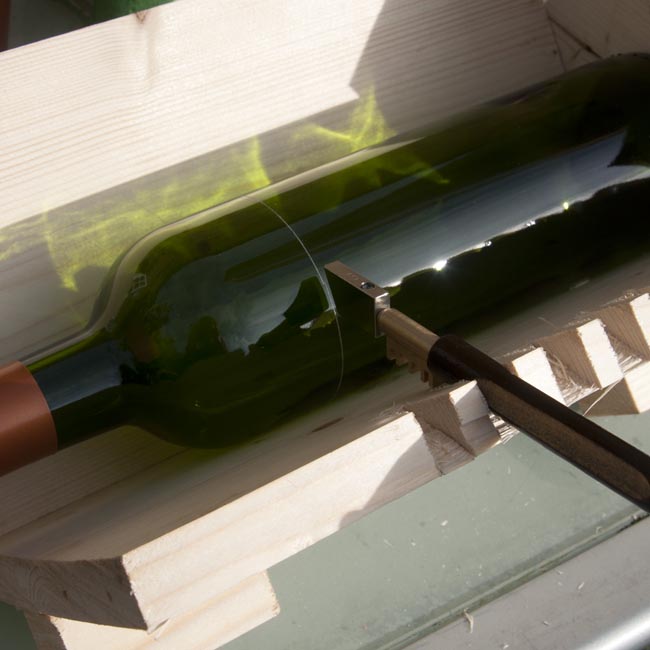
Glass cutting jigStill, a couple of hours work (mostly removing labels!) got me three new nicely cut bottles – a 500ml green cider bottle, and two punt-bottled wine bottles, one of which I cut long, and discarded the top to make a vase, and the other cut more centrally to give a top and bottom section.  Sanding down (see my previous post for more details of the cutting process) gave me safe cut edges.

I’ve really wanted to play with etching, because I’ve seen some beautiful glass decorating projects, but hubby really wasn’t very enamoured with the idea of me using concentrated acid paste in the kitchen (and I can kind of see his point!).  I settled on using some frosted-glass effect spray paint made by plastikote.  This slightly offends one of my fundamental design principles, actually, but never mind!

The ideas for using the bottles were mostly gleaned from Pinterest, which is a new and rather addictive time-sink (those of you who’ve also discovered this can have a browse of my boards here).  I used some black sticky-back vinyl as a masking material for two of the pieces.

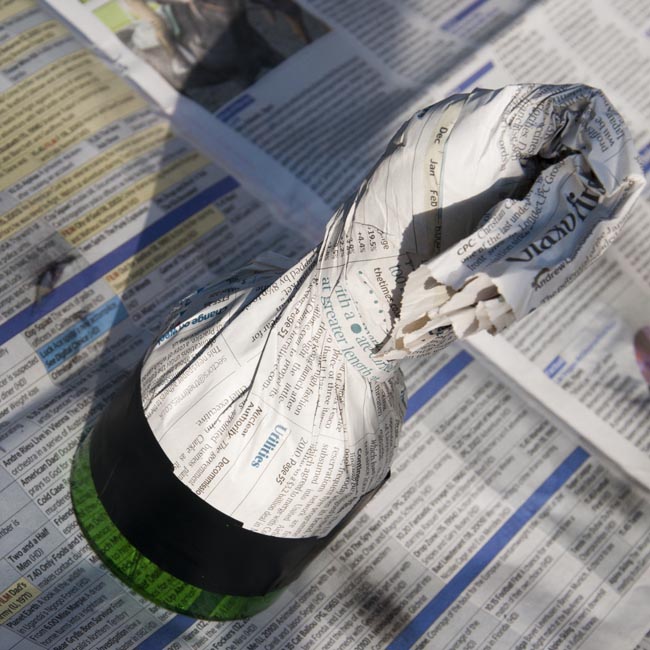
Masked-off bottle topIsn’t it great when you discover that the bits and bobs you’ve bought for one craft can be pressed into service for another?  I dug out the rotary cutter, ruler and cutting mat I bought for quilting, and got to work cutting strips of vinyl.  Two to wrap around the bottom of the cider bottle, to give a striped finish, and the off-cut with some newspaper to mask off all but the edge of the cut-off top of the wine bottle.

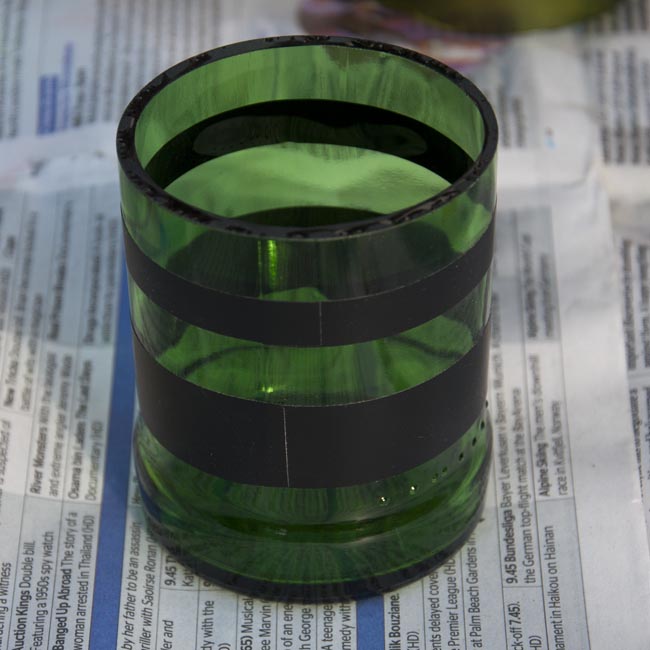
Masked tealight holderThis vinyl is a great masking material for glass, as it adheres tightly, stretches just a little to account for the wonkiness of the bottles, and comes away cleanly without leaving any residue.  The resulting cider bottle makes a very pretty tealight holder which would make a lovely little gift.

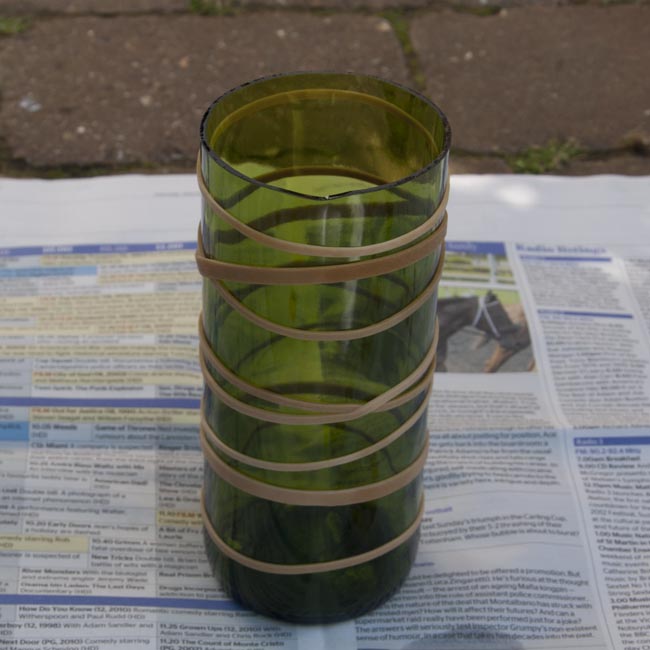
Masked vase with rubber bandsFor the bottle destined to be a vase, I borrowed another idea in wide circulation on pinterest and applied rubber bands, some overlapping, rising and falling. The first thing to note about this approach is that the rubber bands don’t arrange themselves  – it actually takes quite a lot of faffing to get a pleasing arrangement of lines.  They’re not an ideal masking material, either.  As you apply the instructed two or three layers of the frosting paint, some will settle on the top edge of the rubber bands (this is much less of a problem with vinyl which is very thin and doesn’t collect ‘overspray’ in this way).

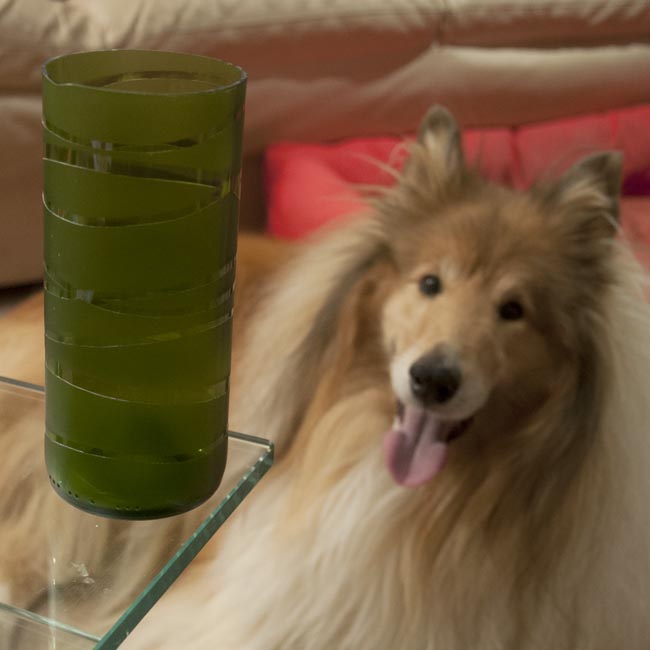
Dave with vaseThe rubber bands came off easily once the paint had dried overnight, but it took quite a lot of delicate trimming away of the extra paint with a scalpel blade to get a reasonable finish.  I’m still not entirely happy with the outcome, and if I try this approach again I’ll try to get away with one, perhaps two layers of paint rather than the three I used.  Still, the result is quite pretty, isn’t it?  Dave said he wanted to be in the photo, and who am I to disappoint him?

Landscape fabric with stringFinally, and perhaps most interesting for me, is the bottle cut in half.  I’ve made a self-watering herb planter, based on a photo I saw – guess where? – that’s right, pinterest again.  The top of the bottle is up-ended inside the bottom.  I lined it with a cut rectangle of landscape fabric about 4″ by 8″, one half of which I threaded through with a bunch of jute string. Fold this in half with the string dangling through the neck of the bottle. Then, fill with compost and plant (in my case, with some rather sorry-looking home-grown basil I always forget to water).

This is where I admit to being a really neglectful gardner.  I’m full of enthusiasm, but when it comes down to it I have a nasty habit of forgetting to water, to pot on, to plant out…  my garden thrives on it’s own resources more than on my care, and my houseplants have to have a strong will to survive!

Self-watering wine bottle planter

So if this contraption actually works (and the jury is still out on this – it’s early days) then it’s going to change my window-sill gardening forever.  Herbs that will water themselves!  In a planter which is recycled, free, and really pretty, rather than something ugly and plastic and more suited to greenhouse shelving than living room windows.

I’ll update with more photos of the herb planter once it’s clear whether there’s any merit to the design.  In the meantime I suspect there’s quite a bit more mileage in breaking bottles for fun and (perhaps??) profit…

Read more from the Country Skills blog >>

The Butterfly Bush – a photo from the garden today

It’s been a funny year, weather wise – we had a very late, wet spring, and summer has been resolutely grey and damp with only flashes of heat and sunshine, and we’ve seen very few butterflies.  And in the last week, suddenly, they’re everywhere.

The buddleia, which grows in a scruffy bit of ground behind our pond, has really been earning it’s name of ‘butterfly bush’ in the weekend sunshine.

Peacock butterfly on buddleia flower.

This is a peacock butterfly – which are around at the moment by the dozen.  In just a few minutes, I also saw several tortoiseshells and a couple of red admirals.  I’m so pleased to see them all around at last, here’s hoping they enjoy all the lovely late nectar on offer and get a good breeding season in!

Read more from the Country Skills blog >>

Getting In A Pickle – gorgeous spiced plum chutney

Accidents in the kitchen always seem to happen when everything’s just at that critical point… and any cook worth their salt, when scalded by a volcanic eruption of boiling sugar and vinegar, is likely to think ‘never mind my arm, have to save the chutney!’

So it was Thursday evening.  The chutney is fine, incidentally, thank you for asking!
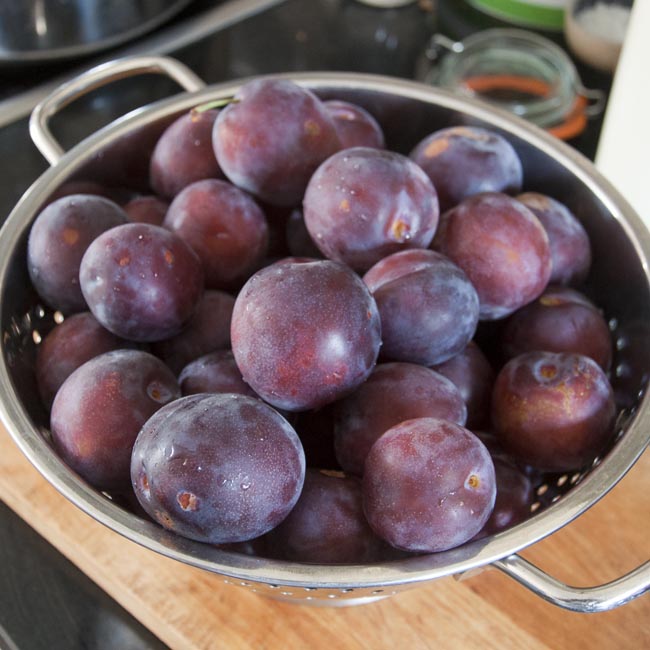
Red plumsAs well as bringing some beautiful French apricots back from their holidays, my lovely in-laws also arrived with a couple of kilos of fabulous red plums.  This put me in a real quandary, let me tell you.  Plum jam is one of my favourite things in the whole world.  But then this spiced plum chutney (originally Delia’s, credit where credit’s due!) is my very very favourite chutney.  It has a lovely fruity character topped with just a subtle hint of Christmas spices, and is wonderful with a lovely sharp mature cheddar, or a slice of home-cooked ham.

What eventually made my mind up was my jam jar situation.  I’ve done a lot of preserving in the last few weeks – it is that time of year after all! – and the jars I have left are a motley bunch.  Quite a lot of them have held things like sauces, curry pastes, and even pickles and chutneys.  The sorts of aromas that ‘hang around’ jars and lids, despite your best cleaning and sterilisation efforts.  It’s not really the flavour sensation you want with your breakfast jam!

This chutney is full of big flavours, and will swamp any faint ‘eau de korma’ residue it might have to deal with!

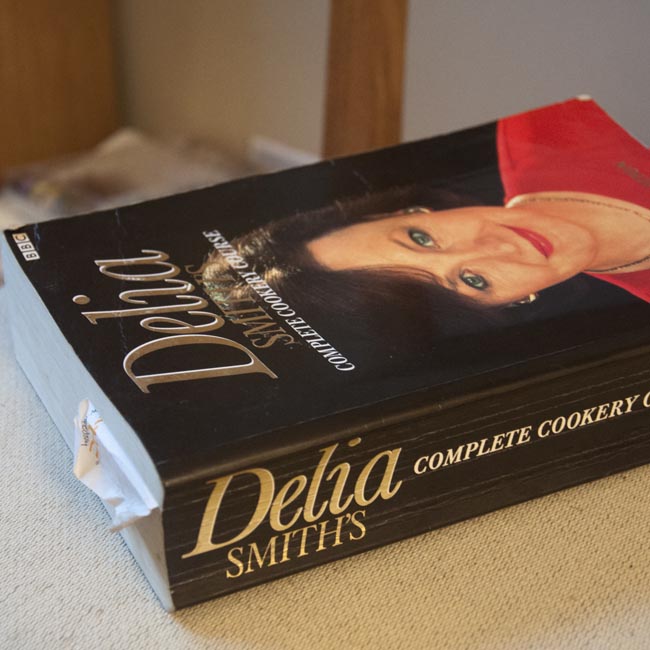
My well thumbed 'bible'The recipe is somewhat modified from the one in my very well thumbed copy of the Delia Smith ‘Complete Cookery Course’, reprinted from the 1982 edition.  Conveniently, it’s also available at ‘Delia Online’, here.  I’m not going to duplicate the recipe, since it’s freely available for you to read, but I changed the quantities and slightly modified some of the ingredients to suit my 2kg batch of plums, and what I had in the cupboard.

This is a BIG batch of chutney, producing 9 jars about 1lb in size, and a further eight small kilner-type jars, plus a bit extra which wasn’t quite a full pound jar.  I estimate in total it makes about 12lb, or 6kg.  It needs a very big pan – my large stock pot was over half filled, before reducing, and has a capacity of about 15l.  Unless you’re planning on eating an awful lot of chutney, giving lots of it away, or selling it (I think it would go really well at a farmer’s market!) I’d probably suggest scaling these quantities down to half or even a third (Delia’s original quantities are for 1.3kg of plums, which is still a very big batch).

I used the following –

  • 2kg of dark red / purple plums.  The tart / acid ‘cooking’ sort are probably better than sweet eating plums for this recipe.
  • Four smallish Bramley apples, totalling about 800g in weight.
  • 5 large-ish onions
  • 5 cloves of garlic
  • 3 teaspoons of ground ginger
  • 750g of seedless raisins
  • 750g each of soft brown and demerera sugar
  • 3 pints of malt vinegar (excuse the switch to imperial measures – this is about 1.7 litres, malt vinegar comes in pint-bottles in these parts, so it’s a measure of convenience).
  • 3 desert spoons of salt
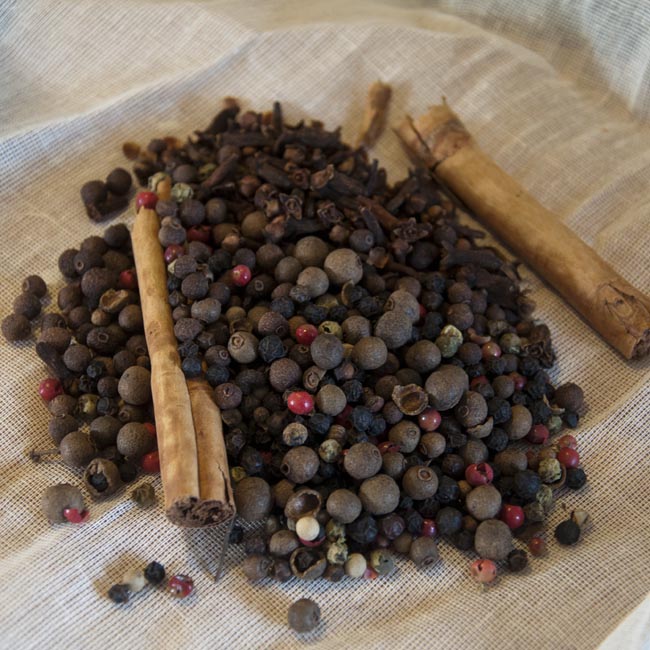
  • a large cinnamon stick, 15g of whole allspice berries, and 20g of mixed peppercorns (the mix was about 1/3rd allspice berries, oddly), and a tablespoon of whole cloves, all tied up in a muslin parcel.
  • A giant stock-pot, food processor, and enough jam jars to contain your chutney (lots, and lots, of jam jars!), which should have plastic-lined lids to help resist the vinegar.
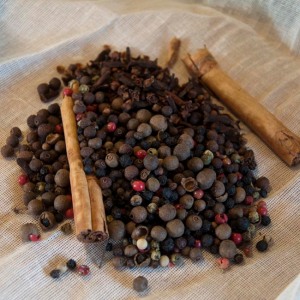
Whole spices with muslin

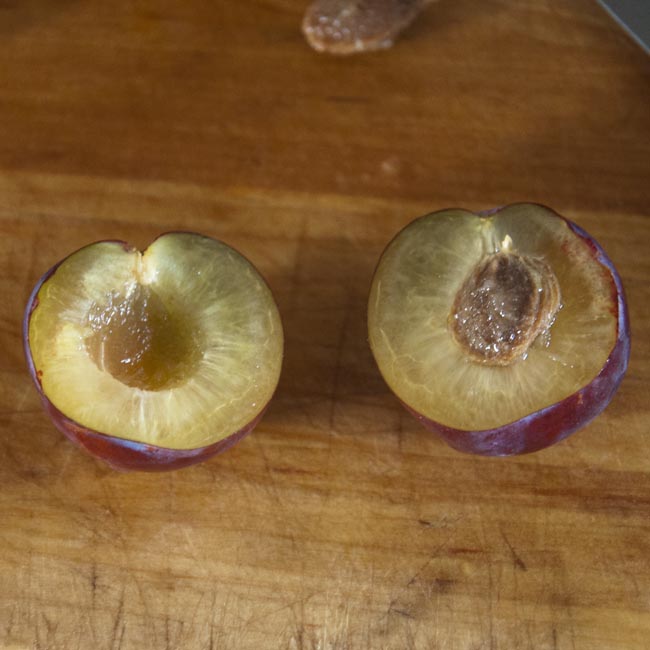
First wash, then stone and quarter all your plums. I find the quickest way to do this is to first slice along the line of the plum, down the visible ‘seam’, and divide the plum in two. The stone will cling to one of the halves, and especially with the smaller firm-textured cooking plums, won’t want to come out easily.
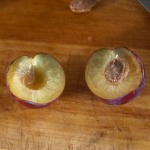
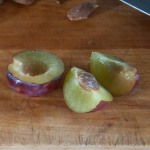
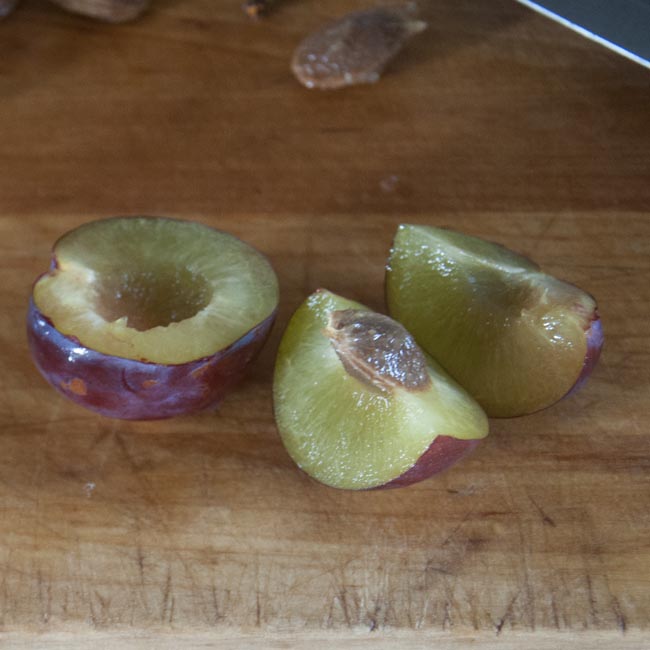
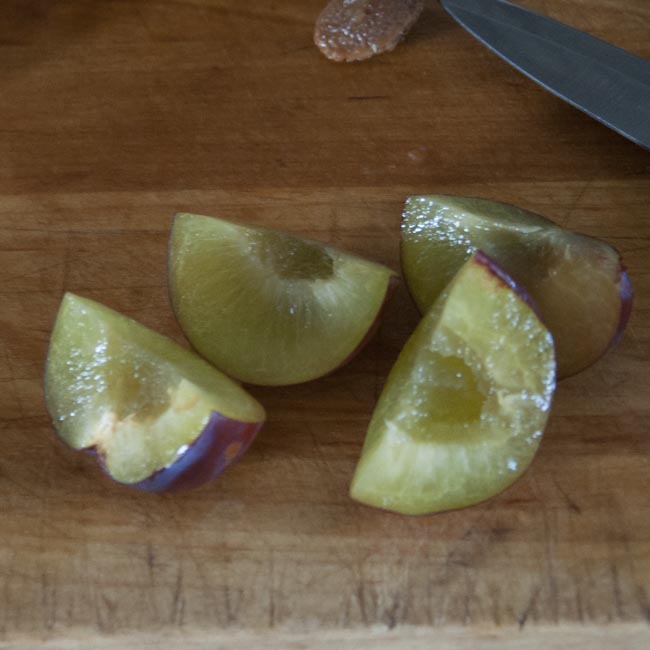
Stoning plums - 1   Stoning plums - 2   Stoning plums - 3

Take this half, and slice in half again, across the sort axis of the stone this time. The stone will now be sticking conveniently out of one of your quarters, and can easily be pushed free.  Cut your other half into quarters, too, and you’re done.  Incidentally, stoning plums can stain your fingers and fingernails a rather attractive nicotine brown colour, I think as a result of the tannins, so if you care about this, consider wearing gloves!
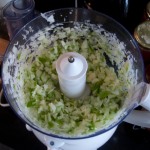
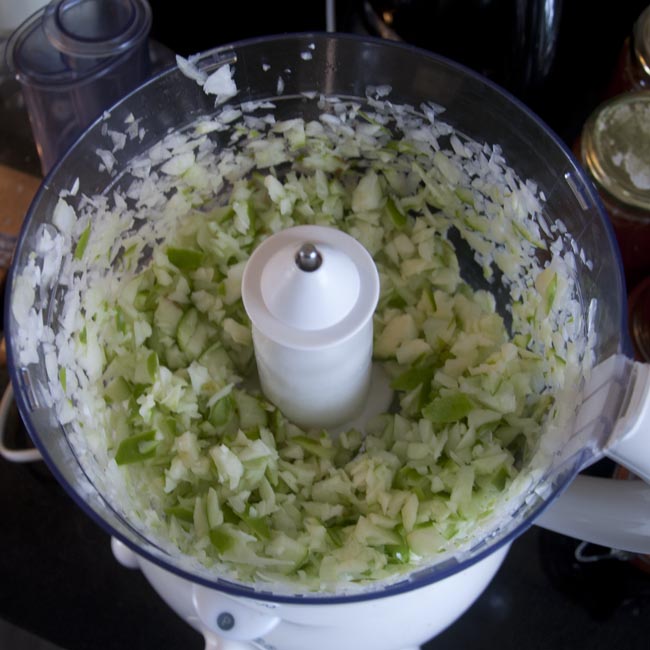
Chopped apple in food processorThe recipe calls for minced onion and apple.  I put mine through my food processor in batches, but left some nice texture in both.  The first time I made this recipe I didn’t have a decent food processor and diced all the apples and onions very finely by hand.  It works, but I can’t say I can recommend it!
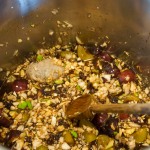
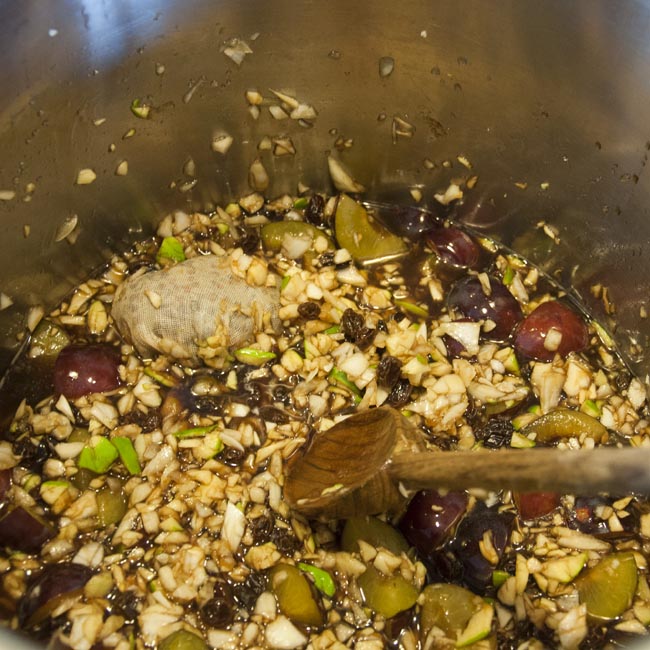
Mixed ingredients in panAfter your fresh ingredient preparation, it’s very simple really.   Add all the other fresh, dry, and liquid ingredients, and toss in your spice bundle (Delia recommends tying your bundle of spices to the pan handle, but I really can’t see any benefit to this!).  Bring everything to a simmer, stirring to mix as it all comes up to temperature.  Your kitchen will smell rather like Christmas-gone-wrong about now – festive spices mixed inexplicably with onion and vinegar.
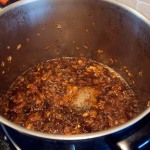
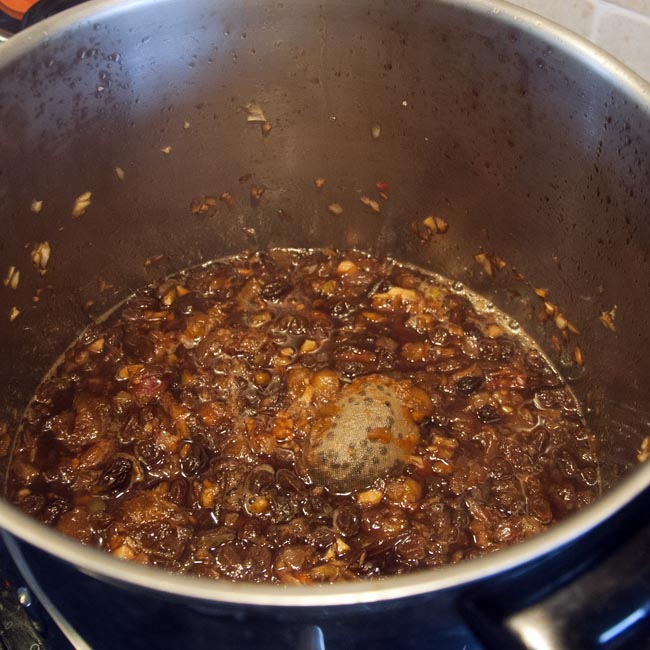
Cooking away nicelyThen let it bubble, stirring occasionally, for about three hours (my mixture was about six inches deep in my very big stock pot – a wider pan, or a smaller batch, which would allow the mix to sit in a shallower layer will reduce noticeably faster) until the mixture is reduced, glutinous, and the vinegar mixture has thickened so that it doesn’t immediately flow back into a channel cleared with a spoon.  I had to ladle out a couple of spoon-fulls into a bowl to check this.

As it starts to reach this stage, it will tend to ‘glob’ with really big bubbles, particularly when stirred, so learn from my experience and take care to protect your hands and arms from scalding!  This is the point that it’s at risk of sticking and burning, too, so keep stirring when you think you’re getting close.  Once it’s ready, fish out the spice bag, and bottle straight away into your hot sterilised jars.
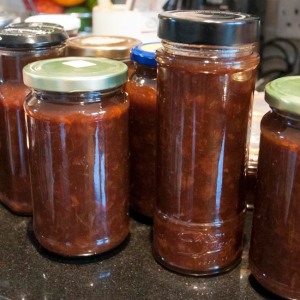
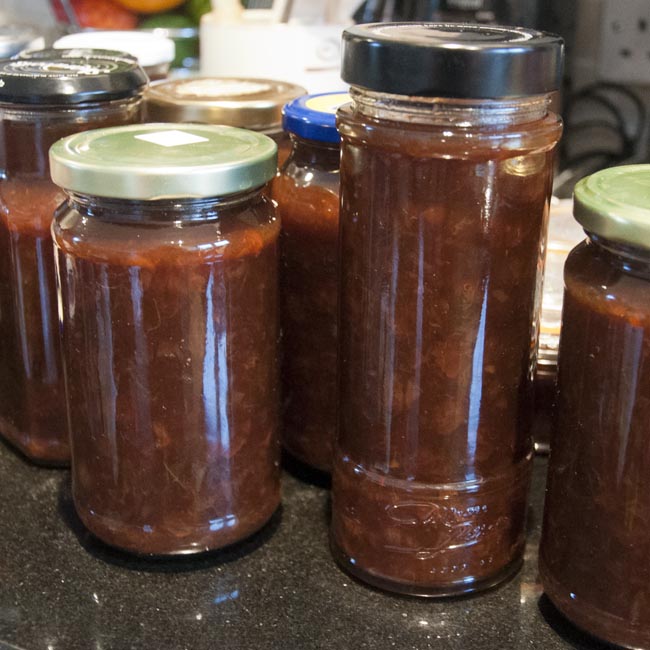
Bottled chutney

It will be at it’s best if you allow it to mature for at least three months before eating – just in time for Christmas, then! – though I had some of the ‘extra’ today with some bread and cheese, and it’s already very good!  It will keep very well, too – I’ve eaten this chutney after at least four years’ storage.

Now, I wonder if I can get hold of some more plums to make some jam, too …

Read more from the Country Skills blog >>

This Is My Jam – French apricot with kirsch

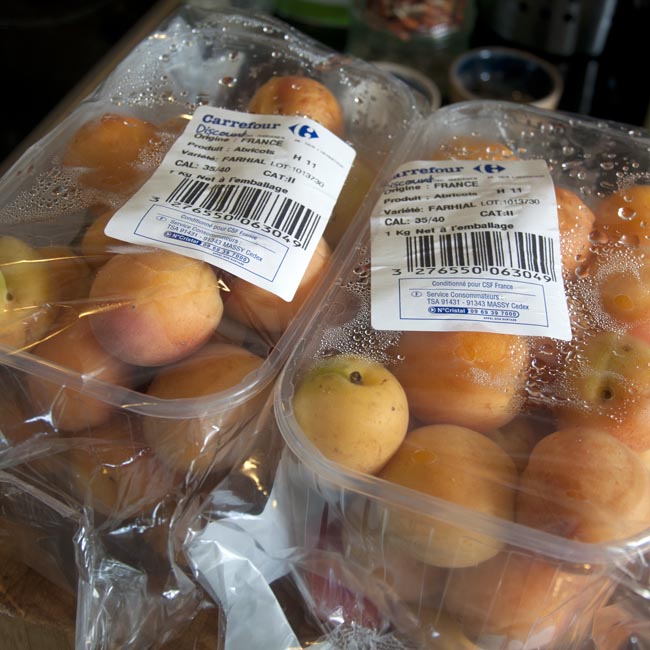
We had a visit from my in-laws this week, on their way back from holidaying in France.  It’s always lovely to see them, but this time was particularly special – they brought with them 2kg each of beautiful French apricots and plums.  So today, my day off, was always going to be about preserving!

I wanted to make some really nice authentic French apricot jam, so this is as simple as it comes – apricots, sugar, a squeeze of lemon juice… and just a little ‘twist’!

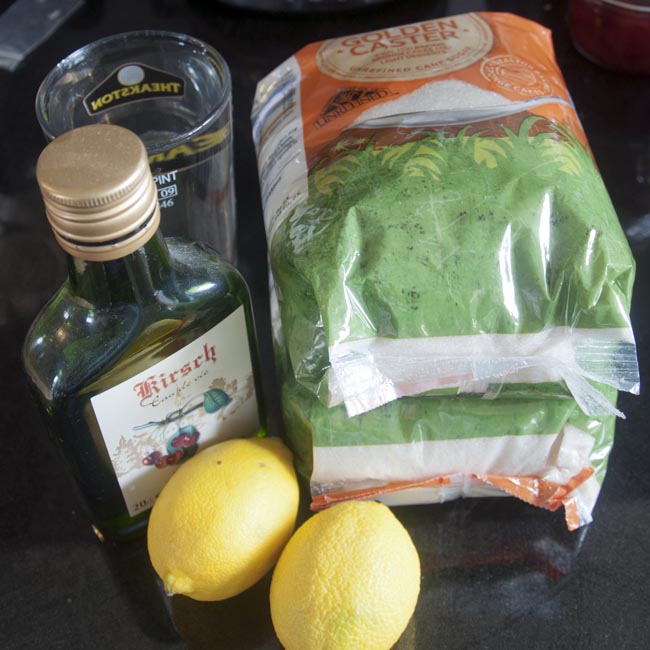
For this jam, you will require –Fresh French apricots

  • 2kg of French apricots (well, OK, anyone’s apricots will do, I suppose!) not too ripe.
  • 2kg of golden caster sugar (as a general rule, I prefer to use the least-refined sugar that I can get away with in any given situation)
  • 3 slightly sorry-looking lemons from the fruit bowl (the sorry state is not compulsory, and two nice big fresh juicy lemons will do well here!)
  • Half a pint of water
  • A couple of tablespoon measures of kirsch (or other eau-de-vie of your preference)
  • Generous sized preserving pan, not aluminium
  • Enough jam jars to contain your batch.  I always wash and sterilise more than I think I’ll need, as it doesn’t do to run out at bottling time!

IngredientsObviously you can scale the quantities to suit your apricot supply – they’re very nice convenient multiples!  I find 2kg of fruit is a good useful batch size, easily manageable with the equipment I’ve got, and makes enough jam to generously repay the investment in time and effort.

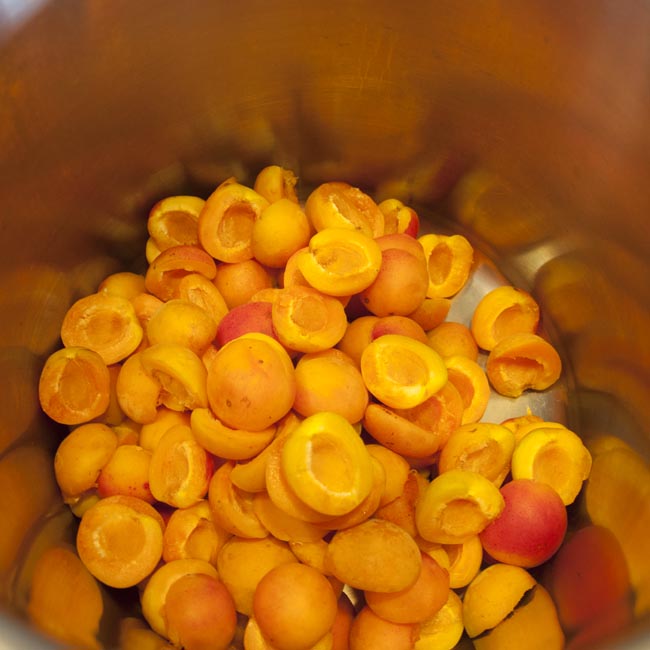
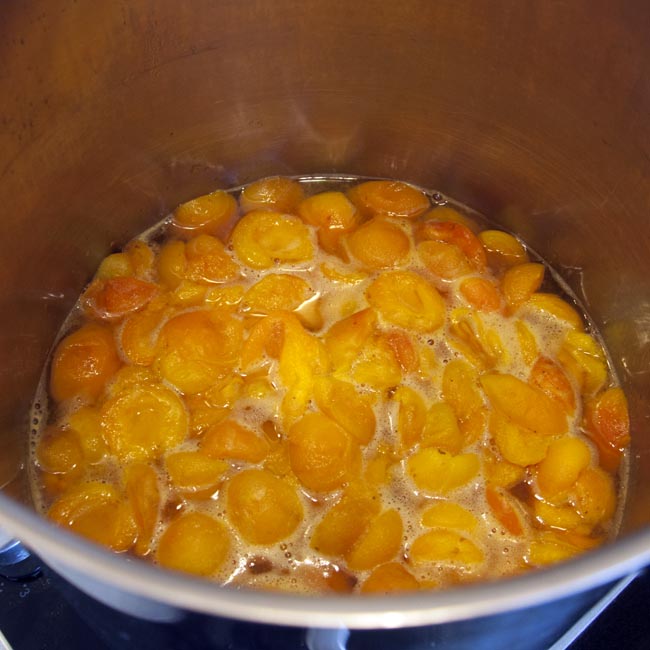
Apricot halvesWash your apricots, then halve them and remove the stones.  Don’t throw the stones away just yet!  Put all your half apricots into your pan, and add the half pint of water, and bring this to a gentle simmer.  Stew the apricots very gently until they’re just soft, and the juice has run.

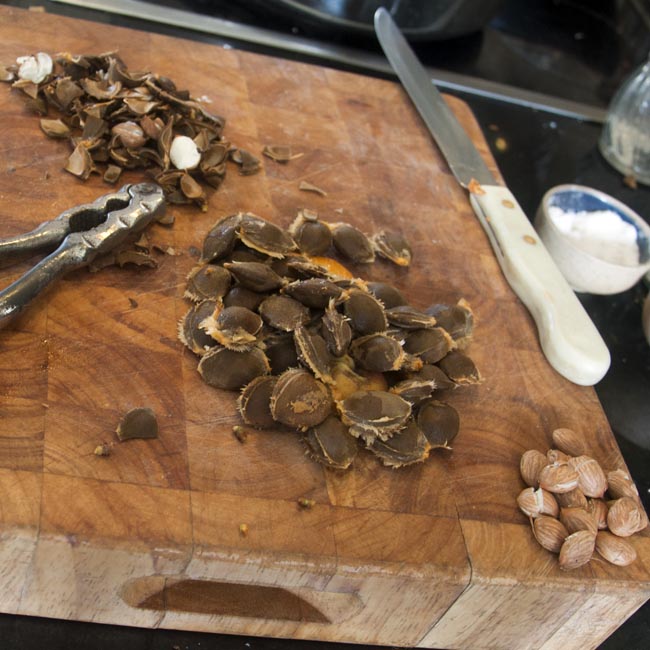
Apricot kernelsWhile your apricots are stewing, take your nutcracker (if you have one) and gently crack about a dozen of the reserved apricot stones.  Inside you’ll find the kernels – they look like little almonds, and this is no coincidence, as almonds and apricots are closely related, so closely in fact that you shouldn’t grow apricot and almond trees nearby one another!  You can add these to the jars of jam at bottling time (about one per jar), which will infuse a lovely subtle bitter-almond flavour into your jam – this is completely optional, of course, if you can’t be bothered with the faff (or can’t lay your hands on a nutcracker!).

Gently stewed apricotsPut your clean jam jars and lids into a cold oven and set it to 150C.  Now add the sugar and heat gently until it’s all dissolved – you might find adding it in portions is easier and results in less trauma to the apricot pieces.

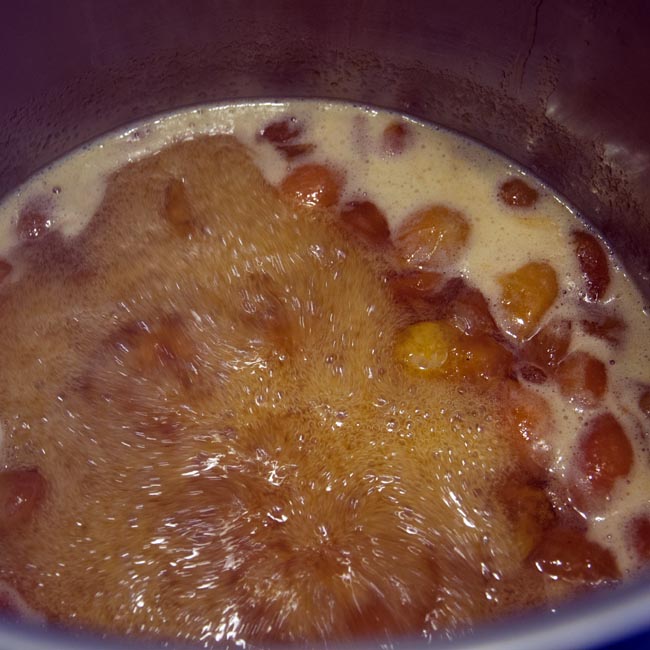
At a rolling boilNow turn up the heat and boil the jam until it reaches a set.  This didn’t seem to take very long at all for me (though I have to admit to being distracted by sorting and cleaning out the *next* batch of jars at this point) and the natural pectin in the apricots seemed to be adequate.

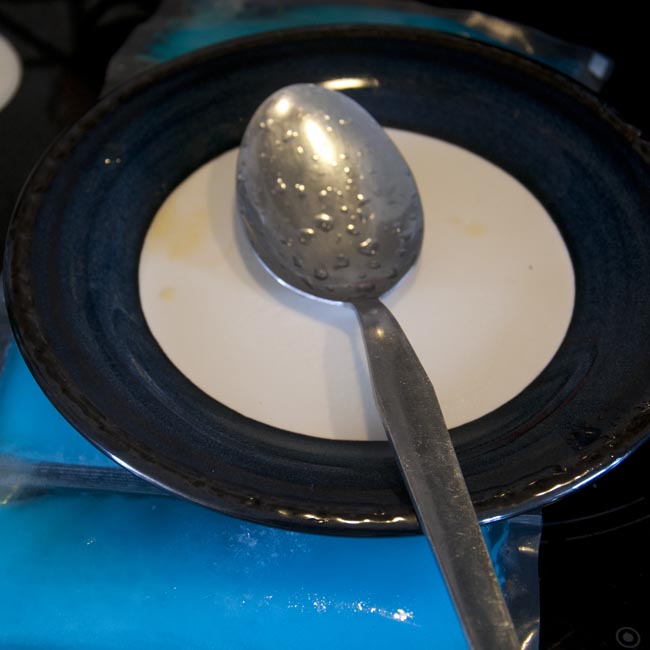
Cold saucerI tested the set using the cold-saucer technique (I often forget to freeze the saucer, so this is my usual approach – placing a saucer on top of a freezer block, the sort you’d use to keep a chill bag cool).  I’m not after a firm set for this jam so I was satisfied as soon as I got a bit of a wrinkle on top of the sample.   Once it looks like you’re getting there, juice the lemons and stir the juice into the jam.  Get the first batch of jars out of the oven ready to go.  Finally add the kirsch and stir in briskly.

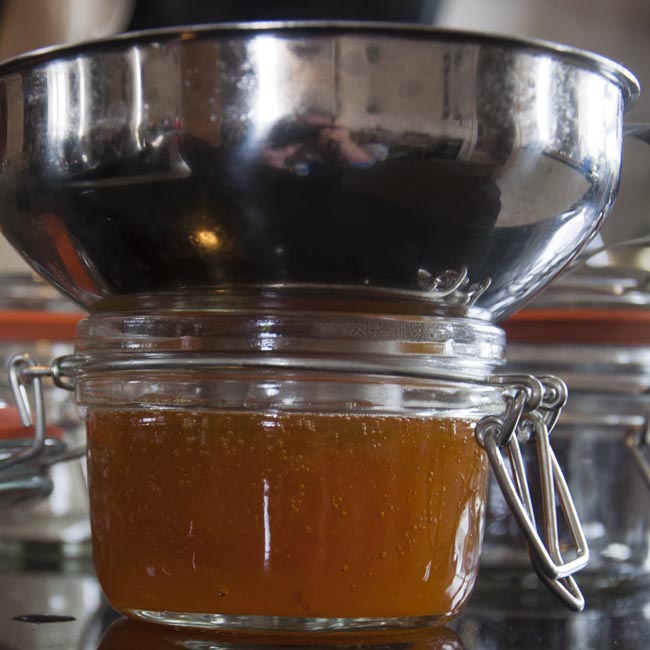
Bubbles at bottling timeNow start bottling your jam immediately, using a large-aperture funnel if you have one.  If you’re doing this right, you’ll be able to see bubbles rising in your jam as it hits the hot glass of the jam jar.

In the jar with the apricot kernelsFill a small number of jars at a time (2 or 3), don’t forget to add a kernel or two to each jar before adding a wax disk (if you like).  Secure the lids down tightly, before getting the next few jars out of the oven.

I was pleased with the yield of this batch, five good big jars with about a half litre capacity, five little mini-kilner-alikes (it would have been six, but one developed an alarming crack during sterilising!), and a cruet-worth for my breakfast over the next few days.

Finished batch

It’s gorgeous jam, too, with the subtle note of the kirsch just evident against the lovely deep rich apricot.  The balance of sweet and acid is very pleasing.  The set seems to have come out as I wanted – not a firm set, but not runny either, just like a traditional French apricot jam should be!

Now all I want is a crusty baguette, some unsalted butter, and an excuse to really tuck in!

Read more from the Country Skills blog >>
Under Pressure – this elderflower ‘champagne’ is a lively brew!

A couple of weeks ago I wrote about making this year’s batch of elderflower champagne, which included my usual warnings (shared with anyone who’ll listen at this time of year!) about the hazards of bottling a rather wild, actively fermenting brew in glass bottles.

Here’s why –

Under Pressure!

The bottle on the right is the ‘donor’ bottle, containing half a litre of sparkling water.  The bottles on the left are my elderflower champagne, about four days after bottling.  They were filled, originally, to about 5mm below the neck of the bottle.  You can see the pressure in the bottles – despite ‘degassing’ daily up to this point – has inflated the bottle like a balloon (it reminds me of one of those cartoon moon rockets!) creating a whole heap of extra headroom in the process. The bottom of the bottle is also noticeably pushed downwards.  Perhaps a passing materials specialist will tell us what internal pressure is required to produce this sort of effect, one of these days!

The little bit of ‘give’ in the plastic has allowed this to happen without catastrophe, which is a luxury that glass doesn’t give you.  So please, please, use plastic bottles for elderflower champagne.  The reinforced sort that have held fizzy drinks (lemonade, tonic water, or sparkling mineral water, like these), not the sort designed for non-carbonated water or drinks.  Yes, I know it looks a bit tatty, but really, why take the risk of a spectacular and dangerous bottle bomb?

And how’s the champagne, you might ask?  Why, very nice, thank you!  For all the hassle involved, I’m really pleased I just managed to make this year’s batch!

Read more from the Country Skills blog >>

Last of the Harvest – elderflower ‘champagne’

Elderflower champagne is one of the tastes of summer for me.  It’s quite unlike anything else, and doesn’t keep well, so it’s there, and then it’s gone.  This a really feisty brew which breaks all the rules of home-brewing.  Please, whatever you do, don’t try and generalise from this brew to any other country wines you might like to make!

For a batch of elderflower champagne, you’ll need the following ingredients and equipment –

  • 30-40 good quality elderflowers (depending on the size of the blooms)
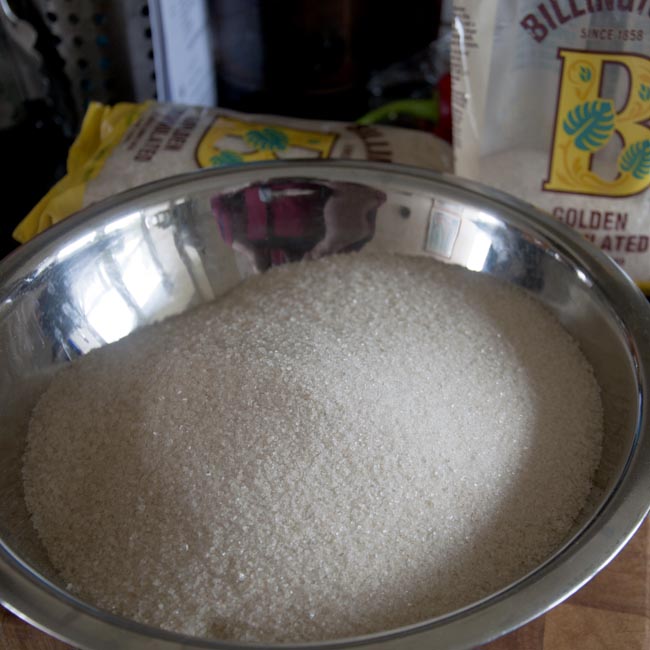
  • 2.5kg of unrefined ‘golden’ granulated or caster sugar
  • 5 lemons (unwaxed if possible, otherwise carefully washed in detergent and rinsed before use)
  • 1 lime (as above)
  • 2 tbsp of white wine or cider vinegar
  • 3 – 4 litres of boiling water, plus extra cold
  • Wine yeast & nutrient (optional)
  • Brewing bucket, at least 12l in volume (and a second is very useful – this can double with your spare vessel for the cordial, though!) with lid, or a clean muslin to cover
  • Enough screw-top plastic fizzy drink bottles to contain your brew (10 – 12 litres in total).  Don’t even think about using glass bottles for this brew.

The first rule that gets broken here is sterilisation.  I don’t sterilise my buckets for elderflower brews – I figure I’m about to throw half a hedgerow into it, so sterility is a bit moot!  But do wash and rinse it very very carefully, and if you have any doubt about contamination from a previous dodgy brew then definitely break out the steriliser!

Put all the sugar in the bucket and add enough boiling water from the kettle to dissolve it fully.  Then top the bucket up to about 8l with cold water.  The result should be a blood-warm sugar solution.

Zested citrus & elderflowers

Peel the zest from the lemons and lime with a potato peeler, as thinly as possible (leaving the bitter white pith behind).  Then juice them, and add the zest and juice to the bucket.  Add the two tablespoons of vinegar.

What's left behindNow to the elderflowers.  You’ve selected them carefully, so they’re all lovely and full of nectar and pollen.  You want to add the flowers – but, unlike the elderflower cordial, you don’t just get to shake the bugs off and throw them in, I’m afraid!  This time, you want to add as little of the green stems as you can.  There are several ways of doing this.  I favour just plucking the flowers off pretty roughly with my fingertips.  You could use a fork to ‘comb’ through the little sprigs and pull the flowers off, but you will tend to take quite a lot of fine stem with you.  Or you could snip the flowers off with scissors.

The reason for this bit of faff is to do with a nasty bitter flavour that the stems can impart to your brew, which is what will make it undrinkable, eventually, with storage.  If you’re planning to drink all your elderflower champagne within a couple of weeks of bottling, you probably needn’t bother, but if you’re hoping to get a month or so of drinking out of them, some of the compounds extracted during brewing from the green stems will eventually be converted (by the yeast?  By oxidation? I don’t really know I’m afraid!) into an overpowering bitter note that will make your champagne entirely undrinkable.  If you minimise the stem, you should minimise the taint.

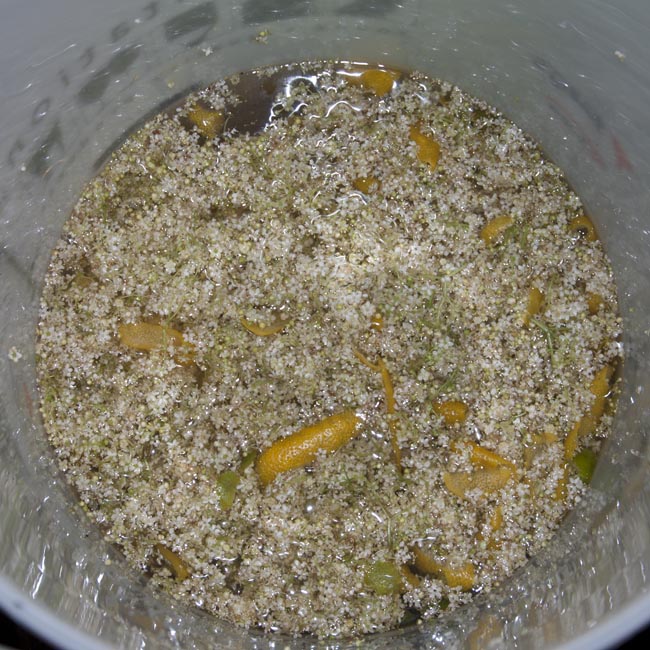
Ready to ferment - elderflower champagne in the bucket

Add all your flowers, then, and you should have an amazing smelling bucket full of flowers & citrus peel.  Top it up to about 11l.  Now add a teaspoon each of yeast and nutrient (if you have some).  Traditionally elderflower champagne is allowed to go on it’s own with the wild yeasts that are expected to be present on the flowers.  I find this unreliable, and want a good predictable outcome.  Loosely cover it with its lid or a double layer of muslin. This is home-brew faux-pas 2 – sorry, no airlock for me!

Signs of fermentation should be evident within a day or so, in the form of bubbles visibly rising to the surface (you may also get a froth, depending on how vigorous your fermentation is).  Watch for a bit, you’ll keep missing them and catching just a little movement in your peripheral vision.  You may also notice the slightly sharp smell of the carbon dioxide.

Leave your champagne to ferment for about five to seven days.  As if we haven’t broken enough rules already, this is where the whole process goes horribly ‘wrong’.  We’re going to make no effort to wait until our brew has ‘fermented out’ (see this cider-making post for discussion if you’re interested), so the brew is still actively fermenting, with the yeasts consuming sugars and producing alcohol and carbon dioxide, when it goes into the bottles.  This ‘quick and dirty’ short cut allows us to go from flowers-into-bucket to drinkable-brew in about a fortnight, which is quite remarkable.  It does however carry a pretty serious risk of producing ‘bottle bombs’ – a quick google for ‘elderflower champagne exploding bottles’ will illustrate how widespread a problem this is.

For this reason, I only use screw-top plastic fizzy drink bottles for my elderflower champagne.  Make sure they’re fizzy drink bottles – the 1 litre and half litre bottles seem most ‘stable’ though you can use the 2l cola or lemonade bottles if you like.  Don’t use bottles from non-sparkling water or fruit juices.  Do sterilise these with home-brew steriliser or milton solution, and rinse carefully before use.

After your brew’s been frothing for a week, filter it through a jelly bag or muslin-lined sieve into the second bucket to remove the solids, and syphon into your bottles (or use a jug and funnel, though this is another breach of ‘protocol’!) and screw the lids down tightly.  I was reminded when doing this this year that the filtration process is can be slow and frustrating – the yeast and pollens clog the jelly bag to a remarkable degree – and in future I suspect I’m going to use a much more open filter – I may even experiment with a nylon sieve (the sort you’d use to sift flour for baking) or something similar.  Using the jelly bag to filter my ~10kg batch took well over two hours, which frankly I could have done without!

Bottled elderflower champagneOnce your champagne is *finally* in your bottles, put them at room temperature somewhere secure where you can keep an eye on them (I tend to store the filled bottles in the washed and dried brewing buckets).

Every day or so, give the bottles a squeeze.  As the brew continues to ferment, the bottles will become harder and harder, and may even start to bulge alarmingly.  If you notice this starting to happen, release the pressure by very gently opening the lid a crack to let the carbon dioxide escape.  You may need to do this about once a day for the first week or so!

Under Pressure!You can see from the photo on the right the extent to which pressure can build up in these bottles – for comparison, the ‘donor’ bottle in it’s original state – the elderflower champagne bottles were filled to just below the neck, and the gas produced has inflated the bottles like balloons, producing a really large volume of extra head-room in the process.  Really, folks, don’t risk glass bottles with this brew!

As soon as you have pressure in the bottles, you can start drinking it – though I suggest waiting a week from bottling before taking your first sip.  As time goes by, the champagne will become ‘drier’ in flavour, and higher in alcohol as the sugars are consumed.  Don’t try to store this brew long-term – once you like the flavour of it, drink it and enjoy it!  I find that even with care, after four or five weeks the flavour is starting to deteriorate.

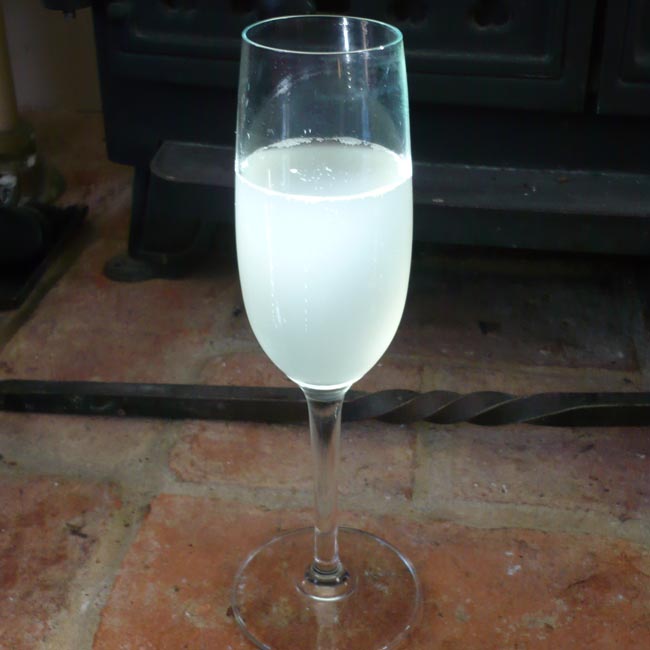
Ready to drink!

Pour, and enjoy this beautiful ephemeral effervescent flavour of summer!

Read more from the Country Skills blog >>

Last of the Harvest – home-made elderflower cordial

After you’ve picked your elderflowers, it’s time to make some gorgeous drinks with them.  Give them a good look over, and sort through.  Throw out any browning flowers.  Shake out any bugs but do not be tempted to wash them – you’ll wash all the flavour away!  You’ll be straining the ‘bits’ out later anyway, so don’t worry about the odd aphid making it through!
Freshly picked elderflowers

These are the ingredients and equipment you’ll need for the elderflower cordial.  You can scale these quantities up or down to suit yourself, but when I’ve gone to the effort of harvesting the flowers I can’t see the point in making much less than this at a time. –

  • About 70 nice elderflowers
  • 6lb (2.7kg) of un-refined ‘golden’ granulated or caster sugar
  • 6 UK pints (3.4l) of boiling water
  • 4 lemons (ideally unwaxed, failing that washed carefully in detergent & rinsed)
  • 4 oranges (likewise)
  • 4oz / 100g of citric acid (get this from a home-brew supplier, or a chemist’s)
  • Large stainless steel pan or food-grade plastic bucket big enough to hold all the ingredients (if you have a second one of these, this will also come in useful), with lid
  • Jug, jelly bag / fine strainer and muslin
  • Enough bottles to hold your cordial – I use recycled screw-top wine bottles, plastic bottles are also fine and you can freeze cordial in them.
  • Campden tablets / powder (optional – if you’re a wine-maker you probably have these anyway – they’ll allow you to store your cordial for long periods at room temperature, which is very useful!)

3lb of golden granulated sugarWeigh out all your sugar – I know there’s a lot of it, on the plus side you’ll be drinking this watered down so it’s not quite as bad as it looks (hey, who am I kidding?).  I’ve seen it asserted you can make this with ‘Splenda’ rather than sugar if you insist, but I haven’t tried it so can’t vouch for the results!

Dissolve your sugar in the boiling water, and add the citric acid.  Stir until it’s all fully dissolved.  Now wait until it’s cooled down (immersing your pan or bucket carefully in a sink full of cold water can speed this process up greatly).

Sliced lemons and orangesSlice up your citrus fruit into thick slices (about 1cm thick), and add these to the cool sugar syrup.  Then add the elderflowers, one at a time so you can give them a good shake to dislodge any debris or creepy crawlies and discard any substandard flowers.

The smell will be amazing.  Steep for two or three days, covered, at room temperature.

Elderflower cordial, steeping

Straining the cordialOnce all the flavours have infused, it’s time to strain and bottle.  First, strain the cordial through the jelly bag or sieve lined with a layer of muslin.  I was about to discard the fruit with the elderflowers but couldn’t bring myself to do it – instead, I made a batch of ‘accidental’ marmalade, which is really very good!

Check your volume, then crush and add your campden (if using) at the doseage given on the pack – usually 1 tablet per gallon.  For me, the ingredients yielded just over a gallon (or 4.5l) of cordial, which was convenient for bottles, at a smidgen over six full wine bottles worth.

Stir well to dissolve, then allow your strained cordial to settle for at least 3 – 4 hours (or overnight) so that some of the sediment that’s survived the filtering – this will mostly be pollen, which is very small – will settle to the bottom of the bucket.  If you use a good fine jelly bag, there’ll be very little sediment to worry about.

Filling bottlesSterilise your bottles using home-brew steriliser (or in the oven like jam jars, but if so make sure you let them cool completely before filling – cold liquid into hot bottles is a recipe for disaster!).  Then fill them using a jug & funnel – you could use a syphon, and this might reduce your sediment a little, but it seems a lot of faff to me!

Filled bottlesWith campden, the bottles should store for a long while at room temperature (at least until next year’s elderflowers are ready – though I challenge you to save any that long!).  Without, they should keep in the fridge for a month or two, without refrigeration, there’s a significant risk that they start to ferment!  If you’re using plastic bottles, you can always stash them in the bottom of the deep freeze – they’ll keep for ages like that.

It looks lovely in a clear glass bottle, like fresh bottled sunshine (and we’ve had precious little of that this year!).  My favourite way to enjoy this cordial is with plenty of ice, a slice of lemon or lime, and sparkling water, in a tall glass on a hot summer’s afternoon.  But I also cherish it as an amazing taste of summer to remind you of the warmer, brighter days in the depths of a cold damp dark winter!

Read more from the Country Skills blog >>

Last of the Harvest – finally foraged the elderflowers!

I nearly missed this year’s elderflower season!  We’ve been having mad weather in the UK this year – a late, cold Spring and then so much rain in the past three months.  The elderflowers started late, and then meteorology managed to conspire with work and family commitments to leave me without a warm sunny day to go picking until today.  We’ve had a few heavy downpours in the past few days, with another one yesterday evening, and I was a bit worried there would be nothing left for me to pick.  A 5 mile, two hour foraging walk around the local lanes and byways eventually yielded the hundred good elderflower heads I needed.  They have never been so hard won!

I can’t remember when I started making elderflower cordial – it’s been well over a decade certainly (and before that – elderflower drinks are one of the things I really did learn from my grandmother!).  The desire to make my own elderflower champagne a couple of years ago drove the acquisition of my first small set of home-brew equipment – and what a great hobby (or can of worms, depending on your point of view!) that turned out to be.  Brewing came before curing and smoking and put me on the path to wanting to learn as much as I could about country skills – and hence, in the end, this blog.  So elderflowers and I go way back – they’ve had quite an influence on my life, one way and another!

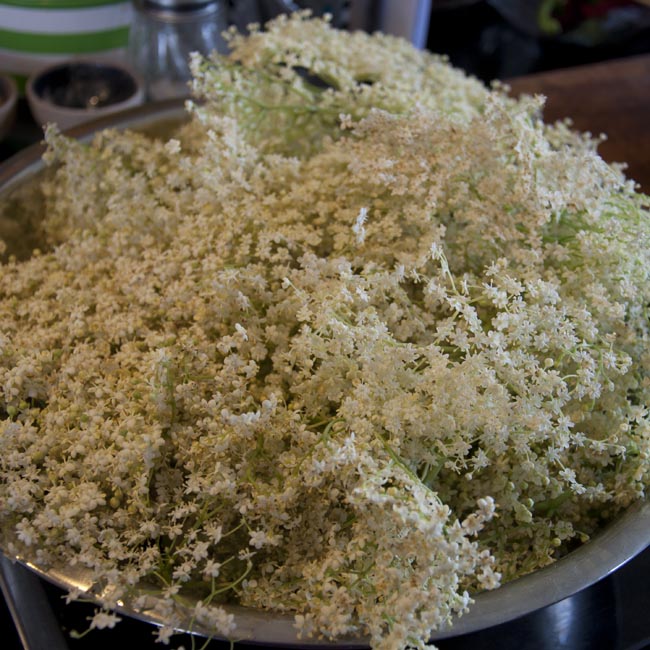
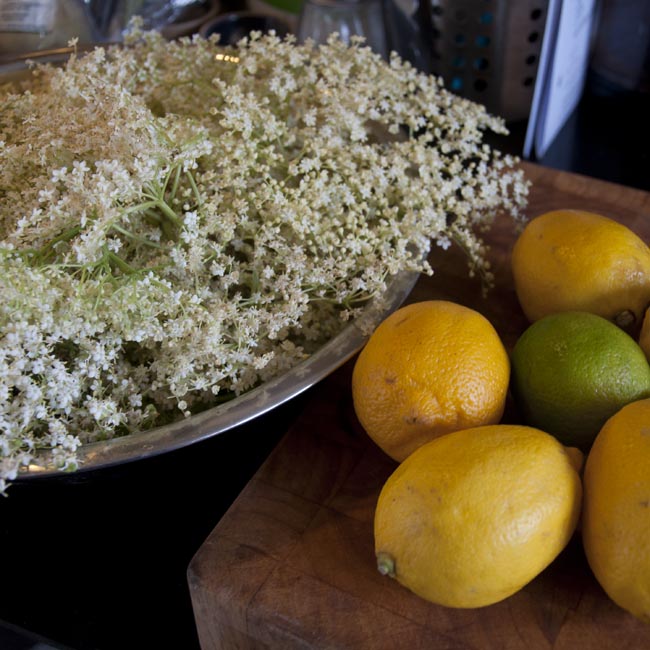
Elderflowers and citrus fruit

These days I make a batch each of elderflower cordial and champagne, at the same time.  In a good year I’ll do this a couple or three times, but sadly this year it’s a one-shot deal, so I’d better make the best of it!  To make both, in the quantities I make, you need about 100 good blooms.

Different quality elderflowersAn ideal quality elderflower is one where all the little flower heads are open, the petals pure white with a lovely buttery-yellow bloom of pollen on it.  As the blooms age, the pollen (and nectar, and the best of the flavour and scent) dissipates.  The flowers then start to appear whiter – still ok to use, but not quite as flavoursome.  Then they start to brown.  Browning blooms will not contribute the flavour you want, and should not be used.  The photo to the left shows great quality blooms at the back, adequate to front left and sub-standard (discard) to the front right.   There were too many adequate and poor flowers today – earlier in the flowering season it’s much easier to get nice flowers!

Now you’ve picked your flowers, you’ll want the recipes.  Here they are –

Read more from the Country Skills blog >>