Unknown's avatar

About Kate Watson

Brewster, cook, poultry-keeper, curer & smoker, in other words, jill of all trades and mistress of none!

Heston Blumenthal – how not to roast a chicken

I saw Heston Blumenthal the other night on TV with his roast chicken recipe, and I wish I hadn’t.  His suggestions really worry me.  Leaving aside his recommendation to brine the bird before roasting (because what we all need in our western diets, ladies and gentlemen, is more salt!), he advocates roasting the bird at 90 degrees centigrade (70, even, in a fan oven!) for several hours to a target internal temperature of 60C in the thickest part of the breast.  While I have no doubt that this treatment results in a marvellously moist tender bird (it’s barely cooked after all!) the food safety implications of the process are pretty horrifying.

All raw meat is contaminated with bacteria. This is just a fact of life – after all, meat is dead animal, and animals have bacteria in and on them in life which are impossible to remove in the course of processing.

Poultry meat in particular is high risk.  A UK study published in 2000 identified Campylobacter jejuni in 83.3% of supermarket chicken that they sampled.  I would go as far as to say, I almost guarantee that any raw chicken you purchase will be contaminated with Campylobacter, Salmonella or E. coli, and the risks are probably higher with free range birds which aren’t raised in a sealed environment.

The reason we don’t all have food poisoning all the time is that cooking – the application of heat – is extremely effective in killing these pathogens.  Here’s the problem – Salmonella requires a temperature of 60C for 10 minutes to be effectively killed. Campylobacter also needs to get to 60C, though it’s a bit  more fragile so a minute or two should do trick.  E. coli is more robust – but less common in poultry meat – and needs to be heated to 72C.  The universal advice for safe cooking of poultry meat takes all of this into account and advises the thickest (and hence least heated) part of the meat should reach a minimum temperature of 75C for at least 10 minutes.

On these numbers you can see how Heston’s recipe might *just about* not be gastrointestinal suicide, but you would want to be very confident of your temperatures.  The trouble is, any error in measurement – if your probe isn’t really in the absolutely coldest part of the bird – is going to read higher than the true lowest temperature, making it very easy to overestimate the minimum temperature and have parts of your bird below 60C.

To be quite honest, I don’t care how tender and succulent this roast bird might end up – it amounts to food hygiene russian roulette!  I’ll be staying away from the Fat Duck, I think.

Please, if you want a wonderful succulent roast chicken, buy a good free-range bird with some good fat under the skin, add some lovely flavours in the cavity (I like a quartered lemon with some whole cloves of garlic and a handful of thyme), a little bit of salt and pepper on the skin with a couple of rashers of bacon if you fancy it, and then roast at about 180C to a safe internal temperature.  Rest for 20 – 30 minutes before carving, and enjoy a tasty, succulent, and above all safe roast dinner!

Read more from the Country Skills blog >>

Basic Butchery – how to portion a chicken

A whole roast chicken is a wonderful treat – more on that later – but it’s not the sort of meal most people want to wait for on a week night after work.

We eat a huge amount of chicken in the UK, and a lot of that is bought pre-portionned and packed from the supermarket, it’s certainly convenient and the portion sizes are more practical.  We’re in love with breast meat in this country, to the extent that the UK is a net importer of white chicken meat – mostly from Thailand and other East-Asian countries – and an exporter of leg meat.  When you think about it, that’s pretty bizzare, not great for the environment (think of the fuel involved in sending the ‘wrong’ chicken backwards and forwards half way around the world!), and leaves us eating lower health and welfare-standard poultry meat than would have been produced in the UK.

Fully portioned chicken

It’s really easy to portion up a whole chicken, and learning this basic butchery skill will save you money.  Even if you just buy a ‘bog-standard’ roasting bird from the supermarket, you get more for your money buying a whole bird and cutting it up yourself, and the savings are even better if you’re buying free range or organic chicken.  And with a bit of kitchen creativity, one whole chicken can provide three or four meals for two people, as well as a lovely batch of chicken stock – bargain!

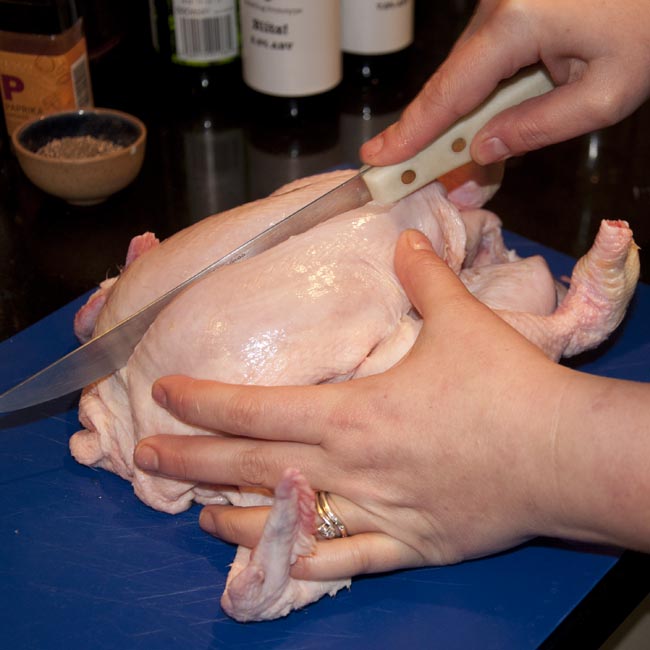
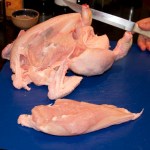
First, un-wrap your whole chicken and remove any trussing string / elastic holding the legs together.  Pat it dry with kitchen towel as this will help with handling it while you’re cutting it up.  You will need a very sharp knife with a long but reasonably slender blade.  Feel down the centre of the bird, and you should feel a bone running the full length – this is the ‘keel bone’.  Starting on this line, cut downwards parallel to the bone along the full length until your knife stops.

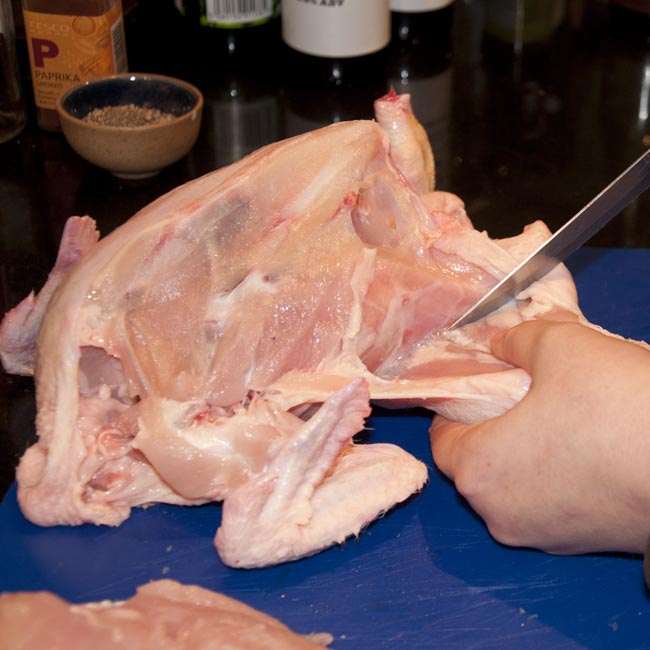
You can now pull the top of the breast away from the keel bone to get a better look at what’s going on.  The bone beneath the knife is the ribcage, so continue carefully cutting the breast meat away from this.  If you work carefully you’ll leave surprisingly little meat behind on the carcass.  After you’ve done this a few times, you’ll get a lot quicker, but speed is not of the essence the first few times.

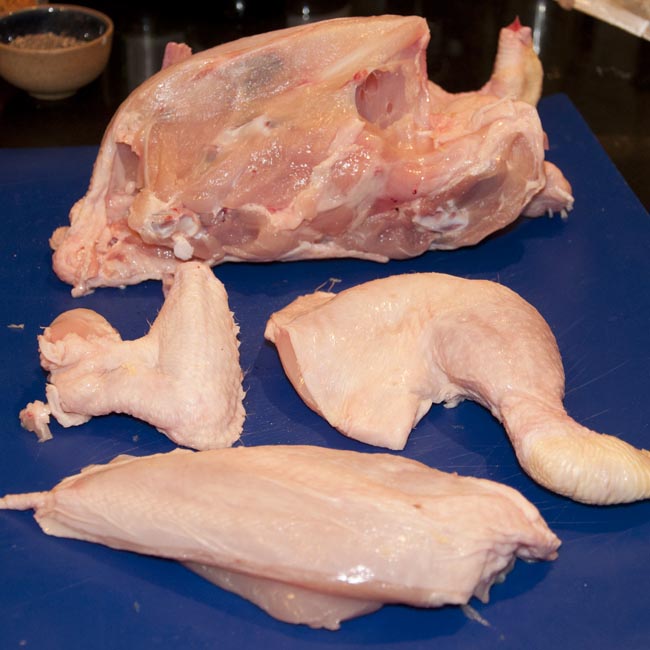
Once the breast meat is mostly free from the bone, cut the skin between the breast and the thigh and finish removing the breast from the bird.

Portioning chicken - step 4Now we need to detach the legs.  Grasp the thigh and extend the leg away from the body.  You should be able to feel the hip joint (indicated with the knife point in this photo).  Insert the knife firmly into the joint to separate the leg from the body, then cut the leg meat away from the torso leaving as little as possible behind.

Portioning chicken - step 5

Grasping the wing in the same way, identify the joint and push the knife firmly through it, separating the wing from the body of the bird.

Portioning chicken - step 6Congratulations, you’re half way there!  Repeat the process on the other side of the bird.

You will now have two breasts, two legs, two wings, and the remains of the body.  Put the body in a saucepan ready to make stock.  You may be happy with the portions you have now, but more commonly we’d divide the legs into thigh and drumstick portions

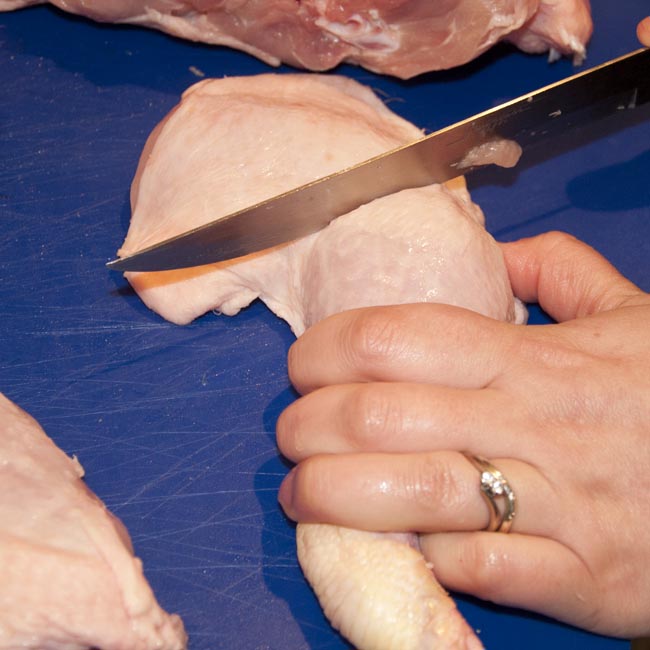
Portioning chicken - step 7Grasp the leg, and feel where the joint moves between the thigh and the drumstick.  Simply cut down firmly along this line.   If you’re accurate your knife will pass through the joint space, but the bone here is actually quite soft so if you’re not quite on target, you should be able to cut through anyway, it will just take a little bit more force.   Cut off the ‘knuckle’ part at the bottom of the drumstick in the same way, and discard these (the only bit of waste in the process, as it happens!).

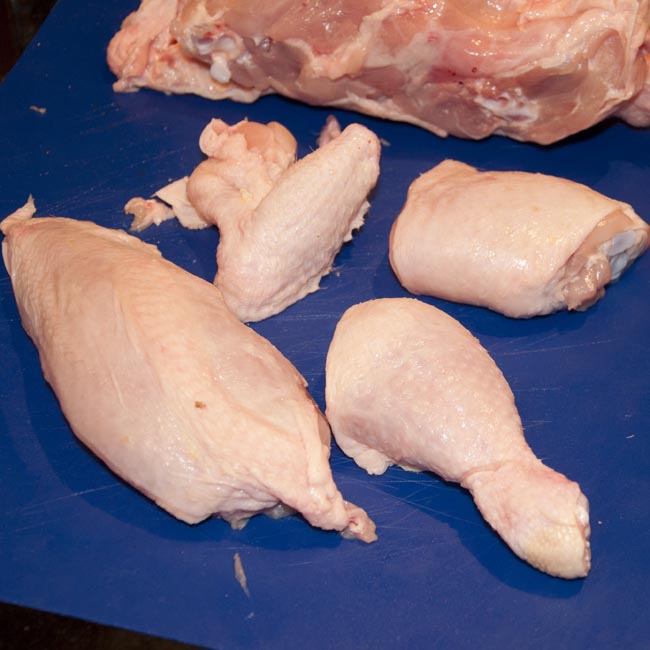
Portioning chicken - step 8You’re there – one whole chicken transformed into two breast portions, two thighs, two drumsticks and two wings, to do with as you please.  With practice it’s less than a five minute job.  Better still, think of the costings.  With standard supermarket chicken (I costed this in my local co-op the other day), starting with a £4 bird, and bearing in mind two breast fillets retail for £3 (smaller fillets than you’ll get from a roasting bird, with the skin off and frequently robbed of their ‘mini fillets’, too!), you’ve just got two thighs, two drumsticks, two wings, and a pint of excellent fresh chicken stock for £1.  Use what you want today, and bag and freeze the rest.  How’s that for thrifty!

I said I’d come back to roasting chicken.  That’s for the next post!

Read more from the Country Skills blog >>
Frugal Food – stuffed breast of lamb, roast dinner on a budget

Breast of lamb is a rather unfashionable cut these days.  In my household it’s usually known as ‘lamb belly’ by analogy with the matching cut of pork.  It’s made up of the abdominal body wall, starting with some ribs just in front of the diaphragm and extending backwards. Folded in three and wrapped in cling-film, it’s a rather uninspiring looking cut. You won’t get it at the supermarket, and it won’t be on display at the butchers, but if you ask it’s likely you’ll get a whole one for not much more than £1.  With a very little bit of effort, you have one of the most cost effective (and tasty!) roast dinners you can buy.

We first discovered breast of lamb when we started buying half-lambs from local smallholders.  I wish I’d discovered it when I was a student, I could have had some fantastic roast Sunday dinners on a budget!

This is a great meal made almost entirely from the store cupboard.  You will need:

  • One breast of lamb
  • Some breadcrumbs
  • An onion (red or white)
  • Garlic, several cloves
  • Rosemary, thyme, sage (fresh or dried)
  • One egg
  • Kitchen / butchers string
  • Potatoes / parsnips / sweet potatoes / swede
  • Some green veg (I had some frozen peas, but anything will do)
Deboned breast of lamb

Deboned breast of lamb

First of all you have a little bit of butchery to do.  It’s unlikely the ribs will have been trimmed out, so you’ll have to do this yourself.  Be careful, and patiently cut around and along each rib with a paring knife and lift it out from the ‘inside’ of the breast.  With practice this is no more than a five minute job, though it might take a bit longer to start with.  It’s likely your breast has been in the fridge, so the meat will be cold.  Stop if you notice your fingertips getting numb, and rinse them under warm water to warm them up again – you’ll have less sensory feedback from cold fingertips and you’re much more likely to make a mistake and cut yourself – which is not the aim of the exercise!

Stuffing ingredients

Try to preserve as much meat as you can attached to the breast – but if you accidentally cut a piece off (and there are some annoying bits of diaphragm which are quite tricky to keep attached) just put it back as you’ll be rolling and tying the ‘joint’ later.

Stuffing on the breast of lamb

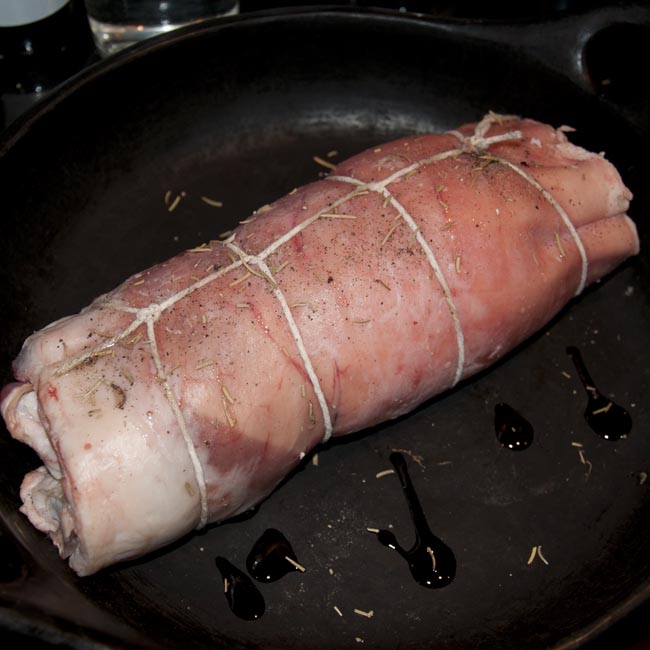
Now make the stuffing.  Mix the finely chopped onion, crushed / minced garlic, breadcrumbs, herbs and egg together.  Season with a bit of salt and pepper.  Then spread this across the inside of the breast and roll it up, starting at the narrow end (where the ribs weren’t).

Tied rolled breast of lamb

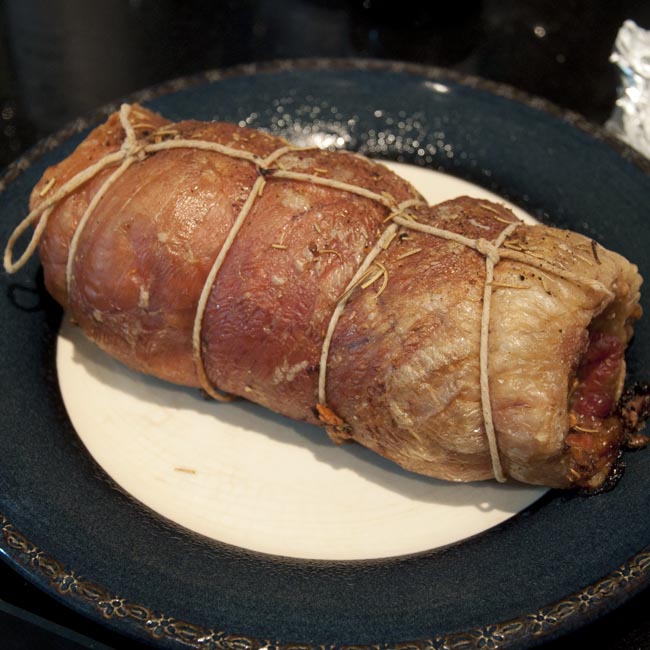
Tie the rolled joint up with string using a butchers knot.  This involves making a series of linked  loops and tying off at both ends, and is a useful knack to learn.  It’s also not dissimilar to the knotting technique used for casting a cow!  Put the rolled join in a roasting dish, drizzle with olive oil, sprinkle with pepper and dried rosemary, and put into a low oven (about 160C) for two and a half hours.

Roasted breast of lambPrepare whatever roast veggies you prefer (I did spuds and sweet potato) and start these at the appropriate time.  You could even have yorkshire puddings (we did!).

Carved roasted stuffed breast of lambThen in due course get the joint out to rest, prepare your green veg and gravy, and dish up.  Add some nice fruit jelly, if you have some.  Crab apple and chilli jelly was a perfect accompaniment.

This is a fabulous roast dinner, and will serve three or four for nearly nothing – we’re greedy so it fed two hungry adults!  Serve with a nice beer or a glass of red wine, and enjoy!

Roast breast of lamb with all the trimmings, served and ready to enjoy

Read more from the Country Skills blog >>

Happy New Year!

Here’s wishing all of you a very happy 2012, and hoping your new year’s celebrations went with a bang!  I should have written this yesterday, of course, but timeliness has never been one of my more natural talents (as people still waiting on Christmas cards from me will attest)!

Fireworks

I’m ambitious to do experiment with even more creative, country skills and crafts next year, and write about them too!  On my list is more brewing (cider, beer, and of course country wines), more curing and smoking, and experiments with sewing, crafting, recycling and thrift.  More food and recipes, of course, as well as some fruit & veg growing as the season starts to get warmer.  I also plan to write a little about my hens and poultry keeping, and to try some new crafts – at the moment I’m reading about candle and soap making, so watch this space.  Perhaps this year my Advent candle might even be homemade!

Thank you to all of you who have been reading the blog since it started back in October 2011 – both here on WordPress and in the syndicated feeds – your comments and feedback mean a lot to me and are very helpful, so please keep them coming!  I’d love to hear of any suggestions you might have for things I should be looking into and trying, too!

Handmade Christmas – cracking crackers!

Christmas crackers are great, and an essential part of Christmas dinner in my house.  I mean, what’s not to like about adults wearing silly paper hats after a lovely meal and plenty of wine?  But the ones I’ve bought always seem to contain absolute rubbish which no one would ever want.  How about making your own, with the traditional silly paper hat and motto, but with the added bonus of a small, thoughtful gift, an after dinner chocolate, or both?  Well, it’s simple and fun, here’s how!

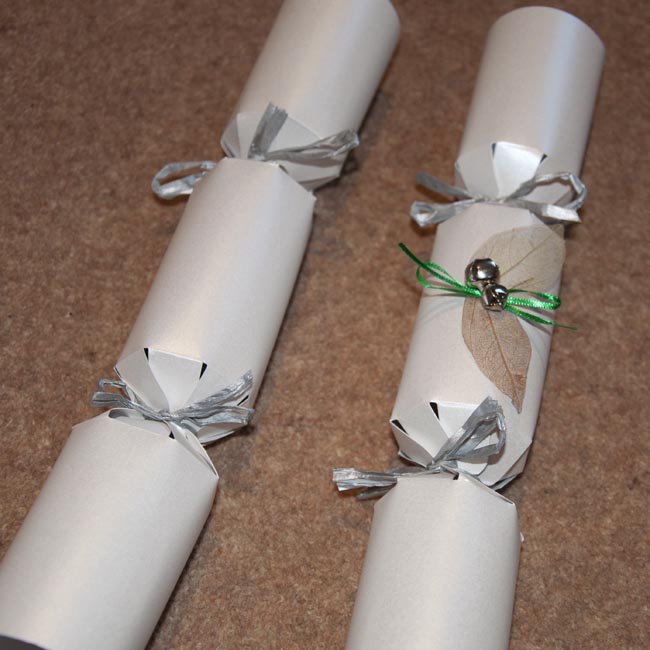
Handmade Christmas crackers

You will need:

  • Some cracker ‘blanks’, these are widely available from craft shops and on the internet in various sizes, colours and pack sizes.  I chose plain silver ones.
  • Cracker ‘snaps’, if these aren’t included with the blanks, one for each cracker you plan to make.
  • Ribbon, wool, raffia or string, for tying the crackers up, as decorative as you like.
  • Decorations for your crackers, if you want.  I used metallic leaf skeletons, some ribbon and a couple of small jingle-bells, all glued in place, but be creative, anything from the card making section of the craft shop is a good place to start, or how about some decoupage with last year’s Christmas cards?
  • Finally, cracker gifts!  I found some quite cute keyring gadgets of various kinds and also added a nice after-dinner chocolate.  If the gifts are for specific guests, put name-labels on the crackers.
  • Scissors, sticky tape, and clear glue.
  • Make hats and mottos yourself!

Making them couldn’t be easier and is a crafty relaxing way to spend a dark December evening.

First three steps of cracker constructionStart by sticking one end of the cracker snap onto the cracker blank with sticky tape.  Then roll the cracker blank using the tabs (cracker blanks have slightly varying designs, so follow the instructions that come with yours!).  Pinch, twist and tie up one end of the cracker with the string, ribbon, or other thread you’re using – I used silver paper raffia.

Decorating the finished crackersNow fill your cracker with all the bits and pieces, and tie up the other end of the barrel in the same way.  Once you’ve tied this up, stick the second end of the cracker snap into place.  You can decorate the crackers now however you like!

‘But what about my hat and motto’, you may be thinking?  I did see hat-and-motto sets for sale, but they’re awfully expensive considering what you get, a cheap tissue paper crown and a small slip of paper.

Making the hats couldn’t be simpler.  Get some Christmas wrapping paper, I used the end of a roll of white and silver metallic paper which I had knocking around.  First, measure the circumference of your head (unless it’s unusually large or small, in which case perhaps find someone with a more ‘representative’ head to measure – then again, you’ve made them, so perhaps it’s only fair to claim the perk of a cracker hat which fits for once!).  Now cut some pieces of wrapping paper twice as wide as the finished hat you want, and about 1cm longer than the circumference you’ve measured.  Using clear sticky tape, stick the paper into a loop.

Making paper crowns for crackers

Now fold the loop flat (image 1), then in half, then fold each of the halves into three, so that you’re now on the central panel of the film-strip above.  Now fold this in half one last time, then make a single diagonal cut half-way up the paper.  Unfold your two zig-zag topped crowns.  It’s like being back in primary school!  And since they’re neatly folded, tie them that way with ribbon or a small elastic band.

For the mottos, anything goes!  Good (or bad!) jokes, limericks (or haikus?), brain teasers, interesting facts, or even thoughts for the season or personal wishes for your family and friends’ year to come – make them pretty in a word processing package, print them out, cut into strips and fold them up with your paper hats.

Crackers needn’t just be for Christmas – they’re a lovely creative way to package small, special gifts.  An unusual way to wrap a special piece of jewellery, perhaps even a surprise ring?  Or consider using crackers to package wedding favours?

Handmade Christmas – decorated glass baubles

I have to confess to having a bit of a ‘problem’ when it comes to Christmas tree decorations – I love them.  Every year I try to add one or two (ok, sometimes a few more than one or two!) new pieces, to go on my tree year after year.  In recent years I’ve tried to make some of these rather than buying them, and this year I’ve bought nothing, which is a first!

Finished bauble on my tree

What I added to my tree this year were four lovely clear glass baubles which I already had, but which I have filled with wool fibres, giving what I hope you’ll agree is rather a lovely effect.

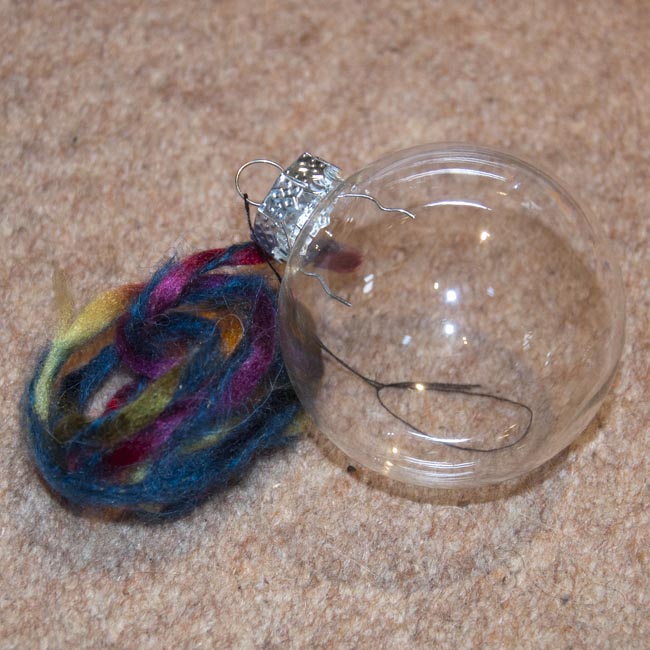
Bauble & woolMaking these is very simple – you will require:

  • Some plain clear glass baubles, any size but I used 6cm ones.  I bought them from a website a couple of years ago, but I gather they’re often available in craft shops before Christmas.
  • Wool scraps, as pretty and colourful as you can find.  I begged these from a friend who’s a keen knitter.

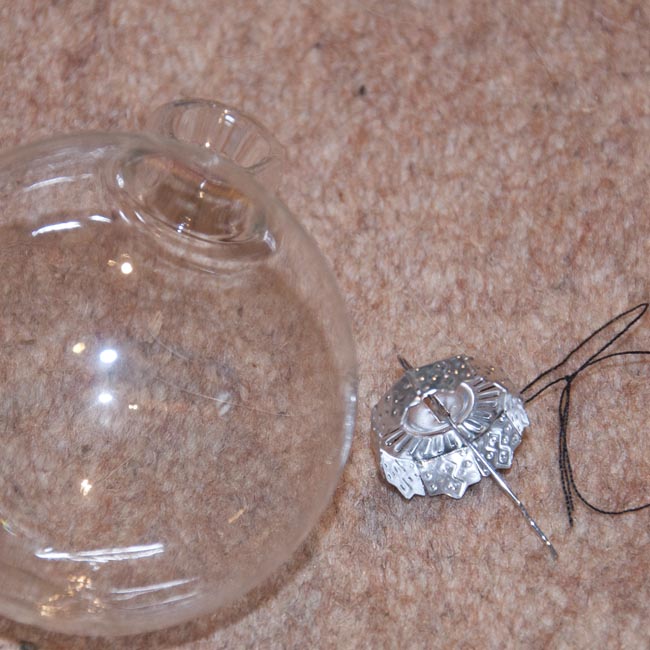
Glass bauble with top removedFirst, gently remove the top from the bauble.  With the normal design of blown glass bauble, you do this by squeezing together the sides of the metal hanging loop, which moves the ends together allowing you to (very carefully, broken bauble glass is sharp!) lift the metal crown from the bauble.

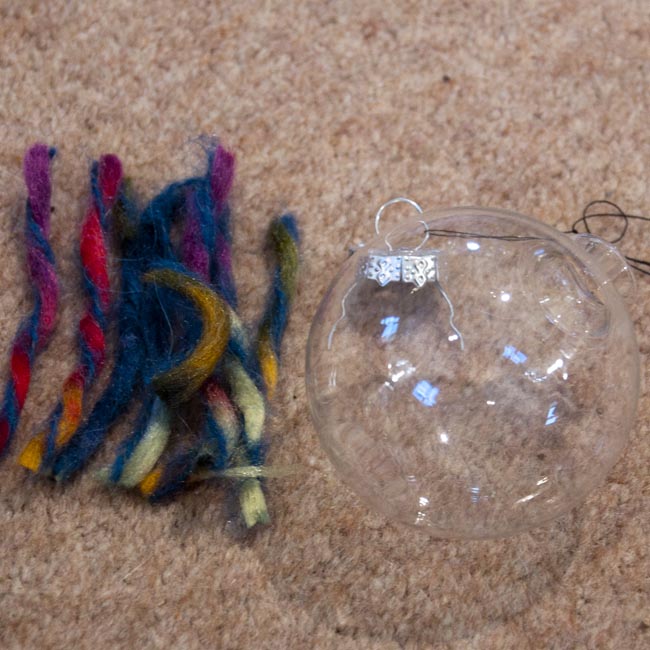
Bauble with cut lengths of woolNow take your length of wool – about a foot (30cm or 12″) is probably quite enough depending on how thick and fluffy it is.  Cut this into approximately 5cm / 2″ lengths.

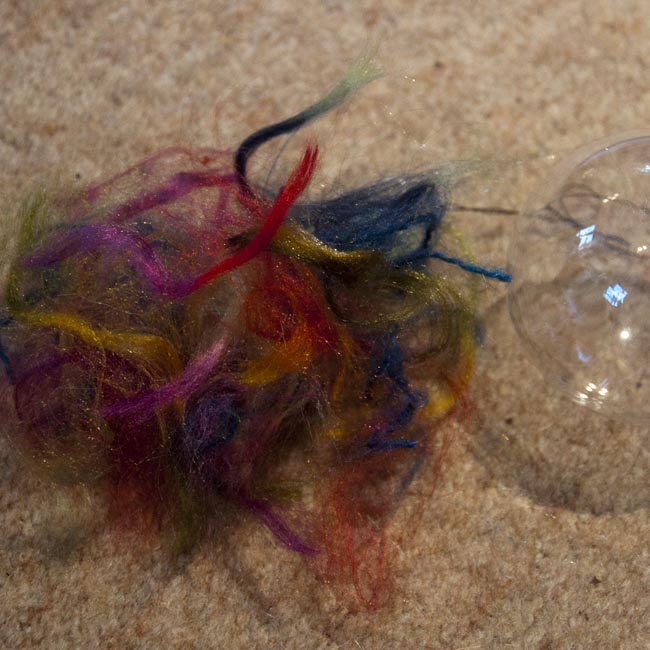
Teased apart wool fibresThen tease the wool apart gently into it’s component fibres.  Depending on the thickness and spinning type of the wool this might be more or less difficult, the wool I had was quite a loose structure and came apart very simply.  At this stage you need to assess whether you have enough fibres, since you want enough to loosely fill your bauble.

Inserting fibresFinally, use something like a chopstick or a pencil to gently push the fibres inside your bauble, and re-attach the cap.

That’s it, all done in only a minute or two, and the colours and effects you can achieve are only limited by your imagination (and wool collection!).  It’s so simple to create a colourful, textured, unique bauble for the price of a plain clear glass one, and these would make lovely gifts, too!  I’ve also seen pretty things done with ribbons, fabric scraps, or glitter inside clear baubles, so why not get creative!

Updated for 2012why limit yourself to wool, there are other things you can fill baubles with, too!

See more crafty ideas for a Handmade Christmas >>

Read more from the Country Skills blog >>
Homemade Gifts – hyacinth bulb and hydrogel beads in a jar

Lovely, fragrant bulb flowers are one of the first signs of spring.  I especially love hyacinths, with their intoxicating perfume, and particularly growing indoors just a little bit out of season.  They’re like a floral promise that the end of winter *will* be along, just around the corner.

Hyacinth Jars, ready to give

Many of the gifts for my friends and family have been homemade this year – of course I couldn’t write about them before the big day, because that might have ruined the surprise! One of my favourites is a ‘prepared’ hyacinth bulb (heat/cold treated for indoor forcing – this is important, as unprepared ‘garden’ bulbs won’t flower if grown in this way) in a jam jar with hydrogel beads (sometimes called ‘water crystals’).  Hydrogel beads are one of the coolest, weirdest things I’ve come across in a long while.  They start out as a tiny little packet of small clear-plastic looking ballbearing things, but when soaked in water overnight, the contents of the tiny little packet will swell up to fill a whole jam jar.  Better still, the ‘reconstituted’ hydrogel has a refractive index so close to water that they’re essentially invisible if they’re below a fluid level, which, you have to concede, is very cool, in a geeky sort of way.

Once you’ve got over the excitement of the whole thing (I know, right?), how do you make them either into a gift or into a lovely spring treat for your own window ledge?

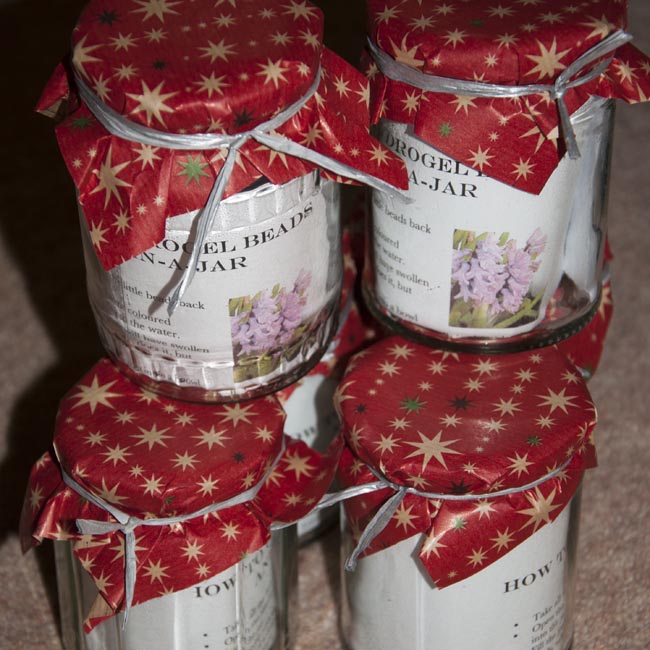
Hyacinth Jar - 'ingredients'For gifting, simply pack up the pouch of dry hydrogel beads and the prepared hyacinth bulb into a washed and dried recycled jam jar (I took the opportunity to use up some of the pickle jars with too much residual ‘taint’ to use as jam or jelly jars), with an instruction sheet (we’ll get to that).  Do up the lid (but don’t worry if you don’t have one) and top it with a pretty bonnet of fabric or Christmas wrapping paper tied on with ribbon.  What could be sweeter?

No, you can’t have my instruction sheet, write one yourself!  But the process is very straightforward.

  • First, you’ll need to reconstitute your hydrogel beads.  Do this in the jam jar, by emptying the tiny pack of beads into the jar and topping up with warm tap water.  I know it seems very very unlikely that this will work, but indulge me here, and leave them overnight.  The next morning, marvel as you discover the beads filling the jar.  It’s very cool.  If you wanted to be a bit psychedelic, you could add a drop or two of food dye to the water to start with, and this will be taken up by the beads.
  • Drain the beads, leaving them in the jar.  Marvel some more.
  • You want the fattest part of the bulb to sit in the ‘neck’ part of the jar, so work out if you need to remove some beads to get the level right, then place the hyacinth bulb on top of the beads.
  • Top up with water to just below the base of the bulb.
  • Now place the bulb in a cool dark place (a larder cupboard is ideal, an airing cupboard isn’t!).
  • Once there are roots growing and green growth is visible in the top of the bulb, move it into a bright place.  This will take a week or two.
  • Keep the water topped up every so often but avoid having water directly in contact with the base of the bulb as this will encourage mould to grow and may make the bulb rot.  The hydrogel beads will make it a lot more forgiving of marginal drying out than a traditional hyacinth bulb vase.
  • Wait for the hyacinth to flower, which will take another three or four weeks.  You may need to find some way to help keep it propped up, though usually they flower in quite a compact way so you might be lucky!

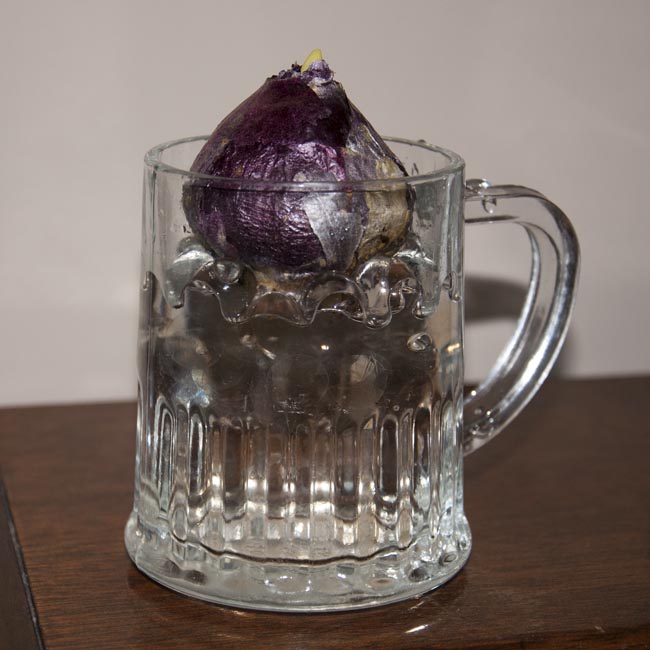
Hyacinth tankardOf course, you don’t need to restrict yourself to jam jars, all sorts of receptacles will do the trick!

These make a very original, eye catching and fun little gift – I used mine as stocking fillers and as part of hampers.  They cost very little, I sourced the bulbs for just under a pound each (in packs of twelve) and they hydrogel packs come in about £3 for ten.  I have three of the bulbs growing together on hydrogel in a small vase, which I started a couple of weeks ago, and they seem to be going well, with great root growth and a nice bit of green emerging!

Last Minute Christmas – perfect giblet stock

If you’ve bought a bird for roasting today, there’s a good chance it’s come with a little plastic packet of ‘bits’.  Whatever you do, don’t throw them away!

These bits are the giblets – the offal – usually the neck (in one or two pieces), the heart, the liver, and the gizzard.  The gizzard is thick, muscular structure with two hard abrasive grinding plates that the bird uses to crush up corn and other food items to make them digestible.  Giblet stock is quick, simple, and makes the most wonderful Christmas gravy.

I have a goose this year, but the following applies just as well if you have a chicken or turkey.  Personally, I use the goose heart and liver in one of my stuffings, so only the neck and gizzard are available for the stock.

In addition to the giblets, you need the following:

  • Stock vegetables.  I use one onion (red or white) and a couple of carrots, I don’t like celery so I don’t use it, even though it’s the often-quoted third member of the stock vegetable trinity.
  • A bouquet garni.  This is just a posh culinary term for some herbs. I use some bay leaves, rosemary, thyme and sage, along with some whole pepercorns and a few juniper berries.  Dried is fine.
  • Water.  Glug of white wine (optional).
  • A splash of olive oil.

Prepare your gizzard by cutting away and discarding the hard plates (use a small sharp knife inserted below and parallel to the plates) and chopping the rest of the meat roughly

Put the splash of olive oil into a nice big saucepan, and brown the neck and gizzard meat, and then add the roughly chopped onion and carrots and sautee for a couple of minutes.  Now add about a litre of water (and the splash of white wine if you want) and the bouquet garni, bring to the boil and simmer for about an hour.  Strain, discard the solids, and return the stock to the pot and boil again until reduced in volume by half.  That’s it.  Set aside in the refrigerator until you make your gravy later. You won’t regret it!

In Fermentation We Trust – apple juice turns into cider

On a lovely bright November weekend, I pressed a load of apples for cider-making.

For the next part of the process, you need to put together the following bits and bobs:

  • Your apple juice (which is already in a fermenting bucket with any luck – you’ll need the lid, if it’s one with a hole for an airlock, so much the better – if so, you’ll also need an airlock)
  • Wine or cider yeast, and yeast nutrient
  • A nice warm location at about 18 – 21 degrees celsius
  • Enough demijohns (plus stoppers and airlocks) to contain the volume of apple juice you’ve collected.  All my demijohns have come from Freecycle, so it’s worth keeping your eyes open.  For recommendations of UK homebewing equipment suppliers, see the suppliers list.
  • A syphon
  • Homebrewing steriliser solution

Now, time to turn your wonderful juice into cider (for any Americans who might be reading, we mean hard cider – the traditional alcoholic sort).  Traditional ‘real cider’ makers would do nothing with it at this stage, and wait for the natural yeasts which you hope are already present on the apples to do their job and get fermenting.  There is an alternative approach which involves using campden (sulphite) tablets to kill off the wild yeasts and then adding some wine or cider yeast of your own, which with any luck should guaranteed a ‘clean’ culture of your chosen yeast strain.  I decided to go a third route, didn’t use any campden, but did add wine yeast and yeast nutrient to give the process a ‘kick-start’ and make sure that an appropriate culture was at least in there with a fighting chance!

Apple juice before fermentation

You should probably take the specific gravity of your apple juice before you start fermenting, as this will tell you something quite important – with a bit of arithmetic (or there are online SG to ABV calculators out there you could avail yourself of) you should be able to work out how alcoholic your cider ends up.  This is relevant both for keeping your driving licence, and for making sure your cider contains enough sugar, and therefore after fermentation, enough alcohol, to keep well.  You’re aiming for a minimum of about 3.5% ABV, real ciders can easily get up to about 8%.

I didn’t test my juice (do as I say not as I do, right?), but it tasted nice and sweet so I think it’s likely my cider is about the 6% mark. Invest in a glass hydrometer (they’re cheap, easy to use with a bit of practice, and ever such pretty bits of old-fashioned looking laboratory glassware), you won’t regret it!

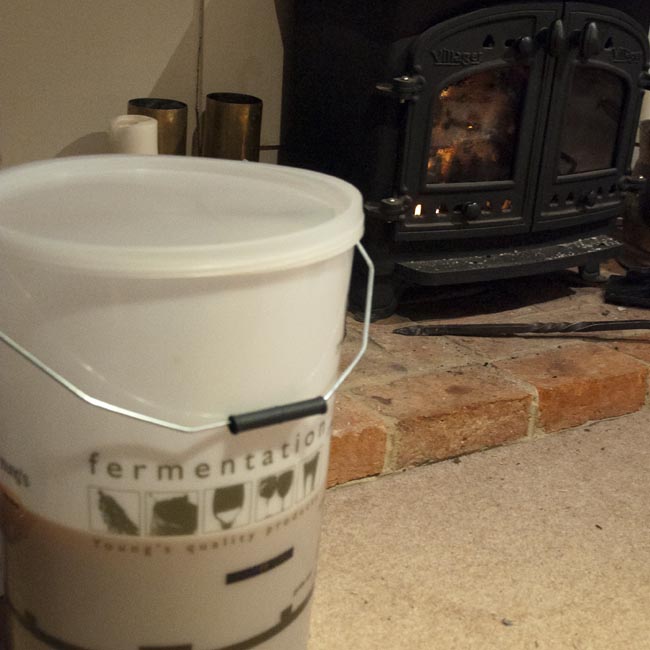
Fermenting by the fireThere is lots of advice that you should ferment your cider under lock.  I didn’t have an airlock capable bucket available so just kept the lid loosely on.  My experience from beer brewing is that the CO2 produced during fermentation will give a good blanket over the brewing liquor, being heavier than air, and oxidation shouldn’t be a problem at this stage as long as you don’t disturb the fermenting juice.  If your bucket does have an airlock, after adding the yeast and nutrient close the lid tightly and set up the airlock.  If it doesn’t, just fit the lid loosely so that the gas produced during fermentation will be able to escape without blowing the lid off!  Put your bucket in a nice warm place and try to avoid peeping.  Mine went by the fire in the living room for the first few days, as we were having a bit of a cold-snap.

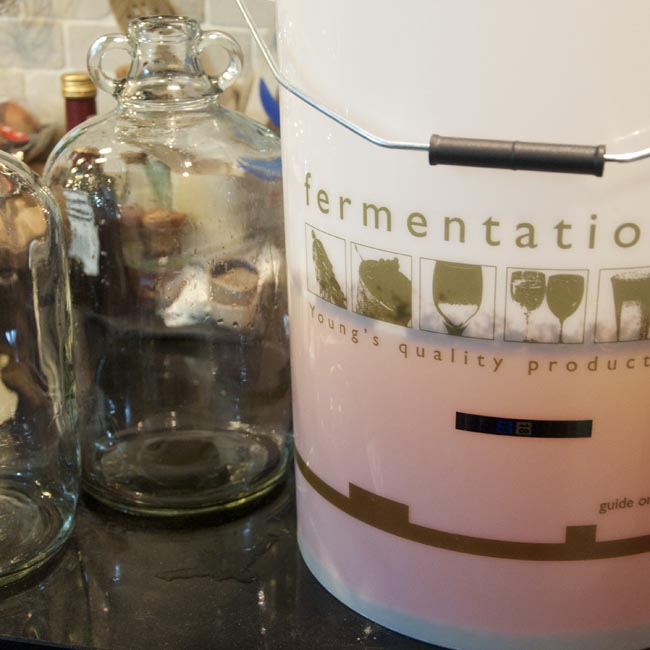
Ready for rackingYou’ll be able to tell fermentation has started when you see bubbles through your airlock, or when a nice loose foam starts to form on top of your apple juice (because you’re not peeping, right?).  During fermentation, the dead yeast and quite a bit of the solids from the apple juice will settle out in the bottom of the bucket, and the colour of the juice changes from brown to a yellow-orange.  In general, the cider will not clear completely, but it will be brighter than it was before.

Top fermenting yeastOnce fermentation seems to have stopped (I gave mine a generous month), you’ll have a nice thick layer of debris on the bottom of the bucket with cider above it.  Now it’s time to ‘rack’ the cider into demijohns for bulk conditioning.  When I opened the bucket, I found rather an alarming-looking layer of yeast floating on the surface of the cider.  I can only assume that this was a wild, top-fermenting yeast strain, as it seems to have done nothing awful to the cider so far!

Clean and sterilise your equipment (demijohns, syphon, stoppers & airlocks) carefully this time, following the directions on your steriliser.  Now the cider has fermented you risk accidentally making cider vinegar if acetobacter bacteria were to get in.  It’s also important to avoid introducing oxygen into the cider at this stage – acetobacter need oxygen to make vinegar from alcohol, so even if there’s some contamination they’ll struggle to get going if the cider stays free of air.  Syphon carefully, keeping the outlet of the syphon below the level of the liquid and avoiding introducing bubbles.  Then fit your stoppers and airlocks and put the cider in a cool dark place to mature for a few months before bottling. Keep an occasional eye on your airlocks to make sure they’re not drying out.  I expect to leave mine in the demijohns until spring, and will then bottle into champagne bottles with a bit of priming sugar to make sparkling cider.

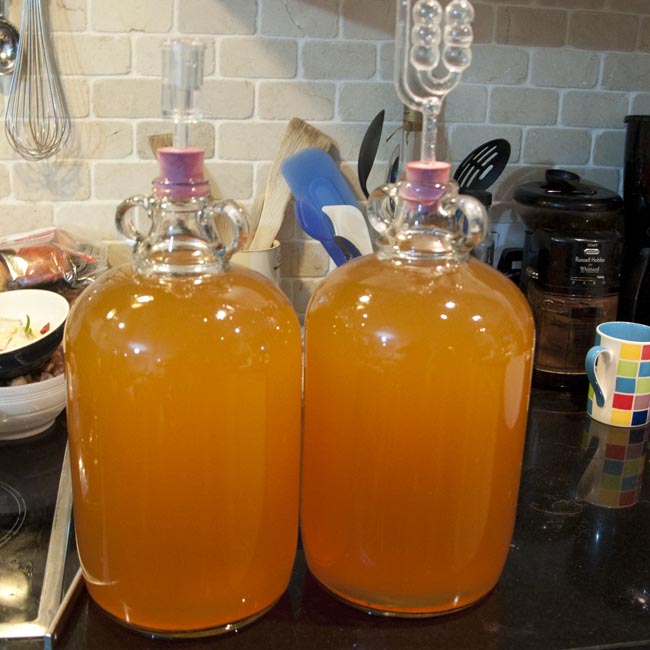
Filled demijohnsWe had a couple of pints more cider than fitted in the demijohns, and it would have been inconceivable to waste it – I can report that it is, already at this stage, definitely cider.  It’s a bit rough around the edges with quite a hard tannin that hopefully will mellow a bit with maturation, but has a lovely fresh apple aroma and definitely shows promise!

If you’re going to try it, I would recommend having a bit more of a read about the process before you start.  Some of my favourite books on home-brewing are listed in the library.

And if all that seems a bit complicated and labour-intensive, I’ll give you my directions for the quickest and easiest (and remarkably tasty!) home-brewed cider in the world very soon!

Hard Pressed – making real cider, the old fashioned way

Apple harvestAt the end of October, a lovely holiday in Cornwall yielded an unexpected bonus – three sacks of apples from the orchard where we stayed.  There was only one thing to do – make cider!  Only one problem – I didn’t have a cider press.  We’ve been faffing about building one for the last couple of years, but hadn’t got round to it.  A bit of pleading and cajoling later, and I’d managed to score a brand new apple press for an early Christmas present – what a result!

Ben's Red applesOf course, apples don’t just press themselves.  Real cider making – unlike most of the country skills in this blog – is time consuming (and good exercise!).  Set aside a nice sunny autumn day, and if you can talk some friends into coming around to help, so much the better.

For an idea of how much apple juice you’re likely to produce, we got a yield of just over a gallon per bag of apples – the bags are the sort you buy logs in.  It’s possible that with more practice and different equipment we may have done slightly better, but I doubt there was much waste.

As well as apples – lots of apples, all different sorts if possible – you will require:

  • a cider press – bought or home-built
  • a robust bucket, and a crushing pole (or a proper scratter, but they’re expensive) – we did try a cheap plastic bucket from B&Q but caved the bottom in very quickly, so ended up using a carefully washed old metal wastepaper bin
  • a large bucket for washing apples in – I used a big garden trug – and clean water
  • knife and chopping board
  • sieve / colander and muslin for straining
  • bucket or demijohn for collecting the juice
  • wine yeast and yeast nutrient (optional)

A quick note on sterility, first.  Home-brewers are obsessed with sterilising things.  I am not washing my apples in camden to kill off wild yeasts, my ingredients (the apples) and tools (wooden equipment and press components) will not be sterile.  But do wash everything very carefully in hot soapy water (not the apples, obviously), and rinse them carefully before using.  There is general advice to avoid metal tools and receptacles when cider pressing – we used a metal bin for crushing in the absence of any alternative – it was enamelled and in good condition, and does not appear to have caused any obvious problems, I suspect because the apples and juice were not in contact with it for very long.

Washing applesIf you have time (and let’s face it, if you’re planning for next year, time is on your side!) there are various plans for DIY presses on the internet, or have a look at some old-fashionned presses, they’re quite simple things really.  I was going to build something using a car jack for the pressing mechanism.  My lovely bought press has a 6l capacity which seems about right for domestic production – the bottleneck on our two-man production process was the crushing stage.

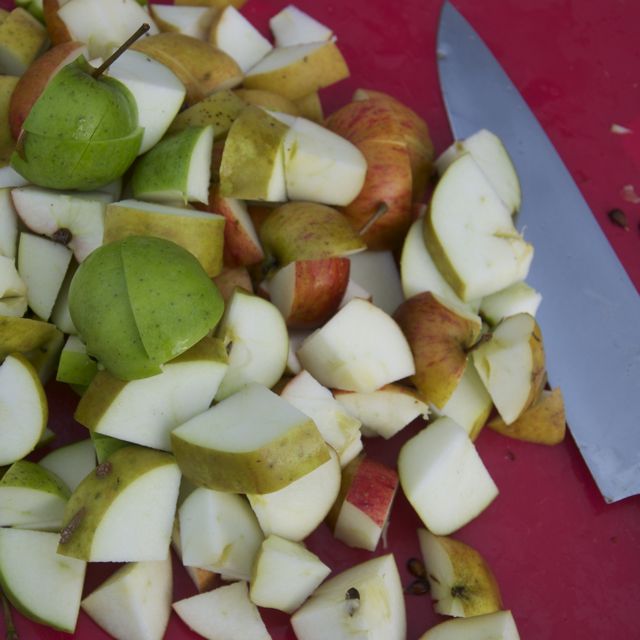
Chopping applesStart by washing your apples in the big bucket, you can do this quite a large batch at a time.  Then slice the apples up into quarters or eighths, discarding any obviously bruised or damaged areas.  Transfer these a batch at a time into your crushing bucket.

Crushing pole - end To crush you could use something like a new clean round-section piece of timber, we bodged a crusher together out of a small piece of inch-square timber we had and a plum-wood log, trimmed and stripped of it’s bark and formed into a blunt wedge at the end.  Avoid using anything which has been treated with timber preservative as it will be in intimate contact with your apples.  Make sure the pole is long enough that you can use it in a comfortable standing position above your bucket, or you’ll hurt your back and shoulders.

Crushing applesNow crush your apples to a rough pulp, until they’re making a wet squelching noise when the pole goes down and there’s just some free juice in the mixture.  The aim is to make it easy to extract the best juice yield you can from your precious apple harvest, so do put in the effort here, our first batch was definitely under-crushed and we got much less juice from this than from subsequent ones.

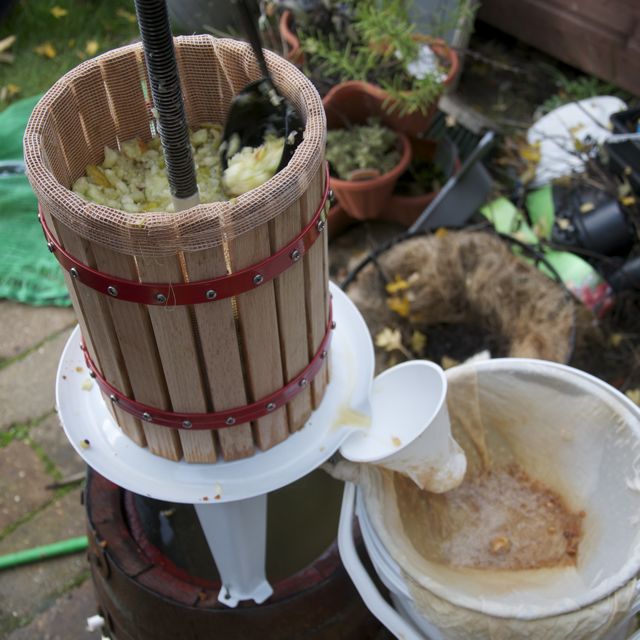
Loading cider pressNow load up your press.  Mine has a mashing bag to retain most of the solids within the press, some will use muslin cheeses or other approaches.  Once the press is loaded, apply pressure slowly, building it up over a few minutes, rather than trying to get the press as tight as possible straight away.

Cider press in useCollect your juice into a bucket through a  muslin to take more of the solids out.  It’s ok to taste some juice at this stage (and it should taste absolutely awesome!).  It will look… well, dirty brown coloured, probably.  This is a result of being hardly-filtered, and the tannins in the apple juice reacting with oxygen.  Don’t worry about this.  The leftover apple pulp (‘pommace’) can be fed to livestock, or composted.  My hens loved it, but be careful not to overdo it.  The rest can be composted.

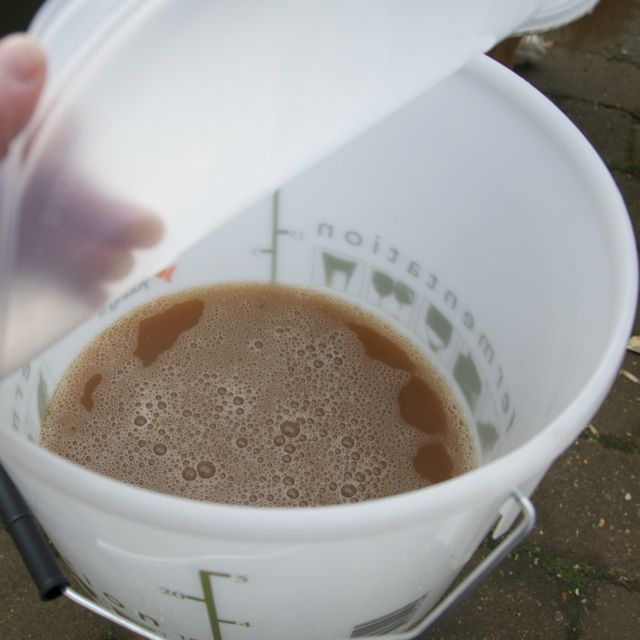
Pressed juiceAt some point you will run out of daylight, apples, or energy.  At this stage you’re done.  Admire the juicy product of your labours.  At the moment you have unprocessed, unfiltered, unpasteurised apple juice.  Smells marvellous, looks decidedly suspect.

Next time, we make the juice into cider – that’s proper, ‘hard cider’ to any Americans reading!