Unknown's avatar

About Kate Watson

Brewster, cook, poultry-keeper, curer & smoker, in other words, jill of all trades and mistress of none!

Basic Butchery – how to butcher & portion a pork belly

Pork belly is such a wonderful and versatile cut, and so under-rated here in the UK.  Most of my bacon making is with belly, so we get through quite a lot of it.  As a result I tend to buy it most-of-a-belly at a time!  The process of butchering it to remove the ribs and prepare it for curing or roasting is quite simple, and worth learning, since it means you’ll end up with precisely the piece of meat you want for the task at hand, and a couple of little bonus items, too!

Large piece of pork belly

Your butcher will probably offer to prepare your belly for you, removing the ribs and trimming it to your preference, but you never quite seem to get exactly what you were after, somehow!  Doing the job yourself means you get exactly what you want.  This is my starting point – just under 2kg piece of pork belly .

Peel away the inner layer of fatStart by removing the layer of fat on the inside of the belly piece, if there’s one there.  You shouldn’t need your knife for this, it should just pull away if you work gently beneath it with your fingers, leaving a clean muscle surface beneath.  Once you’ve removed it, set it to one side (I usually keep an ‘offcuts’ plate or bowl handy when I’m portioning or butchering meats).  This is effectively pork suet.

Belly portion with fat removedNow you can get a better look at the anatomy of your piece of meat.  As it’s laid out in the photo here, the ribs are on the left, you can see the flap of diaphragm meat lying above them.  On the right side of the belly is a band of smooth muscle.  The ends of the ribs lie almost exactly where the visible edge of this muscle joins the diaphragm.

Cut beneath ribsTake a long, thin bladed, sharp knife and first cut beneath the ribs, as close as possible to them to reduce wastage.  The piece has been rotated 180 degrees from where it was in the previous photograph so that the ribs are now bottom right.  You should be able to feel roughly where the ribs end, so extend your cut beneath them as close as possible to this level.

Finding the ends of the ribsNow gently slice beneath the strap-like muscle we identified earlier, where it lies over the ends of the ribs, and peel it back,  You’ll find the ends of the ribs and the strips of cartilage which link them together.  Gently slice around these and then back underneath. By lifting the rib section it should now be quite easy to join up with the cut beneath and remove this as a block.

Rack of ribs, as removedEither put the rack of ribs to one side, or cut them up into individual ribs at this stage.  This couldn’t be simpler – just feel for the gap between each pair of ribs and slice down the centre parallel to them, your knife, if it’s nice and sharp, should cut straight through the connecting cartilage.

Ribs, divided up.You can trim away any strips of cartilage that area easy to identify – you can see this top left.  That bit is genuinely wastage, incidentally, so chuck it away if you want!  Bag your butchered ribs up, label them, and freeze them for another day (they’re great done on the BBQ with a jerk marinade!).
Pork belly with ribs removed

Now let’s turn our attention back to the pork belly itself.

You can really see now that mine is anything but rectangular! It’s actually sitting ‘upside down’ in terms of how it was on the pig – the top as we look at that photo is the part closest to the middle of the pig’s body, the rib side is towards the back.  As we get closer to the abdominal midline, the proportion of fat to muscle increases, so I trimmed the piece to rectangular, discarding the part which is most top-left in this photograph.
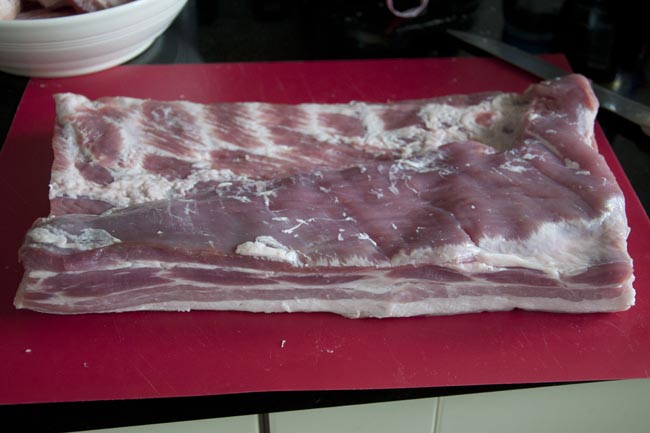
Pork belly, trimmedBecause I’m planning to prepare the belly as streaky bacon, this will give me more manageable, even chunks.  You can see the effect of the trimming in this photograph – the piece has been rotated again so the rib-side is now away from us.  Add your trimmings to the ‘offcuts’ bowl.

Belly pieces, divided upNow simply divide up your belly as you like.  Mine weighed almost exactly 1.6kg at this point, so I divided it evenly into four ~400g pieces.   A large piece like this would be fantastic roasted slowly whole, too, perhaps with chinese spices, for a special meal for a big gathering!  Roast pork belly has the *best* crackling.

Bag your ribs and your offcuts – these will make fantastic quite fatty minced pork for adding to any minced-meat dish that requires extra juiciness and succulence, or for sausages.  Then sit back and admire your work.
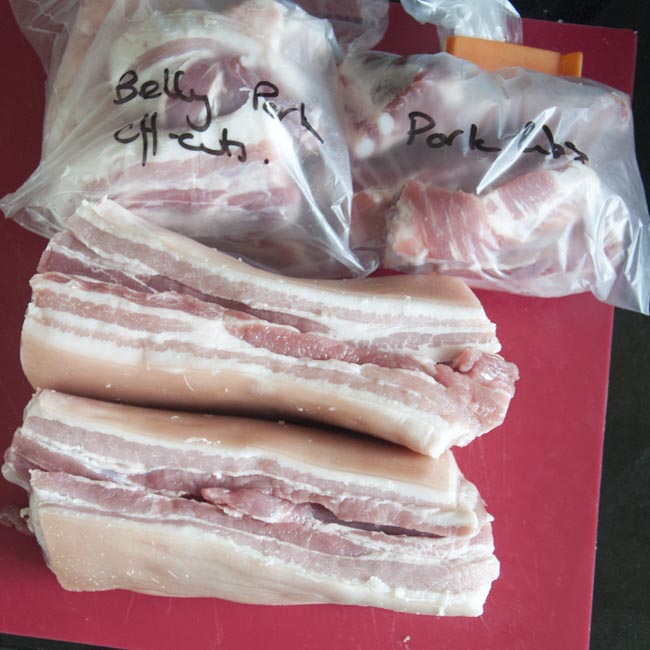
Fully-butchered pork belly

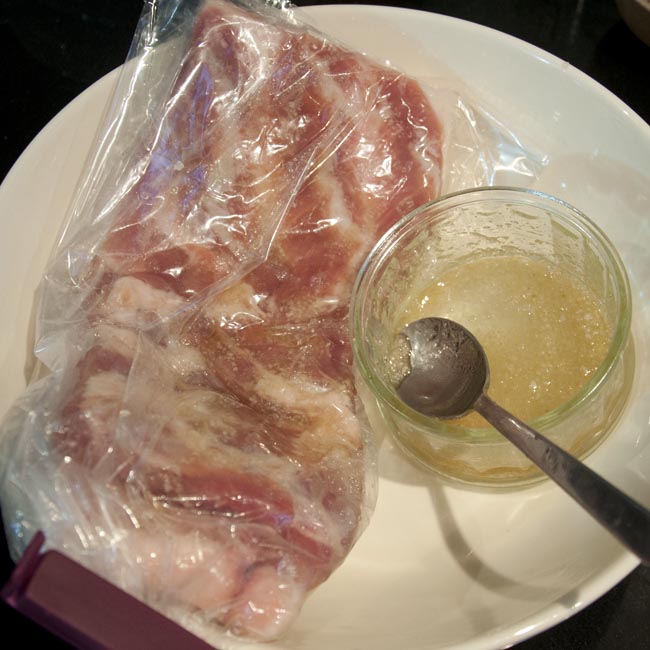
My belly portions were for curing, so I prepared a maple syrup cure made up of 100g of supracure and 90g of pure maple syrup, applied about half to all the bellies, and then bagged them together in the fridge. (More discussion of the bacon-in-a-bag ‘dry’ cure method can be found here.)

Belly pieces with maple syrup cureI’ll apply the second half after 48 hours and re-arrange the bellies so they’re skin-side together for the second half of the curing process.  The total curing time would normally be 5 days for belly pork, but these pieces are thicker than usual, so I may decide to let them go a day longer, depending on the texture and appearance at the 5 day mark.  It would be great to get some maple smoke into some of them – but that’ll depend on the weather.  I’ll keep you posted!

Read more DIY Cold Smoker & Home-Curing posts >>

Read more from the Country Skills blog >>

Banner320-260

Signs of Summer – if you can believe it!

No one in the UK (or probably elsewhere!) can have missed the fact that today marks the peak of the Diamond Jubilee celebrations for Dear Queen Lizzie.  It’s June!  The British weather is a vexatious, tricky beast at the best of times (why else would we all spend so much time talking about it?), and of course it’s done its thing and provided the cold grey drizzle to put the lie to the gorgeous hot sunny spell we were enjoying not a week ago.  But despite all of this (10 degrees centigrade!  In June! I ask you?) and the cheerful, if slightly damp collection of people crowded into the village hall this lunchtime for beer, bunting, and a cracking hog roast, I know summer’s here.  How?

Elderflower buds, just breaking

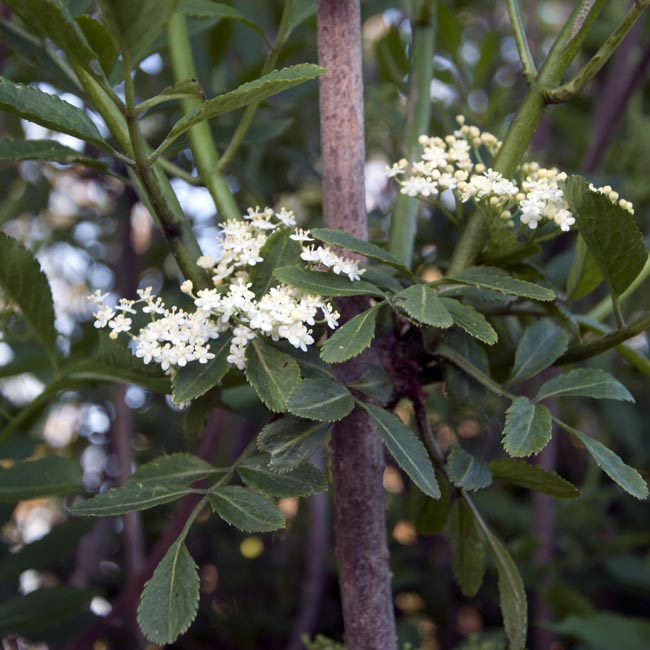
That’s how!  The elderflowers are opening!

Elderflowers in the hedgerowSome of you will have some sense of how exciting this is, perhaps.  The scent of them is just so glorious, and the excitement starts to build towards the elderflower cordial and champagne brewing that the next few weeks will hopefully bring!

Keep your eyes open for these now, and look forward to a couple of great recipes over the next few weeks!  In the meantime, I hope the bad-weather plans in place have allowed everyone with jubilee parties to get a bit of fun, despite the grotty conditions!

Read more from the Country Skills blog >>

Sourdough Saga: Episode 1 – failure to launch

I’ve wanted a sourdough starter for ever so long – for as long as I’ve known and understood the sourdough process, I think.  Traditionally baked sourdough is *the* great bread, by definition, in my opinion.  With its wonderful texture and complex richness of flavour, it leaves the industrial ‘Chorleywood Process’ sliced white loaf so far behind that they’re hardly recognisable as the same animal.

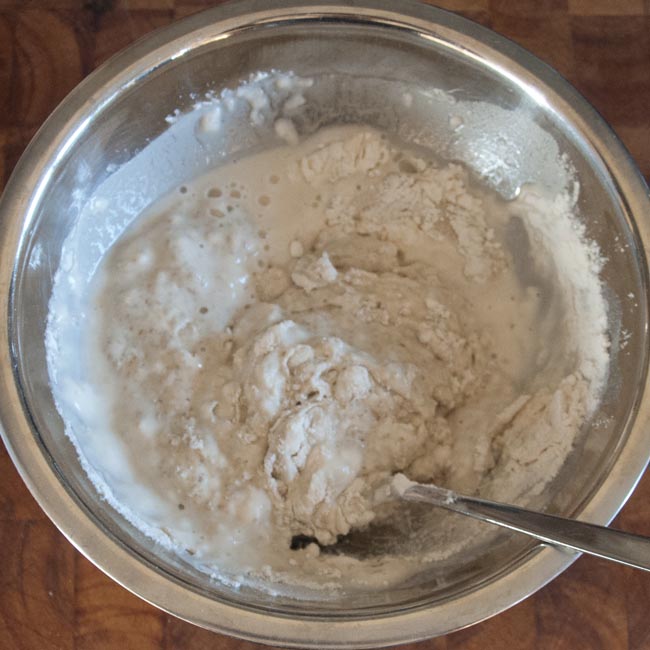
So when I saw that one of my favourite food bloggers, The Rowdy Chowgirl, had brewed herself up a starter recently, it made my mind up.  I was going to do it, and I was going to do it NOW.  Well, just as soon as I tracked down a bag of rye flour, anyway.  And a couple of weekends ago, after following several different lines of reading and research, I got down to business.  ‘What’s that?’ asked Hubby, as he wandered into the kitchen to see me stirring a bowl of what could only be described as goo.  ‘A sourdough starter,’ I replied.  He thought about it for a moment.  ‘You realise you’re going to have to take that thing on holiday with you, don’t you?’  I tried to reassure him that I’d read about stashing it in the refrigerator for a period of time if necessary.  He seemed unconvinced.

Initial mix with rye flour

I broadly used the directions from The Fresh Loaf, except that I don’t have US-type measuring cups, and there’s nothing called AP flour on the shelves in the UK.  So I guessed a bit at quantities and used stoneground bread flour for the day 2 and subsequent additions.  I also used my tap water rather than the mineral or filtered water suggested – mostly on the basis that it’s nice tasting water without an obvious chlorine hit, and I brew with it regularly without adulterating it in any way, so I went ahead and assumed there wasn’t anything in it greatly damaging to yeasty beasties.

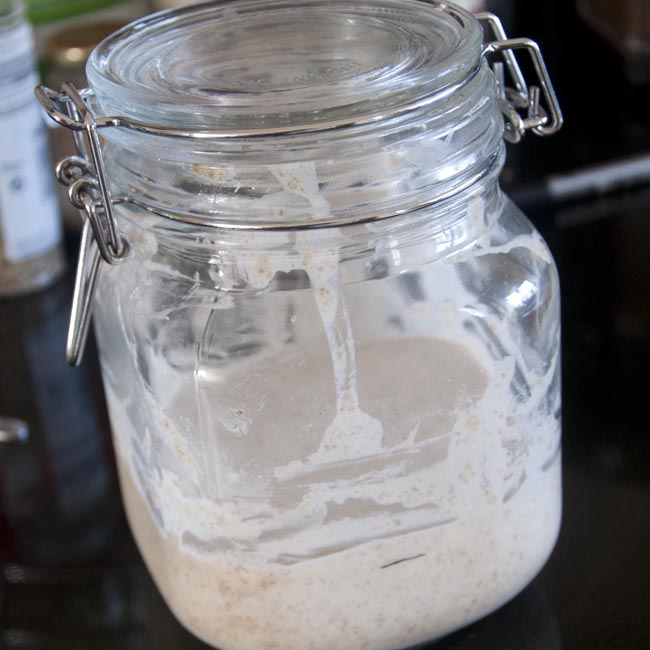
My starter was a thick batter-like consistency.  Thicker the first day when it was rye flour, and then it thinned down a bit with subsequent additions.  I used a 1l kilner jar I had lying around, with the gasket removed so that it wasn’t a sealed container, which I thought was a reasonable match for ‘cover loosely’.  I put it to rest the first day in the boiler cupboard, which is a coupe of degrees warmer than the rest of the kitchen.

After 24 hours, nothing much had happened, much as I expected.  I made the first additions with plain flour, and stashed it back in the cupboard.   It smelt… well, not exactly unpleasant, but definitely an ‘off’ smell, if you know what I mean.  But, forewarned by lots of other sourdough devotees, I plugged gamely on.

After 48 hours     Gordon's Alive!

24 hours after that, it had gone mental, doubled in size, and all bubbly and awesome.  I was convinced I’d cracked it.  I even named it, Gordon.  Because, you know, ‘Gordon’s Alive!?’  Anyway, as we all know, pride comes before a fall.

Feeding timeI discarded half the mix and added more flour and water as instructed (well, kinda).  Made my mark on the side of the container as instructed, and left it a few degrees colder in the kitchen this time.

Growing, but only a littleAfter another day had passed, the mix had risen a little in the jar, but only about 1/3rd and nothing like the doubling that the instructions called on me to wait for.  So, I was patient.  Another 24 hours on and no further progress, I mixed in a few teaspoons of rye flour to help things along.  Still nothing more than a few scanty bubbles breaking surface.

Very scanty bubbles48 hours after adding the rye flour ‘booster’, I opened the jar and got a distinctly ‘musty’ damp sort of smell.  On closer inspection the batter on the sides of the jar had started growing what was unmistakably black mould.  Downhearted, I chucked the whole lot in the bin, disassembled the kilner jar and stuck that in the dishwasher.  What I’d hoped was going to be a weekend of experimental baking lost, sadly, though given the hot spell of weather that was probably no bad thing!

Some really kind feedback from @mannafromdevon, a baker on twitter, suggested that it might have been worth  trying to rescue the ‘good stuff’ from underneath, and carrying on with feeding, but it was too late for sourdough-1, condemned to the rubbish.  But their other advice, ‘Don’t Give Up’, stuck, and I’ve already started sourdough-2, which seems, so far, to be continuing in the tradition of acting as if it’s also read the sourdough primers, and wants no truck with them.

The thing that struck me most reading around the subject is that there seemed to be as many specific processes for getting a sourdough starter going as there are people who have written on the subject.  There were even (remarkably concise!) directions on the back of my bag of rye flour!  In my day job, when there are as many different ‘expert’ opinions on a subject as you can find ‘experts’ to ask, it’s usually a sign that there’s no one really good answer, just a lot of different approaches, many of which work most of the time…   Wish me luck, I’m not giving up until I get there!  This may take some time…

NextSourdough Saga: Episode 2 – keep calm and carry on?

Read all the posts in the Sourdough Saga >>

Read more from the Country Skills blog >>
Opinion – thinking about animals as food, and food as animals

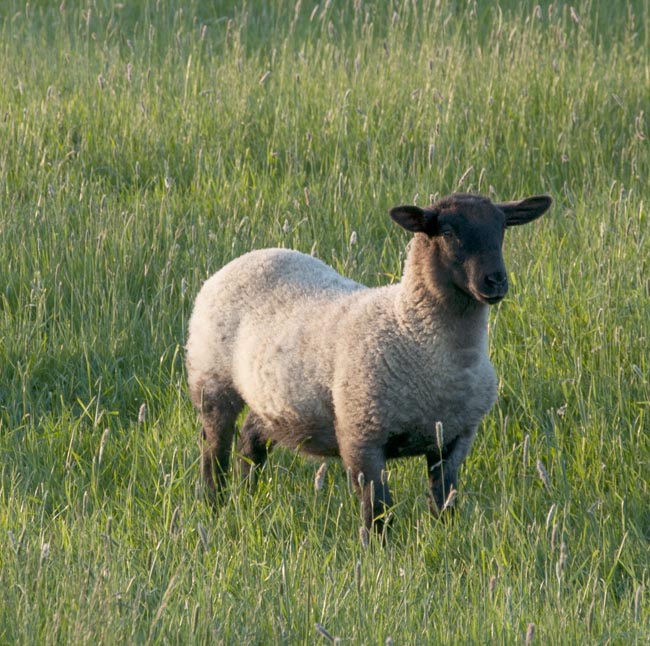
Look at this little lamb – isn’t he just gorgeous? All floppy ears, crinkly coat and frantic tail.

Growing lamb

Now think about eating him – a wonderful slow-roasted shoulder, perhaps, sweet and tender, running with glorious juice and served with a dollop of lovely mint sauce, or a couple of little chops, grilled to your liking with boiled potatoes & greens.

How does that juxtaposition make you feel?  Be honest now…

Hungry? If so, congratulations. You’ve passed!  But perhaps, if you’re honest, it makes you a bit uncomfortable? Unsettled? Maybe even faintly disgusted?  If you’re a vegetarian, you get to leave now, if you like, but if you’re a meat eater then you really should stay and read on.

So many of us today are so divorced from our food, and how it’s produced.  Its appearance on the supermarket shelf, all sanitised and shrink wrapped, so we’re not even used to the touch or smell of it, has allowed this huge chasm – this disconnect – to open up in our minds between our food and where it comes from.  We wince when we’re reminded, very often – how would you feel if you saw a whole roast suckling pig, a chicken dressed for cooking with head and feet still attached (probably on TV in some ‘less civillised’ country), or if you watched a whole side of beef being carried into a traditional butcher’s shop?

Back to our lamb – I’d like to argue that there’s nothing wrong with thinking about him as food – that’s his *purpose*, plain and simple.  If he wasn’t going to be eaten, he wouldn’t have been born.  In a few months, he WILL be on someone’s dinner plate.  Mine, I hope, since he looks to be growing rather nicely and will have enjoyed a cracking life out on that lovely pasture with his ewe and all his little lamby friends!  It’s imperative that we can think of livestock as meat, and step over that chasm, because we also need to make a habit of thinking of the meat on those supermarket chiller shelves as animals.

When you’re grabbing that matching pair of rather sterile-looking chicken breast fillets, sealed airtight in their protective atmosphere, from the chiller shelf, do you have a picture in your mind of the chicken who died to provide them?  It seems to me that to be ethical consumers of meat, we *must* carry just such images with us.  Allowing that disconnect to exist in our thought processes allows us all, thoughtlessly, to make bad choices.  We might say the right things about preferring free range, organic, or higher welfare meat and eggs,  but when push comes to shove, how often and how easily do we pick up that chicken salad sandwich, pork pie, or pack of BBQ burgers without the origin of the meat even crossing our minds?

Unless we’re prepared to think about our food – *really* think about it  – taking time in particular to think about the animals that have provided our meat, how they lived, and how they died, then we cannot possibly claim to be ethical meat eaters.  And if you can’t, or won’t, if ignorance is bliss, if you’d rather close your mind to the idea, and think prettier, less uncomfortable thoughts, if you prefer to pick up the packet of anonymous animal protein, and ignore its source and its story, do you really think you deserve to enjoy the fruits of these animals’ sacrifice?

Read more from the Country Skills blog >>

Maple Bacon – and a bonus summer salad

Every so often I ask my lovely husband for ideas – most recently last time I was making streaky bacon.  ‘What cure shall I use?’ I called out from the kitchen.  ‘Maple!’ he replied.  Right oh, maple bacon.  It’s a new one for us.  I ferreted around in the cupboard and dug out a bottle of pure maple syrup.  This was sounding plausible, after all!

[This bacon was made using a variation on the bacon-in-a-bag technique I wrote about the other week, so you should probably go and read that first if you’re not familiar with it.]

For my bacon, I used –

  • 480g piece of pork belly from our local farm butchers’ shop
  • 30g of supracure
  • 26g of pure maple syrup (really, buy the good stuff, not the blended rubbish)
  • A plastic bag big enough to contain the pork, and a sealed container for the cure.

I was aiming for an 8% total cure weight to the meat (lower than the 10% I normally use), with a 1/3rd to 2/3rd ratio of sugar to salt. This was in deference to the rather aggressive salt flavour I got from the outside pieces of my last bacon-in-a-bag effort.  I got the ratio right but slightly overcooked the total quantity, in this event.  You’re thinking now that my arithmetic doesn’t add up, and that 56g is clearly well over 10% of 480g.  You have to consider that maple syrup is about 40% water to 60% sugar (check the nutritional analysis on the back of the bottle for your particular sugar) so my 26g of syrup is in effect 15g of maple sugar, for a total dry-equivalent cure weight of 45g or ~9%.

Bacon-in-a-bag with maple cureThe mix of salt and syrup is not so much a dry cure, more of a ‘gloop’.  Put the pork in the plastic bag and rub all over with half the cure, massaging in well.  Seal the bag, excluding as much air as possible, and place it in the refrigerator.  Store the rest of the cure in an airtight container.  At least once a day (but in practice I tend to do this whenever I’m going to the fridge and remember) give the meat a bit of a massage, and return to the fridge the other way up.

Maple bacon after curingAfter two days, I poured off the pickle, and applied the rest of the cure.  After three more days (a total cure time of 5 days), remove the bacon from the fridge, rinse it under cold running water, dry carefully with kitchen paper and then wrap loosely in baking parchment and return it to the fridge for at least 24 hours (and preferably a few days) to rest.

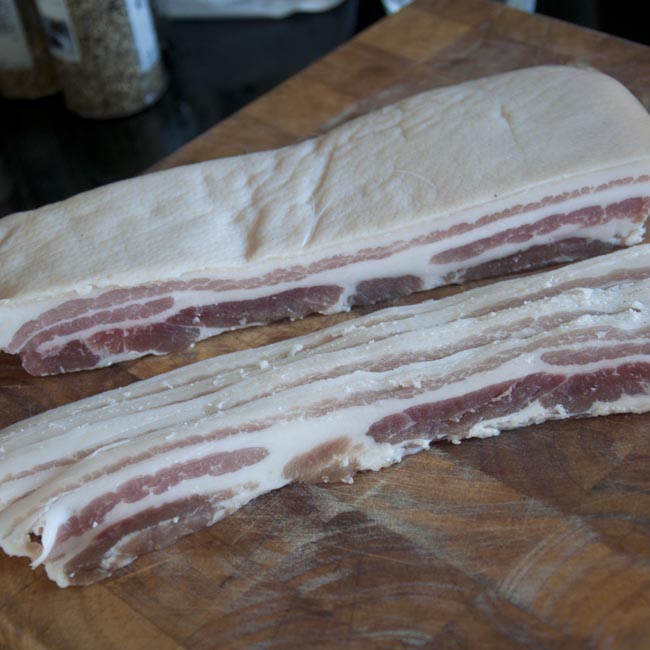
Maple bacon, slicedYou’ll notice that compared to our previous bacon, this one is a lot paler in colour, and retains a much whiter rind.  Most of the change in the meat before and after curing is in the texture, with a slight pink flush to the meat.  This is because we’ve not added colour by using a dark sugar in this cure.  It slices very nicely!

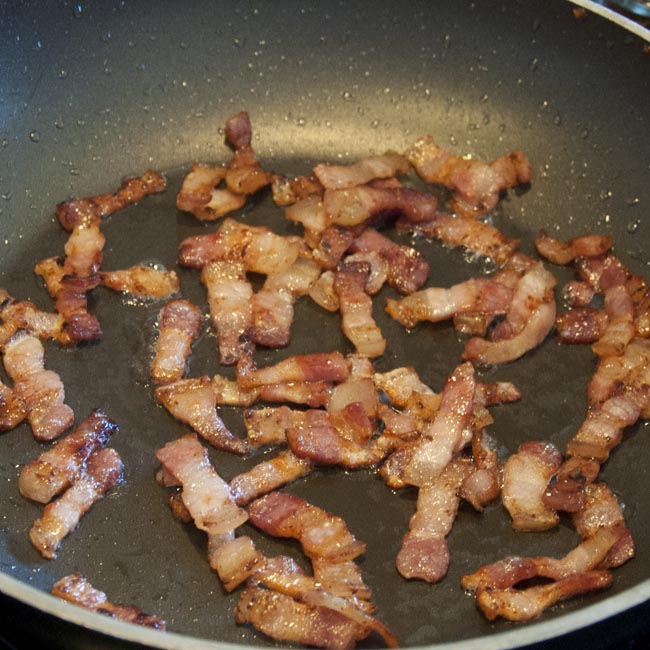
Bacon pieces fryingAt this time of year, with the warmer weather, perhaps you don’t fancy a bacon roll so much as in winter?  For lunch on a hot day, I love a spinach and bacon salad.  It’s the quickest and simplest of light summer lunches.  First slice your bacon into lardons, and fry it off until slighty crispy.  This bacon cooks beautifully, caramelising very rapidly and rendering off lovely clean clear bacon fat.

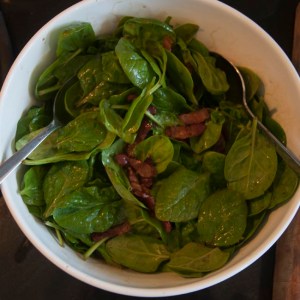
Spinach and bacon salad with balsamic dressing

Then, toss your crispy bacon pieces, while still warm, into a big bowl of baby leaf spinach, dressing with balsamic vinegar and olive oil.

The empty bowl

Doesn’t it look appetising??  It didn’t last long here!

We had a few more rashers for breakfast this morning.  We will certainly be making this one over and over again in the future.  In summary – this is great bacon, subtly flavoured, gently salted, with a gorgeous traditional bacon flavour.  Make it!

Read more DIY Cold Smoker & Home-Curing posts >>

Read more from the Country Skills blog >>

Jerk Pork Ribs – a bargain BBQ treat

Regular readers of the blog will know that I love to advocate using great quality bargain cuts of meat, even if that means a little bit of extra preparation.  Using the less fashionable cuts means getting to enjoy great, outdoor reared, higher welfare meat without having to shell out the premium price tag – and these cuts also reward the creative cook by being, very often, some of the most interesting to eat!

Jerk ribs on the BBQ

I often have a couple of bags of pork ribs in the freezer, as offcuts from the pork belly I make my streaky bacon from.  From that point of view, these ribs are basically free.  Last time we had some friends over and I wanted a few extra, my butcher sold me a 6 -7 inch chunk for 50p.  If you’re buying them as ‘ribs’ in packs from the supermarket, rather than as offcuts, you’ll pay more, of course.  Yet another reason to cultivate your friendly local butcher, and develop a few basic butchery skills yourself.

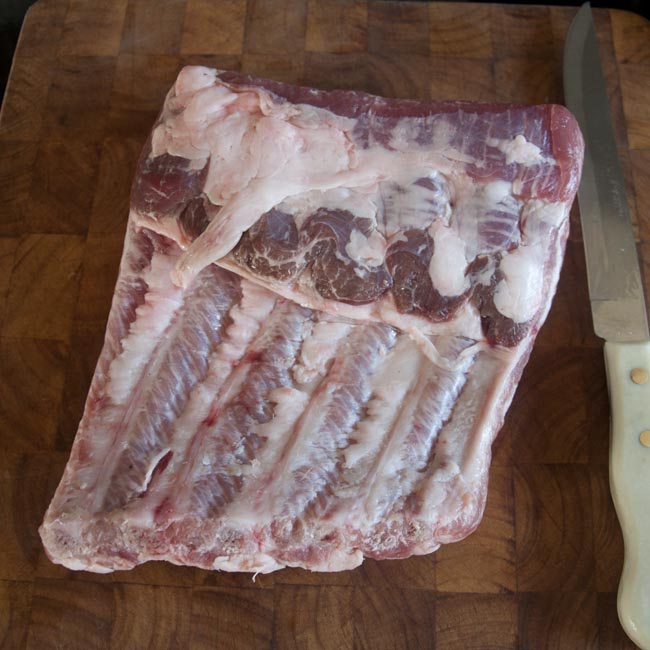
Pork rib sectionThis is how I expect your ribs will arrive – as a roughly square or rectangular piece with more or less loose tissue (from the diaphrgagm) attached to the inner (concave) side.  There should not be very much meat on the outer (convex) side, as the belly meat should have been cut away.

If the belly is still there, you can either remove it and prepare it seperately – as bacon, or as a roast pork belly – or you can leave it attached and make really thick juicy ‘streaky ribs’.  Beware, though, as these will be very fatty and consequently encourage your BBQ to flare up when cooked over coals.  Pork belly is so wonderful, there are better ways to prepare it, in my opinion!

Separating ribsYou need to divide up your rib portion into separate ribs, and this couldn’t be simpler.  Looking at this inner side, feel where the ribs are with your finger tips, and identify the gap between them.  Using a nice, sharp, long knife, place the blade midway between the ribs and cut parallel to them.  Butchered ribsThere’s some cartilage attachment up at the ‘knuckle’ end of the ribs, but any plausibly sharp blade should slide straight through this (bonus hint – keep your kitchen knives *really* sharp – a sharp knife is a safe knife!).

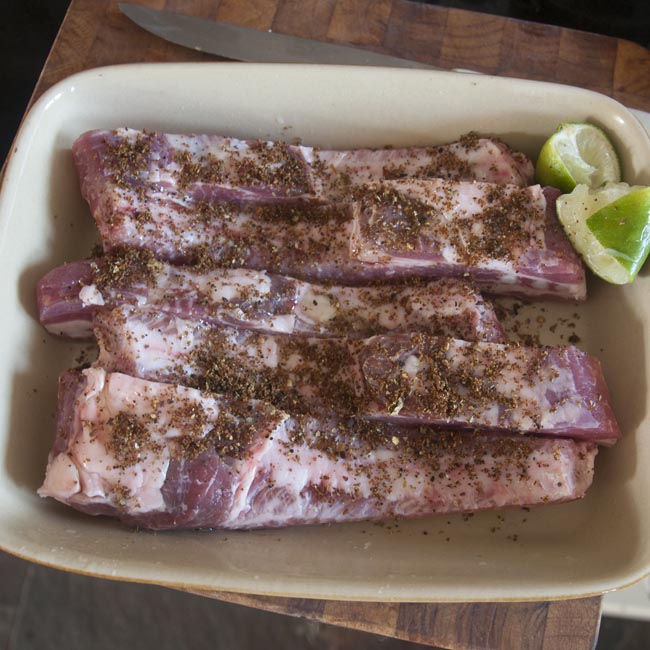
Ribs with seasoning appliedCarry on until all your ribs are divided up.  Now find a nice big dish large enough to contain them all reasonably snugly. Squeeze over the juice of half a lime, and a big glug of olive oil. Then sprinkle generously with your home-made dry jerk seasoning mix and rub in all over.  Turn the ribs over and apply some more mix to the other side.

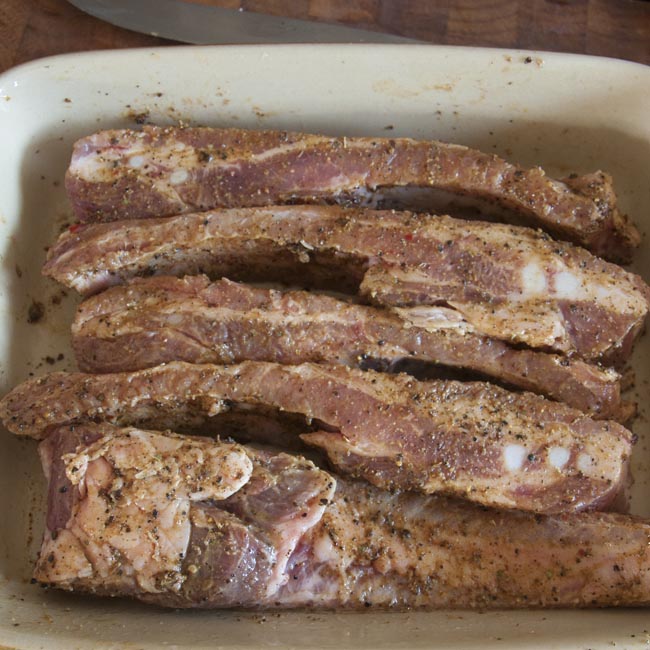
Ribs, restingOnce you’ve finished applying your rub, wash your hands carefully or they’ll end up stained an attractive nicotine-yellow from the turmeric.  Cover the ribs and set aside in the fridge for at least an hour – if you’re able –  before cooking.

Once your BBQ charcoal is smouldering gently, without any flame, put your ribs on the grill and cook until done.  If I’m cooking for a large party, I like to start these ribs in the oven and then just finish them on the BBQ for that lovely open fire flavour without the extended cooking time.  You’ll still get a great result.  Then, sit back, and enjoy your tasty, juicy, spicy, bargain ribs with a nice cold drink!

Read more from the Country Skills blog >>

Ice and a Slice – a great little tip for your summer drinks!

Summer is finally here – what could be nicer on a sunny afternoon than a lovely long drink over ice, with a slice or two of lemon or lime?  And how often does half a citrus fruit end up mouldering in the door of the fridge until it’s completely useless and inedible?  Even worse perhaps, how frustrating is it when there’s no edible lime in the fruit bowl just when you really really fancy that G&T?

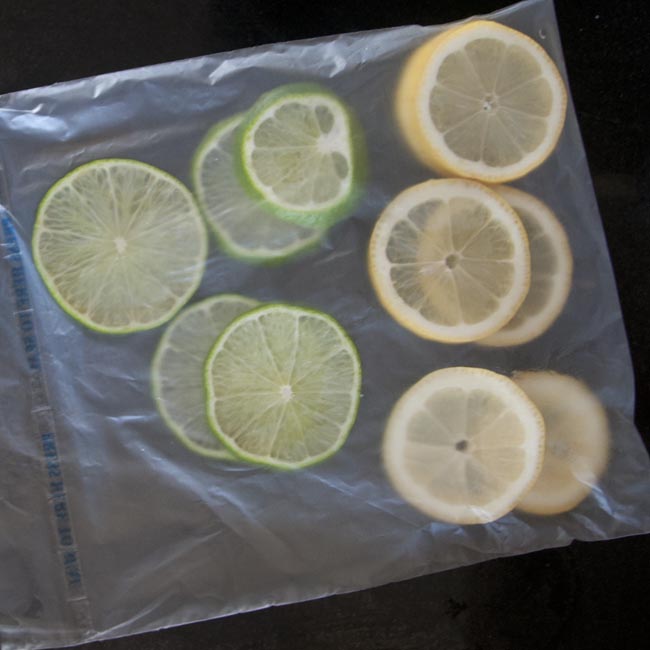
Sliced lemon and lime

Here’s my top tip to save waste and avoid citrus fruit frustration this summer – freeze them!

Sliced lemon and lime, bagged for freezingWhen you’ve sliced what you want, keep going, and finish slicing the whole fruit.  Pack them in a bag (I like using ziplock sandwich bags, if I have them, because I can re-use them time and time again).  I lay them in the bag in twos, if I can, since that’s how I tend to use them in drinks.  Put them in the top of the freezer with the ice-cube trays, job done!  Couldn’t be much simpler, could it, really?

Citrus fruit portions from the freezerHere are a couple of bags of frozen lemon and orange segments I pulled out of my freezer just now.  I freeze all sorts of pieces – half lemons can be defrosted in the microwave (a few 10s blasts should do the trick) and used in cooking and baking (microwaving fresh citrus fruits briefly before juicing is also a useful tip and greatly increases the juice extraction!).  The slices go in drinks, of course (or into the cavity of whole fish before baking!) and the segments are multi purpose – great in a long drink or squeezed over whatever you like.

No need to defrost before using, if it’s a long cold one you’re after.  Just toss the slice or segment into your glass with the ice, and pour over your drink of choice.  The citrus flavour will take a little longer to diffuse into your drink than a fresh slice, but it will all happen as the lemon thaws – which is almost instantaneous for a slice, slightly longer for a segment perhaps but patience is a virtue!  Sit back, and enjoy – and never waste a lime, or go without your wedge of lemon again!

Your long cold drink, ready to go!

Read more from the Country Skills blog >>
Gosh, an award!

A very long time ago (goodness, back in March!) I got an unexpected blog comment from The Bead Den Craftivities awarding me this beauty –

It’s taken me forever to do anything about it, for which I can only apologise!  The rules of the award are quite simple, and require me to do the following –

First – and most importantly – to thank the person who awarded it to me.  So, thank you so very much to The Bead Den – and do go back and read the nomination post here, since it contains links to lots and lots of other worthwhile things.  The rest of the blog is also great, of course, and well worth your attention!

Second – to tell you all seven things about me you probably didn’t know.  This was hard (and the main thing to be honest that’s slowed me down these almost-two-months!). So here goes nothing!

  1. I’m a master mariner’s granddaughter.  Mostly this means I’m good at tying knots, and seem to have inherited a genetic resistance to motion sickness!  Once upon a time I could do semaphore and morse code, too, but I’ve forgotten how.
  2. I learned to love real ale aged 19 (university has a lot to answer for!).  Ten years later, aged 29, I started to brew my own.
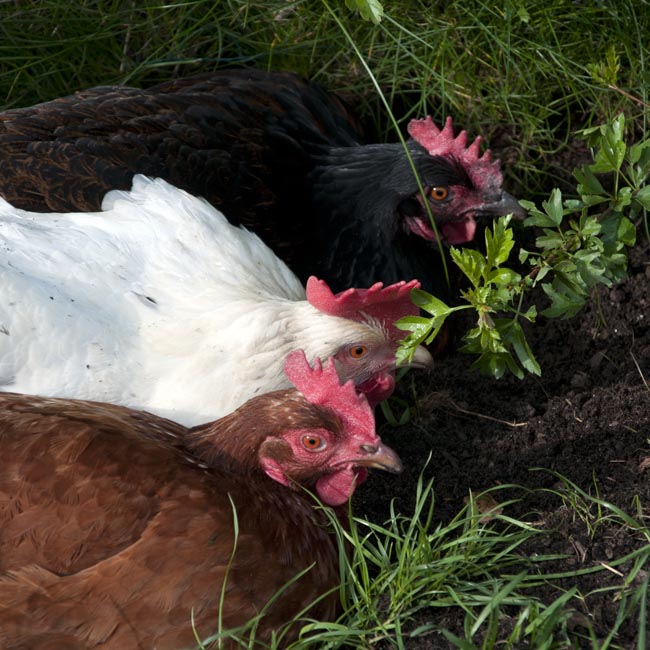
  3. Three of my hens!I have four hens – Gertie, Mabel, Flora, and Spot.  I can heartily endorse back-yard hen keeping, which is a source of great joy (and fantastic eggs!).  Hens make wonderful pets.
  4. I have a 2.1 in Computer Science from the University of Cambridge.  This has no bearing whatsoever on my day job!
  5. I love learning new things, which tends to mean I acquire a new hobby at least once a year – much to my husband’s distress, as he points out (quite rightly!) that there’s no room in our small cottage for any more of my ‘stuff’.   When the hobby turns out to produce something he can eat or drink, he’s a bit more easily mollified!
  6. I have no formal training in cooking, sewing, brewing, curing, butchery, horticulture, photography, writing (beyond GCSE English!), chandlery, or really any of the other skills in this blog – I do have a habit of thinking ‘how hard can it be?’ and just giving things a try!  I have to remind myself from time to time that the other key question is ‘what could possibly go wrong??’.
  7. I adore the information, inspiration, and new perspectives which I get from fellow bloggers, and it’s great to think that in a small way I can contribute to that rich community!  [Ok, perhaps this doesn’t really qualify as ‘surprisng’ but I was really struggling for number 7!]

Third – to nominate seven more bloggers for this wonderful (and pretty, isn’t it?) award.  There’s no obligation here, folks, if you’ve been given this award before, I’m sorry to bother you again, and if you have better things to do, that’s just dandy!  But without further ado, and in no particular order, here are my seven nominees (along with a quick note about why I think their blogs are so great, and always look forward new posts) –

From Belly to Bacon – charcuterie, what more is there to say?

Very Berry Handmade – amazing fabrics, designs & sewing inspiration

The Rowdy Chowgirl – great food, and fermentation – just what every girl needs!

Into Mind – fashion & clothing customisation

Domestic Diva, M.D. – fabulous anecdotes & comfort food

Happiness Stan Lives Here – lots of red-meat based solid grub

Conker & Indigo Recipes – great food & photos

Finally, I have to go and comment on all their blogs to let them know they’ve won (and with apologies for the, um, kreativ spelling) – I hope they’re suitably psyched, or at least not too irritated with me!

Read more from the Country Skills blog >>
BBQ Treats – home-made thyme and tomato beef burgers

A really good, home-made burger is such a treat, hot from the BBQ, under the grill or even pan-fried, when the ingredients are great you can’t go far wrong!  Making your BBQ burgers from scratch means you know exactly what’s gone into them, too, which is no bad thing.

Burgers cooking over charcoal

To make four generous sized burgers, you will require –

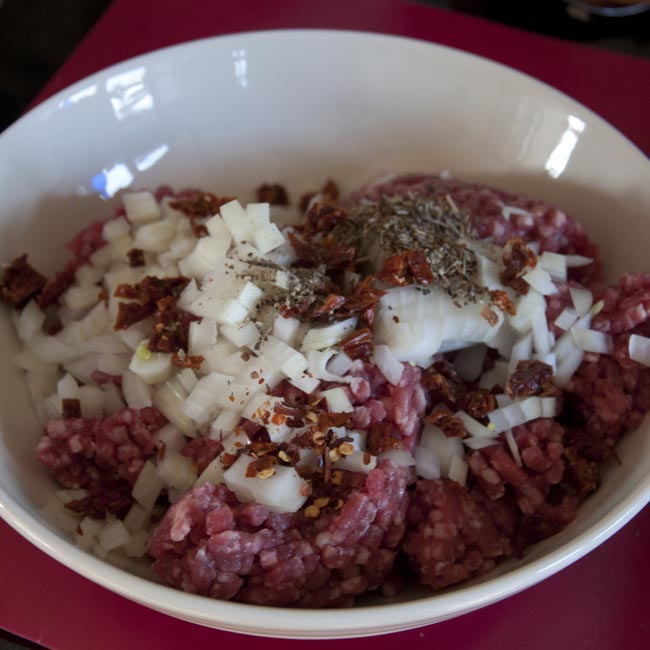
  • Ingredients ready for mixing1lb of good quality lean beef mince – don’t skimp and buy rubbish here, butcher’s is best!
  • Half an onion, finely chopped
  • Four or five sun-dried tomatoes, sliced up as fine as you can
  • Two garlic cloves, minced
  • One and a half teaspoons of dried thyme
  • Half a teaspoon of chilli flakes, and
  • A generous pinch of black pepper

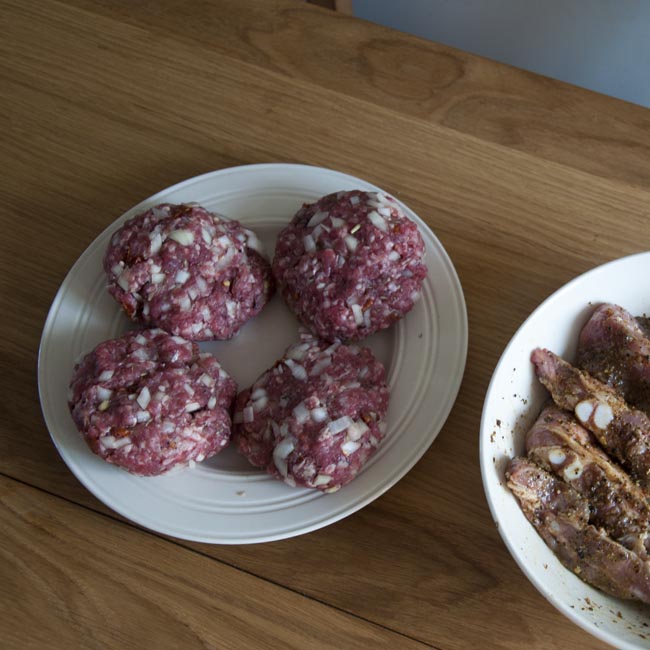
Ready to cookMix all the ingredients in a bowl, mushing them together with your fingers until they combine.  Then divide into four and shape by hand into thick burger patties.  If you have the time to return the burgers to the fridge for an hour or so, this will just firm them up a bit and reduce the risk of them falling apart on the grill.  If you’ve made more burgers than you want to eat today, interleave them with greaseproof paper before putting them in a bag, and they’ll keep in the fridge for a couple of days, or can be frozen.

When you’re ready to start cooking, place your burgers gently on the BBQ grill, and cook through nice and slowly – resist the temptation to move them or turn them until the bottom is cooking well.  Interfering with them too soon is the best way of losing your hard-earned burger into the charcoal!

Then, enjoy in a nice fresh crispy burger bun with a good dollop of sun-dried tomato ketchup, and a generous handful of salad leaves.  The thyme adds a lovely aromatic note, and the tomato a delicate sweetness to the meat that I think you’ll find rather pleasing!  I love to eat these burgers outdoors, with a cold beer or a nice crisp glass of dry white wine.

Read more from the Country Skills blog >>

Adventures in Quilting – my first jelly roll, and baby steps in a new craft

A couple of weeks ago, friends introduced me to a wonderful local quilting shop, The Bramble Patch in Weedon, Northants.  All those beautiful fabrics made an impression on me, and I’ve been thinking about possible projects ever since.  Today I was back for a return visit, and whereas last time I escaped with five pretty fat quarters and a relatively small hole in my wallet, today’s visit was a bit more costly!

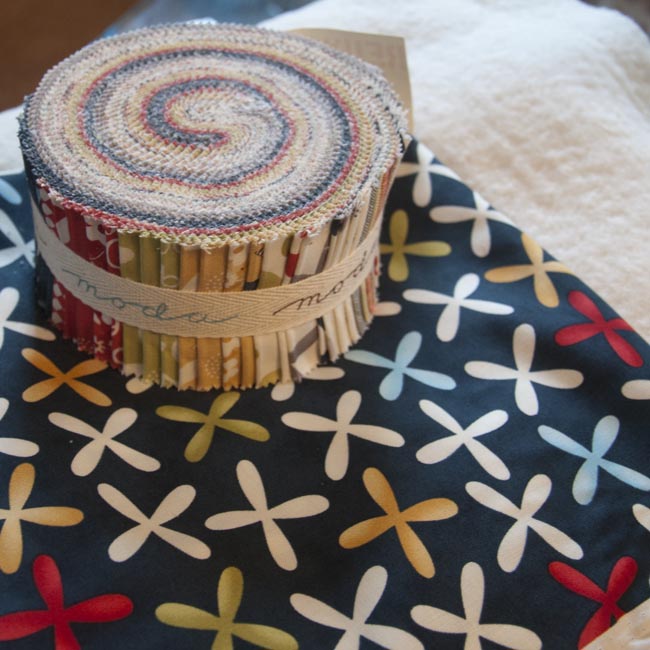
Jelly roll, fabrics & batting

I came home with a jelly roll – my first *ever* jelly roll – ‘Reunion’ by Moda, a metre of quilt batting, a metre and a half of a matching fabric from the Reunion collection to use as backing, as well as a couple of necessary bits and bobs.  I love the idea of jelly rolls – little strips of lots and lots of co-ordinating fabrics.  I would never buy even fat quarters of such a wide range of fabrics, and the diminutive size of the strips (just 2 1/2 inches wide) is its own challenge.  This collection is particularly lovely – in turns fresh and colourful, classic and muted.

Reunion by Moda fabric collection

My project, after consideration, is a set of six place mats and a co-ordinating table runner. I hope that the small size of the working pieces and the limited scope of the project should make it one I can pull off without too much stress or anxiety!  In deference to my complete lack of prior quilting experience, and relative lack of sophisticated general sewing skills, I’ve chosen the simplest possible pattern – just stripes of colour laid next to one another, edged by turning the backing fabric to the front side.  It’s such a pretty fabric and it saves a lot of faff with binding!

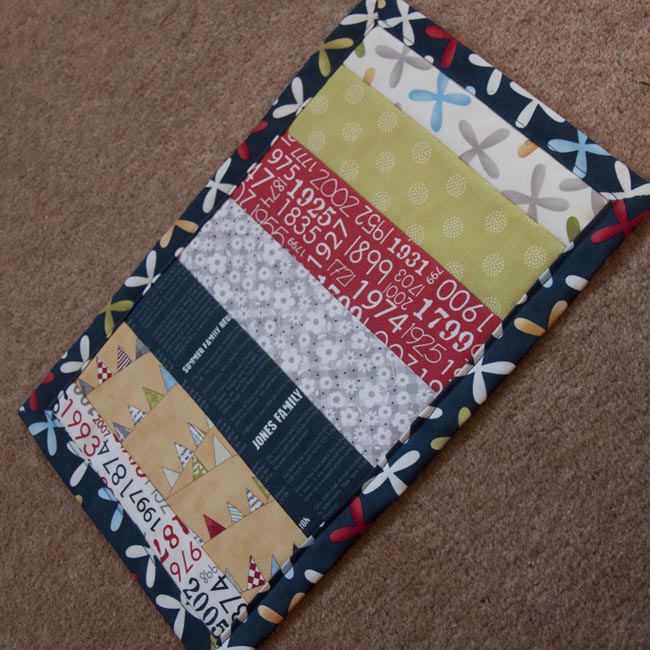
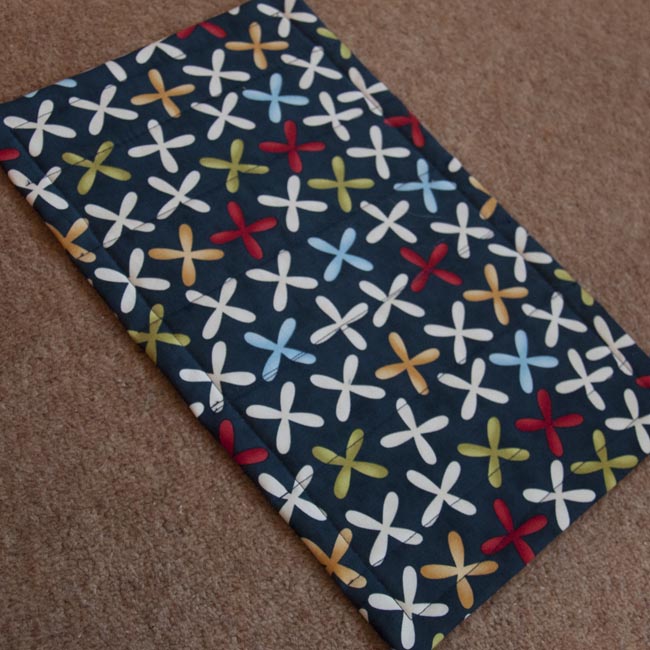
Finished place mat - front     Finished place mat - back

This is my first place mat – the size was chosen with my narrow dining table in mind and is about 22 x 36cm.  The more observant among you will notice one doubled seam where I messed up slightly – this just adds to the cosy hand-made feeling, in my opinion, and in any case is only visible from the back.  I’ll post a full how-to in due course once I’ve finished making it up as I go along – although talk about the blind leading the blind!  The backing fabric was folded over and the corners mitred by hand before being sewn down in a single row close to the edge.  I’m quite pleased with the final result, not bad for a first effort, eh?

Read more from the Country Skills blog >>