On a lovely bright November weekend, I pressed a load of apples for cider-making.
For the next part of the process, you need to put together the following bits and bobs:
- Your apple juice (which is already in a fermenting bucket with any luck – you’ll need the lid, if it’s one with a hole for an airlock, so much the better – if so, you’ll also need an airlock)
- Wine or cider yeast, and yeast nutrient
- A nice warm location at about 18 – 21 degrees celsius
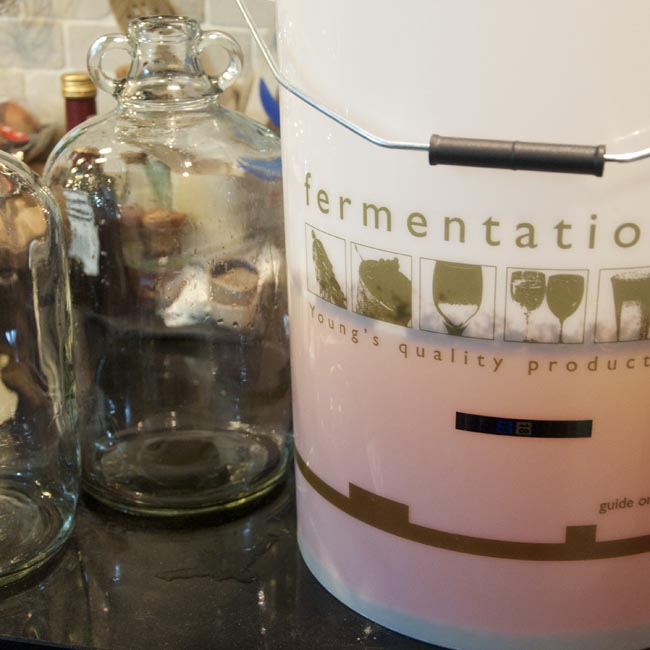
- Enough demijohns (plus stoppers and airlocks) to contain the volume of apple juice you’ve collected. All my demijohns have come from Freecycle, so it’s worth keeping your eyes open. For recommendations of UK homebewing equipment suppliers, see the suppliers list.
- A syphon
- Homebrewing steriliser solution
Now, time to turn your wonderful juice into cider (for any Americans who might be reading, we mean hard cider – the traditional alcoholic sort). Traditional ‘real cider’ makers would do nothing with it at this stage, and wait for the natural yeasts which you hope are already present on the apples to do their job and get fermenting. There is an alternative approach which involves using campden (sulphite) tablets to kill off the wild yeasts and then adding some wine or cider yeast of your own, which with any luck should guaranteed a ‘clean’ culture of your chosen yeast strain. I decided to go a third route, didn’t use any campden, but did add wine yeast and yeast nutrient to give the process a ‘kick-start’ and make sure that an appropriate culture was at least in there with a fighting chance!

You should probably take the specific gravity of your apple juice before you start fermenting, as this will tell you something quite important – with a bit of arithmetic (or there are online SG to ABV calculators out there you could avail yourself of) you should be able to work out how alcoholic your cider ends up. This is relevant both for keeping your driving licence, and for making sure your cider contains enough sugar, and therefore after fermentation, enough alcohol, to keep well. You’re aiming for a minimum of about 3.5% ABV, real ciders can easily get up to about 8%.
I didn’t test my juice (do as I say not as I do, right?), but it tasted nice and sweet so I think it’s likely my cider is about the 6% mark. Invest in a glass hydrometer (they’re cheap, easy to use with a bit of practice, and ever such pretty bits of old-fashioned looking laboratory glassware), you won’t regret it!
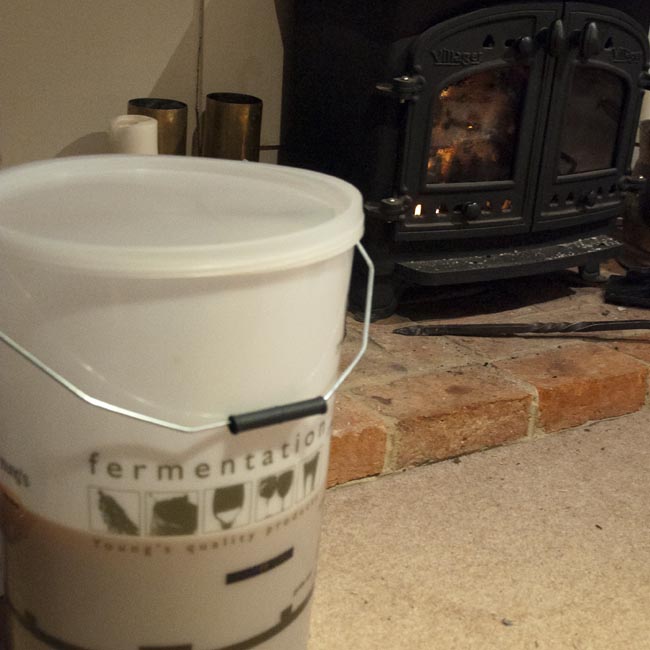
 There is lots of advice that you should ferment your cider under lock. I didn’t have an airlock capable bucket available so just kept the lid loosely on. My experience from beer brewing is that the CO2 produced during fermentation will give a good blanket over the brewing liquor, being heavier than air, and oxidation shouldn’t be a problem at this stage as long as you don’t disturb the fermenting juice. If your bucket does have an airlock, after adding the yeast and nutrient close the lid tightly and set up the airlock. If it doesn’t, just fit the lid loosely so that the gas produced during fermentation will be able to escape without blowing the lid off! Put your bucket in a nice warm place and try to avoid peeping. Mine went by the fire in the living room for the first few days, as we were having a bit of a cold-snap.
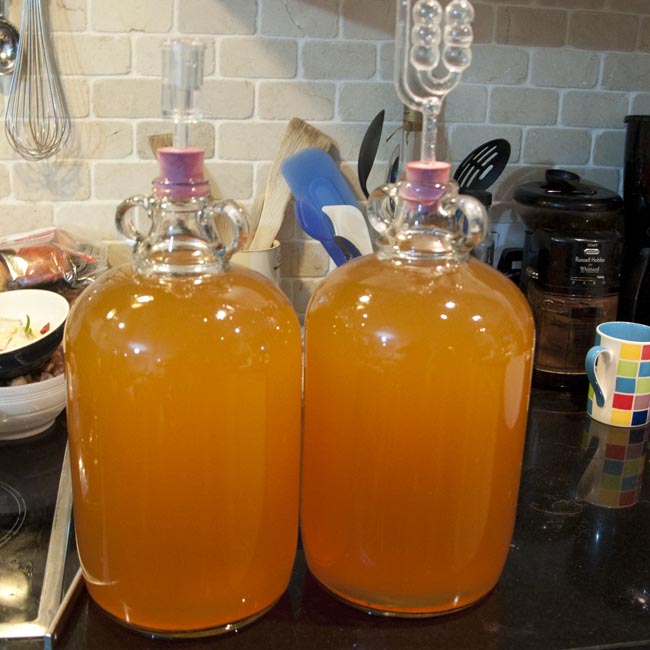
 You’ll be able to tell fermentation has started when you see bubbles through your airlock, or when a nice loose foam starts to form on top of your apple juice (because you’re not peeping, right?). During fermentation, the dead yeast and quite a bit of the solids from the apple juice will settle out in the bottom of the bucket, and the colour of the juice changes from brown to a yellow-orange. In general, the cider will not clear completely, but it will be brighter than it was before.
 Once fermentation seems to have stopped (I gave mine a generous month), you’ll have a nice thick layer of debris on the bottom of the bucket with cider above it. Now it’s time to ‘rack’ the cider into demijohns for bulk conditioning. When I opened the bucket, I found rather an alarming-looking layer of yeast floating on the surface of the cider. I can only assume that this was a wild, top-fermenting yeast strain, as it seems to have done nothing awful to the cider so far!
Clean and sterilise your equipment (demijohns, syphon, stoppers & airlocks) carefully this time, following the directions on your steriliser. Now the cider has fermented you risk accidentally making cider vinegar if acetobacter bacteria were to get in. It’s also important to avoid introducing oxygen into the cider at this stage – acetobacter need oxygen to make vinegar from alcohol, so even if there’s some contamination they’ll struggle to get going if the cider stays free of air. Syphon carefully, keeping the outlet of the syphon below the level of the liquid and avoiding introducing bubbles. Then fit your stoppers and airlocks and put the cider in a cool dark place to mature for a few months before bottling. Keep an occasional eye on your airlocks to make sure they’re not drying out. I expect to leave mine in the demijohns until spring, and will then bottle into champagne bottles with a bit of priming sugar to make sparkling cider.
 We had a couple of pints more cider than fitted in the demijohns, and it would have been inconceivable to waste it – I can report that it is, already at this stage, definitely cider. It’s a bit rough around the edges with quite a hard tannin that hopefully will mellow a bit with maturation, but has a lovely fresh apple aroma and definitely shows promise!
If you’re going to try it, I would recommend having a bit more of a read about the process before you start. Some of my favourite books on home-brewing are listed in the library.
And if all that seems a bit complicated and labour-intensive, I’ll give you my directions for the quickest and easiest (and remarkably tasty!) home-brewed cider in the world very soon!






 Country Skills for Modern Life