Handmade Christmas – cracking crackers!

Christmas crackers are great, and an essential part of Christmas dinner in my house.  I mean, what’s not to like about adults wearing silly paper hats after a lovely meal and plenty of wine?  But the ones I’ve bought always seem to contain absolute rubbish which no one would ever want.  How about making your own, with the traditional silly paper hat and motto, but with the added bonus of a small, thoughtful gift, an after dinner chocolate, or both?  Well, it’s simple and fun, here’s how!

Handmade Christmas crackers

You will need:

  • Some cracker ‘blanks’, these are widely available from craft shops and on the internet in various sizes, colours and pack sizes.  I chose plain silver ones.
  • Cracker ‘snaps’, if these aren’t included with the blanks, one for each cracker you plan to make.
  • Ribbon, wool, raffia or string, for tying the crackers up, as decorative as you like.
  • Decorations for your crackers, if you want.  I used metallic leaf skeletons, some ribbon and a couple of small jingle-bells, all glued in place, but be creative, anything from the card making section of the craft shop is a good place to start, or how about some decoupage with last year’s Christmas cards?
  • Finally, cracker gifts!  I found some quite cute keyring gadgets of various kinds and also added a nice after-dinner chocolate.  If the gifts are for specific guests, put name-labels on the crackers.
  • Scissors, sticky tape, and clear glue.
  • Make hats and mottos yourself!

Making them couldn’t be easier and is a crafty relaxing way to spend a dark December evening.

First three steps of cracker constructionStart by sticking one end of the cracker snap onto the cracker blank with sticky tape.  Then roll the cracker blank using the tabs (cracker blanks have slightly varying designs, so follow the instructions that come with yours!).  Pinch, twist and tie up one end of the cracker with the string, ribbon, or other thread you’re using – I used silver paper raffia.
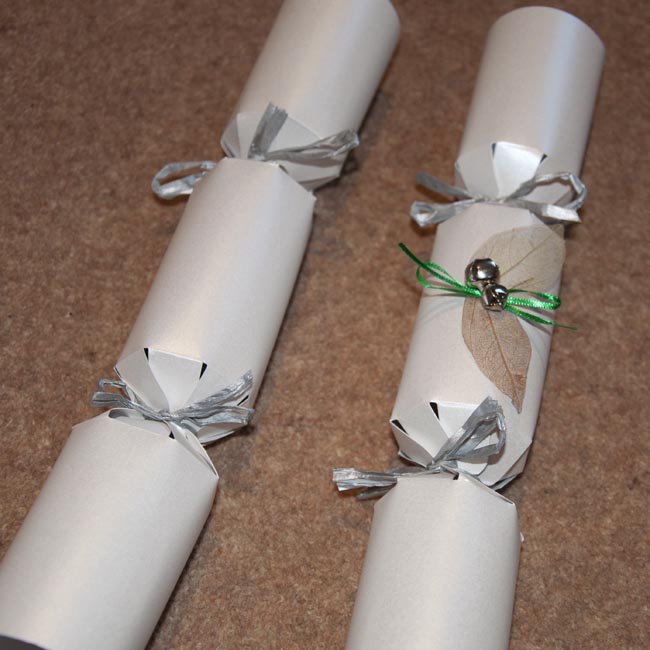
Decorating the finished crackersNow fill your cracker with all the bits and pieces, and tie up the other end of the barrel in the same way.  Once you’ve tied this up, stick the second end of the cracker snap into place.  You can decorate the crackers now however you like!

‘But what about my hat and motto’, you may be thinking?  I did see hat-and-motto sets for sale, but they’re awfully expensive considering what you get, a cheap tissue paper crown and a small slip of paper.

Making the hats couldn’t be simpler.  Get some Christmas wrapping paper, I used the end of a roll of white and silver metallic paper which I had knocking around.  First, measure the circumference of your head (unless it’s unusually large or small, in which case perhaps find someone with a more ‘representative’ head to measure – then again, you’ve made them, so perhaps it’s only fair to claim the perk of a cracker hat which fits for once!).  Now cut some pieces of wrapping paper twice as wide as the finished hat you want, and about 1cm longer than the circumference you’ve measured.  Using clear sticky tape, stick the paper into a loop.

Making paper crowns for crackers

Now fold the loop flat (image 1), then in half, then fold each of the halves into three, so that you’re now on the central panel of the film-strip above.  Now fold this in half one last time, then make a single diagonal cut half-way up the paper.  Unfold your two zig-zag topped crowns.  It’s like being back in primary school!  And since they’re neatly folded, tie them that way with ribbon or a small elastic band.

For the mottos, anything goes!  Good (or bad!) jokes, limericks (or haikus?), brain teasers, interesting facts, or even thoughts for the season or personal wishes for your family and friends’ year to come – make them pretty in a word processing package, print them out, cut into strips and fold them up with your paper hats.

Crackers needn’t just be for Christmas – they’re a lovely creative way to package small, special gifts.  An unusual way to wrap a special piece of jewellery, perhaps even a surprise ring?  Or consider using crackers to package wedding favours?

Handmade Christmas – decorated glass baubles

I have to confess to having a bit of a ‘problem’ when it comes to Christmas tree decorations – I love them.  Every year I try to add one or two (ok, sometimes a few more than one or two!) new pieces, to go on my tree year after year.  In recent years I’ve tried to make some of these rather than buying them, and this year I’ve bought nothing, which is a first!

Finished bauble on my tree

What I added to my tree this year were four lovely clear glass baubles which I already had, but which I have filled with wool fibres, giving what I hope you’ll agree is rather a lovely effect.

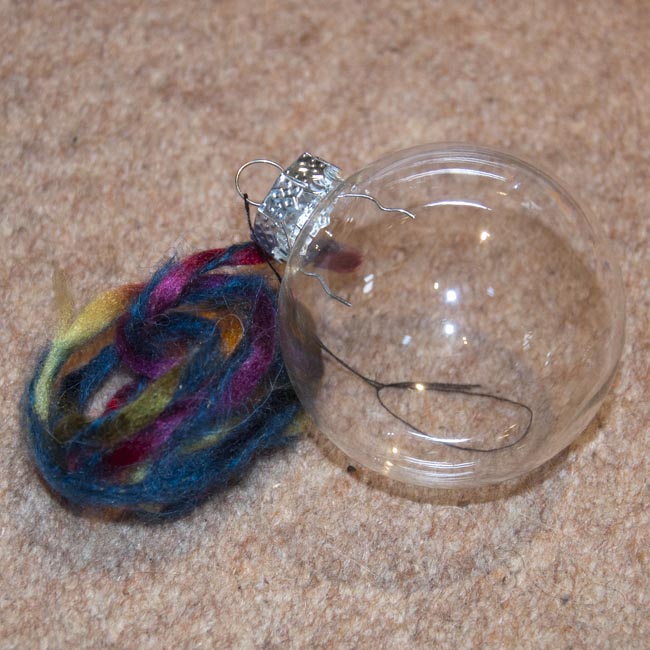
Bauble & woolMaking these is very simple – you will require:

  • Some plain clear glass baubles, any size but I used 6cm ones.  I bought them from a website a couple of years ago, but I gather they’re often available in craft shops before Christmas.
  • Wool scraps, as pretty and colourful as you can find.  I begged these from a friend who’s a keen knitter.

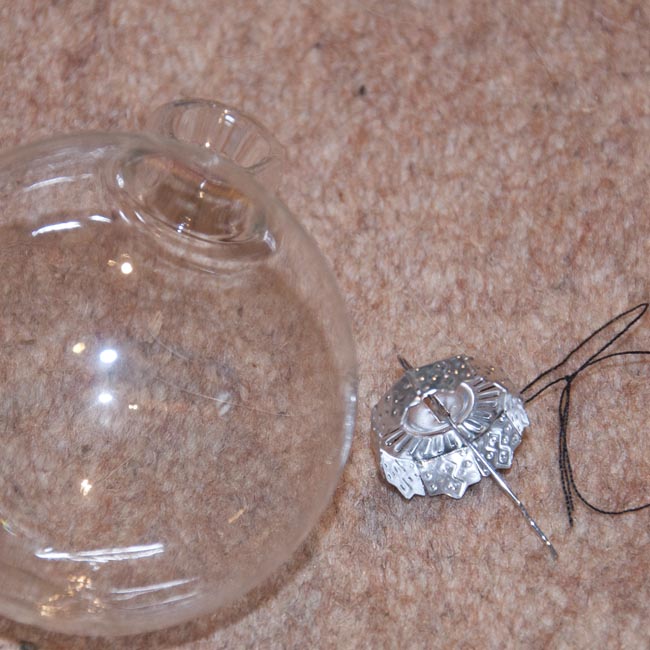
Glass bauble with top removedFirst, gently remove the top from the bauble.  With the normal design of blown glass bauble, you do this by squeezing together the sides of the metal hanging loop, which moves the ends together allowing you to (very carefully, broken bauble glass is sharp!) lift the metal crown from the bauble.

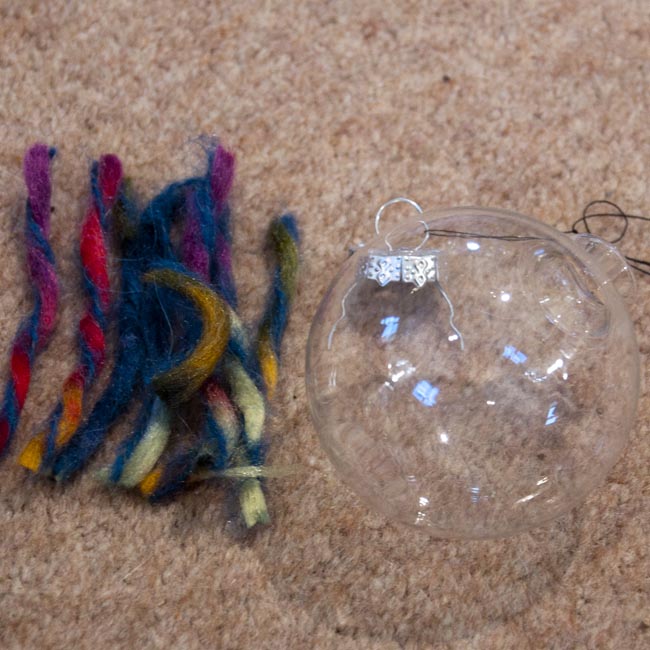
Bauble with cut lengths of woolNow take your length of wool – about a foot (30cm or 12″) is probably quite enough depending on how thick and fluffy it is.  Cut this into approximately 5cm / 2″ lengths.

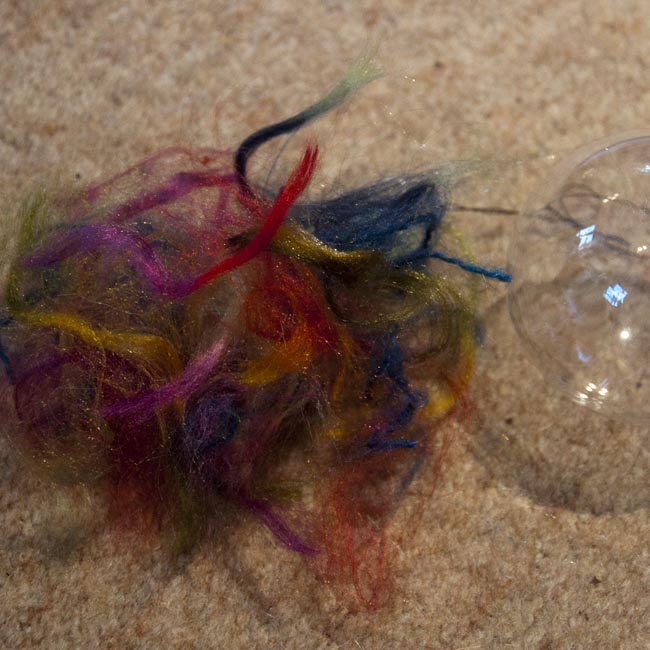
Teased apart wool fibresThen tease the wool apart gently into it’s component fibres.  Depending on the thickness and spinning type of the wool this might be more or less difficult, the wool I had was quite a loose structure and came apart very simply.  At this stage you need to assess whether you have enough fibres, since you want enough to loosely fill your bauble.

Inserting fibresFinally, use something like a chopstick or a pencil to gently push the fibres inside your bauble, and re-attach the cap.

That’s it, all done in only a minute or two, and the colours and effects you can achieve are only limited by your imagination (and wool collection!).  It’s so simple to create a colourful, textured, unique bauble for the price of a plain clear glass one, and these would make lovely gifts, too!  I’ve also seen pretty things done with ribbons, fabric scraps, or glitter inside clear baubles, so why not get creative!

Updated for 2012why limit yourself to wool, there are other things you can fill baubles with, too!

See more crafty ideas for a Handmade Christmas >>

Read more from the Country Skills blog >>

Last Minute Christmas – perfect giblet stock

If you’ve bought a bird for roasting today, there’s a good chance it’s come with a little plastic packet of ‘bits’.  Whatever you do, don’t throw them away!

These bits are the giblets – the offal – usually the neck (in one or two pieces), the heart, the liver, and the gizzard.  The gizzard is thick, muscular structure with two hard abrasive grinding plates that the bird uses to crush up corn and other food items to make them digestible.  Giblet stock is quick, simple, and makes the most wonderful Christmas gravy.

I have a goose this year, but the following applies just as well if you have a chicken or turkey.  Personally, I use the goose heart and liver in one of my stuffings, so only the neck and gizzard are available for the stock.

In addition to the giblets, you need the following:

  • Stock vegetables.  I use one onion (red or white) and a couple of carrots, I don’t like celery so I don’t use it, even though it’s the often-quoted third member of the stock vegetable trinity.
  • A bouquet garni.  This is just a posh culinary term for some herbs. I use some bay leaves, rosemary, thyme and sage, along with some whole pepercorns and a few juniper berries.  Dried is fine.
  • Water.  Glug of white wine (optional).
  • A splash of olive oil.

Prepare your gizzard by cutting away and discarding the hard plates (use a small sharp knife inserted below and parallel to the plates) and chopping the rest of the meat roughly

Put the splash of olive oil into a nice big saucepan, and brown the neck and gizzard meat, and then add the roughly chopped onion and carrots and sautee for a couple of minutes.  Now add about a litre of water (and the splash of white wine if you want) and the bouquet garni, bring to the boil and simmer for about an hour.  Strain, discard the solids, and return the stock to the pot and boil again until reduced in volume by half.  That’s it.  Set aside in the refrigerator until you make your gravy later. You won’t regret it!

In Fermentation We Trust – apple juice turns into cider

On a lovely bright November weekend, I pressed a load of apples for cider-making.

For the next part of the process, you need to put together the following bits and bobs:

  • Your apple juice (which is already in a fermenting bucket with any luck – you’ll need the lid, if it’s one with a hole for an airlock, so much the better – if so, you’ll also need an airlock)
  • Wine or cider yeast, and yeast nutrient
  • A nice warm location at about 18 – 21 degrees celsius
  • Enough demijohns (plus stoppers and airlocks) to contain the volume of apple juice you’ve collected.  All my demijohns have come from Freecycle, so it’s worth keeping your eyes open.  For recommendations of UK homebewing equipment suppliers, see the suppliers list.
  • A syphon
  • Homebrewing steriliser solution

Now, time to turn your wonderful juice into cider (for any Americans who might be reading, we mean hard cider – the traditional alcoholic sort).  Traditional ‘real cider’ makers would do nothing with it at this stage, and wait for the natural yeasts which you hope are already present on the apples to do their job and get fermenting.  There is an alternative approach which involves using campden (sulphite) tablets to kill off the wild yeasts and then adding some wine or cider yeast of your own, which with any luck should guaranteed a ‘clean’ culture of your chosen yeast strain.  I decided to go a third route, didn’t use any campden, but did add wine yeast and yeast nutrient to give the process a ‘kick-start’ and make sure that an appropriate culture was at least in there with a fighting chance!

Apple juice before fermentation

You should probably take the specific gravity of your apple juice before you start fermenting, as this will tell you something quite important – with a bit of arithmetic (or there are online SG to ABV calculators out there you could avail yourself of) you should be able to work out how alcoholic your cider ends up.  This is relevant both for keeping your driving licence, and for making sure your cider contains enough sugar, and therefore after fermentation, enough alcohol, to keep well.  You’re aiming for a minimum of about 3.5% ABV, real ciders can easily get up to about 8%.

I didn’t test my juice (do as I say not as I do, right?), but it tasted nice and sweet so I think it’s likely my cider is about the 6% mark. Invest in a glass hydrometer (they’re cheap, easy to use with a bit of practice, and ever such pretty bits of old-fashioned looking laboratory glassware), you won’t regret it!

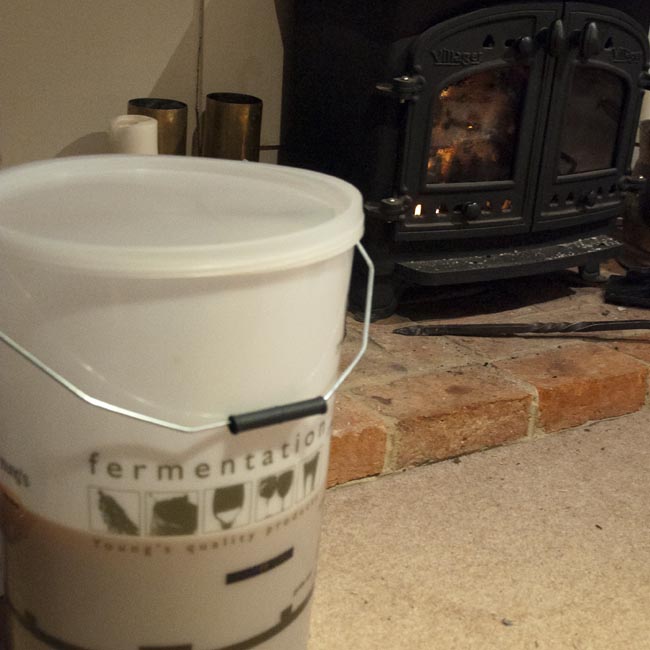
Fermenting by the fireThere is lots of advice that you should ferment your cider under lock.  I didn’t have an airlock capable bucket available so just kept the lid loosely on.  My experience from beer brewing is that the CO2 produced during fermentation will give a good blanket over the brewing liquor, being heavier than air, and oxidation shouldn’t be a problem at this stage as long as you don’t disturb the fermenting juice.  If your bucket does have an airlock, after adding the yeast and nutrient close the lid tightly and set up the airlock.  If it doesn’t, just fit the lid loosely so that the gas produced during fermentation will be able to escape without blowing the lid off!  Put your bucket in a nice warm place and try to avoid peeping.  Mine went by the fire in the living room for the first few days, as we were having a bit of a cold-snap.

Ready for rackingYou’ll be able to tell fermentation has started when you see bubbles through your airlock, or when a nice loose foam starts to form on top of your apple juice (because you’re not peeping, right?).  During fermentation, the dead yeast and quite a bit of the solids from the apple juice will settle out in the bottom of the bucket, and the colour of the juice changes from brown to a yellow-orange.  In general, the cider will not clear completely, but it will be brighter than it was before.

Top fermenting yeastOnce fermentation seems to have stopped (I gave mine a generous month), you’ll have a nice thick layer of debris on the bottom of the bucket with cider above it.  Now it’s time to ‘rack’ the cider into demijohns for bulk conditioning.  When I opened the bucket, I found rather an alarming-looking layer of yeast floating on the surface of the cider.  I can only assume that this was a wild, top-fermenting yeast strain, as it seems to have done nothing awful to the cider so far!

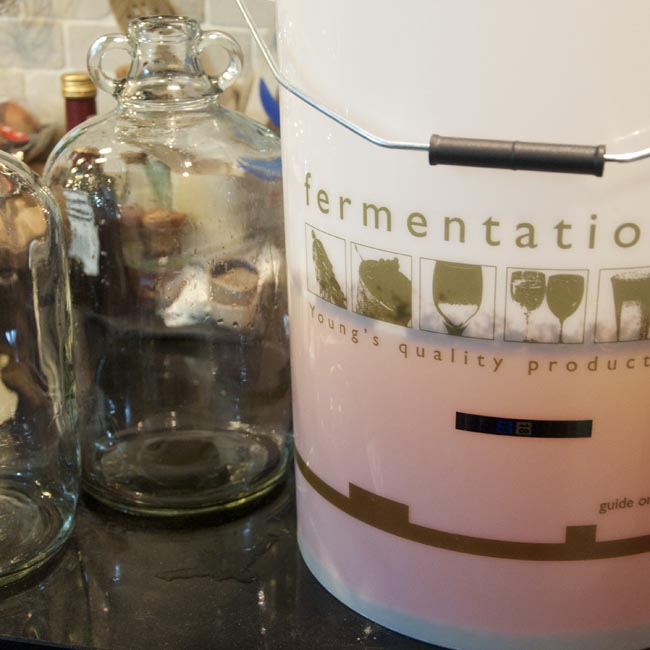
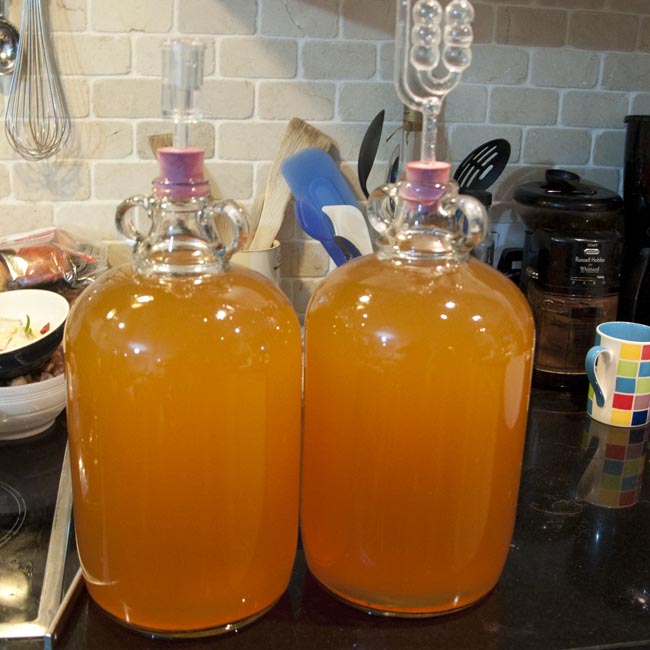
Clean and sterilise your equipment (demijohns, syphon, stoppers & airlocks) carefully this time, following the directions on your steriliser.  Now the cider has fermented you risk accidentally making cider vinegar if acetobacter bacteria were to get in.  It’s also important to avoid introducing oxygen into the cider at this stage – acetobacter need oxygen to make vinegar from alcohol, so even if there’s some contamination they’ll struggle to get going if the cider stays free of air.  Syphon carefully, keeping the outlet of the syphon below the level of the liquid and avoiding introducing bubbles.  Then fit your stoppers and airlocks and put the cider in a cool dark place to mature for a few months before bottling. Keep an occasional eye on your airlocks to make sure they’re not drying out.  I expect to leave mine in the demijohns until spring, and will then bottle into champagne bottles with a bit of priming sugar to make sparkling cider.

Filled demijohnsWe had a couple of pints more cider than fitted in the demijohns, and it would have been inconceivable to waste it – I can report that it is, already at this stage, definitely cider.  It’s a bit rough around the edges with quite a hard tannin that hopefully will mellow a bit with maturation, but has a lovely fresh apple aroma and definitely shows promise!

If you’re going to try it, I would recommend having a bit more of a read about the process before you start.  Some of my favourite books on home-brewing are listed in the library.

And if all that seems a bit complicated and labour-intensive, I’ll give you my directions for the quickest and easiest (and remarkably tasty!) home-brewed cider in the world very soon!

Counting Down the Days – making an ‘everlasting’ fabric Advent calendar

Time: about 6 hours – Patience: how many sleeps is it ’till Christmas?? – Difficulty: a little fiddly in places

Advent calendars have always been such an important part of the countdown to Christmas for me.  But aren’t they often just a little bit of a disappointment?  The chocolate calendars so often contain the lowest grottiest grade of milk chocolate imaginable, and the plain card ones are, well, a bit plain!

Completed Advent Calendar

The last few years I’ve seen a few beautiful fabric advent calendars with pockets, which sadly have always been a bit rich for my wallet.  So after I’d got out my bits and pieces of Christmas fabric scraps for bunting making a couple of weeks ago, I thought, surely I might be able to make something of my own?

You will need –

  • A large piece of heavy fabric for the backing.  The piece I used was about 45 x 80 cm, but obviously this will vary according to your design.
  • Enough scrap Christmas-coloured fabric for 24 pockets and something pretty for the top of your tree.
  • Some way of applying numbers to your pockets (felt, paint, embroidery…)
  • A bamboo cane and some ribbon.
  • A sewing machine capable of straight and zig-zag stitch, matching and contrasting threads.

Backing fabricI was lucky to have some quite heavy, checked, gold-coloured fabric in my scraps bag which was big enough to use as backing fabric.  Even better, the approximately 1″ squares of the pattern made a fantastic layout grid for the advent calendar, saving me a huge amount of hassle.

Calendar doodle I doodled out some boxes, and realised with some pleasure that I could build up a stylised Christmas tree out of square pockets using a very convenient 24 squares – result.

Then I had a dive around the random collection of Christmas fabric scraps I’ve collected over the years, particularly the annoying-sized offcuts  I never seem to be able to bring myself to throw out on the basis they’ll come in handy some day!  Out of some card, I cut myself a pocket template based on the squares of the backing fabric, two boxes wide and two and a half boxes high.  I used this to mark up, and then cut out my 24 pockets out of a mix of fabrics, using pinking shears.

Layout patchesNow it’s time to play about with your pockets to decide on a pleasing arrangement of the different fabrics.  It took a few tries but I pretty quickly came up with an arrangement I was happy with.  It’s also the time to decide how you want to arrange your numbers.   I decided to count them down from 24 at the top of the tree, down to 1 in the pot, but you could arrange them randomly or in some other pattern of your choosing.

I was feeling really chuffed at having found 24 small felt numbers from a craft supplier to use on the calendar pockets.  I can in no way recommend that you do the same thing, and here’s why –  having decided on the layout of the patches, it’s time to number them.  The felt numbers were far too small and fiddly to sew on with my machine, so I hand stitched them to the pockets.  It took me a whole evening in front of the TV (not joking, it took over three hours – as much as the rest of the project put together!).  There must be faster ways – I suppose I could have used fabric glue but I didn’t have any.  Fabric paint or iron on numbers may be a solution.  Of course if you have a marvellous programmable embroidery machine, you could just embroider them on.  If you do, you should know that I’m extremely jealous!

Trimmed pocket

Hemming pocketOnce all your numbers are in place (or before, if you’re paining or ironing on) iron your pockets with the top hem folded over, and then just trim the corners of the fold with the pinking shears.  Then stitch the hem over with a closely matched colour of thread.  Now is the time to cut and hem your backing fabric, too.  I used a wide zig-zag stitch to do the hemming, which avoided having to do any other finishing.  Give yourself enough fabric top and bottom to hem a pocket big enough to thread a bamboo cane through later.

Now lay out all your prepared pockets.  Also cut yourself a star, or other decoration for the top of your tree, out of a suitably spangly fabric.  Now it’s time to sew the pockets onto the backing fabric, which you will have to do a row at a time starting at the top.  First pin your star in place and then, with an appropriate contrasting thread, appliqué it in place. I used zigzag stitch, because I like the effect, and a dark red / burgundy thread, but you should do whatever you like!

Applique starThen, a row at a time, do the same with the pockets, sewing the sides and bottom onto the backing fabric using a zigzag stitch.  Try to make sure you catch both sides of adjoining pockets in the stitch.  Obviously don’t stitch the tops of the pockets if you’re going to want to put anything in them!  Oh, and mind your fingers on the pins as you work – or at least, try not to stab yourself *too* often.

If you don’t quite manage to catch all the edges, you can correct this later by hand using matching rather than contrasting fabric to make the corrections.  It will look hand-made, which is the point, after all!

Once you’re all done, cut two lengths of bamboo, one a bit longer than the other, and some suitably coloured ribbon to hang the calendar with.  I used a spot of fabric glue (yes, I’d learnt my lesson and bought some by then!) on both ends of the top bamboo cane to stop the tied-on ribbon from slipping.  I also used a little scrap of ribbon to tie a jingle bell to a tiny peg to use as a marker to move along from pocket to pocket as December ticks away.

That’s it, sit back and admire your handiwork!  And perhaps pour yourself a nice beverage – go on, you’ve earned it!

Heat and Light – how to clean the glass on a wood-burning stove

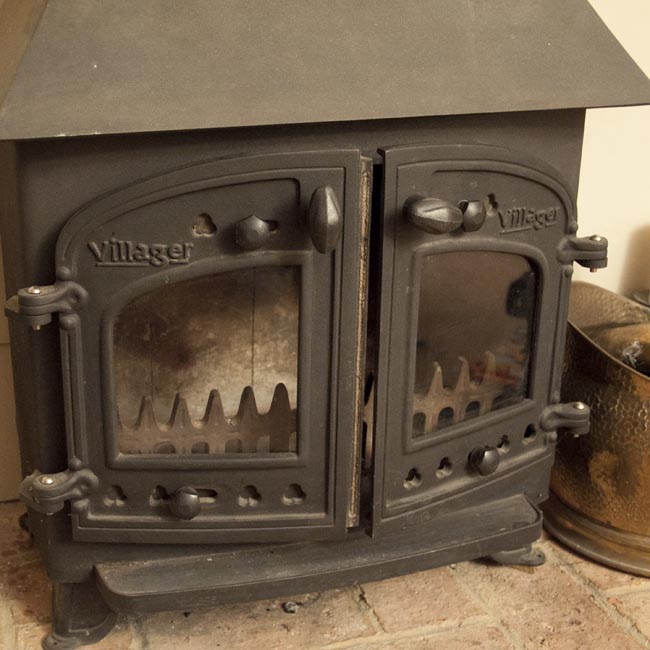
Everyone loves a real fire!  In common with lots of people in rural homes without access to the mains gas network, we use a multi-fuel stove for some of our heating.  Wood burning stoves are becoming more popular in urban areas, too.

Wood-burning stove

If you have an old stove, it’s likely that before too long you’ll find yourself having to work out how to get the soot off the glass.

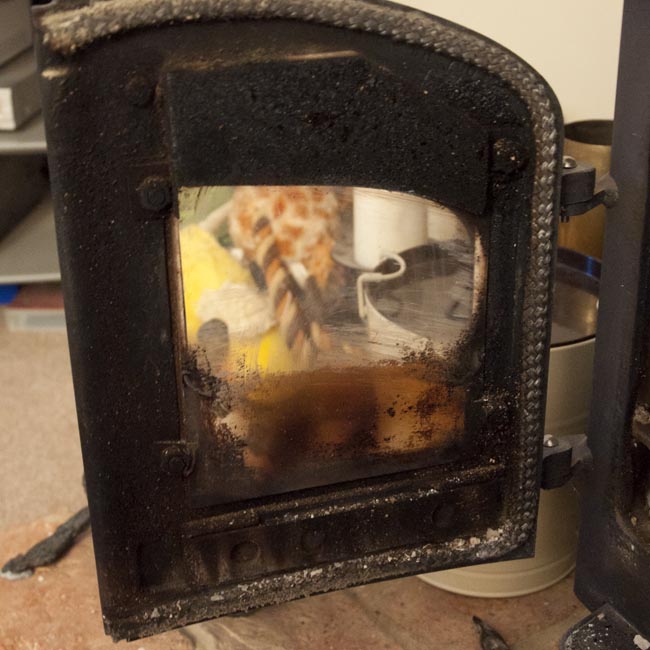
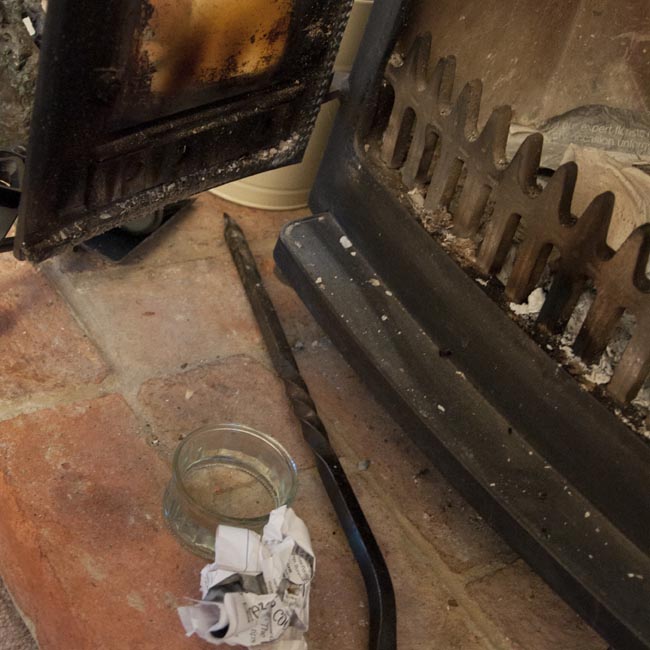
Sooty glass on wood burning stoveI’ve tried oven cleaner.  I’ve tried multisurface cleaner.  I’ve tried a pan scourer, soap and hot water.  Giving it a damn good scrub works a bit, but is very hard work.  I’ve even tried expensive, specifically designed cleaner for the glass on multi-fuel stoves.  Nothing worked convincingly or easily, and the stuff in the aerosol stank, too.  Meanwhile the glass was getting blacker and blacker, and we were deprived of the gorgeous sight of flickering flames, to the point that we were wondering how easy it would be to replace the glass.

Necessary equipmentThe answer is as easy as could be.  No solvents or volatile chemicals, very little effort, and you have all the things you need already.  Strange as it may seem, you need some newspaper, some ash, some tap water, and a very little elbow grease.  And a wood-burning or multi-fuel stove, of course, but if you haven’t got one, you probably haven’t bothered to read this far.

Time: 30 minutes – Difficulty: simple – Cost: free

Glass half cleanedScrunch up about half a sheet of newspaper.  Dip it in the water and squeeze out the excess.  Then dip it into the ash.  Now use this, gently, to rub the glass.  You should notice it working straight away, which is very gratifying.  The water and ash forms a really fine abrasive slurry, which lifts the soot from the glass with very little effort.  When the paper starts to get really black and stops working again, get a new piece, and repeat the process as often as required.  Getting both doors of my fire cleaned took about half an hour.  They’re *sparkling*.

Job done!A small word of warning – if your glass has some sort of clever protective coating, this approach may not do it any good…  Then again, if your glass has some sort of clever protective coating, and is still sooted up, you might reasonably take the view that it’s not working anyway!

Go on, try it!  I know it sounds mad but I promise you won’t be disappointed!

Read more from the Country Skills blog >>

Almost-All-Purpose Any-Fruit Jelly

Time: about an hour – Patience: 4 or 5 hours – Difficulty: easy

Until this year I had never made fruit jellies, out of a misguided belief that the process was needlessly tedious and fiddly – but a bumper crop of crab apples scrumped from a hedge finally forced me to give it a go.  While there’s no escaping that it is a two-stage process – stewing fruit followed by straining and re-boiling with sugar – as hassle goes it’s certainly less trouble than taking stones out of plums for jam! Only the final boil and bottling requires your full attention, otherwise you can be getting on with other things – or putting your feet up with a well deserved cuppa!

Medlar jellies

You will require –

  • Fruit – single or mixed varieties – apples are a popular ‘base’ fruit with additions. A couple of kilos is a sensible quantity to try first time out and will probably make 6 jars or so.
  • Fresh herbs, chillies, spices… the only limit is your imagination
  • Juice of a lemon or orange, if you like
  • Sugar – I usually use preserving sugar for the additional pectin – this is particularly important for soft fruit which contain very little of their own pectins, apples and plums have quite a bit of their own and probably don’t really need supplementing. Still, it can’t hurt, right?
  • A saucepan with a bigger capacity than the volume of your fruit
  • A jelly bag / muslin strainer
  • Jam jars with lids, clean and dry. I like to re-use jam jars if I can, and save small pretty ones for jellies, to the eternal irritation of my husband who keeps finding empty jars all over the house. Jellies often have quite a delicate flavour, so do be careful the jars haven’t previously been used for pickles or curry sauce (give them a good suspicious sniff if in any doubt, and check the lids for staining – if so send them for recycling or use them for chutneys), as this could very easily taint your lovely jelly!

And this is how it’s done –

  • Stewing medlarsRoughly cut your fruit into pieces no more than about an inch square, removing any damaged / rotten areas (ignore this last detail in the case of bletted medlars, or you’ll have no fruit!)
  • Place the fruit in the saucepan and just cover with tap water. Add the citrus juice at this stage if desired.
  • Bring to the boil and then cover and simmer gently for an hour or so, stir from time to time but don’t mash.
  • Straining in the jelly bagSuspend your jelly bag over a bowl and spoon in your stewed fruit. A soup ladle is quite helpful here. A jelly bag is a really useful thing to have if you’re making jellies (who knew?) but can be a bit expensive. You can bodge your own with a tied muslin. Many jelly bags have stands, but I just tie mine to the handles of the eye-level kitchen cabinets.
  • The liquor that drains into the bowl will probably be cloudy. Don’t worry about this too much. You’ll see why in a bit.  Leave it to strain for at least a couple of hours.
  • When the flow of liquor from the jelly bag is almost exhausted, put the clean jam jars and lids in a cold oven and set the temperature to 150.
  • Now, when the dripping is essentially stopped, measure the volume of liquor you have, preferably in pints (please note this recipe uses UK Imperial weights and measures, not US ones).
  • Then weigh out the sugar you need, following the rule of thumb of one pound of sugar to one pint of liquid.
  • Return the liquor and the sugar to the (washed) pan, add any finely shredded herbs or spices (if you just want the flavour but not the pieces of herb or chilli etc in the jelly, you should have added them at the stewing stage so the pieces are filtered out – personally, I rather like the look of little nuggets of flavour in the final product), and bring gently up to the boil, stirring continuously.
  • You now have a pan of quite concentrated boiling sugar syrup, which you should under no circumstances leave unattended. It will probably froth a little and some scum may well rise to the surface. I’ve seen recommendations to skim this but I never bother.
  • At some point during the boiling process, with a bit of luck, the cloudiness will disappear entirely. No, I don’t know why, either. I think it’s that culinary alchemy again!
  • Keep stirring, and check for setting periodically. I put a couple of small saucers in the freezer ahead of time, then put a drop of the boiling syrup on the saucer, it will cool quickly and allow you to check the consistency. It’s ready when the cold jelly wrinkles when you push it with your finger.
  • Different jellies seem to reach setting point at very different rates, some will take as little as 10 minutes, so keep checking regularly. And tasting, of course.
  • Once your jelly has reached setting point, carefully get the hot sterilised jam jars out of the oven, fill with the hot jelly and tighten the lids fully. If you have any pieces in the jelly, watch to see if they’re trying to sink or float in the jars – if they are, then invert the jars every so often as they cool to mix the contents.
  • If you find, once they’re cold, that the jelly isn’t as set as you’d like, it’s perfectly alright to tip it back into the pan the next day, clean and re-sterilise the jars, and boil the jelly for a while longer. But assuming it’s mostly set, why would you bother unless you were planning an attempt on the local flower and produce show with it?
  • That’s it! Label, store, and enjoy at your leisure. They should keep at least a year in a cool dark place, but best to refrigerate after opening.

Doesn’t seem so hard, does it?  Now, don’t you want to know what happened to those medlars..?

First smoke! Testing the DIY cold smoker

Time: 5 minutes – Patience: 10 hours – Difficulty: Trivial – Knackynes: Low

So I built a cold smoker, and then it was time to try it!

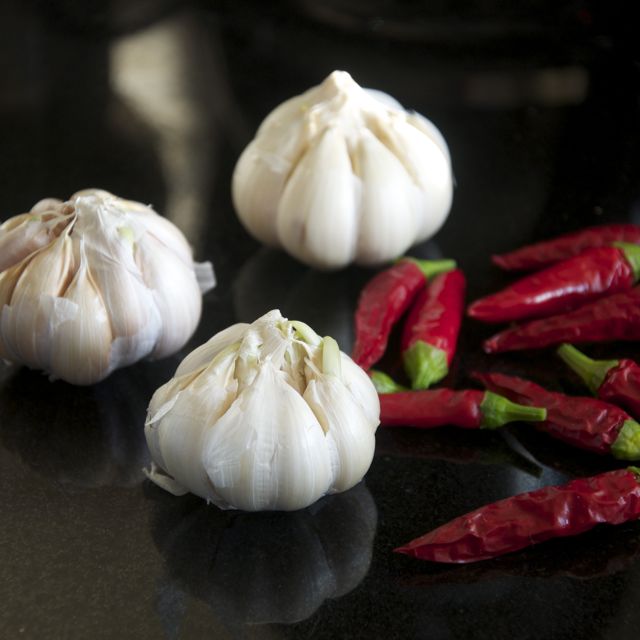
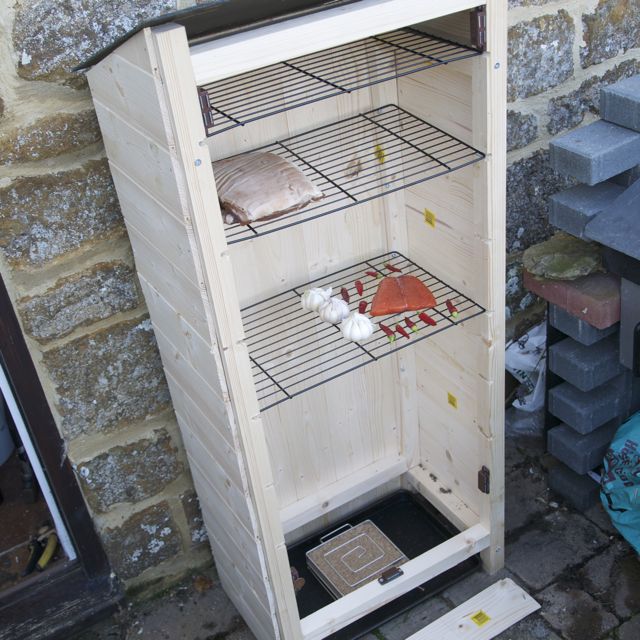
The items in my first smoke run were the cured salmon fillet, a piece of home-cured bacon, three garlic bulbs and about a dozen home-grown chillies.  These were loaded into the smoker on the racks – I considered hanging the bacon piece from a  hook but decided against this time.  The loaded smoker looks really empty so the first lesson is to have more items ready for smoking and do them all at once.

Smoker, loadedThe ProQ smoke generator lit very straightforwardly and behaved immaculately, smouldering gently without any noticeable heat output for almost exactly the advertised ten hours.  I used oak sawdust in the smoke generator for the first attempt, and the 100g pack I had was a little bit more than I needed.

ProQ cold smoke generator, litThe smoker itself leaked like a sieve from the junction between the roof and box, and also from the side of the magnetically-attached door panel.  I suspect this meant the smoke density inside the box was rather less than it might have been.  Before the next run, I plan to plug as many of these leaks as I can using silicone mastic and some batons, and we’ll see if I get a more concentrated smoke as a result.  I could conceivably run a second smoke generator, but this would increase my costs, so I’d rather not!
Overall, the salmon was a great success.  It was firm, glistened slightly with oil on the surface, and cooked wonderfully into the creamy home-smoked salmon pasta I made for dinner on Monday.  You can see photos and more discussion with the recipe.

The garlic and chillies didn’t appreciably change in appearance during smoking – at odds with the smoked garlic I’ve seen before which was dark yellow to brown in colour.  I have seen recommendations for smoking times for garlic up to 36 hours, though, so 10 may not be enough to achieve this, especially in a leaky-smoker.  They smell wonderfully of oak smoke though and the flavour of the garlic is a treat – nice fresh flavour with a subtle but distinct note of oak smoke, not too obtrusive and lovely for general cooking.  I might re-smoke one of the bulbs next time I run the smoker, if I’ve not eaten it all by then.

Bacon, salmon, garlic and chillies after smokingThe bacon has a bit of smoke staining on the rind and has darkened on the meat side.  I think you might get more discolouration on the rind with the bacon hanging rather than sat rind-up on a rack.  Apart from that, it looks and smells as I would expect from good smoked streaky bacon.  I haven’t tasted it yet – but plan to have some for my lunch!

Read more DIY Cold Smoker & Home-Curing posts >>

Read more from the Country Skills blog >>

Smokin’!! DIY Cold Smoker – design and build

Time: 4 hours build time – Difficulty: Easy – Knackyness: Moderate (woodworking skills & equipment required)  – Cost: around £50

I’ve wanted to try cold smoking for a long time.  Hot smoking is an easily solved problem, modify a BBQ with a lid or some heavy duty tinfoil and add some woodchips, or even on the kitchen hob burning rice in an un-loved saucepan and steamer with the cooker hood running full pelt.  Hot smoked food is tasty enough, but though our American cousins have raised it to an art-form, I can’t get terribly excited about it.

Cold smoking, on the other hand, is far more interesting.  It requires more complicated equipment and, a bit like curing, feels like a sort of culinary alchemy.  The knack is to fill a space with sufficiently thick smoke for a long enough period to flavour your food, without raising the temperature so high that the food starts to cook, or worse, is at risk of spoilng.   Now someone observant once said, ‘no smoke without fire’, and therein lies the problem.  The internet, and the various books published on the subject, have a wide variety of different designs for low-cost home smokers.  The involve oil drums, modified fridges and filing cabinets, air conditioning duct, garden sheds, breeze blocks, and innumerable other approaches.  There are high tech ‘smoke generators’ and low tech fires in holes in the ground.  Then there are the purpose built smokers like the lovely-looking ones Bradley make, but they’re a bit outside my budget.

My smoker is a variation on a wooden box, and uses the ProQ cold smoke generator, which burns sawdust, as a smoke source.  I have built my smoker out of new wood, though I would have preferred to have used reclaimed wood – both on cost and ecological grounds.  If you are using reclaimed or scrap wood do make sure it’s clean and hasn’t been treated with any toxic wood preservatives.  The roof is a spare slate I happened to have, you may need to come up with something different. The structure is assembled from 2.5cm square section timber and covered with tongue-and-groove cladding, using various screws and fixings you are likely have in your toolbox.

What I bought to make the smoker –

  • The ProQ smoke generator and a few bags of wood dust
  • Set of 3 non-stick cooling racks (mine were from Amazon, but a cookshop would have similar products)
  • Four 2.5cm square 1.8m lengths of timber
  • Ten 1.8m lengths of tongue-and-groove cladding board
  • Four magnetic clips

I also used the following items I already had –

  • Wood saw, tape measure, screw driver
  • Electric drill and screwdriver, work bench (not essential, but useful)
  • Variety of screws, pins, fencing staples
  • A roof slate
  • Wood glue
  • Water-based shed stain

Smoker Frame

Smoker frame, size relative to rack

Dimensions of the smoker are 1.1m high at the front, 1.0m high at the back.  The width and depth are based on the size of the racks you want to use.

First, build the frame.  It will probably look something like this (note it is slightly narrower than the width of the rack.  Secure the horizontal timbers with long wood screws.

Frame showing slots for racksSlot the front vertical timbers to hold the racks.  The choice of spacings is yours, I placed a slot about every 15cm from about 40cm above the ground.  We cut the slots with a large drill bit and tidied up with a chisel.  There’s a bit of hit-and-miss here and while all the slots are not equally beautiful, they should do the job.  You could also slot the back timbers, but we decided to use small screws here with their heads proud to support the back of the racks,  also preventing backward and forward slip.  The highest slot is positioned to allow a rack to rest on the side timbers to take the weight of items hanging from it on hooks.

Applying claddingNext cover the back and sides with cladding going from floor level all the way to the top of the frame, including the triangle sections at the top of the sides.  I glued the tongue and groove for extra stability.  You could equally use plywood to clad the box.  We used fencing staples to secure the cladding to the frame.  Panel pins would be more traditional.

Complete smoker - openI want the whole front of the smoker box to be removable, in two sections – a large top section to allow me to load and unload the smoker racks and hooks, and a small bottom strip to allow management and monitoring of the smoke generator without letting all the smoke ‘escape’ from the box during use.  I built the main panel and secured it with three strips of 1cm baton.  The top and bottom baton positions are chosen to rest on the horizontal timbers forming the front of the structure, taking the weight of the front panel.  Four magnetic clips hold the front panel snugly in place.  The angle of the roof will allow a 1cm ventilation gap above the front panel.  A final length of cladding is used horizontally for the bottom section.

Complete smoker - closedFixing the roof will depend on your materials.  For the time being my slate just rests carefully on top, in due course we’ll come up with some sort of clip arrangement.  A plywood roof could be screwed in place.  I’m going to use a knackered old baking tray on the floor of the smoker to catch ash and any drips from the food.

The outside of the smoker will be painted with water based fence and shed stain.  The inside will not be painted, and I hope that with time exposure to smoke should provide a good seal to these surfaces.

Next, the first very experimental firing…  I can hardly wait!

Read more DIY Cold Smoker & Home-Curing posts >>

Read more from the Country Skills blog >>

Banner320-260

Medlars – an experiment with strange fruit

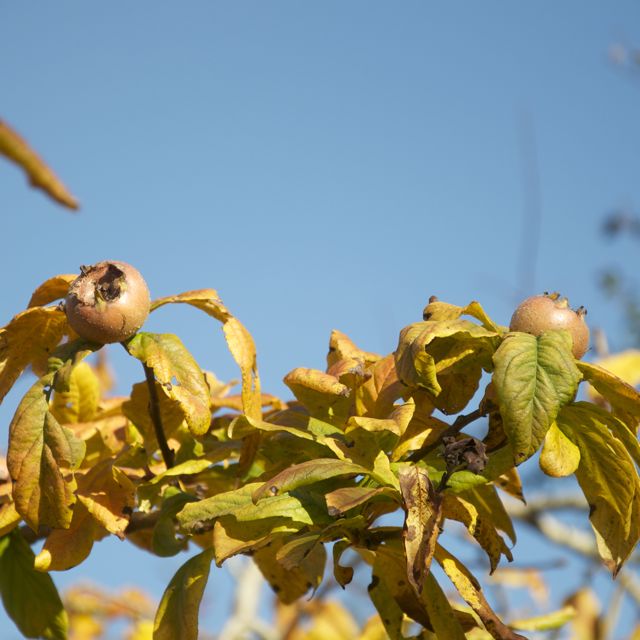
Have you met a Medlar?  Medlars on tree

The Medlar is known less politely as the ‘dog’s bottom fruit’ (and other related and even less polite descriptive names, discovery of which is left as an exercise for the reader!), and was once very popular, these days it seems to have been more or less forgotten, at least as a culinary fruit.  The Royal Horticultural Society describes Medlars by reference to their flowers and habit before their fruit.  They’re in the same horticultural family as roses, filed somewhere between pears and hawthorn.

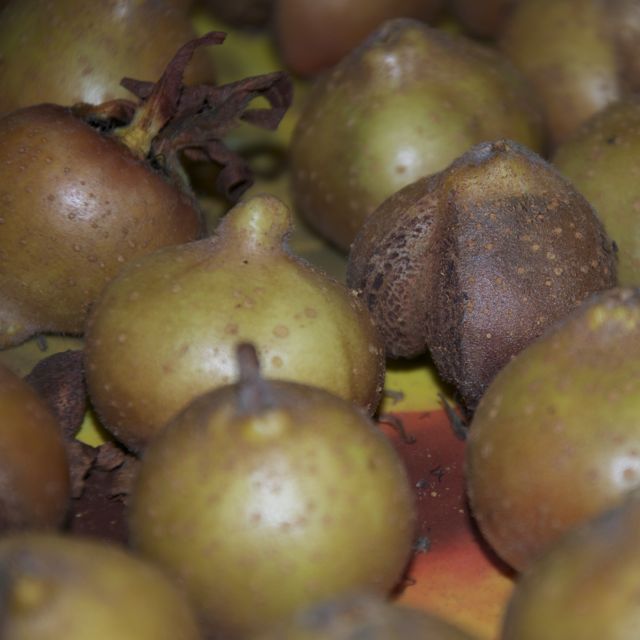
Bletting medlarsI was lucky enough to be able to harvest a lovely little medlar tree, which yielded about a third of a carrier-bag full of fruit.  While late October / early November is the right time to pick medlars, they aren’t actually ripe and need to go through a process of ‘bletting’, where they are allowed to ripen fully in a frost-free, cool dark place.  The only place I have for a tray of fruit is the spare room, which while dark-ish and undoubtedly frost-free, is at house temperature.  Bletting is supposed to take 2 – 3 weeks, during which the fruit will soften and become a dark brown to black colour.  If it all goes well, I plan to make some medlar jelly, so I’ll be back in due course to let you know!