Better than Branded – homemade sun-dried tomato ketchup

It’s too early in the year to have a glut of tomatoes, but I wanted to try my hand at home-made tomato ketchup.  The commercial offering is so ubiquitous, how many of us pause to think what’s in it, or if we could make it better ourselves?  I wondered if using sun-dried tomatoes, the dry-packed sort, might give me a shortcut to a sauce that would pack a real concentrated tomato punch.  Well, they do – with the added bonus of not requiring the extended cooking time required to drive excess water off fresh tomatoes.

To make a little over a litre of sun dried tomato ketchup, you will require the following –

  • 250g of dry-packed sun dried tomatoes
  • Two small to medium sized yellow onions
  • 5 cloves of garlic
  • Whole red chilli
  • Red wine vinegar
  • Balsamic vinegar
  • Fresh ginger
  • Soft brown sugar
  • Ground allspice
  • A carton of apple juice
  • Food processor, ideally with blender attachment, or hand-held liquidiser

Sun dried tomatoesPut the tomatoes in a bowl and pour over enough freshly boiled water to cover.  Roughly chop the onions (or peel, quarter, and chop in the food processor).  Mince the garlic.  Once the tomatoes have been soaking for about half an hour, pour off – but reserve! – the soaking liquid.  Roughly chop the tomatoes by hand or put them through the food processor.  Also finely chop the whole chilli (it can go through the machine with the tomatoes).

Frying onions & garlicNow put a glug of olive oil (or your preferred cooking oil) in the bottom of a large pan, and then start to fry off the onions, adding the garlic when the onion has gone translucent, but not taken on any colour.  Fry until just colouring and then add the chopped tomatoes & chilli, mix together and add the tomato-soaking liquid back in.  This liquid will have taken on some lovely flavour from the tomatoes (which is why we’re using it).  Note however that dry-packed tomatoes are preserved with salt, so if reducing the amount of salt in your diet is important to you, you should discard this liquid and instead add enough apple juice to allow you to start to stew the tomatoes.
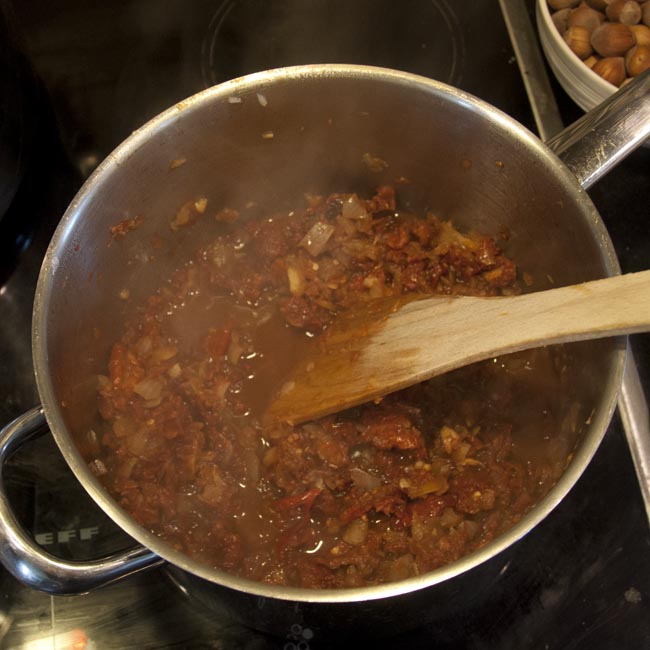
Stewing tomatoes & onionsAt this stage, the whole process becomes a matter of personal taste.  I added about a cm of fresh grated ginger to the pot, along with a quarter of a teaspoon of allspice.  I started by adding 50ml of red wine vinegar, a glug of balsamic vinegar, and a tablespoon of soft dark brown sugar.  Keep tasting the mix as it cooks, and adjust your seasoning as required.

Ketchup in blenderOnce it’s been bubbling away for about twenty minutes, pour the contents of the pan into your blender, or take the pan off the hob and use your handheld blender.  Start to liquidise the mix, adding apple juice as you go until you achieve your desired consistency. I stopped short of blending mine completely smooth, because I like it to have a little texture –  a sort of hybrid ketchup/salsa feeling.  I ended up adding about half a litre of apple juice in total.

Ketchup bubblingNow return your mix to the hob and set it bubbling again.  This is the time to make the final adjustments to your flavours.  I ended up adding an extra splash of wine vinegar at this stage, along with another half tablespoon of sugar.  Remember that you’re tasting the ketchup hot, once it’s cold, most flavours, but particularly vinegar flavours, will be less marked, so if a really sharp vinegar is to your taste, make sure you dial it in now!

Once it’s cooked and seasoned to your satisfaction, pack your ketchup into sterilised jars or bottles while still piping hot, and seal tightly.  Old glass salad dressing bottles are great (and will have plasticised lids, which will help protect the metal from the vinegar).  I would expect this to keep similarly to chutney, and to have a shelf life of several months in a cool dark place.  Keep it in the fridge once opened and eat up reasonably quickly!

Bottled ketchup

Try it – it’s gorgeous, sharp and sweet and packed with concentrated tomato flavour.  I tasted it alongside commercial ketchup today and it makes the branded stuff taste like red acidic sugar water.  It will make a great burger relish, and goes beautifully with oven baked spicy potato wedges.

Read more from the Country Skills blog >>

Bacon Basics – bacon-in-a-bag method for ‘dry’ curing at home

Readers (& participants) in the Big Bacon Challenge will have noticed how little effort is involved in making dry cured bacon at home.  While I was teaching myself to make bacon by this process (which involves daily application of dry cure to the piece of meat), I came across several references to bag methods of ‘dry’ curing.

In this ‘bacon in a bag’ method, you apply the cure to your meat, put the whole thing in a plastic bag, seal it up, and leave it in the fridge for several days, turning occasionally, and adding fresh cure once in mid-process.  It removes the trivial once-daily intervention in the curing process, and the need to find space for a dish in the fridge for the length of the curing process, so might be even easier for busy busy folk… *if*, that is, the results stack up in terms of flavour and quality.

I used my normal black pepper cure for this experiment.  My total cure weight was 10% of the weight of the meat and made up of 4 parts of supracure to 1 part of dark soft brown sugar with about a teaspoon of freshly ground black pepper added (see here for more advice on mixing your dry cure).

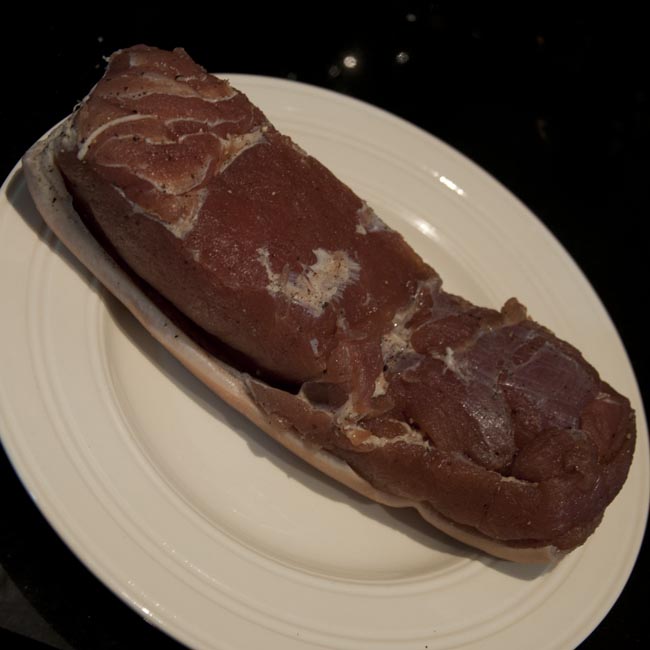
Dry cure applied, in bagIn addition to your piece of belly or loin pork and cure, you need a nice large freezer bag which is reasonably robust, and some sort of clip or bag tie to seal it.  Sprinkle a bit of your cure into the bottom of the bag, place the washed and dried piece of pork in the bag skin-side down, and then continue to rub cure on the meat until you’ve used about half of your total dry curing mix.  Seal the bag excluding as much air as possible, and put it in the fridge.

After 3 days, pickle in bagTurn the bag over from time to time (I turned it every time I went into the fridge for something else, but once a day is fine).  You will notice quite a lot of pickle accumulating in the bag.  After two days for belly, or three days for loin, take the bag out of the fridge.

Drain the pickle, and apply the rest of the cure, before returning the bag to the fridge for another three days.  Effectively we’re curing in a very concentrated brine made from the applied salt and the meat’s own water.  By this stage, at around the half-way mark, it’s already showing the changes I’d expect from successfully-curing bacon, which is a good sign!

Bacon out to restAfter these three days have passed (making a total curing time of five or six days depending on your bacon cut), take the bacon out of the fridge.  Remove it from the bag, rinse it off under the tap, pat dry carefully with kitchen paper, and return it to the fridge un-covered on a plate for 24 hours to finish drying and form a pellicle (that glossy, slightly tacky surface layer).  After that, wrap it loosely in a piece of baking paper and keep it in the fridge until you want to slice it and eat it.

I rested mine for three days before slicing – I was planning to put it through the smoker but the weather on my day off wasn’t particularly suitable.

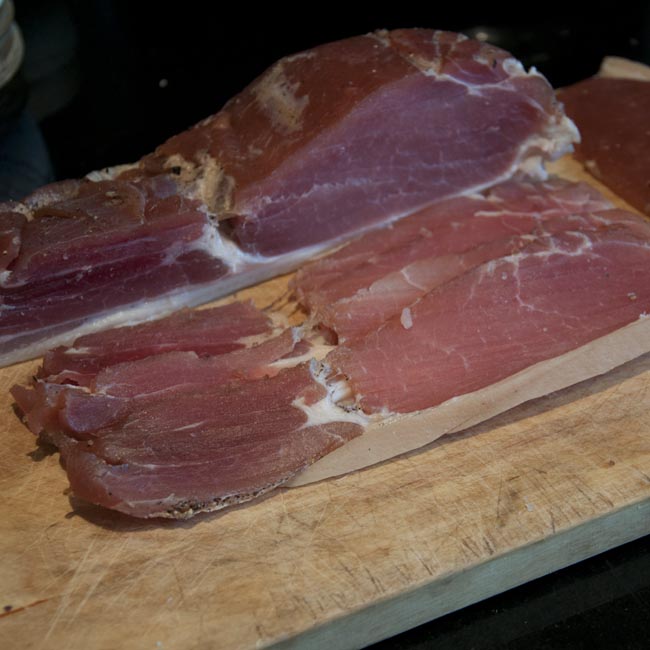
Sliced for breakfast this morning, the texture and appearance on slicing was exactly as I have come to expect from my home dry-cured back bacon.

Sliced bacon

I sliced away but retained the outside piece for lardons before carefully preparing four slices for frying.  The piece of loin pork I used was very lean, and needed a little olive oil to the frying pan to really get things going.  The bacon re-arranged itself in the pan as the rind buckled, but didn’t noticeably shrink, and there certainly wasn’t any of that nasty white watery muck we’re so used to seeing in commercial bacon!

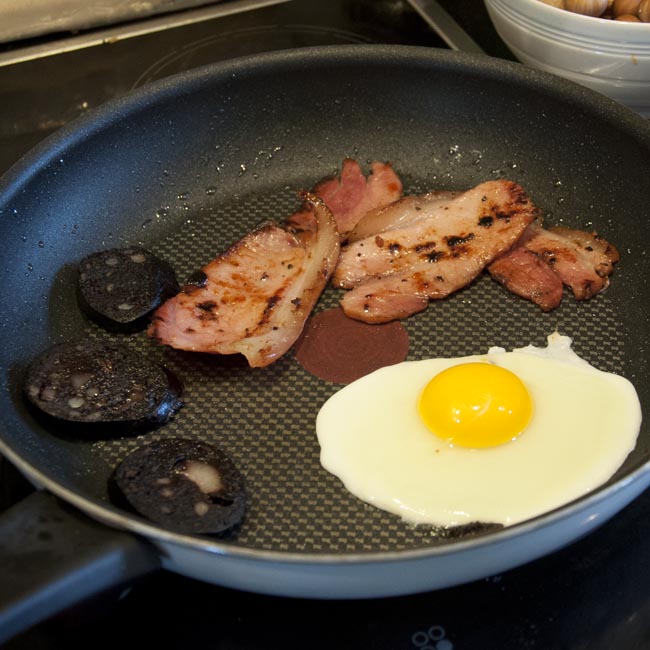
Bacon for breakfastBreakfast this morning was my bacon with some butcher’s black pudding and a fresh home-reared egg, served on a toasted English muffin.  What could be nicer on a lazy Saturday?

And tasting wise?  I would say I couldn’t detect a difference between bacon prepared this way, and my usual technique – but with one caveat.  One of my slices was the second-slice from the edge after the one I’d held over for lardons.  This slice, quite unlike the others, was unpalatably salty, with almost a salt ‘sting’ on the tongue.  I think this can probably be ascribed to the concentration of cure applied at once in this method, despite a good long resting period, the outside surfaces of this bacon are quite aggressively salted.  I would cut off a thicker end-slice in future when using this method – probably somewhere between 5mm and 10mm of the end grain at both ends.  Used in a stew or sauce, it would be fine, but it’s less than ideal to eat as sliced bacon.

So, if you want an *even* easier method for home-cured bacon, do give this one a whirl!  For me, though, it’s likely to be a technique I fall back on when I know I’m going to have a really busy week and still want some bacon for the following weekend.

See more Smoking & Curing posts >>

Read more from the Country Skills blog >>

Foraging Skills – blossom watch

Spring is in full flood now, with bulb flowers and that lovely acid spring green colour of young leaves appearing everywhere.  You’re likely to be seeing lots of frothy white blossom in the hedges, and that’s worth keeping your eyes out for.  The sort you’re looking for is on otherwise naked branches, and spread evenly over the bush rather than forming clusters.

Blackthorn blossom

This is the blackthorn (the name is no coincidence!) or sloe bush.  So if you’re a fan of sloe gin (and let’s face it, isn’t everyone?) and fancy making some this autumn, make a note of any really good stands of blossom you see in the next week or two.  Final identification takes a slightly closer look – single small white flowers, armed with some nasty spikes on dark coloured wood.  The leaves, when they appear, will be small and rounded.

Blackthorn blossom - close up

You’ll notice that the blossom extends quite a long way inside the bush – this is one of the things that’s going to make picking, when you get to it, a bit of a challenge!

Read more from the Country Skills blog >>
Foraging Skills – how to get ahead!

I’ve been thinking about foraging recently.  There’s very little quite as special as a lovely – and free! – treat garnered from a hedge.  I’m thinking about a wild mushroom risotto, pots of crab apple jelly, a steaming blackberry crumble or a bubbling demijohn of rosehip wine.  Foraging is really an autumn sport, though, borne from the season of mists and mellow fruitfulness, so why am I writing about it now?

The thing that makes a really good forager isn’t being able to spot a laden crab apple tree at three hundred paces  – it’s knowing where that tree is in the first place.  Being a successful forager depends on keeping your eyes open all year round – if you notice things now, and remember them, you’re well on target for a bumper summer and autumn foraging season.

So just now, keep your eyes open for these, and make a mental note –

Hazel catkins in hedge

They’re hazel catkins, and where they’re hanging in profusion from the naked branches of hedges and shrubby trees now, there should be some lovely cob nuts in the autumn – they’ll be much harder to see then, when there are leaves on the tree, and hazels growing in mixed planting aren’t especially distinctive looking.  Watch like a hawk though, come autumn, and pick them slightly green and sweet – because the mice will want them too!

A little note on the legality of foraging – if the item is being grown as a crop, then it’s not foraging, it’s scrumping (or stealing!).  It’s very unlikely that cob nuts or blackberries growing in a field hedge are intended as a food crop, but the nuts and sloes in my garden hedge definitely are!  So if it looks like someone’s caring for a tree or a hedge, it’s in an orchard or garden or looks intentionally planted, tread with care!  That said, there at lots of edible crops grown incidentally on trees planted ornamentally, on streets and in council amenity spaces, particularly in urban areas – foraging doesn’t have to be just a country pursuit! – look out for apples, plums and cherries, too!

Read more from the Country Skills blog >>
A little egg-centricity – all about the chicken and the egg

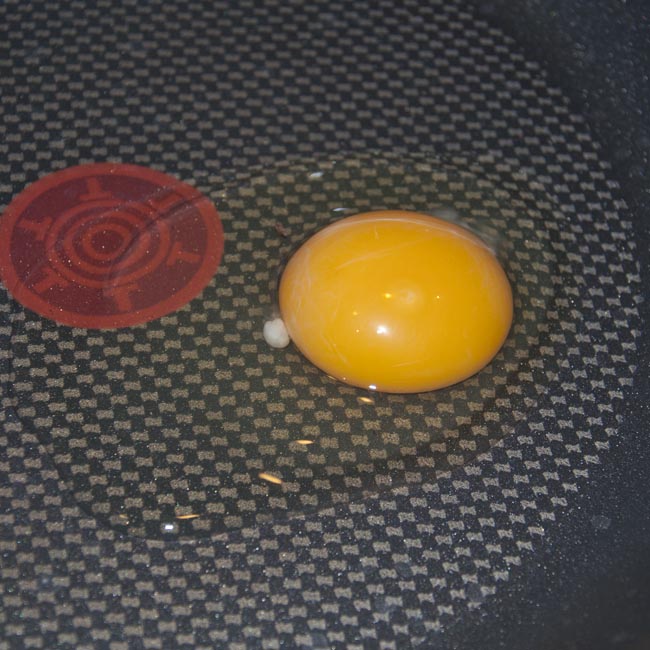
Nothing beats a really fresh free range egg.  For breakfast, fried or poached, boiled or scrambled, or for lunch in an omelette, a really fresh egg – preferably laid this morning – is head and shoulders above any other egg you’ve ever tasted.  You can see the difference straight away, even before you crack it – the shell may well be a bit grubby, and a slightly funny shape, an unexpected or uneven colour.  When you crack it open, the egg white is firm and ‘sits up’ in the pan, and the yolk is a deep orange, and bigger than you expected – if beaten, the raw egg is a rich dark yellow, rather than off-white.  In your mouth the yolk is velvety and rich, creamy and almost sweet with a luxuriant almost-custard quality and the white is firm but never rubbery – a million miles away from the flaccid anaemic and tasteless output of battery cages and the supermarket supply chain.

Fresh egg

It’s a sad fact that in the supermarket dominated, urban West, most people have probably never tasted a really good, fresh egg.  We think of eggs as being uniform, sized and graded, cheap and frankly, dull.  But they’re a natural product, and they vary – in size, colour and shape – and from the very firmest, freshest example, to the end of their storage life when the egg white is watery and the best of the flavour is gone.

I said nothing beats a very fresh egg, but of course that depends what you’re doing with it. If you want to beat the egg and use it to help with raising – in baking, or a soufflé – or you want hard boiled eggs peeled for a Salade Niçoise, then the very freshest eggs aren’t for you.  The egg white – the albumen – is actually in two parts.  The outer albumen is quite watery, you can see it spread out in the pan in the photo above.  The inner albumen is much more firm in a very fresh egg (but in an egg which has been stored for some time you probably won’t be able to see a distinction between the two).  In a very fresh egg this inner albumen has too much structure and tends to want to hold together, which doesn’t allow the batter to rise properly.  Furthermore, if you hard boil a really fresh egg and then remove the shell, the outer albumen will come away with the shell, which is a waste and makes for a scruffy-looking boiled egg.  Eggs about a week old are best for baking and hard boiling – realistically you won’t get eggs much fresher than this from the supermarket, though.

Egg storage

These are my eggs, and three things are obvious – first the range of shapes and sizes, secondly that they’re in some sort of wire device (it’s called an Egg Skelter, and I wouldn’t be without it) and not in the fridge, and thirdly that, frankly, they’re a bit grubby!

The size variability is something that you have to make adjustments for with ungraded eggs.  My approach is to weigh them and then adjust according to standard size references.  The Lion Egg Scheme people have a size guide here.

Fresh eggs will keep safely at room temperature for 3 weeks (it’s no coincidence that this is the length of time they have to stay ‘fresh’ under a warm hen if being hatched!), but if you do put them in the fridge, then you need to leave them there.  If eggs are removed from refrigeration, moisture condenses on the outside of the shell and can then be drawn through into the inside of the egg by osmosis, potentially pulling pathogens from outside the shell into the egg itself and increasing the risk of food poisoning.  My eggs don’t sit around for anything like three weeks (if I have a glut I know plenty of people who are happy to help me deal with it!) so storage at room temperature is ideal.  Better still, the egg skelter enforces first-in-first-out use, which is trickier with other storage systems.

So you’d think washing the dirt from the outside of the egg would be a good idea, right?  In fact dissolving these contaminants in water, and disrupting the outside surface of the shell, also increase the risk of pathogen entry.  Much better to leave grubby eggs as they are, and rub off any loose dirt and mud from the surface just before use.  Egg washing is not permitted in the production chain for commercial shell eggs in the UK, on a risk assessment basis, though it is common practice in other countries including the US (they tend to wash in a chlorine solution – because bleach is what you want in your eggs!).  This goes some way to explaining the obsession with clean eggs in intensive production systems – and the resulting battery cages (improved, but not yet gone), as ‘dirty’ eggs are downgraded.

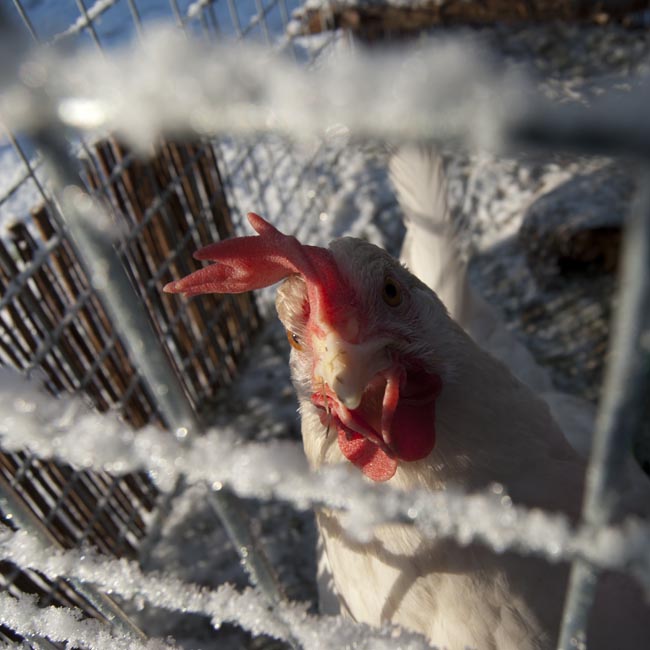
I’ve kept hens for two and a half years now.  I wasn’t expecting get as attached to them as I have, they’re fascinating animals.  Funny feathery little dinosaur-descendants they certainly are, they’re inquisitive, social (and not always sociable!) little creatures.  Only when you’ve watched hens scratch around for bugs, enjoy a bit of a flap and a wing stretch, and then settle down into a well-earned and apparently thoroughly indulgent dust bath, can you really start to understand how inhumane intensive cost-led egg production systems are.  This is Gertie, by the way, my ‘top hen’, being a bit confused by her first sight of snow, and wondering what I’m doing with that camera.

Outdoor hen

You may not be able to keep your own poultry, but if only for the sake of your palate (never mind the quality of life of the poor intensive egg-producing bird) it’s worth seeking out the best and freshest outdoor reared eggs you can find – farmers markets and farm shops are a great place to start – or ask around, you may be surprised to find a colleague keeps backyard hens, and if you’re really super nice to them, they may be prepared to share! Then, enjoy your wonderful, freshest eggs, with the best home cured bacon for the most amazing breakfast fry-up you’ve ever tasted.

Read more from the Country Skills blog >>