Time: an hour or two – Difficulty: low (assuming you can use a sewing machine) – Cost: less than £5
Don’t you love bunting? Not only is it very pretty, it seems to be bang on trend right now, if the smart interiors boutiques where I can’t afford to shop are anything to go by!

A while ago, I (maybe foolishly) volunteered to make a load of bunting to help decorate the village hall for my little sister’s wedding reception. Before embarking on the epic effort, I thought it might be best to do a mini version to iron the kinks out of my process. Christmas is coming, so what better than a bit of Christmas bunting for the hallway?
For this project, you will require –
- A sewing machine (capable of straight stitch – so any sewing machine will do!)
- Straight scissors and pinking shears
- Scrap card for a template
- Bias tape, as much as you want your bunting to be long, and the colour of your choice. Double fold tape will save you the fold-and-iron process, but may not be as easy to get hold of.
- Sewing thread to match or contrast with the bias tape. I find if I’m trying to match a colour and I don’t have a really close match – as in this case, all my greens were too light or too yellow – it’s better to find a neutral colour which matches the tone. I used a dark grey for this bunting.
- Some suitably festive fabric. I used mainly scraps left over from previous Christmas crafting. If you want to use new fabric a single fat quarter should be enough to make 6m of bunting with quite modest 4″ x 6″ pennants spaced 6″ apart.
Realistically you probably have all of the non-consumables or none of them – 6m of bias tape cost me less than £2, and I had the leftover fabrics already.
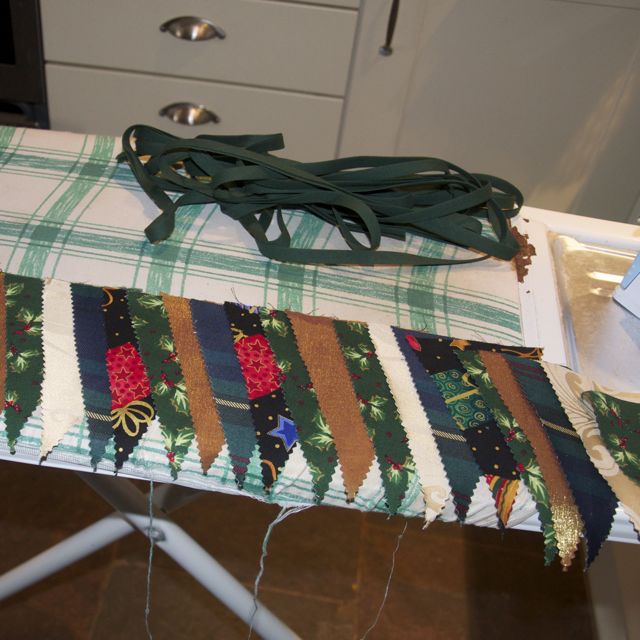
This is a single-sided bunting, if you use printed fabrics like I have. If you use fabrics which have two good sides, of course, you don’t need to worry about that. I like the effect of the pinking-sheared edges, and it saves an awful lot of time over hemming.
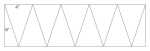
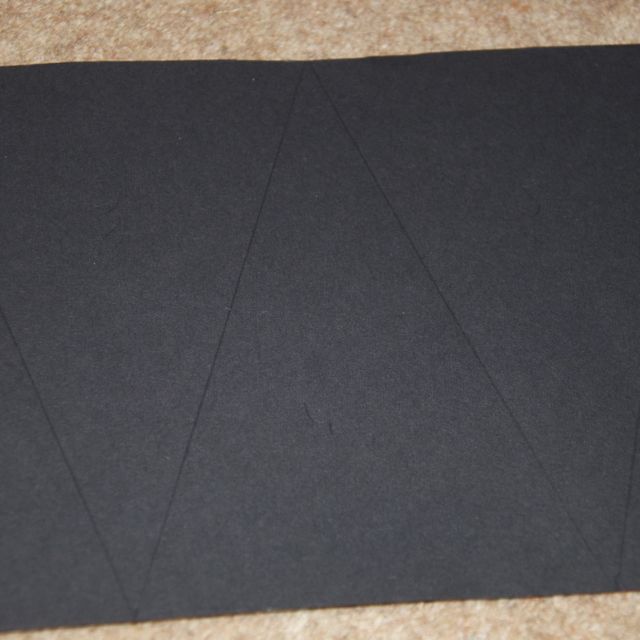
 Start by making your template. I drew mine out for triangular pennants 6″ long and 4″ wide at the top (the whole template is 20″ x 6″). If you’re using lots of small fabric scraps, you may also make to want a template for a single or a pair of pennants. Give some thought to what spacing you’re going to want to have between your pennants. I went for 6″ – the same as the length of the pennant. Any more than this I think looks a bit sparse, closer and you’ll need more time and fabric to make extra pennants – at the end of the day it’s up to your taste! Work out how may pennants you’re going to need by applying some basic primary school maths to the problem. Remember to leave a bit more bias tape at the ends to give you enough to tie the bunting by.
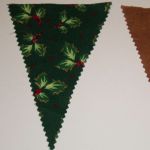 Using your template, mark up your fabric. I used a biro to mark up the back of the fabric. You might want to use something a little less crude, if you have it! Then cut the top of the pennants with the straight scissors, and the sides with the pinking shears. You’ll notice the lines I’ve cut aren’t quite strictly straight, because my pinking shears aren’t long enough to cut the side in a single action. I don’t think it matters!
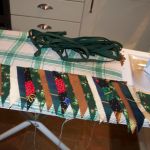 Once you’ve cut all your pennants, it’s probably a good time to iron them. At the same time, if you’ve bought single fold bias tape (bias tape which has the two edges folded in but isn’t yet folded in half) then use the iron to fold this in half and set the fold. Then decide how you want your pennants ordered, if they’re not all the same.
 Now, starting from the centre to ensure they’ll be evenly distributed, start pinning your pennants into the bias tape. I marked my 6″ gap onto the edge of a piece of card to help me space them consistently – it’s quicker than using a measuring tape or a ruler every time. Try to be reasonably accurate but don’t stress over it.
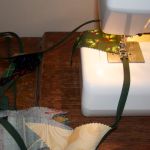 Once all your pennants are placed, it’s time to sew. I just used a single row of straight-stitch as close to the open edge of the bias tape as it was practical to do quite quickly. You could also use a zig-zag stitch, if you prefer. As you get to each pennant, just make sure the top is placed as far into the fold of the tape as possible, and lying nice and flat, before you sew it in place.
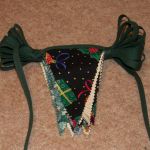
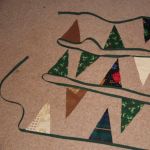 That’s it, keep sewing until you’ve reached the end of your tape and all the pennants are secured in place.
Doesn’t it look pretty? I can’t wait for Christmas now!
Read more from the Country Skills blog >>

 Christmas bacon – first attempt




 Country Skills for Modern Life