Basic Butchery – how to portion a chicken

A whole roast chicken is a wonderful treat – more on that later – but it’s not the sort of meal most people want to wait for on a week night after work.

We eat a huge amount of chicken in the UK, and a lot of that is bought pre-portionned and packed from the supermarket, it’s certainly convenient and the portion sizes are more practical.  We’re in love with breast meat in this country, to the extent that the UK is a net importer of white chicken meat – mostly from Thailand and other East-Asian countries – and an exporter of leg meat.  When you think about it, that’s pretty bizzare, not great for the environment (think of the fuel involved in sending the ‘wrong’ chicken backwards and forwards half way around the world!), and leaves us eating lower health and welfare-standard poultry meat than would have been produced in the UK.

Fully portioned chicken

It’s really easy to portion up a whole chicken, and learning this basic butchery skill will save you money.  Even if you just buy a ‘bog-standard’ roasting bird from the supermarket, you get more for your money buying a whole bird and cutting it up yourself, and the savings are even better if you’re buying free range or organic chicken.  And with a bit of kitchen creativity, one whole chicken can provide three or four meals for two people, as well as a lovely batch of chicken stock – bargain!
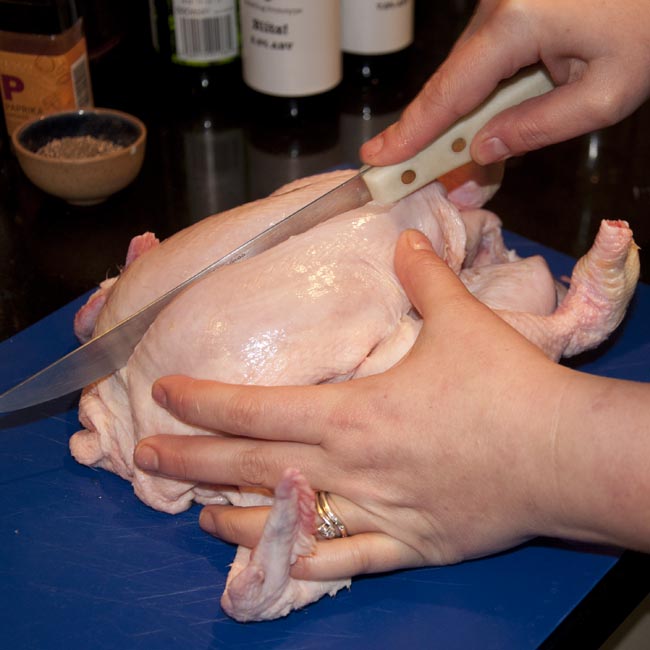
First, un-wrap your whole chicken and remove any trussing string / elastic holding the legs together.  Pat it dry with kitchen towel as this will help with handling it while you’re cutting it up.  You will need a very sharp knife with a long but reasonably slender blade.  Feel down the centre of the bird, and you should feel a bone running the full length – this is the ‘keel bone’.  Starting on this line, cut downwards parallel to the bone along the full length until your knife stops.

You can now pull the top of the breast away from the keel bone to get a better look at what’s going on.  The bone beneath the knife is the ribcage, so continue carefully cutting the breast meat away from this.  If you work carefully you’ll leave surprisingly little meat behind on the carcass.  After you’ve done this a few times, you’ll get a lot quicker, but speed is not of the essence the first few times.
Once the breast meat is mostly free from the bone, cut the skin between the breast and the thigh and finish removing the breast from the bird.
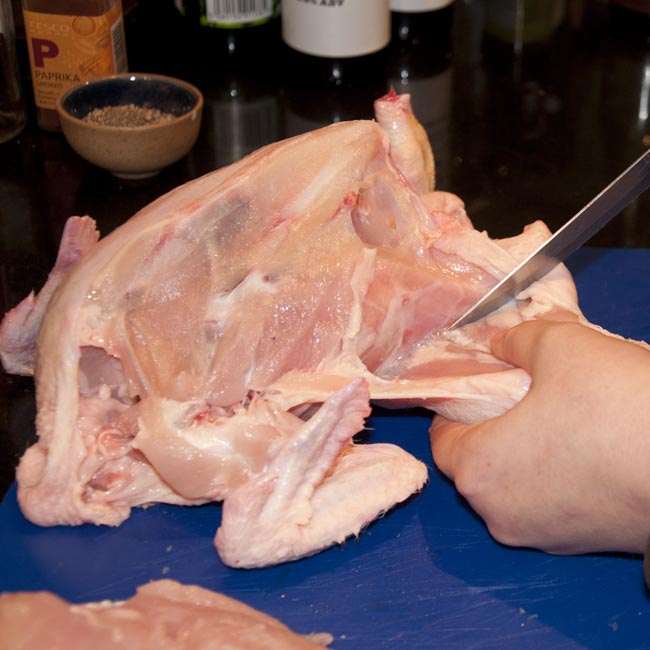
Portioning chicken - step 4Now we need to detach the legs.  Grasp the thigh and extend the leg away from the body.  You should be able to feel the hip joint (indicated with the knife point in this photo).  Insert the knife firmly into the joint to separate the leg from the body, then cut the leg meat away from the torso leaving as little as possible behind.
Portioning chicken - step 5

Grasping the wing in the same way, identify the joint and push the knife firmly through it, separating the wing from the body of the bird.
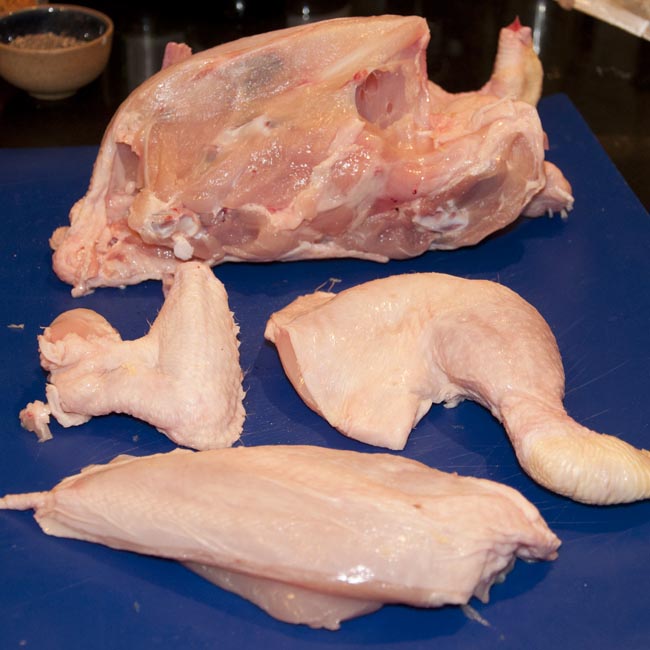
Portioning chicken - step 6Congratulations, you’re half way there!  Repeat the process on the other side of the bird.

You will now have two breasts, two legs, two wings, and the remains of the body.  Put the body in a saucepan ready to make stock.  You may be happy with the portions you have now, but more commonly we’d divide the legs into thigh and drumstick portions
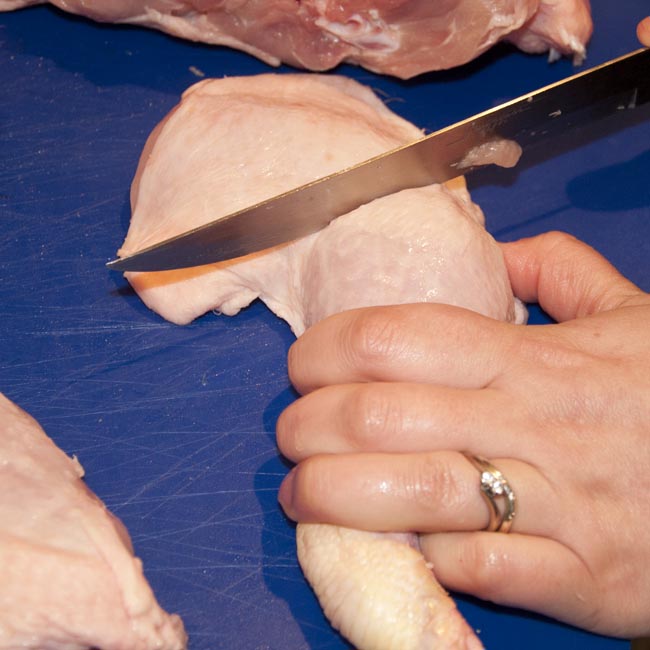
Portioning chicken - step 7Grasp the leg, and feel where the joint moves between the thigh and the drumstick.  Simply cut down firmly along this line.   If you’re accurate your knife will pass through the joint space, but the bone here is actually quite soft so if you’re not quite on target, you should be able to cut through anyway, it will just take a little bit more force.   Cut off the ‘knuckle’ part at the bottom of the drumstick in the same way, and discard these (the only bit of waste in the process, as it happens!).
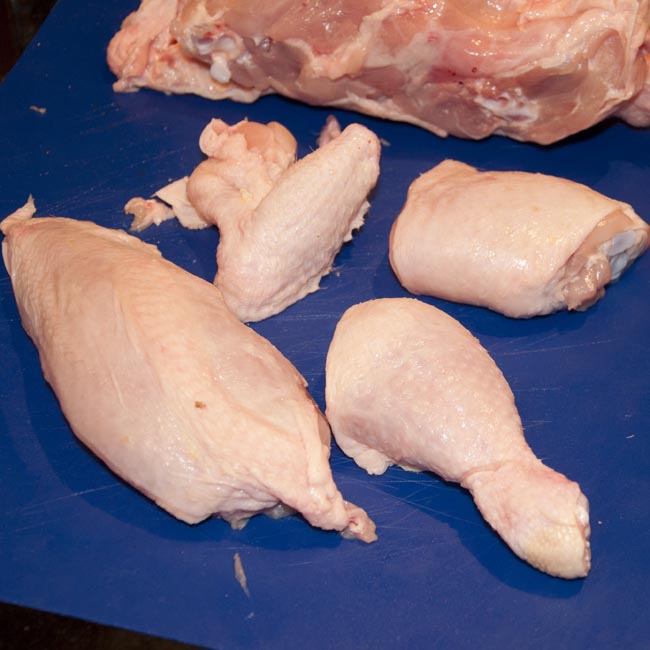
Portioning chicken - step 8You’re there – one whole chicken transformed into two breast portions, two thighs, two drumsticks and two wings, to do with as you please.  With practice it’s less than a five minute job.  Better still, think of the costings.  With standard supermarket chicken (I costed this in my local co-op the other day), starting with a £4 bird, and bearing in mind two breast fillets retail for £3 (smaller fillets than you’ll get from a roasting bird, with the skin off and frequently robbed of their ‘mini fillets’, too!), you’ve just got two thighs, two drumsticks, two wings, and a pint of excellent fresh chicken stock for £1.  Use what you want today, and bag and freeze the rest.  How’s that for thrifty!

I said I’d come back to roasting chicken.  That’s for the next post!

Read more from the Country Skills blog >>

Frugal Food – stuffed breast of lamb, roast dinner on a budget

Breast of lamb is a rather unfashionable cut these days.  In my household it’s usually known as ‘lamb belly’ by analogy with the matching cut of pork.  It’s made up of the abdominal body wall, starting with some ribs just in front of the diaphragm and extending backwards. Folded in three and wrapped in cling-film, it’s a rather uninspiring looking cut. You won’t get it at the supermarket, and it won’t be on display at the butchers, but if you ask it’s likely you’ll get a whole one for not much more than £1.  With a very little bit of effort, you have one of the most cost effective (and tasty!) roast dinners you can buy.

We first discovered breast of lamb when we started buying half-lambs from local smallholders.  I wish I’d discovered it when I was a student, I could have had some fantastic roast Sunday dinners on a budget!

This is a great meal made almost entirely from the store cupboard.  You will need:

  • One breast of lamb
  • Some breadcrumbs
  • An onion (red or white)
  • Garlic, several cloves
  • Rosemary, thyme, sage (fresh or dried)
  • One egg
  • Kitchen / butchers string
  • Potatoes / parsnips / sweet potatoes / swede
  • Some green veg (I had some frozen peas, but anything will do)
Deboned breast of lamb

Deboned breast of lamb

First of all you have a little bit of butchery to do.  It’s unlikely the ribs will have been trimmed out, so you’ll have to do this yourself.  Be careful, and patiently cut around and along each rib with a paring knife and lift it out from the ‘inside’ of the breast.  With practice this is no more than a five minute job, though it might take a bit longer to start with.  It’s likely your breast has been in the fridge, so the meat will be cold.  Stop if you notice your fingertips getting numb, and rinse them under warm water to warm them up again – you’ll have less sensory feedback from cold fingertips and you’re much more likely to make a mistake and cut yourself – which is not the aim of the exercise!

Stuffing ingredients

Try to preserve as much meat as you can attached to the breast – but if you accidentally cut a piece off (and there are some annoying bits of diaphragm which are quite tricky to keep attached) just put it back as you’ll be rolling and tying the ‘joint’ later.

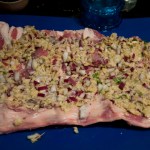
Stuffing on the breast of lamb

Now make the stuffing.  Mix the finely chopped onion, crushed / minced garlic, breadcrumbs, herbs and egg together.  Season with a bit of salt and pepper.  Then spread this across the inside of the breast and roll it up, starting at the narrow end (where the ribs weren’t).

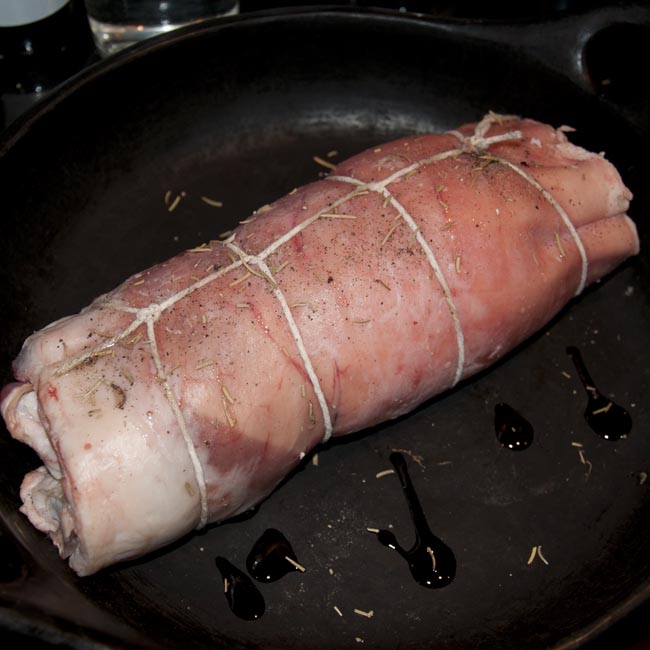
Tied rolled breast of lamb

Tie the rolled joint up with string using a butchers knot.  This involves making a series of linked  loops and tying off at both ends, and is a useful knack to learn.  It’s also not dissimilar to the knotting technique used for casting a cow!  Put the rolled join in a roasting dish, drizzle with olive oil, sprinkle with pepper and dried rosemary, and put into a low oven (about 160C) for two and a half hours.

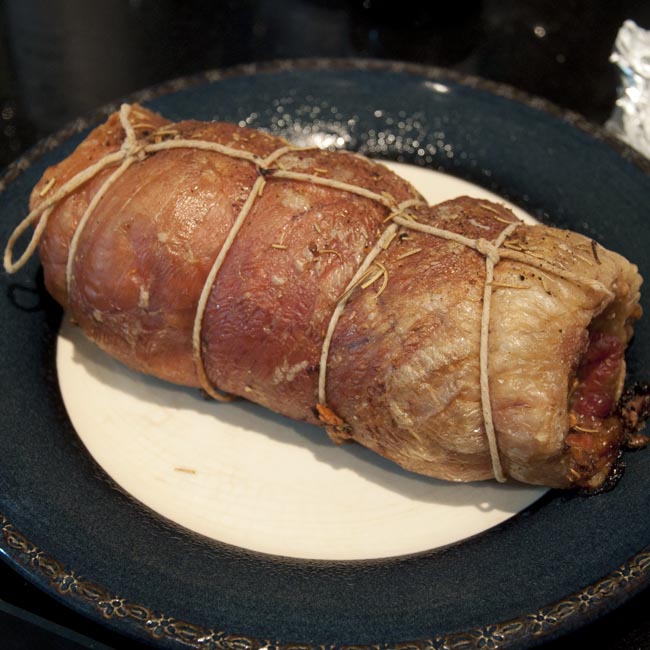
Roasted breast of lambPrepare whatever roast veggies you prefer (I did spuds and sweet potato) and start these at the appropriate time.  You could even have yorkshire puddings (we did!).

Carved roasted stuffed breast of lambThen in due course get the joint out to rest, prepare your green veg and gravy, and dish up.  Add some nice fruit jelly, if you have some.  Crab apple and chilli jelly was a perfect accompaniment.

This is a fabulous roast dinner, and will serve three or four for nearly nothing – we’re greedy so it fed two hungry adults!  Serve with a nice beer or a glass of red wine, and enjoy!

Roast breast of lamb with all the trimmings, served and ready to enjoy

Read more from the Country Skills blog >>

Homemade Gifts – hyacinth bulb and hydrogel beads in a jar

Lovely, fragrant bulb flowers are one of the first signs of spring.  I especially love hyacinths, with their intoxicating perfume, and particularly growing indoors just a little bit out of season.  They’re like a floral promise that the end of winter *will* be along, just around the corner.

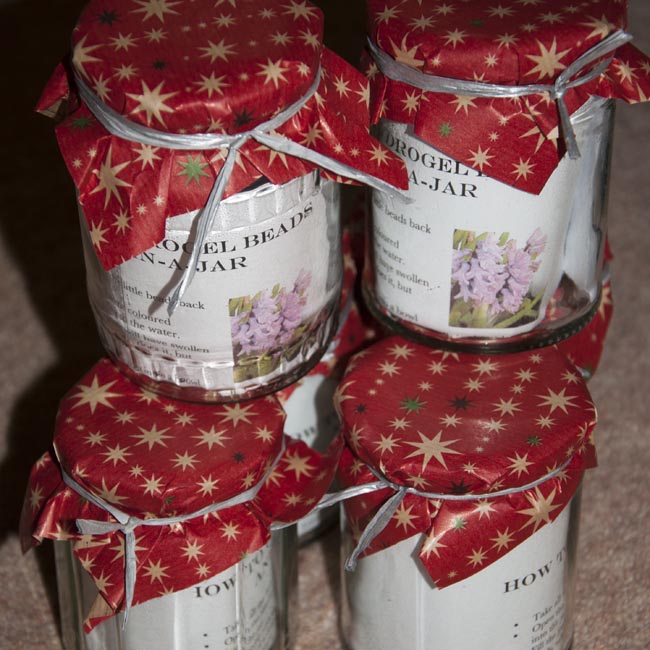
Hyacinth Jars, ready to give

Many of the gifts for my friends and family have been homemade this year – of course I couldn’t write about them before the big day, because that might have ruined the surprise! One of my favourites is a ‘prepared’ hyacinth bulb (heat/cold treated for indoor forcing – this is important, as unprepared ‘garden’ bulbs won’t flower if grown in this way) in a jam jar with hydrogel beads (sometimes called ‘water crystals’).  Hydrogel beads are one of the coolest, weirdest things I’ve come across in a long while.  They start out as a tiny little packet of small clear-plastic looking ballbearing things, but when soaked in water overnight, the contents of the tiny little packet will swell up to fill a whole jam jar.  Better still, the ‘reconstituted’ hydrogel has a refractive index so close to water that they’re essentially invisible if they’re below a fluid level, which, you have to concede, is very cool, in a geeky sort of way.

Once you’ve got over the excitement of the whole thing (I know, right?), how do you make them either into a gift or into a lovely spring treat for your own window ledge?

Hyacinth Jar - 'ingredients'For gifting, simply pack up the pouch of dry hydrogel beads and the prepared hyacinth bulb into a washed and dried recycled jam jar (I took the opportunity to use up some of the pickle jars with too much residual ‘taint’ to use as jam or jelly jars), with an instruction sheet (we’ll get to that).  Do up the lid (but don’t worry if you don’t have one) and top it with a pretty bonnet of fabric or Christmas wrapping paper tied on with ribbon.  What could be sweeter?

No, you can’t have my instruction sheet, write one yourself!  But the process is very straightforward.

  • First, you’ll need to reconstitute your hydrogel beads.  Do this in the jam jar, by emptying the tiny pack of beads into the jar and topping up with warm tap water.  I know it seems very very unlikely that this will work, but indulge me here, and leave them overnight.  The next morning, marvel as you discover the beads filling the jar.  It’s very cool.  If you wanted to be a bit psychedelic, you could add a drop or two of food dye to the water to start with, and this will be taken up by the beads.
  • Drain the beads, leaving them in the jar.  Marvel some more.
  • You want the fattest part of the bulb to sit in the ‘neck’ part of the jar, so work out if you need to remove some beads to get the level right, then place the hyacinth bulb on top of the beads.
  • Top up with water to just below the base of the bulb.
  • Now place the bulb in a cool dark place (a larder cupboard is ideal, an airing cupboard isn’t!).
  • Once there are roots growing and green growth is visible in the top of the bulb, move it into a bright place.  This will take a week or two.
  • Keep the water topped up every so often but avoid having water directly in contact with the base of the bulb as this will encourage mould to grow and may make the bulb rot.  The hydrogel beads will make it a lot more forgiving of marginal drying out than a traditional hyacinth bulb vase.
  • Wait for the hyacinth to flower, which will take another three or four weeks.  You may need to find some way to help keep it propped up, though usually they flower in quite a compact way so you might be lucky!

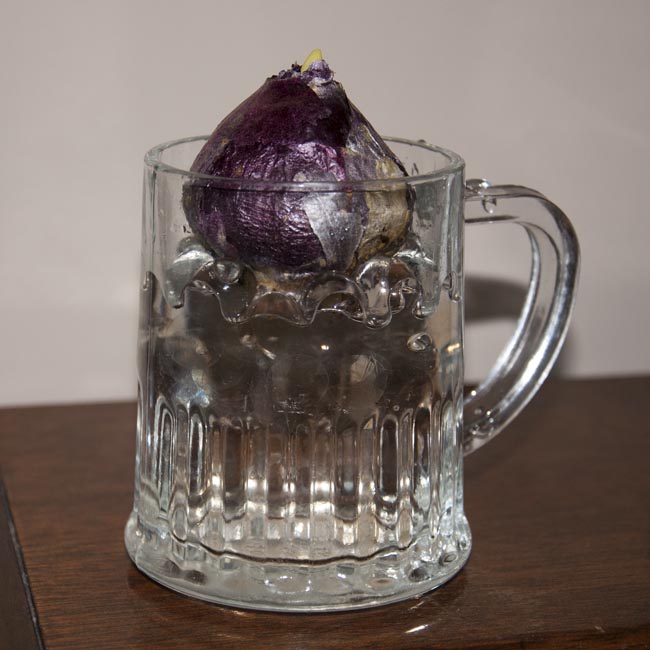
Hyacinth tankardOf course, you don’t need to restrict yourself to jam jars, all sorts of receptacles will do the trick!

These make a very original, eye catching and fun little gift – I used mine as stocking fillers and as part of hampers.  They cost very little, I sourced the bulbs for just under a pound each (in packs of twelve) and they hydrogel packs come in about £3 for ten.  I have three of the bulbs growing together on hydrogel in a small vase, which I started a couple of weeks ago, and they seem to be going well, with great root growth and a nice bit of green emerging!

Last Minute Christmas – perfect giblet stock

If you’ve bought a bird for roasting today, there’s a good chance it’s come with a little plastic packet of ‘bits’.  Whatever you do, don’t throw them away!

These bits are the giblets – the offal – usually the neck (in one or two pieces), the heart, the liver, and the gizzard.  The gizzard is thick, muscular structure with two hard abrasive grinding plates that the bird uses to crush up corn and other food items to make them digestible.  Giblet stock is quick, simple, and makes the most wonderful Christmas gravy.

I have a goose this year, but the following applies just as well if you have a chicken or turkey.  Personally, I use the goose heart and liver in one of my stuffings, so only the neck and gizzard are available for the stock.

In addition to the giblets, you need the following:

  • Stock vegetables.  I use one onion (red or white) and a couple of carrots, I don’t like celery so I don’t use it, even though it’s the often-quoted third member of the stock vegetable trinity.
  • A bouquet garni.  This is just a posh culinary term for some herbs. I use some bay leaves, rosemary, thyme and sage, along with some whole pepercorns and a few juniper berries.  Dried is fine.
  • Water.  Glug of white wine (optional).
  • A splash of olive oil.

Prepare your gizzard by cutting away and discarding the hard plates (use a small sharp knife inserted below and parallel to the plates) and chopping the rest of the meat roughly

Put the splash of olive oil into a nice big saucepan, and brown the neck and gizzard meat, and then add the roughly chopped onion and carrots and sautee for a couple of minutes.  Now add about a litre of water (and the splash of white wine if you want) and the bouquet garni, bring to the boil and simmer for about an hour.  Strain, discard the solids, and return the stock to the pot and boil again until reduced in volume by half.  That’s it.  Set aside in the refrigerator until you make your gravy later. You won’t regret it!

Heat and Light – how to clean the glass on a wood-burning stove

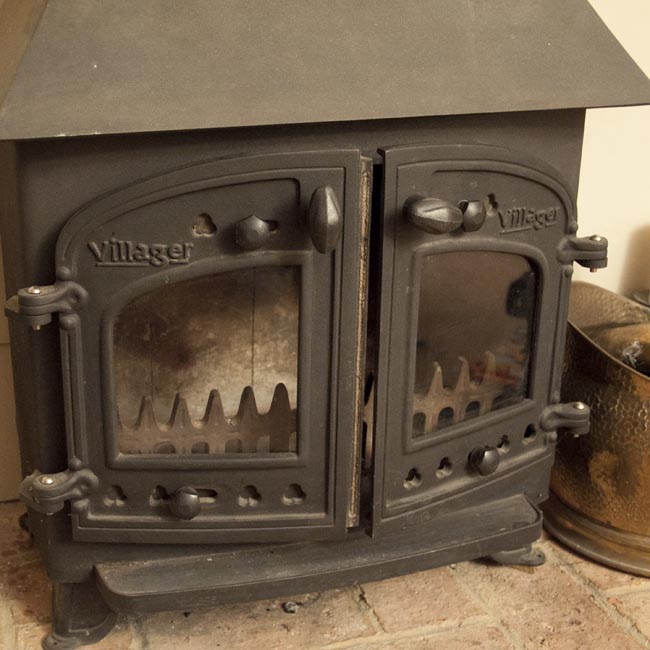
Everyone loves a real fire!  In common with lots of people in rural homes without access to the mains gas network, we use a multi-fuel stove for some of our heating.  Wood burning stoves are becoming more popular in urban areas, too.

Wood-burning stove

If you have an old stove, it’s likely that before too long you’ll find yourself having to work out how to get the soot off the glass.

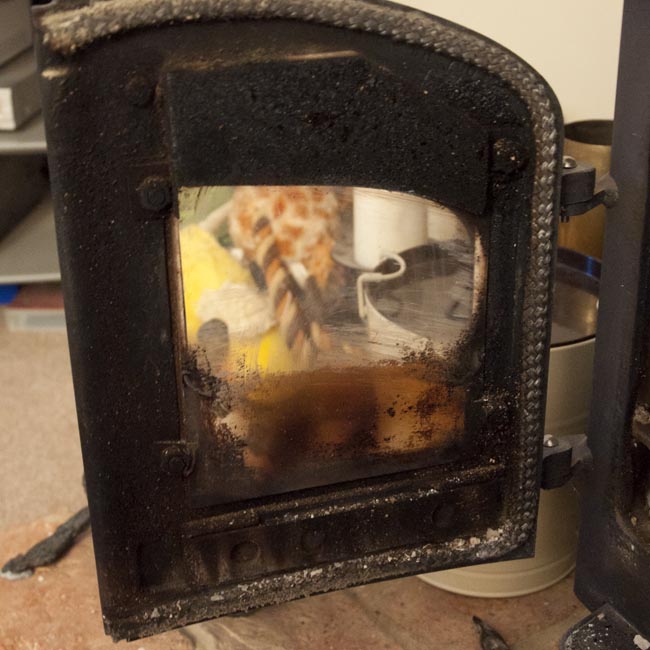
Sooty glass on wood burning stoveI’ve tried oven cleaner.  I’ve tried multisurface cleaner.  I’ve tried a pan scourer, soap and hot water.  Giving it a damn good scrub works a bit, but is very hard work.  I’ve even tried expensive, specifically designed cleaner for the glass on multi-fuel stoves.  Nothing worked convincingly or easily, and the stuff in the aerosol stank, too.  Meanwhile the glass was getting blacker and blacker, and we were deprived of the gorgeous sight of flickering flames, to the point that we were wondering how easy it would be to replace the glass.

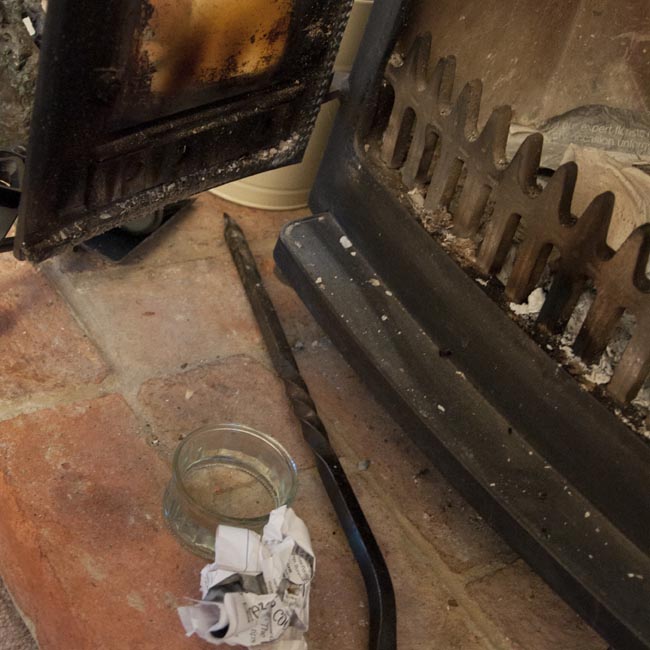
Necessary equipmentThe answer is as easy as could be.  No solvents or volatile chemicals, very little effort, and you have all the things you need already.  Strange as it may seem, you need some newspaper, some ash, some tap water, and a very little elbow grease.  And a wood-burning or multi-fuel stove, of course, but if you haven’t got one, you probably haven’t bothered to read this far.

Time: 30 minutes – Difficulty: simple – Cost: free

Glass half cleanedScrunch up about half a sheet of newspaper.  Dip it in the water and squeeze out the excess.  Then dip it into the ash.  Now use this, gently, to rub the glass.  You should notice it working straight away, which is very gratifying.  The water and ash forms a really fine abrasive slurry, which lifts the soot from the glass with very little effort.  When the paper starts to get really black and stops working again, get a new piece, and repeat the process as often as required.  Getting both doors of my fire cleaned took about half an hour.  They’re *sparkling*.

Job done!A small word of warning – if your glass has some sort of clever protective coating, this approach may not do it any good…  Then again, if your glass has some sort of clever protective coating, and is still sooted up, you might reasonably take the view that it’s not working anyway!

Go on, try it!  I know it sounds mad but I promise you won’t be disappointed!

Read more from the Country Skills blog >>