Living in Glass Houses – DIY greenhouse build

I have to admit to having wanted a decent greenhouse for as long as I can remember. Growing up, my grandmother’s neighbours had a beautiful greenhouse and vegetable garden, which I used to admire from over the fence, and I suspect my life-long enthusiasm for the glass-house springs in part from this!

Dave, showing off his new greenhouse!

Apologies, incidentally, for the quality of the photography in this post – I made the mistake of thinking I had enough on my hands and that photos from my mobile phone would be ‘good enough’ rather than worrying about the SLR as well as everything else.  The photos took ages to tidy up and even now aren’t really up to my usual standard!

A little while after Christmas, while we were watching telly, I asked hubby whether we were really going to get on and build a greenhouse this year.  Yes, he agreed, we definitely were. So I did a bit of digging around, and had more or less decided that for what we required, a baby polytunnel was probably going to be more cost effective and sensible.  Then, deploying his superior (well, so he says) google skills, he turned up a 6ft x 10ft aluminium and polycarbonate greenhouse for about the sort of price I was finding for tunnels.  It seemed like a no brainer, so we got on and ordered it. It arrived a week or so later.

It’s been sat in the garden in two boxes since then, of course, because the weather we’ve had this winter can only be described as ‘not compatible with construction projects’.  As it happens, I’ve given up complaining about the weather for Lent (yes, it’s been that bad!), so I’ll spare you the details.  It finally started to dry out a little a couple of weeks ago, so we finally had a window to get going with the ground works.

The intended site for the greenhouse is on our ‘paddock’, which is a scrappy bit of ridge and furrow pasture land, most of which we planted for an orchard three years ago.  The grass is very established and the land isn’t level (the clue is in the ‘ridge and furrow’!). The only way we were ever going to get a level frame for the greenhouse was to dig a ‘slot’ for it out of the pasture grass to level it, and set a frame of breeze-blocks on which to rest the building.

You’ll need a good spade, a turf cutting tool and ideally, a mattock. We measured out the 6ft by 10ft rectangle and got to work.  Once we’d cleared the space, it occurred to us to consider in more detail the ‘6 x 10ft (aprox)’ size given on the greenhouse packaging.  It turned out the greenhouse was sized in something that could only be described as ‘metric feet’ by its German manufacturers.  Armed with the metric measurements, we enlarged the slot by a reasonably generous margin, and turned in for the evening, pleased with ourselves for having completely cleared the required space, and confident we could crack right on with building the greenhouse the following day.

The next day dawned cold.  Really cold – barely above freezing, in fact, despite being late February.  Undaunted, we put on our ski jackets and thick woollen socks, and headed back out to the greenhouse site. We’d gathered together enough lightweight breeze blocks to do the job – the sort that are made from a sort of concrete ‘froth’, a bit like an aero bar, and would float, if you let them.  Our sophisticated building and levelling tools were the spade and mattock from the previous day, a spirit level, and some string.  The blocks themselves were to act as ‘squaring’ guides, in due course.  And, as we hadn’t yet managed to pick up a bag of sharp sand, we had only the soil itself to use to pack the blocks straight and level.

Assembling the brake blocksThe first course of blocks assembled itself quite straightforwardly.  The mattock is a great help in cutting a clean trench, and then the blocks just go in one after another, with a check on level and height adjustment on each.  After setting the corner as square as we could using one of the blocks for reference, a couple of pegs and a length of string set the alignment for the next course.  Things were going well!

Two courses more or less complete, we wanted to make sure we had the right dimensions for the greenhouse, so we decided to get out the base from the kit and get that assembled for reference.  This done – and it was nice and straightforward (though it revealed that the assembly instructions were a ~50 page pictographic document, in the IKEA tradition) – we offered the frame to the greenhouse site, and discovered our slot was too narrow, given the width of the blocks.  In a stroke of good luck, we also discovered the base build could be bodged to use only whole blocks, which was a huge bonus.

Three courses placedCarrying on with the cut, measure, level, we had three courses installed.  We laid out, crudely, the blocks for the fourth course.  Inevitably, this is when you discover that, rather than a neat rectangle, and despite your most careful efforts, you’ve built some sort of trapezoid only theoretically known to mathematics. A bit of head-scratching and adjustments to the squaring, requiring a bit of extra turf cutting, and we put down the fourth course.

Greenhouse base, complete

It had been trying to snow all afternoon, and we’d been outside for five continuous hours laying the foundation blocks. It seemed apparent that one of the corners (the back one, in this photo) was lower than it should have been, but we were running out of energy, and light.  We tidied up and came back indoors, and gave up for the weekend.

Pro-tip: you know you’re really, properly, cold to the core when you *start* shivering several minutes after you get into a nice warm bath…

Skip ahead, then, through a working week to this weekend.  Finishing the greenhouse was our main order of business.  The weather, at least, is improving – no snow this weekend and even moments of sunshine!

Fixing the base down onto the blocksFirst up on Saturday, completing the levelling of the base.  Easy enough with the base frame sitting on top to confirm our suspicion that the back corner was ‘down’.  We’d got hold of a bag of sharp sand, so correcting this by lifting the two sides progressively was pretty straight forward.

Then, after placing the base as square as we could on top of the blocks, we marked the fixing holes, drilled these out with a hand drill, and then after placing rawlplugs, screwed the greenhouse frame down into place.  (Hint – mark carefully, and then *check* – it’s annoying when the holes aren’t quite in the right place!)  Skip any holes which are really close to an edge, as the block will just crumble away. Note that we’ve used no mortar at all in constructing this base.  You could, of course, if you wanted a more permanent foundation.

Out of the ground at lastThe sun was thinking about coming out, and we were ready, finally, to get the greenhouse build out of the ground.  The construction guide is purely pictorial, and weighing in at 51 pictographic pages, is something out of a flat-pack-furniture-phobe’s screaming nightmare. In the end, it’s just a question of following the instructions, as carefully as you can.

Our greenhouse was manufactured by ‘Palram’ and is a ‘crystal clear’ (read vaccuum-formed, single-ply) polycarbonate glazed aluminium framed greenhouse.  We bought it via B&Q but their greenhouses are stocked by lots of different retailers.  We’d built a tiny (6ft x 4ft) polycarbonate and aluminium greenhouse in our previous townhouse garden, and I was expecting the same, two-ply corrugated polycarbonate glazing that we’d had before, and which we were very pleased with.  I can only surmise that the insulation properties of this single-ply material won’t be as impressive as the other option.  And handling the glazing panels, which seemed alarmingly lightweight, was a bit hairy in places.  That said, once complete, the finished greenhouse does seem reassuringly ‘solid’. So, time will tell!

Side panels installedBut, back to the build.  Proceed carefully according to your pictograms.  Those on the cover informed me two people would be required, and that was certainly the case – at various times this build would have been completely impossible to perform single-handed. I was expecting to assemble the four walls individually and then combine them, but this wasn’t the case – the whole thing came vertically out of the base, acquiring glazing as it went, and then the build continued up into the gables and finally onto the roof.

We made one mistake (repeated at all four corners), which gave us some trouble until we noticed what we’d done wrong – fortunately our efforts at mitigation only involved some very slight trimming of some edges of the polycarbonate panels, nothing with any lasting consequences. Hint – if there’s more than one possible hole you could screw in, check, and check again before committing (and stop that giggling at the back!).

I gave a few small blood sacrifices on the sharp metal edges of the frame while threading the glazing panels.  The instructions tell you to wear gloves, of course, but it’s impossible to do this while fiddling with the 120 pairs of small metal nuts and bolts that hold this monstrous Meccano set together, and in the end I gave up, and suffered the consequences.  Overall we felt that, at least where it came to the glazing panels, the manufacturing tolerances were probably wider than the assembly ones, which made things a bit tricky from time to time.

Greenhouse roof installedGetting the roof apex installed did require a ladder (at least for us – though we’re both a little on the short side!), which isn’t on the list of required equipment.  It would have been a bit of a nuisance if we hadn’t had one conveniently available!  With the sun setting, and the roof on – missing only the final fitting of the window vent, and the door – and after seven hours solid work, we gave up and went to the pub for a well-earned steak dinner and a couple of pints of rather nice Ringwood bitter.

This morning, after a more sedate Sunday breakfast, we got on with the finishing-up tasks. The window went in quite straightforwardly.  The door was a bit fiddlier but posed no major challenges (and is very thoughtfully designed, in fact). By lunchtime, we had a completed greenhouse frame and glazing.

Hubby had work to do this afternoon, so after a whistle-stop trip to Wickes, he got on with that while I cracked on with the inside of the greenhouse.  I was hoping, rather ambitiously, to finish this evening with the hard-standing for the staging installed, as well as a paving slab path, the staging fitted, and the borders initially dug-over with a ceremonial planting – perhaps a row of early carrots, or something – completed.

Laying the slabsLevelling the ground and installing the slabs was probably, in fairness, a good worked example of why you shouldn’t let amateurs do hard-landscaping!  The soil at the back of the greenhouse, where the staging was going, produced a rich vein of solid clay, the kind that would probably have made a victorian brick-maker’s month.  Again, we wanted to avoid concrete or mortar, so the paving slabs are to be laid directly onto a layer of landscape fabric on top of the soil, using some ‘pads’ of sharp sand to help level them.
Hard standing installedThere are gaps between my slabs, which I’ll fill with some gravel once I’ve remembered to buy a bag.  Eight blocks across the back of the greenhouse provide a space for some shelving, and then a five-block path runs between the two greenhouse borders from the door.  I’m hoping that the slabs will also provide some useful heat-sink effect to hold warmth into the evenings as the temperature drops.

It’s around this stage in the process, when you’re raking the soil under the pathway to a fine tilth, while treading your precious borders harder and harder, that you remember that gardening is about pretty flowers in the same way that house-building is about paint colours for the hall.  In the end, it’s mostly hard labour!

Greenhouse staging 'installed'Just as I was ready to give myself a big pat on the back and congratulate myself on a job well done, I realised I had a small problem with my (great, cheap!) greenhouse staging.  The pack, describing itself as 2ft 11in (x2) greenhouse shelving (and I’d measured the gap!!) turned out to have the ‘aprox’ behaviour in the, compulsory, unhelpful direction.  They don’t fit!  Until I decide whether I want to take a hacksaw to eight lengths of steel tubing, they’re installed at a rather ‘jaunty’ angle…

No ceremonial carrots, but three big pots of compost with my newly-arrived hop rhizomes in them, pending the preparation of their final planting site.  There’ll also be a water butt to collect the run-off from the roof and reduce the distance I have to walk to fill the watering can.

Completed greenhouse

I think we’re both, it’s fair to say, seriously pleased with our efforts, even though it’s been physically very demanding and taken about twice as long as we had imagined it would.

To finish, and following Ross’s example in his excellent barn door guest blog post, some summaries:

Costings –

  • Greenhouse kit, including base & glazing – ~£350
  • Breezeblocks – £32
  • Paving slabs – £32
  • Sharp sand – £1.81
  • Landscape fabric – can’t remember, it was in the back of the shed

Time invested –

  • Ground clearance ~1 day, two people (or a bit longer for one)
  • Installing breeze-blocks ~1 day, two people
  • Greenhouse build ~ 1 day, two people (if you get up sharpish or have more hours of light than we did!) allowing extra if you want to do silly things with paving slabs inside.

Lessons learnt –

  • Measure, then measure again. Then have someone else measure too.  Don’t trust the measurements on packets, especially when they may be ‘metric’ feet-and-inches!
  • Wear gloves, unless you want to discover quite how sharp the sliced edges of extruded aluminium components can be.
  • Consider the weather forecast.  It can be really *really* cold in February! And finally,
  • If there is more than one possible hole… insert your own joke here.

I can’t wait to really get growing!

Read more from the Country Skills blog >>

When Life Gives You Lemons – Part 5: sweet lemon pickle [Guest Blogger]

Lemon TreeOur Guest Blogger is Ross, from Christchurch, NZ.  

You may recall the lovely series of lemon-glut busting recipes which Ross shared with us back in November last year.  He’s back today, with another lovely lemon preserve.  He says of this one “This recipe is a keeper! Much, much nicer than the hot oily one.”

Sweet lemon (or lime) pickle

The hot lemon pickle recipe is, well, hot. Great if that’s what you’re looking for, but sometimes you want something sweeter, less oily and less incendiary. This pickle is easier to make, too.

Prep time: 20 mins
Maturing time: 3-4 weeks

This makes somewhere over 1kg of pickle (I didn’t think to weigh it).

  • About 500g of lemons. (Or limes. Confusingly, the two words seem to often be used interchangeably in Indian English. I haven’t tried this recipe with limes but I expect it’ll be just as great.)
  • 100g salt
  • 500g white sugar
  • 250g demerara sugar (Note: Some recipes call for grated jaggery. If you can get hold of some, great!)
  • 1 tsp turmeric
  • 1 tbsp chilli powder of your desired heat

This recipe is almost entirely jar-based. You need space to throw the salt and sugar around, so it’s back to our old friend the large kilner jar – sterilised, of course.

Wash and dry the fruit. As usual, make sure you’ve removed any wax.

Squeeze a few fruits until you’ve collected about 125ml (1/2 cup) of juice. Keep the skins!

Cut the skins, and the remaining whole fruit, into pieces that are the right sort of size that you want to find in your pickle. This might be eighths or quarters, depending on your taste and the size of the fruit. Put all the chopped pieces into the jar.

Mix the juice, salt and turmeric, pour it over the fruit.

Compress the fruit in the jar so that it’s all covered by liquid.

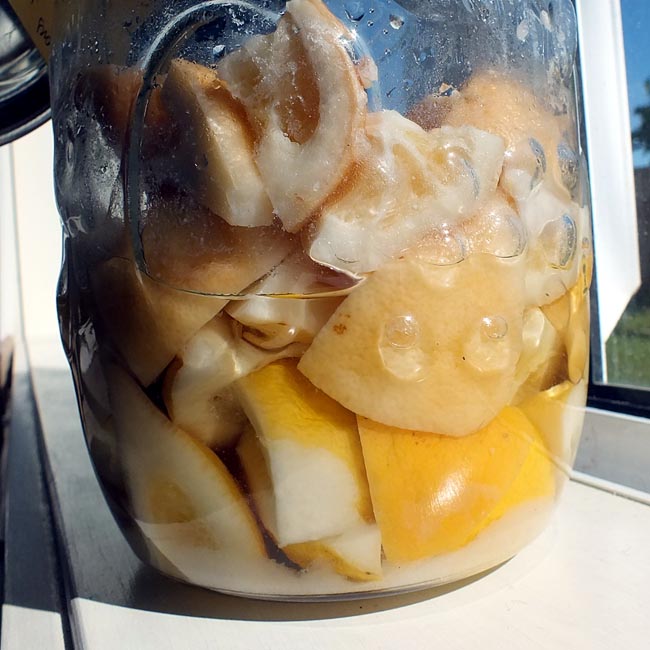
When you add the sugar, it sinks.Put the lid on and leave the jar in a warm sunny place. While it’s ‘cooking’, give the mixture a good shake-up every couple of days. You’re waiting until the fruit has softened; expect this to take about a week and a half, longer if it’s cold.

Throw in the sugar and mix well.

Put the jar in a safe place (doesn’t have to be sunny this time) for another week and a half or so. The sugar sinks, so give it a good stir every couple of days. Before adding the chilli.When most or all of the sugar has dissolved, it’s ready. I found three distinct layers – floating lemon pieces, the denser sugary syrup, and the undissolved sugar.

After adding the chilliFinally, add the chilli powder and stir well.

It’s now ready to bottle and/or eat immediately. If you bottle it later, be sure to stir well as the fruit tends to rise in the sugary mixture.

No need to refrigerate. Apparently it keeps for over a year if you leave it in a cool dry place – but it’s so yummy, I’m not sure it’ll be around that long!

The finished product

Afterword:

I’ll be making more of this, it’s awesome with poppadoms or as a side with a curry.

You could probably try this recipe to good effect with other citrus fruit, but the combination of the sour lemons and sugar really works well on the taste buds.

Ross is an expat thirtysomething Brit who went to the Shakey Isles in search of adventure. Works in technology, enjoys creating, has a love-hate relationship with his kitchen.

If you’ve enjoyed this recipe, have a look at Ross’s other lemon glut-busting recipes for lemonadelemon liqueur, and lemon sorbet (which you might be needing, if you decide to experiment the hot pickle!).

Read more from the Country Skills blog >>

Life’s A Beach – driftwood decorations – Blog Advent (19)

It feels like a very long time since we were on the beach in Cornwall with Dave, back in October!  Dave adores the beach – the seaside is his favourite ever place.

Dave on the beach

After he was done posing for his portrait (well, doesn’t the backdrop suit him??), I indulged in a spot of beach combing along the strand line, and collected up some pieces of driftwood. Only small lengths, the longest was about 8 inches long.  They had to fit in my pocket!

Driftwood Christmas tree

I put them together into this small driftwood Christmas tree.  It’s lashed together with jute twine, a bit like the twig and twine star decorations I made earlier this month.  If you wanted it a bit more solid, it would be simple to add a blob of hot glue or other adhesive between the ‘stem’ and the ‘branches’ before wrapping with twine or ribbon in whatever decorative way you favour.  It makes a very pretty hanging decoration – I’ve got it on the end of a bookcase in the hall.

The scale is a question only for your imagination and your driftwood supply!  I had visions of making a tree a couple of feet high, possibly hanging, with a thick piece of jute rope threaded through a drilled hole in the centre of each of the driftwood branches.  An idea for the future, perhaps – I need to live a lot closer to the sea!

Advent - day 19

I’m trying to write a post a day during Advent, so, please come along with me while I try to Blog Advent – the Country Skills Way – and forgive me if I don’t quite manage it!

Read more from the Country Skills blog >>

Warm Fingers Never Felt So Good – mittens from washing machine felt – Blog Advent (10)

A couple of months ago, I shared a bit of a teaser with you about working with washing machine felt, with a simple technique for making a pair of five minute fingerless gloves.

These mittens are slightly more time consuming, but still really really simple and quick, an easy little hand sewing project to do in an evening in front of the TV.  Better still, they’d make a great personal gift!

Machine felt mittens

You’ll need the following –

  • A washing machine felted sweater.  See here for details on the (easy!) process.
  • Some scrap cardboard, a pencil and scissors for the mitten template.  A tailor’s chalk pencil is useful but not essential.
  • Some thick thread for assembling your gloves.  I used some multicoloured scrap knitting yarn in contrasting / coordinating colours.  Knitting yarn, incidentally, makes really really *rubbish* sewing thread, so see if you have something better – embroidery floss would be great, or how about some really thin (3mm) ribbon? Decorative and contrasting is good – I like the effect – but you could go for something to blend into your sweater felt if you prefer.
  • A really chunky hand sewing needle.  I used one intended for use on sacking fabric with a bit of a spade-end, which makes a nice big hole in the thick felt so that the double thickness of thread passes through more easily.

TemplateTo start creating your template, draw around your hand on the cardboard.  This is the time to decide how long you want the cuffs of your mittens.  Also, I suggest you have your fingers in a relaxed position slightly apart, not all cramped together – this should make the mittens more comfy later!

Next, I measured around the knuckles on my hand and compared the measurement to the appropriate part of the flat silhouette drawing on the card.  You’ll find the circumference is more than twice the silhouette measure – your hand has depth! – for me this was about an extra 2cm.  I don’t need a seam allowance for these mittens (more on this later) so I added about 5mm all the way around the hand silhouette.  Smooth the shape off at this stage to make it nice and pleasing.  [Those of you who have ever drawn a glove or mitten patten will spot my deliberate mistake here – if you haven’t, then I suggest you read the rest of the post *before* you go ahead and cut out your template!]

Mark up feltCut out your cardboard pattern, and using tailors chalk if you have it (or anything else that will draw on your felt, if you don’t) mark up four copies onto the felt.  Arrange the cuff end against the waistband of your felted jumper – this way, you get to cheat and use the waistband detail from the jumper for the cuff of your mittens.

Mitten halvesThe great thing about washing machine felt is that you’ve taken a knit fabric that would unravel, and solved this problem.  You can slice it up just as you like and it behaves very much like polar fleece (and actually, if you have some scrap polar fleece – or you’re allergic to wool – it would make a great substitute fabric for this project). Now cut out your four mitten shapes and assemble them in pairs.

I mentioned earlier that I wasn’t including a seam allowance in the template.  This is because the felt is really quite bulky fabric – great for nice warm toasty fingers in your mittens, but it would be really very cumbersome if you had it doubled – or more – at the seams. I’d guessed there must be edge-to-edge stitches, though I hadn’t used them before, and a bit of googling turned up a perfect solution for this project, which is called ‘Old German stitch’.

Old German stitchHopefully this image illustrates it usefully, but briefly, you assemble the two edges to each other, with the thread emerging on top of one edge, passing into the gap, and going into the other piece from below, emerging on top, passing back through the gap, and so on.  This produces an edge to edge seam without overlap which, because the thread crosses through the gap every time, is protected from the problem of the edges overriding which you’d likely get if you used a slip stitch.

Sewing around to thumb, with insert pieceNow, you can start to sew.  I started at the wristband on the little-finger side of the pattern, and worked around progressively until I reached the tip of the thumb.  I’ve mentioned that knitting yarn makes horrible sewing thread.  This particular yarn tended to shred itself, after a while, and had hideous knot-holding properties which made it really challenging to start, finish, and join.  Don’t say I haven’t warned you!

It’s at this point that my rookie pattern-cutting mistake becomes painfully obvious.  The mitten is the perfect size on the palm and fingers, but far far too narrow on the wrist.  A quick bit of wrist and mitten measuring confirmed that at the cuff, we were going to be about 5cm short.  The only solution – other than starting again with a new sweater! – was to add an insert piece – a triangle, 5cm across the short edge, and as tall as the distance from thumb-tip to cuff.  You can see this in the photo just above.

Three pieces, assembledIf you don’t want to make this as a three-piece pattern, then you should get this wrist circumference incorporated properly into your pattern template in the first place, adding an extra ~2.5cm to the cuff end below the thumb.  Actually, I really like the three part shape, though it was a complete accident.  I think it adds a nice detail, and gives proper ‘depth’ to the thumb construction.

Finished mittensYou’re done at this stage, if you want to be.  I decided I wasn’t bored of hand sewing yet, so I went on to add a row of blanket stitch along the cuff.

These are really great, warm, practical mitts. I’ve been wearing them loads over the past few weeks.  They’re not waterproof, but they’re warm and cozy and have stood up really well so far to plenty of use.

Better still, the world is your oyster in terms of colours (so go on, raid that pile of old sweaters in the back of your wardrobe!) and detailing.  You could even embroider the back of the hands, if you were feeling especially keen!

So, if you want to create a special, warming handmade gift this Christmas, you still have plenty of time to make these.  Go on, you know you want to!

Advent - day 10

I’m trying to write a post a day during Advent, so, please come along with me while I try to Blog Advent – the Country Skills Way – and forgive me if I don’t quite manage it!

Read more from the Country Skills blog >>

Can’t See The Tree For The Lights – invisible outdoor decorations – Blog Advent (8)

I know I’ve said I don’t like outdoor decorations much, but I make an exception for simple, fresh, crisp white lights.  I love the solar outdoor fairy lights that have become available over the last few years, for very reasonable prices.  The last couple of years I’ve strung a string through the bare branches of the small apple tree in our garden – but I thought I’d try something different this year!

Light Tree

This outdoor ‘tree’ smothered in light is so simple and very effective!  You need a set of outdoor solar lights – this was a string of 100 lights on a 12m strand, six bamboo canes – mine were old 6ft ones I had lying around from the veg patch this summer, and some string.  You could obviously make a bigger or a smaller tree, depending on your preferences and the lights you have available.

Arrange your canesStart by arranging the bamboo canes in a rough circle.  This is really easy in our lawn this winter because it’s been so wet recently!

Form into teepee shapeNow tie the tops together firmly with some string or wire, whatever you have to hand, so that the canes are in a teepee shape.  You don’t need a garden, of course, you could also create this in a pot planter on a sunny patio or balcony.

Wrapped with lightsFinally, set up your solar lights.  Usually these come with a small photovoltaic cell on a spike – you can install this in the centre of the ‘tree’.  Then, starting at the top, just wind the lights around and around your tree, spreading them out as evenly as you can.  Secure the ends with string if necessary, leave the lights to charge and wait for sunset.

I like it just simple as it is – but you could add some extra ‘tree’ details if you liked, like a star topper or some cheap plastic baubles.  I rather like the fact it almost entirely disappears into the garden during the day, and only becomes a feature after dark.

Advent - day 8

I’m trying to write a post a day during Advent, so, please come along with me while I try to Blog Advent – the Country Skills Way – and forgive me if I don’t quite manage it!

Read more from the Country Skills blog >>

A Festive Welcome – recycled fabric wreath – Blog Advent (7)

For many years I made a Christmas wreath every year out of spruce, holly and ivy, around a straw wreath-form which had been knocking around for years.  Eventually it fell apart, and instead of buying a new one, I made this – it was made really quickly, and I didn’t expect it to last as well as it has, but it’s now been our front door decoration for four or five years, and looks as good as ever.

Fabric Wreath

It’s another recycled craft, really.  At the base, it’s a wire coat hanger, shaped into a circle with the hook folded over into a triangular hanger for the wreath.  I wrapped this around with the sort of brown packing paper that turns up in all your festive purchases from online retailers at this time if year – just scrunch the paper lengthwise into a sausage shape and wrap it around and around, securing with some sticky tape here and there when you need to.  Use newspaper, if you haven’t got packing paper.  You could even use plastic packing wrap, or bubble wrap – whatever you have to hand, really, as long as it ends up with your coat hanger fairly evenly wrapped.

Now measure the circumference of your wrapped hanger, and get the long measurement from the hook all the way around the outside edge.  Add about an inch for hemming, and this is your fabric requirement.  I was lucky to have some blue and green-based tartan curtain offcuts, but you can use whatever you like.  Fancy a runched-effect?  Use a longer piece of fabric than you need.  If you have a sewing machine to hand, roughly sew your half inch hems on all four sides of your rectangle (I did this really really roughly, with a wide zig-zag stitch!).  If not, then just press them down with an iron to fold them over.

Back view - seamWrap your fabric around your homemade wreath form, starting at the hanger.  Slip-stitch the long seam by hand in as discreet a colour thread as you have. Don’t worry about making this beautiful, though, since it’s going to end up on the back!  Once that’s done, join the two ends of the tube around the hook.  Perhaps ladder stitch this part to make the join as tidy as possible, though if you look at mine I’ve covered the evidence with ribbon!

Really, that’s it – find some pretty Christmas ribbon in a coordinating colour and wrap it around, perhaps add a bow at the top.  Hang it on your door to welcome your festive guests!

Advent - day 7

I’m trying to write a post a day during Advent, so, please come along with me while I try to Blog Advent – the Country Skills Way – and forgive me if I don’t quite manage it!

Read more from the Country Skills blog >>

Star of Wonder – simple twig and twine decorations – Blog Advent (4)

Blogging on work nights is a bit of a challenge – but here’s what I’ve been up to the past few days, in bits and pieces, finished off during my lunch break today – some really pretty, simple, twig and twine Christmas star decorations (I wrongly described these as Star of David decorations – they’re not of course, but you could easily make those if you prefer them!).

Hazel stars

Preparing your twigsMine use some thin hazel ‘whips’ we pruned from our hedge a few weeks ago, but anything would do – willow or ash would be particularly suitable as they tend to grow nice and straight, but a quick scavenge around the garden, park or woods should yield something you can use.  The only other things you need are some string (I used jute twine because I think it’s pretty, but raffia or plain cotton or linen string will do just fine), and some fabric glue (I’ll get to this later).

Arrange your piecesCut your twigs into even lengths using garden cutters – I wanted different sized stars, so I cut the thicker ends of the twigs into longer pieces than thinner bits.

Now, I’m going to pause the how-to quickly to teach you a little trick you really need to know, and it’s a knot known (to me anyway) as a ‘packer’s hitch’ – I’m informed by my sister, who knows better, that it’s properly called a clove hitch!  It’s a self-tightening double loop, so is ideal for this sort of job – or any other situation when you’d otherwise be calling out for someone’s finger to hold the knot for you!  I’ve illustrated it below, but basically you form two loops in the same direction, then take the second and pass it behind the first.  Anything you pass through the centre of the two loops is caught in your noose, pulling the ends tightens it but because the way the knot is constructed, it’s very unlikely to loosen itself again.  Tying a second throw over the top, as in a reef knot, secures the hitch permanently.

How to tie a packer's hitch

Points of star, tiedForm a packers hitch, and use it to tie the tips of two of the twigs together.  Don’t complete the knot with a second throw at this point, you’re just loosely securing the ends.  Work your way around all five points of your star.

Now, have a bit of a play with your twigs to make sure you’re happy with the shape, the more even the better, but twigs are an organic thing, so the aren’t always straight or completely even!  That’s part of the beauty of these little decorations.

Knots placedOnce you’re happy with the shape, start tying the twigs together where they cross over in the centre. I use a knot which crosses over to stabilise the joint.  Make sure you arrange these so that the knots are on the same side as those from the packer’s hitches!  Just like these hitches, don’t complete the knots, just tie the first throw.

This is the time to decide which point of your star is the top, if you’re planning to hang it.  If so, replace the packers hitch on the top point with one made with a much longer piece of twine, so there’ll be plenty of length to work with.  If you want a string of stars, do the same thing with the centre point at the bottom, letting a long tail hang down.

With centre knots completeNow, go around all of these knots and put a blob of glue on the knot – I used fabric glue, because it was what I had to hand, but anything which goes on or dries to clear should be fine.  Now tie your knots nice and tight, and add an extra throw, if you like.  The glue is to stop the knots unravelling when you cut the tails off really short, which is what you’re going to do next.  Now do the same with the packers hitches at the points, making sure that you tie everything as tight as possible before securing the knots down with a blob of glue.

Finished starsIncidentally, I apologise for the classy ‘Costcutter’ bag, it was protecting my table at work from the consequences of my lunchtime activities!

That’s it, you’re done, if you want to be.  I think they look great ‘au naturel’, but I’m planning to get out my gold spray paint and just add a slight ‘burnish’ which I think will really add that final detail to the finish.  You could spray them any colour (or combination of colours!) to suit your decor.  Also consider adding glitter, beads… whatever takes your fancy!

This would make a really good kid’s Christmas craft, I think – no dangerous parts (assuming a grown up cuts the twigs up!), fiddly enough to be challenging without being overwhelming, with a pretty end product, and knot-tying skills to boot!  Perhaps one to try with a group of children at a Christmas party, club or youth group?

Advent - day 4

I’m trying to write a post a day during Advent, so, please come along with me while I try to Blog Advent – the Country Skills Way – and forgive me if I don’t quite manage it!

Read more from the Country Skills blog >>

When Life Gives You Lemons – Part 4: lemon pickle [Guest Blogger]

Today’s Guest Blogger is Ross, from Christchurch, NZ.

Lemon pickle

This one is a bit friskier, with the smoking hot oil making the kitchen smell strongly of mustard for a while – you have been warned!

This made about 1kg of pickle for me (including some excess oil).

  • 8 lemons,
  • 150g salt,
  • 25g fenugreek; 25g mustard powder; 50g chilli powder; 8g turmeric. (I used mild chilli powder from my local Indian supermarket, and the end product still had a bit of a kick; if you prefer it incendiary, then use the hot stuff.)
  • 300ml mustard oil; 1/2 tsp asafoetida (hing); 12g mustard seeds (crushed).

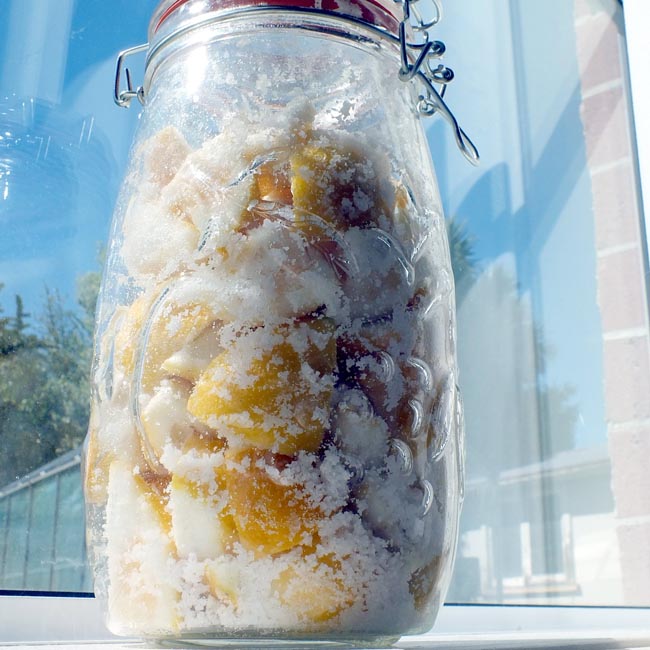
Salted lemonsStart by sterilising a large glass jar – a kilner-type jar like the one pictured is ideal.

Wash the lemons, dry, cut into eighths; you don’t have to remove the pips, but I did.

Put the lemons in the jar. Add the salt and shake it all up well to spread it all over them.

Lemons, after saltingCover; leave in a warm place for 1-2 weeks. (I put it on the windowsill which catches the sun nicely.) The juice leeches out of the lemons; where they’re exposed to the air, the lemon pieces soften and go a dull brown colour.

Mix the fenugreek, mustard powder, chilli powder and turmeric. Add this to the jar and shake it around gently. Re-cover and put it back into the warm for 2-3 days.

With all the spicesTransfer the lemon pieces and spices to a large saucepan.

Heat the mustard oil in a large frying pan. Fry the mustard seeds and asafoetida.

Keep heating the oil until it starts to smoke, then pour it over the lemons. (This is where it gets a bit frisky.)

Mix well. Allow to cool, transfer to a bowl, cover once more and leave in the warm for another week or so.

Lemon pickle

Now it is ready to put into jars; I tried (without huge success) to decant the excess oil. Then you can give some to your friends as presents, or to your enemies as a chemical weapon…

Ross is an expat thirtysomething Brit who went to the Shakey Isles in search of adventure. Works in technology, enjoys creating, has a love-hate relationship with his kitchen.

Warm thanks go out to Ross for these four great blog posts – hopefully he’ll be back with some more antipodean country skills for the blog in the future!  Have a look at Ross’s other lemon glut-busting recipes for lemonade and lemon liqueur, and lemon sorbet (which you’ll be needing, after sampling this pickle, I think!).

I hope you’ve all enjoyed this contribution from a great guest blogger as much as I have!

Read more from the Country Skills blog >>

When Life Gives You Lemons – Part 3: lemon sorbet [Guest Blogger]

Lemon TreeToday’s Guest Blogger is Ross, from Christchurch, NZ.

Lemon sorbet

Next up, to cleanse the palate, a simple sorbet. Note that if you have an ice cream maker it’ll make life easier, but it’s not mandatory (I don’t have one).

This recipe uses 8 lemons, and makes about 2.5 cups of sorbet.

  • Make up some simple syrup (see post 1 of this series) with 1 cup of water and 1 cup of sugar.
  • While it’s cooling, zest most of the lemons. You’re looking for about 2 tsp of zest – the finer, the better – I reckoned I had enough after six lemons.
  • Juice the lemons. You’re looking for about a cup of juice.
  • Mix the juice, zest and cooled syrup. Chill well (I left mine in the fridge for a couple of hours).

Now freeze. If you have an ice cream maker, you’re all set – but I don’t. That’s OK, it just means a bit more effort. The end product is a water ice, not a block of solid ice, so all you have to do is fluff it up a bit as it freezes.

Lemon Sorbet

  • I split the mixture into a couple of clean shallow plastic tubs and put them in the freezer.
  • After a few hours it was semi-solid; I mashed it up with a fork, then put it back in the freezer. Ideally I’d have done this again after a few more hours, but it was late in the evening so I left it overnight. This was maybe a bit too long as it was nearly solid so was a lot of work! (You could probably use a blender instead, but I don’t have one.)
  • Then put it back in the freezer. After 12-24 hours it’s frozen enough to serve.

Ross is an expat thirtysomething Brit who went to the Shakey Isles in search of adventure. Works in technology, enjoys creating, has a love-hate relationship with his kitchen.

Have a look at Ross’s other lemon glut-busting recipes for lemonade and lemon liqueur.  Coming up soon, lemon pickle.  Watch this space!

Read more from the Country Skills blog >>

When Life Gives You Lemons – Part 2: lemon liqueur, or ‘limoncello’ [Guest Blogger]

Today’s Guest Blogger is Ross, from Christchurch, NZ.

Lemon Liqueur

I did the first part of this at the same time as I made up some lemonade. This was a small test batch but will scale up directly.

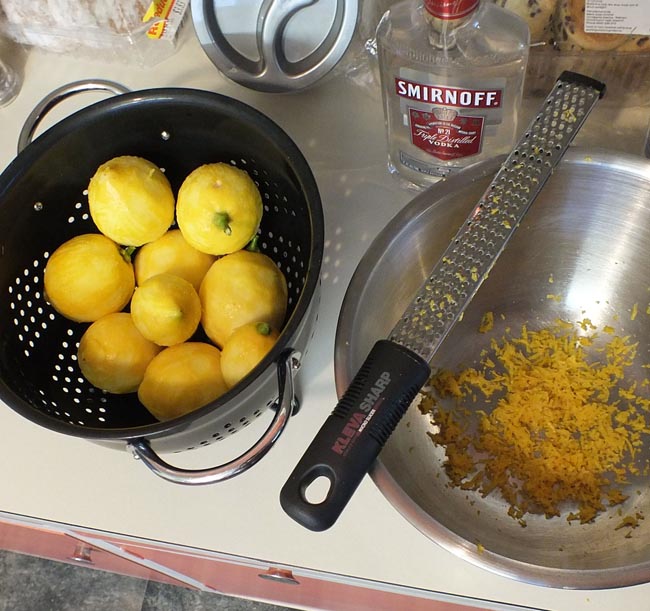
IngredientsIngredients –

  • A half bottle of vodka (375ml) – not flavoured, you want something as pure and tasteless as you can find.
  •  8 lemons (zest only). Go for lemons with thick peels if you can, to maximise the amount of zest.

Sterilise a large sealable jar. This is the same as for making jam – a careful clean, rinse well, then dry in a slow oven.

Scrub and dry the lemons, make sure you’ve removed any wax. Now zest them; be very careful not to take any pith or you will spoil the result.

While the jar was cooling, I juiced the lemons to make the lemonade.

Lemon liqueur, infusingPut the zest into the jar and add the vodka. Make sure all the zest is covered, then seal it up and stash in a cool dark place for a while. I found a number of different recipes suggesting anything from 2 to 45 days; I left it for two weeks.

… time passes …

Make sure your bottles are clean and dry. You’ll end up with slightly more by volume than just the vodka.

Prepare a simple sugar syrup, and let it cool.

The amount of syrup you need is whatever will dilute your starting liquid to the desired strength (traditional limoncello is 30-32% ABV). In my case (375ml of 37.5% ABV vodka) this calls for 80ml of syrup.

Combine the infused alcohol with the syrup. Stir well. Optionally, say some recipes, let it rest for a few more weeks (I didn’t).

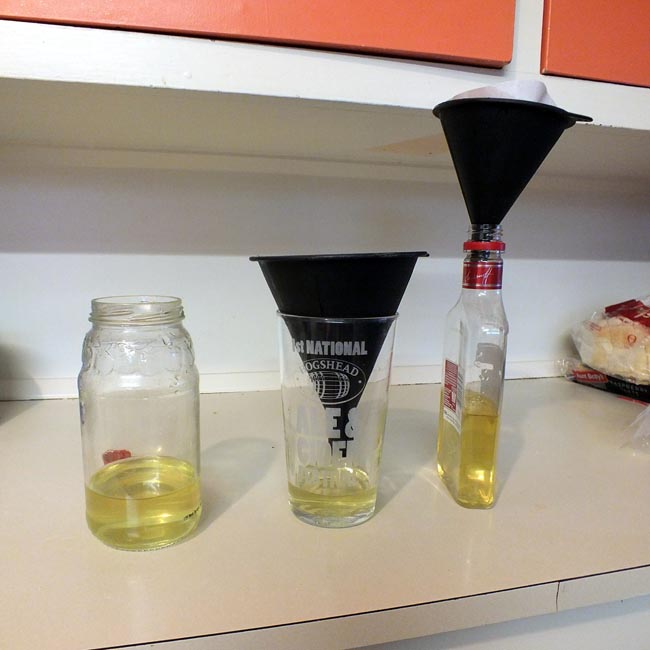
Filtering set-upNow filter carefully; for best results filter more than once. I started out with a sieve, then switched to coffee filters. I filtered it four times, which might be excessive; I set up a little production line (pictured). The filtering was slow, and the setup easy to knock over; I found myself longing for some clamp-stands like I used in chemistry class in high school. Unsurprisingly, the filters clogged quite readily; I got through several of them.

Bottle directly from the last filtration; the liqueur should be clear but coloured. At this point the product is very sweet and sharp. Let it mature in the bottle for at least a week; both the sharpness and the cloying sweetness melt away. Serve cold (direct from the fridge, or even the freezer). It’s dynamite-strong; take care!

Next steps?

This wasn’t real limoncello; apparently the genuine stuff is made with grain alcohol which pulls more flavour out of the lemon. (Grain alcohol as in 95% ABV – yes, almost pure ethanol – 190 proof in old money. It’s difficult to find on the shelves, but here in New Zealand it’s legal to distill spirits for personal use. There might be another blog post in here along those lines, but that’s a project for another day…)

Ross is an expat thirtysomething Brit who went to the Shakey Isles in search of adventure. Works in technology, enjoys creating, has a love-hate relationship with his kitchen.

Coming soon, more lemon glut-busting recipes from Ross – lemon sorbet, and lemon pickle.  Watch this space!

Read more from the Country Skills blog >>