Time: 15 minutes — Patience: 1 week — Difficulty: Easy — Knackyness: Low

“Why would I want to make bacon?” you might well ask yourself. Well, cast your mind back to the last bacon rashers you put in a pan. Did they ooze lots of grotty white watery liquid and end up half the size they started, a bit rubbery and rather grey? Probably a bit uninspiring-tasting, too. [A couple of my more ‘foodie’ friends have pointed out that their bacon doesn’t do this, because they buy good bacon from a butchers, farmer’s market, etc – all I can say is ‘lucky you’, but also I bet if you make your own, it will be just as good, and half the price!]
Making bacon is really easy. It will take a few minutes a day for about a week, and cost very little (certainly less than buying really good dry-cured bacon). The bacon you will make will sizzle and crisp with that gorgeous sweet smell of real bacon, and will render only bacon fat into the pan. The rind, if you decide to leave it on, will be crisp and crunchy. With experimentation, you will be able to control the saltiness, sweetness, smokiness, and any other seasoning flavours you might desire. That, in a nutshell, is why you should make your own bacon.
So, assuming you’re convinced, what do you need?
First, some curing salt. The easiest way is to get premixed salt-and-saltpetre. I’ve used ‘Supracure’, which is available in the UK in 2kg packs from Weschenfelder or Hot Smoked, both of whom I’ve bought supplies from in the past. 2kg will cost you about £6 – 7 plus shipping. [Aside – I know nitrites are associated with potential health concerns – you can make bacon with just salt (rock salt is best) without the saltpetre, it will taste fine, but will look grey rather than pink in colour, and theoretically at least will provide less protection against bacterial contamination and spoilage.]
Second, some meat. The easiest cut to start with is a piece of pork belly. Try to find a nice fresh piece about 500g in weight. Very cheap pork belly can be bought from supermarkets, usually in the ‘bargain cuts’ section for about £2 – 3. Better still, get a nice piece of outdoor reared belly pork from a good butchers, which round here will set you back £4 – 5 for around half a kilo. The fat should be scored (it probably will be anyway).
Thirdly assemble the rest of your equipment, which you probably already have. You want some soft dark brown sugar (or indeed any sugar, but the less refined it is, the better the resulting flavour). Dig out your kitchen scales. You need to find a non-metallic container (oven dish, or tupperware) large enough to comfortably hold the piece of belly pork with plenty of room around for air circulation. You will also require some cling film and some greaseproof paper / baking parchment. Last of this difficult to procure list, a small sealable tupperware box or ziplock bag.
All set? Right, let’s get going.
Weigh out 40g of the supracure and 10g of the sugar into your sealable box or ziplock bag (we’re aiming for about 10% of the weight of the piece of meat in total cure, so if your piece of belly is bigger or smaller, adjust your quantities accordingly). Mix well. Also carefully re-seal your bag of supracure, as you don’t want moisture to get in.
Dry the piece of belly pork with kitchen paper and put into the non-metallic dish. Rub all the surfaces generously with the cure mix, we’re looking for a 5 day cure so you’re aiming to use about 20% of the total mixture, however I’ve found I use a bit more on the first day and less later on. You want a bit more cure on the meat surfaces and less on the fat. Cover loosely with cling film and put it in the fridge.
That’s it for today. Every day for the next four days, take it out of the fridge, pour away the liquid which will be appearing in the dish, re-salt and leave the opposite side up to the day before. Re-cover and return to the fridge. Over this period, the piece of belly will appear to shrink, the meat will darken in colour, the fat will remain white, and the texture will become firmer.
On the sixth day, take your bacon (for bacon it now is) out of the dish, rinse carefully under running water, pat dry with kitchen paper, wrap loosely in the baking parchment and return to the fridge on an open shelf for a couple of days. Try to make sure the air can circulate freely around the bacon, as this will help it continue to dry out. You will notice a slightly tacky shiny surface develop on the bacon, this is normal and desirable. Over the 48 hours, the cure will continue to distribute more evenly within the piece of bacon. If you were going to smoke the bacon, now would be the time to do it.

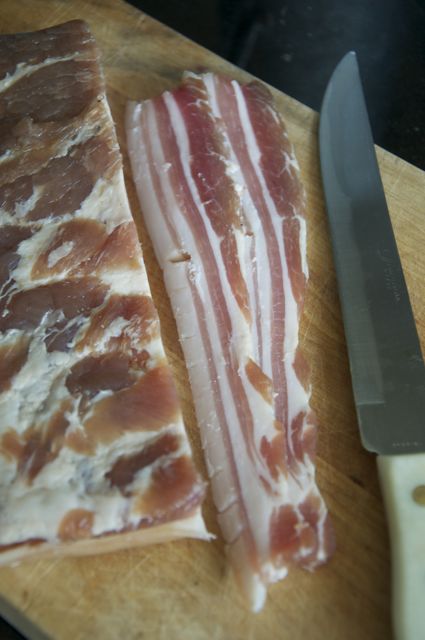
Now enjoy! Slice as thinly as possible (I recommend keeping the the ‘edge’ slice for cutting into lardons and cooking with, as it can be uneven in shape and will be saltier than the rest of the piece) with a very sharp knife, put a couple of slices into a hot frying pan, and wait for the sizzle! You can cut the rind off before or after cooking, but I wouldn’t! The fact the fat was scored on the piece will stop the rind deforming the bacon as it cooks.
The bacon will keep better if you slice it as you need it, you should be able to keep the block of bacon in the fridge for a good 2 – 3 weeks, though I doubt it will take that long to eat it! If you need to store it longer, you can freeze it, either the whole block, or perhaps slice it all, interlace the slices with paper or film, and then you can defrost a slice at a time as you need it.
The whole project takes about five minutes on day 1, 30 seconds each on days 2 – 5 and then perhaps two minutes on day 6.

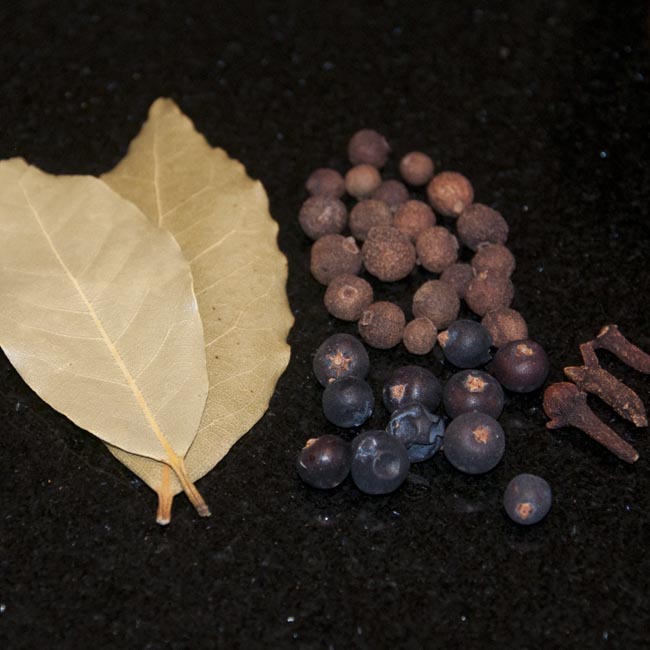 Christmas bacon – first attempt
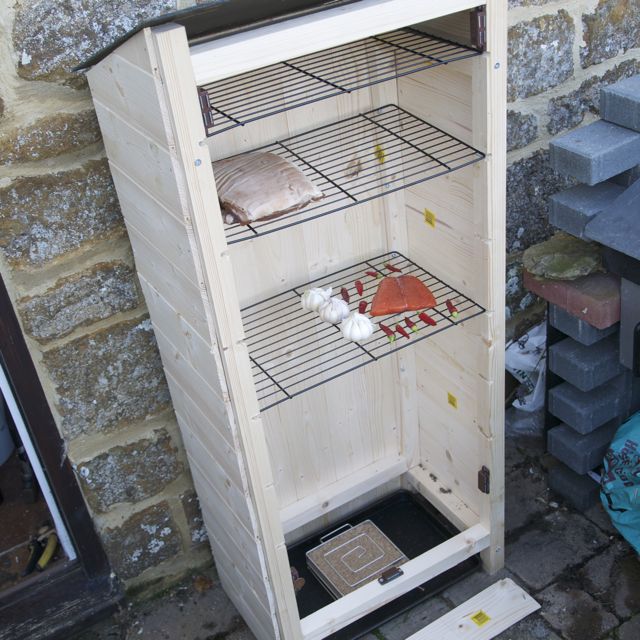
 The smoker itself leaked like a sieve from the junction between the roof and box, and also from the side of the magnetically-attached door panel. I suspect this meant the smoke density inside the box was rather less than it might have been. Before the next run, I plan to plug as many of these leaks as I can using silicone mastic and some batons, and we’ll see if I get a more concentrated smoke as a result. I could conceivably run a second smoke generator, but this would increase my costs, so I’d rather not!


 Country Skills for Modern Life