Unknown's avatar

About Kate Watson

Brewster, cook, poultry-keeper, curer & smoker, in other words, jill of all trades and mistress of none!

First smoke! Testing the DIY cold smoker

Time: 5 minutes – Patience: 10 hours – Difficulty: Trivial – Knackynes: Low

So I built a cold smoker, and then it was time to try it!

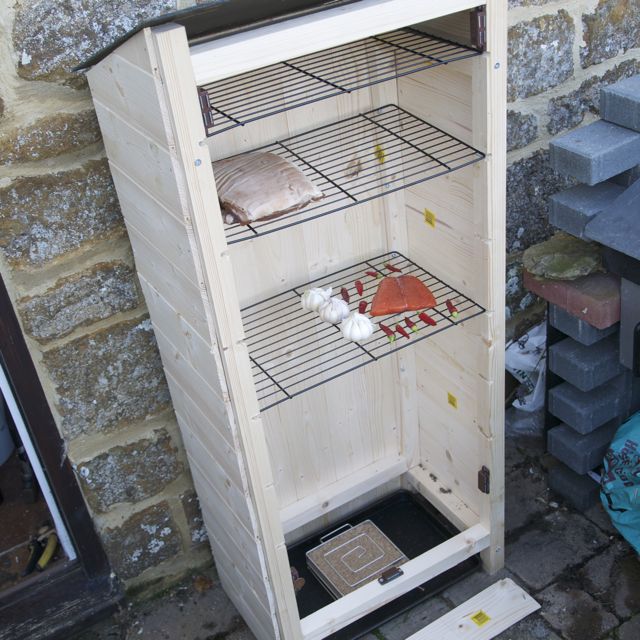
The items in my first smoke run were the cured salmon fillet, a piece of home-cured bacon, three garlic bulbs and about a dozen home-grown chillies.  These were loaded into the smoker on the racks – I considered hanging the bacon piece from a  hook but decided against this time.  The loaded smoker looks really empty so the first lesson is to have more items ready for smoking and do them all at once.

Smoker, loadedThe ProQ smoke generator lit very straightforwardly and behaved immaculately, smouldering gently without any noticeable heat output for almost exactly the advertised ten hours.  I used oak sawdust in the smoke generator for the first attempt, and the 100g pack I had was a little bit more than I needed.

ProQ cold smoke generator, litThe smoker itself leaked like a sieve from the junction between the roof and box, and also from the side of the magnetically-attached door panel.  I suspect this meant the smoke density inside the box was rather less than it might have been.  Before the next run, I plan to plug as many of these leaks as I can using silicone mastic and some batons, and we’ll see if I get a more concentrated smoke as a result.  I could conceivably run a second smoke generator, but this would increase my costs, so I’d rather not!

Overall, the salmon was a great success.  It was firm, glistened slightly with oil on the surface, and cooked wonderfully into the creamy home-smoked salmon pasta I made for dinner on Monday.  You can see photos and more discussion with the recipe.

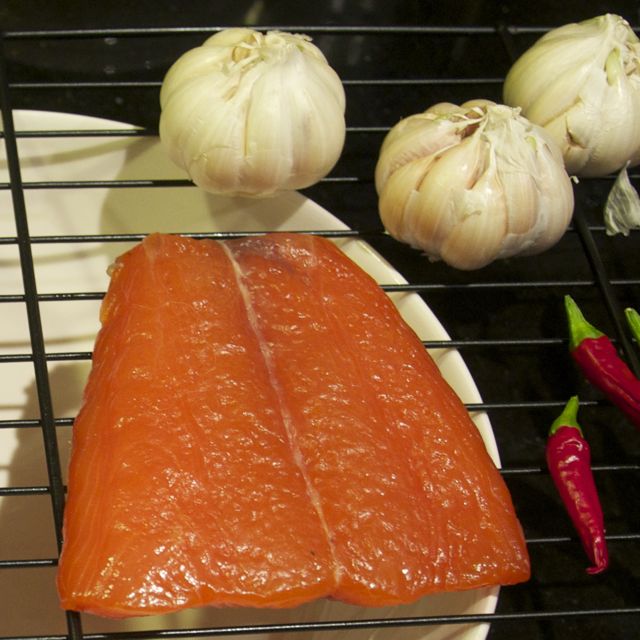
The garlic and chillies didn’t appreciably change in appearance during smoking – at odds with the smoked garlic I’ve seen before which was dark yellow to brown in colour.  I have seen recommendations for smoking times for garlic up to 36 hours, though, so 10 may not be enough to achieve this, especially in a leaky-smoker.  They smell wonderfully of oak smoke though and the flavour of the garlic is a treat – nice fresh flavour with a subtle but distinct note of oak smoke, not too obtrusive and lovely for general cooking.  I might re-smoke one of the bulbs next time I run the smoker, if I’ve not eaten it all by then.

Bacon, salmon, garlic and chillies after smokingThe bacon has a bit of smoke staining on the rind and has darkened on the meat side.  I think you might get more discolouration on the rind with the bacon hanging rather than sat rind-up on a rack.  Apart from that, it looks and smells as I would expect from good smoked streaky bacon.  I haven’t tasted it yet – but plan to have some for my lunch!

Read more DIY Cold Smoker & Home-Curing posts >>

Read more from the Country Skills blog >>

Creamy home-smoked salmon pasta

Time: 10 minutes – Patience: 10 minutes – Difficulty: Simple – Knackyness: Low

Yesterday, I had a first experiment at curing and smoking salmon at home.  Tonight, I made a creamy smoked salmon pasta with the cold smoked fillet I’d produced.

Smoked salmon pasta - some ingredientsIngredients –

  • One tail fillet of home-smoked salmon, around 100g
  • Two home-reared pullet’s eggs
  • One clove of home-smoked garlic, crushed
  • A small handful of grated parmesan or pecorino
  • A glug of double cream
  • Pasta of your choice, sufficient for two portions

Method –

  • In a dry frying pan, start to cook your whole smoked salmon fillet
  • In a large saucepan, bring some salted water to the boil
  • Add the pasta to the boiling water, along with a pinch of salt and a glug of olive oil
  • Once the salmon fillet is cooked, break it up into flakes in the pan, then add the crushed garlic clove and continue to fry gently for a couple more minutes
  • Meanwhile, in a bowl or jug, beat the eggs with a fork, add the glug of double cream and 2/3rds of the grated parmesan, along with a generous pinch of cracked black pepper
  • Once the pasta is cooked, drain and return to the saucepan.
  • Add the liquid ingredients to the frying pan with the salmon and garlic, and almost immediately transfer all of these into the drained pasta
  • Mix swiftly, the heat from the pasta will cook the egg, and the texture should end up thick and glossy.  But don’t worry if it looks a bit like scrambled egg with salmon in it, it will still taste marvellous
  • Serve into two bowls, topped with the rest of the grated parmesan

Simple, tasty, and all the key ingredients home-produced. And done in the ten minutes it takes to cook the pasta. What could be better?

Verdict on the smoked salmon? Undoubted success. Cooked in this dish it is distinctively and recognisably smoked salmon, has a good firm texture and slightly salty flavour and lovely smokey aroma.  Result!

I have an apology to make, however – it was a long day at work, and I was hungry… so I didn’t stop to take photos of the cooked dish, I just ate it!

A little bit fishy – first attempt at smoked salmon

Time: 15 minutes – Patience: 24 hours – Difficulty: Easy – Knackyness: Low

As the smoker build was progressing well, my mind of course turned to what to put in for the first experimental firing along with the piece of bacon I’ve been curing this week.

I’ve never smoked or even cured fish before but there were a couple of tail-piece salmon fillets in the Co-op this afternoon.  Opinions seem to vary incredibly widely on how long one should cure the salmon for (and indeed whether table salt or curing salt are required), whether to dry cure or brine, and then how long a smoke is required (with opinions ranging from 6 to 36 hours!).  Since I planned to run the smoker the next morning, and the fillet is small and thin (and has also been robbed of it’s skin – something I didn’t notice when I bought it) I went for the lowest of all the estimations, and the simplest of approaches.

I used:

  • A 125g farmed Atlantic salmon tail fillet (skinless – not ideal)
  • Very simple dry cure made from 30g of sea salt and 15g of golden caster sugar

Salmon, with cure appliedWeighed down with tinRub the cure generously into both sides of the fish with some extra under the fillet.  Then weigh the fillet down with a plate and a can of tomatoes to encourage the water to come out of it.  Leave the fillet like this in the fridge for six hours.

Salmon fillet after curingAfter six hours the fillet should be flatter, firmer, darker in colour and lighter in weight.  The photograph is the same fillet as above.  After six hours of curing there was lots of salt still left in the bowl, along with quite a bit of pickle (the liquid which has oozed out of the fish).  The fillet, rinsed and dried weighed 111g, a 14g weight loss in water in six hours.

Now put the fish, uncovered, on a rack in the fridge overnight.  In the morning it will have formed a shiny pellicle, and lost a bit more weight (mine was 109g by this time).  Time now to load my home-built cold smoker for it’s maiden voyage…

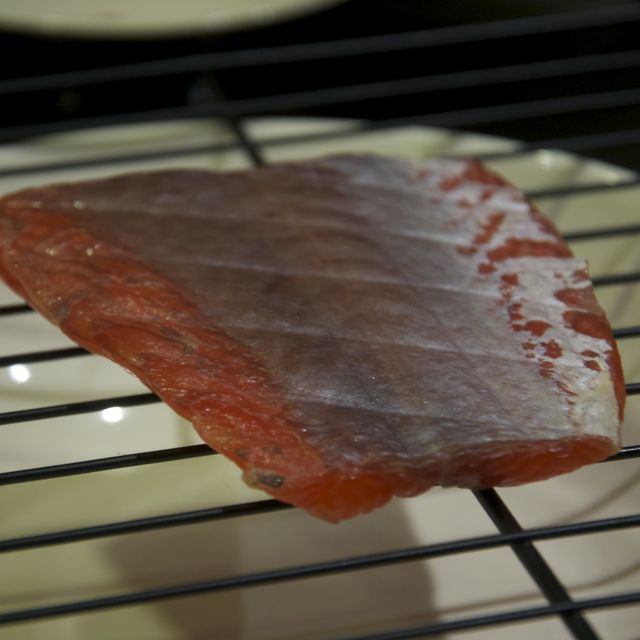
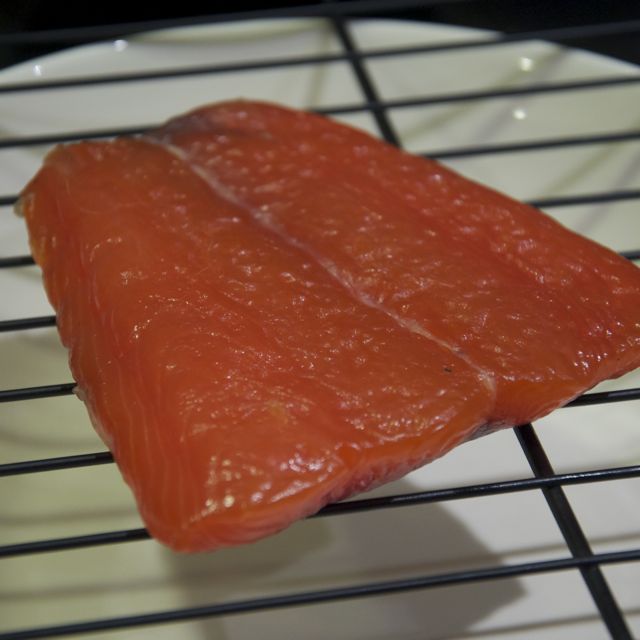
Salmon after smoking - skinned sideSalmon fillet after smokingAfter ten hours of cold oak smoke, the fillet is 106g (a 19g total weight loss which is about 16% – not far off the 17-18% I’ve seen recommended).  It has a glossy, slightly oily surface, a firm texture, and smells more of smoke than it does of fish.    I would describe it as ‘lightly smoked’, for reasons I’ll discuss further in the write-up of the first (rather experimental!) burn in the smoker.  Because I don’t know enough about the storage conditions of the fillet before I bought it, I plan to cook with it instead of eating it raw – probably tomorrow night. Expect a post-sampling update!

Smokin’!! DIY Cold Smoker – design and build

Time: 4 hours build time – Difficulty: Easy – Knackyness: Moderate (woodworking skills & equipment required)  – Cost: around £50

I’ve wanted to try cold smoking for a long time.  Hot smoking is an easily solved problem, modify a BBQ with a lid or some heavy duty tinfoil and add some woodchips, or even on the kitchen hob burning rice in an un-loved saucepan and steamer with the cooker hood running full pelt.  Hot smoked food is tasty enough, but though our American cousins have raised it to an art-form, I can’t get terribly excited about it.

Cold smoking, on the other hand, is far more interesting.  It requires more complicated equipment and, a bit like curing, feels like a sort of culinary alchemy.  The knack is to fill a space with sufficiently thick smoke for a long enough period to flavour your food, without raising the temperature so high that the food starts to cook, or worse, is at risk of spoilng.   Now someone observant once said, ‘no smoke without fire’, and therein lies the problem.  The internet, and the various books published on the subject, have a wide variety of different designs for low-cost home smokers.  The involve oil drums, modified fridges and filing cabinets, air conditioning duct, garden sheds, breeze blocks, and innumerable other approaches.  There are high tech ‘smoke generators’ and low tech fires in holes in the ground.  Then there are the purpose built smokers like the lovely-looking ones Bradley make, but they’re a bit outside my budget.

My smoker is a variation on a wooden box, and uses the ProQ cold smoke generator, which burns sawdust, as a smoke source.  I have built my smoker out of new wood, though I would have preferred to have used reclaimed wood – both on cost and ecological grounds.  If you are using reclaimed or scrap wood do make sure it’s clean and hasn’t been treated with any toxic wood preservatives.  The roof is a spare slate I happened to have, you may need to come up with something different. The structure is assembled from 2.5cm square section timber and covered with tongue-and-groove cladding, using various screws and fixings you are likely have in your toolbox.

What I bought to make the smoker –

  • The ProQ smoke generator and a few bags of wood dust
  • Set of 3 non-stick cooling racks (mine were from Amazon, but a cookshop would have similar products)
  • Four 2.5cm square 1.8m lengths of timber
  • Ten 1.8m lengths of tongue-and-groove cladding board
  • Four magnetic clips

I also used the following items I already had –

  • Wood saw, tape measure, screw driver
  • Electric drill and screwdriver, work bench (not essential, but useful)
  • Variety of screws, pins, fencing staples
  • A roof slate
  • Wood glue
  • Water-based shed stain

Smoker Frame

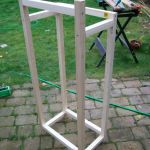
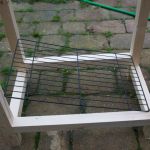
Smoker frame, size relative to rack

Dimensions of the smoker are 1.1m high at the front, 1.0m high at the back.  The width and depth are based on the size of the racks you want to use.

First, build the frame.  It will probably look something like this (note it is slightly narrower than the width of the rack.  Secure the horizontal timbers with long wood screws.

Frame showing slots for racksSlot the front vertical timbers to hold the racks.  The choice of spacings is yours, I placed a slot about every 15cm from about 40cm above the ground.  We cut the slots with a large drill bit and tidied up with a chisel.  There’s a bit of hit-and-miss here and while all the slots are not equally beautiful, they should do the job.  You could also slot the back timbers, but we decided to use small screws here with their heads proud to support the back of the racks,  also preventing backward and forward slip.  The highest slot is positioned to allow a rack to rest on the side timbers to take the weight of items hanging from it on hooks.

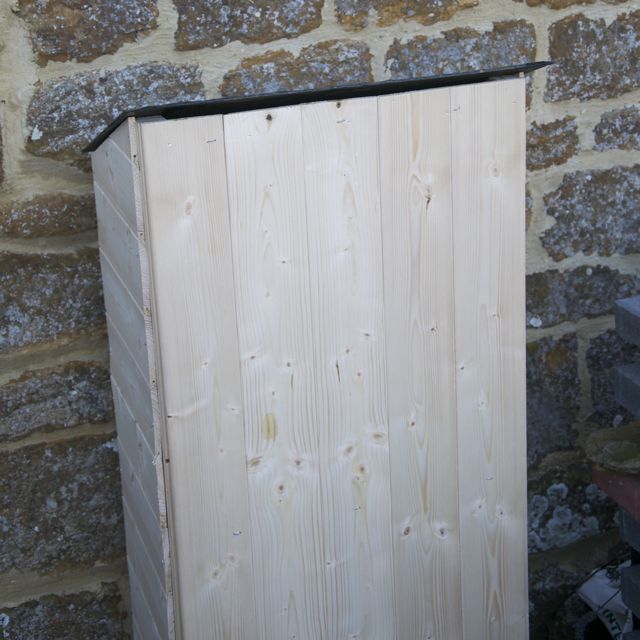
Applying claddingNext cover the back and sides with cladding going from floor level all the way to the top of the frame, including the triangle sections at the top of the sides.  I glued the tongue and groove for extra stability.  You could equally use plywood to clad the box.  We used fencing staples to secure the cladding to the frame.  Panel pins would be more traditional.

Complete smoker - openI want the whole front of the smoker box to be removable, in two sections – a large top section to allow me to load and unload the smoker racks and hooks, and a small bottom strip to allow management and monitoring of the smoke generator without letting all the smoke ‘escape’ from the box during use.  I built the main panel and secured it with three strips of 1cm baton.  The top and bottom baton positions are chosen to rest on the horizontal timbers forming the front of the structure, taking the weight of the front panel.  Four magnetic clips hold the front panel snugly in place.  The angle of the roof will allow a 1cm ventilation gap above the front panel.  A final length of cladding is used horizontally for the bottom section.

Complete smoker - closedFixing the roof will depend on your materials.  For the time being my slate just rests carefully on top, in due course we’ll come up with some sort of clip arrangement.  A plywood roof could be screwed in place.  I’m going to use a knackered old baking tray on the floor of the smoker to catch ash and any drips from the food.

The outside of the smoker will be painted with water based fence and shed stain.  The inside will not be painted, and I hope that with time exposure to smoke should provide a good seal to these surfaces.

Next, the first very experimental firing…  I can hardly wait!

Read more DIY Cold Smoker & Home-Curing posts >>

Read more from the Country Skills blog >>

Banner320-260

Medlars – an experiment with strange fruit

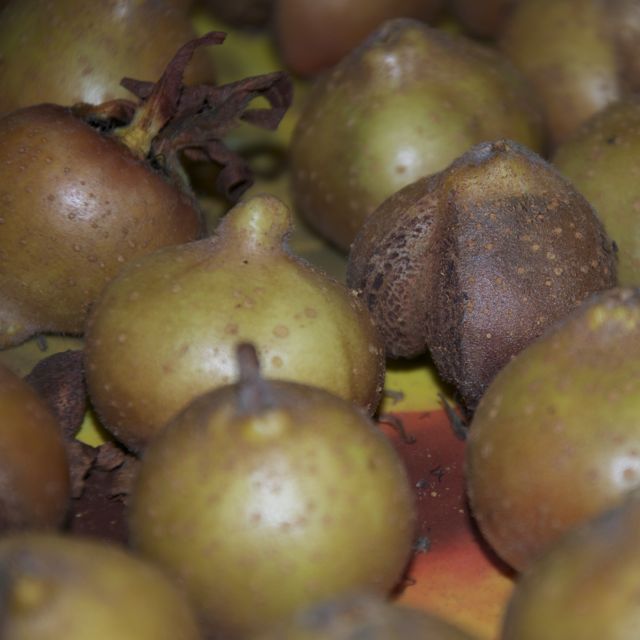
Have you met a Medlar?  Medlars on tree

The Medlar is known less politely as the ‘dog’s bottom fruit’ (and other related and even less polite descriptive names, discovery of which is left as an exercise for the reader!), and was once very popular, these days it seems to have been more or less forgotten, at least as a culinary fruit.  The Royal Horticultural Society describes Medlars by reference to their flowers and habit before their fruit.  They’re in the same horticultural family as roses, filed somewhere between pears and hawthorn.

Bletting medlarsI was lucky enough to be able to harvest a lovely little medlar tree, which yielded about a third of a carrier-bag full of fruit.  While late October / early November is the right time to pick medlars, they aren’t actually ripe and need to go through a process of ‘bletting’, where they are allowed to ripen fully in a frost-free, cool dark place.  The only place I have for a tray of fruit is the spare room, which while dark-ish and undoubtedly frost-free, is at house temperature.  Bletting is supposed to take 2 – 3 weeks, during which the fruit will soften and become a dark brown to black colour.  If it all goes well, I plan to make some medlar jelly, so I’ll be back in due course to let you know!

Juniper and Bay cure for cooking bacon

This was my first experiment with adding aromatics to a bacon cure.  I’d picked up a pack of ‘thick streaky pork slices’ from the supermarket bargain-meats section – a pack of five pork belly slices about as thick as they were deep, and seven or eight inches long.  For the curing technique, see Bringing Home The Bacon.

I probably wouldn’t recommend using this as a cure for bacon you intend to slice and have for breakfast (though, if you like it, why not?), but it produces really excellent bacon for cutting into cubes and using in cooking.  My first batch was incorporated variously into a celeriac and sausage casserole, a lovely rich bolognese sauce, cauliflower cheese, and sliced and fried to crispy as a burger garnish.

To make 100g of cure (enough to cure about a kilo of belly pork), you will need:Juniper and Bay cure, and ingredients

  • 67g of Supracure (see Bringing Home the Bacon for more information on curing salt)
  • 33g of molasses sugar
  • 8 – 10 juniper berries
  • 1 bay leaf

Put the bay leaf and juniper berries in a spice grinder or pestle and mortar and grind to a medium texture. Add the sugar and Supracure to the grinder and mix well.  Store in an airtight container.  Thanks to the juniper berries, the cure will smell faintly of gin.  This is no bad thing in my opinion!

This is quite a dark coloured cure with a distinctive aroma – it adds a lovely and unusual flavour to dishes when used in cooking.  It seemed to go down well with the people to whom I experimentally fed it, anyway!

Christmas is coming, the gin is getting pink!

Time: 1hr — Patience: 2 – 3 months — Difficulty: Low — Knackyness: Low

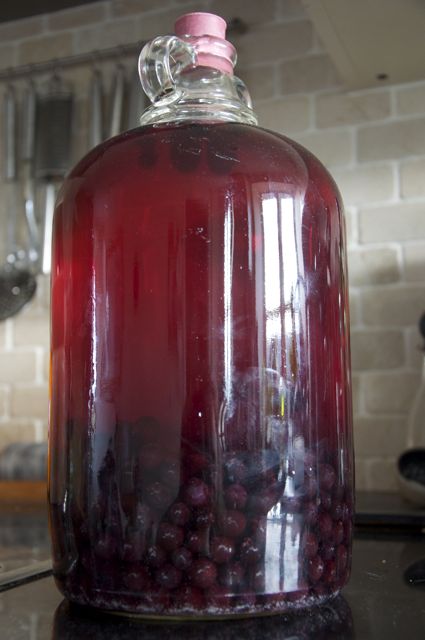
Sloe Gin maturing in demijohn

Sloe gin is a traditional country Christmastime treat, and is a liqueur made by flavouring gin with sloes (the fruit of the blackthorn bush) and sugar.  The traditional time to pick sloes is just after the first frost (so right now, for most of the UK!) as this both damages the cell walls of the sloes and changes their flavour, sweetening them.  You can make sloe gin very successfully with sloes picked before the first frost, but it’s wise to freeze them at least overnight before proceeding.

BE AWARE – Blackthorn isn’t called blackthorn for nothing!  The bushes are armed with vicious spikes, so proceed carefully and consider wearing gloves to pick with.  Personally I don’t, but as a result I give a blood sacrifice for my sloes every year.

This gin is very simple, and is sweetened to my taste.  You might find your palate runs to more or less sugar.  I’ve also seen gin recipes with spice additions such as a cinnamon stick, vanilla pods, and so on – so go ahead and experiment!

You will require –

  • A 1.5l bottle of cheap gin
  • 750g of sugar.  I like to use golden caster sugar, but you could experiment with other sugars
  • About a pint to a pint and a half of sloes, washed, dried (and frozen overnight if required)
  • An empty 1l glass screw-top bottle.
  • Kitchen scales, a measuring jug and, if available, a funnel.

Transfer 600ml of the gin from the 1.5l bottle to the clean 1l bottle, leaving 900ml behind.

Using the dry funnel, add 300g of sugar to the small bottle and 450g to the large one.

Fill up the remaining space in the bottles with the sloes.  Put any extras back in the freezer.

That’s it, really!

Give the bottles a good shake several times a day until all the sugar dissolves.  By this time it should have a similar appearance to the photo above, with colour starting to come into the gin.  Then put it in a cool dark place and forget about it for at least two months.

After that, strain the gin from the sloes and store in clean bottles.  In the past I’ve bought some pretty-looking 250ml bottles and used these for Christmas presents, which seem to be popular!  Add a couple of the excess sloes you put in the deep freeze to each bottle for that extra decorative touch.

Bringing Home the Bacon

Time: 15 minutes — Patience: 1 week — Difficulty: Easy — Knackyness: Low

“Why would I want to make bacon?” you might well ask yourself. Well, cast your mind back to the last bacon rashers you put in a pan. Did they ooze lots of grotty white watery liquid and end up half the size they started, a bit rubbery and rather grey? Probably a bit uninspiring-tasting, too. [A couple of my more ‘foodie’ friends have pointed out that their bacon doesn’t do this, because they buy good bacon from a butchers, farmer’s market, etc – all I can say is ‘lucky you’, but also I bet if you make your own, it will be just as good, and half the price!]

Making bacon is really easy. It will take a few minutes a day for about a week, and cost very little (certainly less than buying really good dry-cured bacon). The bacon you will make will sizzle and crisp with that gorgeous sweet smell of real bacon, and will render only bacon fat into the pan. The rind, if you decide to leave it on, will be crisp and crunchy. With experimentation, you will be able to control the saltiness, sweetness, smokiness, and any other seasoning flavours you might desire. That, in a nutshell, is why you should make your own bacon.

So, assuming you’re convinced, what do you need?

First, some curing salt. The easiest way is to get premixed salt-and-saltpetre. I’ve used ‘Supracure’, which is available in the UK in 2kg packs from Weschenfelder or Hot Smoked, both of whom I’ve bought supplies from in the past. 2kg will cost you about £6 – 7 plus shipping. [Aside – I know nitrites are associated with potential health concerns – you can make bacon with just salt (rock salt is best) without the saltpetre, it will taste fine, but will look grey rather than pink in colour, and theoretically at least will provide less protection against bacterial contamination and spoilage.]

Second, some meat. The easiest cut to start with is a piece of pork belly. Try to find a nice fresh piece about 500g in weight. Very cheap pork belly can be bought from supermarkets, usually in the ‘bargain cuts’ section for about £2 – 3. Better still, get a nice piece of outdoor reared belly pork from a good butchers, which round here will set you back £4 – 5 for around half a kilo. The fat should be scored (it probably will be anyway).

Thirdly assemble the rest of your equipment, which you probably already have. You want some soft dark brown sugar (or indeed any sugar, but the less refined it is, the better the resulting flavour). Dig out your kitchen scales. You need to find a non-metallic container (oven dish, or tupperware) large enough to comfortably hold the piece of belly pork with plenty of room around for air circulation. You will also require some cling film and some greaseproof paper / baking parchment. Last of this difficult to procure list, a small sealable tupperware box or ziplock bag.

All set? Right, let’s get going.

Weigh out 40g of the supracure and 10g of the sugar into your sealable box or ziplock bag (we’re aiming for about 10% of the weight of the piece of meat in total cure, so if your piece of belly is bigger or smaller, adjust your quantities accordingly). Mix well. Also carefully re-seal your bag of supracure, as you don’t want moisture to get in.

Dry the piece of belly pork with kitchen paper and put into the non-metallic dish. Rub all the surfaces generously with the cure mix, we’re looking for a 5 day cure so you’re aiming to use about 20% of the total mixture, however I’ve found I use a bit more on the first day and less later on. You want a bit more cure on the meat surfaces and less on the fat. Cover loosely with cling film and put it in the fridge.

That’s it for today. Every day for the next four days, take it out of the fridge, pour away the liquid which will be appearing in the dish, re-salt and leave the opposite side up to the day before. Re-cover and return to the fridge. Over this period, the piece of belly will appear to shrink, the meat will darken in colour, the fat will remain white, and the texture will become firmer.

On the sixth day, take your bacon (for bacon it now is) out of the dish, rinse carefully under running water, pat dry with kitchen paper, wrap loosely in the baking parchment and return to the fridge on an open shelf for a couple of days. Try to make sure the air can circulate freely around the bacon, as this will help it continue to dry out. You will notice a slightly tacky shiny surface develop on the bacon, this is normal and desirable. Over the 48 hours, the cure will continue to distribute more evenly within the piece of bacon. If you were going to smoke the bacon, now would be the time to do it.
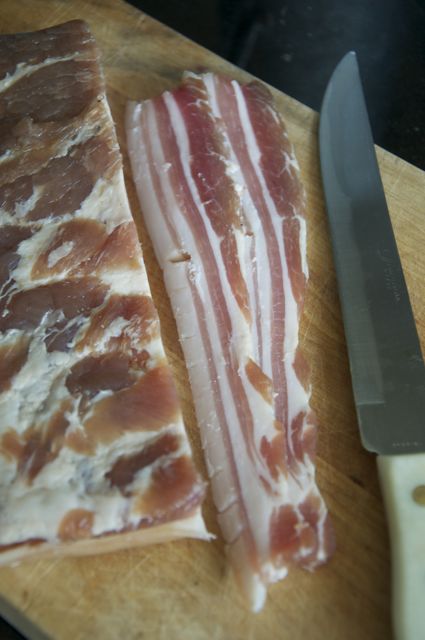
Now enjoy! Slice as thinly as possible (I recommend keeping the the ‘edge’ slice for cutting into lardons and cooking with, as it can be uneven in shape and will be saltier than the rest of the piece) with a very sharp knife, put a couple of slices into a hot frying pan, and wait for the sizzle! You can cut the rind off before or after cooking, but I wouldn’t! The fact the fat was scored on the piece will stop the rind deforming the bacon as it cooks.

The bacon will keep better if you slice it as you need it, you should be able to keep the block of bacon in the fridge for a good 2 – 3 weeks, though I doubt it will take that long to eat it! If you need to store it longer, you can freeze it, either the whole block, or perhaps slice it all, interlace the slices with paper or film, and then you can defrost a slice at a time as you need it.

The whole project takes about five minutes on day 1, 30 seconds each on days 2 – 5 and then perhaps two minutes on day 6.