
This week, my choice of recipe was guided by the fact I have two chicken breasts in the fridge that need eating today. Which, if you think about it, is an ordinary enough problem in a country where chicken breast portions are some of the most popular cuts of meat bought daily in our supermarkets.
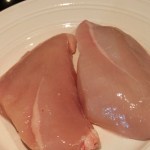 Now, I would normally buy a whole chicken and portion it up myself, but for reasons not worth going into here, on this occasion I’m the ‘proud’ owner of these two rather aggressively trimmed, skinless and boneless breast pieces. And I can immediately think of at least a dozen things to do with them, too – the trouble is, it’s Thursday, and I’m due to do a Cooking the Books post, so none of my usual go-to recipes will do, I need to find something different from among the extensive cookbook collection.
Cross-legged on the floor by the bookcase, I must have gone through at least half a dozen of my favourite books – Jamie Oliver, Nigel Slater, Hugh Fearnley-Whittingstall and even the Two Fat Ladies all let me down, their chicken breast recipes either variations on something I already regularly make – and prefer my version to theirs – or requiring an exciting range of exotic ingredients which aren’t in my kitchen cupboards and which, I suspect, I might have had trouble finding in our local village co-op!
So, down to my second string of cookbook options, the ‘collections’ – Good Housekeeping, Australian Woman’s Own, even the National Trust, and found the same problems here, too. What was going on? And then I spotted a paperback book which, I have to say, I’d forgotten we own, but the spine caught my attention, saying simply ‘Chicken’. Here, surely, would be the answer I was looking for?
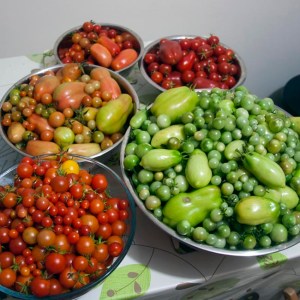
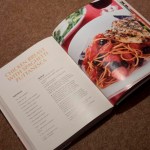 I can’t remember whether this book came to us as a gift, or as a remaindered-bin find, but I’m pretty sure I haven’t cooked from it before. A flick through, though, came up with the goods – a recipe for spaghetti puttanesca with chicken breast. Perfect, a taste of summer for a winter supper, and because the recipe called for fresh cherry tomatoes as the base for the sauce, an opportunity to substitute some of my chopped and frozen home-grown tomatoes.
A quick read of the recipe instructions, however, immediately started to raise some doubts. For instance, the second instruction, after ‘Heat the oven to 400F’, is ‘Cook the spaghetti according to the package instructions’. Before you’ve started to do anything with the raw chicken. So, you either have the slowest-cooking pasta known to mankind, or it’s going to be a nasty overcooked mush before your chicken is half-way to being safe to eat. Not an auspicious start. Still, the recipe for the most part seemed worth trying, caveat coquus…
To serve two, you need to get together the following ingredients –
 Two chicken breast fillets, skinless and boneless
- Six anchovy fillets
- Two smallish cloves of garlic
- 50g of black olives
- 250g of fresh tomatoes (mine were home grown, roughly chopped and frozen last year, but fresh cherry tomatoes, halved, would be fine, or you could even use a tin)
- A handful of sun-dried tomatoes (optional)
- Dried rosemary, thyme and oregano
- Chilli flakes
- 200 g of decent italian dried spaghetti
- Salt and pepper
- Olive oil
- Butter
- Balsamic vinegar, or better, elderberry vinegar
Put the oven on to heat at 180 C.
 In a frying pan, heat a tablespoon or two of olive oil. Mince up four anchovies, and the garlic, and add these to the pan with about a quarter of a teaspoon of the dried chilli flakes. Fry until slightly browning, then add a teaspoon each of dried thyme and oregano, and about half a teaspoon of rosemary.
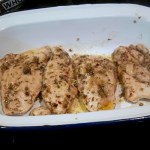 Slice the chicken fillets in half to make four half-thickness fillets, and mix these with the herbs and flavours in the pan, coating evenly, and fry lightly on both sides, until just golden. Then transfer the chichen to an oven proof dish, with all the tasty extras, and put it in the oven.
Return the frying pan to the hob, add a little more olive oil and a knob of butter, and once this has melted, the fresh tomatoes. Here I deviate from the recipe in the book, quite significantly and without apology. The tomato sauce in the recipe is just fresh tomatoes, red wine, olives, salt & pepper. I think it needs a little more than that to stand up to the highly-flavoured chicken fillets.
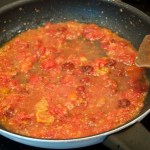 Add the sun-dried tomatoes if you’re using these. They make a great addition if your fresh tomatoes are chopped, like mine, or if you’re using tinned tomatoes, as they’ll add texture to the final dish as well as the lovely sweet flavour. Mine are the dry type (home-made!), which you can add directly. If yours are in oil, drain as well as you can before adding.
Now, you can boil the kettle and get the pasta going. Use a big pan with lots of salted water and a glug of oil to keep the pasta from sticking.
Mince another two anchovies, and add these to the tomato in the frying pan, along with a sprinkle of thyme and oregano, and a pinch of chilli flakes. Once this has cooked down a little, add about half a glass of red wine. Keep tasting this tomato sauce as it’s the only way you’ll get it right. Tomato sauces often need a lift in the sugar and acid department, and my favourite way of adding this is by using a splash of vinegar – balsamic is great, but home-made elderberry vinegar is better! Add a pinch of freshly ground black pepper, if you think it needs it.
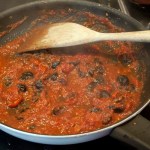 At this stage, notice that your olives aren’t pitted, and swear under your breath. Squeeze out the stones, while keeping a close eye on the spaghetti, to make sure it’s not over-cooking, and on the sauce, to check it’s reducing nicely to a rich dark colour. Chop the olives roughly, and add them to the tomato sauce to heat through.
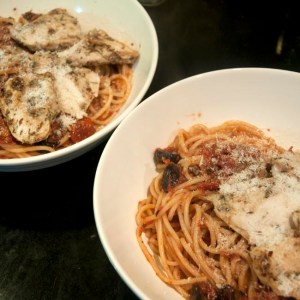
 Drain the pasta and mix it into the tomato and olive sauce. Take the chicken out of the oven, and check it’s cooked through (since you sliced it in half, it should be nicely done, cooked through but not dry). Serve the pasta in wide bowls, with the chicken on top, pouring over any pan juices from the chicken. Serve with a sprinkle of freshly grated parmesan.
So – the verdict? This is a properly decent pasta dish, with or without the chicken, but the chicken, pan-fried and finished in the oven with all those great flavours, is tender and really very good. I recommend this dish to you. Sadly I can’t say the same about the cookbook!
**
Food Lovers: Chicken by various authors.
Recipes selected by Jonnie Léger. Images & Recipes by StockFood©.
Transatlantic Press, 2011. ISBN 978-1-907176-80-7.
400 pages. RRP £16.99.
[Full disclosure: This is my book. I have received no payment or sponsorship for this post, nor have I accepted a review copy. I do not have an amazon affiliate account and do not profit from any links provided.]
 This is pretty much a ‘copy and paste’ effort of a cookbook, and I can’t honestly recommend you buy it. I may have been unlucky with the recipe I chose, but if the checking and proof reading standards are this unpredictable, I would bet on problems with other recipes, too. It’s quite a pretty book, in fairness, a nicely photographed large format paperback, and I’m sure there are some gems in among the 200 recipes featured, but I can’t see it being worth the hit and miss effort required to find them. And anyway, I rather suspect most of these recipes are probably available on the internet, in places like Epicurious.
So, probably not one to add to the collection – and as there seem to be others in the ‘Food Lovers’ series, I’d give those a miss, too.
‘Cooking the Books’ is my self-imposed blog challenge for 2014 – I’ll be trying to cook a new recipe from one of my (rather extensive!) collection of cookbooks once a week, write it up and review it. Wish me luck!
Read more from the Country Skills blog >>





 Country Skills for Modern Life